Welcome back, to the captivating journey through time and heritage as we continue to unravel the intricate puzzle of my ancestral legacy.
In this second instalment, we delve deeper into the remarkable life of my third great-grandmother Susan Mary Kirby nee Lagden, and explore the documents and challenges she faced as a married women.
As we venture further into the annals of history, the enigmatic figure of my third great-grandmother emerges from the shadows, her stories begging to be told.
Together, we will retrace her steps, witness her triumphs and tribulations, and uncover the legacy that she left behind.
As we peer into the lives of our foremothers, we honor the resilience, strength, and unwavering spirit that shaped the live of this remarkable women.
As we embark on the second part of her journey through life, our hearts and minds become intertwined with the life of my third great-grandmother and the family that surrounds her.
Her tale offers us valuable insights into our own identities, reminding us of the untold stories that shape who we are today.
As Susan’s story transcend time, it will inspire us to appreciate the progress we have made especially in childbirth and medical science and education.
So please join me in this odyssey through time, where we can honour the sacrifices, celebrate the triumphs, and learn from the challenges of the past. While immerse ourselves in the rich history, discovered through documentation, in turn unearthing the wisdom and courage of those who came before us, inspiring us to forge a brighter future for generations yet to come.
So without further ado, I give you.
The Life of Susan Mary Lagden,
Part 2,
Life As Mrs Susan Mary Kirby.
Welcome back to 1881, Victorian London, and the life of Susan Mary Kirby nee Lagden.
Let’s take a quick refresh of her life so far.
Susan Mary Lagden, was born on Saturday the 13th of November 1858, at Whittleford, Duxford, Cambridgeshire, England, to William Henry Lagden and Elizabeth Lagden nee Prime.
Elizabeth had 8 siblings, Sarah, Elizabeth, James, William, Eliza, Richard, Emily and Alice Lagden.
Susan was baptised on Sunday the 27th February 1859 at St Mary and Andrew Church, Whittlesford, Cambridgeshire, England.
She lived at 7 different homes up until her marriage, they were, Whittlesford in Cambridgeshire, 5 Prospect Row in Tottenham, Somerset Road in Tottenham, 1 Garibaldi Cottage in Tottenham, Sunbury, Railway Place in Sunbury, and 6 Oxford Terrace, Islington.
Susan met and fall in love with a carman, called Alfred Kirby and they got engaged.
Their marriage banns, were called by Rev D Wilson, Vicar, on the 11th, of April 1880 and on the 18th and 25th April 1880, by E. H. Forthergile, at St Mary’s Church, Islington, Middlesex, England.
Susan and Alfred got married on Sunday the 16th of May, 1880, at St Mary’s, The Parish Church of Islington.
We are all caught up, so let’s step back in time to the year 1881, Islington, London, England and Susan’s life as a married woman.

It’s was the year 1881. Queen Victoria sat proudly upon the throne. The Prime Minister was William Ewart Gladstone (Liberal) and it was the 22nd parliament.
The Census Act of 1880 was passed in the UK, establishing a legal requirement for a national census to be conducted every ten years. The subsequent census took place in 1881.
The First Boer War began on December 16, 1880, in South Africa between the British Empire and the South African Republic (Transvaal). The conflict continued into 1881.
The Married Women’s Property Act of 1882 was passed, granting married women in the UK greater control over their property, earnings, and possessions. This Act marked a significant step towards women’s rights and financial independence.
The Glasgow International Exhibition of Science, Art, and Industry was held in Kelvingrove Park, Glasgow, from May to November 1881. It showcased various displays and exhibits related to science, technology, and industry.
The Royal Society for the Protection of Birds (RSPB) was founded with the aim of conserving and protecting wild birds and their habitats. The RSPB continues its vital conservation work to this day.
Benjamin Disraeli, a prominent British statesman and two-time Prime Minister, passed away on April 19, 1881. Disraeli played a significant role in British politics, championing social reforms and expanding the British Empire.
The National Agricultural Labourers’ Union (NALU) was established in 1881, representing the interests of rural laborers. It campaigned for better wages, working conditions, and increased rights for agricultural workers.
The Royal College of Music (RCM) was founded in London in 1882, with its origins dating back to 1881. It became a leading institution for musical education, training many renowned musicians and composers.
And life was about to change dramatically for Susan and Alfred.
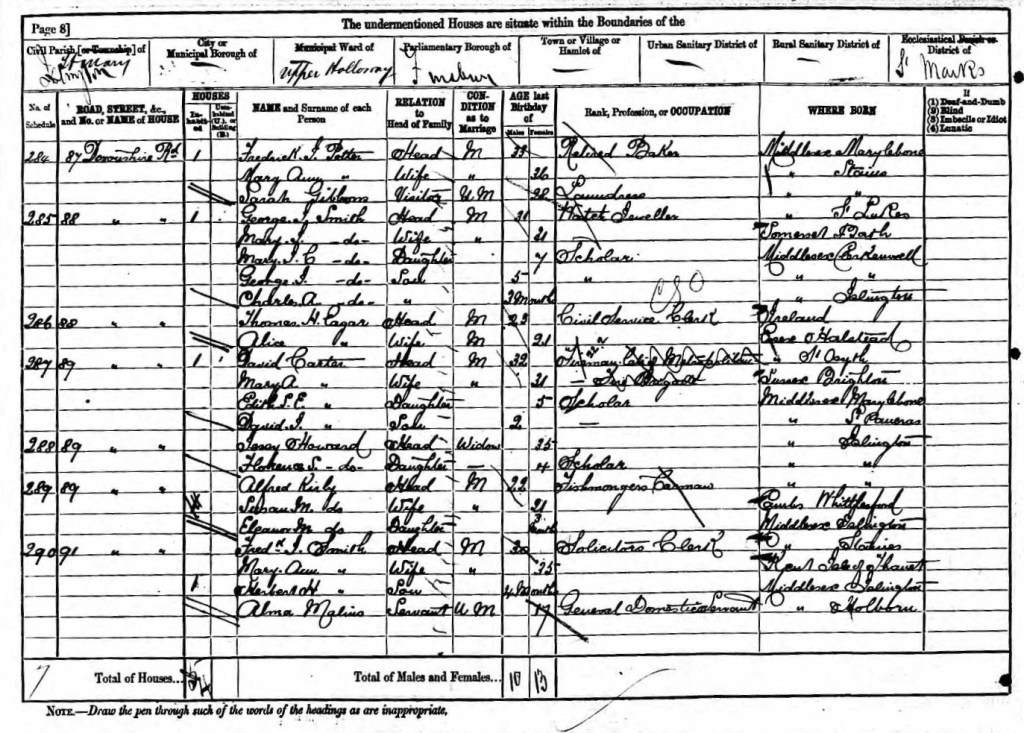
Going off the dates of Susan and Alfred’s marriage, Susan was in the family way when she married Alfred Kirby, and she gave birth to, their daughter, Eleanor Mary Kirby, on Thursday 6th of January, 1881, at Number 89, Devonshire Road, Islington, Middlesex, England.
Susan registered Eleanor’s birth on Tuesday the 15th of February, 1881.
She gave her husband Alfreds, occupation as a Carman, and their abode as, 89 Devonshire Road, Islington.
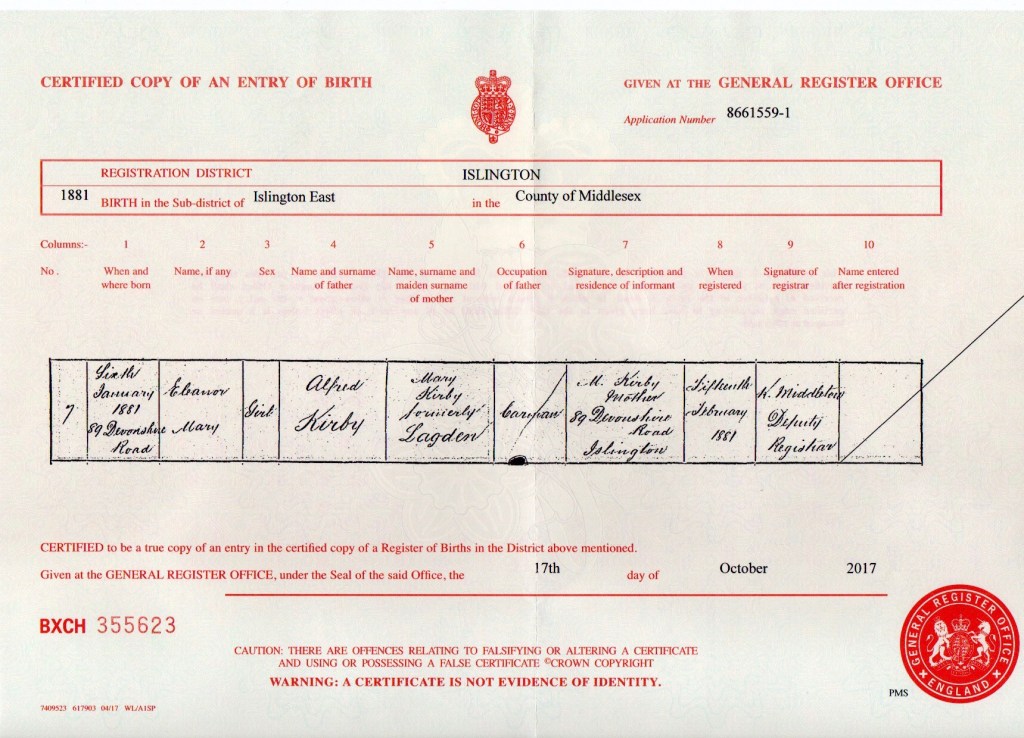
So what would it have been like to be a mum in Victorian, England? Victorian motherhood was characterised by a set of ideals and expectations that shaped the role and responsibilities of women as mothers during the Victorian era (1837-1901) here in Britain. After a lot of research here are a few details about what was expected from Victorian motherhood.
Victorian society emphasized the importance of women as nurturing, moral guardians of the home. Mothers were expected to create a warm and orderly household, instill proper moral values in their children, and provide a religious upbringing. They were seen as the primary educators of their children’s character.
Victorian society assigned women primarily to the domestic sphere, focusing on child-rearing, managing the household, and supporting their husbands. Professional pursuits outside the home were generally discouraged, although middle-class women sometimes engaged in philanthropic or charitable activities.
Victorian society valued large families as a sign of prosperity, social status, and moral virtue. Contraception was considered immoral and illegal until later in the era, so many women had numerous children. However, it is worth noting that different social classes had varying family sizes due to factors such as economic circumstances and birth control availability.
Victorian mothers were responsible for their children’s education, particularly during early childhood. They were expected to teach basic literacy and numeracy skills, religious teachings, manners, and social etiquette. Formal education outside the home, especially for girls, was limited until later in the era.
Mums were expected to maintain discipline and moral order within the family. They used various methods, including corporal punishment, to enforce obedience and instill a sense of propriety in their children.
Victorian Mums were expected to embody ideal feminine qualities, including self-sacrifice, modesty, and gentleness. They were expected to serve as role models for their children, demonstrating appropriate behavior, manners, and moral values.
Mums played a crucial role in the care of infants. Breastfeeding was the norm, and wet nurses were sometimes employed by wealthier families. Mums also supervised the care of children’s health, nutrition, and general well-being.
The experience of motherhood varied greatly depending on social class. Working-class Mums often faced the challenge of balancing household responsibilities with labor outside the home, while upper-class Mums had more resources and assistance in raising their children.
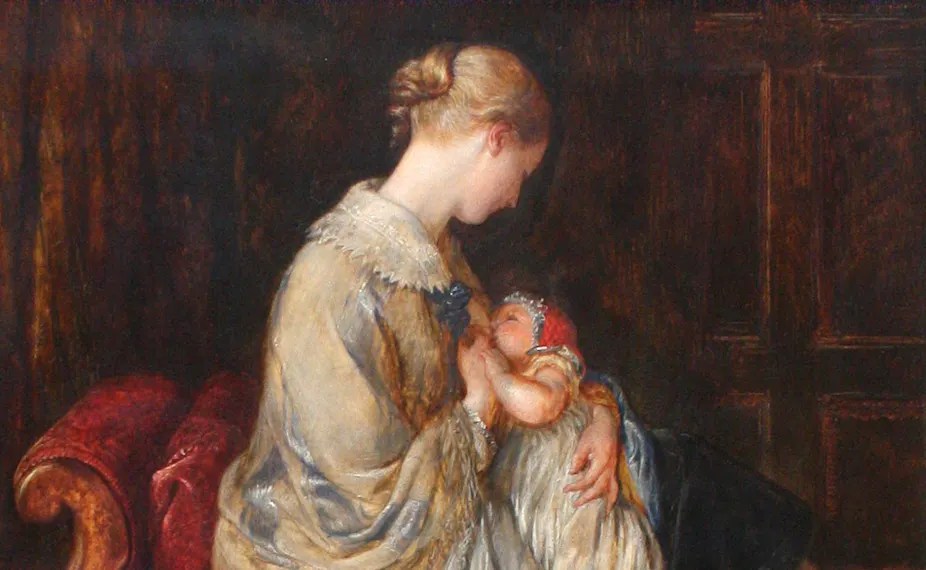
Susan, and Alfred, baptised Eleanor, on Sunday the 6th of February, 1881, at St. Marks Church, 1a Moray Rd, Tollington Park, Finsbury Park, London, England.
They were residing at 89 Devonshire Road, Islington, Middlesex, England. (Axminster Road, Islington, since 1938.)
Alfred was working as a Carman.

The church of St Mark, Tollington Park, was built 1853-1854 of Kentish rag and Bath stone in the Early English style, following the designs of Alexander Dick Gough. It was consecrated on 22 May 1854, and was assigned a district out of the parish of St John, Upper Holloway, on 11 August 1854.
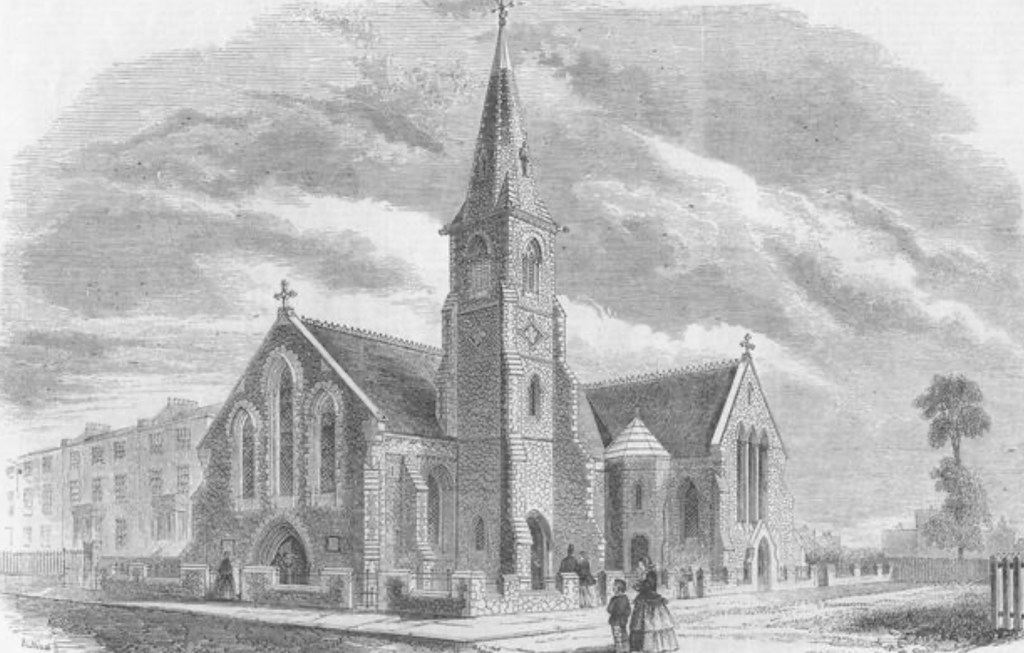
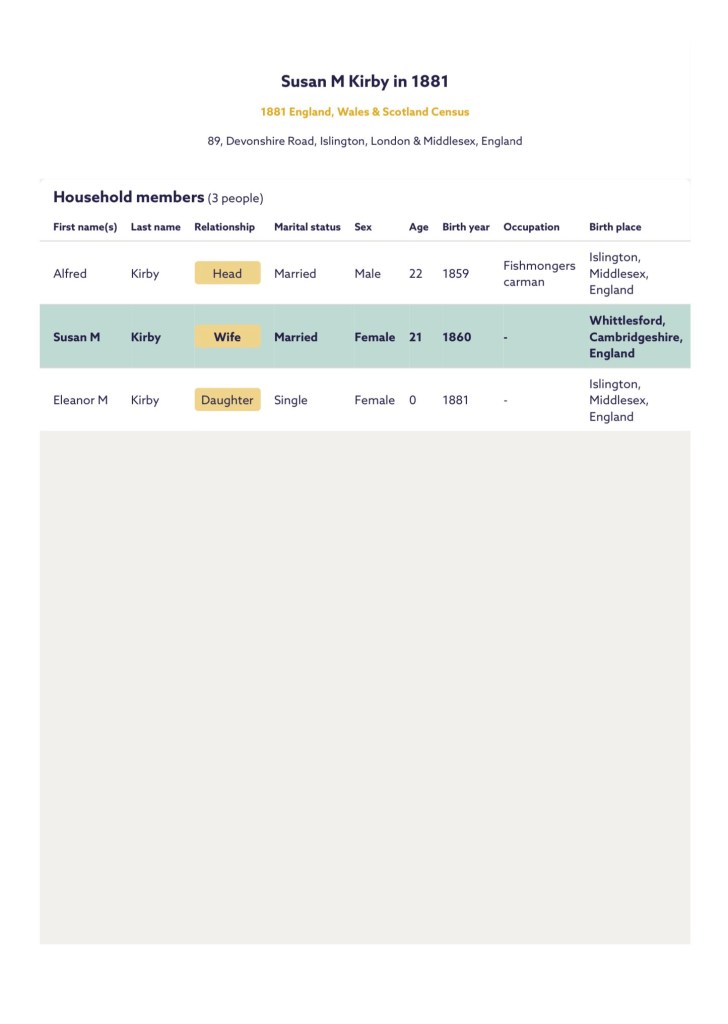
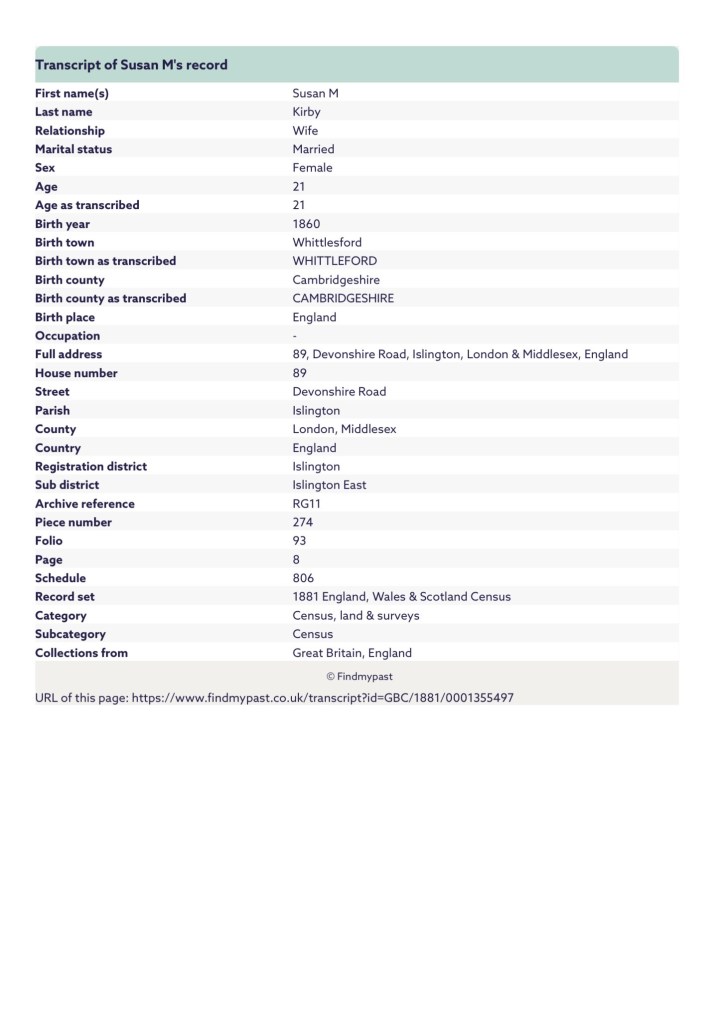
On Sunday the 3rd of April, 1881, the census was taken, which shows Susan, Alfred, and their daughter Eleanor, were still residing at Number 89, Devonshire Road, Upper Holloway, Islington, England.
Alfred was now working as a, Fishmonger Carman.
A few years later, Susan and Alfred, were once again expecting.
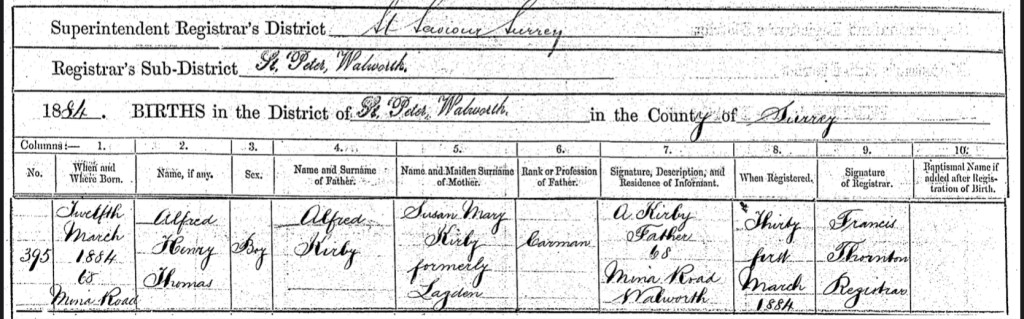
Their son, Alfred Henry Thomas Kirby, was born on Tuesday the 12th of March 1884, at their home, Number 68, Mina Road, St Peter’s, Walworth, Surrey, England.

Susan’s husband Alfred, registered his son Alfred Henry Thomas’s birth on Monday the 31st of March, 1884, in St Saviour, Surrey.
He gave his occupation as a Carman.

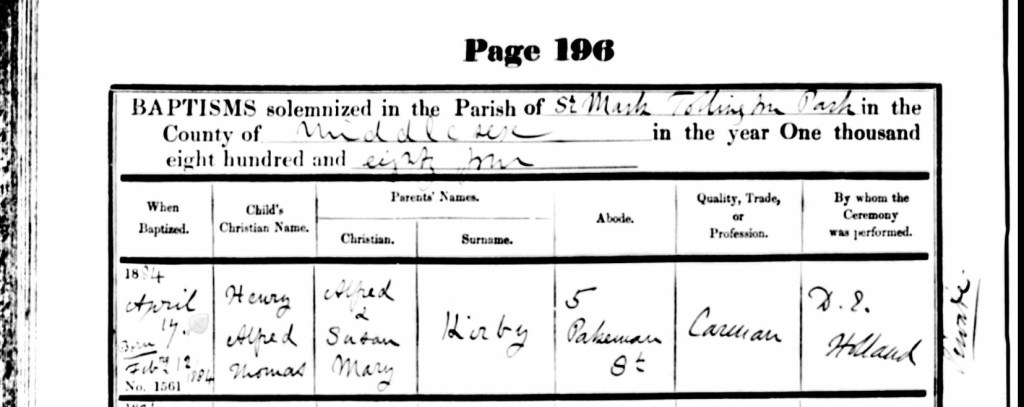
And on Thursday the 17th of April, 1884, Susan and Alfred, baptised Alfred Henry Thomas Kirby under the name Henry Alfred Thomas Kirby, at St Mark’s Church, Tollington Park, 1a Moray Rd, Finsbury Park, Middlesex, England.
Alfred’s baptism gives Alfred’s birth date as the 12th of February, 1884, and states that his father Alfred occupation was a Carman and their abode was, Number 5 Pakeman Street.
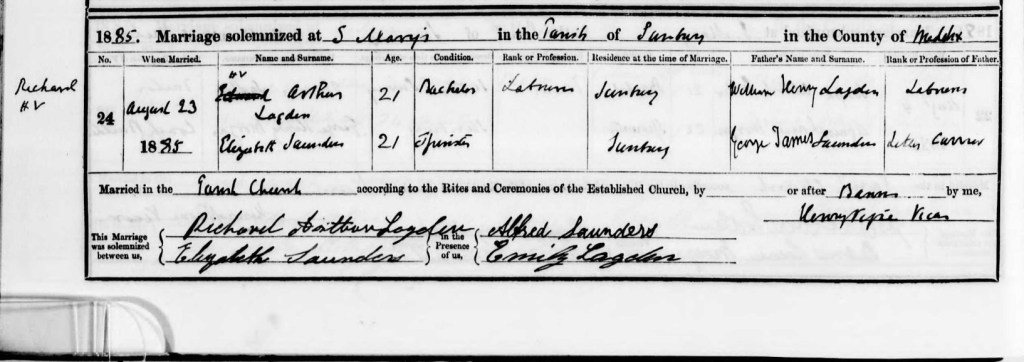
The following year, Susan’s Brother, 21 year old, bachelor, Richard Arthur Lagden, a Labourer, married 21 year old, spinster, Elizabeth Saunders on Sunday the 23rd of August, 1885, at St Marys Church, Sunbury on Thames, Surrey, England.
They gave their abodes as, Sunbury and their fathers names and occupations as, William Henry Lagden, a Labourer and George James Saunders, a Letter Carrier.
Their witnesses were Alfred Saunders and Emily Lagden.
Elizabeth was the sister of Alice Saunders, who Susan and Richard’s brother, Jame Frederick Lagden married in 1876.
The following year, on Wednesday the 26th May, 1886, Susan’s and Alfreds daughter, Alice Maude Olive Kirby, was born at, Number 2, Bovay Street, Highbury, Islington, Middlesex, England.
Susan, registered her birth on Friday the 9th of July 1886 in Islington.
She gave her husband’s occupation as a Laundry Carman and their abode as, Number 2, Bovay Street, Highbury, Islington, Middlesex, England.

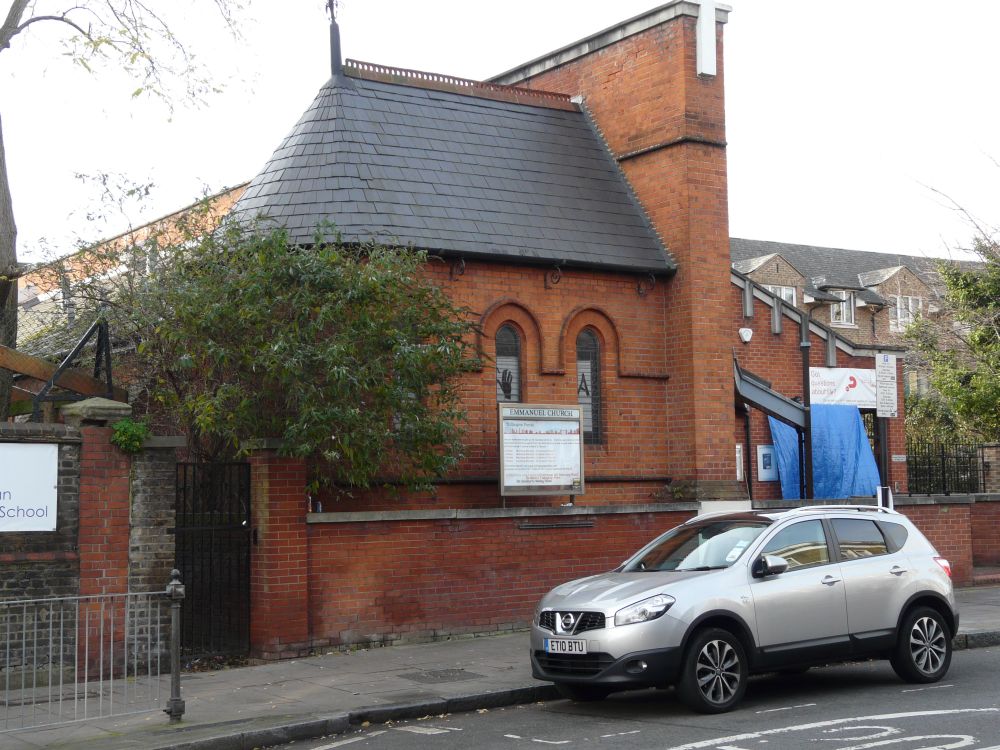
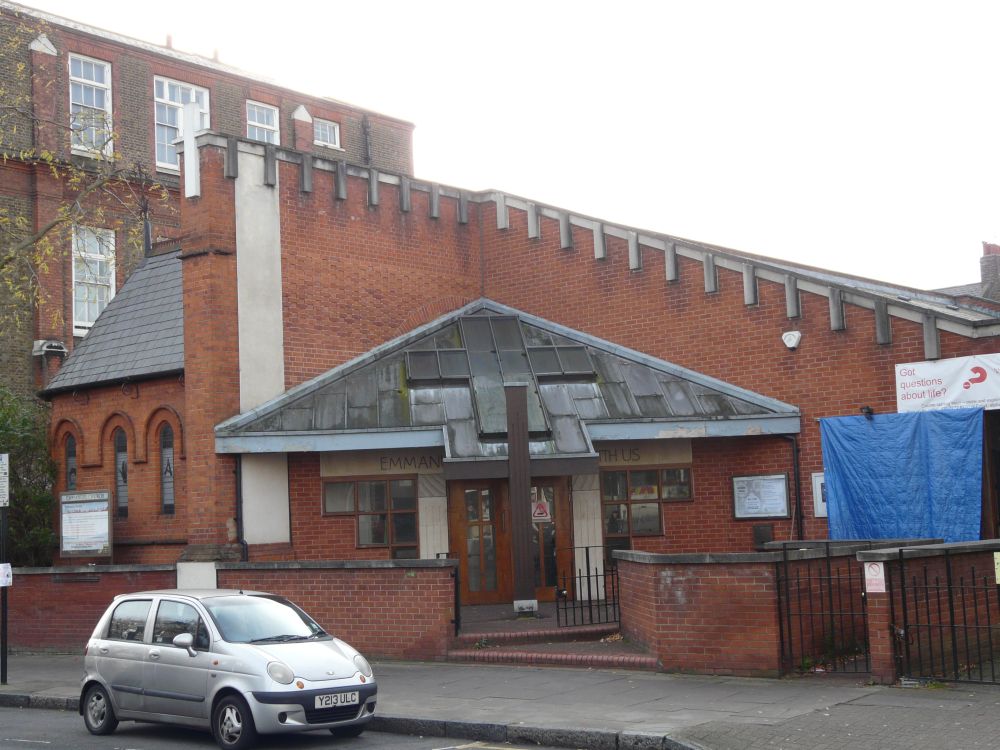
Susan and Alfred, baptised Alice Maud Olive Kirby, on Tuesday the 13th of July, 1886, at Emmanuel Holloway Church, 145 Hornsey Road, Holloway, Islington, Middlesex, England.
Their abode was given as 2 Bovay Street, Highbury, Islington.

Emmanuel Church has been part of life in Holloway since 1884
The current building combines part of the original building (including the prayer chapel) with a new, multi-use space built in 1988.
For three decades, Emmanuel has been one of three churches that make up the Tollington Parish (the others being St Mark’s Moray Road and St Saviour’s Hanley Road). But on October 1st 2019, this team was transformed into three separate parishes. Emmanuel is now legally known as “Emmanuel Hornsey Road” – although day-to-day they call themselves Emmanuel Holloway.
The new parish incorporates the area of Islington that runs east of the Holloway Road. To the north, the boundary runs along Seven Sisters Road, to Finsbury Park. To the east and south, the railway line marks the border with adjacent parishes.
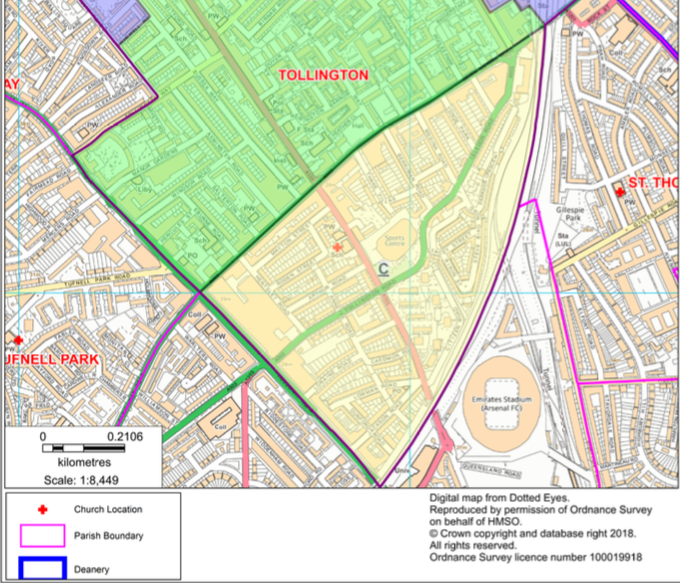
The Harvist Estate is a key part of the parish, and is built upon the site of St Barnabas Church, which was destroyed in WW2. Its tower blocks feature in the stained glass window, and several of the buildings that form the estate are named after previous vicars of Emmanuel and St Barnabas.
You will soon discover that Susan’s life was far from easy, and death lingered in every corner, waiting to pounce, and shatter their lives, hopes and dreams.
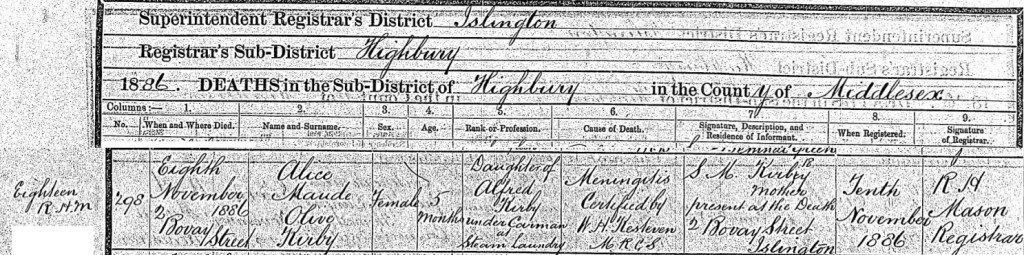
It all started when, heartbreakingly life took a devastating turn, when Susan and Alfred’s 5 month old Daughter, Alice Maude Olive Kirby, sadly passed away, on Monday the 8th of November, 1886, at Number 2, Bovay Street, Highbury, Islington, Middlesex, England.
Baby Alice died from Meningitis. (A recurring illness throughout our families history.)
Susan was present and registered Alice’s death on Wednesday the 10th of November, 1886, in Islington.
She gave her husband Alfred’s occupation as an Under Carman at a Steam Laundry and their abode as, Number 2, Bovay Street, Highbury, Islington, Middlesex, England.
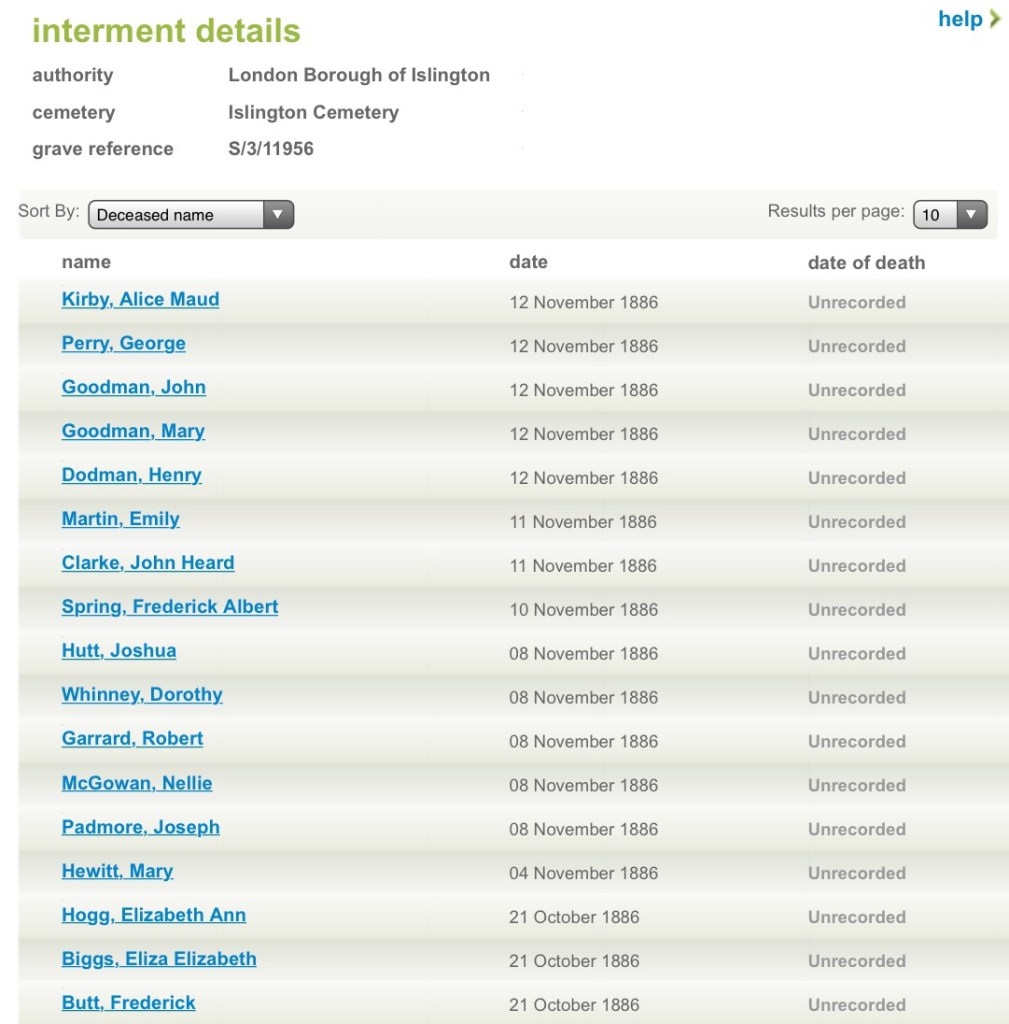
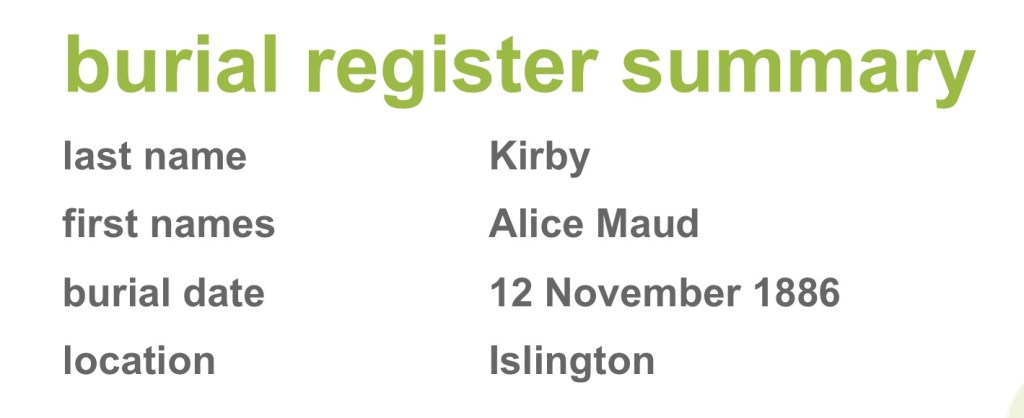
Susan and Alfred’s baby girl, Alice Maude Olive Kirby, was laid to rest, at Finchley Burial Ground, Islington Cemetery, Islington, Middlesex, England, on Friday the 12th of November 1886, in Grave reference – S/3/11956.
She was buried with 16 other people.
They were, George Perry, John Goodman, Mary Goodman, Henry Dodman, were buried on the 12th November 1886. (The same day as Alice.)
Emily Martin and John Heard Clarke, were buried on the 11th November 1886.
Frederick Albert Spring, was buried on the 10th November 1886.
Joshua Hutt, Dorothy Whitney, Robert Garrard, Nellie McGowan, and Joseph Padmore, were buried on the 8th November 1886.
Mary Hewitt, was buried on the 4th November 1886 and Elizabeth Ann Hogg, Eliza Elizabeth Biggs and Frederick Butt, were buried on the 21st October 1886.
No parent should ever have to lay their child to rest, it’s the cruelest fate imaginable, one I never wish to incounter.
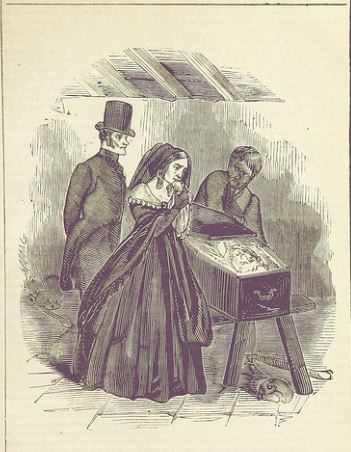
As I look at Susan’s life, heart wrenching images flood my mind of Alice’s tiny coffin, and the devastation my family somehow survived.
I can not even start to comprehend having my babies coffin at home, so the family could moan their loss.
I must admit, I am very grateful that the grand old tradition is no longer part of modern moaning.
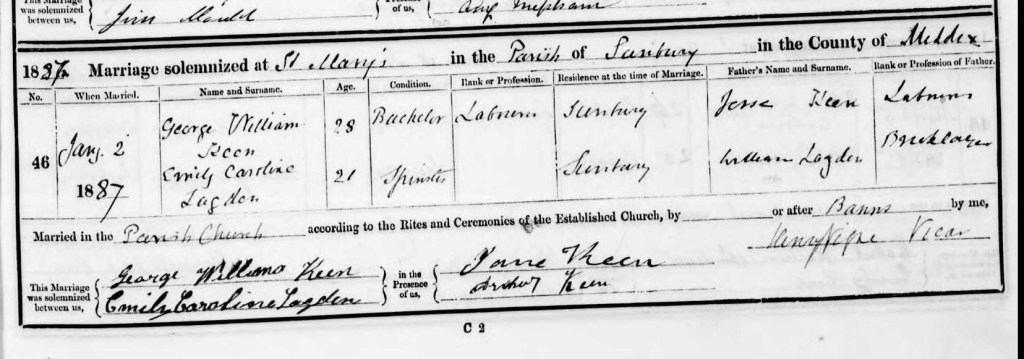
Thankfully the family had a reason to smile when, Susan’s sister, 21 year old, spinster, Emily Caroline Lagden, married 28 year old, bachelor, George William Keen, a Labourer, son of labourer, Jesse Keen, on Sunday the 2nd of January 1887, at St. Mary’s, Sunbury, Middlesex, England.
Their witnesses were, Jane and Anthony Keen.
Emily and George both gave their abodes as Sunbury.
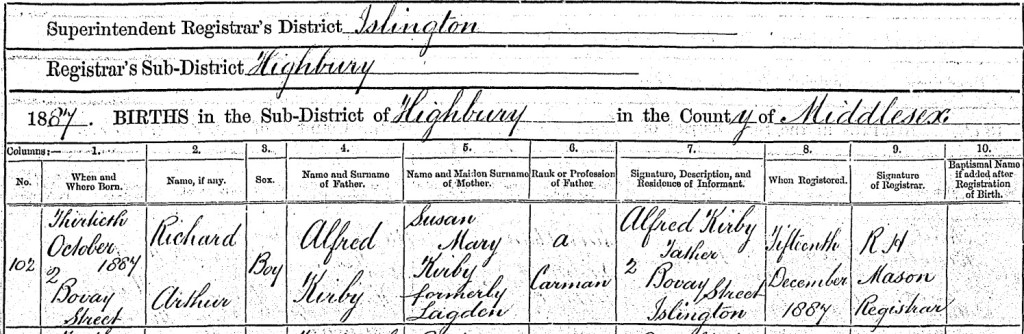
More happiness followed when, Susan and Alfred’s son, Richard Arthur Kirby, was born on Thursday the 13th of October, 1887, at their home, Number 2, Bovay Street, Highbury, Islington, Middlesex, England.
Alfred registered his birth on the 15th of December 1887 in Islington.
He gave his occupation as a Carman and their abode as Number 2, Bovay Street, Islington.
Susan and Alfred’s baptised, Richard Arthur Kirby, on Tuesday the 7th of February 1888, at Emmanuel Church, Hornsey Road, Holloway, Islington, Middlesex, England.
Alfred’s occupation was given as a Carman and their abode as number 2, Bovay Street.

Sorrowfully death was once again lurking in the shadows.
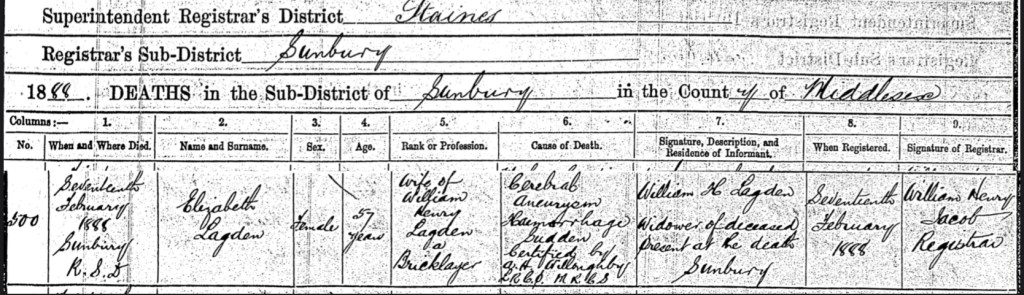
Susan’s Mum, 57 year old, Elizabeth Lagden nee Prime, wife of Bricklayer, William Henry Lagden, sadly passed away on Friday the 17th of February 1888 at Sunbury R.S.D.
Elizabeth died from a sudden Cerebral Aneurysm Haemorrhage.
William Henry Lagden, widow of deceased was present and registered Elizabeth’s death on the same day, Friday the 17th of February, 1888, in Sunbury, Staines, Middlesex .
He gave their abode as Sunbury.

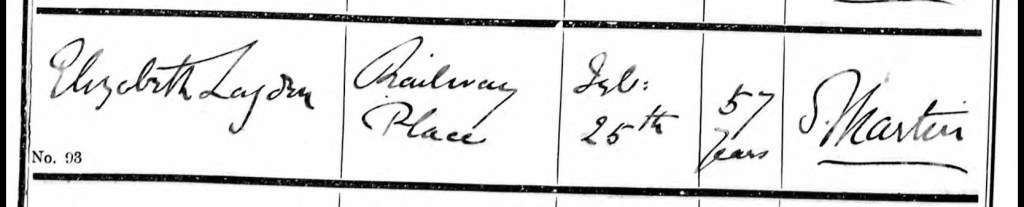
Susan’s mum, Elizabeth, was laid to rest on Saturday the 25th February 1888, at Sunbury, Staines, Middlesex, England.
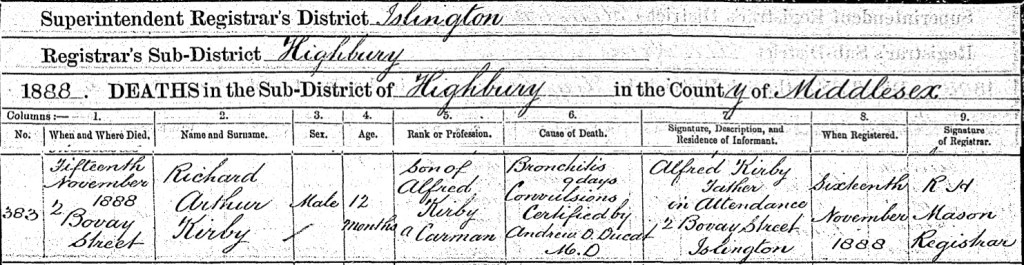
More death followed when, Susan and Alfred’s son, 12 month old, Richard Arthur Kirby, passed away, on Thursday the 15th of November 1888, at their home, Number 2, Bovay Street, Highbury, Islington.
Richard died from, from Bronchitis, 9 days and Convulsions.
Alfred was present and registered Richards death on Friday the 16th of November 1888.
He gave his occupation as a Carman and their abode as, Number 2, Bovay Street.
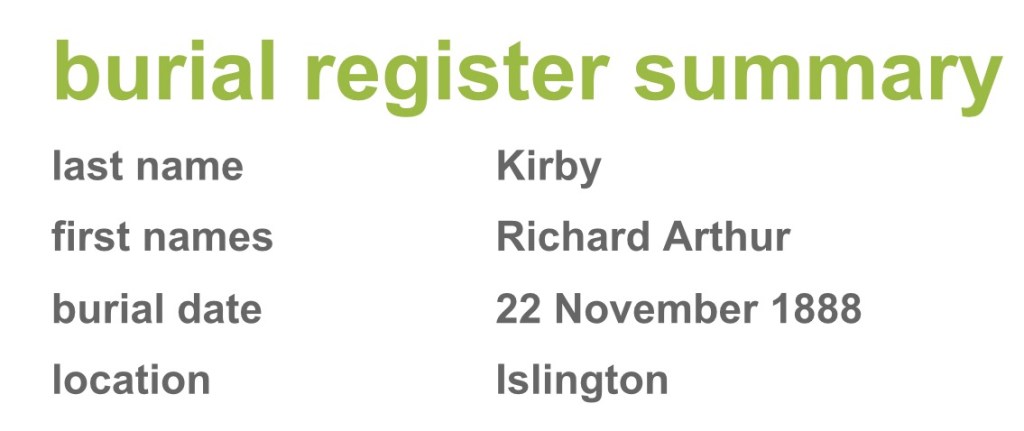
Susan and Alfred’s laid, Richard Arthur Kirby, to rest, at Finchley Burial Ground, Islington Cemetery, St Mary’s, Islington, Middlesex, England, on Thursday the 22nd of November 1888.
If the heartbreak of losing their son wasn’t painful enough, Susan’s heart would have completely shattered when her husband, Alfred Kirby, tragically passed away on Friday the 24th of May 1889, at number 240a, Seven Sisters Road, Highbury, Islington, London, England.
Alfred died from Sudden Syncope, Heart Disease and Rheumatic Fever.
A post-mortem and inquest was held.

On the 28th of May, 1889, the Islington Gazette, reported about Alfred death. It’s reads,
DEATH PROM SYNCOPE.
On Monday, at the Coroner’s Court, Hollo-
way-road, Dr. Danford Thomas held an inquiry
relative to the death of Alfred Kirby, aged 28
years.
Mary Kirby, of 2, Bovay-street, said the
deceased was her husband, and kept a coffee-
stall. He seldom enjoyed good health, and
suffered with his heart. He had had fainting
attacks, and four times since he had been
married he had rheumatic fever. On
Friday morning, he left to go to work as usual,
and soon after she heard of his death. Deceased.
kept a stall in Seven Sisters’- Road, near
the “Clarence” public house.
Charles Webb, a laundryman, said on Friday
morning he was talking to deceased, when he
suddenly complained of a pain inwardly.
Witness looked after the shall while deceased
retired to the stable near by.
Robert Matthews, foreman of the stables,
said he saw the deceased lying in the stable.
yard grouning. He attended to him, and de-
ceased died in his arms.
Dr. G. Wight, of 428, Liverpool-road, said
he was called to see the deceased, and on
arrival, he found him dead. The heart was
very large and diseased, and death was due to
Syncope.
Verdict accordingly.

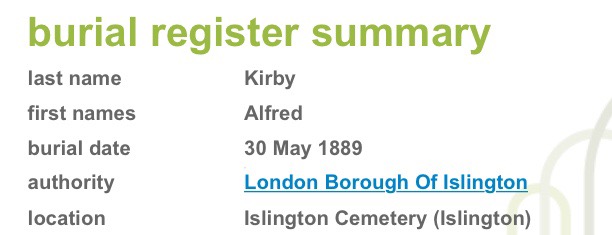
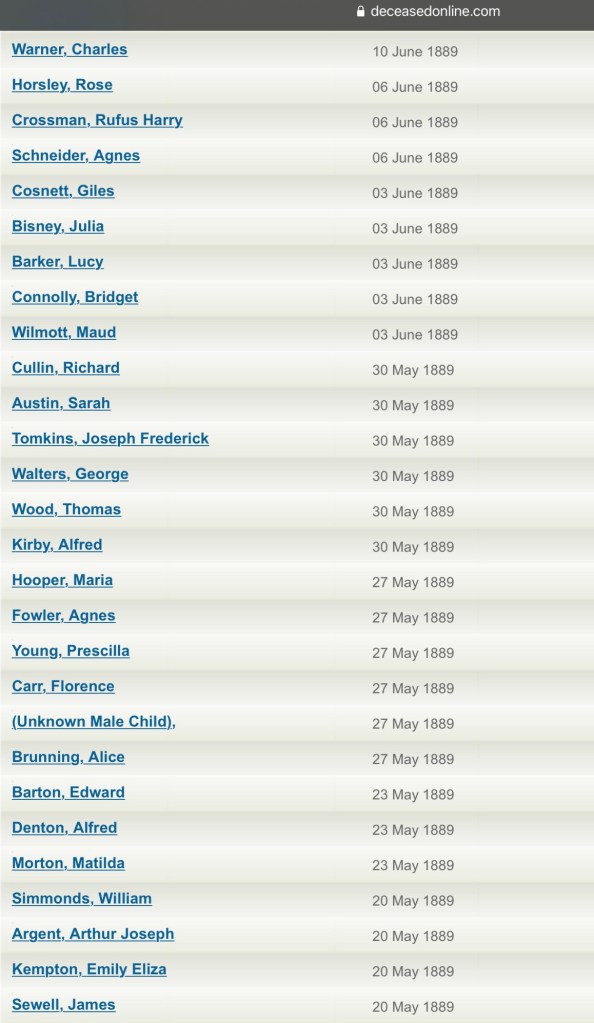
Susan, family and friends, laid Alfred to rest, on Thursday the 30th of May 1889, at Islington Cemetery, Islington, Middlesex, England, in Grave Reference O/Poor/17168, with 52 other souls.
They were, Richard Newman, Ester Morris, George William Waddell and Thomas Alfred Letting, who were buried on the 8th of July 1889.
Joseph Rawlinson, William Owens, John White, and Charles Bush, who were buried on the 4th of July 1889.
Daniel Reed, and William Charles Chapman, who were buried on the 1st of July 1889.
Rhoda Smith, John Sharp, and Elizabeth Davies, who were buried on the 27th of June 1889.
Elizabeth Taylor and John Martin, who were buried on the 24th of June 1889.
Joseph Paulbar, and Harry Payne, who were buried on the 20th of June 1889.
Mary Carr and Susan Ethel Oston, were buried on the 17th of June 1889.
Mary Ann Halpin, and Albert Victor George, who were buried on the 13th of June 1889.
Rachel Scott, Henry Sprinks, John Watton, Mary Ann Barrett, and Charles Warner, who were buried on the 10th of June 1889.
Rose Hursley, Rufus Harry Crossman and Agnes Schneider, who were buried on the 6th of June 1889.
Giles Cosnett, Julia Bisney, Lucy Barker, Bridget Connolly, and Maud Wilmott, who were buried on the 3rd of June 1889.
Richard Collins, sarah Austin, Joseph Frederick Tomkins, George Walters, Thomas Wood, who were buried on the 30th of May 1889, the same day as Alfred Kirby.
Maria Hooper, Agnes Fowler, Priscilla Young, Florence Carr, Unknown Male Child and Alice Brunning, who were buried on the 27th of May 1889.
Edward Barton, Alfred Denton, and Matilda Morton, who were buried on the 23rd of May 1889.
William Simmonds, Arthur Joseph Argent, Emily Eliza Kempton and James Sewell, who were buried on the 20th of May 1889.

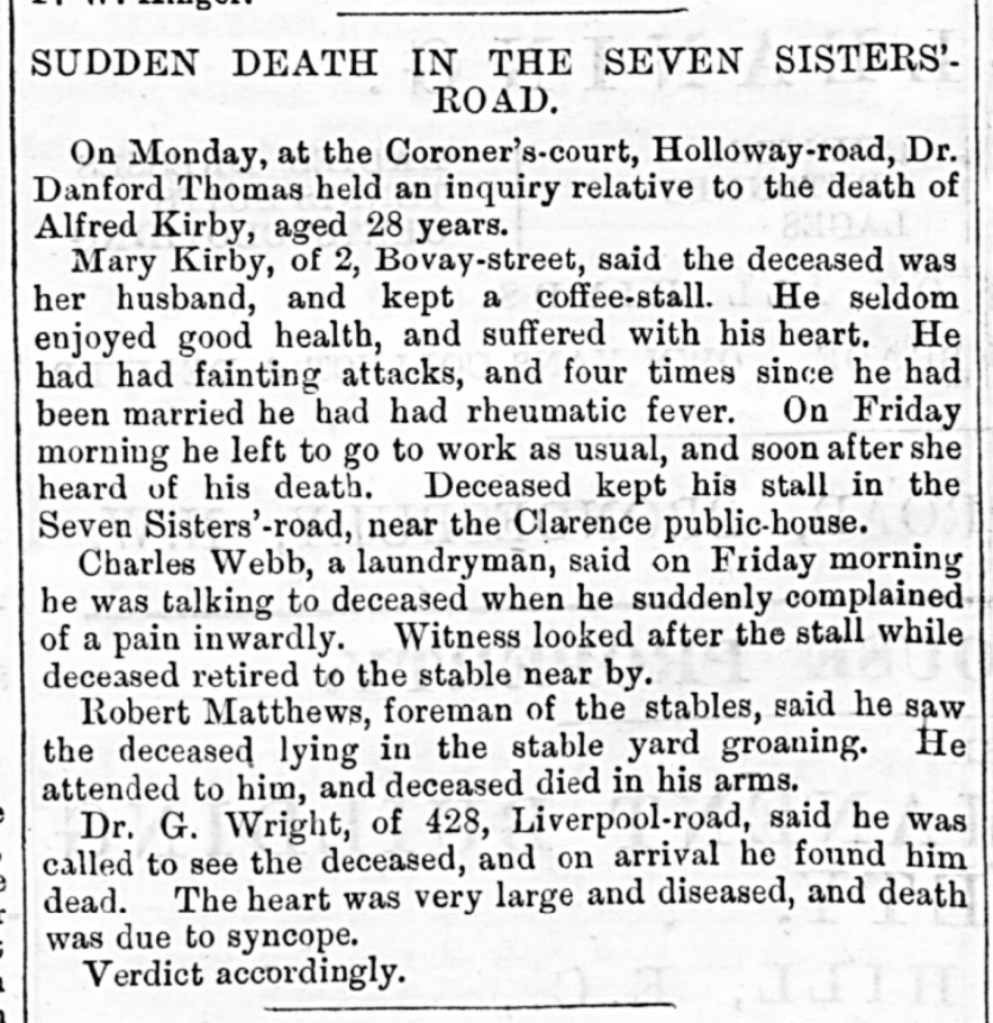
Susan’s husband, Alfred Kirby’s death was reported in the North Middlesex Chronicle, on the 01st June 1889.
It reads,
SUDDEN DEATH IN THE SEVEN SISTERS’-
ROAD.
On Monday, at the Coroner’s Court, Holloway-road, Dr.
Danford Thomas held an inquiry relative to the death of
Alfred Kirby, aged 28 years.
Mary Kirby, of 2, Bovay-street, said the deceased was
her husband, and kept a coffee.stall. He seldom
enjoyed good health, and suffered with his heart. He
had had fainting attacks, and four times since he had
been married he had rheumatic fever. On Friday
morning, he left to go to work as usual, and soon after she
heard of his death. Deceased kept a stall in the
Seven Sisters’- Road, near the “Clarence” public house.
Charles Webb, a laundryman, said on Friday morning
he was talking to deceased, when he suddenly complained
of a pain inwardly. Witness looked after the shall while
deceased retired to the stable near by.
Robert Matthews, foreman of the stables, said he saw
the deceased lying in the stable yard groaning. He
attended to him, and deceased died in his arms.
Dr. G. Wight, of 428, Liverpool-road, said he was
called to see the deceased, and on arrival, he found him
dead. The heart was very large and diseased, and death
was due to Syncope.
Verdict accordingly.
What was to become of Susan after the death of her love, Alfred?
Did her heart ever recover?
Did she find happiness again?
Did death continue to haunt her and her loved ones?
Please pop back next week to read all about what happened next.
Until then, stay safe, stay true, stay you!
Too-da-loo for now.
🦋🦋🦋
I have brought and paid for all certificates,
Please do not download or use them without my permission.
All you have to do is ask.
Thank you.
 Intwined
Poor soul not much joy in her life to date
LikeLike