We live a world where change is constant, the unexpected lurks around every corner, and life never fails to surprise us. Throughout our lives, we often find ourselves entangled in the ebb and flow of circumstances beyond our control.
As human beings, we strive for stability, seeking solace in the familiar and predictable. But deep down, we know that life has its own plans, weaving a complex narrative that unfolds with or without our consent.
In the face of adversity and uncertainty, one thing remains undeniable, life continues regardless. It marches forward, propelled by the unstoppable force of time. The world keeps spinning, seasons come and go, and each day dawns with the promise of new beginnings. While we may yearn for stability, it is through the unpredictable nature of existence that we truly discover our strength, resilience, and capacity for growth.
As we explore the profound truth that life, in all its magnificent chaos, persists and as we look back through history we will discover the meaning in both the mundane and the extraordinary. We will delve into the stories of individuals who have triumphed against the odds, learn from their experiences, and draw inspiration from their unwavering spirit.
Throughout Susan’s life story we will learn, the resilience of the human spirit, seeking solace in the realization that even amidst the most challenging circumstances, life carries on.
And hopefully we will learn to find the strength to navigate the uncharted territories that lie ahead, understanding that life’s journey is not about avoiding the unexpected, but rather about learning to dance amidst the chaos.
After all, no matter what comes our way, life will persist, and it is up to us to make the most of our own unpredictable journey.
Welcome back to the life of Susan Mary Kirby nee Lagden, my 3rd Great-Grandmother.
Let’s have a quick recap on her life so far before we learn what life had in store for her as the late Mrs Susan Mary Kirby.
Susan Mary Lagden was born on Saturday the 13th of November 1858, at Whittleford, Duxford, Cambridgeshire, England, to William Henry Lagden and Elizabeth Lagden nee Prime.
Elizabeth had 8 siblings, Sarah, Elizabeth, James, William, Eliza, Richard, Emily and Alice Lagden.
Susan was baptised on Sunday the 27th February 1859 at St Mary and Andrew Church, Whittlesford, Cambridgeshire, England.
Susan met and fall in love with a carman, called Alfred Kirby and they got engaged.
Their marriage banns, were called by Rev D Wilson, Vicar, on the 11th, of April 1880 and on the 18th and 25th April 1880, by E. H. Forthergile, at St Mary’s Church, Islington, Middlesex, England.
Susan and Alfred got married on Sunday the 16th of May, 1880, at St Mary’s, The Parish Church of Islington.
And it wasn’t long before Susan had four children, Eleanor Mary Kirby aka Nellie Montague, Alfred Henry Thomas Kirby, Alice Maude Olive Kirby and Richard Arthur Kirby.
Sadly Alice Maude Olive Kirby and Richard Arthur Kirby both passed away in infancy.
Susan also lost her mother Elizabeth Lagden nee Prime.
Worse still Susan’s husband Alfred Kirby, unexpectedly died, leaving Susan a widow with two hungry mouths to fill.
What a sad life Susan has had, up until this point.
Would she find happiness in life from here on out, let’s see shall we.

Welcome back to the year 1891, London England.
Queen Victoria was monarch. Prime Minister was Robert Gascoyne-Cecil, 3rd Marquess of Salisbury (Conservative) and it was the 24th parliament.
The New Forest Act was passed, granting greater protection to the New Forest in southern England. The act aimed to preserve the forest’s natural beauty and prevent encroachment on its resources.
The London County Council (LCC) was established in 1891 as the first elected local government body for Greater London. It was responsible for the administration of London’s public services and played a crucial role in the development and improvement of the city.
A severe blizzard swept across the United Kingdom, leading to extensive snowfall and disruption. The blizzard caused transportation problems, power outages, and numerous accidents, resulting in loss of life and property damage.
The Isle of Man Tourist Trophy (TT) Races began in 1907, but its predecessor, the Gordon Bennett Trial, took place in 1891. The trial was a motorcar race held on public roads on the Isle of Man, marking the beginnings of the prestigious racing tradition on the island.
Irish writer Oscar Wilde published his novel “The Picture of Dorian Gray.” The book, which explores themes of beauty, morality, and the pursuit of pleasure, became one of Wilde’s most famous works.
Aneurin Bevan, a prominent British politician and the architect of the National Health Service (NHS), was born on November 15, 1891. Bevan’s contribution to healthcare reform in the UK had a profound and lasting impact on the nation’s social policies.
Unfortunately Susan disappears in the paper trails until 1891 and the next documentation in her story is a marriage certificate.
30 years old, Susan, remarried a few years after her husband Alfred’s death.
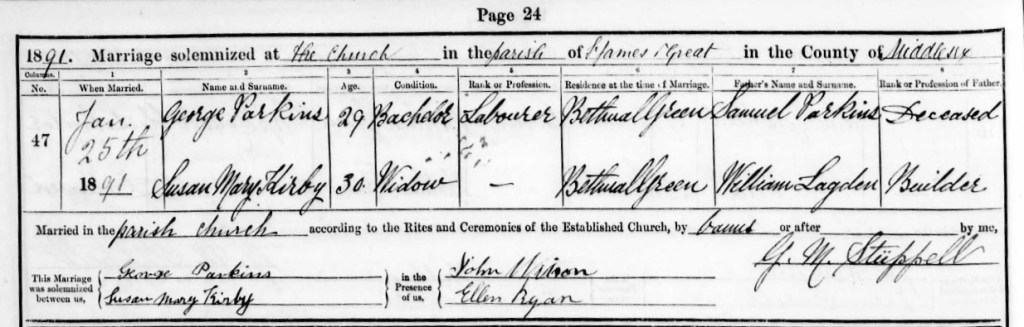
She married, a 29 year old bachelor, George Parkins, a Labourer, on Sunday the 25th of January, 1891, at St. James The Great, Bethnal Green, Middlesex, England.
They gave their abodes as Bethel Green and their fathers names and occupations as, Samuel Perkins, deceased and William Lagden, a builder.
Their Witnesses were John Wilson and Emma Ryan.
St James The Great Church is a large red brick church located on Bethnal Green Road, East London. It was the place where Reggie Kray and Frances Shea married on 19th April 1965.

The “Red” church, as it was once known, was built in 1844 by Edward Blore, a master architect of his day who completed work on Buckingham Palace when it was expanded, restored Lambeth Palace and worked on Westminster Abbey & St James’ Palace. The church of Saint James the Great was constructed between 1840 and 1844; designed by E. Blore in an Early English style.
A district was assigned in 1844. Incumbent Edward Coke offered marriages for the fee of 7 pence, causing rowdy scenes as young couples got married in batches. He also raised many funds, founded a dispensary, a visiting society and a Sunday School. In 1951 the parish was united with Saint Jude (P72/JUD), and in 1969 with Saint Matthew (P72/MTW) and Saint Peter (P72/PET) in a team ministry. In 1984 Saint James the Great with Saint Jude united with Saint Matthew. The church was converted for residential use. From: ‘Bethnal Green: List of Churches’, A History of the County of Middlesex: Volume 11: Stepney, Bethnal Green (1998), pp. 217-226. In 1865, the Reverend E F Coke made the church the first in London where poor couples could get married for free. It survived the blitz during the Second World War and more recent redevelopment in the area. The church served from 1844 to 1987, when it closed and was converted into housing.
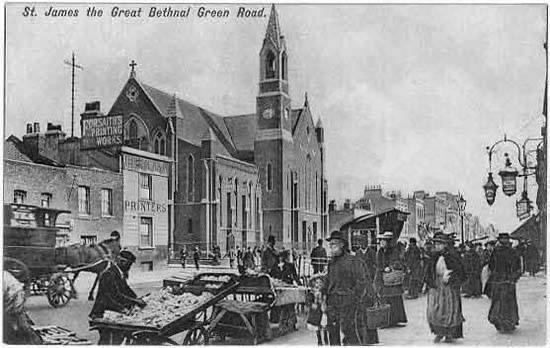
Bethnal Green
Second marriages, in the Victorian Era, were generally viewed with less societal acceptance and were often met with scrutiny or judgment. The prevailing belief was that marriage was meant to be a lifelong commitment, and the idea of remarriage after the death of a spouse or divorce was generally frowned upon.
The legal framework surrounding second marriages varied depending on the reason for the previous marriage’s end. If the previous spouse had passed away, a widower or widow was free to remarry, but widows were often expected to observe a period of mourning before entering a new marriage. In the case of divorce, which was a difficult and costly process, individuals seeking to remarry would have had to navigate legal hurdles and potential social stigma.
Financial considerations played a significant role in second marriages during this era. Women, in particular, often relied on marriage for financial security, and a second marriage could provide stability and support. Widows especially, may have faced economic challenges without a husband’s income and might have been motivated to remarry for financial reasons.
Second marriages often brought together families from previous marriages or relationships. This could introduce complex dynamics, especially if there were children involved. Balancing the needs and dynamics of both the new and existing family units could present challenges and require compromises.
Victorian society had strict gender roles and expectations, and these would have influenced the dynamics of a second marriage. Men were generally seen as the breadwinners and heads of households, while women were expected to fulfill domestic roles and be submissive to their husbands.
While second marriages may have faced societal and legal challenges during the Victorian Era, many individuals did find love and companionship in their second unions, forging new paths forward in their lives and families.
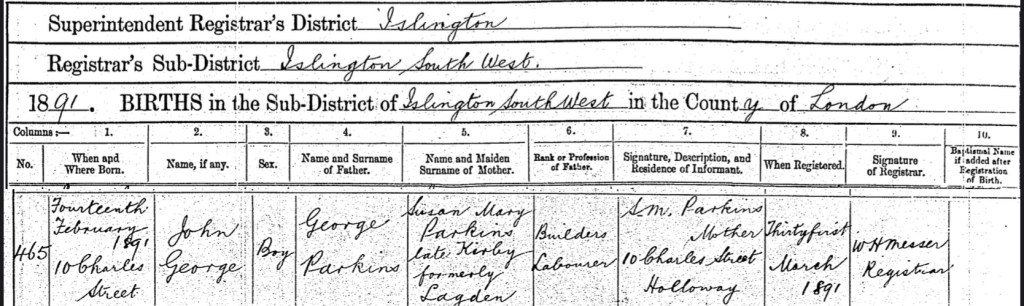
Susan was heavily pregnant when she married George and their son, John George Parkins, was born on Saturday the 14th of February 1891, at their home, Number 10, Charles Street, South West Islington, London, England. Susan registered Johns birth on Tuesday the 31st of March 1891, in Islington. She gave her husband George Parkins, occupation as a Builders and their abode as, Number 10, Charles Street, South West Islington.

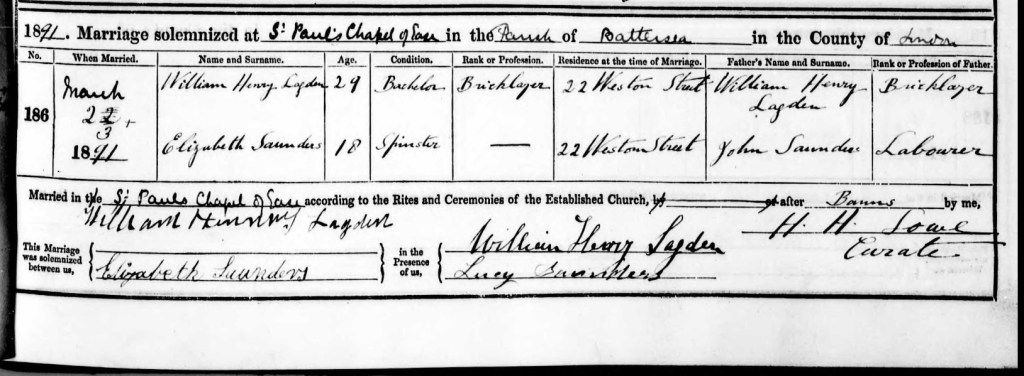
Another love story was beginning when, Susan’s Brother, 29 year old, bachelor, William Henry Lagden, a Bricklayer, married 18 year old, spinster, Elizabeth Saunders at St. Paul’s Chapel Of Ease, Battersea, London, England, on Monday the 23rd of March, 1891. William and Elizabeth were both residing at, 22 Weston Street, at the time of their marriage. They gave their fathers names and occupations as, William Henry Lagden, a Bricklayer and John Saunders, a Labourer. Their witnesses were, Susan’s and Williams father, William Henry Lagden and Lucy Saunders. (Possibly Elizabeth’s mother.)
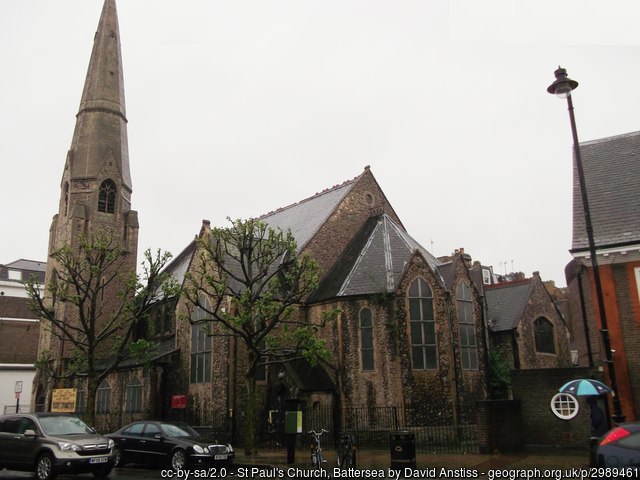
St Paul’s church was originally built as a chapel of ease in the new ecclesiastical parish of Battersea St. John, which was created in 1863 from parts of the Ancient Parish of Battersea St. Mary.
According to the Diocesan records at some point St. Paul’s became a separate parish but the two were merged ca 1939. The name of the parish was changed to Battersea St. Paul in 1948, and St. John’s church was demolished around 1950.
The parish was merged into Battersea St. Peter and St. Paul in 1972.
The church is no longer in use, it seems to be used as a community centre.
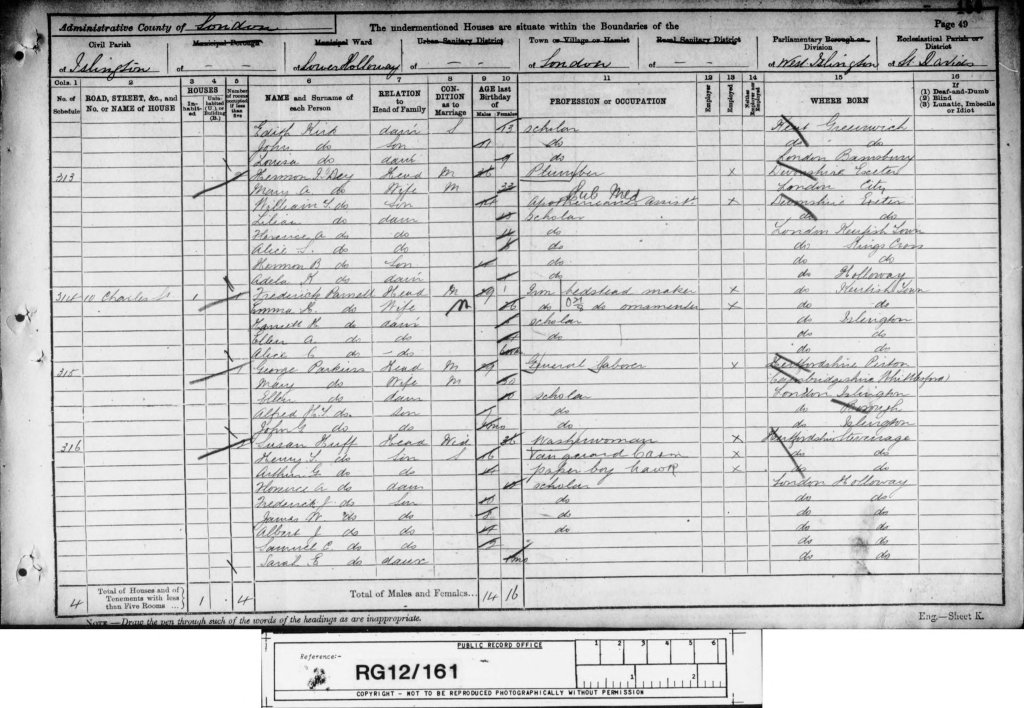
A few months later, Susan Mary, her new husband George, daughter Eleanor, sons Alfred and John, were residing at, 10, Charles Street, Islington, London & Middlesex, England on Sunday the 5th of April 1891, when the census was taken.
George was working as a General Labourer and Eleanor and Alfred were Scholars.


Susan and George’s son, John George Parkins, was baptised in a private baptism at his home, 10 Charles Street, Islington, Middlesex, England, on the 10th July 1891. His baptism gives his birth date as the 14th February 1891.

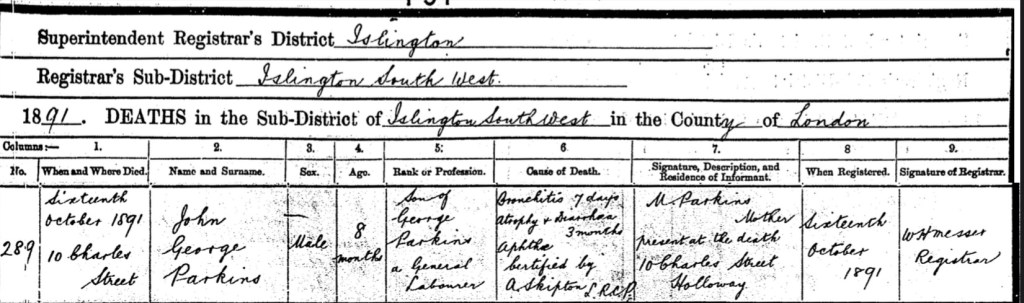
Heartbreak followed when Susan and George’s son, 8 month old, John George Parkins, sadly passed away, on Wednesday the 16th of October 1891, at home, Number 10, Charles Street, South West Islington, London, England. John died from Bronchitis 7 days, atrophy and Diarrhoea 3 months and Aphtha.
His mother, Susan, was present and registered his death on the same day as his death, Wednesday the 16th of October 1891, in Islington.

John George Parkins, was laid to rest at Islington Cemetery, Islington, Middlesex England, on Monday the 19th October 1891, in grave reference M/Poor/17400, with 65 others.
They were, Ann Joyce Regan, William Bacon, Martha Janet Arcus, and Rose Edith Sytherleigh, were buried on the 3rd of December 1891. Florence Pain, Mary Cox, Emily Bennyon, Alfred Harden, and John Corey, were buried on the 16th of November 1891. William Cunningham, and Harriett Ward were buried on the 12th of November 1891. George Palmer, William Dadson, and Matilda Buckley, were buried on the 02nd of November 1891. Thomas Escott, Jessie Stilling, Emma Hart and, William Harold Brading, were buried on the 29th of October 1891. William Loon, Eliza Poulton, Margaret Williams, Ada Stamford, and Kate Watson, were buried on the 26th of October 1891. Ann Sheenhan, Naomi Axton, Thomas Root, and Elizah John Townsend, were buried on the 22nd of October 1891. George Hearn, was buried on the 19th of October 1891, the same day as John George Parkins. Martha McDonald, Ada Brown, William Robert Mason, Mary Frank, Sarah Audley, Charles E Clark, Maud Grace King and Charles Chamont, were buried on the 15th of October 1891. William Conway, was buried on the 14th of October 1891. Nora Harris, Mary Ann Strode, Alice Thomas, Hannah Harris, William Tierney, Henry Long, Edith Grace Purcell, Daisy Caroline Drake and Jessie E G Powell, were buried on the 12th of October 1891. William Collins, Eli Grainger, and Ellen Collins, were buried on the 05th of October 1891. Arthur Canter, Eliza Carter, Eleanor Williams, and Bertram Rose Wright, were buried on the 01st of October 1891. John Christie, Thomas Jones, and Rosa Floyd, were buried on the 28th of September 1891. Richard Davey, Martha Wright, and Sophia Jones, were buried on the 17th of September 1891. William Foster, Henry Jones, Henry Duning, Susan Falstead, Alice Duncan, and Grace Sunman, were buried on the 14th of September 1891.

My heart breaks for Susan she has lost so many throughout the years, and I truly wonder how she survived her losses, especially her children.
Thankfully Susan once again fall pregnant.
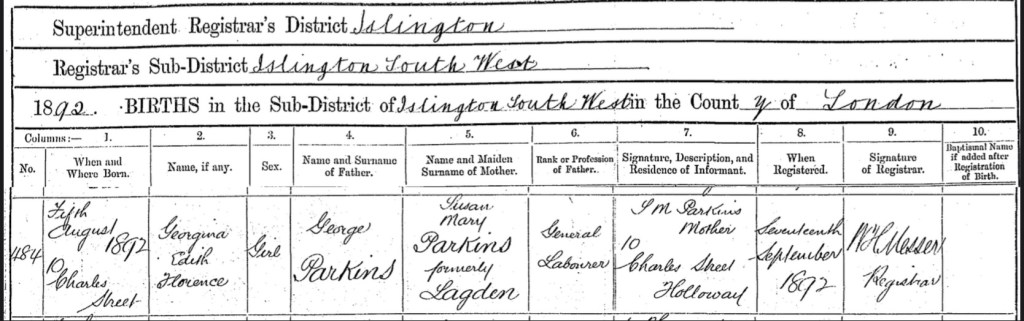
Susan and George Parkins daughter, Georgina Edith Florence Parkins, was born on Wednesday the 5th of August 1892, at Number 10, Charles Street, South West Islington, London, England. Her mother Susan Mary Parkins, registered her birth on Thursday the 17th of September 1892. She gave Georgina’s fathers name and occupation as, George Parkins, a General Labourer.
Susan and George’s daughter, Georgina Edith Florence Parkins, was Baptism on Wednesday the 18th of October 1893, at St David’s Church, Islington, London, England. Their abode was given as 10 Charles Street and George’s occupation was given as a labourer.

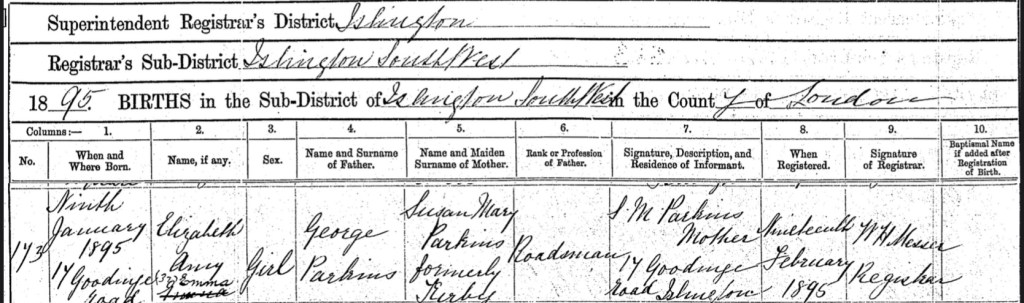
And a few year later, on Monday the 9th of January, 1895, Susan Mary, gave birth to Elizabeth Amy Emma Parkins, at home, Number 17 Goodinge Road, Islington, London, England.
Susan registered Elizabeth’s birth on Sunday the 19th of February 1895, in Islington.
She gave Elizabeth’s fathers name and occupation as, George Parkins, a Roadman.

Susan and George, baptised, Elizabeth Amy Emma Parkins, on Thursday the 16th April 1896, at St David’s, Middlesex, England.
It was a private baptism.
Their abode was given as, Number 68, Wellington Road and George’s occupation as a Labourer.
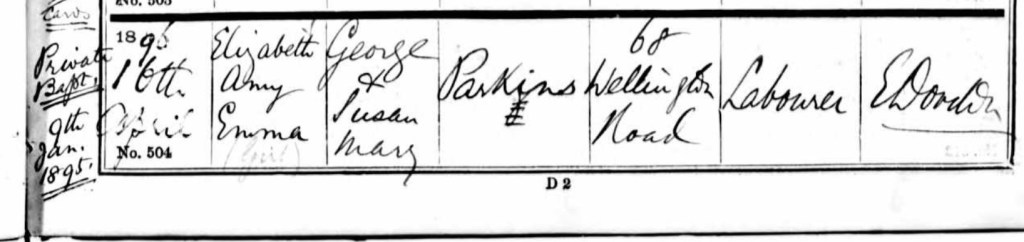
Happiness was very short lived as, on the same day as Elizabeth’s baptism, Susan and George’s Daughter, 15 month month old, Elizabeth Amy Parkins, sadly passed away on Thursday the 16th of April 1896, at their home, Number 68 Wellington Road, Islington, London, England.
Elizabeth died from, Measles and Pneumonia.
Susan was present and registered Elizabeth’s death on Friday the 17th April 1896, in Islington.


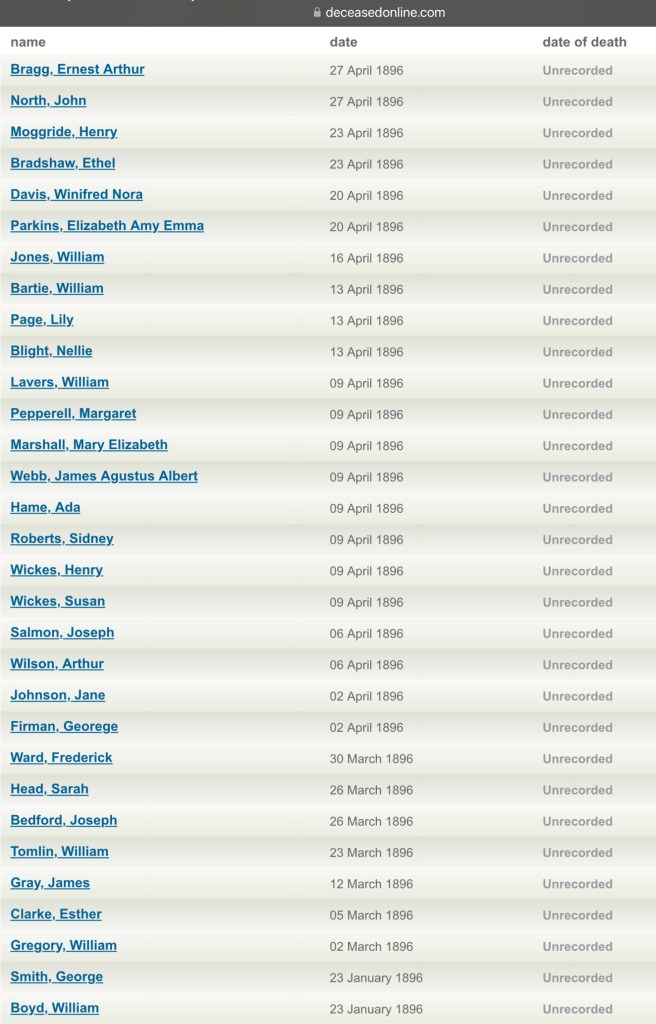
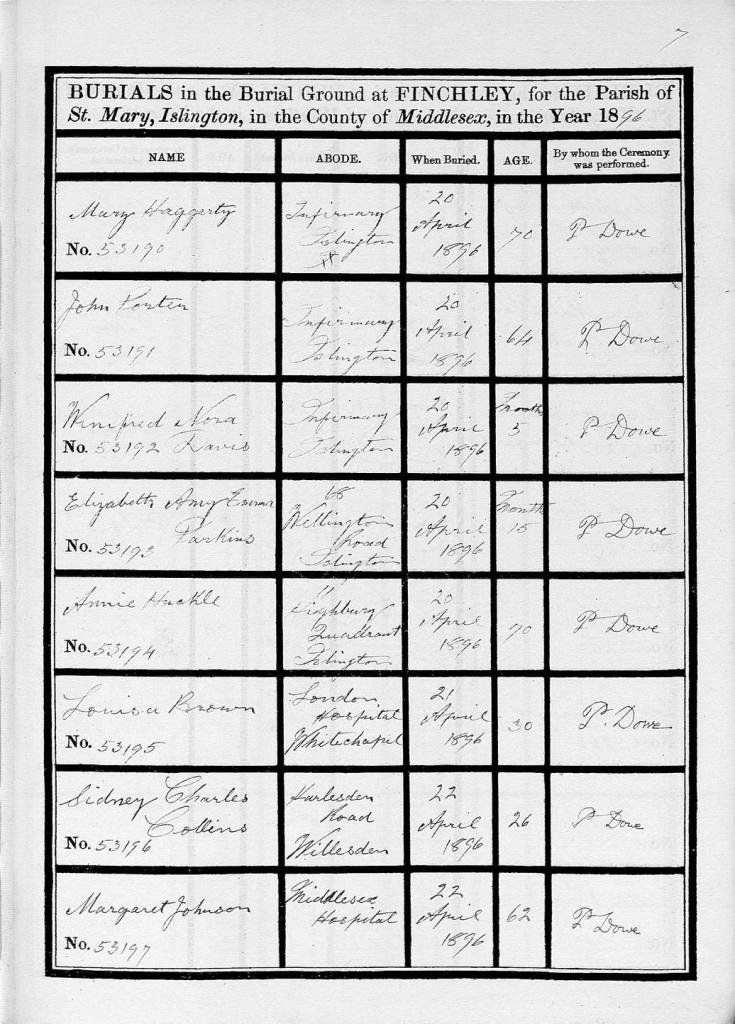
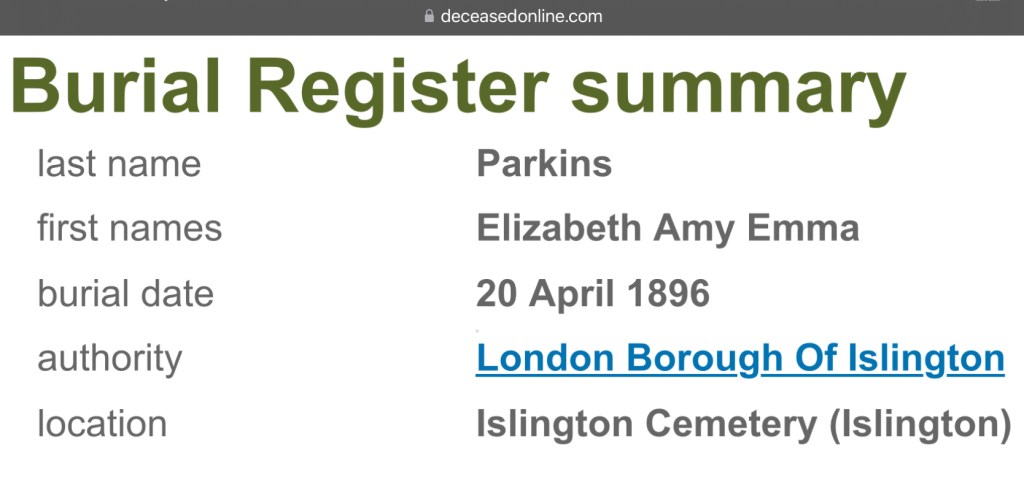
Elizabeth Amy Emma Parkins, was laid to rest on Monday the 20th of April 1896, in Islington Cemetery, Islington, Middlesex, England, in a open grave, grave reference M/Poor/17568, with 30 other people.
They were, Elizabeth Amy Emma Parkins, and Winifred Nora Davis, were buried, 20th April 1896.
Ernest Arthur Bragg, and John North, buried, 27th April 1896.
Henry Moggride, and Ethel Bradshaw, buried, 23rd April 1896.
William Jones, buried 16th April 1896.
William Bartie, Lily Page and Nellie Blight, buried, 13th April 1896.
William Lavers, Margaret Pepperell, Mary Elizabeth Marshall, James Agustus Albert Webb, Ada Hame, Sidney Roberts, Henry Wickes, and Susan Wickes, buried, 09th April 1896.
Joseph Salmon, and Wilson, Arthur Wilson, buried 06th April 1896.
Jane Johnson, and Georege Firman, buried 02nd April 1896.
Frederick Ward, buried, 30th March 1896. Sarah Head and Joseph Bedford, buried, 26th March 1896.
William Tomlin, buried, 23rd March 1896.
James Gray, buried, 12th March 1896.
Esther Clarke, buried, 05th March 1896.
William Gregory, buried 02nd March 1896.
George Smith, buried, 23rd January 1896.
And William Boyd, buried 23rd January 1896.
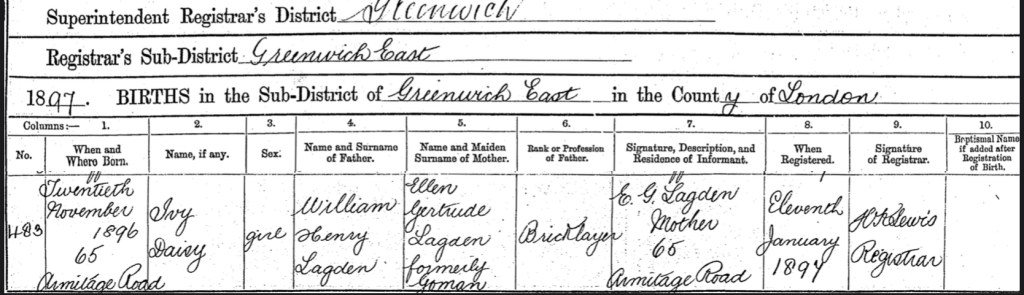
Thankfully a few short months later, Susan’s half-sister, Ivy Daisy Lagden was born on Friday the 20th of November 1896, at Number 65, Armitage Road, East Greenwich, London, England. to William Henry Lagden and his new wife/partner Ellen Gertrude Goman.
Ellen registered Ivy’s birth in Greenwich, on Monday the 11th of January 1897.
Ellen gave Williams occupation as a Bricklayer and there Abode as, Number 65, Armitage Road, East Greenwich.
Susan also had another sister born to her father William and his new wife or partner, Ellen Gertrude Goman, whom they named Ellen.
At present I haven’t been able to locate a birth or baptism for her. The 1901 census states Ellen was born in 1888, in Sunbury.
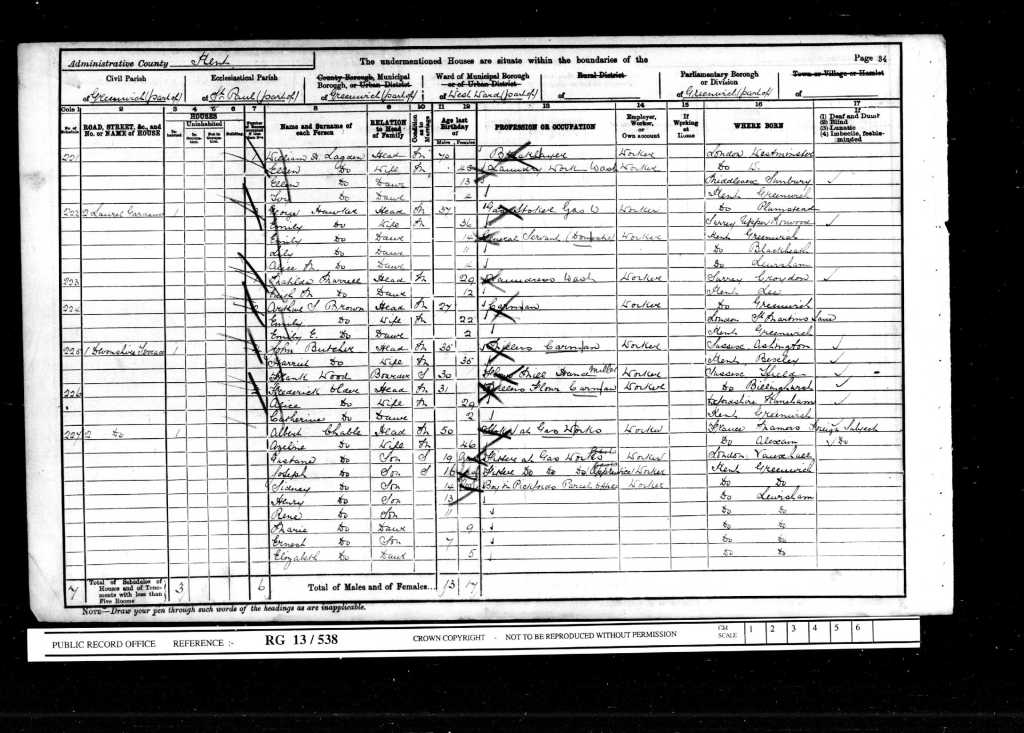
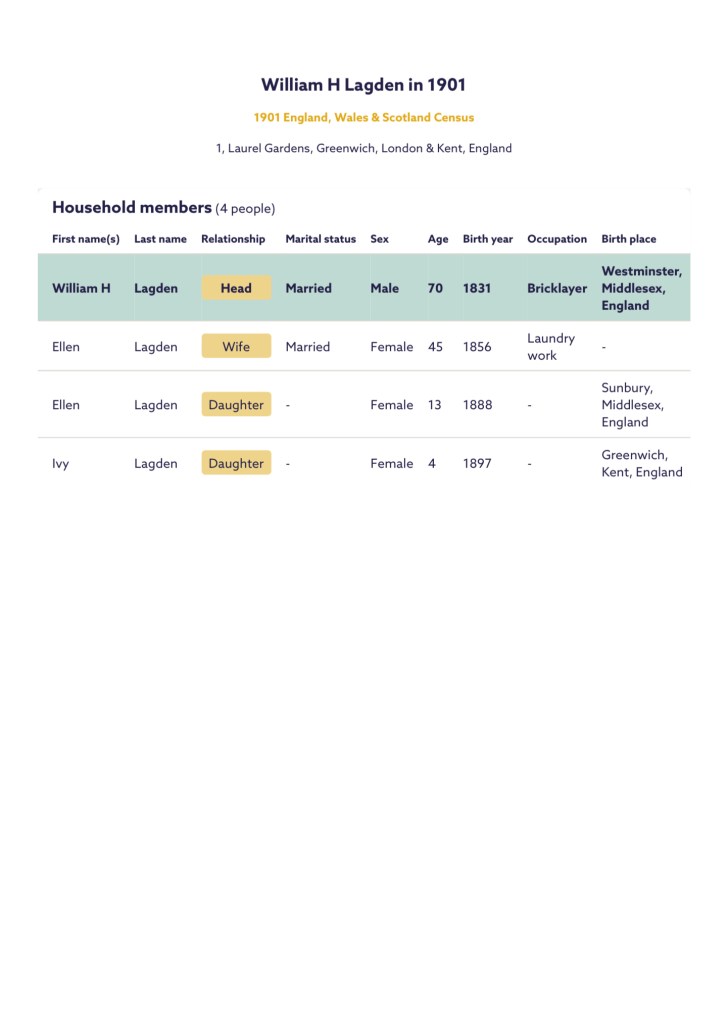
This seems not quite right as Susan’s mum, Williams first wife Elizabeth Lagden nee Prime, died in 1888. Either William was a very quick worker, or his new wife/partner Ellen Gertrude Goman, was married before (Goman being her marital name) and Ellen was a child from her first marriage?
I haven’t been able to locate a marriage for William and Ellen Gertrude Goman, as of yet, which reinforces my suspicion the Ellen Gertrude was possibly married before. Ellen Gertrude‘s year of birth is also very different on the two census 1901 and 1921, I have for her. The 1901 gives her birth year as 1856, Westminster and the 1921 as, 1868, London.
I will update you if I find the answers.
Jumping forward to the year 1901, United Kingdom. The Monarch was Queen Victoria (until 22 January) and King Edward VII (starting 22 January)
Prime Minister was Robert Gascoyne-Cecil, 3rd Marquess of Salisbury (Coalition) and it was the 27th Parliament.
On January 22, 1901, Queen Victoria, who had reigned for over 63 years, passed away at the age of 81. Her death marked the end of the Victorian era and the beginning of the Edwardian era.
Following Queen Victoria’s death, her eldest son, Prince Albert Edward, ascended the throne as King Edward VII. His reign lasted until his death in 1910 and was known for its focus on diplomacy and international relations.
The Education (Provision of Meals) Act was passed in the United Kingdom. This legislation aimed to address the issue of malnourishment among school children by providing free or subsidized meals in public elementary schools.
The Royal Army Medical Corps (RAMC) was established, bringing together several medical units of the British Army. The RAMC played a vital role in providing medical care to soldiers during conflicts and peacetime operations.
The year 1901 saw the first Nobel Prizes being awarded. The prizes, established by the will of Alfred Nobel, were awarded in several categories, including physics, chemistry, medicine, literature, and peace.
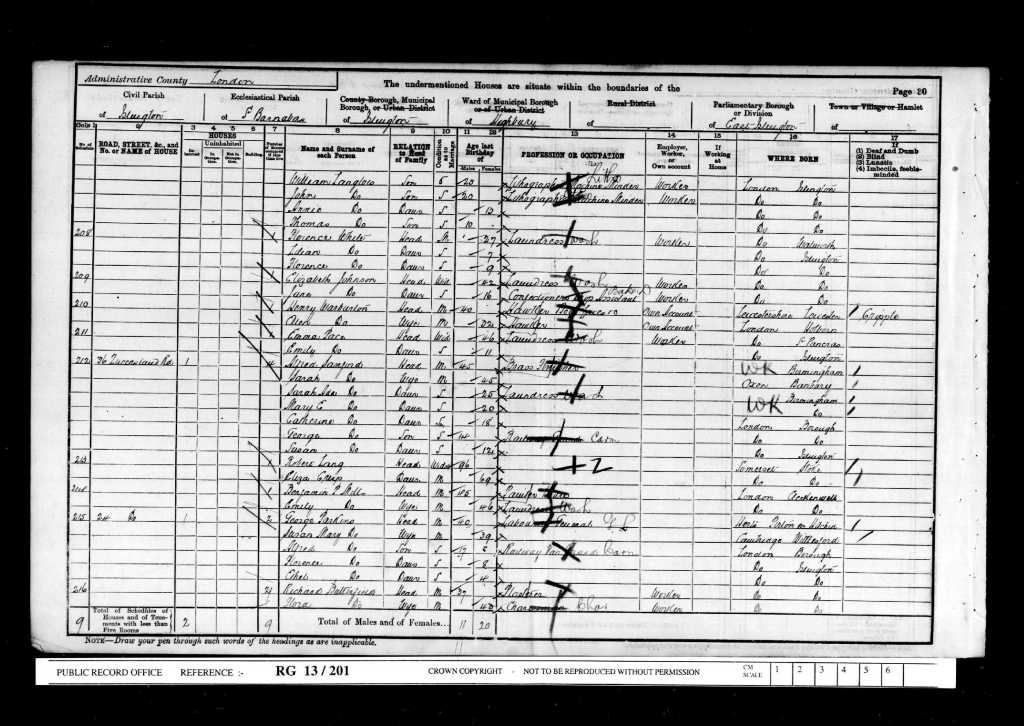
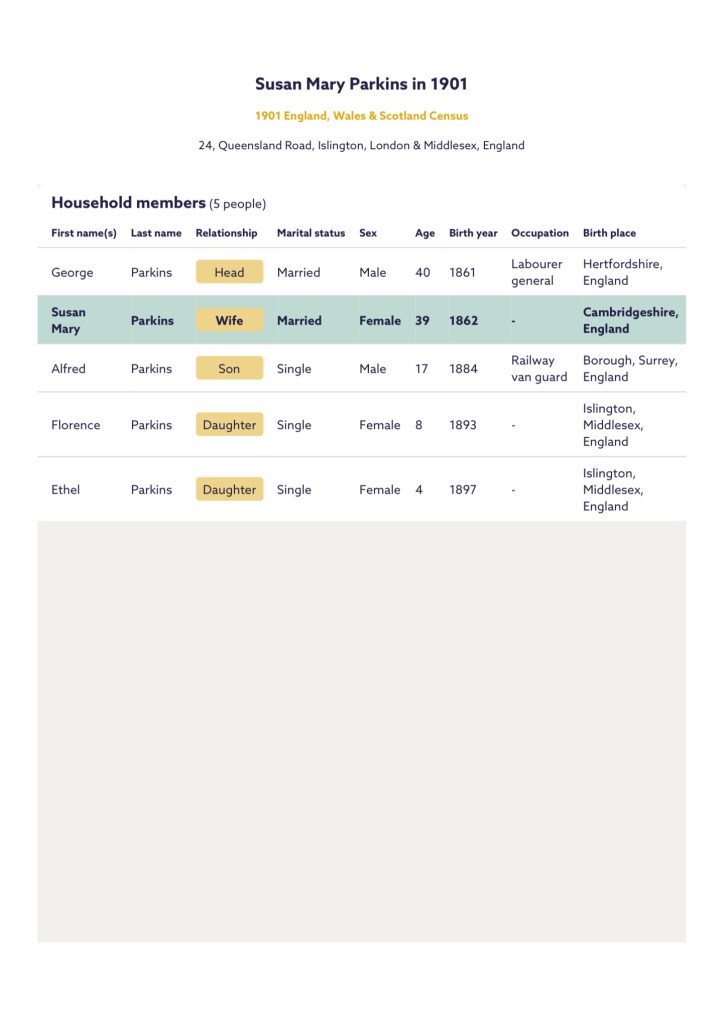
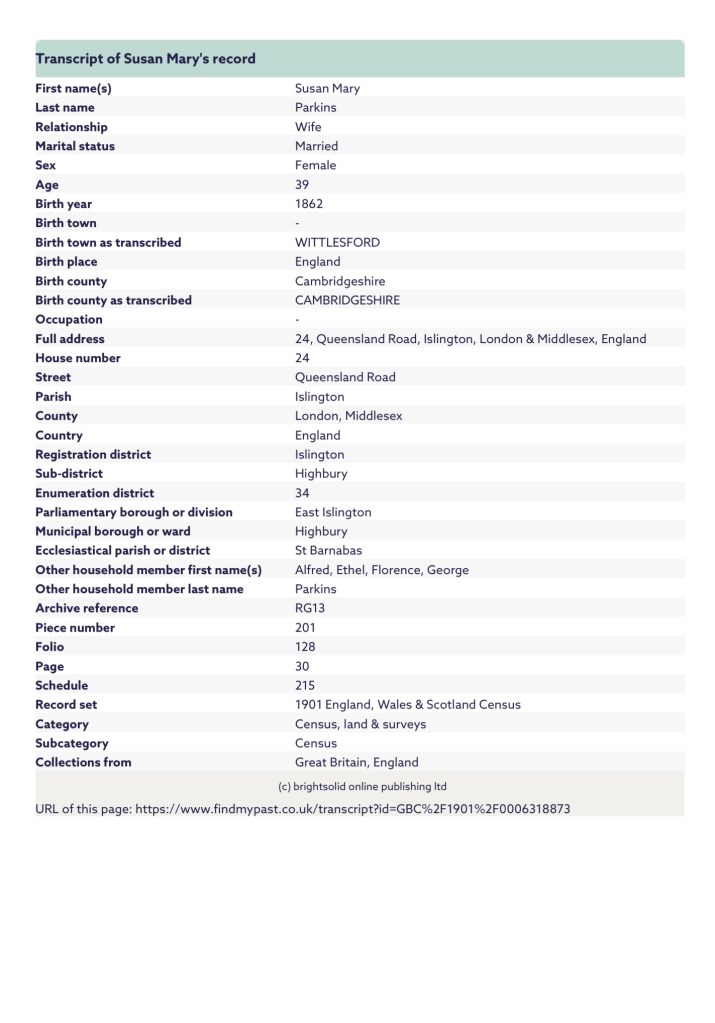
And the 1901 census was taken on Sunday the 31st of March, 1901, which showed Susan, George, Ethel, Florence and Alfred, residing at, 24, Queensland Road, Islington, London & Middlesex, England.
George was working as a General Labourer and Alfred was a, Railway Van Guard.
Susan was listed under the name Mary.
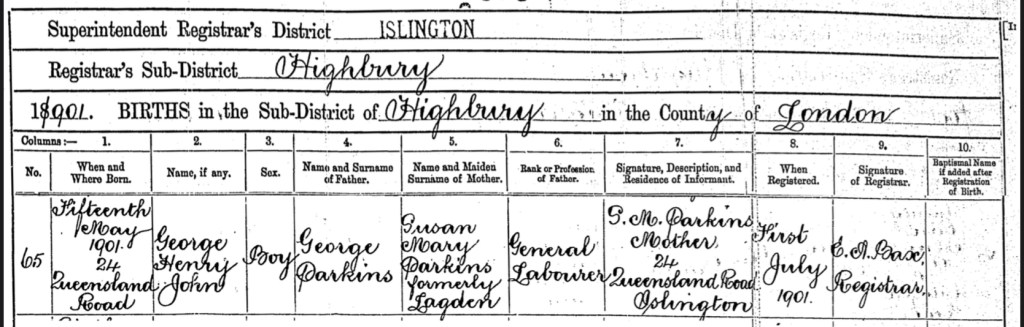
What the census doesn’t tell us is that, Susan was once again expecting and gave birth to a son, whom they named, George Henry John Parkins.
George was born on Wednesday the 15th of May 1901, at their home, Number 24, Queensland Road, Highbury, Islington, Middlesex, England.
Susan registered his birth on Monday the 1st of July 1901, in Highbury, Islington.
She gave her husband George’s occupation as a General Labourer and their abode as Number 24, Queensland Road, Islington.

The grime reaper was once again plaguing the family and on, Tuesday the 29th of July, 1902, Susan’s Father, 71 year old, Bricklayer, William Henry Lagden, passed away, on Tuesday the 29th of July, 1902, at the Union Workhouse, Greenwich East, Greenwich, London, England.
William died from, Paralysis Syndrome.
His widow Ellen Lagden was present and registered Williams death, on Thursday the 31st of July 1902, in Greenwich.
Ellen gave their abode as, Number 1, Laurel Gardens, Greenwich, London, England.


In 1902, the Union Workhouse in Greenwich was a significant institution that provided relief and care for the poor and destitute individuals in the area. The Union Workhouse system was established under the Poor Law Amendment Act of 1834, which aimed to address poverty and unemployment by providing institutional support.
The Greenwich Union Workhouse was located in the Greenwich area of London, within the boundaries of the Metropolitan Borough of Greenwich. Its primary function was to house and support those who were unable to support themselves financially. The workhouse was administered by the Greenwich Board of Guardians, which was responsible for managing the relief and welfare of the poor within the union.
Life in the workhouse during this period was harsh and often seen as a last resort for those who were desperate and had no other means of support. Conditions were often spartan, and residents were required to perform manual labor in exchange for their upkeep. Workhouse residents were segregated by gender and age, and families were often separated.
The workhouse provided basic necessities such as food, clothing, and shelter, but the conditions were designed to discourage people from seeking support unless absolutely necessary. The workhouse was seen as a place of last resort, and many people did their best to avoid being admitted.
Over time, the Poor Law system and workhouses faced criticism for their harsh conditions and the separation of families. Reforms were gradually implemented in the early 20th century, leading to the eventual decline and abolition of the workhouse system.

The new union workhouse was erected in 1839-40 junction of Woolwich Road and Vanbrugh Hill. The architect, RP Browne, later described his design as as ‘plain but cheerful and almslike’.
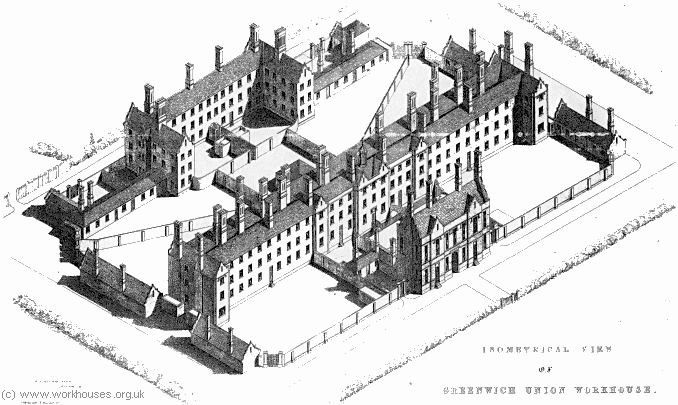
from south-west, 1844.
The layout comprised a two-storey entrance block containing the board-room, porter’s lodge, probationary wards, refractory wards and vagrants’ wards. The three-storey main block was based on a central corridor plan. Greenwich is one of the earliest examples of this type of design which became extremely popular — around 150 corridor plan workhouses were built between 1840 and 1875. At the centre of the main block were the Master’s quarters, with a T-shaped chapel/dining-hall behind. Various rooms opened off the central corridor for the various classes of inmates, including ones for ‘bad women’. The upper floors contained dormitories.
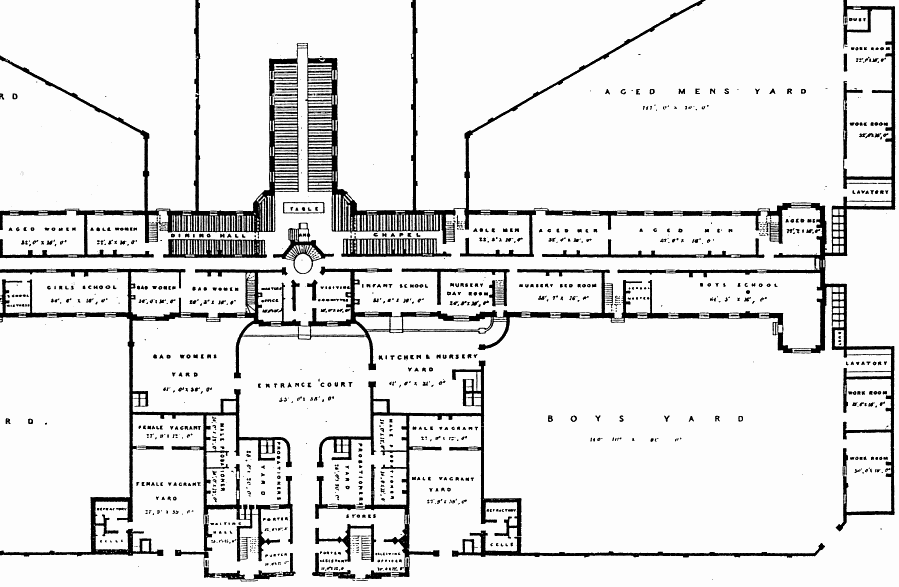
To the rear, at the south of the site, separated from the main block by the inmates’ exercise yards, stood the infirmary block which was adjoined by wash-houses, laundry, work-rooms, and the mortuary.
By the end of the nineteenth century Vanbrugh Hill was very overcrowded and the Greenwich Guardians instigated plans for an additional building. In 1896 they acquired a ten-acre site at Grove Park, and the following year approved plans by T & J Norman Dinwiddy for a new workhouse to accommodate 815 aged and able-bodied inmates. The foundation stone for the new building was laid on 15th June 1899, and the construction work, by T Rowbotham of Birmingham, was completed in April 1902.
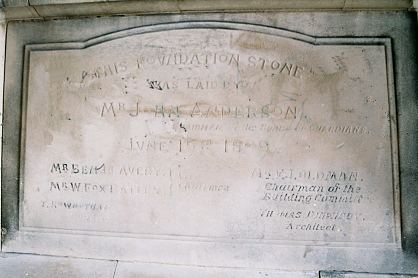
© Peter Higginbotham.
Unfortunately for the Greenwich Guardians, changes in the poor-relief system had just come into operation which provided for substantially more out-relief than had previously been the case. The effect of this was to significantly reduce numbers applying to enter the workhouse. The new Greenwich workhouse stood empty for two years, during which time the press made much of the situation. The Illustrated London Newsdescribed the building as being one of the most luxurious in the country with “mosaic flooring, beautiful panelling, a dining-hall fit for royalty, and a church which any rector would envy.”
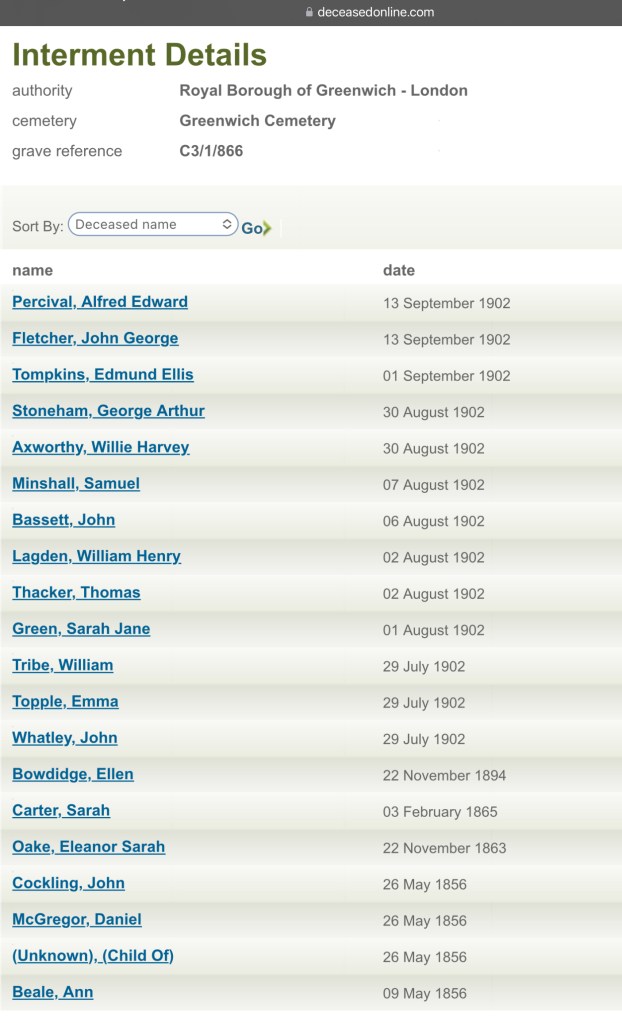
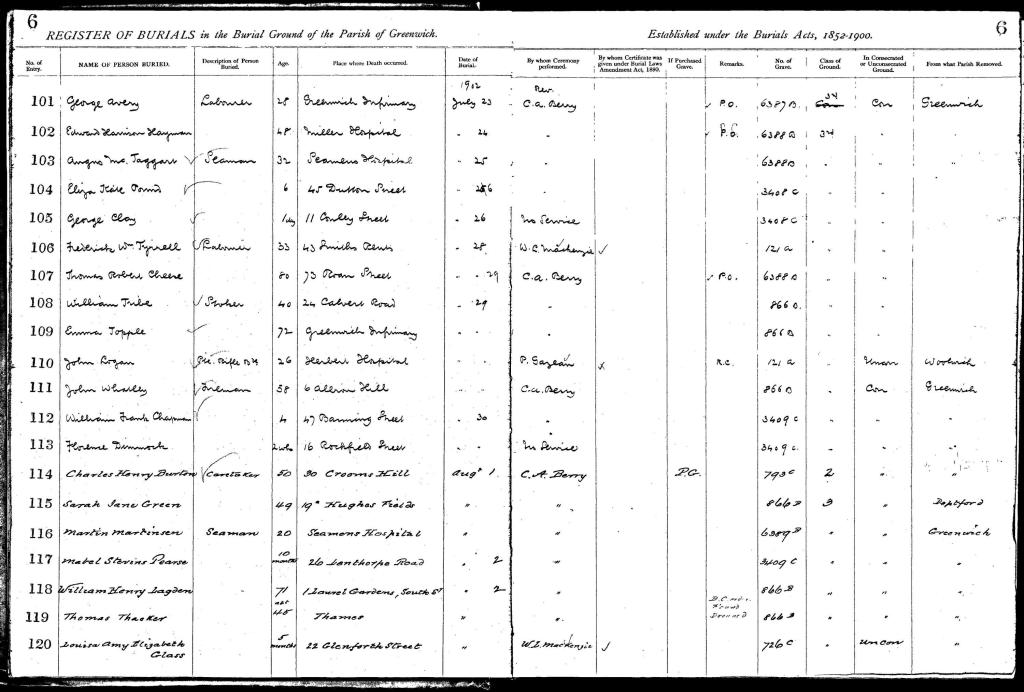
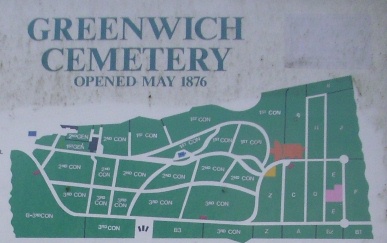
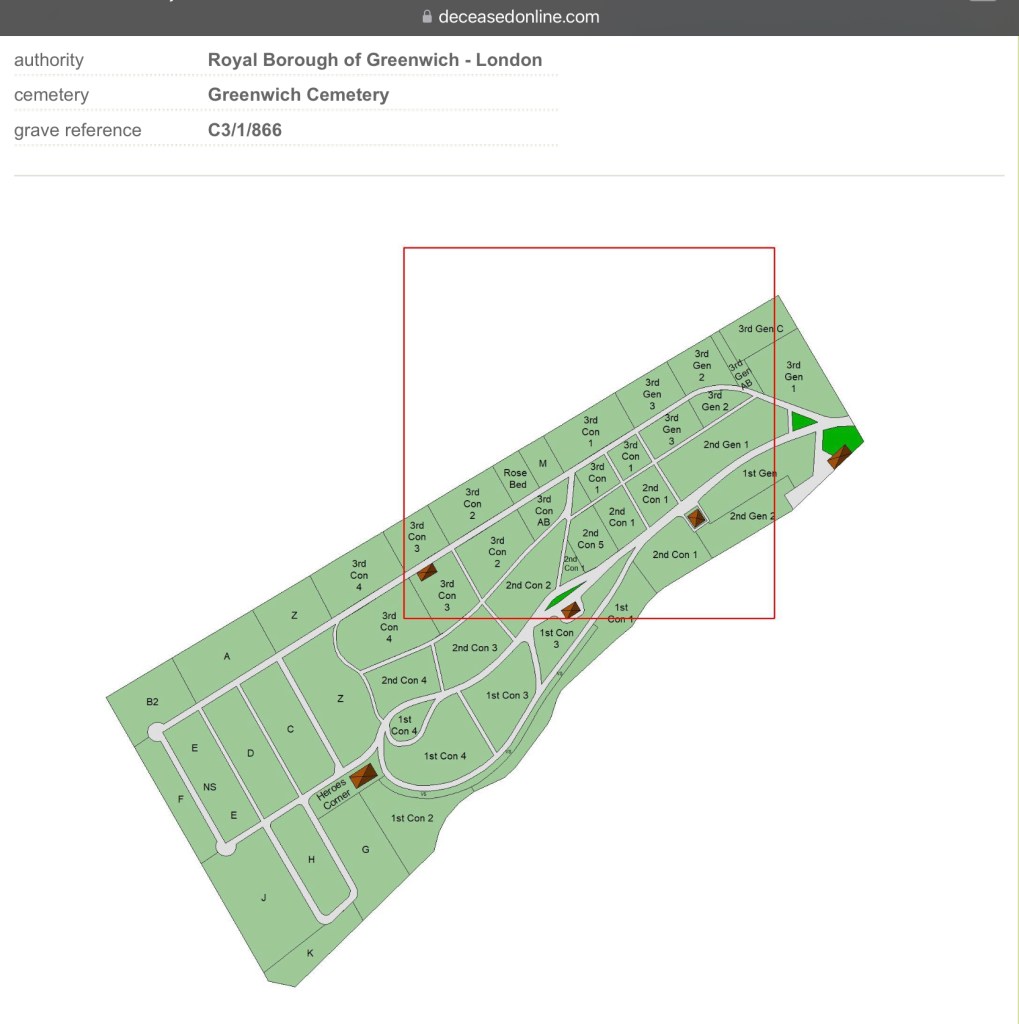
Susan’s Father, William Henry Lagden was laid to rest on Saturday the 2nd of August 1902, at Greenwich Cemetery, Greenwich, London, England. He was buried with 19 others, in Grave reference C3/1/866. They were, William Henry Lagden And Thomas Thacker, 02nd August 1902.
Alfred Edward Percival, and John George Fletcher, 13th September 1902.
Edmund Ellis Tompkins, 01st September 1902.
George Arthur Stoneham, and Willie Harvey Axworthy, 30th August 1902.
Samuel Minshall, 07th August 1902.
John Bassett, 06th August 1902.
Sarah Jane Green, 01st August 1902.
William Tribe, Emma Topple, John Whatley, 29th July 1902.
Ellen Bowdidge, 22nd November 1894.
Sarah Carter, 03rd February 1865.
Eleanor Sarah Oake, 22nd November 1863.
John Cockling, Daniel McGregor, And (Unknown), (Child Of), 26th May 1856.
Ann Beale, 09 May 1856.
Jumping forward to the year 1907, King Edward VII was monarch.
The Prime Minister was Henry Campbell-Bannerman(Liberal) and it was the 28th parliament.
The United Kingdom and Russia signed the Anglo-Russian Entente, a diplomatic agreement aimed at resolving disputes and improving relations between the two countries. The agreement marked a significant shift in British foreign policy by reducing tensions and increasing cooperation with Russia.
The suffragette movement, advocating for women’s right to vote, gained momentum. The Women’s Social and Political Union (WSPU), led by Emmeline Pankhurst, intensified its protests and civil disobedience campaigns to raise awareness about women’s suffrage. These actions included demonstrations, public meetings, and acts of vandalism.
The British Royal Navy launched the HMS Dreadnought, a revolutionary battleship that introduced a new era in naval warfare. The Dreadnought was the first battleship to be powered solely by steam turbines, making it faster and more powerful than previous designs.
A protest against unemployment and poor working conditions in Trafalgar Square, London, turned into violent clashes between the police and demonstrators. The event, known as the Trafalgar Square Riots, resulted in injuries and arrests.
The Liberal government, under Prime Minister Henry Campbell-Bannerman, introduced the Irish Home Rule Bill in 1907. The bill aimed to grant self-government to Ireland within the United Kingdom. Although the bill did not become law in 1907, it marked a significant step toward addressing Irish demands for autonomy.
The first Imperial Conference took place in London. Representatives from various self-governing colonies of the British Empire, including Australia, Canada, New Zealand, and South Africa, gathered to discuss matters of common interest and strengthen imperial ties.
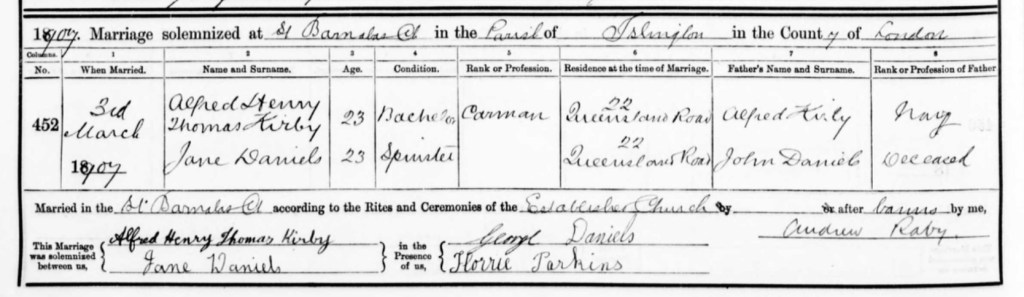
And Susan’s son, 23 year old bachelor, carman, Alfred Henry Thomas Kirby married 23 year old, Spinster, Jane Daniels, Daughter of John Daniels, on Sunday the 3rd of March, 1907, at St Barnabas Church, Hornsey Road, Islington, England.
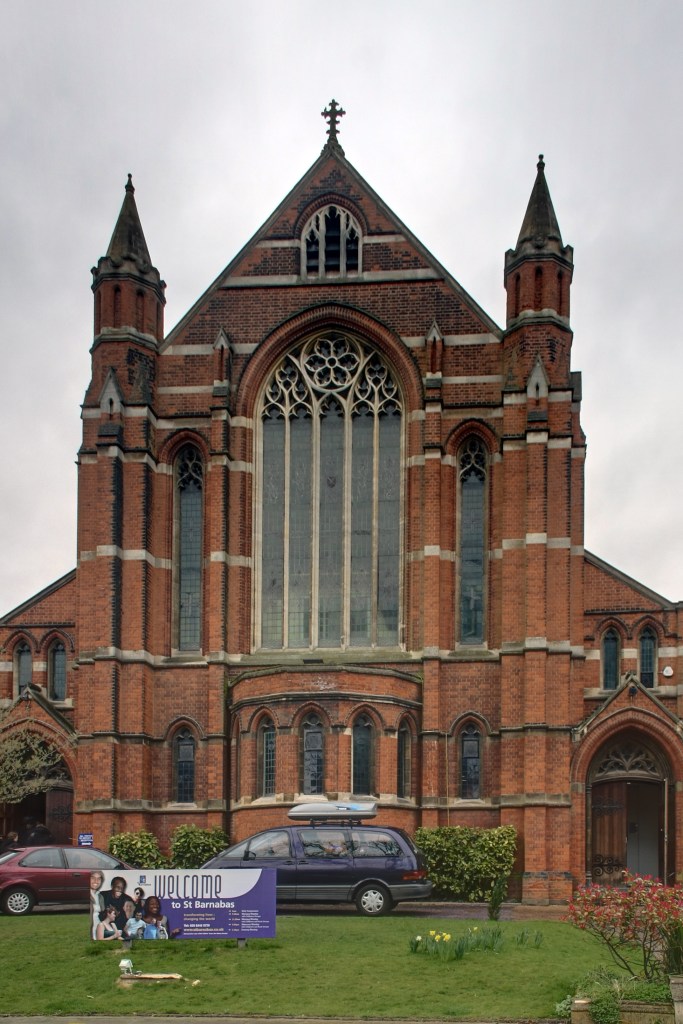
Their witnesses were Florence Parkins and George Daniels.
Alfred and Jane gave their abode as, Number 22 Queensland Road.
Death seemed to always be lurking in the shadows and it once again came knocking at Susan’s door.
This time it had Susan’s husbands life firmly in it grip.
Susans husband, 43 year old, General Labourer, George Parkins, passed away on Saturday the 1st of August 1908, at Islington Infirmary, Highgate Hill, Islington, Middlesex, England.
George, died from Acute Vascular Disease, and Pulmonary Tuberculosis.
George’s widow, Susan Mary Parkins, nee Kirby, nee Lagden, registered George’s death on Saturday the 1st of August 1908, in Islington. She gave their abode as, 22 Queensland Road, Islington.

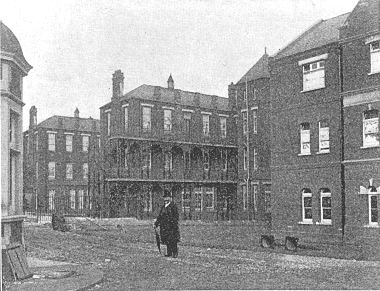
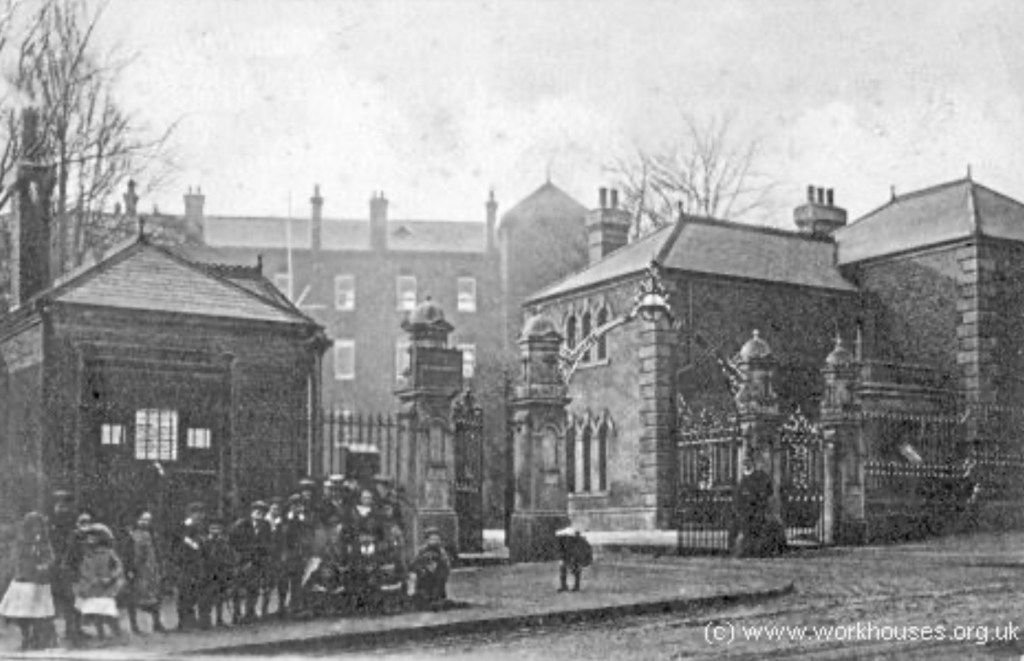
In 1898-1900, Islington developed a workhouse infirmary at a site on Highgate Hill, already occupied by the Highgate Smallpox and Vaccination Hospital. This hospital had been erected in 1848-50 as a replacement for an earlier smallpox hospital near Battle Bridge in St Pancras which was demolished as part of the King’s Cross station development by the Great Northern Railway. The new building, designed by Samuel Daukes on what was the a “green field” site, has 108 beds and continued in use until 1896 when a new and larger smallpox hospital was opened at South Mimms in around 1896.
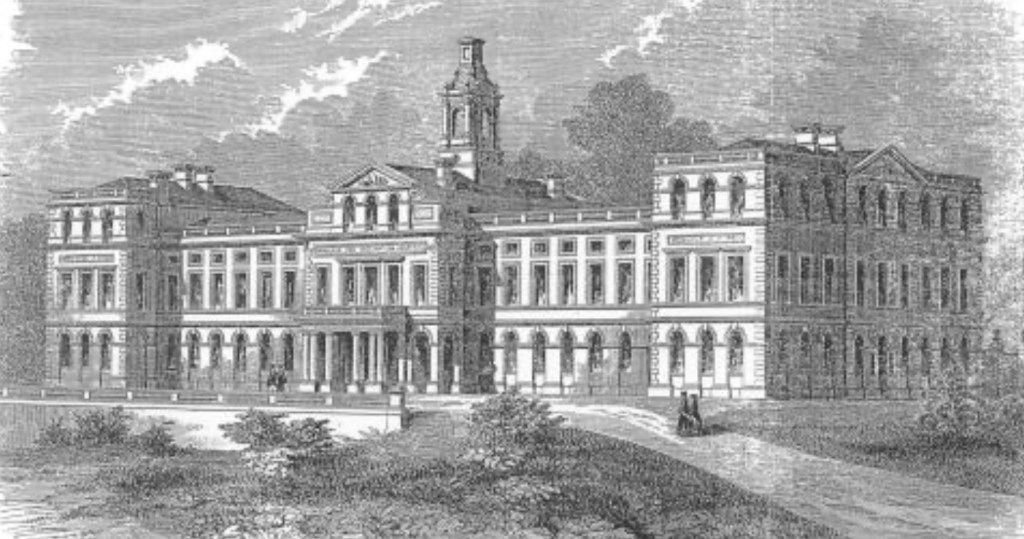
After the relocation of the smallpox hospital, the Islington Guardians acquired the Highgate site and built a large new 800-bed infirmary alongside the old buildings. The infirmary was opened on the 16th July, 1900, by the Duke and Duchess of York, on what was the hottest day of the year with a temperature of 92 degrees in the shade. In his speech, the Duke noted that Islington was the largest parish in the country, numbering 340,000 people.
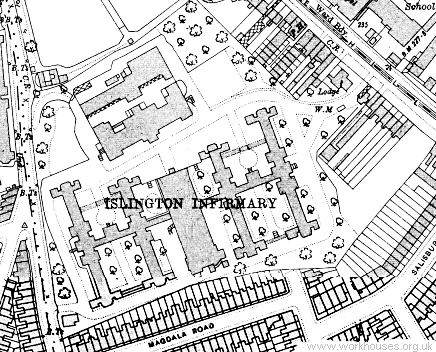
Designed by William Smith of Chancery Lane, and built by Kirk & Randall, the new building was a late example of the pavilion-plan layout popular between about 1870 and 1910. It comprised a central administration and service block of two or three storeys, connected by a long corridor to four double ward pavilions 100 feet apart. Because of the site’s slope, the ward blocks were four storeys high at the south but only three at the north end. The connecting corridors were enclosed on the first two floors but open on the two upper floors. There were also open iron galleries for fire-escape purposes connecting each pair of wards. Bathrooms and lavatories were placed in small annexes on either side of the wards, with the ends of the pavilions being used to provide small day rooms. Ancillary buildings such as the laundry, mortuary and coffin store were located at the rear of the old smallpox hospital, which itself provided a nurses’ home and office accommodation. The home was linked to the pavilions by a subway.
In 1930, control of the site passed to the London County Council and it was renamed St Mary’s Hospital. By 1945 it had become grouped with the adjacent Highgate Hospital (former St Pancrasparish infirmary) and Archway Hospital (former Holborn Union infirmary) under a single administration. With the advent of the National Health Service in 1948, the three sites became the St Mary’s, Highgate, and Archway wings of the Whittington Hospital.
© Peter Higginbotham.
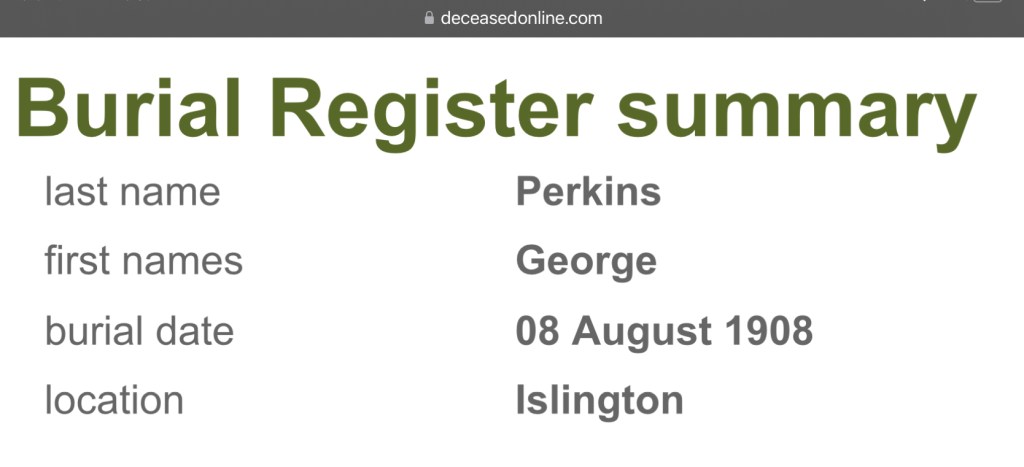
George Parkins, was laid to rest on Saturday the 8th of August 1908, at Islington Cemetery, Islington, Middlesex, England, in grave reference Q/3/18982, with 7 others. They were William John Marquis, was buried on the 13th August 1908. Harriet Rogers, and Colin Trewartha Greenwood, buried on the 11th August 1908. Mary Monk, and Ann Flyn, buried on the 10th August 1908. Charlotte Dedmen, and Ellen Jane Merrett, were buried on the 08th August 1908, that same day as George.

Once again we leave Susan as a widow.
She has lost so many of her loved one, all way beyond their time.
How she managed to find the strength to continue I will never know but boy wasn’t she a strong woman.
The passing of Susan’s second husband, George, must have left a profound void in her heart, and the weight of grief must have been unbearable.
As I leant all about her life as Mrs Parkins, I couldn’t help but be moved by the resilience and strength that had defined her remarkable journey.
Susan faced adversity with an unwavering spirit throughout her life. Losing her first husband, Alfred, had been a devastating blow, but she managed to rebuild her life and provide for her children as a courageous single mother.
As she grieved the loss of George, the pain of losing her love and the loss of her babies, must have consumed her.
But amidst the sorrow, there is always a glimmer of hope.
Susan’s eyes, once filled with the joy of her Alfred and George’s company, now held a newfound determination.
In her heart, she must have known that life’s journey was filled with both joy and sorrow, and she had faced enough hardships to recognize that even in the darkest times, there was a chance for healing and renewal.
As days turned into weeks and weeks into months, did Susan gradually find solace in the company of her family and friends.
Did she rediscover the joys of spending time with her grandchildren, telling them stories of her youth, and passing on the wisdom she had accumulated over her eventful life so far.
As we all know too well, the pain of loss never completely vanishes, it finds a place within our heart, alongside the cherished memories. I sincerely hope Susan felt that too.
Susan’s unwavering strength remained a guiding light for her and possibly those around her. Her resilience surely must have inspired her family to cherish each moment and embrace the bonds that held them together.
The legacy she had created throughout her lifetime would forever echo in the hearts of her descendants, an enduring reminder of the strength that resided within the human spirit.
As I close part 3 of Susan’s life journey, I am left with a profound appreciation for the tragic life she had lived up until this point.
Her journey has taught me that life with all the trials and tribulations can be very cruel, but the human spirit has an incredible capacity to endure and find hope even in the darkest moments.
Susan’s story is a reminder that love and strength can intertwine in unexpected ways, in doing so, leaving behind a legacy which I hope will be remembered for generations.
Please pop back soon, to find out how Susan’s life as a widow would unfold.
Until then,
Too-da-loo for now.
🦋🦋🦋
I have brought and paid for all certificates,
Please do not download or use them without my permission.
All you have to do is ask.
Thank you.
 Intwined