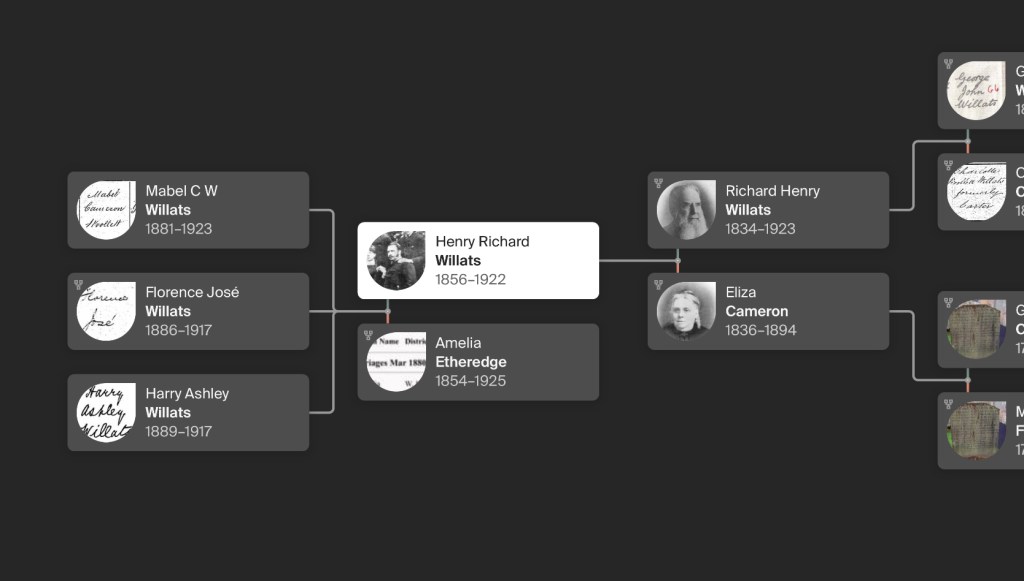
In the dimly lit corners of history, where memories fade and stories are left untold, there exists an extraordinary life that has been hidden from the world for far too long. Today, I invite you to step back in time and embark on a poignant journey through the life of my 3rd Great-Granduncle, Henry Richard Willats. A man whose legacy has touched the hearts of generations, leaving an indelible mark on our family’s heritage.
Born in 1856, at a time when the world was so very different to the world we live in today, Henry Richard Willats’ story begins against the backdrop of a rapidly industrialising society. A profound soul, who traversed the labyrinth of life, guided by the virtues of compassion, and resilience.
As the pages of history turned, young Henry found solace in helping others, in doing so he unlocked the door to worlds beyond his own.
But life is rarely a linear path, and as the years unfolded, Henry faced his fair share of tragedy. The tumultuous times of the late 19th and early 20th centuries brought both personal and societal challenges. Yet, he remained steadfast, demonstrating unwavering courage and grace.
I am sure it was through these trials that he discovered the depths of his character and the resilience of his spirit.
Destiny led to a serendipitous encounter that forever altered the course of his life – the love of his life, Amelia.
Theirs was a love that transcended time, a union built on the bedrock of mutual respect and a shared appreciation for the wonders of life. Together, they created a home that became a haven for not only their children but also a gathering place for kindred souls seeking warmth and solace.
As the final chapter of his life approached, Henry’s essence remained etched in the hearts of his loved ones. He left this world in 1922, leaving behind a legacy that I hope will defied the constraints of time, and fill our hearts with pride. 💕
Please join me as we delve deep into the archives and learn all about the life of this intriguing man, honouring his memory and keeping his legacy alive for generations to come.
So without further ado, I give you,
The Life Of,
Henry Richard Willats,
Through Documentation,
1855-1922.
Welcome to the year 1855, England.
Queen Victoria was sat proudly upon the throne. The Prime Minister was George Hamilton-Gordon, 4th Earl of Aberdeen (Coalition) (until 30 January); Henry John Temple, 3rd Viscount Palmerston(Whig) (starting 6 February). It was the 16th parliament.
Several significant events occurred in the United Kingdom, in the year 1855, here are a few examples of the key occurrences, reflecting significant military conflicts, industrial innovations, social reforms, and literary achievements.
Crimean War: The Crimean War, which began in 1853, continued into 1855. British and French forces, along with their allies, were engaged in battles against the Russian Empire in the Crimean Peninsula. The most notable event of this war was the Battle of Balaklava, which took place on October 25, 1854, but its famous charge, the “Charge of the Light Brigade,” was immortalized by Lord Alfred Tennyson in his poem.
Great Britain declared war on China: In 1856, but often referred to as the “Second Opium War,” hostilities escalated between Great Britain and China. The conflict was rooted in issues concerning the Chinese government’s control over trade, particularly the British desire to continue the opium trade. The war officially began on October 8, 1856, and resulted in British forces occupying parts of China.
The Newcastle Commission: The Newcastle Commission, also known as the Royal Commission on the Health of the Army, was established in 1855 to investigate the appalling conditions and high mortality rates of British soldiers during the Crimean War. This investigation led to significant reforms in military medical care and sanitation.
The Bessemer process: In 1855, British engineer Henry Bessemer patented his revolutionary steelmaking process, known as the Bessemer process. This innovation allowed for the mass production of steel, significantly impacting the industrial development of the United Kingdom and beyond.
The Marriage Act 1855: This act was passed, allowing non-religious civil marriages to take place in England and Wales. Prior to this, all marriages were required to be conducted within the confines of the Church of England.
Robert Browning’s poem “Men and Women”: In 1855, the English poet Robert Browning published a collection of poems titled “Men and Women.” One of the most notable poems in this collection was “Fra Lippo Lippi.”
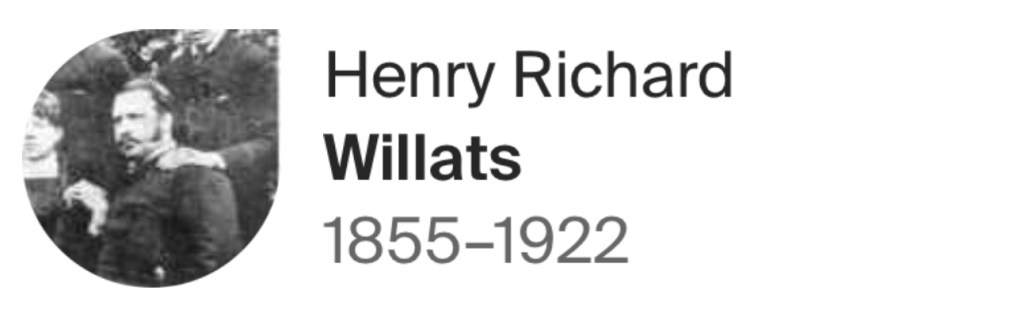
And Richard Henry Willats and Eliza Willats nee Cameron, son, Henry Richard Willats was born on Saturday the 8th of December, 1855, at Number 30 Poland Street, Berwick Street, St James, Westminster, Middlesex, England. Henry’s Father Richard Henry Willats, registered his birth on, Tuesday the 8th of January, 1856. Richard gave his occupation as a Tailor and there abode as Number 30 Portland Street.
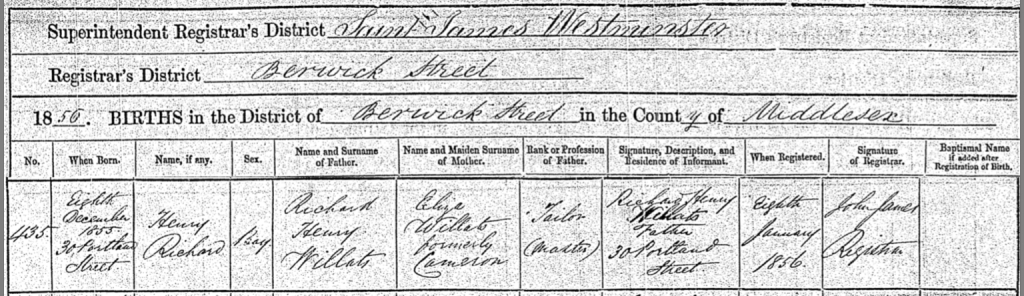
Henry’s brother, Francis Montague Allen Willats, was born on September 17, 1857, at Number 30 Golden Square, St. James, Westminster, Middlesex, England. Richard Henry, gave his occupation as a, Master Artificial Flower Maker and his abode as, 30 Golden Square, St. James, Westminster, when Richard registered Francis’s birth on the 29th of October 1857.
Henry’s sister, Charlotte Ellen Willats was born on Wednesday the 10th of August, 1859, at 56, Bunton Street, St Pancras, Middlesex, England.
Eliza registered Charlotte’s birth on Tuesday the 13th of December, 1859.
She gave Richards occupation as a Commercial Traveller and their abode as, 56, Bunton Street, St Pancras.

Richard and Eliza, baptised Henry’s sister, Charlotte Ellen Willats, on Thursday the 1st of September, 1859, at the Old Church, Saint Pancras, London, England.
Richard’s occupation was given as an Engraver and their abode as, Mabledon Row.

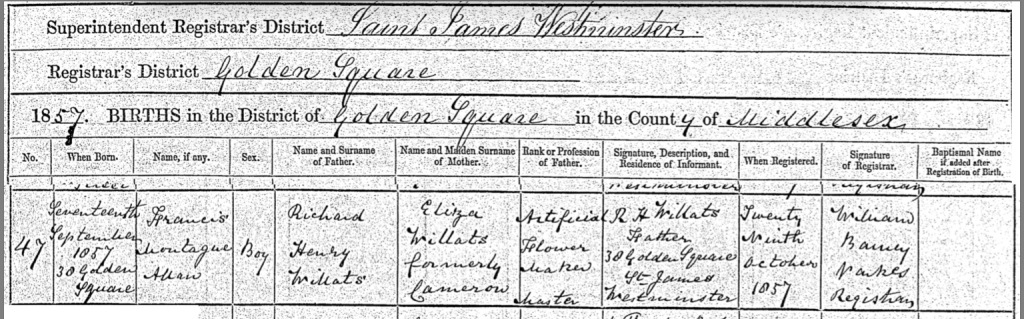
St Pancras Church is a Greek Revival church in St Pancras, London, built in 1819–22 to the designs of William and Henry William Inwood. The church is one of the most important 19th-century churches in England and is a Grade I listed building.
The church is on the northern boundary of Bloomsbury, on the south side of Euston Road, at the corner of Upper Woburn Place, in the borough of Camden. When it was built its west front faced into the south-east corner of Euston Square, which had been laid out on either side of what was then simply known as the “New Road”. It was intended as a new principal church for the parish of St Pancras, which once stretched almost from Oxford Street to Highgate. The original parish church was small ancient building to the north of New Road. This had become neglected following a shift in population to the north, and by the early 19th century services were only held there once a month, worship at other times taking place in a chapel in Kentish Town. With the northwards expansion of London into the area, the population in southern part of the parish grew once more, and a new church was felt necessary. Following the opening of the new Church, the Old Church became a chapel of ease, although it was later given its own separate parish. During the 19th century many further churches were built to serve the burgeoning population of the original parish of St Pancras, and by 1890 it had been divided into 33 ecclesiastical parishes.
Jumping forward to the year, 1861, Queen Victoria still sat upon her throne. It was the 18th parliament and the Prime Minister was Henry John Temple, 3rd Viscount Palmerston (Liberal).
The One O’Clock Gun was first fired from Edinburgh Castle.
Storms damaged the Crystal Palace in London and cause the collapse of the steeple of Chichester Cathedral.
About 350 convicts held on St Mary’s Island at Chatham Dockyard took over their prison in a riot.
A major fire in Southwark destroyed several buildings.
A tenement collapsed in the Old Town, Edinburgh killing 35 with 15 survivors.
Princess Victoria of Saxe-Coburg-Saalfeld, Duchess of Kent, mother of Queen Victoria Died.
The British Empire established bases in Lagos to stop the slave trade.
The 1861 census was held on the 7th of April, 1861.
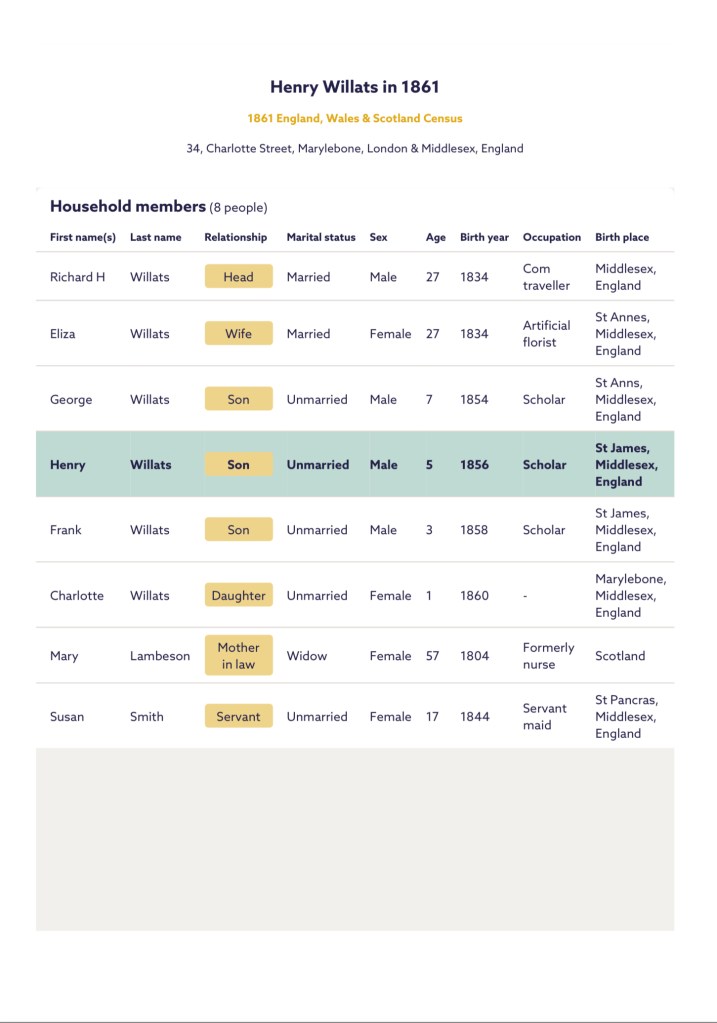
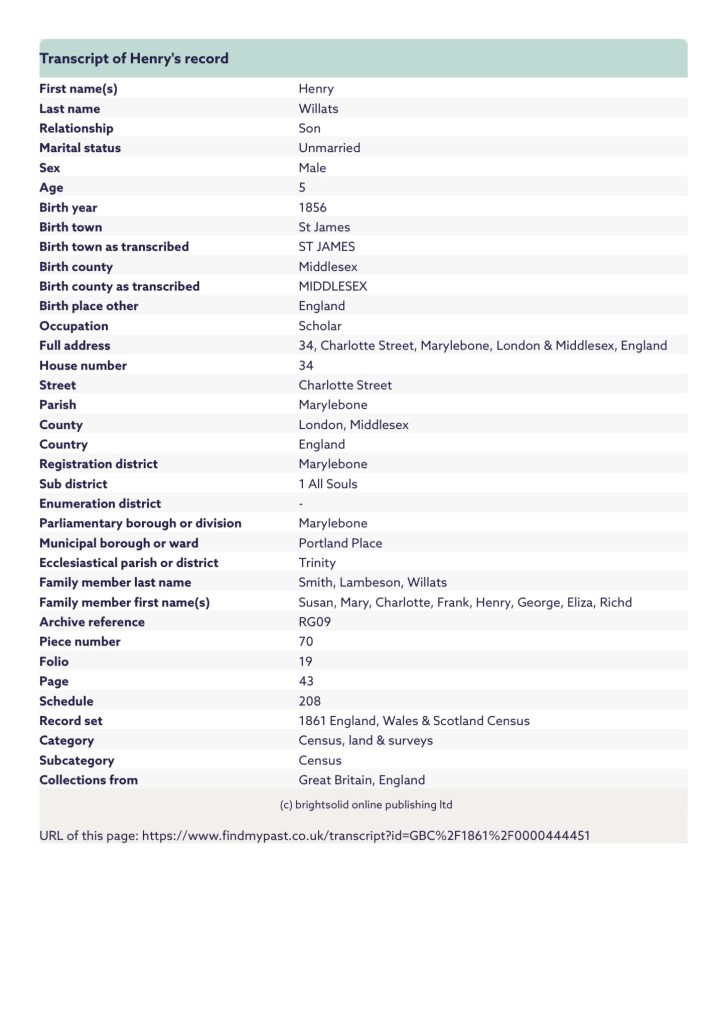
It shows Henry Richard residing at 34, Charlotte Street, Marylebone, London, England, with his parents Richard Henry and Eliza and his siblings, George, Frank, and Charlotte and his Grandmother Mary Falconer as well as a servant, called Susan Smith. His father Richard, was working as a commercial traveller, and his mother Eliza, as an Artificial florist.

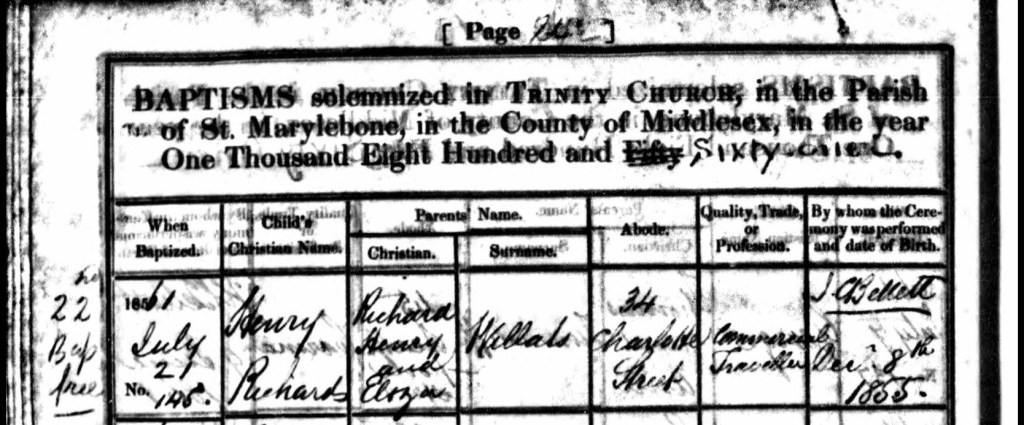
Richard and Eliza baptised, Henry Richard Willats and Francis Montague Allen, on Sunday the 21st of July, 1861, at Holy Trinity Church, Marylebone Road, Westminster, London, England.
Richard gave his occupation as a commercial travelling and their abode, as 34 Charlotte Street.
Holy Trinity Church, in Marylebone, Westminster, London, is a Grade I listed former Anglican church, built in 1828 and designed by John Soane. In 1818 Parliament passed an act setting aside one million pounds to celebrate the defeat of Napoleon. This is one of the so-called “Waterloo churches” that were built with the money. It has an external pulpit facing onto Marylebone Road, erected in memory of the Revd. William Cadman MA (1815-1891), who was rector of the parish from 1859 – 1891, renowned for his sonorous voice and preaching. The building has an entrance off-set with four large Ionic columns. There is a lantern steeple, similar to St Pancras New Church, which is also on Euston Road to the east.
George Saxby Penfold was appointed as the first Rector, having previously taken on much the same task as the first Rector of Christ Church, Marylebone. The first burial took place in the vault of the church in 1829, and the last was that of Sir Jonathan Wathen Waller in 1853.
By the 1930s, the use of the church had declined, and from 1936 it was used as a book warehouse by the newly founded Penguin Books. A children’s slide was used to deliver books from the street into the large crypt. In 1937 Penguin moved out to Harmondsworth, and the Society for Promoting Christian Knowledge (SPCK), an Anglican missionary organisation, moved in. It was their headquarters until 2006, when they relocated to Tufton Street, Westminster (they have since moved again to Pimlico). The church is currently[when?] the location of the world’s first wedding department store, The Wedding Gallery, which is based on the ground floor and basement level. The first floor is used as an events space operated by One Events and known as “One Marylebone”.
The former church stands on a traffic island by itself, bounded by Marylebone Road at the front, and Albany Street and Osnaburgh Street on either side; the street at the rear north side is Osnaburgh Terrace.

Henry welcomed his sister, Edith Cameron Willats into the world, their hearts and home, on Sunday the 20th of October, 1861, at Number 34, Charlotte Street, Marylebone, Middlesex, England. Richard Henry was working as a Commercial Traveller and he registered Edith’s birth on Monday the 25th of November, 1861.

Henry’s brother, Arthur Charles Willats was born on Saturday the 11th of July, 1863, at Number 37, Charlotte Street, Marylebone, Middlesex, England, to Eliza Cameron, age 27, and Richard Henry Willats, age 28. Richard’s occupation was given as a, Commercial Traveller and he registered Arthur’s birth on Friday the 21st August 1863.

Henry’s brother, Arthur Charles and his sister, Edith Cameron Willats, were baptised on Sunday the 9th of August 1863, at Holy Trinity Church, Marylebone Road, Westminster, Middlesex, England.
Richard’s occupation was given as a Traveller and their abode as Number 37, Charlotte Street.

Henry’s parents, Richard and Eliza, welcomed their new born son into their hearts, home and family, on Friday the 13th January 1865.
They names him, Walter James Willats.
Eliza gave birth at their home, 37, Charlotte Street, Marylebone, All Souls, Middlesex, England.
Richard registered Walters birth on Thursday the 9th of March 1865.
He gave his occupation as a commercial traveller and their abode as, 37, Charlotte Street.

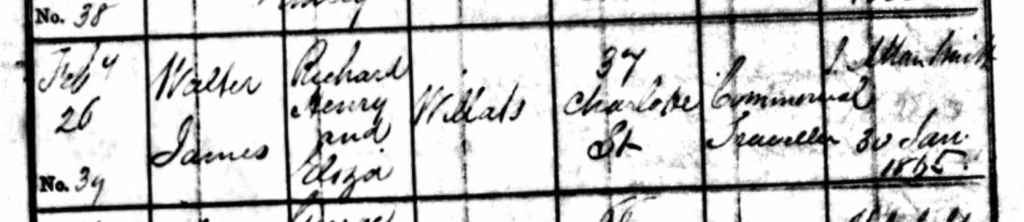
Richard and Eliza, baptised Walter James, on Sunday the 26th February, 1865, at Holy Trinity Church Marylebone Road, Marylebone, Middlesex, England.
Richards occupation was given as a commercial traveller and there abode 37 Charlotte Street.
Henry’s parents Richard Henry and Eliza Willats nee Cameron finally married, on Thursday the 4th of May, 1865.
They married at, St Margarets, Westminster, London, England.
Richard was a Bachelor.
Eliza was listed as a widower, which is rather strange as her first husband George John Willats (Richard Henry Willats’s brother) didn’t die until later that year.
Their witnesses were, George John Willats, Patrick’s brother and Eliza’s first husband and Eliza’s sister Mary Cameron.
Eliza and Richard, were residing at 10 North Street.
Richard was working as a Commercial Traveller.
Eliza’s Father, Allen Cameron was working as a Tailor and Richard’s Father George Willats, was working as a Wood Craver.
I have no idea as to how Richard and Eliza were able to marry, as it was strictly forbidden to marry a brothers wife even a deceased brother. Family story’s state that, a sympathetic member of the clergy came to their rescue and had the first marriage annulled. I guess we will never know for sure but it seems that maybe something fishy was going on as George John married Sarah Elizabeth Southall Jukes, in Victoria, Australia, in 1856 (11 years before Richard and Eliza wed.)

The Church of St Margaret, Westminster Abbey, is in the grounds of Westminster Abbey on Parliament Square, London, England. It is dedicated to Margaret of Antioch and forms part of a single World Heritage Site with the Palace of Westminster and Westminster Abbey.
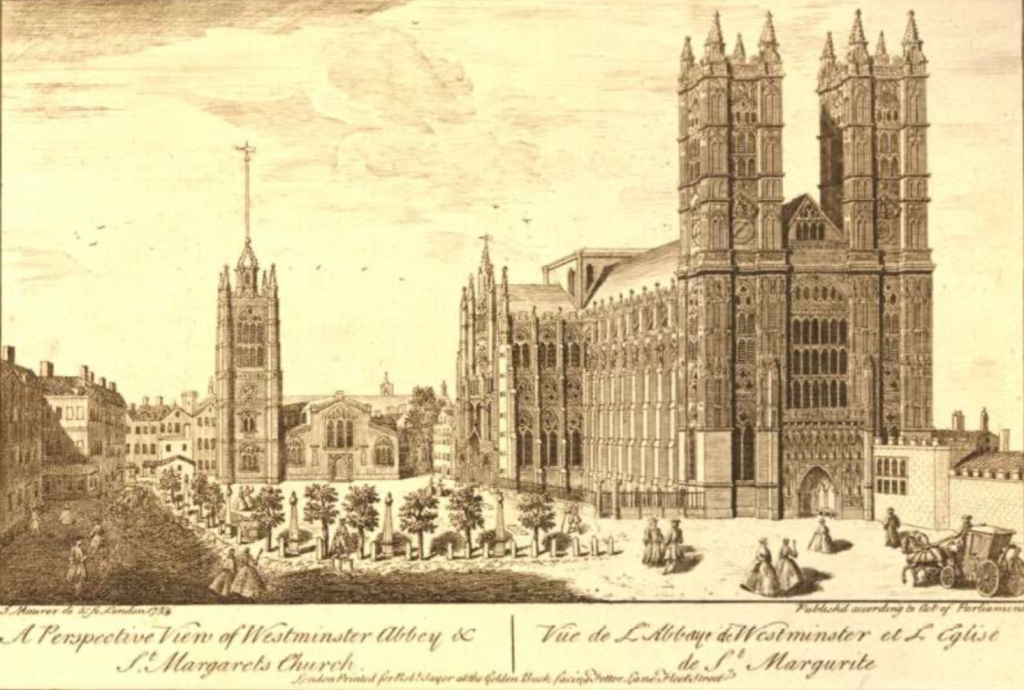
The church was founded in the twelfth century by Benedictine monks, so that local people who lived in the area around the Abbey could worship separately at their own simpler parish church, and historically it was within the hundred of Ossulstonein the county of Middlesex. In 1914, in a preface to Memorials of St. Margaret’s Church, Westminster, a former Rector of St Margaret’s, Hensley Henson, reported a mediaeval tradition that the church was as old as Westminster Abbey, owing its origins to the same royal saint, and that “The two churches, conventual and parochial, have stood side by side for more than eight centuries – not, of course, the existing fabrics, but older churches of which the existing fabrics are successors on the same site.”
St Margaret’s was rebuilt from 1486 to 1523, at the instigation of King Henry VII, and the new church, which largely still stands today, was consecrated on 9 April 1523. It has been called “the last church in London decorated in the Catholic tradition before the Reformation”, and on each side of a large rood there stood richly painted statues of St Mary and St John, while the building had several internal chapels. In the 1540s, the new church came near to demolition, when Edward Seymour, 1st Duke of Somerset, planned to take it down to provide good-quality materials for Somerset House, his own new palace in the Strand. He was only kept from carrying out his plan by the resistance of armed parishioners.
In 1614, St Margaret’s became the parish church of the Palace of Westminster, when the Puritans of the seventeenth century, unhappy with the highly liturgical Abbey, chose to hold their Parliamentary services in a church they found more suitable: a practice that has continued since that time.
Between 1734 and 1738, the north-west tower was rebuilt to designs by John James; at the same time, the whole structure was encased in Portland stone. Both the eastern and the western porch were added later, with J. L. Pearson as architect. In 1878, the church’s interior was greatly restored and altered to its current appearance by Sir George Gilbert Scott, although many Tudor features were retained.
In 1863, during preliminary explorations preparing for this restoration, Scott found several doors overlaid with what was believed to be human skin. After doctors had examined this skin, Victorian historians theorized that the skin might have been that of William the Sacrist, who organized a gang that, in 1303, robbed the King of the equivalent of, in modern currency, $100 million. It was a complex scheme, involving several gang members disguised as monks planting bushes on the palace. After the stealthy burglary 6 months later, the loot was concealed in these bushes. The historians believed that William the Sacrist was flayed alive as punishment and his skin was used to make these royal doors, perhaps situated initially at nearby Westminster Palace. A subsequent study revealed the skins were bovine in origin, not human.
By the 1970s, the number of people living nearby was in the hundreds. Ecclesiastical responsibility for the parish was reallocated to neighbouring parishes by the Westminster Abbey and Saint Margaret Westminster Act 1972, and the church was brought under the authority of the Dean and Chapter of Westminster Abbey.
An annual New Year service for the Coptic Orthodox Church in Britain takes place in the church in October, and in 2016 Bishop Angaelos gave the sermon.
The Rector of St Margaret’s is often a canon of Westminster Abbey.

Henry’s mum, Eliza gave birth to a baby girl whom they called, Eliza Mary Willats. Eliza Mary was born on Wednesday the 20th of March, 1867, at Number 37 Charlotte Street, All Paul’s, Marylebone, Middlesex, England.
Her Father Richard was working as a Buyer …. at the time of her birth. Eliza registered Eliza’s birth on Monday the 29th of April 1867.
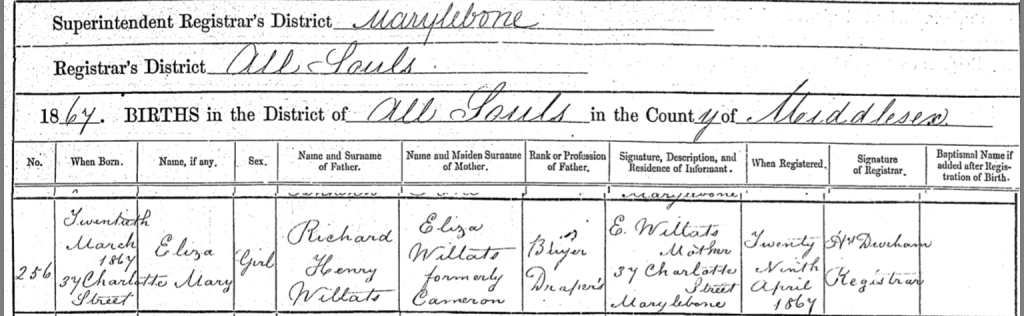
Richard and Eliza baptised Eliza Mary, on Sunday the 21st of April 1867, at Holy Trinity Church, Marylebone Road, Marylebone, Middlesex, England. Richards’s occupation was given as Saleman and their abode as, 37 Charlotte Place.
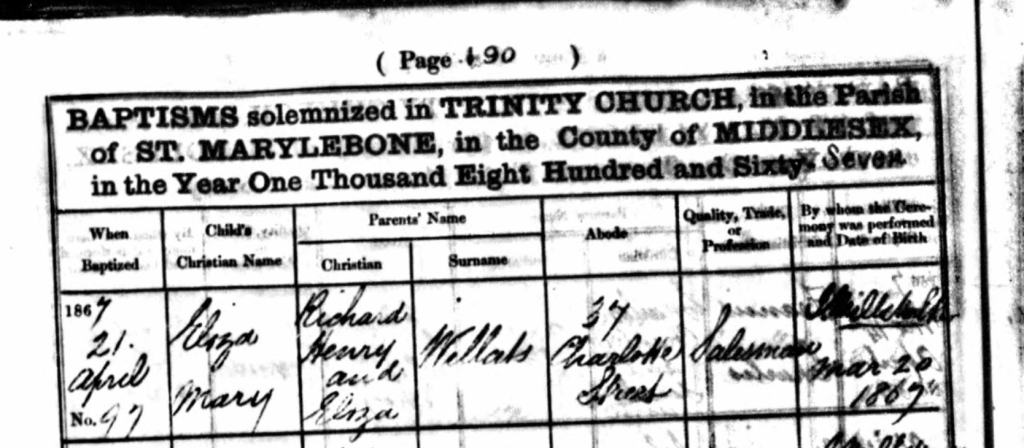
Henry’s mum, Eliza was once again in the family way and she gave birth to her 9th child, Richard and her, 4th Daughter, on Monday the 4th of October, 1869, at, Number 38, Regent Square, Greys Inn Lane, Pancras, Middlesex, England.
Eliza and Richard named her, Lilly Jenny Willats.
Eliza registered her birth on the 15th January 1869.
She gave Lilly’s Father Richard, occupation was listed as a Traveller (Feathers) and their abode as, Number 38, Regent Square, Pancras.
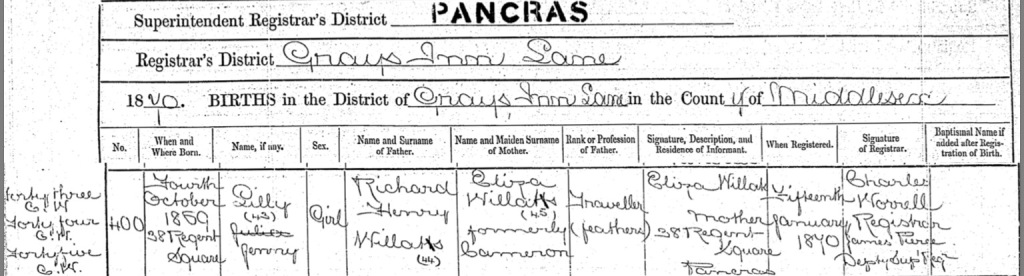
Richard and Eliza baptised Lillian Jenny Willats, on Sunday the 31st of October, 1869, at Saint Peter Church, Saint Pancras, London, England.
It was a private baptism.
Richard, occupation was listed as a Warehouseman and their abode was, Number 38, Regent Square, Pancras.

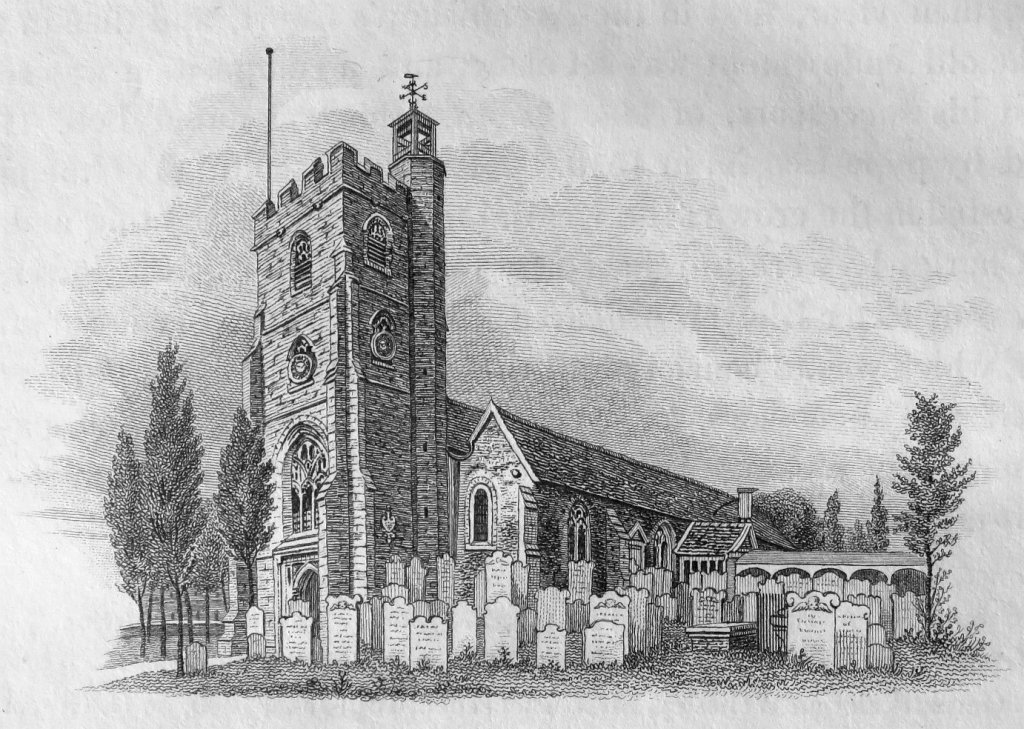
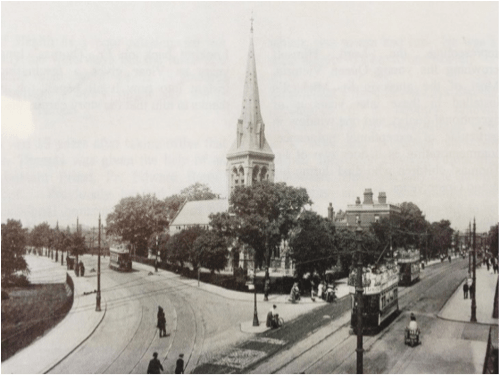
Devastatingly Saint Peters in Regent Square was hit by bombs in the war and had to be demolished. Unfortunately there doesn’t seem to be much information about it online. From the below image, it was a very impressive building.

Henry, his parents Eliza and Richard and his siblings, Walter, Eliza, Francis, Lillian, Edith, George and Charlotte, were residing at, Number 5, Park Place, Islington, Middlesex, England, on Sunday the 2nd of April 1871. Richard was working as a Dealer in Feathers. The family had two General Servants, residing with them, Jemima Roach and Caroline Curry.
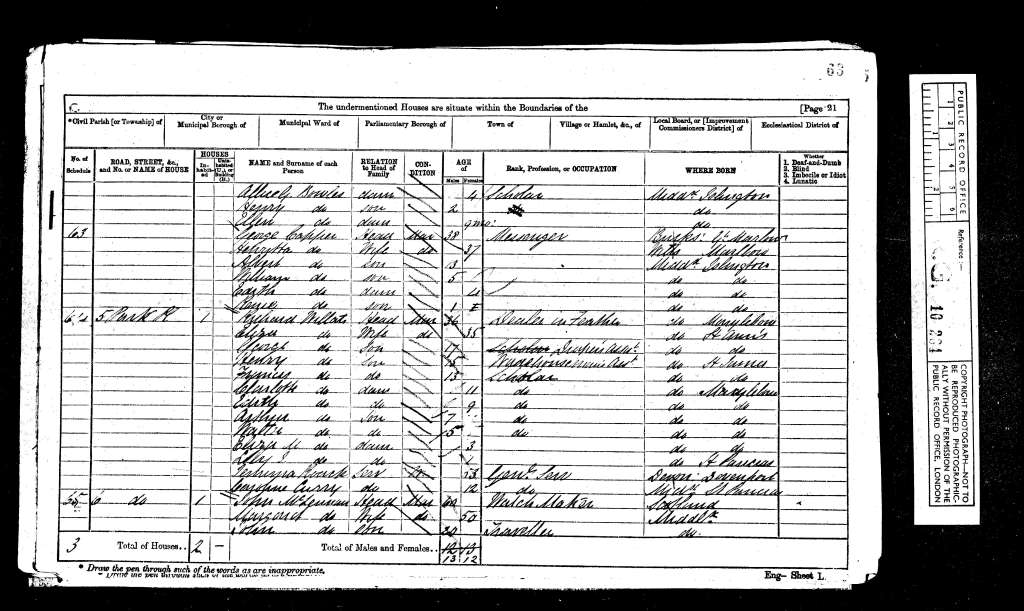
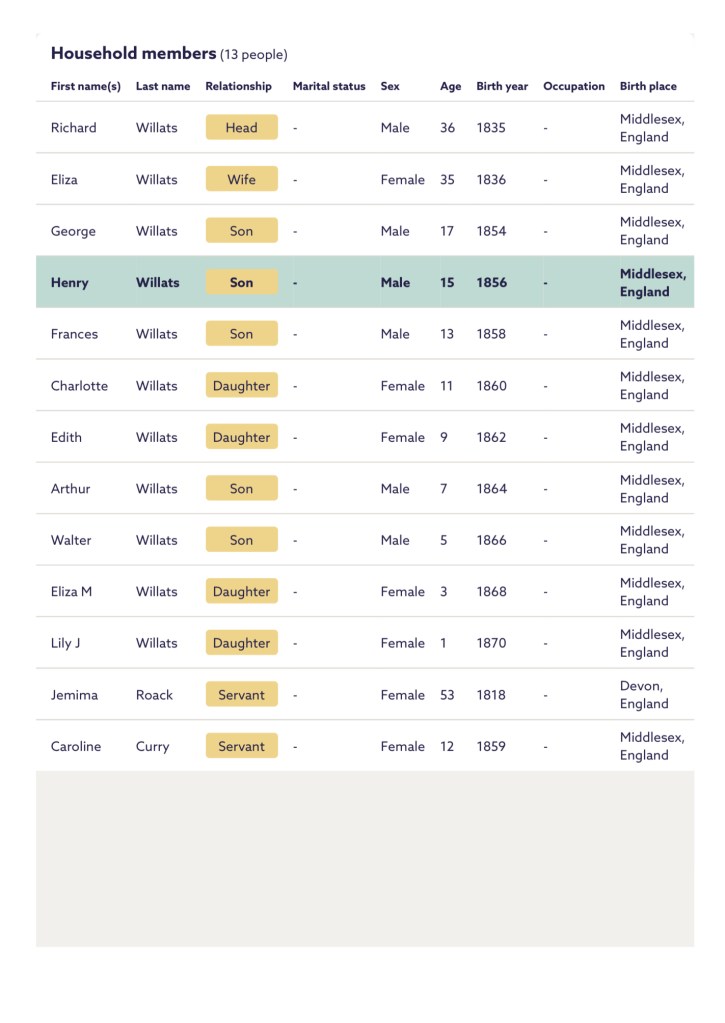
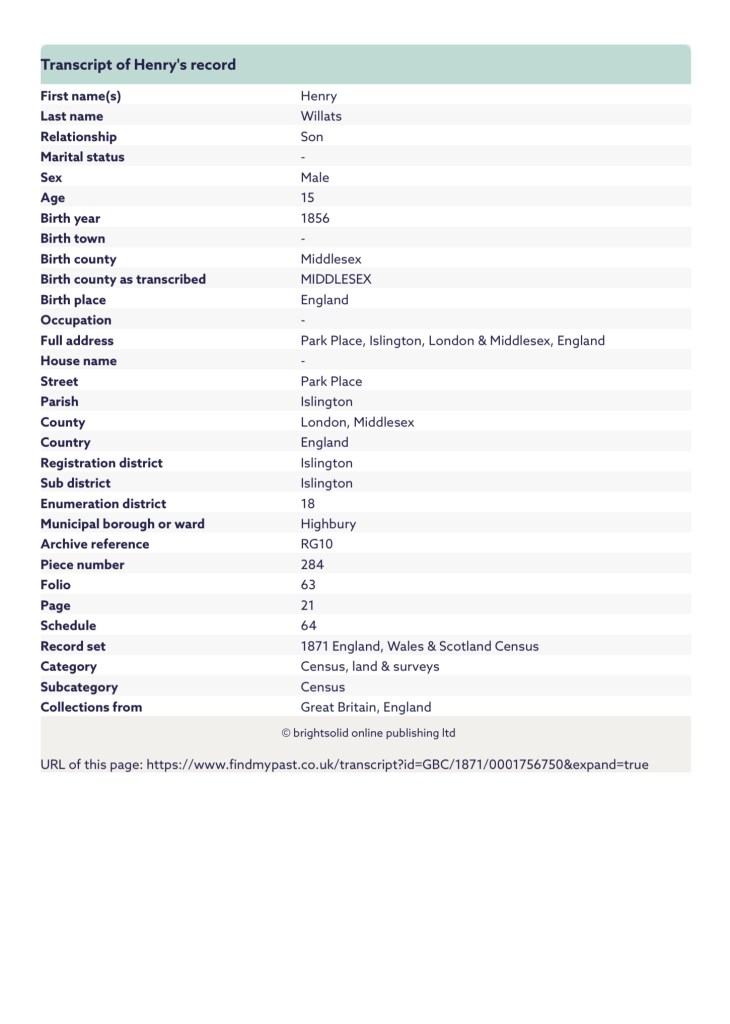
Henry’s mum, Eliza, childbearing days were still in full flow and gave birth to her and Richard 5th Son, Edwin Paul Willats, on Wednesday the 8th of November, 1871, at Number 5, Park Place, Highbury, Islington, Middlesex, England.
Richard was working as a Commercial Buyer and he registered Edwins birth on Wednesday December 20th 1871.
He gave their abode as, Number 5, Park Place, Islington.
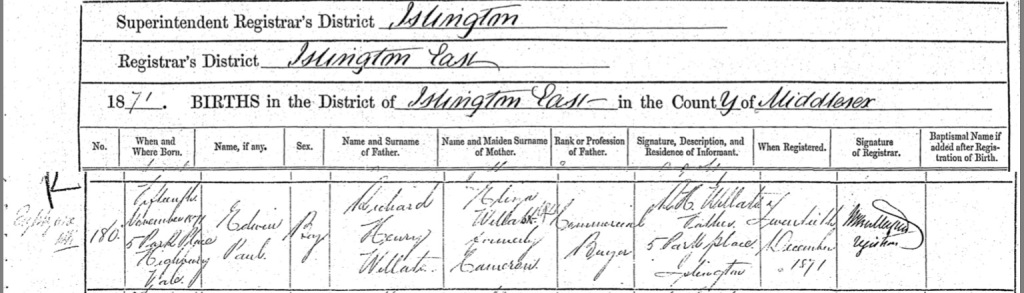
Henry’s brother Edwin was baptised on Friday the 8th December 1871, at the Parish Church of St Mary the Virgin, Islington, Middlesex, England.
Richards occupation was listed as a Workhouse Man and their abode as 5 Park Place.

The Church of St Mary the Virgin is the historic parish church of Islington, in the Church of England Diocese of London. The present parish is a compact area centered on Upper Street between Angel and Highbury Corner, bounded to the west by Liverpool Road, and to the east by Essex Road/Canonbury Road. The church is a Grade II listed building.
The churchyard was enlarged in 1793. With the rapid growth of Islington, it became full and closed for burials in 1853. It was laid out as a public garden of one and a half acres in 1885.

Henry’s parents, Richard and Eliza, welcomed their 5th Daughter into the world on Tuesday the 5th of May, 1874, at 5 Park Place, Highbury, East Islington, England. They named her May Claretta Willats. Richards’s occupation was given as a Feather Warehouseman and he registered May’s birth on Tuesday the 16th of June 1874.
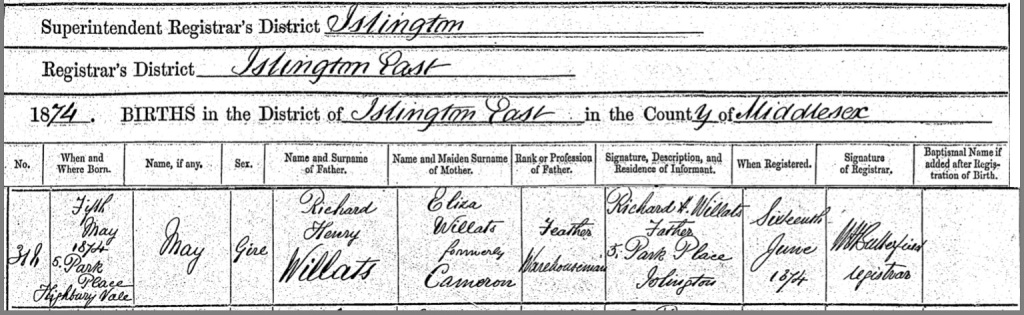
Henry, his parents Richard and Eliza, and his siblings, baptised May Claretta, on, Sunday the 9th of August, 1874, at Christ Church, Highbury, Islington, north-west London, England. Richard gave his occupation as a Manufacturer and their abode as, Highbury. Christ Church, Highbury, is an Anglican church in Islington, north London, next to Highbury Fields.

Christ Church, Highbury is an Anglican church in Islington, north London, next to Highbury Fields.
The site was given by John Dawes, a local benefactor and landlord, and the church was built by Thomas Allom in a cruciform shape with a short chancel, transepts, and nave from 1847 to 1848. Bridget Cherry and Nikolaus Pevsner write that Christ Church Highbury ‘is a successful and original use of Gothic for a building on a cruciform plan with broad octagonal crossing. The cross-plan with broad nave and crossing were popular for churches in the low church tradition where an effective auditorium for the spoken word was preferred to a plan designed for an elaborate liturgy.’
Since then, several changes have been made to the church, including the addition of a balcony in 1872, and new rooms for children’s work and fellowship in 1980.
The church was opened in 1848 by Reverend Matthew Anderson Collisson, son of Irishman Daniel Marcus Collisson and his wife Catherine.
A special service booklet was published to celebrate the occasion: “On the Consecration of the New Church at Highbury, Dedicated to the Saviour as ‘Christ’s Church'”, Reverend M A Collisson.

On Wednesday the 1st September 1875, Henry’s mum, Eliza gave birth to Percy Sidney Willats, at Richards and Eliza’s family home, Number 9, Park Place, Highbury, Islington, Middlesex, England.
Richard gave his occupation as a Fancy Warehouseman and their abode as, 9, Park Place, Islington, when he registered Percy’s birth on Saturday the 9th of October, 1875, in Islington.

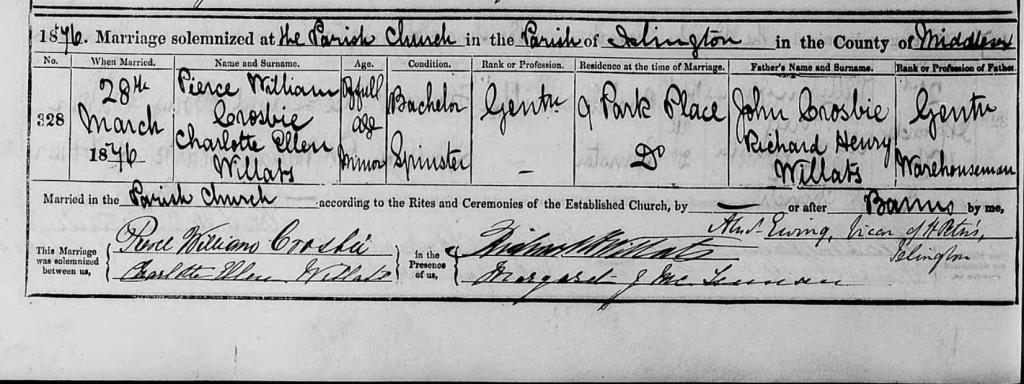
Henry’s sister, spinster Charlotte Ellen Willats married bachelor, Pierce William Crosbie, on Tuesday the 28th of March, 1876, in St Mary’s Church, Islington, Middlesex, England.
Charlotte was a minor and Pierce was of full age. Pierces occupation was given as a Gentu.
They gave their residence as 9 Park Place and gave their fathers names and occupations as, Richard Henry Willats, a Warehouseman and John Crosbie a Gentu.
Their witnesses were Richard Willats and Charlotte’s future sister-in-law Margaret Jane McLennon.
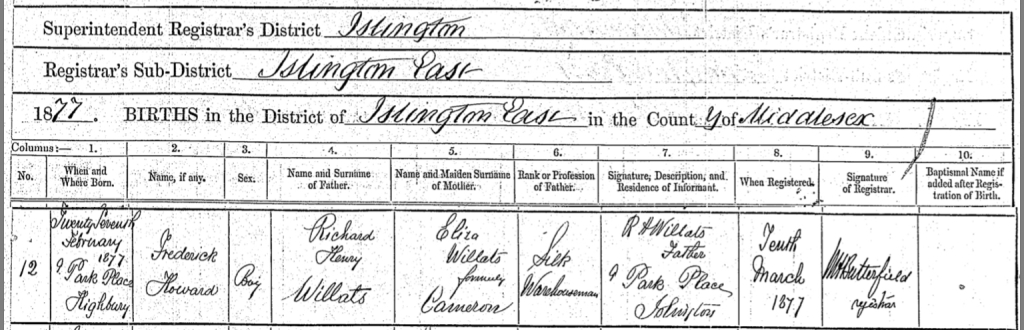
After many, many years of bearing children, Eliza, Henry’s mum, gave birth to her 13th Child, a baby boy, on the 27th February 1877 at Number 9, Park Place, Highbury, Islington, Middlesex, England.
Richard and Eliza named him, Frederick Howard Willats.
Richards gave his occupation as a Silk Warehouseman, and their abode as, 9 Park Place, Islington, when he registered Frederick’s birth on the 10th March 1877.
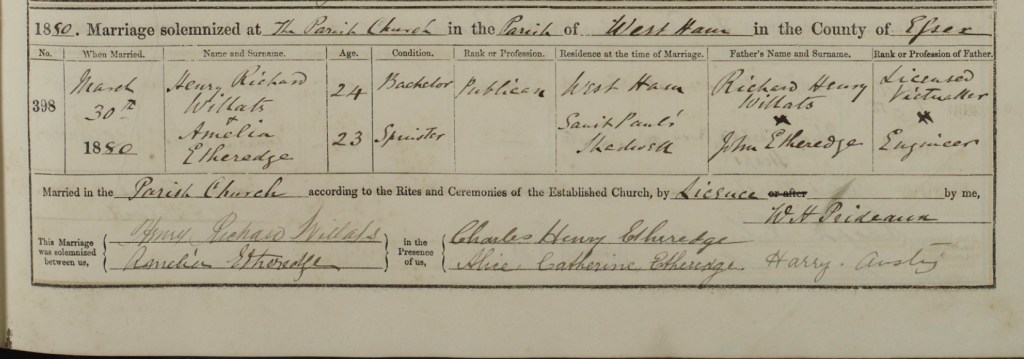
24 year old, bachelor, publican, Henry Richard Willats married 23 year old, spinster, Amelia Etheredge, daughter of John Etheredge, on Tuesday the 30th of March, 1880 at All Saints Church, West Ham, Essex, England.
Henry gave his residence as West Ham and Amelia as, Saint Paul’s, Shadwell.
They gave their fathers names and occupations as, Richard Henry Willats, a Licensed Victualler and John Etheredge, an Engineer.
Their witnesses were Charles Henry Etheredge and Alice Catherine Etheredge.
All Saints Church is a parish church in West Ham, an area in east London. It has been a Grade I listed building since 1984.
In the medieval era the church’s parish included all of West Ham, with the one exception of the 24 acres within Stratford Langthorne Abbey‘s precincts, which formed a separate parish of St Mary and All Saints until the abbey was dissolved, that parish’s church was destroyed and the parish itself merged into All Saints.
There has been a building on the site since at least the late 12th century – the three blocked clerestory windows on either side of the present building’s nave date to that time. One of the founding endowments for the Abbey was land that had belonged to “Ranulph the priest”, implying the existence of a parish church. The first concrete reference is a charter of 1181-82 by Henry II of England which confirmed the church of West Ham to the abbey. Gilbert Foliot, bishop of London also assigned a vicar to the parish church around the same time. The building contains a relief and possibly the remains of a font from the Abbey.
The nave was largely rebuilt halfway through the 13th century, adding five-bay arcades on the north and south sides. Its crossing was demolished around 1400 to add two bays to the nave’s east end – the chancel arch was rebuilt and the west tower added at the same time. The abbey acquired the parish by 1334 and held onto it until the crown took it over after the Dissolution. A north chapel was added in mid 15th century, closely followed by a south chapel. Many of the windows in the north aisle seem to date to the late 15th century, implying another rebuilding in that area at that time, whilst wall paintings found in the nave during 19th century restorations probably also date to the 15th century. Around 1547 the churchwardens sold some of the church’s communion plate and a property in Stratford to fund a rebuilding of the north chapel in brick, without the parish’ permission – this included a turret for a stairwell into a rood screen on its north side. The Protestant Thomas Rose was made its vicar in 1552.
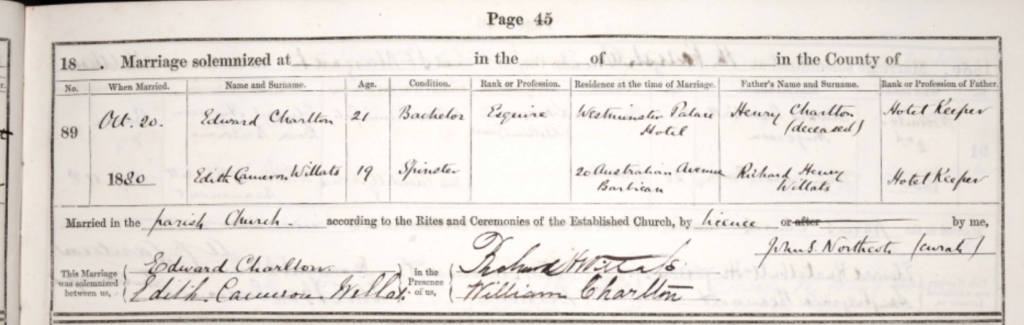
Henry’s sister, 19-year-old, spinster, Edith Cameron Willats married 21-year-old Bachelor, Edward Charlton, an Esquire, on Wednesday the 20th of October, 1880, at St Margaret Church, George Hanover Square, Westminster, London, England.
They gave their fathers names and occupations as, Richard Henry Willats, a Hotel Keeper and Henry Charlton, a Hotel Keeper.
Edith gave her residents as, 20 Australian Avenue, Barbican, Silk Street, St Giles, Westminster, London, EnglandAnd Edward gave his as Westminster Palace Hotel.
Their witnesses were, Richard Willats and William Charlton.
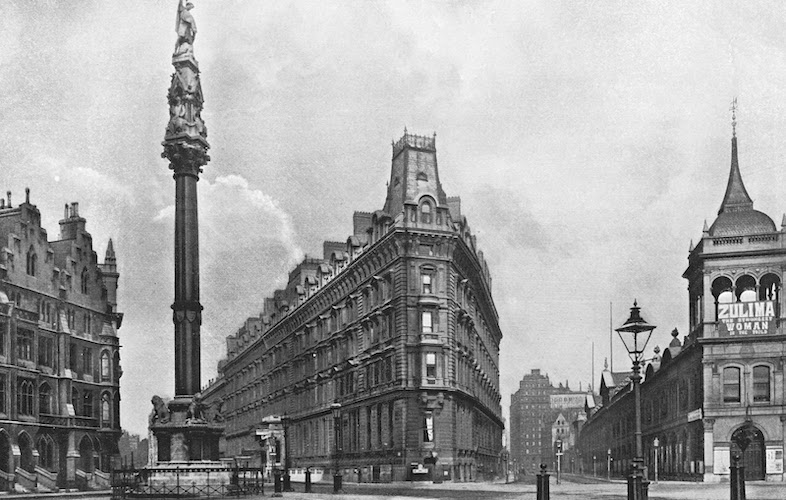
The Westminster Palace Hotel, was a luxury hotel in London, located in the heart of the political district. Opened in 1860, the hotel was the scene of many significant meetings, including the London Conference of 1866 which finalised the details for the confederation of Canada. It also served as the office building of the India Office of the British government for several years in the 1860s. It was demolished in 1974.
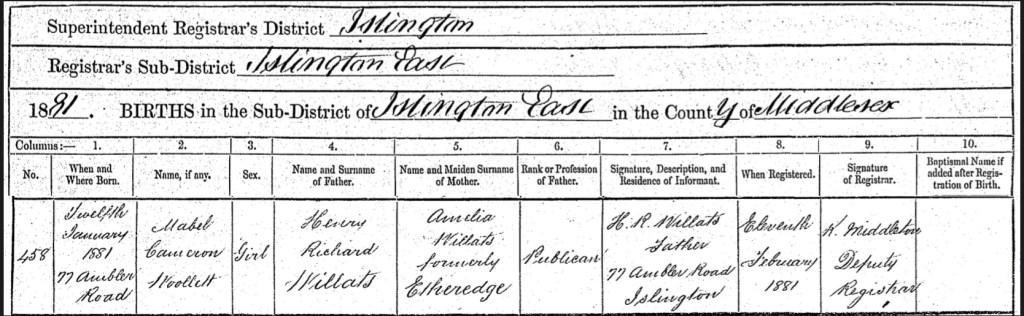
Henry and Amelia, welcomed a newborn daughter into the world when Amelia gave birth on Wednesday, the 12th of January, 1881, at their home, Number 77 Ambler Road, Islington, Middlesex, England.
They named her Mabel Cameron Woollett Willats.
Her father, publican, Henry Richard Willats, registered her birth on Friday the 11th February 1881.
Henry and Amelia, baptised Mabel Cameron Wollett Willats, at The Parish Church of St Anne, Tollington Park, Islington, Middlesex, England, on Sunday the 6th of February, 1881.


However ancestry gives the church as St Anne, Poole’s Park, Islington, England.
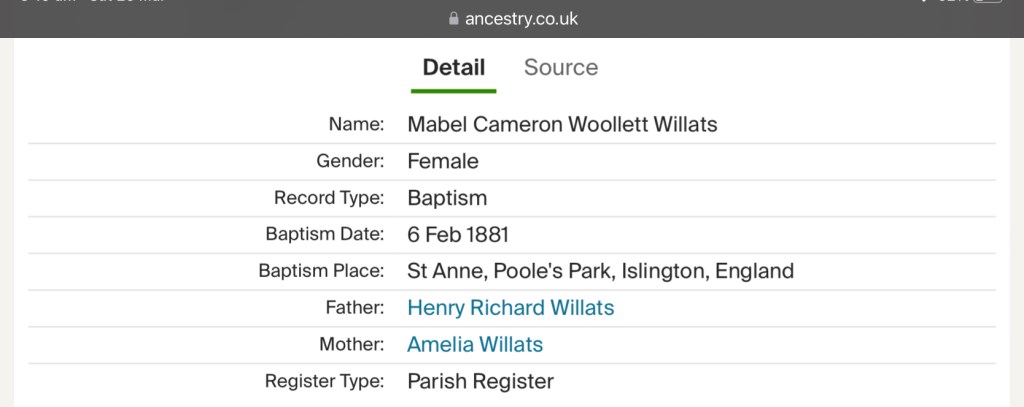
Henry, and Amelia, seem to be playing a very good game of hide and seek in the 1881 census.
I can’t seem to locate them anywhere, but we do know that they were residing at, 77 Ambler Road, Islington, in January 1881, when their daughter Mabel was born.
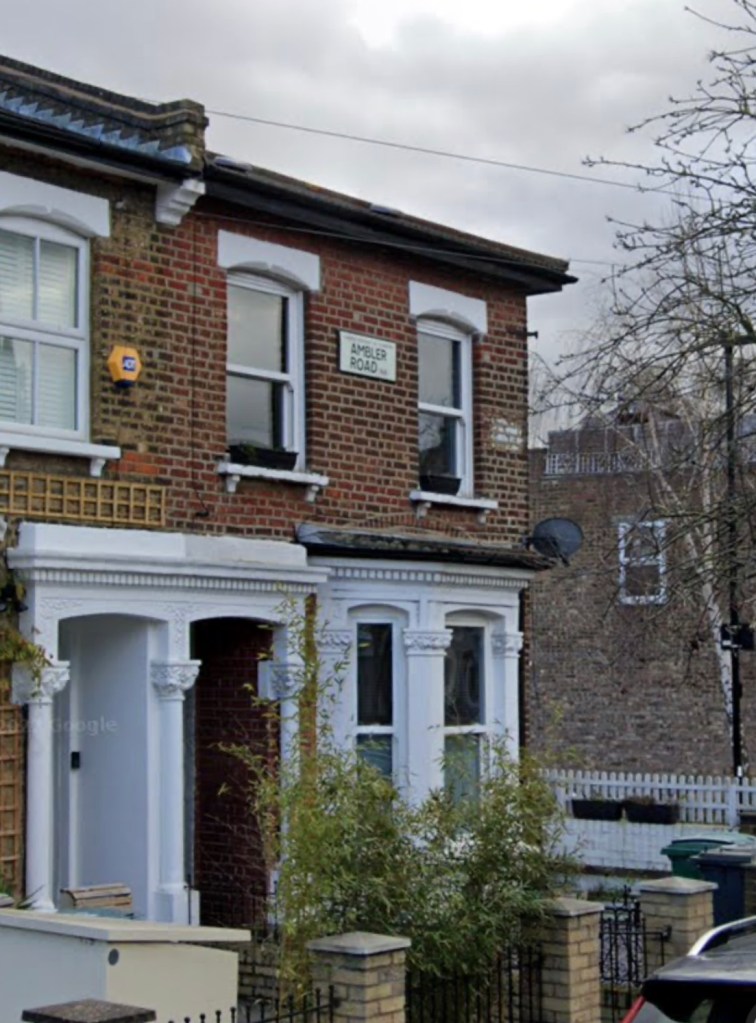
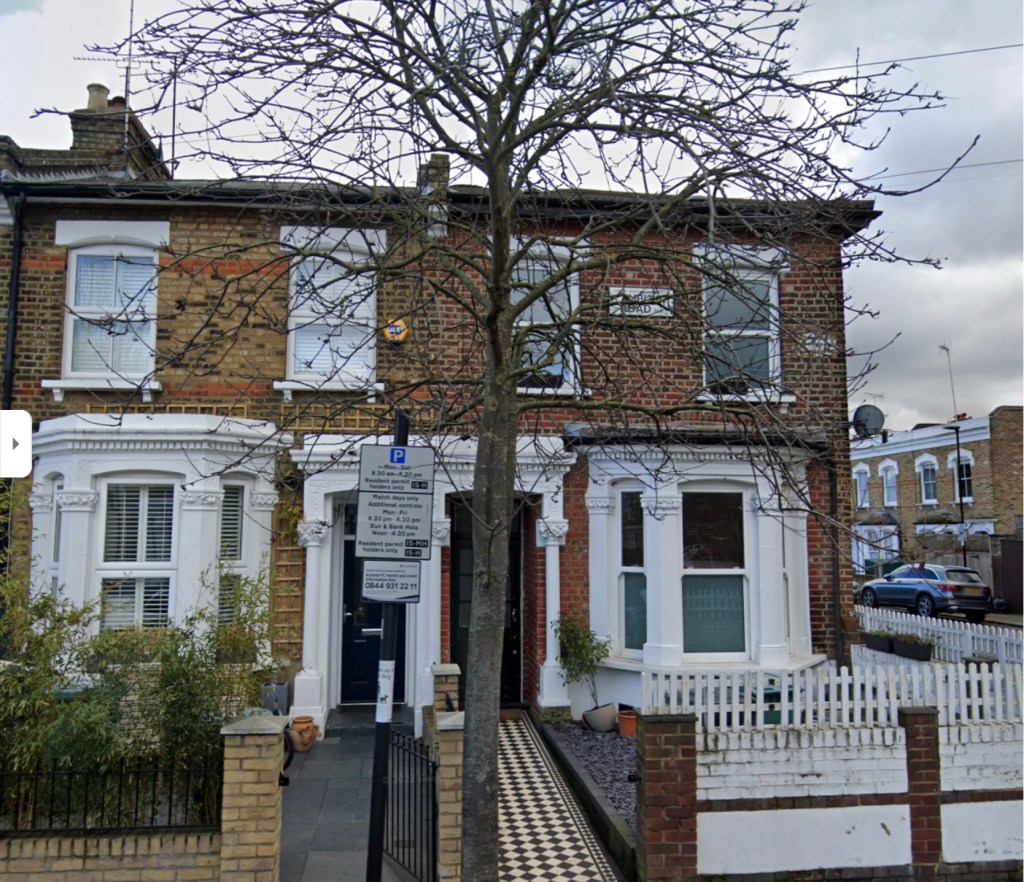
However I have looked through the 1881 census, page by page, starting at number 61,
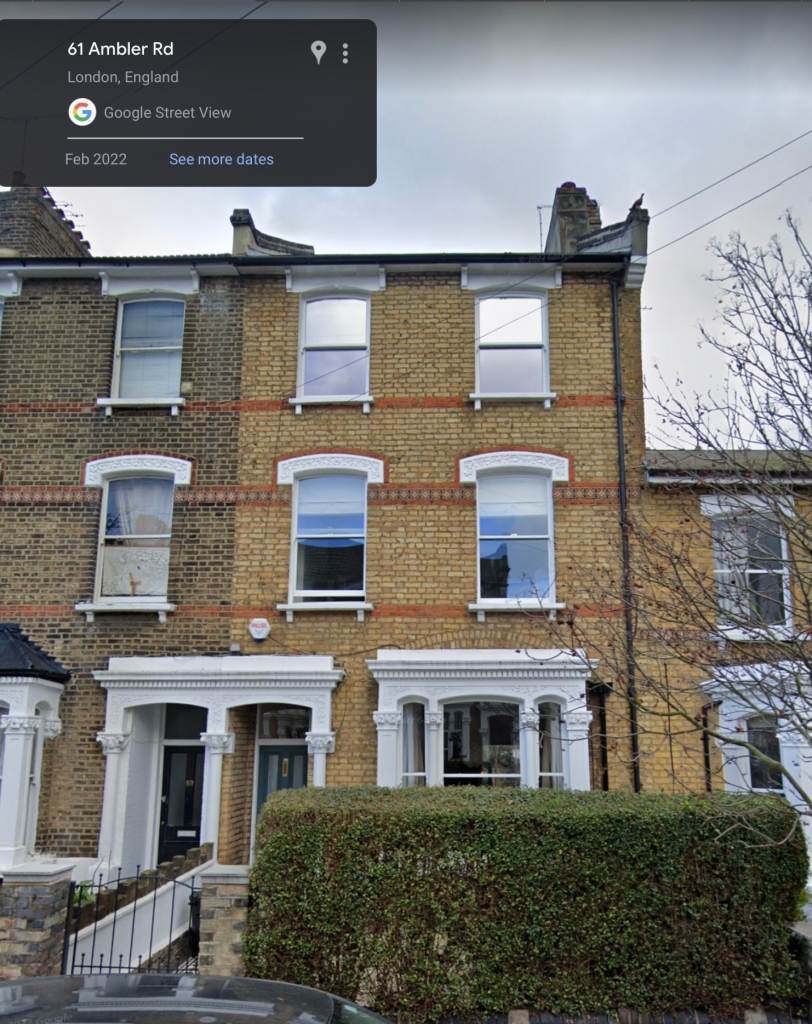
where Henry’s parents and siblings were residing and they are not at number 77.
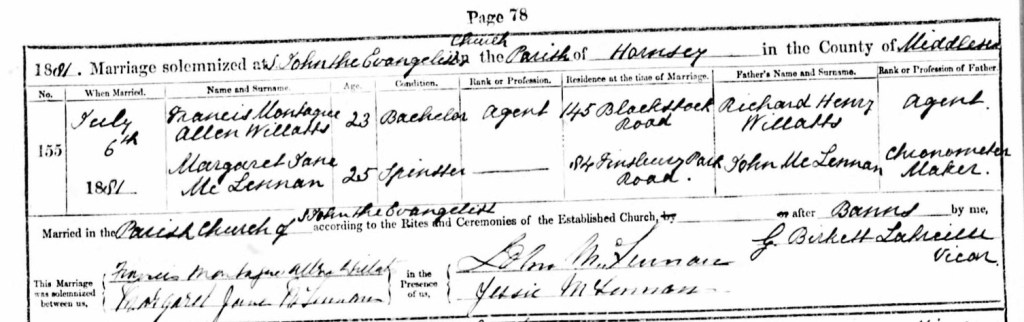
Specking of Henry’s siblings, Henry’s brother, 23-year-old, bachelor, Francis Montague Allen Willats married 25 year old, spinster, Margaret Jane McLennon, at St John’s Church, Hornsey, Middlesex, England, on Wednesday the 6th of July, 1881.
Francis was working as an agent at the time of his marriage.
They gave their fathers names and occupations as Richard Henry Willats, an Agent and John McLennon, a Chronometer Maker.
Francis gave his abode as, 145 Blackstock Road and Margaret gave hers as, 84, Finsbury Park Road.
Their witnesses were John McLennon and Jessie McLennon.
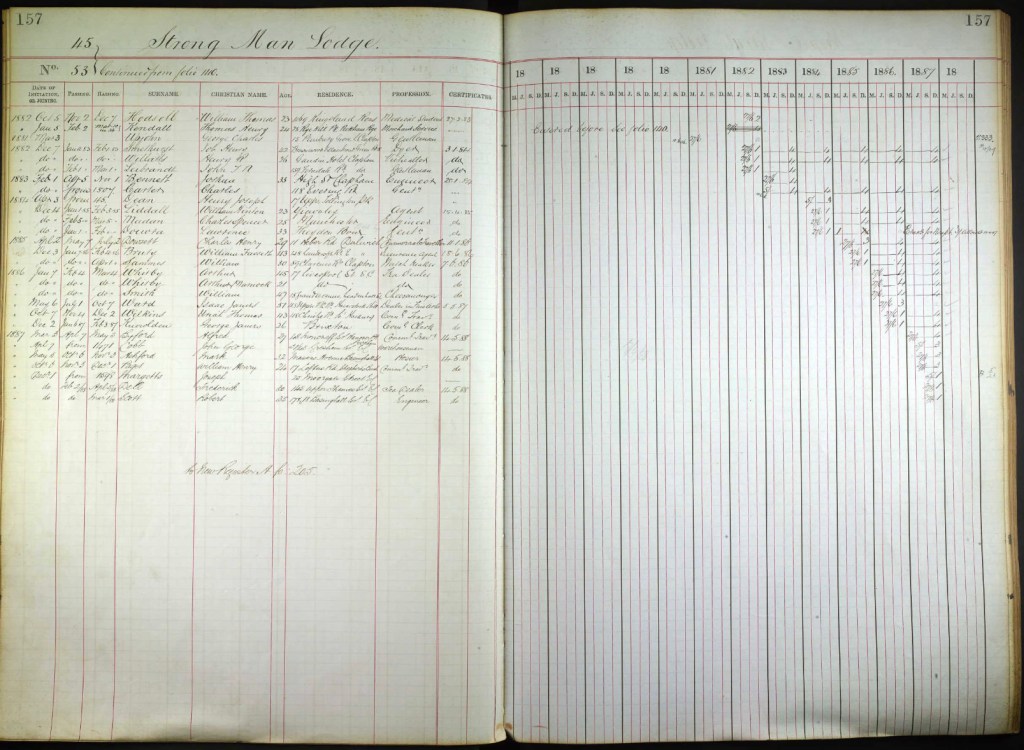
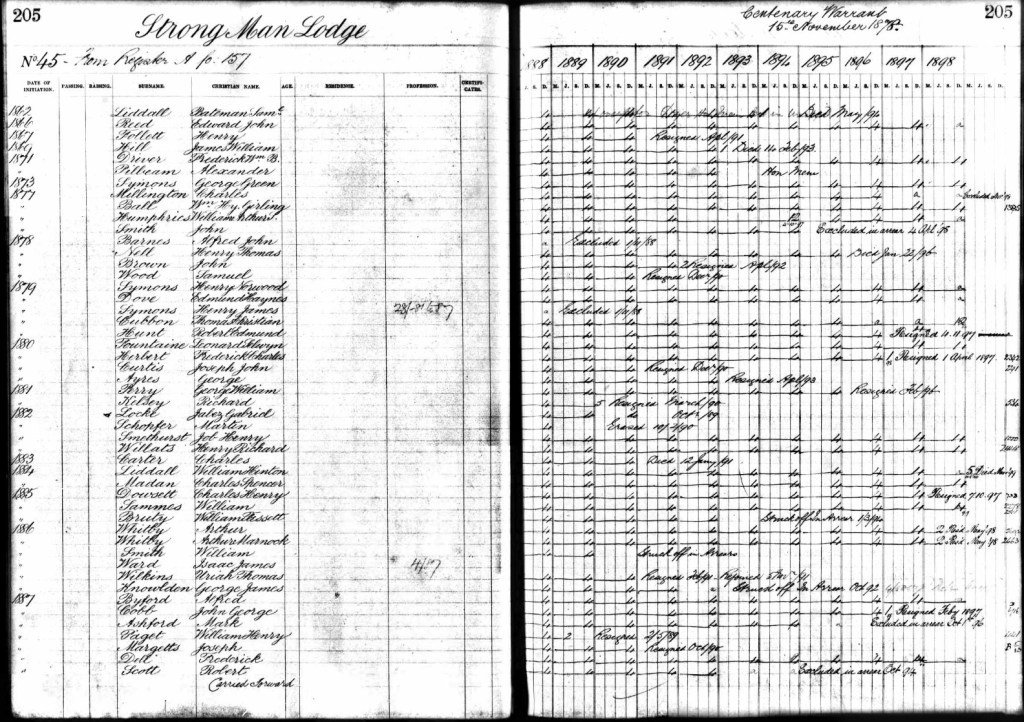
Henry joined the Freeman’s on Thursday the 7th of December 1882, passing on Thursday the 4th of January, 1883, and raising on Thursday the 1st of February 1883. He gave his residence as the Guardian Hotel, Clapham, and his occupation as a victualler.
Henry received his certificate on the 3rd of January 1884.
In 1882, Freemasonry was already a venerable institution, its origins tracing back centuries. The fraternity’s tenets of brotherly love, relief, and truth resonated deeply with men seeking a sense of belonging, purpose, and moral guidance in a rapidly changing world. In a time when societal values were being redefined, Freemasonry offered a sanctuary, where men of diverse backgrounds united under a common banner to strive for personal growth and the betterment of society.
To become a Freemason in 1882 was to embark on a transformative journey, a voyage through rituals laden with symbolism and allegory. Initiates entered a sacred space where the secrets of the craft were imparted upon them, and bonds were forged that transcended the ordinary. Within the hallowed walls of Masonic lodges, these men discovered profound lessons of morality, virtue, and the importance of self-improvement.
Central to the spirit of Freemasonry was the principle of equality. Within the lodge, societal hierarchies dissolved, and men of all walks of life stood shoulder to shoulder, equally respected and esteemed. This radical notion of inclusivity and mutual respect was groundbreaking, paving the way for camaraderie that extended beyond borders, religions, and politics.
The Masonic fraternity also played a vital role in supporting charitable endeavors and serving the broader community. Benevolence and philanthropy were woven into the very fabric of Freemasonry, as lodges took up causes to uplift the less fortunate and provide relief to those in need. Whether it was funding educational initiatives, supporting widows and orphans, or contributing to civic projects, Freemasons embraced their duty to make a positive impact on society.
Furthermore, Masonic symbolism and rituals were deeply interwoven with spiritual and philosophical teachings. Drawing inspiration from sacred geometry, ancient architecture, and biblical narratives, Freemasons sought to understand the deeper truths of existence and the human condition. The allegorical journey of the initiate mirrored the pursuit of self-discovery and enlightenment, as they navigated the path of the craftsman, honing their moral character through virtue and introspection.
However, Freemasonry was not without controversy and criticism. Detractors questioned the society’s secretive nature, fearing that hidden agendas lurked behind its closed doors. Yet, Freemasons steadfastly maintained that their secrets were merely symbolic and served to foster a sense of unity and shared experience among brethren.
The spirit of brotherhood, enlightenment, and service that illuminated Masonic lodges in the 19th century still shines brightly today, connecting us to our shared history and the timeless pursuit of human excellence.
In the ever-changing world, the lessons of Freemasonry remain a beacon of wisdom, guiding its members to be better men, better citizens, and better stewards of humanity.
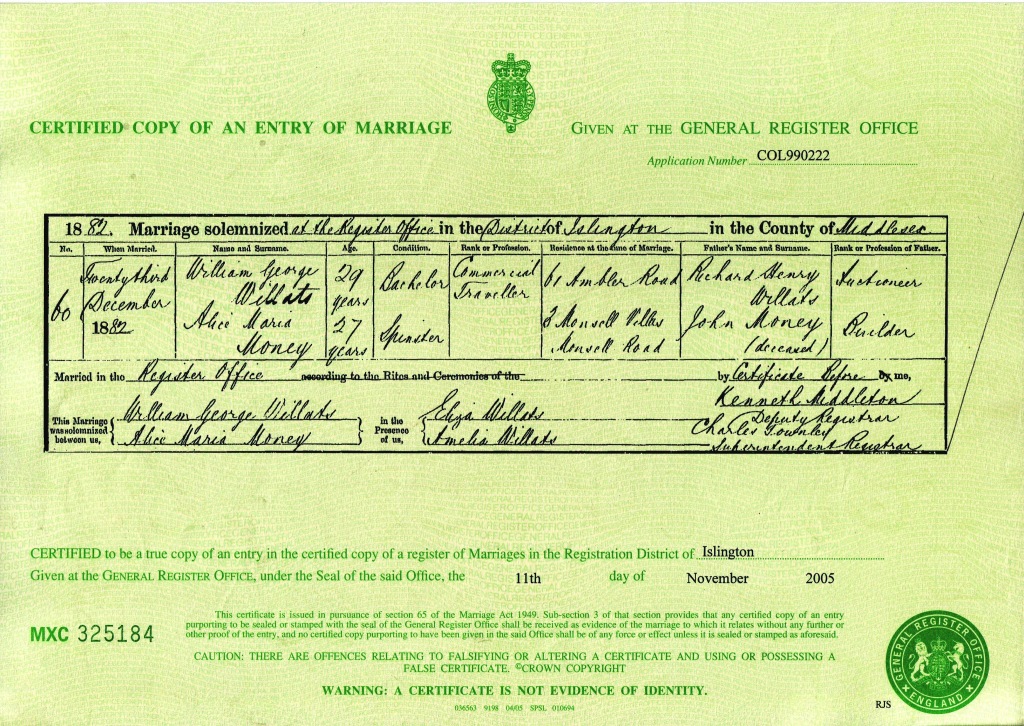
Henry’s half-brother, 29-year-old, bachelor William George Willats, my 3rd Great Grandfather, a Commercial Traveller, married 27-year-old spinster, Alice Maria Money, at The Register Office, Islington, Middlesex, England, on Saturday the 23rd of December, 1882.
William gave his occupation as a Commercial Traveller.
They gave their fathers names and occupations as, Richard Henry Willats, an Auctioneer, and John Money (deceased) a Builder.
Their witnesses were, Eliza Willats and Amelia Willats.
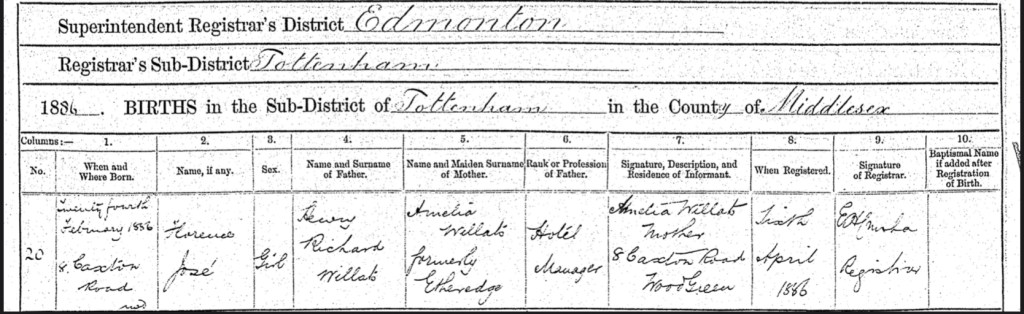
More celebrations happened, when Henry Richard and Amelia, welcomed their new born daughter into their growing family, on Wednesday the 24th of February, 1886. They named her Florence Jose Willats.
Florence was born at their home, 8 Caxton Road, Wood Green, Edmonton, Tottenham, Middlesex, England.
Amelia registered her birth on Tuesday the 6th of April, 1886.
She gave Richards occupation as a Hotel Manager.
Henry and Amelia baptised Florence, on the 11th of April, 1886, at St Michael and All Angels Church, Wood Green, Tottenham, Middlesex, England. Henry’s occupation was given as Hotel Manager and their abode was, Wood Green.

Managing a hotel in the late Victorian era (late 19th century) involved a combination of hands-on tasks, administrative duties, and a strong focus on providing quality service to guests.
The managers primary focus was on ensuring the comfort and satisfaction of guests. This involved supervising staff to provide attentive and personalized service, handling guest inquiries and complaints, and overseeing room assignments.
Managing a hotel’s workforce was crucial. This included hiring, training, and supervising staff, such as bellboys, maids, cooks, and waiters. In larger hotels, there might have been department heads responsible for their respective areas.
The front desk served as the central hub of hotel activities. Hotel managers would oversee check-ins, check-outs, and manage reservations. They were responsible for maintaining guest registers and ensuring smooth communication among the staff. Ensuring the cleanliness and proper maintenance of the hotel was essential. Managers had to ensure that the rooms were well-kept and that public areas, such as lobbies and dining rooms, were presentable.
The hotel manager was responsible for the financial aspects of running the hotel, managers had to maintain detailed records of expenses, revenues, and guest accounts. They would handle billing and payments, ensuring all financial transactions were accurate and secure.
The hotel manager was also involved in overseeing the procurement of necessary supplies, such as linens, toiletries, food, and beverages. It also required managing relationships with suppliers and ensuring the quality of goods.
Hotel managers were responsible for the safety and security of both guests and the property. They had to implement measures to prevent theft and accidents and address any security issues that arose.
While advertising and marketing during the late Victorian era were not as sophisticated as today, hotel managers were still responsible for promoting their establishments through local newspapers, brochures, and word-of-mouth.
Hotel managers often played a role in engaging with the local community, building relationships with businesses and organizations that could refer guests to their hotel.
Understanding and enforcing the proper etiquette and social norms of the time were essential for providing a refined and respectable atmosphere.
Hotels often hosted events and social gatherings. Managers would oversee the organization and coordination of banquets, receptions, and other gatherings.
Depending on the location, hotel managers needed to adapt to seasonal variations in demand. They might have to adjust staffing levels, operating hours, and services offered during peak and off-peak seasons.
Overall, managing a hotel in the late Victorian era required a combination of business acumen, people skills, attention to detail, and a commitment to providing the highest level of hospitality to guests. It was a demanding job, but a successful hotel manager could build a strong reputation and establish a loyal clientele.
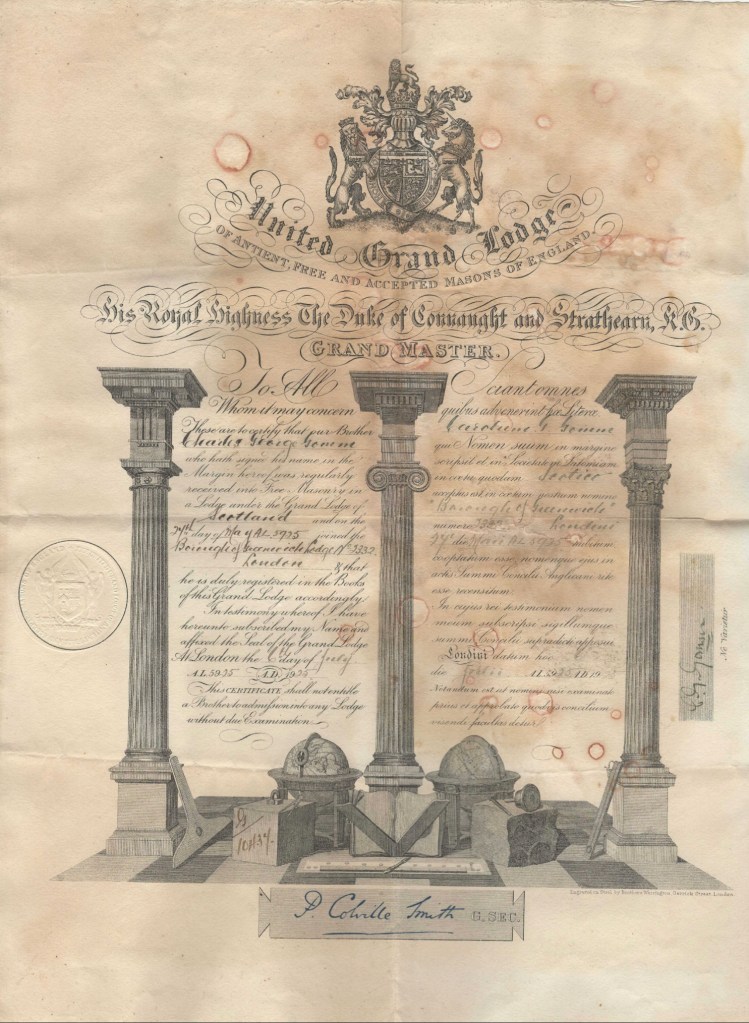
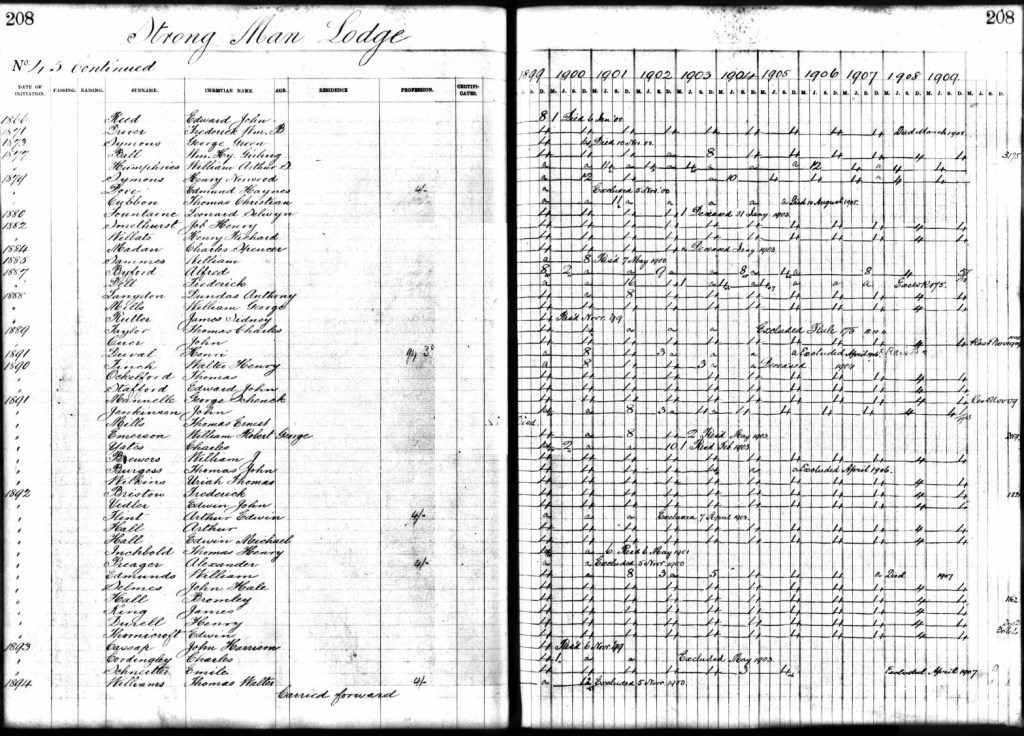
Henry was named on the 1888- 1898, United Grand Lodge of England Freemason.
In 1888 and 1889, Henry advertised the Cliftonville Hotel in numerous newspapers, including the London Evening Standard, Sporting Life – London, Globe – London and Daily News (London), among many others. They all read very similar. Here are a few examples.


The Cliftonville Hotel, Margate, was built in 1868, the Cliftonville Hotel served the affluent classes of the Victorian era, who would typically flock from London to enjoy their holidays and second homes in Margate. It had views across a public garden populated with statues and beautiful seascape, the Cliftonville Hotel was a landmark in Kent. After a few decades of declining popularity, the hotel sadly burnt down in 1952.
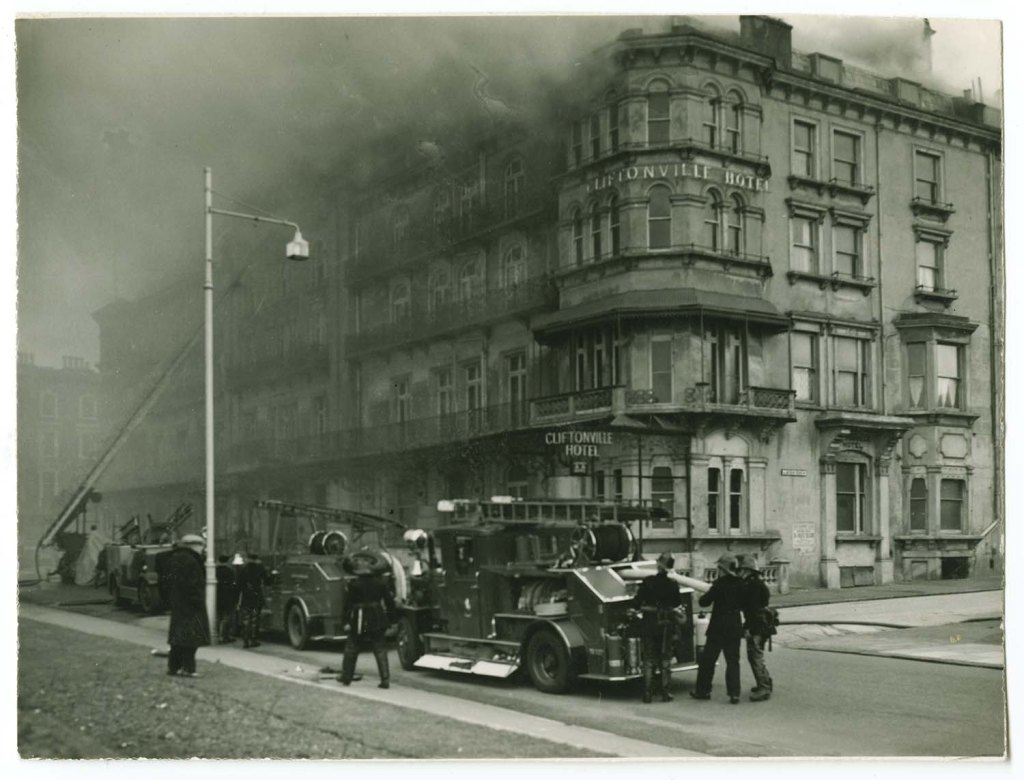
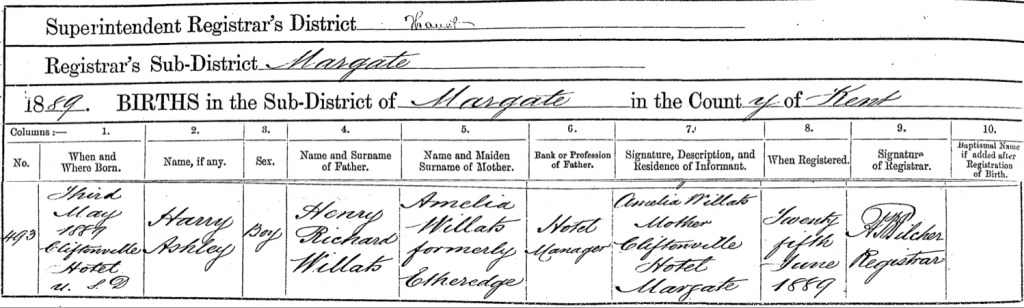
It was in the Cliftonville Hotel, Margate, Kent, England, that Henry and Amelia’s son, Harry Ashley Willats was born on Friday the 3rd of May, 1889, where Henry was manager.
Amelia registered his birth on Tuesday the 25th June 1889, at Margate.
She gave their abode as, Cliftonville Hotel, Margate, and her husband Henry, occupation as, Hotel Manager.
You can read about his life at https://intwined.blog/2018/06/01/harry-ashley-willats-52-ancestors-in-52-weeks-week-18/

Jumping forward to the year 1891, Queen Victori was still holding strong upon the throne. It was the 24th parliament and Prime Minister was Robert Gascoyne-Cecil, 3rd Marquess of Salisbury (Conservative).
Deptford Power Station (designed by Sebastian Z. de Ferranti for the London Electric Supply Corporation) was fully commissioned, pioneering the use of high voltage (10 kV) alternating current, generating 800 kW for public supply.
The first street charity collection in the UK was held in Manchester in aid of the Royal National Lifeboat Institution.
The Baptist Union of Great Britain established by merger of the General and Particular Baptists.
Oscar Wilde‘s novel The Picture of Dorian Gray (book version) and Lord Arthur Savile’s Crime and Other Stories was published.
The British steamship SS Utopia sunk in the inner harbour of Gibraltar after collision with the battleship HMS Anson, killing 564.
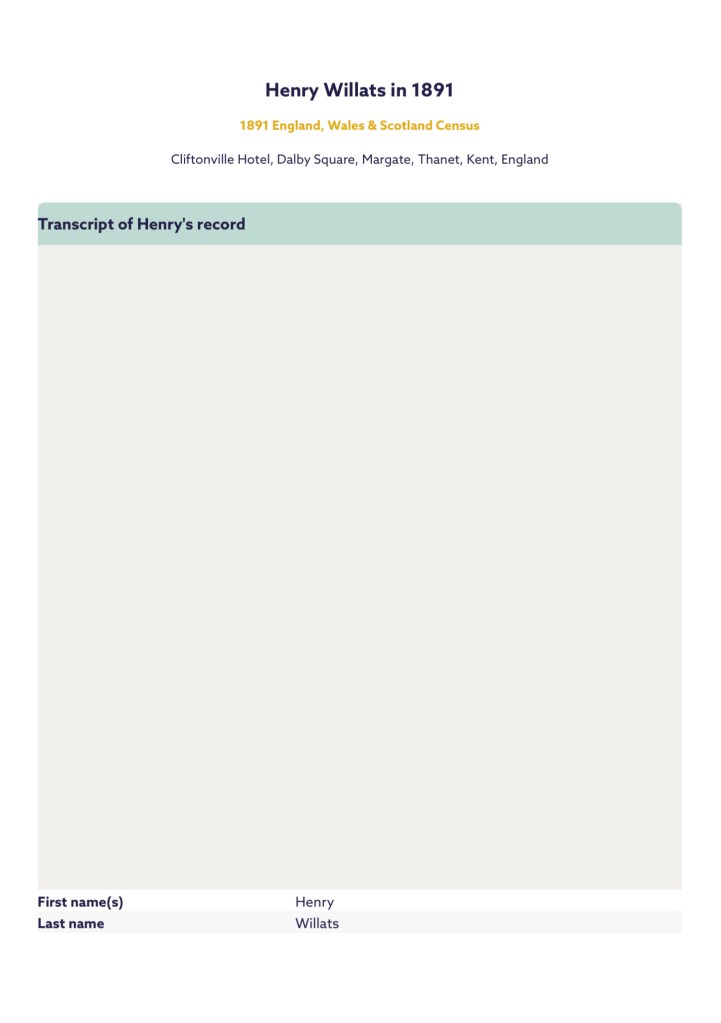
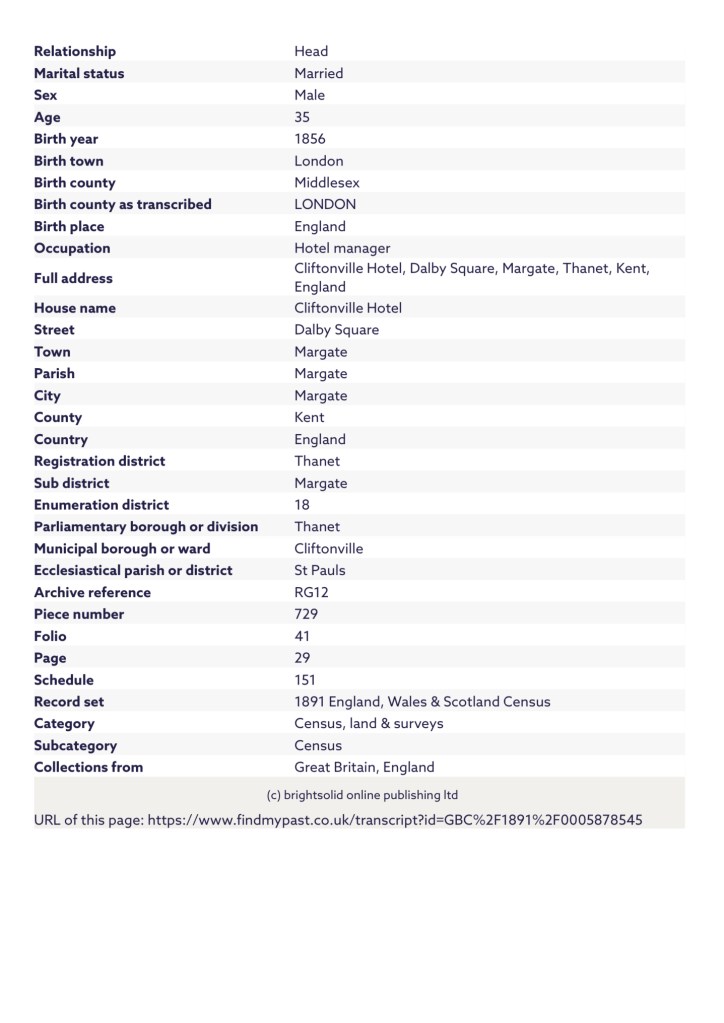
And the 1891 census was taken on Sunday the 5th of April, It shows Henry Richard, Amelia and their children Harry, Mabel, and Florence, residing at, Cliftonville Hotel, Dalby Square, Margate, Thanet, Kent, England.
Henry was the Hotel Manager. Amelia was a Housekeeper and Mabel was a scholar.

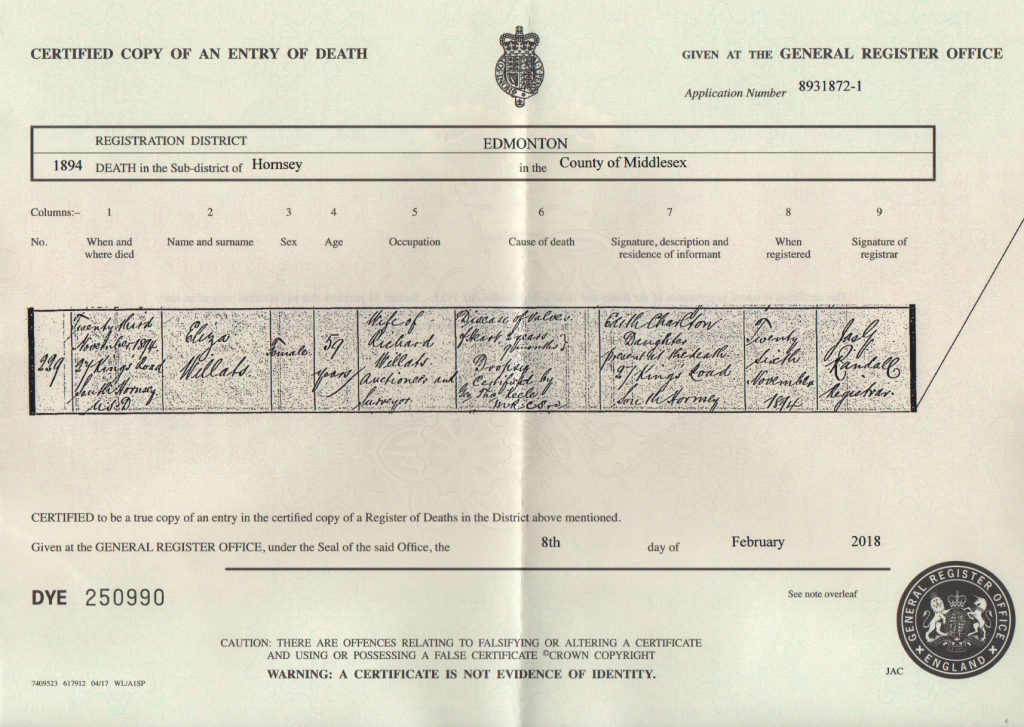
Just a few short years later, Henry’s mum, Eliza, passed away on Friday the 23rd of November, 1894, at Number 27, Kings Road, South Hornsey, Edmonton, Middlesex, England, when she was 59 years old.
Eliza died from, disease of the valves of the heart, two years nine months and dropsy.
Her daughter Edith Charlton of Number 27, Kings Road, South Hornsey, was present and registered Eliza’s death on Monday the 26th of November, 1894.
Edith gave her father Richards occupation as an Auctioneer and Surveyor.
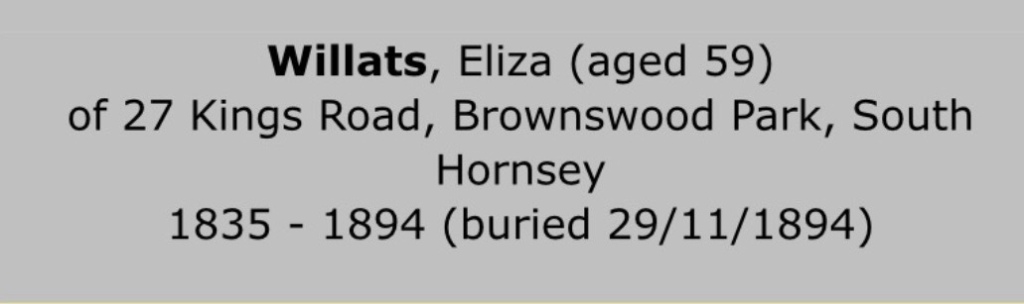
When Eliza died Henry’s father, Richard Henry, purchased 2 graves in Abney Park Cemetery, which was then the beautiful garden of a big house turned into a private cemetery.
Each grave cost, 3 guineas and took six interments.
The Willats family laid Eliza to rest, in one of the purchased graves at, Ebney Park Cemetery, Stoke Newington, Middlesex, England, on Thursday the 29th of November, 1894, in D06, Grave 092431.
Her abode was given as, Number 27, Kings Road, Brownswood Park, South Hornsey.
You can read more about Abney Park Cemetery, later on, but here’s a little information in the meantime.
Abney Park Cemetery is one of the “Magnificent Seven”cemeteries in London, England.
Abney Park in Stoke Newington in the London Borough of Hackney is a historic parkland originally laid out in the early 18th century by Lady Mary Abney, Dr. Isaac Watts and the neighbouring Hartopp family.
In 1840 it became a non-denominational garden cemetery, a semi-public park arboretum, and an educational institute, which was widely celebrated as an example of its time. A total of 196,843 burials had taken place there up to the year 2000

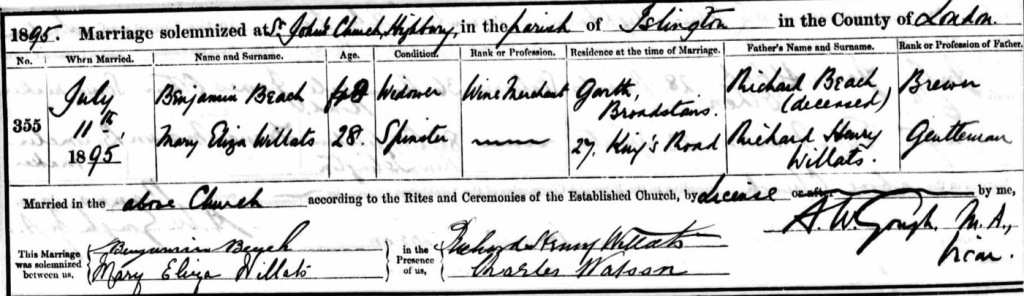
Henry’s sister, 28-year-old, spinster, Mary Eliza Willats, married 48-year-old, Widower, wine merchant, Benjamin Beach, on Thursday the 11th July 1895, at St John’s Church, Highbury, Islington, Middlesex, England. Mary gave her residence as, 27 Kings Road and Benjamins as . (If you can work it out, please let me know.) They gave their fathers names and occupations as, Richard Beach (deceased) a Brewer and Richard Henry Willats, a Gentleman. Their witnesses were, her father Richard Henry Willats and Charles Watson. Eliza used the name Mary Eliza Willats.
Henry’s brother, 21 years old, bachelor Walter James Willats and 21 years old, spinster, Amelia High, Marriage Bonds was licenced on Tuesday 20th October 1896, at St Mary Magdalene, Enfield, Middlesex, England. Their marriage licence reads as follows.
DIOESE OF LONDON.
20th October 1896
APPEARED PERSONALLY, Walter James Willats of the parish. of St Mary Magdalene Enfield in the County of Middlesex a Bachelor aged Twenty one years and upwards and prayed a Licence for the Solemnization of Matrimony in the parish church of St Mary Magdalene Enfield aforesaid between him and Amelia Ellen High of the same parish a spinster of the age of Twenty-one years and upwards and made Oath that he believeth that there is no Impediment of Kindred or Alliance, or of any other lawful cause, nor any Suit commenced in any Ecclesiastical Court to bar or hinder the Proceeding of the said Matrimony, according to the tenor of such Licence. And he further made Oath, that he the said Appearer hath had his usual Place of abode within the said parish of St Mary Magdalene Enfield. for the space of Fifteen days last past
Walter James Willats
Sworn before me
F S May Swn:

I have ordered their marriage certificate which I will share in Walters life story.
Heartbreakingly death followed when Henry’s half-brother, 43 year old, Estate Bailiff, William George Willats, died on Sunday the 14th of February, 1897 at Number 44, Gillespie Road, Islington, Middlesex, England.

He died from Cardial Haemorrhage Corona Syncope.
Their Sister, Charlotte Ellen Crosbie, of, 132 Wilberforce Road, Finsbury Park, was present and registered his death on Tuesday the 16th of February 1897.

Henry and the Willats family laid my 3rd Great- Grandfather, William George Willats, to rest at Abney Park Cemetery, Stoke Newington, Hackney, London, England on Thursday the 18th of February, 1897, in grave D06 092431 with his mother, Eliza Willats nee Cameron.

Henry’s sister, Lillian Jenny Willats, married William Alexander Willats, on Saturday the 15th of July, 1899, at St. John’s Church, Highbury, Islington, Middlesex, England. Lillian was a 29-year-old spinster and William was a 31-year-old bachelor, whom was working as a commercial. (I assume that means commercial traveller?) They gave their fathers names and occupations as, Richard Henry Willats, an auctioneer and William Neilson, a commercial. Lillian was residing at 27 Kings Road, Brownhill Park and William at Madeira Avenue, Worthing, Sussex, at the time of their marriage. Their witnesses were, brother in-law, Benjamin Beach and her cousin, Amina Charlton.

Henry was named on the 1899- 1909 United Grand Lodge of England Freemason.
Henry’s brother, 28-year-old Bachelor Edwin Paul Willats married 19-year-old, spinster, Nellie Elizabeth High on Saturday the 7th of July, 1900, at All Hallows, Tottenham, Edmonton, Middlesex, England. Their witnesses were, Walter James Willats and Amelia Ellen Willats. Their fathers names and occupations were given as Richard Henry Willats, a surveyor and James High, a Cabinet Maker. As you can see the certificate is nearly impossible to transcribe, so I have given you the information I can work out, sorry.

Death was once again had the Willats family firmly in its grasp.
Henry’s sister, Eliza Mary Beach nee Willats, died on Monday the 21st of July 1902, at Beach Court, Upper Deals, Eastry, Kent, England, at the awfully young age of 35 years.
Eliza died from Pneumonia and exhaustion.
Edith Cameron Charlton nee Willats, Richards’s daughter and Eliza’s sister, was present and registered her death on the same day, Monday the 21st of July 1902.
Edith stated the Eliza was the wife of Benjamin Beach, giving his profession as, independent means.
Eliza’s death was registered under the name Mary Eliza Beach.

Eliza Mary Beach nee Willats was laid to rest, on Thursday the 24th of July, 1902, at St Peter in Thanet, Kent, England.
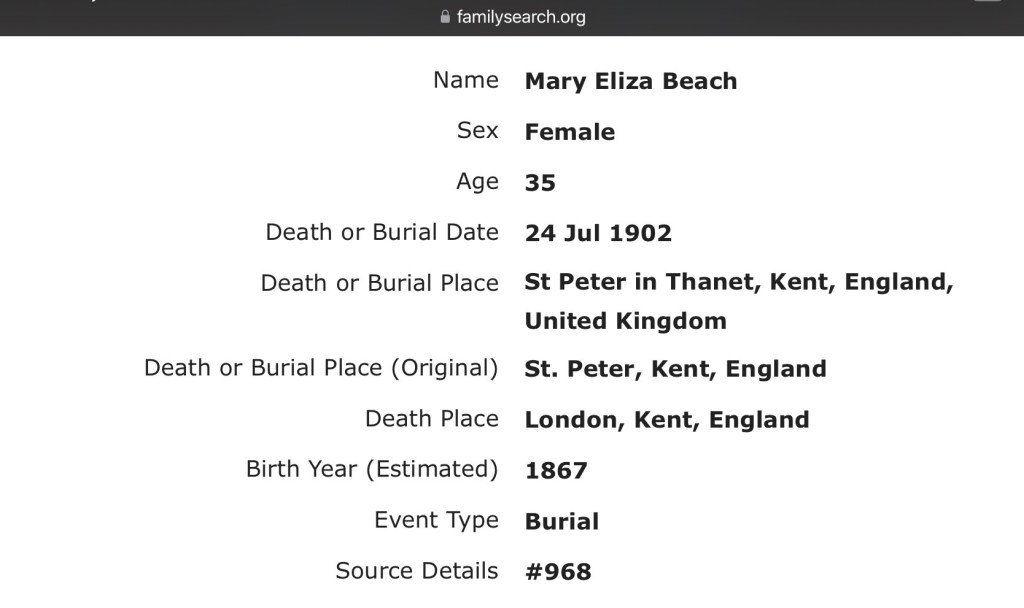
Thankfully Henry’s and his family finally had something to celebrate, when his sister, 28 year old, spinster, May Claretta Willats married 20 year old, architectural florist, bachelor, George Frederick Champion on Saturday the 4th of April 1903, at St. John’s Church, Highbury Vale, Islington, London, England.
May gave her residence as, 21 Montague Road and George as, 194 Green Lanes.
They gave their father’s names and occupations, as George Frederick Champion, an architectural florist and Richard Henry Willats an Estate Agent.
Their witnesses were, George Frederick Champion and Mays niece, Amina Eliza Catherine Charlton.

And his 26 year old bachelor brother, surveyor, Frederick Howard Willats, married 24 year old spinster Maud May Beach, on Saturday the 19th September 1903, at St. John’s Church, Highbury Vale, Islington, London, England.
Frederick gave his abode as, 27 Kings Road and Maud graves hers as, 16 Orchard Road, St. Margarets on Thames.
They gave their fathers names and occupations, as Richard Henry Willats, estate agent, and Walter Beach (deceased), a Gentleman.
Their witnesses were his brother, Persey Sidney Willats and his niece, Amina Eliza Catherine Charlton.

On the 12th April 1907, the Kent & Sussex Courier Newspaper published that an application was made for the transfer of the licence of the Spa Hotel to Mr Henry Richard Willats, the resident proprietor. It was granted.
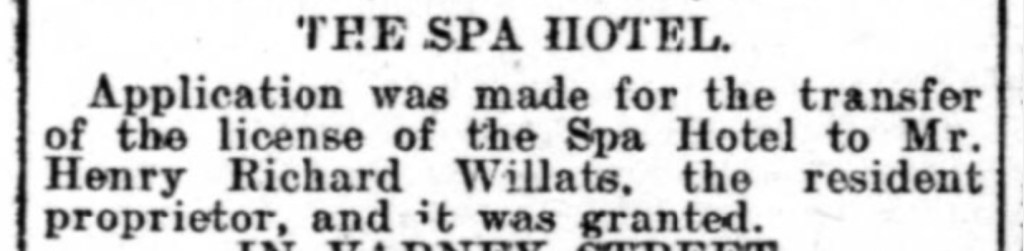

Originally built in 1766 as a country mansion and bought by Major Martin Yorke in 1772, after serving under Lord Clive of India and making his fortune with the East India Company.
The Hotel first opened its doors as “The Bishops Down Spa Hotel”, named after the Spa town of Tunbridge Wells, in 1880.
It was advertised as “in a pleasant green oasis of lawns and trees in 60 acres of parkland, 400 feet up facing the southern sun. Sporting golf course in the grounds. Solid comfort, quiet hospitality, plus the usual attractions of Tunbridge Wells in early Summer. 85 rooms and suits. Private Bathrooms. Cooking and service of a high degree of excellence.”

Henry’s brother, 33-year-old, Percy Sidney Willats, married Sophie Ann Smart, on Saturday the 24th of July 1909 in Edmonton, Middlesex, England. I have ordered their marriage certificate, unfortunately, it is taking a rather long time to arrive so I will update their information when I write about Percy’s life story. Watch this space. In the meantime, you can order your own copy, with the low information.

Henry was once again named on the 1910- 1921 United Grand Lodge of England Freemason.

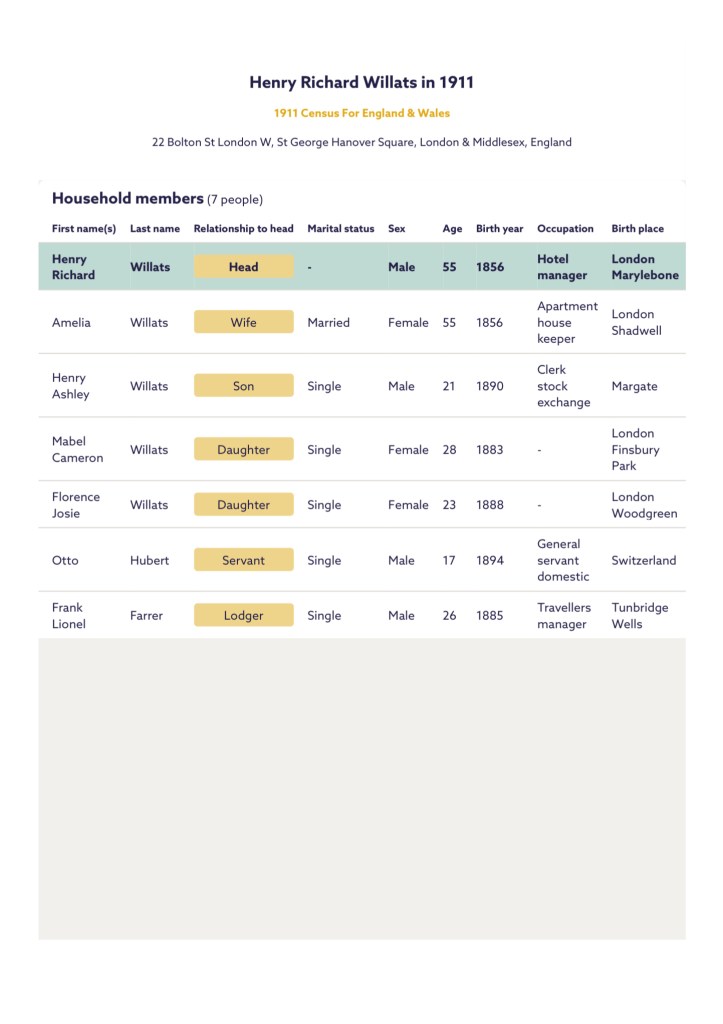
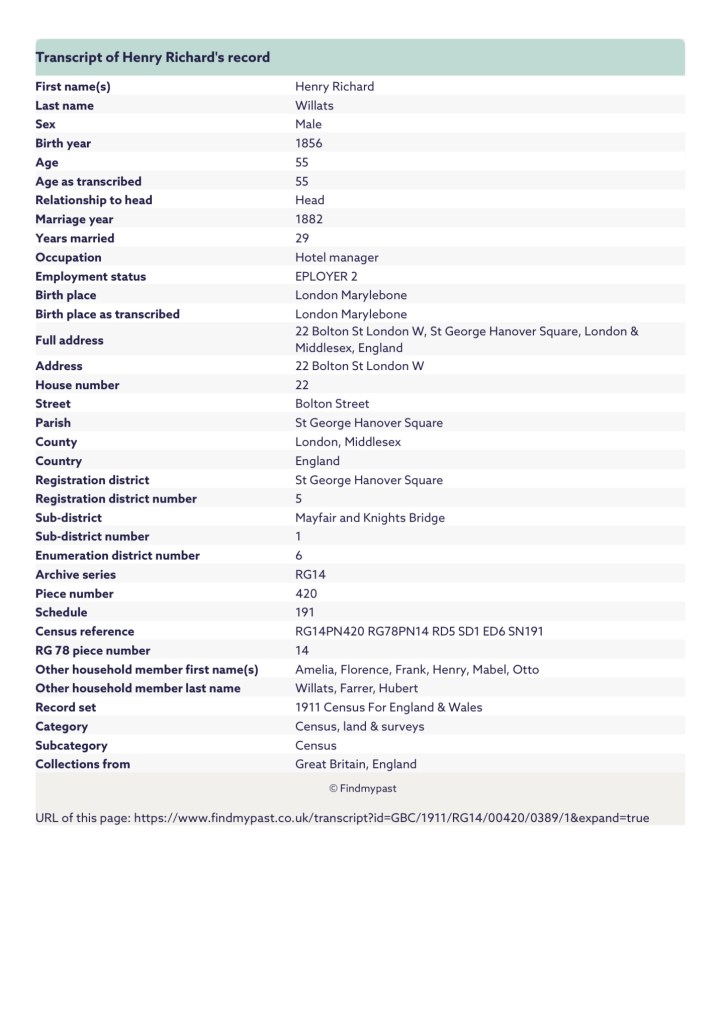
On Sunday 2nd of April 1911 the Census was taken.
It shows, Henry Richard, Amelia and their children, Henry Ashley, Mabel Cameron, and Florence Josie Willats were residing at, 22 Bolton Street, St George Hanover Square, London & Middlesex, England.
Richard was working as a Hotel Manager, Amelia as an Apartment house keeper and Henry Ashley as a, Clerk in the stock exchange. They had one general domestic servant, called Otto Hebert and a lodge called Frank Lionel Farrer, whom was a Travellers manager, residing with them.
I wish it showed what hotel he was managing.

His sister, 43 year old widow, Lillian Jenny Neilson nee Willats married 41 year old bachelor, George Campbell Ferris, a Commercial Clark, at the Registry Office, Islington, Middlesex, England on Saturday the 23rd of October, 1915.
Their witnesses were, Claude Eayes and J. E. Bailie.
Lillian gave her residential address’s as 35 Yesbury Road and George gave his as, 87, Winchester Street.
Their fathers names and occupations were given as, George Coell Ferris, a deceased, Commercial Traveller, and Richard Henry Willits, an Auctioneer.

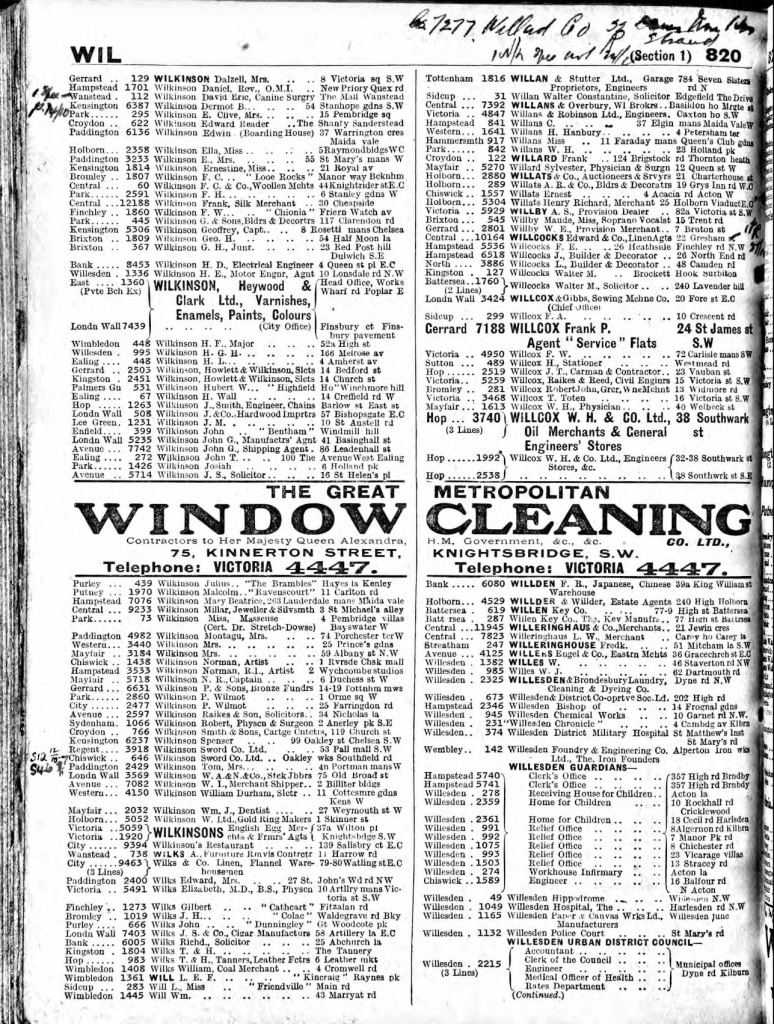
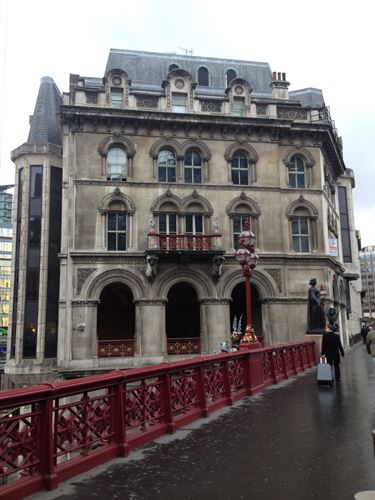
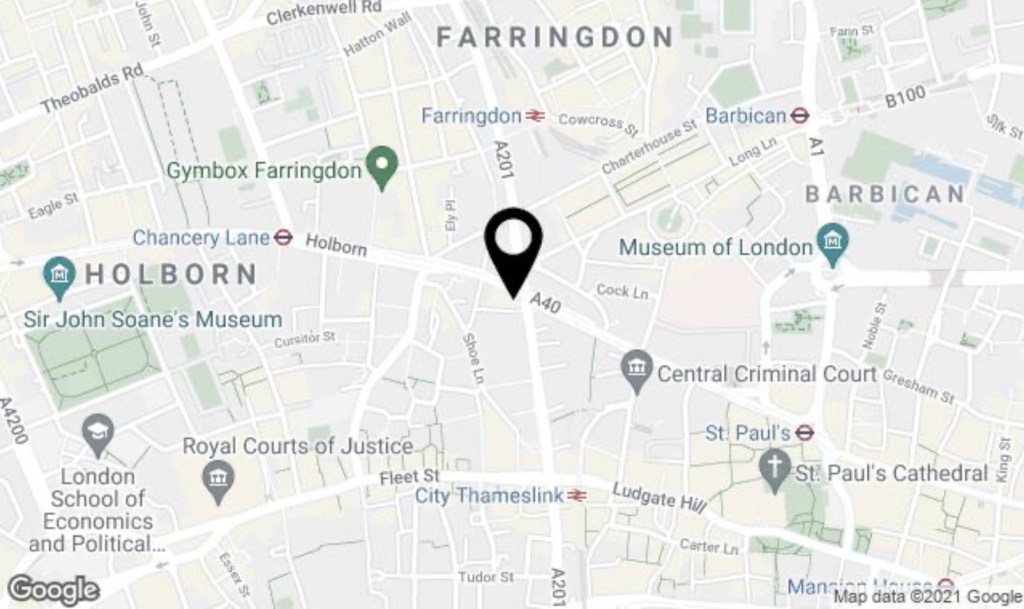
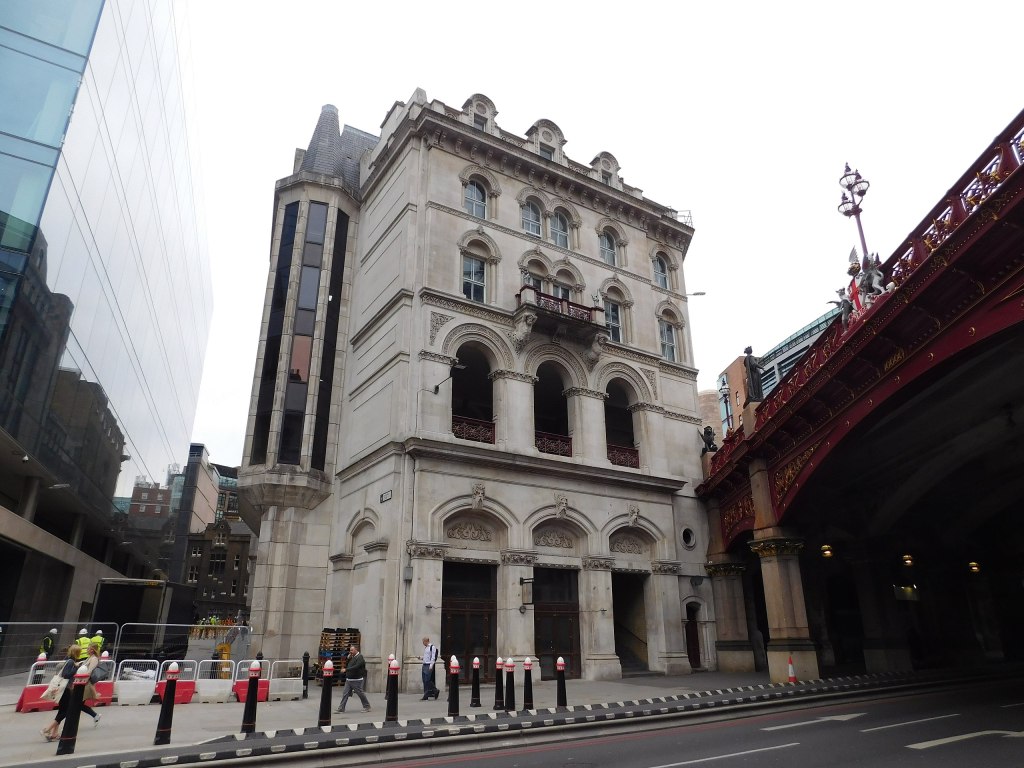
From the 1880-1984 British Phone Books, we know that Henry Richard was either residing or working out of, 25 Holborn Viaduct, London England, now known as Fitz-Eylwin House, 25 Holborn Viaduct, London EC1A 2BP, in 1916.

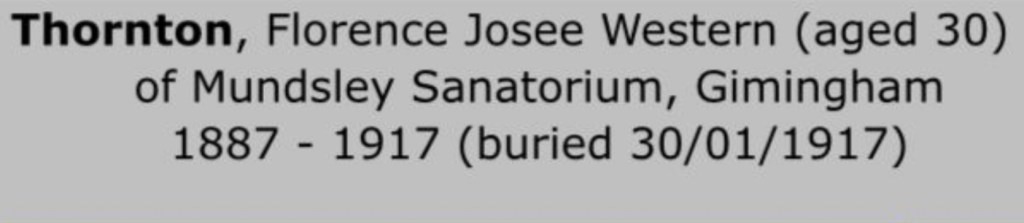
Henry’s daughter Florence Jose Western Thornton nee Willats, of 15 Moanor Road, Hornington, Sussex, wife of William Western Thornton, of independent means, sadly passed away on Monday the 25th of January, 1917, at Mundesley Sanatoriam, Mundedley, Gimingham, Cromer, Norfolk, England, aged 30. She died from, Pulumory Tuberculosis. Maurice F Squire acting chief resident officer of Mundesley Sanatoriam, Mundedley, Gimingham, registered her death on Tuesgay the 26th of January, 1917.

Mundesley sanatorium was built in pre-fabricated sections made of timber, by Boulton and Paul ltd. It was the first large centre in England that had been built specifically for open-air treatment of the disease. However, due to its status as a private hospital, Mundesley could only offer treatment to wealthy patients. Mundesley had a post and telegraph office, and is was terminus of the Great Eastern, and Midland and Great Northern Railways, so that it was easily accessible from London, the Midlands, and the North.
The sanatorium was built one mile distant from the railway station, and about the same distance in a direct line from the sea. It was built on the southern slope of a hill, to protect it from the prevailing winds, while to the south an expanse of countryside, that had a view extending for several miles in that direction.
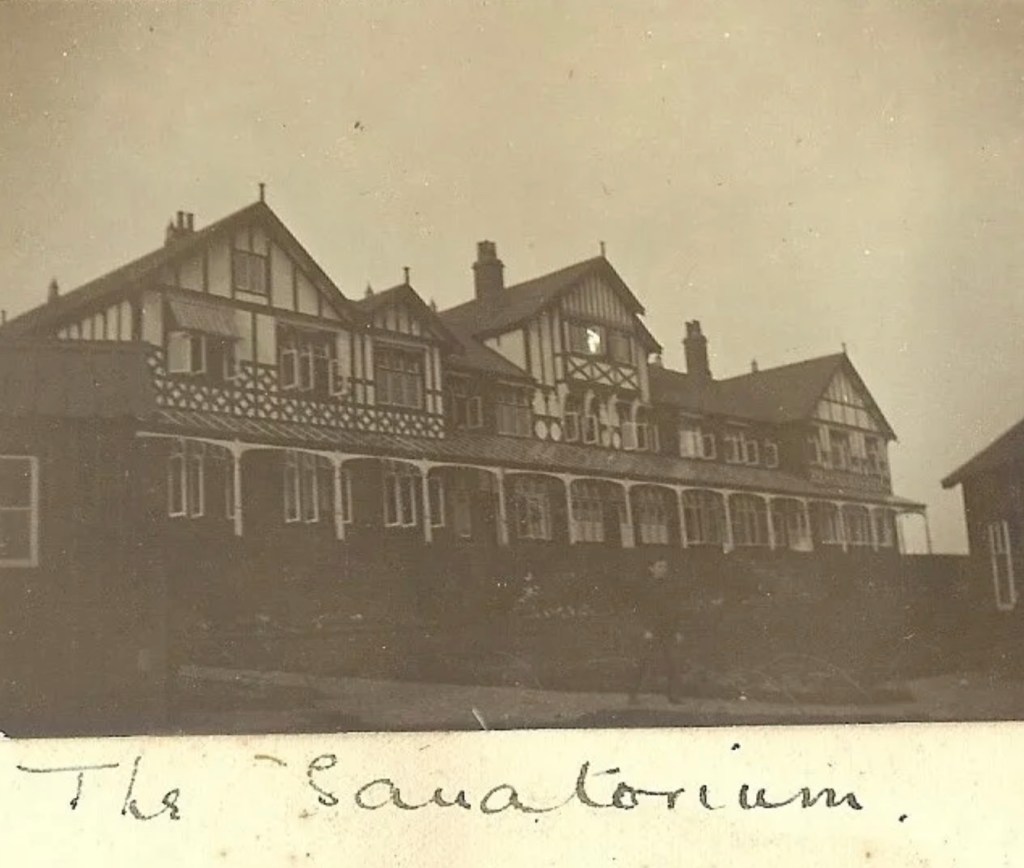
The sanatorium was built on twenty-five acres of land, approached by two private roads, with no main road within a quarter of a mile to secure isolation and freedom from dust. The sanatorium was built on two levels with attic accommodation for servants. All the rooms for the use of patients faced the south, twelve bedrooms being on the upper floor and three on the ground floor.
A large dining and drawing rooms were also situated on the ground floor, and a corridor 8 ft. wide extended the whole length of the building on both floors, giving access to the rooms. Large casement windows were fitted to all the rooms, which can be opened so as to admit a maximum amount of air, and over each bedroom door there is a ventilator. The floors were covered with linoleum and the inside walls with pegamoid paper, to allow cleaning with damp cloths as to not stir up dust, most of the furniture has been specially designed with the same objective. All corners were rounded to prevent dust accumulation. Fresh air formed an important part of the treatment for tuberculosis, with many hospitals using open windows and balconies.

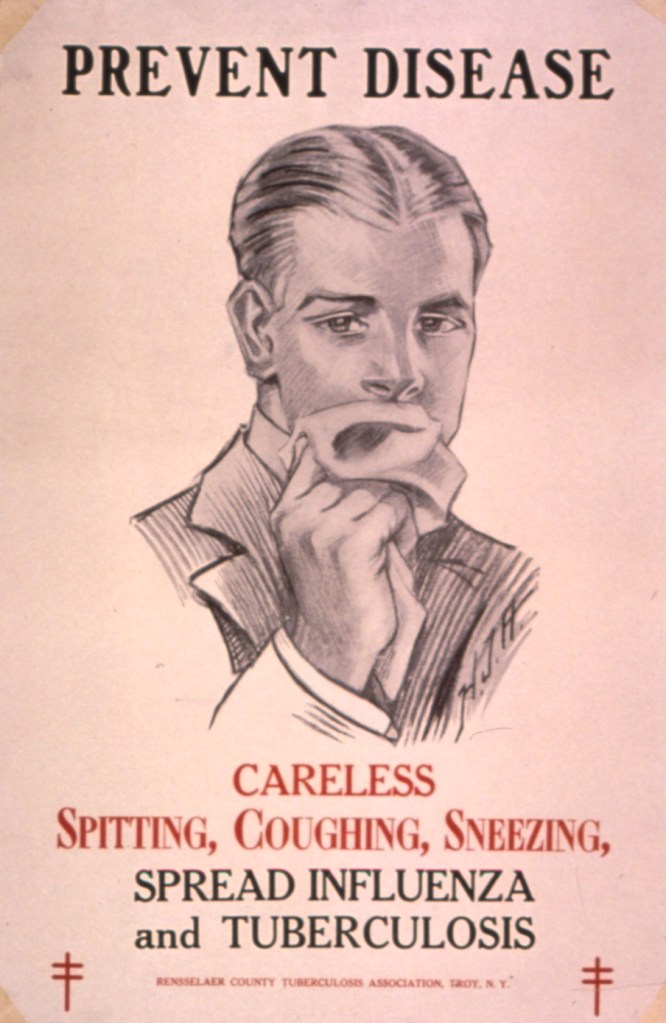
Before the Industrial Revolution, folklore often associated tuberculosis (TB) with vampires. When one member of a family died from it, the other infected members would lose their health slowly. People believed this was caused by the original person with TB draining the life from the other family members.
Due to the variety of its symptoms, TB was not identified as a single disease until the 1820s, and was not named tuberculosis until 1839 by Dr J. L. Schönlein.
During 1838–1845, Dr. John Croghan, the owner of Mammoth Cave, brought a number of people with tuberculosis into the cave in the hope of curing the disease with the constant temperature and purity of the cave air; they died within a year.
Dr Hermann Brehmer opened the first TB sanatorium on the second of July 1859 in Poland, for the treatment of tuberculosis. Patients were exposed to plentiful amounts of high altitude, fresh air, and good nutrition. Tuberculosis sanatoria became common throughout Europe from the late 19th century onwards. The rationale for sanatoria was that before antibiotic treatments existed, a regimen of rest and good nutrition offered the best chance that the sufferer’s immune system would “wall off” pockets of pulmonary tuberculosis (TB) infection.
The bacillus causing tuberculosis, Mycobacterium tuberculosis, was identified and described on 24 March 1882 by Robert Koch. He received the Nobel Prize in physiology or medicine in 1905 for this discovery. Koch did not believe the bovine (cattle) and human tuberculosis diseases were similar, which delayed the recognition of infected milk as a source of infection. Later, the risk of transmission from this source was dramatically reduced by the invention of the pasteurisation process. Koch announced a glycerine extract of the tubercle bacilli as a “remedy” for tuberculosis in 1890, calling it ‘tuberculin’. While it was not effective, it was later successfully adapted as a screening test for the presence of presymptomatic tuberculosis.
The reluctance to adopt the open-air treatment in Britain is undoubted, many different factors were involved. There was some satisfaction and hope in the progressive year-by-year drop in the mortality rate from tuberculosis, which fell from 3239 per million in 1861-70 to 2429 per million in 1881-90. The clinicians were aware that it was in no way due to their activities, there was still a widespread and strong belief in the merits of climate, the fickle British climate being regarded as unsuitable.
An exaggerated fear of draughts and chills led to closed windows and stuffy, over-heated rooms for patients. ‘All social classes were prejudiced against fresh air, and their prejudices were not without foundation. First, on quasi-medical grounds that are still with us, there was the fear of draughts: the draughts would produce the great British chill, an affliction unknown to the rest of the civilised world’ (Dr Anne Hardy). There was, however, no need for the patient with tuberculosis to fear a cold draught.
Henry, Amelia, her husband William and family, laid Florence to rest, on the 30th of January 1917, at Abney Park Cemetery, Stoke Newington, Hackney, London, England, in grave 127402. Her husband William, their unnamed child, her mother Amelia and father Henry Richard as well as her brother, Harry Ashley Willats, were all buried in the same vault.
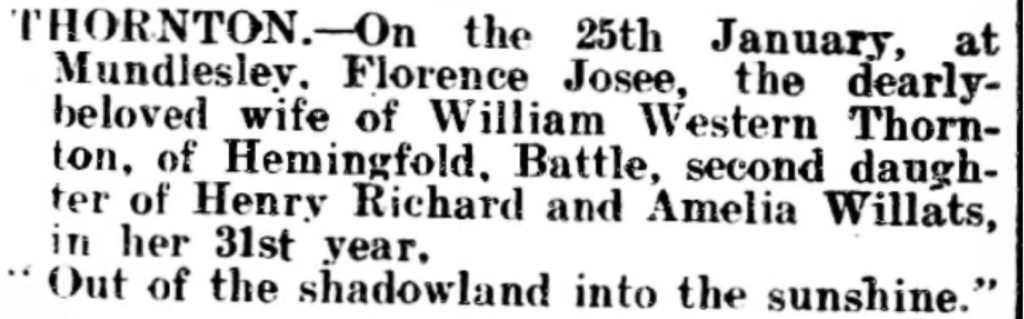
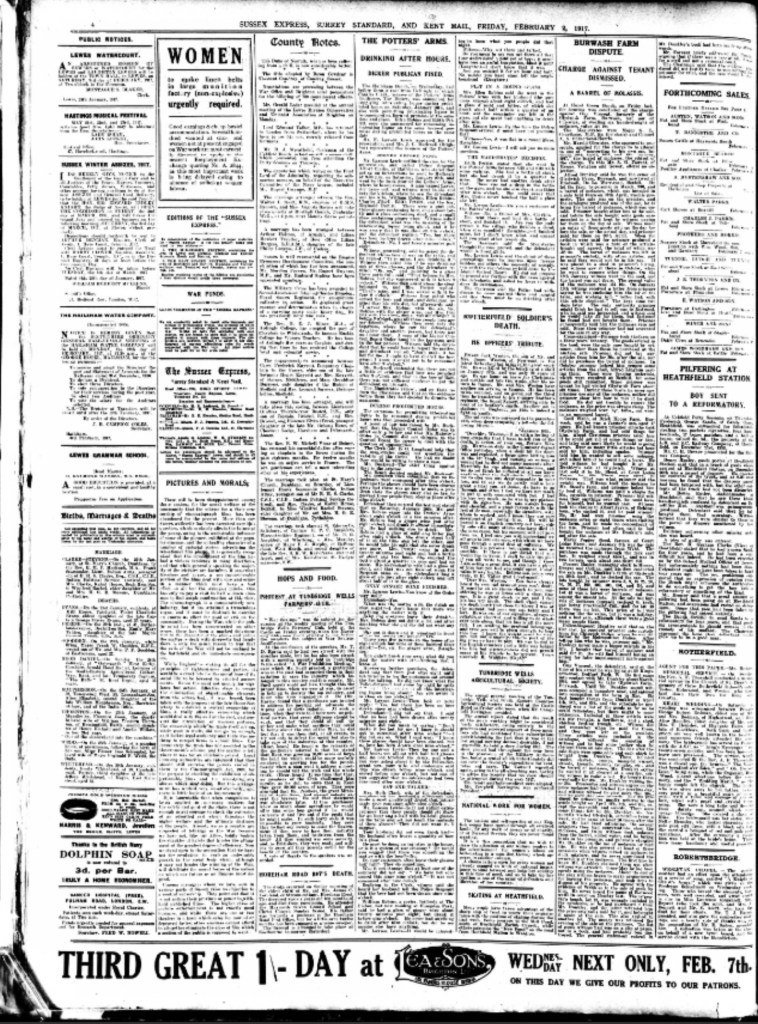
On the 02 February 1917 the Sussex Agricultural Express, reported on Flora cues death.
It reads,
THORNTON. – On the 25th January, at
Mundlesley. Florence Jose, the dearly-
beloved wife of William Western Thorn-
ton, of Hemingfold, Battle, second daugh-
Ter of Henry Richard and Amelia Willats,
in her 31st year.
“Out of the shadowland into the sunshine.”
If the death of Henry and Amelia’s daughter wasn’t bad enough While going through a gunnery course at Salisbury Plain, Wiltshire, not far from where I live, their son, Harry Ashley Willats, contracted a chill, which ended fatally.
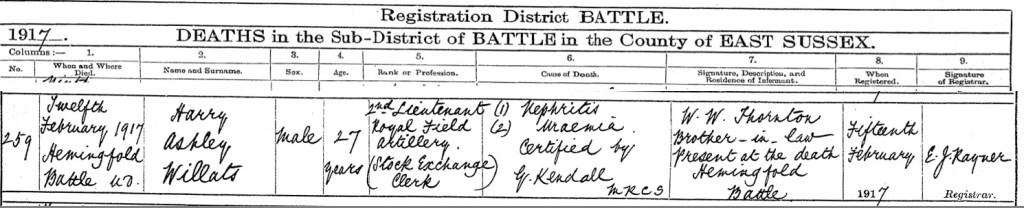
Heartbreakingly on Monday the 12th of February 1917, 2nd Lieutenant Harry Ashley Willats, died at the age of 27, at Hemingfold Battle, East Sussex.
The cause of death was from, Nephritis, inflammation on the Kidneys and Uremia, urea in the blood.
His brother-in-law, William Western-Thornton, registered his death on Thursday the 15th of February 1917.
Harry’s remains were taken to the Cadet College at Lords and he was laid to rest at Abney Park Cemetery, in their family vault, with his sister Florence Jöse Western-Thornton nee Willats who as we know had died scarcely three weeks before Harry.
2nd Lieutenant Harry Ashley Willats, funeral was largely attended with friends traveling a distance to pay their respects to a popular officer.
Harry was buried on Saturday the 17th of February 1917 in grave number 127402, possibly renumbered as 17402. Grave location J10.

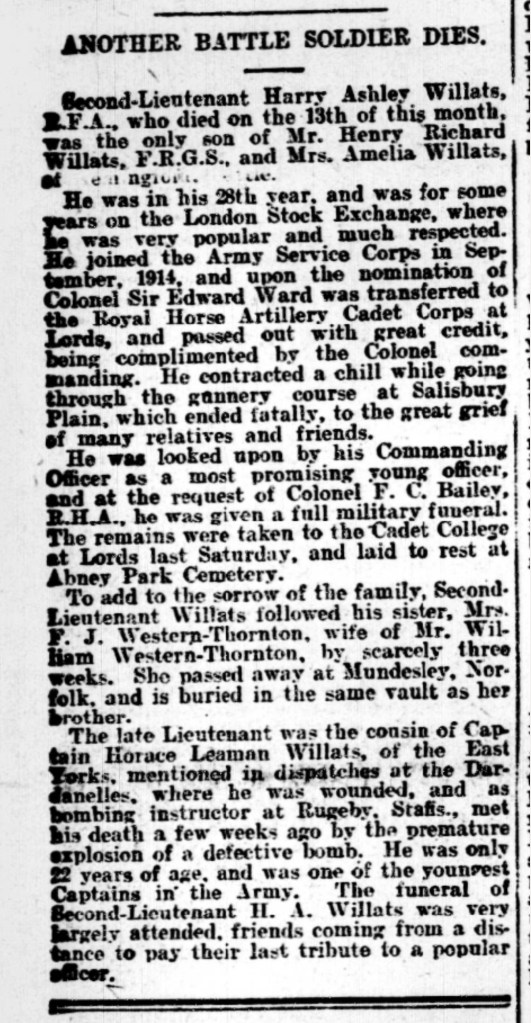
On Saturday the 24th of February, 1917 , the Hastings and St Leonards Observer reported about Harry’s Death.
It reads,
ANOTHER BATTLE SOLDIER DIES.
Second-Lieutenant Harry Ashley Willats,
R.F.A., who died on the 13th of this month,
was the only son of Mr. Henry Richard.
Willats, F.R.G.S., and Mrs. Amelia Willats,
at ………….
He was in his 28th year, and was for some.
years on the London Stock Exchange, where
he was very popular and much respected.
He joined the Army Service Corps in Sep-
temper, 1914, and upon nomination of
Colonel Sir Edward Ward was transferred to.
the Royal Horse Artillery Cadet Corps at
Lords, and passed out with great credit,
being complimented by Colonel com-
Manding. He contracted a chill while going
through the gunnery course at Salisbury
Plain, which ended fatally, to the great grief
of many relatives and friends.
He was looked upon by his commanding
Officer as a most promising young officer,
and at the request of Colonel F. C. Bailey,
R.H.A., he was given a full military funeral.
The remains were taken to the Cadet Collage
at Lords last Saturday, and laid to rest at
Abney Park Cemetery.
To add to the sorrow of the family, second
Lieutenant Willats followed his sister, Mrs.
F. J. Western-Thornton, wife of Mr. Wil-
liam Western-Thornton by scarcely three
weeks. She passed away at Mundesley, Nor-
folk, and is buried in the same vault as her
brother.
The late Lieutenant was a cousin of Cap-
tain Horace Leaman Willats, of the East
Yorks, mentioned in dispatches at the Dar-
danelles, where he was wounded, and as
bombing instructor at Rugeby, Staffs, met
his death a few weeks ago by the premature
explosion of a defective bomb. He was only
22 years of age, and was one of the youngest
Captains in the Army. The funeral of
Second Lieutenant H. A. Willats was very
largely attended, friends coming from a dis-
tance to pay their last tribute to a popular
officer.
Henry and Amelia’s daughter, Florence Josee Western- Thorntonnee Willats, Probate was granted on Wednesday the 2nd of May 1917 in Sussex. It reads,
WESTERN- THORNTON Florence Josee of Hemingfold Battle Sussex (wife of William Western- Thornton) died 25 January 1917 at Mundesley Sanatorium Mundesley Norfolk Probate London 2 May to the said William Western- Thornton gentleman. Effects £5440 5s.

Her grant reads,
DEATH ON OR AFTER 1st JANUARY, 1898. Will
BE IT KNOWN that Florence Josee Western Thornton of Hemmingfold Battle in the County of Sussex (wife of William Western Thornton) died on the 25th day of January 1917 at Munddesley Sanatorium Mundesley in the County of Norfolk AND BE IT FURTHER KNOWN that at the date hereunder written the last Will and Testament of the said deceased was proved and registered in the Principal Probate Registry of His Majesty’s High Court of Justice and that administration of all the estate which by law devolves to and vests in the personal representative of the said deceased was granted by the aforesaid Court to the said William Western Thornton of Hemmingfold Battle aforesaid Gentleman the sole Executor named in the said Will
Dated the2nd day of april May 1917
Gross value of Estate … £5440-5-0 Net value of Personal Estate £5239-8-1

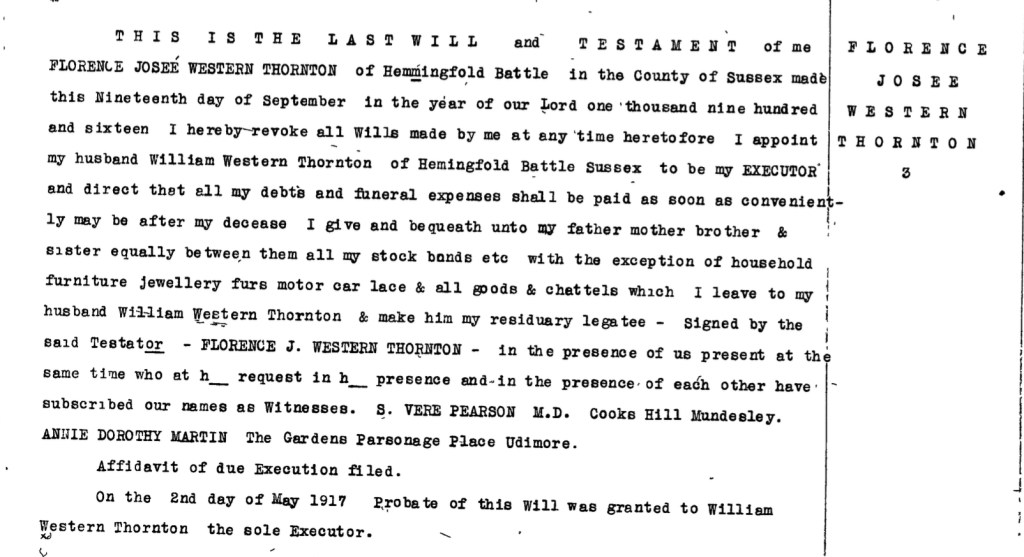
Henry Amelia, and their children, Harry and Mable, were all named in Florence Josee’s last will and testimony. It reads as follows,
THIS IS THE LAST WILL and TESTAMENT of me FLORENCE JOSEÉ WESTERN THORNTON of Hemmingfold Battle in the County of Sussex made this Nineteenth day of September in the year of our Lord one thousand nine hundred and sixteen I hereby revoke all Wills made by me at any time heretofore I appoint my husband William Western Thornton o f Hemingfold Battle Sussex to be my EXECUTOR and direct that all my debts and funeral expenses shall be paid as soon as conveniently may be after my decease I give and bequeath unto my father mother brother & sister equally between them all my stock bonds etc with the exception of household furniture jewellery furs motor car lace & all goods & chattels which I leave to my husband William Western Thornton & make him my residuary legatee – signed by the said Testator – FLORENCE J. WESTERN THORNTON – in the presence of us present at the same time who at h- request in h_ presence and in the presence, of each other have subscribed our names as Witnesses. S. VERE PEARSON M.D. Cooks Hill Mandesley. ANNIE DOROTHY MARTIN The Gardens Parsonage Place Udimore. Affidavit of due Execution filed. On the 2nd day of May, 1917 Probate of this Will was granted to William Western Thornton the sole Executor.
And Henry and Amelia’s son, Harry, probate was granted on Thursday the 19th of July 1917. It reads as follows,
WILLATS Harry Ashley of Hemingbold Battle Sussex second lieutenant R.F.A died 12 February 1917 Probate London 19 July to William Western Thornton gentleman. Effects £1222 11s 3d.
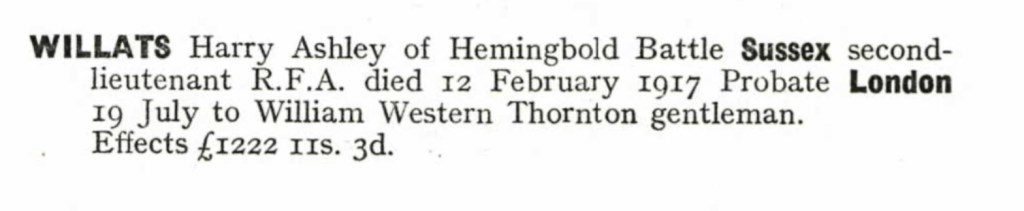
His grant document also reads as follows,
DEATH ON OR AFTER 1st JANUARY, 1898. Will BE IT KNOWN that Harry Ashley Willats of Hemmingbold Battle in the county of Sussex second lieutenant R.F.A died on the 12th day of February 1917 at Hemmingbold aforesaid AND BE IT FURTHER KNOWN that at the date hereunder written the last Will and Testament of the said deceased was proved and registeled in the Principal Piobate Registry of His Majesty’s High Court of Justice, and that administration of all the estate which by law devolves to and vests in the personal representative of the said decensed was granted by the aforesaid Court to William Western Thornton of Hemmingbold aforesaid gentleman the sole executor Named in the said will Dated 19th day of July 1917 Gross valve of Estate .. £1222-11-3 Net value of Personal Estate £1118.3.0

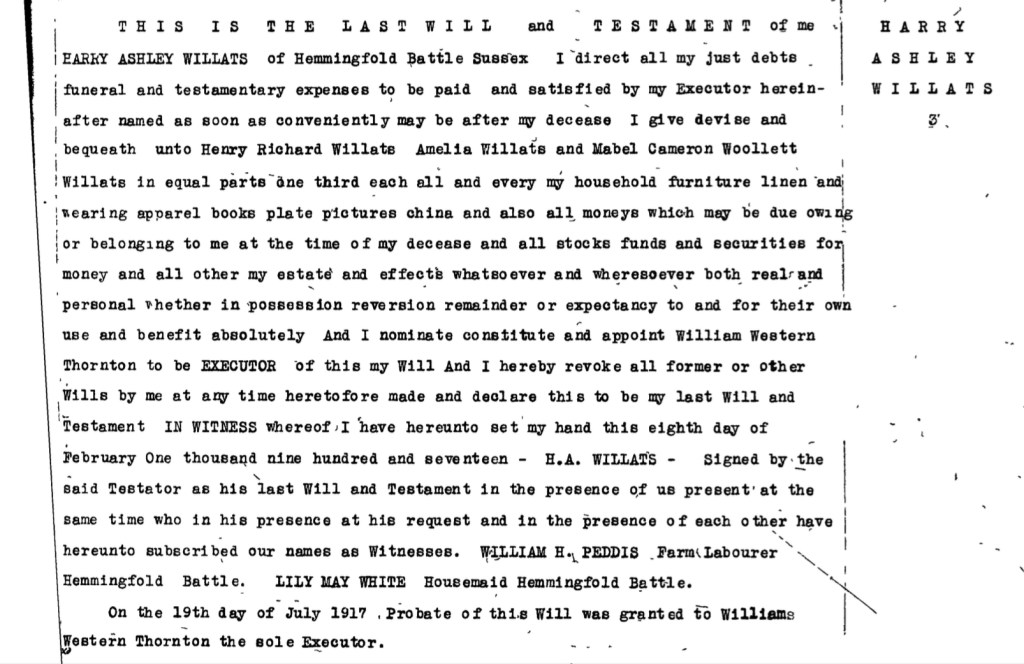
Henry, Amelia and their daughter Mabel were all named in their son Harry Ashley’s last will and testimony.
It reads as follows,
THIS IS THE LAST WILL and TESTAMENT of me HARRY ASHLEY WILLATS of Hemmingfold Battle Sussex. I direct all my just debts funeral and testamentary expenses to be paid and satisfied by my Executor hereinafter named as soon as conveniently may be after my decease. I give devise and bequeath unto Henry Richard Willats, Amella Willats and Mabel Cameron Woollett Willats, In equal parts one third each all and every my household furniture linen and wearing apparel books plate pictures china and also all money which may be due owing or belonging to me at the time of my decease and all stocks funds and securities for money and all other my estate’ and effects whatsoever and wheresoever both real and personal whether in possession reversion remainder or expectancy to and for their own use and benefit absolutely And I nominate constitute and appoint William Western Thornton to be EXECUTOR of this my Will And I hereby revoke all former or other Wills by me at any time heretofore made and declare this to be my last will and Testament IN WITNESS whereof I have hereunto set my hand this eighth day of February One thousand nine hundred and seventeen – H.A. WILLAT’S – Signed by the said Testator as his last Will and Testament in the presence of us present at the same time who in his presence at his request and in the presence of each other have hereunto subscribed our names as Witnesses. WILLIAM H. PEDDIS Farm Labourer Hemmingfold Battle. LILY MAY WHITE Housemaid Hemmingfold Battle. On the 19th day of July 1917 Probate of this Will was granted to Williams Western Thornton the sole Executor.
Jumping forward a few years, to the year 1920. George V was sat upon the throne, David Lloyd George(Coalition) was Prime Minister, and it was the 31st Parliament.
War Secretary Winston Churchill announced that conscripts will be replaced by a volunteer army of 220,000 men.
Queen Alexandra unveiled a monument to Nurse Edith Cavell in London.
Great Britain and Ireland competed at the 1920 Summer Olympics in Antwerp and won 15 gold, 15 silver and 13 bronze medals. 🥇
Forty Irish republican prisoners on hunger strike at Wormwood Scrubs were released.
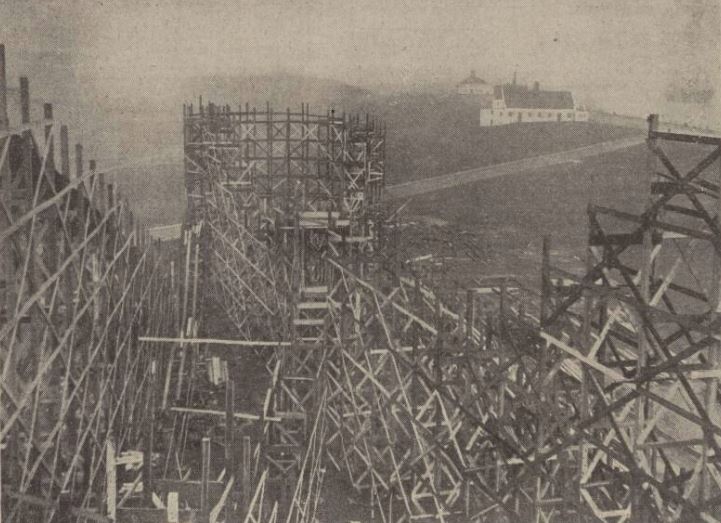
The Scenic Railway (roller coaster) at Dreamland Margate amusement park opened, the first in the UK.
Sinn Féin supporters and Unionists engage in pitched street battles in Derry.
World War I is officially declared over with Austria. 😢.
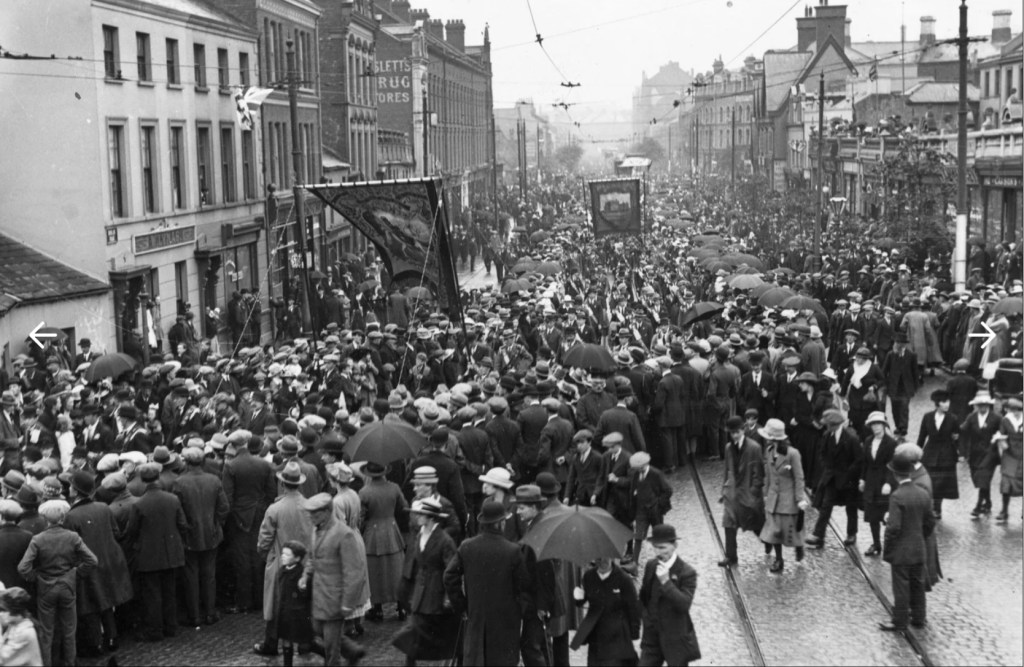
Fourteen die and one hundred are injured in fierce rioting in Belfast.
1920 sees the all-time highest annual number of live births in the country, over 1.1 million.
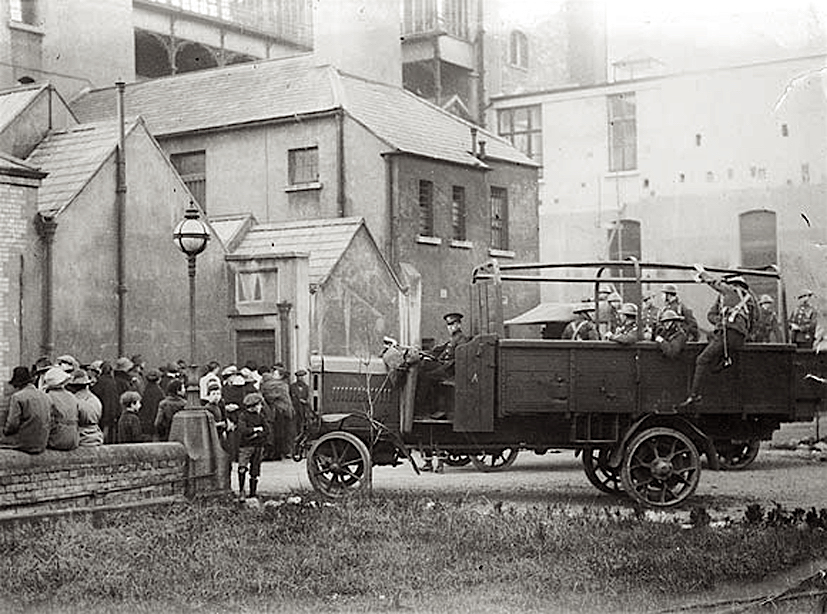
The Irish Republican Army, on the instructions of Michael Collins, shoot dead the Cairo gang, fourteen British undercover agents in Dublin, most in their homes. Later the same day in retaliation, the Auxiliary Division of the Royal Irish Constabulary open fire on a crowd at a Gaelic Athletic Association Football match in Croke Park, killing thirteen spectators and one player and wounding 60. Three men are shot on this night in Dublin Castle “while trying to escape”. (Bloody Sunday)
And the grim Reaper, was still lurking in the shadows and it wasn’t long before death had its next Willats victim in its grasp.
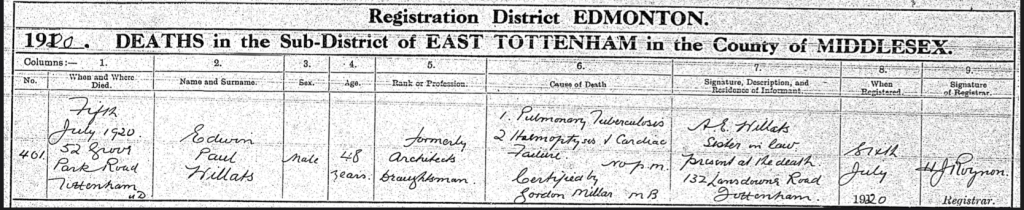
Sorrowfully Henry’s brother, 48 year old, a Architects Draftsman, Edwin Paul Willats, sadly passed away, on Monday the 5th of July 1920, at Number 52, Grove Park Road, Tottenham, Edmonton, Middlesex, England.
Edwin died from Pulmonary Tuberculosis and Hemoptysis cardiac failure. Certificated by Gordon Miller mb.
No post-mortem was taken.
Edwins sister in-law, Amelia Ellen Willats nee High, of 132, Landsdowne Road, Tottenham, was present and registered Edwins death on Tuesday the 6th of July 1920, in Edmonton.
Henry, his father Richard and the rest of the Willats family, laid, Edwin Paul Willats, to rest at, Abney Park Cemetery, Stoke Newington, Hackney, London, England, in Section, D06, Index 7S03, on Saturday the 10th of July, 1920.
He was buried with other family members.

Heartbreakingly death continued to plague the family. Henry’s brother, 63 years old, Insurance Manager, Francis Montague Allan Willats, sadly passed away on Sunday the 19th of September 1920, at Wymondley Heathgate, Hendon, Middlesex, England.
He died from Chronic interstitial hepatitis several years, certified by H. Stedman.
No post-mortem was taken.
Francis’s son, Allen Montague Willats was present and registered his death on Tuesday the 22nd September, 1920, in Hendon.

The Willats family laid, Francis Montague Willats, to rest, on Tuesday the 21st September 1920, at Highgate Cemetery, Camden, London, England, grave reference /40479.
He was buried with 7 others, Frances Jessie Willats, buried 16th September 1976.
Allan Montague Willats, buried 2nd March 1968. Dorothy Beaumont Willats, buried 9th April 1965. Margaret Eliza Craddock, buried 1st January 1961. David Allan Willats, buried 5th February 1948. Margaret Jane Willats, 25th October 1937 and Horace Lennan Willats, buried 19th December 1916..

Jumping forward to the following year, 1921, Britain was a nation still recovering from the First World War (1914-18) and the global Spanish flu pandemic (1918-20). Millions of lives had been lost in those tragedies. The families and communities left behind were still picking up the pieces. Yet, life-changing progress was also happening around them to help them move forward in a world changed forever.
Divorce was no longer taboo, over 16,600 people identified themselves as such in the 1921 census and families were getting smaller, especially when compared to Victorian times. Families of 3 or 4 children were the norm. This is reflected in statistics compiled from the 1921 Census. The average family size was 4.1 in 1921, down from 4.3 in 1911.
primary school was now free for all children which meant they were staying in school longer. Most children left aged 14.
Spinning tops, marbles and tiddlywinks were the must-have playthings of the era.
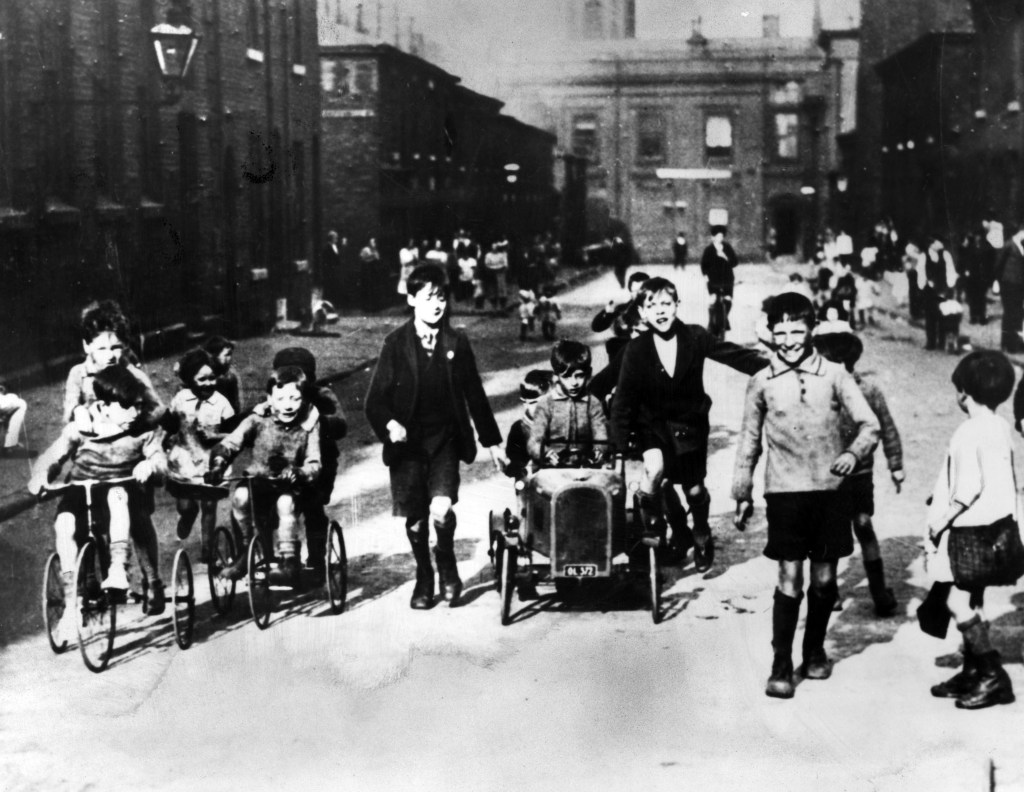
Middle-class families and the aristocracy enjoyed lavish country homes and estates. While urban settings mainly consisted of shared accommodation, Victorian terraces and newly-built two-up, two-down council houses. Think Downton Abbey at the richer end of the scale and Peaky Blinders’ depiction of 1920s Birmingham at the poorer end.
For the first time since the 1801 Census, women outnumbered men, most notably in the 20 to 45 age group
Women in the 1920s were more independent than ever before. The suffragettes’ fierce efforts finally secured women’s voting rights in 1918. And with millions of men serving overseas during the war, back home, women found themselves taking on jobs traditionally given to men. They worked in munitions factories, on the railways and formed the Women’s Army Auxiliary Corps, Women’s Royal Naval Service and Women’s Royal Air Force.
The 1921 Census features the first female policewomen, as well as significantly more female barristers, medical professionals and architects than recorded a decade earlier in the 1911 Census. But change didn’t come overnight but women were no longer just housewives and domestic servants. Flapper girls, synonymous with 1920s Great Gatsby culture, were out in the world, earning their own money, drinking alcohol, smoking cigarettes and enjoying themselves.
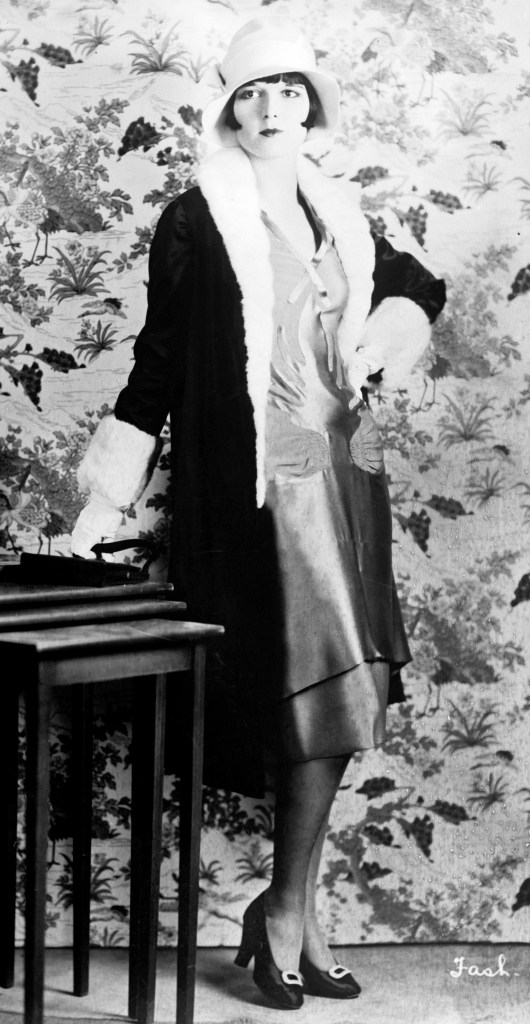
The ‘bright young things’ lifestyle shaped women’s fashion choices. Haircuts and hemlines got shorter and lipstick went mainstream. Cloche hats were paired with bob hairstyles to finish off the quintessential flapper look. And with women taking on more arduous jobs, more of them chose trousers over skirts.
The world was changing, for the better one would say, so where and what was Henry doing during this extra extraordinary time in British history?
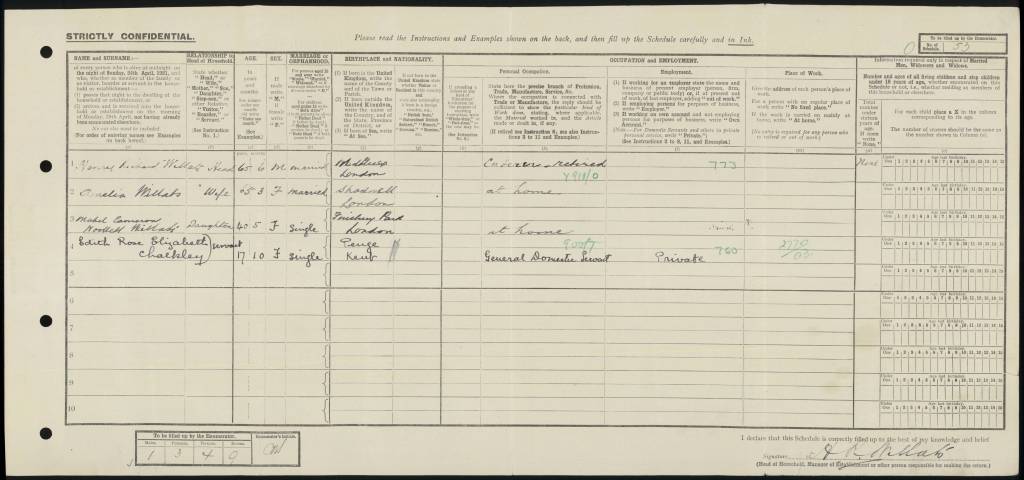
Henry, Amelia and Mabel, were residing at, 23, Barnmead Road, Beckenham, Kent, England, on Sunday the 19th June 1921. They had a 17 year old, general domestic servant residing with them, named, Edith Rose Elizabeth Chalkley, whom was privately hired.
Henry gave his occupation as a Caterer – Retired.


And still more death came, this time for our very own, Henry Richard Willats.
67-year-old, former Director of Limited Companies, Henry Richard Willats, passed away on Monday the 27th of November 1922, at 23 Barnmead Road, Beckenham, Bromley, Kent, England.
Henry died from Chronic Naphritis 10 years and Cardinal Failure 6 months.
Certified by Georgia R Stilwell M.B.
Henry’s brother, Walter James Willats, of 132 Lansdowne Road, was in attendance and registered Henry’s death on the same day as his death, Monday the 27th of November, 1922, in Bromley.

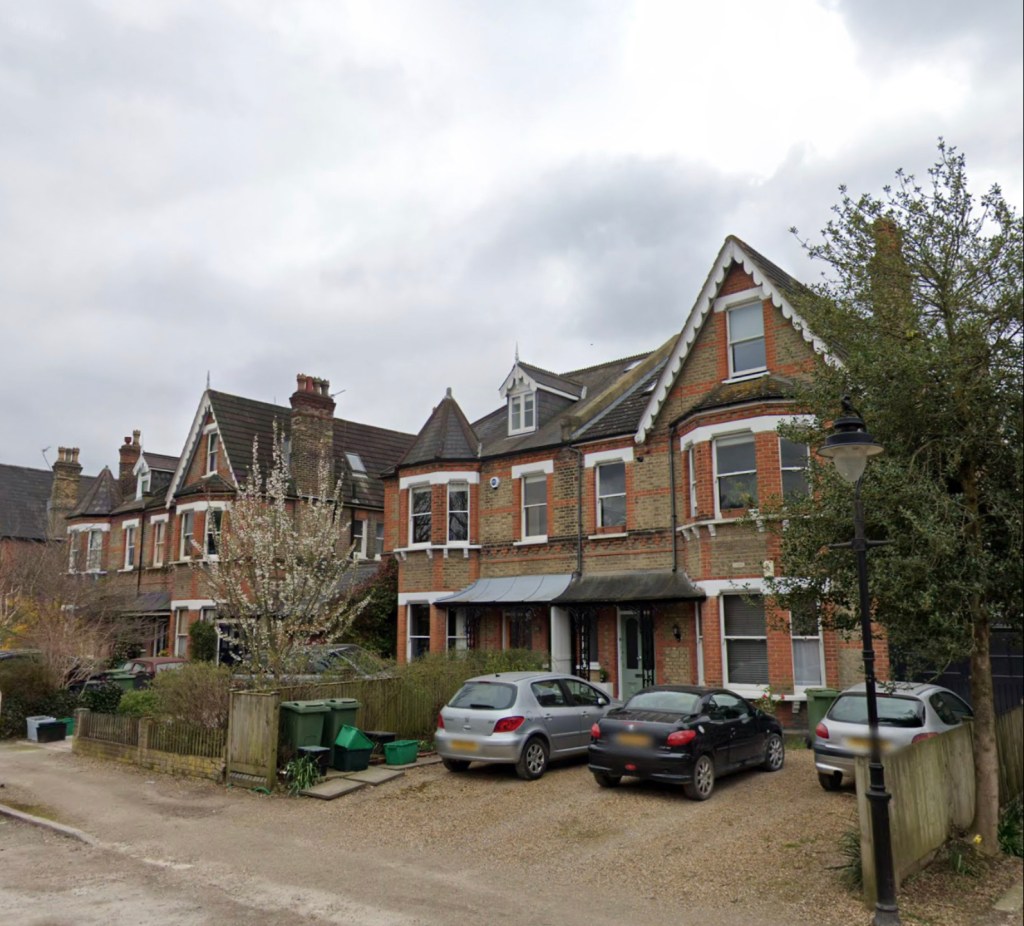
The Willats family laid, Henry Richard Willats, to rest, on Friday the 1st of December 1922, at Abney Park Cemetery, Stoke Newington, Middlesex, England.
He was buried in a family grave/vault and was buried with Baby Thornton, Florence Jose Western nee Willats, Harry Ashley Willats, William Western Thornton, and his lifelong love and wife, Amelia Willats.

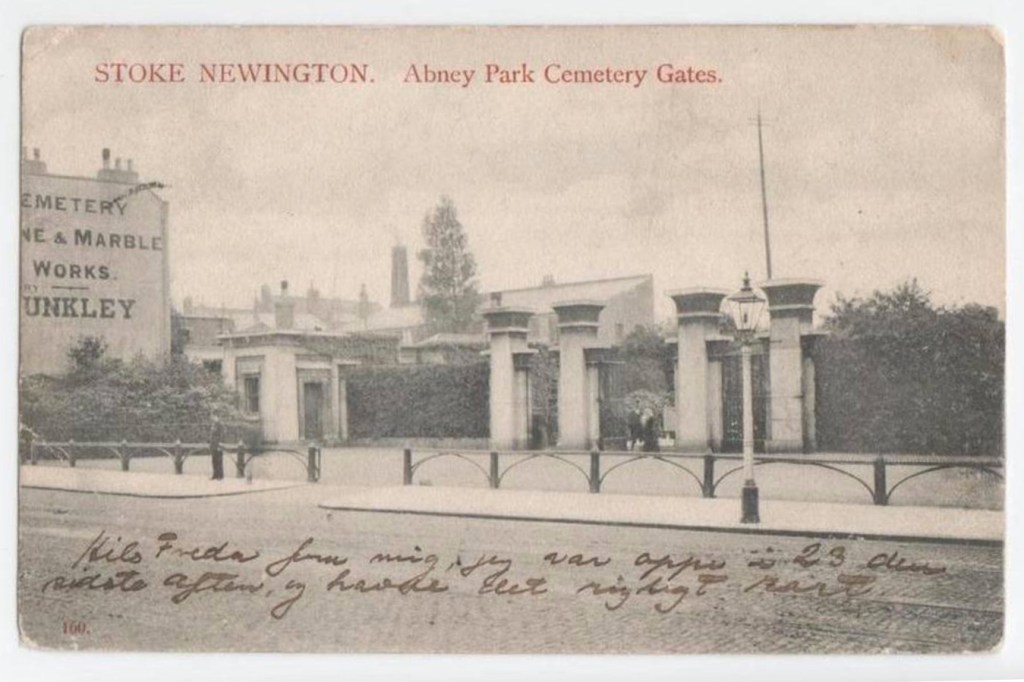
Abney Park started off as a picturesque parkland, laid out by Lady Mary Abney and Dr Isaac Watts, along with their neighbours, the Hartopps, in the early 18th century.
It wasn’t until 1840 that it was destined to become one of London’s cemeteries, a public arboretum, and an education centre.
Dr Isaac Watts was famously a non-conformist – which means that he practised religion outside of the established church (or simply had no faith), which was a big no no at the time.
This association led to Abney Park becoming a burial ground for non-conformists – but, although the chapel was non-denominational, the park was open to everyone regardless of their religious beliefs.
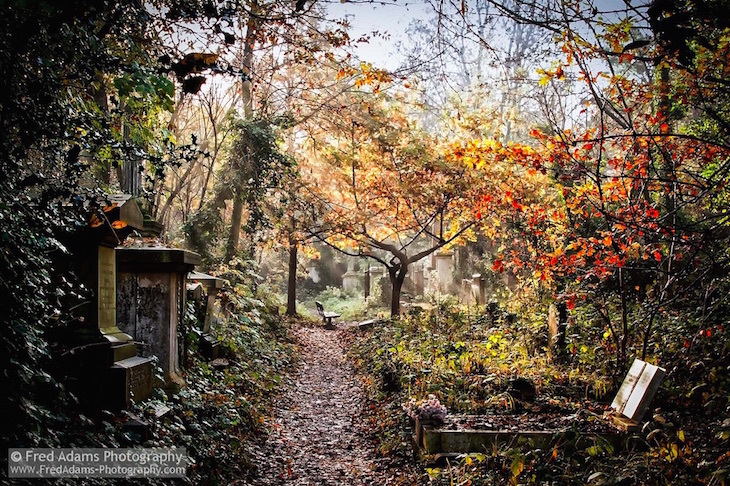
Today, as well as being a graveyard, Abney Park is a popular local nature reserve. Boasting more than 13 acres of lush woodland, Abney Park has around 200 trees dating back to the Victorian era and plenty more from the 19th century.
As the only mature mixed woodland in North Hackney, Abney Park is also home to some pretty cool wildlife including the Sparrowhawk and Tawny Owl, around a dozen Great Spotted Woodpeckers, and (to many people’s dismay) parakeets – you can read all about their controversy here.
Arboricultural and ecological consultant Russell Miller has studied ecology at Abney Park Cemetery for over 25 years, and he offers guided tours and fascinating talks relating to the unusual wildlife and fauna that can be found at Abney.
Hackney Council has also been putting in plenty of work to restore the graves and conserve Abney Park Cemetery as a significant area of architecture and ecology.
In recent years, this has meant that the Williams sarcophagus has been repaired, Sir Isaac Watt’s monument has been restored, and plenty of memorials have been deep cleaned.
A £5m project to improve Abney Park Cemetery in Stoke Newington, which will bring its chapel back into use and create a new café at its main entrance has begun.
The work, £4.4m of which is funded by the National Lottery Heritage Fund and The National Lottery Community Fund, will also see a new accessible entrance created on Stoke Newington Church Street.
Hackney Council will contribute an additional £710,000 to the National Lottery funding, which will bring total investment to over £5m. Abney Park Trust Charityorganisation will also contribute to the improvement project through its volunteers and local donations.
Henry Richard Willats, probate was granted on the 8th of February 1923, in London, England.
It reads,
WILLATS Henry Richard of 23 Barnmead-Road Kent House
Beckenham Kent died 27 November 1922 Probate London 8
February to Walter James Willats stock exchange member.
Effects £416 1s.

i have tried to order Henrys Last Will and Testament, but unfortunately I am having trouble locating them on the ordering system. However, I have contacted them and I’m keeping everything crossed that they can help.
It’s beyond sad that Henry never got to see the world evolve, never got to see the first BBC broadcast from Plymouth (station 5PY) or the first broadcast by King George V, opening the British Empire Exhibition at Wembley Stadium or complete the Sunday Express first ever publish a crossword in a newspaper. He never got to buy Amelia an American-made Frigidaire (the first brand of fridge to be sold in the United Kingdom.)

Or ride on a roller coaster.
It saddens my soul to think of all he wouldn’t see and accomplish. I’m sure his future would have been very interesting and full of adventures. Even though his life was busy running hotels, Henry saw a great deal of loss. I very much hope, his eyes were not drowned in sorrow and that they shone with adventure and excitement.
I very much wish that I could travel back in time, sit by one of the grand fires in his hotels and listen to him tell me all the stories, he would have heard from travellers over the years. I’m sure as sure can be, that we could have spent many hours, days, weeks and even years, listening to his tales. My heart sincerely hopes that he is at peace and reunited with his lost loved ones, and they all look down upon me with a little pride in their hearts, as I take a trip through their histories and honour their lives.
A link is missing from the chain.
Rest In Peace
Henry Richard Willats.
1856-1922
🦋🦋🦋
I have brought and paid for all certificates,
Please do not download or use them without my permission.
All you have to do is ask.
Thank you.
 Intwined