In the quiet corners of our family’s history, there lies a figure whose life’s story has remained shrouded in the mists of time. As the years roll on, the tales of our ancestors tend to fade, becoming mere whispers carried by the winds of generations. But today, we embark on a journey to reclaim the narrative of a remarkable individual who left an indelible mark on our lineage. A man whose spirit echoes through the years, Francis Montague Allen Willats, my 3rd Great Granduncle.
In an era long before the conveniences of modern life, where society and values were vastly different from what we know today, Francis Willats came into existence. Born in a time when horse-drawn carriages graced cobbled streets and the telegraph was the epitome of communication technology, he navigated a world that was both thrillingly different and oddly familiar. Francis’s story is one that deserves to be told, a narrative that reminds us of the resilience and fortitude that characterized those who lived in the 19th century. His early years were colored by the rustling of crinoline skirts, the aroma of open-hearth fires, and the lively sounds of bustling marketplaces. Each footstep he took on those cobblestones was a step toward carving out a path uniquely his own.
As we delve into the annals of his life, we’ll uncover the essence of the man behind the name—the dreams he held close, the challenges he braved, and the choices that ultimately led him to the most pivotal moment of his existence: his marriage in 1881. The turning point when two lives converged, setting the stage for the lineage that would follow.
But let’s not simply recount dates and facts; let’s imagine the sensations he experienced, the thoughts that swirled through his mind, and the emotions that stirred in his heart. Let’s breathe life into his journey, honoring his memory by stitching together the fragmented threads of history into a vivid tapestry that weaves through time.
So please join me as we step back into an era long past, as we honor the memory of Francis Montague Allen Willats, and as we pay homage to the spirit that continues to course through our veins. Through the pages of Intwined, we’ll resurrect his tale, one chapter at a time, and in doing so, we’ll resurrect a piece of ourselves—a connection to a heritage that weaves us all together.
The Life of
Francis Montague Allen Willats,
1857-1920,
The Early Years,
Through Documention.
Welcome to the year, 1857, in Westminster, London, England. Queen Victoria sat proudly upon the throne. The Prime Minister was Henry John Temple, 3rd Viscount Palmerston (Whig) and it was the 16th Parliament.
The year 1857 was a significant period in the history of the United Kingdom. It was marked by various social, political, and cultural events that had a lasting impact on the country.
One of the most notable global events of 1857 was the Indian Rebellion of 1857, also known as the Sepoy Mutiny or the First War of Independence. While this event primarily took place in British India, it had a significant impact on the British Empire as a whole. The uprising against British rule in India was sparked by various factors, including cultural, religious, and economic grievances among the Indian population. The repercussions of the rebellion led to changes in governance and administration in India.
Another major event of 1857 was the opening of “The Art Treasures of Great Britain” exhibition in Manchester. This exhibition showcased a wide range of artworks and artifacts from various periods and regions, and it attracted a large number of visitors. The success of this exhibition led to the planning of the Great Exhibition of 1851, which showcased the advancements of the Industrial Revolution and contributed to the growth of cultural exchange and trade.
Also the year 1857 witnessed an economic downturn known as the “Panic of 1857.” This was a worldwide financial crisis that had its origins in the United States, but it also had effects on the British economy. The crisis led to a recession and financial difficulties for many businesses and individuals.
The year saw the publication of several notable literary works in the UK. Charles Dickens, one of the most prominent writers of the time, published “Little Dorrit.” This novel highlighted social issues and class disparities in Victorian society. It was also a period of emergence for Pre-Raphaelite art and literature, with the Pre-Raphaelite Brotherhood gaining attention for their unique artistic style.
Politically, 1857 was a time of relative stability in the United Kingdom. Queen Victoria was in the middle of her long reign (1837-1901). The Crimean War, which had involved the UK, France, and Russia, had ended in 1856. The British political landscape was characterized by the dominance of the Conservative Party under Prime Minister Viscount Palmerston.
And my 4th Great Grandmother Eliza Willats nee Cameron and her partner /brother In-law, Richard Henry Willats, welcomed their second Son, Eliza’s 3rd son, into their home, hearts and lives.
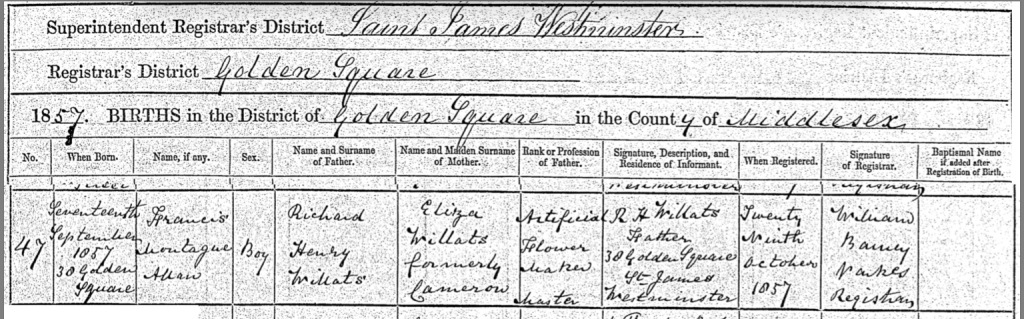
Francis Montague Allen Willats, was born on Thursday the 17th of September, 1857, at Number 30 Golden Square, St James, Westminster, London, England. Richard Henry, was working as a, Master Artificial Flower Maker. He registered Francis birth on the 29th October 1857.
Golden Square is a historic garden square located in the Soho district of Westminster, London, England. It has a rich history dating back to the 17th century and has been a focal point of social and cultural life in London for centuries. Here’s an overview of its history.
17th Century – Golden Square was originally developed in the late 17th century as part of the expansion of London’s West End. It was designed as a residential square, featuring Georgian townhouses surrounding a central garden area. The square’s name is believed to be derived from the Golden Lyon pub, which once stood nearby.
18th Century – By the 18th century, Golden Square had become a fashionable and affluent area. The townhouses around the square were home to various notable individuals, including artists, writers, and aristocrats. The square’s central garden provided a serene and attractive gathering place for residents.
19th Century – During the 19th century, the fortunes of Golden Square began to change. Industrialization and urban growth led to changes in the neighborhood, and the square’s social status declined. The area became more commercialized, with shops and offices replacing some of the residential buildings.
20th Century – The 20th century saw a renewed interest in preserving London’s historic architecture, including squares like Golden Square. Efforts were made to restore some of the original Georgian buildings and maintain the square’s historical character. The square remained a mix of commercial and residential use.
21st Century – In recent years, Golden Square has experienced a resurgence in popularity and significance. It is now part of the vibrant Soho neighborhood known for its entertainment, restaurants, and creative industries. The square’s central garden continues to provide a green oasis in the heart of the city.
Today, Golden Square is a mix of historic buildings, modern businesses, and cultural activities. It remains a notable landmark in London’s urban landscape, reflecting the city’s evolution over centuries. Visitors and residents alike are drawn to its history, architecture, and its place within the broader context of London’s cultural.

Francis’s sister, Charlotte Ellen Willats, was born on Wednesday the 10th of August, 1859, at Number 56, Bunton Street, St Pancras, Middlesex, England. Eliza registered Charlotte’s birth on Tuesday the 13th of December, 1859. She gave Richards occupation as a Commercial Traveller and their abode as, Number 56, Bunton Street, Saint Pancras.

Richard and Eliza, baptised Francis’s sister, Charlotte Ellen Willats, on Thursday the 1st of September, 1859, at the Saint Pancras Church, Saint Pancras, London, England.
Richard’s occupation was given as an Engraver and their abode as, Mabledon Row.

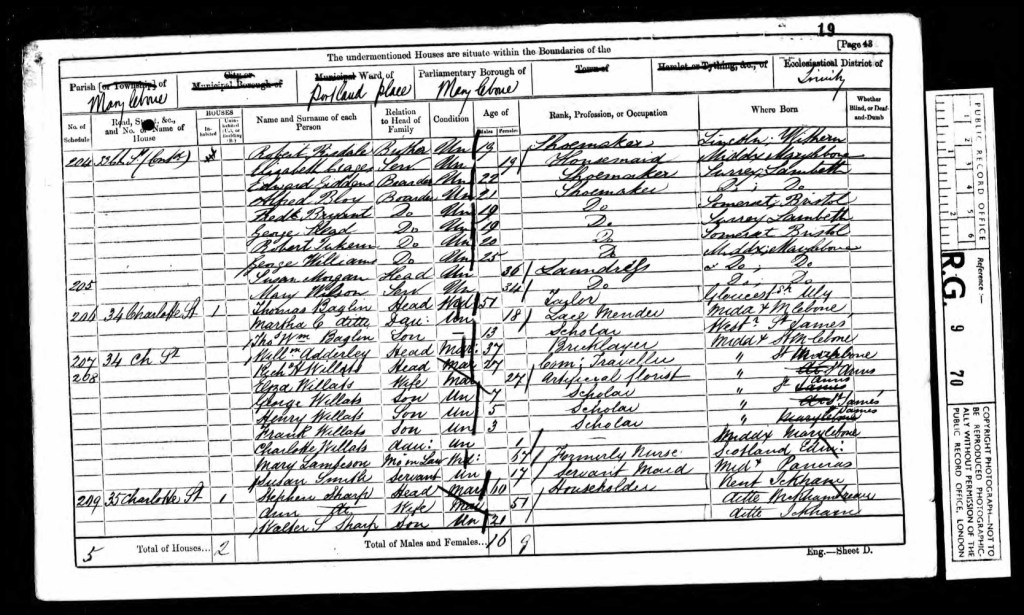
The 1861 census was held on Sunday the 7th of April, 1861. It shows Francis, residing at 34, Charlotte Street, Marylebone, Middlesex, England, with his parents, Richard and Eliza and siblings, Biggun aka William George, Henry, and Charlotte, his grandmother Mary Falconer and a servant, Susan Smith.
Richard was working as a commercial traveller, and Eliza as an Artificial florist. Francis was named as Frank.
Charlotte Street, seems to have been named after Queen Charlotte and runs from south to north from Percy Street to Howland Street. The original Charlotte Street extended to Goodge Street, and from thence to Tottenham Street it was called Lower Charlotte Street, the remainder being known as Upper Charlotte Street. The houses have been re-numbered twice since they were first numbered, the present sequence running from south to north, with the odd numbers on the west and the even on the east side.

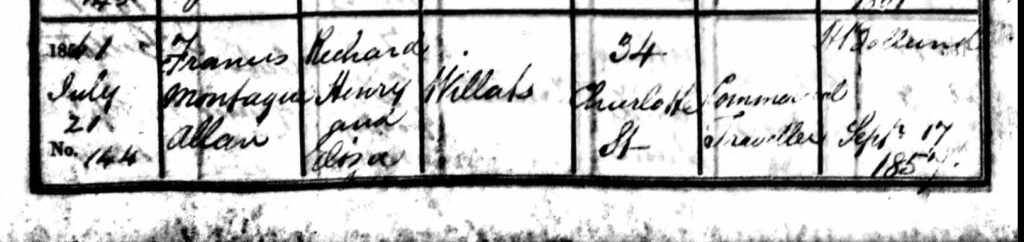
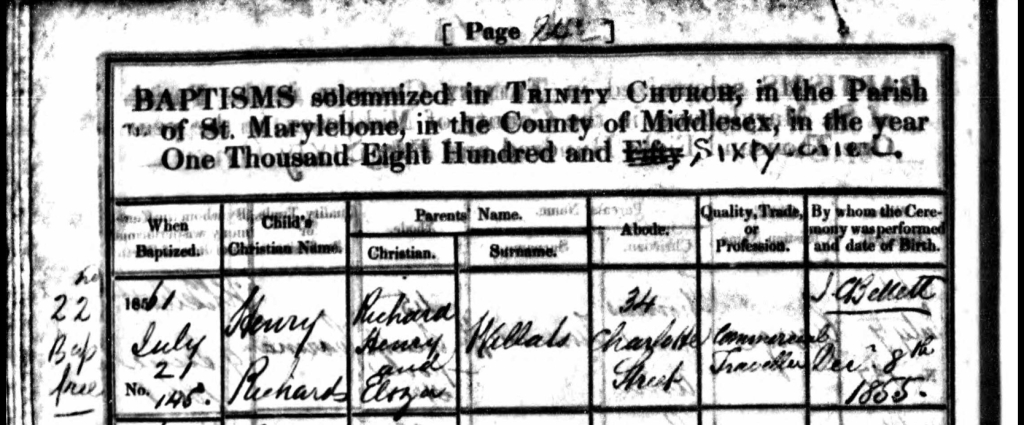
Francis Montague Allen and his brother Henry Richard Willats, were baptised on Sunday the 21st of July, 1861, at the Holy Trinity Church, Marylebone Road, Westminster, London, England.
Their father, Richard, gave his occupation as a commercial traveller and their abode, as 34 Charlotte Street.
Holy Trinity Church, in Marylebone, Westminster, London, is a Grade I listed former Anglican church, built in 1828 and designed by John Soane. In 1818 Parliament passed an act setting aside one million pounds to celebrate the defeat of Napoleon. This is one of the so-called “Waterloo churches” that were built with the money. It has an external pulpit facing onto Marylebone Road, erected in memory of the Revd. William Cadman MA (1815-1891), who was rector of the parish from 1859 – 1891, renowned for his sonorous voice and preaching. The building has an entrance off-set with four large Ionic columns. There is a lantern steeple, similar to St Pancras New Church, which is also on Euston Road to the east.
George Saxby Penfold was appointed as the first Rector, having previously taken on much the same task as the first Rector of Christ Church, Marylebone. The first burial took place in the vault of the church in 1829, and the last was that of Sir Jonathan Wathen Waller in 1853.
By the 1930s, the use of the church had declined, and from 1936 it was used as a book warehouse by the newly founded Penguin Books. A children’s slide was used to deliver books from the street into the large crypt. In 1937 Penguin moved out to Harmondsworth, and the Society for Promoting Christian Knowledge (SPCK), an Anglican missionary organisation, moved in. It was their headquarters until 2006, when they relocated to Tufton Street, Westminster (they have since moved again to Pimlico). The church is currently[when?] the location of the world’s first wedding department store, The Wedding Gallery, which is based on the ground floor and basement level. The first floor is used as an events space operated by One Events and known as “One Marylebone”.
The former church stands on a traffic island by itself, bounded by Marylebone Road at the front, and Albany Street and Osnaburgh Street on either side; the street at the rear north side is Osnaburgh Terrace.

Francis’s sister, Edith Cameron Willats, was born on Sunday the 20th of October, 1861, at 34 Charlotte Street, Marylebone, Middlesex, England.
Richard Henry, registered Edith’s birth on Monday the 25th of November, 1861, in Marylebone.
He gave his occupation as a Commercial Traveller and their abode as, Number 34 Charlotte Street, Marylebone.

And his brother, Arthur Charles Willats was born on Saturday the 11th of July, 1863, at Number 37, Charlotte Street, Marylebone, Middlesex, England. Their father, Richard Henry registered Arthur’s birth on Friday the 21st of August, 1863.
Richard’s occupation was given as a, Commercial Traveller and their abode as Number 37, Charlotte Street, Marylebone.

Arthur Charles and Edith Cameron Willats, were baptised on Sunday the 9th of August, 1863, at Holy Trinity Church, Marylebone Road, Westminster, Middlesex, England.
Richard’s occupation was given as a Traveller and their abode as Number 37, Charlotte Street.

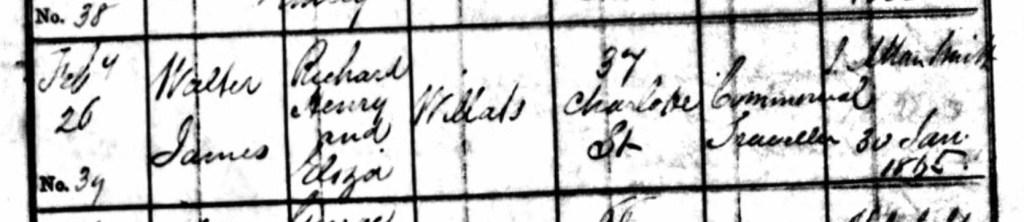
Francis welcomed another new brother, on Friday the 13th of January 1865. Eliza and Richard, named him, Walter James Willats.
Eliza gave birth at their home, 37, Charlotte Street, Marylebone, All Souls, Middlesex, England.
Richard registered Walters birth on the 9th of March 1865. He gave his occupation as a commercial traveller and their abode as, 37, Charlotte Street.

Francis’s brother Walter James, was baptised on Sunday the 26th February, 1865, at Holy Trinity Marylebone Road, Marylebone, Middlesex, England. Richards occupation was given as a commercial traveller and there abode 37 Charlotte Street.
Francis parents Richard Henry Willats and Eliza Willats nee Cameron finally decided to marry. Their banns were read, at St John the Evangelist, Smith Square, London, England, on the Sunday 9th and Sunday 16th of April, by W.S. Bruce and again on Sunday the 23rd April, 1865, by J. Graham.

St John’s Smith Square is a redundant church in the centre of Smith Square, Westminster, London.
In 1710, the long period of Whig domination of British politics ended as the Tories swept to power under the rallying cry of “The Church in Danger”. Under the Tories’ plan to strengthen the position of the Anglican Church and in the face of widespread damage to church buildings after a storm in November 1710, Parliament concluded that 50 new churches would be necessary in the cities of London and Westminster. An Act of Parliament in 1711 levied a tax on coal imports into the Port of London to fund the scheme and appointed a commission to oversee the project. Archer was appointed to this commission alongside, amongst others, Hawksmoor, Vanburgh and Wren. The site for St. John’s was acquired from Henry Smith (who was also Treasurer to the Commissioners) in June 1713 for £700 and building commenced immediately. However, work proceeded slowly and the church was finally completed and consecrated in 1728. In total, the building had cost £40,875. The church was built by Edward Strong the Younger a friend of Christopher Wren the Younger.
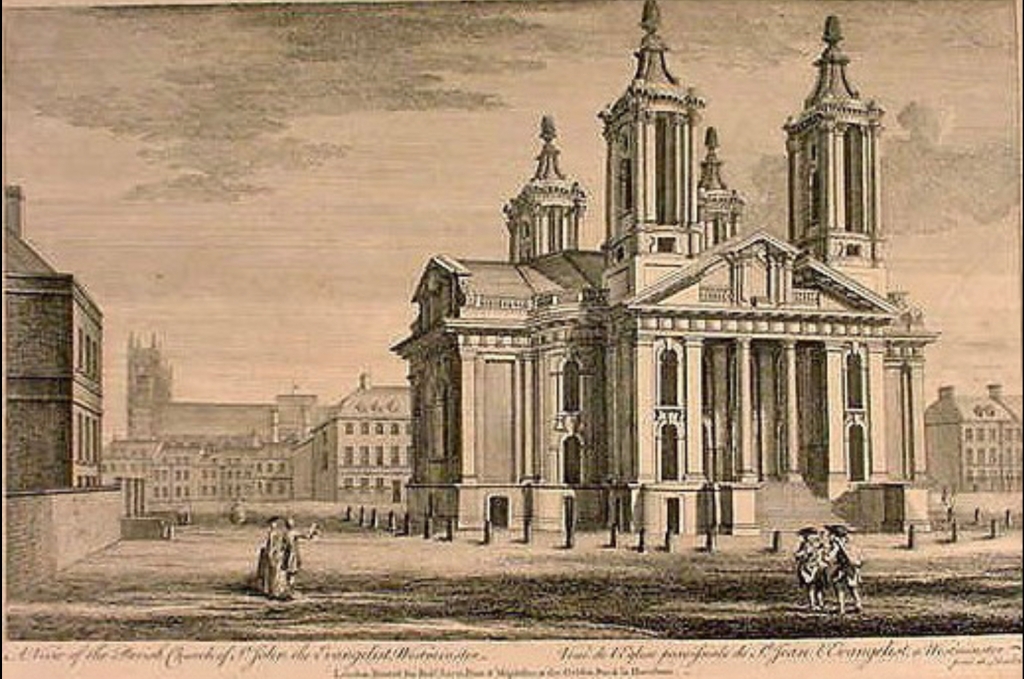
in the 18th century
Francis’s mum, Eliza Willats nee Cameron, and his father, Richard Henry Willats finally wed on Thursday the 4th of May, 1865.
They married at, St Margarets, Westminster, London, England.
Richard was a Bachelor.
Eliza was listed as a widower, which is rather strange as her first husband George John Willats (Francis’s uncle/Richard Henry Willats brother) didn’t die until later that year.
Their witnesses were, George John Willats, (Biggun’s father and Eliza’s first husband) and Eliza’s sister, Mary Cameron.
Eliza and Richard, were residing at 10 North Street.
Richard was working as a, Commercial Traveller.
Eliza’s Father, Allen Cameron was working as a Tailor and Richard’s Father, George John Willats, was working as a Wood Craver.

St. Margaret’s, known as ‘the Church on Parliament Square’, is a 12th-century church next to Westminster Abbey. It’s also sometimes called ‘the parish church of the House of Commons’.
The Church of St Margaret, Westminster Abbey, is in the grounds of Westminster Abbey on Parliament Square, London, England. It is dedicated to Margaret of Antioch, and forms part of a single World Heritage Site with the Palace of Westminster and Westminster Abbey.
The church was founded in the twelfth century by Benedictine monks, so that local people who lived in the area around the Abbey could worship separately at their own simpler parish church, and historically it was within the hundred of Ossulstonein the county of Middlesex. In 1914, in a preface to Memorials of St. Margaret’s Church, Westminster, a former Rector of St Margaret’s, Hensley Henson, reported a mediaeval tradition that the church was as old as Westminster Abbey, owing its origins to the same royal saint, and that “The two churches, conventual and parochial, have stood side by side for more than eight centuries – not, of course, the existing fabrics, but older churches of which the existing fabrics are successors on the same site.
In 1863, during preliminary explorations preparing for this restoration, Scott found several doors overlaid with what was believed to be human skin. After doctors had examined this skin, Victorian historians theorized that the skin might have been that of William the Sacrist, who organized a gang that, in 1303, robbed the King of the equivalent of, in modern currency, $100 million. It was a complex scheme, involving several gang members disguised as monks planting bushes on the palace. After the stealthy burglary 6 months later, the loot was concealed in these bushes. The historians believed that William the Sacrist was flayed alive as punishment and his skin was used to make these royal doors, perhaps situated initially at nearby Westminster Palace. Subsequent study revealed the skins were bovine in origin, not human.
You can read more about, St Margaret’s here.

in the grounds of Westminster Abbey on Parliament Square, London, England
As I have mentioned many times before (sorry), I have no idea as to how Richard and Eliza were able to marry, as it was strictly forbidden to marry a brothers wife even a deceased brother.
Family story’s state that, a sympathetic member of the clergy came to their rescue and had the first marriage annulled.
I guess we will never know for sure but it seems that maybe something fishy was going on as George John married Sarah Elizabeth Southall Jukes, in Victoria, Australia, in 1856 (11years before Richard and Eliza wed. George and Sarah, went on to have 4 Children. George John, stayed in Australia until his death in 1865, visiting England frequently.
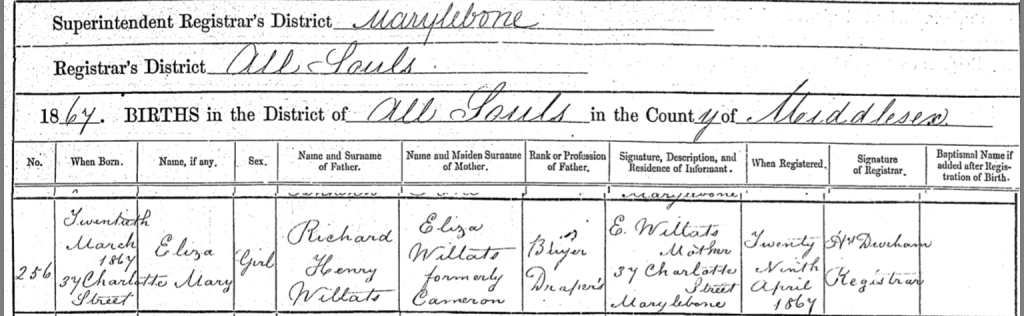
A few years later, Francis’s mum Eliza, was once again in the family way and gave birth to a baby girl whom they called, Eliza Mary Willats.
Eliza Mary was born on Wednesday the 20th of March, 1867, at Number 37 Charlotte Street, All Paul’s, Marylebone, Middlesex, England.
Their Father Richard was working as a Buyer of Diamonds, at the time of her birth.
Eliza registered Eliza’s birth on Monday the 29th April 1867.
Eliza Mary, was known as Polly.
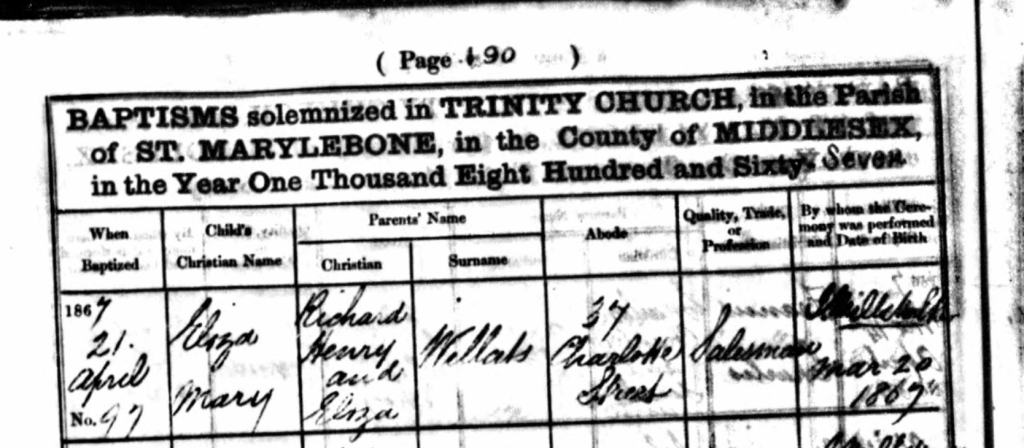
The family baptised Eliza Mary, on Sunday the 21st of April 1867, at Holy Trinity Church, Marylebone Road, Marylebone, Middlesex, England. Richards occupation was given as a Salesman and their abode as, 37 Charlotte Street.
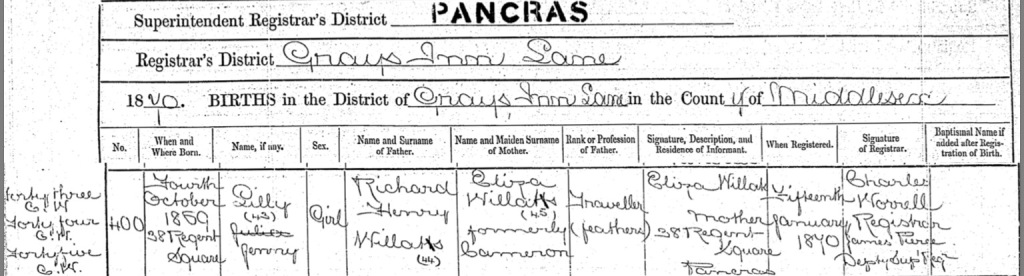
Francis’s mum, Eliza, was once again in the family way and she gave birth to her 9th child, Richard and her, 4th Daughter, on Monday the 4th of October, 1869, at, Number 38, Regent Square, Gray’s Inn Lane, Pancras, Middlesex, England.
Eliza and Richard named her, Lilly Jenny Willats.
Richards, occupation was listed as a Traveller ( Feathers). Eliza registered her birth on Friday the 15th January 1869.
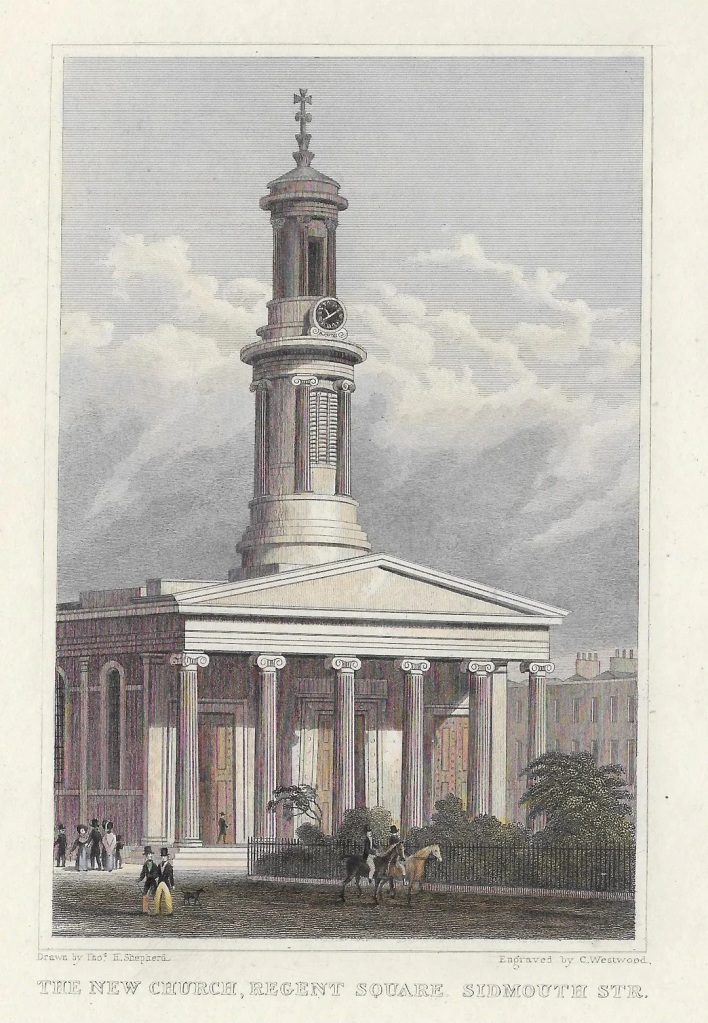
Regent Square is a public square and street in the London Borough of Camden in London, England. It is located near Kings Cross and Bloomsbury. Regent Square was laid out around a large garden in the historic Harrison Estate and first occupied in 1829, forming a garden square similar to more famous ones to the west in Bloomsbury. The southern side of the square is composed of its original buildings, and is Grade II listed in its entirety. Also listed is the phone box within the square gardens themselves.
Lillian Jenny Willats, was baptised on Sunday the 31st October, 1869, at Saint Peter Church, Saint Pancras, London, England. It was a private baptism. Her baptism shows that Richard was working as a Warehouse Man and their abode was, Number 38, Regent Square.

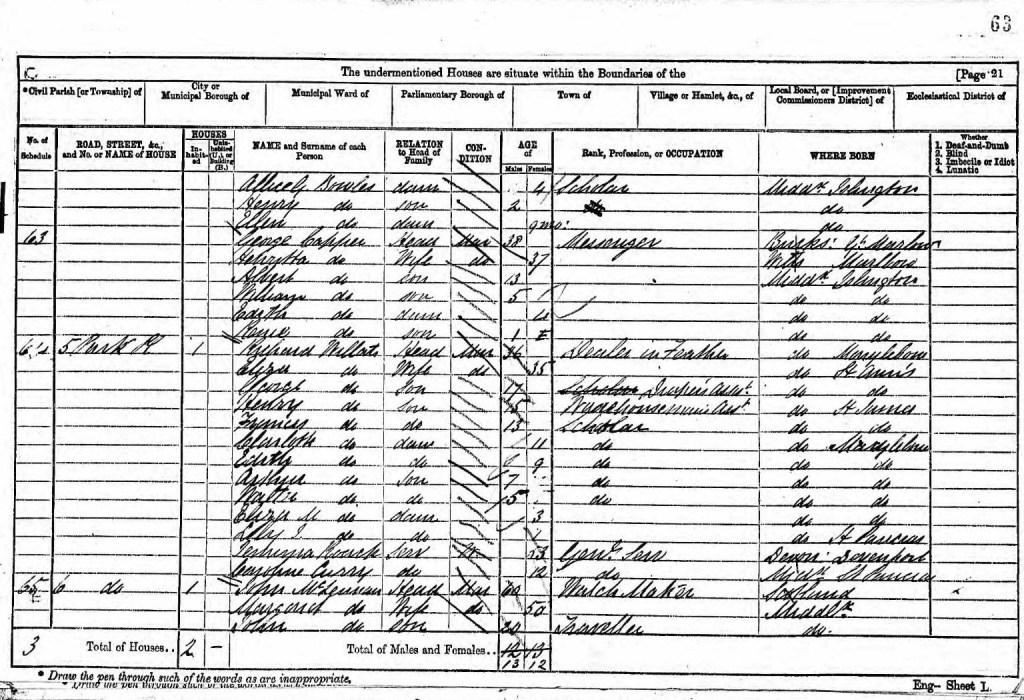
Francis, his parents Richard, Eliza, and his siblings, Walter, Henry, Eliza, Lillian, Edith, George and Charlotte, were residing at, Number 5, Park Road, Islington, Middlesex, England, on Sunday the of 2nd April 1871. Richard was working as a Dealer in feathers. The family had two General Servants, residing with them, Jemima Roac and Caroline Curry.
5 Park Place, London is a 3 bedroom freehold terraced house – it is ranked as the 3rd most expensive property in N1 3JU, with a valuation of £1,432,000. Since it last sold in July 2016 for £1,450,000, its value has decreased by £18,000. It is now a sleek contemporary townhouse within a private gated mews, arranged over three floors with an allocated parking space. You can see what it looks like here.
Francis’s mum, Eliza, childbearing days were still in full flow and gave birth to hers and Richards 5th Son, Edwin Paul Willats, on Wednesday the 8th of November, 1871, at Number 5, Park Place, Highbury, Islington, Middlesex, England. Richard was working as a Commercial Buyer and he registered Edwins birth on Wednesday December 20th 1871.
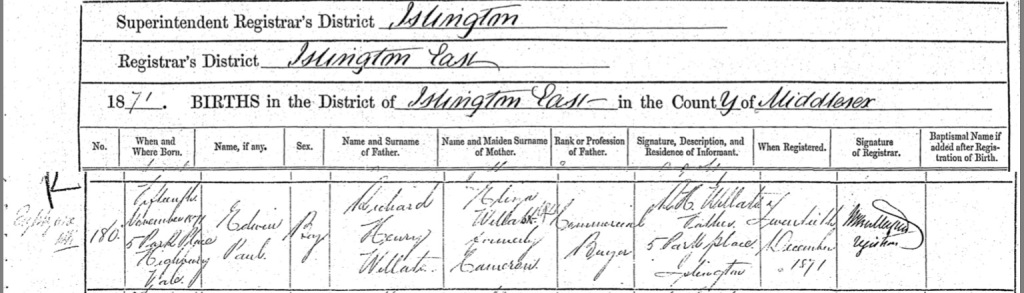
Edwin was baptised on Friday the 8th December 1871, at the Parish Church of St Mary the Virgin, Islington, Middlesex, England. Richards occupation was listed as a, Workhouse Man and their abode as 5 Park Place.

The Church of St Mary the Virgin is the historic parish church of Islington, in the Church of England Diocese of London. The present parish is a compact area centered on Upper Streetbetween Angel and Highbury Corner, bounded to the west by Liverpool Road, and to the east by Essex Road/Canonbury Road. The church is a Grade II listed building.
The churchyard was enlarged in 1793. With the rapid growth of Islington, it became full and closed for burials in 1853. It was laid out as a public garden of one and a half acres in 1885.
You can read more about St Mary’s here.

And Francis’s sister, May Claretta Willats, was born on Tuesday the 5th of May, 1874, at 5 Park Place, Highbury, East Islington, England.
Their father Richard, occupation was given as a, Feather Warehouseman and he registered May’s birth on Tuesday the 16th June 1874.
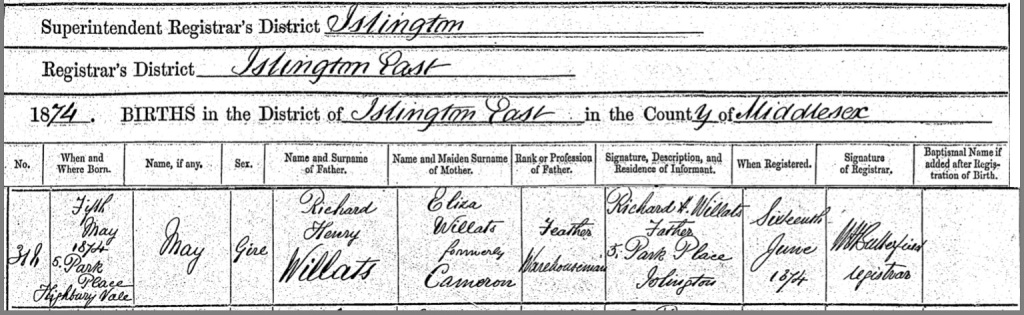
May Claretta, was baptised on, the 9th of August, 1874, at Christ Church, Highbury, Islington, Middlesex, England. Richard gave his occupation as a Manufacturer and their abode as, Highbury. Christ Church, Highbury, is an Anglican church in Islington, north London, next to Highbury Fields.

Christ Church, Highbury, is an Anglican church in Islington, north London, next to Highbury Fields.
The site was given by John Dawes, a local benefactor and landlord, and the church was built by Thomas Allom in a cruciform shape with a short chancel, transepts, and nave from 1847 to 1848. Bridget Cherry and Nikolaus Pevsner write that Christ Church Highbury ‘is a successful and original use of Gothic for a building on a cruciform plan with broad octagonal crossing. The cross-plan with broad nave and crossing was popular for churches in the low church tradition where an effective auditorium for the spoken word was preferred to a plan designed for an elaborate liturgy.’
Since then, several changes have been made to the church, including the addition of a balcony in 1872, and new rooms for children’s work and fellowship in 1980.

And on Wednesday the 1st of September 1875, Francis’s brother, Percy Sidney Willats, was born at the family home, Number 9, Park Place, Highbury, Islington, Middlesex, England.
Richard gave his occupation as a, Fancy Warehouseman and their abode as, 9, Park Place, Islington, when he registered Percy’s birth on Saturday the 9th October, 1875, in Islington.

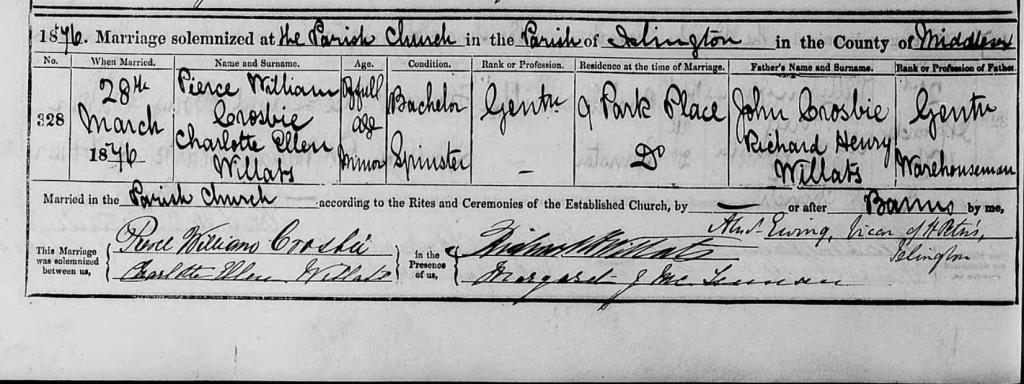
Francis’s sister, spinster Charlotte Ellen Willats, married bachelor, Pierce William Crosbie, on Tuesday the 28th of March, 1876, in St Mary’s Church, Islington, Middlesex, England. Charlotte was a minor and Pierce was of full age. Pierces occupation was given as a Gentu. They gave their residence as 9 Park Place and gave their fathers names and occupations as, Richard Henry Willats, a Warehouseman and John Crosbie a Gentu. Their witnesses were Richard Willats and Charlottes future sister in-law Margaret Jane McLennon.
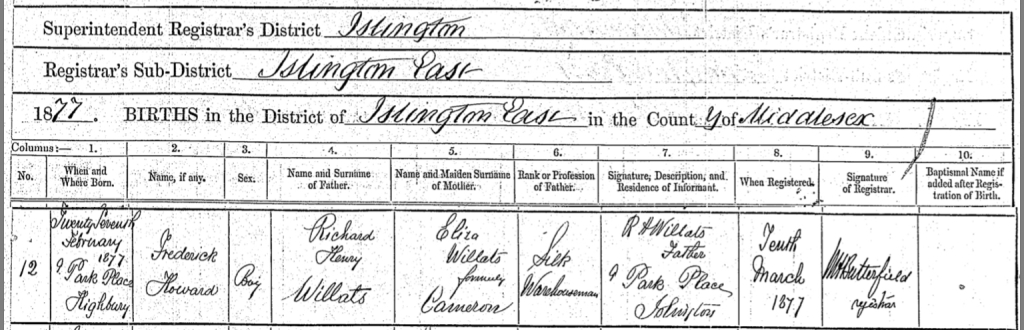
After many, many years of bearing children, Eliza, Francis’s mum, gave birth to her 13th Child, a baby boy, on Tuesday the 27th February 1877 at Number 9, Park Place, Highbury, Islington, Middlesex, England.
Richard and Eliza named him, Frederick Howard Willats.
Richards gave his occupation as a, Silk Warehouseman, and their abode as, 9 Park Place, Islington, when he registered Frederick’s birth on the 10th March 1877.
Francis’s brother, 24 year old, bachelor, publican, Henry Richard Willats married 23 year old, spinster, Amelia Etheredge, daughter of John Etheredge, on Tuesday the 30th of March, 1880 at All Saints Church, West Ham, Essex, England. Henry gave his residence as West Ham and Amelia as, Saint Paul’s, Shadwell.
They gave their fathers names and occupations as, Richard Henry Willats, a Licensed Victualler and John Etheredge, an Engineer.
Their witnesses were Charles Henry Etheredge and Alice Catherine Etheredge.

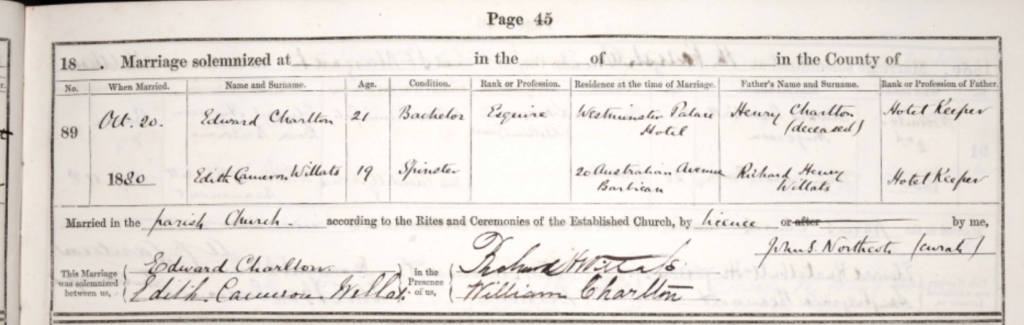
And his sister, 19 year old, spinster, Edith Cameron Willats married 21 year old Bachelor, Edward Charlton, a Esquire, on Wednesday the 20th of October, 1880, at St Margaret Church, George Hanover Square, Westminster, London, England. They gave their fathers names and occupations as, Richard Henry Willats, a Hotel Keeper and Henry Charlton, a Hotel Keeper. Edith gave her residents as, 20 Australian Avenue, Barbican, Silk Street, St Giles, Westminster, London, EnglandAnd Edward gave his as Westminster Palace Hotel. Their witnesses were, Richard Willats and William Charlton.
Jumping forward a couple of months to 1881, life in London was a reflection of the Victorian era, characterized by a mix of both progress and challenges.
London was rapidly urbanizing, with a growing population fueled by rural-to-urban migration and the effects of the Industrial Revolution. The city was a bustling metropolis with a mix of wealthy districts and densely populated working-class neighborhoods.
Victorian London was marked by stark social class divisions. The upper classes enjoyed luxurious lifestyles, while the working class faced difficult living conditions and long work hours. The disparity between the rich and poor was quite pronounced. Housing conditions varied greatly based on social class. The wealthy lived in elegant townhouses and mansions, often in the more affluent areas of the city. However, the working class often resided in cramped, overcrowded tenement buildings or slums, where sanitation and living conditions were poor.
London’s transportation system was expanding. Horse-drawn carriages, omnibuses, and trams were common means of getting around the city. The London Underground (subway) had also opened a few lines, revolutionizing urban transportation and making it more accessible.
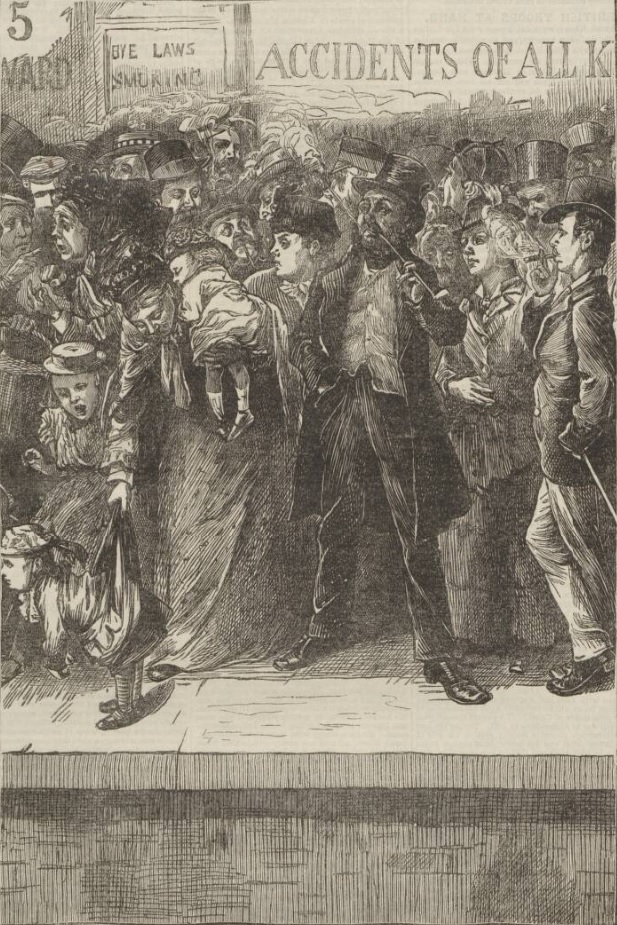
London was a hub of industrial and commercial activity. Factories and workshops were prominent, providing employment opportunities for many. However, working conditions were often challenging, and labor rights were limited. Child labor was also prevalent in many industries.
Theatres, music halls, and entertainment venues thrived in Victorian London. The West End became known for its theatrical productions and opera performances. Music halls were popular for working-class entertainment, offering a mix of music, comedy, and variety acts.
Education was expanding in the city. Elementary schools were becoming more common, although education for the working class was often basic and focused on practical skills. For the wealthier classes, private tutors or prestigious schools provided a more comprehensive education.
Sanitation was a significant concern in Victorian London. Overcrowding, inadequate sewage systems, and poor waste disposal led to unsanitary conditions, contributing to the spread of diseases such as cholera and typhoid.
Gender roles were strongly defined during this era. Women were often limited to domestic roles, and suffrage movements were gaining momentum, advocating for women’s rights and the right to vote.
Victorian London was a center of cultural and intellectual activity. Coffeehouses, salons, and literary gatherings provided spaces for discussions on literature, art, politics, and science. Renowned writers like Charles Dickens, Thomas Hardy, and Oscar Wilde were part of London’s literary scene.
Social reform movements were emerging, addressing issues such as public health, child labor, and housing conditions. Philanthropic efforts and social activism aimed to improve the lives of the less fortunate.
Basically the city was a vibrant center of commerce, culture, and innovation, yet it also grappled with issues related to social inequality, poor living conditions, and limited labor rights. The Victorian era’s values and norms heavily influenced daily life and societal dynamics during this period.
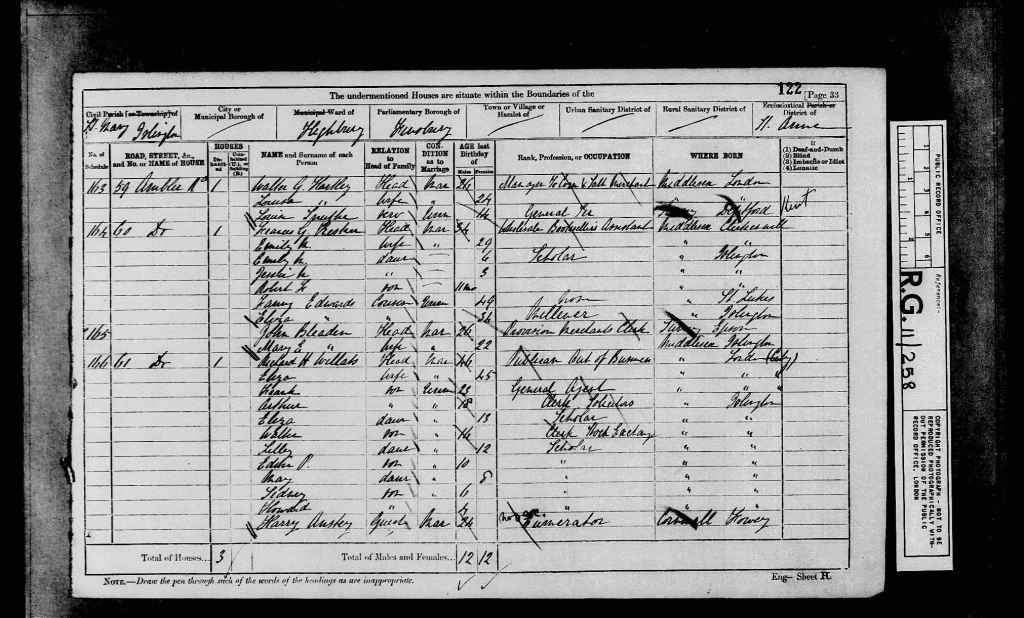
As we know the 1881 census was taken on Sunday the 3rd April 1881. It shows, Francis, his parents Richard and Eliza, and his siblings, Arthur, Eliza, Walter, Lillian, Edwin, May, and Sidney, were residing at number 61, Ambler Road, Islington, London, England. They had a guest named Henry Anstey staying with them. Frank was a General agent, Richard was a Publican, out of business. Arthur a Clerk solicitors, Walter a Clerk stock exchange and Eliza, Lillian, Edwin, May and Sidney were scholars. Henry Anstey was a Enumerator (no occ). Francis was named as Frank.
A few short months later, 23 year old, bachelor, Francis Montague Allen Willats, married 25 year old, spinster, Margaret Jane McLennon, at Saint John the Evangelist Church, Hornsey, Middlesex, England, on Wednesday the 6th of July, 1881. Francis was working as an agent at the time of his marriage.
They gave their fathers names and occupations as Richard Henry Willats, an Agent and John McLennon, a Chronometer Maker.
Francis gave his abode as, 145 Blackstock Road and Margaret gave hers as, 84, Finsbury Park Road.
Their witnesses were John McLennon and Jessie McLennon.

An upperclass/Gentlemen’s wedding in 1881 London, England, would have been a formal and traditional affair, reflecting the social norms and customs of the Victorian era.
Their engagement would likely start with a formal proposal from the gentleman to the lady’s family. The engagement would be announced, and an engagement party might be held to celebrate the upcoming union.
Invitations would be sent out in advance to guests, including family members, friends, and acquaintances. The invitations would typically be formal and written in a sophisticated style.
The wedding ceremony might have taken place in a church, reflecting the strong influence of religion on Victorian society. St. Paul’s Cathedral and Westminster Abbey were among the popular choices for such ceremonies. Alternatively, private venues or family estates could be used for smaller weddings.
The groom’s attire would consist of a formal morning suit, typically in dark colors, including a cutaway coat, waistcoat, striped trousers, a cravat, and a top hat. Accessories might include gloves and a pocket watch. The style would be conservative and in line with the fashion of the time.
The groom would have a best man and groomsmen by his side, usually close friends or family members. The bridal party would wear formal attire, complementing the groom’s look.
The wedding ceremony would be conducted by a clergyman and would include traditional vows and religious elements. The couple would exchange rings, which were becoming increasingly popular during this period.
Guests would arrive in their finest attire, adhering to strict social etiquette. Victorian society placed a strong emphasis on proper behavior and manners, and guests would be expected to adhere to these standards.
After the ceremony, a formal reception would be held. This could take place in a grand hall, a private residence, or a dedicated venue. The reception would feature a meal, speeches, and toasts to the newlyweds.
The menu would consist of a multi-course meal featuring dishes considered sophisticated and elegant for the time. Champagne and other fine wines would be served for toasts.
Victorian weddings often featured live music, including string quartets or small orchestras. Dancing and socializing would be central to the celebration. Decorations would be elaborate, with floral arrangements and ornate decorations adorning the venue. Floral motifs were particularly popular during this era.
Guests may have brought gifts for the newlyweds, often practical items for the couple’s new home. It was customary for the couple to provide wedding favors as a token of appreciation for their guests.
After the wedding, the newlyweds would embark on a honeymoon, typically to a destination known for its natural beauty or cultural significance. This marked the beginning of their life together as a married couple.
I am currently still looking into the history of the church, but in true honesty I am getting myself a little confused. If you know any information about Saint John the Evangelist Church, Hornsey, I would be extremely grateful for any information or photographs/Drawings.
In tracing the life journey of my 3rd Great Granduncle, Francis Montague Allan Willats, we have delved a little into a captivating era that was marked by both remarkable progress and intricate challenges. As we’ve journeyed through the documents of his early life, we’ve uncovered a portrait of a young man navigating his way in Victorian London.
From the bustling streets to the cobbled lanes, Francis’s footsteps echoed through a city undergoing transformative change.
In an age of urbanisation and industrialisation, he experienced the interplay of tradition and innovation, as horse-drawn carriages shared the roads with the newly emerging Underground system.
His upbringing, shaped by Victorian values, laid the foundation for his character, molded by the dichotomy of social classes and the pursuit of proper etiquette.
The vibrant culture of the city seeped into his soul, with theaters and music halls beckoning him to evenings of entertainment, a testament to an era that prized the arts and expression.
And within this bustling world, he embarked on the journey of love, culminating in the significant milestone of his wedding day in 1881.
As Francis exchanged vows and promises with his beloved Margaret, the echoes of tradition reverberated through the sacred walls of the church. And as I picture Francis in his formal morning suit and carefully chosen accessories, I sincerely feel connected to this remarkable man we are beginning to know and understand.
Francis Montague Allan Willats, a product of his time and place, carries with him the stories of an era that saw the convergence of progress and tradition. Through his eyes, we glimpse into the heart of a city alive with possibilities, a society undergoing rapid transformation, and the love story that graced his journey.
As we bid adieu to the chapter of his history, we call infinity, I honor his memory and the echoes of his footsteps in the annals of time.
May the documented tale of Francis Montague Allan Willats early life, inspire us to embrace the rich complexities of the past, as we embark on our own journeys through the ever-changing world we live in. Let’s make our ancestors proud and live our lives to the fullest while protecting the memories of the lives whom gave us ours.
Please pop back soon, to see Francis and Margarets lives unfold.
Will their love, continue to blossom or will the rat race and hassle and bustle of London life, smother them in its ashes?
Until next time, stay safe, stay true, be you.
Too-da-loo for now.
🦋🦋🦋
I have brought and paid for all certificates,
Please do not download or use them without my permission.
All you have to do is ask.
Thank you.
 Intwined
Very interesting well done
LikeLike