In the hallowed pages of history, there are chapters that demand to be revisited, stories that beckon us back for another glimpse into a life lived with purpose and heart. As we turn the page to Part 2 of “The Life of Francis Montague Allen Willats, 1857-1920 – Until Death Do Us Part,” we step deeper into the tapestry of a man whose legacy endures, woven into the very fabric of our existence. Francis, my 3rd great-granduncle, continues to inspire as we delve further into his remarkable journey. In every heartbeat, in every whispered tale, we find echoes of a spirit unyielding, a resolve unbreakable, and a love that transcends the confines of time. Born in a world that witnessed the birth pangs of modernity, Francis met the shifting tides of change with a tenacity that left an indelible mark. Through the sepia-toned lens of yesteryears, we glimpse a life coloured by dreams, aspirations, and the quiet victories that come from steadfast dedication. With each step taken in this exploration, I find myself standing on the cusp of eras long past, breathing in the essence of a world that Francis once navigated. The cobblestones underfoot, and the whispers in the wind, all tell tales of a man who, in the face of adversity, chose to stand tall and resolute. Yet, it is not just the triumphs that shape this narrative. It is the moments of vulnerability, the shadows of doubt, and the silent sacrifices that resonate with an honesty that transcends generations. In retracing these steps, we seek not only to uncover the history of one man but to unveil the universal truths that bind us all. As we embark on this second leg of our journey, let us do so with hearts open wide, ready to receive the gifts of wisdom and inspiration that Francis so generously imparts. Together, we honour not only a single life but the collective resilience of the human spirit. With every word written, through every cherished document, we draw closer to understanding the profound impact that one life can have on the course of history. Welcome, to a continuation of a tale that spans the ages, a tale of love, of perseverance, and of a legacy that endures, until death do us part.
The Life Of Francis Montague Allan Willats, Until Death Do Us Part.
Welcome back to the year 1882, London, England. Queen Victoria sat upon the throne. The Prime Minister was William Ewart Gladstone (Liberal) and it was the 22nd Parliament. The London Chamber of Commerce was founded. Roderick Maclean fails in an attempt to assassinate Queen Victoria outside Windsor railway station, the last attempt on her life. An underground explosion in the Durham Coalfield kills 69. Queen Victoria opens the Royal Courts of Justice in London. Lord Frederick Cavendish, the newly appointed Chief Secretary for Ireland, and Thomas Henry Burke, his Permanent Undersecretary, are fatally stabbed in Phoenix Park, Dublin, by members of the “Irish National Invincibles” (militant Irish republicans). Holborn Viaduct power station in the City of London, the world’s first coal-fired public electricity generating station, begins operation, supplying street lighting and some premises. The Married Women’s Property Act was an important step toward improving women’s rights in the UK. It allowed married women to own and control their own property, which was a major departure from previous laws that essentially made a woman’s property her husband’s upon marriage. British forces occupied Egypt and established a protectorate. This followed a period of political unrest in Egypt and Sudan, known as the Urabi Revolt, which sought to remove foreign influence from Egyptian affairs. The British occupation ultimately led to a semi-colonial administration of Egypt. The Education Act (marked a significant development in education in the UK. It made school attendance compulsory for children aged 5 to 10, although it still allowed for various exceptions. The Irish Home Rule movement, advocating for self-governance for Ireland within the United Kingdom, gained momentum in the late 19th century. While the Home Rule Bill of 1886 was ultimately defeated in Parliament, it was a significant event in the lead-up to the Irish War of Independence and the eventual establishment of the Irish Free State. Although not a UK-specific event, it had profound implications for British foreign policy. In 1882, Germany, Austria-Hungary, and Italy formed the Triple Alliance, which was a significant factor in European geopolitics and contributed to the complex alliances leading up to World War I.
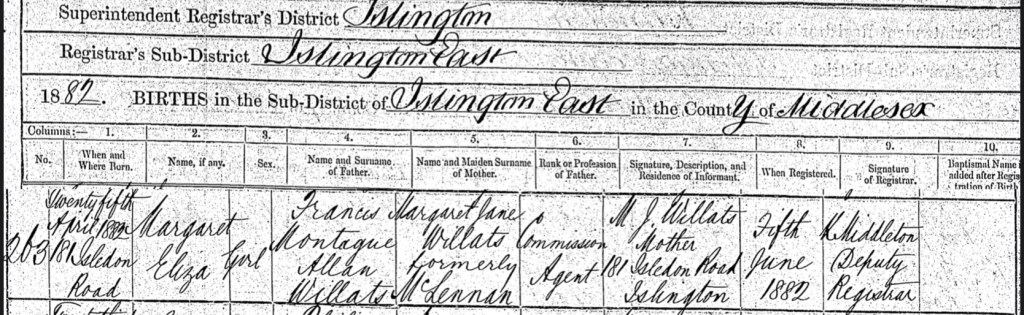
The year after, Francis and Margarets took their vows, to have and to hold, until death do us part, their daughter, Margaret Eliza Willats, was born on Tuesday the 25th of April 1882, at Number 181 Isledon Road, Islington, Middlesex, England.
Francis’s wife, Margaret Jane, registered Margaret’s birth on Monday the 5th of June 1882. She gave Francis’s occupation as a Commercial Agent, and their abode as 181 Isledon Road, Islington.
A commercial agent such as our Francis, would have held a role that involved facilitating business transactions and representing the interests of a company or client in various trade-related activities. Commercial agents played a crucial role in a time when communication and transportation were less advanced than they are today.
A commercial agent would act as the representative of a company or manufacturer in a specific region. They would be responsible for promoting and selling the company’s products or services to potential customers, often on a commission basis.
Agents would gather information about market trends, consumer preferences, and competitors in their assigned region. This information was valuable for the company to adapt its strategies and products accordingly.
Establishing and maintaining relationships with clients, suppliers, distributors, and other business partners was a fundamental aspect of the role. Personal connections and trust were essential in a business environment where face-to-face interactions were more common.
Commercial agents would negotiate deals, contracts, and terms of sale on behalf of the company they represented. This could include pricing, payment terms, and delivery arrangements.
They would handle orders from clients and ensure that they were processed accurately and efficiently. This might involve coordinating with the company’s production and logistics departments to ensure timely delivery.
Agents would promote the company’s products through various means, such as presentations, demonstrations, trade shows, and networking events. They would highlight the unique selling points of the products and convince potential buyers to make purchases.
Providing excellent customer service was important to maintain client satisfaction and loyalty. Agents would address any concerns, queries, or issues that customers might have and ensure a positive overall experience. Commercial agents would often report to their company on market conditions, sales performance, and relevant developments in their assigned region. This information would help the company make informed decisions. Depending on the scope of their responsibilities, commercial agents might need to travel frequently within their region to meet with clients, attend trade fairs, and assess local market conditions.
Agents would handle paperwork related to transactions, contracts, and other business processes. Accurate record-keeping was crucial for tracking sales and maintaining legal and financial compliance.
Agents operating in different regions would need to be sensitive to cultural differences, customs, and business practices. This would help build rapport and avoid misunderstandings.
Commercial agents needed to be adaptable to changing business environments and economic conditions. They had to navigate challenges such as economic downturns, trade barriers, and evolving consumer preferences.
Basically a commercial agent in 1881 played a pivotal role in bridging the gap between businesses and customers in a time when long-distance communication and travel were less efficient. They acted as intermediaries, responsible for sales, relationship-building, negotiation, and providing valuable market insights to the companies they represented.
Frances and Margaret baptised their daughter Margaret Eliza Willats, on Sunday the 28th of May 1882, at St Annes (St. Thomas), Finchley Park, Islington, Middlesex, England. Francis’s occupation was given as, an Agent and their abode as, 181 Isledown Road.

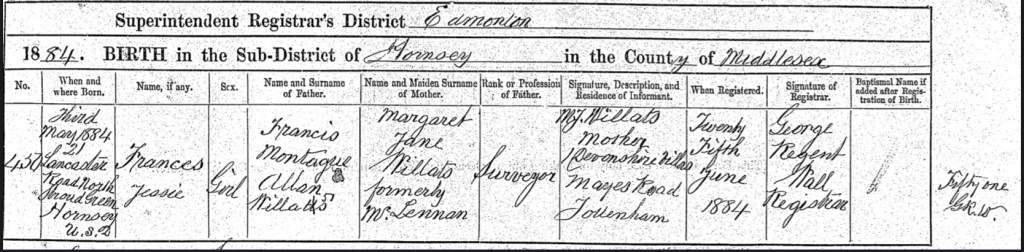
Francis and Margaret’s daughter, Frances Jessie Willats, was born on Saturday the 3rd of May 1884, at number 21 Lancaster Road, Stroud Green, Hornsey, Edmonton, Middlesex, England. Margaret registered her birth on Wednesday the 25th of June 1884 in Edmonston. She gave Frances ‘ father’s name as, Francis Montague Allan Willats, his occupation as, Surveyor and their abode as, Number 1, Devonshire Villas, Mayes Road, Tottenham.
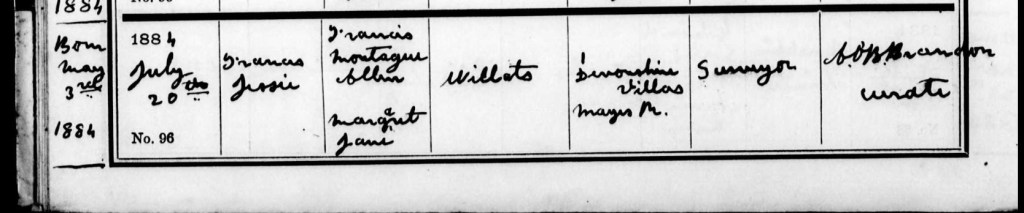
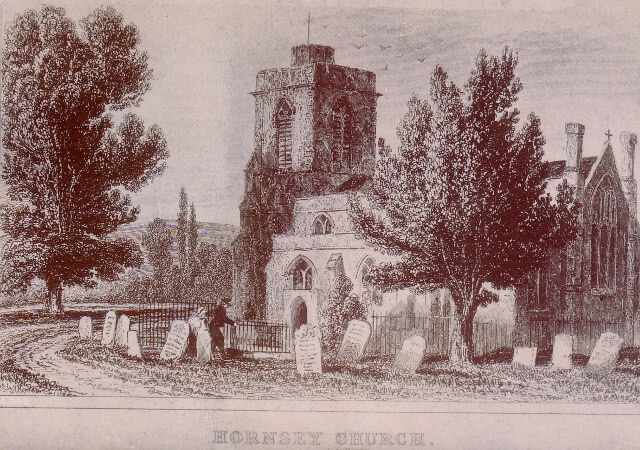
Francis and Margaret baptised Frances Jessie Willats on Sunday the 20th of July, 1884 at, St Mary’s Church, Hornsey, Middlesex, England. Francis’s occupation was given as a surveyor and their abode was given as, 1 Devonshire Villas, Mayes Road.
St. Mary’s Church in Hornsey, located in North London, is a historic Anglican church with a rich history that dates back many centuries. The exact date of the church’s founding is uncertain, but it is believed to have originated in the 13th century. Some historical records suggest that a church may have existed on the site as early as 1202. Over the centuries, St. Mary’s underwent several architectural changes and renovations. The church’s architecture evolved from its medieval origins to include elements of various architectural styles, including Gothic and Victorian. Like many churches in England, St. Mary’s Church went through significant changes during the English Reformation in the 16th century. During this time, the Church of England broke away from the authority of the Pope, and many Catholic practices and decorations were removed or altered in Anglican churches. In the 19th century, St. Mary’s Church underwent a major restoration under the guidance of architect William Butterfield. This restoration work added distinctive features to the church, including a new spire and other Gothic Revival elements. St. Mary’s Church has been an important part of Hornsey’s history for centuries. It has served as a place of worship, community gathering, and social events. The churchyard surrounding the church contains numerous historic graves and tombstones, providing insights into the local history and prominent figures from the past. St. Mary’s Church continues to be an active place of worship and a center of community life in Hornsey. It hosts regular religious services, as well as various community events and activities. The church’s architecture is notable for its Gothic Revival design, stained glass windows, and ornate interior decorations. Visitors can also admire the church’s beautiful organ and other historic features. St. Mary’s Church is typically open to the public during certain hours and for special events. Visitors are welcome to explore its historical and architectural treasures. St. Mary’s Church, Hornsey, stands as a testament to the enduring legacy of religious and architectural history in the United Kingdom. It continues to play an important role in the life of the local community and remains a place of spiritual significance and historical interest.
From the 1863-1894 London, England, Overseer Returns, Francis Montague Allen Willats was residing at, 1 Devonshire Villas, Mayes Road, Wood Green, Tottenham, Middlesex, England, in 1885.

Across the pond in Buffalo United States of America, Francis’s brother Arthur Charles Willats married Josephine Mary Conley in 1886 when he was 23 years old. Unfortunately at present I haven’t come across any documentation for their marriage only census records and births of their children. Being in the United Kingdom, research in America isn’t the easiest especially ordering certificates etc.
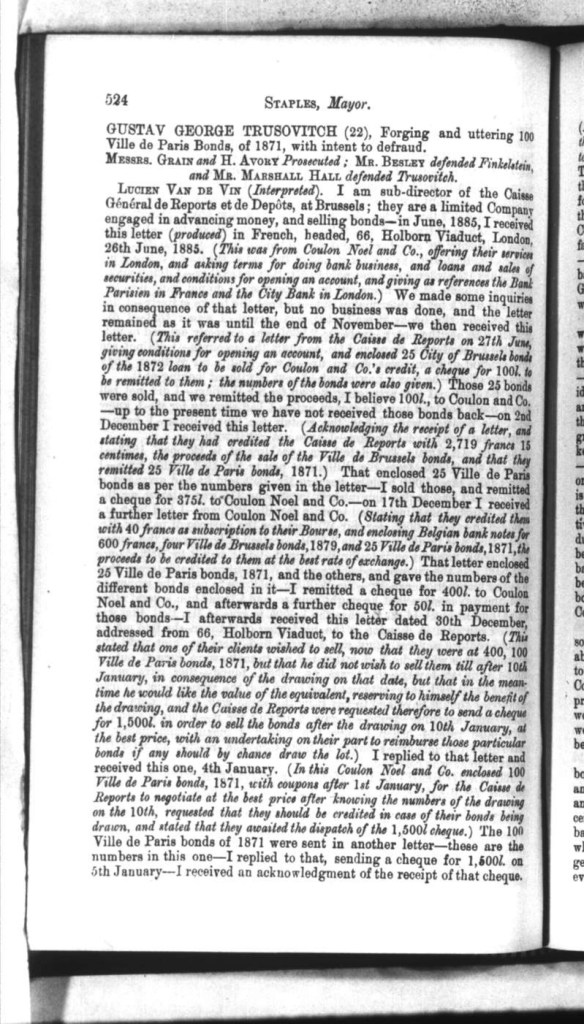
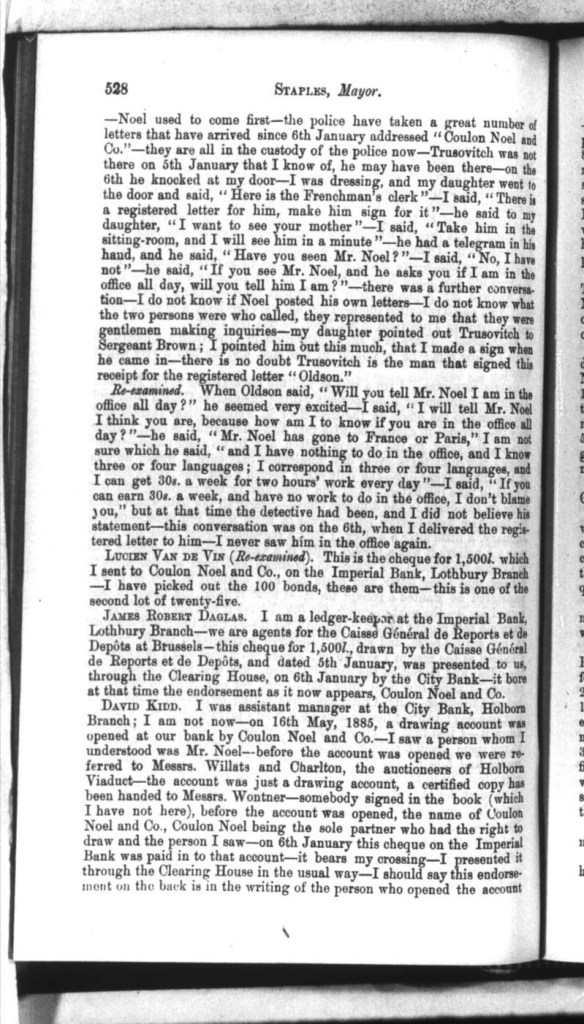
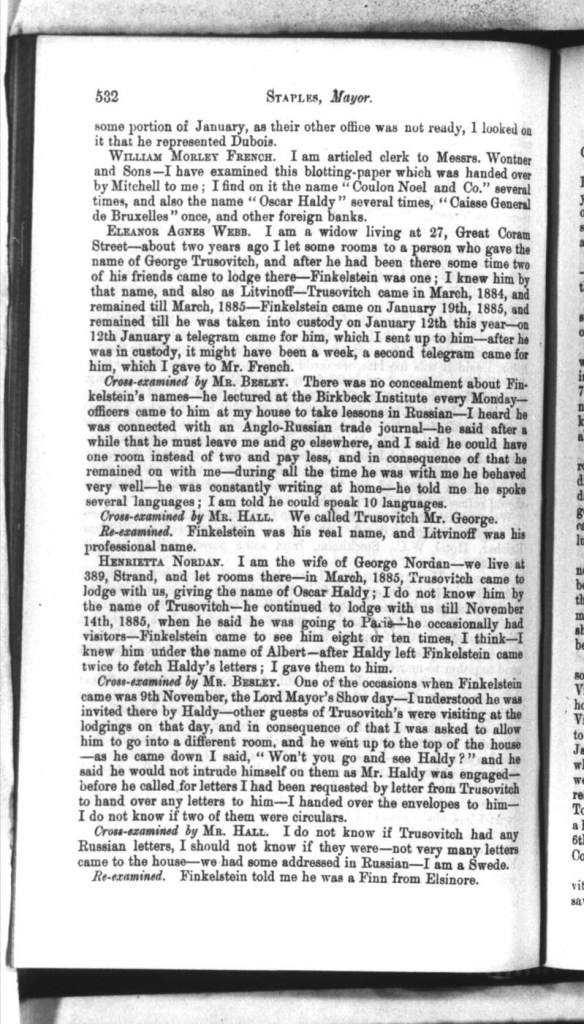
On the 8th of March 1886, Francis was a witness at the trial of James Abel Albert Apollo Finkelstein (34), and Gustav George Trusovitch (22), who were found guilty of, Forging and uttering 100 Ville de Paris Bonds, of 1871, with intent to defraud. The case reads as follows,
377. JAMES ABEL ALBERT APOLLO FINKELSTEIN (34) and GUSTAV GEORGE TRUSOVITCH (22), Forging and uttering 100 Ville de Paris Bonds, of 1871, with intent to defraud.
MESSRS. GRAIN and H. AVORY Prosecuted; MR. BESLEY defended Finkelstein, and MR. MARSHALL defended Trusovitch.
LUCIEN VAN DE VIN (Interpreted). I am sub-director of the Caisse General de Reports et de Depots, at Brussels; they are a limited Company engaged in advancing money, and selling bonds—in June, 1885, I received this letter (produced) in French, headed, 66, Holborn Viaduct, London, 26th June, 1885. (This was from Coulon Noel and Co., offering their services in London, and asking terms for doing bank business, and loans and sales of securities, and conditions for opening an account, and giving as references the Bank Parisien in France and the City Bank in London.) We made some inquiries in consequence of that letter, but no business was done, and the letter remained as it was until the end of November—we then received this letter. (This referred to a letter from the Caisse de Reports on 27th June, giving conditions for opening an account, and enclosed 25 City of Brussels bonds of the 1872 loan to be sold for Coulon and Co.’s credit, a cheque for 100l. to be remitted to them; the numbers of the bonds were also given.) Those 25 bonds were sold, and we remitted the proceeds, I believe 100l., to Coulon and Co.—up to the present time we have not received these bonds back—on 2nd December I received this letter. (Acknowledging the receipt of a letter, and stating that they had credited the Came de Reports with 2,719 francs 15 centimes, the proceeds of the sale of the Ville de Brussels bonds, and that they remitted 25 Ville de Paris bonds, 1871.) That enclosed 25 Ville de Paris bonds as per the numbers given in the letter—I sold those, and remitted a cheque for 375l. to Coulon Noel and Co.—on 17th December I received a further letter from Coulon Noel and Co. (Stating that they credited them with 40 francs as subscription to their Bourse, and enclosing Belgian bank notes for 600 francs, four Ville de Brussels bonds, 1879, and 25 Ville de Paris bonds, 1871, the proceeds to be credited to them at the best rate of exchange.) That letter enclosed 25 Ville de Paris bonds, 1871, and the others, and gave the numbers of the different bonds enclosed in it—I remitted a cheque for 400l. to Coulon Noel and Co., and afterwards a further cheque for 50l. in payment for those bonds—I afterwards received this letter dated 30th December, addressed from 66, Holborn Viaduct, to the Caisse de Reports. (This stated that one of their clients wished to sell, now that they were at 400, 100 Ville de Paris bonds, 1871, but that he did not wish to sell them till after 10th January, in consequence of the drawing on that date, but that in the mean-time he would like the value of the equivalent, reserving to himself the benefit of the drawing, and the Caisse de Reports were requested therefore to send a cheque for 1,500l. in order to sell the bonds after the drawing on 10th January, at the best price, with an undertaking on their part to reimburse those particular bonds if any should by chance draw the lot.) I replied to that letter and received this one, 4th January. (In this Coulon Noel and Co. enclosed 100 Ville de Paris bonds, 1871, with coupons after 1st January, for the Caisse de Reports to negotiate at the best price after knowing the numbers of the drawing on the 10th, requested that they should be credited in case of their bonds being drawn, and stated that they awaited the dispatch of the 1,500l cheque.) The 100 Ville de Paris bonds of 1871 were sent in another letter—these are the numbers in this one—I replied to that, sending a cheque for 1,400l. on 5th January—I received an acknowledgment of the receipt of that cheque.
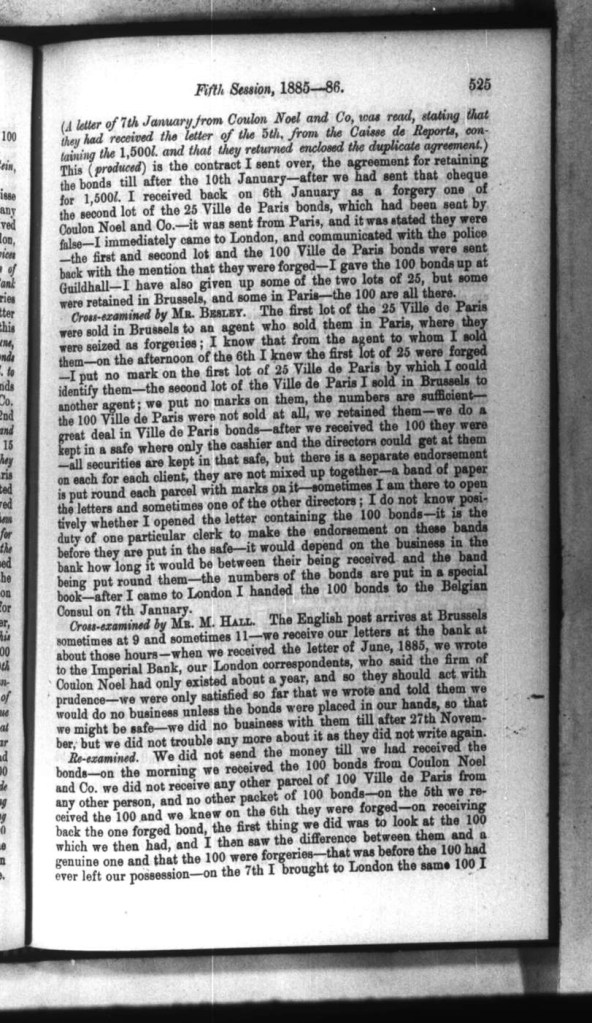
(A letter of 7th January from Coulon Noel and Co, was read, stating that they had received the letter of the5th, from the Caisse de Reports, containing the 1,500l. and that they returned enclosed the duplicate agreement.) This (produced) is the contract I sent over, the agreement for retaining the bonds till after the 10th January—after we had sent that cheque for 1,500l. I received back on 6th January as a forgery one of the second lot of the 25 Ville de Paris bonds, which had been seat by Coulon Noel and Co.—it was sent from Paris, and it was stated they were false—I immediately came to London, and communicated with the police—the first and second lot and the 100 Ville de Paris bonds were sent back with the mention that they were forged—I gave the 100 bonds up at Guildhall—I have also given up some of the two lots of 25, but some were retained in Brussels, and some in Paris—the 100 are all there.
Cross-examined by MR. BESLEY. The first lot of the 25 Ville de Paris were sold in Brussels to an agent who sold them in Paris, where they were seized as forgeries; I know that from the agent to whom I sold them—on the afternoon of the 6th I knew the first lot of 25 were forged—I put no mark on the first lot of 25 Ville de Paris by which I could identify them—the second lot of the Ville de Paris I sold in Brussels to another agent; we put no marks on them, the numbers are sufficient—the 100 Ville de Paris were not sold at all, we retained them—we do a great deal in Ville de Paris bonds—after we received the 100 they were kept in a safe where only the cashier and the directors could get at them—all securities are kept in that safe, but there is a separate endorsement on each for each client, they are not mixed up together—a band of paper is put round each parcel with marks on it—sometimes I am there to open the letters and sometimes one of the other directors; I do not know positively whether I opened the letter containing the 100 bonds—it is the duty of one particular clerk to make the endorsement on these bands before they are put in the safe—it would depend on the business in the bank how long it would be between their being received and the band being put round them—the numbers of the bonds are put in a special book—after I came to London I handed the 100 bonds to the Belgian Consul on 7th January.
Cross-examined by MR. HALL. The English post arrives at Brussels sometimes at 9 and sometimes 11—we receive our letters at the bank at about those hours—when we received the letter of June, 1885, we wrote to the Imperial Bank, our London correspondents, who said the firm of Coulon Noel had only existed about a year, and so they should act with prudence—we were only satisfied so far that we wrote and told them we would do no business unless the bonds were placed in our hands, so that we might be safe—we did no business with them till after 27th November, but we did not trouble any more about it as they did not write again.
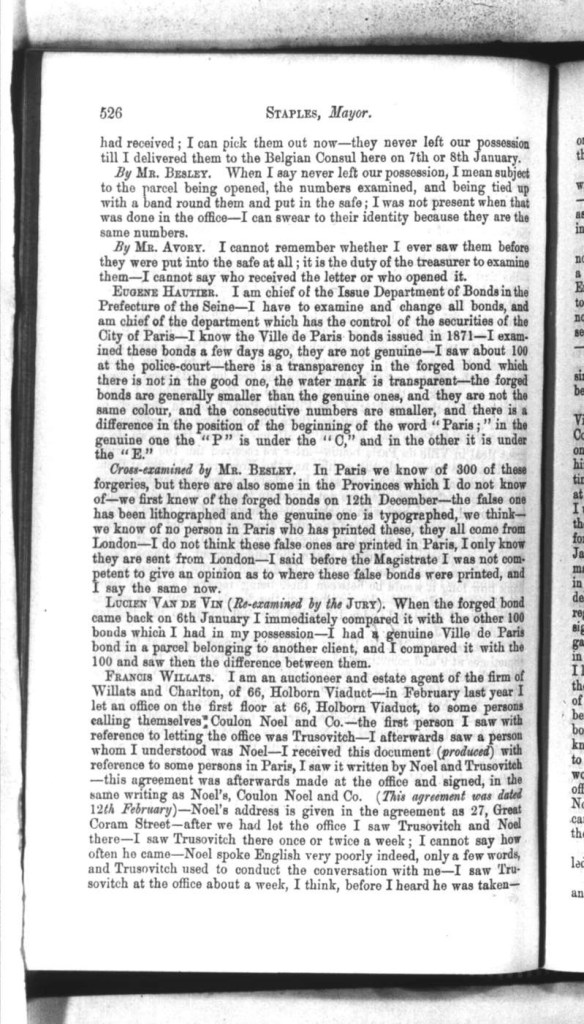
Re-examined. We did not send the money till we had received the bonds—on the morning we received the 100 bonds from Coulon Noel and Co. we did not receive any other parcel of 100 Ville de Paris from any other person, and no other packet of 100 bonds—on the 5th we received the 100 and we knew on the 6th they were forged—on receiving back the one forged bond, the first thing we did was to look at the 100 which we then had, and I than saw the difference between them and a genuine one and that the 100 were forgeries—that was before the 100 had ever left our possession—on the 7th I brought to London the same 100 I had received; I can pick them out now—they never left our possession till I delivered them to the Belgian Consul here on 7th or 8th January.
By MR. BESLEY. When I say never left our possession, I mean subject to the parcel being opened, the numbers examined, and being tied up with a band round them and put in the safe; I was not present when that was done in the office—I can swear to their identity because they are the same numbers.
By MR. AVORY. I cannot remember whether I ever saw them before they were put into the safe at all; it is the duty of the treasurer to examine them—I cannot say who received the letter or who opened it.
EUGENE HAUTIER . I am chief of the Issue Department of Bonds in the Prefecture of the Seine—I have to examine and change all bonds, and am chief of the department which has the control of the securities of the City of Paris—I know the Ville de Paris bonds issued in 1871—I examined these bonds a few days ago, they are not genuine—I saw about 100 at the police-court—there is a transparency in the forged bond which there is not in the good one, the water mark is transparent—the forged bonds are generally smaller than the genuine ones, and they are not the same colour, and the consecutive numbers are smaller, and there is a difference in the position of the beginning of the word “Paris;” in the genuine one the “P” is under the “C,” and in the other it is under the “E.”
Cross-examined by MR. BESLEY. In Paris we know of 300 of these forgeries, but there are also some in the Provinces which I do not know of—we first knew of the forged bonds on 12th December—the false one has been lithographed and the genuine one is typographed, we think—we know of no person in Paris who has printed these, they all come from London—I do not think these false ones are printed in Paris, I only know they are sent from London—I said before the Magistrate I was not competent to give an opinion as to where these false bonds were printed, and I say the same now.
LUCIEN VAN DE VIN (Re-examined by the JURY). When the forged bond came back on 6th January I immediately compared it with the other 100 bonds which I had in my possession—I had a genuine Ville de Paris bond in a parcel belonging to another client, and I compared it with the 100 and saw then the difference between them.
FRANCIS WILLATS . I am an auctioneer and estate agent of the firm of “Willats and Charlton, of 66, Holborn Viaduct—in February last year I let an office on the first floor at 66, Holborn Viaduct, to some persons calling themselves Coulon Noel and Co.—the first person I saw with reference to letting the office was Trusovitch—I afterwards saw a person whom I understood was Noel—I received this document (produced) with reference to some persons in Paris, I saw it written by Noel and Trusovitch—this agreement was afterwards made at the office and signed, in the same writing as Noel’s, Coulon Noel and Co. (This agreement was dated 12th February)—Noel’s address is given in the agreement as 27, Great Coram Street—after we had lot the office I saw Trusovitch and Noel there—I saw Trusovitch there once or twice a week; I cannot say how often he came—Noel spoke English very poorly indeed, only a few words, and Trusovitch used to conduct the conversation with me—I saw Trusovitch at the office about a week, I think, before I heard he was taken on the 6th January I passed him in the street—I had received no notice that they were going to leave the office.
Cross-examined by MR. BESLEY. Our office is on the ground floor, level with the street, and that occupied by the prisoners was on the first floor—they were there from February for many months—I only saw Trusovitch as he went upstairs, casually—I knew nothing of Finkelstein till he was in custody—I never spoke to him and never saw him.
Cross-examined by MR. HALL. I knew Trusovitch as the clerk—I do not think I was present when the agreement was signed; my father was a witness to it—I understood Noel had just come from France; he spoke English very badly—we made some inquiries as to this reference given to us—I did not know Noel advertised in the papers for a clerk—I did not know a Mr. Alphonso or a Mr. Dubois there—I think I have only seen Noel and Trusovitch there—I did not see everybody who came there—I am positive Trusovitch is not Noel, he was the clerk.
Re-examined. There is a slight alteration in Trusovitch’s appearance since I knew him; he is stouter in the face, and he had a very slight beard.
RHODA SUMMERS . I am a widow, and the housekeeper at 66, Holborn Viaduct—I remember some persons calling themselves Coulon Noel and Co. coming to the office on the first floor in February last year—I saw only two persons in connection with that firm—Trusovitch is one; I knew him as the clerk, by the name of Oldson, and by no other name—sometimes I saw him there every day, sometimes only once a week; he was at the office every day—the only other person I saw was Andre Noel—I used to take the letters out of the letter-box in the morning, and put them on the desks in the different offices—nearly all the letters that came for this firm were foreign letters, some of them were registered—on 5th January, a little after 5 o’clock, I took a registered letter from the post-man; I believe it was a foreign letter in a yellow envelope—nobody was in Coulon Noel and Co.’s office—the postman had been several times to deliver that same letter, and could not find anybody in, and as it was registered he wanted a receipt for it—I took it from the postman and signed for it—the next morning, the 6th, I gave it to Trusovitch, and he gave me this receipt signed “Oldson” for it—he took the letter from me in my sitting-room, and signed “Received a registered letter”—when I looked at the receipt I saw he had signed no name, and I ran down to the office, and he put on the name “Oldson,” and that was the last I saw of him—I never saw Noel after that—I had not seen Noel for some time before Christmas—after Christmas I was taking letters out of the letter-box one day; two gentlemen asked me Noel’s private address; I did not know it—I told that to Trusovitch, and he said “Nor I”—he came up to my room about 2 o’clock and said if anybody wanted Mr. Noel they would find him on the Stock Exchange after 11 o’clock; he was at the office from 10 to 11, and after that at the Stock Exchange—I did not see Noel after the day I had that conversation—after that a number of letters came for Noel and Co.; the police came to fetch them, and took them off the desk.
Cross-examined by MR. BESLEY. I never saw Finkelstein to my knowledge till I was at the police-court on 14th January.
Cross-examined by MR. HALL. I never saw anybody besides Trusovitch and Noel in the office; I have seen somebody trying to get into the office Noel used to come first—the police have taken a great number of letters that have arrived since 6th January addressed “Coulon Noel and Co.”—they are all in the custody of the police now—Trusovitch was not there on 5th January that I know of, he may have been there—on the 6th he knocked at my door—I was dressing, and my daughter went to the door and said, “Here is the Frenchman’s clerk”—I said, “There is a registered letter for him, make him sign for it”—he said to my daughter, “I want to see your mother”—I said, “Take him in the sitting-room, and I will see him in a minute”—he had a telegram in his hand, and he said, “Have you seen Mr. Noel?”—I said, “No, I have not”—he said, “If you see Mr. Noel, and he asks you if I am in the office all day, will you tell him I am?”—there was a further conversation—I do not know if Noel posted his own letters—I do not know what the two persons were who called, they represented to me that they were gentlemen making inquiries—my daughter pointed out Trusovitch to Sergeant Brown; I pointed him out this much, that I made a sign when he came in—there is no doubt Trusovitch is the man that signed this receipt for the registered letter “Oldson.”
Re-examined. When Oldson said, “Will you tell Mr. Noel I am in the office all day?” he seemed very excited—I said, “I will tell Mr. Noel I think you are, because how am I to know if you are in the office all day?”—he said, “Mr. Noel has gone to France or Paris,” I am not sure which he said, “and I have nothing to do in the office, and I know three or four languages; I correspond in three or four languages, and I can get 30s. a week for two hours’ work every day”—I said, “If you can earn 30s. a week, and have no work to do in the office, I don’t blame you,” but at that time the detective had been, and I did not believe his statement—this conversation was on the 6th, when I delivered the registered letter to him—I never saw him in the office again.
LUCIEN VAN DE VIN (Re-examined). This is the cheque for 1,500l. which I sent to Coulon Noel and Co., on the Imperial Bank, Lothbury Branch—I have picked out the 100 bonds, these are them—this is one of the second lot of twenty-five.
JAMES ROBERT DAGLAS . I am a ledger-keeper at the Imperial Bank, Lothbury Branch—we are agents for the Caisse General de Reports et de Depots at Brussels—this cheque for 1,500l., drawn by the Caisse General de Reports et de Depots, and dated 5th January, was presented to us, through the Clearing House, on 6th January by the City Bank—it bore at that time the endorsement as it now appears, Coulon Noel and Co.
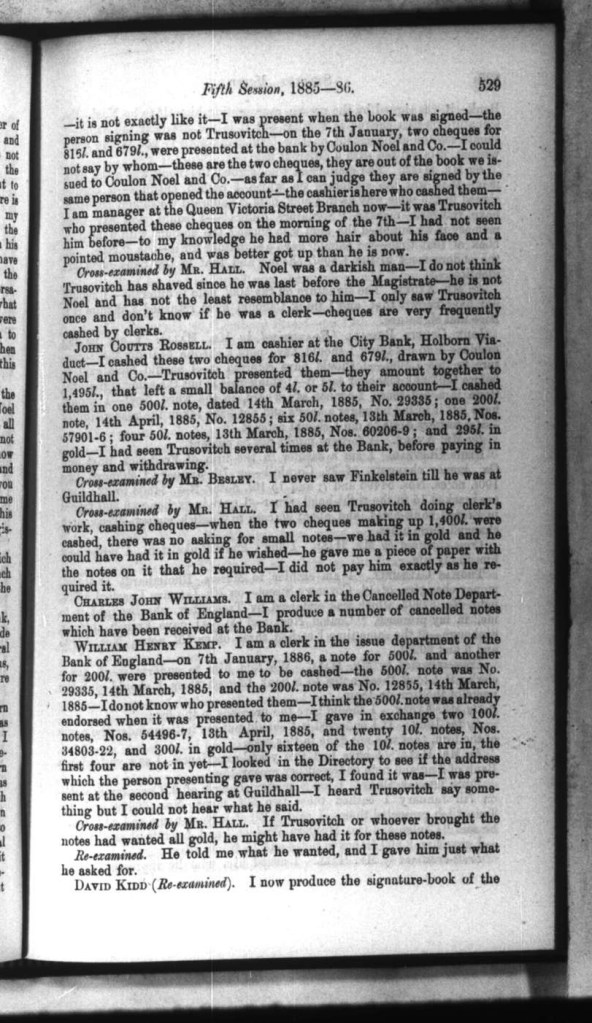
DAVID KIDD . I was assistant manager at the City Bank, Holborn Branch; I am not now—on 16th May, 1885, a drawing account was opened at our bank by Coulon Noel and Co.—I saw a person whom I understood was Mr. Noel—before the account was opened we were referred to Messrs. Willats and Charlton, the auctioneers of Holborn Viaduct—the account was just a drawing account, a certified copy has been handed to Messrs. Wontner—somebody signed in the book (which I have not here), before the account was opened, the name of Coulon Noel and Co., Coulon Noel being the sole partner who had the right to draw and the person I saw—on 6th January this cheque on the Imperial Bank was paid in to that account—it bears my crossing—I presented it through the Clearing House in the usual way—I should say this endorsement on the back is in the writing of the person who opened the account—it is not exactly like it—I was present when the book was signed—the person signing was not Trusovitch—on the 7th January, two cheques for 816. and 679l., were presented at the bank by Coulon Noel and Co.—I could not say by whom—these are the two cheques, they are out of the book we issued to Coulon Noel and Co.—as far as I can judge they are signed by the same person that opened the account—the cashier is here who cashed them—I am manager at the Queen Victoria Street Branch now—it was Trusovitch who presented these cheques on the morning of the 7th—I had not seen him before—to my knowledge he had more hair about his face and a pointed moustache, and was better got up than he is now.
Cross-examined by MR. HALL. Noel was a darkish man—I do not think Trusovitch has shaved since he was last before the Magistrate—he is not Noel and has not the least resemblance to him—I only saw Trusovitch once and don’t know if he was a clerk—cheques are very frequently cashed by clerks.
JOHN COUTTS ROSSELL . I am cashier at the City Bank, Holborn Viaduct—I cashed these two cheques for 816l. and 679l., drawn by Coulon Noel and Co.—Trusovitch presented them—they amount together to 1,495l., that left a small balance of 4l. or 5l. to their account—I cashed them in one 500l. note, dated 14th March, 1885, No. 29335; one 200l. note, 14th April, 1885, No. 12855; six 50l. notes, 13th March, 1885, Nos. 57901-6; four 50l. notes, 13th March, 1885, Nos. 60206-9; and 295l. in gold—I had seen Trusovitch several times at the Bank, before paying in money and withdrawing.
Cross-examined by MR. BESLEY. I never saw Finkelstein till he was at Guildhall.
Cross-examined by MR. HALL. I had seen Trusovitch doing clerk’s Work, cashing cheques—when the two cheques making up 1,400l. were cashed, there was no asking for small notes—we had it in gold and he could have had it in gold if he wished—he gave me a piece of paper with the notes on it that he required—I did not pay him exactly as he required it.
CHARLES JOHN WILLIAM . I am a clerk in the Cancelled Note Department of the Bank of England—I produce a number of cancelled notes which have been received at the Bank.
WILLIAM HENRY KEMP . I am a clerk in the issue department of the Bank of England—on 7th January, 1886, a note for 500l. and another for 200l. were presented to me to be cashed—the 500l. note was No. 29335, 14th March, 1885, and the 200l. note was No. 12855, 14th March, 1885—I do not know who presented them—I think the 500l. note was already endorsed when it was presented to me—I gave in exchange two 100l. notes, Nos. 54496-7, 13th April, 1885, and twenty 10l. notes, Nos. 34803-22, and 300l. in gold—only sixteen of the 10l. notes are in, the first four are not in yet—I looked in the Directory to see if the address which the person presenting gave was correct, I found it was—I was present at the second hearing at Guildhall—I heard Trusovitch say something but I could not hear what he said.
Cross-examined by MR. HALL. If Trusovitch or whoever brought the notes had wanted all gold, he might have had it for these notes.
Re-examined. He told me what he wanted, and I gave him just what he asked for.
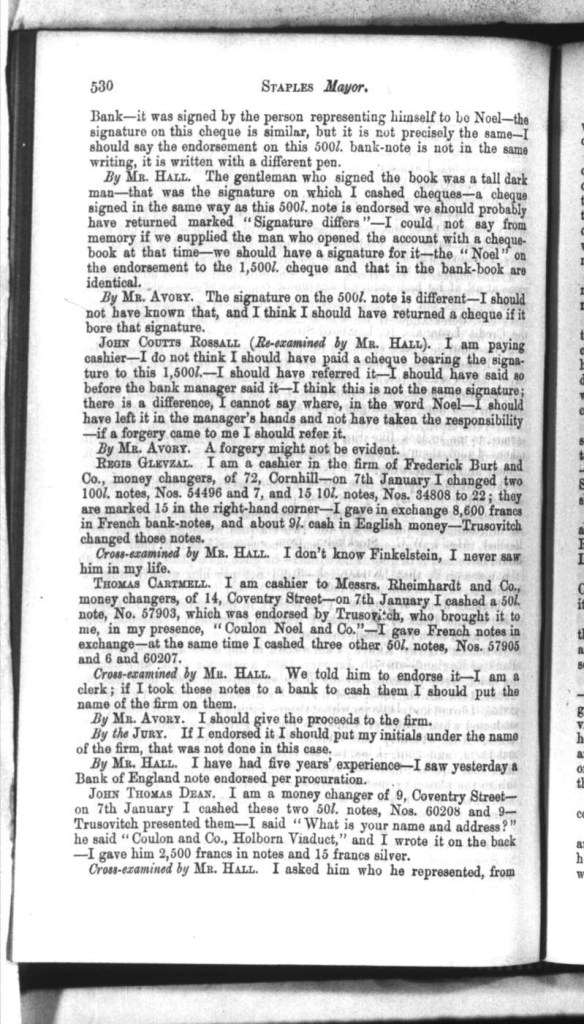
DAVID KIDD (Re-examined). I now produce the signature-book of the Bank—it was signed by the person representing himself to be Noel—the signature on this cheque is similar, but it is not precisely the same—I should say the endorsement on this 500l. bank-note is not in the same writing, it is written with a different pen.
By MR. HALL. The gentleman who signed the book was a tall dark man—that was the signature on which I cashed cheques—a cheque signed in the same way as this 500l. note is endorsed we should probably have returned marked “Signature differs”—I could not say from memory if we supplied the man who opened the account with a cheque-book at that time—we should have a signature for it—the “Noel” on the endorsement to the 1,500l. cheque and that in the bank-book are identical.
By MR. AVORY. The signature on the 500l. note is different—I should not have known that, and I think I should have returned a cheque if it bore that signature.
JOHN COUTTS ROSSALL (Re-examined by MR. HALL). I am paying cashier—I do not think I should have paid a cheque bearing the signature to this 1,500l.—I should have referred it—I should have said so before the bank manager said it—I think this is not the same signature; there is a difference, I cannot say where, in the word Noel—I should have left it in the manager’s hands and not have taken the responsibility—if a forgery came to me I should refer it.
By MR. AVORY. A forgery might not be evident.
REGIS GLEVZAL . I am a cashier in the firm of Frederick Burt and Co., money changers, of 72, Cornhill—on 7th January I changed two 100l. notes, Nos. 54496 and 7, and 15 10l. notes, Nos. 34808 to 22; they are marked 15 in the right-hand corner—I gave in exchange 8,600 francs in French bank-notes, and about 9l. cash in English money—Trusovitch changed those notes.
Crow-examined by MR. HALL. I don’t know Finkelstein, I never saw him in my life.
THOMAS CARTMELL . I am cashier to Messrs. Rheimhardt and Co., money changers, of 14, Coventry Street—on 7th January I cashed a 50l. note, No. 57903, which was endorsed by Trusovitch, who brought it to me, in my presence, “Coulon Noel and Co.”—I gave French notes in exchange—at the same time I cashed three other 50l. notes, Nos. 57905 and 6 and 60207.
Cross-examined by MR. HALL. We told him to endorse it. I am a clerk; if I took these notes to a bank to cash them I should put the name of the firm on them.
By MR. AVORY. I should give the proceeds to the firm.
By the JURY. If I endorsed it I should put my initials under the name of the firm, that was not done in this case.
By MR. HALL. I have had five years’ experience—I saw yesterday a Bank of England note endorsed per procuration.
JOHN THOMAS DEAN . I am a money changer of 9, Coventry Street—on 7th January I cashed these two 50l. notes, Nos. 60208 and 9—Trusovitch presented them—I said “What is your name and address?” he said “Coulon and Co., Holborn Viaduct,” and I wrote it on the back—I gave him 2,500 francs in notes and 15 francs silver.
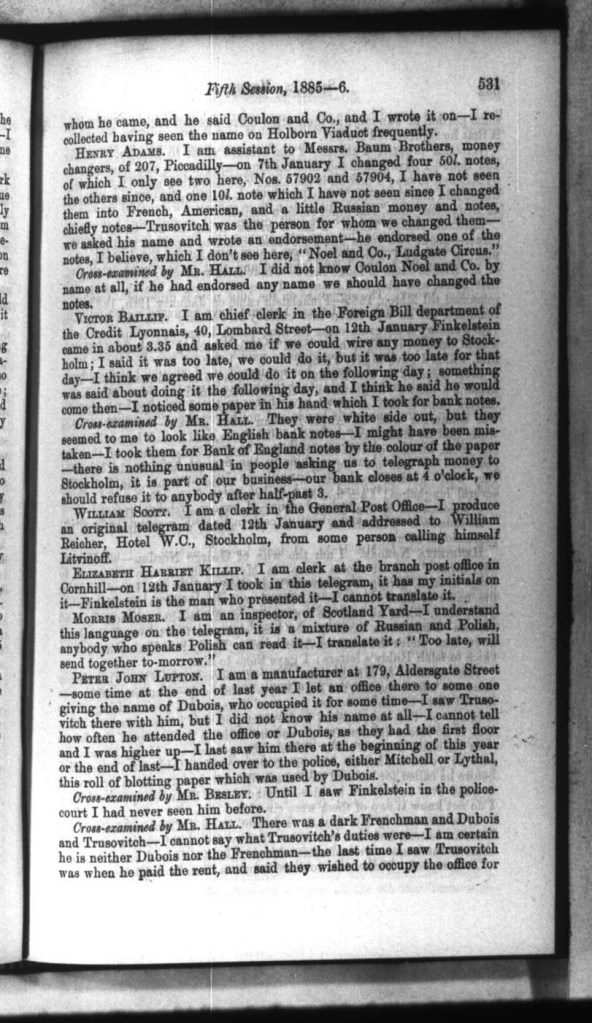
Cross-examined by MR. HALL. I asked him who he represented, from whom he came, and he said Coulon and Co., and I wrote it on—I recollected having seen the name on Holborn Viaduct frequently.
HENRY ADAMS I am assistant to Messrs. Baum Brothers, money changers, of 207, Piccadilly—on 7th January I changed four 50l. notes, of which I only see two here, Nos. 57902 and 57904, I have not seen the others since, and one 10l. note which I have not seen since I changed them into French, American, and a little Russian money and notes, chiefly notes—Trusovitch was the person for whom we changed them—we asked his name and wrote an endorsement—he endorsed one of the notes, I believe, which I don’t see here, “Noel and Co., Ludgate Circus.”
Cross-examined by MR. HALL. I did not know Coulon Noel and Co. by name at all, if he had endorsed any name we should have changed the notes.
VICTOR BAILLIF . I am chief clerk in the Foreign Bill department of the Credit Lyonnais, 40, Lombard Street—on 12th January Finkelstein came in about 3.35 and asked me if we could wire any money to Stockholm; I said it was too late, we could do it, but it was too late for that day—I think we agreed we could do it on the following day; something was said about doing it the following day, and I think he said he would come then—I noticed some paper in his hand which I took for bank notes.
Cross-examined by MR. HALL. They were white side out, but they seemed to me to look like English bank notes—I might have been mistaken—I took them for Bank of England notes by the colour of the paper—there is nothing unusual in people asking us to telegraph money to Stockholm, it is part of our business—our bank closes at 4 o’clock, we should refuse it to anybody after half-past 3.
WILLIAM SCOTT . I am a clerk in the General Post Office—I produce an original telegram dated 12th January and addressed to William Reicher, Hotel W.C., Stockholm, from some person calling himself Litvinoff.
ELIZABETH HARRIET KILLIP . I am clerk at the branch post office in Cornhill—on 12th January I took in this telegram, it has my initials on it—Finkelstein is the man who presented it—I cannot translate it.
MORRIS MOSER . I am an inspector, of Scotland Yard—I understand this language on the telegram, it is a mixture of Russian and Polish, anybody who speaks Polish can read it—I translate it; “Too late, will send together to-morrow.”
PETER JOHN LUPTON . I am a manufacturer at 179, Aldersgate Street—some time at the end of last year I let an office there to some one giving the name of Dubois, who occupied it for some time—I saw Trusovitch there with him, but I did not know his name at all—I cannot tell how often he attended the office or Dubois, as they had the first floor and I was higher up—I last saw him there at the beginning of this year or the end of last—I handed over to the police, either Mitchell or Lythal, this roll of blotting paper which was used by Dubois.
Cross-examined by MR. BESLEY. Until I saw Finkelstein in the police-court I had never seen him before.
Cross-examined by MR. HALL. There was a dark Frenchman and Dubois and Trusovitch—I cannot say what Trusovitch’s duties were—I am certain ho is neither Dubois nor the Frenchman—the last time I saw Trusovitch was when he paid the rent, and said they wished to occupy the office for some portion of January, as their other office was nut ready, I looked on it that he represented Dubois.
WILLIAM MORLEY FRENCH. I am articled clerk to Messrs. Wontner and Sons—I have examined this blotting-paper which was handed over by Mitchell tome; I find on it the name “Coulon Noel and Co.” several times, and also the name “Oscar Haldy “several times, “Caisse General de Bruxelles “once, and other foreign banks.
ELEANOR AGNES WEBB . I am a widow living at 27, Great Coram Street—about two years ago I let some rooms to a person who gave the name of George Trusovitch, and after he had been there some time two of his friends came to lodge there—Finkelstein was one; I knew him by that name, and also as Litvinoff—Trusovitch came in March, 1884, and remained till March, 1885—Finkelstein came on January 19th, 1885, and remained till he was taken into custody on January 12th this year—on 12th January a telegram came for him, which I sent up to him—after he was in custody, it might have been a week, a second telegram came for him, which I gave to Mr. French.
Cross-examined by MR. BESLEY. There was no concealment about Finkelstein’s names—he lectured at the Birkbeck Institute every Monday—officers came to him at my house to take lessons in Russian—I heard he was connected with an Anglo-Russian trade journal—he said after a while that he must leave me and go elsewhere, and I said he could have one room instead of two and pay less, and in consequence of that he remained on with me—during all the time he was with me he behaved very well—he was constantly writing at home—he told me he spoke several languages; lam told he could speak 10 languages.
Cross-examined by MR. HALL. We called Trusovitch MR. GEORGE.
Re-examined. Finkelstein was his real name, and Litvinoff was his professional name.
HENRIETTA NORDAN . I am the wife of George Nordan—we live at 389, Strand, and let rooms there—in March, 1885, Trusovitch came to lodge with us, giving the name of Oscar Haldy; I do not know him by the name of Trusovitch—he continued to lodge with us till November 14th, 1885, when he said he was going to Paris—he occasionally had visitors—Finkelstein came to see him eight or ten times, I think—I knew him under the name of Albert—after Haldy left Finkelstein came twice to fetch Haldy’s letters; I gave them to him.
Cross-examined by MR. BESLEY. One of the occasions when Finkelstein came was 9th November, the Lord Mayor’s Show day—I understood he was invited there by Haldy—other guests of Trusovitch’s were visiting at the lodgings on that day, and in consequence of that I was asked to allow him to go into a different room, and he went up to the top of the house—as he came down I said, “Won’t you go and see Haldy?” and he said he would not intrude himself on them as Mr. Haldy was engaged—before he called for letters I had been requested by letter from Trusovitch to hand over any letters to him—I handed over the envelopes to him—I do not know if two of them were circulars.
Cross-examined by MR. HALL. I do not know if Trusovitch had any Russian letters, I should not know if they were—not very many letters came to the house—we had some addressed in Russian—I am a Swede.
Re-examined. Finkelstein told me he was a Finn from Elsinore.
By MR. HALL. Haldy told me in November he was going to spend Christmas in Sweden.
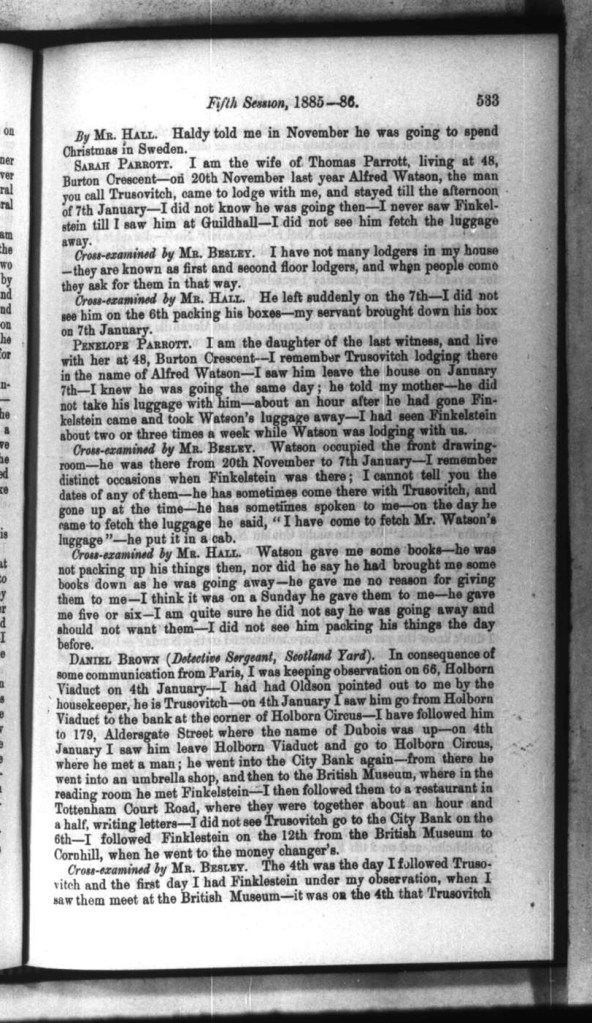
SARAH PARROTT . I am the wife of Thomas Parrott, living at 48, Burton Crescent—on 20th November last year Alfred Watson, the man you call Trusovitch, came to lodge with me, and stayed till the afternoon of 7th January—I did not know he was going then—I never saw Finkelstein till I saw him at Guildhall—I did not see him fetch the luggage away.
Cross-examined by MR. BESLEY. I have not many lodgers in my house—they are known as first and second floor lodgers, and when people come they ask for them in that way.
Cross-examined by MR. HALL. He left suddenly on the 7th—I did not see him on the 6th packing his boxes—my servant brought down his box on 7th January.
PENELOPE PARROTT . I am the daughter of the last witness, and live with her at 48, Burton Crescent—I remember Trusovitch lodging there in the name of Alfred Watson—I saw him leave the house on January 7th—I knew he was going the same day; he told my mother—he did not take his luggage with him—about an hour after he had gone Finkelstein came and took Watson’s luggage away—I had seen Finkelstein about two or three times a week while Watson was lodging with us.
Cross-examined by MR. BESLEY. Watson occupied the front drawing-room—he was there from 20th November to 7th January—I remember distinct occasions when Finkelstein was there; I cannot tell you the dates of any of them—he has sometimes come there with Trusovitch, and gone up at the time—he has sometimes spoken to me—on the day he came to fetch the luggage he said, “I have come to fetch Mr. Watson’s luggage”—he put it in a cab.
Cross-examined by MR. HALL. Watson gave me some books—he was not packing up his things then, nor did he say he had brought me some books down as he was going away—he gave me no reason for giving them to me—I think it was on a Sunday he gave them to me—he gave me five or six—I am quite sure he did not say he was going away and should not want them—I did not see him packing his things the day before.
DANIEL BROWN (Detective Sergeant, Scotland Yard). In consequence of some communication from Paris, I was keeping observation on 66, Holborn Viaduct on 4th January—I had had Oldson pointed out to me by the housekeeper, he is Trusovitch—on 4th January I saw him go from Holborn Viaduct to the bank at the corner of Holborn Circus—I have followed him to 179, Aldersgate Street where the name of Dubois was up—on 4th January I saw him leave Holborn Viaduct and go to Holborn Circus, where he met a man; he went into the City Bank again—from there he went into an umbrella shop, and then to the British Museum, where in the reading room he met Finkelstein—I then followed them to a restaurant in Tottenham Court Road, where they were together about an hour and a half, writing letters—I did not see Trusovitoh go to the City Bank on the 6th—I followed Finklestein on the 12th from the British Museum to Cornhill, when he went to the money changer’s.
Cross-examined by MR. BESLEY. The 4th was the day I fallowed Trusovitch and the first day I had Finklestein under my observation, when I saw them meet at the British Museum—it was on the 4th that Trusovitch
went to Aldersgate Street; he went there alone—Finkelstein was not there—I did not see Finkelstein on the 5th or 6th, 7th or 9th—I think Mitchell followed him on the 9th.
Cross-examined by MR. HALL. There is no doubt that Trusovitch is Oldson.
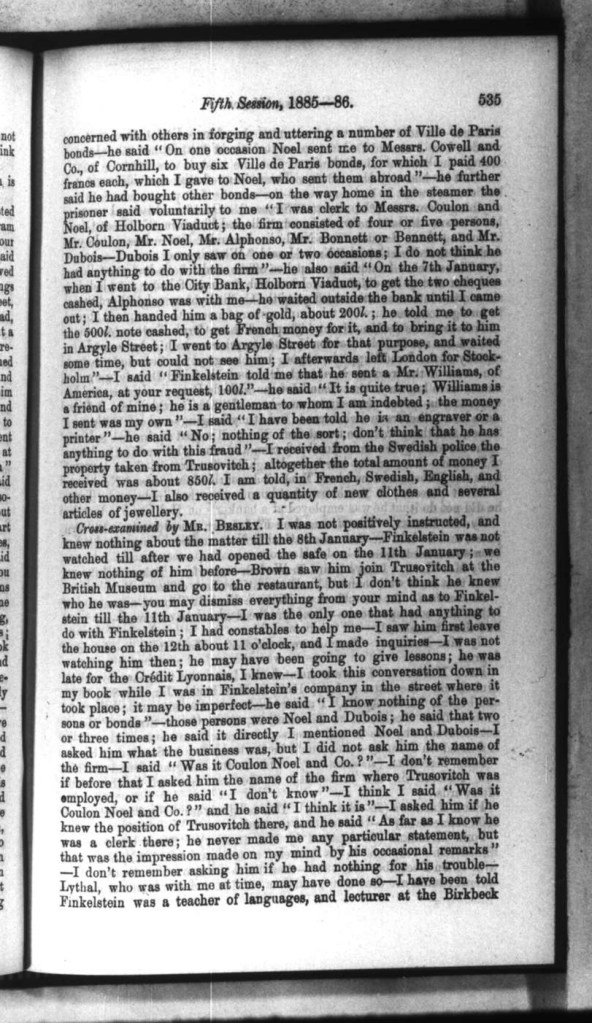
JOHN MITCHELL (City Detective Sergeant). On 13th January I arrested Finkelstein in Hunter Street, having followed him from 27, Great Coram Street—I said “Is your name Noel?”—he said “No”—I said “Is your name Dubois?”—he said” No”—I said “What is your name?”—he said “Finklestein”—I said “lama police officer, and I have had you followed for several days, and yesterday I watched you myself leave your lodgings at 27, Great Coram Street, and go to the Credit Lyonnais, Lombard Street, where you endeavoured to telegraph a sum of money to some place abroad, and I also followed you to a telegraph office on Cornhill, when you sent a telegram to some place abroad; from inquiries which I have made respecting you, I shall apprehend you, and charge you with being concerned with two men named Noel and Dubois with feloniously forging and uttering a large number of bonds of the Ville de Paris”—I cautioned him as to anything he might say to me—he said “On Thursday last a friend of mine named Trusovitch came to me at my lodgings and left with me to mind, 590l. in gold, to be forwarded on to him in parts; yesterday I went to the Credit Lyonnais in Lombard Street to send some money to him at Stockholm, but it was too late to send it; I also sent Trusovitch a telegram “—I said “Do you know where Trusovitch got the money from?”—he said “No—I said “Do you know what business he was?”—he said “Trusovitch told me that he was employed at a banker’s on Holborn Viaduct, but I cannot remember the name; he said he was paid by salary and part profits”—I said “Was the name Coulon Noel and Co.?”—he said “Yes, that was the name”—I said “How often have you seen him?”—he said “Frequently, I was with him on Wednesday last”—I said “Have you sent him any money before?”—he said “No, only 100l. to Mr. Williams of America by Trusovitch’s instructions”—I said “What have you done with the remainder of the money?”—he said “I have 350l. in this bag, which I was going to send to him, and the rest you will find at my lodgings; I don’t know, the persons you have mentioned or the bonds”—I then took him to the police-station, where he was charged—I searched his bag and found 349l. in English sovereigns—I also found this letter, and this telegram, and some registered slips, and on him besides the 349l. was nearly 9l.—I found a receipt for a registered letter to a man named Williams—at the station he said he knew nothing about the bonds, and “I have never seen nor do I know the men named in the charge”—I searched his lodging at 27, Great Coram Street with Lythel, and saw Lythel find there 137l.—Finkelstein told us where we should find it—we found the keys on him—I had followed him on that day to the Credit Lyonnais and to the post-office, and prior to that, on the 11th January, I had been to the office, 66, Holborn Viaduct; I found nobody there—I broke open the safe, and in it found this agreement with Willatts and Charlton, containing the address 27, Great Coram Street—afterwards I went over to Stockholm, and on 24th February I received Trusovitch in custody from the Swedish police—before he was handed over to me I saw him in prison, and told him I was an officer sent over from England to arrest him in case he was handed over to the English authorities for being concerned with others in forging and uttering a number of Ville de Paris bonds—he said “On one occasion Noel sent me to Messrs. Cowell and Co., of Cornhill, to buy six Ville de Paris bonds, for which I paid 400 francs each, which I gave to Noel, who sent them abroad”—he further said he had bought other bonds—on the way home in the steamer the prisoner said voluntarily to me “I was clerk to Messrs. Coulon and Noel, of Holborn Viaduct; the firm consisted of four or five persons, Mr. Coulon, Mr. Noel, Mr. Alphonso, Mr. Bonnett or Bennett, and Mr. Dubois—Dubois I only saw on one or two occasions; I do not think he had anything to do with the firm”—he also said “On the 7th January, when I went to the City Bank, Holborn Viaduct, to get the two cheques cashed, Alphonso was with me—he waited outside the bank until I came out; I then handed him a bag of gold, about 200l.; he told me to get the 500l. note cashed, to get French money for it, and to bring it to him in Argyle Street; I went to Argyle Street for that purpose, and waited some time, but could not see him; I afterwards left London for Stockholm”—I said “Finkelstein told me that he sent a Mr. Williams, or America, at your request, 100l.”—he said “It is quite true; Williams is a friend of mine; he is a gentleman to whom I am indebted; the money I sent was my own”—I said “I have been told he in an engraver or a printer”—he said “No; nothing of the sort; don’t think that he has anything to do with this fraud”—I received from the Swedish police the property taken from Trusovitch; altogether the total amount of money I received was about 850l. I am told, in French, Swedish, English, and other money—I also received a quantity of new clothes and several articles of jewellery.
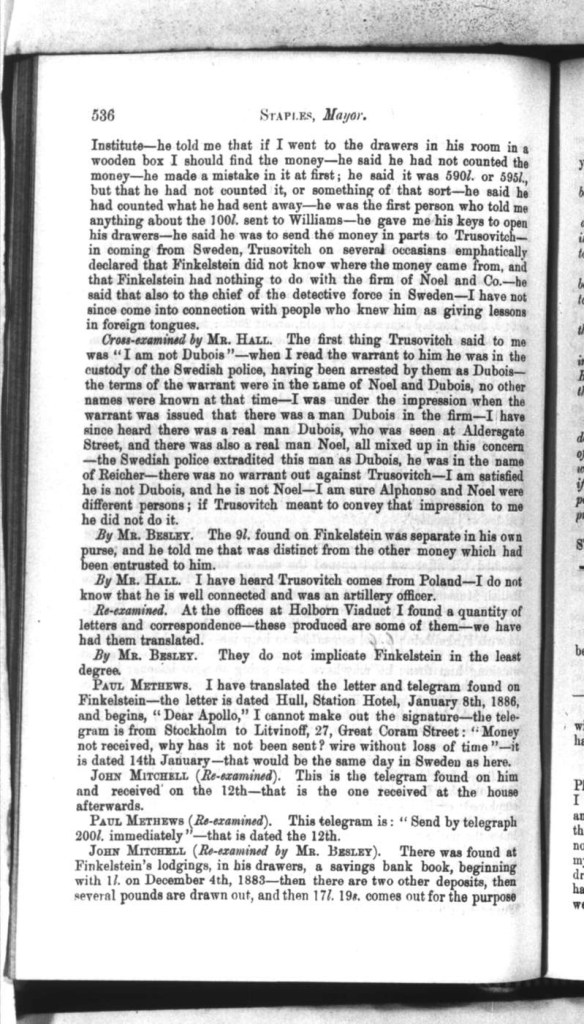
Cross-examined by MR. BESLEY. I was not positively instructed, and knew nothing about the matter till the 8th January—Finkelstein was not watched till after we had opened the safe on the 11th January; we knew nothing of him before—Brown saw him join Trusovitch at the British Museum and go to the restaurant, but I don’t think he knew who he was—you may dismiss everything from your mind as to Finkelstein till the 11th January—I was the only one that had anything to do with Finkelstein; I had constables to help me—I saw him first leave the house on the 12th about 11 o’clock, and I made inquiries—I was not watching him then; he may have been going to give lessons; he was late for the Credit Lyonnais, I knew—I took this conversation down in my book while I was in Finkelstein’s company in the street where it took place; it may be imperfect—he said “I know nothing of the persons or bonds”—those persons were Noel and Dubois; he said that two or three times; he said it directly I mentioned Noel and Dubois—I asked him what the business was, but I did not ask him the name of the firm—I said “Was it Coulon Noel and Co.?”—I don’t remember if before that I asked him the name of the firm where Trusovitch was employed, or if he said “I don’t know”—I think I said “Was it Coulon Noel and Co.?” and he said “I think it is”—I asked him if he knew the position of Trusovitch there, and he said “As far as I know he was a clerk there; he never made me any particular statement, but that was the impression made on my mind by his occasional remarks “—I don’t remember asking him if he had nothing for his trouble—Lythal, who was with me at time, may have done so—I have been told Finkelstein was a teacher of languages, and lecturer at the Birkbeck Institute—he told me that if I went to the drawers in his room in a wooden box I should find the money—he said he had not counted the money—he made a mistake in it at first; he said it was 590l. or 595l., but that he had not counted it, or something of that sort—he said he had counted what he had sent away—he was the first person who told me anything about the 100l. sent to Williams—he gave me his keys to open his drawers—he said he was to send the money in parts to Trusovitch—in coming from Sweden, Trusovitch on several occasisns emphatically declared that Finkelstein did not know where the money came from, and that Finkelstein had nothing to do with the firm of Noel and Co.—he said that also to the chief of the detective force in Sweden—I have not since come into connection with people who knew him as giving lessons in foreign tongues.
Cross-examined by MR. HALL. The first thing Trusovitch said tom was “I am not Dubois”—when I read the warrant to him he was in the custody of the Swedish police, having been arrested by them as Dubois—the terms of the warrant were in the Lame of Noel and Dubois, no other names were known at that time—I was under the impression when the warrant was issued that there was a man Dubois in the firm—I have since heard there was a real man Dubois, who was seen at Aldersgate Street, and there was also a real man Noel, all mixed up in this concern—the Swedish police extradited this man as Dubois, he was in the name of Reicher—there was no warrant out against Trusovitch—I am satisfied he is not Dubois, and he is not Noel—I am sure Alphonso and Noel were different persons; if Trusovitch meant to convey that impression to me he did not do it.
By MR. BESLEY. The 9l. found on Finkelstein was separate in his own purse, and he told me that was distinct from the other money which had been entrusted to him.
By MR. HALL. I have heard Trusovitch comes from Poland—I do not know that he is well connected and was an artillery officer.
Re-examined. At the offices at Holborn Viaduct I found a quantity of letters and correspondence—these produced are some of them—we have had them translated.
By MR. BESLEY. They do not implicate Finkelstein in the least degree.
PAUL METHEWS . I have translated the letter and telegram found on Finkelstein—the letter is dated Hull, Station Hotel, January 8th, 1886, and begins, “Dear Apollo,” I cannot make out the signature—the telegram is from Stockholm to Litvinoff, 27, Great Coram Street: “Money not received, why has it not been sent? wire without loss of time”—it is dated 14th January—that would be the same day in Sweden as here.
JOHN MITCHELL (Re-examined). This is the telegram found on him and received on the 12th—that is the one received at the house afterwards.
PAUL METHEWS (Re-examined). This telegram is: “Send by telegraph 200l. immediately”—that is dated the 12th.
JOHN MITCHELL (Re-examined by MR. BESLEY). There was found at Finkelstein’s lodgings, in his drawers, a savings bank book, beginning with 1l. on December 4th, 1883—then there are two other deposits, then several pounds are drawn out, and then 17l. 19s. comes out for the purpose
by MR. HALL. I found some reader’s tickets for the British. Museum, you cannot get in there without being vouched for by some householder.
MR. HALL moved to quash the indictment against Trusovitch, as he had been extradited upon a warrant granted against a person named Dubois
MR. AVORY stated that the warrant had been obtained upon information against the prisoner under the name of Dubois, and therefore it was quite immaterial in what name he was arrested if the Court had the jurisdiction to try the offence. The COMMON SERJEANT overruled the objection.
MR. BESLEY submitted that there was no evidence of any uttering of forged bonds in this country, and no evidence that Finkelstein had been an accessory to the uttering.
MR. HALL cited Queen v. Carr (Sessions Paper, vol. lxxxvii p. 47) upon the question as to jurisdiction.
MR. AVORY argued that there was sufficient evidence of posting the bonds in this country to support the Count for uttering (Queen v. Burdett, 4 Bramwell and Alderson, and Queen v. Giles, 1 Moody), and he also urged that there was evidence to go to the Jury as to both prisoners.
MR. BESLEY replied.
The Common SERJEANT. having consulted with MR. JUSTICE STEPHEN, decided to ask the Jury whether they considered there was sufficient evidence of the posting of the letter containing the bonds; that if they decided there was not such evidence, he should take a verdict of not guilty, but that if they thought there was, he should allow the case to proceed, reserving the point as to jurisdiction should the prisoners be found guilty. Each of the prisoners received a good character.
GUILTY . TRUSOVITCH— Five Years’ Penal Servitude.
FINKELSTEIN— Six Months’ Hard Labour.




Francis and Margaret’s son, Allan Montague Willats, was born on Wednesday, the 5th of May 1886, at their home, Number 1, Devonshire Villas, Mayes Road, Wood Green, Edmonton, Middlesex, England. Margaret registered Allan’s birth on Wednesday the 16th of June 1886 in Edmonton, London, England. She gave her husband Francis’s occupation as an Auctioneer and their abode as, Number 1, Devonshire Villas, Mayes Road, Wood Green.

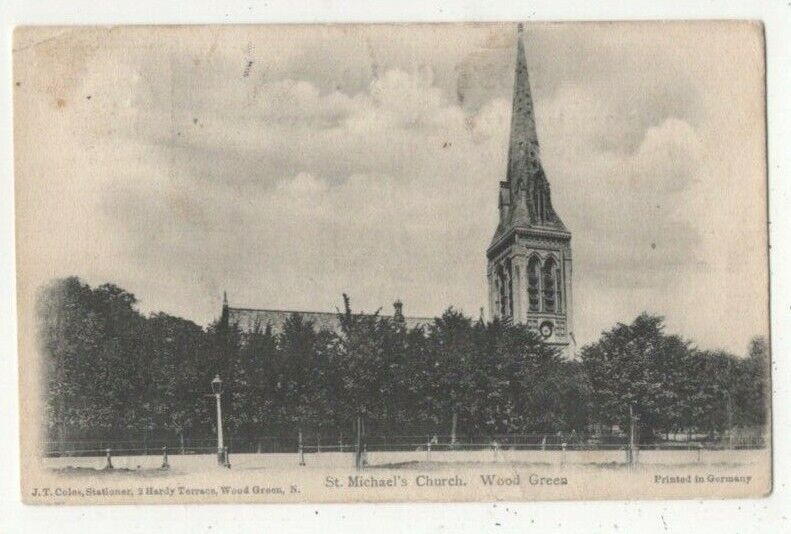
Francis and Margaret, baptized Allan Montague Willats on Sunday the 17th of October 1886, at St Michael Church, Wood Green, England. Francis gave his occupation as an Agent and their aside as Devonshire Villas, Mayes Road, Wood Green.

St Michael and All Angels is a Church of England parish church that stands on Bounds Green Road in Wood Green within the London Borough of Haringey. The church was designed by George Gilbert Scott and built in 1843. Alterations designed by H Curzon were made in 1865. The chancel and tower were added in 1874. The building is grade II listed.
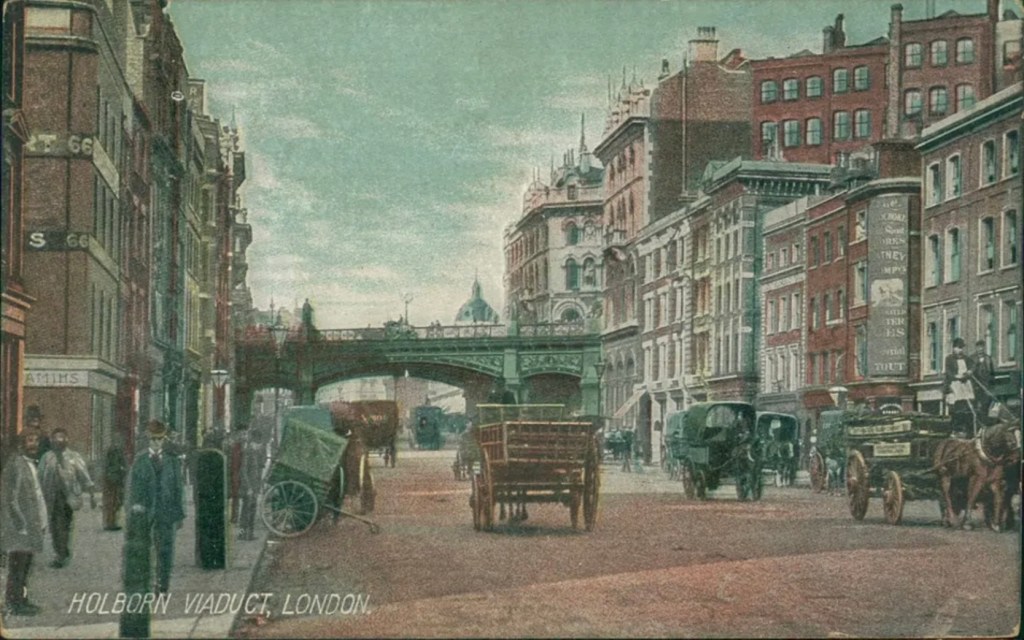
Francis put an advertisement in the Field Newspaper on the 23rd of October 1886. It reads,
FUND OF £90,000 To be placed upon MORTGAGE (divisible) of FREEHOLD and LEASEHOLD PROPERTIES or Reversionary Interesta. – Apply to Messers WILLATS and CHARLTON, 66, Holborn Viaduct.

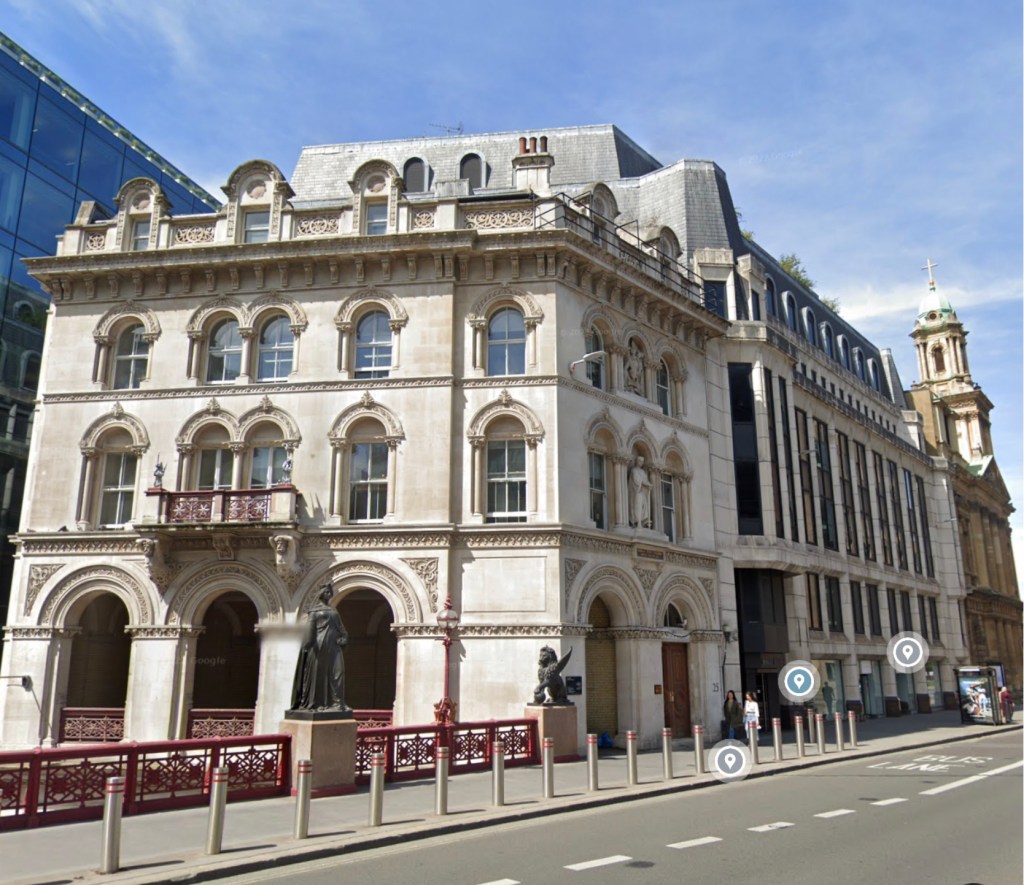
Holborn Viaduct is a historic structure located in the heart of London, England. It is both a road and a bridge that spans the busy Holborn and Farringdon Road intersection in the City of London, a historic and financial district of the city. Holborn Viaduct has a rich history and is an important landmark in London. Holborn Viaduct was built between 1863 and 1869 as part of a project to improve transportation in the city. The viaduct was designed by the architect Sir William Haywood and the engineer Rowland Mason Ordish. The viaduct is known for its impressive Victorian architecture. It features ornate iron and stone detailing, including decorative iron railings and statues. The architectural style of Holborn Viaduct is often described as Victorian Gothic Revival. Holborn Viaduct was constructed to address the problem of congestion and to provide a better route for traffic in central London. It spans a large intersection and carries both road traffic and pedestrian walkways. The viaduct consists of several distinctive elements, includingseveral statues, including figures representing Commerce, Fine Arts, Agriculture, and Science. It is known for its decorative lamp posts that line the bridge, adding to its aesthetic appeal. There are grand staircases on either side of the viaduct that provide access to the pedestrian walkways. The viaduct is situated in close proximity to notable landmarks such as St. Paul’s Cathedral and the Old Bailey, making it an integral part of the city’s historic landscape. Holborn Viaduct serves as a key transportation route, connecting various parts of the City of London. It facilitates the flow of both vehicular and pedestrian traffic. Over the years, Holborn Viaduct has undergone several renovations and maintenance projects to preserve its historic charm and structural integrity. Holborn Viaduct is not only an important piece of infrastructure but also holds cultural significance as an architectural gem from the Victorian era. The area around Holborn Viaduct is a bustling commercial and financial district with numerous businesses, offices, and shops. It is a hub of activity in London. The viaduct is accessible via public transportation, including the London Underground, and is also within walking distance of various other attractions in central London.
From the 1863-1894 London, England, Overseer Returns, we know that, Francis was residing at, 1 Devonshire Villas, Mayes Road, Wood Green, Tottenham, Middlesex, England, in 1886.
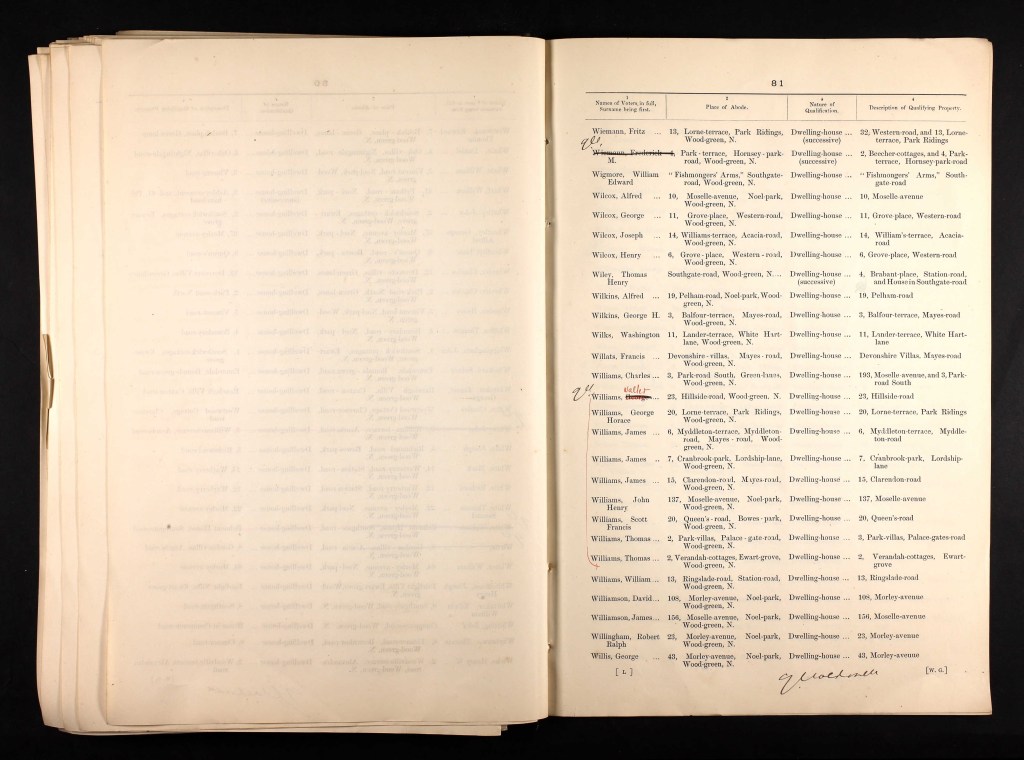
And from the 1863-1894 London, England, Overseer Returns, we know that, Francis was residing at, 1 Devonshire Villas, Mayes Road, Wood Green, Tottenham, Middlesex, England, in 1887.
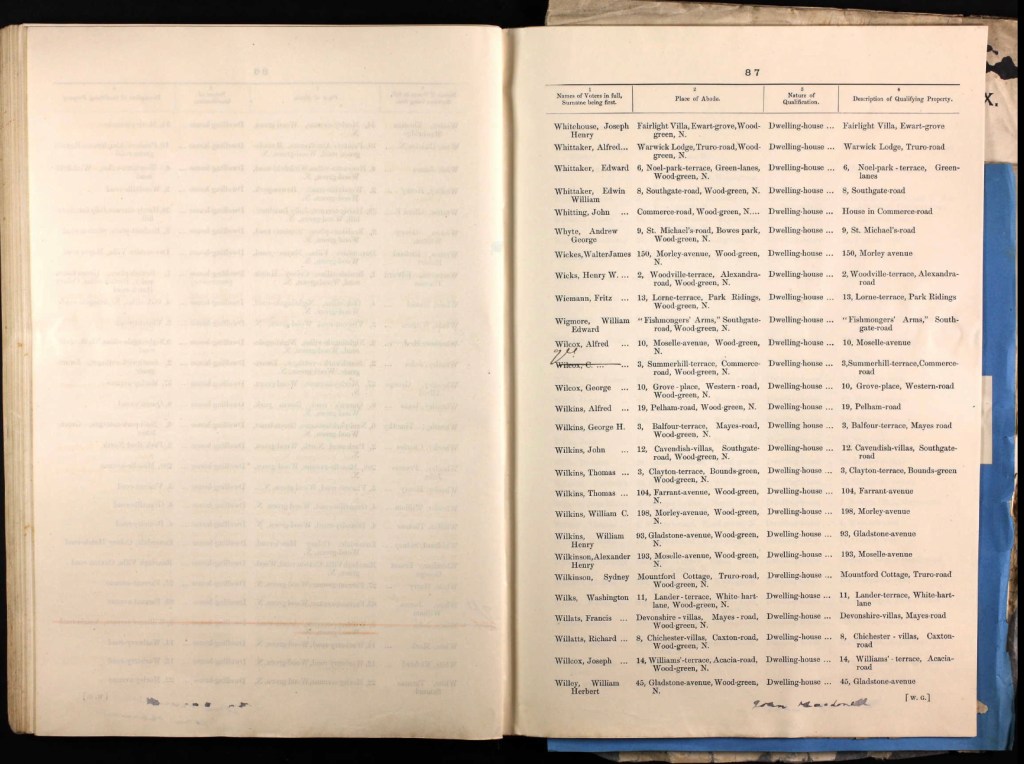
From the 1888 London, England, Electoral Register, we know Francis was residing at Devonshire Villas, Mayes Road, Wood Green, Tottenham, Middlesex, England.

And from the 1889 London, England, Electoral Register, we know Francis was residing at Devonshire Villas, Mayes Road, Wood Green, Tottenham, Middlesex, England.
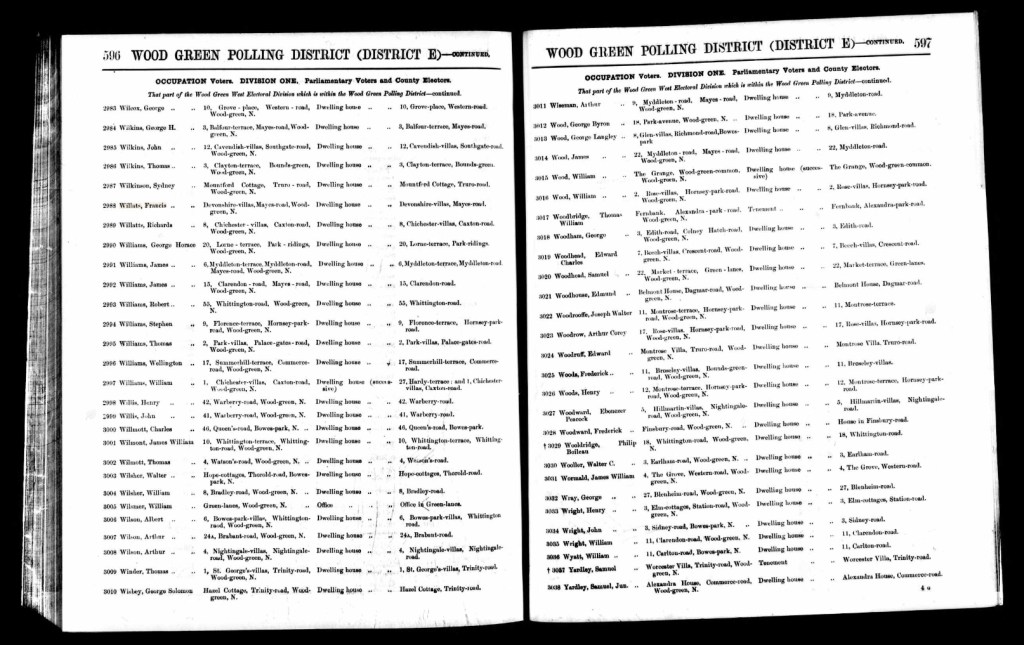
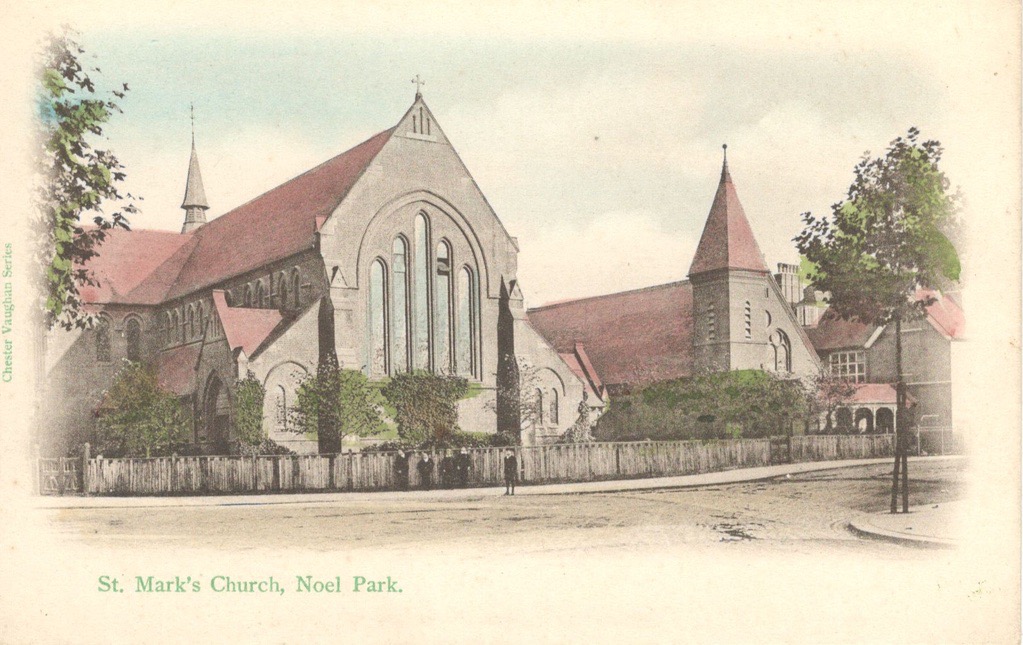
Francis and Margaret, welcomed a son into their home, hearts and family on Saturday the 21st of December, 1889, at 1 Devonshire Villas, Mayes Road, Wood Green, Tottenham, Middlesex, England. They named him Alton Henry Willats. His mum Margaret registered his birth on the 12th February 1890, in Edmonton. She gave her husband Francis’s occupation as a auctioneer and their abode as 1 Devonshire Villas, Mayes Road, Wood Green.

Francis and Margaret baptised Alton Henry Willats, on Sunday the 20th of April 1890, at The Parish Church of St Mark the Evangelist, Ashley Crescent, Noel Park, London, England. Their abode was given as, 1 Devonshire Villas, Mayes Road, Wood Green, Tottenham, Middlesex, England.
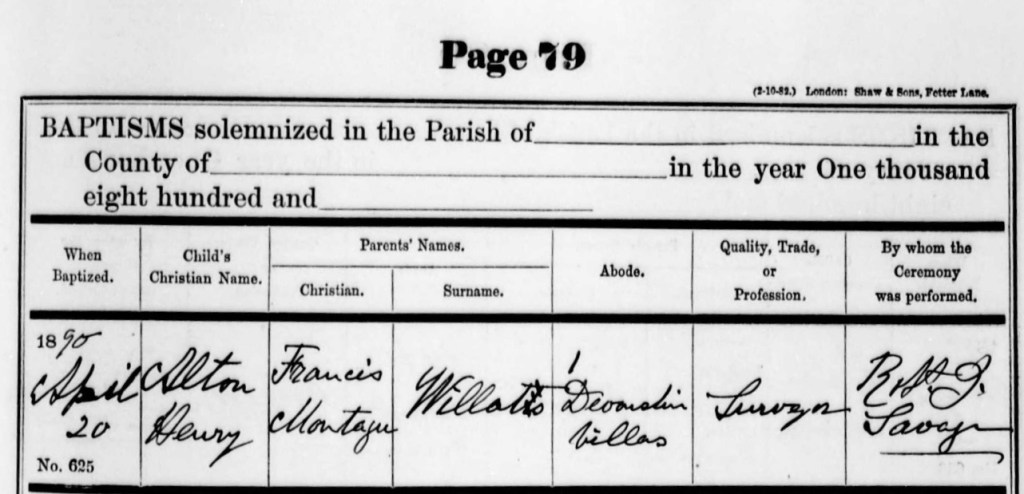
The history of St Mark, Noel Park, begins in 1884 when work commenced on the Noel Park Estate and services were held by Revd R.B. Dowling in a shop in Lymington Avenue. A site in Gladstone Avenue had already been purchased with the help of the Bishop of London’s Fund for the church, vicarage and a hall. The church hall was opened on 25 March 1885. The church of St Mark was consecrated on 1 November 1889, when an ecclesiastical district was assigned by the Ecclesiastical commissioners from St Michael’s, Wood Green.
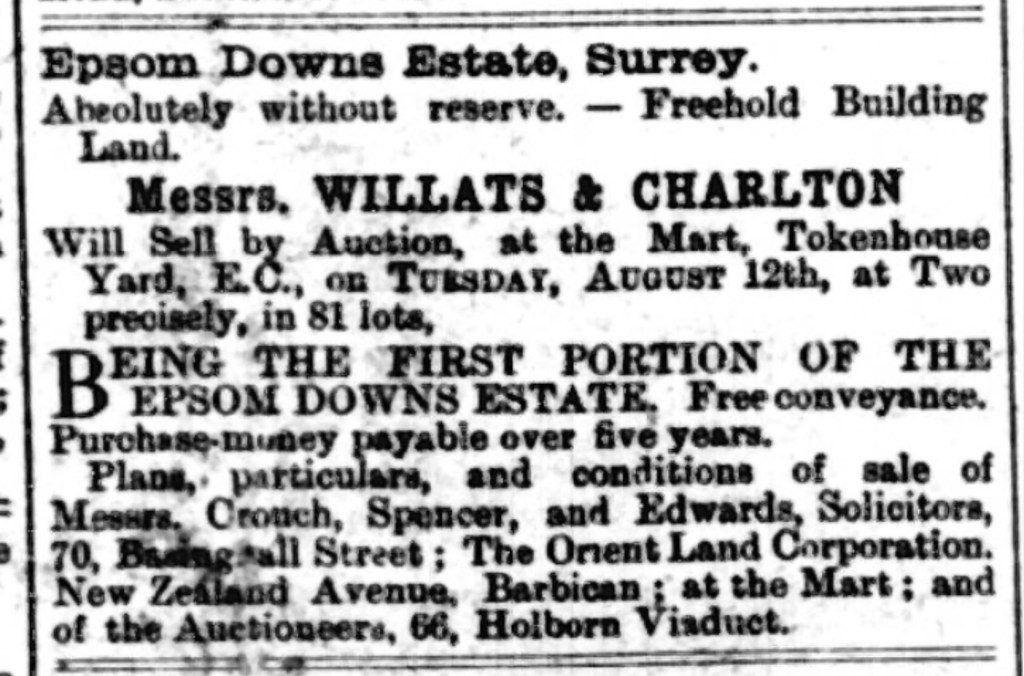
Francis put an advertisement in the Croydon Advertiser and East Surrey Reporter Newspaper, on Saturday the 26th of July, 1890. It reads,
Epsom Downs Estate, Surrey. Absolutely without reserve. – Freehold Building Land. Messrs. WILLATS & CHARLTON Will Sell by Auction, at the Mart, Tokenhouse Yard, E.C., on TUESDAY, August 12th, at Two precisely, in 81 lots, BEING THE FIRST PORTION OF THE EPSOM DOWNS ESTATE. Free conveyance. Purchase-money payable over five years. Plans, particulars, and conditions of sale of Messrs, Cronch, Spencer, and Edwards, Solicitors, 70, Basinghall Street; The Orient Land Corporation. New Zealand Avenue, Barbican; at the Mart; and the Auctioneers, 66, Holborn Viaduct.
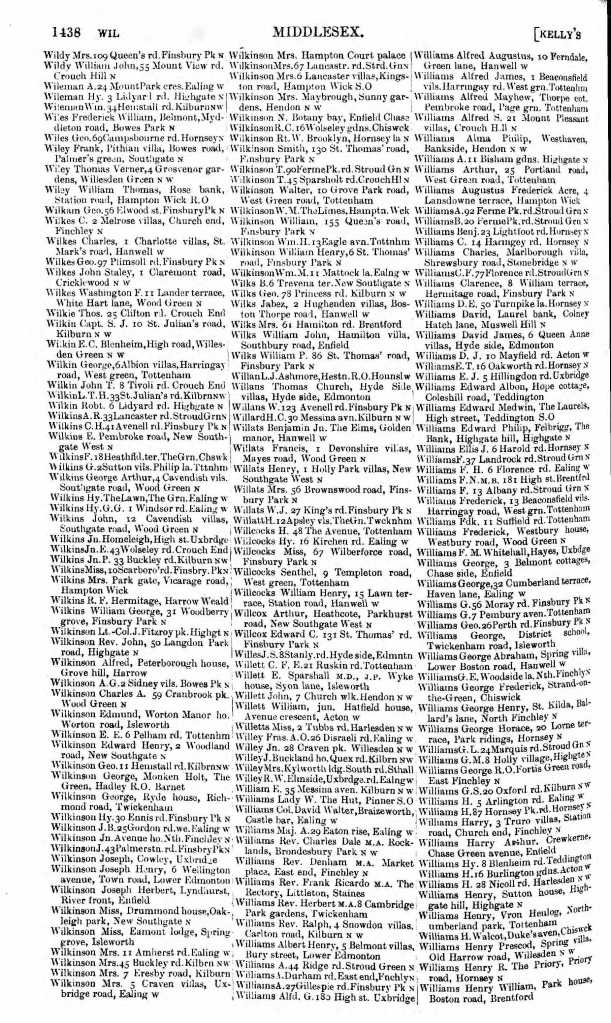
From the 1766 – 1946 UK, City and County Directories, we know Francis, was residing at, 1 Devonshire Villas, Mayes Road, Wood Green, Tottenham, Middlesex, England, in 1890.
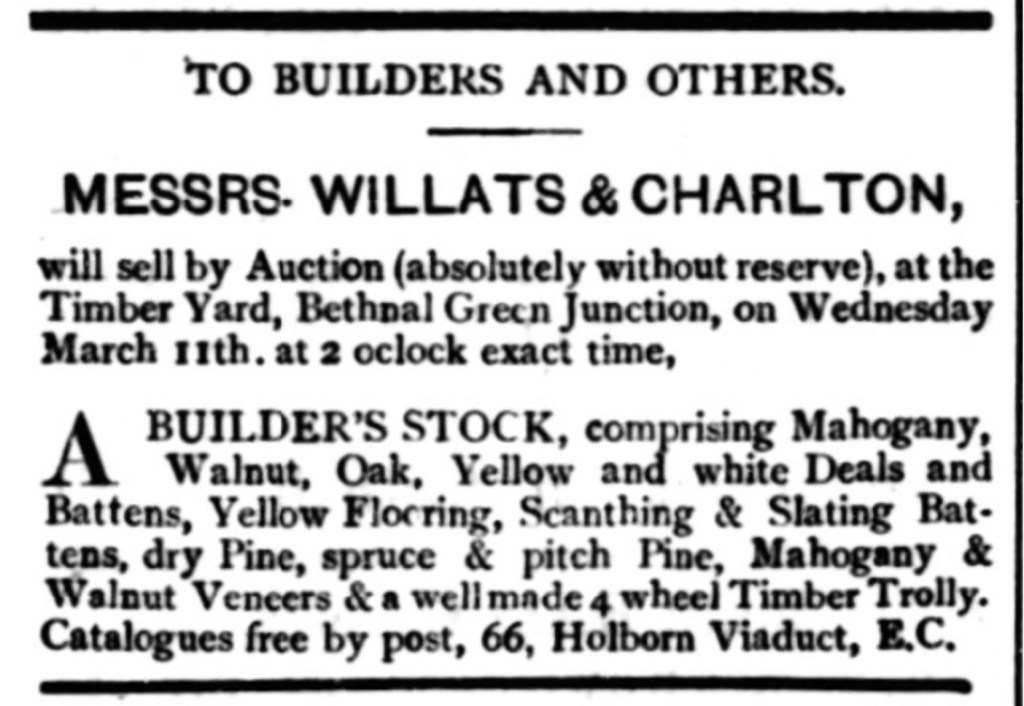
Francis put an advertisement in the West Ham and South Essex Mail Newspaper, on Saturday the 7th of March 1891. It reads,
TO BUILDERS AND OTHERS.
MESSRS. WILLATS & CHARLTON,
Will sell by Auction (absolutely without reserve), at the Timber Yard, Bethnal Green Junction, on Wednesday March 11th. At 2 o’clock exact time,
A BUILDERS STOCK, comprising Mahogany, Walnut, Oak, Yellow and white Deals and Battens, Yellow Flooring, Scanting & Slating Battens, dry Oine, spruce & pitch Oind, Mahogany & Walnut Veneers & a well made 4 wheel Timber Trolly.
Catalogues free by post, 66, Holborn Viaduct, E.C.
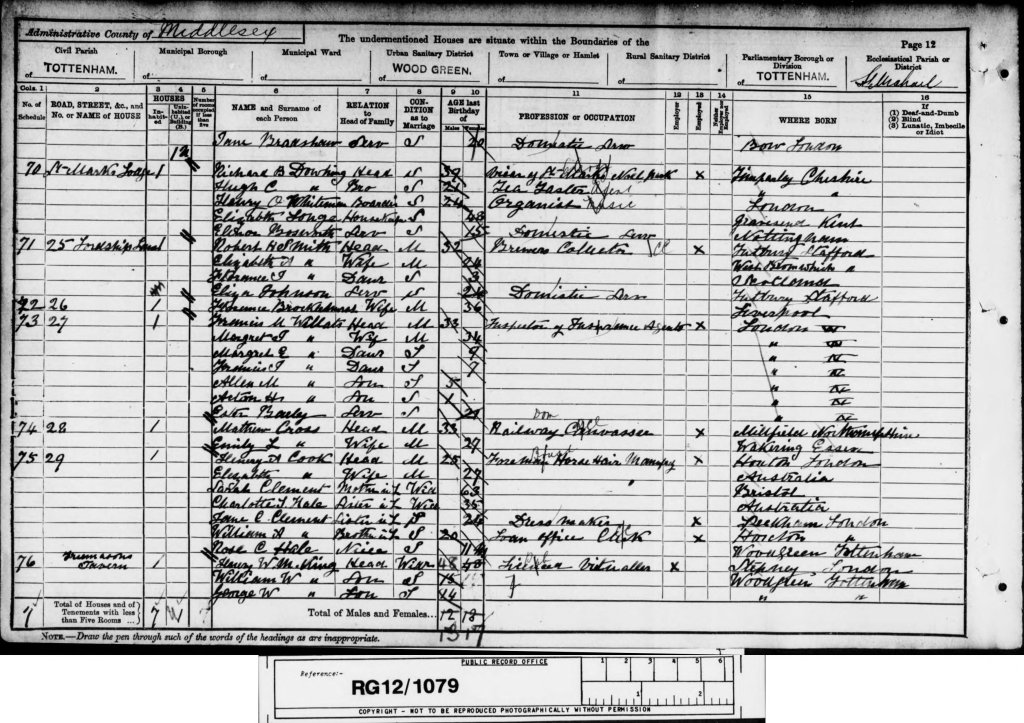
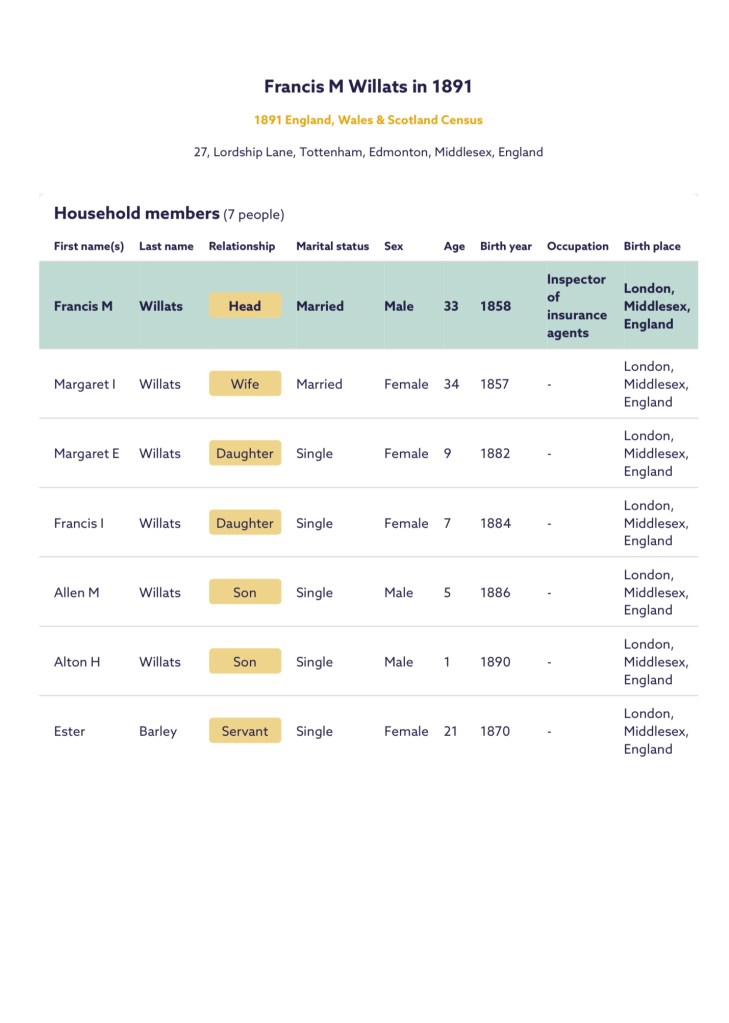
On Sunday the 5th of April, 1891, Francis, Margaret and their children Margaret, Frances, Allan, and Alton, were residing at Number 27, Lordship Lane, Tottenham, Edmonton, Middlesex, England. They had a 21-year-old servent, called Ester Barley, residing and working with them. Francis was working as an Inspector of insurance agents.

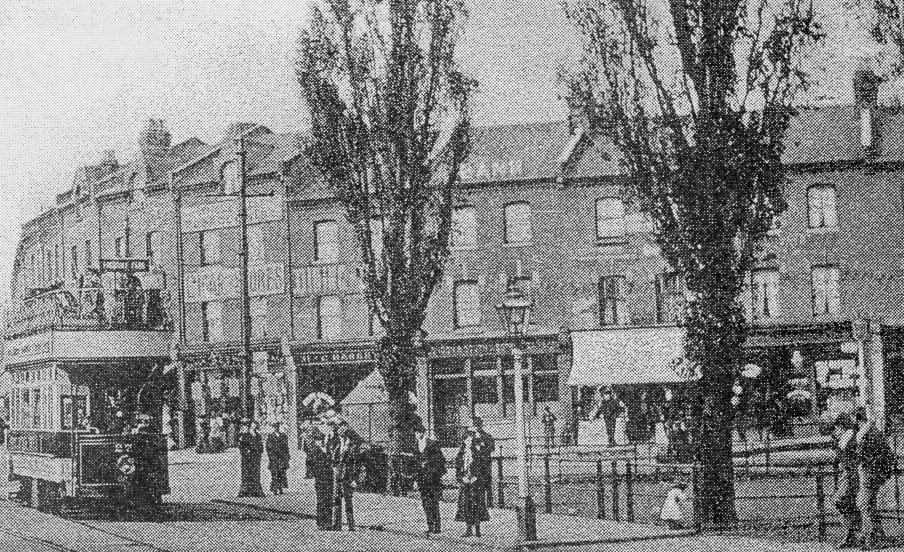
Lordship Lane connects Wood Green (N22) with Tottenham High Road (N17). It lies in the London Borough of Haringeyand forms part of the A109 road. Wood Green was originally a clearing in the dense forests of oak, ash and beech that covered most of what is now North London. There were a number of these clearings in the vicinity and each is likely to have been the site of a few simple habitations. Lordship Lane would have begun as a track running through the forest from the clearing at Wood Green to Ermine Street, the main Roman roadfrom London to the north east. During the 1000 years before the Norman Conquest, the county of Middlesex was established and divided into administrative areas called Hundreds. Lordship Lane was in Edmonton Hundred. The importance of the Hundred in local government declined as that of the Manor grew. Manors were estates controlled by a landowner called the Lord of the Manor. Tottenham’s manor house is on Lordship Lane. It is called Bruce Castle. By 1619 (the date of the first known map) the land to the north and south of Lordship Lane had been cleared of woodland and was mostly in cultivation. On this map the majority of the lane (from Chapmans Green to Tottenham High Road) is called Berry Lane although its modern name was recorded in 1526.
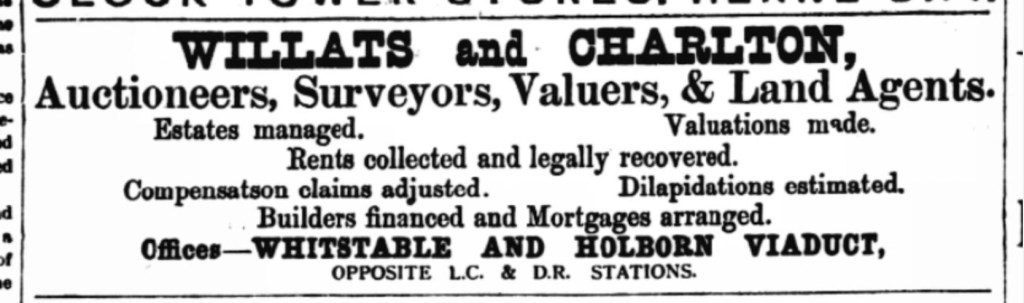
Francis put an advertisement in the Canterbury Journal, Kentish Times and Farmer Gazette Newspaper, on Saturday the 02nd of July 1892, Saturday the 30th of July 1892, the 20th of August 1892,
It reads,
WILLATS and CHARLTON,
Auctioneers, Surveyors, Valuers, & Land Agents.
Estates managed. Variations made.
Rents collected and Legally recovered.
Compensation claims adjusted. Dilapidations estimated.
Builders financed and Mortgages arranged.
Offices-WHITSTABLE AND HOLBORN VIADUCT,
OPPOSITE L.C. & D.R.STATIONS.
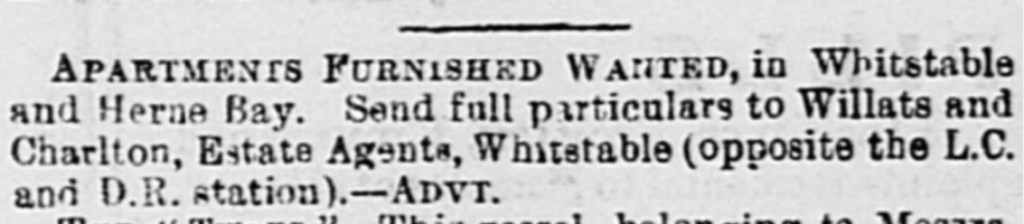
Francis put an advertisement in the Whitstable Times and Herne Bay Herald Newspaper, on, Saturday the 9th of July, 1892, Saturday the 16th of July 1892, Saturday the 30th of July 1892, Saturday the 13th of August 1892 and Saturday the 20th of August 1892. It reads,
APARTMENTS FURNISHED WANTED, in Whitstable and Herne Bay. Send full particulars to Willats and Charlton, Estate Agents, whitstable ( opposite L.C. and D.R.station). – Advt.
Francis put an advertisement in the Whitstable Times and Herald Newspaper, on Saturday the 10th of September, 1892.
It reads,
WILLATS and CHARLTON,
Auctioneers, Surveyors, Valuers, & Land Agents.
Estates managed. Variations made.
Rents collected and Legally recovered.
Compensation claims adjusted. Dilapidations estimated.
Builders financed and Mortgages arranged.
Offices-WHITSTABLE AND HOLBORN VIADUCT,
OPPOSITE L.C. & D.R.STATIONS.
Francis was listed under the address, 27 Wagstaff Villas, Mayes Road, Wood Green, Tottenham, Middlesex, England and Devonshire Villas, Mayes Road, Wood Green, Tottenham, Middlesex, England, in 1892, The London Electoral Register.

Francis put two advertisement in the London Evening Standard Newspaper on the 12th of June 1893. They read,
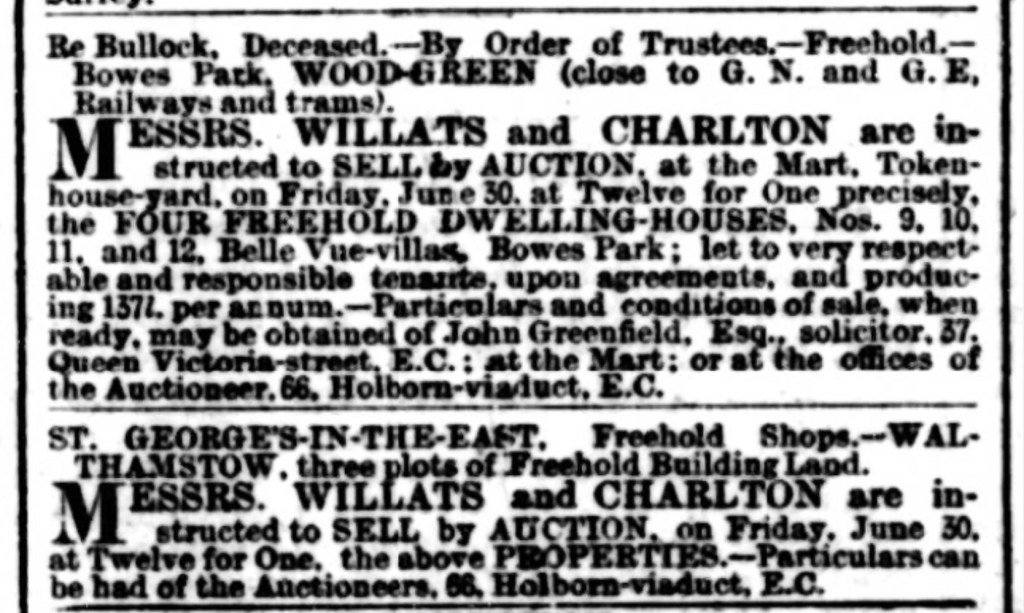
Re Bullock, Deceased. – By Order of Trustees.-Freehold.- Bowes Park, WOOD-GREEN (close to G.N. and G.E, Railways and trams). MESSRS. WILLATS and CHARLTON are instructed to SELL by AUCTION, at the Mart, Token-house-yard, on Friday, June 30, at Twelve for One precisely, the FOUR FREEHOLD DWELLING-HOUSES, NOS. 9, 10, 11, and 12, Belle Vue-villas, Bowes Park ; let to very respectable and responsible tenanite, upon agreements, and producing 1371 per annum.- Particulars and conditions of sale, when ready, May be obtained of John Greenfield, Esq., solicitor, 37, Queen Victoria-street, E.C. : at the Mart : or at the offices of the Auctioneer, 66 Holborn-viaduct, E.C. ST.
GEORGE’S-IN-The-EAST, Freehold Shops…WALTHAMSTOW, three plots of Freehold Building Land. MESSRS. WILLATS and CHARLTON are instructed to Sell by AUCTION, on Friday, June 30, at Twelve for One, the above PROPERTIES. particulars can be had of the Auctioneers, 66, Holborn-viaduct, E.C.
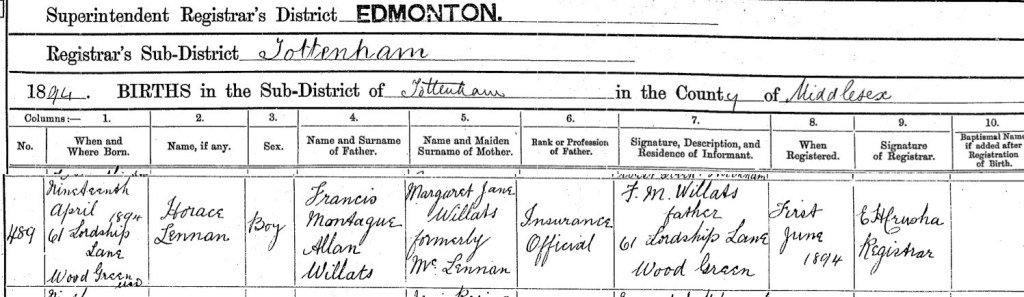
Francis and Margaret’s son, Horace Lennan Willats was born on Thursday the 19th April, 1894, at 61 Lordship Lane, Wood Green, Tottenham, Middlesex, England. Frances registered his birth on the 1st June 1894 in Edmonton. He gave his occupation as an Insurance Official and their abode as, 61 Lordship Lane, Wood Green.
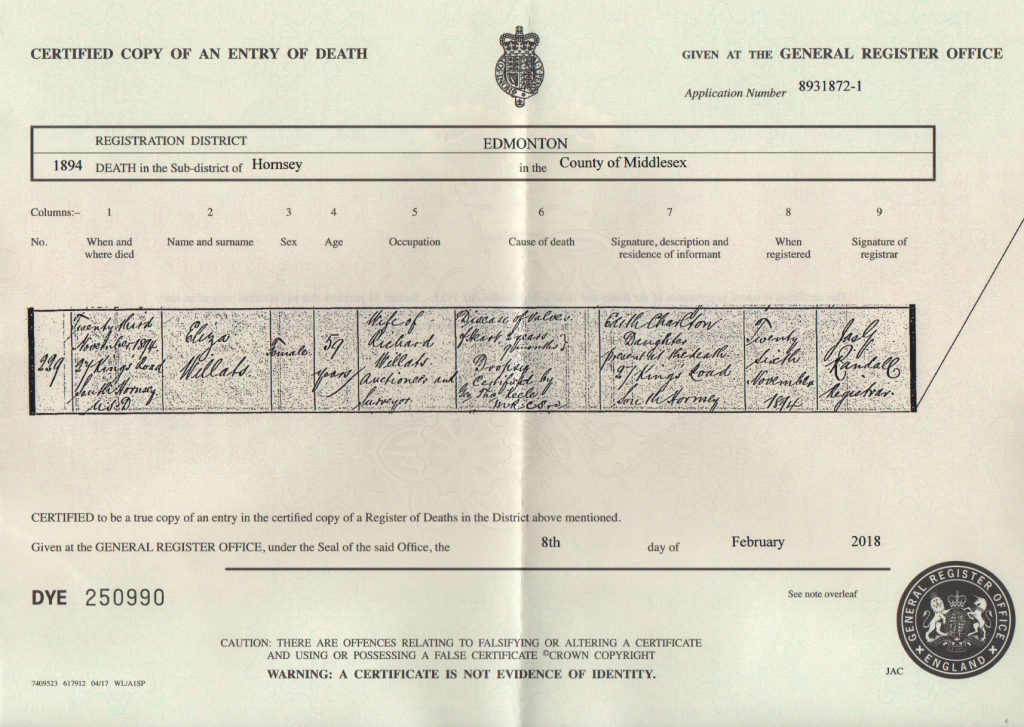
Francis’s mum, Eliza, passed away on Friday the 23rd of November, 1894, at Number 27, Kings Road, South Hornsey, Edmonton, Middlesex, England, when she was 59 years old.
Eliza died from, disease of the valves of the heart, two years nine months and dropsy.
Her daughter Edith Charlton of Number 27, Kings Road, South Hornsey, was present and registered Eliza’s death on Monday the 26th of November, 1894.
Edith gave her father Richards occupation as an Auctioneer and Surveyor.
When Eliza died Francis’s father, Richard Henry, purchased 2 graves in Abney Park Cemetery, which was then the beautiful garden of a big house turned into a private cemetery.
Each grave cost, 3 guineas and took six interments.
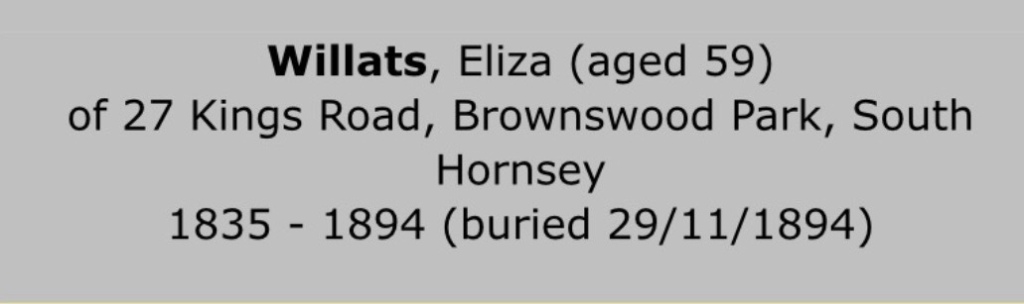
The Willats family laid Eliza to rest, in one of the purchased graves at, Ebney Park Cemetery, Stoke Newington, Middlesex, England, on Thursday the 29th of November, 1894, in D06, Grave 092431.
Her abode was given as, Number 27, Kings Road, Brownswood Park, South Hornsey.
Abney Park cemetery is one of the “Magnificent Seven”cemeteries in London, England.
Abney Park in Stoke Newington in the London Borough of Hackney is a historic parkland originally laid out in the early 18th century by Lady Mary Abney, Dr. Isaac Watts and the neighbouring Hartopp family.
In 1840 it became a non-denominational garden cemetery, a semi-public park arboretum, and an educational institute, which was widely celebrated as an example of its time. A total of 196,843 burials had taken place there up to the year 2000.

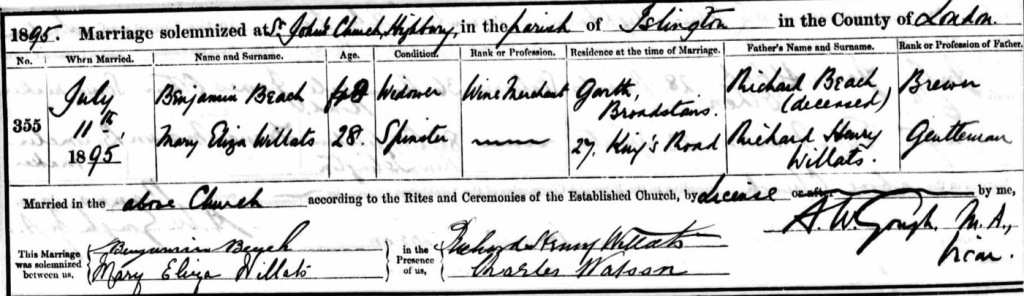
Francis’s sister, 28-year-old, spinster, Mary Eliza Willats, married 48-year-old, Widower, wine merchant, Benjamin Beach, on Thursday the 11th July 1895, at St John’s Church, Highbury, Islington, Middlesex, England. Mary gave her residence as, 27 Kings Road and Benjamins as . (If you can work it out, please let me know.) They gave their fathers names and occupations as, Richard Beach (deceased) a Brewer and Richard Henry Willats, a Gentleman. Their witnesses were, her father Richard Henry Willats and Charles Watson. Eliza used the name Mary Eliza Willats.
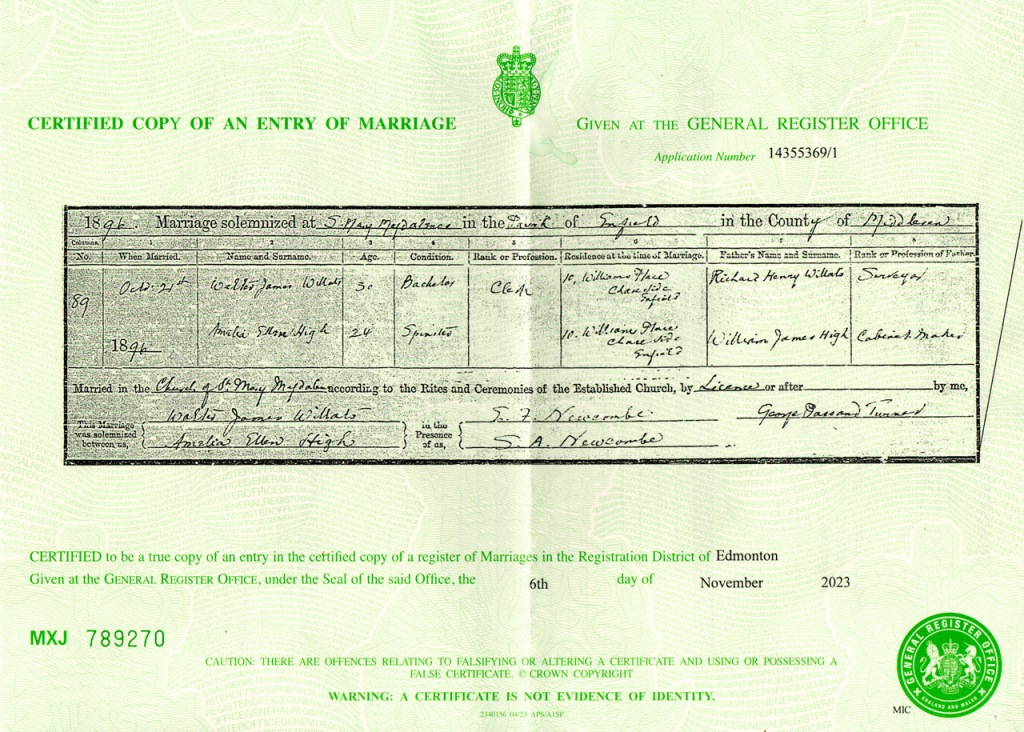
Francis’s brother, 21 years old, bachelor Walter James Willats and 21 years old, spinster, Amelia High, Marriage Bonds was licenced on Tuesday 20th October 1896, at St Mary Magdalene, Enfield, Middlesex, England. Their marriage licence reads as follows.
DIOESE OF LONDON.
20th October 1896
APPEARED PERSONALLY, Walter James Willats of the parish. of St Mary Magdalene Enfield in the County of Middlesex a Bachelor aged Twenty one years and upwards and prayed a Licence for the Solemnization of Matrimony in the parish church of St Mary Magdalene Enfield aforesaid between him and Amelia Ellen High of the same parish a spinster of the age of Twenty-one years and upwards and made Oath that he believeth that there is no Impediment of Kindred or Alliance, or of any other lawful cause, nor any Suit commenced in any Ecclesiastical Court to bar or hinder the Proceeding of the said Matrimony, according to the tenor of such Licence. And he further made Oath, that he the said Appearer hath had his usual Place of abode within the said parish of St Mary Magdalene Enfield. for the space of Fifteen days last past
Walter James Willats
Sworn before me
F S May Swn:

Francis’s brother, 30-year-old, Bachelor, Walter James Willats, a Clark married 24-year-old spinster, Amelia Ellen High on Wednesday 21st October 1896 at the church of St Mary Magdalene, Enfield, Middlesex, England. They gave their residence at the time of their marriage as, Number 10, William Place, Chase side, Enfield. they gave their fathers names and occupations as, Richard Henry Willats, a Suvayor and William James High, a cabinet Maker. Their witnesses were, E. F. Newcombe and S. A. Newconbe.
St Mary Magdalene, Enfield, is a Church of England church in Enfield, London, dedicated to Jesus’ companion, Mary Magdalene. The building is grade II* listed with Historic England. The church was built as a memorial to Philip Twells, MP and city banker, by his wife Georgiana Twells, who employed the architect William Butterfield. The foundation was stone was laid in 1881 and the church opened in 1883. The artist Charles Edgar Buckeridge painted the ceiling and east wall of the sanctuary and after his early death the side walls were painted by Nathaniel Westlake. The walls and ceiling were conserved in 2012 by Hirst Conservation with the help of local donations and the Heritage Lottery Fund. The stained-glass windows are by Heaton, Butler and Bayne.
The tower originally contained 8 change ringing bells cast by John Warner & Sons for the new church in 1883, however these were replaced in 1999, as they were too heavy for the tower and were causing damage. The church installed a new, lighter ring of 8 bells cast by the Whitechapel Bell Foundry, and the older, larger bells were bought by Grace Church Cathedral in Charleston, United States, where they were installed and augmented to 10 with two new treble bells cast in the same year, also by Whitechapel.

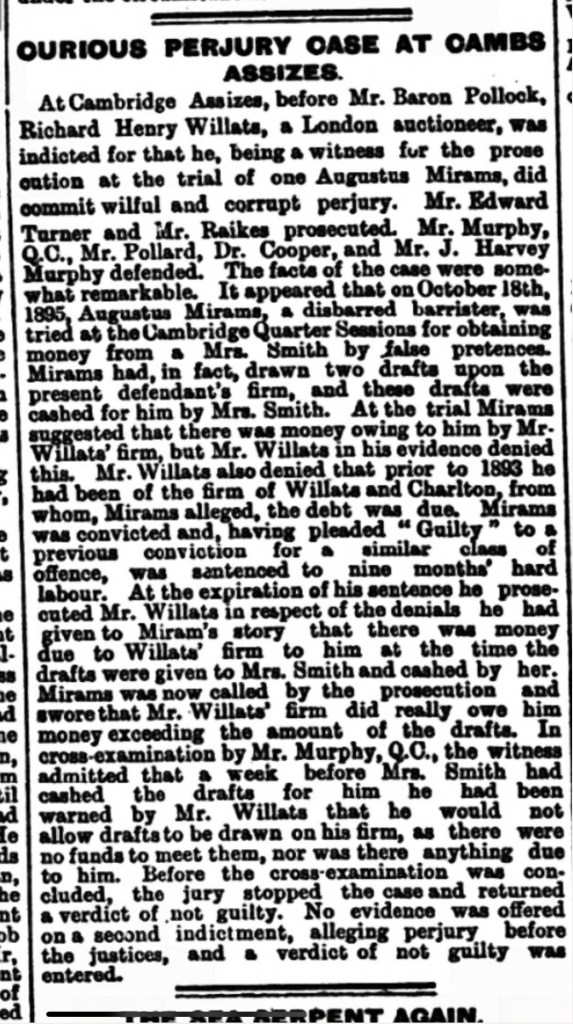
Francis was mentioned in the Norwich Mercury Newspaper, on Wednesday the 04th of November 1896.
It reads,
CURIOUS PERJURY CASE AT CAMBS
ASSIZES.
At Cambridge Assizes, before Mr. Baron Pollook,
Richard Henry Willats, a London auctioneer, was
indicted for that he, being a witness for the prose-
cution at the trial of one Augustus Mirams, did
commit wilful and corrupt perjury. Mr. Edward
Turner and Mr. Raikes prosecuted. Mr. Murphy,
Q.C., Mr. Pollard, Dr. Cooper, and Mr. J. Harvey
Murphy defended. The facts of the case were some-
what remarkable. It appeared that on October 18th,
1895, Augustus Mirams, a disbarred barrister, was
tried at the Cambridge Quarter Sessions for obtaining
money from Mrs Smith by false pretences
Mirams had in fact drawn two drafts upon the
present defendant’s firm, and these drafts were
cashed for him by Mrs. Smith. At the trial Mirams
suggested that there was money owing to him by Mr-
Willats’s firm, but Mr. Willats in his evidence denied
this. Mr. Willats also denied that prior to 1893 he
had been of the firm of Willats and Charlton, from
whom, Mirams alleged, the debt was due. Mirams
was convicted and, having pleaded “Guilty” to a
previous conviction for similar cases of
offence, was sentenced to nine month hard
Iabour. At the expiration of his sentence he prose-
cuted Mr. Willats in respect of the denials he had
given to Miram’s story that there was money
due to Willats’ firm to him at the time the
drafts were given to Mrs. Smith and cashed by her.
Mirams was now called by the prosecution and
swore that Mr. Willats firm did really owe him
money exceeding the amount of the drafts. In
cross-examination by Mr. Murphy, Q.C., the witness
admitted that a week before Mrs. Smith had
cashed the drafts for him he had been
warned by Mr. Willats that he would not
allow drafts to be drawn on his firm, as there were
no funds to meet them, nor was there anything due
to him. Before the cross-examination was con-
cluded, the jury stopped the case and returned
a verdict of not guilty. No evidence was offered
on a second indictment, alleging perjury before
the justices, and a verdict of not guilty was
entered.
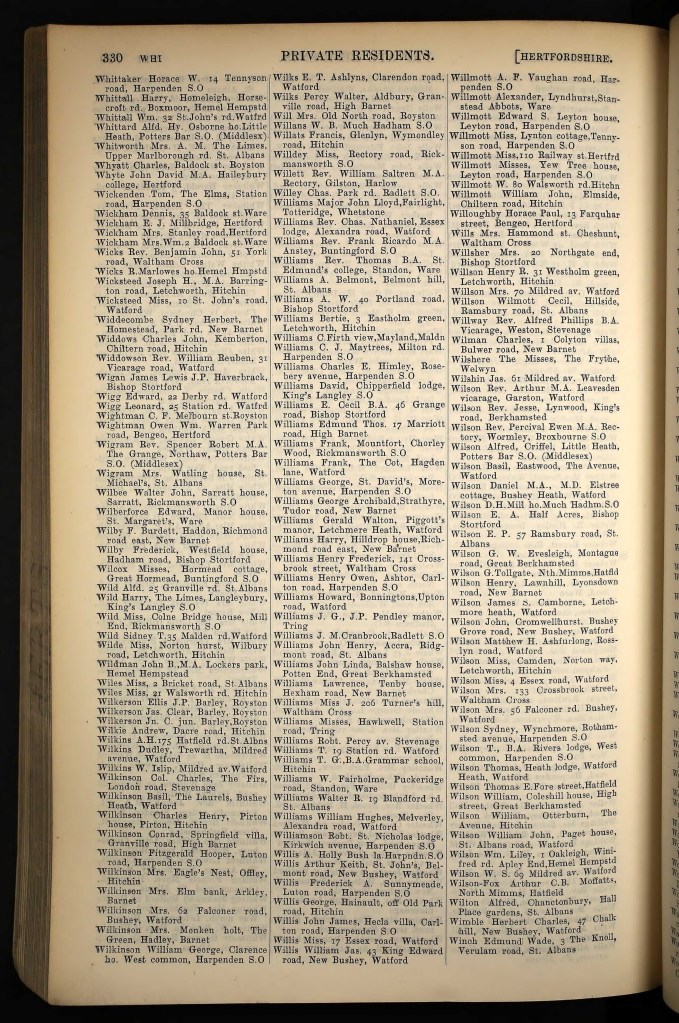
Heartbreakingly Francis’s half-brother, 43-year-old, Estate Bailiff, William George Willats, died on Sunday the 14th of February, 1897 at Number 44, Gillespie Road, Islington, Middlesex, England.

He died from Cardial Haemorrhage Corona Syncope.
Their Sister, Charlotte Ellen Crosbie, of, 132 Wilberforce Road, Finsbury Park, was present and registered his death on Tuesday the 16th of February 1897.

The Willats family laid my 3rd Great- Grandfather, William George Willats, to rest at Abney Park Cemetery, Stoke Newington, Hackney, London, England on Thursday the 18th of February, 1897, in grave D06 092431 with his mother, Eliza Willats nee Cameron.

From the London City Directories, we know that, Francis was residing at, Glenlyn, Wymondley Road, Hitchin, Tottenham, England, in 1897.
Francis’s sister, Lillian Jenny Willats, married William Alexander Willats, on Saturday the 15th of July, 1899, at St. John’s Church, Highbury, Islington, Middlesex, England. Lillian was a 29-year-old spinster and William was a 31-year-old bachelor, whom was working as a commercial. (I assume that means commercial traveller?) They gave their fathers names and occupations as, Richard Henry Willats, an auctioneer and William Neilson, a commercial. Lillian was residing at 27 Kings Road, Brownhill Park and William at Madeira Avenue, Worthing, Sussex, at the time of their marriage. Their witnesses were, brother in-law, Benjamin Beach and her cousin, Amina Charlton.

Francis’s brother, 28-year-old Bachelor Edwin Paul Willats married 19-year-old, spinster, Nellie Elizabeth High on Saturday the 7th of July, 1900, at All Hallows, Tottenham, Edmonton, Middlesex, England. Their witnesses were, Walter James Willats and Amelia Ellen Willats. Their fathers names and occupations were given as Richard Henry Willats, a surveyor and James High, a Cabinet Maker.

Francis, Margaret and their children Margaret, Allen, Frances Alton and Horace, were residing at, 17, Verulam Road, Hitchin, Hitchin Urban, Hertfordshire, England, on the eve of Sunday the 31st March 1901. They had a general servant Lydia Smith and a cook Gertrude Saunders, residing with them. Francis was working as a, Assurance agent.

Sadly death once again had the Willats family firmly in its grasp.
Henry’s sister, Eliza Mary Beach nee Willats, died on Monday the 21st of July 1902, at Beach Court, Upper Deals, Eastry, Kent, England, at the awfully young age of 35 years.
Eliza died from Pneumonia and exhaustion.
Edith Cameron Charlton nee Willats, Richards’s daughter and Eliza’s sister, was present and registered her death on the same day, Monday the 21st of July 1902.
Edith stated the Eliza was the wife of Benjamin Beach, giving his profession as, independent means.
Eliza’s death was registered under the name Mary Eliza Beach.

Eliza Mary Beach nee Willats was laid to rest, on Thursday the 24th of July, 1902, at St Peter in Thanet, Kent, England.
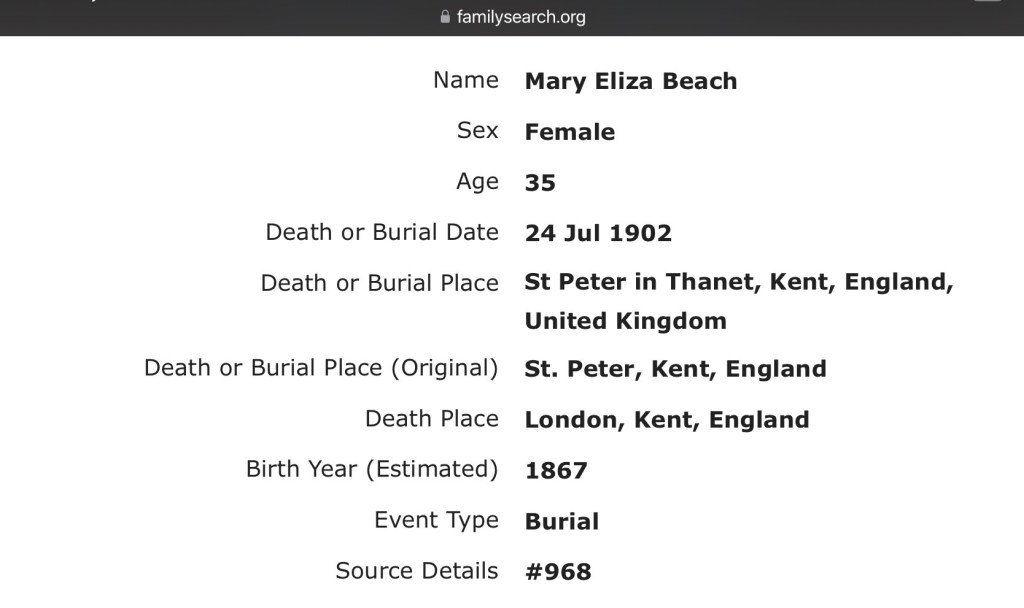
Thankfully Francis and his family finally had something to celebrate, when his sister, 28-year-old, spinster, May Claretta Willats married 20-year-old, architectural florist, bachelor, George Frederick Champion on Saturday the 4th of April 1903, at St. John’s Church, Highbury Vale, Islington, London, England.
May gave her residence as, 21 Montague Road and George as, 194 Green Lanes.
They gave their father’s names and occupations, as George Frederick Champion, an architectural florist and Richard Henry Willats an Estate Agent.
Their witnesses were, George Frederick Champion and Mays niece, Amina Eliza Catherine Charlton.

And his 26 year old bachelor brother, surveyor, Frederick Howard Willats, married 24 year old spinster Maud May Beach, on Saturday the 19th September 1903, at St. John’s Church, Highbury Vale, Islington, London, England.
Frederick gave his abode as, 27 Kings Road and Maud graves hers as, 16 Orchard Road, St. Margarets on Thames.
They gave their fathers names and occupations, as Richard Henry Willats, estate agent, and Walter Beach (deceased), a Gentleman.
Their witnesses were her brother, Persey Sidney Willats and his niece, Amina Eliza Catherine Charlton.

And more celebrations followed when Francis and Margaret’s daughter, 24-year-old, spinster, Margaret Eliza Willats, married Stock Brooker, 38-year-old, bachelor, Leopald Radcliff Craddock, on Saturday the 29th of December, 1906, at the St. Mary’s, The Parish Church Of Hitchin, Hitchin, Hertfordshire, England. Their witnesses were, H. J. Robins and Margaret’s brother, Allan Montague Willats. Margaret gave her abode as, Glenlyn, Hitchin and Leapald gave his abode as, Oakleigh, Loughton, Essex. They named their fathers as, Francis Montague Allan Willats, an Assurance Officer and Charles Augustine Craddock, a Gentleman.
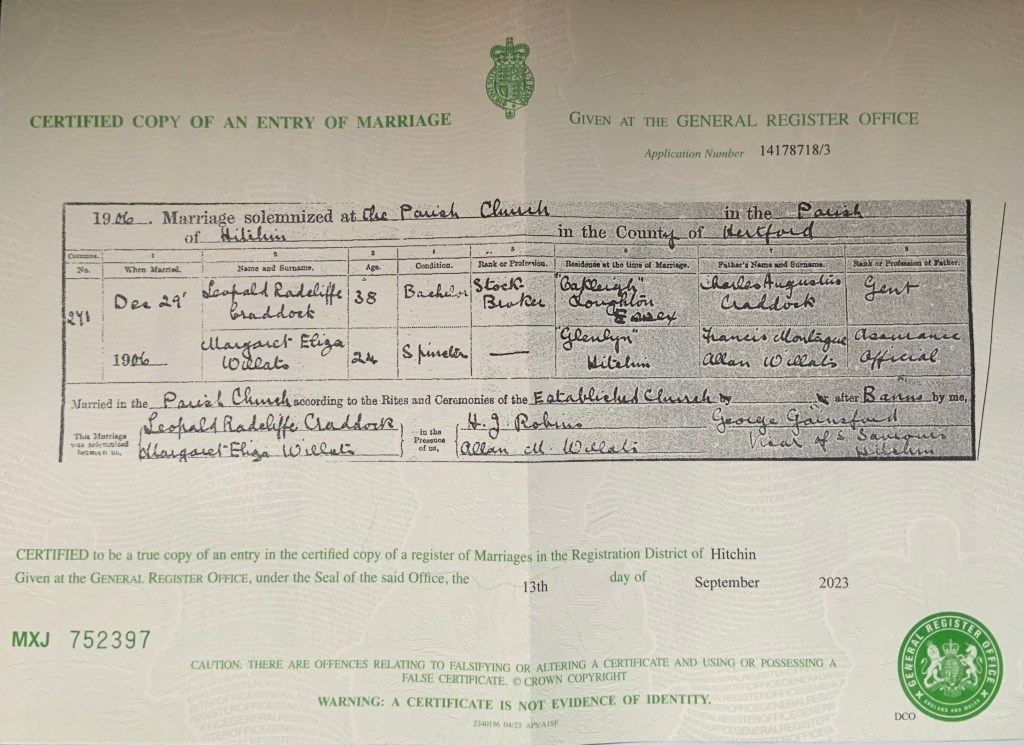
On Friday the 11th of January, 1907, The Luton Times and Advertiser printed an article about Francis’s daughter Margaret Eliza’s wedding. It reads,
The wedding took place at the parish church of Miss Margaret Elsie Willats, well known in Hitchin as a vocalist, and Mr. L. R. Craddock, the Rev. G. Gainsford officiating.
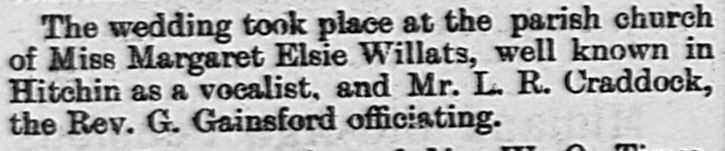
From the London City Directories, we know that Francis was residing at, Glenlyn, Wymondley Road, Hitchin, Tottenham, England, in 1908.
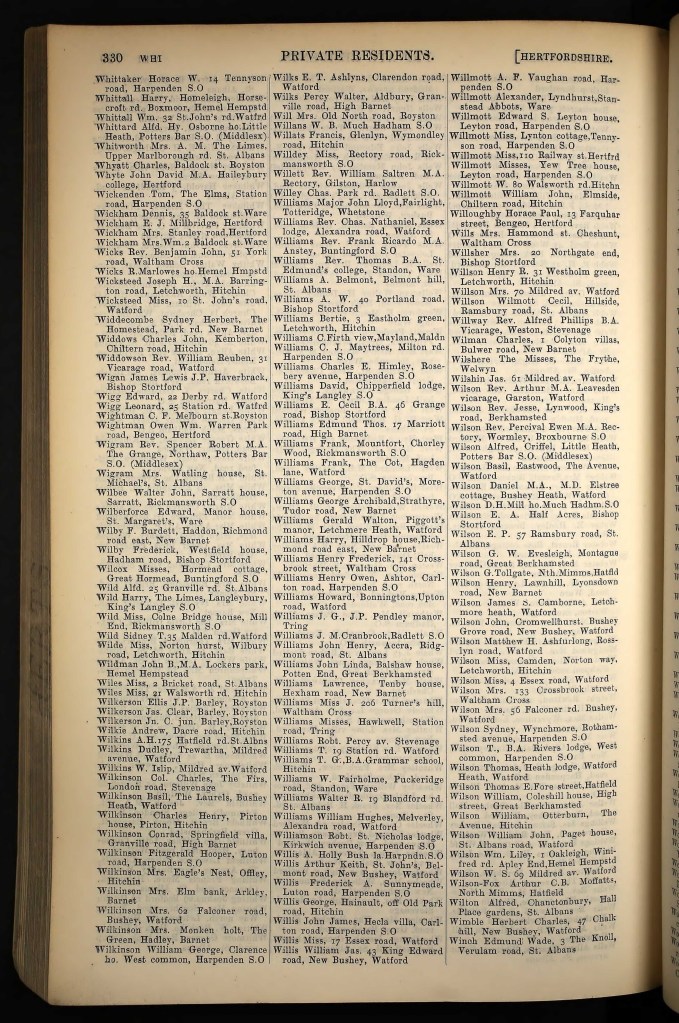
Over in the United States of America, Francis’s brother, 43-year-old, widower and salesman, Arthur Charles married 30-year-old, spinster and actress, Ruth Gadsby, on the 17th of June 1908, at Niagara Falls, Welland, Ontario, Canada.

Back in rainy old England, Francis’s other brother, 33-year-old, bachelor, Percy Sidney Willats, married 25-year-old, spinster, Sophie Ann Smart on Saturday the 24th of July 1909 at The Register Office, Edmonton, Middlesex, England. Their witnesses were, E. P. Willats and J H Champion. Percy gave his occupation as an auctioneer. They gave their abode as Number 11 The Quadrant, Winchmore Hill, Edmonton. They gave their fathers names and occupations as, Richard Henry Willats, a auctioneer and John Smart, a Market Gardener.
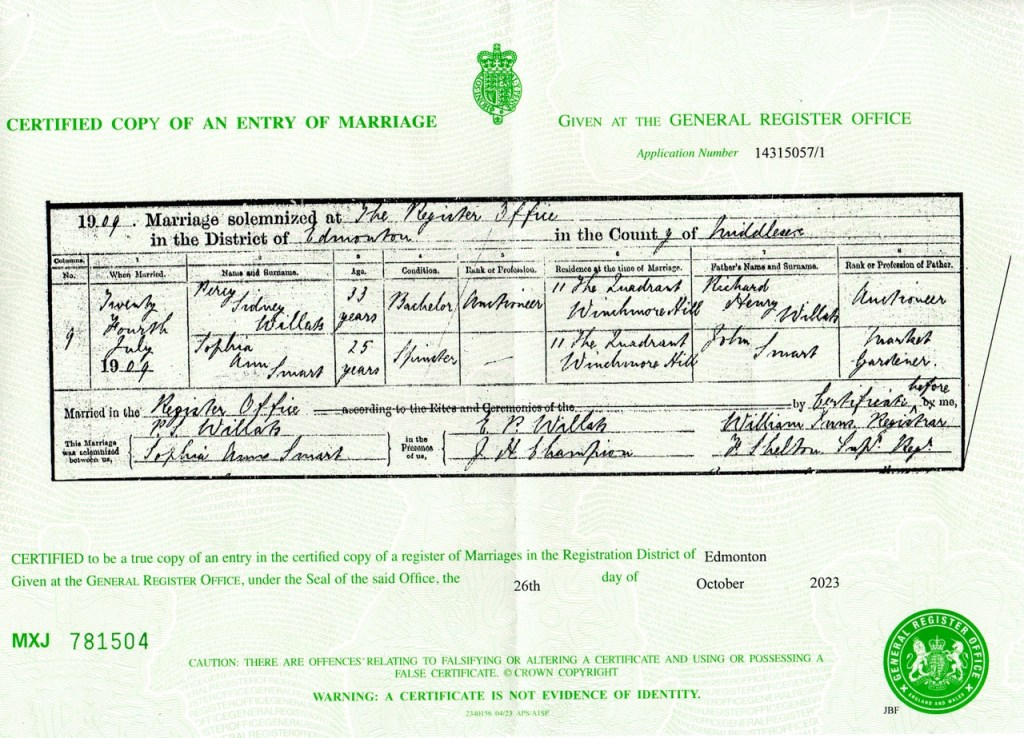
On the eve of Sunday the 2nd of April 1911, Francis, Margaret and their children, Frances and Alton were residing at, Wymondley Road, Hitchin, Hertfordshire, England. They had two servants working and residing with them, 15-year-old, Florence Wilshire and 35-year-old, Ellen Clifton. They also had William and Georgina Durch, visiting them. Francis was working as an Assurance Official, Alton was a Builder’s assistant and William was an Engineer. Their home in Wymondley Road, was a nine-room dwelling.
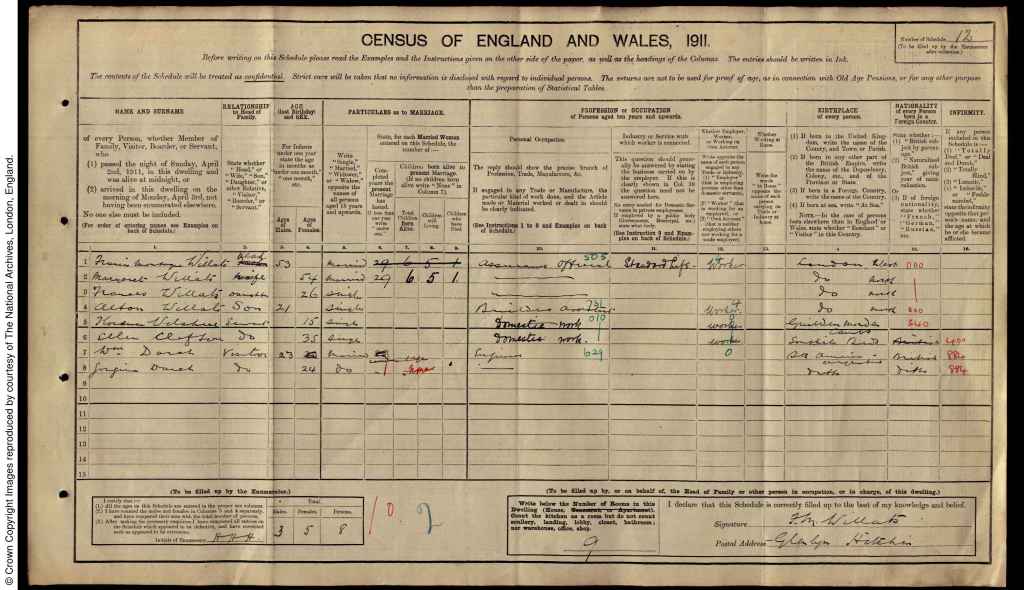

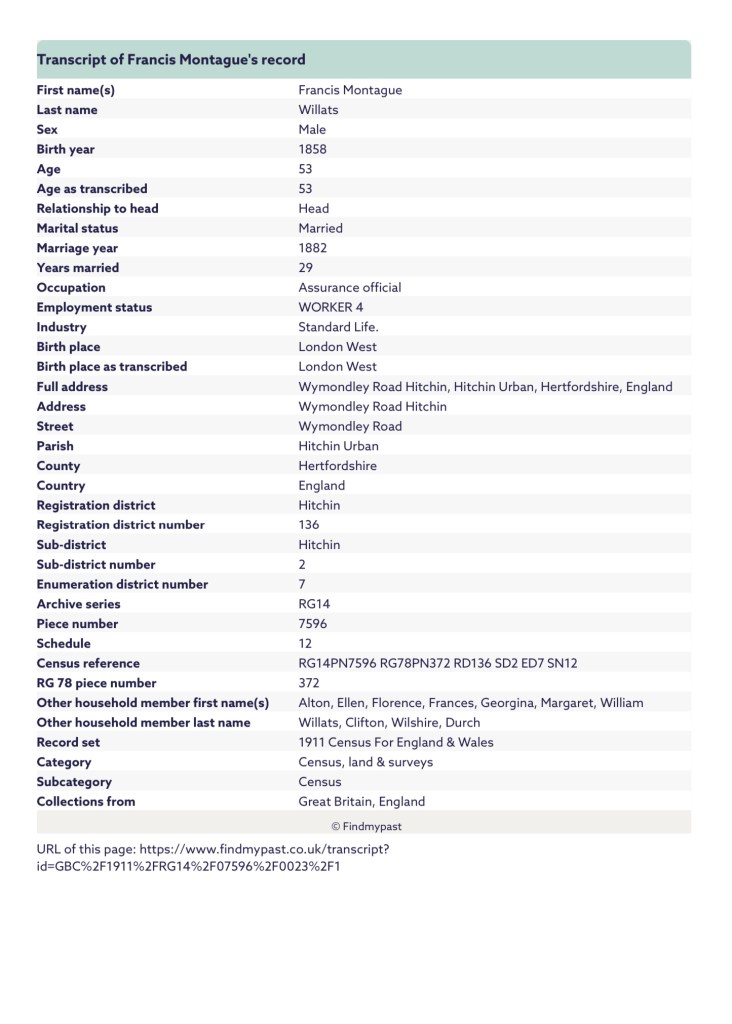
From the 1912, London City directives, we know Frances was residing at, Glenlyn, Wymondley Road, Hitchin, London, England, in 1912.
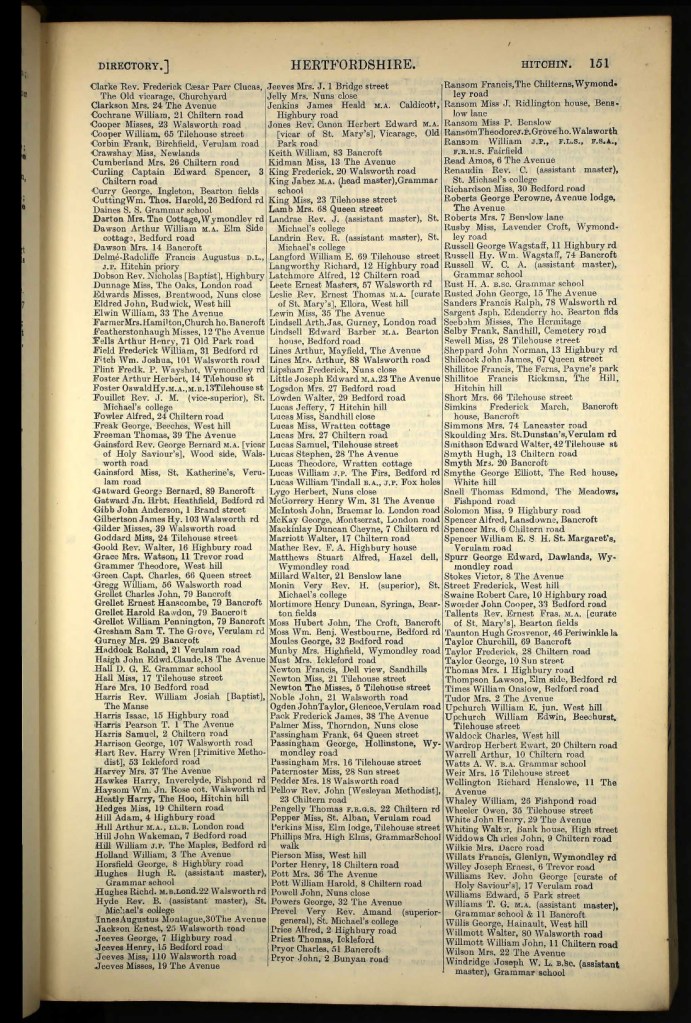
Francis’s sister, 43 year old, widow, Lillian Jenny Neilson nee Willats, married 41 year old, bachelor, George Campbell Ferris, on the 23rd of October 1915, at The Register Office, Islington, London, England. Jenny gave her abode as, 35, Yesbury Road and George gave his as 87 Winchester Street and his occupation as a commercial clark. Their parents were named as, George Coell Ferris a commercial traveler (deceased) and Richard Henry Willats, an Auctioneer. Their witnesses were, Claude Eayes and J E Bailie.

Francis’s son, Horace Lennan Willats, a Captain in the 7th Training Reserve Battalion, Rugeley Camp died on Sunday the 17th of December, 1916, at Ministry Hospital, Cannock Chase, Rugeley, Staffordshire, England. He died from, compression of the brain due to haemorrhage inside the skull caused by accidental wounds to the head from the premature bursting of a grenade whilst engaged in bombing practice at the Ministry of Pensions Hospital at Brindley Heath on Cannock Chase.

The Military Hospital was built in 1916 to serve both Brocton and Rugeley army training camps. The hospital had twelve wards with a total of one thousand beds and served the camps for the remainder of the war, as well as housing convalescing soldiers from France. It continued to be used until the late 1920s. After this time the buildings were acquired by the Coal Board and they were available to rent for local miners and their families, and so the site became known as ‘Brindley Village’.
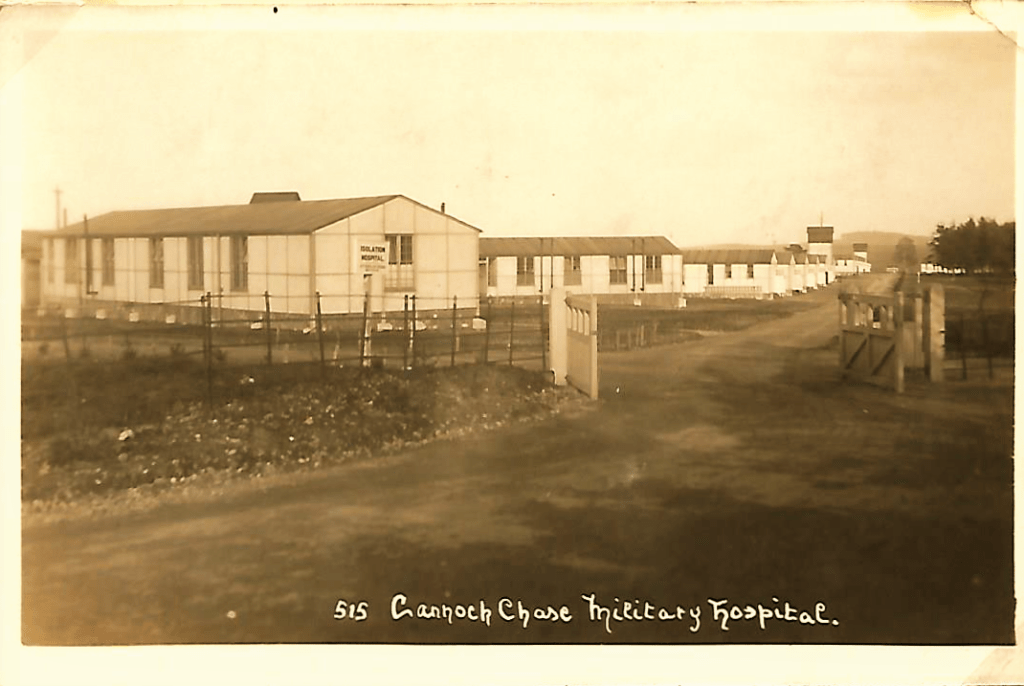
Francis, Margaret and their family laid Horace to rest in Grave 79.40479, grave reference /40479, in Highgate Cemetery, St. Pancras, London, England, on Tuesday the 19th of December 1916.
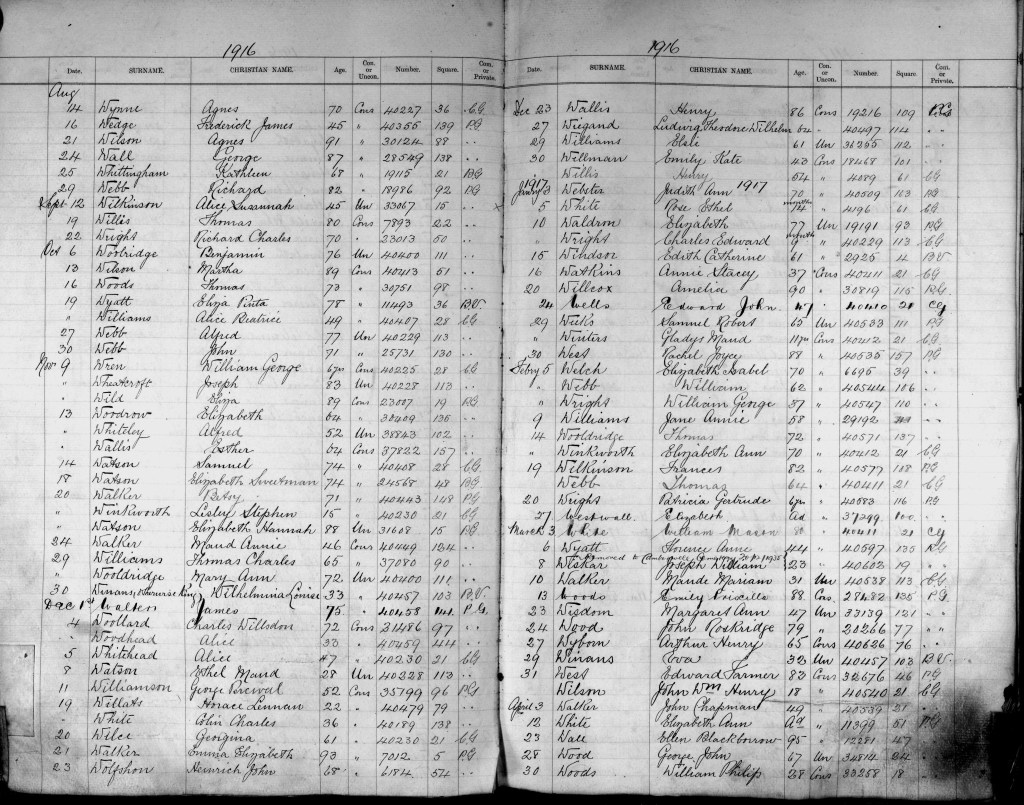
Highgate Cemetery was established in 1839 as one of the “Magnificent Seven” garden cemeteries that were built on the outskirts of London to address the overcrowding of city churchyards. The cemetery was designed as a tranquil and scenic final resting place for the deceased. The cemetery is divided into two parts, known as the East Cemetery and the West Cemetery. The East Cemetery is open to the public and contains the graves of many well-known individuals. The West Cemetery, which is the older part of the cemetery, requires a guided tour to visit and is known for its elaborate Victorian architecture, intricate gravestones, and overgrown, romanticized atmosphere. Highgate Cemetery is the final resting place of several famous individuals, including Karl Marx, the renowned political philosopher and co-author of “The Communist Manifesto.” His tomb is one of the most visited in the cemetery. Other notable figures buried in Highgate Cemetery include George Eliot (the pen name of author Mary Ann Evans), Douglas Adams (author of “The Hitchhiker’s Guide to the Galaxy”), and Michael Faraday (a pioneering scientist). In the 20th century, Highgate Cemetery fell into disrepair, but it has since undergone extensive restoration efforts. The Friends of Highgate Cemetery Trust, a charitable organization, was formed in 1975 to help preserve and maintain the cemetery. Today, it is a protected historic site. Visitors can explore the East Cemetery independently or take guided tours of the West Cemetery. These tours offer insight into the cemetery’s history, architecture, and notable residents. It’s advisable to check the official website for tour availability and booking information. Highgate Cemetery is renowned for its eerie and Gothic ambiance, characterized by overgrown ivy, towering trees, and atmospheric tombs. This unique atmosphere has made it a popular location for film and television productions. Highgate Cemetery is situated in the London Borough of Camden, not far from Highgate Village. It is easily accessible via public transportation, with Highgate Underground station nearby. Highgate Cemetery is not only a place of historical significance but also a beautiful and contemplative space where visitors can reflect on the past and pay tribute to some of the notable figures who rest there.
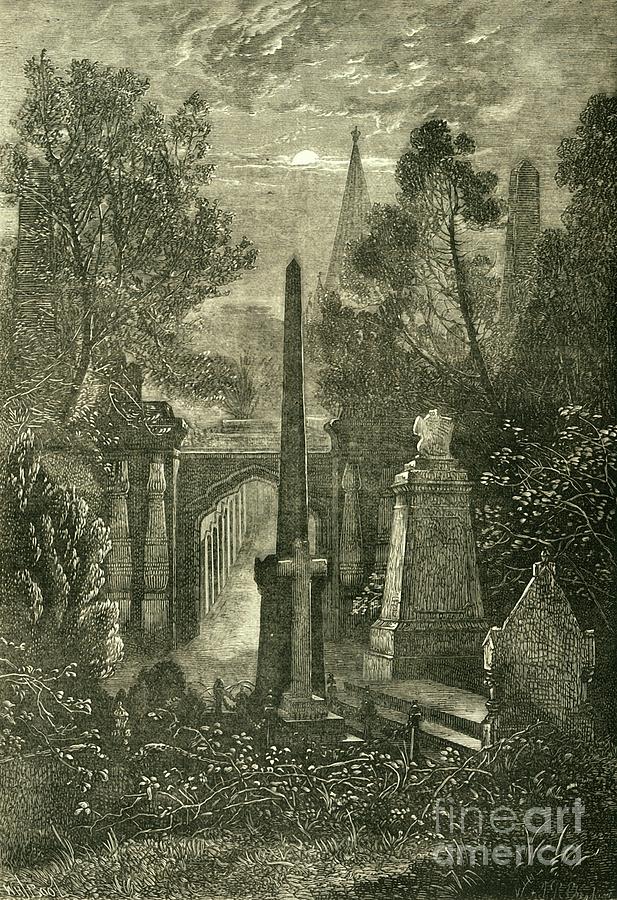
Horace’s probate was granted on Monday the 09th of July 1917, in London, England. It reads,
WILLATS Horace Lennan of Wymondley Heath Gate Hendon Middlesex captain East Yorkshire regiment died 17 December 1916 at Rugeley Camp Rugeley Staffordshire Administration London 17 July to Francis Montague Willats Secretary. Effects £218 12s. 3d.
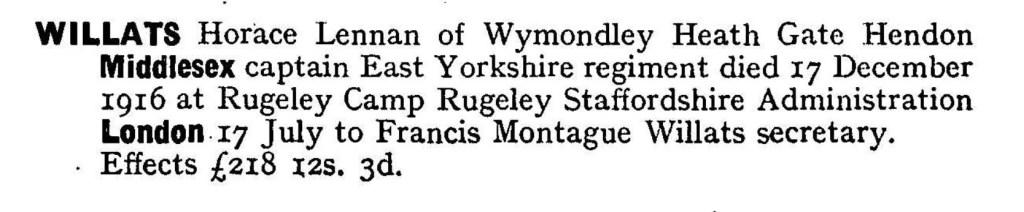
I have purchased his will, unfortunately even though I gave them all information needed, they have had trouble locating his documents. If and when they aretraced down I will of course update you.

Sadly death was still lingering at the family door. Francis and Margaret’s son, Captain, 2nd/5th Battalion, Alton Henry Willats of the York and Lancaster Regiment was killed in action on Friday the 7th of September 1917, in France.
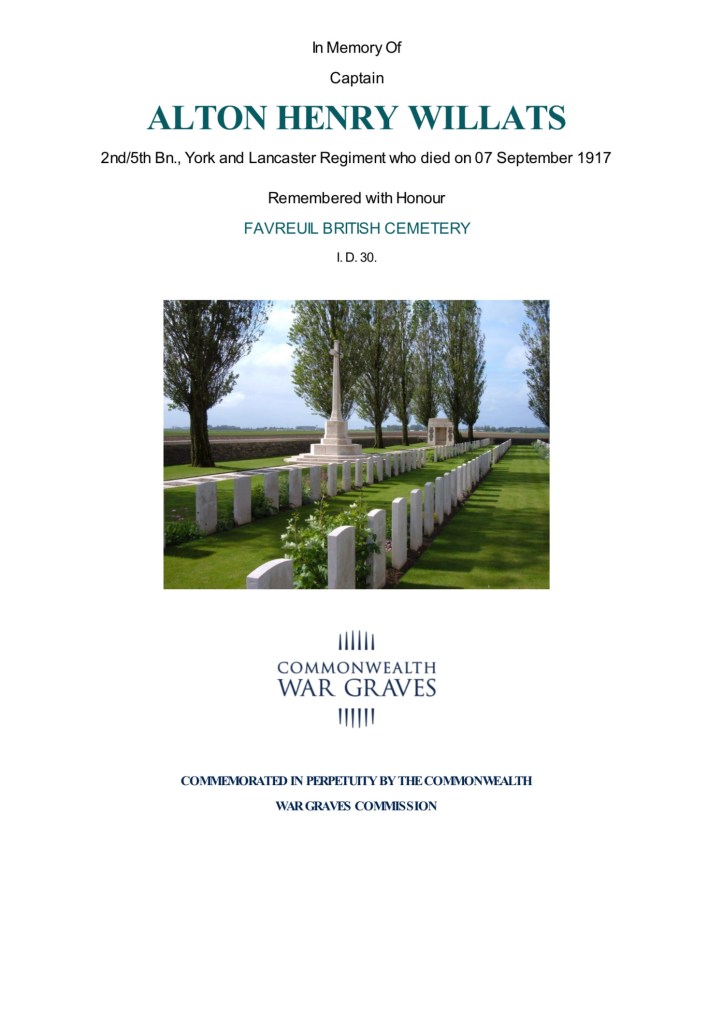
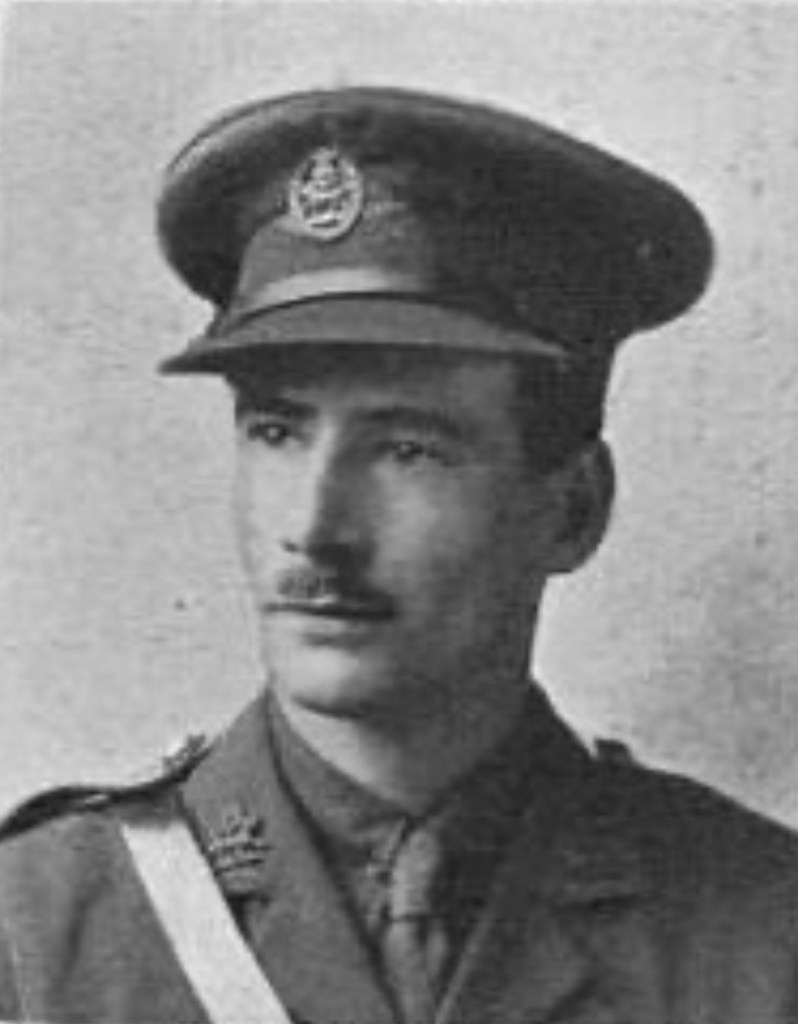
Alton was laid to rest, at Favreuil, Departement du Pas-de-Calais, Nord-Pas-de-Calais, France. Favreuil village was occupied by British troops in March, 1917, lost in March, 1918, and retaken by the 37th and New Zealand Divisions on the 25th August. The cemetery was begun in April, 1917, and used until March, 1918, by fighting units (particularly of the 62nd (West Riding) Division) and Field Ambulances. Further burials were made in August and September, 1918, and after the Armistice British graves were brought in from the neighbouring battlefields and other burial grounds, including:- BEAULENCOURT CHURCHYARD GERMAN EXTENSION, in which three South African soldiers and two from the United Kingdom were buried in July, 1916. BEUGNY GERMAN CEMETERY No.3 (adjoining the present Red Cross Corner Cemetery), in which 350 German soldiers, eight from the United Kingdom and one from New Zealand were buried. VELU CHURCHYARD, which contained the graves of 39 German soldiers and five from the United Kingdom. There are now nearly 400, 1914-18 war casualties commemorated in this site. Of these, over ten are unidentified and special memorials are erected to four soldiers from the United Kingdom known or believed to be buried among them. Another special memorial records the name of a soldier from the United Kingdom, buried in Favreuil German Cemetery, whose grave could not be found. The bodies of 484 German soldiers were removed after the Armistice from a German Cemetery of 1918 on the North-West side, and 45 from the British Cemetery. The cemetery covers an area of 1,983 square metres and is enclosed by a rubble wall.

On Thursday the 20th of September, 1917 Altons death announcement was places in the Hampstead News. It reads,
Captain Alton Henry Willats, York and Lancaster Regiment, killed in action on Sept. 7th, aged twenty-six, was second son of Mr. And Mrs. F. M. Will at S, Heart Gate, Hampstead Garden Suburb. He received his first commission in February, 1915, and was promoted lieutenant in the following January.

Francis and Margaret’s, son, Alton Henry Willats, Probate was granted on the 24th of April 1918. It reads,
WILLATS Alton Henry of Wymondley Heath Gate Hendon Middlesex acting captain 5th Yorkshire and Lancashire regiment died 7 September 1917 in France Administration (with Will) London 24 April to Francis Montague Allan Willats Secretary. Effects £366 14s. 5d.
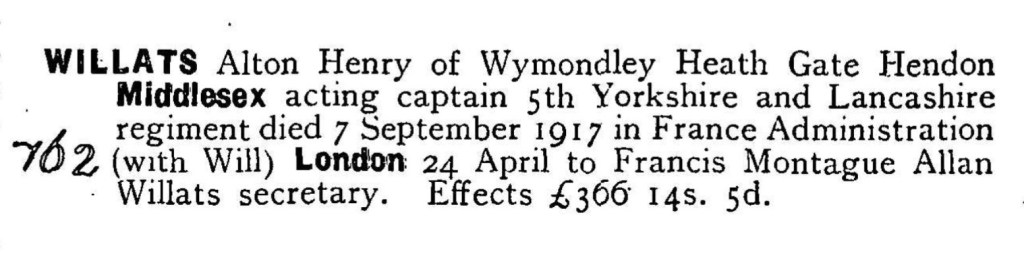
I have purchased Altons, will, unfortunately evenen though I gave them all information needed, they have had trouble locating his documents. If and when they aretraced down I will of course update you.
And even more, heartbreak followed, when Francis’s brother, 48-year-old, Architects Draftsman, Edwin Paul Willats, sadly passed away, on Monday the 5th of July 1920, at Number 52 Grove Park Road, Tottenham, Edmonton, Middlesex, England. Edwin died from Pulmonary Tuberculosis and Hemoptysis cardiac failure. Certificated by Gordon Miller mb. No post-mortem was taken. Edwins sister in-law, A E Willats of 132 Landsdowne Road, Tottenham, was present and registered Edwins death on Tuesday the 6th of July 1920, in Edmonton.
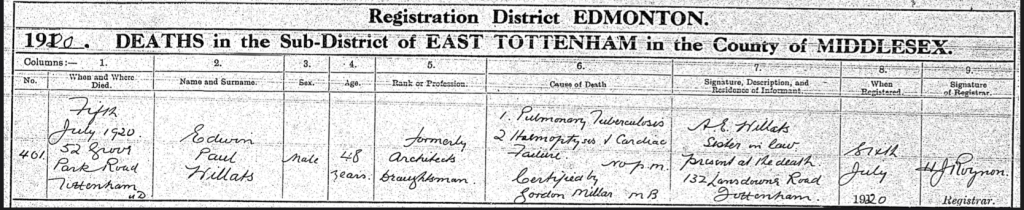
The Willats family and friends laid Edwin Paul Willats, to rest at, Abney Park Cemetery, Stoke Newington, Hackney, London, England, in Section, D06, Index 7S03, on Saturday the 10th of July, 1920. He was buried with other family members.

The London Election Register shows that, Francis was residing at, Wymondley, Hitchin, Tottenham, England, in 1920.
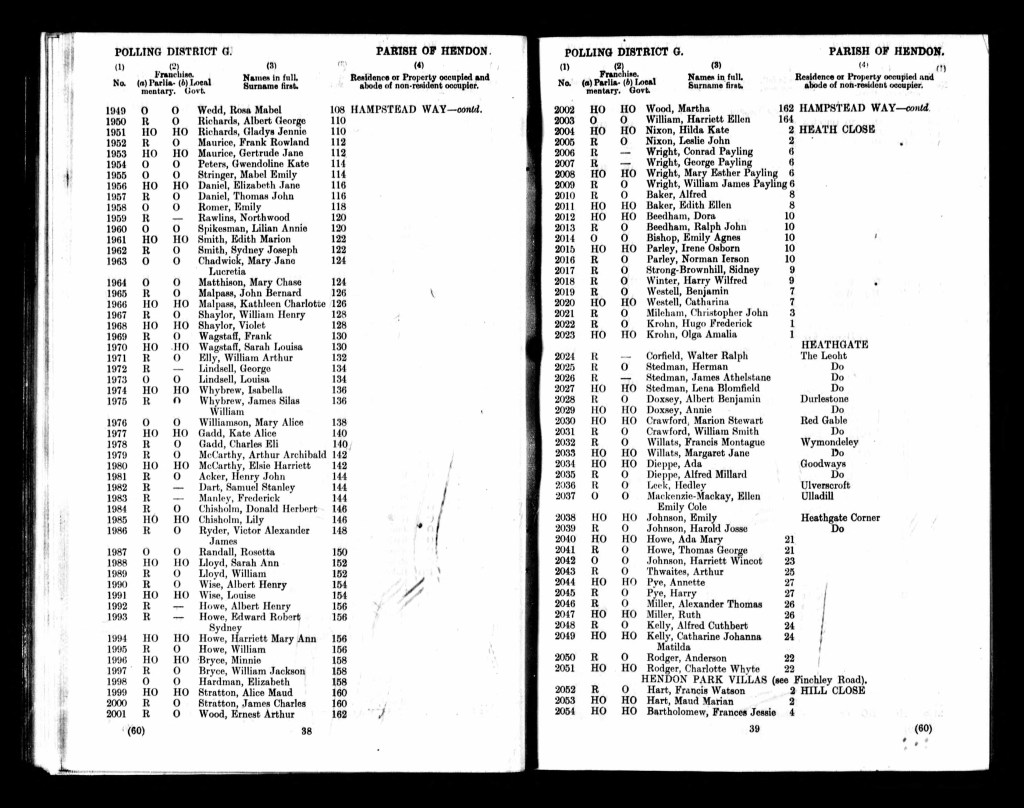
Sadly this is where Francis’s story draws to a close. 63-year-old, Insurance Manager, Francis Montague Allan Willats, sadly passed away on Sunday the 19th of September 1920, at Wymondley Heathgate, Hendon, Middlesex, England. He died from Chronic interstitial hepatitis several years, certified by H. Stedman. No post-mortem was taken. Francis’s son, Allen Montague Willats was present and registered his death on Tuesday the 22nd of September 1920, in Hendon.

Francis was laid to rest, on Tuesday the 21st September 1920, at Highgate Cemetery, Camden, London, England, in grave reference /40479. He was buried with 7 others, Frances Jessie Willats, buried 16th September 1976. Allan Montague Willats, buried 2nd March 1968. Dorothy Beaumont Willats, buried 9th April 1965. Margaret Eliza Craddock, buried 1st January 1961. David Allan Willats, buried 5th February 1948. Margaret Jane Willats, 25th October 1937 and Horace Lennan Willats, buried 19th December 1916.

Highgate Cemetery is one of London’s most famous and historic cemeteries, located in the borough of Camden. It opened in 1839 as part of a response to London’s rapidly growing population and the inadequate burial space in existing churchyards. The cemetery was designed by architect Stephen Geary, and it quickly became a prestigious burial ground, attracting attention for its picturesque landscaping and impressive architecture. Here is an overview of the history of Highgate Cemetery: Founding and Early Years (1839-1860): Highgate Cemetery was consecrated in May 1839, and the first burial took place later that same month. The cemetery was divided into two parts: the East Cemetery and the West Cemetery. The East Cemetery was the original part, and it was open to all, while the West Cemetery was added later and was intended for wealthier individuals who could afford more elaborate memorials. Victorian Highgate (1860s-1900s) – During the Victorian era, Highgate Cemetery became a fashionable burial place for the wealthy and influential individuals of the time. Many impressive mausoleums, monuments, and gravestones were erected, showcasing a variety of architectural styles, including Gothic, Egyptian, and classical influences. Notable figures buried in Highgate Cemetery include Karl Marx, George Eliot (Mary Ann Evans), and Michael Faraday. Decline and Neglect (20th Century): In the early 20th century, Highgate Cemetery faced financial difficulties, leading to a decline in maintenance and upkeep. The cemetery fell into a state of neglect, with vegetation overgrowth and decay affecting many of the graves and structures. Restoration and Preservation (1970s-2000s): In the 1970s, a restoration campaign was initiated by the Friends of Highgate Cemetery, a volunteer organization dedicated to the preservation of the cemetery. Restoration efforts focused on repairing and maintaining the cemetery’s historic structures, cleaning and restoring gravestones, and managing the landscape. The cemetery is now divided into active and historic sections, with the historic areas preserved to maintain their original character. Visitor Attraction and Tours: Highgate Cemetery has become a popular tourist attraction, drawing visitors interested in its historical significance, architecture, and famous residents. Guided tours are available, providing insights into the cemetery’s history, notable interments, and architectural features. Highgate Cemetery remains an important cultural and historical landmark in London, offering a unique glimpse into the city’s past through its graves and monuments.


Francis’s death was announced in the Hendon & Finchley Times, on the 1st of October, 1920. It reads,
The death has taken place of Mr. Francis M. Willats, of “Wymondley.” Garden Suburb, who for some years was a sidesman at St. Jude’s.
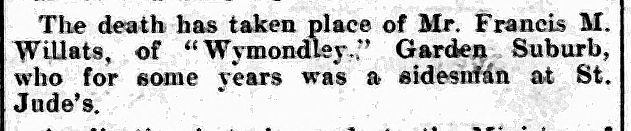
Francis’s probate was granted on the Monday 6th December 1920. It reads,
WILLATS Francis Montague of Wymondley Heathgate Hendon Middlesex died 19 September 1920 Probate London 6 December to the Public Trustee. Effects £7586 17s. 5d.
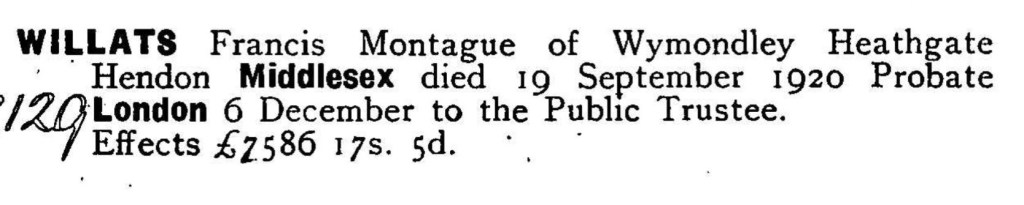
His Grant reads as follows,
DEATH ON OR AFTER lst JANUARY, 1898. Will.
BE IT KNOWN that Francis Montague Willats of Wymondley Heathgate Hendon in the county of Middlesex
died Thurs on the 19th of September 1920 AND BE IT FURTHER KNOWN that at the date hereunder written the last Will and Testament
of the said deceased was proved and registered of His Majesty’s High Court of Justice, and that administration of all the estate which by law devolves to and vests In the personal representative of the said deceased was granted by the aforesaid Court to The Public Trustee the sole executor
named in the said Will
Dated the 1st day of November 1920
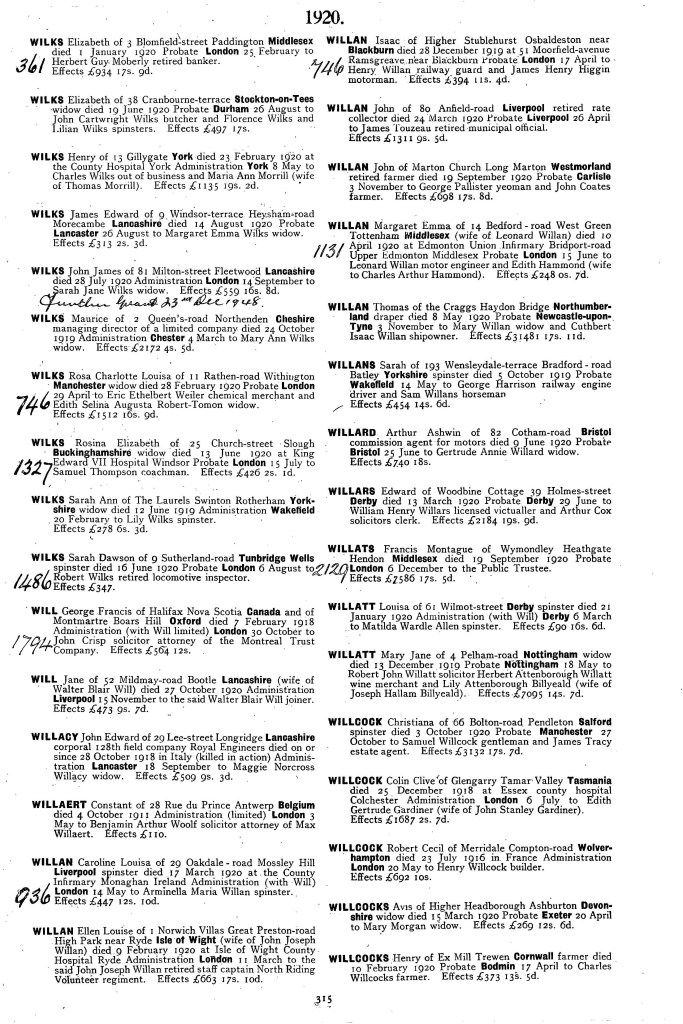

I have purchased Francis’s Last Will and Testament. It reads as follows.
THIS IS THE LAST WILL of me FRANCIS MONTAGUE WILLATS of Wymondley Heathgate Hendon In the County of Middlesex Esquire 1. I revoke all former wills and testamentary dispositions made by me 2. I appoint the Public Trustee to be the EXECUTOR and trustee of this my will 3. I bequeath (free of duty) to my son Allan Montague Willets my gold repeater watch presented to me by the Directors of the Standard Life Assurance Company requesting him to treat it as an heirloom 4. Subject as afsd I bequeath (free of duty) to my wife Margaret Jane Willats all the plate plated articles linen chine glass books pictures prints furniture jewellery, and articles, of household or personal use or ornament wines liquors and consumable stores and other articles and effects of every kind which at my death shall be in or about my dwellinghouse and the buildings and gardens, occupied therewith but except money or securities for money 5 I devise and bequeath all the residue of my property unto the Public Trustee Upon trust to sell and convert into money such part thereof as does not consist of money with power to postpone such sale and conversion for such a period as the Public Trustee without being liable to account may think proper and so that unless the Public Trustee see special reason for sale no reversionary interest be sold until it falls into possession and no policy held bg me on the life of any other person be sold until the same becomes payable with power for the Public Trustee in the meantime to pay the premiums thereon out of the capital of my residuary estate 6 The Public Trustee shall out of the money to arise from the sale and conversion of my residuary estate and out of my ready money pay my funeral and testamentary expenses death duties and debate and shall invest the resident of the said moneys in or upon any of the investments authorised by law for the investment of trust funds with power at his discretion to change such investments for others of a like nature 7 The Public Trustee shall stand possessed of the investments hereinbefore directed to be made or authorised to be retained (including any part of my residuary estate remaining unconverted) and the investments for the time being representing the same (hereinafter called “the trust fund”) and of the annual income thereof Upon the trusts following that is to say (1) During the lifetime of my said wife the Public Trustee shall pay the income of the trust fund as to two-fifths thereof to my said wife as to other two-fifths to my daughter Frances Jessie Willats and as to the remaining one-fifth to my daughter Margaret Eliza Craddock and in the event of such daughters or either of them dying during the lifetime of my wife the shares or share of income of the daughters or daughter so dying shall thereafter be payable to my said wife (11) After the death of my said wife the Public Trustee shall out of the capital of the trust fund pay the sum of £500 (free of duty) to my son the sd Allan Montague Willats if he shall then be living and during the joint lives of my said two daughters shall pay the income of the remainder of the trust, fund as to three-fifths thereof to my daughter the sd Frances Jessie Willats and as to the remaining two-fifths thereof to my daughter the sd Margaret Eliza Craddock (111) After the death of my wife and of such one of my daughters as shall first die the Public Trustee shall stand possessed of the remainder of the trust fund (as to both capital & income) on the following trusts (a) In the event of my daughter the sd Frances Jessie Willats dying first then as to seven-tenths of such remainder for my daughter the sd Margaret Eliza Craddock absolutely and as to the remaining three-tenths thereof for my son the sd, Allan Montague Willats absolutely (b) In the event of my daughter the ad Margret Eliza Craddock dying first then as to four-fifths of such reminder for my daughter the sd France Jessie Willats absolutely and as to the remining one-fifth thereof for my son the sd Allan Montague Willats absolutely (iv) I direct that the share of my surviving daughter in the remainder of the Trust Fund shall be laid out by the Public Trustee in the purchase from the Government or an Insurance Company in the name and for the benefit of my surviving daughter of an annuity for the term of her life unless the Public Trustee shall see good reason for not doing so (v) In the event of both my said daughters dying during the lifetime of my said wife then I direct that after the death of my said wife the Public Trustee shall stand possessed of the remainder of the trust fund (both as to capital & income) in trust for my son the sd Allan Montagne Willats absolutely if he be then living. 8. The income of my estate however invested shall from my death be treated and applied as income and no part thereof shall be added to capital. 9. All income payable to my wife and daughters under this my will shall be for their separate use without power of anticipation during any coverture. 10. In case my wife or any of my children shall sell mortgage assign charge or other-wise dispose of (except by will or codicil) his or her expectant share or interest of and in the trust fund or any portion thereof prior to the actual receipt of the same or shall attempt so to do then and in such case my wife or the child so selling mortgage assigning charging or otherwise disposing of his or her expectant share or attempting so to do shall forfeit and lose all benefit under my will and his or her share and interest shall devolve under this my will as if such wife or child had predeceased me IN WITNESS whereof I have hereunto set my hand this 6th day of August 1920 – F M WILLATS – Signed by the above named Francis Montague Willats as his last will in the presence of us both present at the same time who in his presence and the presence of each other have hereunto set our names as witnesses IAN A FLETCHER 83 King William St E C – G M SHEEHAN 83 King William St E C.
On the 6th day of December 1980, Probate of this Will was granted to The Public Trustee the sole executor.
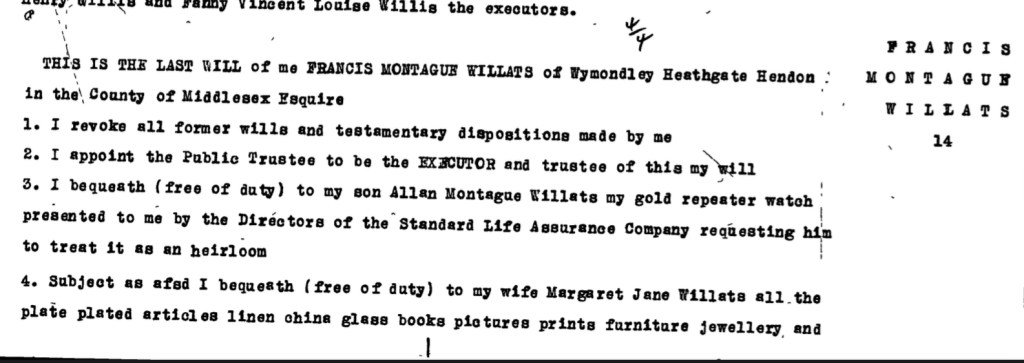

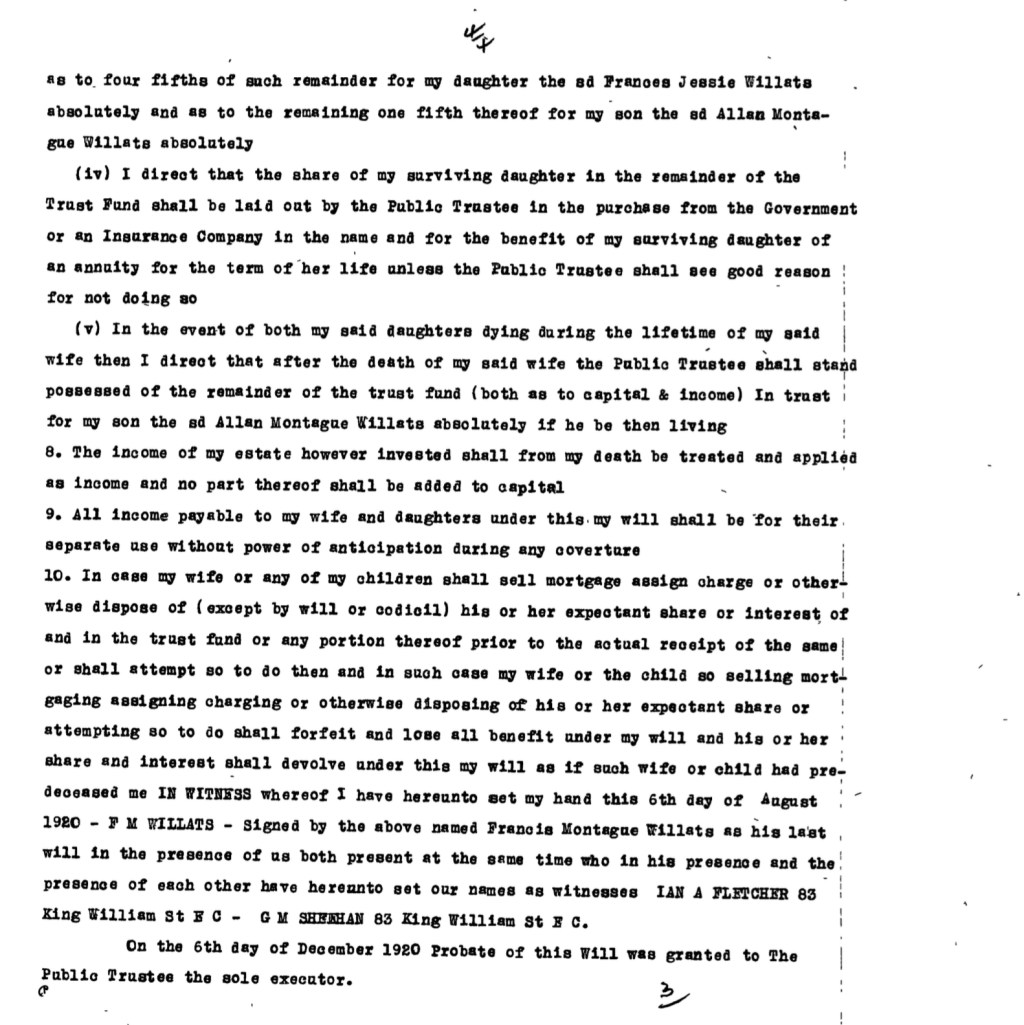
Francis was mentioned in the London Gazette in 1921. (no date given). It reads,
FRANCIS MONTAGUE WILLATS, Deceased. Pursuant to the Statute 22nd and 23rd Victoria, chapter 35. intituled An Act to further amend the Law of Property and to relieve Trustees.” N That personaby, even, that all ereditors and other persons having any debts, claims or demands against the estate of Francis Montague ” Heatihgate, Hendon, in the couty of Middleser, the 19th day of September, 1920, and whose will was proved in the Principal Registry of the ProbateDivision of His Majesty’s High Court of Justice, On the 6th day of December, 1920, by the Public Trustee, the executor therein named), are hereby required to send particulars, in writing of their debts, claims. or demands to us, the undersigned, as Solicitors the said executor, on or before the 28th day of Feb- ruary, 1921, after which date the said executor will proceed to distribute the assets of the said deceased amongst the persons entitled thereto, having regard only to the debts, clairns and demands of which he shall then have had notice; and that he will not be liable for the assets, or any part thereof, so distri. buted, to any person or persons of whose debt, claim or demand he shall not then have had notice. -Dated this 18th day of January, 1921. MINET, MAY and CO., 5, Dowgate-hill. London, E.C. 4, Solicitors for the said executor.
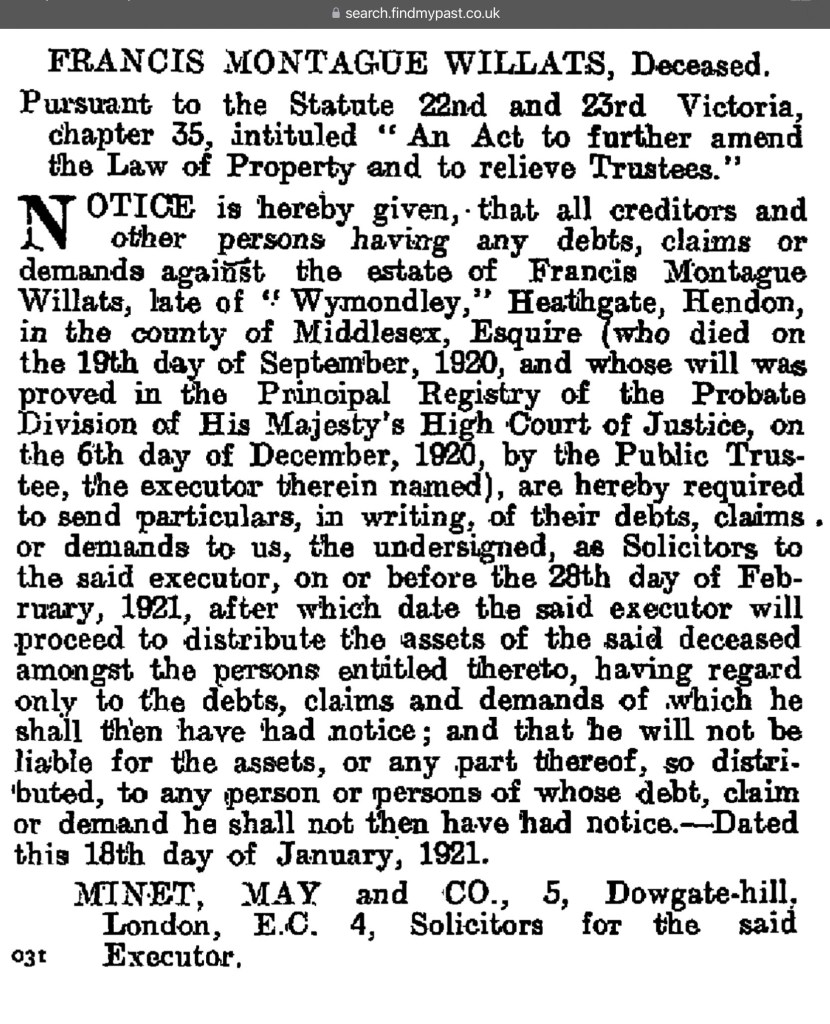
As I reflect upon the life of my 3rd great-granduncle, Francis Montague Allan Willats, I am reminded of the profound impact one individual can have on our family history. Francis’s life may be relegated to the pages of time, but his legacy continues to resonate in our hearts. Through documentation, stories passed down through generations, newspaper articles and the one fading copy of a photograph, Francis lives on. He was not just a name on our family tree, he was a living, breathing soul who experienced the trials of his era and the most tragic loss of his sons. His struggles and successes are a testament to the resilience and fortitude that run deep within our family’s veins. In his time, he may have been one among many, but to us, he is a symbol of the enduring spirit of our lineage. We owe it to him and those who came before us to remember, honor, and celebrate the lives that paved the way for our own existence. As we bid farewell to his chapter on Intwined, let us take a moment to appreciate the connections that bind us across time and space. Francis, though gone for over a century, remains an indelible part of our family story. In honouring his memory, we acknowledge the profound impact our ancestors have on who we are today and the legacy we leave for future generations. May Francis’s story continue to inspire us to embrace our own lives with courage and determination, knowing that our journey is a continuation of the stories that came before us. And as we remember him, we strengthen the bonds that tie us to our roots and remind ourselves of the importance of cherishing our heritage, for it is the foundation upon which our future is built.
Rest In Peace, Francis Montague Allan Willats 1857-1920
Until next time, stay true, stay you, not blue. Too-da-loo for now.
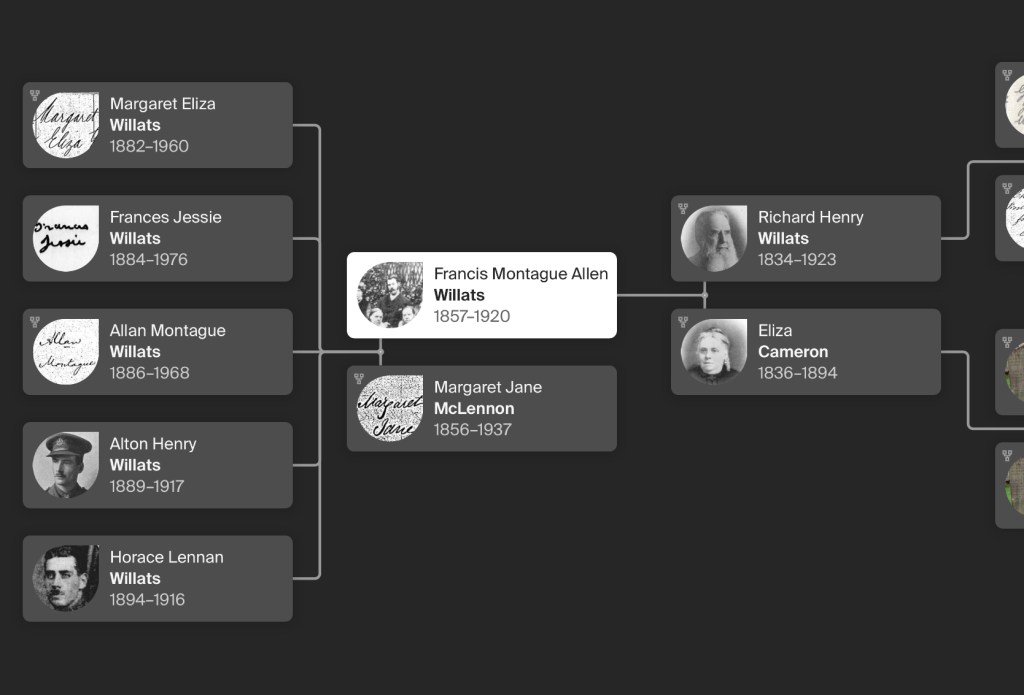
🦋🦋🦋
I have brought and paid for all certificates,
Please do not download or use them without my permission.
All you have to do is ask.
Thank you.
 Intwined
Amazing research you brought him to life
LikeLike