In the heart of bustling St Pancras, London, amidst the cobbled streets and whispers of a bygone era, a tale of resilience and tenacity unfolded. This is the story of Charlotte Ellen Willats, a name that resonates through the annals of history as a testament to the strength of the human spirit. Born in the crisp winter of 1859, Charlotte embarked on a life that would be woven into the very fabric of time itself. As we step back in time, we find ourselves immersed in an era defined by its own unique challenges and triumphs. The 19th century was a crucible of change, a period where society was in the throes of transformation, and the echoes of the industrial revolution reverberated through the cobblestone streets of London. It was in this world that Charlotte took her first breath, a harbinger of an extraordinary journey that would touch the lives of many. With each passing year, Charlotte’s life unfolded against the backdrop of an evolving world. From the gas-lit streets of her childhood to the dawn of the electric age, she bore witness to a seismic shift in human history. Yet, it wasn’t just the external world that molded her; it was the indomitable spirit within her, a spirit that would guide her through the trials and tribulations of her time. As we uncover the challenges she faced, the dreams she dared to chase, and the legacy she left behind. We’ll resurrect her world, allowing it to live and breathe once more. So as we embark on this journey through time, let us not only pay homage to Charlotte Ellen Willats, but also draw inspiration from her. In a world where the tides of change seem ceaseless, her story stands as a beacon of hope, a reminder that the human spirit can weather any storm and with a little hope, dreams really can come true. So without further ado I give you,
The Life Of Charlotte Ellen Willats, 1859-1924, The Early Years, Through Documentation.
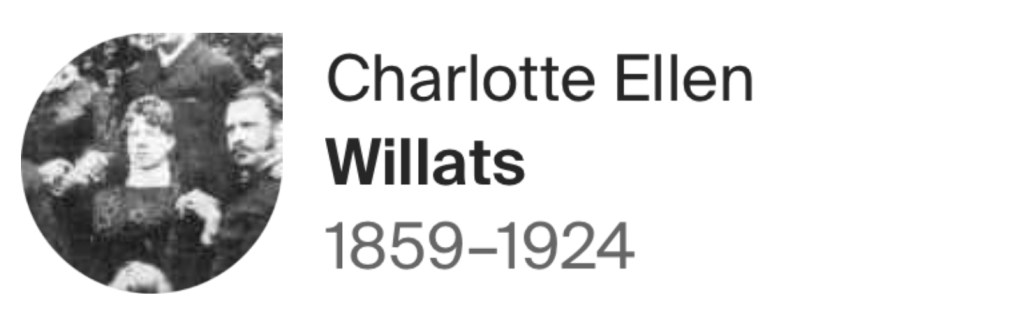
Welcome to the year 1859, St Pancras, London England, where my 4th Great Grandmother Eliza Willats nee Cameron and her partner/Brother In-law, my 4th Great Granduncle, Richard Henry Willats, lived with their Children/Stepchild, William George, Henry Richard, and Francis Montague Allan Willats. Eliza was expecting and she gave birth to my 3rd Great Grandaunt, Charlotte Ellen Willats, on Wednesday the 10th of August, 1859, at Number 56, Bunton Street, St Pancras, Middlesex, England. Eliza registered Charlotte’s birth on Tuesday the 13th of December, 1859. She gave Richards occupation as a Commercial Traveller and their abode as, Number 56, Bunton Street, Saint Pancras.

St Pancras (/ˈpæŋkrəs/) is a district in north London. It was originally a medieval ancient parish and subsequently became a metropolitan borough. The metropolitan borough then merged with neighbouring boroughs and the area it covered now forms around half of the modern London Borough of Camden. The area of the parish and borough includes the sub-districts of Camden Town, Kentish Town, Gospel Oak, Somers Town, King’s Cross, Chalk Farm, Dartmouth Park, the core area of Fitzrovia and a part of Highgate.
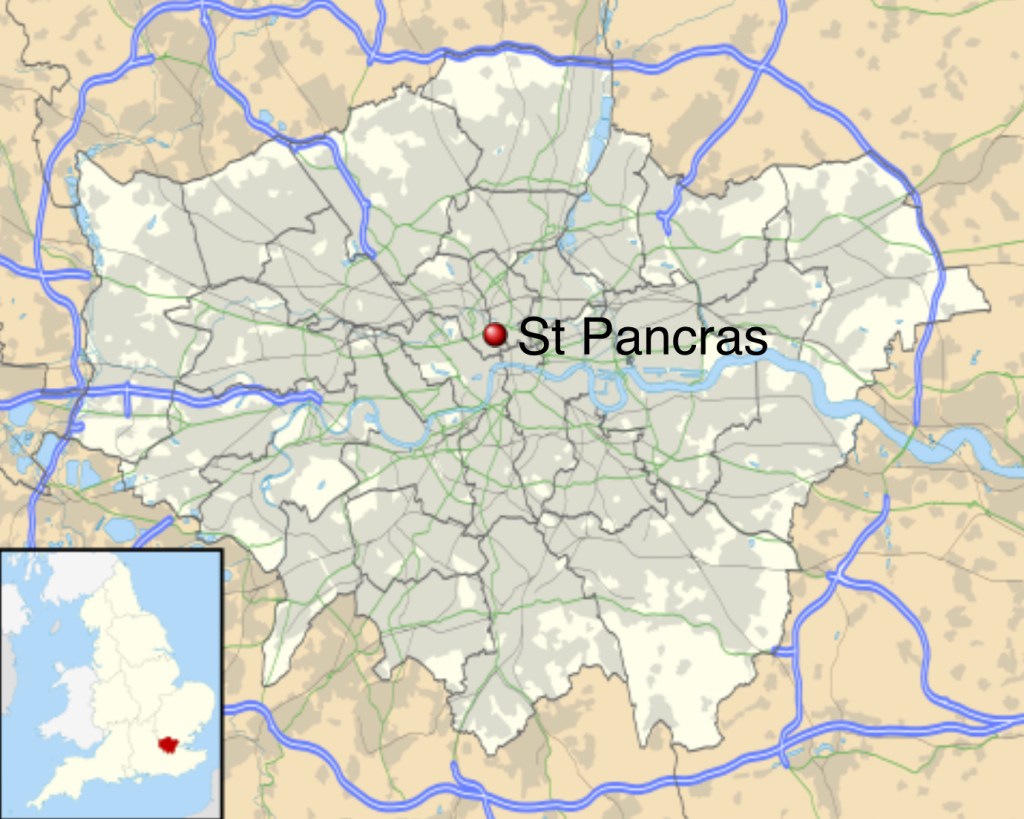
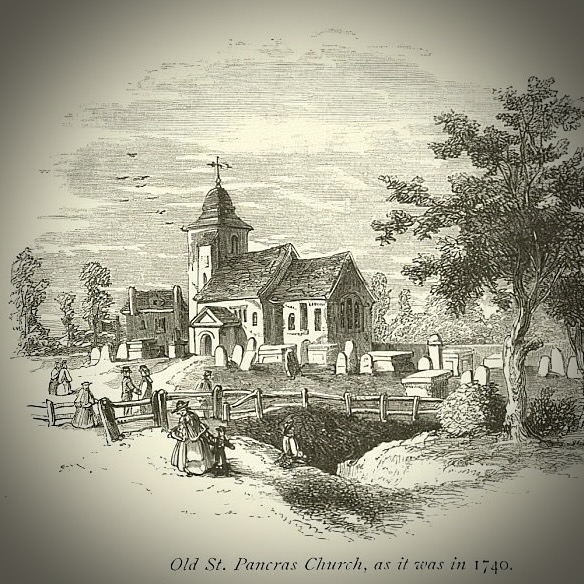
So what would it have been like to live in St Pancras, in 1859? London was undergoing a period of rapid urbanization and industrialization, which would have had certain impacts on daily life. St Pancras in 1859 would have featured predominantly Georgian and early Victorian architecture. The houses would have been built using traditional materials like brick and stone. Many of the buildings would have been terraced houses, with small shops and local businesses scattered throughout the area. The primary modes of transportation would have been horse-drawn carriages and omnibuses. Railways were becoming increasingly important for long-distance travel, but local commuting within the city was still largely dependent on horse-drawn vehicles. St Pancras would have been a mixed area, with residents from various social classes. The wealthier residents might have lived in larger, more ornate houses, while the working class would have resided in smaller, more modest accommodations. The local economy would have been diverse, with a range of occupations. You would have found tradesmen, craftsmen, small business owners, as well as domestic servants, laborers, and factory workers. Basic amenities like water supply and sanitation would have been available, but not up to modern standards. Local shops would provide everyday necessities, and public houses (pubs) would be popular for socializing.
The entertainment options would have been limited compared to today. Theaters, music halls, and pubs were popular places for social gatherings. There would have been parks and green spaces for recreation.
Education was available, but it might not have been as accessible or compulsory as it is today. Healthcare would have been provided by local doctors and apothecaries, but medical practices were less advanced. Social norms and customs of the time would have been quite different from contemporary standards. There would have been more rigid class distinctions and different expectations regarding behaviour, dress, and social interactions. The telegraph was the fastest form of long-distance communication, and letters were the primary means of written communication. Gas lighting would have been used in the streets, but electricity was not yet available. Like many urban areas of the time, St Pancras would have faced challenges such as overcrowding, poor sanitation, and disease. The Industrial Revolution was in full swing, which brought both economic opportunities and social disruptions.
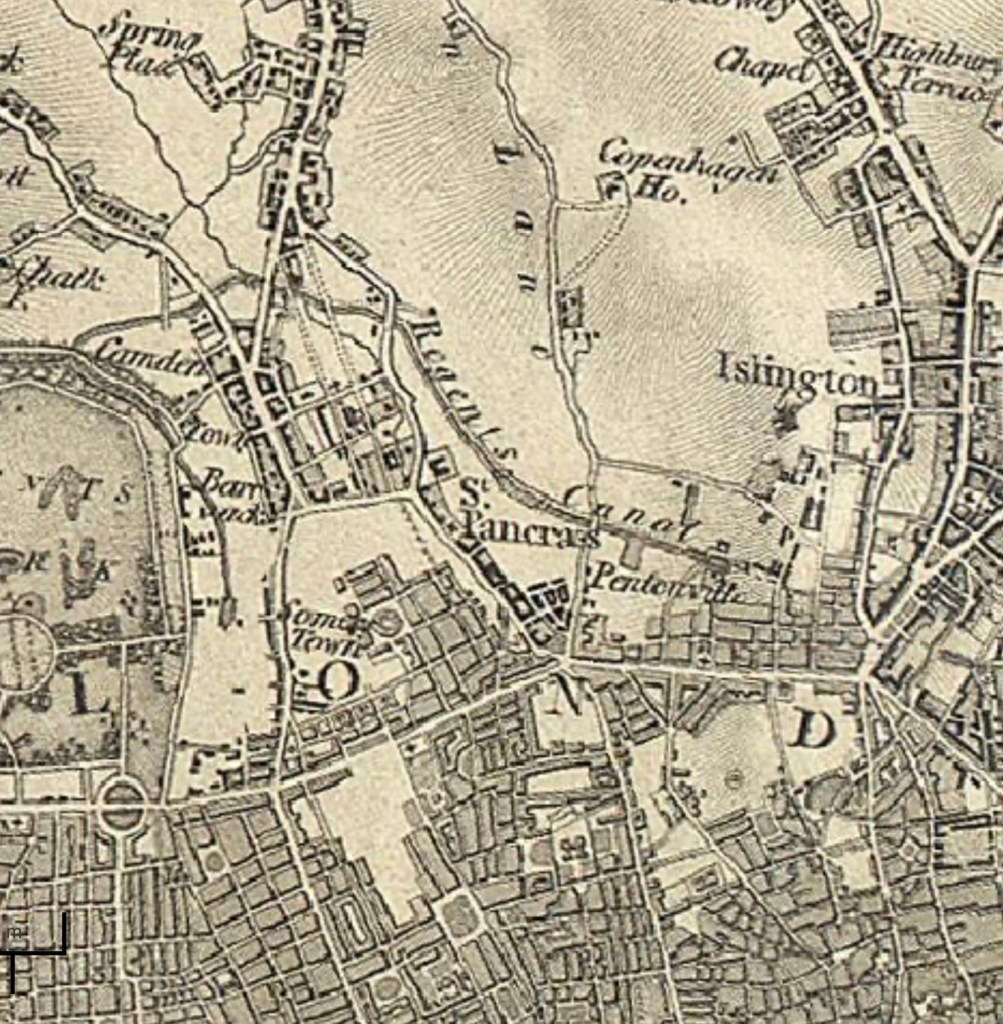
Richard and Eliza, baptised Charlotte Ellen Willats, on Thursday the 1st of September, 1859, at the Saint Pancras Church, Saint Pancras, London, England.
Richard’s occupation was given as an Engraver and their abode as, Mabledon Row.

St Pancras Old Church is a Church of England parish church on Pancras Road, Somers Town, in the London Borough of Camden. Somers Town is an area of the ancient parish and later Metropolitan Borough of St Pancras. Dedicated to the Roman martyr Saint Pancras, the patron saint of children. It is reputed to be one of the oldest sites of Christian worship in England. St Pancras Old Church, which was largely rebuilt in the Victorian era, should not be confused with St Pancras New Church (1819–1822) about 860 metres (940 yd) away, on Euston Road.
The 1861 census was held on the 7th April, 1861. It shows Charlotte residing at 34, Charlotte Street, Marylebone, London & Middlesex, England, with her parents Richard and Eliza and her brothers, George, Henry, and Francis (named as Frank) and her grandmother Mary Falconer and a servant, Susan Smith.
Richard was working as a commercial traveller, and Eliza as an Artificial florist.
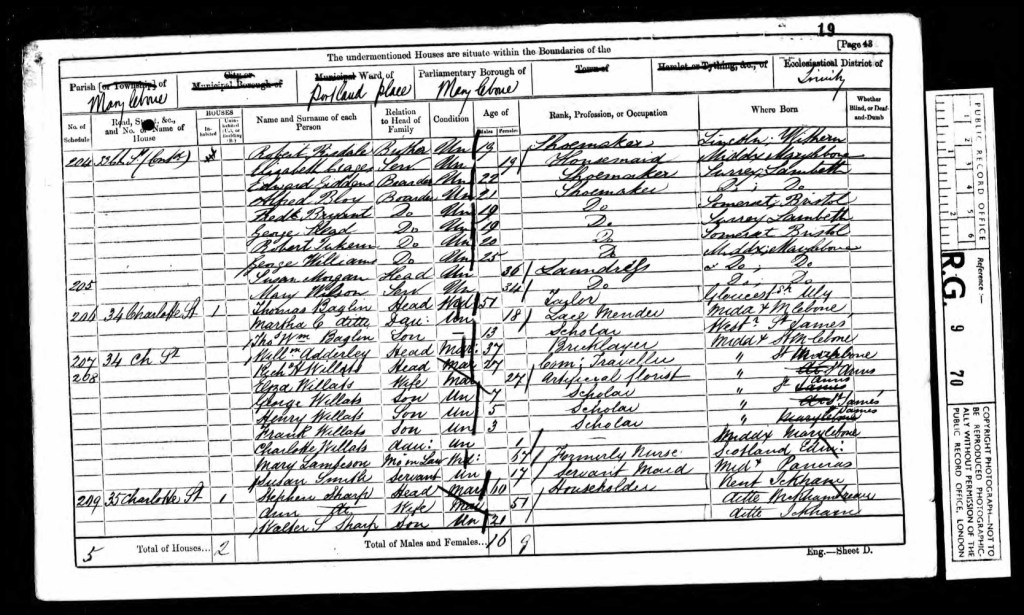
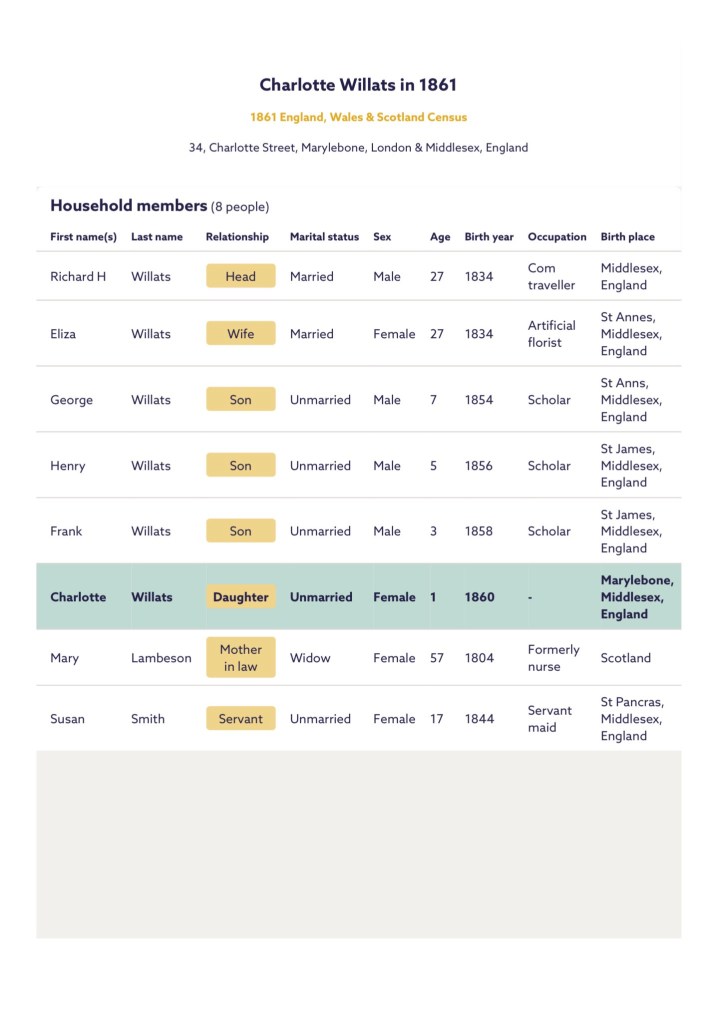
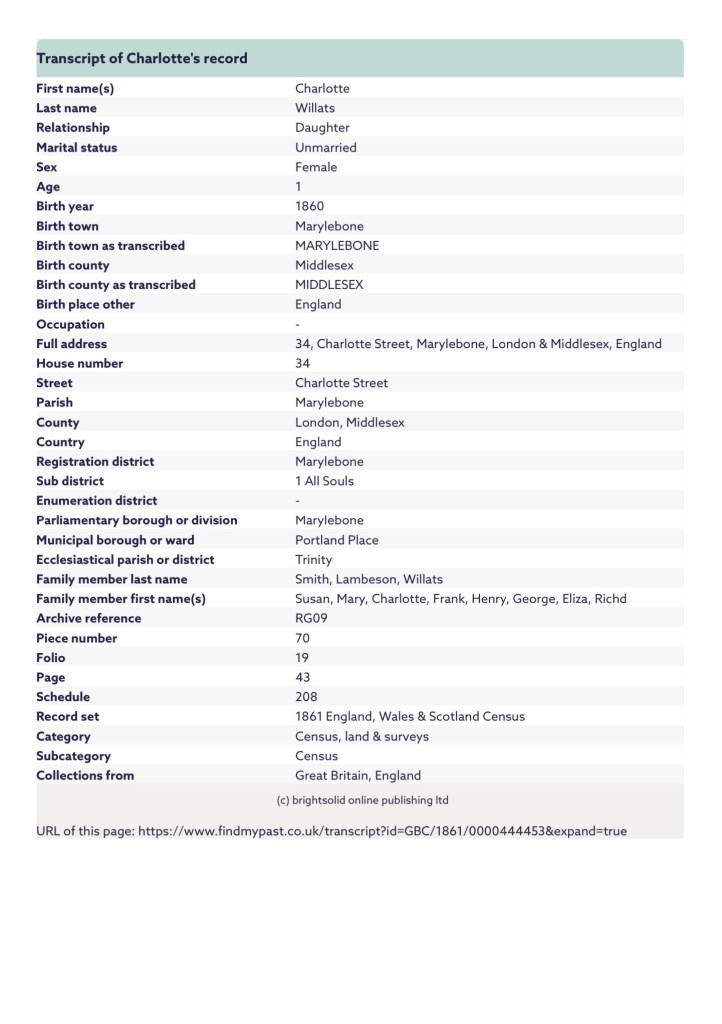
Charlotte Street, seems to have been named after Queen Charlotte and runs from south to north from Percy Street to Howland Street. The original Charlotte Street extended to Goodge Street, and from thence to Tottenham Street it was called Lower Charlotte Street, the remainder being known as Upper Charlotte Street. The houses have been re-numbered twice since they were first numbered, the present sequence running from south to north, with the odd numbers on the west and the even on the east side.

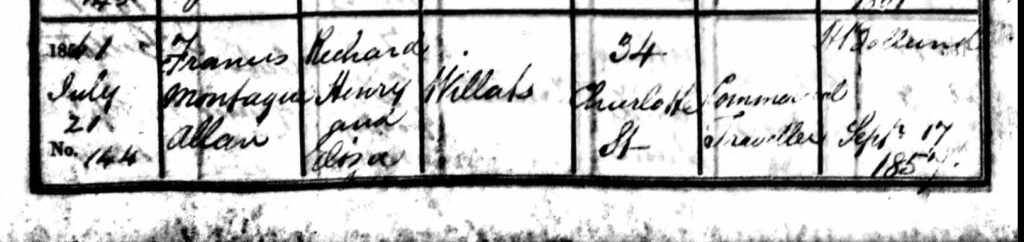
Charlotte’s brothers, Francis Montague Allen and Henry Richard Willats, were baptized on Sunday the 21st of July, 1861, at Holy Trinity Church, Marylebone Road, Westminster, London, England. Richard gave his occupation as a commercial travelling and their abode, as 34 Charlotte Street.
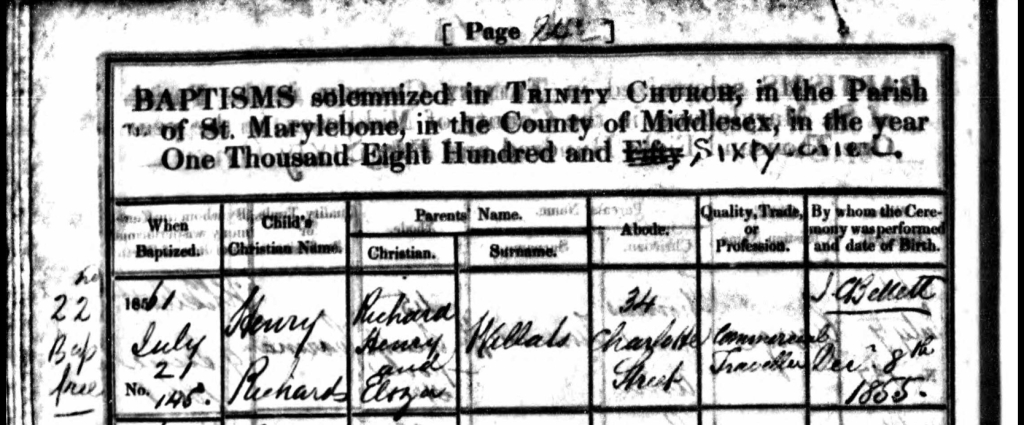
Holy Trinity Church, in Marylebone, Westminster, London, is a Grade I listed former Anglican church, built in 1828 and designed by John Soane. In 1818 Parliament passed an act setting aside one million pounds to celebrate the defeat of Napoleon. This is one of the so-called “Waterloo churches” that were built with the money. It has an external pulpit facing onto Marylebone Road, erected in memory of the Revd. William Cadman MA (1815-1891), who was rector of the parish from 1859 – 1891, renowned for his sonorous voice and preaching. The building has an entrance off-set with four large Ionic columns. There is a lantern steeple, similar to St Pancras New Church, which is also on Euston Road to the east. George Saxby Penfold was appointed as the first Rector, having previously taken on much the same task as the first Rector of Christ Church, Marylebone. The first burial took place in the vault of the church in 1829, and the last was that of Sir Jonathan Wathen Waller in 1853. By the 1930s, the use of the church had declined, and from 1936 it was used as a book warehouse by the newly founded Penguin Books. A children’s slide was used to deliver books from the street into the large crypt. In 1937 Penguin moved out to Harmondsworth, and the Society for Promoting Christian Knowledge (SPCK), an Anglican missionary organisation, moved in. It was their headquarters until 2006, when they relocated to Tufton Street, Westminster (they have since moved again to Pimlico). The church is currently[when?] the location of the world’s first wedding department store, The Wedding Gallery, which is based on the ground floor and basement level. The first floor is used as an events space operated by one event and known as “One Marylebone”. The former church stands on a traffic island by itself, bounded by Marylebone Road at the front, and Albany Street and Osnaburgh Street on either side; the street at the rear north side is Osnaburgh Terrace.

Charlotte’s sister, Edith Cameron Willats, was born on Sunday the 20th of October, 1861, at 34 Charlotte Street, Marylebone, Middlesex, England. Richard Henry, registered Edith’s birth on Monday the 25th of November, 1861, in Marylebone. He gave his occupation as a Commercial Traveller and their abode as, Number 34 Charlotte Street, Marylebone.

And her brother, Arthur Charles Willats, was born on Saturday, the 11th of July, 1863, at Number 37, Charlotte Street, Marylebone, Middlesex, England. Their father, Richard Henry registered Arthur’s birth on Friday the 21st of August, 1863.
Richard’s occupation was given as a, Commercial Traveller and their abode as Number 37, Charlotte Street, Marylebone.

Arthur Charles and Edith Cameron Willats, were baptised on Sunday the 9th of August, 1863, at Holy Trinity Church, Marylebone Road, Westminster, Middlesex, England.
Richard’s occupation was given as a Traveller and their abode as Number 37, Charlotte Street.

Charlotte welcomed another new brother, on Friday the 13th of January 1865. Eliza and Richard, named him, Walter James Willats.
Eliza gave birth at their home, 37, Charlotte Street, Marylebone, All Souls, Middlesex, England.
Richard registered Walter’s birth on the 9th of March 1865. He gave his occupation as a commercial traveller and their abode as, 37, Charlotte Street.

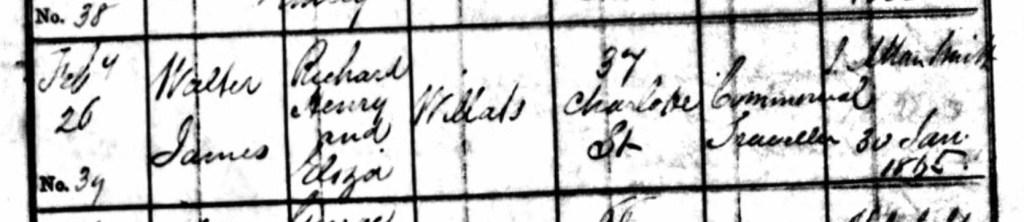
Charlotte’s brother Walter James, was baptised on Sunday the 26th February, 1865, at Holy Trinity Marylebone Road, Marylebone, Middlesex, England. Richards occupation was given as a commercial traveller and there abode 37 Charlotte Street.
Charlottes parents Richard Henry Willats and Eliza Willats nee Cameron finally decided to marry. Their banns were read, at St John the Evangelist, Smith Square, London, England, on the Sunday 9th and Sunday 16th of April, by W.S. Bruce and again on Sunday the 23rd April, 1865, by J. Graham.

St John’s Smith Square is a redundant church in the centre of Smith Square, Westminster, London.
In 1710, the long period of Whig domination of British politics ended as the Tories swept to power under the rallying cry of “The Church in Danger”. Under the Tories’ plan to strengthen the position of the Anglican Church and in the face of widespread damage to church buildings after a storm in November 1710, Parliament concluded that 50 new churches would be necessary in the cities of London and Westminster. An Act of Parliament in 1711 levied a tax on coal imports into the Port of London to fund the scheme and appointed a commission to oversee the project. Archer was appointed to this commission alongside, amongst others, Hawksmoor, Vanburgh and Wren. The site for St. John’s was acquired from Henry Smith (who was also Treasurer to the Commissioners) in June 1713 for £700 and building commenced immediately. However, work proceeded slowly and the church was finally completed and consecrated in 1728. In total, the building had cost £40,875. The church was built by Edward Strong the Younger a friend of Christopher Wren the Younger.
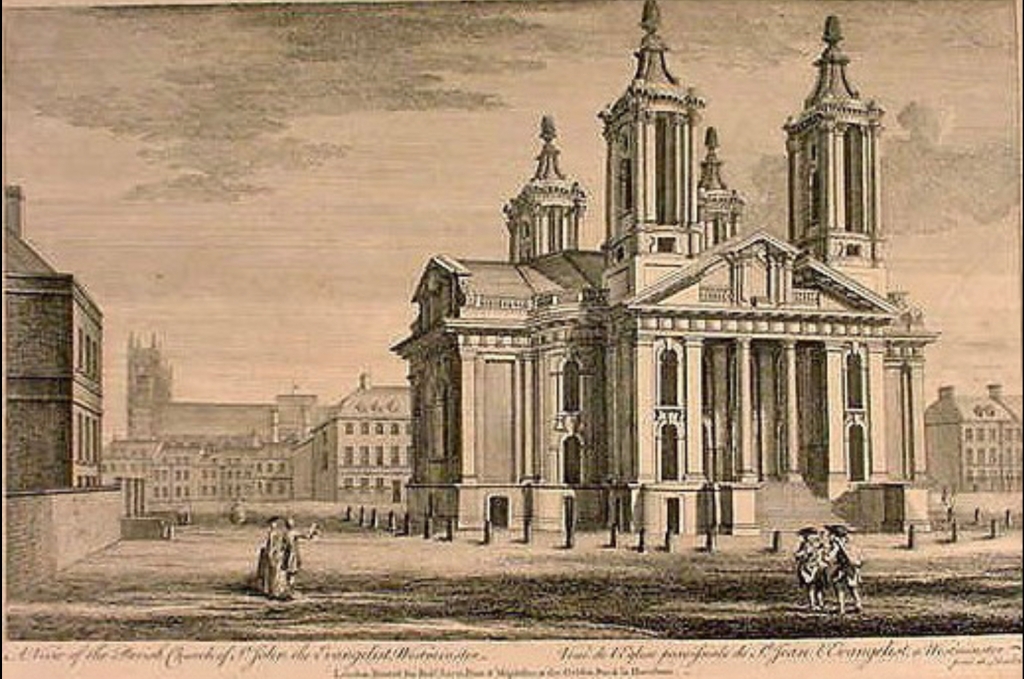
in the 18th century
Charlotte’s mum, Eliza Willats nee Cameron, and her father, Richard Henry Willats married on Thursday the 4th of May, 1865, at, St Margarets, Westminster, London, England.
Richard was a Bachelor.
Eliza was listed as a widower, which is rather strange as her first husband George John Willats (Charlotte’s uncle/Richard Henry Willats brother) didn’t die until later that year.
Their witnesses were, George John Willats, (Eliza’s first husband) and Eliza’s sister, Mary Cameron.
Eliza and Richard, were residing at 10 North Street.
Richard was working as a, Commercial Traveller.
Eliza’s Father, Allen Cameron was working as a Tailor and Richard’s Father, George John Willats, was working as a Wood Craver.

St. Margaret’s, known as ‘the Church on Parliament Square’, is a 12th-century church next to Westminster Abbey. It’s also sometimes called ‘the parish church of the House of Commons’.
The Church of St Margaret, Westminster Abbey, is in the grounds of Westminster Abbey on Parliament Square, London, England. It is dedicated to Margaret of Antioch, and forms part of a single World Heritage Site with the Palace of Westminster and Westminster Abbey.
The church was founded in the twelfth century by Benedictine monks, so that local people who lived in the area around the Abbey could worship separately at their own simpler parish church, and historically it was within the hundred of Ossulstonein the county of Middlesex. In 1914, in a preface to Memorials of St. Margaret’s Church, Westminster, a former Rector of St Margaret’s, Hensley Henson, reported a mediaeval tradition that the church was as old as Westminster Abbey, owing its origins to the same royal saint, and that “The two churches, conventual and parochial, have stood side by side for more than eight centuries – not, of course, the existing fabrics, but older churches of which the existing fabrics are successors on the same site.
In 1863, during preliminary explorations preparing for this restoration, Scott found several doors overlaid with what was believed to be human skin. After doctors had examined this skin, Victorian historians theorized that the skin might have been that of William the Sacrist, who organized a gang that, in 1303, robbed the King of the equivalent of, in modern currency, $100 million. It was a complex scheme, involving several gang members disguised as monks planting bushes on the palace. After the stealthy burglary 6 months later, the loot was concealed in these bushes. The historians believed that William the Sacrist was flayed alive as punishment and his skin was used to make these royal doors, perhaps situated initially at nearby Westminster Palace. Subsequent study revealed the skins were bovine in origin, not human.
You can read more about, St Margaret’s here.

in the grounds of Westminster Abbey on Parliament Square, London, England
As I have mentioned many times before (sorry), I have no idea as to how Richard and Eliza were able to marry, as it was strictly forbidden to marry a brothers wife even a deceased brother.
Family story’s state that, a sympathetic member of the clergy came to their rescue and had the first marriage annulled.
I guess we will never know for sure but it seems that maybe something fishy was going on as George John married Sarah Elizabeth Southall Jukes, in Victoria, Australia, in 1856 (11years before Richard and Eliza wed. George and Sarah, went on to have 4 Children. George John, stayed in Australia until his death in 1865, visiting England frequently.
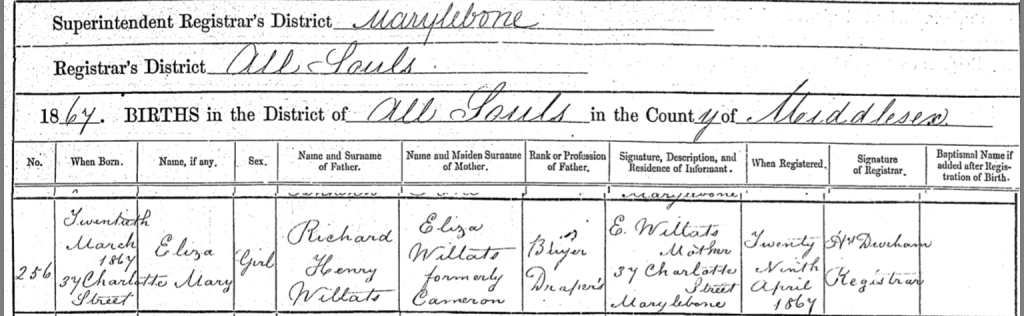
Charlotte’s mum Eliza, was once again in the family way and gave birth to a baby girl whom they called, Eliza Mary Willats.
Eliza Mary was born on Wednesday the 20th of March, 1867, at Number 37 Charlotte Street, All Paul’s, Marylebone, Middlesex, England.
Their Father Richard was working as a Buyer of Diamonds, at the time of her birth.
Eliza registered Eliza’s birth on Monday the 29th April 1867.
Eliza Mary, was known as Polly.
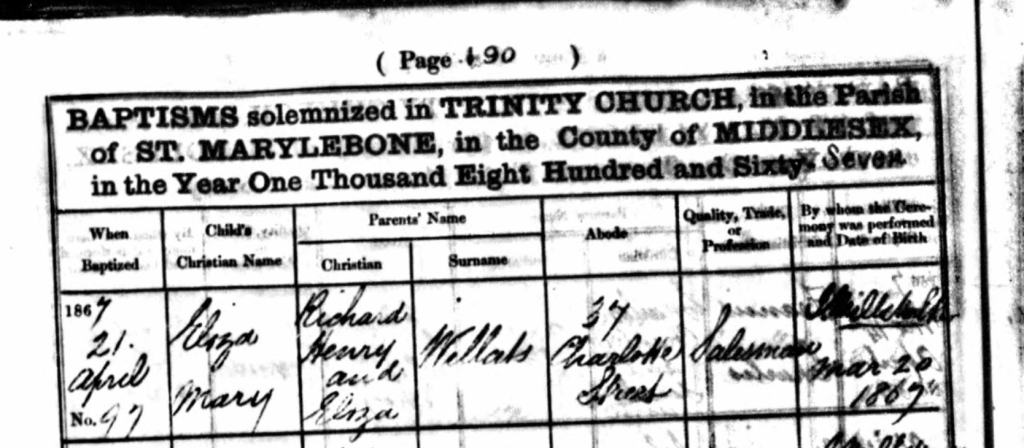
The family baptised Eliza Mary, on Sunday the 21st of April 1867, at Holy Trinity Church, Marylebone Road, Marylebone, Middlesex, England. Richards occupation was given as a Salesman and their abode as, 37 Charlotte Street.
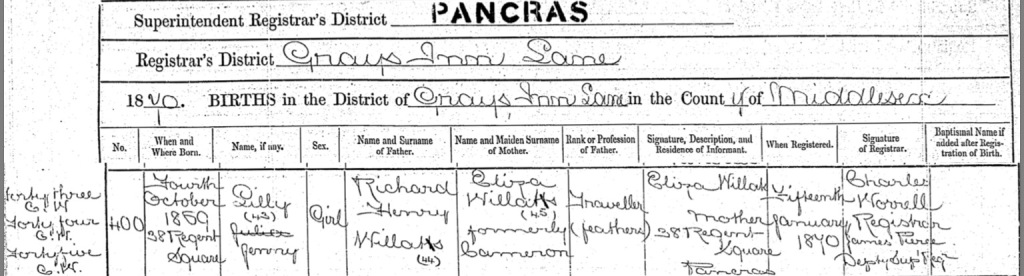
Charlotte’s mum, Eliza, was once again in the family way and she gave birth to her 9th child, Richard and her, 4th Daughter, on Monday the 4th of October, 1869, at, Number 38, Regent Square, Gray’s Inn Lane, Pancras, Middlesex, England.
Eliza and Richard named her, Lilly Jenny Willats.
Regent Square is a public square and street in the London Borough of Camden in London, England. It is located near Kings Cross and Bloomsbury. Regent Square was laid out around a large garden in the historic Harrison Estate and first occupied in 1829, forming a garden square similar to more famous ones to the west in Bloomsbury. The southern side of the square is composed of its original buildings, and is Grade II listed in its entirety. Also listed is the phone box within the square gardens themselves.
Lily Jenny Willats, was baptised on Sunday the 31st October, 1869, at Saint Peter Church, Saint Pancras, London, England. It was a private baptism. Her baptism shows that Richard was working as a Warehouse Man and their abode was, Number 38, Regent Square.

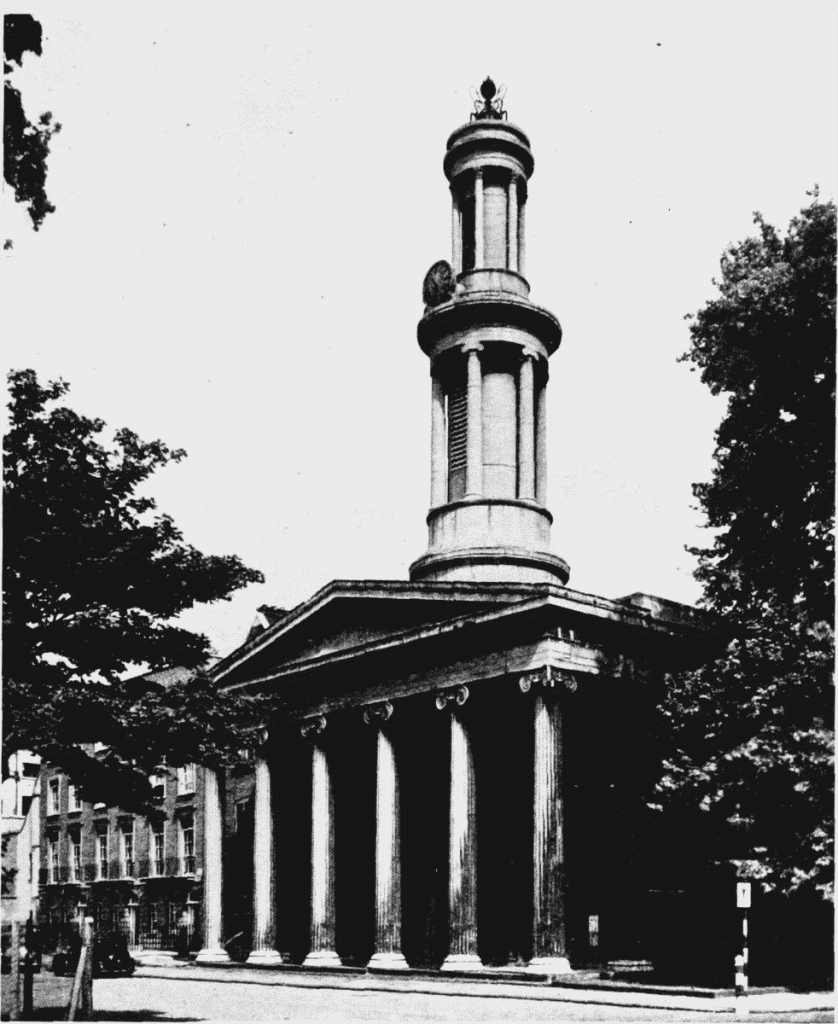
Saint Peters church, in Regent Square was hit by bombs in the war and had to be demolished. Unfortunately there doesn’t seem to be much information about it online. From the below image, it was a very impressive building.
Jumping forward to the year 1871. Queen Victoria sat proudly upon her throne, The Prime Minister was William Ewart Gladstone (Liberal), and it was the 20th Parliament. England was experiencing significant social and economic changes. Industrialization was in full swing, transforming the landscape and lifestyle of the country. The rich, middle class, and poor experienced vastly different lives. The upper class, comprising the wealthy elite and aristocracy, enjoyed a lavish lifestyle characterized by opulent estates, fine clothing, and extravagant social events. They held considerable political power and influence, often shaping policies that favored their interests. The middle class, including merchants, professionals, and some skilled workers, experienced a growing prosperity due to the industrial boom. They benefited from increased employment opportunities, better wages, and access to education. This group often aspired to emulate the lifestyle of the upper class, seeking social mobility and a higher standard of living. However, the working class faced challenging conditions. Many toiled in factories and mines, enduring long hours, dangerous working conditions, and low wages. The Industrial Revolution brought about urbanization, leading to overcrowded and unsanitary living conditions in cities. Poor sanitation and inadequate housing resulted in health issues and a high mortality rate among the poor. In terms of historical events, 1871 was a year of significance in England for several reasons, these included, The Education Act of 1870 was implemented, establishing a system of elementary education for children aged 5 to 13. This marked a pivotal step towards universal education, although challenges in accessibility and quality persisted. The Trade Union Act of 1871 legalised trade unions in the UK, granting workers the right to organise and collectively bargain for better wages and working conditions. This was a crucial development in the labor movement. In 1871, Charles Darwin published his book “The Descent of Man,” which expanded on his evolutionary theory, exploring human evolution and its implications. Darwin’s work continued to influence scientific and social discourse. The year 1871 also witnessed ongoing debates surrounding women’s rights and suffrage. The movement for women’s rights gained momentum, advocating for equality in various spheres of life, including education and employment.
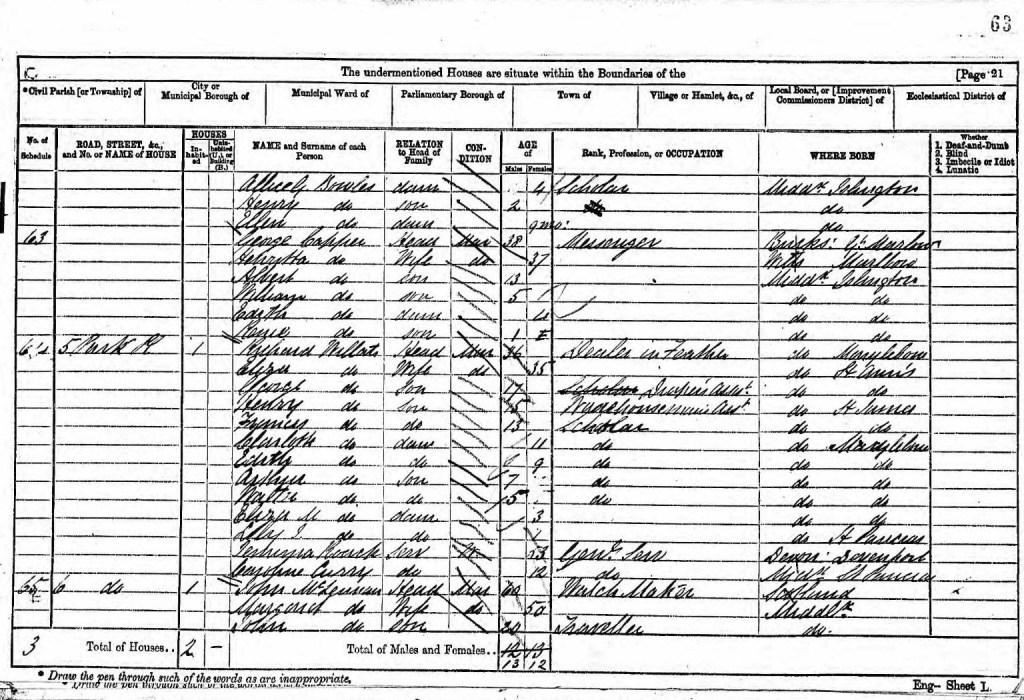
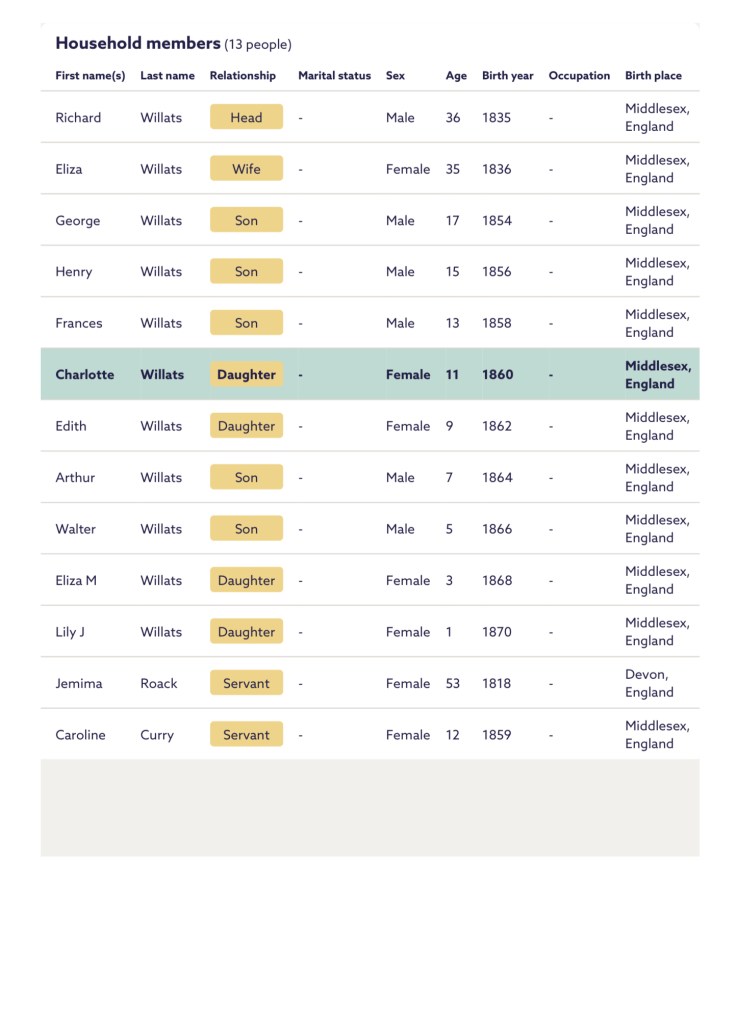
And the UK census was taken, which shows us, that Charlotte, her parents Richard, and Eliza, and her siblings, Walter, Henry, Eliza, Lillian, Edith, George and Francis, were residing at, Number 5, Park Road, Islington, Middlesex, England, on Sunday 2nd April 1871. Richard was working as a Dealer in feathers. The family had two General Servants, residing with them, Jemima Roack and Caroline Curry.

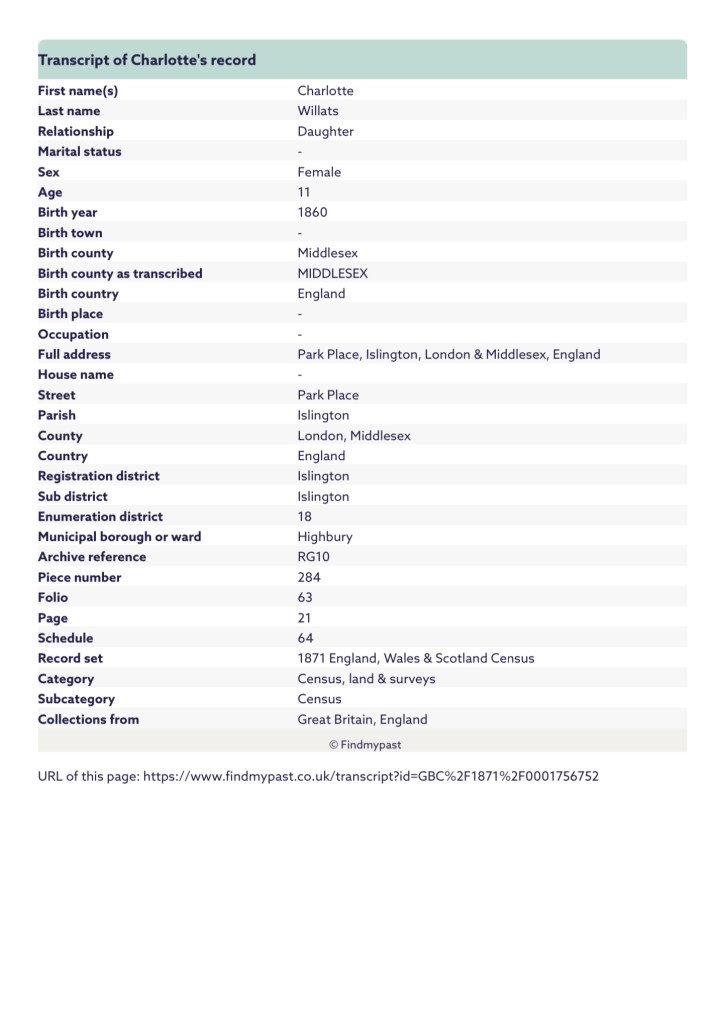
5 Park Place, London is a 3-bedroom freehold terraced house – it is ranked as the 3rd most expensive property in N1 3JU, with a valuation of £1,432,000. Since it last sold in July 2016 for £1,450,000, its value has decreased by £18,000. It is now a sleek contemporary townhouse within a private gated mews, arranged over three floors with an allocated parking space. You can see what it looks like here.


Charlotte’s brother, Edwin Paul Willats, on Wednesday the 8th of November, 1871, at Number 5, Park Place, Highbury, Islington, Middlesex, England. Richard was working as a Commercial Buyer and he registered Edwin’s birth on Wednesday December 20th 1871. He gave their abode as, Number 5, Park Place, Islington.
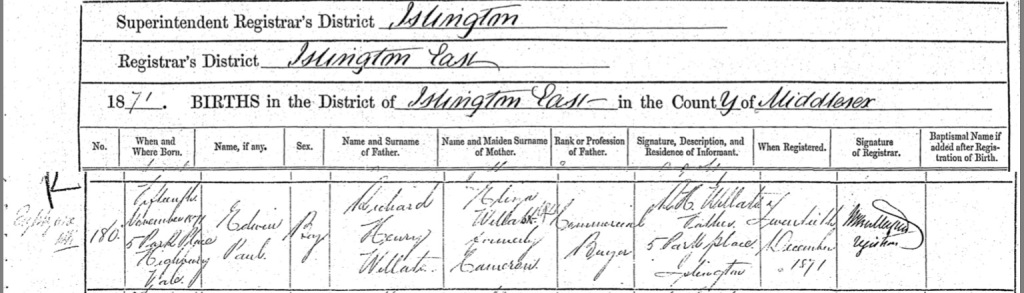
Edwin was baptised on Friday the 8th December 1871, at the Parish Church of St Mary the Virgin, Islington, Middlesex, England. Richards occupation was listed as a, Workhouse Man and their abode as 5 Park Place.

Charlotte’s sister, May Claretta Willats, was born on Tuesday the 5th of May, 1874, at 5 Park Place, Highbury, East Islington, England.
Their father Richard, occupation was given as a, Feather Warehouseman and he registered May’s birth on Tuesday the 16th June 1874.
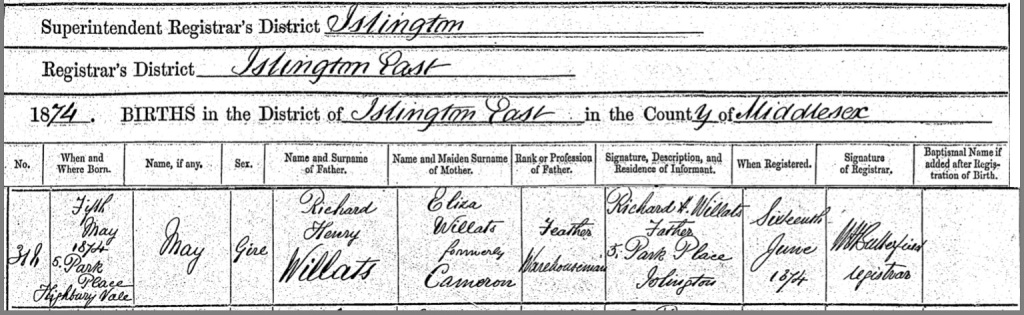
May Claretta, was baptised on, the 9th of August, 1874, at Christ Church, Highbury, Islington, Middlesex, England. Richard gave his occupation as a Manufacturer and their abode as, Highbury. Christ Church, Highbury, is an Anglican church in Islington, north London, next to Highbury Fields.

Christ Church, Highbury, is an Anglican church in Islington, north London, next to Highbury Fields.
The site was given by John Dawes, a local benefactor and landlord, and the church was built by Thomas Allom in a cruciform shape with a short chancel, transepts, and nave from 1847 to 1848. Bridget Cherry and Nikolaus Pevsner write that Christ Church Highbury ‘is a successful and original use of Gothic for a building on a cruciform plan with broad octagonal crossing. The cross-plan with broad nave and crossing was popular for churches in the low church tradition where an effective auditorium for the spoken word was preferred to a plan designed for an elaborate liturgy.’
Since then, several changes have been made to the church, including the addition of a balcony in 1872, and new rooms for children’s work and fellowship in 1980.

And on Wednesday the 1st of September 1875, Charlotte’s brother, Percy Sidney Willats, was born at the family home, Number 9, Park Place, Highbury, Islington, Middlesex, England.
Richard gave his occupation as a, Fancy Warehouseman and their abode as, 9, Park Place, Islington, when he registered Percy’s birth on Saturday the 9th October, 1875, in Islington.

Jumping forward a few months to a new year, one that was of most importance to Charlotte and her future life. But one that would leave her descendents baffled by the following events.
In 1876, the atmosphere in the country was one of burgeoning industrialization and technological advancement. The Industrial Revolution continued to transform the landscape, fueling economic growth and urban development. Cities were bustling hubs of activity, teeming with factories, workshops, and expanding industries. However, this rapid industrial expansion came at a cost, contributing to pollution, overcrowding, and unsanitary living conditions in urban areas.
Socially, the disparities between the rich, working class, and poor were starkly evident. The upper class maintained their opulent lifestyles, enjoying luxury, fine dining, and extravagant social events. They held significant influence in politics and society, furthering their interests and maintaining their privileged positions.
The working class faced challenging circumstances. Many labored in factories, mills, and mines, enduring long work hours, dangerous conditions, and meager wages. Urbanization led to overcrowded and often squalid living conditions in cramped tenements and slums. Sanitation was inadequate, contributing to health issues and a higher mortality rate among the poor. Meanwhile, the middle class, comprising professionals, merchants, and some skilled workers, experienced varying degrees of prosperity. They benefited from expanding job opportunities in emerging industries and sectors like finance and trade. This group aspired to improve their social standing and quality of life, seeking upward mobility and better living conditions.
Historically, several notable events occurred in 1876 including,
Queen Victoria was in the midst of her long reign, providing a sense of stability and continuity to the nation. Her reign was characterized by significant cultural, social, and technological changes. The British Empire continued to expand globally, with territories across Africa, Asia, and the Pacific. This period marked the height of Victorian imperialism, with ongoing colonization efforts and geopolitical strategies to expand British influence. The year also saw the introduction of the Telephone by Alexander Graham Bell, a revolutionary invention that would transform communication and connectivity worldwide.
And on the 10th of January 1876, Charlotte was writing a new chapter in her life story.
Charlotte and her future husband Pierce William Crosbie, Marriage Bonds and Allegations, were called at St Mary Church, Islington, Middlesex, England.
It official document reads,
DIOCESE OF LONDON.
10th January 1876.
APPEARED PERSONALLY, Pierce William Crosbie
of the parish of Saint Mary, Islington, in the county
of Middlesex, a Bachelor of the age of
twenty-one years and upwards
and prayed a Licence for the Solemnization of Matrimony in.
in the Parish Church of Saint Mary,
Islington unforesaid
between him and Charlotte Eleanor Willats
of the same parish, spinster, a minor,
of the age of sixteen years and upwards
but under the age of twenty one years
and made Oath that he believeth that there is no Impediment of
Kindred or Alliance, or of any other lawful cause, nor any Suit com-
menced in any Ecclesiastical Court to bar or hinder the Proceed-
ing of the said Matrimony, according to the tenor of such Licence.
And he further made oath, that he the said, Appeaser
hath had his usual Place of abode within the said Parish
of Saint Mary Islington
for the space of Fifteen days last past and he lastly made
oath that the consent of Richard Henry Willats
the natural and lawful Father of the said
Minor hath been obtained to the said intended
Marriage.
Sworn before me. Peirce William Crosbie.

Charlotte secretly married by licence a young Bachelor named Peirce William Crosbie, on the 11th of January 1876, at St Mary Church, Islington, Middlesex, England. They both stated they were of full age, even though Charlotte was only 16. Their witnesses were, Henry Billey and Henry Smith. Charlotte gave her abode as, Number 9 Park Place and Pierce gave his as Number 9 Riverdale Road. Pierces occupation was given as a Clark. They gave their fathers names and occupations as, Richard Henry Willats, a Warehouseman and John Crosbie a Gentu.

The Church of St Mary the Virgin is the historic parish church of Islington, in the Church of England Diocese of London. The present parish is a compact area centered on Upper Streetbetween Angel and Highbury Corner, bounded to the west by Liverpool Road, and to the east by Essex Road/Canonbury Road. The church is a Grade II listed building.
The churchyard was enlarged in 1793. With the rapid growth of Islington, it became full and closed for burials in 1853. It was laid out as a public garden of one and a half acres in 1885.
You can read more about St Mary’s here.

As we bid farewell to this glimpse into the early years of Charlotte Ellen Willats, it’s clear that her childhood was marked by resilience, curiosity, and a spirit of growing up in such a big family. Her experiences within theo walls of her busy home, surrounded by so many different personalities and their love for each other, that would undoubtedly shape the woman she would become.
I have thought about how Charlotte would sum up her early years and picture her sat at her dressing table, with her ink and fountain pen, writing her last diary entry before her marriage.
I imagine it would read, something like this,
January 10, 1876.
Dear Diary,
The air tonight carries the weight of anticipation and joy, yet my heart dances on a delicate thread between excitement and trepidation. Tomorrow, at long last, I shall become Mrs. Charlotte Ellen Willats no more, but rather, wedded to the man who has filled my days with laughter and warmth.
As I sit by the hearth, penning these thoughts, I cannot help but reflect on the journey that has led me to this very precipice of change. My childhood, nestled within the heart of London, within the walls of our fine home, I emerged as the fourth among thirteen siblings, the cherished daughter of a loving family.
From the tender age of innocence, I was initiated into a world where duty and care merged seamlessly. A nurturing role was etched upon my youthful shoulders.
As the eldest daughter, I became an assistant to my mother, a second pair of hands, helping to tend to my younger siblings.
Guided by maternal wisdom, I learned to swaddle infants, to cajole laughter from the littlest ones, and to soothe tears with whispered lullabies. Within those walls, I became an unwitting instructor, teaching younger siblings the letters and numbers that opened pathways to knowledge.
My role as the eldest daughter bore the weight of expectations softened by privilege. The household buzzed with activity, yet the rhythm of chores differed from those faced by many. Instead of tending to the fires or managing scant resources, my duties leaned toward helping mother overseeing the maids, directing the household flow, and assisting in the subtleties of managing our home.
Education, a rarity for many girls in that epoch, was an offering I received. While not as extensive as that of my brothers, I was afforded lessons in decorum, and exposure to the arts and literature. However, the pursuit of knowledge walked hand in hand with societal constraints, for my aspirations were reined in by the prevailing norms dictating a woman’s place in that world.
The societal clock ticked with expectations that bespoke a reserved path for a daughter in that era. My world was confined, constrained by the stringent corset of societal norms, limiting pursuits and interactions deemed unsuitable for a proper Victorian maiden.
Yet, within those confines, amidst the cacophony of daily routines, lay the silver lining of kinship. A tight-knit tapestry of siblings, each thread woven with laughter, squabbles, and unspoken understandings. We were bound not just by blood but by shared struggles and shared joys, forging bonds that time could not erode.
The bustling streets of London, with their cacophony of sounds, were my playground. Father’s auction house, a realm of marvels and curiosities, became my haven. The musty scent of old parchment and the sight of intricate items up for bid were my companions during those formative years. I found solace in the quiet corners, amid stacks of forgotten tomes and antique trinkets.
Mother, with her gentle demeanor and unwavering grace, was my guiding star. Her embroidery needles seemed to weave not just delicate patterns on linen but also threads of wisdom into my very being. She taught me the art of poise and the strength found in quiet resolve. Even now, her lessons echo within me, a soothing balm to calm the nerves that flutter like caged birds in my chest.
The seasons passed in a tranquil rhythm, spring brought the scent of blossoms, summer adorned our home with warmth, autumn whispered of change, and winter enveloped us in its chill embrace. Yet amidst this rhythmic existence, there is a longing, a desire to chart my own course beyond the familiar lanes of London.
Life as the fourth child among thirteen siblings, the pioneering daughter in Victorian Britain, is a labyrinth of challenges and blessings. Each day was a juggling act, balancing the demands of familial duties against the yearnings of personal growth. It is a life where simplicity reigned, where the heartbeats of family echoed louder than the societal dictates that sought to define us.
Nonetheless, my world is confined by the stringent borders of gender. My dreams and ambitions were hemmed in by the relentless struggle of being a female, a stark contrast to the opportunities afforded to men. The walls of our home that sheltered me also confined my ambitions and aspirations. And so, tomorrow, I embark upon the most remarkable journey, a secret union with my beloved, a man whose love has set my heart alight like the stars that twinkle above. We have chosen secrecy, not out of fear but out of a desire to cherish this moment as our own, away from prying eyes and societal expectations.
My thoughts flit between the joy of tomorrow’s union and the bittersweet farewell to the life I’ve known. Yet, in this amalgamation of emotions, there resides an unwavering certainty, a belief that love shall guide me through the unknown chapters awaiting beyond the threshold of this clandestine wedding.
The candle flickers, casting dancing shadows upon the parchment, much like the swirling emotions that inhabit my soul tonight. Tomorrow, under the veil of secrecy and the stars as silent witnesses, I shall take the hand of my beloved, and together, we shall begin a new chapter, one that I shall pen with the ink of love and the quill of courage.
Until tomorrow, dear diary, when I shall write as Mrs. Charlotte Ellen Crosbie, bound not just by name but by the profound promise of love. Yours faithfully,
Charlotte.
Charlotte’s life experiences so far in her young life, laid the foundation for a life filled with adventures, challenges, and dreams.
In the next instalment, we will delve into her life as a married woman, exploring the pivotal moments that continued to mould her character.
Stay tuned to uncover more about the remarkable journey of my 3rd Great Aunt, Charlotte Ellen Willats.
Until next time, stay safe, stay true, be you.
Toodle pip.
 Intwined