In the gentle embrace of love, our dear Charlotte Ellen Crosbie stepped into the enchanting second act of her life. A bride with stars in her eyes and dreams woven into her heart, she embarked on a new chapter hand in hand with destiny. The promises exchanged, the vows spoken, marked not only the union of two souls but the beginning of a legacy that would ripple through time. Their love story was a symphony, composed of shared glances, stolen kisses, and the comfort of knowing they were each other's greatest confidantes.                                                                                                                   As the years unfolded, Charlotte and her beloved carved a story of devotion and shared dreams, painting their canvas with hues of laughter, tenderness, and support. Their love was the foundation upon which a home was built, a sanctuary that echoed with the melodies of dreams, determination, loyalty to her family and the warmth of cherished moments. In the midst of life's ebbs and flows, Charlotte blossomed into a beacon of strength and grace, navigating the challenges that danced across her path with a spirit that knew no bounds. Her nurturing touch and boundless compassion became the very heartbeat of her story, and her wisdom was sought by all who had the privilege to know her.
Through the passage of seasons, Charlotte's life was woven with threads of joyous celebrations, moments of quiet reflection, and an almighty drive to succeed. Each achievement marked not only the passing of years but a testament to the enduring flame that illuminated her passions.
As the years turned into decades, Charlotte's legacy extended beyond the walls of her home, touching the lives of generations yet to come.
Her kindness, her generosity, and her unbreakable spirit became the cornerstone upon which her dreams became reality.                                                                                               And then, as the final pages of this cherished chapter approached, Charlotte faced the inevitable with a grace that mirrored the way she had lived her life, with unwavering determination and an unshakeable sense of purpose. She left behind a legacy not measured in years, but in the countless lives she had touched and the indelible mark she had left on the world.
In this second part of our journey through the life of my third Great Aunt Charlotte Ellen Crosbie, we celebrate the radiant chapters that illuminated her path, a life woven with threads of love, resilience, and the enduring beauty of a legacy that will forever bloom in the hearts of those who remember her and those who never knew her. To me she is one incredible woman, a fascinating one at that. She touched my soul deeply.                                So without further ado, I give you,
The Life Of Charlotte Ellen Crosbie Nee Willats 1859-1924, Part 2, Embracing Forever.

Welcome back to the year 1876, England. Queen Victoria was in the 39th year of her reign, which ultimately spanned from 1837 to 1901, making her the longest-reigning British monarch until our late Queen Elizabeth II surpassed her record. Benjamin Disraeli was the Prime Minister of the United Kingdom. His tenure lasted from 1874 to 1880. The Conservative Party, led by Disraeli, held power. England was experiencing the later stages of the “Long Depression,” a prolonged period of economic stagnation which began in 1873 and lasted until the mid-1890s. This was characterized by deflation, unemployment, and a general downturn in economic activity. The arts were thriving, with notable authors like Thomas Hardy, Henry James, and Mark Twain producing influential works during this time. Alexander Graham Bell patented the telephone. This invention revolutionized communication and played a crucial role in the development of modern telecommunications. 1876 saw the continued popularity of the “bathing machine,” a sort of beach hut on wheels that allowed Victorian-era bathers to change into their bathing suits in privacy.
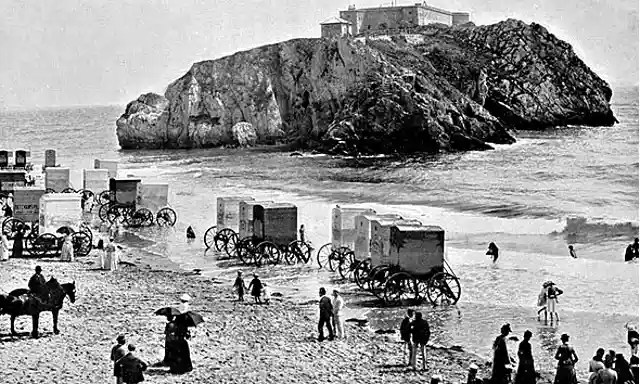
The British Empire was at its zenith, with colonies and territories around the world. The empire continued to expand, and this period marked the high point of British imperialism. Various legal reforms and social changes were underway, including discussions about women’s suffrage and workers’ rights. The Elementary Education Act of 1870, often known as the Forster Act, aimed to provide elementary education for all children aged 5 to 13 in England and Wales. The modern rules of rugby were formalized in 1876, with the creation of the Rugby Football Union. Beatrix Potter, The English writer, illustrator, and conservationist, known for her children’s books featuring characters like Peter Rabbit, was born on the 28th of July, 1866 and David Lloyd George, a prominent Liberal politician who would later become Prime Minister, was born on the 17th of January, 1863. George Smith, the English Assyriologist who discovered and translated the Epic of Gilgamesh, one of the earliest known works of literature died on the 19th of March, 1876.
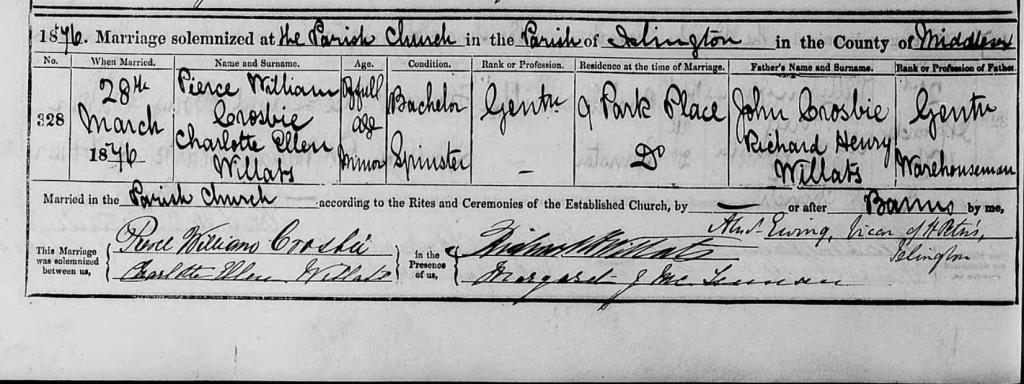
And our Charlotte had just secretly married Pierce William Crosbie. I’m not sure what happened after their secret marriage, how she told her family but a few short months later, Charlotte and Pierce found themselves back at St Mary Church, Islington, Middlesex, England, listening to their marriage banns being called. Their banns were called on the 12th of March, the 19th of March and the 26th of March, 1876. They were listed as, spinster and bachelor.

Spinster, Charlotte Ellen Willats married bachelor, Pierce William Crosbie, on Tuesday the 28th of March, 1876, in St Mary’s Church, Islington, Middlesex, England, for the second time. Charlotte was a minor, I believe 16 years old and Pierce was of full age. Pierces occupation was given as a Gentu. They gave their residence as 9 Park Place and gave their fathers names and occupations as, Richard Henry Willats, a Warehouseman and John Crosbie a Gentu. Their witnesses were Richard Willats and Charlottes future sister in-law Margaret Jane McLennon.
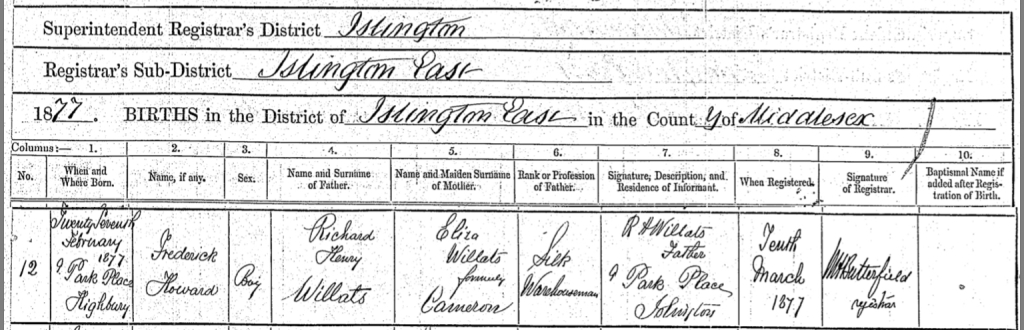
Back in her family home, Eliza, Charlotte’s mum, gave birth to her 13th Child, a baby boy, on Tuesday the 27th of February 1877 at Number 9, Park Place, Highbury, Islington, Middlesex, England.
Richard and Eliza named him, Frederick Howard Willats.
Richards gave his occupation as a Silk Warehouseman, and their abode as, 9 Park Place, Islington, when he registered Frederick’s birth on the 10th March 1877.
Charlotte’s brother, 24-year-old, bachelor, publican, Henry Richard Willats married 23 year old, spinster, Amelia Etheredge, daughter of John Etheredge, on Tuesday the 30th of March, 1880 at All Saints Church, West Ham, Essex, England. Henry gave his residence as West Ham and Amelia as, Saint Paul’s, Shadwell.
They gave their fathers names and occupations as, Richard Henry Willats, a Licensed Victualler and John Etheredge, an Engineer.
Their witnesses were Charles Henry Etheredge and Alice Catherine Etheredge.

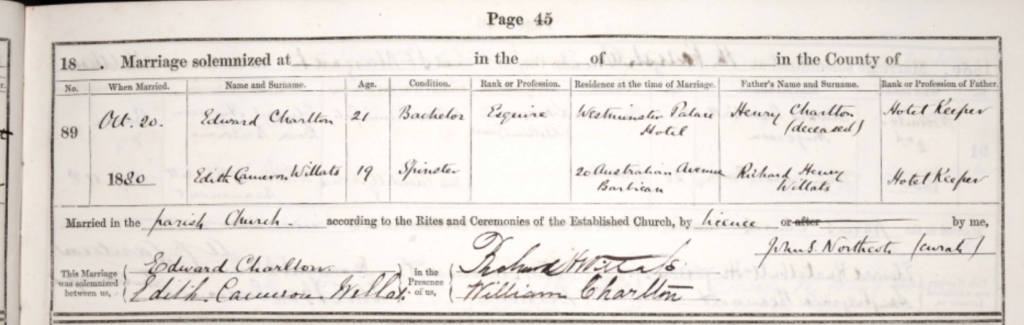
And her sister, 19-year-old, spinster, Edith Cameron Willats married 21-year-old Bachelor, Edward Charlton, an Esquire, on Wednesday the 20th of October, 1880, at St Margaret Church, George Hanover Square, Westminster, London, England. They gave their fathers names and occupations as, Richard Henry Willats, a Hotel Keeper and Henry Charlton, a Hotel Keeper. Edith gave her residents as, 20 Australian Avenue, Barbican, Silk Street, St Giles, Westminster, London, England and Edward gave his as Westminster Palace Hotel. Their witnesses were, Richard Willats and William Charlton.
Jumping forward a few short months, to the year 1881. Queen Victoria’s reign was in full swing, marking a period of relative stability and prosperity in the UK. Her reign had a significant impact on the country’s politics, culture, and society. It was the 22nd Parliament and the Prime Minister was William Ewart Gladstone (Liberal). William Ewart Gladstone, was a prominent figure in British political history, served as Prime Minister of the United Kingdom multiple times during the 19th century. Gladstone, first became Prime Minister in 1868. He was known for his strong convictions and dedication to various reforms, particularly those aimed at expanding civil liberties and promoting social justice. During his early premiership, Gladstone’s government passed a series of reforms that aimed to modernize and democratize British society. The Reform Act of 1867 extended voting rights to more male citizens, significantly broadening the electorate. This act was a major step toward democratic representation, though it did not grant universal suffrage. Gladstone also pursued measures to address Ireland’s grievances. His policies regarding Irish land reform aimed to improve conditions for tenant farmers and ease tensions between landlords and tenants. However, his attempts to navigate the issue of Irish Home Rule faced considerable opposition and challenges within Parliament. He was a passionate advocate for free trade and fiscal responsibility. His policies aimed at reducing government spending and promoting economic liberalism earned him praise from some quarters but faced opposition from those advocating protectionist measures. Gladstone’s strong moral convictions also influenced his policies. He supported issues such as temperance and moral reform, and he was a staunch opponent of slavery. Despite his successes in implementing various reforms, Gladstone’s tenure was not without controversies. His government faced challenges in handling the Eastern Question, particularly the issue of the Ottoman Empire’s control over areas with Christian populations in the Balkans. His stance on foreign policy, including intervention in conflicts such as the Russo-Turkish War, was a subject of debate and criticism. Gladstone’s leadership style was characterized by his eloquence and dedication to his principles. His commitment to reform and his efforts to address social and political issues left a lasting impact on British politics and society. By 1881, Gladstone had already established himself as a transformative figure in British politics, leaving a legacy of significant reforms and debates that would continue to shape the country’s trajectory in the years to come. In 1881, the United Kingdom was experiencing a period of both progress and challenges. The Industrial Revolution continued to shape the country’s landscape, economy, and society. The atmosphere was marked by a mix of optimism and discontent. Technological advancements and industrial growth were driving economic prosperity for some, particularly in urban areas. However, this progress came with social and environmental costs. Cities were heavily industrialized, leading to pollution and overcrowding in urban centers. The air was often thick with smoke from factories and the stench of untreated sewage due to inadequate sanitation systems. Socially, the gaps between the rich, working class, and poor were stark. The upper class maintained their opulent lifestyles, with lavish estates, fine dining, and extravagant social gatherings. They enjoyed luxury and privilege, wielding significant political and economic power. The middle class, including professionals, merchants, and some skilled workers, experienced varying degrees of prosperity. Many benefited from expanding job opportunities in sectors such as finance, trade, and emerging industries. They sought to improve their social standing, often aspiring to emulate the lifestyle of the upper class. Conversely, the working class faced challenging conditions. Industrial laborers, especially in factories and mines, endured grueling work hours, unsafe conditions, and low wages. Housing in industrial areas was often overcrowded and unsanitary, contributing to health issues and high mortality rates among the poor. Many lived in poverty, struggling to make ends meet.
Historically, several notable events occurred in 1881, including, In Ireland, the Land War intensified as tenant farmers protested against unfair land laws and sought reforms to improve their living conditions. This struggle for land rights and fair treatment exacerbated tensions between landlords and tenants. The year also saw the opening of the Natural History Museum in London, showcasing a vast collection of specimens, fossils, and artifacts, contributing to scientific and cultural knowledge. Godalming becomes the first town to have its streets illuminated by electric light(hydroelectrically generated). A bomb explodes at a military barracks in Salford, Lancashire; a young boy is killed, which lead to the beginning of the Fenian dynamite campaign. The Cunard Line‘s SS Servia, the first steel transatlantic liner, was launched at Clydebank. Andrew Watson of Glasgow‘s Queen’s Park F.C. (from a mixed Scottish/British Guianese background) captains the Scotland national football team in a 6–1 victory against England, becoming the world’s first mixed race international Association football player.
Edward Rudolf founded the ‘Church of England Central Society for Providing Homes for Waifs and Strays’ (later The Children’s Society).
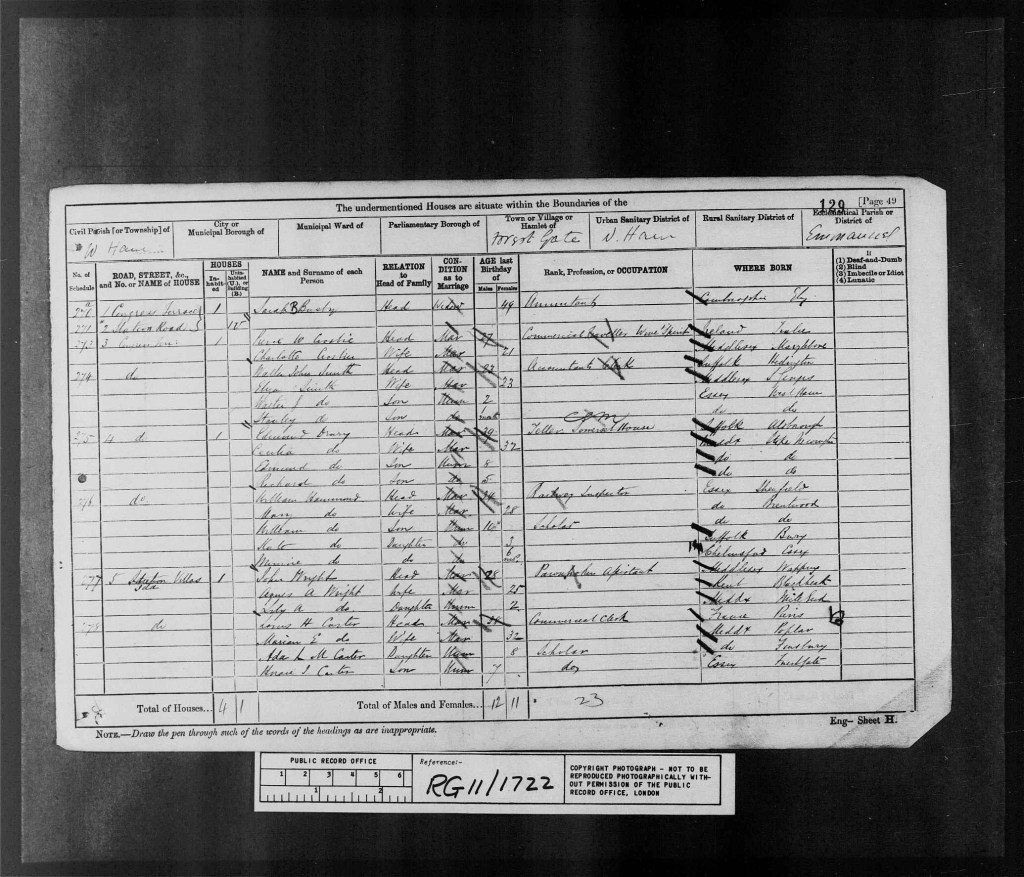
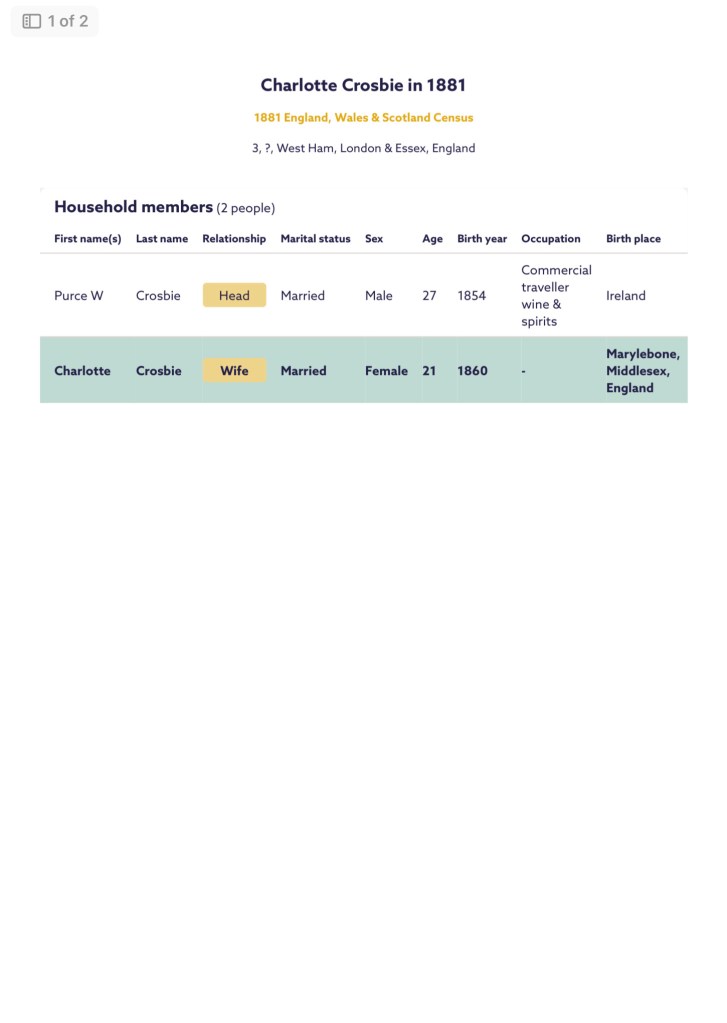
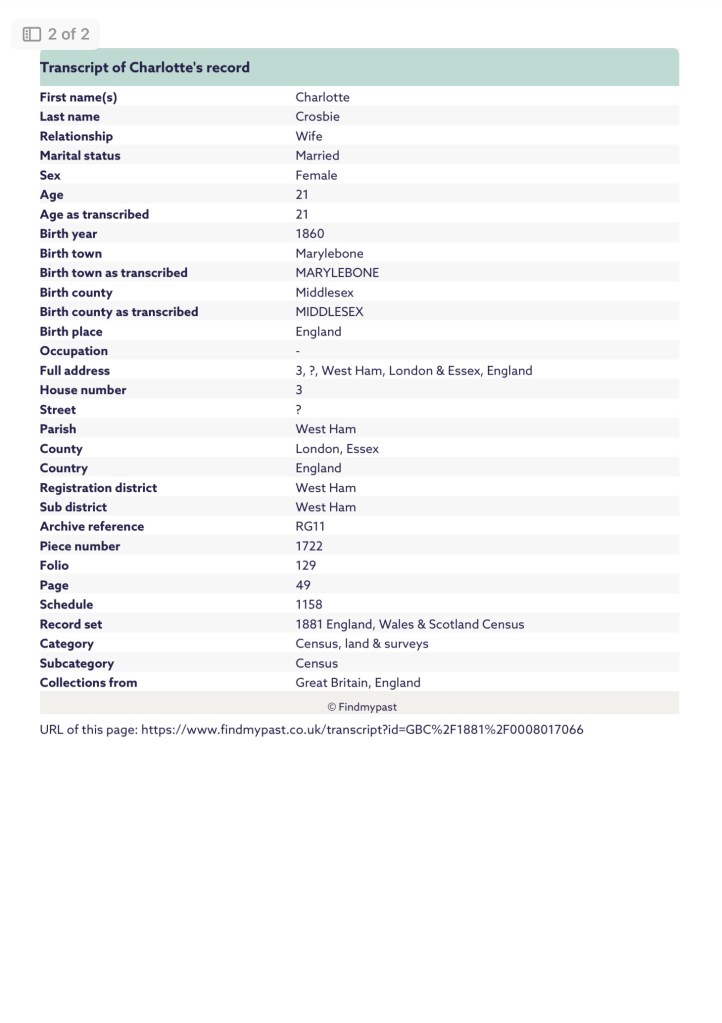
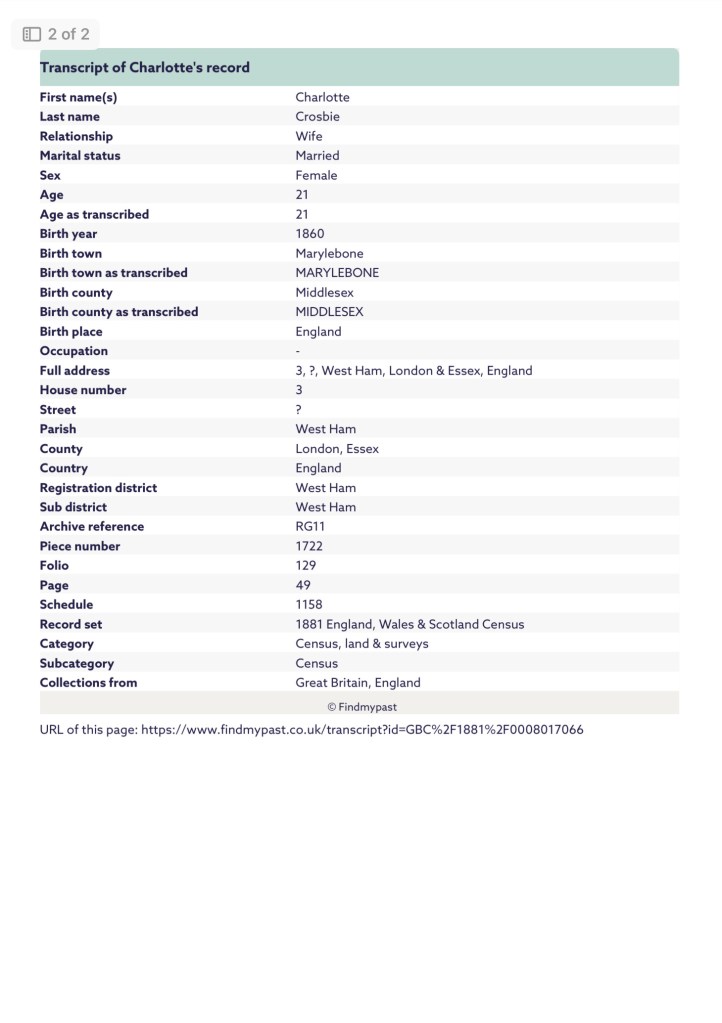
And on Sunday the 3rd of April, 1881, the census was taken, which shows, Charlotte and her new husband Pierce, were residing at Number 3, Congress Terrace, Forest Gate, West Ham, Essex, England. The address is far from clear but I believe it to be Congress Terrace. Charlotte’s husband was working as a Commercial Traveler of Wines and Spirits.
Charlotte’s brother, 23-year-old, bachelor, Francis Montague Allen Willats married 25-year-old, spinster, Margaret Jane McLennon, at St John the Evangelist Church, Hornsey, Middlesex, England, on Wednesday the on 6th of July, 1881. Francis was working as an agent at the time of his marriage. They gave their fathers names and occupations as Richard Henry Willats, a Agent and John McLennon, a Chronometer Maker. Francis gave his abode as, 145 Blackstock Road and Margaret gave hers as, 84, Finsbury Park Road. Their witnesses were John McLennon and Jessie McLennon.

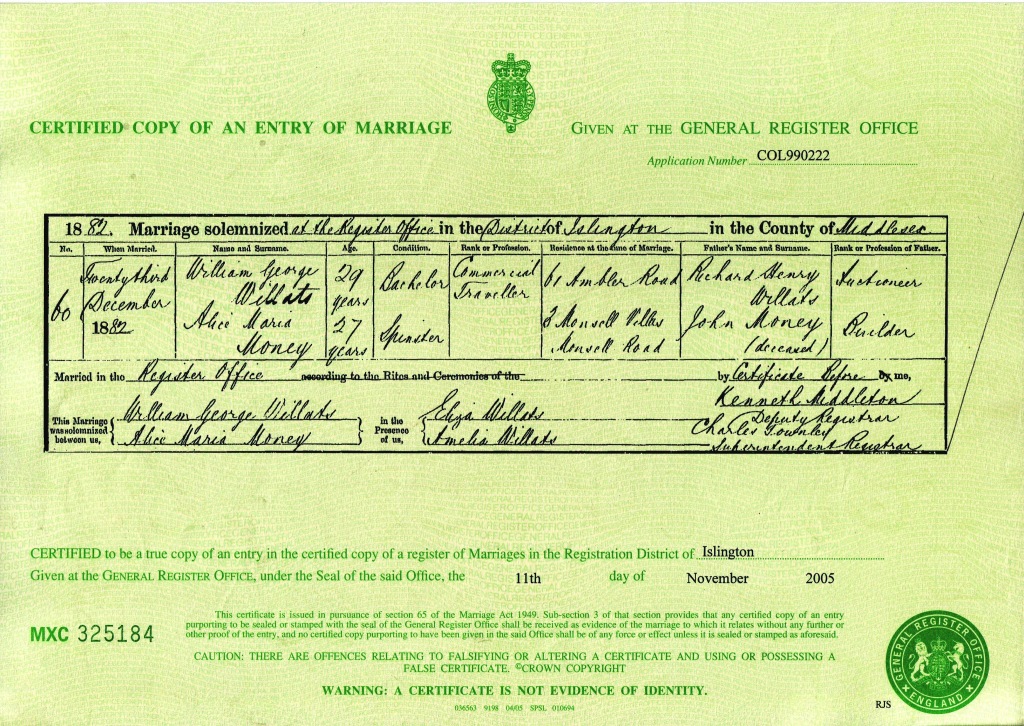
Charlotte’s half-brother, 29-year-old, bachelor William George Willats, a Commercial Traveller, married 27-year-old spinster, Alice Maria Money, at The Register Office, Islington, Middlesex, England, on Saturday the 23rd of December, 1882. William gave his occupation as a Commercial Traveller. They gave their fathers names and occupations as, Richard Henry Willats, an Auctioneer, and John Money (deceased) a Builder. Their witnesses were, Eliza Willats and Amelia Willats.
Across the pond in Buffalo, Erie, New York, United States of America, Arthur Charles Willats married Josephine Mary Conley in 1886 when he was 23 years old. Unfortunately at present I haven’t come across any documentation for their marriage only census records and births of their children. Being in the United Kingdom, research in America isn’t the easiest especially ordering certificates etc.
Jumping forward to the year 1891, Queen Victoria was still holding strong upon the throne. It was the 24th parliament and Prime Minister was Robert Gascoyne-Cecil, 3rd Marquess of Salisbury (Conservative). The Sunday Closing (Wales) Act prohibited the sale of alcohol in Wales on a Sunday. This was the first act of Parliament of the United Kingdom, Great Britain or England since the 1542 Act of Union between England and Wales whose application is restricted to Wales. Edward Rudolf founded the ‘Church of England Central Society for Providing Homes for Waifs and Strays’ (later The Children’s Society). The Natural History Museum was opened in London. The first performance of the Gilbert and Sullivan opera Patience, a satire on aestheticism, was performed at the Opera Comique in London. Sherlock Holmes and Dr John H. Watson first meet at Bart’s Hospital, London, prior to the events narrated in Conan Doyle‘s A Study in Scarlet (1887) commencing on 4 March. A tribunal was set up under the Land Law (Ireland) Act 1881 to examine excessive rents. Godalming became the first town to have its streets illuminated by electric light(hydroelectrically generated). Charles Stewart Parnell was imprisoned for to his part in land agitation in Ireland. And the 1891 census in the United Kingdom was taken, on Sunday the 5th of April, 1891, which shows, Charlotte and Pierce, were residing at, 98, Sydney Road, Hornsey, Edmonton, Middlesex, England. They had a 16-year-old general servant called Eliza Smith residing with them. Pierce was working as a Traveler at the time of the census.


It was around this time, that Charlotte took the world by storm and went against the grain by starting her own business. I was told many years ago that she had made her fortune in the beauty business. However I never knew what she did or sold. After many Google searches that came up blank to delving deep into the newspaper archives, I finally came across newspaper advertisements for her company, MRS. CROSBIE, Health Electrician. To be honest I was pretty blown away by my discovery and her amazing achievements.
The first advertisements I came across was an advert Charlotte put in the Gentlewoman Newspaper on the 13th of May, the 27th of May and the 24th of June 1893. They read,
MRS. CROSBIE, Health Electrician, 4 Langham Place, St. George’s Hall, Regent Street, receives PATIENTS. Corpulence, facial, and figure improvements. Superfluous hairs, lines and other disfigurements removed. Nervous, anaemia, rheumatic, liver affections, & c. Court and Society Ladies Health Specialist.
Hours eleven till six.

Throughout my family history research, Charlotte is the first woman I have come across who started her own business, a massive achievement in her time and ours. Being an entrepreneur in the late 1800s was a challenging endeavor, particularly for women. The societal norms and legal restrictions of that time placed significant barriers on women’s participation in business. However, there were still notable women who defied these norms and managed to establish successful ventures. So what struggles would Charlottes have come across as an entrepreneurial woman in the late 1800s? Society held strong beliefs about the roles of men and women. Women were primarily expected to be homemakers and caregivers, making it unusual for them to be involved in business. Women had limited legal rights, especially in terms of property ownership, contract-making, and business operation. In many places, a married woman’s property and earnings were considered her husband’s, and she often needed his permission to conduct business. Women’s access to education was limited compared to men during this time. Higher education, which could be beneficial for entrepreneurship, was especially restricted for women. Many women engaged in cottage industries, which involved producing goods at home, such as textiles, candles, and preserves, to be sold locally. Some women operated small-scale retail shops or offered services like dressmaking, millinery, or hairdressing. A few stepped outside the norm dreamed big and succeeded. Access to capital was a significant challenge. Women had limited access to credit or investment opportunities, as financial institutions were often reluctant to lend to them. Women entrepreneurs in the late 1800s often relied on informal networks of friends, family, and neighbours for support and advice. There were also women’s clubs and organizations emerging at the time that provided some networking opportunities. Marketing strategies were quite different in the late 1800s compared to today. Entrepreneurs relied heavily on word-of-mouth, local advertising, and sometimes, if they could afford it, newspaper advertisements. Technological advancements and innovations were emerging during this period. Women who were able to access education and resources sometimes engaged in inventing new products or improving existing ones. The late 1800s saw significant industrialization, which transformed economic landscapes. Some women capitalized on these changes by starting businesses related to new technologies or industries. Given the societal norms and legal constraints, women who ventured into entrepreneurship displayed significant determination and resilience. They often had to navigate through prejudice, skepticism, and outright opposition. Notable women like Madam C.J. Walker (a self-made millionaire in the haircare industry), Elizabeth Arden (founder of the cosmetics company), and Sarah Breedlove (known as Madam C.J. Walker’s daughter, who continued her mother’s legacy) were among the pioneering women entrepreneurs of this era. These outstanding brave women faced so many significant challenges, their achievements paved the way for future generations of women entrepreneurs, and their stories continue to inspire today, our Charlotte being one of them.
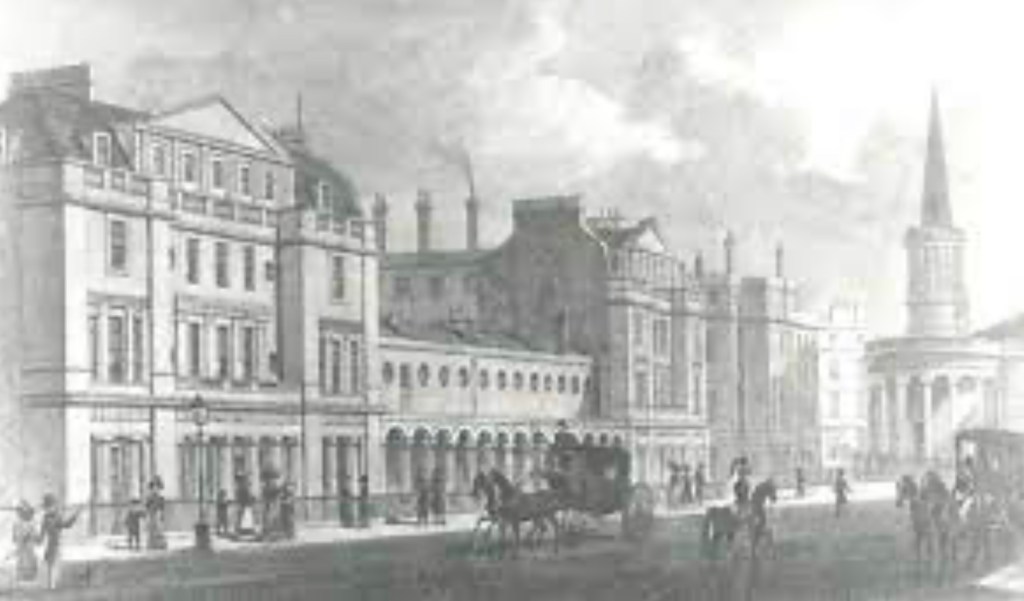
Langham Place is a short street in Westminster, central London, England. Just north of Oxford Circus, it connects Portland Place to the north with Regent Street to the south in London’s West End. It is, or was, the location of many significant public buildings, and gives its name to the Langham Place group, a circle of early women’s rights activists. There are several major buildings on Langham Place, including All Souls Church, Broadcasting House, and the Langham Hotel. Queen’s Hall and St. George’s Hall were also here until their destruction during World War II. The area is associated with the architect John Nash, although all but one of his original buildings have been replaced.
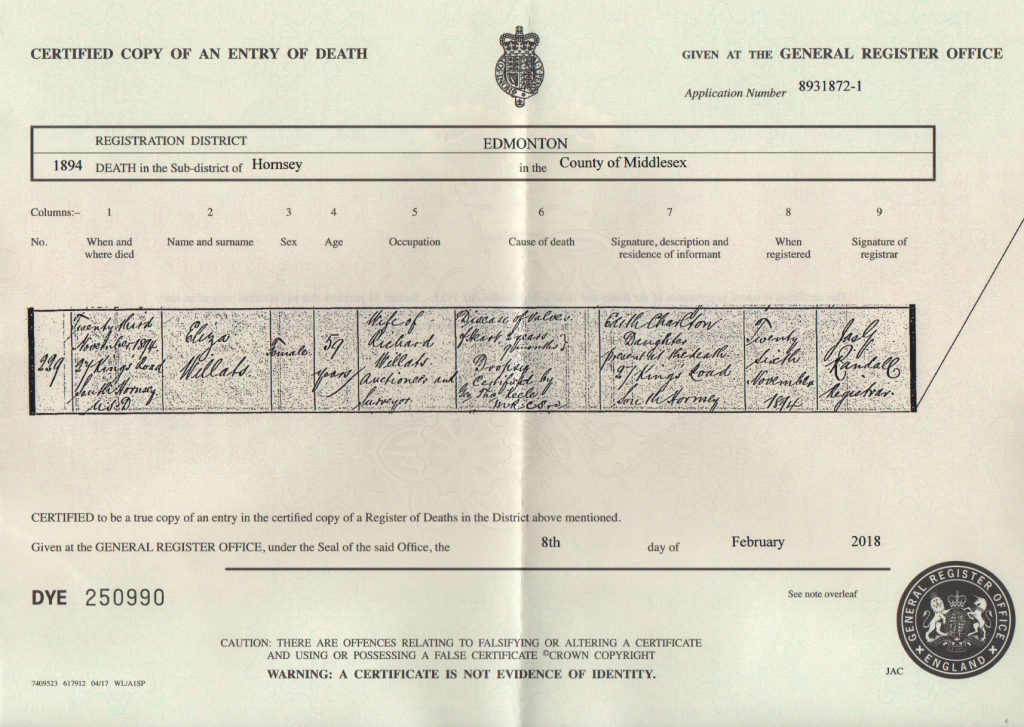
While Charlotte was busy growing her business, sadly her mum, Eliza, passed away on Friday the 23rd of November 1894, at Number 27, Kings Road, South Hornsey, Edmonton, Middlesex, England, when she was 59 years old. Eliza died from, disease of valves of the heart two years nine months and dropsy. Her daughter Edith Charlton of Number 27, Kings Road, South Hornsey, was present and registered Eliza’s death on the 26th of November 1894.
As I think of the pain Charlotte, her Father Richard and her siblings must have felt, once again I ponder upon the words Charlottes hands may have written upon the tear stained pages of her diary. (if she did indeed write one.) I envision it would read something along the lines of this,
November 23, 1894.
Dear Diary, I can barely bring myself to write these words, for the weight of sorrow upon my heart feels too heavy to bear. Today, the world around me shattered into an abyss of grief and loss. My dearest Mother, departed from this life, leaving behind an unfathomable void that no words can encapsulate. The day began like any other, but fate had already set its cruel course. The news came like a thunderbolt, ripping through the tranquility of our family home. Mother, the epitome of grace and warmth, was taken from us, leaving me adrift in a sea of despair. I can still feel the echo of her laughter, the tenderness in her embrace, and the wisdom in her words. She was my beacon of light, my confidante, and my unwavering source of strength. Her absence feels like a gaping wound, an ache that permeates every fiber of my being. The world seems surreal, as if time has halted in its tracks, unwilling to acknowledge the irreversible loss that now defines my existence. How does one find peace in a reality where the pillar of their life has crumbled? Our darling Father, a pillar of strength for our family, now bears a weight so heavy, it threatens to consume him entirely. Losing our Mother, his soulmate, has torn a chasm in his heart that I fear may never heal. The depth of their bond was unparalleled, woven with threads of love, understanding, and shared dreams. His eyes, once alight with her presence, now hold an emptiness that pierces through to the very core of my being. How does one console another when their own soul feels shattered? I ache witnessing the depth of his grief. My tears blur the ink on these pages, each droplet a testament to the love and bond we shared. Memories flood my mind like an unstoppable torrent, the gentle lullabies she sang, the wisdom she imparted, the unwavering support through life’s trials. The pain is suffocating, yet amidst this anguish, I hope one day I will find comfort in the legacy she left behind. Her love, her teachings, her unwavering spirit, they shall live on within me, guiding my steps through this tumultuous journey without her physical presence. Oh, how I wish I could hold her hand once more, share one last conversation, and tell her how much she means to me. But alas, the cruel hands of fate have separated us, leaving me to navigate an unfamiliar world without her comforting presence. The stars seem to weep alongside me, as if mourning the departure of a soul so pure. And tonight as I lay my head upon the pillow, I will pray for strength to endure this profound loss and carry on the legacy of love and kindness that she so beautifully embodied. Farewell, dearest Mother. Your love will be the compass that guides me through the darkest of nights. With a shattered heart, Charlotte.
So what would the mourning process have been like for Charlotte and her family?
In the late 1800s and early 1900s, mourning customs were deeply ingrained in society, particularly in Western cultures. This period was marked by elaborate and strict mourning rituals that governed how individuals expressed grief and loss. The Victorian era, especially, was characterized by a culture of mourning that was highly ritualized and visible. When someone passed away, mourning was not only a personal experience but a societal expectation. It was common for mourning periods to extend for a significant duration, with widows often adhering to mourning for years, dressed in black as a symbol of their bereavement. Clothing played a crucial role in mourning practices during this time. Black attire was the predominant symbol of mourning, and specific garments were designated for different stages of mourning. Initially, widows wore full black attire, veils, and crepe fabrics. As time passed, they transitioned to less intense mourning attire, incorporating shades of gray and purple. Furthermore, mourning etiquette dictated various social behaviors. For instance, mourners were expected to refrain from attending social events and entertainment, often withdrawing from public life to convey their respect for the deceased. The presentation of mourning cards and the organization of funeral ceremonies became elaborate affairs, each with its own set of expected customs and rituals. Mourning was not only a personal expression but also became an industry in itself. Businesses emerged that specialized in producing mourning attire, accessories, and items specifically designed for mourning periods. Photography also played a role in memorializing the deceased during this era. Post-mortem photography, where individuals were photographed after death, became a way for families to preserve memories and cope with loss. These photographs often depicted the deceased in a peaceful or sleeping pose, sometimes alongside family members. The strict observance of mourning began to change as the 20th century progressed. World events like World War I had a significant impact on these customs, as mass casualties made extended mourning periods impractical for many. Social changes, evolving attitudes towards death, and the desire for more personal expressions of grief gradually led to a relaxation of the stringent mourning practices that were prevalent in the late 1800s and early 1900s.c
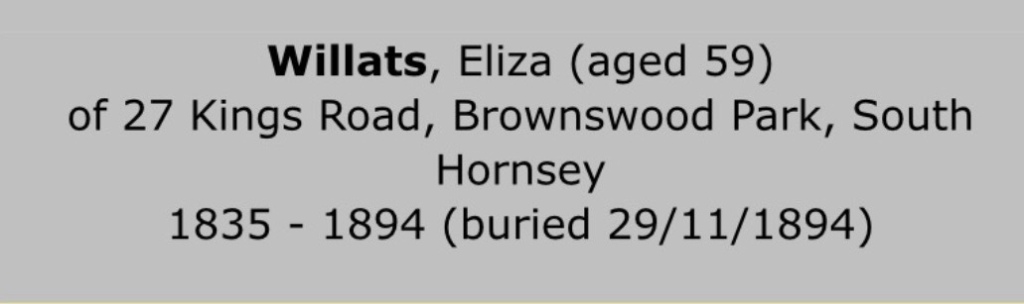
Charlotte and the Willats family, laid Eliza to rest, in one of the purchased graves at, Abney Park Cemetery, Stoke Newington, Middlesex, England, on Thursday the 29th November, 1894, in D06, Grave 092431. Her abode was given as, Number 27, Kings Road, Brownswood Park. When Eliza died Henry’s father, Richard Henry, purchased 2 graves in Abney Park Cemetery, which was then the beautiful garden of a big house turned into a private cemetery.
Each grave cost, 3 guineas and took six interments.
Abney Park cemetery is one of the “Magnificent Seven”cemeteries in London, England.
Abney Park in Stoke Newington in the London Borough of Hackney is a historic parkland originally laid out in the early 18th century by Lady Mary Abney, Dr. Isaac Watts and the neighbouring Hartopp family.
In 1840 it became a non-denominational garden cemetery, a semi-public park arboretum, and an educational institute, which was widely celebrated as an example of its time. A total of 196,843 burials had taken place there up to the year 2000.

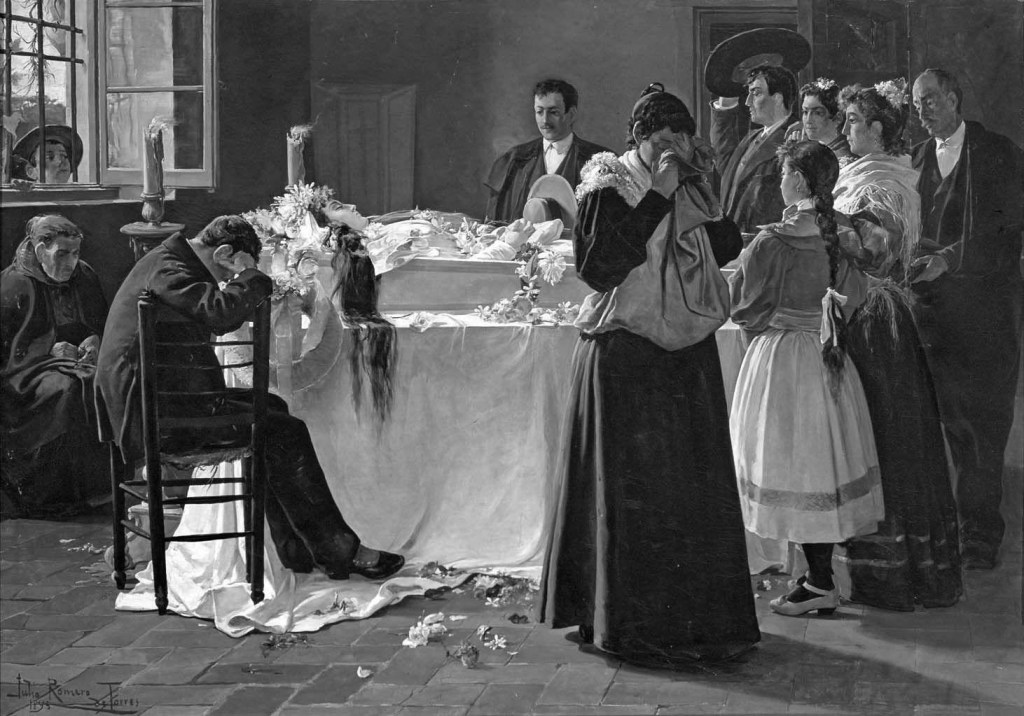
Wakes, also known as vigils or viewings, were gatherings held before or after the funeral. They provided an opportunity for friends, family, and acquaintances to pay their respects to the deceased and offer condolences to the bereaved. Wakes could take place at the family home or a designated location, where the body of the deceased might be present in an open casket, allowing mourners to view and pay their respects. The atmosphere during wakes was typically solemn and reflective, but it was also a time for sharing memories and stories about the departed. People would gather to comfort the family, offer support, and share in the grieving process. Additionally, wakes often involved various customs, such as prayers, hymns, or readings, depending on the religious or cultural practices of the community. Mourning attire was customary during these occasions. Mourners would dress in black or dark clothing as a sign of respect for the deceased. In some cultures, specific rituals or practices were observed during funerals and wakes, such as lighting candles, placing flowers, or offering prayers for the departed soul. The rituals and customs surrounding death and mourning were deeply ingrained in society, providing a framework for navigating loss and honoring the deceased within the community.
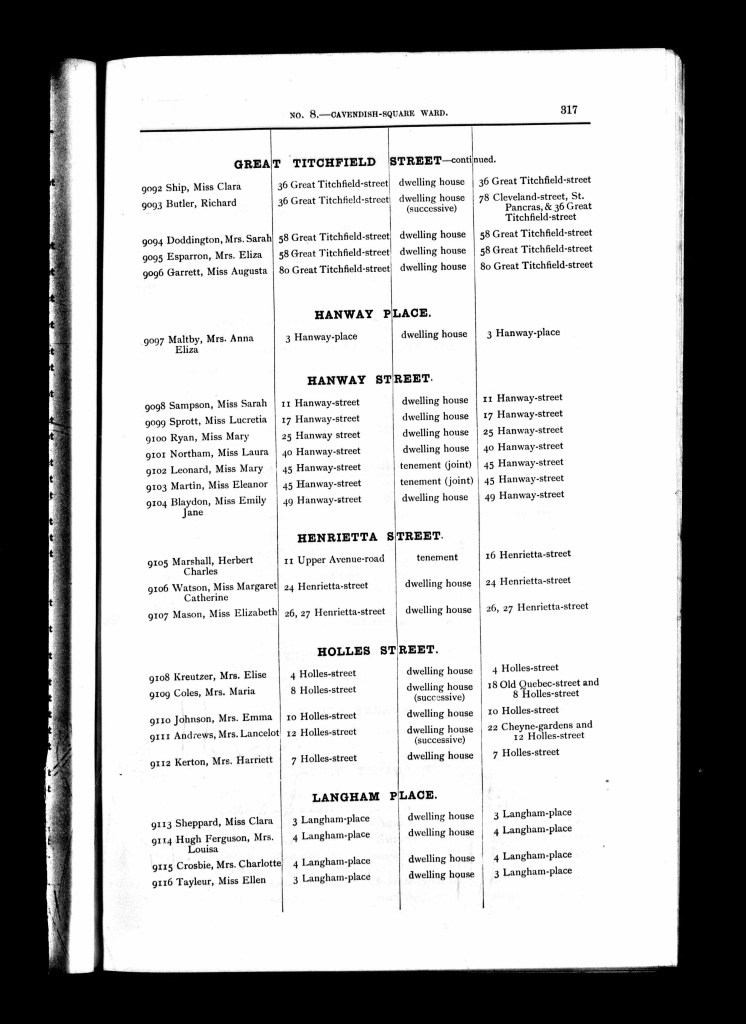
From the London City Commercial directory, we know Charlotte was trading as a Health Electrician, from, Number 4 Langham Place, West London, England, in 1895. I believe this to be her home address too.

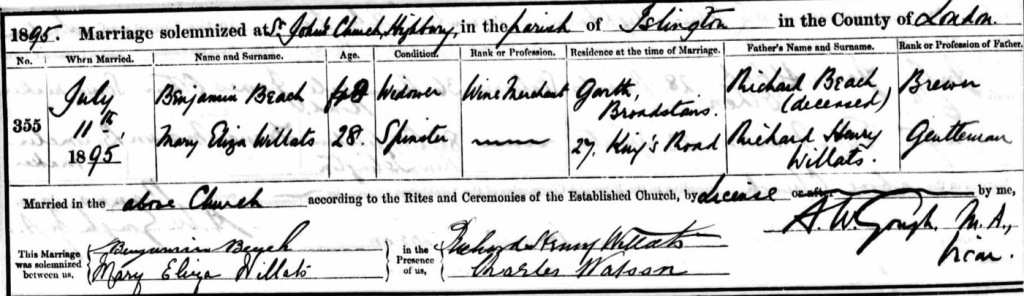
Charlotte’s sister, 28-year-old, spinster, Eliza Mary Willats, married 48-year-old, Widower, wine merchant, Benjamin Beach, on Thursday the 11th of July, 1895, at St John’s Church, Highbury, Islington, Middlesex, England. Eliza gave her residence as, 27 Kings Road and Benjamins as ? (If you can work it out, please let me know.) They gave their fathers names and occupations as, Richard Beach (deceased) a Brewer and Richard Henry Willats, a Gentleman. Their witnesses were, her father Richard Henry Willats and Charles Watson. Eliza used the name Mary Eliza Willats.
Charlotte’s brother, 21-year-old, bachelor, Walter James Willats and 21-year-old, spinster, Amelia High, Marriage Bonds were licenced on Tuesday 20th October 1896, at St Mary Magdalene, Enfield, Middlesex, England. Their marriage licence reads as follows.
DIOESE OF LONDON.
20th October 1896
APPEARED PERSONALLY, Walter James Willats of the parish. of St Mary Magdalene Enfield in the County of Middlesex a Bachelor aged Twenty one years and upwards and prayed a Licence for the Solemnization of Matrimony in the parish church of St Mary Magdalene Enfield aforesaid between him and Amelia Ellen High of the same parish a spinster of the age of Twenty-one years and upwards and made Oath that he believeth that there is no Impediment of Kindred or Alliance, or of any other lawful cause, nor any Suit commenced in any Ecclesiastical Court to bar or hinder the Proceeding of the said Matrimony, according to the tenor of such Licence. And he further made Oath, that he the said Appearer hath had his usual Place of abode within the said parish of St Mary Magdalene Enfield. for the space of Fifteen days last past
Walter James Willats
Sworn before me
F S May Swn:

Charlotte’s brother, 30-year-old, Bachelor, Walter James Willats, a Clark married 24-year-old spinster, Amelia Ellen High on Wednesday 21st October 1896 at the church of St Mary Magdalene, Enfield, Middlesex, England. They gave their residence at the time of their marriage as, Number 10, William Place, Chase side, Enfield. they gave their fathers names and occupations as, Richard Henry Willats, a Suvayor and William James High, a cabinet Maker. Their witnesses were, E. F. Newcombe and S. A. Newconbe.
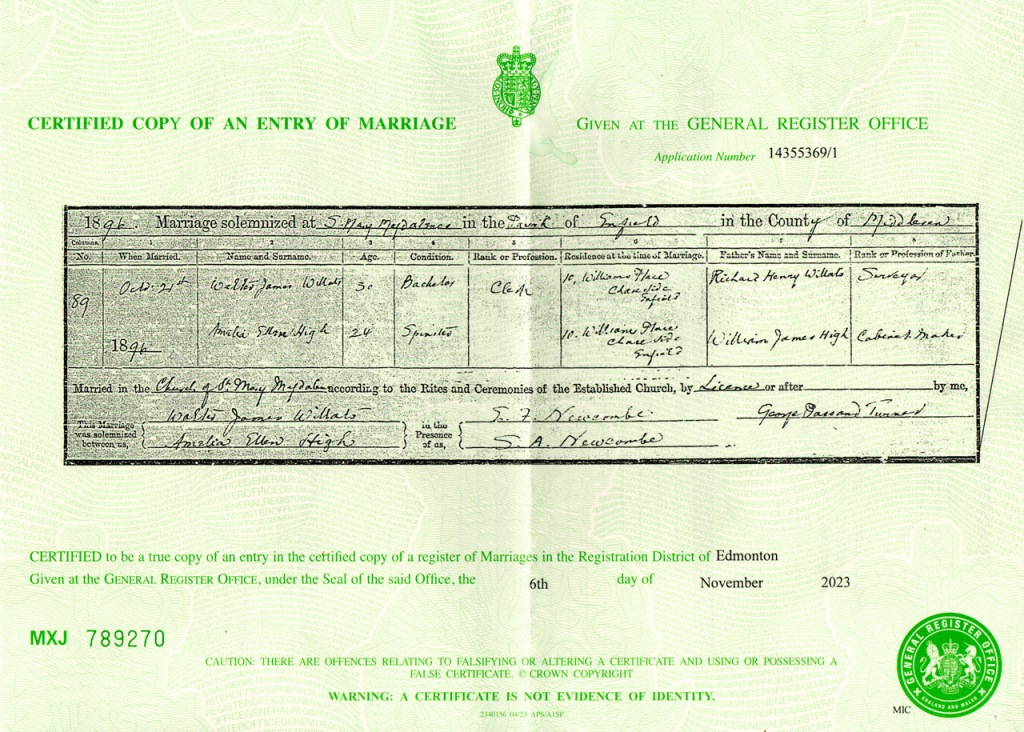
Did you notice the age changes?
St Mary Magdalene, Enfield, is a Church of England church in Enfield, London, dedicated to Jesus’ companion, Mary Magdalene. The building is grade II* listed with Historic England. The church was built as a memorial to Philip Twells, MP and city banker, by his wife Georgiana Twells, who employed the architect William Butterfield. The foundation was stone was laid in 1881 and the church opened in 1883. The artist Charles Edgar Buckeridge painted the ceiling and east wall of the sanctuary and after his early death the side walls were painted by Nathaniel Westlake. The walls and ceiling were conserved in 2012 by Hirst Conservation with the help of local donations and the Heritage Lottery Fund. The stained-glass windows are by Heaton, Butler and Bayne.
The tower originally contained 8 change ringing bells cast by John Warner & Sons for the new church in 1883, however these were replaced in 1999, as they were too heavy for the tower and were causing damage. The church installed a new, lighter ring of 8 bells cast by the Whitechapel Bell Foundry, and the older, larger bells were bought by Grace Church Cathedral in Charleston, United States, where they were installed and augmented to 10 with two new treble bells cast in the same year, also by Whitechapel.

Heartbreakingly the Willats family lives were thrown back into the depths of grief when Charlotte’s brother, William George Willats, my 3rd great-grandfather, died on Sunday the 14th of February, 1897, at 44 Gillespie Road, Islington, Middlesex, England.

He died from Cardial Haemorrhage Corona Syncope. Charlotte was present and registered William George Willats, death on the 16th of February 1897.

Charlotte gave her abode as, Number 132, Wilberforce Road, Finsbury Park.

Charlotte and her family laid, William George Willats, to rest at, Abney Park Cemetery, Stoke Newington, Hackney, London, England, on Thursday the 18th of February 1897, in grave D06 092431.

From the 1832-1965 London, England, Electoral Registers, we know, Charlotte was residing at 4 Langham Place, Marylebone East, Westminster, London, England, in 1897. Mrs Lousisa Hugh Ferguson, was also residing there.
We continue to see Charlotte’s determination, and drive, to change her life and the lives of many other women, when she put an advert in The Cornish Telegraph, on the 9th June 1898, the 21st of July 1898, the 25th of August 1898 and the 8th of September 1898.
They read,
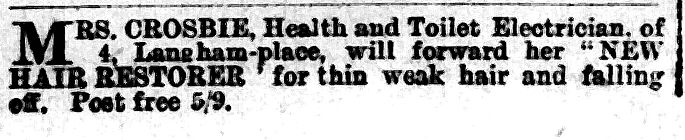
MRS. CROSBIE, Health and Toilet Electrician, of 4, Langham-place, will forward her “NEW HAIR RESTORER” for thin weak hair and falling off. post free 5/9.
Charlotte put another advertisement in the Weekly Freeman’s Journal, on Saturday the 16th and 23rd of July 1898. They read,
MRS. Crosbie, Health and Toilette Electrician, of 4, Langham-place, Regent street, London will for- ward her “NEW HAIR RESTORER” for thin weak hair and falling off. post free 5/9d. 1135

Charlotte’s sister, 29-year-old spinster, Lillian Jenny Willats, of Number 27, Kings Road, Brownhill Park, married 31-year-old bachelor, and commercial. (I assume that means commercial traveller?), William Alexander Neilson, of Madeira Avenue, Worthing, Sussex, on Saturday the 15th of July, 1899, at St. John’s Church, Highbury, Islington, Middlesex, England. They gave their fathers names and occupations as, Richard Henry Willats, an auctioneer and William Neilson, a commercial. Their witnesses were, brother in-law, Benjamin Beach and their niece, Amina Charlton. Lilly’s name was recorded as Lillian Jenny Willats.

Charlotte’s brother, 28-year-old Bachelor Edwin Paul Willats married 19-year-old, spinster, Nellie Elizabeth High on Saturday the 7th of July, 1900, at All Hallows, Tottenham, Edmonton, Middlesex, England. Their witnesses were, Walter James Willats and Amelia Ellen Willats. Their fathers names and occupations were given as Richard Henry Willats, a surveyor and James High, a Cabinet Maker. As you can see the certificate is nearly impossible to transcribe, so I have given you the information I can work out, sorry.

Unfortunately, there is no trace of Charlotte and Peirce in the 1901 census, but the hunt continues.
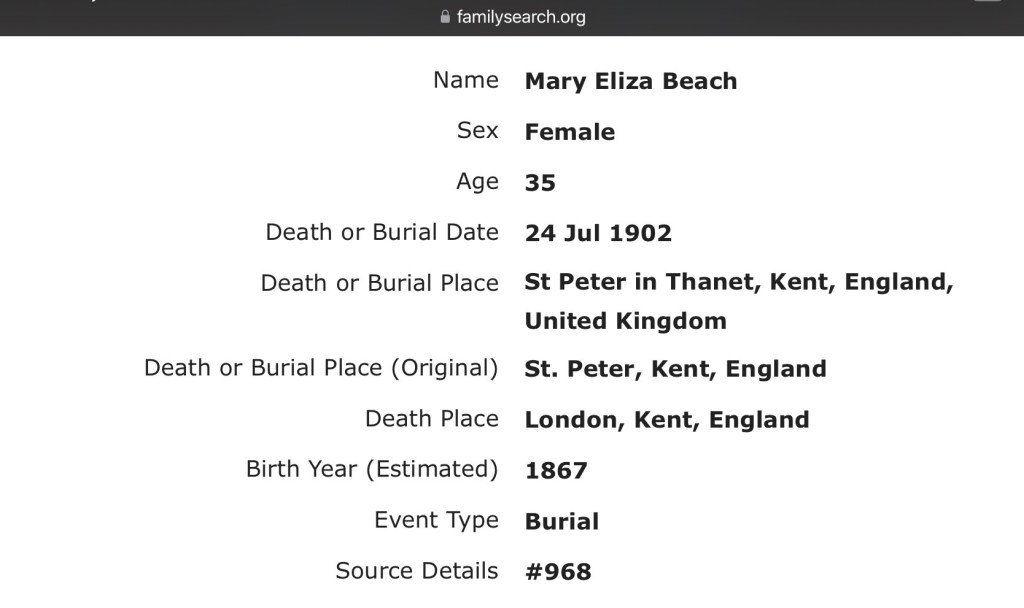
Sadly death once again had the Willats family firmly in its grasp. Charlotte’s sister, Eliza Mary Beach nee Willats died on Monday the 21st of July 1902, at Beach Court, Upper Deals, Eastry, Kent, England, at the awfully young age of 35 years. Eliza died from Pneumonia and exhaustion. Edith Cameron Charlton nee Willats, Charlotte and Eliza’s sister, was present and registered her death on the same day, Monday the 21st of July 1902. Edith stated the Eliza was the wife of Benjamin Beach, giving his profession of, independent means.

Charlotte and family laid Eliza Mary Beach nee Willats, to rest on Thursday the 24th of July, 1902, at St Peter in Thanet, Kent, England.
St Peter’s is an area of Broadstairs, a town on the Isle of Thanet in Kent. Historically a village, it was outgrown by the long-dominant settlement of the two, Broadstairs, after 1841. Originally the borough or manor of the church of St. Peter-in-Thanet, it was said to be the largest parish east of London, at least until Broadstairs became a separate parish on 27 September 1850. The two settlements were formally merged administratively in 1895. The village and its church, named after Saint Peter, was the second daughter church of Minster established in 1070, although the first written record of its present name dates to 1124. In 1254 the village was named “scī Petr'”, which gradually changed to “scī Petri” by 1270, Sti Petri in Insula de Thaneto by 1422, and finally settling by 1610 on its current form of St Peter’s. The church has the right to fly the white ensign, dating from when the church tower was used as a signalling station in the Napoleonic Wars. The village sign won first prize in a nationwide competition in 1920. Edward Heath, leader of the Conservative Party from 1965 to 1975, serving as prime minister from 1970 to 1974, was born in the village in 1916. On 27 April 1952, a United States Air Force Republic F-84 Thunderjet from RAF Manston crashed in the main street with loss of life.

Charlotte passion, determination and drive for success did not stop within London’s boundaries and venture further afield, conquering the beauty industry, not only on her home soil but within the beautiful landscape of Ireland.
The first signs of Charlotte‘s new venture are when Charlotte put advertisements in Irelands, Northern Whig, News Paper, on the 10th, 12th, 16th, 17th, 19th and 20th of March 1903.
They read,
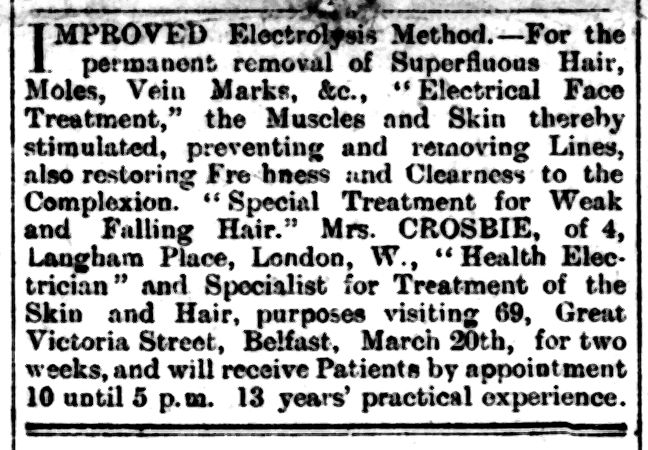
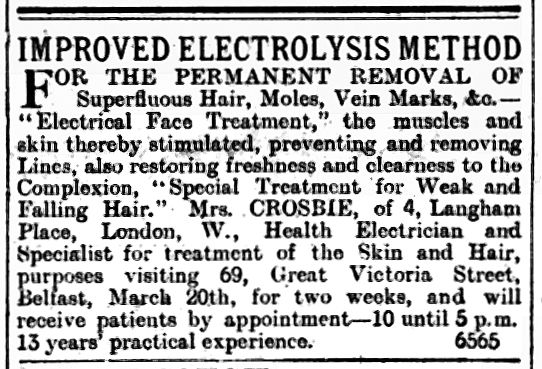
IMPROVED ELECTROLYSIS METHOD. – For the permanent removal of Superfluous Hair, Moles, &c.- “Electrical Face Treatment,” the muscles and skin thereby stimulated, preventing and removing Lines, also restoring freshness and clearness to the Complexion, “Special Treatment for Weak and Falling Hair.” Mrs. CROSBIE, of 4, Langham Place, London, W., Health Elec- trician and Specialist for treatment of the Skin and Hair, purposes visiting 69, Great Victoria Street, Belfast, March 20th, for two weeks, and will receive patients by appointment – 10 until 5 p.m. 13 years practical experience.
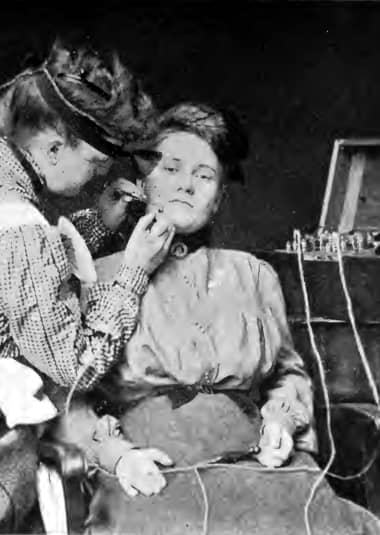
By 1903, electrolysis was a well-established scientific and industrial process. Electrolysis is a chemical process that uses an electric current to drive a non-spontaneous chemical reaction. It involves the breaking down of a compound into its constituent elements using electricity. The principles of electrolysis were first formulated by Michael Faraday in the early 19th century. Faraday’s laws of electrolysis, which he developed in the 1830s, laid the groundwork for understanding how the process works. Electrolysis had various industrial applications in 1903, including: Electroplating, This was used for coating objects with a layer of metal to improve their appearance or protect them from corrosion. Electrorefining, A process for purifying metals, particularly copper and aluminum. Electrolytic cells for production of chemicals, for instance, the industrial production of chlorine and sodium hydroxide through the chloralkali process. Electrolytic cells were primarily made of metal or graphite. They contained an electrolyte (a substance capable of conducting electricity when molten or dissolved in water) and electrodes (conductors through which the electric current enters or leaves the electrolyte). Common electrolytes in 1903 included solutions of salts, acids, or bases. These provided ions that could carry the electric current. Electrodes were typically made of inert materials like platinum, graphite, or other metals that would not react with the electrolyte. The power sources used for electrolysis were primarily direct current (DC) generators. These generators produced a continuous flow of electric charge in one direction. Faraday’s First Law of Electrolysis states that the amount of a substance deposited during electrolysis is directly proportional to the quantity of electricity passed through it. Faraday’s Second Law states that the amount of different substances deposited by the same quantity of electricity is proportional to their chemical equivalent weights. The industrial applications of electrolysis played a crucial role in various sectors, including metallurgy, electroplating, and the chemical industry. It allowed for the production and refinement of metals on a large scale. By 1903, there were likely ongoing refinements in the apparatus and techniques used in electrolysis, as it was a well-established process by this time. While electrolysis was a valuable industrial process, it required a significant amount of energy. This made it most practical for substances where no other cost-effective method of production was available. The principles of electrolysis, as elucidated by Faraday, continue to be fundamental in various fields of science and industry today.
On the 10th, 12th, 17th, 19th and 20th of March 1903, Charlotte put the same advert in the
Belfast News-Letter. They read,,
IMPROVED ELECTROLYSIS METHOD. FOR THE PERMANENT REMOVAL OF Superfluous Hair, Moles, &c.- “Electrical Face Treatment,” the muscles and skin thereby stimulated, preventing and removing Lines, also restoring freshness and clearness to the Complexion, “Special Treatment for Weak and Falling Hair.” Mrs. CROSBIE, of 4, Langham Place, London, W., Health Electrician and Specialist for treatment of the Skin and Hair, purposes visiting 69, Great Victoria Street, Belfast, March 20th, for two weeks, and will receive patients by appointment – 10 until 5 p.m. 13 years practical experience. 6565
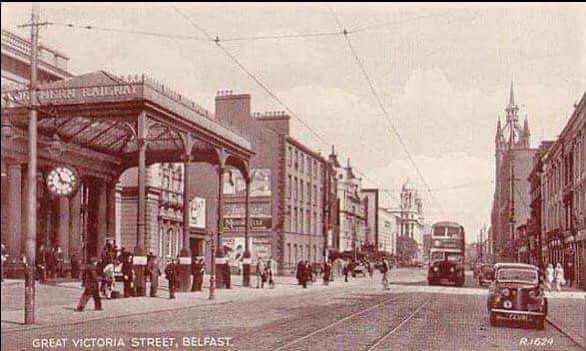
Great Victoria Street in Belfast, Northern Ireland, is a major thoroughfare located in the city centre and is one of the important streets used by pedestrians alighting from Belfast Great Victoria Street railway station and walking into shopping streets such as Royal Avenue. The street connects with the Donegall Road and the Lisburn Road which are also linked into Shaftesbury Square in the southern direction and towards the Donegall Square in the northern direction, which links via Howard Street into Donegall Place. The street itself was named in honour of Queen Victoria. It includes the Monument to the Unknown Woman Worker, which is in a prominent walking route into Belfast Great Victoria Street railway station. There are also a number of churches located along the street.

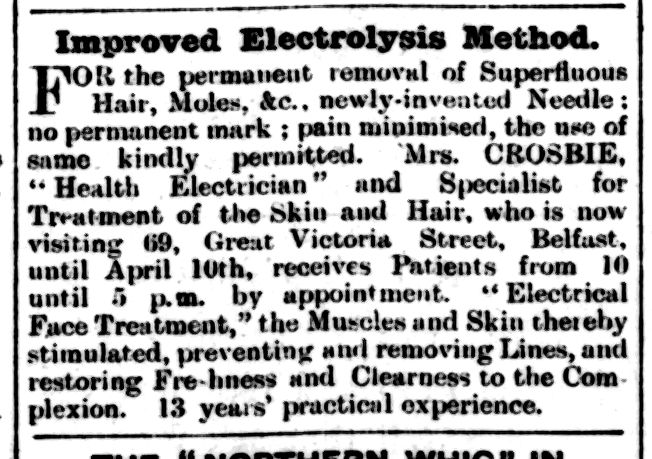
Charlotte put a slightly different advert in the Belfast News-Letter on the 23rd, 24th of March 1903, and the 24th, 25th and 27th 28th and 31st of March 1903. They read,
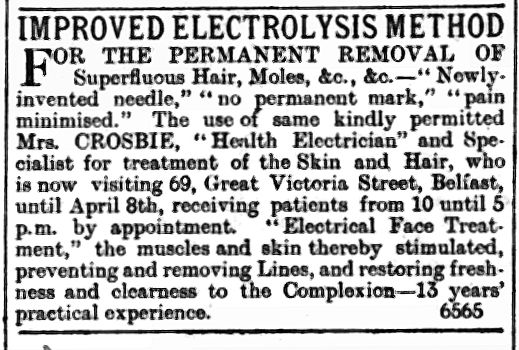
IMPROVED ELECTROLYSIS METHOD. For the permanent removal of
Superfluous Hair, Moles, &c. . Newly- invented needle, “no permanent mark,” pain minimised,” The use of same kindly permitted Mrs Crosbie, “Health Electrician” and Spe- cialist for Treatment of the skin and Hair, who is now visiting 69, Great Victoria Street, Belfast, until April 8th, receives Patients from 10 until 5 p.m. by appointment. “Electrical Face Treat- ments, “ the Muscles and Skin thereby stimulated, preventing and removing Lines, and restoring Fresh- ness and Clearness to the Complexion. 13 years’ experience. 6565
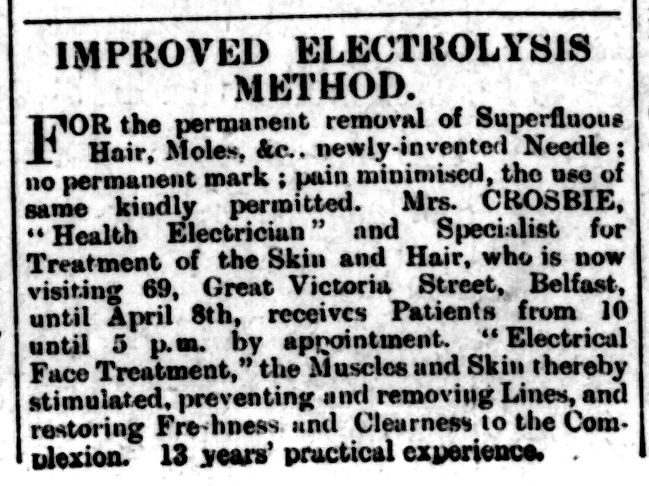
And Charlotte put practically the same advert in the Northern Whig newspaper on the 23rd and 27th of March 1903. They read,
IMPROVED ELECTROLYSIS METHOD. For the permanent removal of Superfluous Hair, Moles, &c. . newly-invented Needle ; no permanent mark ; Pain minimised, the use of same kindly permitted. Mrs Crosbie, “Health Electrician” and Specialist for Treatment of the skin and Hair, who is now visiting 69, Great Victoria Street, Belfast, until April 8th, receives Patients from 10 until 5 p.m. by appointment. “Electrical Face Treatments, “ the Muscles and Skin thereby stimulated, preventing and removing Lines, and restoring Freshness and Clearness to the Com- plexion. 13 years experience.
On the 2nd, 3rd, 6th and 7th of April 1903, Charlotte put an advert in the Belfast News-Lette. They read,
IMPROVED ELECTROLYSIS METHOD. FOR THE PERMANENT REMOVAL OF Superfluous Hair, Moles, &c. . Newly- invented needle, “no permanent mark,” pain minimised,” The use of same kindly permitted. Mrs CROSBIE, “Health Electrician” and Spe- cialist for treatment of the Skin and Hair, who is now visiting 69, Great Victoria Street, Belfast, until April 10th, receives patients from 10 until 5 p.m. by appointment. “Electrical Face Treat- ments, “ the Muscles and Skin thereby stimulated, preventing and removing Lines, and restoring Fresh. ness and Clearness to the Complexion. 13 years’ practical experience. 6565

On the 2nd and 4th of April 1903, Charlotte put an advert in the Northern Whig Newspaper. They read,
IMPROVED ELECTROLYSIS METHOD. For the permanent removal of Superfluous Hair, Moles, &c. . newly-invented Needle ; no permanent mark ; Pain minimised, the use of same kindly permitted. Mrs Crosbie, “Health Electrician” and Specialist for Treatment of the skin and Hair, who is now visiting 69, Great Victoria Street, Belfast, until April 10th, receives Patients from 10 until 5 p.m. by appointment. “Electrical Face Treatments, “ the Muscles and Skin thereby stimulated, preventing and removing Lines, and restoring Freshness and Clearness to the Com- plexion. 13 years experience.
Charlotte’s sister, 28-year-old, spinster, May Claretta Willats married 20-year-old, architectural florist, bachelor, George Frederick Champion on Saturday the 4th of April 1903, at St. John’s Church, Highbury Vale, Islington, London, England. May gave her residence as, 21 Montague Road and George as, 194 Green Lands. They gave their father’s names and occupations, as George Frederick Champion, an architectural florist and Richard Henry Willats an Estate Agent. Their witnesses were, George Frederick Champion and May’s niece, Amina Eliza Catherine Charlton.

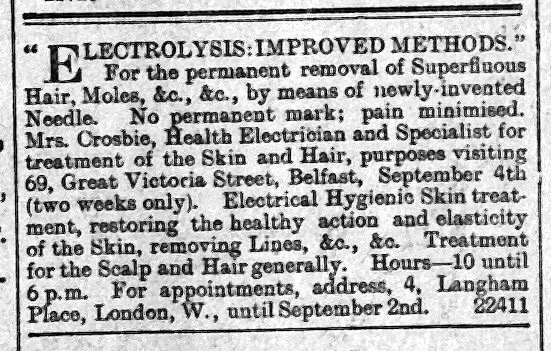
Charlotte put an advert in the Belfast News Letter, on the 25th, 26th, 31st of August 1903, and the 1st, 2nd, 3rd 4th, and the 5th of September, It reads,
“ELECTROLYSIS – IMPROVED METHODS.” for permanent removal of Superfluous Hair, Moles, &c., &c. , by means of Newly-Invented Needle. No permanent mark; pain minimised. Mrs. CROSBIE, Health Electrician and Specialist for treatment of the Skin and Hair, purposes visiting 69, Great Victoria Street, Belfast, September 4th (two weeks only). Electrical Hygienic Skin treat- ment restoring the healthy action and elasticity of the skin, removing Lines, &c. , &c. Treatment for Scalp and Hair generally. Hours – 10 until 6 p.m. For appointment, address 4, Langham Place, London, W., until September 2nd. 22411
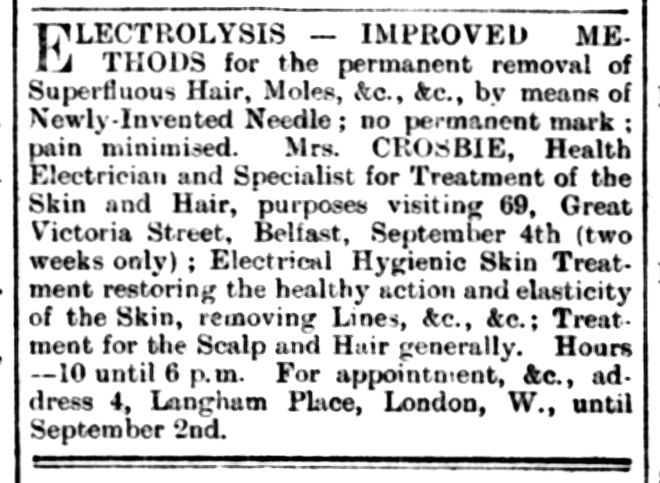
Charlotte put an advert in Irelands, Northern Whig New Paper on the 22nd of August, the 27th of August, the 4th of September and the 5th of September 1903. They read,
ELECTROLYSIS – IMPROVED ME- THODS for permanent removal of Superfluous Hair, Moles, &c., &c. , by means of Newly-Invented Needle ; no permanent mark ; pain minimised. Mrs. CROSBIE, Health Electrician and Specialist for Treatment of the Skin and Hair, purposes visiting 69, Great Victoria Street, Belfast, September 4th (two weeks only); Electrical Hygienic Skin Treat- ment restoring the healthy action and elasticity of the skin, removing Lines, &c. , &c. ; Treat- ment for Scalp and Hair generally. Hours – – 10 until 6 p.m. For appointment, &c. , ad- dress 4, Langham Place, London, W., until September 2nd.
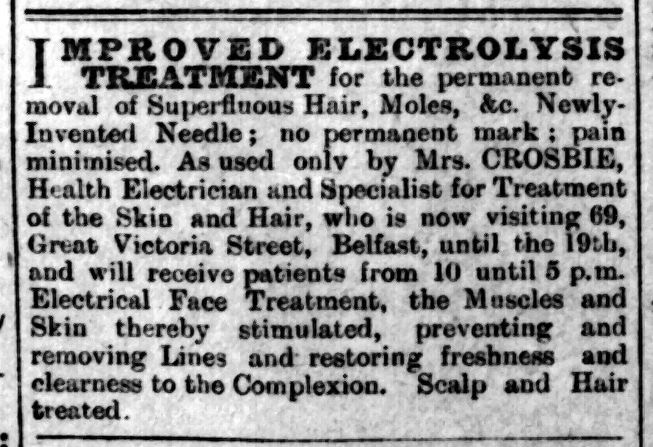
Charlotte put an advert in the Northern Whig newspaper on the 7th, 8th, 10th, 11th, 12th of September 1903. They read,
IMPROVED ELECTROLYSIS TREATMENT for permanent re- moval of Superfluous Hair, Moles, &c., &c. Newly. Invented Needle ; no permanent mark ; pain minimised. As used only by Mrs. CROSBIE, Health Electrician and Specialist for Treatment of the Skin and Hair, who is now visiting 69, Great Victoria Street, Belfast,until the 19th, and will receive patients from 10 until 5 p.m. Electrician Face Treatment, the Muscles and Skin thereby stimulated, preventing and removing Lines and restoring Freshness and clearness to the Complexion. Scalp and Hair treated.
Charlotte put an advert in the Northern Whig newspaper on the 14th and 17th September 1903. It reads,
IMPROVED ELECTROLYSIS TREATMENT for permanent re- moval of Superfluous Hair, Moles, &c. Newly- Invented Needle; no permanent mark; pain. minimised. As used by Mrs. CROSBIE, Health Electrician and Specialist for Treatment of the Skin and Hair, who is now visiting 69, Great Victoria Street, Belfast, until the 22nd and will receive patients from 10 until 5 p.m. Electrical Face Treatment the Muscles and Skin thereby stimulated, preventing and removing Lines and restoring freshness and clearness to the Complexion. Scalp and Hair treated.
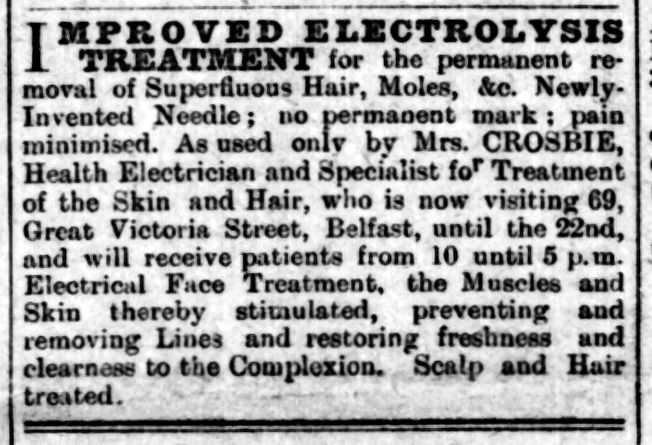
and on the 18th of September 1903, Charlotte put an advertisement in the Belfast News Letter. It reads,
IMPROVED ELECTROLYSIS METHODS For permanent removal of Superfluous Hair, Moles, &c. Newly-Invented Needle. No permanent mark; pain minimised. As used only by Mrs. CROSBIE, Health Electrician and Specialist for Treatment of the Skin and Hair, who is now visiting 69, Great Victoria Street, Belfast, until the 21st and will receive patients from 10 until 5 p.m. Electrical Face Treatment the Muscles and Hair thereby stimulated, preventing , and removing Lines and restoring freshness and clearness to the Complexion. Scalp and Hair treatement. 24728
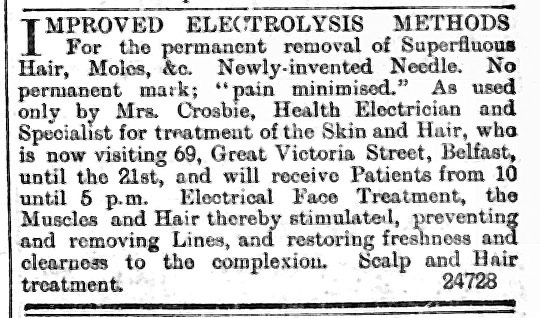
Charlotte’s brother, 26-year-old bachelor, surveyor, Frederick Howard Willats, married 24-year-old, spinster, Maud May Beach, on Saturday the 19th of September 1903, at St. John’s Church, Highbury Vale, Islington, London, England. Frederick gave his abode as, 27 Kings Road and Maud graves hers as, 16 Orchard Road, St. Margarets on Thames. They gave their fathers names and occupations, as Richard Henry Willats, estate agent, and Walter Beach (deceased), a Gentleman. Their witnesses were her brother, Persey Sidney Willats and his niece, Amina Eliza Catherine Charlton.

As the year 1903 comes to end, a prosperous, new year in her grasp, I imagine Charlotte, writing her final diary entry of the year. I imagine it may read something along the lines of this,
December 31, 1903. Dear Diary, As I stand on the cusp of bidding adieu to this year, my heart feels a blend of weariness and excitement. The echoes of London’s bustling streets still resonate within me, a constant backdrop to my journey. The challenges persist, seemingly unchanged by the ticking hands of time, yet my resolve remains unyielding. With the turn of the year approaching, I find myself reflecting upon the lessons garnered from navigating through these unconventional alleys of life. The weight of responsibilities rests heavy upon my shoulders, yet the fire within me refuses to dim. Today marked another year in the labyrinth of London, amidst the cobbled streets and the bustling city life, where my path as a working woman and a Health Electrician often feels both empowering and daunting. As I tread through this unconventional path, one that society scarcely deems fit for a woman, I am met with both admiration and skepticism. My days as a specialist for the treatment of skin and hair are filled with a peculiar blend of fulfillment and challenge. The passion that fuels my dedication to this profession is unwavering, it is a vocation that ignites a fervour within me, one that surpasses the conventions of my time. In the eyes of many, my pursuit is an anomaly, a disruption to the norms dictated by society. Yet, within these treatments, I find comfort, a canvas to express my expertise and an avenue to offer respite to those seeking refuge from their skin and hair ailments. The difficulties of my work mirror the complexities of my own journey. The delicate art of administering electric therapies to rejuvenate the skin and scalp is not just a technical skill, it’s a testament to perseverance and resilience. In the rooms of my clinic, where the hum of electrical currents intertwines with whispered hopes for healing, I witness the convergence of science and compassion. However, this path isn’t without its hurdles. The skeptics linger like shadows, their doubts casting an unrelenting veil over my ambitions. The doors often close before they even open, denying me access to spaces where my expertise could make a difference. The patriarchal structures of this society continue to bar my way, whispering incessantly that this realm is not meant for a woman. Yet, within these moments, I find strength. It’s in the faces of those I’ve treated, in the smiles that bloom upon witnessing their newfound confidence. Their gratitude, though unspoken at times, resonates within me, affirming that this journey, despite its challenges, is worthwhile. London’s streets may echo with the clangor of progress, but the confines of tradition remain unyielding. And in Ireland, where I’ve also treaded my path, the landscape might differ, but the obstacles persist. Yet, I persist too. As a working woman in an unconventional domain, I pen these words not just as a testament to my struggles but as an affirmation of my unwavering determination. For every closed door, I shall seek out a window. For every skeptic, I shall sow a seed of belief. My journey, as a Health Electrician and Specialist, may be unconventional, but it’s one that fuels my spirit with a fervor that refuses to be extinguished. In the embrace of the year ahead, I reaffirm my commitment, to carve a path where none existed, to illuminate the darkest corners with the light of knowledge, and to etch a mark upon the pages of history as a testament to the strength and resilience of a woman defying the odds. Yours in resilience, Charlotte.
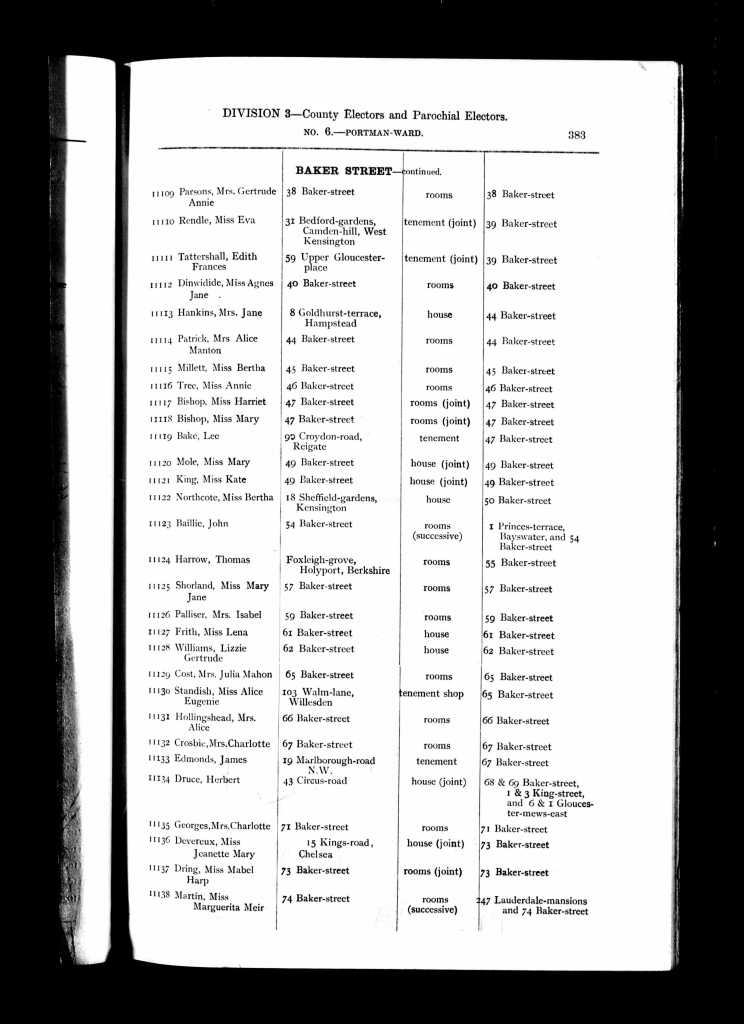
From the 1832-1965 London, England, Electoral Registers, we know, Charlotte was residing at 67 Baker Street, Marylebone West, Westminster, London, England, in 1907.
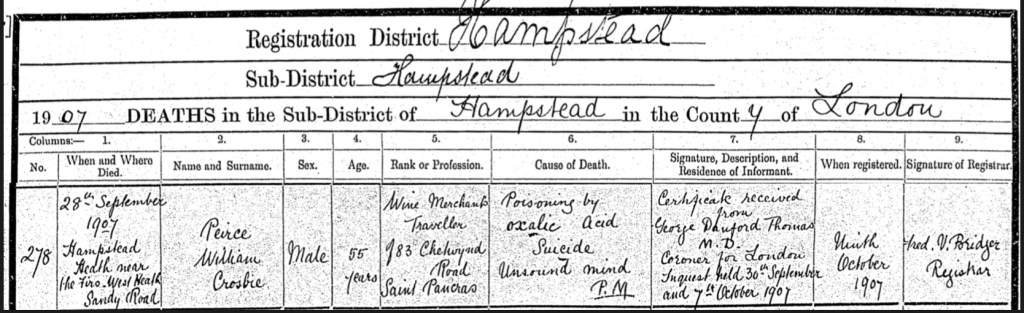
Charlotte’s husband, 55-year-old, wine merchant Traverler of number 83, Chetwynd Road, Saint Pancras, Pierce William Crosbie sadly died on Saturday the 28th of September 1907, at Hampstead Heath near the final, West Heath Sandy Road. Pierce died from committing Suicide, by Poisoning himself with Oxalic Acid, while suffering from an unsound mind. His certificate we received from George Danford Thomas, medicinal director coroner from London. An inquest was held on Monday the 30th of September 1907 and ended on Monday the 7th of October 1907. Pierce’s death was registered on Wednesday the 9th of October 1907.
Once again, I envision Charlotte sitting at her desk, with her ink and pen, writing out her emotions in her diary. I imagine her entry would be something along the lines of this,
September 28th, 1907.
Dear Diary, Today, the world shattered around me. Pierce, my once beloved, has departed from this life in a manner that leaves my heart shattered and my soul adrift in a tempest of emotions. The news arrived like a thunderbolt, ripping through the fabric of my reality. Pierce, estranged though he may have been, was once the anchor of my life. The man I loved, the one with whom I shared dreams and aspirations, now lies in the clutches of an unfathomable abyss. His decision to bid farewell to this world has left me grappling with an agony that knows no bounds. In the beginning, our love was a symphony, harmonious and enrapturing. But as time unfolded, its melody turned discordant. The rifts widened, and the chasm between us grew insurmountable. Our paths diverged, leaving behind scars of irreconcilable differences. Yet, despite the estrangement, he remained a part of my story. His struggles, his joys, and his sorrows were woven into the fabric of my existence. And now, to comprehend that his pain reached such depths, depths he felt could only be soothed by departure, is a burden too heavy for my heart to bear. Questions swirl within me, tormenting my thoughts with their unanswerable weight. Could I have done more? Should I have reached out despite the chasm that separated us? The echoes of regret reverberate, taunting me with their haunting refrain. The ache of his absence is compounded by the tumultuous waves of emotions crashing against the shores of my soul. Grief, guilt, and an inexplicable sense of loss envelop me like a suffocating shroud. I mourn not just the man he was, but the dreams we once dared to share, the hopes that now lie shattered in the wake of his final act. The world continues its ceaseless march, unaware of the tempest raging within. London bustles with its daily affairs, its inhabitants consumed by their own pursuits. Yet, within the confines of my solitude, the world feels devoid of colour, drained of its vibrancy. Pierce’s departure leaves behind a void that time may never fill. The memories, both beautiful and tumultuous, now flicker like fragile candle flames in the recesses of my mind. I grasp at them desperately, afraid that they might fade into oblivion. In this moment of profound loss, I seek comfort in the fragments of memories that bind us. I pray that he finds the peace that eluded him in life, that wherever his spirit may wander, it finds respite from the pain that haunted him. The pages of life turn relentlessly, yet today, time stands still for me. I mourn not just the passing of a man, but the unravelling of a chapter in my own story, a chapter entwined with love, strife, and the unspoken echoes of what could have been. Yours in sorrowful reflection, Charlotte.
Charlott’s Husband, Pierce Crosbie, was laid to rest, on Friday the 4th of October 1907, at Hampstead Cemetery, Camden, London, England, in grave, C7/49. He was buried with 5 others, Charles Frederick Harnack, buried 02 October 1907, Emily Elizabeth Stilton buried 01 October 1907, Matthew William Sharp buried 30th September 1907, Wilson, John 25 September 1907 and Richard Ebrey, buried 25th September 1907.
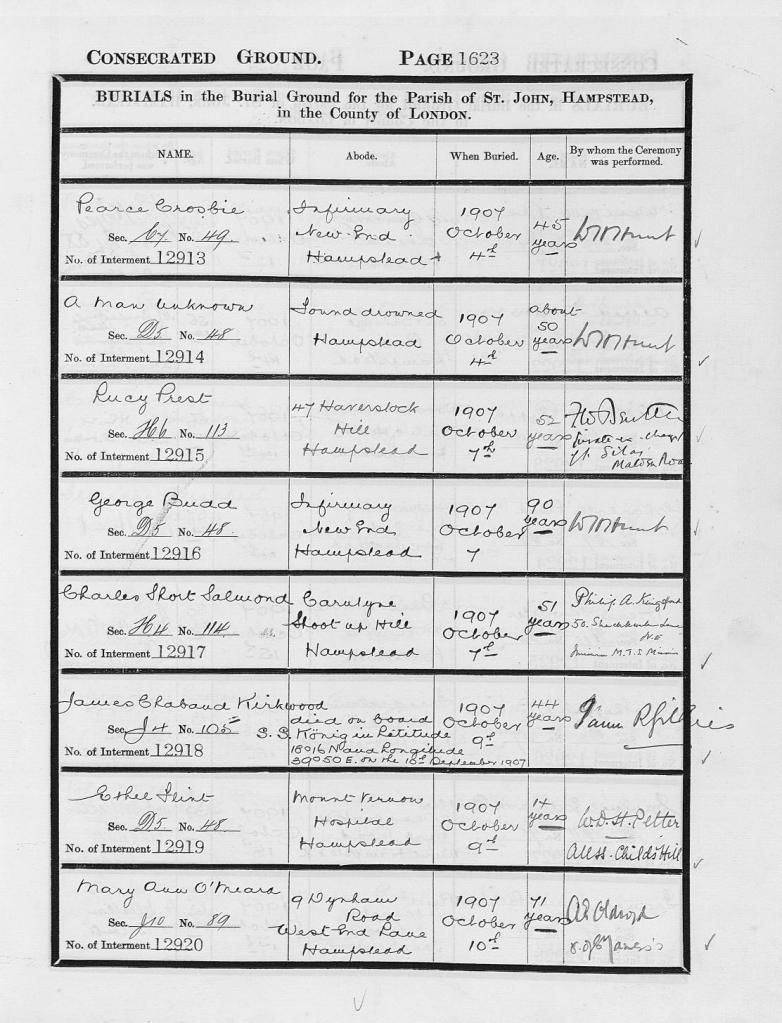
Hampstead Cemetery is a historic cemetery in West Hampstead, London, located at the upper extremity of the NW6 district. Despite the name, the cemetery is three-quarters of a mile from Hampstead Village, and bears a different postcode. It is jointly managed by Islington and Camden Cemetery Service and opens seven days a week, with closing times varying throughout the year.
Hampstead Cemetery is situated on Fortune Green Road and is bordered on the northern side by the sports ground of University College School. A public footpath running from Hocroft Road to Fortune Green runs through the cemetery, effectively splitting it in two.
Hampstead Cemetery was consecrated by the Bishop of London and opened in November 1876. The entire site covers 26 acres (0.11 km2), and an estimated 60,000 people are buried there. While there are no new grave spaces available, there is an area for cremated remains to the north of the cemetery, by the Fortune Green Road exit.
The cemetery has a pair of Gothic style mortuary chapels, both of which are Grade II listed buildings. The southern chapel was originally Anglican, and the northern non-conformist; they share a common porte-cochère. Currently, only the southern chapel is in use as an inter-faith place of worship. There is also an entry lodge made of Kentish Rag and Bath stone. The Heritage Lottery Fund has funded restoration work on the buildings.
A large number of Celtic crosses can be found in the area to the southwest of the chapel, marking the presence of several Scottish families. The northeastern corner has some notable examples of modern and Art Deco stonemasonry, in particular the Bianchi monument and the sculpted church organ in memory of Charles Barritt.
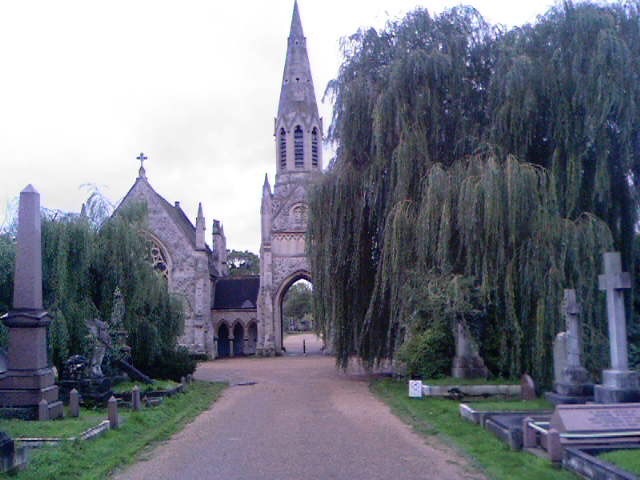
A newspaper paper article, about the suicide of Charlotte’s husband, Pearce Crosbie, was printed on the 12th of October 1907, in the Hampstead & Highgate Express.
It reads,
SUICIDE ON HAMPSTEAD HEATH.
On Monday Mr. Walter Schroder held an adjourned inquest at the Hampstead Provident Dispensary Hall. Newend, respecting the death of Pearce Crosbie, aged fifty-five. a wine and spirit traveller, who was found dead on Hampstead-heath on Sept. 28th. The evidence showed that deceased had been living apart from his wife, who was in Ireland, for about fifteen years, and for some months prior to Sept. 16th he was living in Chetwynd-road, Highgate-road, with a woman named Emily Marlow, who had been separated from her husband about seven years. On Sept. 16th he went away from her, but she saw him again on the 20th. On the evening of Sept. 27th he was found drunk in Archway-road. Highgate, bleeding from a wound over the left eye, and was taken into custody. At the police station he would not allow the divisional surgeon to examine him. He was placed in the cells, and late at night he was allowed out on bail to appear at the North London Police Court on the following morning. That he failed to do, and in the afternoon his dead body was discovered on Hampstead Heath by a boy who was blackberrying there. In his possession was an envelope, on which was written. “ This is all through ”- giving a name which was not read out by the comoner. Mr. Richard Willats, a surveyor. father-in-law of the deceased. said the latter was formerly a doctor at Barnsbury. Mr. J. T. Chapman, a publican, of High Barnet, with whom the deceased had heen staying, said the deceased arrived at his house shortly after midnight on Friday. Sept. 27th, after having been bailed out from the police station, and left again at nine o’clock in the morning. He appeared to have a great deal of trouble. Dr. Norman Evans said he found a large quantity of oxalic acid in the stomach of deceased, which was the cause of death. The jury returned a verdict of “Suicide whilst of unsound mind.”

Across the pond, Charlotte’s brother, 43-year-old, widower and salesman, Arthur Charles married 30-year-old, spinster and actress, Ruth Gadsby, on Wednesday the 17th of June 1908, at Niagara Falls, Welland, Ontario, Canada.

And back in rainy England, Charlotte’s brother, 33-year-old, bachelor, Percy Sidney Willats, married 25-year-old, spinster, Sophie Ann Smart on Saturday the 24th of July 1909 at The Register Office, Edmonton, Middlesex, England. Their witnesses were, E. P. Willats and J H Champion. Percy gave his occupation as an auctioneer. They gave their abode as Number 11 The Quadrant, Winchmore Hill, Edmonton. They gave their fathers names and occupations as, Richard Henry Willats, a auctioneer and John Smart, a Market Gardener.

Jumping forward to the year 1911, George V was sat upon the throne.
It was the 30th Parliament and H. H. Asquith (Liberal) was Prime Minister.
In 1911, the United Kingdom was undergoing significant societal changes, with a noticeable divide between the rich and poor that permeated various aspects of life. The atmosphere was marked by a growing tension stemming from social inequalities and the disparities in wealth distribution.
The gap between the affluent and the impoverished was stark. The upper class still enjoyed a life of luxury and opulence, with access to lavish homes, fine dining, and extravagant social events. They also still held significant influence in politics and society, shaping policies to their advantage.
Conversely, the working class faced harsh living conditions and economic hardships. Many worked in factories or mines under grueling conditions for meager wages, struggling to make ends meet. Poor housing conditions still plagued urban areas, with overcrowded and unsanitary living spaces contributing to health issues.
Sanitation was a considerable concern during this period, particularly in densely populated urban centers. Access to clean water and proper waste disposal was limited for many in the lower socioeconomic strata, leading to the spread of diseases and high mortality rates, especially among children.
In terms of travel, the means were transitioning. While railways had long been a prominent mode of transportation, automobiles were gaining popularity among the wealthy. However, for the majority, reliance on public transportation like trams and buses persisted, and walking remained a common mode of commuting for the working class.
Historically, the year 1911 witnessed several significant events in the UK. One of the pivotal moments was the Parliament Act, which restricted the powers of the House of Lords, curtailing its ability to veto legislation passed by the House of Commons.
Moreover, the suffragette movement advocating for women’s rights was in full swing. Suffragettes organised various protests and demonstrations, demanding the right to vote for women. The movement gained momentum, although women’s suffrage wouldn’t be fully achieved until later in the decade.
Culturally, the arts were flourishing, with innovations in literature, music, and theater. Authors like D.H. Lawrence and Virginia Woolf were making their mark in the literary world, contributing to the vibrant cultural landscape of the time.
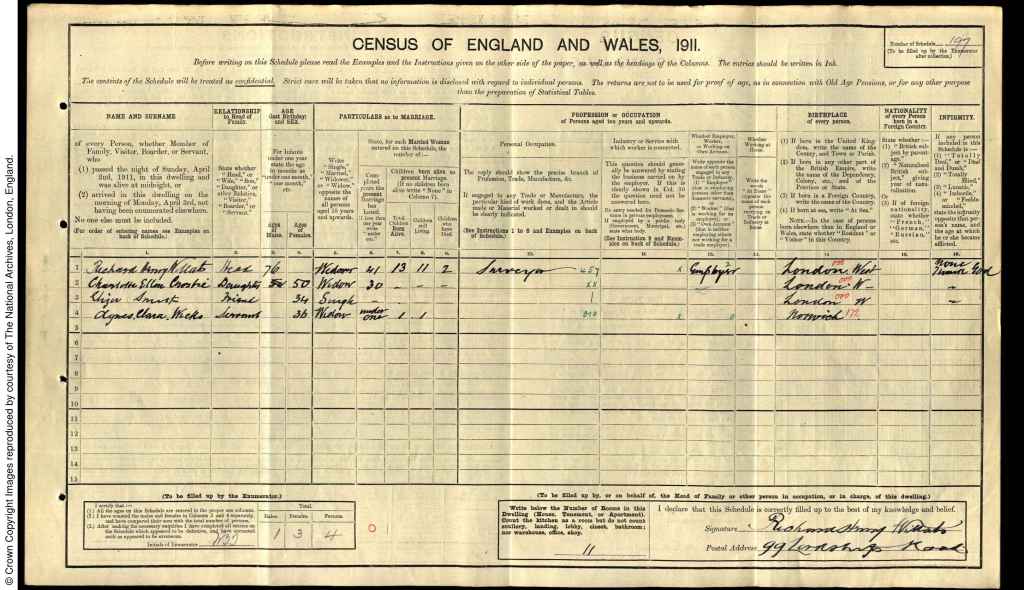
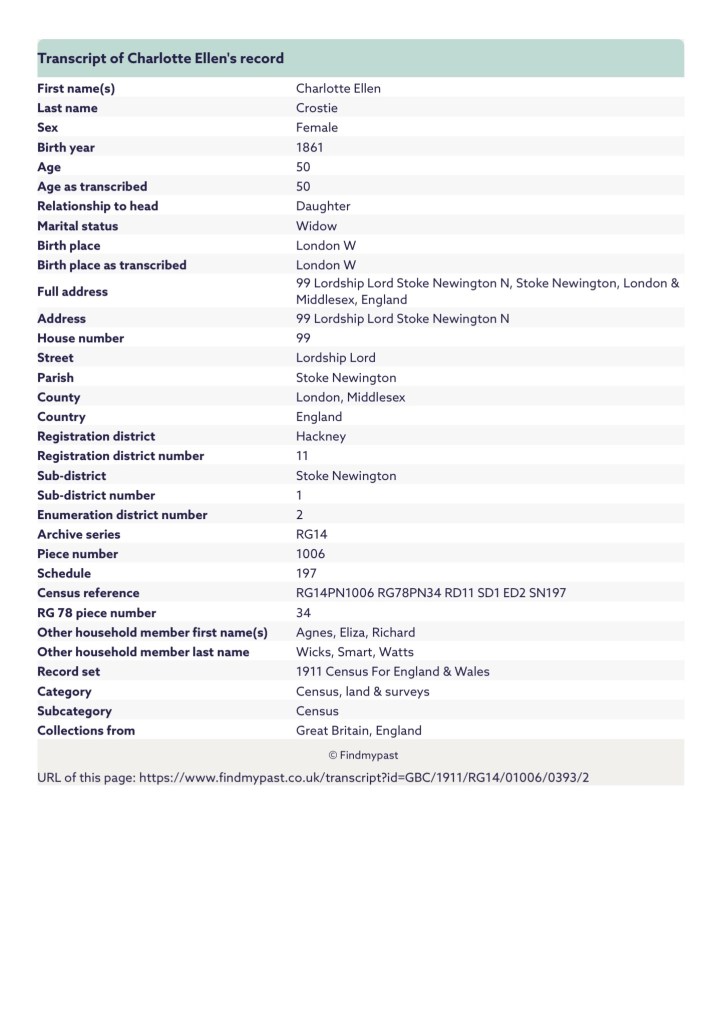
It was also the year of the 1911 census, which was taken on Sunday the 2nd of April 1911. It shows Charlotte Ellen Crosbie, now a widow, and her father Richard H Willats, residing at, Number 99, Lordship Road, Stoke Newington North, Stoke Newington, Middlesex, England. Number 99, Lordship Road, Was an 11-room dwelling. They had a friend called Ellen Smart and a servant named Agnes Clara Wicks, residing with them. Richard was working as a Surveyor. Richard had filled out the section under Infirmity as “None Thank God.” 😂 Richard states that he was married for 41 years, had 13 children of which 11 were still living and two had died. Charlotte had been married for 30 years and had no children. Agnes was a widow and had been married under a year and had one living child. Ellen had never been married and had no children.

Charlotte’s sister, 43-year-old, widow, Lilly Jenny Neilson nee Willats, of Number 35, Yesbury Road, married 41-year-old, bachelor, and commercial clark, George Campbell Ferris, of Number 87, Winchester Stree, on Saturday the 23rd of October 1915, at The Register Office, Islington, London, England. Their parents were named as, George Coell Ferris, a commercial traveler (deceased) and Richard Henry Willats, an Auctioneer. Their witnesses were, Claude Eayes and J E Bailie. Lilly name was recorded as Lillian Jenny Neilson.

From Abey Park, Cemetery burial records, their is a great possibility that Charlotte had a baby born either in late December 1916 or January 1917. Her child was not named so I assume they were a stillborn. I have checked the GRO indexes for a birth and death but haven’t been able to locate one, which strengthens my belief that her baby wasn’t born alive. ☹️. Of course I can not confirm this to be 100% true but I could not, not mention it. I have contacted Abney Park to see if they have any further information. If I hear back from them, I will update in due course.
Charlotte’s possible child, Baby Crosbie sadly passed away before Tuesday the 9th of January 1917.
Charlotte’s possible child, Baby Crosbie was laid to rest on Tuesday the 9th of January 1917, at Abney Park Cemetery, Stoke Newington, Middlesex, England, in grave 127434 possibly renumbered 17434, (Grave Reference – Sec. I09, Index 7S08.) with Charlotte Ellen Crosbie, Amina Eliza Kathleen Reichert nee Charlton, Mabel Cameron Woollet Willats, and Eliza Smith.

Of course I could be barking up the wrong tree altogether so after a quick look at the death indexes for Crosbie’s whom died in the November to December quarter for 1916 and the January to March quarter of 1917, it could be anyone of these possibilities.

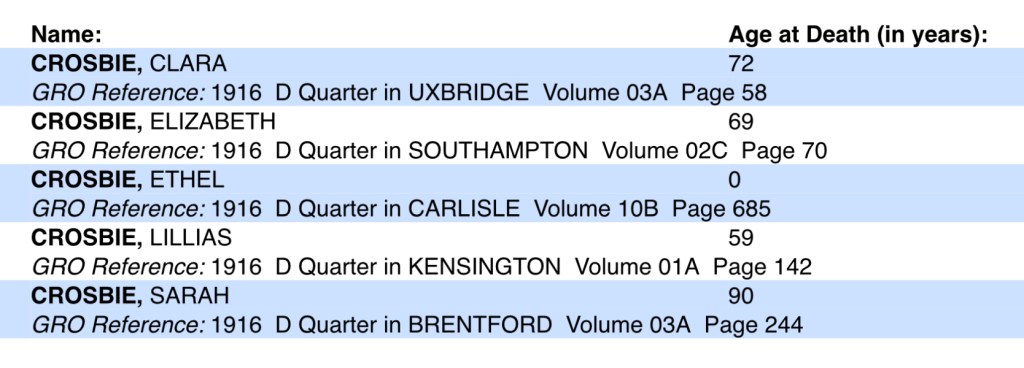

There were no males deaths in the deathkndexs for January to March Quater 1917.
Two death stand out more than the others, mainly down to location. So I ordered their death certificates.


Lillias Crosbie, looks promising. My first thought was that she could be Pierce’s sister. However, his name was John, a Gentu, (I am not sure what that stands for but I think it could be Gentleman.) where Lillias’s father is named William a deceased Banker. The address of Radcliff Garden rings a bell. I swear one of the Willats family members resided there.
Whoever this Crosbie person was if not Charlotte’s child, they must have been of great importance as Charlotte purchased this grave and was later buried with them.
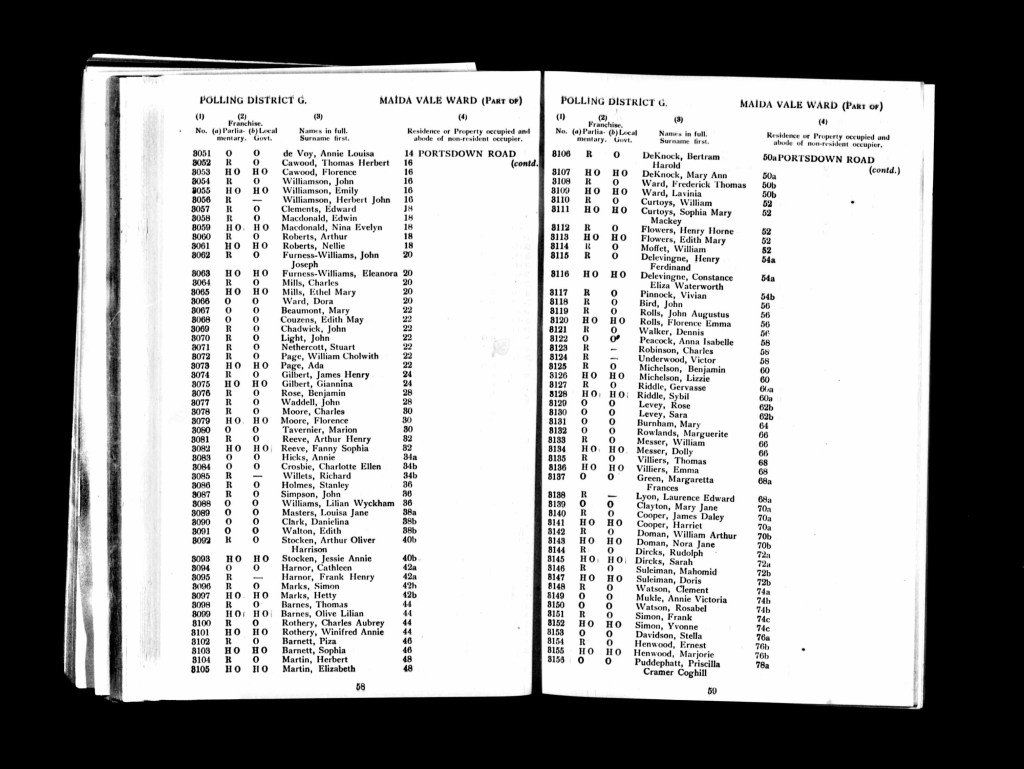
From the 1832-1965 London, England, Electoral Registers, we know, Charlotte was residing at 34 Portsdown Road, Paddington and St Marylebone, Westminster, London, England, in 1918. A lady named Annie Hicks was also residing there.
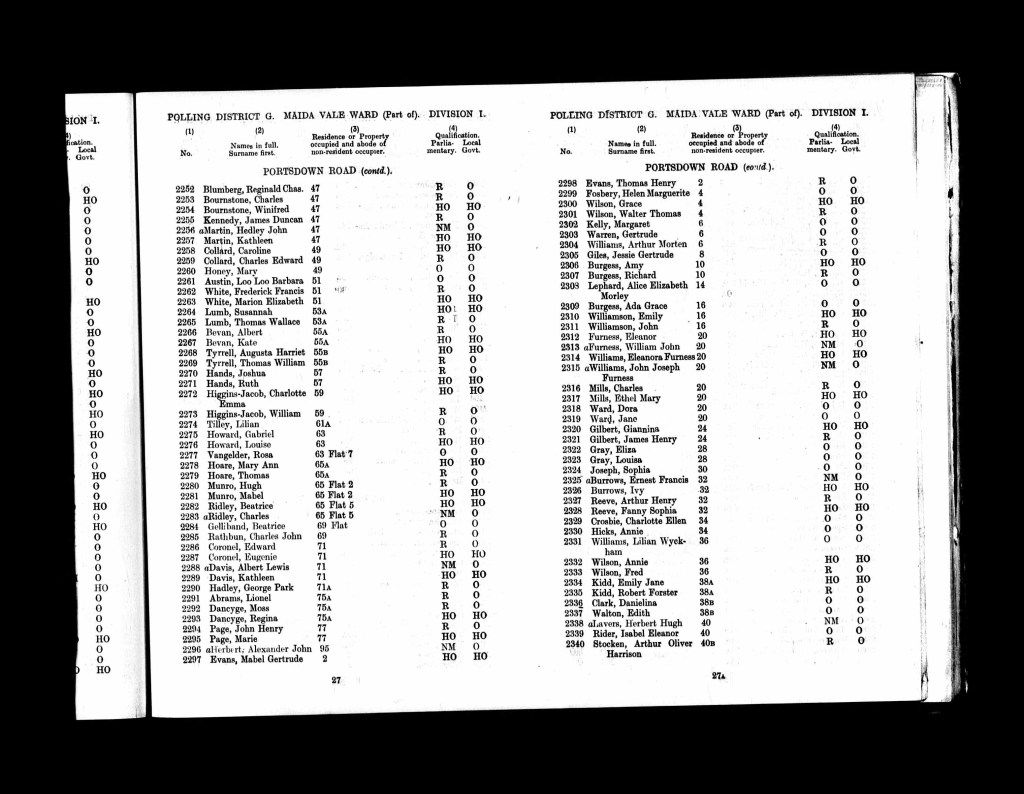
From the 1919 London, England, Electoral Registers, we know, Charlotte was residing at 34 Portsdown Road, Paddington and St Marylebone, Westminster, London, England, in 1919. Annie Hicks was still residing there.
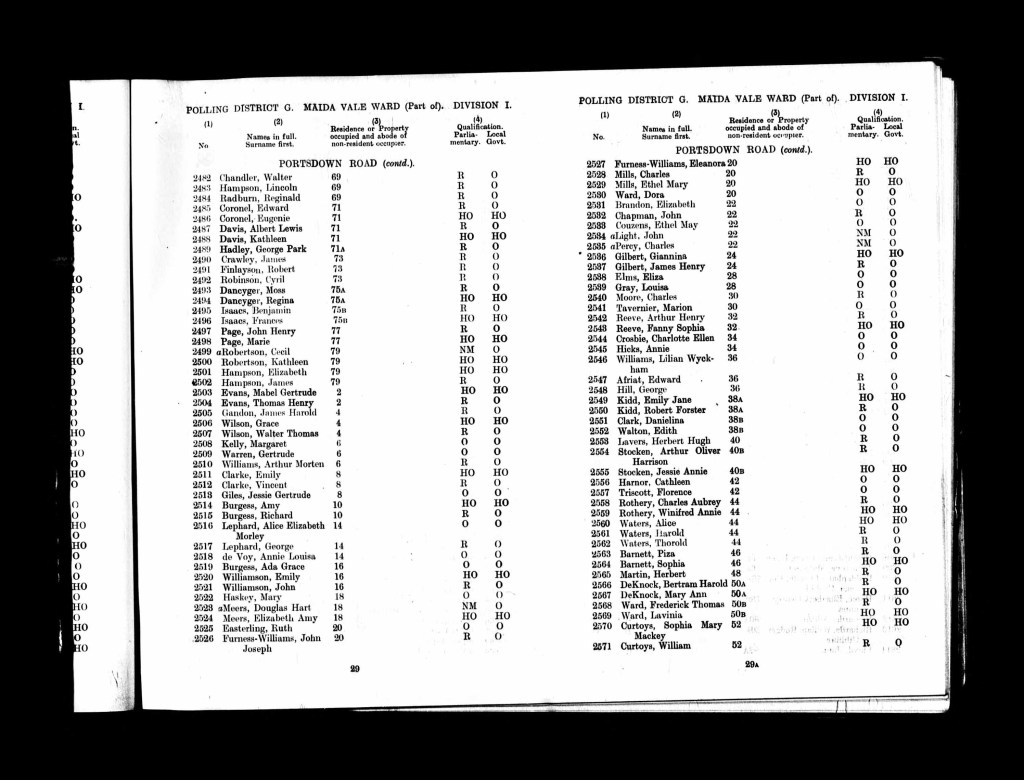
From the 1920 London, England, Electoral Registers, we know, Charlotte was residing at 34 Portsdown Road, Paddington and St Marylebone, Westminster, London, England, in 1920. Annie Hicks was also still residing there. Charlotte’s father, Richard was residing at 34b.
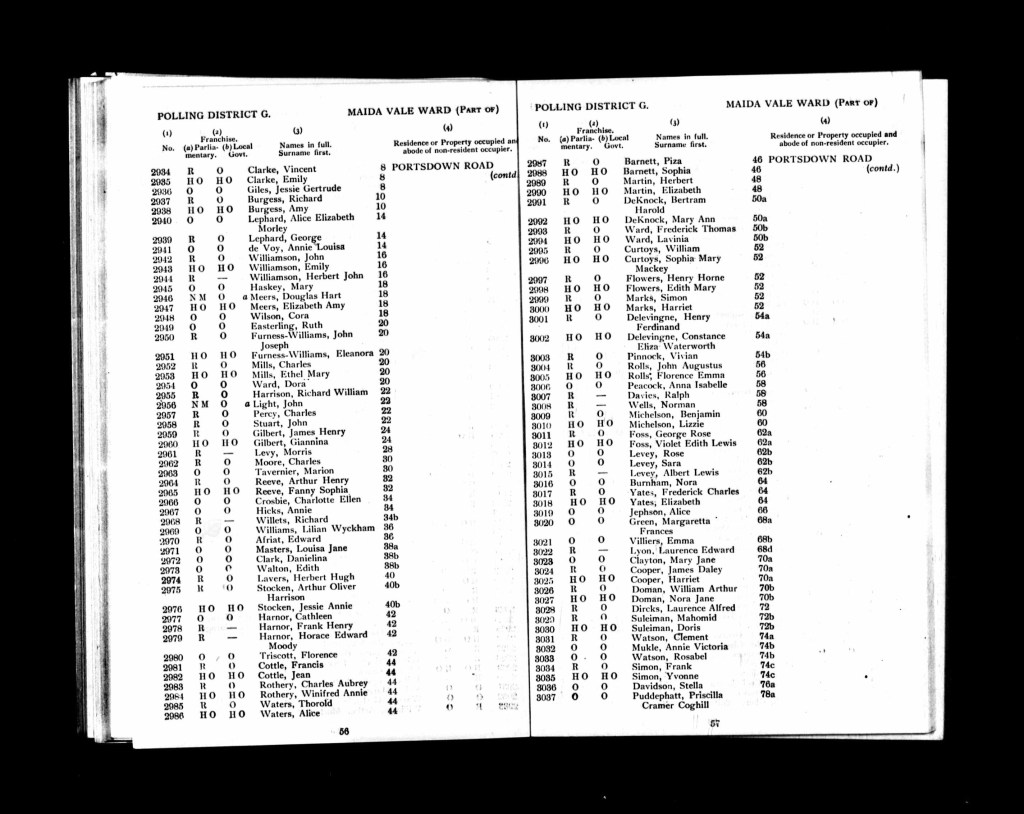
There is a second entry in the 1920 London, England, Electoral Registers. It shows Charlotte was residing at 34b Portsdown Road, Paddington and St Marylebone, Westminster, London, England, with her Father Richard Willats, in 1920.

Charlotte’s brother, 48-year-old, Architects Draftsman, Edwin Paul Willats, sadly passed away, on Monday the 5th of July 1920, at Number 52, Grove Park Road, Tottenham, Edmonton, Middlesex, England.
Edwin died from Pulmonary Tuberculosis and Hemoptysis cardiac failure. Certificated by Gordon Miller mb. No post-mortem was taken.
Edwins sister in-law, Amelia Ellen Willats nee High, of 132, Landsdowne Road, Tottenham.

A E Willats aka Amelia Ellen Willats nee High, Charlotte’s sister-in-law, was present and registered Edwins death on, Tuesday the 6th of July 1920, in Edmonton.
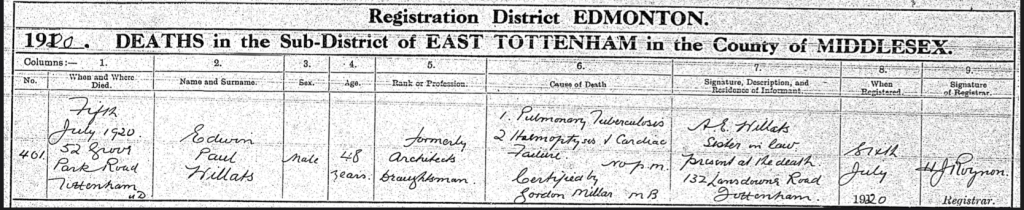
The Willats family and friends laid Edwin Paul Willats, to rest at, Abney Park Cemetery, Stoke Newington, Hackney, London, England, in Section, D06, Index 7S03, on Saturday the 10th of July, 1920.
He was buried with other family members.

Heartbreakingly death continued to plague the family. Charlotte’s brother, 63-year-old, Insurance Manager, Francis Montague Allan Willats, sadly passed away on Sunday the 19th of September 1920, at Wymondley Heathgate, Hendon, Middlesex, England. He died from Chronic interstitial hepatitis several years, certified by H. Stedman. No post-mortem was taken.
Francis’s son, Allen Montague Willats was present and registered his death on Tuesday the 22nd September, 1920, in Hendon.

Charlotte and family laid Francis Montague Willats, to rest, on Tuesday the 21st September 1920, at Highgate Cemetery, Camden, London, England, grave reference /40479. He was buried with 7 others, Frances Jessie Willats, buried 16th September 1976. Allan Montague Willats, buried 2nd March 1968. Dorothy Beaumont Willats, buried 9th April 1965. Margaret Eliza Craddock, buried 1st January 1961. David Allan Willats, buried 5th February 1948. Margaret Jane Willats, 25th October 1937 and Horace Lennan Willats, buried 19th December 1916.

The following year, on Sunday the 19th of June 1921, the UK census was taken, it shows Charlotte and her father Richard, were still residing at, 34, Portsdown Road, Paddington, London, England, a 9-room dwelling.
The census also states that they had a 45-year-old lady called Eliza Smith residing with them. Eliza was listed as their niece.
However, I believe this to be incorrect due to the information in Charlotte’s last will and testimony.
The census also states that Charlotte and Eliza occupations are Home Duties and Richard is a late surveyor. (no occupied).
There are a good few mistakes on this census return.
Charlotte is named as Charlotte Ellen Garbie. Richards’s place of birth was given as Ireland, S Pannas and Charlotte’s birth place was transcribed as Chautt Shil, Saltund Hea.
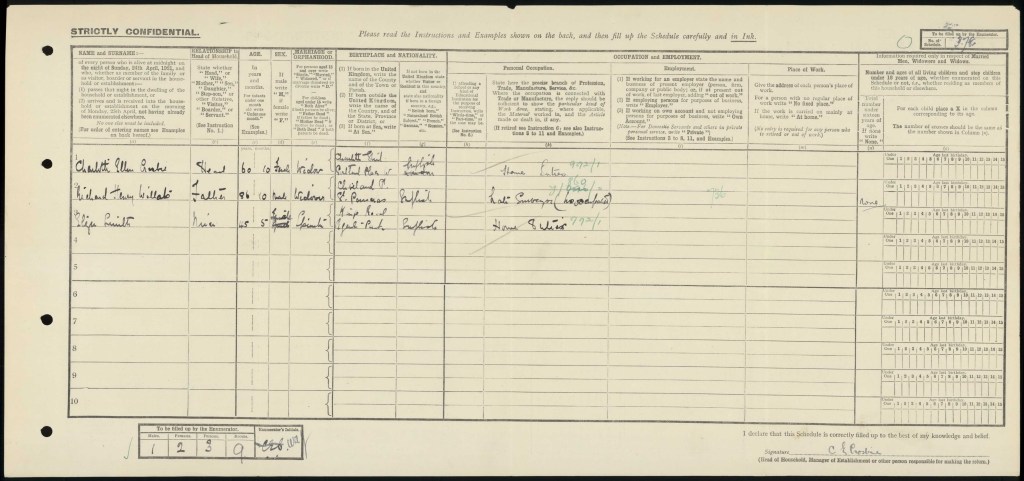
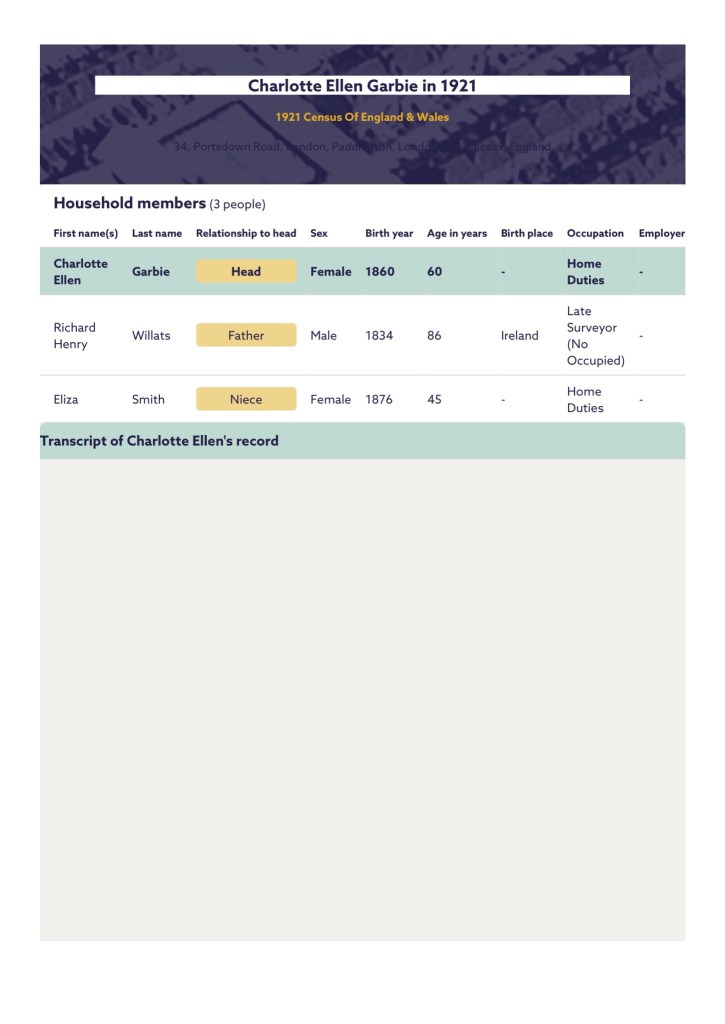
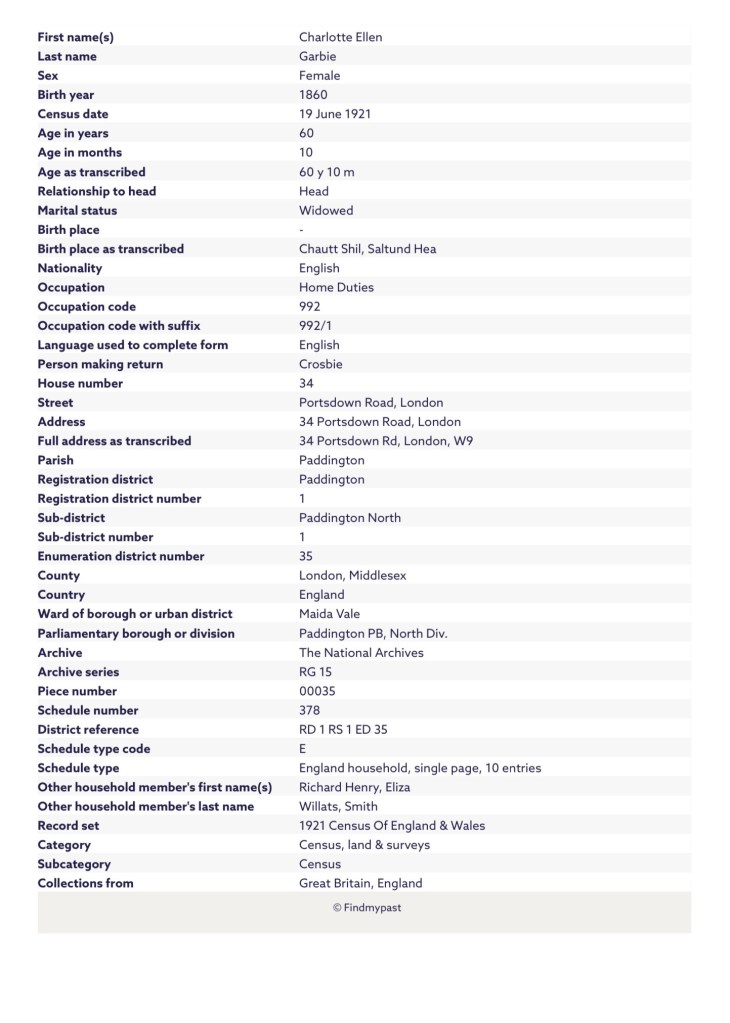
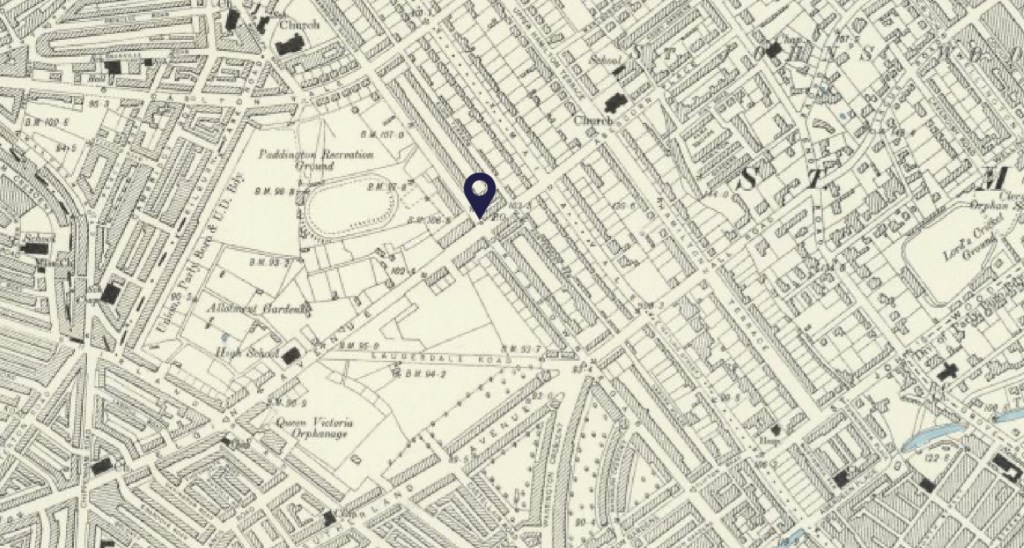
The 1921 London, England, Electoral Registers, confirms, Charlotte was residing at 34b, Portsdown Road, Paddington and St Marylebone, Westminster, London, England, in 1921, with her father, Richard Willats.
Charlotte wrote her Will on Tuesday the 16th of August 1921. It reads as follows,
I CHARLOTTE ELLEN CROSBIE of 34B Portsdown Road Maida Vale in the County of London Widow hereby revoke all wills and testamentary dispositions heretofore made by me and declare this to be my last will I desire to be buried in the grave belonging to me at Abney Park Cemetery which I bequeath to my dear friend and companion Eliza Smith so that she may be buried with me I appoint my brother Henry Richard Willats and my — friend George Thomas Hancock of 50 Fairholt Road Stoke Newington in the County of London Eequire to be the EXECUTORS and trustees of this my will and they or other the trustees or trustee for the time being of this my will are hereinafter referred to as “my trustees or trustee” And in the event of either of them dying in my lifetime or being unable or unwilling to act then I appoint my brother Walter James Willats to be an executor and trustee of my will and in the event of both of them dying in my lifetime or being unable or unwilling to act then I appoint the said Walter James Willats and my brother Frederick Howard Willats to be the executors and trustees of my will I give tothe said George Thomas Hancook the sum of twenty five guineas if he shall accept the office of executor and trustee I bequeath the following legacies to be paid immediately after my decease namely To my sisters Ada Charlton Lilly Ferris and May Champion and the said Eliza Smith and Henry Richard Willats as a small memento and to my brothers Arthur Charles Willats, Walter James Willats, Sidney Percy Willats and Frederick Howard Willats the sum of ten pounds each in addition to the foregoing legacies I bequeath the following legacies to be paid as soon as conveniently may be after my decease namely To my said three sisters and five brothers and the said Eliza Smith the sum of ninety pounds each And I direct that if any one or more of my said sisters and brothers and the said Eliza Smith shall die in my lifetime the additional legacy or legacies bequeathed to such one or more of them so dying shall be divided equally between such of them as shall be living at my decease I also bequeath to Nellie Willats the widow of my late brother Edwin Willats the sum of twenty pounds if she shall-not have married again at my decease I also give to any of my said brothers and sisters any sum of money which may be owing by him or her to me at my decease I bequeath to my father the use during his life of the six chairs covered in leather and two easy chairs covered in velvet which formerly belonged to him two large bronzes in my dining room one large marble clock in my bedroom the overmantle in my small sitting room my large dining room sideboard my dining room fender and fire irons the two large oil paintings in my dining room the Turkey carpet and the table in my sitting room the contents of his bedroom and such other articles as the said Eliza Smith shall select for his own personal use and after his death I bequeath the six chairs carved in leather and the sideboard to the said May Champion one of my easy chairs to each of my brothers Walter James Willats and Sidney Percy Willats and the contents of his bedroom to the said Ada Charlton or if she does not require them to the said May Champion and I direct that the remainder of such articles shall fall into and form part of my residuary estate I also bequeath the following specific legacies namely To the said Ada Charlton my turquoise and diamond ring my gold watch and one large easy chair from my drawing room To the said Lilly Ferris my large half hoop diamond ring and my pearl earrings To the said May Champion my small half hoop diamond ring and gold chain bracelet To the said Walter James Willats my gold albert chain To the said Frederick Howard Willats the watch which formerly belonged to our mother To my niece Margaret Eliza Craddock my small sapphire and diamond French ring my Victorian necklace and my silver card case To my niece Frances Willats my gold cross my silver note case and my small drawing room glass table and contents To my niece Mabel Willats my large half hoop sapphire ring the two engravings in my bedroom and the vase of Coalport china in my drawing room To my niece Joy Willats my pair of diamond earrings To my said three sisters or such of them as shall be living at my decease my wearing apparel to be equally divided between them if more than one by the said Ada Charlton and Eliza Smith or the survivor of them whose decision shall be final and to Rose Hancock the wife of the said George Thomas Hancock the two china vases on the console table in my drawing room my blue and white rose bowl and my French paste brooch I bequeath to the said Eliza Smith my business of a medical electrician at present carried on by me at 34B Portsdown Road aforesaid with the goodwill thereof and the liberty to carry on the same under my name if she so desires and all recipes prescriptions batteries instruments furniture and other things appertaining thereto or used in connection therewith and all debt owing to me in respect of such business and also my wedding ring my marquise diamond ring my large gold heart my gold chain bracelet with six charms attached my piano gramophone and records chess and other games my umbrella my dressing bag my Goss china all my plates linen household china cutlery glass and kitchen utensils my washing and knife machines the linoleum in the small bedroom upstairs the whole of the furniture ornaments and effects in my dining room my own bedroom and my kitchen the carpet and rugs on my stairs and landings the oak hatstand and bench the clock the two black pedestals and ornaments and four Japanese brass trays and large pictures in my hall the table the small mahogany dressing table and the carpet in her own bedroom and the following articles in my drawing room namely carpet and fur rugs overmantle china on mantleshelf belonging to me fender and fire irons brasses and screens curtains bookcase with contents one large and one smaller inland cabinets one music cabinet with contents one inland table one fancy armchair and one plain armchair to match one fancy velvet seat three large panels of roses etc and a black satin painting I bequeath the following annuities namely To the said Eliza Smith an annuity of eighty-five pounds during her life or until she shall assign or charge the said annuity or any part thereof or do or suffer any act or thing whereby the said annuity or any part thereof if belonging absolutely to her would become vested in or payable to some other person – And to my father an annuity of sixty five pounds during his life such annuities to be paid quarterly and the first of such quarterly payments to be made at the end of three calendar months after my decease I direct that all legacies and annuities hereinbefore bequeathed shall be paid and enjoyed free of death duties I devise and bequeath all my estate not hereby or by any codicil hereto otherwise disposed of unto my trustees or trustee Upon trust that my trustees or trustee shall sell call in and convert into money such part thereof as shall not consist of money with power to postpone such sale and conversion for such a period as my trustees or trustee without being liable to account may think proper and so that any reversionary interest be not sold until it falls into possession unless my trustees or trustee see special reason for sale and I direct that the income of my personal estate however invested shall from my death be treated and applied as income and no part thereof shall be added to capital And I direct that my trustees or trustee shall out of the money to arise from such sale and conversion and out of my ready money pay my funeral and testamentary expenses death duties and my debts and shall also pay or provide for the legacies hereby or by any codicil hereto bequeathed and the duty on all legacies and annuities bequeathed free of duty and shall in the first place set apart out of the residue of the said money and invest in their or his names or name in any investments authorised by law for the investment of trust funds such sum as will when invested produce by the income thereof the amount of the annuity hereinbefore given to the said Eliza Smith and shall apply the income or (if necessary) the capital of the fund so set apart (hereinafter called the first annuity fund) in payment of such annuity while payable and shall in the next place set apart out of the residue of the said money and invest as aforesaid such sum as will when invested/by (produce) the income thereof the amount of the annuity hereinbefore given to my father and shall apply the income but not the capital of the said last mentioned fund (hereinafter called the second annuity fund) in payment so far as the same will suffice of the annuity to my father while payable but if the residue of the said money remaining after setting apart the first annuity fund shall not be sufficient to produce by the income thereof when invested the amount of the annuity hereinbefore given to my father then the last mentioned annuity shall be reduced to such lesser sum as such income shall be sufficient to pay And upon the death of the said Eliza Smith I direct my trustees or trustee to pay out of the first annuity fund the following – charitable legacies all free of duty namely To the Society for Disabled Soldiers now or formerly of the Star and Garter Richmond the sum of two hundred pounds To the St Dunstans Hostel for Blinded Soldiers and Sailors the sumn of two hundred poundes To the Dumb Friends League for Horses of Victoria Street Westminster the sum of fifty pounds To the Royal Surgical Aid Society of Salisbury Square Fleet Street the sum of twenty guineas To the Mission to Lepers of 33 Henrietta Street Covent Garden the sum of twenty guineas To Doctor Barnardos Homes of 18 to 26 Stepney Causeway the sum of twenty guineas To the Church Army of 55 Bryanston Street Marble Arch the sum of twenty guineas To the Salvation Army of 101 Queen Victoria Street the sum of twenty guineas And to the Bishop of Londons Poor Clergy Fund the sum of thirty guineas and I direct my trustees or trustee to stand possessed of the balance of the first annuity fund remaining after payment of the said charitable legacies and the duty thereon in trust for such one or more of my brothers and sisters as shall be living at the death of the said Eliza Smith and if more than one in equal shares and upon the death of my father I direct my trustees or trustee to pay the income of the second annuity fund unto such one or more of my said three sisters and the said Eliza Smith as shall be living at the death of my father and to the survivors and survivor of them for and during the terms of their respective lives and if more than one in equal shares and upon the death of the survivor of my said three sisters and the said Eliza Smith I direct my trustees or trustee to stand possessed of both the capital and income of the second annuity fund in trust for such of my brothers as shall be living at the date of the death of the survivor of my said three sisters and the said Eliza Smith and ‘ if more than one in equal shares And as to all the residue of my estate not hereby or by any codicil hereto otherwise disposed of I devise and bequeath the same unto and equally between my said three sisters and the said Eliza Smith Provided always and I direct that (1) If the said Ada Charlton shall die in my lifetime the share of such residue which she would have taken if she had survived me shall go to her son Frank Charlton who is now residing in Australia or if he shall also die in my lifetime then to the children of my brother Sidney Percy Willats in equal shares (2) If the said Lilly Ferris shall die in my lifetime the share of such residue which she would have taken if she had survived/me shall go to the children of my late brother Edwin Willats in equal shares (3) If the said May Champion shall die in my lifetime the share of such residue which she would have taken if she had survived me shall go to her children in equal shares and (4) If the said Eliza Smith shall die in my lifetime the share of such residue which she would have taken if she had survived me shall go to the children of my brother Frederick Howard Willats I direct that if any beneficiary under this my will or any codicil thereto shall dispute or attempt to dispute anything contained in such will or codicil such beneficiary shall forfeit all interest thereunder And lastly I express a special request to my brothers Henry Richard Willats and Walter James Willats to do everything they can to look after the happiness and welfare of the said Eliza Smith IN WITNESS whereof I have hereunto set my hand this sixteenth day of August one thousand nine hundred and twenty one — CHARLOTTE E CROSBIE.– Signed and declared by the above named Charlotte Ellen Crosbie as her last will in the presence of us both present at the same time who in her presence and the presence of each other have hereunto set our names as witnesses ROBERT F FOX Maxwell House Arundel Street W C 2

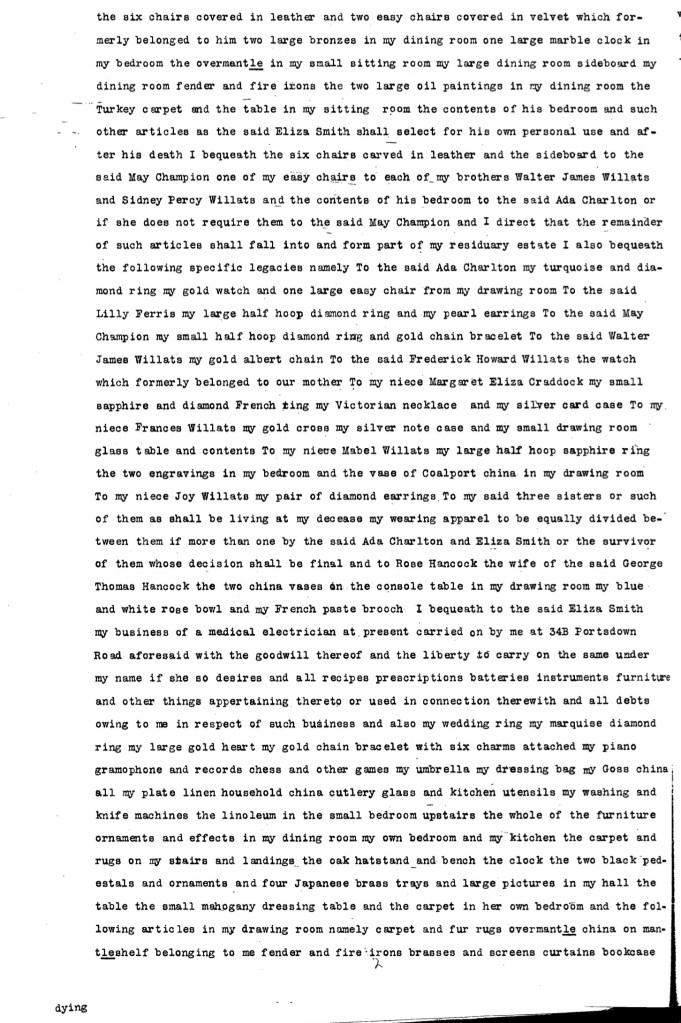

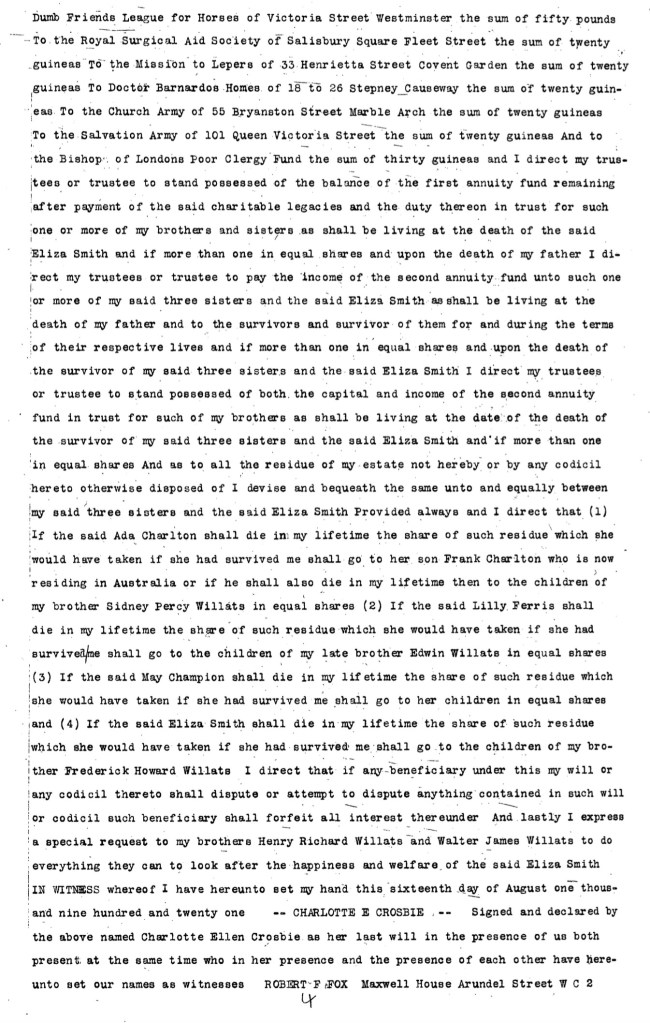
Charlotte’s brother, 67 years old, formerly Director of Limited Companies, Henry Richard Willats, passed away on Monday the 27th of November 1922, at 23 Barnmead Road, Beckenham, Bromley, Kent, England. Henry died from Chronic Naphritis 10 years and Cardinal Failure 6 months. Henry’s brother W J Willats (Walter James Willats) of Number 132, Lansdowne Road, was in attendance and registered Henry’s death on the same day as his death, Monday the 27th of November, 1922, in Bromley.

The Willats family laid, Henry Richard Willats to rest, on Friday the 1st of December 1922, at Abney Park Cemetery, Stoke Newington, Middlesex, England. His was buried in a family grave and was buried with Baby Thornton, Florence Jose Western nee Willats, Harry Ashley Willats, William Western Thornton, and Amelia Willats.

From the 1922 London, England, Electoral Registers, we know, Charlotte was residing at 34b, Portsdown Road, Paddington and St Marylebone, Westminster, London, England, in 1922, with her father, Richard Willats.
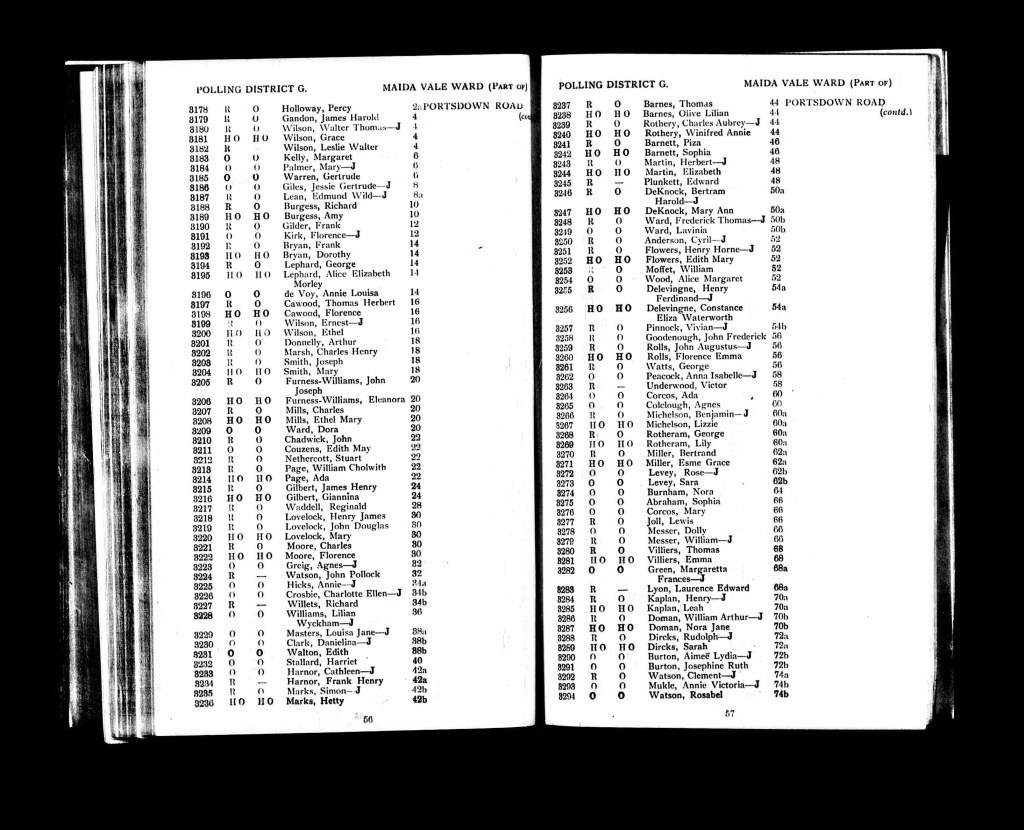
Charlotte altered her Will on Wednesday the 6th of June 1923, it reads as follows,
Solicitor JOHN H TWEEDALE Maxwell House Arundel Street W C 2 Solicitor
I CHARLOTTE ELLEN CROSBE of 34B Portsdown Road Maida Vale in the County of London widow declare this to be a first codicil to my will which is dated the sixteenth day of August one thousand nine hundred and twenty one and I revoke all previous codicil thereto In consequence of the death of my brother Henry Richard Willats I appoint my brother Walter James Willats to be an EXEOUTOR and trustee of my will with George Thomas Hancock appointed by my said will who now resides at *The Limes'” Roydon in the County of Essex and in the event of either of them dying in my lifetime or being unable or unwilling to act then I appoint my brother Frederick Howard Willats to be an executor and trustee in the place of the one so dying or being unable or unwilling to act I direct that the clause in my said will relating to the additional legacies thereby bequeathed to my sisters and brothers and Eliza Smith shall be read as if the additional legacy to the said Henry Richard Willats were omitted therefrom and I revoke the bequest to Nellie Willats the widow of my late brother Edwin Willats contained in my said will And whereas since the date of my said will my means have been very considerably reduced and I am consequently unable to give effect
to the charitable bequests contained in my said will in accordance with my original intentions Now I hereby revoke the pecuniary legacies which my said will I have directed my trustees or trustee to pay upon the death of the said Eliza Smith out of the first annuity fund mentioned in my said will to the Society for Disabled Soldiers St Dunstans Hostel for Blinded Soldiers and Sailors the Dumb Friends League for Horses the Royal Surgical Aid Society the Mission to Lepers Doctor Barnardos Homes the Church Army the Salvation Army and the Bishop of London Poor Clergy Fund and I direct that upon the death of the said Eliza Smith my trustees or trustee shall stand possessed of the whole of the first annuity fund in trust for such one or more of my brothers and sisters as shall be then living and if more than one in equal shares And in all other respects I confirm my said will IN WITNESS whereof I have hereunto set my hand this sixth day of June one thousand nine hundred and twenty three CHARLOTTE E CROSBIE
Signed and declared by the above named Charlotte Ellen Crosbie as a first codicil to her last will in the presence of us both present at the same time who in her presence and the presence of each other have hereunto set our names as witnesses — FRANCES JESSIE WILLATS “Brampton” Cedars Avenue Rickmansworth Spinster MARGARET ELIZA CRADDOCK “Brampton’ Cedars Avenue Rickmansworth Married
On the 13th day of June 1924 Probate of this will with one codicil thereto
was granted to Thomas George Hancook named in the will and Walter James Willats named in codicil the executors.
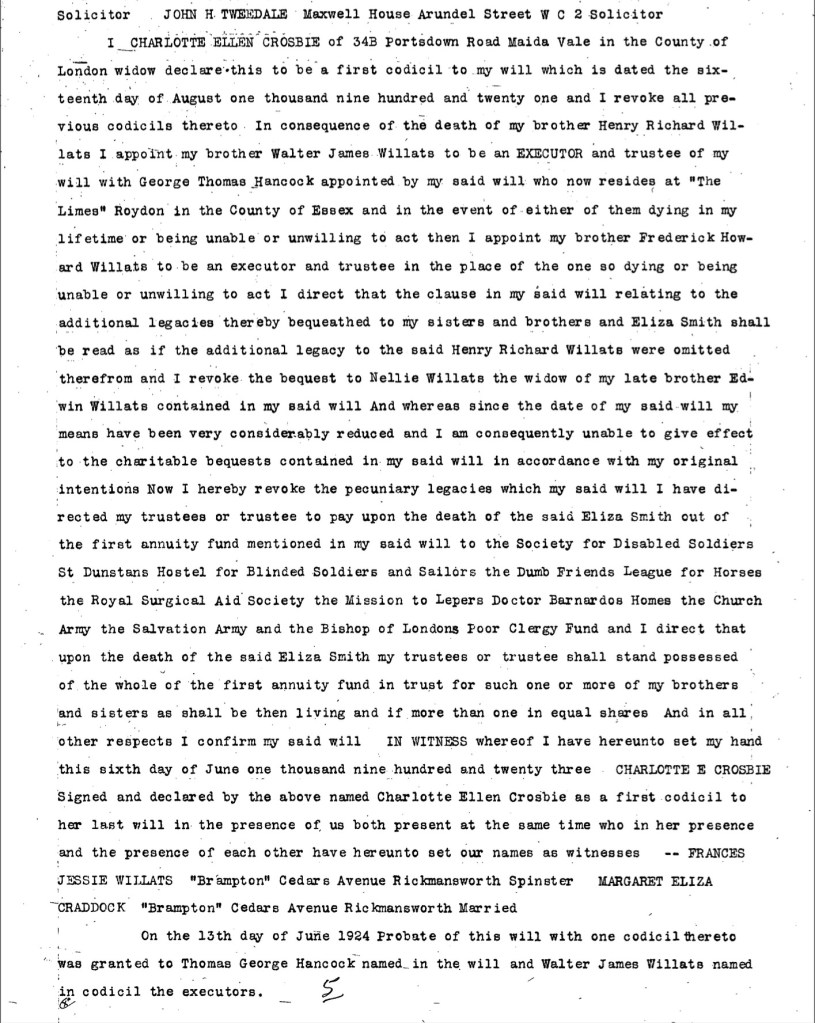
The 1923 London, England, Electoral Registers confirms that, Charlotte was residing at 84b Portsdown Road, Paddington, Westminster, London, England, in 1923, with her father, Richard Willats.

Charlotte’s heart shattered into a trillion pieces, as on, Thursday the 22nd of November, 1923, her beloved father, Richard Henry Willats, passed away. Richard died at their home, 34B Portsdown Road, Paddington, London, England, when he was 89 years old.

Richard died from, Bronchitis and Senility, the state of being senile, down to the weakness or mental infirmity of old age.
Richards son, Percy Sidney Willats of 27 Kings Road, Finsbury Park, was present and registered his fathers death on Saturday the 24th of November, 1923.
Percy, gave Richards occupation as a retired, auctioneer and surveyor.

Once again I ponder over the words Charlotte may have written in her diary, at the loss of her father and dearest friend. As I envision her entry, tears well in my own eyes, as I know to well, the excruciating pain she must’ve felt as, I did and still do, at the loss of my darling, dad. With my own heart full of sorrow I imagine it would read something upon the lines of this,
November 22, 1923.
Dear Diary, I cannot bring myself to put these words onto paper, but I must. Today, the world shattered into a million fragments, leaving me suspended in a void of profound sorrow and emptiness. My dearest father, my pillar of strength, my guiding light, has departed from this realm. His presence, so vivid and warm in my life, has been cruelly extinguished, leaving behind a void that nothing can ever fill. His death arrived like an unwelcome storm, tearing through the tranquility of our lives. I saw my dear Brother Percy’s pained expression, his trembling hands after holding our dear father’s hand as he took his last breath. A sudden chill pierced through my soul, forewarning me of the devastation that awaited. And when the words spilt out, confirming what my heart had dreaded, it felt as though the earth had ceased to turn, as though time had frozen in its tracks. Oh, Father, with your gentle wisdom and unwavering kindness, you were more than just a parent, you were my closest confidant, my unwavering support, my companion in every adventure. Your laughter echoed in the halls of our home, bringing warmth and joy to even the coldest of days. Your stories, rich with wisdom and love, were the cornerstone of my understanding of the world. The ache in my heart feels insurmountable. How can one find solace when a piece of their soul has departed? How can I continue, knowing that your comforting presence will no longer grace our lives? The memories, though precious, now cut deeper than any sorrow I’ve ever known. The warmth of your embrace, the sound of your voice, they linger as bittersweet echoes, tormenting me with their absence. The world seems a torturous place today. The skies weep in unison with my heart, mourning the loss of a remarkable soul. Yet, amidst this desolation, I must carry your legacy forward. Your teachings, your love for life, your unwavering optimism shall remain etched within me, guiding my steps through this bleak unknown. Oh, Father, how I wish for just one more moment, one more chance to tell you how much I love you, to thank you for every lesson, every smile, every ounce of love you bestowed upon all your twelve children, especially me. As the stars flicker in the night sky, I send my whispered prayers to the heavens, hoping they find their way to you and to Mother. I hope you are reunited with your eternal love, your soulmate, our dear Mother. Rest peacefully, my dearest Father. You shall forever be the brightest star in my universe. Yours always,
Charlotte.
Richard was laid to rest, on Tuesday the 27th of November, 1923, at Abney Park Cemetery, Stoke Newington, Hackney, London, England, in grave D06 092431 with his wife, Eliza Willats nee Cameron, his sons Francis Paul Willats and Percy Sidney Willats. And his Stepson/nephew William George Willats. (My 3rd Great-Grandfather.)
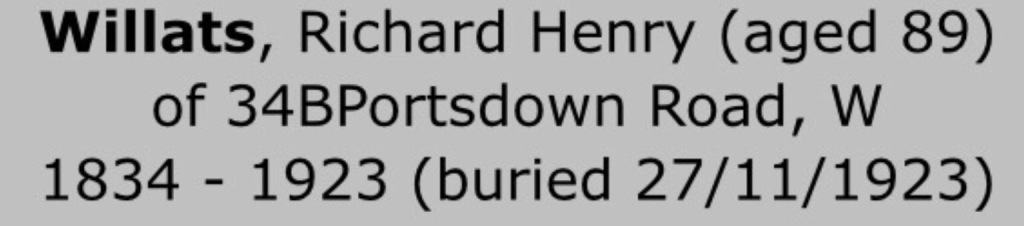
The 1924 London, England, Electoral Registers confirms that, Charlotte was residing at 84b Portsdown Road, Paddington, Westminster, London, England, in 1924. It states that Charlotte was living alone, but from Charlotte’s Last Will and Testament, we know that Charlotte’s companion Eliza Smith was living with her in 1923, even though Eliza hasn’t been named on any previous Electoral Registers.
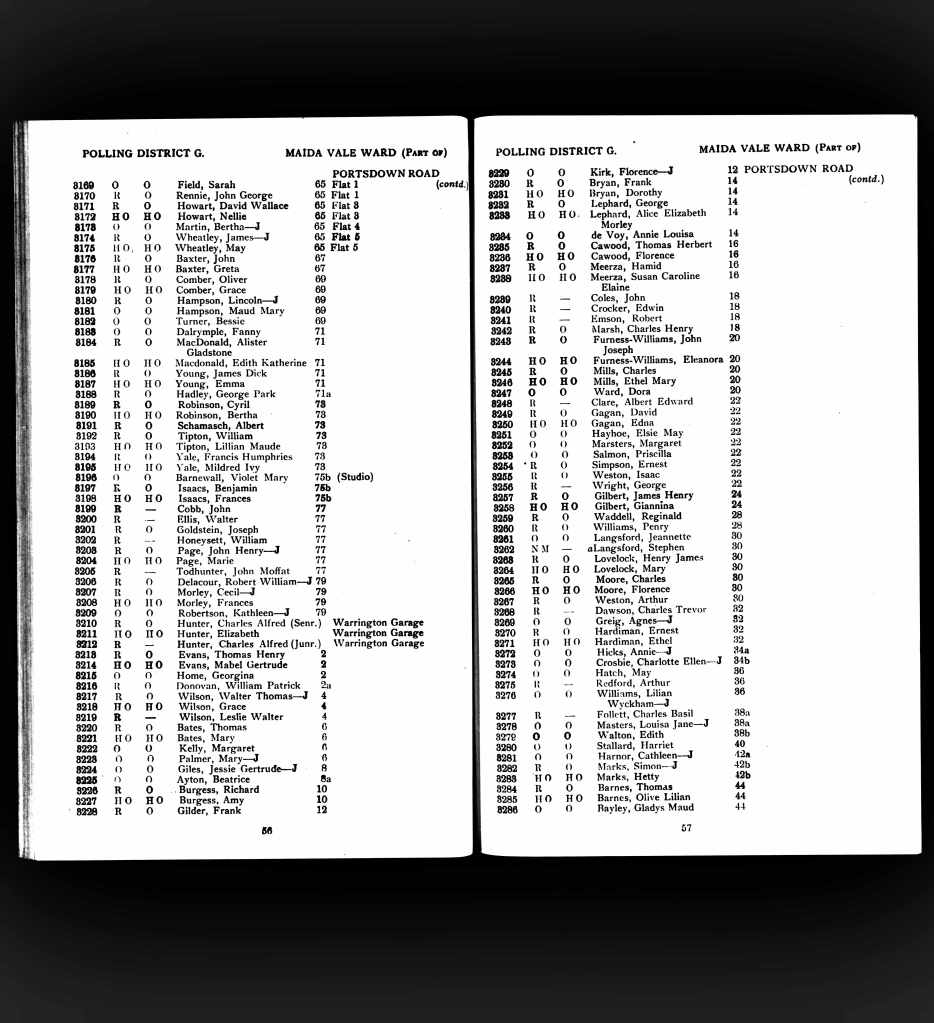
Sadly this is where the incredibly fascinating, life of our Charlotte comes to an end.
I wonder if she knew her time upon this earthly realm was at an end?
Either way, I sincerely hope she was surrounded by family, love and friendship, that she felt she had completed her life’s journey, that she had achieved her greatest dreams and felt beyond proud of all her amazing achievements in a world dominated by males.
Once more and for the last time, I imagined her pen in hand, ink at the ready, sitting down with her dairy, knowing the words she would write, would be her last, her testimony to her life, a life full of love, companionship, dreams, travel and achievements.
April 4th, 1924
Dearest Diary, As I pen these final words, the sepia-tinted reel of my life unfolds before me, each frame etched with moments of joy, sorrow, and an indomitable spirit that weathered the storms of time. Today marks the conclusion of my journey, a journey that traversed the landscapes of dreams, determination triumph and struggles, weaving a tapestry of experiences that defined the very essence of my existence. The frailty of life, once an abstract concept, now stands before me as an immutable truth. The sands of time slip through my fingers, and with each grain, I embrace the certainty of bidding adieu to this mortal coil. Reflections cascade through the corridors of my mind, echoing the symphony of a life lived with enthusiasm and resilience. From the cobblestone streets of London to the rolling hills of Ireland, I navigated a path less traveled, carving my narrative amidst the confines of a society that often sought to confine my aspirations. The roles I embraced, the battles I fought, and the hearts I touched, all interwoven into the fabric of my legacy. As an entrepreneur and Specialist in my field, I dared to challenge norms, offering hope and healing to those who sought refuge within the sanctuary of my expertise. The journey wasn’t without its hurdles, but each obstacle served as a testament to my unwavering determination. Love, both tender and tempestuous, etched its mark upon the canvas of my life. In the embrace of affection, I found companionship, and shared dreams that painted the horizon with hues of hope. Yet, amidst the embrace of love, there existed heartaches and farewells that tested the fortitude of my spirit. And now, as the final curtain descends upon this theatrical stage we call life, I embrace the serenity that comes with acceptance. The flickering flame within me may dim, but my essence shall linger, a testament to the unbeatable spirit that defined my very being. To those who graced my journey, whose footprints are intertwined with mine, I offer my gratitude. Each encounter, every shared moment, enriched my life, leaving an indelible mark upon my soul. As I embark on this ephemeral voyage beyond the realms of mortal existence, I bid farewell to the corporeal constraints that tethered me to this earthly realm. With a heart brimming with gratitude, I surrender myself to the embrace of eternity, where the essence of my being shall merge with the cosmic symphony. Dear Diary, you’ve been the silent confidant, the repository of my hopes, dreams, fears, and aspirations. Within your pages lie the echoes of a life lived with ardor and tenacity. As I close this final chapter, I entrust my essence to the annals of time, where whispers of my journey shall linger, an ode to the resilience of the human spirit. Farewell, dear Diary, and farewell to this earthly sojourn. Yours in eternal gratitude, Charlotte.
I imagine that although Charlotte may have felt fear of death, as we all do, the strength and determination, her constant through her life, gave her peace.
And with her last diary entry written, (in this case her imagery diary) she felt ready to step forward into her spiritual journey with a full heart, ready to be reunited with all that she loved, lost and mourned.
64-year-old Charlotte Ellen Crosbie, the widow of medical student, Pierce William Crosbie, sadly passed away on Saturday the 5th of April, 1924, at her home, number 34 Portsdown Road, Paddington, London, England. Charlotte died from, Cardiac Disease (mitral) and Hemiplegia. Her sister Edith C Charlton nee Willats, of number 27 Kings Road, Finsbury Park was present and registered Charlotte’s death on Monday the 7th of April 1924.

Charlotte was laid to rest at Abney Park Cemetery, 215 Stoke Newington High Street, Stoke Newington, London, England, N16 0LH, on Wednesday the 9th of April 1918, in grave 127434 possibly renumbered 17434, (Grave Reference – Sec. I09, Index 7S08.) with Baby Crosbie, her niece Amina Eliza Kathleen Reichert nee Charlton, her cousin Mabel Cameron Woollet Willats, and Eliza Smith (Charlotte’s companion).
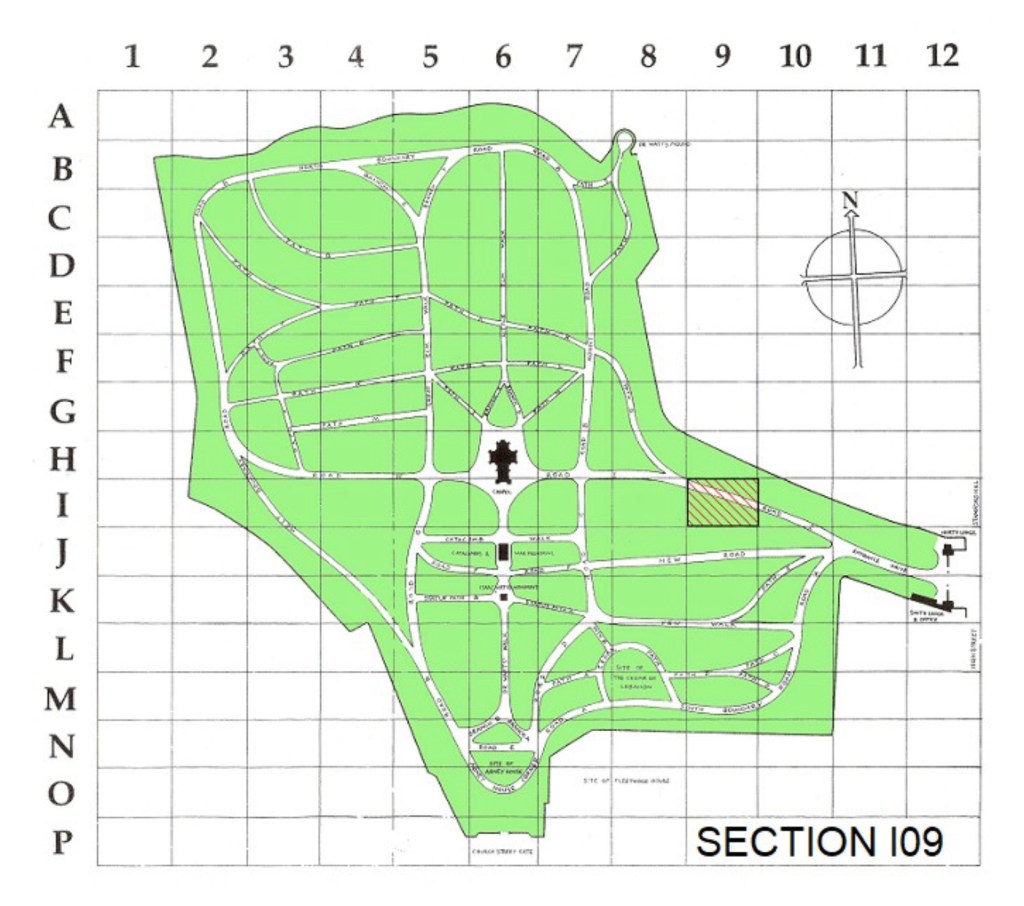

Charlottes probate was granted on the 13th of June 1924, in London, England. It reads as follows,
CROSBIE Charlotte Ellen of 34b Portsdown Road Maida Vale Middle- sex widow died 5 April 1924 Probate London 13 June to Thomas George Hancock of no occupation and Walter James Willats member of stock exchange. Effects £4433 16s. 5d.

Charlotte’s grant reads as follows,
DEATH ON OR AFTER 1st JANUARY, 1898. Will.
BE IT KNOWN that Charlotte Ellen Crosbie. of 34b Portsdown Road, Maida Vale in the County of Middlesex widow
Died there on the 5th day of april 1924
AND BE IT FURTHER KNOWN that at the date hereunder written the last Will and Testament with a Codicil thereto. of the said deceased was proved and registered in the Principal Probate Registry of His Majesty’s Eigh Court of Justice, and that administration of all the estate which by law devolves to and vests in the personal representative of the said deceased was granted by the aforesaid Court to Thomas George (in the will and Codicil called George Thomas) Hancock of The Limes Roydon in the County of Essex of no occupation the executor named in the said will and Walter James Willats of 132 Lansdowne Road Bruce Grove Tottenham in the county of Middlesex member of the Stock Exchange Brother of diseased the Executor. named in the said Codicit
Dated the 13th day of June 1924
Goss value of Estate … £4433 : 16.5
Net value of Persomal Estate £4352 : 2.6
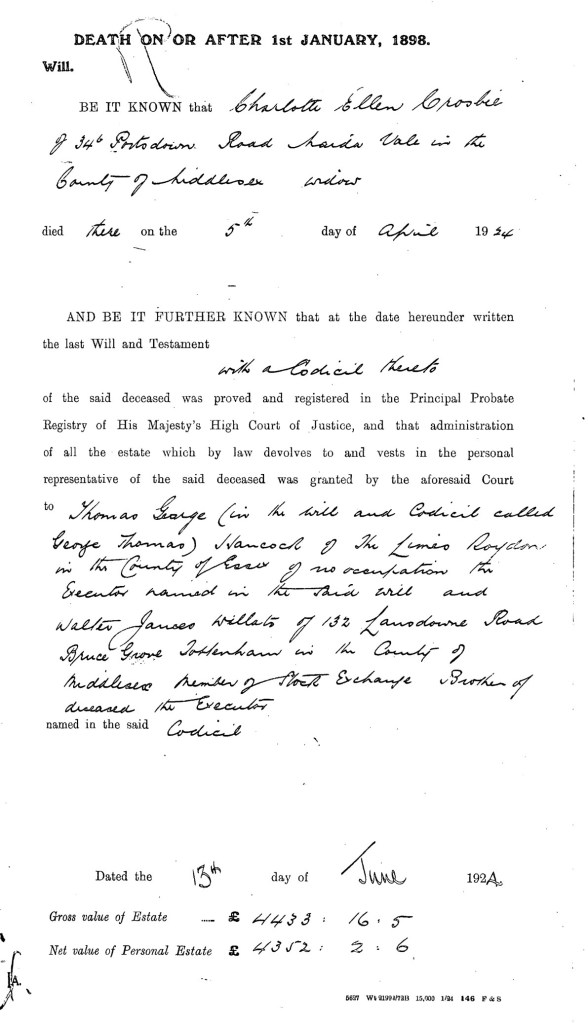
As we draw the curtains on this tribute to Charlotte Ellen, we find ourselves wrapped in the warmth of her enduring spirit. Her life, a tapestry woven with threads of love, resilience, and boundless compassion, continues to inspire and guide us. Through the chapters of her journey, Charlotte’s legacy radiates like a beacon, illuminating our path and reminding us of the profound impact one soul can have on the world. Her nurturing touch, her unwavering strength, and her heart overflowing with kindness have left an indelible mark on our hearts. As we reflect on the radiant moments that defined her life, the vows exchanged, the laughter shared, the trials faced, and the victories celebrated I find solace in knowing that her memory will forever be a source of comfort and inspiration. In the gentle embrace of our memories, Charlotte lives on. Her story becomes a part of ours, interwoven with the threads of our own narratives, reminding us that family transcends time and space. Though she may have bid farewell to this earthly realm, her presence lingers in the whispered winds, in the tender touch of sunlight, and in the quiet moments of reflection. She is, and forever will be, an integral part of our family’s tapestry, a guiding star in our constellation of cherished memories. So, let us carry forth the torch of Charlotte’s legacy with the same grace, strength, and compassion that defined her life. May we, in our own way, strive to leave behind a legacy that echoes through the generations, just as Charlotte did. As we close this chapter in Charlotte’s story, we do so with hearts filled with gratitude for the privilege of having learnt about her, for the lessons she imparted, and for the love she bestowed upon us all. She will forever remain etched in our hearts, a guiding light, a cherished memory, and a testament to the enduring power of dreams.
Rest in eternal peace, dear Charlotte. You are, and always will be, remembered beyond measure.
Charlotte Ellen Crosbie Nee Willats 1859-1924
Before I say my goodbyes, please remember that the diary entries throughout Charlotte’s life story, are totally fictional, written by my hand, not Charlotte’s. I sincerely hope they helped bring a personal touch to Charlotte’s story, though fiction not fact, I felt obligated to bring Charlotte to life because I feel she was beyond an inspirational character, one of great strength. It has truly been the up most honour to tell you about her life, and even though I feel deep within my soul there is so much more to Charlottes personality and the relationship she had with Eliza Smith, I feel we will sadly never know more about this important part of her life and character.
Until next time,
Too-da-loo.
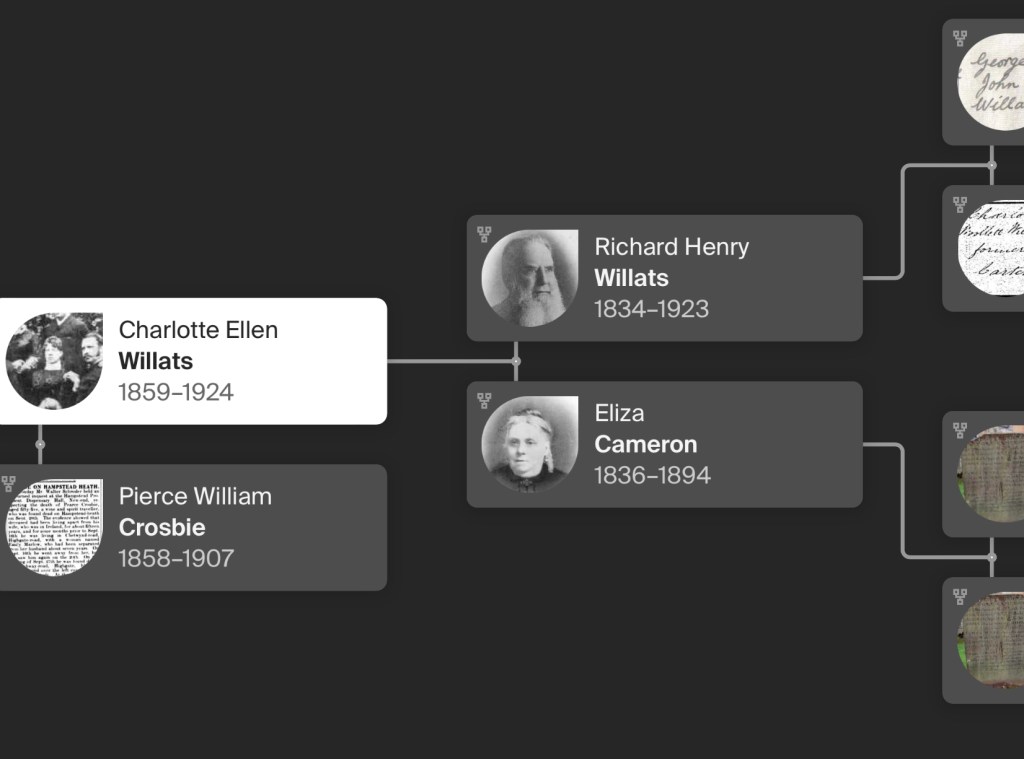
I have brought and paid for all certificates,
Please do not download or use them without my permission.
All you have to do is ask.
Thank you.
🦋🦋🦋
 Intwined