In the quiet hum of 19th-century London, amidst the cobblestone streets and gaslit alleys, a story quietly unfolded, one that echoed through generations, whispered in the annals of our family’s history. At the heart of this tale stood a man whose life, though a distant echo now, bore witness to an era of change, resilience, and unspoken fortitude. His name was Arthur Charles Willats, a figure woven into the fabric of our lineage, his legacy a tapestry of moments etched in time. Born into the embrace of Number 37, Charlotte Street, Marylebone, Arthur emerged into a world in transition. The echoes of horse-drawn carriages reverberated through the streets, mingling with the distant chimes of Big Ben, painting the backdrop against which his journey began. In the heart of bustling Middlesex, young Arthur’s life embarked upon its trajectory, tracing a path that would thread through the warp and weft of historical milestones and personal triumphs. His story, though distant, resonates with the cadence of an era marked by both simplicity and complexity, an era where dreams and destinies were shaped by resilience, tenacity, and unwavering determination. As we delve into the chronicles of Arthur Charles Willats, we unearth more than just dates and places; we discover fragments of a life, illuminated by the flickering candlelight of an era long past. Join me on this voyage, a pilgrimage through time, to unravel the layers of a man who stood at the crossroads of history, painting a portrait of a life marked by courage, passion, and the indomitable spirit that courses through our veins to this day. So without further ado let me tell you all about the incredible life of Arthur Charles Willats, my 3rd Great Granduncle.
The Life Of
Arthur Charles Willats,
1863-1933
Through Documention.
Welcome to 1863, Marylebone, Middlesex, England. Nestled within the vibrant heart of London, Marylebone in the 19th century was a microcosm of Victorian society, teeming with a diverse array of inhabitants and buzzing with activity.
The atmosphere in Marylebone in 1863 was a mixture of hustle and bustle, as the streets bustled with merchants hawking their wares, carriages clattering over cobblestones, and pedestrians weaving their way through the crowded thoroughfares. The scent of coal smoke and horse dung lingered in the air, mingling with the aromas of freshly baked bread and roasting meat from the local bakeries and eateries.
Gossip was rife in Marylebone, as it was in any tight-knit community. Residents eagerly exchanged tidbits of news and scandal over cups of tea or pints of ale in the local taverns and tea shops. From whispered tales of illicit affairs among the upper crust to rumors of petty crimes committed by the lower classes, gossip provided a form of entertainment and social currency for Marylebone's inhabitants.
The disparity between the rich and the poor was starkly evident in Marylebone. In the affluent neighborhoods, such as those around Regent's Park, grand townhouses and elegant mansions housed the aristocracy and wealthy merchants, who enjoyed lives of luxury and privilege. Meanwhile, in the poorer districts, such as Lisson Grove, cramped and squalid slums were home to the working class and impoverished, where overcrowded tenements and unsanitary living conditions were the norm.
At the head of the nation sat Queen Victoria, reigning over the British Empire with dignity and authority. Her long and eventful reign had already left an indelible imprint on Victorian society, shaping its values, culture, and politics. In Marylebone, as elsewhere in the realm, the Queen's image adorned public buildings and monuments, serving as a constant reminder of her enduring presence and influence.
Historical events of the time left their mark on Marylebone. The American Civil War dominated headlines, with news of battles and political developments reaching the shores of England and stirring debate among the populace. Meanwhile, the ongoing process of industrialization brought both opportunities and challenges to Marylebone, as factories sprang up alongside traditional artisan workshops, transforming the local economy and landscape.
The the first section of the London Underground Railway opened to the public (Paddington to Farringdon Street).
Clapham Junction railway station opened in London.
The marriage of Albert Edward, Prince of Wales (later Edward VII) to Princess Alexandra of Denmark (later Queen Alexandra) was held St George's Chapel, Windsor Castle.
Broadmoor Criminal Lunatic Asylum at Crowthorne received its first patients.
A scarlet fever epidemic causes over 30,000 deaths.
And Arthur Charles Willats, the 5th child of Richard Henry Willats and 6th child of Eliza Willats nee Cameron, was born on Saturday the 11th of July, 1863, at Number 37, Charlotte Street, Marylebone, Middlesex, England. Their father, Richard Henry registered Arthur’s birth on Friday the 21st of August, 1863.
Richard’s occupation was given as a, Commercial Traveller and their abode as Number 37, Charlotte Street, Marylebone.

Charlotte Street, seems to have been named after Queen Charlotte and runs from south to north from Percy Street to Howland Street. The original Charlotte Street extended to Goodge Street, and from thence to Tottenham Street it was called Lower Charlotte Street, the remainder being known as Upper Charlotte Street. In 1766 building was proceeding on its western side as shown by a lease from the Goodge Brothers to William Franks, gentleman, of Gerrard Street (afterwards of Percy Street, q.v.), of ground adjoining west on ground late Marchant’s Waterworks, south on ground whereon is late erected a chapel also let to him and north on Bennett Street. The Waterworks are shown on Rocque’s Plan of London (1746), and Percy Chapel stood on the west side of Charlotte Street immediately opposite the end of Windmill Street (see below, p. 21). Charlotte Street is typical of the late 18th-century development of this area and its present condition is therefore described in this section in some detail. The houses have been re-numbered twice since they were first numbered, the present sequence running from south to north, with the odd numbers on the west and the even on the east side. The progress of erection was in the same direction and except for the breaks at the cross streets, the houses were (before the war) in uninterrupted rows like those in Percy Street.

East side: Nos. 16 to 36, up to Colville Place
The ground floor shop fronts are modern unless otherwise described. No. 16, the Fitzroy Tavern, is all modern. Original brickwork is seen in Nos. 18, 20, 28, 32 and 36, but with a few variations, while Nos. 22, 24, 26, 30 and 34 have been cemented. The first floor windows of No. 20 have lowered sills and iron balconies. The fourth storeys of Nos. 18 and 20 are later additions, the latter higher than the former. The cement face of No. 22 is of a mid-late 19th-century design. Nos. 24 and 26 have architraves to the windows, and the first-floor window sills are at floor level with balconies: the top storey has a cornice and parapet behind which are mansard roofs with dormer windows. The ground storey of No. 24 has the two original window openings, fitted with casements and a roundheaded south doorway. The top storey of No. 28 is modern, the wall having been rebuilt from about 2 feet above the second floor windows; the first floor sills are at floor level. The windows of No. 30 are the original openings, with the first-floor sills lowered all have architraves. The two storeys above the shop of No. 32 are original but the top two storeys are later: they have been damaged and the windows are at present unglazed. The ground floor front may be of early 19th-century design with a middle and a south doorway but the actual windows are later. The south door is eight-panelled. The cementing of No. 34 resembles that of Nos. 24 and 26 but the sills have not been lowered. The shop front—a middle window between side doorways—is probably older than that of No. 32. The two top storeys of No. 36 are built of later and larger bricks than the lower. The north side, to Colville Place, is cemented in the ground storey and of ancient brickwork above and is unpierced.
The hollow cornice of No. 9 is repeated in a number of lower rooms and passages of this row but not in all. The staircases also differ. For instance Nos. 20 and 22 have the original stairs with plain newels, turned balusters with a square block and cut strings with shaped brackets but to No. 18 is plainer with a straight string and in No. 26 the cut strings have no brackets and the handrail finishes with a spiral over the lowest newel.

Richard and Eliza, baptised their son and daughter, Arthur Charles and Edith Cameron Willats, on the 9th August 1863, at Holy Trinity Church, Marylebone Road, Westminster, Middlesex, England. Richard’s occupation was given as a Traveller and their abode as Number 37, Charlotte Street.

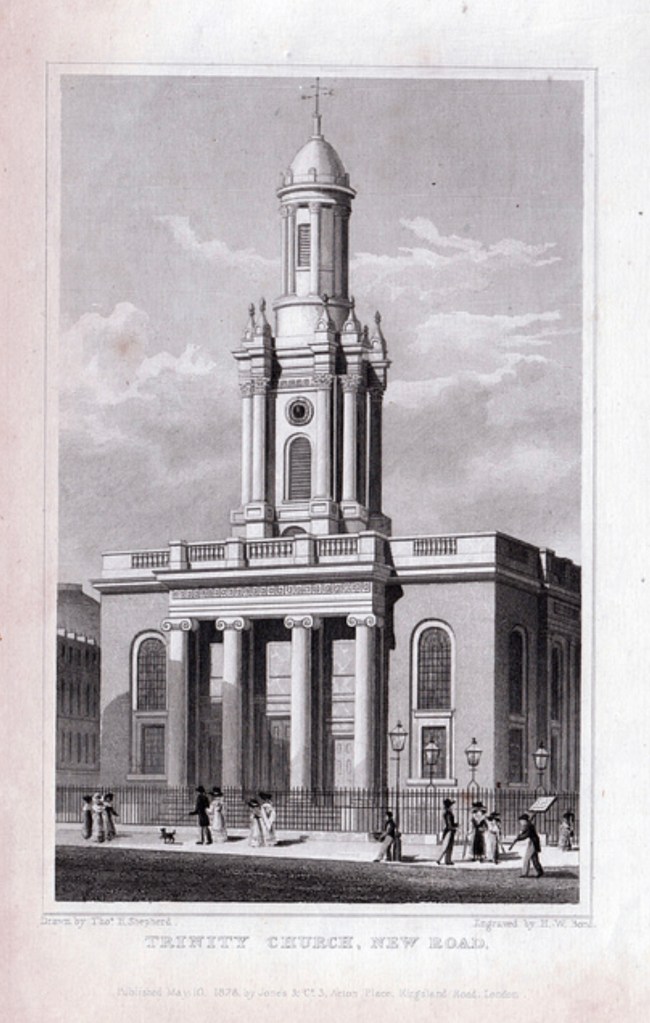
Holy Trinity Church, in Marylebone, Westminster, London, is a Grade I listed former Anglican church, built in 1828 and designed by John Soane. In 1818 Parliament passed an act setting aside one million pounds to celebrate the defeat of Napoleon. This is one of the so-called “Waterloo churches” that were built with the money. It has an external pulpit facing onto Marylebone Road, erected in memory of the Revd. William Cadman MA (1815-1891), who was rector of the parish from 1859 – 1891, renowned for his sonorous voice and preaching. The building has an entrance off-set with four large Ionic columns. There is a lantern steeple, similar to St Pancras New Church, which is also on Euston Road to the east.
George Saxby Penfold was appointed as the first Rector, having previously taken on much the same task as the first Rector of Christ Church, Marylebone. The first burial took place in the vault of the church in 1829, and the last was that of Sir Jonathan Wathen Waller in 1853.
By the 1930s, the use of the church had declined, and from 1936 it was used as a book warehouse by the newly founded Penguin Books. A children’s slide was used to deliver books from the street into the large crypt. In 1937 Penguin moved out to Harmondsworth, and the Society for Promoting Christian Knowledge (SPCK), an Anglican missionary organisation, moved in. It was their headquarters until 2006, when they relocated to Tufton Street, Westminster (they have since moved again to Pimlico). The church is currently[when?] the location of the world’s first wedding department store, The Wedding Gallery, which is based on the ground floor and basement level. The first floor is used as an events space operated by one event and known as “One Marylebone”.
The former church stands on a traffic island by itself, bounded by Marylebone Road at the front, and Albany Street and Osnaburgh Street on either side; the street at the rear north side is Osnaburgh Terrace.
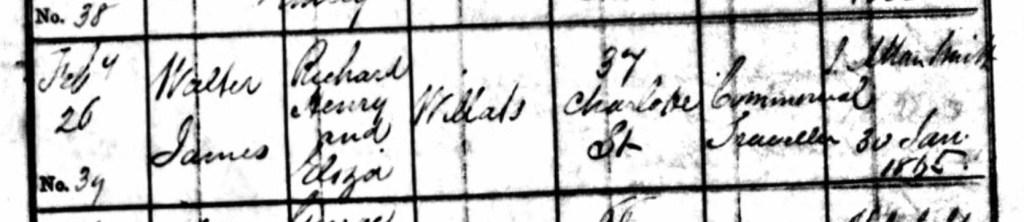
Arthur’s brother, Walter James Willats, was born on Friday the 13th January 1865, at the families home, Number 37, Charlotte Street, Marylebone, All Souls, Middlesex, England. Walters father Richard Henry Willats, registered Walters birth on Thursday the 9th of March 1865. He gave his occupation as a commercial traveller and their abode as, 37, Charlotte Street.

Walter James Willats, was baptised on Sunday the 26th of February, 1865, at Holy Trinity Church, Marylebone Road, Marylebone, Middlesex, England.
Richards’s occupation was given as a commercial traveller and their abode was 37 Charlotte Street.
Arthur’s parents Richard Henry Willats and Eliza Willats nee Cameron finally decided to marry. Their banns were read, at St John the Evangelist, Smith Square, London, England, on the Sunday 9th and Sunday 16th of April, by W.S. Bruce and again on Sunday the 23rd April, 1865, by J. Graham.

St John’s Smith Square is a redundant church in the centre of Smith Square, Westminster, London.
In 1710, the long period of Whig domination of British politics ended as the Tories swept to power under the rallying cry of “The Church in Danger”. Under the Tories’ plan to strengthen the position of the Anglican Church and in the face of widespread damage to church buildings after a storm in November 1710, Parliament concluded that 50 new churches would be necessary in the cities of London and Westminster. An Act of Parliament in 1711 levied a tax on coal imports into the Port of London to fund the scheme and appointed a commission to oversee the project. Archer was appointed to this commission alongside, amongst others, Hawksmoor, Vanburgh and Wren. The site for St. John’s was acquired from Henry Smith (who was also Treasurer to the Commissioners) in June 1713 for £700 and building commenced immediately. However, work proceeded slowly and the church was finally completed and consecrated in 1728. In total, the building had cost £40,875. The church was built by Edward Strong the Younger a friend of Christopher Wren the Younger.
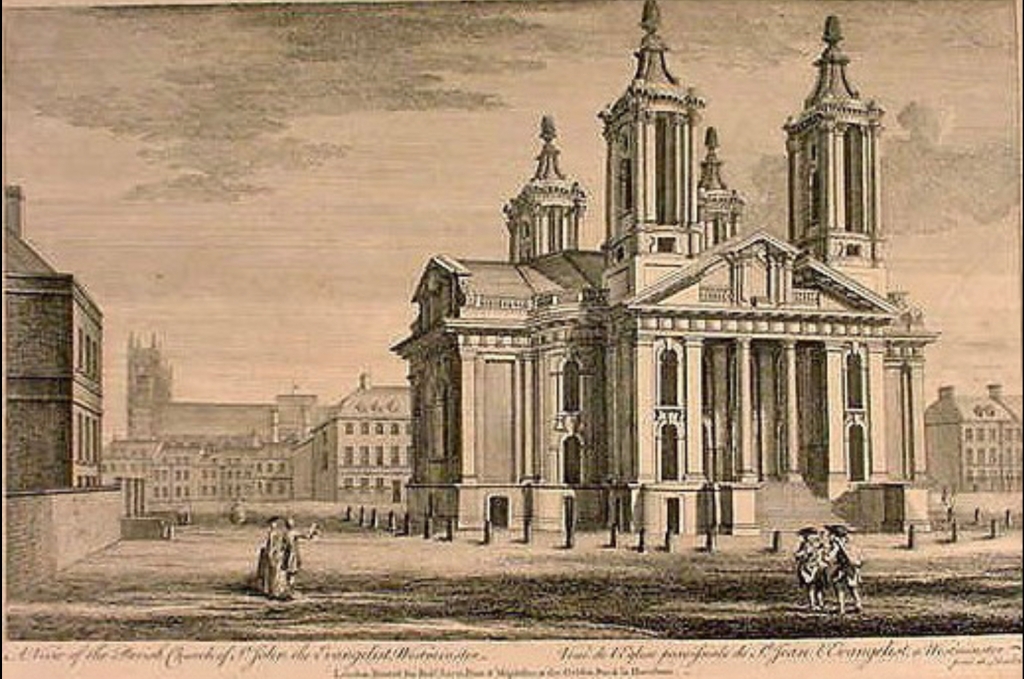
in the 18th century
Arthur’s mum, Eliza Willats nee Cameron, and her father, Richard Henry Willats married on Thursday the 4th of May, 1865, at, St Margarets, Westminster, London, England.
Richard was a Bachelor.
Eliza was listed as a widower, which is rather strange as her first husband George John Willats (Charlotte’s uncle/Richard Henry Willats brother) didn’t die until later that year.
Their witnesses were, George John Willats, (Eliza’s first husband) and Eliza’s sister, Mary Cameron.
Eliza and Richard, were residing at 10 North Street.
Richard was working as a, Commercial Traveller.
Eliza’s Father, Allen Cameron was working as a Tailor and Richard’s Father, George John Willats, was working as a Wood Craver.

St. Margaret’s, known as ‘the Church on Parliament Square’, is a 12th-century church next to Westminster Abbey. It’s also sometimes called ‘the parish church of the House of Commons’.
The Church of St Margaret, Westminster Abbey, is in the grounds of Westminster Abbey on Parliament Square, London, England. It is dedicated to Margaret of Antioch, and forms part of a single World Heritage Site with the Palace of Westminster and Westminster Abbey.
The church was founded in the twelfth century by Benedictine monks, so that local people who lived in the area around the Abbey could worship separately at their own simpler parish church, and historically it was within the hundred of Ossulstonein the county of Middlesex. In 1914, in a preface to Memorials of St. Margaret’s Church, Westminster, a former Rector of St Margaret’s, Hensley Henson, reported a mediaeval tradition that the church was as old as Westminster Abbey, owing its origins to the same royal saint, and that “The two churches, conventual and parochial, have stood side by side for more than eight centuries – not, of course, the existing fabrics, but older churches of which the existing fabrics are successors on the same site.
In 1863, during preliminary explorations preparing for this restoration, Scott found several doors overlaid with what was believed to be human skin. After doctors had examined this skin, Victorian historians theorized that the skin might have been that of William the Sacrist, who organized a gang that, in 1303, robbed the King of the equivalent of, in modern currency, $100 million. It was a complex scheme, involving several gang members disguised as monks planting bushes on the palace. After the stealthy burglary 6 months later, the loot was concealed in these bushes. The historians believed that William the Sacrist was flayed alive as punishment and his skin was used to make these royal doors, perhaps situated initially at nearby Westminster Palace. Subsequent study revealed the skins were bovine in origin, not human.
You can read more about, St Margaret’s here.

in the grounds of Westminster Abbey on Parliament Square, London, England
As I have mentioned many times before (sorry), I have no idea as to how Richard and Eliza were able to marry, as it was strictly forbidden to marry a brothers wife even a deceased brother.
Family story’s state that, a sympathetic member of the clergy came to their rescue and had the first marriage annulled.
I guess we will never know for sure but it seems that maybe something fishy was going on as George John married Sarah Elizabeth Southall Jukes, in Victoria, Australia, in 1856 (11years before Richard and Eliza wed. George and Sarah, went on to have 4 Children. George John, stayed in Australia until his death in 1865, visiting England frequently.
Arthur’s sister, Eliza Mary Willats, was born on Wednesday the 20th of March, 1867, at Number 37 Charlotte Street, All Paul’s, Marylebone, Middlesex, England. Eliza’s Father Richard Henry Willats, was working as a Buyer of Diamonds, at the time of her birth. Eliza mother Eliza Willats nee Cameron, registered Eliza’s birth on Monday the 29th April 1867.
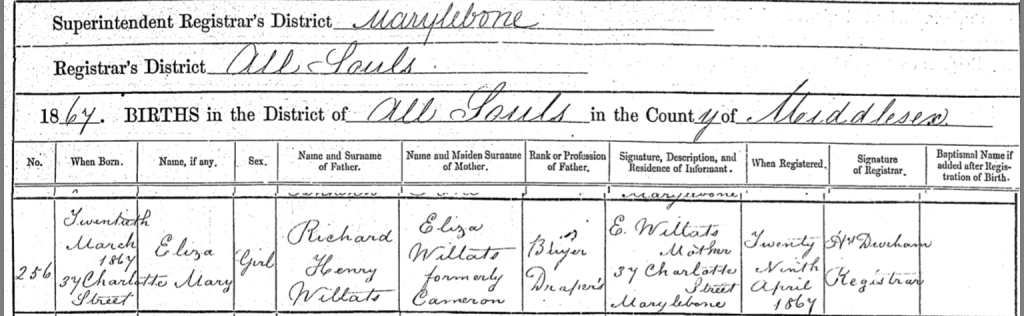
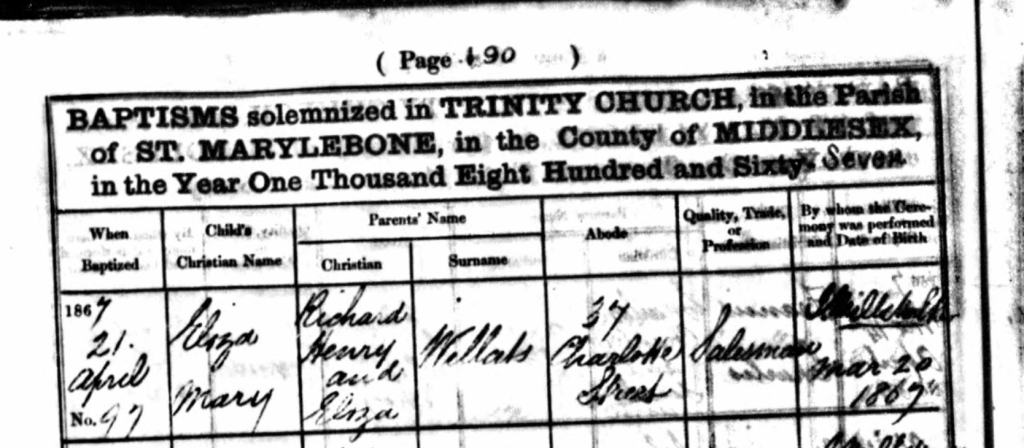
Richard and Eliza baptised Eliza Mary, on the 21st of April 1867, at Holy Trinity Church, Marylebone Road, Marylebone, Middlesex, England. Richards occupation was given as Saleman and their abode as, 37 Charlotte Place.
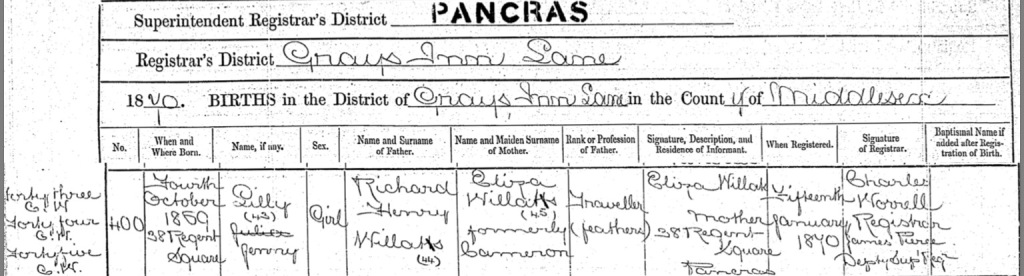
Arthurs’s sister, Lilly Jenny Willats, was born on Monday the 4th of October, 1869, at, Number 38, Regent Square, Greys Inn Lane, Pancras, Middlesex, England. Lily’s mother Eliza Willats bed Cameron, registered her birth on the 15th January 1869. She gave Lily’s Father Richard Henry Willats, whose occupation was listed as a Traveller ( Feathers) and their abode as Number 38, Regent Square, Pancras.
Regent Square is a public square and street in the London Borough of Camden in London, England. It is located near Kings Cross and Bloomsbury. Regent Square was laid out around a large garden in the historic Harrison Estate and first occupied in 1829, forming a garden square similar to more famous ones to the west in Bloomsbury. The southern side of the square is composed of its original buildings, and is Grade II listed in its entirety. Also listed is the phone box within the square gardens themselves.
Arthur’s parents, Richard and Eliza, baptised Lillian Jenny Willats, on Sunday the 31st of October 1869, at Saint Peter Church, Saint Pancras, London, England. It was a private baptism. Her father Richard’s occupation was given as Warehouse Man and their abode as 38 Regent Square.

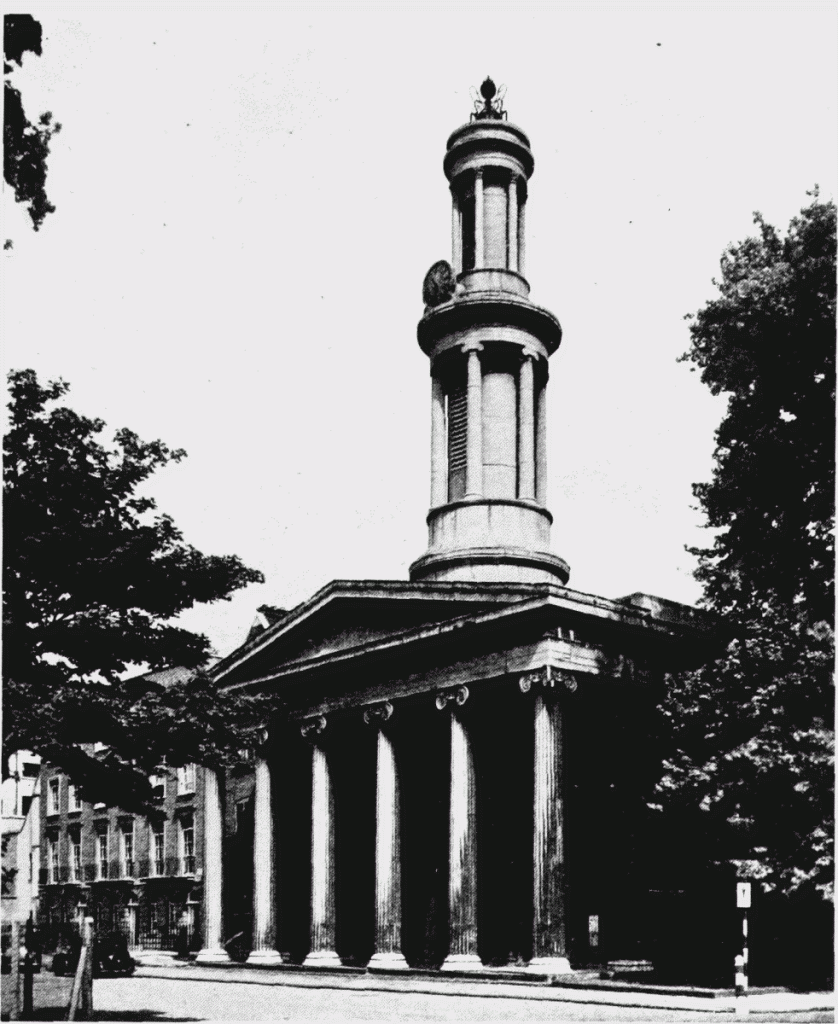
Saint Peters church, in Regent Square was hit by bombs in the war and had to be demolished. Unfortunately there doesn’t seem to be much information about it online. From the below image, it was a very impressive building.
The 1871 census was taken on Sunday 2nd April 1871, it shows us, that Arthur, his parents Richard, and Eliza, and siblings, Walter, Henry, Eliza, Lily, Edith, Charlotte, George and Francis, were residing at, Number 5, Park Road, Islington, Middlesex, England, Richard was working as a Dealer in feathers. The family had two General Servants, residing with them, Jemima Roack and Caroline Curry.
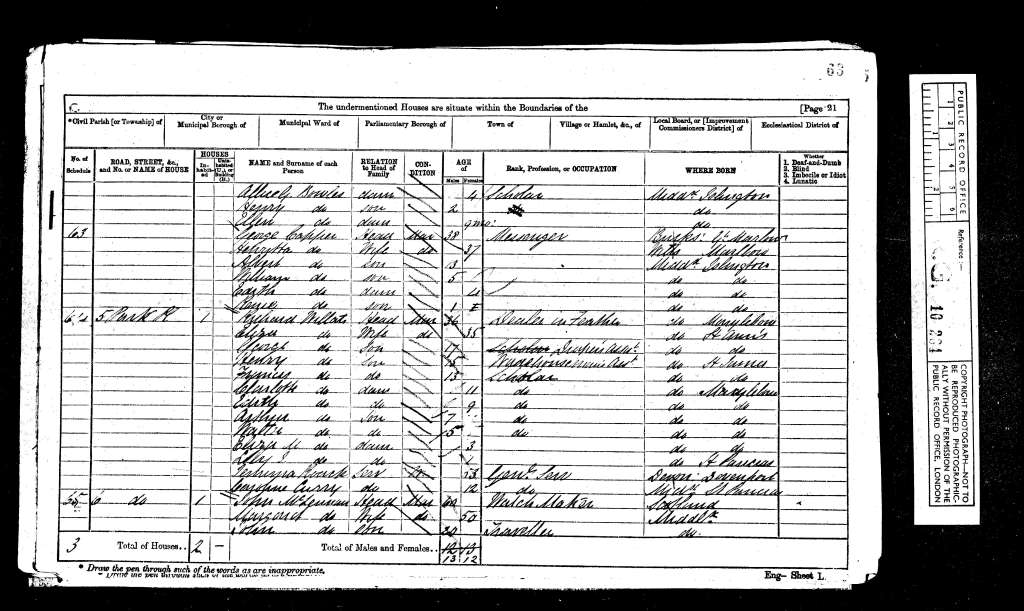
The 1871 UK Census was a comprehensive survey conducted by the General Register Office (GRO) of the United Kingdom. It aimed to collect detailed demographic information about the population of England, Wales, Scotland, and Ireland during that time period. The census was conducted on the night of April 2, 1871. Like other census years, the 1871 census collected data on various aspects of individuals and households. This included details such as names, ages, occupations, relationships to the head of household, birthplaces, marital status, and whether individuals were lodgers, boarders, or servants. One notable feature of the 1871 census was the inclusion of questions related to housing conditions, such as the number of rooms occupied by each household and whether the dwelling was inhabited or empty. The data collected during the 1871 census provides valuable insights into the social and economic conditions of the time, including information on the distribution of occupations, patterns of migration, and family structures. Researchers, historians, genealogists, and demographers often refer to the 1871 census records to study trends and patterns in Victorian society and to trace the ancestry of individuals living during that period. The records from the 1871 census are preserved and accessible to the public through various sources, including online databases, archives, and libraries, making them an invaluable resource for those interested in studying the history and demographics of the United Kingdom during the 19th century.
5 Park Place, London is a 3-bedroom freehold terraced house – it is ranked as the 3rd most expensive property in N1 3JU, with a valuation of £1,432,000. Since it last sold in July 2016 for £1,450,000, its value has decreased by £18,000. It is now a sleek contemporary townhouse within a private gated mews, arranged over three floors with an allocated parking space. You can see what it looks like here.


Arthur’s brother, Edwin Paul Willats, was born on Wednesday the 8th of November, 1871, at Number 5, Park Place, Highbury, Islington, Middlesex, England. Edwin father Richard Henry Willats, registered Edwins birth on Wednesday December 20th 1871. He gave his occupation as a Commercial Buyer and their abode as, Number 5, Park Place, Islington.
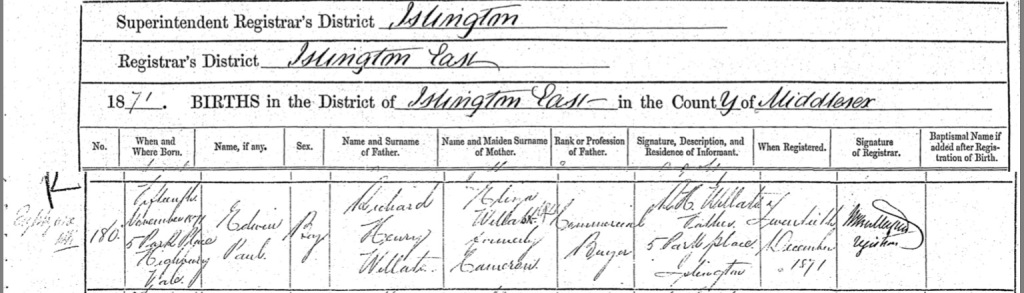
Arthur’s Parents, Richard and Eliza, baptised their son, Edwin Paul Willats, on Friday the 8th of December 1871, at St. Mary’s Church, Islington, Middlesex, England. Richards occupation was given as a Warehouse Man and their abode as 5 Park Place.

The Church of St Mary the Virgin is the historic parish church of Islington, in the Church of England Diocese of London. The present parish is a compact area centered on Upper Streetbetween Angel and Highbury Corner, bounded to the west by Liverpool Road, and to the east by Essex Road/Canonbury Road. The church is a Grade II listed building.
The churchyard was enlarged in 1793. With the rapid growth of Islington, it became full and closed for burials in 1853. It was laid out as a public garden of one and a half acres in 1885.
You can read more about St Mary’s here.

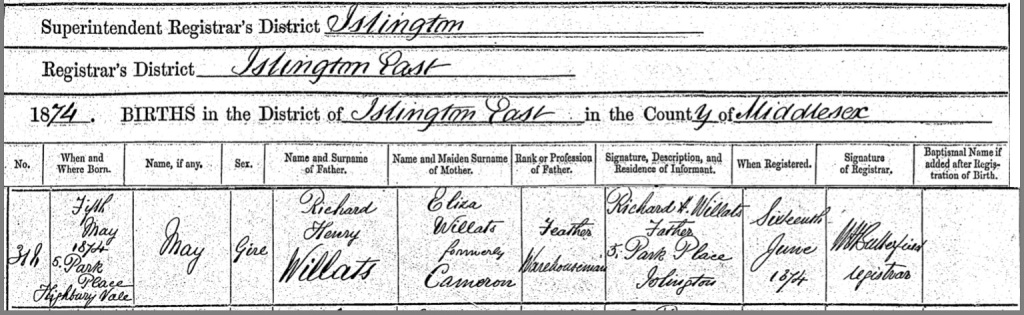
Arthur’s Sister, May Claretta Willats, was born on Tuesday the 5th of May, 1874, at 5 Park Place, Highbury, East Islington, England.
May’s father Richard Henry Willats registered May’s birth on Tuesday the 16th of June 1874. He gave his occupation as a Feather Warehouseman and their abode as 5 Park Place, Islington.
Arthur’s Parents, Richard and Eliza, baptised May, on, Sunday the 9th of August, 1874, at Christ Church, Highbury, an Anglican church in Islington, north-west London, situated next to Highbury Fields. Richard gave his occupation as a Manufacturer and their abode as, Highbury.

Christ Church, Highbury, is an Anglican church in Islington, north London, next to Highbury Fields.
The site was given by John Dawes, a local benefactor and landlord, and the church was built by Thomas Allom in a cruciform shape with a short chancel, transepts, and nave from 1847 to 1848. Bridget Cherry and Nikolaus Pevsner write that Christ Church Highbury ‘is a successful and original use of Gothic for a building on a cruciform plan with broad octagonal crossing. The cross-plan with broad nave and crossing was popular for churches in the low church tradition where an effective auditorium for the spoken word was preferred to a plan designed for an elaborate liturgy.’
Since then, several changes have been made to the church, including the addition of a balcony in 1872, and new rooms for children’s work and fellowship in 1980.

Arthur’s brother, Percy Sidney Willats, was born on Wednesday the 1st of September 1875, at Number 9, Park Place, Highbury, Islington, Middlesex, England. His father Richard Henry Willats, registered Percy’s birth on Saturday the 9th October, 1875, in Islington. He gave his occupation as a, Fancy Warehouseman and their abode as, 9, Park Place, Islington.

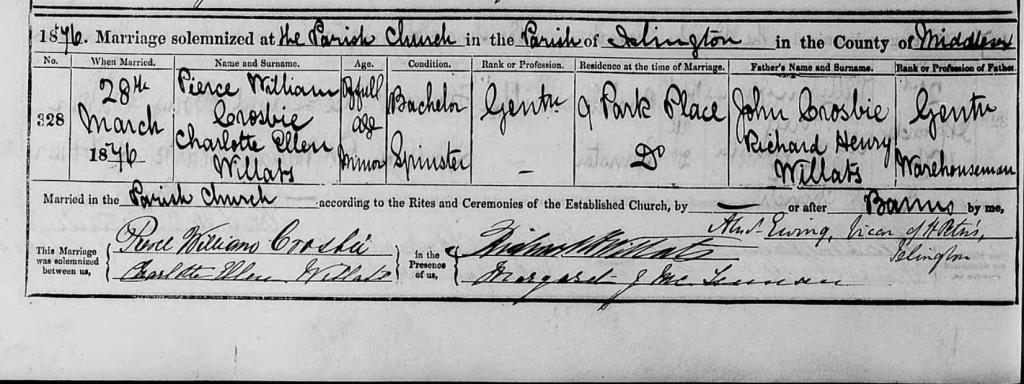
Arthur’s sister, Charlotte secretly married my licence a young Bachelor named Peirce William Crosbie, on Tuesday the 11th of January 1876, at St Mary Church, Islington, Middlesex, England. They both stated they were of full age, even though Charlotte was only 16. Their witnesses were, Henry Billey and Henry Smith. Charlotte gave her abode as, 9 Park Place and Pierce gave his As 9 Riverdale Road. Pierces occupation was given as a Clark. They gave their fathers names and occupations as, Richard Henry Willats, a Warehouseman and John Crosbie a Gentu.

I’m not sure what happened after Arthur’s sister, Charlotte and Peirce’s secret marriage in January but a few short months later, Charlotte and Pierce found themselves back at St Mary Church, Islington, Middlesex, England, listening to their marriage banns being called. Their banns were called on Sunday the 12th of March, Sunday the 19th of March and Sunday the 26th of March, 1876.
Charlotte and Pierce found themselves back at St Mary Church, Islington, Middlesex, England, where Charlotte Ellen Willats married bachelor, Pierce William Crosbie, for the second time, this time not in private. They married on Tuesday the 28th of March, 1876, in St Mary’s Church, Islington, Middlesex, England. Charlotte was a minor and Pierce was of full age. Pierces occupation was given as a Gentu. They gave their residence as 9 Park Place and gave their fathers names and occupations as, Richard Henry Willats, a Warehouseman and John Crosbie a Gentu. Their witnesses were Richard Willats and Charlotte’s future sister-in-law Margaret Jane McLennon.
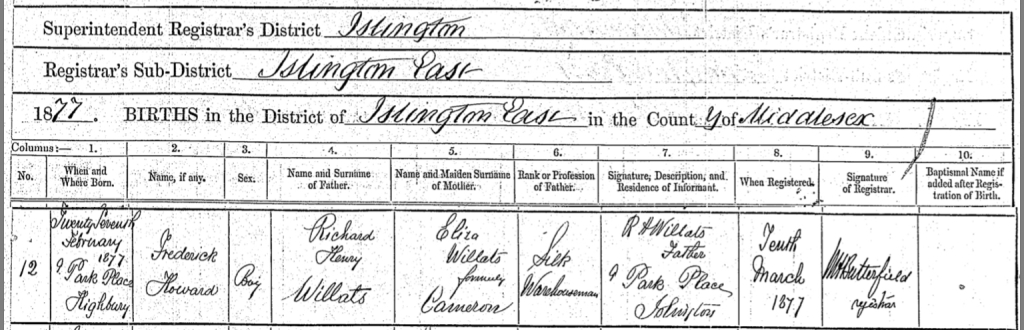
Frederick Howard Willats was born on on Tuesday the 27th of February 1877 at, Number 9, Park Place, Highbury, Islington, Middlesex, England. His father Richard Henry Willats registered Frederick’s birth on Saturday the 10th March 1877. Richard gave his occupation as a Silk Warehouseman, and their abode as, 9 Park Place, Islington.
Arthur’s brother, 24-year-old, bachelor, and publican, Henry Richard Willats married 23-year-old, spinster, Amelia Etheredge, daughter of John Etheredge, on Tuesday the 30th of March, 1880 at All Saints Church, West Ham, Essex, England. Henry gave his residence as West Ham and Amelia as, Saint Paul’s, Shadwell. They gave their fathers names and occupations as, Richard Henry Willats, a Licensed Victualler and John Etheredge, an Engineer. Their witnesses were Charles Henry Etheredge and Alice Catherine Etheredge.

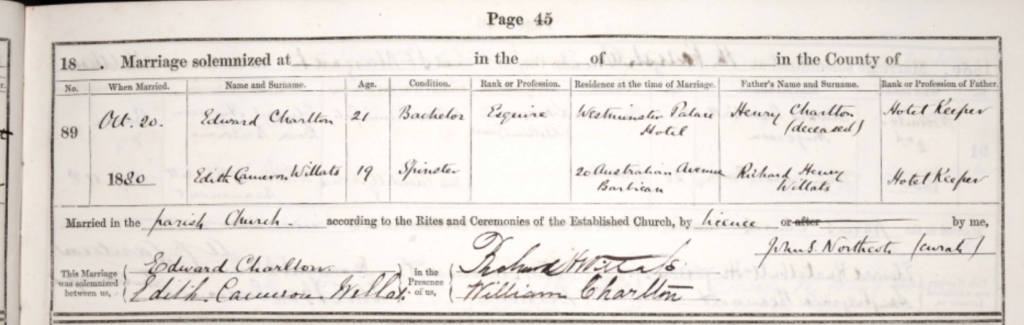
Arthur’s sister, 19-year-old, Edith Cameron Willats, married 21-year-old Bachelor, Edward Charlton, an Esquire, on Wednesday the 20th of October, 1880, at St Margaret Church, George Hanover Square, Westminster, London, England. They gave their fathers names and occupations as, Richard Henry Willats, a Hotel Keeper and Henry Charlton, a Hotel Keeper. Edith gave her residents as, 20 Australian Avenue, Barbican, Silk Street, St Giles, Westminster, London, EnglandAnd Edward gave his as Westminster Palace Hotel. Their witnesses were, Richard Willats and William Charlton.
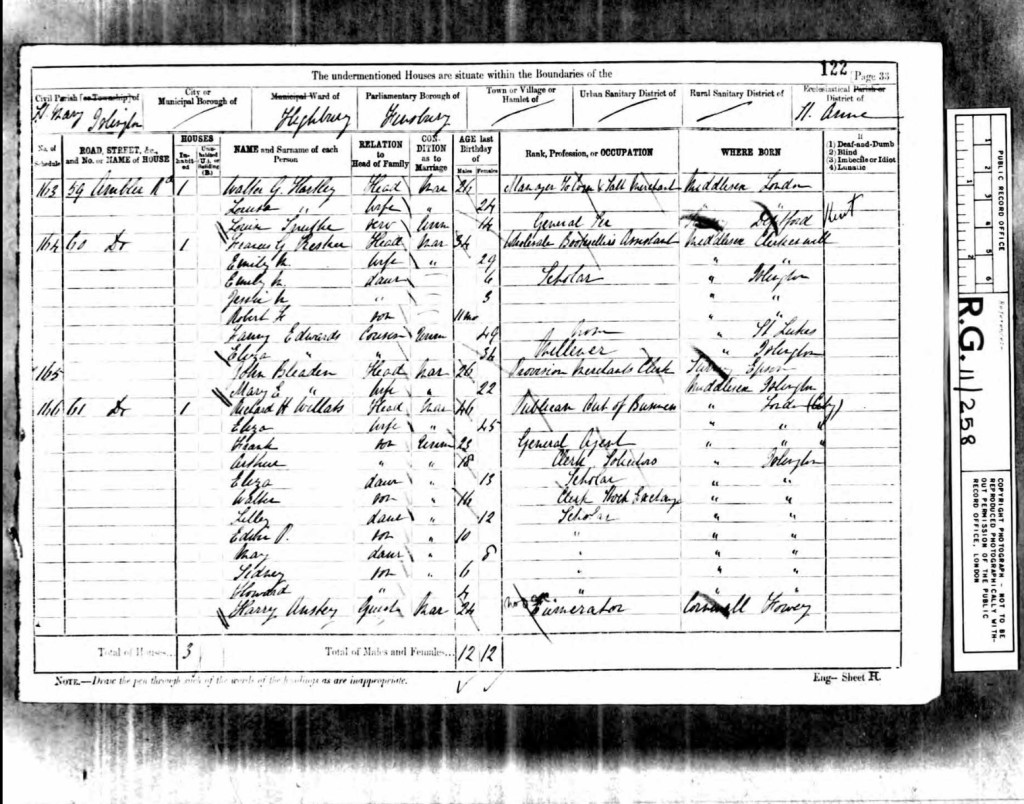
The 1881 census was taken on Sunday the 3rd April 1881. The census shows, Arthur, his parents Richard, and Eliza, and his siblings, Frank, Eliza, Walter, Lillian, Edwin, May, and Sidney, were residing at number 61, Ambler Road, Islington, London & Middlesex, England. They had a guest named Henry Anstey staying with them. Arthur was working as a Clerk solicitors his father Richard was a Publican, out of business. Frank was a General agent, Walter a Clerk stock exchange and Eliza, Lillian, Edwin, May and Sidney were scholars. Henry Anstey was a Enumerator (no occ).
Arthur’s brother, 23-year-old, bachelor, Francis Montague Allen Willats, married 25-year-old, spinster, Margaret Jane McLennon, at St John’s Church, Hornsey, Middlesex, England, on Wednesday the 6th of July, 1881. Francis was working as an agent at the time of his marriage. They gave their fathers names and occupations as Richard Henry Willats, an Agent and John McLennon, a Chronometer Maker. Francis gave his abode as, 145 Blackstock Road and Margaret gave hers as, 84, Finsbury Park Road. Their witnesses were John McLennon and Jessie McLennon.

When Arthur was 18 years old, he decided to leave England and immigrate to the United States.
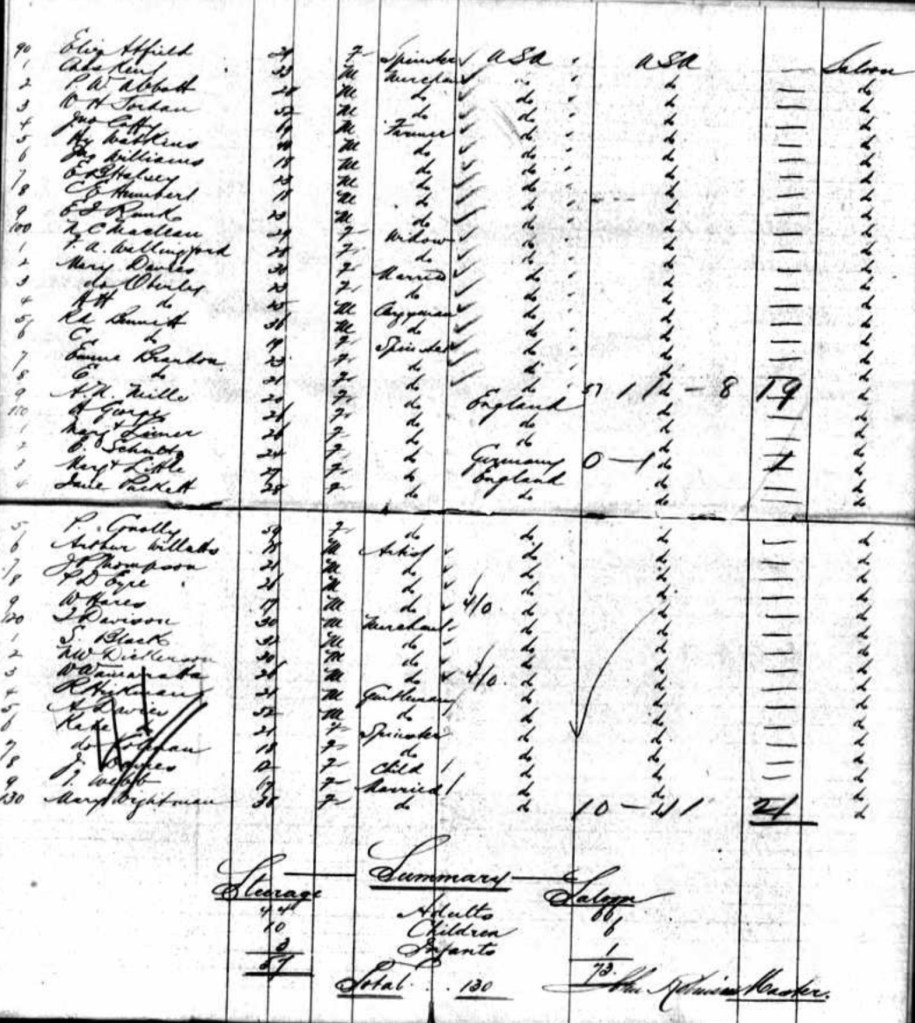
From the 1820-1957 New York, U.S, Arriving Passenger and Crew Lists (including Castle Garden and Ellis Island), we know, that Arthur arrived in New York, United States of America on Wednesday the 23rd of August 1882, aboard a ship named Canada, which departed from Glasgow, Scotland and London, England.
| Name | Arthur Willatts |
|---|---|
| Gender | Male |
| Ethnicity/ Nationality | English |
| Age | 18 |
| Birth Date | abt 1864 |
| Place of Origin | England |
| Departure Port | Glasgow, Scotland and London, England |
| Destination | USA |
| Arrival Date | 23 Aug 1882 |
| Arrival Port | New York, New York, USA |
| Ship Name | Canada |
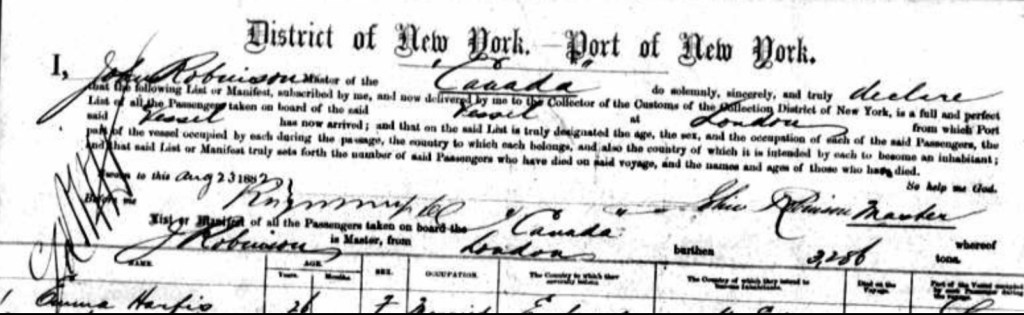
Traveling from London, England to New York aboard a ship in 1882 would have been a lengthy and arduous journey, yet also an adventure filled with anticipation and uncertainty. Passengers embarking on such a voyage would have experienced a mix of excitement and apprehension as they prepared to cross the vast Atlantic Ocean.
The journey typically began with the hustle and bustle of departure preparations at the port of London. Passengers would have arrived at the docks with their luggage, bidding farewell to loved ones and acquaintances who remained on shore. The sight of the towering masts and billowing sails of the steam-powered ocean liners would have been awe-inspiring, symbolizing the promise of distant lands and new opportunities.
Once aboard, passengers would have settled into their cabins, which varied in comfort depending on their class of accommodation. First-class passengers enjoyed spacious cabins with elegant furnishings and attentive service, while those in steerage endured cramped quarters and shared facilities below deck.
As the ship set sail, passengers would have experienced a mix of emotions, excitement at the prospect of adventure, perhaps tinged with sadness at leaving behind familiar shores. The routine of ship life would have quickly settled in, with days structured around meals, leisure activities, and socializing with fellow passengers.
Crossing the Atlantic in 1882 would have been a slow and sometimes perilous journey, with ships at the mercy of the weather and sea conditions. Storms could be fierce, causing the vessel to pitch and roll, testing the resolve of even the most seasoned travelers.
Despite the challenges, the voyage would have offered moments of beauty and tranquility as passengers gazed out across the vast expanse of the ocean, marveling at the play of light on the water and the ever-changing skies above. On clear nights, the stars would have provided a dazzling spectacle, offering a sense of wonder and perspective amidst the vastness of the open sea.
Throughout the journey, passengers would have formed bonds with their fellow travelers, sharing stories, meals, and moments of camaraderie that helped to alleviate the monotony of life aboard ship. For many, the voyage represented a rite of passage, a journey into the unknown that held the promise of new beginnings and the fulfillment of dreams.
Finally, after days or weeks at sea, the skyline of New York would have appeared on the horizon, signaling the end of the voyage and the beginning of a new chapter in the lives of those aboard. As the ship docked at the bustling port of New York, passengers would have disembarked, eager to set foot on solid ground once more, their hearts full of anticipation for the adventures that lay ahead in the bustling metropolis of America's largest city.
Arriving in New York city, Arthur took the first train west to Wheeling, West Virginia, where an uncle then resided.
Arthur ended up in Buffalo, Erie, New York, after having toured the United States from coast to coast as an actor in Shakespearean dramas. His most notable success was in the role of Hamlet, although he had achieved distinction in many other difficult parts, but your read more about his later on.
In 1882, a UK citizen immigrating to Buffalo, New York, would likely have encountered a city undergoing rapid industrialization and growth. Economic opportunities fueled migration, drawing individuals seeking employment in industries such as steel and shipping. The city’s strategic location along the Erie Canal and Great Lakes added to its appeal. The reception varied; while economic opportunities were a pull factor, nativist sentiments existed. Discrimination and challenges were not uncommon, especially for groups like the Irish, Italians, and Eastern Europeans. Immigrants often formed ethnic enclaves, fostering a sense of community amidst the challenges of adapting to a new environment. Life in Buffalo differed significantly from London. The pace of urbanization and industrialization was faster in the United States, contributing to crowded tenements and long working hours. Cultural adaptation was a complex process, involving learning a new language and adjusting to different customs. Immigrants relied on community institutions like churches and schools to navigate these changes. Despite the hardships, some individuals found success and acceptance in their new home. Overall, the immigrant experience was diverse, shaped by a combination of economic, social, and personal factors, reflecting the complexities of the time.
From the 1900 United States census we know that Arthur Charles Willats married Josephine Mary Conley in 1886, in Buffalo, Erie, New York, United States of America. Unfortunately at present I haven’t come across any documentation for their marriage only census records and births of their children. Being in the United Kingdom, research in America isn’t the easiest especially ordering certificates etc.

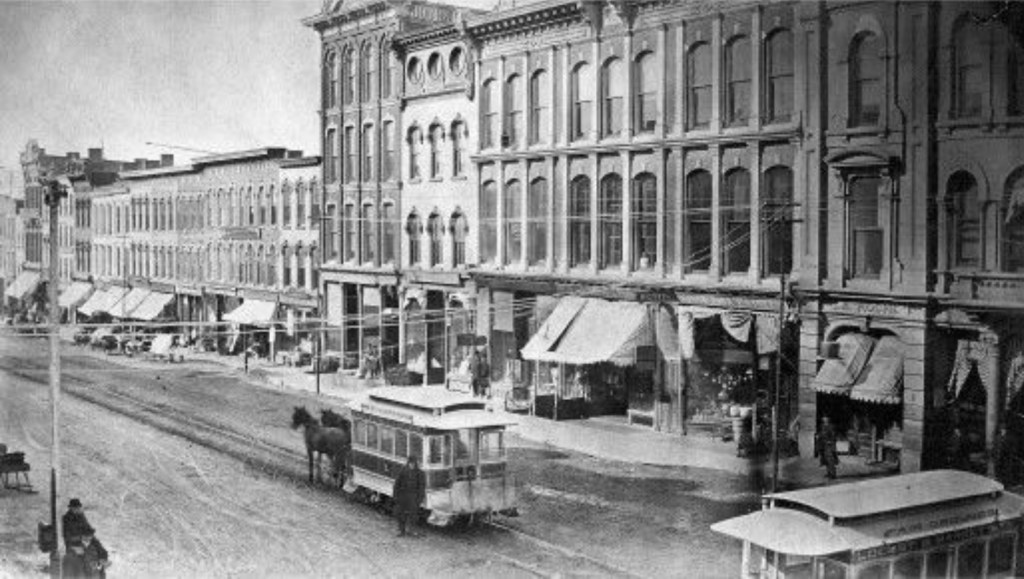
In 1886, Buffalo, Erie County, New York, was a bustling city experiencing significant growth and development. Situated at the eastern end of Lake Erie and serving as a vital inland port, Buffalo played a crucial role in transportation and commerce, particularly as a gateway to the Great Lakes and the Midwest.
The city's economy was driven by a diverse range of industries, including shipping, manufacturing, and trade. The Erie Canal, completed in the early 19th century, connected Buffalo to the Hudson River and New York City, facilitating the movement of goods and people between the East Coast and the interior of the country. Additionally, the city's strategic location along the Great Lakes made it a hub for maritime trade, with ships carrying goods such as grain, lumber, and iron ore to and from ports across the region.
Buffalo's industrial sector was thriving, with factories producing a wide array of products, including steel, machinery, textiles, and processed food. The city's proximity to natural resources and its access to transportation networks fueled its industrial growth, attracting entrepreneurs and laborers seeking employment opportunities.
The population of Buffalo was also expanding rapidly, driven by waves of immigration from Europe and migration from rural areas. Ethnic neighborhoods began to take shape, with communities of Irish, German, Italian, Polish, and other immigrants contributing to the city's cultural diversity.
In terms of infrastructure, Buffalo underwent significant development during this period. The city's skyline was dominated by impressive architecture, including commercial buildings, churches, and mansions built by wealthy industrialists. Notable landmarks included the Guaranty Building (designed by Louis Sullivan), the Ellicott Square Building, and St. Joseph's Cathedral.
Social life in Buffalo was vibrant, with theaters, music halls, and social clubs providing entertainment for residents. Parks and public spaces offered opportunities for recreation and relaxation, while civic organizations and charitable institutions worked to address the needs of the community.
Despite its prosperity, Buffalo faced challenges common to rapidly growing industrial cities, including pollution, overcrowding, and social inequality. Issues such as labor unrest, urban poverty, and political corruption were prevalent, reflecting the complexities of urban life during the late 19th century.
Overall, Buffalo in 1886 was a dynamic city on the cusp of significant transformation. Its strategic location, thriving industries, and diverse population laid the foundation for its continued growth and prominence as a major urban center in the United States.
As we conclude part one of this captivating journey delving into the life of Arthur Charles Willats, we’ve merely skimmed the surface of his remarkable story. From his humble beginnings to his adventures across continents, Arthur’s life is a testament to resilience, determination, and an insatiable thirst for exploration. Join us in the next installment as we uncover more about Arthur’s pioneering spirit and the legacy he left behind. Stay tuned for the next chapter of this extraordinary saga.
Until next time,
Toodle pip.
Lainey.
🦋🦋🦋
 Intwined