As we turn the page to Part 2 of "The Life of Lilly Jenny Neilson Nee Willats, 1869-1947: Life as a Married Woman," we enter a chapter filled with love, trials, and resilience. Lilly's transition from the innocence of youth to the responsibilities and complexities of married life is a testament to her strength and character. Through the joys and sorrows that accompanied her union with William Alexander, Lilly navigated the uncharted waters of matrimony with grace and determination.
In this segment of her story, we will explore the intricate tapestry of Lilly's marriage,a journey marked by profound love and unyielding challenges. From the tender moments of newfound partnership to the heart-wrenching trials that tested their bond, Lilly's experiences offer a poignant glimpse into the life of a woman striving to build a family and find stability in a world that was often unkind.
Join me as we delve deeper into Lilly's life as a married woman, uncovering the layers of her enduring spirit and the legacy she forged through her unwavering commitment to her family and her enduring hope for a brighter future.

Welcome back to the year 1900, London, England. As the 19th century gives way to the 20th, London stands as a vibrant, bustling metropolis at the heart of the British Empire, the largest and most powerful the world has ever seen. Queen Victoria, now in the twilight of her reign, sits on the throne, a symbol of continuity and stability. Her influence pervades every aspect of life, even as the shadow of her approaching death looms over the nation.
The British Parliament is the epicenter of political activity, with the Conservative Party, led by Lord Salisbury, dominating the political landscape. The early years of the new century are marked by significant social and economic change, driven by the ongoing industrial revolution. This period sees the expansion of suffrage and the rise of new political movements that will shape the future of the country.
Fashion in 1900 is characterized by elegance and formality. Women wear long, flowing dresses with tight corsets, high collars, and elaborate hats adorned with feathers and ribbons. Men sport tailored suits with waistcoats, bowler hats, and polished shoes. The influence of the Art Nouveau movement can be seen in the intricate patterns and designs of fabrics and accessories, adding a touch of artistic flair to the era's sartorial elegance.
Travel in London is becoming more accessible thanks to the expansion of the railway and the introduction of the motor car. Horse-drawn carriages still ply the streets, but the sight of the newfangled automobiles is becoming increasingly common. The London Underground, already a marvel of engineering, continues to grow, making it easier for residents to navigate the sprawling city.
Cuisine in 1900 London reflects the city’s cosmopolitan nature. Traditional British dishes such as roast beef and Yorkshire pudding remain popular, but the influence of the Empire is evident in the availability of spices, teas, and exotic ingredients from far-flung colonies. Dining out becomes a social event, with restaurants and cafes offering a variety of culinary delights.
Entertainment options are rich and varied. Theaters along the West End draw crowds with performances of plays, operas, and the latest musical hits. Music halls and vaudeville shows provide more lighthearted fare, while the burgeoning film industry offers glimpses of a new form of storytelling. Social gatherings often center around the home, where families play parlour games, read, and listen to music on the gramophone.
Sanitation in 1900 London is improving, though it remains a significant challenge. The Great Stink of 1858 spurred major improvements in the city’s sewage system, but overcrowded slums and inadequate waste disposal continue to pose health risks. Efforts to provide clean water and better housing are underway, driven by a growing awareness of public health and hygiene.
Energy in London is dominated by coal, which powers homes, factories, and the ever-expanding network of electric streetlights. Gas lamps still illuminate many streets and homes, but electricity is steadily becoming the preferred source of power. The sight of chimneys belching smoke is a common one, a stark reminder of the city’s industrial heart.
Gossip in London at the turn of the century often revolves around the scandals and intrigues of the upper classes. The press is filled with tales of aristocratic misdeeds, political machinations, and royal rumors. The social lives of the rich and famous are a source of endless fascination, providing a diversion from the hardships faced by many.
Historically, the year 1900 is a time of both reflection and anticipation. The Boer War in South Africa dominates headlines, raising questions about the future of the British Empire and its role in the world. Domestically, the dawn of the 20th century brings with it a sense of optimism and progress, tempered by the challenges of modernity and the ever-present undercurrent of social change.
Lilly is starting a new life as a newly married woman, the wife of William Alexander Neilson. In the year 1900, her life is poised to transform significantly from her previous single existence. As a wife, her role in society and her daily duties are defined by the norms and expectations of the time.
Lilly’s primary responsibility is to manage the household. This includes overseeing domestic chores such as cooking, cleaning, and laundry. While she may have help from a maid or other domestic staff if William's income permits, much of the organization and supervision fall on her shoulders. The home is seen as her domain, a reflection of her capability and diligence.
Her day begins early, often before sunrise, to prepare breakfast and ensure that the household runs smoothly. Meals are a significant part of her duties; she must plan, shop for, and prepare nutritious and satisfying food. Skills in preserving food, baking bread, and creating balanced meals from scratch are essential. The kitchen is both her workshop and her stage, where she demonstrates her proficiency and care for her family.
In addition to her domestic duties, Lilly is expected to maintain a well-kept appearance and manage the family's social engagements. Hosting and attending social events, such as tea parties and church functions, are important aspects of her life. These gatherings are opportunities for her to showcase her social graces, build connections, and support William's standing in the community.
Lilly’s role extends to managing the household finances, a task that requires her to budget prudently, keep meticulous records, and stretch resources effectively. She must ensure that the home is warm and welcoming, often involving tasks such as sewing, mending clothes, and decorating the house to reflect a comforting and hospitable atmosphere.
Children, when they arrive, will add another layer to Lilly's responsibilities. She will be the primary caregiver, responsible for their upbringing, education, and moral guidance. This role is both demanding and revered, as the mother is seen as the cornerstone of the family's future.
Society expects Lilly to be a dutiful and supportive wife to William. Her support for him is multifaceted, encompassing emotional encouragement, managing the home efficiently so he can focus on his work, and being a partner in public life. Her comportment, behavior, and achievements reflect directly on him, making her role crucial in their collective social standing.
Religiosity often plays a significant role in her life. Attending church regularly, participating in church activities, and instilling religious values in her household are part of her routine. The moral and ethical upbringing of her children and the maintenance of a pious household fall within her remit.
Lilly's world is largely defined by the private sphere of home and family, but she may also engage in charitable work or join women's clubs that focus on social reform or intellectual improvement. These activities provide a sense of purpose beyond her domestic duties and allow her to contribute to the wider community.
Lilly wasn’t the only person head over heals and making a new life as Lilly’s brother, 28-year-old Bachelor and auctioneer, Edwin Paul Willats married 19-year-old, spinster, Nellie Elizabeth High on Saturday the 7th of July, 1900, at All Hallows, Tottenham, Edmonton, Middlesex, England.
Their witnesses were their brother Walter James Willats and Nellie's sister Amelia Ellen Willats nee High (Walter’s wife).
Edwin and Nellie gave their father's names and occupations were given as Richard Henry Willats, a surveyor and James High (William James), a Cabinet Maker.

Just under a year later, the 1901 census was completed. It shows Lilly and William were residing at The French Horn Tavern, Lambeth Walk, Lambeth, London, England, on Sunday 31st March 1901. William was a Publican. 25-year-old Barman Joseph Sutton and 29-year-old Domestic Labour, Emma Anstee were residing with them.
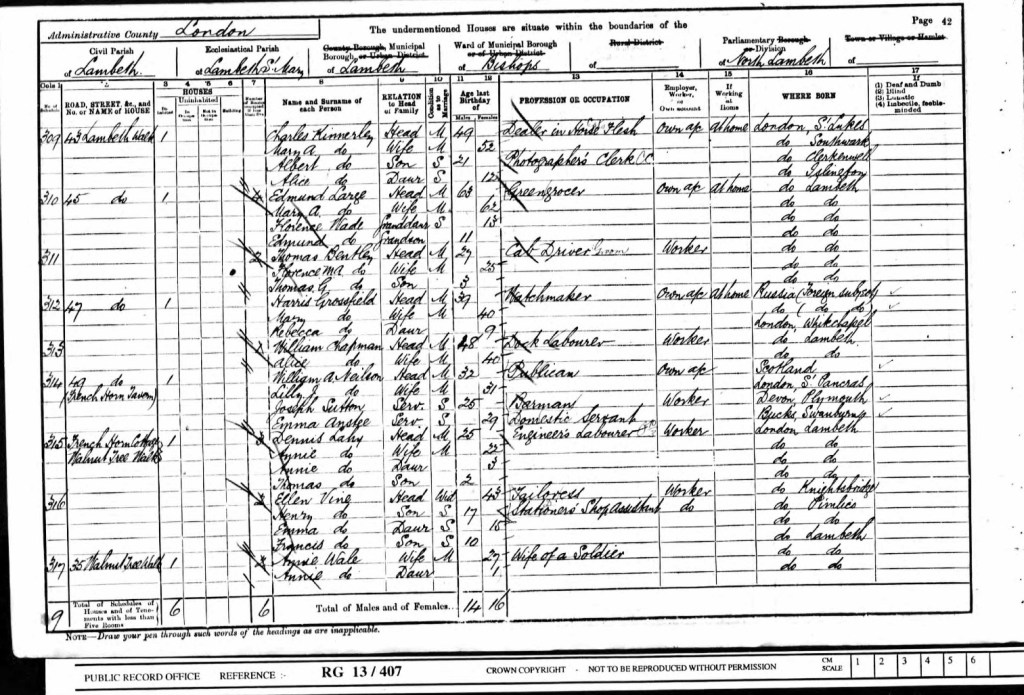
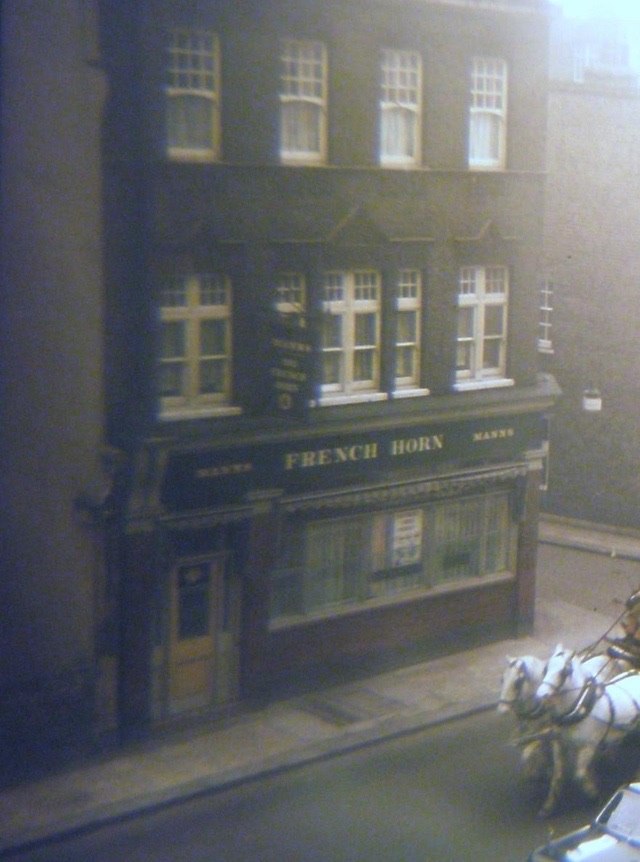
The French Horn Tavern, located on Lambeth Walk in Lambeth, London, is a historic public house with a rich past that reflects the changing character of its surroundings. Lambeth Walk, once a bustling street market and a vibrant community hub, has seen significant transformations over the years, and the French Horn Tavern has been a witness to many of these changes.
The tavern itself dates back to at least the early 19th century, though the exact date of its establishment is somewhat murky. As with many pubs of its era, the French Horn Tavern served as a central meeting place for the local community, offering a place for socializing, conducting business, and, at times, engaging in more dubious activities. Its name, "The French Horn," is likely derived from the musical instrument, a common naming convention for pubs during that period, reflecting a lively and convivial atmosphere.
Throughout its history, the French Horn Tavern has seen a succession of landlords, each bringing their unique influence to the establishment. These landlords played crucial roles not just in the management of the pub but also in maintaining its standing within the community. Unfortunately, detailed records of the individual landlords are sparse, but their impact is evident in the tavern's enduring presence on Lambeth Walk.
One of the most intriguing aspects of the French Horn Tavern is its association with ghost stories and local legends. Like many historic pubs in London, the French Horn is reputed to be haunted. Patrons and staff alike have reported eerie occurrences over the years, including unexplained noises, sudden drops in temperature, and even sightings of ghostly figures. One popular tale involves the spirit of a former landlord who is said to roam the premises, still tending to his duties long after his death. Another story speaks of a Victorian-era woman who met a tragic end nearby and whose restless spirit is believed to linger in the tavern.
These ghost stories add a layer of mystique to the French Horn Tavern, attracting both skeptics and believers who are curious about the supernatural. The combination of the pub's rich history, its place within the local community, and these spectral legends make it a compelling destination for both locals and visitors.
In recent years, the French Horn Tavern has continued to serve as a traditional English pub, offering a range of ales, beers, and classic pub fare. Its décor often reflects its historical roots, with period-appropriate furnishings and memorabilia that celebrate its long-standing presence in Lambeth. The tavern's ability to maintain its character while adapting to contemporary tastes is a testament to its enduring appeal.
The French Horn Tavern remains a cherished part of Lambeth's heritage, embodying the spirit of the area with its welcoming atmosphere, historical significance, and the intriguing stories that have become part of its legacy. Whether one is interested in local history, in search of a good pint, or curious about the paranormal, the French Horn Tavern offers a unique and enriching experience.
Lilly, now the wife of William Alexander, the publican of The French Horn Tavern, finds herself immersed in a bustling and dynamic environment. As the wife of a publican, her life revolves around the pub, which serves as both their business and home.
The role of a publican's wife was multifaceted and demanding, requiring a blend of hospitality, management, and social skills.
In Lambeth, a working-class district known for its vibrant community, the pub was a central social hub. Lilly's presence and demeanor play a crucial role in the establishment's success.
She would have been expected to be hospitable and welcoming, ensuring that patrons feel comfortable and valued. Her duties would have often include greeting customers, serving drinks, and maintaining the cleanliness and orderliness of the pub.
It was not uncommon for publicans' wives to be seen behind the bar, especially during busy times. Lilly likely helped with pulling pints, taking orders, and chatting with customers, all while keeping a watchful eye on the atmosphere of the establishment.
Managing the pub involves a significant amount of work behind the scenes. Lilly would have been responsible for keeping track of inventory, including ordering and managing supplies such as beer, spirits, and food items. She would have also handle the financial aspects of the business, ensuring that records are kept meticulously, and that transactions are accurate. Her organizational skills would have been essential in keeping the pub running smoothly, particularly during peak hours when the demand is high, and the environment can become hectic.
Women working in public houses face specific societal expectations and rules. While it was acceptable for Lilly to be involved in the business, she would have  maintain a respectable demeanor at all times.
The Victorian values of propriety and modesty still influence public perceptions, and as such, her behavior must have reflected decorum and respectability. It was crucial for her to strike a balance between being approachable and maintaining the dignity expected of a publican's wife. Engaging with customers, especially male patrons, requires a delicate touch, ensuring that friendliness did not lead to any impropriety.
Lilly's role would have extends beyond merely serving customers and managing the bar. She likely handled the kitchen, preparing food that is served in the pub. Meals and snacks are an integral part of the pub experience, and her cooking skills contribute to the establishment's reputation. Additionally, she may have managed any staff employed at the pub, overseeing their work and ensuring that service standards are met.
The pub also serves as a community center, hosting events and gatherings. Lilly would have helped organize these activities, from arranging space for local meetings to setting up entertainment such as music or games. Her involvement in these events reinforces the pub's status as a welcoming and integral part of the community.
Living above or adjacent to the pub, Lilly's life would have been closely entwined with the business. There would have been little separation between her personal and professional life, and she would have been always on call to address any issues that may arise. This constant engagement requires stamina and resilience, as the demands of the pub can be relentless.
Despite the challenges, there are also rewards. Lilly would have been a respected figure in the community, known for her hard work and dedication. The pub would have provided a steady income and a social network that enriches her life. Her partnership with William was vital, as their combined efforts are what make the business thrive.
Sadly Lilly’s joyous new life would have shadowed when her sister, Eliza Mary Beach nee Willats died on Monday the 21st of July 1902, at Beach Court, Upper Deals, Eastry, Kent, England, at the awfully young age of 35 years.
Eliza died from Pneumonia and exhaustion.
Edith Cameron Charlton nee Willats, their sister, was present and registered her death on the same day, Monday the 21st of July 1902.
Edith stated that Eliza was the wife of Benjamin Beach, giving his profession an, independent means.
Eliza’s death was registered under the name Mary Eliza Beach.

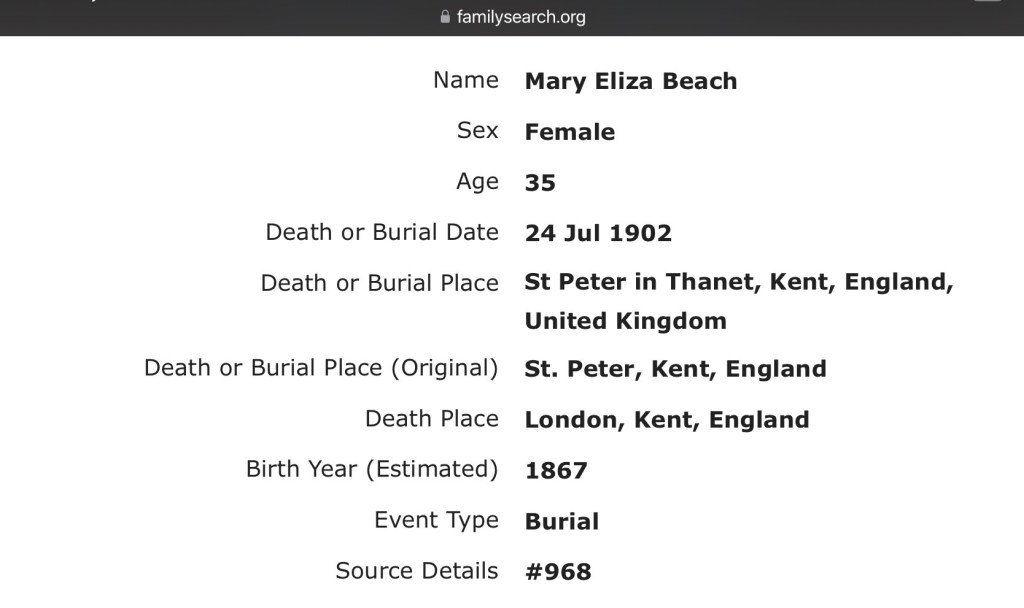
Lilly and her family laid Eliza Mary Beach nee Willats, to rest on Thursday the 24th of July, 1902, at St Peter in Thanet, Kent, England.
St Peter's is an area of Broadstairs, a town on the Isle of Thanet in Kent. Historically a village, it was outgrown by the long-dominant settlement of the two, Broadstairs, after 1841. Originally the borough or manor of the church of St. Peter-in-Thanet, it was said to be the largest parish east of London, at least until Broadstairs became a separate parish on 27 September 1850. The two settlements were formally merged administratively in 1895. The village and its church, named after Saint Peter, was the second daughter church of Minster established in 1070, although the first written record of its present name dates to 1124. In 1254 the village was named "scī Petr'", which gradually changed to "scī Petri" by 1270, Sti Petri in Insula de Thaneto by 1422, and finally settling by 1610 on its current form of St Peter's. The church has the right to fly the white ensign, dating from when the church tower was used as a signalling station in the Napoleonic Wars. The village sign won first prize in a nationwide competition in 1920. Edward Heath, leader of the Conservative Party from 1965 to 1975, serving as prime minister from 1970 to 1974, was born in the village in 1916. On 27 April 1952, a United States Air Force Republic F-84 Thunderjet from RAF Manston crashed in the main street with loss of life.

Thankfully joy was once again on the horizon when, Lilly’s sister, 28-year-old, spinster, May Claretta Willats married 20-year-old, architectural florist, and bachelor, George Frederick Champion, on Saturday the 4th of April 1903, at St. John’s Church, Highbury Vale, Islington, London, England.
May gave her residence as, 21 Montague Road and George as, 194 Green Lands.
They gave their father’s names and occupations, as George Frederick Champion, an architectural florist and Richard Henry Willats an Estate Agent.
Their witnesses were, George Frederick Champion and May’s niece, Amina Eliza Catherine Charlton.

And Lily’s brother 26-year-old bachelor, surveyor, Frederick Howard Willats, married 24-year-old spinster Maud May Beach, on Saturday the 19th of September 1903, at St. John’s Church, Highbury Vale, Islington, London, England.
Frederick gave his abode as, 27 Kings Road and Maud graves hers as, 16 Orchard Road, St. Margarets on Thames.
They gave their fathers names and occupations, as Richard Henry Willats, estate agent, and Walter Beach (deceased), a Gentleman.
Their witnesses were her brother, Persey Sidney Willats and his niece, Amina Eliza Catherine Charlton.

Across the pond, Lilly’s brother, 43-year-old, widower and salesman, Arthur Charles Willats, married 30-year-old, spinster and actress, Ruth Gadsby, on Wednesday the 17th of June 1908, at Niagara Falls, Welland, Niagara, Ontario, Canada.

Back in England Lily’s brother, 33-year-old, bachelor, Percy Sidney Willats, married 25-year-old, spinster, Sophie Ann Smart on Saturday the 24th of July 1909 at The Register Office, Edmonton, Middlesex, England.
Their witnesses were, E. P. Willats and J H Champion.
Percy gave his occupation as an auctioneer. They gave their abode as Number 11 The Quadrant, Winchmore Hill, Edmonton.
They gave their fathers names and occupations as, Richard Henry Willats, an auctioneer and John Smart, a Market Gardener.

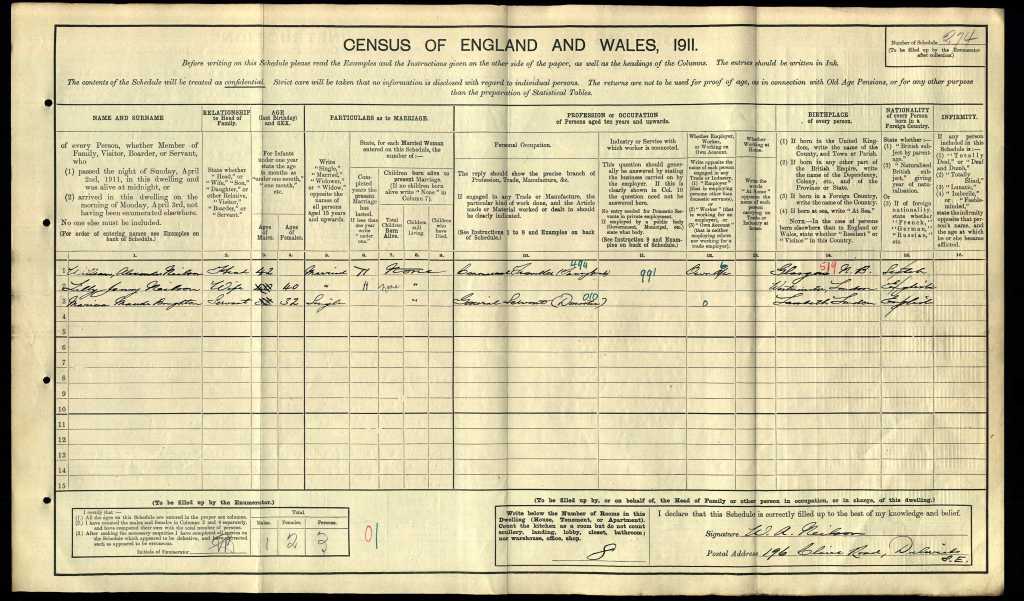
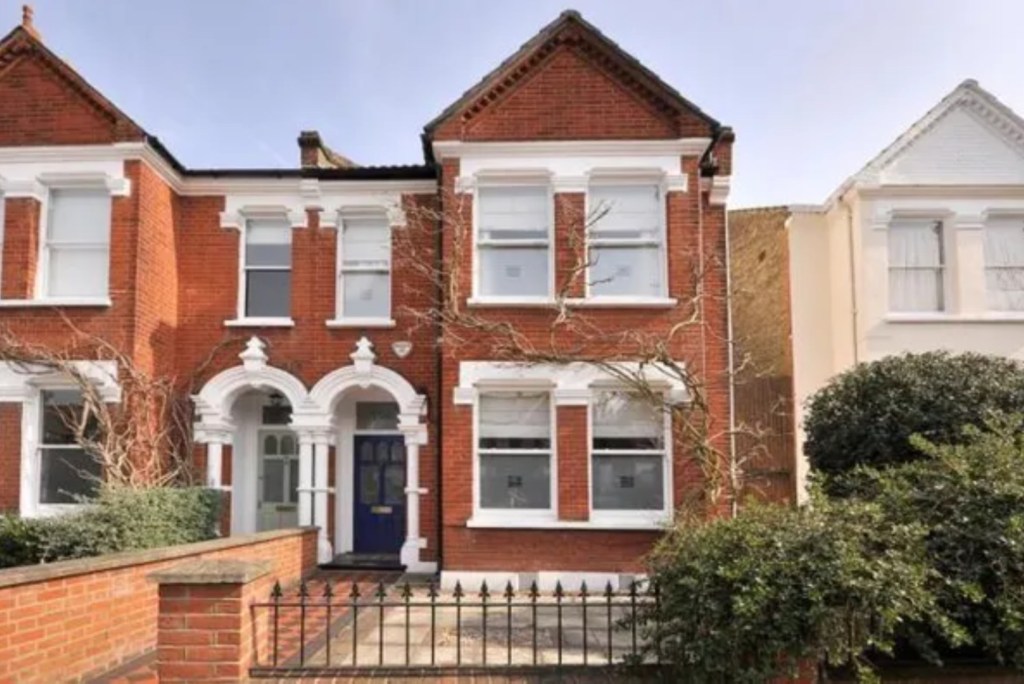
Jumping forward to the year 1911, the year of the census. Lilly and William were residing at, Number 196 Clive Road, Dulwich, Lambeth, London, England, on Sunday 2nd April 1911.
William was now working as a commercial traveller of fancy goods.
32-year-old general domestic servant Marian Maude Broughton, was residing with them.
196 Clive Road was an eight-room dwelling.
Lilly and William had been married 11 years and had no children.
Clive Road in Lambeth, London, England, is a residential street that exemplifies the diverse and historically rich character of the Lambeth area. Located in the southern part of the borough, Clive Road has seen significant changes over the decades, reflecting broader social, economic, and architectural trends in London.
Lambeth itself is one of London's oldest boroughs, with a history that dates back to at least the Domesday Book of 1086. It has evolved from a rural area into a densely populated urban district. Clive Road, situated within this dynamic environment, is part of the Norwood area, which is known for its Victorian and Edwardian housing.
The street is lined with typical London terraced houses, many of which date back to the late 19th and early 20th centuries. These homes often feature the distinctive architectural details of their era, such as bay windows, ornate brickwork, and small front gardens. Over the years, some properties have been modernized, but many still retain their original charm.
Clive Road, like much of Lambeth, has a diverse population, reflecting the multicultural nature of London. The area has long been home to a mix of working-class families, professionals, and immigrants from various parts of the world, contributing to a vibrant and eclectic community.
In terms of amenities, Clive Road benefits from its proximity to several local attractions and facilities. Nearby, residents can find shops, cafes, and schools, as well as parks and green spaces. Brockwell Park, one of the largest and most popular parks in the area, is just a short distance away. The park offers extensive recreational facilities, including a historic lido, tennis courts, and beautiful gardens, making it a favorite spot for local residents.
Transportation links are another key feature of Clive Road's appeal. The street is well-connected to the rest of London via public transport. Tulse Hill and West Norwood railway stations are the closest, providing regular services to central London and other parts of the city. Numerous bus routes also serve the area, ensuring convenient access to surrounding neighborhoods and amenities.
Historically, the development of Clive Road and its surrounding areas can be traced back to the expansion of London's suburbs during the Victorian era. As London grew, new residential areas were developed to accommodate the increasing population, leading to the construction of many of the houses that still stand today. This period saw the transformation of Lambeth from a series of rural villages into a bustling urban district.
In recent years, Lambeth, including Clive Road, has seen significant regeneration and investment. This has included improvements to local infrastructure, housing, and public spaces. These changes have helped to enhance the quality of life for residents and have made the area increasingly attractive to new families and professionals looking for a blend of urban living and community spirit.
Clive Road, while perhaps not as famous as some of London's more well-known streets, is a microcosm of the city's broader history and diversity. It offers a glimpse into the everyday life of Londoners and stands as a testament to the enduring appeal of Lambeth as a place to live, work, and raise a family. Whether one is drawn by its historical architecture, community atmosphere, or convenient location, Clive Road remains an integral part of the vibrant tapestry that makes up this part of London.
Heartbreakingly for Lilly, her husband, 46-year-old, commercial traveller of fancy goods, William Alexander Neilson, died Tuesday on the 21st of July 1914, at the Brighton Workhouse Infirmary, 250 Elm Grove, Brighton, Sussex, England.
William died from Cirrhosis of the liver (scarring of the liver caused by long-term liver damage, mainly caused by drinking too much alcohol.) and Ascites (fluid collected in spaces within the abdomen).
Lilly registered Williams death on Thursday the 23rd of July 1914.
She gave their address as, Number 45, Mighill Street, Brighton, Sussex, England.

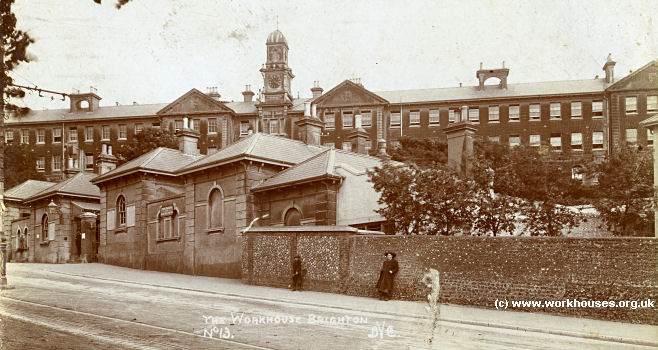
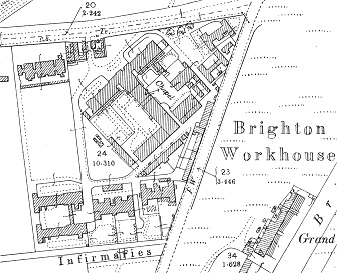
Elm Grove Workhouse The foundation stone at the new workhouse on Race Hill at Elm Grove in Brighton was finally laid on 11th April, 1865. Two and a half years later, on 12th September 1867, the building was finished at a cost of £41,000. Soon afterwards, all the inmates were transferred from the Church Hill workhouse, with the old building was demolished soon afterwards. The vacant site was then sold off for the construction of prestige housing. The sale of the land and materials raised £42,000, providing the Guardians with an overall profit of £1,000 on their transfer from one workhouse site to another. The new workhouse was designed by the London firm of JC & G Lansdown of Charing Cross, in conjunction with local man George Maynard. The site location and layout is shown on the OS map of 1897. The impressive main block at the north of the site, was T-shaped in plan. Its frontage was four storeys with a central clock tower. The building was divided into separate sections for male and female inmates by means of iron gates in the corridors. The building employed a system of artificial ventilation. The projecting wing at the centre of the main block included a large chapel. An infirmary was located the south-west of the site, with a lunatics' block to its east. Other blocks included casual wards, and foul and fever wards at the north-east of the workhouse. In 1880, three acres of land was purchased to the west of the workhouse on which new casual wards were erected in 1885, followed by infirmary pavilions at the south-west. From 1904, to protect them from disadvantage in later life, the birth certificates for those born in the workhouse gave its address just as 250 Elm Grove, Brighton. By 1910, the workhouse had a scheme of classification, under which some thirty or so of the best conducted male inmates were housed themselves in more comfortable quarters. Each of the men was also allotted a small plot of ground outside, in which they could garden and grow flowers for which prizes are given during the season. In 1914, the workhouse became known as Brighton Poor Law Institution. Between 1915 and 1920 it was taken over by the War Office and operated as the Kitchener Indian Hospital accommodating sick and wounded Indian soldiers. In 1921, it reverted to use as a workhouse until 1930 when it became Brighton Municipal Hospital. In 1948, it became part of the National Health Service and renamed Brighton General Hospital.
Family story’s state that William left Lilly destitute.
William’s probate was granted on Thursday the 29th of October 1914 in London. It reads, NEILSON William Alexander of 53 South End South Croydon Surrey died 21 July 1914 at The Infirmary Brighton Probate London 29 October to Lillian Jean Neilson widow. Effects £427 1s. 3d.

Williams Grant reads as follows, -

DEATH ON OR AFTER 1st JANUARY,1898. Will. BE IT KNOWN that William Alexander Neilson of 53 South End South Croydon in the County of Surrey onetime of 96 Clive Road West Dubwich in the said county died on the 21st day of July 1914 at The Infirmary Brighton in the County of Sussex - AND BE IT FURTHER KNOWN that at the date hereunder, written the last Will and Testament - of the said deceased was proved and registered in the Principal Probate Registry of His Majesty's High Court of Justice, and that administration of all the estate which by law devolves to and vests in the personal representative of the said deceased was granted by the aforesaid Court to Lillian Jean Neilson of 99 Lordship Road Stoke Newington in the county of Middlesex widow the realist of deceased one of the executors - named in the said Will - John George Shearman the other executor their in named having renounced probate thereof - Dated the 29th day of October 1914 Gross value of Estate … £427-1-3 Net value of Personal Estate £

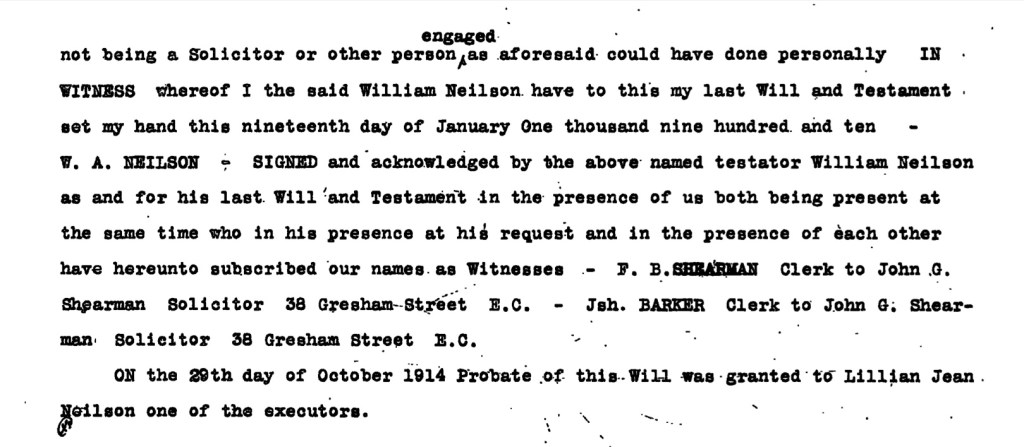
Lilly’s husband, William Alexander Neilson, had write his will on Wednesday the 19th of January 1910, at John G. Shearman Solicitor 38 Gresham-street. It reads as follows.

William Alexander Willats 5 This IS THE LAST WILL and TESTAMENT of me William Alexander Neilson commonly known as William Alexander Nadlson of 190 Clive Road West Dulwich in the County of Surrey Fancy Goods Merchant I revoke all former testamentary dispositions made by me and declare this to be my last Will I appoint my dear Wife Lillian Jean and John George Shearman of 38 Gresham Street in the City of London Gentleman (hereinafter called “my Trustees”) to be EXECUTORS and TRUSTEES of this my Will. I give devise and bequeath all my real and personal estate unto my Trustees Upon trust that my Trustees shall sell call in and convert into money such part thereof as shall with any ready money belonging to me at the time of my death be sufficient for the purpose of paying my funeral and testamentary expenses and debt And shall stand possessed of the residue thereof after such payments as aforesaid In trust for my dear Wife absolutely should “she survive me but if she should predecease me then In trust for my sister Janet Neilson absolutely And I declare thàt my Trustees my instead of acting personally employ and pay solicitor or other person to transact and business or do any act required to be done in connection with the administration of my estate or the trusts hereby declared including the receipt and payment of money and that any Executor orTrusree being a solicitor or other person engaged in any professional or other charges for any business or act done by him or his firm in connection with the trust including any act which an Executor or Trustee not being a Solicitor or other person engaged as aforesaid could have done personally IN WITNESS whereof I the said William Neilson have to this my last Will and Testament set my hand this nineteenth day of January One thousand nine hundred and ten - W. A. NELSON : SIGNED and acknowledged by the above named testator William Neilson as and for his last Will and Testament in the presence of us both being present at the same time in his presence at his request and in the presence of èach other have hereunto subscribed our names as Witnesses - F. B. SHEARMAN Clerk to John G. Shearman Solicitor 38 Gresham-street E.C. - Jsh. BARKER Clerk to John G: Shearman Soltcitor 38 Gresham Street E.C. ON the 29th day of October 1914 Probate of this Will was granted to Lillian Jean Neilson one of the executors.

I once again picture our Lilly writing to her brother Arthur to inform him of Williams death and the desperate situation she has been left in. I imagine it would read something along these lines.


My Dearest Arthur,
I hope this letter finds you well, even as I find myself overwhelmed by sorrow and despair. It has been a long time since we last spoke, and I wish the circumstances were brighter. But I must share with you the heartbreaking news that my husband, William Alexander, has passed away. Though our marriage was fraught with trials, his loss has left me in a dire and desperate situation.
William’s struggle with alcohol was a constant shadow over our lives. His erratic behavior and the relentless grip of his addiction often left us teetering on the edge of ruin. Despite my efforts to help him, he fell deeper into the abyss, taking our financial stability with him. In the end, it was his drinking that led to his untimely death, leaving me to pick up the shattered pieces of our lives.
Arthur, I find myself destitute and with little hope.
William’s death has not only left me heartbroken but also financially ruined. His addiction drained our savings, and now, with him gone, I am left with nothing but debts. The small amount of money I have managed to scrape together is barely enough to keep the creditors at bay, and each day I fear they will come to take what little I have left.
The weight of this burden is almost more than I can bear. I am struggling to find work, but opportunities for women are scarce, especially for a widow with no means. Every door I knock on seems to close in my face, and the sense of hopelessness grows with each passing day. I have sold everything of value, even the few cherished mementos that brought me comfort, yet it is not enough.
The pain of William’s death and the reality of my situation are almost too much to endure. Yet, writing to you gives me a glimmer of hope, a thread of connection to a life that feels so distant now. Your love and understanding would be a balm to my wounded heart, offering me strength in this darkest hour.
Please forgive me for laying such heavy burdens upon you. I had hoped for a brighter path, but fate has been cruel.
Know that your kindness and support would be a lifeline to me now.
With all my love and deepest gratitude,
Lilly.
As we conclude Part 2 of "The Life of Lilly Jenny Willats, 1869-1947: Life As a Married Woman," we've witnessed Lilly's transformation from a young bride to a pillar of strength within her family. Her marriage, marked by both challenges and triumphs, has highlighted her unwavering dedication, love, and resilience. Through the highs and lows, Lilly's journey has been a poignant reminder of the complexities and rewards of married life in her era.
In the upcoming Part 3, we'll delve into the next chapter of Lilly's life, exploring her role as a widow and the further adventures that shaped her enduring legacy.
Thank you for following along, and I look forward to sharing more of Lilly's inspiring story with you soon. Stay tuned!
Until next time,
Toodle pip,
Yours Lainey.
🦋🦋🦋
I have brought and paid for all certificates,

Please do not download or use them without my permission.

All you have to do is ask.

Thank you.
 Intwined