Welcome back to the captivating journey of James William Willats, an enigmatic figure whose life’s tale continues to unfold with both intrigue and inspiration. In our first installment, we embarked on a thrilling expedition through his early years. Now, we delve into the next chapter of his extraordinary life, the story of James William Willats as a married man.
As we retrace the footsteps of my fourth great granduncle, we will find ourselves traversing the paths of love, commitment, and growth. The entry into marriage marks a significant milestone in any person’s life, and for James, it proved to be no different. His heart now intertwined with another’s, his journey takes on new dimensions, and his character encounters fresh tests.
From the rich historical archives, we are invited to witness James’s transformation as he evolves into a devoted husband, partner, and provider. Drawing from dusty documents, the answers to his life’s stories lie in the annals of history which bore witness to his journey.
While we celebrate the joys and triumphs, we shall not shy away from acknowledging the challenges and sacrifices that accompanied this new phase of life. As with any union, there were moments of elation and moments of adversity, but it is within these human intricacies that we find the true essence of our ancestor’s character.
On the bustling streets of London, James and his wife Elizabeth embarked on their own adventure. Their love story, woven amid the backdrop of historical events, has captured the hearts of generations that followed.
As we immerse ourselves in the life of James William Willats as a married man, and discover the legacy of love and commitment. James leaves behind a timeless reminder of the power of human connection and the strength found in the bonds of marriage.
So, let us venture forth, hand-in-hand with James and his beloved, to a time of trials and triumphs, love and laughter. And as we honor the memory of James William Willats, let’s celebrate that this intriguing man is still being remembered all these years later.
The Life of James William Willats,
Embracing Life as a Married Man.
Welcome back to London in 1865, a city of vibrant contrasts, where history seems to pulse through the streets and the air is thick with the energy of change. London was at the crossroads of tradition and modernity, a sprawling metropolis where the hum of progress mingled with the weight of centuries-old customs. This was a city where stories of triumph and hardship intertwined, where the rich and poor existed side by side, though often worlds apart in experience.
At the helm of the British Empire was Queen Victoria, a monarch whose image was everywhere, from portraits to statues. She was the embodiment of the Victorian ideal, moral, steadfast, and deeply committed to the duty that came with her crown. Her reign, long and steady, cast a shadow over the entire Empire, a constant in an ever-changing world. By 1865, Queen Victoria had been on the throne for nearly 30 years, and though the world was rapidly evolving, she remained a symbol of stability. Despite personal tragedy in her life, including the passing of her beloved husband, Prince Albert, her reign was one of expansion, both geographically and culturally, as the British Empire continued to grow.
In the world of politics, the prime minister was Lord Palmerston, an older statesman who held sway over much of the country’s foreign and domestic policies. He was known for his fierce defense of Britain’s interests and a keen ability to navigate the complex political terrain of the time. But by 1865, even Palmerston’s influence was beginning to fade, and debates over reform were gaining momentum. It was a time of change, where the old guard was giving way to new ideas, and whispers of social reform and suffrage for the working class were stirring.
The streets of London were alive with the pulse of a nation on the brink of transformation. In the West End, the wealthy promenaded in the latest Parisian fashions, women in wide crinolines that swayed like clouds, their dresses a cascade of silk and lace. The men, ever the image of refinement, wore well-tailored suits with top hats perched just so. Their lives were a world of private carriages, glittering theatres, and sumptuous balls. The scent of roses filled the air at garden parties, and the hum of conversation in drawing rooms seemed as constant as the ticking of the grandfather clocks.
But for the majority, life was far different. The working class, the backbone of the city, could be found in the industrial heart of London—the East End, where the streets were lined with row houses and factories puffing thick clouds of smoke into the air. The rich may have lived in elegance, but the working class lived in the grit of progress. Horse-drawn buses clattered down the cobbled streets, and the noise of factory machines filled the air, alongside the shouts of market vendors. There was a sense of unrelenting toil for these men and women, with hours spent in dim factories or as servants in the homes of the rich, their lives shaped by labor, not luxury.
The divide between the rich and poor could not have been starker. The wealthy could afford to enjoy the city’s finest pleasures, opera, ballet, theatre, while the working class had their own forms of entertainment. Music halls and penny gaffs offered them vaudeville acts, comedic performances, and lively dances. The city’s theatres were the soul of high society, but for the working class, a trip to the music hall was an escape, a chance to laugh, to dream of a life they could never quite grasp. And as for the poor? They lived in squalor, their tenements crammed with families, the air thick with the stench of disease and poverty. Many families could barely afford to feed themselves, let alone entertain the idea of leisure.
The city itself was a place of constant motion. The train lines were expanding, stretching across the country, though most of London’s commuters still relied on the slow, rumbling horse-drawn omnibuses. For the rich, the private carriage was the mark of status, a personal oasis in the bustling streets. But even they were not immune to the rapidly changing world around them. The trains, new and daring, were beginning to transform travel, a hint of the future to come, though the underground railway was still in its infancy.
Yet for all its progress, the city was a place where the past seemed ever-present. London in 1865 was a city of coal smoke and soot, where the skies often seemed to be filled with a permanent grey haze. The Thames, once the lifeblood of the city, had become a foul river, its waters polluted by the waste of thousands of people, and its smell so rancid it was known to knock the wind from your lungs. The streets were often muddy, crowded, and poorly lit, with gas lamps flickering weakly in the dark. Even though gaslight was the latest in lighting technology, it was still a distant dream for many of the poorer districts, where darkness often swallowed up the night.
The rich lived in stately homes with gas lamps and fireplaces blazing in every room, while the poor huddled together in cold, damp, and poorly constructed buildings, relying on the occasional coal fire for warmth. The smell of burning coal filled the air, a constant reminder of the harshness of the environment. In the West End, gaslight bathed the streets in a soft glow, a symbol of comfort and affluence. But in the East End, where the working class lived, there was little light, and the night was often a time of fear, a time when crime and disease seemed to creep through the shadows.
Nutrition was also tied to class. The wealthy dined on rich meats, delicate pastries, and exotic imports from the Empire, with fresh vegetables and fruit available year-round. But for the poor, their diet was more limited, often consisting of cheap cuts of meat, potatoes, and bread. Many working-class families had to make do with what they could grow in small urban gardens or buy in the local markets. Fresh produce was a luxury, and the poorer you were, the harder it was to find anything nourishing beyond the basics.
Sanitation, too, was a matter of class. While the wealthy had private water supplies and servants to tend to their needs, the poor lived in areas where sewage ran through the streets, and the smell of refuse filled the air. Public health was beginning to be a topic of conversation, but the reality for many was that sanitation and clean drinking water were luxuries they could not afford. Disease was rampant, particularly in the East End, where cholera outbreaks were not uncommon, and the squalor of tenement living led to the spread of tuberculosis and other diseases.
Amidst all this, the city buzzed with gossip and intrigue. The lives of the rich were a constant source of fascination, who was marrying whom, which families were rising and which were falling. Scandals in high society were whispered about in drawing rooms, and the social columns in the papers eagerly awaited the next dramatic turn of events. Meanwhile, the lives of the working-class were filled with resilience and community, as people supported one another in the face of hardship. Yet, for all the gossip about the wealthy, the true stories of London’s underclass were often untold, their struggles unseen by the privileged few.
London in 1865 was a city of contrasts, of sharp lines drawn between the rich and poor, between tradition and progress, between the grand ambitions of empire and the quiet struggles of everyday life. It was a place of contradiction, where hope and despair lived side by side, and where the echoes of history and the whispers of the future could be heard in every street, every conversation, and every soul. It was a time of change, but also of deep-rooted inequality, a city on the edge of transformation, yet still deeply tied to the past.
The first glimpse I had into James’s life after his marriage came unexpectedly, hidden in the pages of the 1865 Trade Directory. It was as if a door had opened just a crack, offering me a view into the world he was navigating at the time. There, amidst the rows of names and professions, was James, listed not by his full name, but simply as a "Jewel Agent." It was a title that seemed both elegant and elusive, the kind of profession that could whisper of riches, of precious stones, of high society. But it wasn’t the glamour that caught my attention; it was the address that followed.
Number 25, Golden Square, Soho, London. There, in the heart of one of London’s most bustling and vibrant districts, James was working from a location that sounded as intriguing as his profession. Soho, with its crowded, lively streets, filled with the hum of commerce, was a place where the boundaries between the fashionable and the ordinary were often blurred. It was a district known for its mix of entertainment, music halls, and shops, yet it also had a quieter side, home to businesses that catered to the tastes of the wealthy and the sophisticated.
Golden Square itself, a little square tucked away amidst the chaos of Soho, seemed to be a place where the busy pulse of the city met the more refined world of trade. I could almost picture James there, working tirelessly, surrounded by the gleam of precious stones and the whispers of potential deals. Though the directory entry was brief, it gave me the sense that this was a time of quiet ambition for him. He was starting to carve out his space in a city that was full of opportunity but also fierce competition.
The name "Jewel Agent" suggested someone who acted as an intermediary between the world of precious gems and the wealthy buyers who sought them. It wasn’t quite the same as being a jeweler, but perhaps it was the perfect role for someone like James, someone who had the skills and knowledge but didn’t yet have the means to own the glittering treasures he worked with. Soho, in 1865, was still a neighborhood of contrasts, where the bright lights of entertainment coexisted with more discreet, professional businesses. The presence of a Jewel Agent there felt like a symbol of the time, a blend of elegance and grit, of luxury and labor, a reflection of the larger world James was a part of.
As I read the directory entry again, I imagined what his days might have looked like. Maybe he was meeting clients in one of Soho's many cozy rooms, where deals were made over tea and the quiet hum of London life spilled in from the streets. Or perhaps he was overseeing transactions, arranging for exquisite gemstones to be delivered to wealthy customers who craved a touch of glamour in their lives. Whatever his role, it was clear that James was part of a world that balanced carefully between the everyday hustle of Soho and the glittering allure of fine jewels, all while making his mark on a city that was transforming before his very eyes.
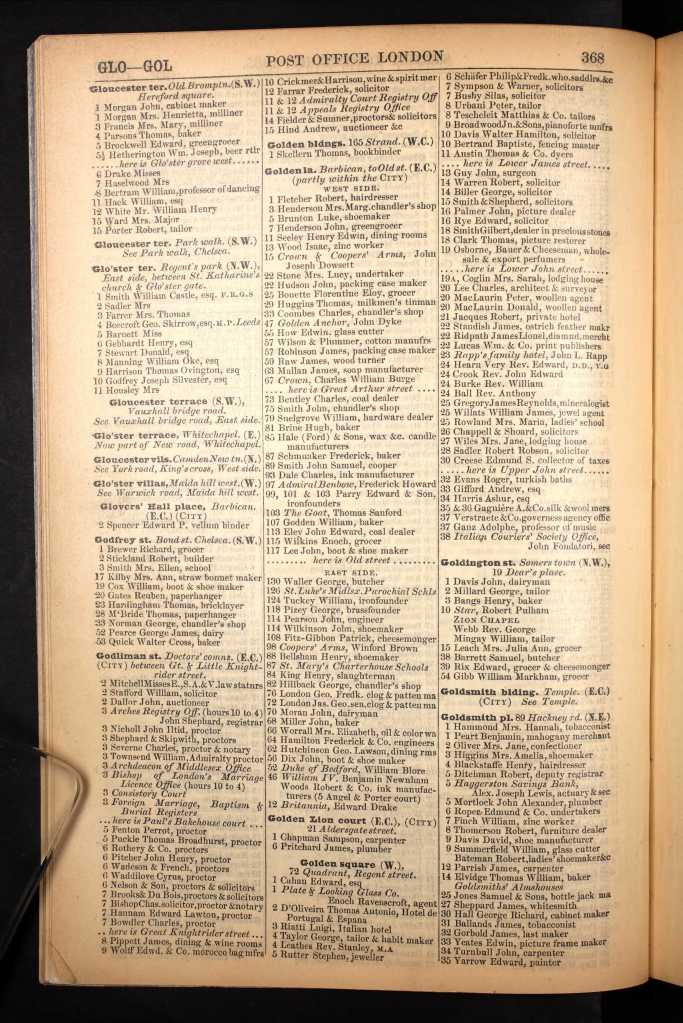
So what would have been involved in working as a Jeweler Agent in 1870? Here’s a few examples. Crafting and Repairing Jewelry: Jewelers in the 1870s would spend a significant amount of time handcrafting fine jewelry pieces. They would work with precious metals such as gold and silver, and precious gemstones like diamonds, rubies, sapphires, and emeralds. Additionally, they would repair damaged or broken jewelry brought in by customers.
Designing Custom Pieces: A skilled Jeweler might have been asked to design custom jewelry pieces for wealthy clients or special occasions. This involved understanding the customer’s preferences, sketching designs, and creating unique jewelry items tailored to the individual’s taste.
Gemstone Selection: Jewelers needed expertise in evaluating and selecting high-quality gemstones. They would need to have an eye for identifying genuine stones and assessing their color, clarity, and cut.
Appraisal and Valuation: Clients might have sought the expertise of a Jeweler agent to appraise and value their jewelry for insurance purposes or estate planning.
Sales and Customer Service: Jewelers would be required to interact with customers, showcasing their inventory, and persuading potential buyers to make purchases. Providing excellent customer service was crucial for building trust and repeat business.
Metalworking and Casting: Jewelers of that era often had to engage in metalworking and casting processes to create jewelry settings and structures.
Engraving and Embellishment: Hand-engraving was a common technique used to add intricate designs or personalization to jewelry pieces.
Keeping up with Trends: Staying up-to-date with the latest jewelry trends and fashion preferences was essential for offering desirable and contemporary designs.
Working with Precious Metals: Jewelers were required to melt, shape, and solder precious metals to create various components of jewelry items.
Managing Inventory: Jewellers needed to keep track of their inventory, including gemstones, precious metals, and finished jewellery items.
It’s important to note that in 1870, the jewellery industry lacked modern tools and technologies. Most jewelry making was done by hand, and crafting a single intricate piece could take considerable time and effort. Jewelers were highly skilled artisans and often apprenticed under experienced craftsmen to acquire their expertise.
The jewelry market was influenced by cultural and societal factors, and the clientele often consisted of the wealthy elite. While some jewelry stores were independent businesses, others may have been associated with larger retailers or manufacturers.
Overall, being a Jeweler agent in 1870 was a specialized and respected profession, requiring a blend of artistic creativity, technical skill, and business acumen.
Richard Henry Willats, my 4th great-granduncle, had a long and winding road to the moment that changed everything for him. After years of what I can only imagine were quiet moments of longing, Richard finally married the love of his life, his soulmate, Eliza Willats, née Cameron, my 4th great-grandmother, on Thursday, May 4th, 1865. It was a moment of joy, but also one shrouded in curious details, as their union took place at St. Margaret’s Church in Westminster, London, a place of history, elegance, and reverence, fitting for such a significant occasion.
At the time of the marriage, Richard was still a bachelor, stepping into a future he must have eagerly anticipated. But the oddity of the situation lies in Eliza’s status. She was listed as a widow, which made me pause and wonder. Her first husband, George John Willats, none other than Richard’s own brother, and my 4th Great Grandfather, hadn’t passed away yet. In fact, George John would only die later that same year. It’s one of those small, perplexing details that left me with a sense of mystery, as if something more lay beneath the surface, perhaps unspoken or unnoticed in the public records.
Their witnesses, however, added another layer of intrigue to the story. Of course, Richard’s brother George John Willats, Eliza’s late husband, was there, not yet gone from this world but surely present in the minds of both Richard and Eliza on this fateful day. And then there was Eliza’s sister, Mary Cameron, who must have played an important role in her sister’s life, standing by her side to mark this new chapter. It’s easy to imagine how the presence of these two, George, who had been both family and husband, and Mary, a sister bound by blood and love, added weight to the ceremony, making it feel both joyful and bittersweet.
At the time, Richard and Eliza were living at 10 North Street, a modest address that, in my mind, evokes the feel of a busy, bustling London street where life moved swiftly and the world outside their door was filled with possibility. Richard worked as a Commercial Traveller, which meant he was always on the move, probably crisscrossing the city, perhaps the entire country, representing companies, selling goods, and meeting clients. His life was one of constant travel, and I can only imagine the strain it must have placed on him, never staying in one place for too long, always looking toward the next journey.
Eliza, too, came from a background of hard work and skilled labor. Her father, Allen Cameron, worked as a tailor, a trade that required both precision and artistry, fitting for someone like Eliza, who would later marry into the Willats family. Richard’s father, George John Willats, was a wood carver, a craft that would have demanded both strength and delicate skill, chiseling away at wood to create intricate designs that could last for generations. In many ways, the trades of these two families reflected their personalities: steady, dedicated, and deeply connected to the artistry of their work.
The marriage between Richard and Eliza, while a moment of love and hope, was also a reflection of the complexities of life during that time, an intricate web of relationships, familial bonds, and personal histories that would shape their journey together. What began on that warm May day in 1865 would unfold into a life marked by love, loss, and the shared stories that continue to echo through the generations.

As I have said in previous life stories, I have no idea as to how Richard and Eliza were able to marry, as it was strictly forbidden to marry a brothers wife even a deceased brother.
Family story’s state that, a sympathetic member of the clergy came to their rescue and had the first marriage annulled.
I guess we will never know for sure but it seems that maybe something fishy was going on as George John married Sarah Elizabeth Southall Jukes, in Victoria, Australia, in 1856 (11years before Richard and Eliza wed. George and Sarah, went on to have 4 Children. George John, stayed in Australia until his death, visiting England frequently.
In 1865, marriage laws in England were both a reflection of deep-rooted traditions and a mirror to a society that valued control and order over individual desires. The law did not simply govern the formalities of a wedding or the process of becoming a husband and wife, it was a structure that placed immense weight on family, bloodlines, and social order. In this tightly regulated world, marriage was seen as a contract, not just between two people, but between families, social classes, and communities. It was the bedrock of social standing, family reputation, and even economic stability.
One of the most critical aspects of these laws was the importance of blood relations and the rules about who could and could not marry. Marriages were, by law, forbidden between close relatives, siblings, parents and children, and, crucially, between a person and their sibling’s spouse. The law held strong prohibitions against these unions, partly because they were seen as morally reprehensible and biologically risky, and partly because society viewed the integrity of family bonds as sacrosanct.
The prohibition against marrying one’s brother’s wife or sister’s husband was as serious as the taboo against incest. It wasn’t merely a social no-no; it was legally binding, and breaking it could have severe consequences. For example, if someone married their brother’s widow, or vice versa, the marriage would be considered invalid, and the couple could be forced to separate. The legal reasoning behind this was complex, but much of it came down to the idea of preserving family integrity. A man marrying his deceased brother’s wife could threaten the family’s ability to maintain clear lines of inheritance and property, potentially creating legal conflicts. Similarly, marrying a sibling’s spouse was seen as a betrayal of the family, an act that could upset the balance of power and loyalty within it.
In the eyes of the law, the bond between siblings was not just one of blood, but one of allegiance to the family unit. The notion that a person could marry into the family in such a direct way was thought to undermine the very structure of society and the moral fiber it stood upon. To marry your brother’s wife, in particular, was seen as a disruption of the sacredness of the family unit. The law also recognized that such a union could create complications with inheritance. In an era when property and wealth were inherited through the male line, any ambiguity in family relationships, such as a brother marrying his sibling’s widow, could create disputes that would have been messy and difficult to resolve.
The legal concept of "consanguinity" (the closeness of blood relationship) governed most of the marriage restrictions. While it was illegal to marry a direct blood relative like a parent or sibling, the law also extended to prohibiting marriage with in-laws. Marrying a brother's widow or a sister’s husband was regarded as a violation of that sacred family bond. This was because the marriage between siblings, by law, and for the purposes of inheritance, was considered too closely related, no matter how indirect. It was considered the same as marrying a direct family member in the eyes of the law, not just a legal transgression, but a social and moral one as well.
The impact of such laws went far beyond simply preventing marriages between siblings and their in-laws. These laws shaped the very foundation of family relationships in Victorian England. Families were not just linked by love, but by an intricate web of social expectations, financial dependencies, and legal bindings. A woman could not simply marry anyone she loved; she had to marry someone who was deemed "suitable" by society’s standards, someone who could offer her security, social standing, and compatibility within the framework of family law. For men, the same expectations applied, though they had more legal freedoms in choosing their spouses. Still, the laws surrounding marriage dictated that a man, especially one of higher social standing, must often consider the wealth, lineage, and reputation of a woman before choosing her as a wife.
In practical terms, these laws and restrictions could create significant personal and familial tension. Imagine a widow who, after the death of her husband, found herself in a difficult position, unsure of her future. The legal barriers preventing her from remarrying within the family could leave her isolated, especially if she was still young and had no means of supporting herself. On the flip side, imagine the dilemma of a man who had lost his brother but wanted to marry his widow. The law dictated that such a union was impossible, even if it made perfect sense for them emotionally. In that sense, the law created barriers between what was socially accepted and what individuals desired, often resulting in heartache.
Yet, despite the restrictions, there were still people who found ways to circumvent the law or bend it. In some cases, a man could marry his brother’s widow with a special license if the local authorities agreed or if there were compelling reasons for the marriage. However, such cases were rare and often took years to be legally approved. For most people, the laws surrounding in-law marriages were non-negotiable, a set of rules that defined their personal and social lives.
Looking at marriage laws in 1865, it’s clear how heavily they shaped lives and relationships. The inability to marry a brother’s wife or a sister’s husband was not just a legal restriction; it was a moral boundary that governed relationships within families. The rules that regulated marriage were meant to preserve social order, and the weight of these restrictions bore down on individuals, often forcing them into difficult choices. For many, marriage was not just about love; it was about securing one’s place in society, ensuring family legacy, and fulfilling duty. The law stood as a barrier to anything that might disrupt that order, even if love or affection was at stake.
For someone living in 1865, marriage was more than just an emotional connection. It was a contract, a bond that tethered families together with an invisible yet undeniable force. Laws like those prohibiting marriage between a sibling and their spouse were a reminder that the family was not just a group of people; it was a delicate system that required careful regulation. And in the end, despite the seeming rigidity of the laws, they were shaped by something deeply human: the desire to protect, preserve, and sustain family bonds, however complicated they might be.
St. Margaret’s, known as ‘the Church on Parliament Square’, is a 12th-century church next to Westminster Abbey. It’s also sometimes called ‘the parish church of the House of Commons’.
The Church of St Margaret, Westminster Abbey, is in the grounds of Westminster Abbey on Parliament Square, London, England. It is dedicated to Margaret of Antioch, and forms part of a single World Heritage Site with the Palace of Westminster and Westminster Abbey.
The church was founded in the twelfth century by Benedictine monks, so that local people who lived in the area around the Abbey could worship separately at their own simpler parish church, and historically it was within the hundred of Ossulstonein the county of Middlesex. In 1914, in a preface to Memorials of St. Margaret’s Church, Westminster, a former Rector of St Margaret’s, Hensley Henson, reported a mediaeval tradition that the church was as old as Westminster Abbey, owing its origins to the same royal saint, and that “The two churches, conventual and parochial, have stood side by side for more than eight centuries – not, of course, the existing fabrics, but older churches of which the existing fabrics are successors on the same site.
In 1863, during preliminary explorations preparing for this restoration, Scott found several doors overlaid with what was believed to be human skin. After doctors had examined this skin, Victorian historians theorized that the skin might have been that of William the Sacrist, who organized a gang that, in 1303, robbed the King of the equivalent of, in modern currency, $100 million. It was a complex scheme, involving several gang members disguised as monks planting bushes on the palace. After the stealthy burglary 6 months later, the loot was concealed in these bushes. The historians believed that William the Sacrist was flayed alive as punishment and his skin was used to make these royal doors, perhaps situated initially at nearby Westminster Palace. Subsequent study revealed the skins were bovine in origin, not human.
You can read more about, St Margaret’s here.

The year 1865 brought with it a shadow of sorrow that would forever mark the Willats family. The sad news of James’s brother, George John Willats, reached them from the far-flung shores of Victoria, Australia, casting a pall over what had otherwise been a year filled with new beginnings. George John’s death came after the 19th of June, when he had returned to Australia following his brief time in England as a witness at Richard and Eliza’s wedding.
While the exact nature of their relationship is unclear, I can’t help but feel a deep sense of warmth when I think about it. There’s something about the way Richard stepped into the role of a father for George John’s son that speaks to a connection that ran deeper than mere familial obligation. After all, Richard had been there for the boy, raising him when his own father couldn’t, and later, George John stood by as a witness at Richard’s wedding to Eliza, the very woman who had once been his wife and mother to his child. Perhaps, in this act, there was a quiet symbol of reconciliation, or at the very least, a reminder of the closeness that the family shared, despite the twists and turns that life had taken.
Of course, it’s impossible to know for certain the full extent of their bond, but there’s a sense of continuity that lingers when thinking about this moment. Eliza and George John’s son seemed to have been taken in by the Willats family in a way that suggests the ties between them were more than just those of a distant, formal family. Richard’s role in his nephew’s life, nurturing him through the difficult days after George John’s departure, paints a picture of a family that was bound by a certain tenderness. In fact, when I think about how George John stood as a witness to his first wife’s remarriage, I can’t help but wonder if this was not just an act of duty, but of genuine goodwill, love and respect.
Though George John’s passing came from far away in Australia, the ripples of his death were felt across the miles, weaving a sense of melancholy into the fabric of the family’s history. Yet, despite the sorrow, there’s a comforting thought that lingers: that in the end, despite the distances, the possible strained relationships, and the heartache, there was a profound sense of connection that held them all together.
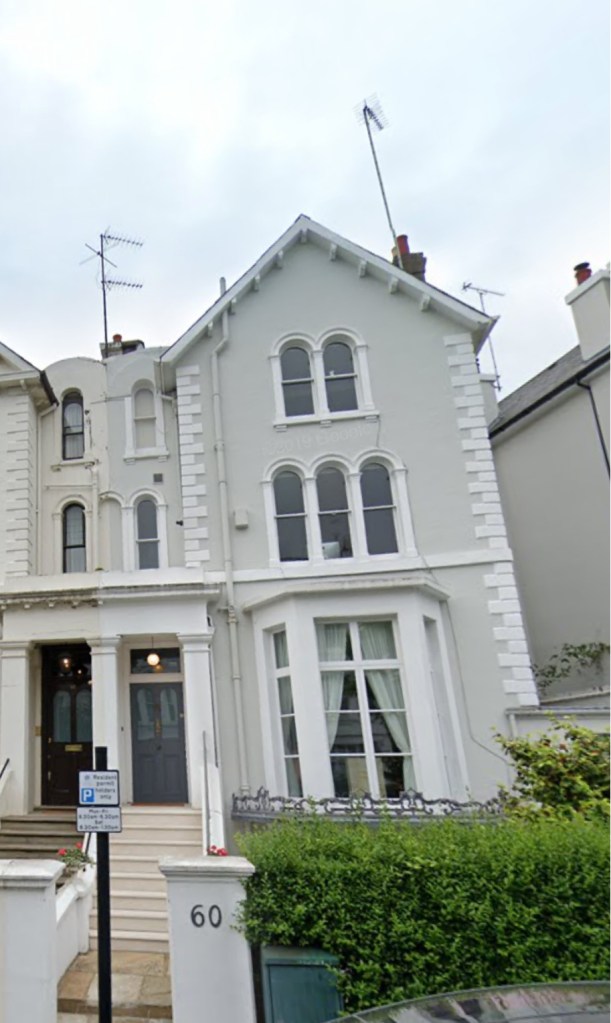
On a September day in 1865, James William and Elizabeth Ann Willats (née Davis) welcomed their son, William Henry Willats, into the world. Born on the 8th of September at Number 60, Lansdowne Road, in the heart of Notting Hill, Kensington, William’s arrival surely brought a glow of joy to the Willats household. The genteel address, with its quiet charm and promise of stability, became the backdrop for this new chapter in their family story.
A few weeks later, on the 29th of September, James, ever the diligent patriarch, made his way to register his son’s birth. The official records bear his unmistakable mark of individuality: while his given name was James William, he had a habit of flipping the order, introducing himself as William James. With characteristic precision, he listed his profession as a Commercial Traveller, a role that likely took him far and wide, bringing the world into the orbit of their home on Lansdowne Road.
This simple act of registration, ink on paper, became a touchstone of their lives, capturing not just the facts but the essence of a family carving out its place in the bustling tapestry of Victorian London.

Lansdowne Road in Kennington, London, is a street that weaves together the rich tapestry of the area's history and the personal stories of its residents. The name "Kennington" itself is steeped in history, believed to derive from Old English, possibly meaning "farm or estate associated with Coena." This etymology hints at the area's agricultural roots before it evolved into the vibrant urban landscape we know today.
The development of Lansdowne Road mirrors the broader urbanization of Kennington. In the mid-18th century, the construction of Westminster Bridge and its approach roads increased traffic through the area, highlighting the inadequacies of existing routes. This led to the creation of new roads, including Kennington Road, known initially as the New Road or Walcot Place, which connected Westminster Bridge Road with Kennington Common.
As the 19th century progressed, Kennington transformed from rural estates to a suburban enclave. The land, once owned by the Earls of Arundel and later the Dukes of Norfolk, began to see residential development. In 1559, Thomas, Duke of Norfolk, sold a portion of the land, paving the way for future urbanization.
The architectural landscape of Kennington, including streets like Lansdowne Road, was further shaped in the 20th century by town planners and architects such as Stanley Ashtead. Ashtead's vision and designs significantly influenced the post-Victorian character of the area, contributing to the unique blend of historical and modern elements that define Kennington today.
Today, Lansdowne Road stands as a testament to Kennington's rich history, reflecting the area's journey from pastoral lands to a bustling urban neighborhood. The street's architecture and its very name serve as reminders of the layers of history and personal stories that have shaped this distinctive part of London.
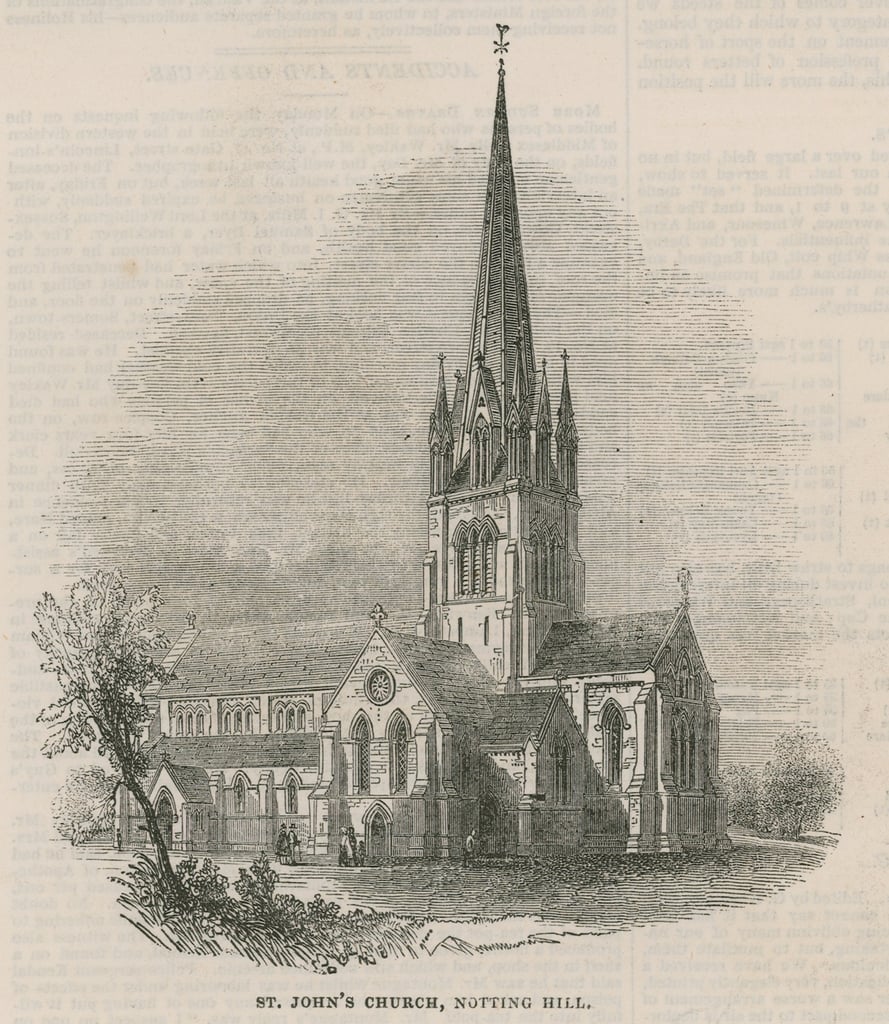
On a bright autumn Friday, the 29th of September, 1865, James William and Elizabeth Ann Willats brought their infant son, William Henry, to the font of Saint John the Evangelist in Notting Hill. The church, with its soaring arches and hallowed air, was the perfect backdrop for a moment as significant as this, a proud declaration of faith and family.
As the waters of baptism were poured, William Henry Willats was welcomed into the fold, his name ringing out with promise and hope. James, a Commercial Traveller by trade, stood alongside Elizabeth, both surely glowing with the quiet pride of young parents setting the foundations of their son’s life. Their home was listed as 60 Lansdowne Road, a genteel address that whispered of stability and a touch of aspiration.
That day, within the stone walls of Saint John the Evangelist, the Willats family etched their names into both the spiritual and earthly records of Notting Hill, a poignant step in their shared journey.

St John’s, Notting Hill is a Victorian Anglican church built in 1845 in Lansdowne Crescent, Notting Hill, London, designed by the architects John Hargrave Stevens (1805/6–1857) and George Alexander (1810–1885), and built in the Victorian Gothic style. Dedicated to St John the Evangelist, the church was originally built as the centrepiece of the Ladbroke Estate, a mid nineteenth century housing development designed to attract upper- and upper middle-class residents to what was then a largely rural neighbourhood in the western suburbs of London.
In 1821 James Weller Ladbroke (died 1847) and his architect Thomas Allason (1790–1852) began to plan an estate on land which now spans the southern end of Ladbroke Grove. From 1837 to 1841 a significant part of this land was used as the Hippodrome race-course. The hill that is now surmounted by St John’s was used by spectators as a natural grandstand to view the races. The Hippodrome was not however a financial success, and by 1843 it had closed, the circular racecourse soon to be replaced by crescents of stuccoed houses. St John’s Church, now a Grade II listed building, forms the high point and centrepiece of the Ladbroke estate, and is dedicated to St John the Evangelist. It was built to accommodate a congregation of 1,500, and was designed in the Early English style, the spire being notably similar in design to that of St Mary’s Church in Witney, Oxfordshire. The architecture of St John’s contrasts with the classical style of neighbouring St Peter’s, built a decade later. Money was raised by private subscription, in particular by means of two substantial loans of £2,000, one from Viscount Canning and one from entrepreneur Charles Blake, who also helped to finance St Peter’s. Work on St John’s was begun on 8 January 1844, when the foundation stone was laid by the Ven John Sinclair, Vicar of Kensington from 1842 to 1875, and Archdeacon of Middlesex. During Sinclair’s long incumbency (1842–1875), 19 parish churches were built in Kensington, of which St John’s was the first. It was consecrated by Dr Charles James Blomfield, Bishop of London, on 29 January 1845. Due to its rural location, the church was initially known as “St John in the Hayfields”.
It is with a heavy heart that we recount the passing of Julia Elizabeth Condon (née Willats), the beloved sister of James. At just 41 years of age, Julia, a widow of commercial traveller David Condon, took her final breath on Sunday, March 11, 1866. She passed away at her home on Sheffield Terrace in Kensington Town, Kensington, Middlesex, England, after a brave battle with phthisis, a relentless illness of the lungs.
By her side in her final moments was Elizabeth Gilbert of Holland Street, Kensington, a testament to the love and care Julia inspired in those close to her. Elizabeth took on the somber duty of registering Julia’s death just two days later, on Tuesday, March 13, 1866, in Kensington. Julia’s untimely departure left a profound void in the hearts of her family and friends, who mourned the loss of a gentle soul taken far too soon.

On a solemn Friday, the 16th of March, 1866, Julia Elizabeth Condon was gently laid to rest in Brompton Cemetery, Westminster, London. She was interred in an 8-foot common grave, marked O263.ox26.0—a final resting place amidst the serene grounds of this historic cemetery.
Her recorded residence at the time was 1 Sherfield Terrace, Kensington, a home that likely bore witness to her joys, struggles, and the quiet courage she carried throughout her life. Though her grave may be humble, the love and memories she left behind are anything but. Julia’s spirit lives on in the hearts of those who knew and cherished her, a lasting testament to a life cut short but deeply felt.

On a winter Friday, February 15th, 1867, beneath the bustling skies of Kensington, London, a new chapter began for James William and Elizabeth Ann Willats (née Davis). Their daughter, Clariss Charlotte Willats, arrived into the world at the family home, Number 60, Lansdowne Road. The stately street, known for its elegance, became the setting for the debut of a little girl destined to carry the charm of her name into the future.
A month later, on March 19th, James, ever the meticulous gentleman, registered his daughter’s birth with the precision befitting his trade. A jeweler by profession, James had an eye for detail, a talent that no doubt extended beyond his workbench to the way he filled out that all-important certificate. The family’s abode remained the same, Number 60 Lansdowne Road, a residence that whispered of refinement and security.
True to his individual flair, James didn’t follow convention when it came to his name. Though christened James William, he presented himself with his names intriguingly swapped: William first, James second. A small but telling quirk, it hinted at a man who walked his own path, setting the tone for the family he would raise. And so, with Clariss’s birth officially noted and her future unfurling ahead, the Willats family continued their life in Kensington, steeped in the traditions and quiet grace of the era.

Working as a jeweller in Soho, London, in 1867 would have been a fascinating yet challenging experience, steeped in the burgeoning atmosphere of the Victorian era. Soho was a vibrant area, known for its diverse population and bustling streets filled with artisans, craftsmen, and businesses catering to the expanding middle class. The industrial revolution had transformed the landscape of manufacturing, and the jewellery trade was no exception.
A jeweller in Soho would likely have started the day early, as the rhythm of work was dictated by daylight and the demands of customers. The workshop would have been a compact space, often shared with other craftsmen or tradesmen. It would have been filled with the sounds of tools clinking, the smell of metal and polishing compounds, and the sight of various materials, gold, silver, and precious stones, spread across workbenches. The jeweller would have spent much of their day engaged in a variety of tasks, which included designing, crafting, and repairing jewellery.
Daily tasks would vary depending on the jeweller's specific role and expertise. A jeweller might begin by sketching designs for new pieces, taking into account the latest fashions and customer preferences. This required not only artistic skill but also an understanding of the market and trends, as the demand for certain styles could fluctuate rapidly. Once a design was approved, the jeweller would move on to sourcing materials, which involved working with suppliers to obtain the required metals and gemstones, often negotiating prices to maintain profitability.
The actual crafting process was meticulous and labor-intensive. Jewellers used a range of hand tools, such as files, saws, and hammers, to shape and assemble pieces. Techniques like soldering, stone setting, and engraving required a high level of precision and skill, as even the smallest mistake could ruin a piece. This meant that jewellers had to possess not only technical ability but also patience and attention to detail. Many jewellers would have trained as apprentices, spending years honing their craft under the guidance of more experienced artisans.
Working conditions in the workshop could be challenging. Lighting was often inadequate, especially on cloudy days or in the winter months, which made intricate work more difficult. The air could be filled with dust and fumes from various materials, which posed health risks over time. The jeweller would need to be mindful of safety, especially when handling sharp tools and hot soldering equipment.
Despite these challenges, the job could also be rewarding. Successful jewellers had the opportunity to create exquisite pieces that could be displayed in shop windows, attracting the attention of potential buyers. Custom orders from wealthy clients could also bring significant financial rewards. Jewellers often formed close relationships with their customers, as personalised pieces were highly valued, and word-of-mouth recommendations were essential for business growth.
By the end of the day, a jeweller in Soho would likely have felt a deep sense of satisfaction in having contributed to the vibrant tapestry of London’s jewellery scene, playing a part in the lives of clients who cherished the pieces crafted by skilled hands. The blend of artistry, craftsmanship, and entrepreneurship defined the life of a jeweller in this bustling neighbourhood during the Victorian era, encapsulating the spirit of an age marked by innovation and change.

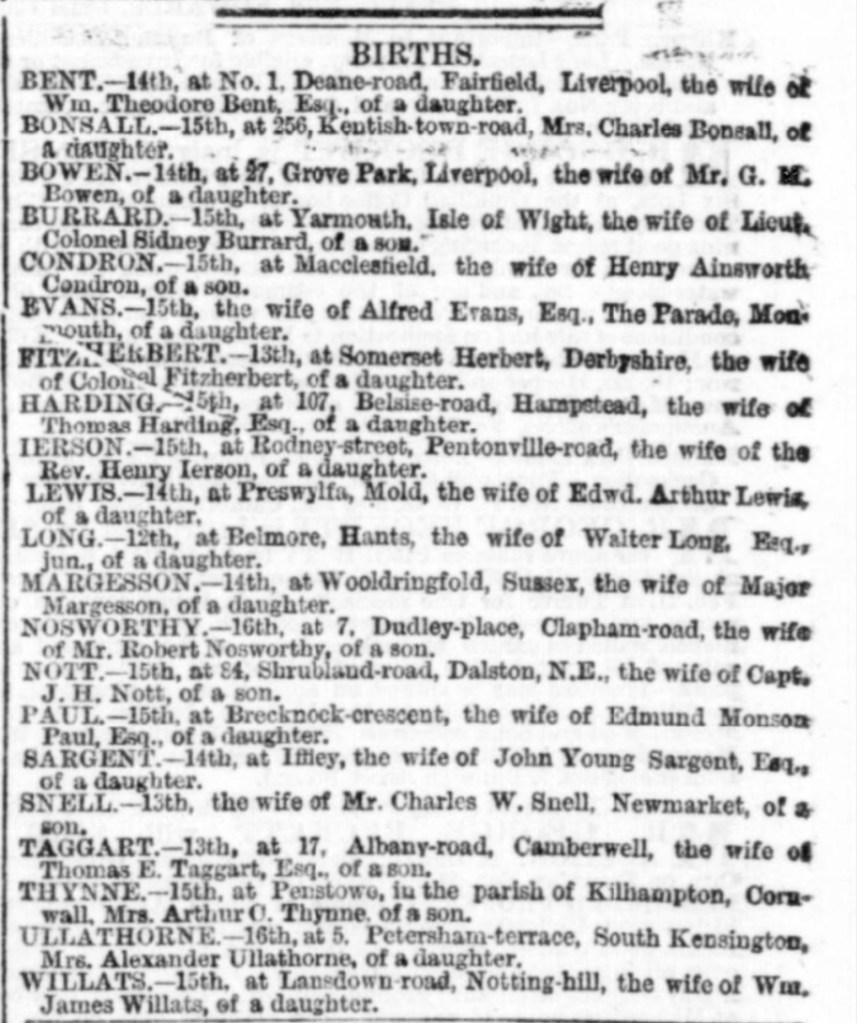
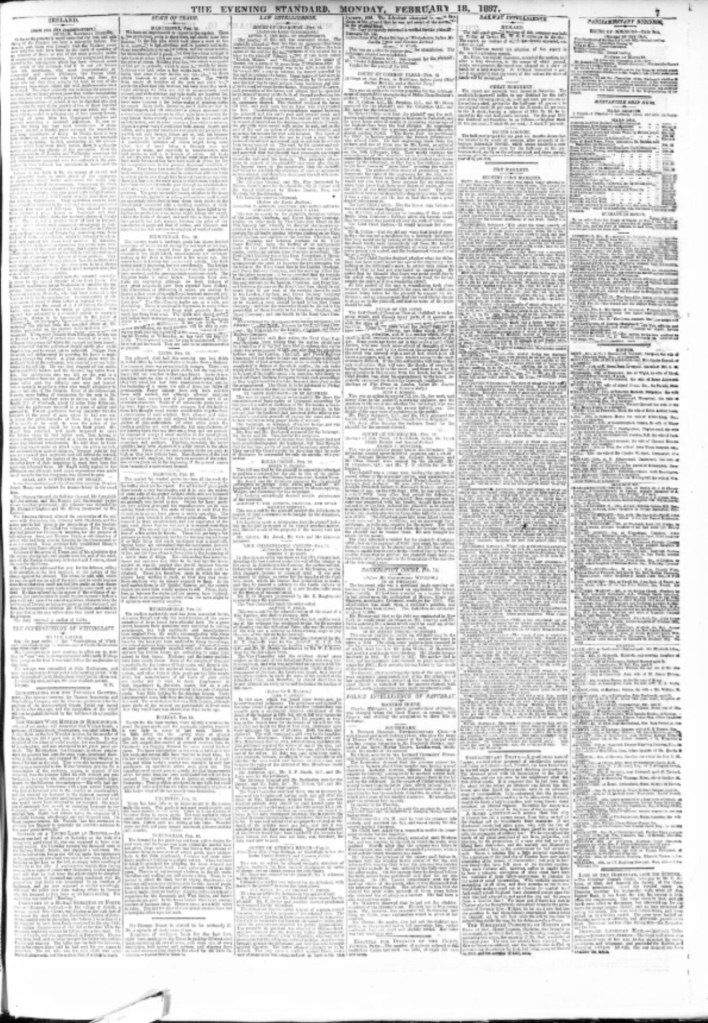
On a chilly Monday, February 18th, 1867, James William Willats, ever the proud and doting father, took a moment to share his family’s joy with the world. Nestled amidst the columns of the esteemed London Evening Standard, a simple yet heartwarming announcement appeared, bearing news of a precious arrival:

**WILLATS.—15th, at Lansdown Road, Notting Hill, the wife of Wm. James Willats, of a daughter.**

With these few elegant words, James made it known that his wife, Elizabeth Ann, had given birth to their daughter, Clarice, just days earlier on February 15th. The announcement, understated yet brimming with pride, carried the charm of the era, a delightful whisper of family news shared across the city.
And in true James fashion, he made sure his chosen moniker, "Wm. James Willats," added a distinctive flair to the occasion, an enduring reminder of his penchant for swapping his names. From their home at Lansdowne Road, Notting Hill, the Willats family’s joy was now inked for posterity, a small yet enduring detail in the grand story of their lives.

On a serene Wednesday, April 10th, 1867, beneath the soaring arches of Saint John the Evangelist in Notting Hill, a little girl named Clarice Charlotte Willats was baptized. Her proud parents, James William and Elizabeth Ann, stood at her side as she was welcomed into the fold, the promise of her future unfolding in that sacred space. The church, a steady pillar of their community, became the setting for a moment that would remain etched in the fabric of their family’s story forever.
James, who had made a name for himself as a Diamond Merchant, was a man whose life sparkled with ambition and precision. The trade he pursued, rare and radiant, seemed a fitting reflection of his character. He and Elizabeth, ever the poised couple, called 60 Lansdowne Road home, a place where aspirations were nurtured and family ties grew strong.
That day, as the waters of baptism touched Clarice’s forehead, the Willats family’s story continued to be written in ink and devotion, at the intersection of faith, ambition, and the promise of a bright future.

On Monday, the 13th of July, 1868, a soft cry echoed through the rooms of Number 60, Landsdowne Road, Kensington, London. It was the birth of James William and Elizabeth Ann Willats’ second daughter, Emily Beatrice Willats. The family’s home, located in the heart of Notting Hill, was about to be filled with even more joy, as the little one joined her siblings in this already lively household.
James, ever diligent, registered Emily’s birth on the 6th of August, 1868. His occupation was listed as a Jewel Agent, a title that hinted at his role in the world of precious stones and business dealings, a life of both finesse and trade. Their abode, the same residence where Emily was born, stood proudly at Number 60, Landsdowne Road. To those who would see the name written, it may have looked unassuming, but for James and Elizabeth, it was a place where memories were made and lives intertwined.
In a tradition common for some during that time, James used his middle name, William, as his first name, with James being his middle. There’s a certain quiet authority in the way he carried himself, as though each name he used spoke to different aspects of his character, his work as a Jewel Agent, his standing in society, and his personal identity.
As for Emily, while she was named Emily at birth, she would come to embrace her middle name, Beatrice, for much of her life. The name “Beatrice” itself, elegant and timeless, would have suited her perfectly, graceful, serene, and full of potential. Perhaps it was the sweetness of that name that seemed to carry her through her years, or perhaps it was the quiet strength that lay beneath it. Either way, “Beatrice” was the name that stuck, a soft yet dignified moniker that would follow her through all her days.
In the heart of that bustling city, surrounded by the everyday rhythms of life, Emily’s early years were likely filled with the laughter of siblings, the steady presence of parents, and the warmth of the family home. And as she grew into the woman she would become, I imagine Emily Beatrice carrying that name with the same elegance and quiet beauty it promised when she first entered the world, at Number 60, Landsdowne Road.

On an autumn day, Wednesday the 21st of October, 1868, Emily Beatrice Willats was brought before the solemnity of St John’s Church, Notting Hill, for her baptism. Her parents, James William and Elizabeth Ann, held their little girl close as she was welcomed into the fold of the Christian faith. The grand stone walls of the church, filled with the quiet reverence of history, must have echoed with the soft promises made over the newborn child. The ritual was a gentle reminder that, despite the everyday hustle of life, some moments held deep, sacred meaning, a promise of protection, hope, and community.
James, who stood by as both father and provider, gave his occupation as a Diamond Merchant, a testament to the life he had carved out for himself in the world of precious stones. His work was one of finesse and refinement, where elegance met business, and it spoke volumes about the life he wanted for his children. Their home, nestled at 60 Lansdowne Road, Kensington, was a reflection of this quiet prosperity, stable, comfortable, and in the heart of a vibrant, bustling neighborhood. It was a home where James, despite the demands of his work, could always return to a family that grounded him. Once again, in the official records, James used his middle name, William, as his first name, presenting himself as William James. It’s an intriguing glimpse into the modesty of the time, where names often carried not only family traditions but personal choices, hinting at deeper layers of identity.
As Emily Beatrice was christened, one can imagine the soft glow of the candlelight, the quiet whispers of the congregation, and the tender love of her parents. Emily, with her delicate name and fresh innocence, was ready to take her place in a world filled with both promise and complexity.
In that church, on that October day, the Willats family’s legacy was further etched into the annals of history. The gentle chime of the church bell that day must have been heard far beyond the walls of St John’s, carrying with it the weight of family, faith, and the enduring bond that would see Emily Beatrice through all the seasons of her life.

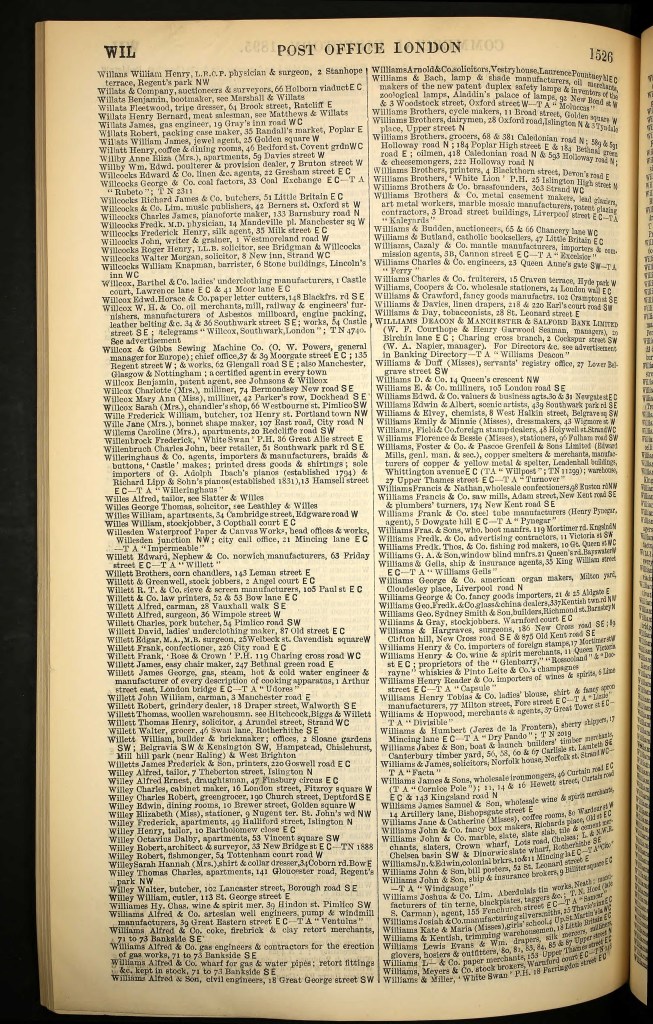
In the 1870 Trade Directory, James is listed as a Jewellery Agent, conducting his business from the bustling heart of London at 25 Golden Square, Soho. This address places him amidst the lively streets of a city known for its elegance and commerce, where he likely forged connections and built his reputation in the glittering world of fine jewellery.
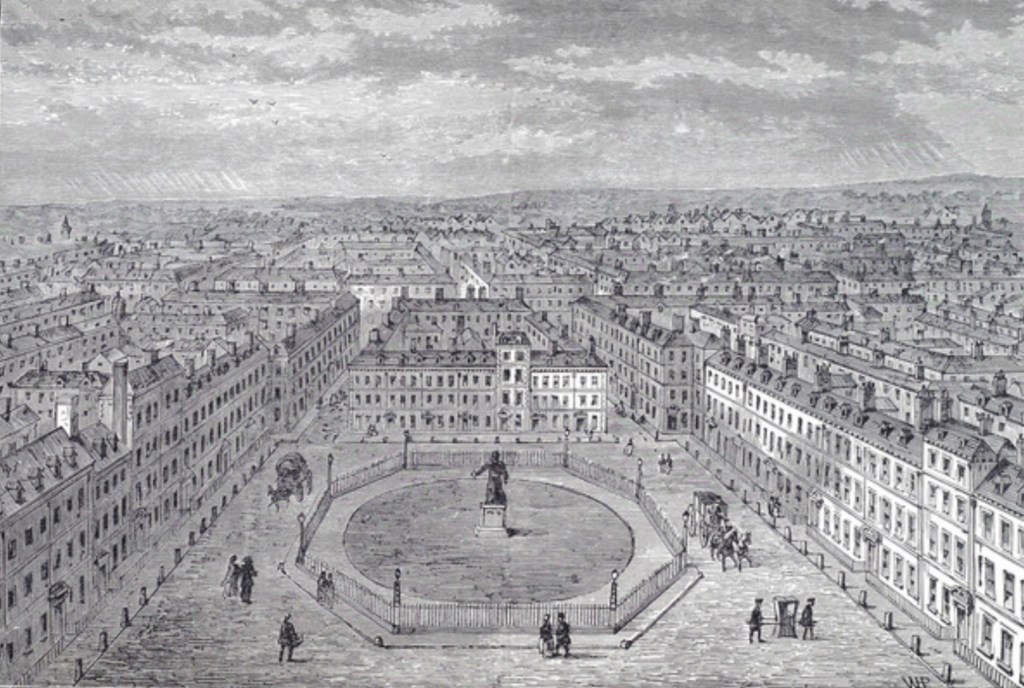
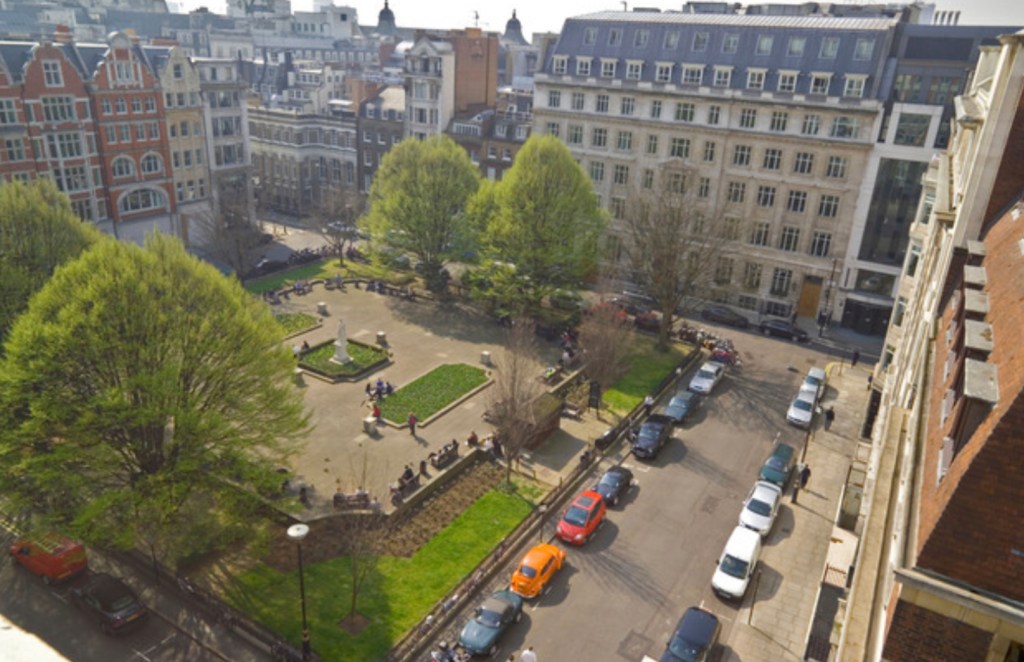
In 1870, Golden Square was a prominent square located in the heart of the West End of London, England. It is situated in the district of Soho, which has a long history of being associated with entertainment, music, and the arts. Golden Square itself was known for its elegance and was considered one of the more fashionable areas of London during the Victorian era.
The square was surrounded by beautiful Georgian townhouses, many of which were inhabited by wealthy families, merchants, and professionals. These residences were built with a distinctive architectural style, featuring grand facades, ornate balconies, and well-manicured gardens. The area was highly sought after due to its central location and proximity to various theaters, music halls, and social clubs, making it a vibrant and bustling part of the city.
During this period, London was undergoing significant industrialization and urbanization, leading to a stark contrast between the wealth and luxury of Golden Square and the poverty-stricken areas nearby. The working-class neighborhoods, which included overcrowded tenements and slums, were in stark contrast to the opulence and grandeur of Golden Square.
In addition to its residential character, Golden Square also served as a commercial hub, with various businesses, shops, and offices lining its streets. As a testament to its significance, the square attracted notable figures of the time, including artists, writers, and socialites who would often frequent its elegant cafes and social venues.
Though Golden Square has evolved significantly since 1870, some of its historical architecture and charm remain. Many of the original Georgian buildings have been preserved and restored, adding to the area’s appeal and maintaining a connection to its rich past.
Today, Golden Square continues to be an attractive location in London, with a mix of residential and commercial properties, bustling with activity, and still reflecting some of its historical charm amid the modern cityscape.
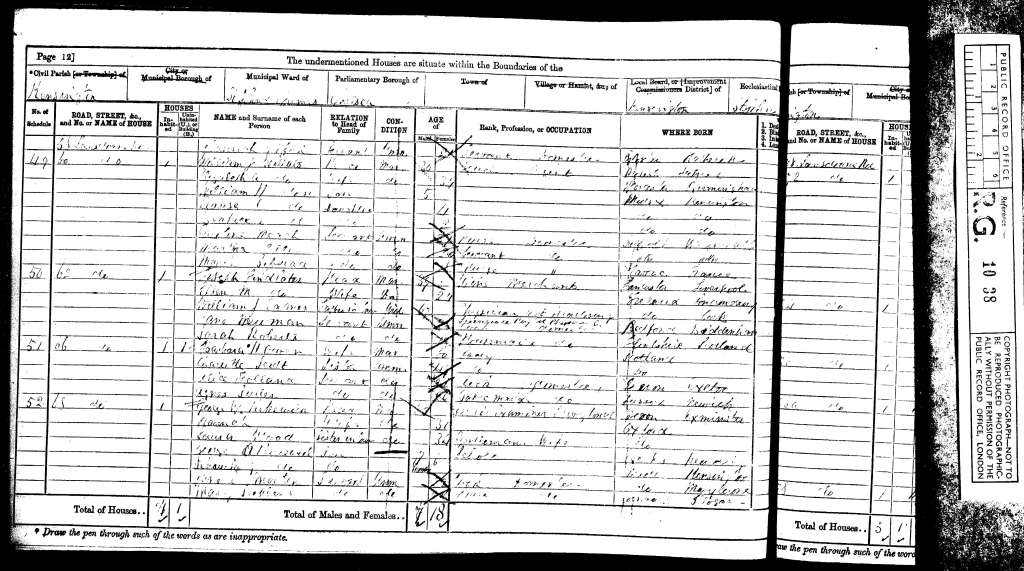
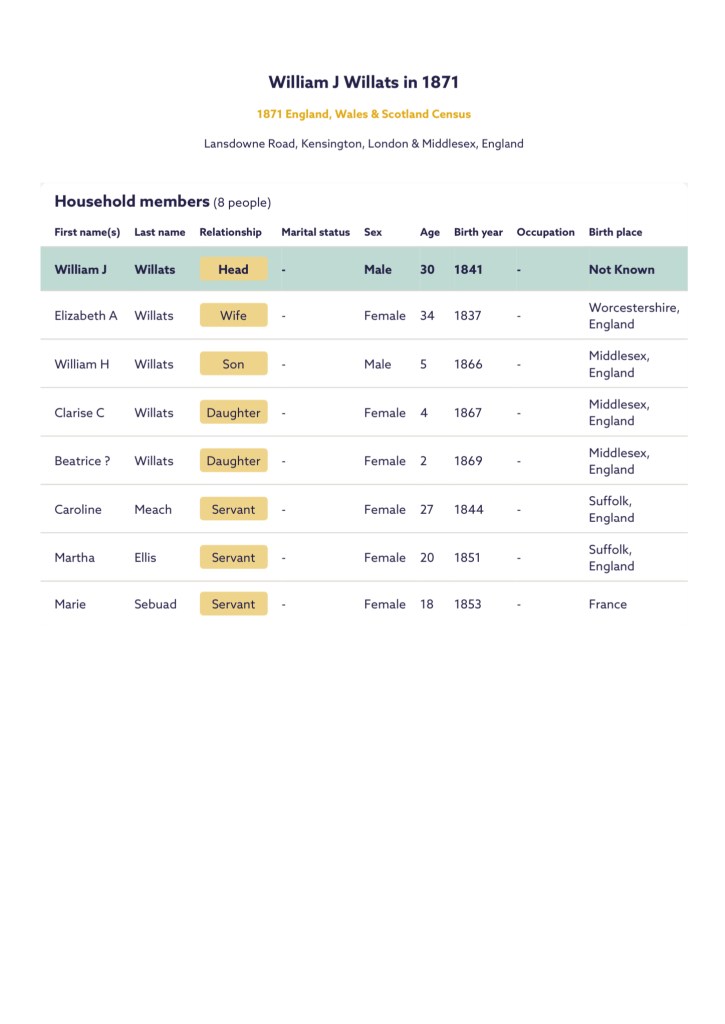
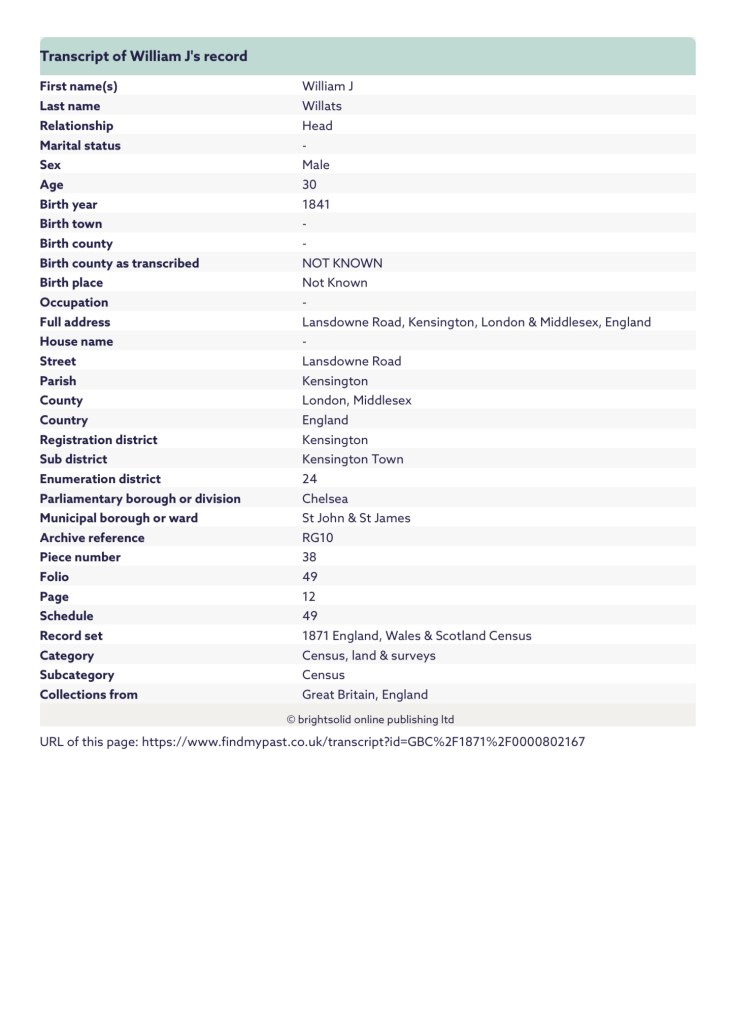
On Sunday, April 2, 1871, James was living with his beloved wife, Elizabeth, and their children, William H., Clariss C., and Emily Beatrice, at a comfortable home on Lansdowne Road in Kensington, London. Their household was bustling, not just with family but also with the presence of three dedicated servants: 28-year-old Caroline Meach, 20-year-old Martha Ellis, and 18-year-old Marie Sebuad. Each of them likely played a role in supporting the family’s day-to-day life.
James was listed as working as a Jewel Agent, a profession that reflected his connection to the world of fine craftsmanship and beauty. Interestingly, during this time, he once again adopted the name William, a detail that adds an intriguing layer to his story and leaves us pondering the reasons behind this choice. Their home must have been filled with both the lively energy of children and the quiet industriousness of a family building their future together.
With great sadness, we reflect on the passing of George John Willats, the cherished father of James. George departed this life on Saturday, April 29, 1871, at the age of 66, at his home at 53 Marshall Street, Golden Square, Westminster, London. He succumbed to bronchitis, a struggle that marked his final days.
By his side in his last moments was Maria Silvester, also of 53 Marshall Street, who tenderly ensured his death was registered on Thursday, May 4, 1871. When speaking of George, Maria lovingly noted his lifelong craft as a Pianoforte maker, a profession that no doubt brought music and joy to many.
George’s passing leaves a profound void in the hearts of those who knew and loved him. His legacy lives on in the echoes of his life’s work and in the memories of his family and friends, who mourn the loss of a kind and dedicated man.

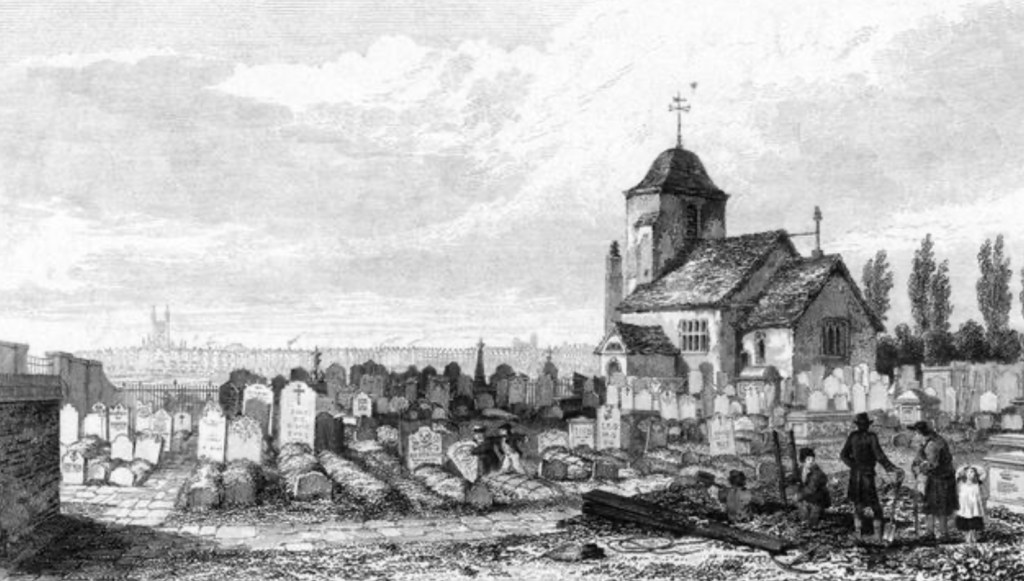
On Wednesday, May 3, 1871, George John Willats was tenderly laid to rest in Pancras Cemetery, Camden, London. His grave, E10/39, became a shared resting place with 12 other dear souls, a testament to the interconnectedness of lives, even in eternal peace.
Though his final resting place is humble, the love and memories he left behind resonate deeply in the hearts of his family and those who knew him. George’s journey on this earth may have come to an end, but his legacy and spirit endure, cherished by those who carry his story forward.

Pancras Cemetery, located in Camden, London, holds a rich and fascinating history, deeply entwined with the evolution of burial practices in 19th-century England. Established in 1854, it was one of the earliest municipal cemeteries in London, created during a period when urban churchyards had become dangerously overcrowded. This overcrowding, combined with concerns about public health and sanitation, prompted the introduction of larger burial grounds on the outskirts of the city.
The cemetery was originally established to serve the parish of St. Pancras and quickly became a significant resting place for many Londoners, reflecting the diverse and growing population of the area. The cemetery’s layout was designed with both functionality and aesthetics in mind, offering a peaceful and dignified space for mourning and reflection. Its picturesque design, characterized by winding paths, mature trees, and thoughtfully arranged graves, follows the Victorian tradition of creating cemeteries as tranquil, park-like environments.
Pancras Cemetery is notable not only for its role in accommodating London’s deceased but also for its historical and architectural features. The cemetery chapel, built in the Gothic Revival style, served as a centerpiece and a space for funerary services. Over the years, the cemetery became the final resting place for people from all walks of life, from everyday citizens to individuals of notable social, cultural, and historical significance.
Like many Victorian cemeteries, Pancras Cemetery reflects the changing attitudes toward death and commemoration during the 19th century. Elaborate headstones, mausoleums, and epitaphs reveal the era’s focus on memorialization and the desire to honor the deceased. However, as the decades passed, some parts of the cemetery fell into neglect, reflecting the broader societal shifts in attitudes toward older burial grounds.
Today, Pancras Cemetery is part of a larger conservation area and is valued not only as a burial ground but also as a space of historical and cultural importance. It provides insight into the lives and deaths of Londoners over the centuries and serves as a poignant reminder of the city’s past. Visitors to the cemetery often find it a place of quiet contemplation, where history and memory converge amidst the natural beauty of the grounds.
The following year brought joy and new life to the Willats family. On August 28, 1872, James William and Elizabeth Ann Willats (née Davis) welcomed their daughter, Florence Willats, into the world. She was born at their family home, 60 Lansdowne Road, Kensington, London, a place that must have been filled with excitement and love as they embraced this precious addition to their family.
On September 26, 1872, James took on the proud and tender responsibility of registering Florence’s birth. In doing so, he listed his profession as a Jewel Agent and reaffirmed their address as 60 Lansdowne Road, Notting Hill. Ever enigmatic, James once again chose to present himself under the name William James Willats, using his middle name as his first.
This moment marked a special chapter in the family’s story, a time of hope, growth, and the quiet happiness that a newborn brings into a home. Florence’s arrival surely deepened the bonds of love within their household, as her parents celebrated the gift of her life.

On a Sunday morning, November 17, 1872, James William and Elizabeth Ann Willats brought their infant daughter, Florence, to be baptized at St. John’s Church in Notting Hill, Kensington. The sacred ceremony marked a moment of deep commitment and joy, as they welcomed Florence into their faith and community with love and hope for her future.
At this significant occasion, James was listed as a Jeweller, a profession that reflected his connection to craftsmanship and beauty. The family’s home at 60 Lansdowne Road in Kensington was noted once more, grounding them in a neighborhood that had become a central part of their lives. Ever the enigmatic figure, James again chose to present himself as William James.
This day at St. John’s Church must have been filled with emotion for James and Elizabeth, a moment of gratitude for their daughter’s safe arrival and the opportunity to bless her life in the company of their faith and tradition.

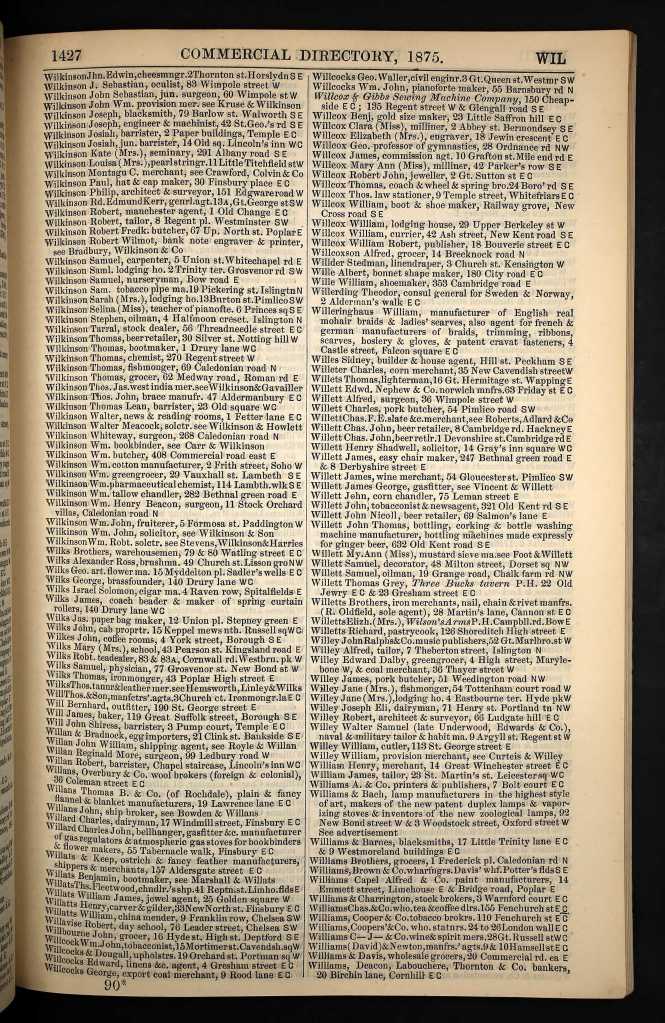
In the 1875 Trade Directory, James is listed as working as a Jeweller Agent, carrying out his trade from 25 Golden Square in the vibrant heart of Soho, London. This address, nestled within the bustling streets of a thriving city, reflects a life devoted to the intricate and elegant world of fine jewelry.
One can imagine James moving through the lively square, engaging with clients and craftsmen, his days filled with the sparkle of gemstones and the hum of commerce. His work at Golden Square speaks to his dedication and skill, as well as the connections he built in a city renowned for its artistry and trade.
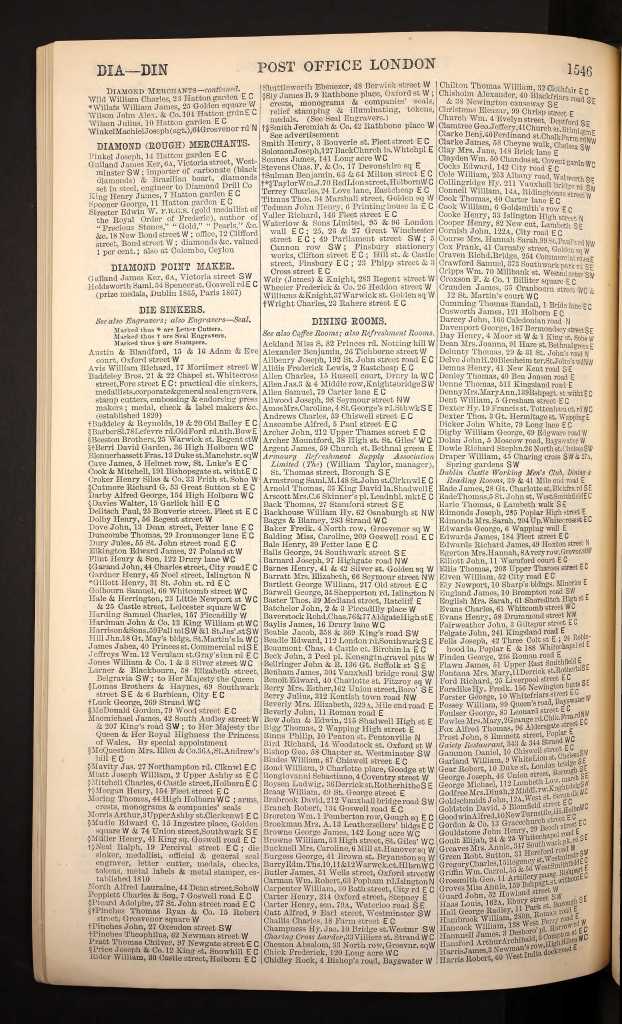
In the 1880 Trade Directory, James’ name appears among the esteemed Diamond Merchants, proudly listed at 25 Golden Square in Soho, London. This recognition marks a new chapter in his career, reflecting his growing reputation and expertise in the glittering world of diamonds.
At Golden Square, amidst the energy and creativity of Soho, James was likely surrounded by the finest gemstones, handling them with care and precision. His work as a diamond merchant would have been a testament to his skill, ambition, and the trust he had earned within the industry. The address at Golden Square, now forever linked with his name, speaks of a life dedicated to the pursuit of beauty and craftsmanship, a life woven into the very fabric of London’s vibrant trade scene.
Being a diamond merchant in the Victorian era was an endeavor that required a unique blend of business acumen, cultural understanding, and social finesse. This profession involved several key aspects that contributed to a successful and esteemed position in society. Here are a few of the key elements involved in being a diamond merchant during this time.
Sourcing Diamonds: Diamond merchants in the Victorian era had to travel extensively to source the finest diamonds from various parts of the world. Regions like India, South Africa, and Brazil were significant sources of diamonds during this time. Establishing relationships with local diamond miners and traders was crucial to access the best and most sought-after gems.
Expertise in Gemology: A diamond merchant needed a deep understanding of gemology, including knowledge about diamond grading, the 4 Cs (cut, color, clarity, and carat weight), and gem identification. This expertise allowed them to accurately evaluate the quality and value of diamonds and ensure they offered only the most exquisite pieces to their clientele.
Art of Negotiation: The diamond trade was competitive, and skilled negotiation was essential to secure the best deals when buying diamonds from miners or traders. It required shrewd business skills to strike profitable agreements while maintaining respectful relationships with suppliers.
Collaboration with Artisans: Once the diamonds were acquired, the merchant collaborated with skilled jewelers and designers to create exquisite jewelry pieces. This involved sharing ideas, sketches, and specifications to ensure the final product met the expectations of both the merchant and the client.
Design and Trends: Keeping abreast of the latest trends in jewelry design was vital. The Victorian era saw a wide range of jewelry styles, from romantic and delicate pieces inspired by nature to bold and intricate designs showcasing status and wealth. Understanding the preferences of their clientele and predicting upcoming trends helped merchants stay ahead in the market.
Networking and Social Etiquette: Victorian society was structured with a strict social hierarchy, and being part of the upper class was crucial for a successful diamond merchant. Networking at exclusive events, attending social gatherings, and being part of elite clubs allowed merchants to meet potential clients and showcase their latest acquisitions.
Brand and Reputation: Building a reputable brand was paramount to gain the trust and loyalty of clients. A diamond merchant had to be known for dealing in genuine and high-quality diamonds, impeccable craftsmanship, and outstanding customer service. Word of mouth played a significant role in promoting their business.
Salesmanship: Convincing potential buyers of the beauty and value of diamonds required excellent salesmanship. Merchants often used storytelling, highlighting the diamond’s origin, history, and rarity, to create an emotional connection with their clients.
Adapting to Changing Times: The Victorian era saw significant cultural and societal changes. As a diamond merchant, adapting to these changes and catering to the evolving tastes of their clients was vital for sustained success. Ethical Considerations: Ethical practices in the diamond trade have always been important. During the Victorian era, merchants were expected to ensure that the diamonds they traded were obtained legally and without exploitation or harm to local communities and the environment.
In conclusion, being a diamond merchant in the Victorian era was a multifaceted profession that demanded not only a keen eye for exquisite gems but also a deep understanding of the social nuances and business dynamics of the time. The allure of diamonds, combined with the art of negotiation and refined social skills, made this profession a symbol of elegance and sophistication in the opulent Victorian society.
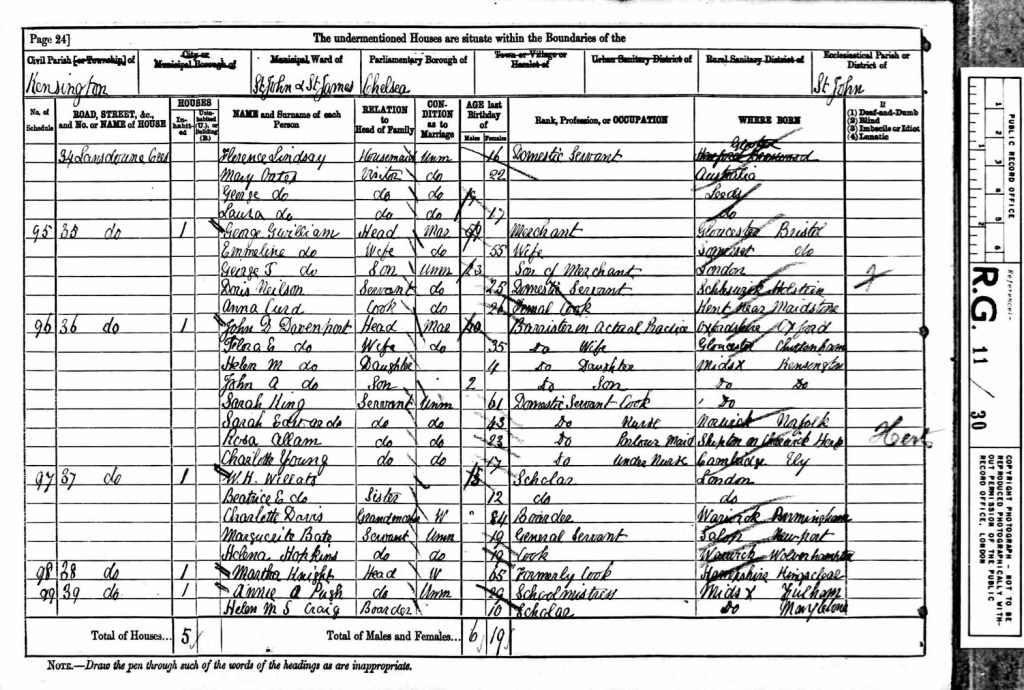
In the 1881 Census, James and Elizabeth seem to have vanished from the records, leaving us to wonder where they might have been at the time. However, their two children, William and Emily Beatrice, were living at the family home, 37 Lansdowne Crescent, in the charming area of Notting Hill, Kensington. They were under the loving care of their grandmother, Charlotte Davis (née Smith), James’ mother-in-law.
Charlotte, listed as a boarder in the household, provided a sense of continuity and family presence. William and Emily were both attending school, their bright futures unfolding in the embrace of their grandmother’s nurturing care. The household also had two young servants, 19-year-old Marguerite Bate, a general servant, and 19-year-old Helena Hopkins, a cook, helping maintain the home.
The absence of James and Elizabeth during this period raises questions. Were they abroad, perhaps on business or traveling for reasons unknown? Or were they simply visiting family or friends? Whatever the case, it’s clear that William and Emily were surrounded by the warmth of family, even in their parents’ absence.
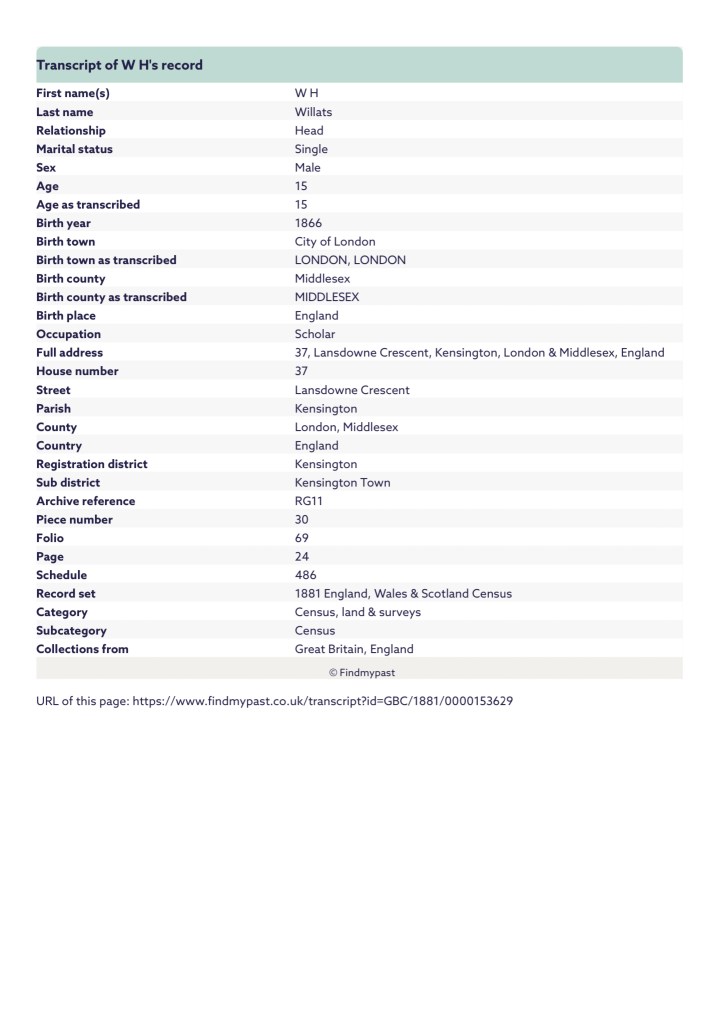

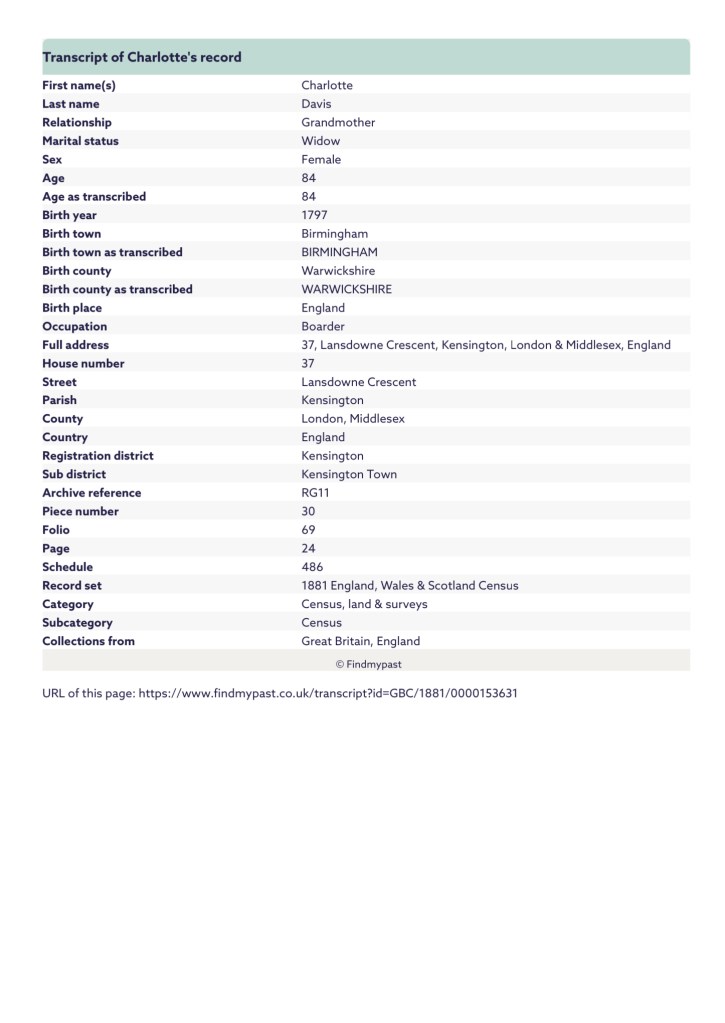
Lansdowne Crescent, situated in Notting Hill within the Royal Borough of Kensington and Chelsea, London, is a notable example of mid-19th-century residential development. Constructed between 1860 and 1862 by the Wyatt family, the crescent is named after Henry Petty-Fitzmaurice, the 3rd Marquess of Lansdowne, who held prominent political positions including Chancellor of the Exchequer and Home Secretary.
The crescent is characterized by its distinctive architecture, comprising stuccoed terraced houses with bow fronts and classical detailing. The two segments of the terrace, encompassing numbers 19–28 and 29–38, are recognized for their architectural significance and have been designated as Grade II listed buildings.
A prominent landmark within Lansdowne Crescent is St John's Notting Hill, a Victorian Gothic church completed in 1845. Designed by architects John Hargrave Stevens and George Alexander, the church was intended to serve as the focal point of the Ladbroke Estate, a 19th-century housing development aimed at attracting affluent residents to what was then a suburban area of London.
Regarding number 37 Lansdowne Crescent, specific historical details are limited. However, it is part of the terrace constructed during the 1860s and shares the architectural features that contribute to the crescent's overall heritage value. The listing of numbers 29–38 as Grade II buildings underscores the importance of this segment in the architectural tapestry of the area.
Lansdowne Crescent has been home to notable residents over the years. For instance, the renowned rock guitarist Jimi Hendrix spent his final hours at the Samarkand Hotel, located at 22 Lansdowne Crescent, where he passed away on September 18, 1970.
The crescent's development is intertwined with the history of the Ladbroke Estate, which originally encompassed open fields and even a racecourse known as the Kensington Hippodrome in the 1830s. Following the closure of the racecourse, the area was developed into the residential neighborhood seen today, with Lansdowne Crescent forming a significant part of this transformation.
Today, Lansdowne Crescent remains a sought-after residential area, appreciated for its historical architecture and proximity to the vibrant cultural scene of Notting Hill. The preservation of its architectural heritage ensures that it continues to be a significant landmark within London's urban landscape.


In the 1883 Electoral Registers for London, England, James is listed as residing at 37 Lansdowne Crescent, in the picturesque neighborhood of Notting Hill, Kensington. True to his enigmatic nature, he was once again using the name William, a name that seems to have held a special significance for him.
This record places James at the heart of the family home, a place that had witnessed both quiet domestic moments and lively family life. One can imagine him walking the charming streets of Notting Hill, deeply rooted in the rhythm of the neighborhood he called home. His presence in the Electoral Registers serves as a small but meaningful glimpse into his life during that time, a life filled with subtle mystery and enduring connection to those he loved.
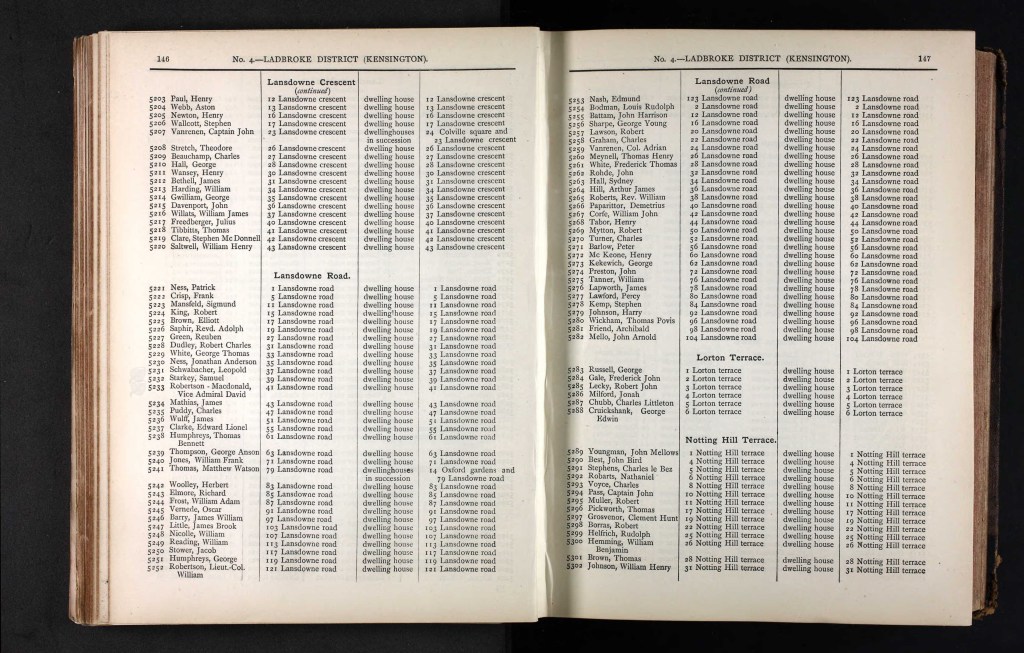
In the 1884 Electoral Registers for London, James is once again listed as residing at 37 Lansdowne Crescent, the family home in the charming heart of Notting Hill, Kensington. As before, he is recorded under the name William, a detail that adds a touch of intrigue to his story. His continued presence at Lansdowne Crescent paints a picture of stability and connection, a man deeply rooted in his family’s life. It’s easy to imagine James, or William as he preferred, moving through the familiar surroundings of this vibrant neighborhood, his life interwoven with the home and community he held dear.
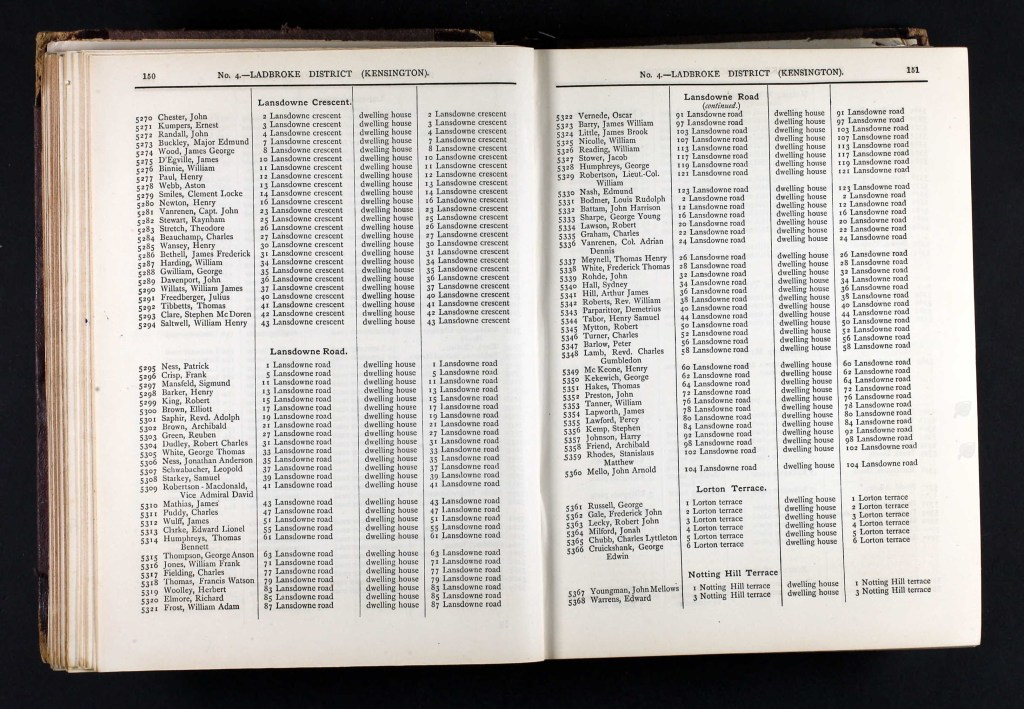
In 1888, James’s name appeared once more in the Electoral Register, tied to the family’s cherished home at 37 Lansdowne Crescent in Kensington, London. This enduring connection to Lansdowne Crescent speaks to a life anchored in the rhythms and relationships of this vibrant neighborhood. One can imagine James, a steady presence within these walls, shaping the home with his character and care. Whether he was tending to his business, spending time with his family, or simply enjoying the lively spirit of Kensington, this record reminds us of his place in the story of Lansdowne Crescent, a home filled with love, life, and the subtle mysteries that made him who he was.
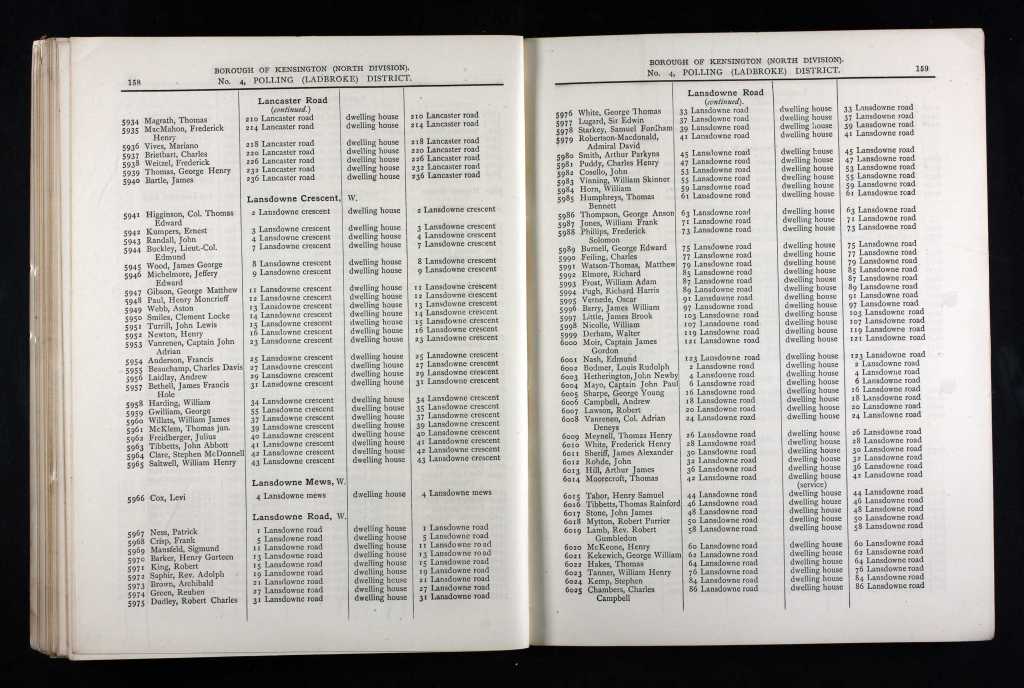
Jumping forward to the year 1890, London was a city caught between the past and the future, buzzing with progress while grappling with the challenges of rapid urban growth. Queen Victoria was the reigning monarch, her rule firmly cemented as the longest in British history. The prime minister at the time was Lord Salisbury, a conservative statesman steering the country through an era of industrial innovation and imperial ambition. The halls of Parliament in Westminster echoed with debates about reform, modernity, and the role of Britain on the world stage.
Transportation in London was transforming. Horse-drawn omnibuses and hansom cabs still dominated the streets, their rhythmic clatter mingling with the hum of steam-powered trains arriving and departing from stations like Paddington and King’s Cross. The city’s Underground, already a marvel of its time, had expanded, offering Londoners a glimpse of what a modern, interconnected city could look like. Yet, despite these advances, the streets were often congested and chaotic, filled with a mix of pedestrians, vendors, and carriages.
Sanitation remained a pressing issue. Although great strides had been made since the infamous "Great Stink" of 1858, overcrowding and poverty in the poorer districts meant that not everyone benefited from the city’s advancements. Efforts to improve living conditions were underway, with clean water systems and sewerage networks being expanded, but life in the slums of East London was harsh and unforgiving.
Heating and lighting in homes were undergoing a transformation. Gas lighting illuminated streets and houses, casting a soft, flickering glow, while wealthier homes began experimenting with the wonders of electricity. Heating remained dependent on coal fires, their warm glow a comfort during long, damp winters, even as they contributed to the ever-present smog that hung over the city.
The atmosphere in London was a mixture of excitement and tension. The city was alive with innovation, but the rapid pace of change left some feeling nostalgic for simpler times. Social inequality was starkly visible, with lavish parties in Mayfair contrasting sharply with the struggles of families in Whitechapel. Gossip filled the air, with tales of Jack the Ripper, whose reign of terror had only recently ended, still whispered in fear and fascination.
Fashion in 1890 was a spectacle of elegance and formality. For women, corsets, bustles, and layered skirts were all the rage, creating dramatic silhouettes that reflected Victorian ideals of femininity. Men’s fashion leaned toward tailored suits with waistcoats and pocket watches, exuding a sense of respectability and decorum. The streets of London were a living fashion parade, as the upper classes showcased their wealth through elaborate attire.
Entertainment offered an escape from the daily grind. Music halls were wildly popular, offering a blend of comedy, song, and spectacle to audiences across the city. Theatres in the West End staged performances that drew crowds eager to be dazzled by the drama and artistry of the age. For those who could afford it, evenings at the opera or ballet were events to be savored, while public parks and fairs provided simple pleasures for the masses.
Education was becoming more accessible, thanks to the 1870 Elementary Education Act, which had laid the groundwork for compulsory schooling. By 1890, more children were learning to read and write, though opportunities for advanced education remained limited to the privileged few. Libraries and reading rooms were growing in popularity, providing a space for intellectual curiosity and self-improvement.
Food in 1890 reflected London’s status as a global city. Markets brimmed with goods from the far corners of the British Empire—spices from India, tea from Ceylon, and exotic fruits like pineapples and bananas. For the working classes, meals were simple but hearty, often consisting of bread, cheese, and stews, while the upper classes enjoyed lavish dinners served in courses, complete with elaborate desserts and fine wines.
Historically, 1890 was a year of both consolidation and transformation. The Industrial Revolution had reshaped not just London but the entire world, and Britain’s empire was at its zenith, its influence touching nearly every continent. Yet beneath the grandeur lay the seeds of change. Social reformers were calling attention to inequality, women were beginning to demand more rights, and technological advancements hinted at an even more dynamic future.
To step into London in 1890 was to experience a city at a crossroads, one foot firmly planted in the traditions of the past, the other reaching toward the promises of the modern age. It was a place of contrasts, where innovation and inequality coexisted, but above all, it was a city alive with the energy of possibility.
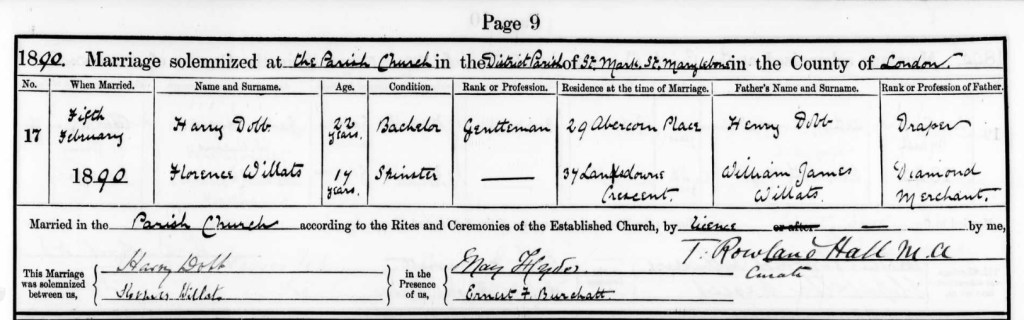
The year 1890 began as a celebration of love and new beginnings for the Willats family. On a crisp Wednesday, February 5th, James’s daughter, Florence Willats, just 19 years old and filled with the promise of her future, exchanged vows with 22-year-old Harry Dobbs, a bachelor with charm and ambition, at the elegant St. Mark’s Church on Old Marylebone Road in London.
The ceremony was a moment of joy and significance, witnessed by friends May Hydes and Ernest F. Burchatt, whose presence surely added warmth and support on this special day. Florence, radiating youthful grace, gave her family home at 37 Lansdowne Crescent as her address, a place steeped in memories and love. Harry, her groom, listed his address as 29 Abercrombie Place and proudly described his occupation as "Gentleman," a title that spoke to his aspirations and standing.
When asked about their fathers, Florence and Harry honored the men who had shaped their lives. Harry’s father, Henry Dobb, was noted as a Draper, a respectable trade that spoke to hard work and business acumen. Florence’s father, recorded as William James Willats, was listed as a Diamond Merchant, his life spent in the glittering world of jewels. The formality of the occasion and these details offered a glimpse into the lives and legacies they carried with them into this new chapter.
As Florence and Harry stood before their loved ones and made their vows, the moment must have been filled with a sense of possibility, a blending of two lives, two families, and two futures, all beginning on that February day in the heart of London.
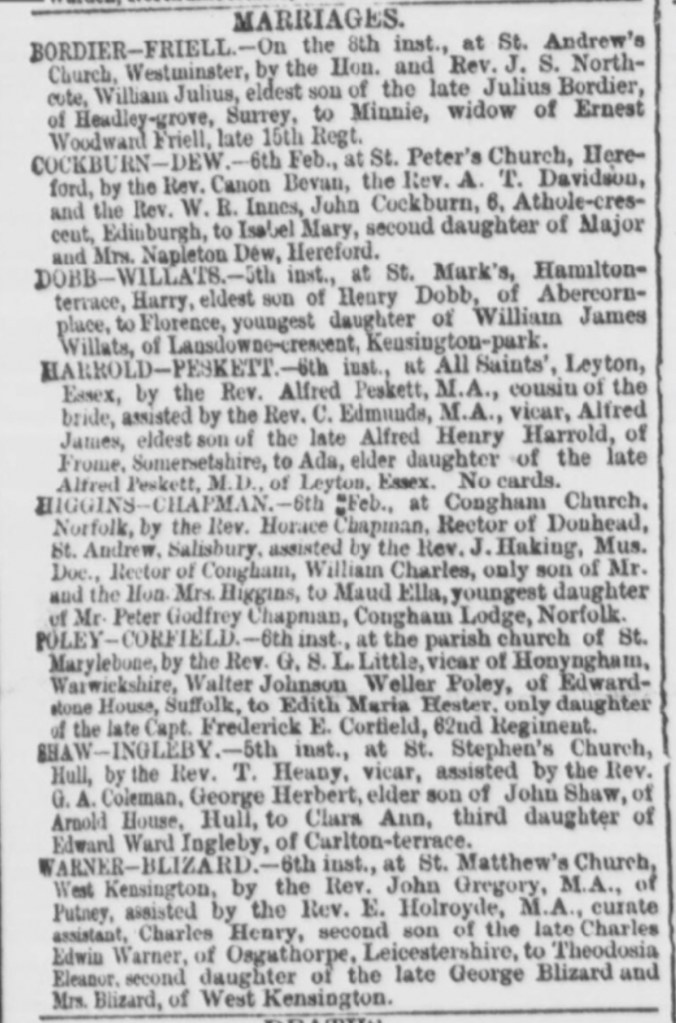
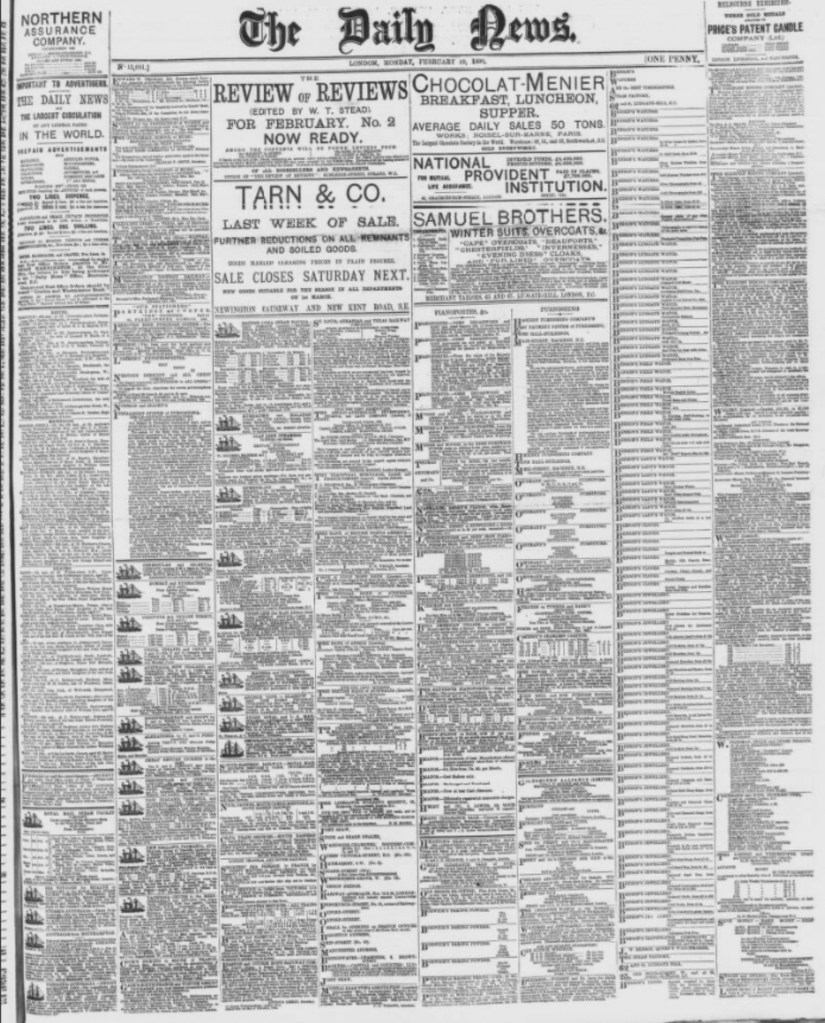
On the 10th of February, 1890, James’s name appeared in the Daily News (London), marking a cherished moment in his family’s life. The newspaper published an announcement of his daughter Florence's marriage, beautifully worded in the paper’s column:

"DOBB-WILLATS. – 5th inst, at St. Mark’s, Hamilton-terrace, Harry, eldest son of Henry Dobb, of Abercrombie-place, to Florence, youngest daughter of William James Willats, of Lansdowne-crescent, Kensington-park."

This brief yet heartfelt notice captured the essence of the joyous occasion that had unfolded just days earlier, as Florence, the youngest of James and Elizabeth’s children, had married Harry Dobbs at St. Mark’s Church. The newspaper’s mention of the families' addresses, James’s at Lansdowne Crescent, Kensington Park, served as a quiet reminder of the home and legacy Florence carried with her into this new chapter with Harry. It was a public acknowledgment of a milestone, a beautiful moment in the lives of the Willats family, now forever preserved in the pages of the London newspaper.

On the 5th of April, 1891, as the census was completed, James and his family were once again counted in the heart of their home at 37 Lansdowne Crescent, Kensington, London. The house, a place filled with the sounds of everyday life, was shared by James, his devoted wife Elizabeth, and their children, William Henry, Clariss C, and Emily B. The warmth of family life radiated through the census as it recorded their peaceful existence in this elegant part of London.
That year, the household was joined by a lodger, Bernard L. Davis, a 62-year-old assistant.
The family’s domestic staff included two young women, 28-year-old Elizabeth Moles and 24-year-old Emma E. Mendham, whose roles would have been vital in maintaining the bustling household.
James, ever adaptable, was now working as a communications agent, a shift from his previous roles in the world of jewels and diamonds. His work in this new field reflected a life of transition, embracing the changes of the time. As with the previous records, James was once again listed as William J. Willats, maintaining the use of his middle name.
The census captures a moment in time where the Willats family continued to build their lives, now a blend of old and new, in a house filled with the hum of domesticity, companionship, and change.
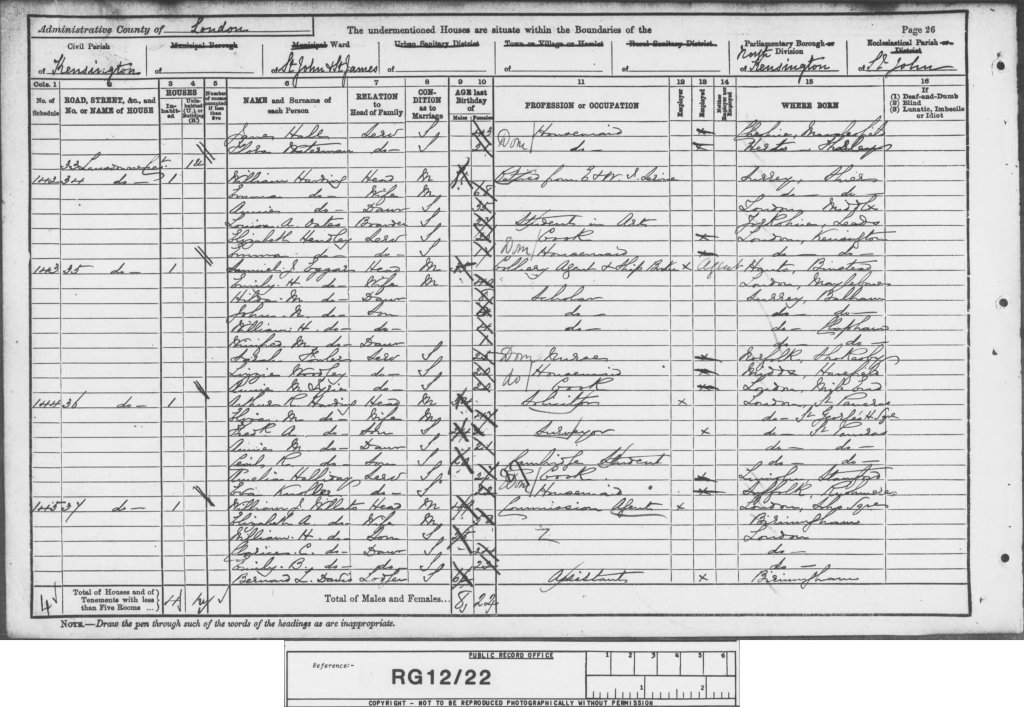

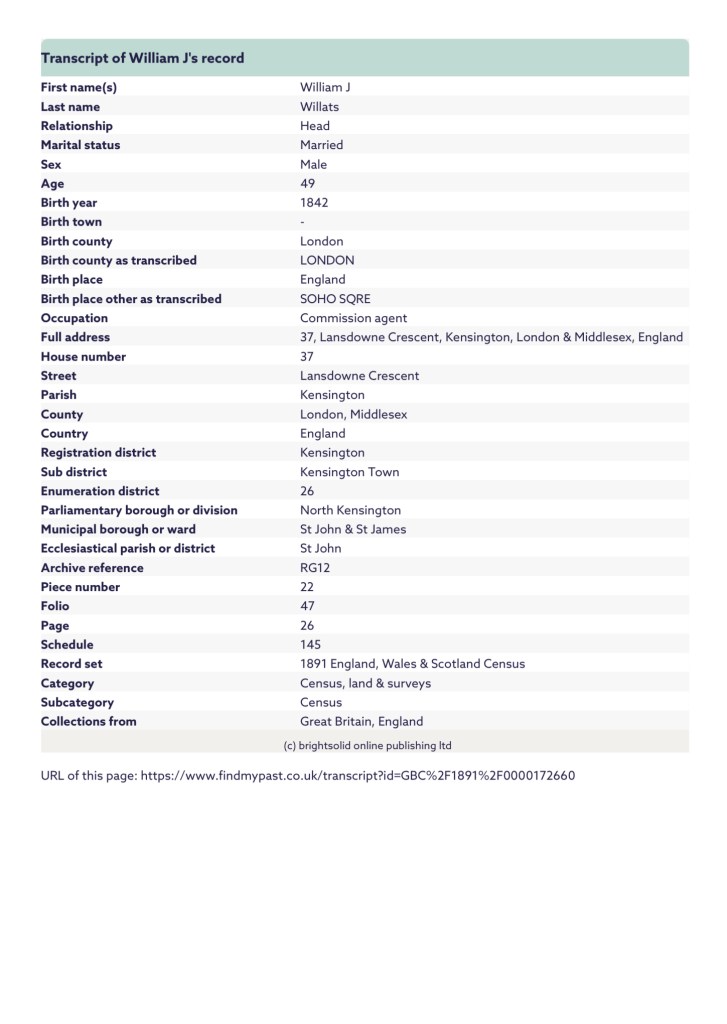
On a gentle spring morning, April 30th, 1892, fate ushered two souls together in a quiet moment of profound consequence. Clarice Charlotte Willats, the poised and hopeful 24-year-old daughter of James William, stood beside Walter G. Jones, a 36-year-old solicitor whose every year bore the marks of ambition and experience. They chose not the echoing arches of a grand church but the understated intimacy of The Register Office in Kensington, London, a modest yet hallowed venue where love stories were sealed not with ceremony, but with pen and paper.
Walter and Clarice came from lives that, while distinct, seemed destined to converge. Walter called 35 Abingdon Villas in Kennington his home, a genteel residence that spoke of quiet respectability and familial pride. Clarice, on the other hand, hailed from 37 Lansdowne Crescent in Notting Hill, a setting of sweeping architectural beauty that whispered of grace and tradition. These addresses, though brick and mortar, reflected the aspirations and storied lineage of their occupants.
As formalities were observed, Walter invoked the memory of his late father, Walter Jones, a M.D., whose absence was keenly felt but whose legacy lingered in his son’s resolve. Clarice, meanwhile, honored William James Willats, a gentleman whose influence lived on in her refined spirit and measured grace. Witnessing this tender union were A. E. Bathew and Walter H. Charten, silent guardians of a day that would be etched into the annals of their lives.
This was not a union of pomp and spectacle, but of quiet determination and shared hope. Together, Walter and Clarice began their journey, a partnership founded not in grandeur, but in the steadfast commitment to a life yet unwritten, filled with the promise of all they would build together.
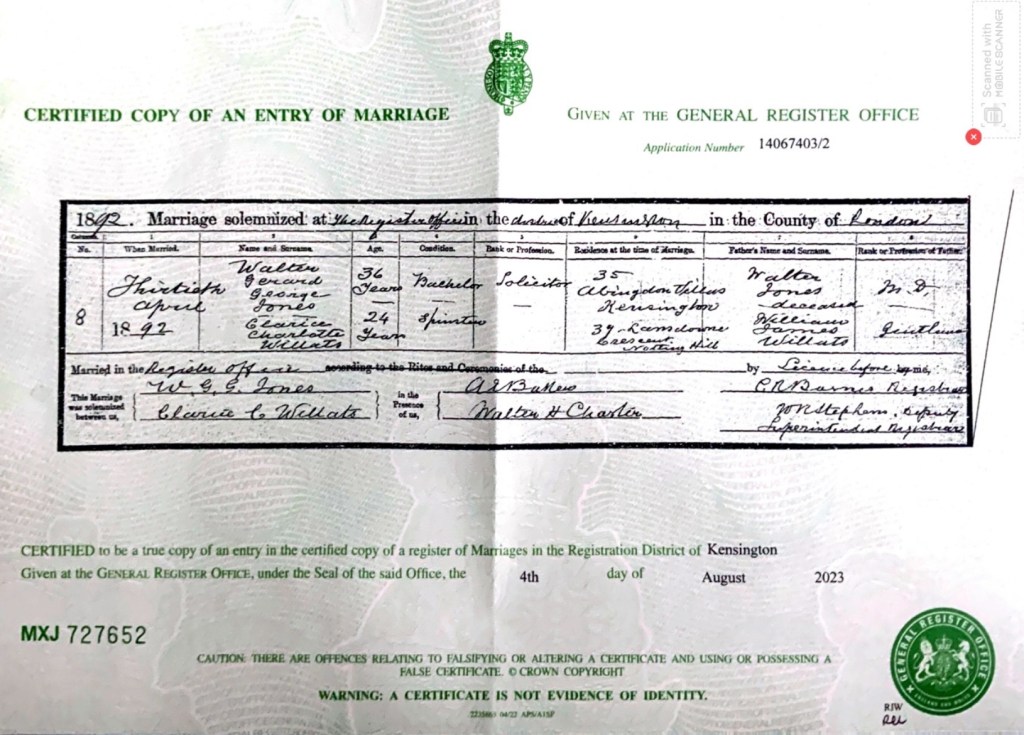
Abingdon Villas, nestled in the heart of Kensington, London, is a street rich in architectural heritage and historical significance. Its development unfolded between 1850 and 1864, a period marked by rapid urban expansion in the area. The construction was a collaborative effort involving various builders and developers, each contributing to the street's distinctive character.
The initial phase of development commenced around 1851, with builders such as Francis Attfield spearheading the construction of properties at Nos. 80-82 Abingdon Villas. This early construction was part of a broader initiative to develop houses along the adjoining Earls Court Road.
As the years progressed, the street witnessed a flurry of building activity. Between 1852 and 1854, a variety of builders were involved in constructing properties on both the north and south sides of Abingdon Villas. Notably, Nos. 65-85 (odd) were developed during this period, with craftsmen such as Edward Good, a carpenter from Kensington, and Joseph Liddiatt, a builder from St Marylebone, playing pivotal roles.
The development continued into the late 1850s and early 1860s. In 1856, John Turner and Robert Sharpen of Bayswater constructed a short terrace at Nos. 46-52 (even) on the south side of the street. By 1862, builders like Edmond Perfect and George Butt were instrumental in completing additional properties, further enhancing the architectural diversity of Abingdon Villas.
The turn of the century brought a shift in architectural trends, leading to the introduction of mansion blocks. Between 1901 and 1904, Abingdon Court, a substantial block of flats, was constructed on the north side of the street. This development was commissioned by Henry Labouchere, with architects Paul Grave & Company and Sydney Newcombe contributing to its design. On the opposite side, another block of flats named Abingdon Gardens was erected, also designed by Sydney Newcombe.
Today, Abingdon Villas stands as a testament to Kensington's rich architectural evolution. The street's blend of mid-19th-century terraces and early 20th-century mansion blocks reflects the dynamic nature of urban development during that era. Its historical significance is further underscored by its inclusion in the Edwardes Square, Scarsdale, and Abingdon Conservation Area, ensuring the preservation of its unique character for future generations.
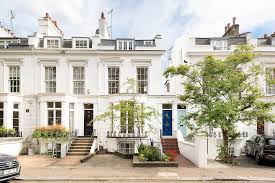
Sorrow touched the Willats family deeply when, on Sunday, the 23rd of October, 1892, James’s sister, Jenny Eliza Keep (née Willats), passed away at the age of 44. Jenny had been living at 97 Cottonham Road, Upper Holloway, in the district of Islington, London, where she had spent her final days surrounded by the quiet comforts of her home, though undoubtedly burdened by the weight of her illness.
Jenny had struggled with Phthisis, a condition that, in those times, often carried a heavy toll on the body, and her death was a profound loss not only to her immediate family but to all who had known her warmth and spirit. Her daughter, Mary Higgs (née Keep), was at her side in those final moments and took on the solemn task of registering her mother’s death the following day, Monday, the 24th of October, 1892. In the record, Mary lovingly confirmed that Jenny was the wife of Henry Arthur Keep, a commercial traveller, a man who had shared a life with Jenny and, no doubt, felt the sting of this untimely parting.
The loss of Jenny left a hole in the hearts of those who had known her. James, having lost his sister, surely felt the deep ache of missing someone so close to him. In this sorrowful moment, the family would have drawn together, finding strength in one another as they navigated the grief of saying goodbye.

On Friday, the 28th of October, 1892, Jenny Eliza Keep, known lovingly to her family as a cherished sister and mother, was laid to rest at Islington Cemetery, Highbury, London. In a quiet, solemn ceremony, she was buried in an open grave, reference N/3/17456, alongside six others, each of their lives marked with their own stories and journeys.
Jenny’s name, recorded as Jane Eliza Keep, reflects the simplicity and dignity with which she was laid to rest, though it may have felt bittersweet for those who knew her best. Her final resting place, now a part of the peaceful landscape of Islington Cemetery, became a silent testament to her life, the love she gave, and the loss her family felt.
It is easy to imagine the sorrow James, her brother, must have felt as he thought of the life she had lived, the memories they shared, and the parting that no words could truly capture. Though Jenny was gone, the love and respect for her lingered, forever held in the hearts of those who cherished her.

In the 1895 Trade Directory, James’s name once again appeared in the heart of London, his business listed at 25 Golden Square, Soho. Here, amidst the bustling energy of Soho’s vibrant streets, James was once again working as a Jewel Agent, a role that had long defined much of his career.
Golden Square, with its blend of old-world charm and the pulse of modernity, must have been the perfect backdrop for his world of precious gems and business dealings.
For James, this address symbolized more than just a place of work, it was a cornerstone of his life in London. Each day, as he moved through the city, he would have carried with him the legacy of his craft and the experience he’d gathered over the years. His connection to the world of jewels, like the stones he dealt with, remained as much about personal pride and legacy as it was about business.
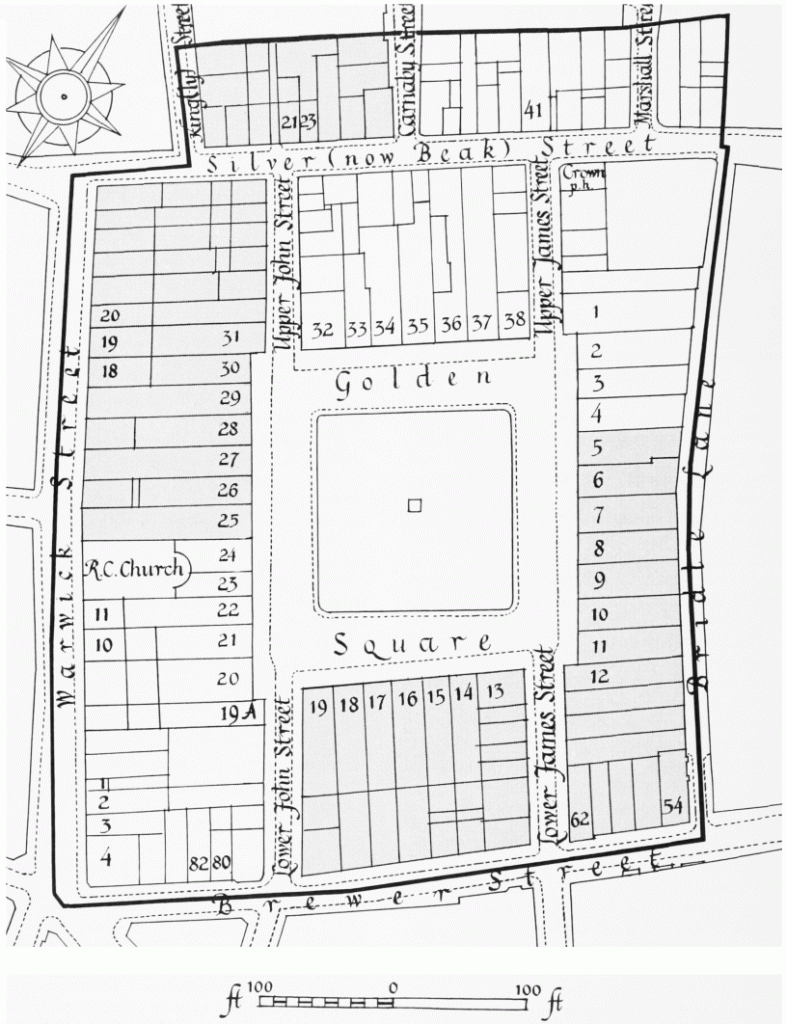

In the 1900-1901 Kensington and Chelsea Electoral Registers, William, as he was known in the records, was listed once again at 37 Lansdowne Crescent, the family home in the heart of Kensington, London. This address, a place that had seen so many chapters of his life unfold, continued to serve as a testament to the years spent in the vibrant and ever-changing city of London.
The house at 37 Lansdowne Crescent had witnessed James’s journey, from the early days of his marriage to Elizabeth, the raising of their children, to the many quiet moments shared within those walls. Though the years had passed, and much had changed, the connection to this home remained constant, as if the house itself had become a part of his story. In this moment of the electoral record, William’s presence there was a reminder of the stability he had carved out for his family, even as the world around them continued to evolve.
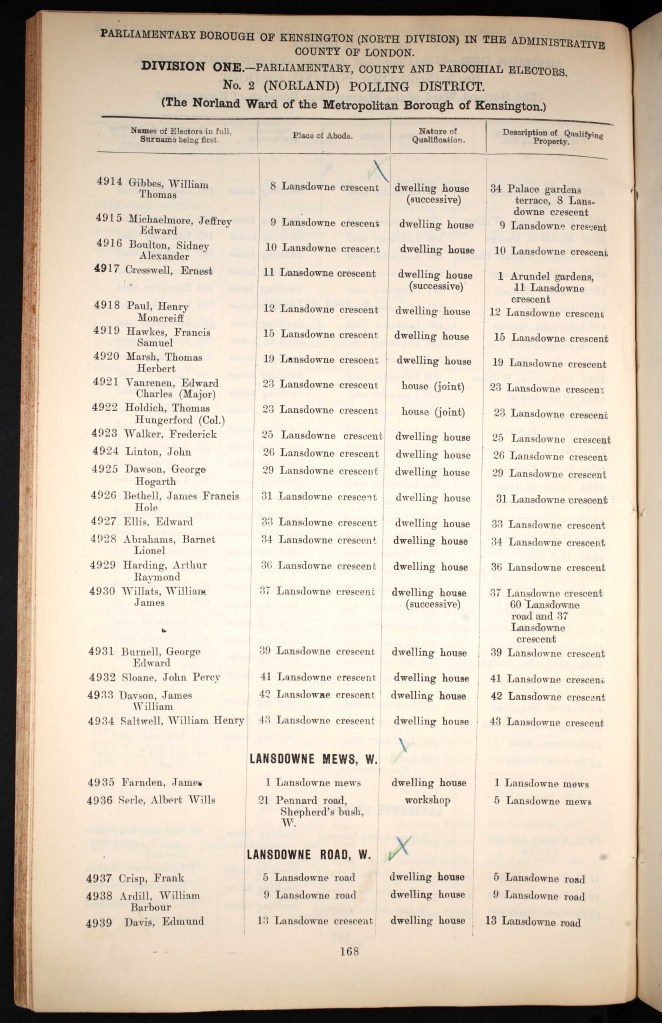
In the 1901-1902 Kensington and Chelsea Electoral Registers, James William was once again listed as residing at 37 Lansdowne Crescent, Notting Hill, Kensington, London. This home, so rich with family history, continued to be a place of refuge and connection for James, his life unfolding in the same familiar surroundings.
James had once again chosen to be recorded by his middle name, William, as he had in earlier years. It was as though he had crafted an identity that, over time, had become intertwined with this name, perhaps a subtle shift, a personal choice that added an air of distinction or simplicity. Whatever the reason, it was clear that this home in Notting Hill, with its quiet charm and timeless appeal, remained at the center of his world as he moved through the years.
On Sunday, the 31st of March, 1901, the day the census was completed, James, Elizabeth, and their two daughters, Emily Beatrice and Florence Dobb (née Willats), were still living together in the home they had long called their own at 37 Lansdowne Crescent, Kensington, London. This residence, a steadfast cornerstone in their lives, continued to offer them the familiarity and comfort of shared memories, woven into the fabric of everyday routines.
The household had grown to include 18-year-old Ellen Eager, their domestic cook, and 16-year-old Sarah Bailey, their housemaid. Both young women were integral to the smooth running of the household, their quiet presence bringing a sense of order and warmth to the home that allowed the family to carry on with their lives with ease.
James, as had become his custom, once again listed his occupation as a communications agent, a role that spoke to his ability to adapt and navigate the changing world around him. As in the 1891 census, he chose to use his middle name, William, rather than his first, keeping to the name that had become part of his identity over the years. This small detail, recorded in the census, was a reminder of the man he had become, navigating through his own life’s chapters with purpose, while his family thrived in the comfort of their shared home.
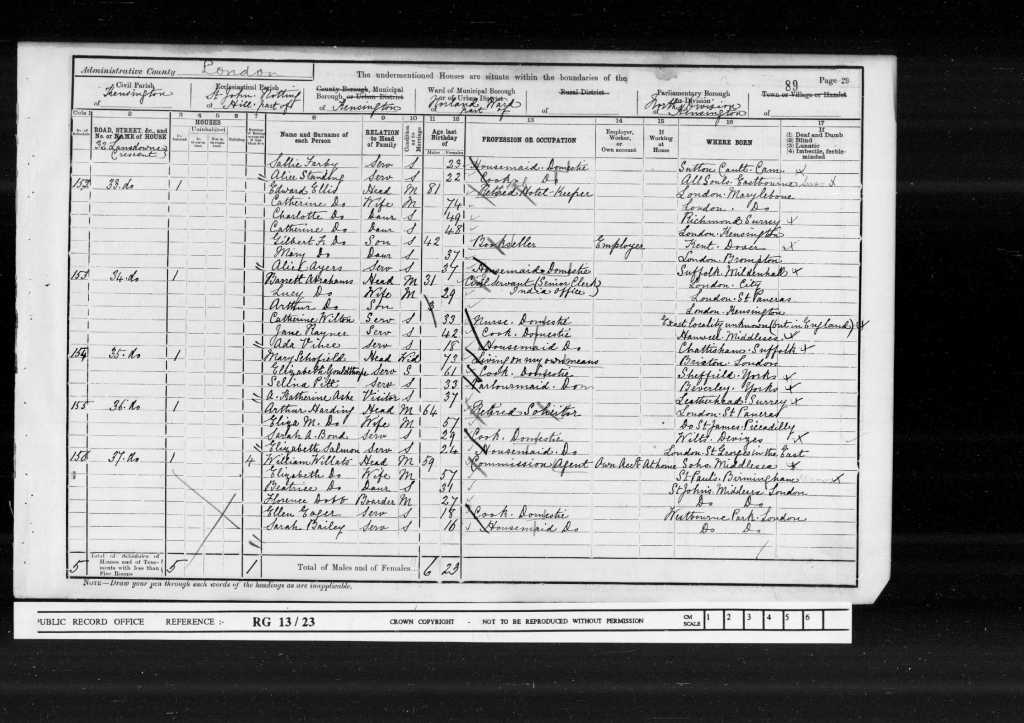
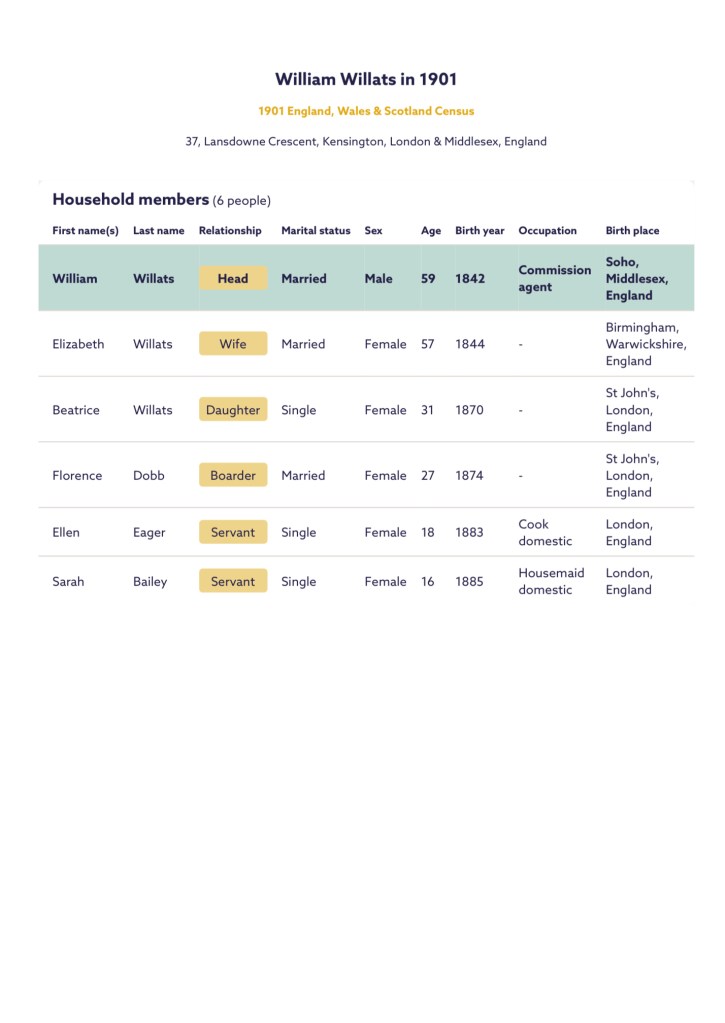
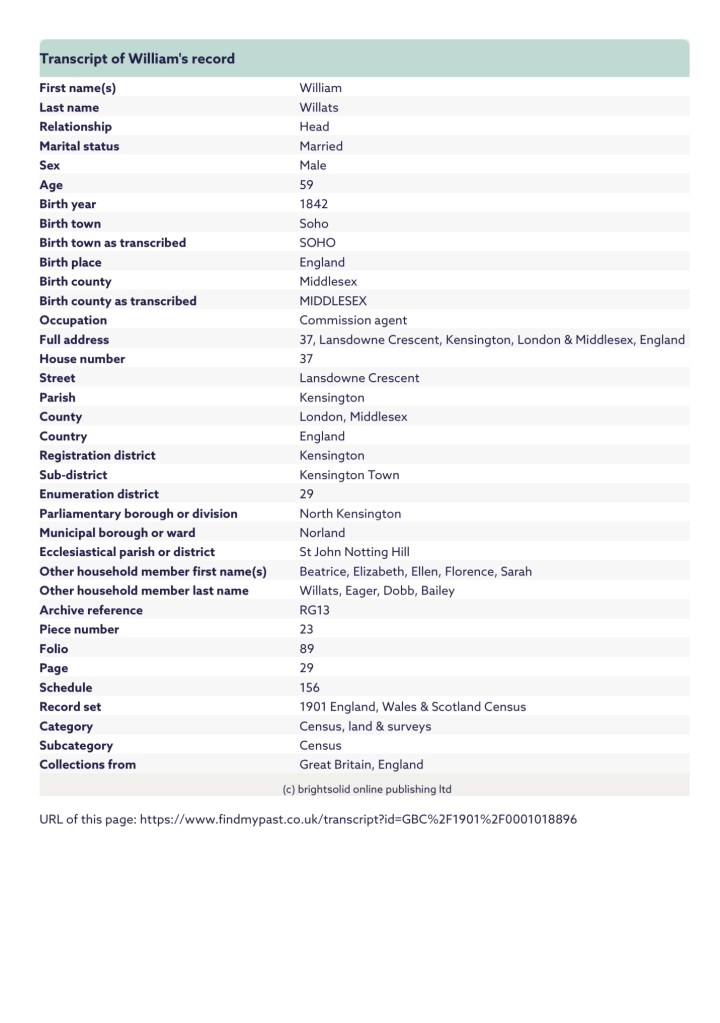
In the 1901-1902 Kensington and Chelsea Electoral Registers, James William was once again listed as residing at 37 Lansdowne Crescent, Notting Hill, Kensington, London. This home, so familiar and full of family history, continued to be the steady backdrop to his life. James once again used his middle name, William, in the record, continuing the pattern he had followed in earlier years.
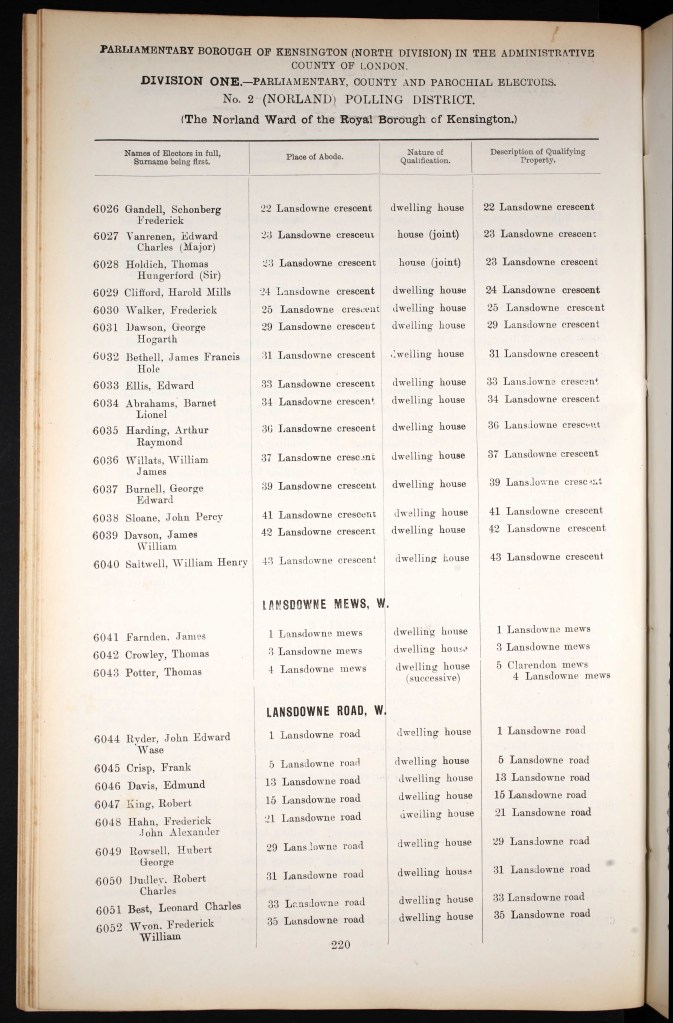
James’s world came crashing down on the 5th of June, 1902, when he lost his beloved wife, Elizabeth Ann Willats (née Davis). At 65 years old, Elizabeth passed away at their home on 37 Lansdowne Crescent, Kensington, London. The grief that James must have felt was immeasurable, as the woman who had stood by his side for so many years, through joys, trials, and shared moments, was now gone. Elizabeth had been suffering for several months, her health declining due to Splenic Leukocyte for five months and Ascites for four, conditions that would have caused immense physical pain and wear on her body.
William James, utterly heartbroken, was present with her in those final moments. He took on the solemn responsibility of registering his wife’s death later that same day, marking the end of a chapter in their shared life. In the official record, he gave his occupation as a General Merchant, though at that moment, no title or role could truly encapsulate the loss he felt. Their home, once filled with the rhythm of daily life, now felt like an echo of a past that could never be reclaimed. The sorrow of losing Elizabeth, the heart of their family, left James to navigate the world without the partner he had cherished for so long.
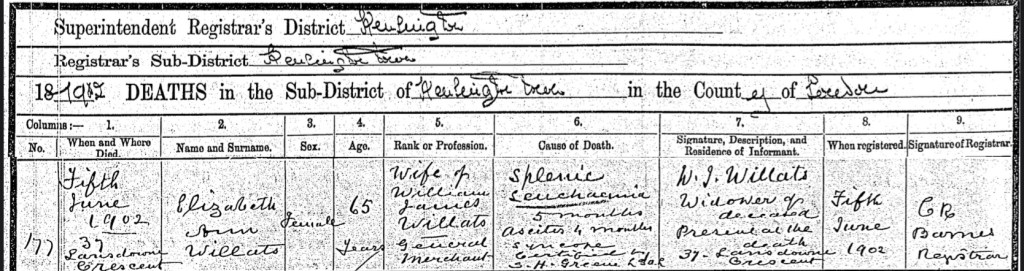
In June of 1902, James, along with family and friends, said their final goodbyes to Elizabeth Ann Willats (née Davis) at Kensal Green Cemetery, a place where the departed were laid to rest in quiet peace. The heartache of that day must have been profound, as Elizabeth, the woman who had been at James’s side through so much, was now being interred in the serene grounds of the cemetery.
Elizabeth’s final resting place is marked in grave reference /Con/21966, a spot she shares with several loved ones. In this shared grave, Elizabeth is reunited with her daughter Florence Dobb (who passed away in January 1907), her mother Charlotte Davis (who passed in May 1891), and her father William Davis (who had passed in 1870). The family’s presence in this sacred space, each life now linked in the stillness of time—must have been a bittersweet comfort to those left behind. Though Elizabeth’s physical presence was gone, her connection to her family, to James, and to the home they had built together lived on in the memories and love they had shared.
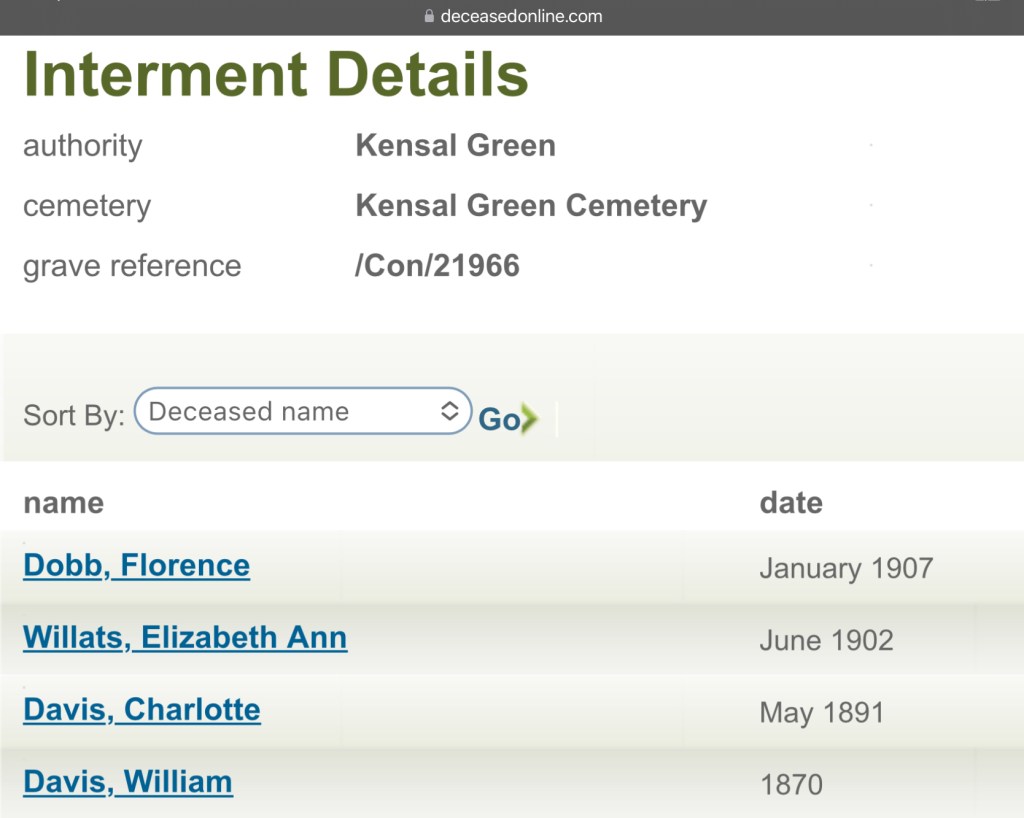

Jumping forward to 1907, the Willats family was struck by an unimaginable tragedy when James’s beloved daughter, Florence Dobb (née Willats), took her own life at the tender age of 34. A mother to three young children, Harry Raymond, George Conway, and Robert Alan, and the wife of Harry Dobb, a barrister at law, Florence’s passing sent shockwaves through the family, leaving an indelible mark on all who knew her.On the 9th of January 1907, Florence tragically drowned in Leg of Mutton Pond, Hampstead Heath, a place where, in a moment of deep and overwhelming despair, she chose to end her life. Her death certificate later listed the cause as suffocation from drowning, noting the heartbreaking conclusion of suicide, attributed to temporary insanity. The finality of her passing, coming so suddenly and unexpectedly, must have been deeply painful for her family, particularly her father, James, who had already borne the loss of his beloved wife just a few short years earlier.
The death was registered in Hampstead on the 19th of January 1907, and the certificate was issued by Dr. George Donford Thomas, the coroner for London. An inquest into Florence’s death was held on the 11th and 17th of January 1907, the details of which would have been difficult to bear for those close to her. Florence’s untimely and tragic end left a void in the lives of her family and all who knew her, and her memory was forever etched into the hearts of those who loved her.
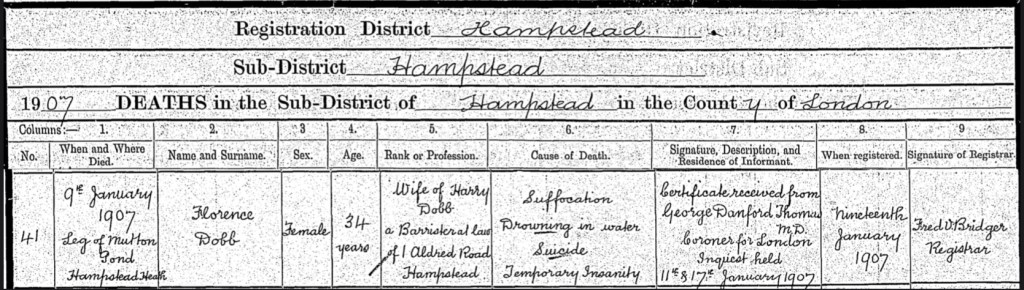
James, heartbroken by the loss of his beloved daughter Florence, laid her to rest at Kensal Green Cemetery, Kensington and Chelsea, London, in the same grave where his wife, Elizabeth, and his in-laws, William and Charlotte Davis, had been buried. The grave reference is /Con/21966, a sacred place where generations of family would now rest together, their stories interwoven even in death.
Though a date was not recorded for Florence’s burial, the solemnity and finality of that moment must have been profoundly difficult for James. To bury his daughter beside his wife and in-laws created a shared resting place, but it also served as a constant reminder of the deep grief he had already suffered. Florence’s death, coming so soon after the loss of Elizabeth, left a hole in the family that would be felt for years to come. Her memory, preserved in the quiet stillness of the cemetery, was a painful reminder of the love and loss that had marked James’s later years.

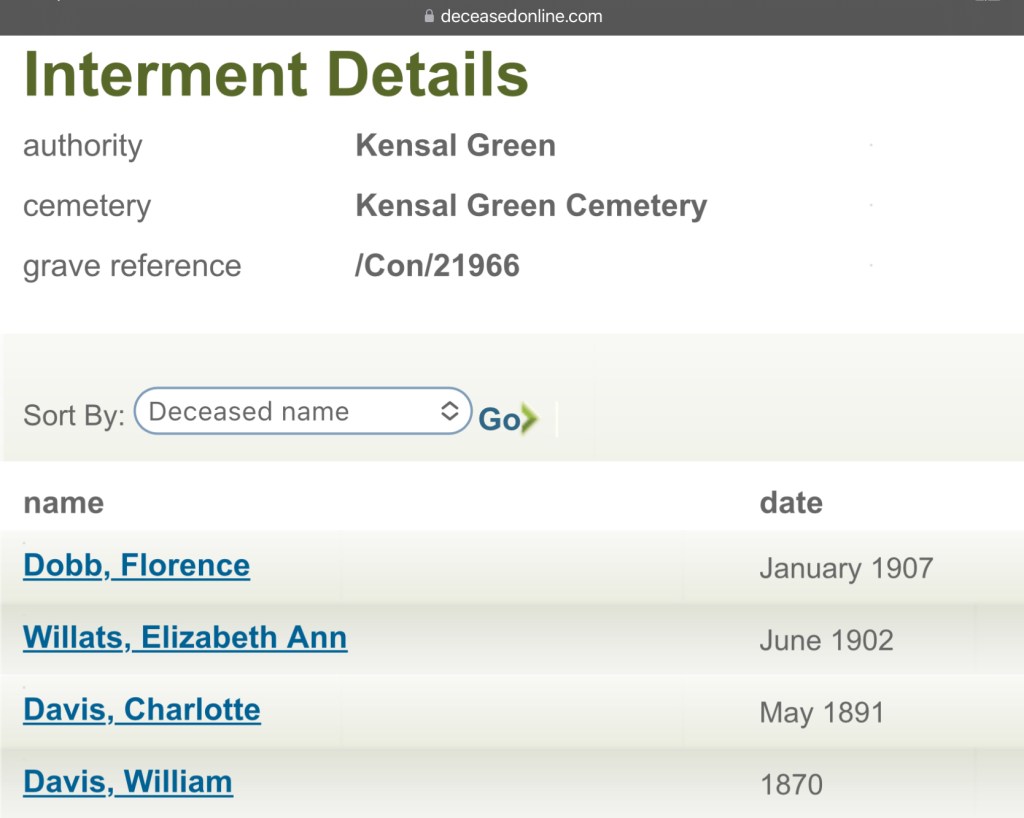
An article, though the exact newspaper remains uncertain, was printed regarding the mysterious death of Florence Dobb, and it read:
LADYS MISTERIOUS DEATH.
INQUIRY ADJOURNED.
At Hampstead, to-day, an inquest was held on
Mrs. Florence Dobb, who was drowned in a Hamp-
stead pond. According to the evidence deceased,
who was living apart from her husband, Mr. Harry
Dobb, barrister, Hampstead, under deed of
separation, suffered from insomnia.
A keeper said he sew the lady in the water. He
appealed to her to come out, but she said, “Let
me die.” He rode away for assistance. Another
witness said three men were at the pond’s edge.
The inquiry was adjourned.
A keeper testified that he saw the lady in the water and called out to her, urging her to come out. But, in her final moments, she simply replied, “Let me die.” In a state of despair, he rode away for help. Another witness recounted seeing three men at the pond’s edge, but it was unclear whether they were able to assist.
The inquiry into her death was adjourned, leaving the tragic circumstances of Florence’s passing shrouded in further mystery. This heartbreaking report must have been an agonizing read for James and the rest of the family, exposing the deep pain Florence had been struggling with before her tragic end. The details of the inquest would forever remain a haunting part of the story of her untimely death.
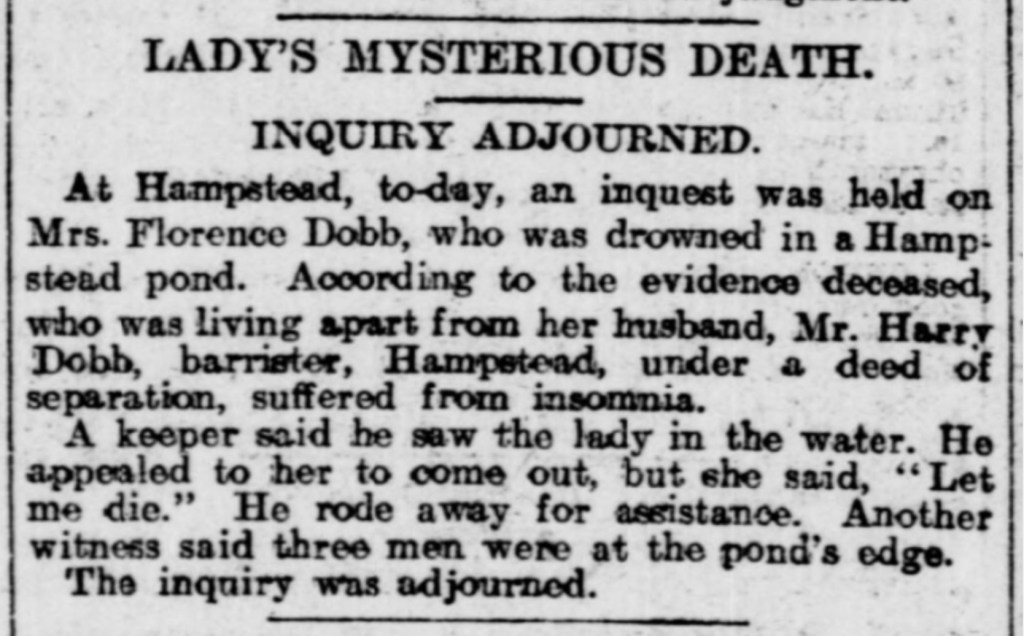
It is truly heartbreaking to reflect on the series of newspaper articles that mentioned James, many of which were written in the wake of his daughter Florence Dobb’s tragic death. These articles, some brief and others more detailed, paint a sorrowful picture of the pain and hardship Florence endured before her untimely end. The sadness of her situation is impossible to ignore, and as you mentioned, her story should never be forgotten. It’s a reminder of the silent struggles that many face, often unseen by the world around them, and the devastating effects those struggles can have.
The details shared in these articles, particularly the one you mentioned, show the depth of Florence’s despair and the emotional toll it took on her. It is clear that Florence’s life had become incredibly difficult, with the separation from her husband, Harry Dobb, and her long battle with insomnia contributing to her fragile state of mind. Her tragic decision to take her own life is an immense sorrow for the family, but also a stark reminder of the importance of mental health and the sometimes-overlooked struggles people face.
As much as it is a story of deep sorrow, there is hope that, in the end, Florence’s soul found the peace she so desperately needed. May she be at rest now, free from the pain that plagued her in life. It is a memory that should remain in the hearts of all who hear it, not just to mourn her loss, but to honor her life and the love that she had, even in the darkest moments. ❤️🩹
The article from the Hampstead & Highgate Express offers a detailed account of the tragic drowning of Mrs. Florence Dobb in the Leg of Mutton Pond on January 9, 1907, following an inquest into her death. Florence Dobb, aged 34, lived in Alfred-road, West Hampstead, and was married to Mr. Harry Dobb, a barrister. The couple had been living apart under a deed, with Florence receiving an allowance and having some means of her own. Florence had long suffered from insomnia and nervous conditions, and it was believed these health issues might have contributed to her loss of self-control on the fateful morning.
On January 9, 1907, Florence was seen swimming in the Leg of Mutton Pond by Mr. Charles Gask, a draper who was taking a morning ride. Mr. Gask tried to persuade her to come out of the water but was unsuccessful. Florence repeatedly cried out “Don’t let me die,” but she refused to leave the water. Despite multiple efforts by bystanders, including a postman, an under-keeper, and other individuals who arrived at the scene, they were unable to assist her in time. Florence drowned before help could reach her.
Various attempts were made to rescue her, but none proved successful. Mr. Gask had shouted for help when he first noticed Florence, but she resisted all attempts to save her, even as the others arrived on the scene. Walter James Crane, the under-keeper, tried to throw a life-belt, but it fell short of her. The body was eventually recovered after the use of a punt to retrieve it from the pond.
In the inquiry, medical testimony revealed that Florence had been suffering from emotional distress, insomnia, and had a history of attempted suicide. Dr. Adolphus Edward Bridger, who had treated Florence, described her as an “intensely emotional woman,” prone to impulsive behavior, and noted that she had once attempted to harm herself at the seaside and had taken large amounts of drugs at other times.
The coroner’s inquiry concluded that Florence’s death was a suicide brought on by her mental state. The jury returned a verdict of “Suicide whilst of unsound mind” and expressed regret that no one present at the scene felt competent enough to attempt a rescue from the pond, even though several people had witnessed the incident. The jury made several recommendations following the inquiry. They suggested that a lifeboat be placed in a location where it could be easily accessed and that notices be posted around the pond to inform people about the lifeboat’s location. They also recommended that the keepers of Hampstead Heath be trained in performing artificial respiration to assist in future emergencies.
This poignant and tragic story highlights not only the sorrow surrounding Florence Dobb’s death but also the public response and the lessons learned from the incident. The combination of her emotional struggles and the failed attempts to rescue her paints a picture of the difficulties faced by those who witnessed the drowning, as well as the deep impact on those who knew her.
The full article reads,
THE HAMPSTEAD DROWNING
TRAGEDY.
On Thursday Mr Walter Schroeder, deputy coroner resumed his inquiry at the Hampstead Providence Dispensary Hall into the circumstances attending the death of Mrs Florence Dobb, aged thirty four, of Alfred-road, West Hampstead, the wife of Mr. Harry Dobb, barrister, of Albemarle mansions, Heath-drive.The evidence given last week showed that the deceased was drowned in the Leg of Mutton Pond, Hampstead-heath on the 9th inst. The body was identified by the husband. He stated that he and his wife had been living apart under a deed. She had an allowance from him and also means of her own. She suffered from insomnia and nervous affection and a medical man had stated that the insomnia might bring on hysteria and that while suffering from that she might lose all self control. She left the house in which she had been lodging before breakfast in the morning in question and at about eight o’clock was seen by Mr Charles. Gask, Draper of England’s- lane, who was taking horse exercise on The Ride on Hampstead-Heath, in the water of the Leg of Mutton Pond She was swimming away from the bank when he first saw her when he stopped and turned his horse she turned and swam towards him for a short distance. He asked several times to come out and said that if she did not, he would raise an alarm. She replied, “Don’t let me die”, He then shouted for help but every time he did so she cried, “Don’t”, and also kept going under the water. Another rider came up, and also pleaded with her to come out, and a postman and an under-keeper in the employ of the London County Council afterwards arrived on the scene, and later still Mrs Emma Cook, of Gardnor-road who was on her way to work, came up. The under-keeper, Walter James Crane, waded into the pond as far as he could, and also tried to get a life-belt to the lady. Mr. Alexander C Cairns, barrister, now appeared for Mr. Gask, whose conduct, he said, had been the subject of some misapprehension. Mr D. Carter, from the solicitors department of the London County Council attended, and produced a plan of the pond.
Mr William James Willats, of Lansdowne road, Holland Park, a merchant, father of the decreased said she had been staying at his house on a visit extending several days. She appeared comparatively well, but complained of great depression of spirits and insomnia, and occasionally of pains in the head. She Ieft his house on Monday the 7th inst.. and said she was going to see her boys to whom she was very much attached. She said she should return in the after-noon, which she did. She then said that she should go to Hampstead and return on Tuesday morning. She dd not return but slept at Hampstead on the Tuesday. and on Wednesday, the 9th inst.. they received a ‘wire.” asking if she was with them. She had never threatened to take her life. She was an excellent swimmer. Willian Daid Mann. an auxiliary postman. of Dale-read. Kentish-town. said he was on his morning delivery of letters near Telegraph-hill, at eight o’clock on the morning in question, when Mr Gask galloped up The Ride and shouted that there was a woan in the pond, and asked if there was any possibility of getting her out. Witness ran to the pond and saw a woman in the water. about twelve or fourteen yards from the western side and a long way from the roadway. She was very near the centre of the pond She was apparently standing in the water. Mr Gask and he shouted ‘Come out of the water.” She then swam farther towards the centre and shouted. “Don’t save me, let me die’ She had no hat but had on a grey coat, which. whilst treading the water, she buttened up. Witness throw down his Ietter bag and ran to the Golder’s hill lodge and asked where he could get a drag or a rope. The reply he got was “We don’t know where we can get it, we have not been here long.” When he retured the lady was under the water. He could only see a black speck. She did not appear above the water again. By the coroner: I can swim a little, a very little. I did not feel competent to tackle a big woman like that. She seemed to me to be a very powerful swimmer. When Mr Gask first spoke to me, my idea was that he was anxious to get assistance.
The foreman of the jury: What did you say to Mr. Gask when he told you there was a woman in the water?
Witness: I sad. Oh’ is there: We’ll soon have her out.
By a juror: The lifebelt was not brought until the woman was under the water. Mr. Edward Tanered Agus, a merchant of Belize grove, said that on the morning in question he was returning along The Ride towards the West heath-road on horsehack, when he saw Mr. Gask standing on the bank by his horse. which was restive. Thinking that he had met with an accident witness went to his assistance. He then saw the woman in the water and heard her shout ‘ Don’t Let me die.’
The cooner: Was it a continuous sentence? Did it convey to vou tbe impression that she did not wish to die, or that she did not wish te be saved?Witess: That she did not wish to be saved. I shouted to her to come out, and got off mv horse, saying that I was going into the water, but was dissuaded from doing so. I had a good look at her. and then it seemed as though she was standing in the water. She made no effort to come towards us. At my request Mrs Cook tried to coax the dereased to come out. Mrs Cook called, “Dearie. dearie do come out. for God’s sake. “ but the deceaed took no notice. Then two keepers came up, one with a life-belt and the other with a drag, but they could do nothing to help her. She went under the water a few seconds after.
The coroner: Are you accustomed to swim? Yes.
You told the jury that you were persuaded not to go into the water. What stopped you? I can hardly say. Mv first impression was to go into the water, but afterwards I thought she was quite safe.
Mr. Cairns: Who dissuaded you from going into the water? Mr. Gask. He evidently thought she was safe. He meant it kindly by suggesting that I was hot from riding and might catch cold. It appeared to me that the lady could have come out if she had liked.
Sergt. Ward, 5 S. deposed that he procured a punt and with assistance, got the body out of the water at a quarter to nine. The woman had been dead some time, and his efforts at artifcial restoration wire without avail.
By the coroner: The pond was not used for bathing. The police had no record of anyone falling into the pond, though there had been suicides there. The pond was protected by an iron railing on The Ride side.
A juror: How many suicides are there on the Heath in a year?
The coroner: It would be difficult to tell The suicides on the Heath are not usually on that side at all.
David Wathing (coroner’s officer) : It is four or five years since there was a case from this pond.
Mr. W H Payme. police divisional surgeon said that death was due to suffocation from drowning. The fact of having been in tbe water some time would tend to death happening very quickly after she went undemeath.
The under-keeper Crane was recalled by the coroner. He said that his attention was first called to the lady by the sound of a whistle blown by the woman at the lodge at Golder’s hill. He went into the water up to his knees in order to throw the drag out. He saw no signs of life and his object was to get the body out as quickly as possible. From the time of his arrival to the time the body was got out was quite half an hour. It took about twenty minutes to get the punt from Golder’s-hill. Ths was the first time he had heard of assistance bring required at the pond. When he threw the life-belt out it fell short of the deceased by about ten yards. The line was long enough to have reached to her, but, as he had been running he was too exhausted to throw it further.
Mr John G Gillies, surveyor in the Parks Department of the London County Council, said the exactly 100yds, the extreme width 46yd*. (at the end near The Ride): on the western side the ground slopes gradually down to the water. and then for 30ft out the water was only 3ft. deep, with 6in. of mud: in the centre of the pond the water was 7ft. 6in. deep. with from 3ft to 5ft of mud underneath. Where the body was found the depth of water was 7ft. with 3ft 6in of mud underneath: and at the end near The Ride the water was 7ft deep only twenty yards out. At The Ride end a person would be out of depth almost at once. The spot at which the deceased was found was nineteen yards from the north bank: twenty-one yards from the south bank : and twenty eight yards from the west bank. There was a notice prohibiting bathing.
Mr Dobbs (recalled) said his wife was 5ft 5in in height.
Mr Gillies said the lady could have stood in the water at the spot where she was first seen by the postman.
George Palmer the L C C Superintendent of Hampstead-heath, said the pond was somewhat altered four years ago, when an improvement was made in The Ride.
Bathing was prohibited in the pond which as used largely for dog bathing and fishing.
There were many natural springs (and some minerals) on the West Heath, of which this pond was the basin. He had never heard of anyone falling into the pond, and therefore there had never been any necessity for further protecting it.
Dr. Adolphus Edward Bridger, of Portland place, called at the request of the husband said that he saw Mrs Dobb twice in November and twice in December. She was an intensely emotional woman, a woman of many Impulses. She told him that she once went to the seaside with the intention of going into the sea. She suffered greatly from sleeplessness, and, he was sorry to say had taken large quantities of drugs. A Person in that condition was subject to sudden impulses and to many of them. Her condition on this occasion was partly due to derangement of the mind. and also she wished he thought to make a “demonstration” of how much she suffered.
The husband: Would you describe her as a normal woman! No as an abnormal woman. I don’t think I ever knew so emotional a woman extending over so long a time, eight years, I think.
Mr Gask recalled, said th decreased did not speak until he spoke to her. She first swam towards him, and when he said he would raise an alarm she called “Don’t Let me die’ When he rode away to get help she screamed and shouted “Don’t” again. In going for help he was actuated by the best motives, though he did not know what help he was likely to get. When Mr Agus offered to go into the water witness said, ‘You can’t her out. It’s not good ‘
Witness had done no swimming for twenty years.
Even if he had been able to swim out to the lady he did not think he would have been able to do anything.
The Jury returned a verdict of Suicide whilst of unsound mind” They also added the following riders
1. The jurors desire to record their regret that when the deceased was alive in the pond there was no one present who felt competent to enter the water and endeavour to effect her rescue.
2. Is that the lifeboat should be placed in a position where it can be easily obtained, and noticed placed on the railings around the pond, or in some other prominent position, stating whether it’s kept.
3. That’s the keepers of the heath should be instructed how to restore life by artificial means.
The joint enquiry lasted over three hours.


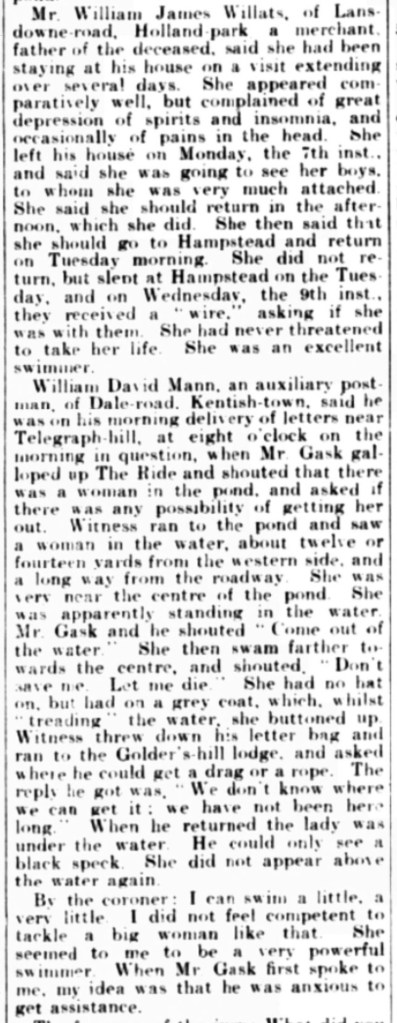

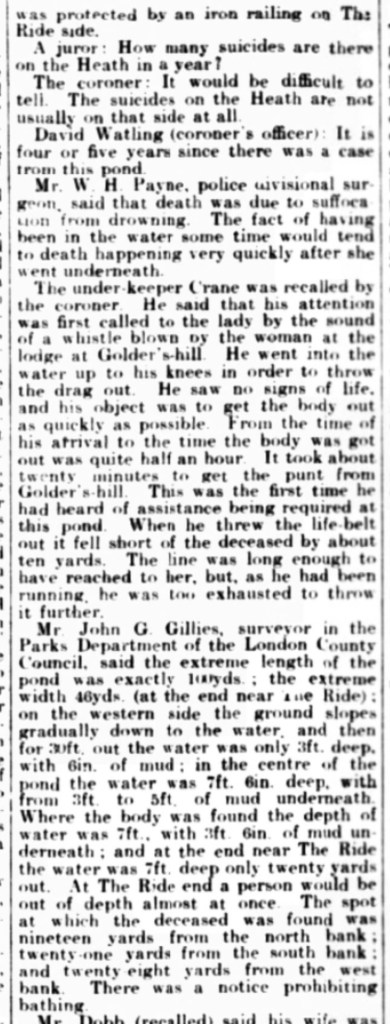


The probate records show that James daughter, Florence Dobb (née Willats), who passed away on January 9, 1907, was granted administration of her estate many years later, on March 1, 1922. According to the record, Florence had been residing at 60 Lansdowne Road, Kensington Park, Middlesex, at the time of her death. She was the wife of Harry Dobb, and her death occurred in Hampstead, Middlesex. The probate was granted to her husband, Harry Dobb, who was a county court judge at the time. The total value of her estate was £1,740 17s.
DOBB Florence of 60 Lansdowne-Road Kenisinton Park
Middlesex (wife of Harry Dobb) died 9 January 1907 at
Hampstead Middlesex Administration London 1 March
to the said Harry Dobb county court judge.
Effects £1740 17s.
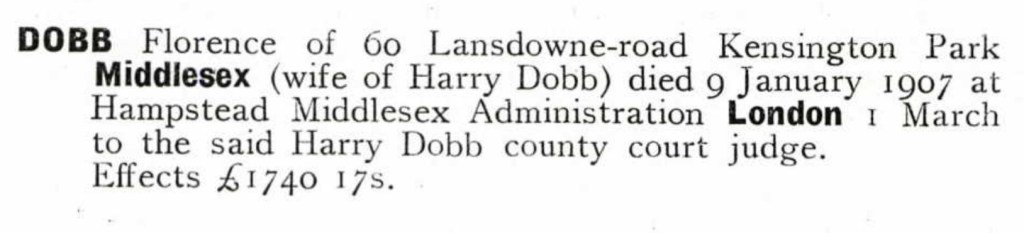
In a devastating turn of events, Charles Conway Dobb, the grandson of James and the son of the late Florence Dobb, tragically took his life on Wednesday, March 29, 1939. The 28-year-old, who was well known within his community, ended his life by throwing himself in front of an underground train at Sloane Square Station.
Charles, who had been battling emotional and mental distress in the years leading up to his death, was described by those who knew him as a deeply sensitive and thoughtful individual. His sudden and untimely demise left his family and friends in shock, as they struggled to understand the underlying causes behind such a tragic act.
The incident occurred during the evening rush hour, and eyewitnesses reported that Charles appeared to walk calmly onto the tracks just moments before the train arrived. Despite the efforts of station personnel and bystanders to raise the alarm and assist, it was tragically too late to save him.
The tragic news sent waves of grief throughout his family, particularly because his own mother, Florence, in a similar manner more than three decades earlier had taken her own life.

The Sunderland Daily Echo and Shipping Gazette, printed the below article about his death on Tuesday the 4th April 1939.
PHONED NEWS OF HIS
OWN SUICIDE
Shell-Shocked Officer
Tragedy.
A few minutes after telephoning to a
friend, ‘I cannot face things any
longer; within one hour I shall be dead,’
Capt, George Conway Dobb (46), of Nell
Gwynn House, Sloane Square, London,
threw himself in front of an Under-
ground train at Sloane Square Station.
Mr Eric Gordon, who received the tele-
phone message, said at the Hammer-
smith inquest that he tried to console
Capt, Dobb, and reason with him, but
he hung up the telephone. Witness then
tried to trace him, but failed.
It was stated that Capt. Dobb, who had
been in the RFA., was wounded and
shell-shocked during the War. About ten years
ago his spine was injured when a
horse rolled on him. He was invalided
from the Army on pension, and became.
a director of a motor company.
His financial position was good, but he was.
“temperamental” and was inclined to
make mountains out of molehills.
A verdict of * Suicide while of unsound
mind” was returned.
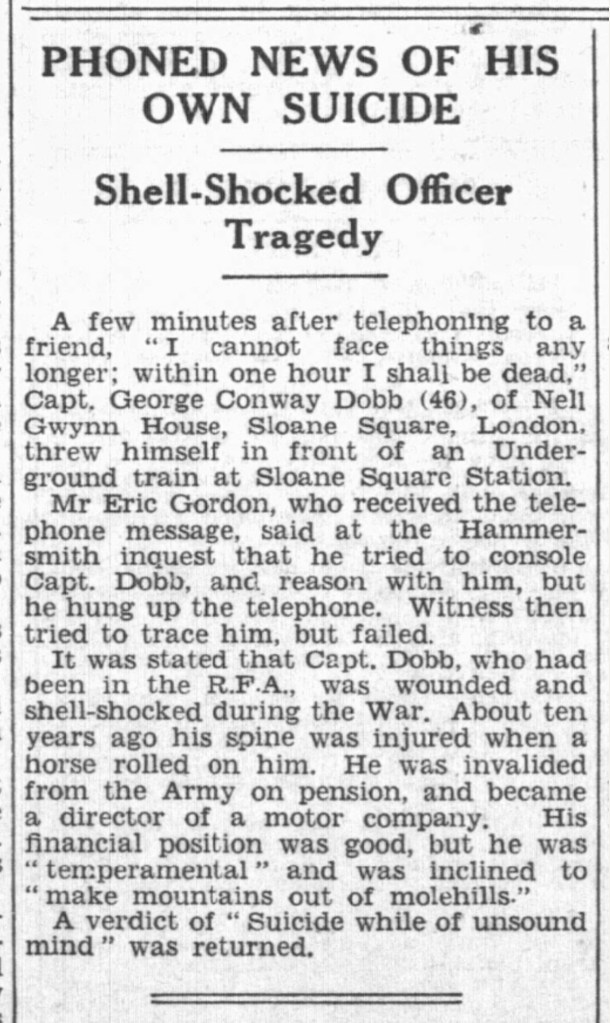
With heavier hearts, lets get back to James life story.
On Sunday, April 2nd, 1911, the 1911 census was completed, providing a glimpse into his life during that time. The census shows James Willats, listed as William James, living at Number 37, Lansdowne Crescent, Kensington, London & Middlesex, with his daughter Emily Beatrice, his granddaughter Cecil Jones (the daughter of Clariss Charlotte Jones, née Willats), and a general servant, Ethel Forse.
James was working as a General Merchant at that time, and the census also reveals that he had five children, though tragically, two of them had already passed away.
While we know of four of James’ children, I have been unable to find any record of his fifth child, whether through a birth registration or any other means.
Of course I checked for Davis births incase Elizabeth had given birth before they married. Two possibilities came up, so I ordered their birth certificate in digital form, just in case. Sadly neither were correct but I thought I would share them just incase they can help others.
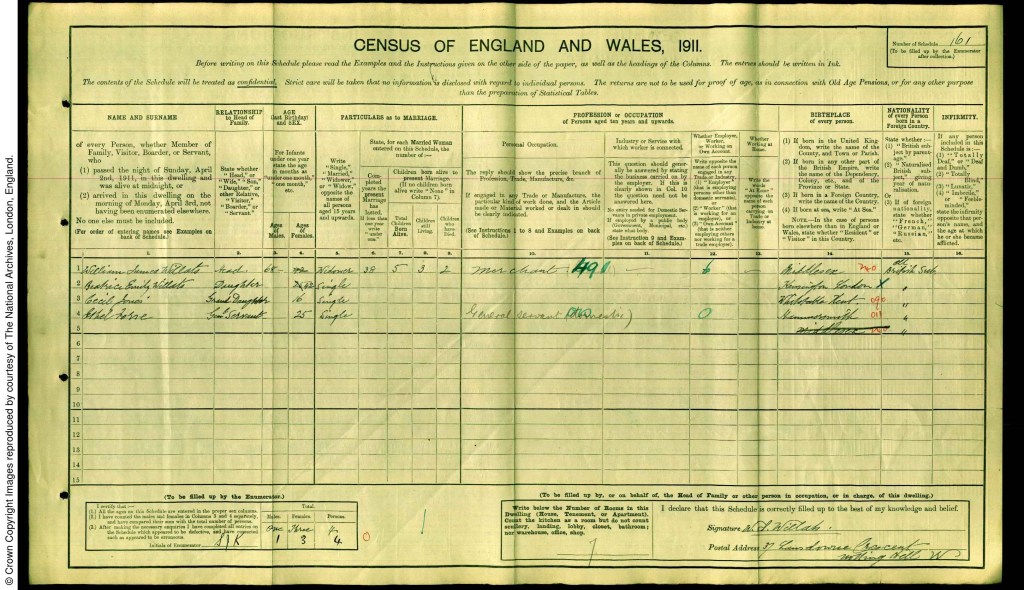
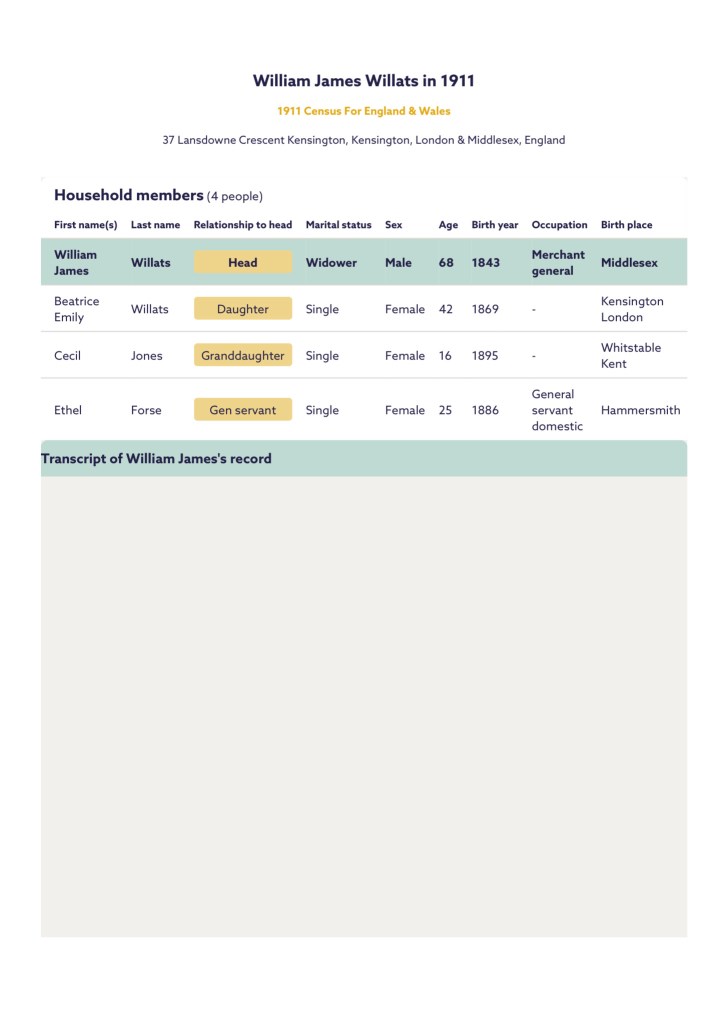

I’ve been working with all my heart to uncover the full story of James’ family. While we are aware of four of his children, I’ve encountered a bit of a mystery with his fifth child. Despite my best efforts, I haven’t been able to find any official records, like a birth registration or anything else that might offer a clue.
In my search, I also looked into Davis births to see if Elizabeth might have had a child before her marriage to James. A couple of possibilities surfaced, so I went ahead and ordered the birth certificates, hoping to find something that could help piece the puzzle together. Unfortunately, neither of these turned out to be the right match.
I wanted to share these records with you, though, in case they might help someone else in their own search. Even in moments of uncertainty, we’re all part of this journey together, and every small step we take can bring us closer to understanding.


It deeply saddens me, knowing there is a part of his story that remains untold, and that I cannot honour that child in even the smallest way. The feeling of not being able to share their name, to bring them into the light of memory, is something I carry with me. Though we may not know all the details, they are never forgotten, and their place in this family's history is just as important.
James Weller Ladbroke, in the early 1820s, made a significant decision that would shape the landscape of what we know today as Lansdowne Crescent. He inherited 170 acres of farmland from his uncle, and in his vision to develop it into housing, he commissioned the architect and surveyor Thomas Allason (1790-1852) to create a plan that would forever change this area. Allason’s design featured a circular road, more than 500 meters in diameter, intersected by an axial road that would align with what we now know as Ladbroke Grove. The development started with a building boom in 1825, but it was short-lived. By 1837, the area surrounding the circular road was transformed into a Hippodrome racecourse, where races and steeplechases were held. Unfortunately, the racecourse lost money and was eventually closed in 1841. What followed was a long series of building developments, which began to take shape in the form of terraces, crescents, and the expansive Ladbroke Square. Though the layout evolved significantly from Allason’s original vision, there were still remnants of his circular design, including the crescent shapes that remain today, Lansdowne Crescent being one of the most iconic. The development of Lansdowne Crescent itself was no simple affair. The financial and legal arrangements were complex, as they were part of the larger estate development. Essentially, the landowner, primarily James Ladbroke or his solicitor and developer Richard Roy, leased plots to developers under the condition that they construct houses that met certain specifications. Once completed, these houses were granted 99-year leases to the builders or their nominees, who then sublet the properties to recoup their construction costs. By 1851, the area had become home to a thriving community, as reflected in the census records of that year. The census reveals that twenty houses were occupied by 133 residents, including a mix of individuals from all walks of life. There were fundholders, lawyers, army officers, civil servants, and even a clergyman. The area was not only growing in population but also in importance, and it became a community with diverse professions and backgrounds, making it a significant place within London at the time. Lansdowne Crescent itself is a near-perfect hemicircle, beginning and ending at Ladbroke Grove. Its houses are numbered consecutively, with the inner side of the crescent, Nos. 2 to 18, stretching from south to north, and the outer side, Nos. 19 to 43, running from north to south. Over the years, the numbering system was rationalised, with changes in 1867 adjusting the original numbers. What once stood as grand villas, such as Wycombe House and Canonteign House, were eventually renumbered and integrated into the homes we see today, including No. 41, which was originally Shelburne Lodge. James, who had decided to reside here for many years, was part of the very history of Lansdowne Crescent. His presence, his choice to make this place his home, reflects the importance of the area in its early days of development. As we think about his life in 1912, it’s poignant to reflect on how much history has unfolded, and how Lansdowne Crescent continues to stand as a testament to those who helped shape it.

In addition to the census, James was also named in the 1912 Electoral Register, listed under the same abode at 37 Lansdowne Crescent, Kensington, London. This confirms that he was still there the following year, grounding his place in the fabric of this community, even as time moved forward.
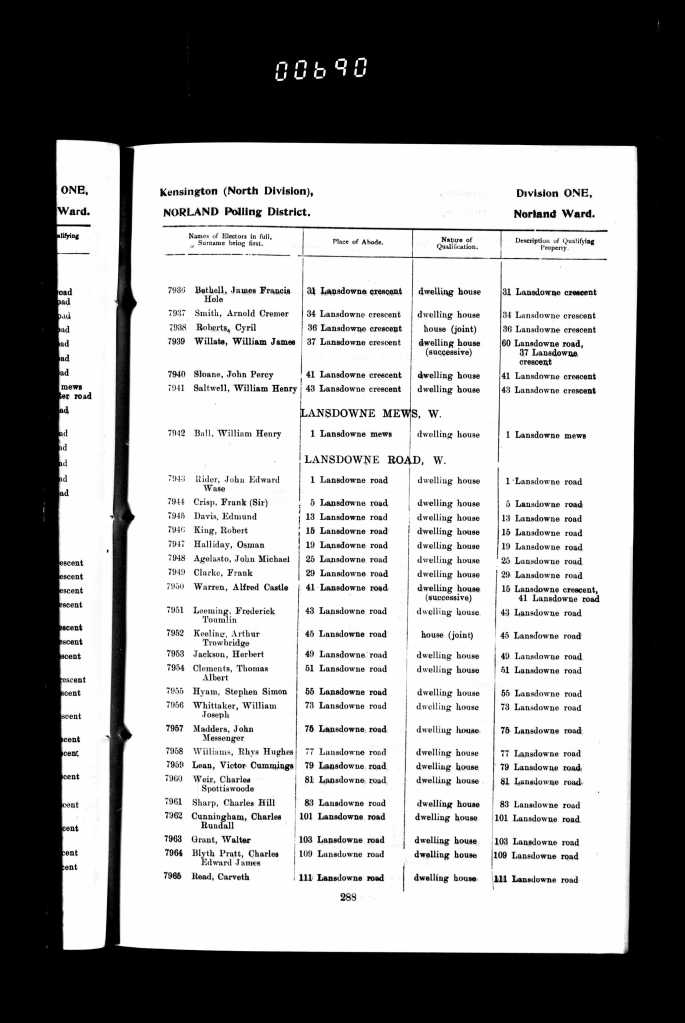
On a winter day, Saturday, December 6, 1919, James’s daughter, Beatrice Emily Willats, stood at the altar of All Hallows Church in Tottenham, Haringey, England, ready to embrace a new chapter in her life. At 57 years old, a dignified spinster, she was about to wed Sir Charles Guy Coventry Pocock, a 61-year-old bachelor. Their union was a poignant moment, blending histories and lives that had long run parallel before finally converging.
Beatrice, listed her residence as Number 58, Flanders Mansions, Flanders Road, Bedford Park, Chiswick, London. Sir Charles, a man of quiet distinction, noted his address as 10 Tottenham Terrace. When asked his occupation, he declared himself a Baronet, a title that bore echoes of an illustrious family lineage steeped in history and service.
Sir Charles descended from a line of proud military service. His father, the late Alfred George Drake Pocock, had served as an Army Captain, a career that undoubtedly shaped the character and bearing of his son. Beatrice’s own father, William James Willats, a retired merchant, had built a legacy of diligence and enterprise. Together, the couple represented the union of two worlds: one of military honor and one of industrious achievement.
The ceremony surely would have been a dignified affair, presided over by Edward W. Yates, the vicar of St. Paul’s, Tottenham. It was attended by witnesses E. Gwyn Jones and A. Gwyn Jones, who stood alongside the couple as they pledged their lives to one another.
This late-in-life marriage symbolized not only the enduring power of love but also the strength of resilience. Beatrice and Sir Charles found each other in the autumn of their years, bringing together two families whose stories were steeped in history. From Beatrice’s merchant heritage to Sir Charles’s baronetcy, their union was a testament to the deep ties of tradition and the unexpected paths of the human heart.
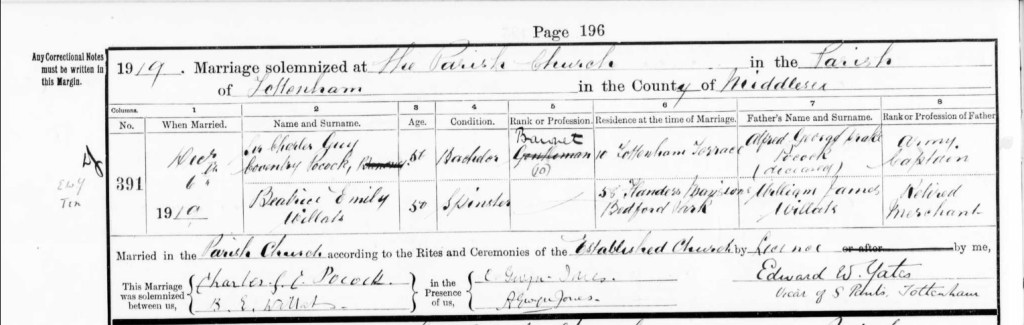
Flanders Mansions, located on Flanders Road in the Bedford Park area of Chiswick, London, is a distinguished red-brick mansion block that reflects the architectural charm of the early 20th century. Bedford Park, often hailed as the world's first garden suburb, was developed in the late 19th century and became a sought-after residential enclave for professionals and artists seeking a suburban retreat with easy access to central London.
Constructed around 1900, Flanders Mansions embodies the period's architectural style, characterized by red-brick facades and ornate detailing. The mansion block comprises several flats, each designed to offer spacious living accommodations. Flat 58, in particular, spans approximately 97 square meters (1,044 square feet), making it one of the more generously sized units within the building. This flat has been the subject of property transactions in recent years, with a recorded sale price of £738,750 on August 29, 2023.
The location of Flanders Mansions is particularly advantageous. Situated in Bedford Park, residents enjoy proximity to the boutique shops and excellent restaurants on Turnham Green Terrace and Chiswick High Road. The area is also well-served by public transport, providing convenient access to central London.
The history of Flanders Mansions is intertwined with the broader development of Bedford Park. In the early 20th century, as Bedford Park's popularity grew, some larger buildings were replaced by three- or four-storey blocks of flats to accommodate the increasing demand for housing. This period saw the construction of similar mansion blocks, such as Sydney House and Bedford Park Mansions, around 1900.
While specific historical records about Flat 58 are limited, the building's enduring appeal is evident in its continued desirability among homebuyers. The combination of architectural elegance, spacious interiors, and a prime location in one of London's most charming suburbs contributes to the lasting allure of Flanders Mansions on Flanders Road.
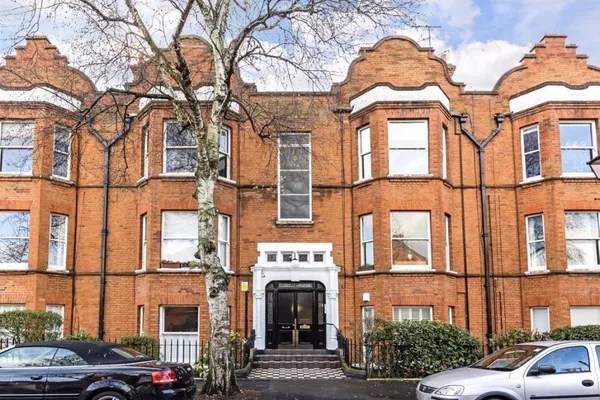
Their marriage bonds had been called on Wednesday the 3rd of December 1919, at 1 Dean’s Court, Doctor’s Commons, London, England.
Doctors’ Commons, also called the College of Civilians, was a society of lawyers practising civil (as opposed to common) law in London, namely ecclesiastical and admiralty law. Like the Inns of Court of the common lawyers, the society had buildings with rooms where its members lived and worked, and a large library.
It was also a lower venue for determinations and hearings, short of the society’s convening in the Court of the Archesor Admiralty Court, which frequently consisted of judges with other responsibilities and from which further appeal lay. The society used St Benet’s, Paul’s Wharf as its church.
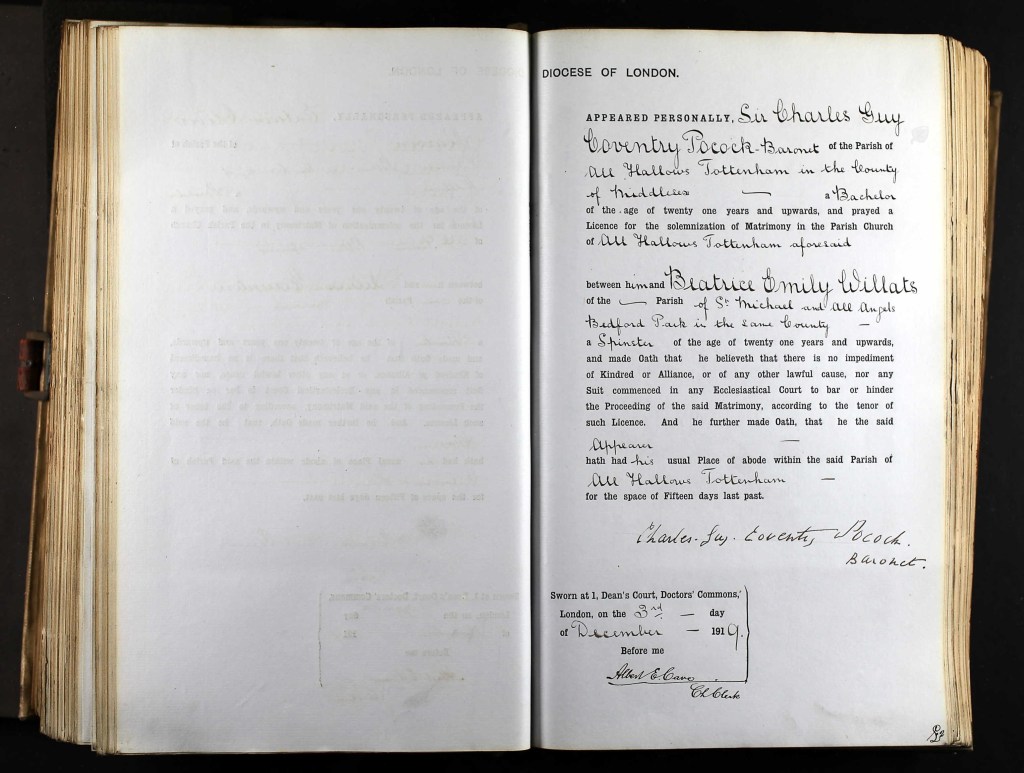
Sir Charles Guy Coventry Pocock, was the heir and succeeded his uncle George George Francis Coventry Pocock 3rd Bt. (1831-1915) as 4th Baronet Pocock upon his death in 1915. Upon Sir Charles Guy Coventry Pocock, death, the baronetcy became extinct.
James’s Son In-Law, Sir Charles Guy Coventry Pocock, died on Thursday the 31st of March, 1921, in Marylebone, Middlesex, England, when he was 58 years old.

The 1921 census provides an intimate portrait of James William, his daughter Beatrice Emily Pocock (née Willats), and his granddaughter Cecil Clarice Gwyn-Jones. On Sunday the 19th day of June, 1921, the three were living together at Number 37, Lansdowne Crescent, Kensington, London, in the county of Middlesex.
James William, then a retired diamond merchant, was the patriarch of this household. His career in the diamond trade likely brought the family both affluence and connections, and his retirement at Lansdowne Crescent symbolized a life well-accomplished. The address itself, a prestigious one in Kensington, reflects the family's social standing. Lansdowne Crescent, with its grand, stucco-fronted townhouses and leafy surroundings, was a coveted location, exuding the elegance and charm of early Victorian London. Number 37, their home, was a spacious 10-room dwelling that would have provided ample comfort for the family.
Beatrice, living with her father, had endured the profound loss of her husband, Sir Charles Guy Coventry Pocock, leaving her widowed. Despite this tragedy, she seemed to anchor her life around family, sharing the family home with her father and Cecil Clarice, whose presence might have brought some light and joy into the household during this time of mourning and adjustment.
The family’s day-to-day life in this well-appointed home would have been shaped by both their personal losses and their enduring bonds. Number 37 Lansdowne Crescent, with its stately rooms and prime location, was more than a residence; it was a space where three generations came together, offering mutual support and strength during a pivotal moment in their lives.

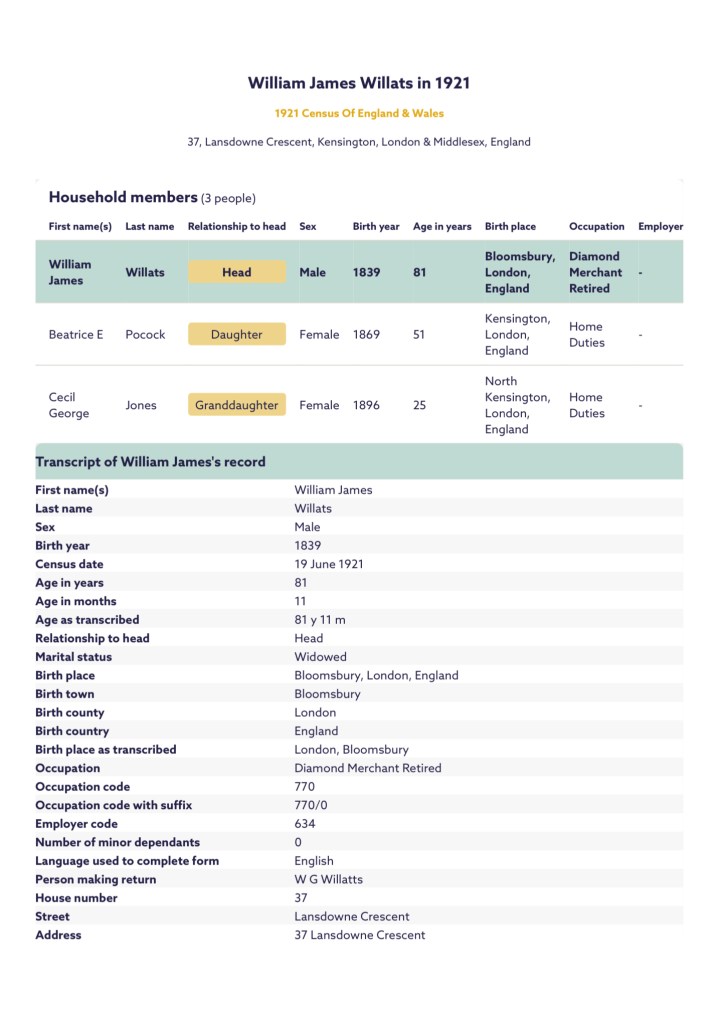

On Monday, January 23, 1922, at the age of 86, James William Willats, known affectionately as William James, passed away at his home at Number 37, Lansdowne Crescent, Kensington, London. His life, marked by a long career as a jewelry merchant, came to a close in the presence of his beloved daughter, Beatrice Emily, also known as Emily.
James had endured years of declining health. The causes of his death, as certified by Dr. R. Williams, included arteriosclerosis, emphysema of the lungs, and mitral disease, ailments that he had battled for many years. Compounding these chronic conditions, influenza had taken hold of him in the final month of his life, weakening his body further and leading to his passing.
The family’s home at 37 Lansdowne Crescent became a place of both loss and remembrance. Emily, ever devoted to her father, was present at his side during his final moments and took on the solemn duty of registering his death the following day, on Tuesday, January 24, 1922, in Kensington. She lovingly recorded his profession as a retired jewelry merchant, a title that spoke to his industrious spirit and the life he had built through his work.
James’s death marked the end of an era for the Willats family. His passing was not only the loss of a father but also the closing chapter of a life that had spanned decades of personal and professional achievement. Emily’s care and presence during his final days reflected the deep bond between father and daughter, a testament to the love and strength that defined their relationship.
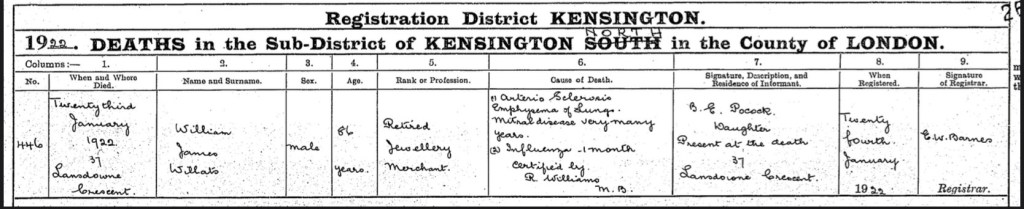
James William Willats, known in his later years as William J. Willats, was laid to rest in the tranquil grounds of Kensal Green Cemetery in Kensington and Chelsea, London. His burial took place on Thursday, January 26, 1922, just days after his passing.
Kensal Green Cemetery, one of London's most historic and distinguished resting places, became the final home for James, where he was interred under the name William J. Willats. The cemetery, with its serene pathways and stately monuments, provided a fitting setting for a man whose life had been marked by dignity and hard work.
This moment marked the culmination of a life that spanned 86 years, during which William James had built a legacy as a dedicated jewelry merchant, a loving father, and a figure of resilience and grace. Those who loved him, including his devoted daughters Beatrice Emily, and Clarice Charlotte as well as his son William Henry and his grandchildren, surely would have found solace in knowing he was laid to rest in such a peaceful and historic place. His grave now stands as a quiet testament to a life well-lived and cherished by his family.
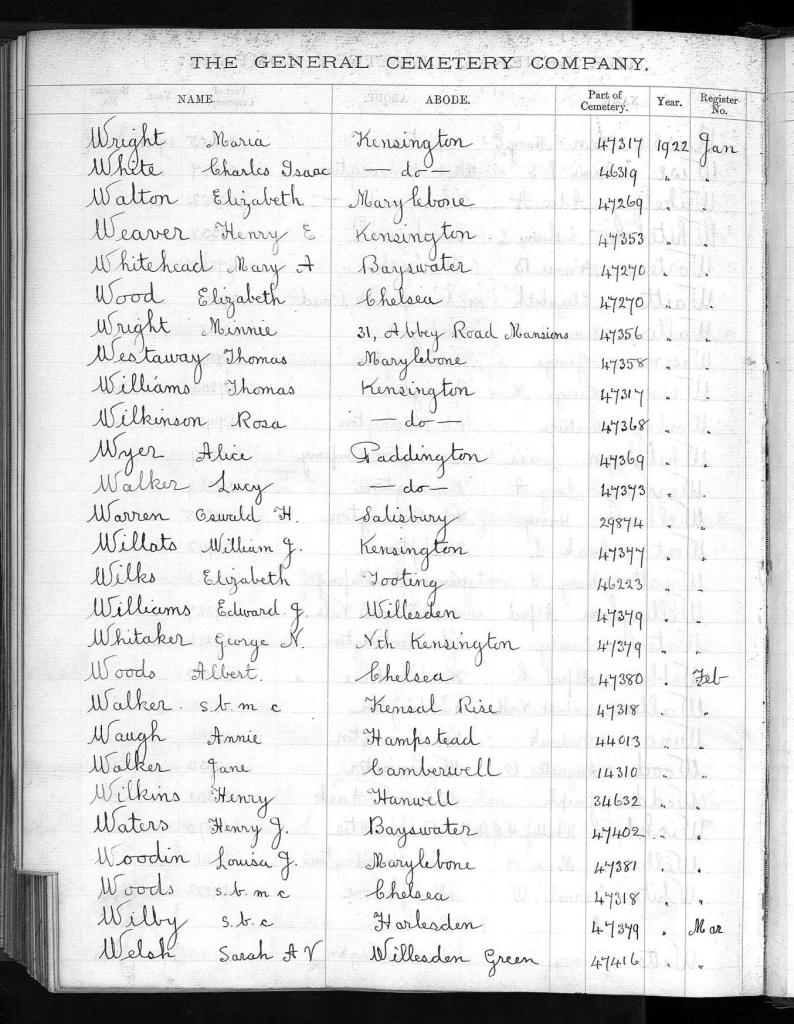
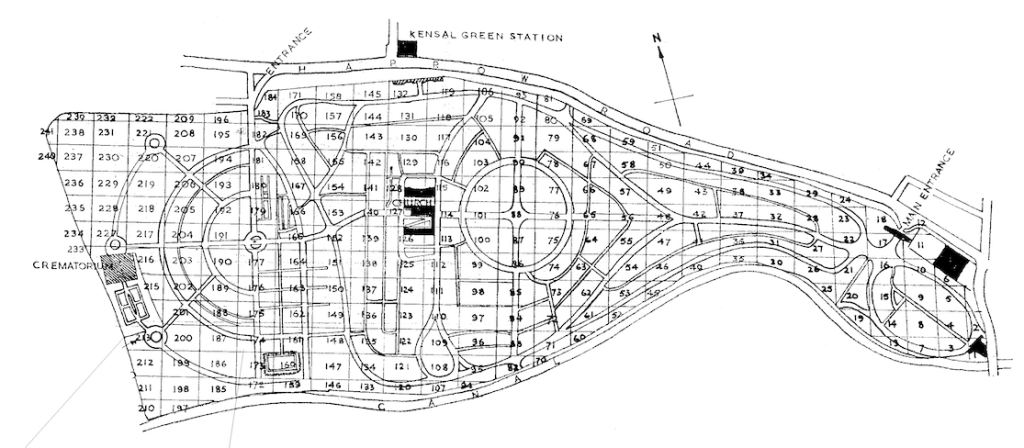
The probate of James William Willats, a man deeply cherished by those who knew him, was granted on Thursday, May 11, 1922, in London, England. It is a poignant reminder of the legacy he left behind after a long and fulfilling life. The official record reads:

“WILLATS William James of 37 Lansdowne Crescent, Kensington, Middlesex, died 23 January 1922. Probate London 11 May to Dame Beatrice Pocock, widow, and Cecil Clarice Gwyn-Jones, spinster. Effects £8730 13s. 6d.”

At the time of his passing, this sum, equivalent to approximately £495,000 in today’s money, represents not just the material wealth James William accumulated through his years of dedicated work as a jewellery merchant but also a testament to the care he took in providing for his family even after his death.
The responsibility of managing his affairs fell to his beloved daughter, Beatrice Emily Pocock, and his granddaughter, Cecil Clarice Gwyn-Jones. Together, they carried forward his memory with dignity, ensuring that the fruits of his lifetime of diligence would continue to support and uplift his family.
James William's probate encapsulates more than a figure—it reflects a life marked by perseverance, love, and unwavering devotion to his loved ones. For Beatrice and Cecil, this responsibility was not just an administrative task but a deeply personal duty to honor the man who had given them so much in life. His passing left a profound void, but his legacy remains a guiding light for those he left behind.

The last will and testament of William James Willats is a deeply personal and meaningful document, reflecting his enduring love and care for his family. Drafted on the 22nd of September, 1921, just a few months before his passing, it is a solemn acknowledgment of his desire to provide for his daughter Beatrice and his granddaughter Cecil Clarice Gwyn-Jones, ensuring their well-being and unity after his departure.
In his will, William James revoked all previous testamentary dispositions and declared this as his final wishes. He devised and bequeathed all his real and personal estate, wherever situated, to his daughter Beatrice and granddaughter Cecil Clarice in equal shares, granting them equal importance in his eyes. To safeguard their futures, he included a clause stipulating that if one of them were to predecease him, the entirety of the estate would go to the survivor. This thoughtful provision demonstrated his wish to avoid any complexities or disputes, emphasizing his intent for harmony and security within the family.
The will was signed by William James and acknowledged in the presence of two witnesses: Alice M. Jekyll of 17 Badinton Road, Balham, and Alfred Debenham, a solicitor from 52 and 53 Cheapside, London. Their presence affirmed the validity and solemnity of his final wishes. William James appointed both Beatrice and Cecil Clarice as executrices of the will, entrusting them with the responsibility of managing and distributing his estate as outlined in the document.

As stated above, probate for the will was granted on the 11th of May, 1922, a few months after his passing, officially empowering Dame Beatrice Pocock and Cecil Clarice Gwyn-Jones to act as executrices. This legal acknowledgment brought his wishes into effect, ensuring that the provisions he had carefully outlined would be respected.
The will stands as a testament to William James’s devotion to his family. It reflects his foresight, his unwavering sense of responsibility, and his hope to leave a lasting legacy of care and stability. This document, penned with the intention of easing the burden of loss for those he loved, continues to echo his thoughtful and compassionate nature.
William James’s, last Will and Testament reads,
I WILLIAM JAMES WILLATS of 37 Lansdowne Crescent Kensington in the County of London Diamond Merchant hereby revoke all testamentary dispositions heretofore made by me and declare this to be my last will I devise and bequeath all the real and personal estate whatsoever and wheresoever which I can dispose of by will in any manner I think proper either as beneficially entitled thereto or under any general power Unto my daughter Beatrice and my granddaughter Cecil Clarice In equal shares absolutely but if either of them shall die in my lifetine I devise and bequeath the whole to the survivor And I appoint my said daughter and granddaughter EXECUTRICES of this my will IN WITNESS WHEREOF I have hereunto set my hand this twenty second day of September one thousand nine hundred and twenty one — W J ‘WILLATS — signed and acknowledged by the said William James Willats as his will in the presence of us both present at the same time who in his presence and in the presence of each other have hereunto subscribed our names as witnesses, – ALICE M JEKYLL 17 Badinton Rd Balhan S W — ALFRED DEBENHAM 52 & 53 Cheapside London Solr – On the llth day of May. 1922 Probate of this will was granted to Dame Beatrice Pocock and Cecil Clarice Gwyn-Jones the Executrixes.

The grant for the last will and testament of William James Willats offers a poignant insight into the legal and familial legacy he left behind. It stands as an official acknowledgment of his passing and the execution of his final wishes, which he so thoughtfully crafted to provide for his loved ones.
It is noted that William James Willats, of 37 Lansdowne Crescent in Kensington, Middlesex, passed away at his residence on the 23rd of January, 1922. His will was proved and registered on the 11th of May, 1922, in the Principal Probate Registry of His Majesty's High Court of Justice. This formal validation of his will brought it into effect, ensuring that his expressed intentions for his estate were legally upheld.
The administration of his estate was granted to his daughter, Dame Beatrice Pocock, and his granddaughter, Cecil Clarice Gwyn-Jones. Both resided at the same address and were named executrices in his will. Their shared responsibility reflects William James’s faith in their ability to carry out his wishes with diligence and care, further underlining the bond of trust and unity he sought to preserve within his family.
The grant also provided a detailed valuation of his estate. The gross value of his estate was recorded at £8,730.13s.6d, while the net value of his personal estate was £6,590.19s.0d. In today’s monetary terms, this would equate to a substantial amount, signifying a lifetime of hard work and success as a diamond merchant. It speaks volumes about his efforts to ensure financial security for his descendants.
This grant not only marks the legal completion of William James’s earthly affairs but also highlights his deep commitment to his family’s welfare. The document is a solemn reminder of his life, his achievements, and the enduring love and responsibility he felt for those he held dear.
The Grant for James Last Will and Testament, reads,
DEATH ON OR AFTER Ist JANUARY, 1898.
Will.
BE IT KNOWN that William James Willats
of 37 Lansdowne Crescent, Kensington in the county of Middlesex
died there on the 23rd day of January 1922.
AND BE IT FURTHER KNOWN that at the date hereunder written the last Will and Testament ——————
of the said deceased was proved and registered in the Principal Probate Registry of His Majesty’s High Court of Justice, and that administration of all the estate which by law devolves to and vests in the personal representative of the said deceased was granted by the aforesaid Court to Dame Beatrice Pocock widow daughter and Cecil Clarice Gwyn-Jones Spinster Granddaughter of deceased both of the above address the executors ——————
named in the said Will ————
Dated the 11th day of May 1922.
Gross Value of Estate £8730.13.6.
Net value of Personal Estate £6590.19.0.

Rest in peace.
James William Willats.
1841-1922.
As I close this chapter on the life of James William Willats, it’s with a profound sense of gratitude and admiration for the remarkable journey he led. From his early days as a diamond merchant to his final years in the heart of Kensington, his story is rich with experiences, challenges, and triumphs that speak to both resilience and grace. His life, though marked by moments of hardship, also shines with the love and devotion he had for his family, leaving a legacy that continues to resonate even today.
Researching his fascinating life has been nothing short of an eye-opening experience. It’s been an absolute pleasure to delve into the details of his journey, uncovering the intricacies of his character, his achievements, and his lasting influence. Each discovery, each fact, has deepened my understanding and appreciation for the man he was, one who, though no longer here, still lives on through the stories shared by those who knew him.
In the end, James William Willats, with all his complexities, triumphs, and moments of grace, has left a lasting impression, not only on the history of his time, but also on those of us who have had the privilege of learning about him. Thank you for allowing me to share this journey, and may his memory continue to inspire.
Until next time,
Toodle Pip,
Yours Lainey.

💎💎💎
 Intwined