As we step into the next chapter of Francis Herbert Butt’s life, we find him not as a young boy growing up above his father’s butcher shop in Romsey, nor as the grieving son mourning the loss of his mother, but as a man beginning a new life of his own. With Henrietta Annie Richardson, by his side, he embarked on a journey of love, work, family, and resilience, one that would take him through the joys and struggles of the early 20th century, through world wars, personal trials, and moments of quiet happiness.
Yet, what makes this story truly special is how Francis’s life, lived so many years ago, has found its way into the present, entwining with my own son's journey. Though time has passed, bloodlines have stretched, and generations have come and gone, Francis remains woven into our story. My son, his paternal first cousin four times removed, is unknowingly walking through a world shaped in part by the choices and experiences of those who came before him. It is a profound thought, that the laughter, struggles, and triumphs of Francis still ripple through the generations, connecting us in ways we may never fully understand.
In this part of the story, we will follow Francis from his marriage to Henrietta through the years that shaped the man he became, tracing his life through the documents and records that serve as echoes of the past. And as we do, we honor not just his life but the way it continues to matter, not just in history books or family trees, but in the very existence of those who carry his story forward today.
Welcome back to the year 1907,Romsey, Hampshire, England. The town, like much of the country, was caught between tradition and modernity, standing at the edge of a new century while still deeply rooted in the ways of the past. The cobbled streets of Romsey, lined with its historic buildings and family-run businesses, would have been alive with the sounds of market traders, horse-drawn carriages, and the chatter of townsfolk going about their daily routines. The air carried the scent of fresh bread from the bakery, the sharp tang of leather from the cobbler’s shop, and the unmistakable aroma of fresh meat from the butchers, perhaps even from the Butt family’s own establishment.
At the helm of the country was King Edward VII, whose reign brought a shift from the rigid Victorian values of his mother, Queen Victoria, toward a more relaxed and pleasure-seeking society. He was a king who loved fashion, entertainment, and diplomacy, earning the nickname “Uncle of Europe” for his influence over foreign affairs. Meanwhile, the Prime Minister, Sir Henry Campbell-Bannerman, led the Liberal government, which was pressing for social reform, championing the rights of workers, and grappling with issues like poverty, education, and welfare. In Parliament, discussions around old-age pensions and employment rights were beginning to take shape, signaling the early stirrings of what would become the modern welfare state.
For the upper classes, life was one of comfort and excess. Women of high society adorned themselves in elaborate Edwardian gowns, featuring delicate lace, high collars, and cinched waists, while men dressed in tailcoats and bowler hats, exuding an air of authority. The wealthy dined on rich meats, fine wines, and imported delicacies, served by a fleet of domestic staff who ensured the household ran seamlessly. In stark contrast, the working class and the poor lived lives of hard labor and uncertainty. Factory workers, servants, and tradesmen toiled long hours for meager wages, and in cities, many lived in overcrowded, unsanitary slums where disease was rampant, and survival was a daily struggle. In Romsey, a town that still held on to its agricultural and market-town traditions, life for the working class was somewhat better than in the industrial cities, but poverty was never far away.
Transportation was transforming. The sight of horse-drawn carriages  still dominated the roads, but the growing presence of automobiles hinted at the future. The streets of Romsey, though not yet bustling with motorcars, would have seen the occasional early automobile rattling through, stirring up dust and turning heads. The railway was the backbone of national travel, connecting Hampshire to London and beyond, making trade, communication, and movement easier than ever before.
In the home, energy and lighting were still evolving. While gas lighting was common in towns and cities, many homes in rural Hampshire still relied on oil lamps and candles. Only the wealthiest had access to electricity, which was slowly making its way into homes but remained a luxury. Heating was provided by coal fires, their thick smoke curling from chimneys, filling homes with warmth but also contributing to the sooty air that often lingered in more urban areas. Sanitation had improved since the grim conditions of the previous century, but many homes still lacked indoor plumbing, relying instead on outhouses and communal water pumps. Infections and illnesses such as tuberculosis and diphtheria were still a very real threat, and medical care remained costly and inconsistent.
The food on the average table was simple and hearty. Bread, cheese, root vegetables, and stews were staples for the working class, with meat reserved for special occasions or those who could afford it. For those in service or living in hardship, meals were often dictated by what was cheap and available, while wealthier families enjoyed fine roasts, fresh seafood, and decadent desserts prepared by their household cooks.
When it came to entertainment, music halls and theatre were popular for a night out, with vaudeville acts, live music, and dramatic performances drawing in eager audiences. Public houses and taverns were filled with men unwinding after a long day's work, sharing stories over pints of ale. For those who preferred a quieter pursuit, newspapers and serialized novels offered windows into politics, scandal, and adventure. Gossip swirled about high society affairs, royal rumors, and local disputes, with tongues wagging over everything from King Edward’s mistresses to the latest fashion trends in London.
The world was changing, though not always quickly or smoothly. Conversations about women’s suffrage, workers’ rights, and social equality were beginning to take hold, though resistance from traditionalists remained strong. The stark divide between the rich and the poor was ever-present, with servants bowing to their masters, factory workers lining up for exhausting shifts, and gentlemen discussing the Empire over brandy and cigars. Meanwhile, scientific advancements, from early aviation experiments to breakthroughs in medicine, hinted at an exciting and uncertain future.
Back in Romsey, life moved at a gentler pace, shaped by the rhythms of the market, the church, and the family. Against this backdrop, Francis Herbert Butt and Henrietta Annie Richardson were setting out on their own journey, newly married and stepping into a world that, while still holding onto its past, was on the cusp of extraordinary change.
Around 1907–1908, Francis’s father Arthur Butt, made a decision that would shape his family’s future in ways he could never have imagined. He purchased Number 8 Bell Street, Romsey, Hampshire, a place that would become far more than just bricks and mortar. It was a home for his son Francis, whom was known as Frank, a fresh start, and the foundation of a family business that would stand the test of time.
With Frank at the helm, Butt and Son Family Butchers became a respected and well-loved name in Romsey. It was a shop built on the same values that had carried the Butt family through generations, hard work, dedication, and an unwavering commitment to quality. For years, customers would have stepped through its doors, greeted by the comforting sights and sounds of a traditional butcher’s shop, the rich aroma of fresh cuts, and the familiar faces of those who had served the community for so long. The business remained in the family until World War II, weathering the challenges of a changing world, yet always standing strong, a symbol of resilience, tradition, and pride.
And now, all these years later, history has come full circle. My son, Calum, works and lives in that very same place, unknowingly walking in the footsteps of those who came before him. It is humbling to think that the echoes of Arthur and Frank’s work still linger within those walls, that their legacy continues, not just in stories or old photographs, but in the day-to-day rhythm of life in Bell Street, Whether Francis’s father Arthur himself worked side by side with Frank in those early years or simply took a quieter role as time went on, one thing is certain, his foresight and dedication shaped not only his own family's future but also the trade that defined them. And now, in ways neither of them could have predicted, their story lives on.
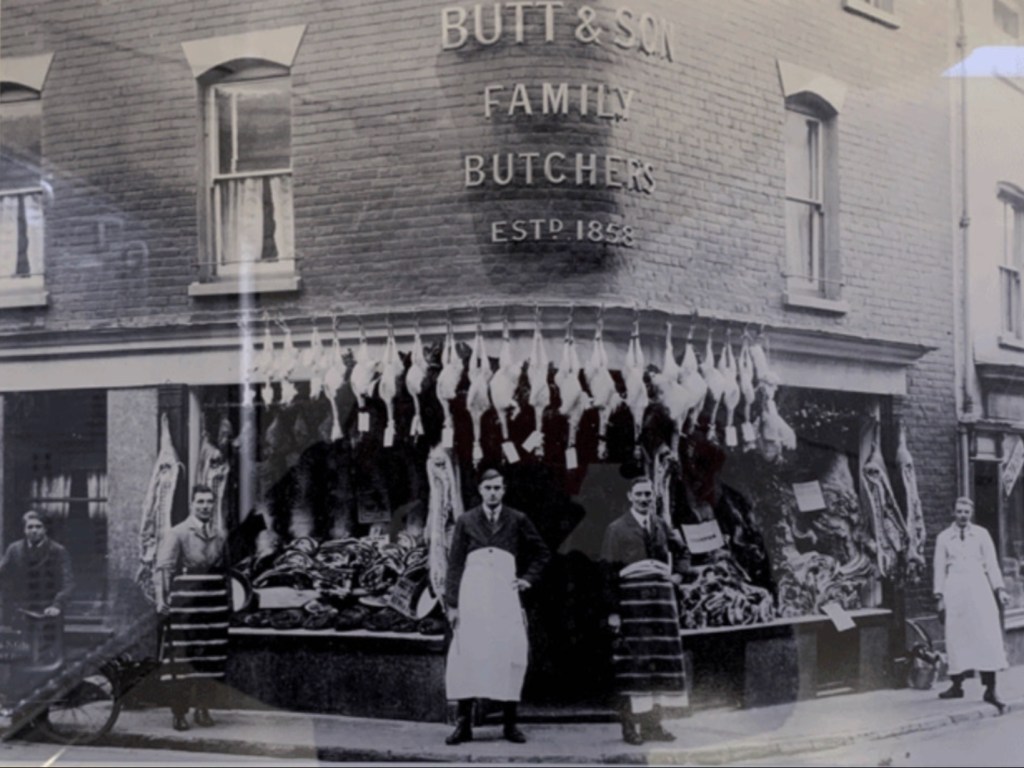
Butt & Son Family Butchers Est 1858
On Friday the 14th day of February 1908, in the warmth of the family home at Number 8, Bell Street, Romsey, Hampshire, Bernard Hugh Butt came into the world. A new life, a new chapter, and a moment of joy for his parents, Francis and Henrietta. This was more than just a birth, it was the continuation of a family legacy, a future shaped by the love and dedication of those who came before him.
On Tuesday the 31st day of March 1908, Francis walked into the registrar’s office in Romsey to officially record his son’s arrival. Henry Bedford, the registrar, carefully noted the details in the birth register, writing that Bernard was the son of Francis Herbert Butt, a Master Butcher, and Henrietta Butt, formerly Richardson, both residing at Number 8, Bell Street.
It is deeply moving to picture that moment, Francis, a proud father, carrying the weight of both his growing family and the family trade on his shoulders. Number 8 Bell Street was more than just an address; it was a home, a place of work, and the very heart of their world. Little could they have known then just how much their story, their choices, and their love would echo through time, connecting their past to the present in ways they could never have imagined.

Becoming a father must have been a profound and emotional experience for Francis. The moment he held Bernard in his arms for the first time, he would have felt an overwhelming sense of love, pride, and responsibility. This tiny life, so fragile and full of promise, was now his to guide and protect. There would have been joy in watching his son grow, in the quiet moments of holding him close, and in the dreams he must have had for Bernard’s future. But beneath that happiness, there must also have been a deep ache, a longing for his mother, Fanny, who had been gone for nearly five years. He would have thought of how she had cared for him and his siblings, how her warmth had filled their home, and how much he wished she were there to meet her grandson. The absence of her guidance and reassurance would have been felt most in the quiet, uncertain moments of fatherhood, when he longed for her wisdom, her comfort, her steady hand. He had his father, his wife, and his growing family, but a mother’s presence is irreplaceable, and in those first few years, as he learned how to be a father himself, he must have missed her more than ever.
On Tuesday the 14th day of September 1909, in the familiar comfort of the family home at Number 8, Bell Street, Romsey, Hampshire, Francis and Henrietta welcomed their daughter, Margery Doreen Butt. Another tiny heartbeat joined their world, bringing with her new joys, new hopes, and a love that only deepened the bond of their growing family. Francis, already a devoted father to Bernard, would have felt his heart swell once more as he looked at his newborn daughter, marveling at the life he and Henrietta had created together.
On Thursday the 28th day of October 1909, Francis made the journey to the registrar’s office in Romsey to officially record Margery’s birth. Henry H. Sax carefully wrote the details in the register, noting that she was the daughter of Francis Herbert Butt, a Master Butcher, and Henrietta Butt, formerly Richardson, both of Number 8, Bell Street. As Francis signed his name, he must have felt the same mix of emotions he had with Bernard, pride, gratitude, and the ever-present longing for his own mother, who had never had the chance to meet her grandchildren. But in Margery’s tiny hands, in the way she stirred in her crib, in the way Henrietta held her close, there was something of the past, something of the future, a love and legacy that would carry on through generations.

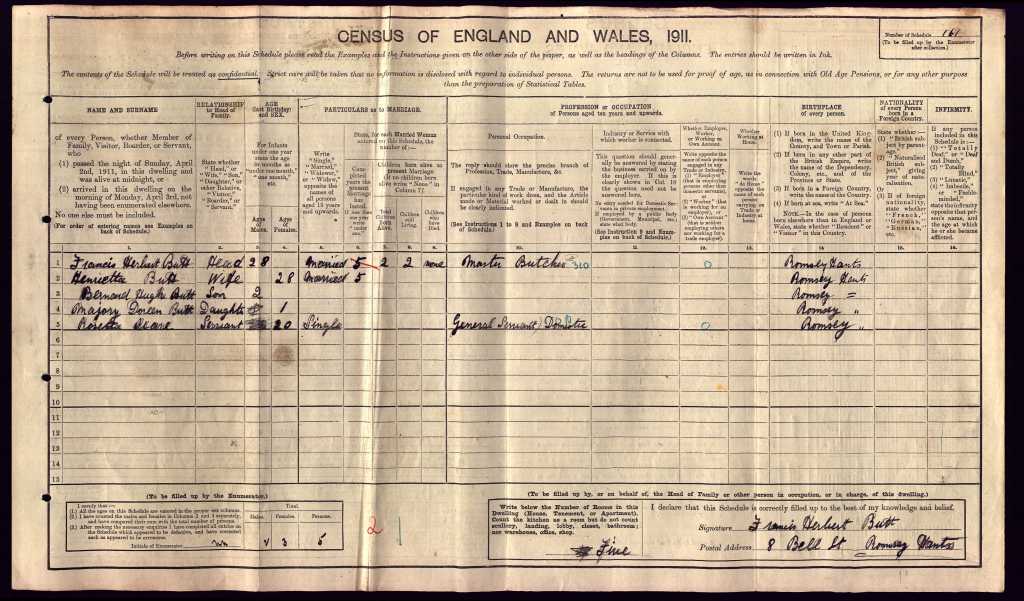
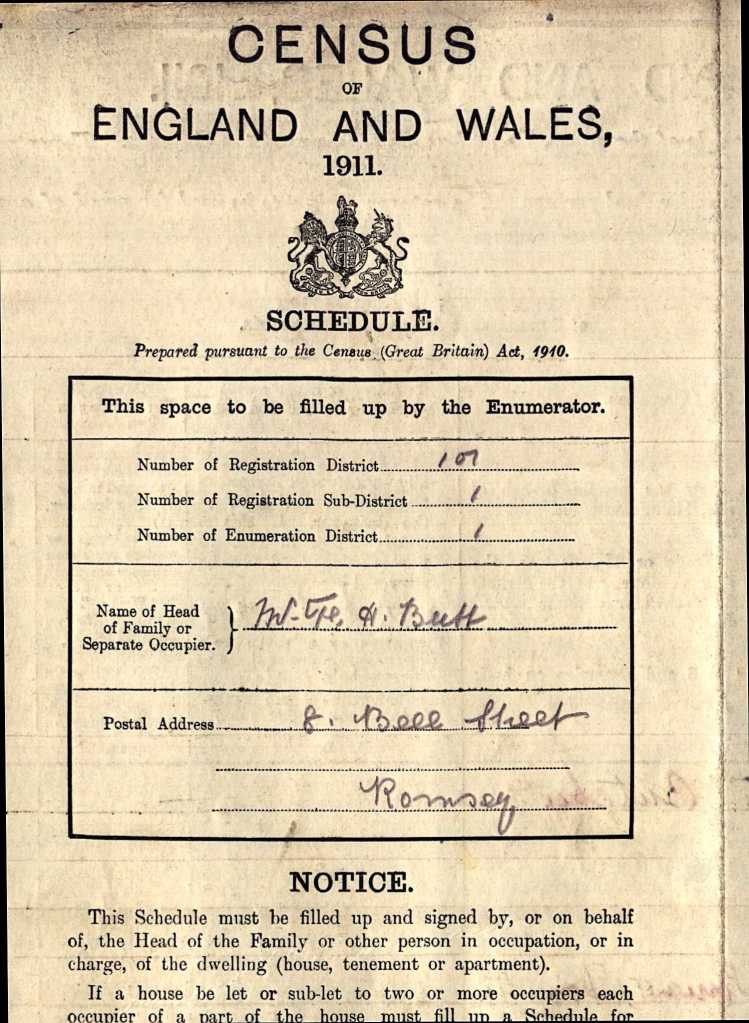
On the eve of the 1911 census, as Sunday the 2nd of April faded into night, Francis and Henrietta settled into their home at Number 8, Bell Street, Romsey. Their young children, Bernard Hugh and Margery Doreen, were safe in their beds, their quiet breaths filling the familiar walls of the house that was not just their home, but the heart of the family business, Butt and Son Family Butchers. By now, Francis had fully stepped into his role as a Master Butcher, carrying forward the trade that had shaped his family for generations. The comforting routine of early mornings, the scent of fresh cuts, and the steady hum of a business built on hard work and reputation had become the rhythm of his life.
Living alongside them was their 20-year-old servant, Rosetta Stare, a presence in the household who helped with the daily tasks of a busy home and young family. As Francis and Henrietta reflected on the five years of marriage they had shared, there must have been a quiet gratitude in knowing that both of their children were thriving. The census recorded that Number 8, Bell Street, was a five-room dwelling, modest but full of life, laughter, and the unspoken dreams of the future. As Francis signed his name to the official record, he may have paused for a moment, realizing that this simple document was a snapshot of their lives, a testament to all they had built together.
In 1911, Francis had truly come into his own, firmly established as a butcher at his family's beloved business, Butt and Son Family Butchers, at Number 8, Bell Street, Romsey, Hampshire. The UK City and County Directories of that year bore testament to his dedication, recording his place in the trade, a role built on the foundation of skill, perseverance, and the deep-rooted traditions of his father and the generations before him. Stepping into the shop each morning, he was not just continuing a business; he was honoring a legacy, walking the very same path that three generations of Butt men had taken before him.
But the butchery was never just a means of livelihood, it was the heart of his family’s world, woven into the fabric of their daily lives. It was where his father had set him up in business, where the scent of freshly cut meat filled the air, and where familiar faces would call out his name, Francis to some, Frank to others, placing their trust in his craftsmanship and integrity. The days were long, the work demanding, but for Francis, it was a labor of love, bound to the values of hard work, family, and community.
And yet, in quiet moments, there must have been an ache, a longing for the presence of his mother, Fanny, the woman who had nurtured him and shaped his heart. She had not lived to see him take his place at the helm of the family trade, to watch him provide for his own children in the way she once had for him. But her influence lingered, in the way he worked, in the way he cared for his young family, in the very foundation of the life he was building.

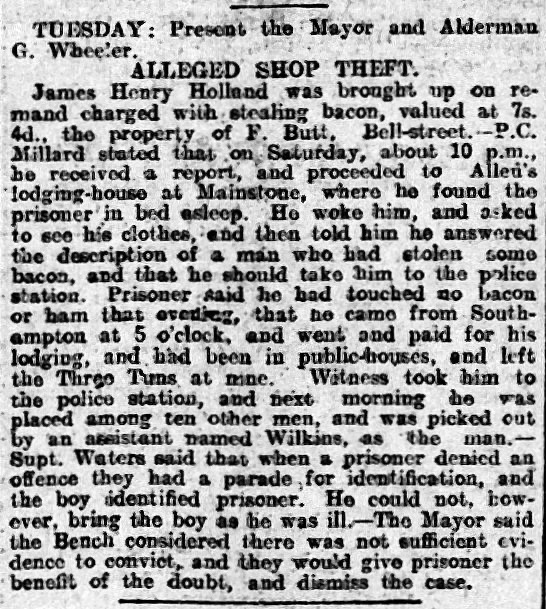
On Saturday, the 13th day of March, 1915, Francis was mentioned in an article published in the Hampshire Advertiser, detailing an alleged theft that had taken place at his shop on Bell Street.
The case unfolded on a Tuesday, with the Mayor and Alderman G. Wheeler presiding. A man named James Henry Holland had been accused of stealing bacon, valued at 7 shillings and 4 pence, from Francis’s shop. Police Constable Millard testified that he received a report of the theft around 10 p.m. on Saturday the 6th day of March, 1915, and immediately went to Alleds lodging-house at Mainstone, where he found the suspect fast asleep. After waking him, the officer inspected his clothes and informed him that he matched the description of the man who had stolen the bacon. Holland, however, denied any involvement, insisting that he had arrived from Southampton at 5 p.m., paid for his lodging, and spent the evening in various public houses before leaving the Three Tuns at nine o’clock.
Despite his denial, he was taken to the police station, where he was later placed in an identity parade with ten other men. A shop assistant named Wilkins identified him as the thief, though the case became more complicated when Superintendent Waters revealed that a second witness, a young boy, had also identified Holland but was unable to testify due to illness.
After reviewing the evidence, the Mayor and the Bench concluded that there was not enough proof to convict Holland beyond a reasonable doubt. They ruled in his favor, dismissing the case and allowing him to walk free.
For Francis, this must have been a frustrating ordeal, one that, unfortunately, did not end with justice for the theft. Yet, even in this small moment of legal drama, his presence in the community as a local businessman is clear, with his shop at the center of daily life in Bell Street, Romsey.
The article reads as follows,

Tuesday: Present the Mayor and Alderman G. Wheeler.
ALLEGED SHOP THEFT.
James Henry Holland was brought up on remand charged with stealing bacon, valued at 7s.4d., the property of F. Butt. Bell-street. P.C. Millard stated that on Saturday, about 10 p.m he received a report and proceeded to Alleds lodging-house at Mainstone, where he found the prisoner in bed asleep. He sokehim and asked to see his clothes and then told him he answered the description of a man who had stolen some bacon, and that he should take him to the police station.
Prisoner said he had touched no bacon or ham that evening, that he camo from Southampton at 5 o'clock, and went and paid for his lodging, and had been in public-houses, and left the Three Tuns at nine.
Witness took him to the police station, and next morning he was placed among ten other men and was picked out by an assistant named Wilkins, as the man. Supt. Waters said that when a prisoner denied an offence they had a parade for identifying and the boy, identified prisoner.
He could not, however, bring the boy as he was ill. The Mayor said the Bench considered there was not sufficient evidence to convict, and they would give prisoner the benefit of the doubt, and dismiss the case.
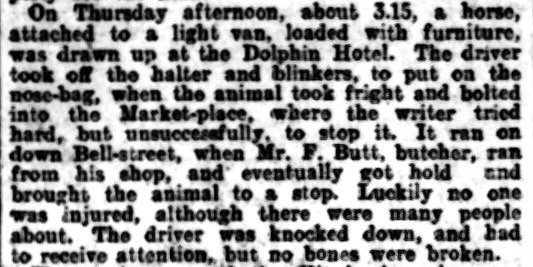
On a spring afternoon, Thursday, the 6th day of May, 1915, the quiet rhythm of the town was suddenly shattered by the sound of pounding hooves and the shouts of alarmed bystanders. It was just after three o’clock when a horse, harnessed to a light van filled with furniture, was stopped outside the Dolphin Hotel. The driver, tending to his routine, removed the halter and blinkers to fit the nosebag, an ordinary task that took a sudden and terrifying turn. Without warning, the horse took fright and bolted, tearing through the market-place in a wild panic.
Amid the chaos, the writer of the account tried desperately to stop the runaway animal but failed. People gasped, scrambled, and shouted as it charged onward, thundering down Bell Street. And then, just when disaster seemed inevitable, Francis, a butcher well known in the town, sprang into action. Without hesitation, he dashed from his shop, chasing down the terrified horse. With a steady hand and remarkable courage, he finally managed to seize hold of the animal and bring it to a stop.
Miraculously, no one was seriously hurt, though the close call left many shaken. A number of bystanders needed attention, but no bones were broken, and the town could breathe a sigh of relief. That day, thanks to Francis’s quick thinking and bravery, what could have ended in tragedy became instead a story of heroism, a moment forever captured in the pages of the Hampshire Independent on May 8th, 1915.
The article reads as follows,

On Thursday afternoon about 3.15, a horse, attached to a lightvan loaded with furniture, was drawn up at the Dolphin Hotel. The driver took off the halter and blinkers, to put on the nose-bag, when the animal took fright and bolted into the market-place, where the writer tried hard, but unsuccessfully, to stop it. It ran on down Bell-street, when Mr. F. Butt, butcher, ran from his shop, and eventually got hold and brought the animal to a stop. Luckily no one was injured, although there were many people to receive attention, but no bones were broken.
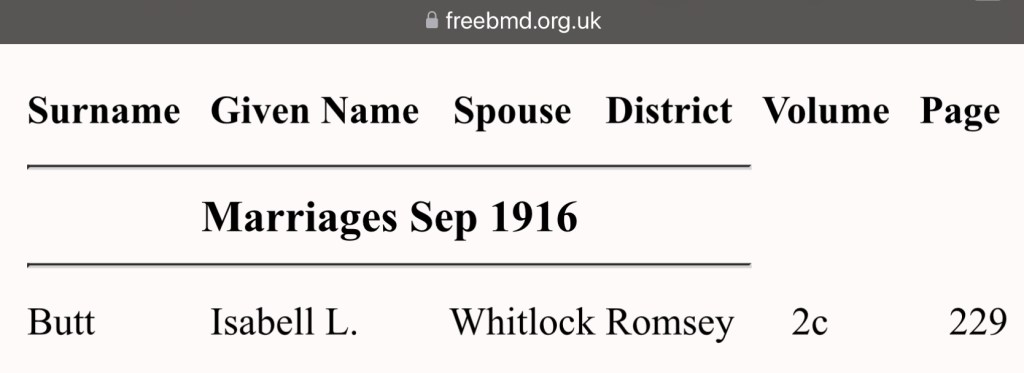
In the warmth of a summer in 1916, as the world was engulfed in the turmoil of war, Francis’s sister, Isabel Lucy Butt, found a moment of light amidst the darkness. In the heart of Romsey, Hampshire, she married George Whitlock, marking the beginning of a new chapter in their lives. Their union, recorded in the July quarter, was a testament to love and resilience in uncertain times.
Family would have gathered, finding solace in this joyous occasion, cherishing a rare moment of happiness while so many young men were away fighting. The Whitlock and Butt families were already deeply connected through previous marriages, and with Isabel and George’s vows, those bonds grew even stronger, intertwining their histories for generations to come.
Their wedding was more than just a celebration, it was a symbol of continuity, of hope, and of the unbreakable spirit of family. In a time when the future was uncertain, Isabel and George’s love stood as a reminder that even in the hardest of times, life carried on, and new beginnings were always possible.
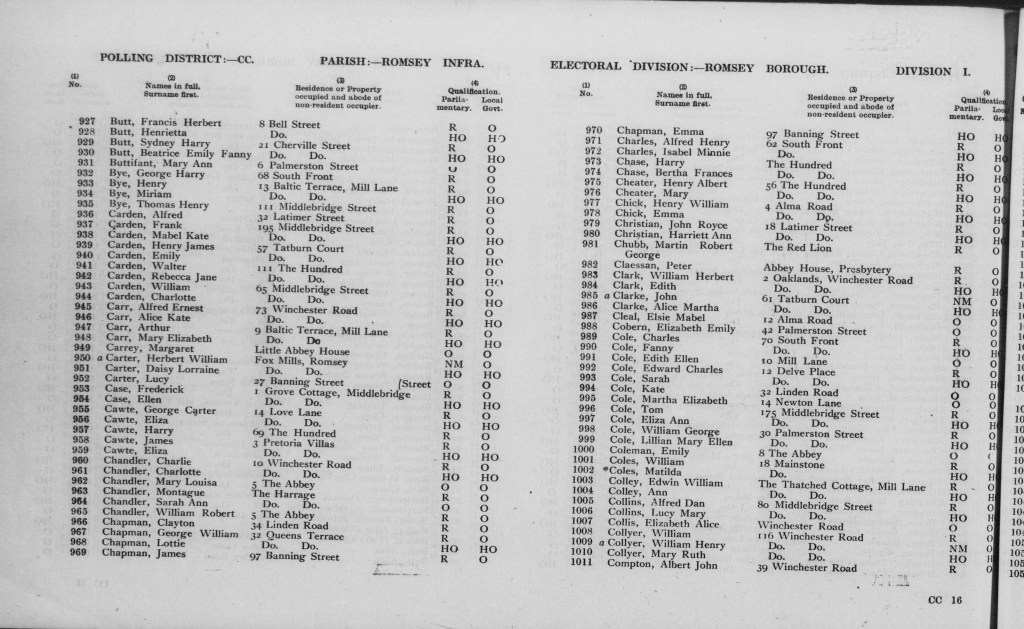
The 1918 England & Wales Electoral Registers reveal that Francis and Henrietta were living at Number 8, Bell Street, Romsey, Hampshire, England, in the flat above their family business, Butt & Son Family Butchers. This was not only their home but also the hub of their lives, where they had built a thriving business and started their family. The flat above the shop would have been where they created a home filled with the bustle of daily life, where their children grew up surrounded by the sounds and scents of their father’s work.
It’s easy to imagine that, despite the demands of running a busy butchery, the home above it offered a sense of warmth, connection, and continuity. The family lived in close quarters with their business, embodying the deep ties between work and home life that defined their world. In 1918, the world was beginning to change, but for Francis and Henrietta, Number 8 Bell Street was a place where life moved forward, grounded in love, family, and tradition.
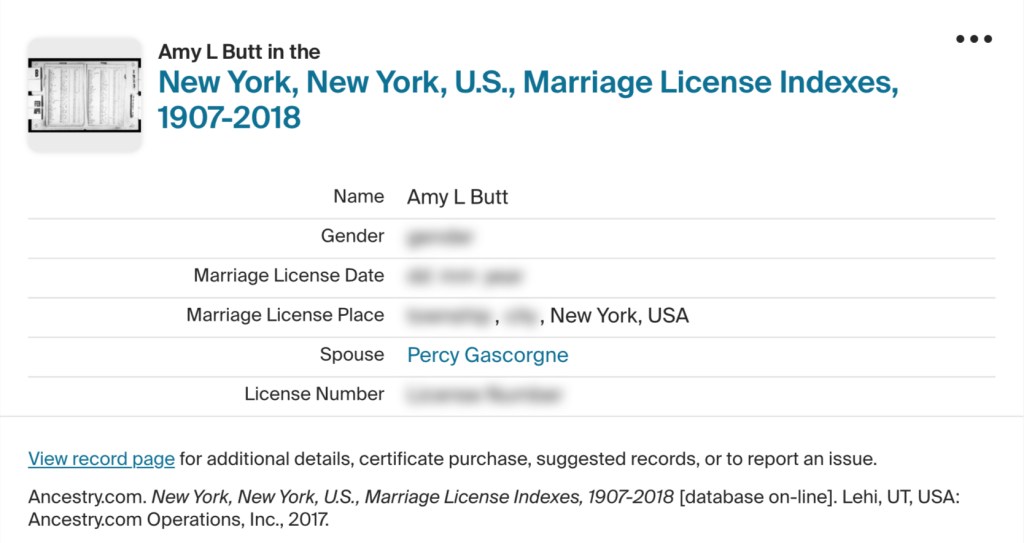
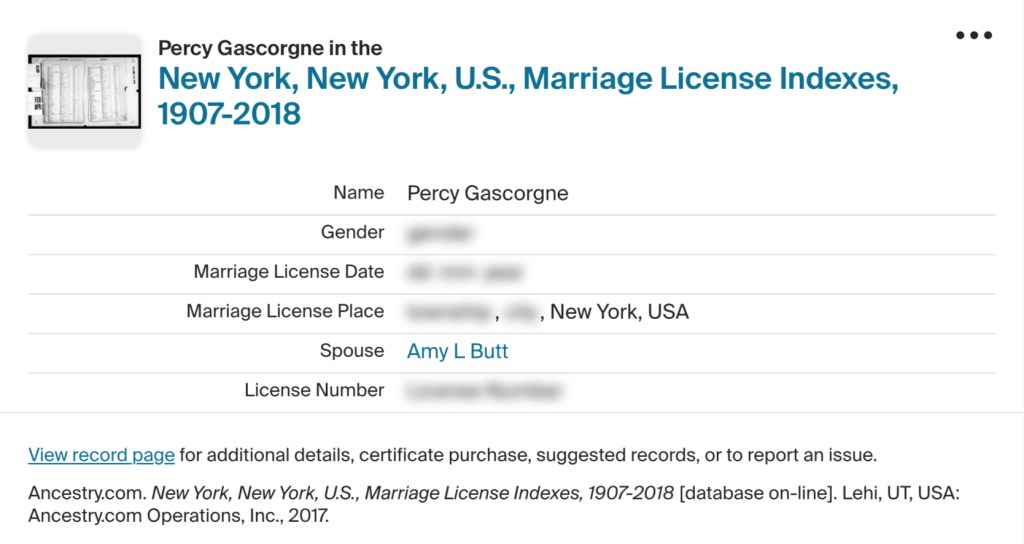
Francis’s sister, Amy Lilian Butt, took a bold step into the unknown when she married Percy Gascoigne in New York, United States, after arriving there on the 6th of August 1920. Both Amy and Percy had grown up in Romsey, Hampshire, and it’s fascinating to imagine what might have drawn them both to America. Was it the promise of new opportunities in a land full of hope and potential? The allure of adventure, of starting fresh in a place where everything seemed possible? Or perhaps it was a desire to leave behind the familiar and seek out something entirely different, far from their roots in Romsey?
Whatever the reasons, there must have been a powerful pull, an unspoken longing that led them to cross the Atlantic and embrace a new life in a country so far from everything they had ever known. The decision to leave the comfort of home for the unfamiliar shores of the United States marked a significant chapter in both their lives, one that would forever change the course of their futures. It’s a reminder of the courage that must have filled their hearts as they took the leap, with all the uncertainty that came with it, but also with the promise of a new beginning.
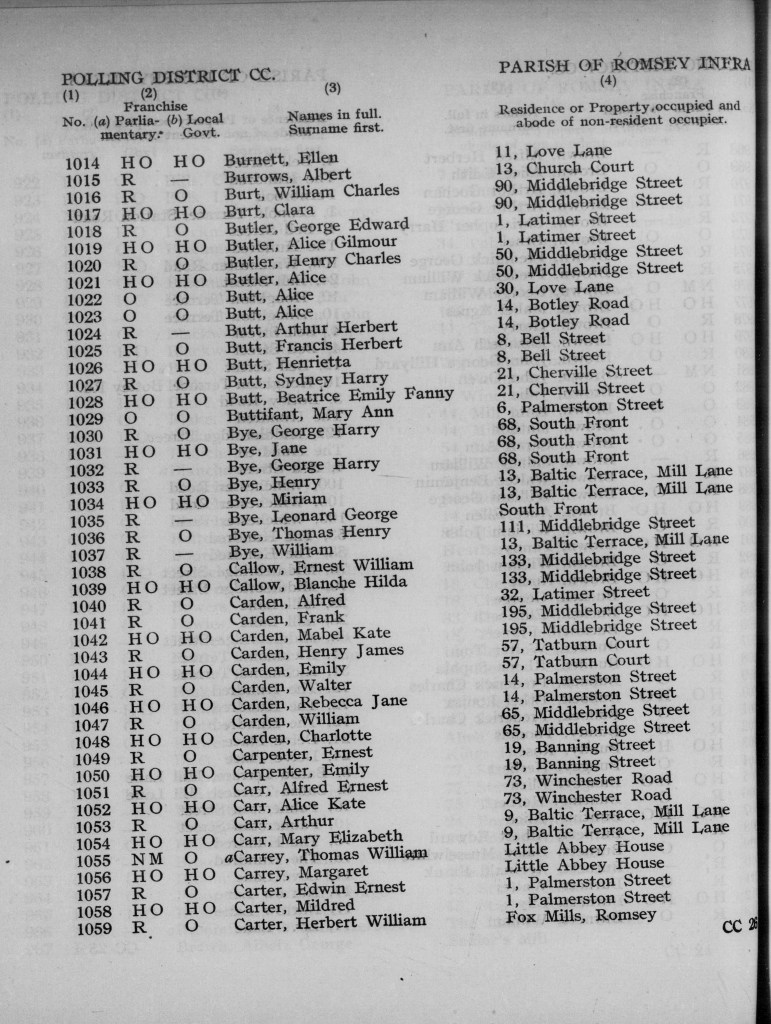
The 1920 England & Wales Electoral Registers show that Francis Herbert Butt and his wife, Henrietta, were residing at Number 8, Bell Street, Romsey, Hampshire, England, in the same flat above their family butchers' shop, Butt & Son Family Butchers. The shop continued to be an integral part of their lives, as they maintained their place in the community through hard work and dedication.
The registers also reveal where some other possible family members were living at the time. Arthur Herbert Butt, and his wife, Alice, were living at 14 Botley Road, Romsey. Meanwhile, his brother Sydney Harry Butt and his wife, Beatrice Emily Fanny Butt formerly Whitlock, were residing on Cherville Street, Romsey. Additionally, Alice Butt, another possible family member, was listed as living at 30 Love Lane, Romsey.
It’s heartening to see the family scattered across Romsey, each carving out their own spaces in the town, yet remaining connected by the ties that bound them together. The proximity of their homes suggests that, even in the midst of life's changes, family remained a central part of their world.
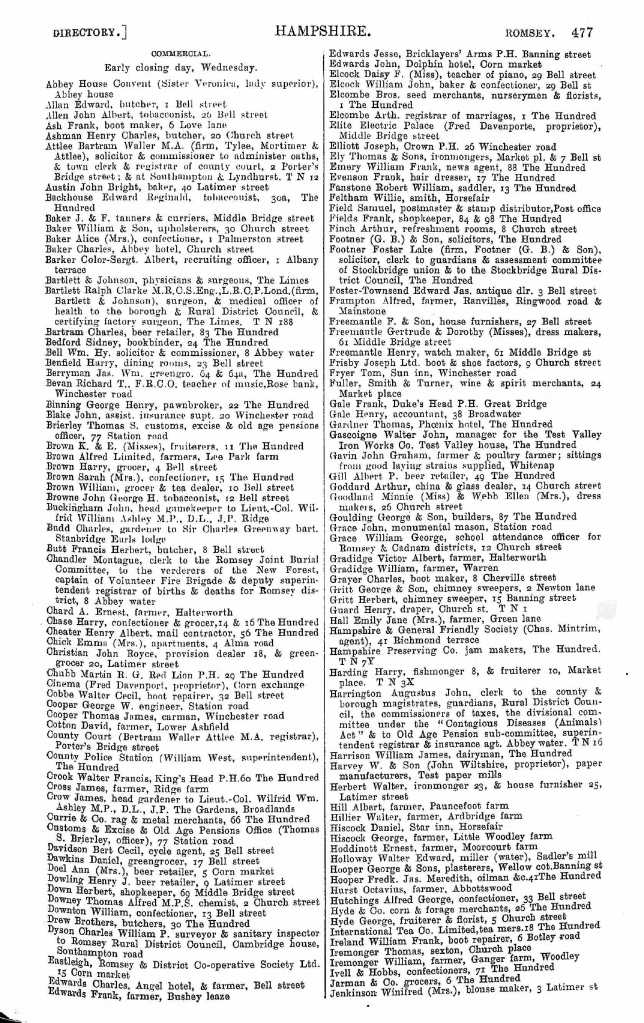
The 1920 UK City and County Directories confirm that Francis was residing at Number 8, Bell Street, Romsey, Hampshire, England, alongside his family. Not only was this their home, but it was also where Francis worked as a butcher in the family business, Butt and Son Family Butchers, operating from the very same premises. The continuity of living and working in the same place, a tradition passed down from his father, was a testament to the deep roots the Butt family had in the town.
This dual role, as both a husband and a father in the home and a committed professional in the shop, speaks to the rhythm of Francis's life, a life shaped by the work he had inherited and the family he had built. His name, alongside his father’s, continued to be a hallmark of quality in the community, and the shop remained a cornerstone of both their livelihood and legacy. The fact that Francis and Henrietta chose to stay at the same town where their family’s legacy had begun suggests a sense of pride in their work and a strong connection to their roots in Romsey.
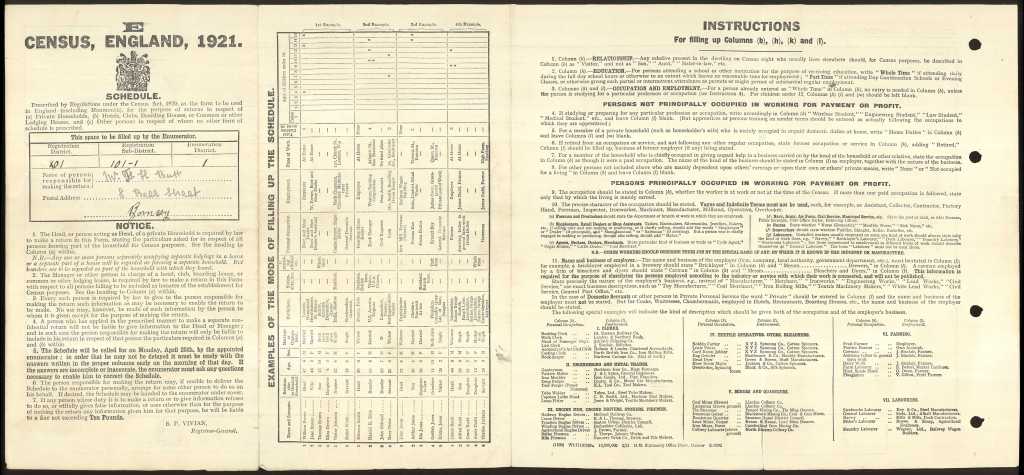
On the eve of the 1921 Census, Sunday the 19th day of June, 1921, Francis, Henrietta, and their children, Bernard (listed as Hugh B Butt) and Marjorie (named as Doreen Butt on the census), were living in their home at Number 8, Bell Street, Romsey, Hampshire, England. The home, a 12-room dwelling, doubled as the business premises for Butt and Son Family Butchers, where Francis continued to build the family legacy as a Butcher Proprietor.
At 38 years and 2 months old, Francis was the head of the household, responsible not only for his family but for the thriving business he had been gifted and worked hard to maintain. Henrietta, also 38 years and 3 months old, worked alongside him at home, continuing to support him in every way possible as they both poured their energy into the family’s work and their children. Bernard, now 13 years and 3 months old, was attending school full-time, as was his younger sister Marjorie, who at 11 years and 8 months old, was growing up in the warmth of her family’s love and work.
In addition to their family, the Butt household had the help of a servant, Rose Vall, who at 20 years and 4 months old, was residing with them. Rose would have played a significant role in the daily workings of the household, assisting with chores and ensuring that the home remained well-kept while the family focused on their work and business.
It’s clear that the Butt family, while living through the everyday rhythms of life, were deeply connected to both their family and the business that had become the cornerstone of their existence. The census gives us a beautiful snapshot of their world, a world that centered around home, hard work, and the ties that bound them together.

In 1921, the England & Wales Electoral Registers show that Francis Herbert Butt and his wife Henrietta were residing at Number 8, Bell Street, Romsey, Hampshire, England. This was both their home and the location of their family business, Butt and Son Family Butchers. The register also lists a few other family members who were living nearby in Romsey. Arthur Herbert Butt and his wife Alice were residing at 14 Botley Road, while Sydney Harry Butt and his wife Beatrice Emily Fanny Butt were living on Cherville Street. Additionally, Alice Butt was residing at 30 Love Lane.
The family was spread out across Romsey, each maintaining their own homes, but clearly still connected by their shared legacy and the bonds they had built over the years. The listing in the electoral registers captures a moment in time where, while the family had grown and expanded, the ties to their roots in Romsey remained strong.
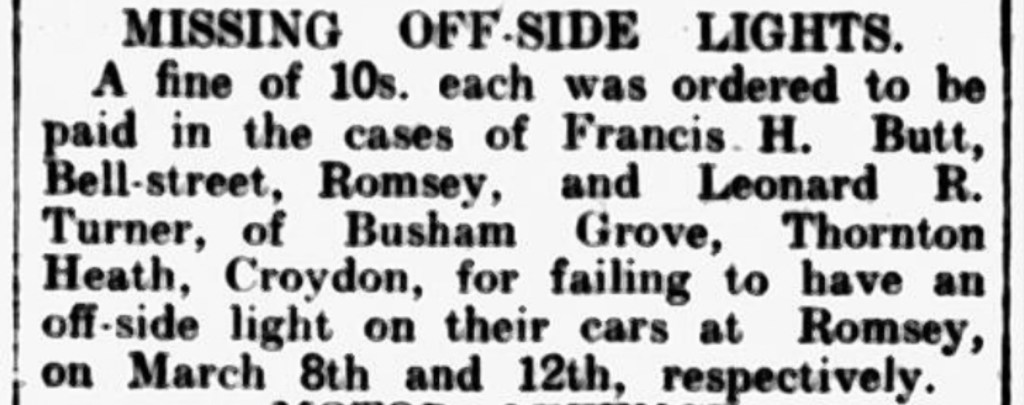
In the Hampshire Independent, on Friday the 30th day of March, 1923, Francis H. Butt was mentioned in an article concerning a fine related to vehicle regulations. The report states that Francis, residing at Bell Street, Romsey, was one of two individuals fined for failing to have an off-side light on his car. The fine, which amounted to 10 shillings, was imposed for the incident on Thursday the 8th day of March, 1923. Another individual, Leonard R. Turner of Busham Grove, Thornton Heath, Croydon, was also fined for a similar offense that occurred on March 12th of the same year. This brief mention in the newspaper provides a snapshot of Francis's life outside of the butchery business, reflecting the normal everyday aspects of life during the 1920s. The article reads as follows -

MISSING OFF-SIDE LIGHTS.
A fine of 10s. each was ordered to be paid in the cases of Francis. H. Butt, Bell-street, Romsey, and Leonard R.Turner, of Busham Grove, Thornton Heath, Croydon, for failing to have an off-side light on their cars at Romsey, on March 8th and 12th, respectively.
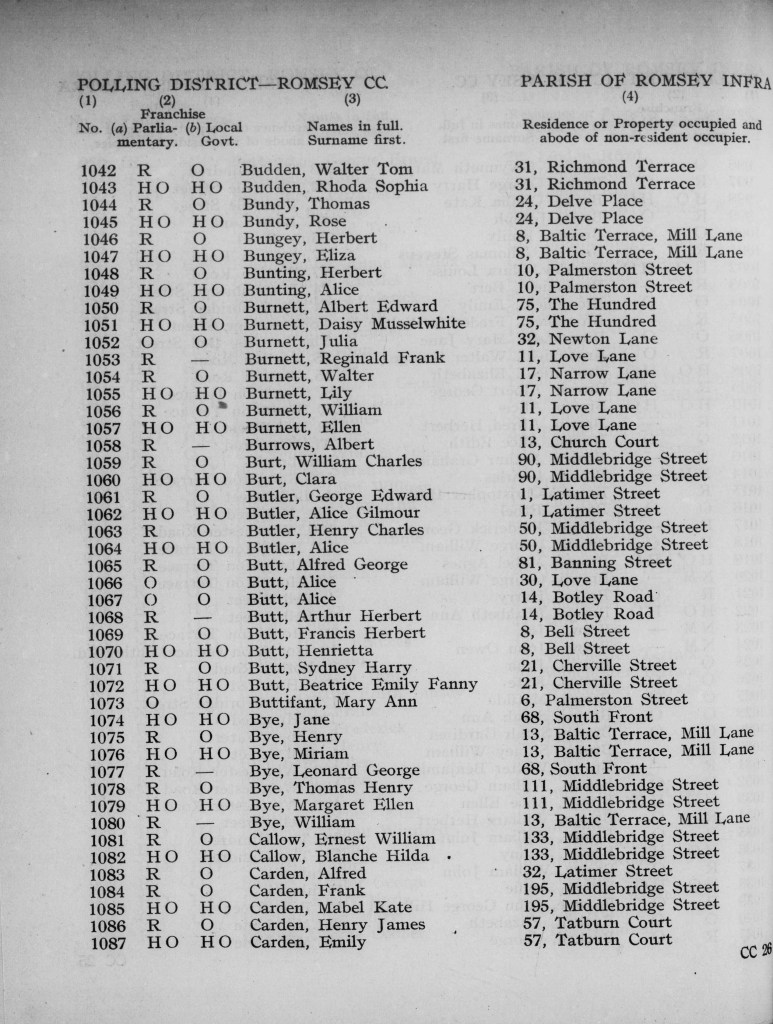
In 1923, the England & Wales Electoral Registers show that Francis and his wife Henrietta, were still residing at Number 8, Bell Street, Romsey, Hampshire, England. This remained both their home and the location of their family business, Butt and Son Family Butchers. Other members of the Butt family are also listed in the registers, residing in nearby locations within Romsey. Arthur Herbert Butt and his wife Alice were living at 14 Botley Road, while Alfred and Emily Butt were at 11 Church Court. Additionally, Alice Butt was residing at 30 Love Lane.
This snapshot from the electoral registers highlights how the Butt family remained closely knit, with different members continuing to make their homes in Romsey. Their continued presence in the area reflected their deep roots in the community, and their lives were intricately tied to the town and the legacy of the family business.
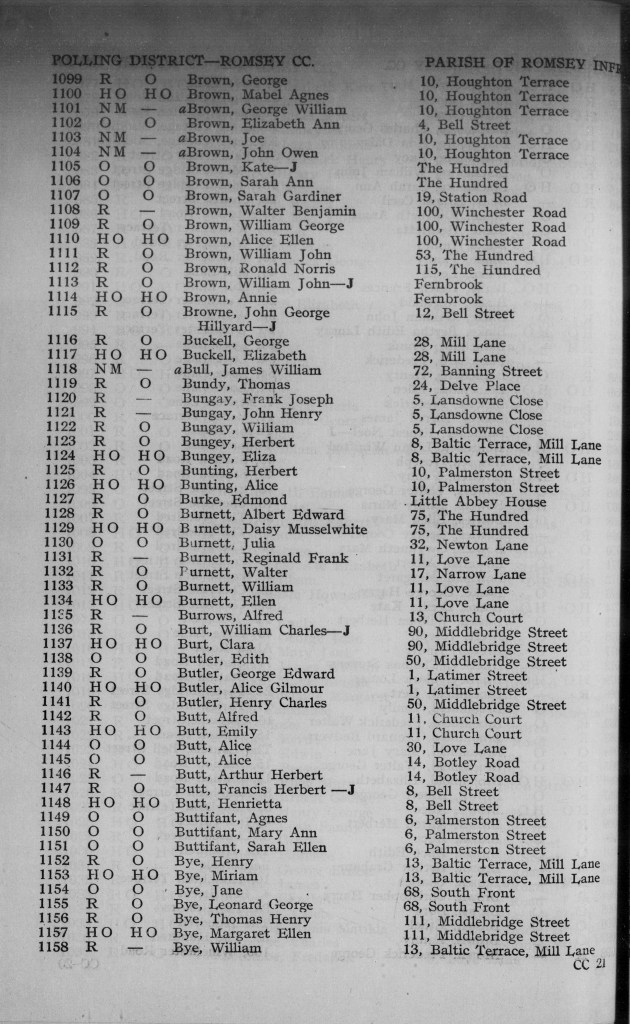
In 1924, the England & Wales Electoral Registers show that Francis Herbert Butt and his wife Henrietta were still residing at Number 8, Bell Street, Romsey, Hampshire, England. Their home continued to serve as both their residence and the premises for their family business, Butt and Son Family Butchers. The registers also list other members of the Butt family in Romsey. Arthur Herbert Butt and his wife Alice were living at 14 Botley Road, while Alfred and Emily Butt were at 11 Church Court. Additionally, Alice Butt was residing at 30 Love Lane.
This continued presence of the Butt family in various parts of Romsey highlights their deep-rooted connection to the town. It is a reflection of the family’s enduring commitment to their community, their business, and each other. The Butt family, spread across different addresses in the town, remained united through both family bonds and the shared history of their butchery business.
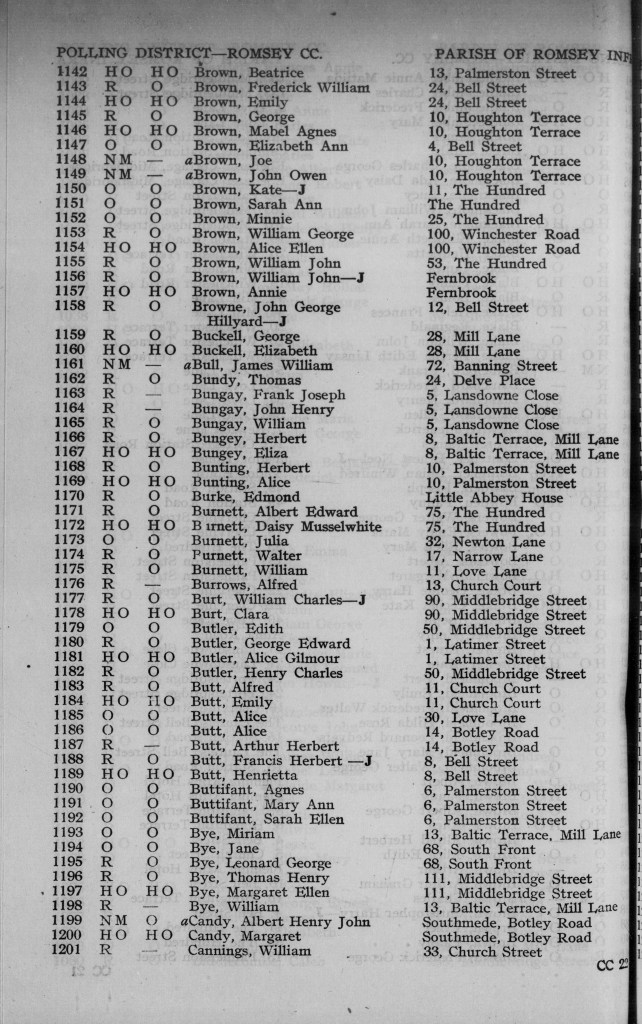
In 1925, the England & Wales Electoral Registers confirm that Francis Herbert Butt and his wife Henrietta were still residing at Number 8, Bell Street, Romsey, Hampshire, England. Their home continued to serve as the family residence and the location of their thriving butchery business, Butt and Son Family Butchers. Other members of the Butt family are also listed in Romsey, reflecting their close-knit connection to the town. Arthur Herbert Butt and his wife Alice were living at 14 Botley Road, while Alfred and Emily Butt resided at 11 Church Court. Additionally, Alice Butt was living at 30 Love Lane.
The persistence of the Butt family’s presence in these various addresses is a testament to their enduring influence in Romsey. With each address, the Butt family not only supported each other but also contributed to the community's fabric. Through both their personal connections and their business, they continued to maintain a lasting legacy in the town.
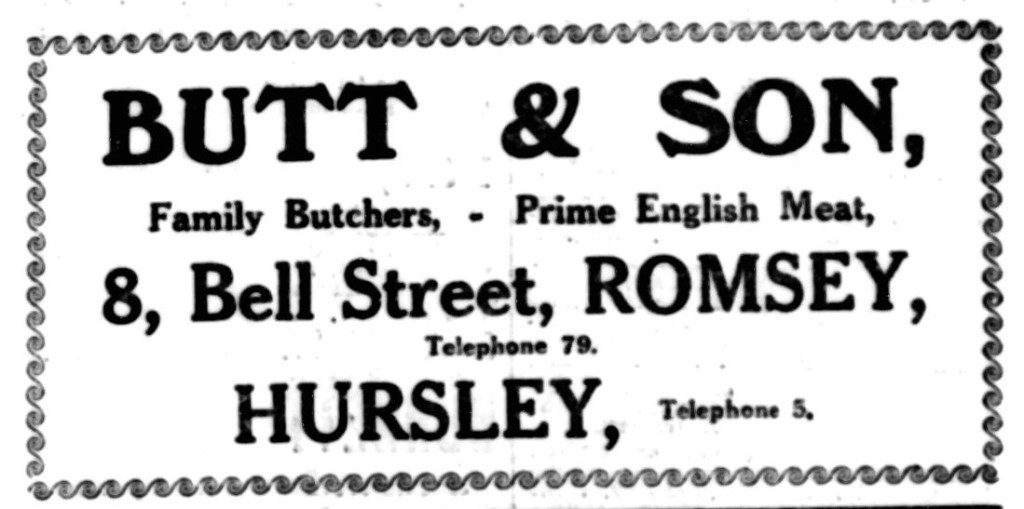
On Friday, the 28th of August 1925, Francis took out an advertisement in the Hampshire Advertiser. The ad was a reflection of his deep involvement in the local community and his ongoing dedication to the family business. As a Master Butcher with years of experience, Francis understood the importance of reaching out to his customers and letting them know about the quality service he offered at Butt and Son Family Butchers, located at Number 8, Bell Street, Romsey.
In those days, local newspapers served as an essential means of communication, and advertisements like Francis’s were an effective way to keep the community informed about special offers, products, or services. This ad was not just a promotional tool; it was also a way for Francis to strengthen his ties with the people of Romsey, assuring them that the family business remained a trusted part of their daily lives. It is a small, but telling detail of his life in the 1920s, showing how, even in an era of social and economic change, Francis remained committed to his trade and the people he served.
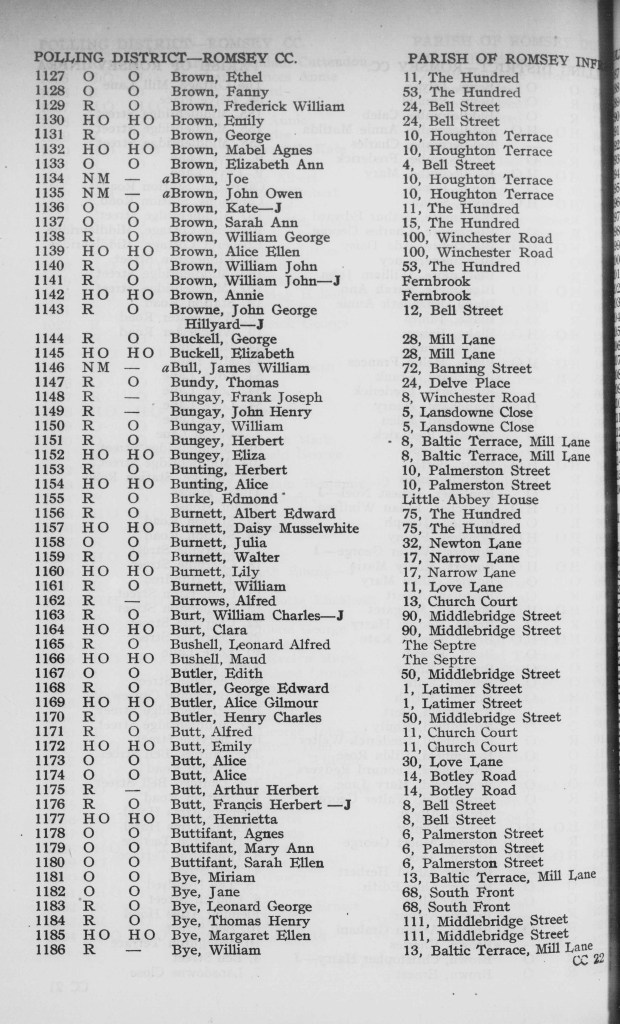
In 1926, the England & Wales Electoral Registers confirm that Francis Herbert Butt and his wife Henrietta were still living at Number 8, Bell Street, Romsey, Hampshire, England. This address continued to be both their home and the location of their well-established family business, Butt and Son Family Butchers. The family remained closely tied to the town, with several other members listed in the registers. Arthur Herbert Butt and his wife Alice were residing at 14 Botley Road, while Alfred and Emily Butt lived at 11 Church Court. Additionally, Alice Butt was listed as residing at 30 Love Lane.
The continuity of the Butt family's presence in these locations further emphasizes the deep roots they had established in Romsey, both as a family and a respected business. Their enduring legacy in the town continued to thrive, supported by a strong sense of family unity and community involvement.

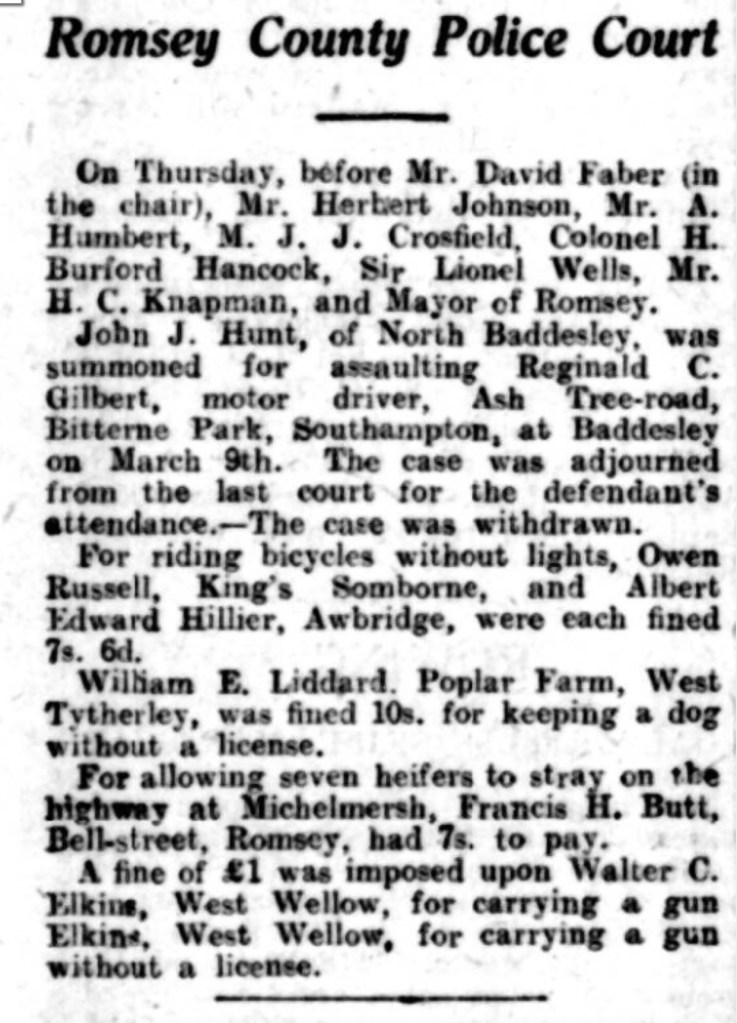
In an article printed in the Hampshire Advertiser, on Saturday the 23rd of April 1927, Francis Herbert Butt was mentioned in the context of a hearing at the Romsey County Police Court. The case was related to his heifers straying on the highway at Michelmersh. For this, Francis was fined 7s. This was part of a regular series of minor offenses that made their way to the court, but it was a reminder of the practical responsibilities and challenges Francis faced, both in his personal life and his work. Managing a farm and livestock could often lead to such incidents, and while the fine was relatively small, it highlighted his ongoing connection to the land and the local community of Romsey.
The article reads as follows,

Romsey County Police Court
On Thursday, before Mr. David Faber (in the chair) Mr Herbert Johnson, Mr A Humber, M.J.J. Crosfield, Colonel H.Burford Hancock, Sir Lionel Wells, Mr. H.C.Knapman, and Mayor of Romsey.
John J. Hunt, of North Baddesley, was summoned for assaulting Reginald C. Gilbert, motor driver, Ash Tree-road, Bitterne Park, Southampton, at Baddesley on March 9th. The case was adjourned from the last court for the defendant's attendance.--The case was withdrawn.
For riding bicycles without lights, Owen Russell, King’s Somborne, and Albert Edward Hillier, Awbridge, were each fined 7s. 6d.
William E. Liddard. Poplar Farm, West Tytherley, was fined 10s. for keeping a dog without a license.
For allowing seven heifers to stray on the highway at Michelmersh, Francis H. Butt, Bell-street, Romsey, had 7s to pay.
A fine of £1 was imposed upon Walter C.
Elkins, West Wellow, for carrying a gun Elkins, West Wellow, for carrying a gun without a license.
In 1927, the England & Wales Electoral Register shows that Francis and Henrietta were residing at Bell Street, Romsey, Hampshire, England. Their residence was located in the Hursley Polling District. This record not only marks their continued place in the Romsey community but also reflects their ongoing connection to the area where they had built their family and their business. Living in this polling district meant they were actively part of the local electorate, engaged in the civic life of Romsey, just as they had been for many years. The significance of this moment in time lies not only in their daily lives but in their enduring presence within the fabric of their community.

In an article printed in the Hampshire Advertiser, on Saturday, the 23rd of April, 1927, Francis Herbert Butt was mentioned in the context of a hearing at the Romsey County Police Court. The case revolved around his heifers straying on the highway at Michelmersh, for which he was fined 7 shillings. This incident, while seemingly minor, sheds light on the everyday challenges that came with managing livestock and running a business in a rural community like Romsey. It served as a reminder of Francis’s deep-rooted connection to the land and his responsibilities beyond the butcher shop. Livestock could easily wander, and though the fine was small, it reflects the practical realities of his life, intertwined with the land, the community, and his ongoing work as a butcher. The court cases involving minor offenses like this one were part of the fabric of daily life during that time, but they also revealed the way Francis, like many others, navigated the balance between personal, professional, and civic duties.
The article reads as follows,

Romsey County Police Court
On Thursday, before Mr. David Faber (in the chair) Mr Herbert Johnson, Mr A Humber, M.J.J. Crosfield, Colonel H.Burford Hancock, Sir Lionel Wells, Mr. H.C.Knapman, and Mayor of Romsey.
John J. Hunt, of North Baddesley, was summoned for assaulting Reginald C. Gilbert, motor driver, Ash Tree-road, Bitterne Park, Southampton, at Baddesley on March 9th. The case was adjourned from the last court for the defendant's attendance.--The case was withdrawn.
For riding bicycles without lights, Owen Russell, King’s Somborne, and Albert Edward Hillier, Awbridge, were each fined 7s. 6d.
William E. Liddard. Poplar Farm, West Tytherley, was fined 10s. for keeping a dog without a license.
For allowing seven heifers to stray on the highway at Michelmersh, Francis H. Butt, Bell-street, Romsey, had 7s to pay.
A fine of £1 was imposed upon Walter C.
Elkins, West Wellow, for carrying a gun Elkins, West Wellow, for carrying a gun without a license.
Francis’s brother, 51-year-old Ernest William Butt, sadly passed away on Tuesday, the 22nd of November, 1927, at Number 9, Blechyarden Street, Kensington, London. His death marked a profound loss for the Butt family, one that left an emotional void. G. Jones, who was present at the time of his passing, witnessed the end of a life that had been deeply intertwined with his family’s history. The official registration of Ernest’s death was carried out by F.M. Oliver on Friday, the 25th of November, 1927. The cause of death was recorded as pulmonary tuberculosis and cirrhosis of the liver, two conditions that had clearly ravaged his health over time. Remarkably, no postmortem was required, with the death certified by R.G. Griffiths, a medical director.
For Francis, the loss of his brother must have been a heart-wrenching blow. They had shared a lifetime of memories, and to lose Ernest at such a relatively young age would have cast a deep shadow over him. The reality of mortality was ever-present, but this loss, so close to home, served as a painful reminder of life’s fragility and the unpredictable course it takes. The Butt family, who had known one another’s joys and struggles intimately, felt the absence of Ernest not just in the loss of his life, but in the loss of the shared bond that had bound them all together for so many years.

Francis’s brother, Ernest William Butt, was laid to rest at Romsey Old Cemetery, Botley Road, Romsey, Hampshire, England, on Saturday, the 26th of November 1927. His final resting place was in grave A463b, a poignant spot in the cemetery where his family could visit and remember him. The burial, just days after his passing, would have been a somber occasion for Francis and the rest of the Butt family. It is likely that they gathered in grief, marking the loss of a brother, son, and uncle whose life had been cut short by illness. As the family said their farewells, the cemetery became a place where the memories of Ernest would remain, a testament to his life and the bond he shared with his loved ones

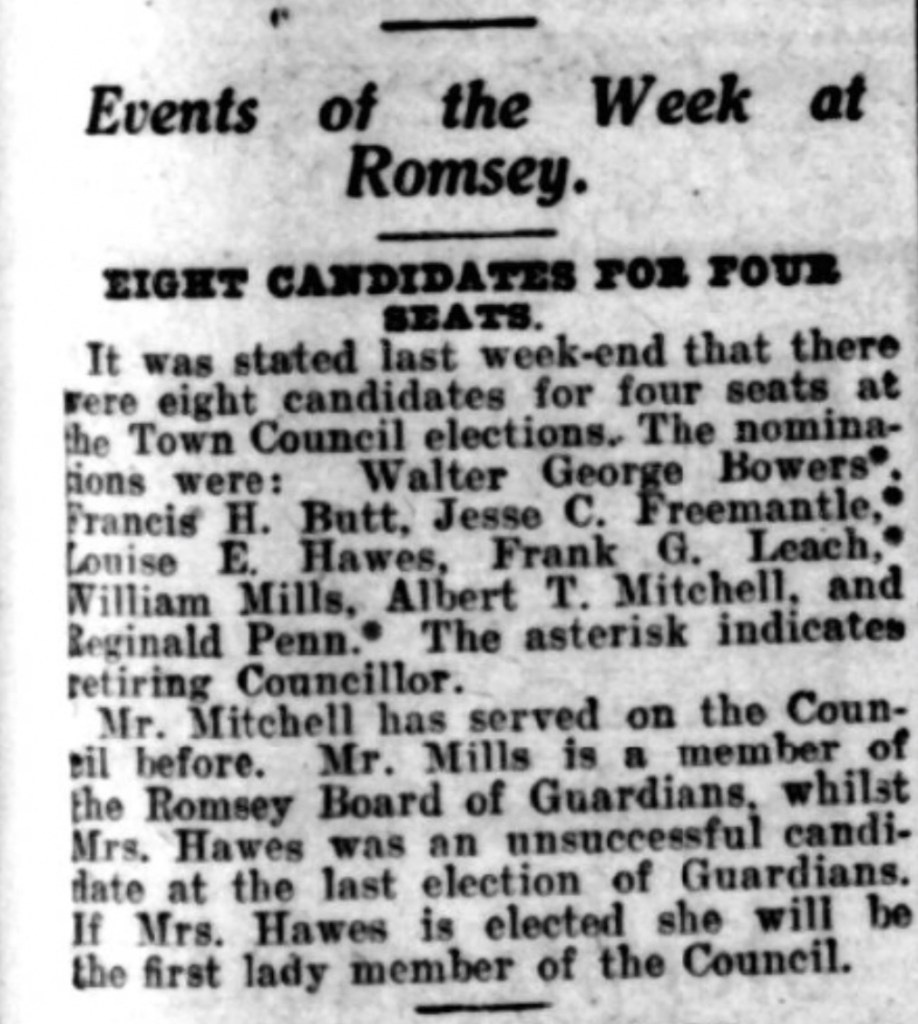
Francis was mentioned in a newspaper article printed in the Hampshire Advertiser, on the 3rd of November, 1928. The article, titled "Events of the Week at Romsey," shared important details about the upcoming Town Council elections. It revealed that there were eight candidates vying for four seats on the council. Among the list of candidates was Francis H. Butt, who was putting himself forward as a potential new representative for the people of Romsey.
The other candidates included Walter George Bowers, Jesse C. Freemantle, Louise E. Hawes, Frank G. Leach, William Mills, Albert T. Mitchell, and Reginald Penn. It was noted that the asterisk next to a candidate’s name indicated those who were retiring councillors. The article also provided some background on the candidates, including the fact that Mr. Mitchell had previously served on the Council, and Mr. Mills was a member of the Romsey Board of Guardians. Mrs. Louise E. Hawes was noted as being an unsuccessful candidate in the last election of Guardians, but if she were elected to the Town Council this time, she would become the first lady member of the Council.
For Francis, the nomination was a significant step forward, not only as a businessman but as someone who wanted to contribute to the local governance of Romsey. It spoke to his growing sense of responsibility and his desire to be actively involved in the well-being of his community.
The article reads as follows, -

Events of the Week at Romsey.
EIGHT CANDIDATES FOR FOUR SEATS.
It was stated last week-end that there were eight candidates for four seats at the Town Council elections. The nominalions were: Walter George Bowers, Francis H. Butt, Jesse C. Freemantle, Louise E. Hawes, Frank G Leach, William Mills, Albert T Mitchell, and Leginald Penn. The asterisk indicates retiring councillor.. Mr. Mitchell has served on the Countil before. Mr. Mills is a member of the Romsey Board of Guardians, whilst Mrs. Hawes was an unsuccessful candidate at the last election of Guardians. If Mrs. Hawes is elected she will be the first lady member of the Council.
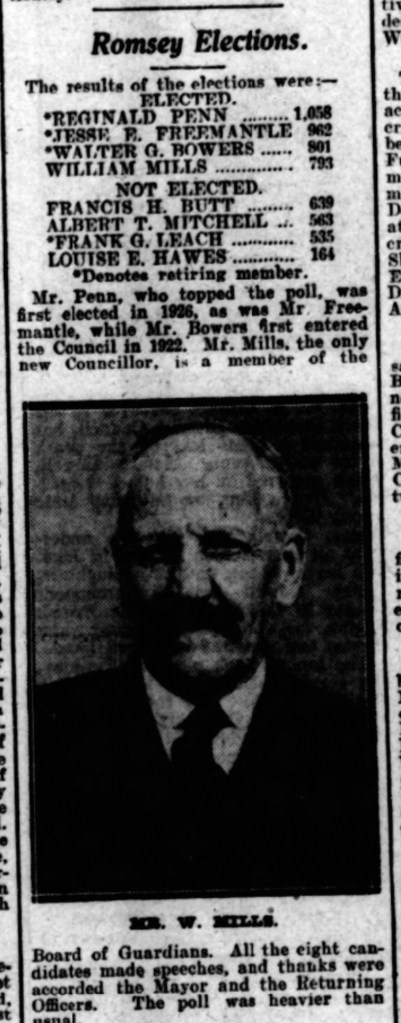
In the Hampshire Advertiser, on Saturday the 10th day of November 1928, Francis was mentioned in the context of the results from the recent Romsey elections. The article highlighted the names of the candidates and the outcome of the voting.
Unfortunately, Francis did not secure a seat on the Romsey Town Council, receiving 639 votes, which was not enough to surpass the elected candidates. Reginald Penn, Jesse P. Freemantle, Walter G. Bowers, and William Mills were the successful candidates, with Mr. Penn leading the poll. It must have been a disappointment for Francis, who had worked hard in his community and was deeply committed to his town. His candidacy reflected his desire to contribute more to Romsey, but the result showed that the community’s support had leaned in another direction at that time.
Despite not being elected, Francis’s name being mentioned in the article showed his active engagement in local affairs. The election was significant in Romsey, with a heavier-than-usual turnout, and Francis’s involvement in this democratic process spoke to his ongoing dedication to serving his community in whatever capacity he could. The mention of his candidacy was another reminder of how involved he was in the fabric of local life. The article reads as follows, -
Romsey Elections.
The results of the elections were:-
ELECTED. REGINALD PENN 1,058 JESSE P. PREPMANTLE 962 WATTER G. BOWERS 801 WILLIAM MILLS 793 NOT ELECTED. FRANCIS H. BUTT 639 ALBERT T. MITCHELL 563 FRANK G. LEACH 535 LOUISE E. HAWES 164 Denotes retiring member. Mr. Penn, who topped the poll, was first elected in 1926, as was Mr Freemantle, while Mr. Bowers first entered the Council in 1922. Mr. Mills, the only new Councillor,is a member of the Board of Guardians. All the eight candidates made speeches, and thanks were accorded the Mayor and the Returning Officers. The Poll was heavier than usual.
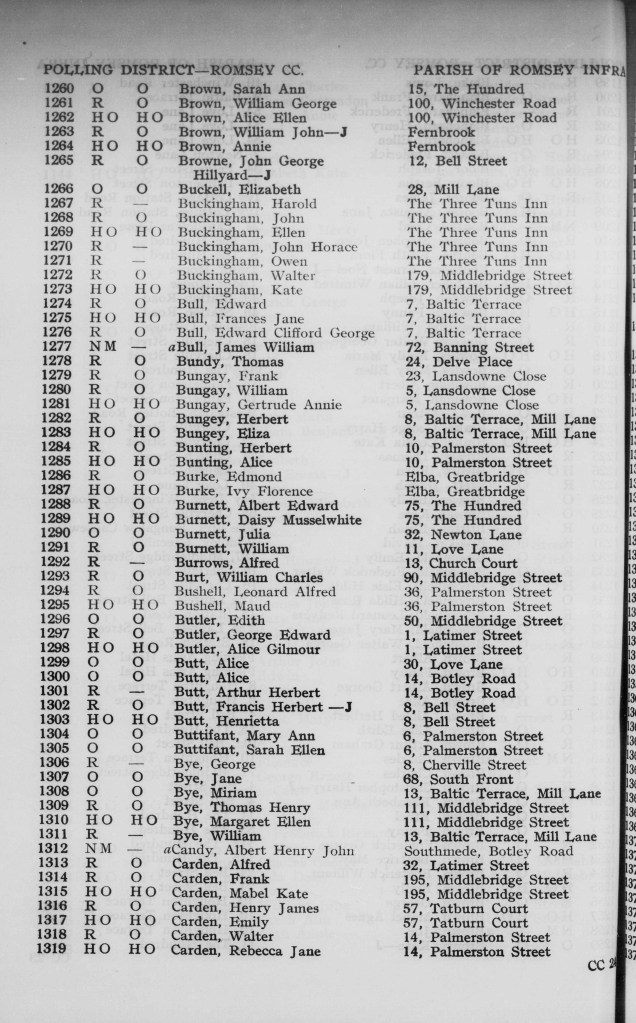
In 1928, according to the England & Wales, Electoral Registers, Francis Herbert Butt and his wife Henrietta were still residing at their home at Number 8, Bell Street, Romsey, Hampshire. Their family home continued to serve not only as a residence but as the premises for Butt and Son Family Butchers. The registers also show other family members living in Romsey during this time. Francis's brother, Arthur Herbert Butt, and his wife Alice were residing at 14 Botley Road, Romsey. Another relative, Alice Butt, was living at 30 Love Lane, Romsey.
This snapshot from the Electoral Registers reflects the close-knit nature of the Butt family, with several members living within the same area, staying connected through both family ties and their community. It was clear that Francis and Henrietta had deep roots in Romsey, not only as business owners but also as part of the wider fabric of the town, with family living in nearby homes.
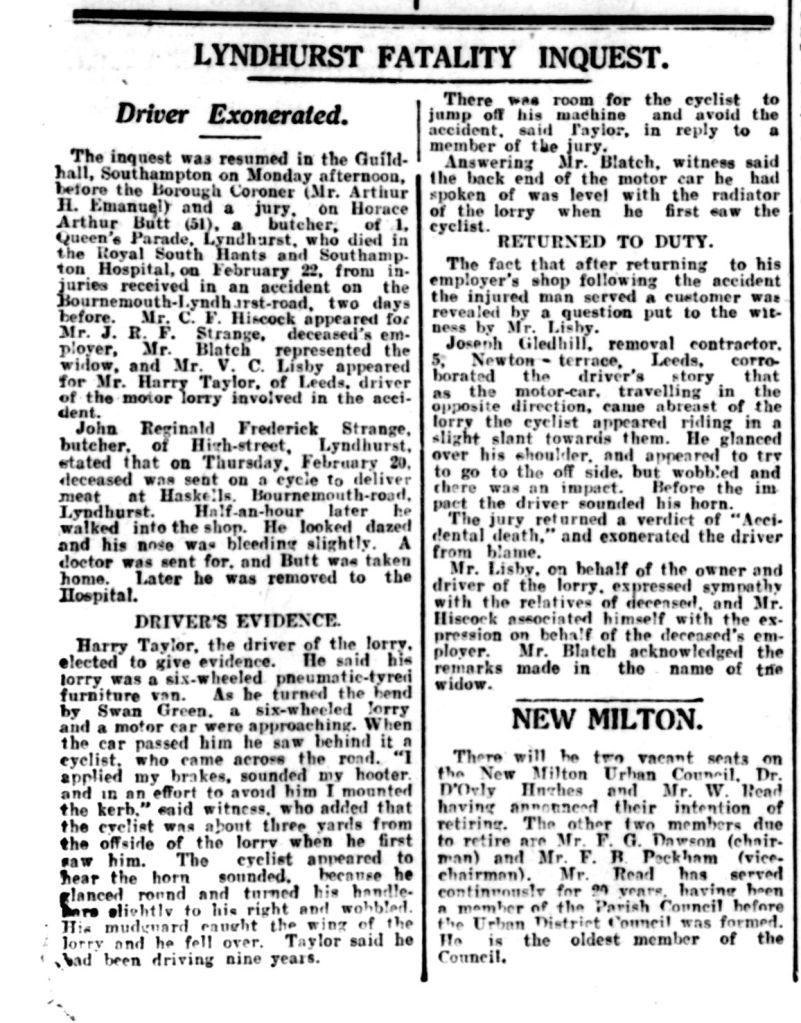
Francis’s brother, 51-year-old Horace Arthur Butt, tragically passed away on Saturday, the 22nd of February 1930, at the Royal South Hants and Southampton Hospital. His death was the result of a devastating accident, Horace was thrown from his bicycle after a collision with a motor car, sustaining fatal injuries, including a laceration of the brain and a fractured skull. The coroner, Arthur H. Emanuel, certified the cause of death, and an inquest was held on Monday, the 17th of March 1930. The registrar, H.R. Hardy, recorded Horace’s occupation as a butcher, and his residence was listed as Sheens Parade, Lyndhurst, Hampshire.
Horace's death was officially registered on Wednesday, the 19th of March 1930. This loss must have been deeply felt by his family, especially Francis, who had shared much of his life with Horace. The circumstances of the accident added a tragic and sudden nature to his passing, leaving a lasting mark on the Butt family.

Francis’s brother, Horace Arthur Butt’s tragic death was the subject of an inquest that was reported in the Hampshire Advertiser, on Saturday, the 22nd day of March 1930. The inquest took place at the Guild-hall, Southampton, before the Borough Coroner, Mr. Arthur H. Emanuel, and a jury. Horace, a 51-year-old butcher from 9 Queens Parade, Lyndhurst, had passed away in the Royal South Hants and Southampton Hospital on the 22nd of February from injuries he sustained in a bicycle accident on the Bournemouth-Lyndhurst road two days earlier.
The inquest revealed several details about the incident. John Reginald Frederick Strange, Horace’s employer, testified that on Thursday, February 20, Horace had been sent on a bicycle to deliver meat in Haskells, Bournemouth Road, Lyndhurst. Half an hour later, Horace returned to the shop, looking dazed and with a slight nosebleed. A doctor was called, and Horace was later taken to the hospital.
Harry Taylor, the driver of the motor lorry involved in the accident, gave his testimony. He described his vehicle as a six-wheeled pneumatic-tyred furniture van. As he turned a bend by Swan Green, he saw a motor car pass, followed by a cyclist who appeared to wobble and veer toward the offside of the lorry. Despite the driver sounding his horn and attempting to avoid the cyclist by mounting the kerb, the cyclist's mudguard caught the wing of the lorry, causing him to fall. The driver indicated that there was enough room for the cyclist to avoid the accident by jumping off his bicycle.
Joseph Gledhill, a removal contractor, corroborated the driver's account, stating that the cyclist wobbled as the motor car passed, leading to the impact after the horn was sounded.
After hearing the evidence, the jury returned a verdict of "Accidental death" and exonerated the driver of blame. The driver and his employer expressed sympathy with the deceased’s relatives, as did the lawyer representing the widow, Horace’s wife.
The inquest’s conclusion, while confirming the accidental nature of the event, added a layer of grief for the Butt family, especially for Francis, who had already endured the loss of other close family members.
The Hampshire Advertiser, report reads as followers.

LYNDHURST FATALITY INQUEST.
The inquest was resumed in the Guild-hall, Southampton on Monday afternoon, before the Borough Coroner (Mr. Arthur H Emanuel) and a jury on Horace Arthur Butt (51), a butcher, of 9 Queens Parade, Lyndhurst, who died in the Royal South Hants and Southampton Hospital, on February 22, from injuries received in an accident on theBournemouth-Lyndhurst-road, two days before. Mr. C. E. Hiscock appeared for Mr. J. R. F. Strange, deceased's employer, Mr.Blatch represented the widow, and Mr. V. C. Lisby appeared for Mr. Harry Taylor, of Leeds, driver of the motor lorry involved in the accident. John Reginald Frederick Strange, butcher of High-street, Lyndhurst stared that on Thursday, February 20 deceased was sent on a cycle to deliver meat at Haskells. Bournemouth-road, Lyndhurst. Half-an-hour later he walked into the shop. He looked dazed and his nose was bleeding slightly. A doctor was sent for, and Butt was taken home. Later he was moved to hospital. DRIVER'S EVIDENCE. Harry Taylor, the driver of the lorry elected to give evidence he said his lorry was a six wheel pneumatic-tyred furniture van. As he turned the bend by Swan Green. a six-wheeled lorry and a motor car were approaching. When the car passed him, he saw behind it a cyclist, who came across the road. “I applied my brakes, sounded my hooter, and in an effort to avoid him I mounted the kerb." said witness, who added that the cyclists was about three yards from the offside of the lorry when he first saw him. The cyclists appeared to hear the horn sounded, because he glanced round and turned his handle slightly to his right and wobbled. His mudguard caught the wing of the lorry and he fell over. Taylor said he had been driving for nine years. There was room for the cyclists to jump off his machine and avoid the accident, said Faylor, in reply to a member of the jury. Answering, Mr. Blatch, witness said the back end of the motor car he had spoken of was level with the radiator of the lorry when he first eaw the cyclist. RETURNED TO DUTY. The fact that after returning to his employer's shop following the accident the injured man served a customer was revealed by a question put to the witness by Mr. Lisby. Joseph Gledhill, removal contractor. 5, Newton - terrace, Leeds, corroborated the driver’s story that as the motorcar traveling in the opposite direction, came abreast of the lorry the cyclist appeared to try to go to the off side, but wobbled and there was an impact. Before the impact the driver sounded his horn. The jury returned a verdict of Accidental death," and exonerated the driver from blame. Mr. Lisby, on behalf of the owner and driver of the lorry, espressed sympathy with the relatives of deceased, and Mr. Hiscock associated himself with the expression on behalf of the deceased's employer. Mr. Blatch acknowledged the remarks made in the name of the widow.
The 1930 England & Wales Electoral Registers, reveal that Francis, Henrietta, and their son Bernard were living at Number 10, Bell Street, Romsey, Hampshire. Also listed at the same address was Rose Vane, suggesting that she too resided there at the time. Given that their home was a two-story flat above their shop, it is likely that Bell Street had been re-numbered at some point, or that their living quarters had been assigned a separate address. Either way, this record provides a glimpse into their daily lives in the heart of Romsey, where their home and business were closely intertwined.

The 1931 England & Wales Electoral Registers show that Francis, Henrietta, their daughter Doreen Marjorie, and their son Hugh Bernard Butt were residing at Number 10, Bell Street, Romsey, Hampshire. Rose Vane was also listed at the same address, as she had been the previous year.
Their residence fell within the polling district of Romsey Infra, a designation that placed them within the local voting jurisdiction. This record offers another glimpse into their lives, illustrating their continued presence in the heart of Romsey, where their home and business remained central to both their family and the community around them.

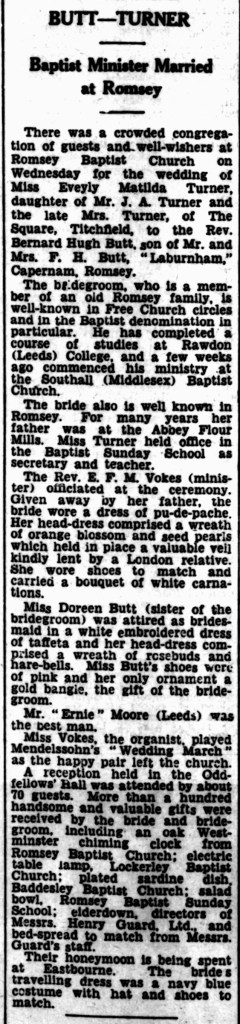
Francis was mentioned in two article printed in the Hampshire Advertiser, on Saturday the 24th day of July 1937 and in the West Middlesex Gazette on Saturday, the 31st of July, 1937, in connection with a wedding that brought together two deeply respected members of the Baptist community.
On a summer day Wednesday the 21st day of July, 1937, the town of Romsey gathered in celebration of a wedding that was as deeply meaningful as it was joyous. The occasion was the marriage of the Reverend B. Hugh Butt, the newly appointed minister of Southall Baptist Church, to Miss Evelyn Matilda Turner, a devoted Sunday School secretary and teacher. The ceremony took place at the Baptist Church in Romsey, where the bride had long been a cherished member of the congregation.
Evelyn, the daughter of Mr. J. A. Turner of The Square, Titchfield, was well-known in the community for her dedication to the church, making her union with Hugh—himself a beloved figure from an old Romsey family—all the more special. Hugh, the son of Mr. and Mrs. F. H. Butt of “Laburnham,” Capernam, had just completed his theological studies at Rawdon College in Leeds before beginning his ministry at Southall on July 4th. His commitment to his faith and his standing in Free Church circles made this wedding a momentous event, drawing a large and affectionate congregation of guests and well-wishers.
The ceremony, officiated by the Reverend E. F. M. Vokes, was filled with love and tradition. As the church organist, Miss Vokes, played Mendelssohn’s Wedding March, Evelyn walked down the aisle in an exquisite pu-de-pêche gown. A delicate wreath of orange blossom and seed pearls secured a treasured veil, a family heirloom lent by a London relative. Her shoes matched her dress perfectly, and she carried a bouquet of white carnations. Beside her stood the groom’s sister, Miss Doreen Butt, as a bridesmaid, dressed in white embroidered taffeta with a dainty wreath of rosebuds and harebells in her hair. She wore pink shoes and a gold bangle—a heartfelt gift from the groom.
Standing at Hugh’s side as best man was Mr. E. Moore from Leeds, offering his support on this momentous day. After the vows were exchanged, the celebration continued at the Oddfellows Hall in Romsey, where around 70 guests gathered for a warm and lively reception. The couple was showered with more than a hundred gifts, each a token of love and appreciation from family, friends, and congregations who held them dear. Among the many thoughtful presents were an oak Westminster chiming clock from Romsey Baptist Church, an elegant electric table lamp from Lockerley Baptist Church, a plated sardine dish from Baddesley Baptist Church, and a beautifully crafted salad bowl from Romsey Baptist Sunday School.
As they bid farewell to their guests, the newlyweds set off for their honeymoon in Eastbourne, with Evelyn dressed in a smart navy blue ensemble, complete with a matching hat and shoes. It was the perfect beginning to their journey together, one built on faith, community, and a shared devotion that would no doubt guide them through a lifetime of love and service.
The articles reads as pretty much the same as each other. The West Middlesex Gazette article reads as follows,
NEW BAPTIST MINISTER WEDS
BRIDE SUNDAY SCHOOL SECRETARY
The Rev. B. Hugh Butt, new minister of the Southall Baptist Church, was married at the Baptist Church, Romsey. Hants, on Wednesday week. His bride, Miss Evelyn Matilda Turner, daughter of Mr. J. A. Turner, of The Square, Titchfield, has held office in the Romsey Baptist Sunday School as secretary and teacher. Son of Mr. and Mrs. F. H. Butt, of “Laburnham” Capernam, Romsey, the bridegroom is a member of an old Romsey family and is well known in Free Church circles in the neighbour-hood and in the Baptist denomination in particular. He commenced his ministry at Southall on July 4 on completion of a course of studies at Rawdon (Leeds) College. The bride is also well known in Romsey, and there was a crowded congregation of guests and well-wishers at the wedding ceremony, at which the Rev. E. F. M. Vokes (minister) officiated. Miss Vokes, the organist. played Mendelssohn’s “Wedding March.” Given away by her father, the bride wore a dress of pu-de-pache. A wreath of orange blossom and seed pearls held in place a valuable veil lent by a London relative. She wore shoes to match her dress and carried a bouquet of white carnations. Miss Doreen Butt (sister of the bridegroom) attended as bridesmaid, being attired in a white embroidered dress of taffeta, with head-dress of a wreath of rosebuds and harebells. She wore pink shoes, and her only ornament was a gold bangle, the gift of the bridegroom. Mr. E. Moore (Leeds) was best man. A reception held at the Oddfellows Hall. Romsey. was attended by about 70 guests. More than a hundred handsome and valuable gifts were received by the bride and bridegroom, including an oak Westminster chiming clock from Romsey Baptist Church, an electric table lamp from Lockerley Baptist Church, a plated sardine dish from Baddesley Baptist Church, and a salad bowl from Romsey Baptist Sunday School. The honeymoon is being spent at Eastbourne. The bride travelled in a navy blue costume with hat and shoes to match.

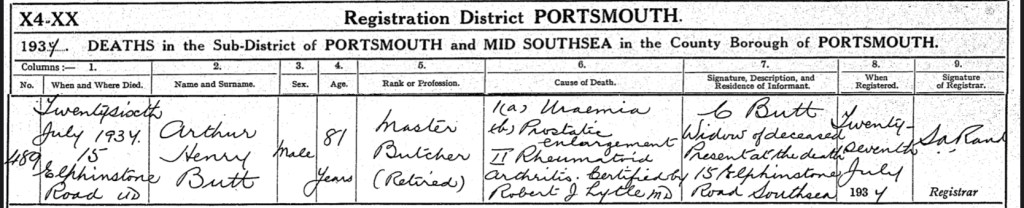
On Monday, the 26th day of July, 1937, Francis’s father, Arthur Henry Butt, a retired master butcher, passed away at the age of 87. He took his final breaths at his home, Number 15, Elphinstone Road, Southsea, Portsmouth, Hampshire, with his devoted wife, Christina, by his side.
Arthur had lived a long and hardworking life, but in his final days, he suffered from uraemia, prostate enlargement, and rheumatoid arthritis. Despite the care he received, his body finally succumbed, and his passing was certified by Robert J. Lythe, the attending medical director.
The very next day, on Tuesday, the 27th day of  July, Christina carried out the solemn duty of registering his death, a moment no wife ever wishes to face. She reported his passing at the local registry office, where Ja Ranl, the registrar in attendance, recorded the details.
Arthur’s passing marked the end of an era for the Butt family, a man who had dedicated his life to his trade and his loved ones. Though gone, he remained a figure of strength and legacy, remembered not only for his craftsmanship as a master butcher but also for the life he built and the family he left behind.
After his passing in Portsmouth, Francis’s father, Arthur Henry Butt, was brought home to Romsey, the town where his life and legacy had been deeply rooted. On Friday, the 30th day of July, 1937, he was laid to rest in Romsey Old Cemetery on Botley Road, in grave E451.
This final resting place held special significance, as it was where his beloved first wife, Fanny Butt (née Kemish), had been buried before him. Now reunited in eternal peace, Arthur and Fanny rested side by side, a testament to the bond they had shared in life.
For Francis and the family, this homecoming must have been bittersweet, a sorrowful farewell, yet a comforting return to the familiar soil of Romsey, where Arthur had built his life, his family, and his legacy. You can read all about Arthur’s life, here and here.


If you have read Arthur’s life story, you may have noticed something rather puzzling, Francis was not named in his father’s Last Will and Testament. This omission is difficult to understand, especially considering the role Arthur played in shaping Francis’s life and future. It was Arthur who had purchased the property in Bell Street, Romsey, setting Francis up in business and providing him with a home above the shop.
Given this history, one would expect Francis to have been acknowledged in the will, making his absence from it all the more confusing. Was it an oversight? A legal technicality? Or perhaps there were other arrangements made outside the formal will? Whatever the reason, it remains a mystery, one that adds an unexpected layer of complexity to Arthur’s otherwise well-documented devotion to his family.
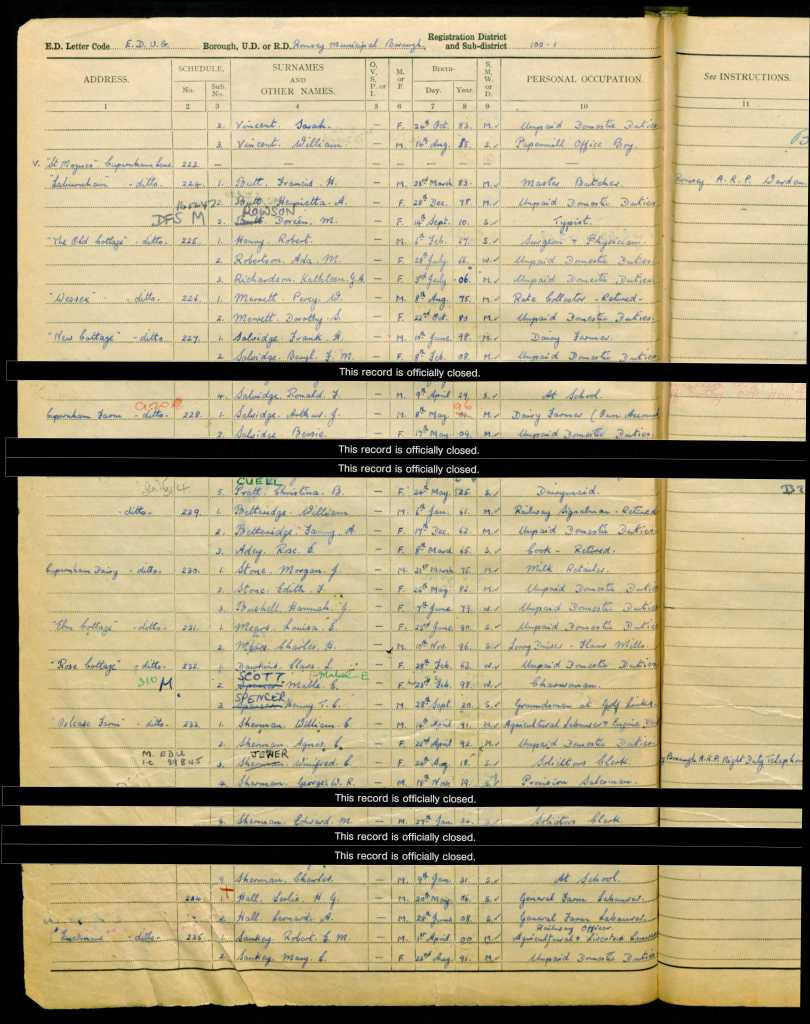
On Friday, the 29th day of September, 1939, as the WWII National Registration was completed across the country, Francis, Henrietta, and their daughter Marjorie were recorded as residing at Laburnham, Cupernham Lane, Romsey, Hampshire, England. This snapshot in time offers a glimpse into their lives at the onset of the war.
Francis, born on the 23rd March, 1883 was listed as a married man and continued his lifelong trade as a butcher. However, in addition to his profession, he had also taken on an important wartime role, serving as an A.R.P. (Air Raid Precautions) Warden, a duty that would have placed him at the heart of civil defense efforts, ensuring the safety of Romsey’s residents during air raids.
Henrietta, born on 28th day of December, 1878, was recorded as a married woman, with her occupation noted as "Unpaid Domestic Duties." This term, commonly used in the 1939 Register, reflected her role in managing the household, a crucial responsibility, particularly in such uncertain times.
Their daughter, Marjorie, listed under her full name, Doreen M. Butt (later Rowson), was born on the 14th of September p, 1910. At the time of the registration, she was single and working as a typist, a role that may have been vital to local businesses or even part of the war effort.
This record not only confirms their whereabouts at a critical moment in history but also highlights their contributions, Francis as a tradesman and a warden, Henrietta as the cornerstone of their home, and Marjorie as a working professional. Together, they faced the challenges of wartime Britain, each playing their part in their own way.
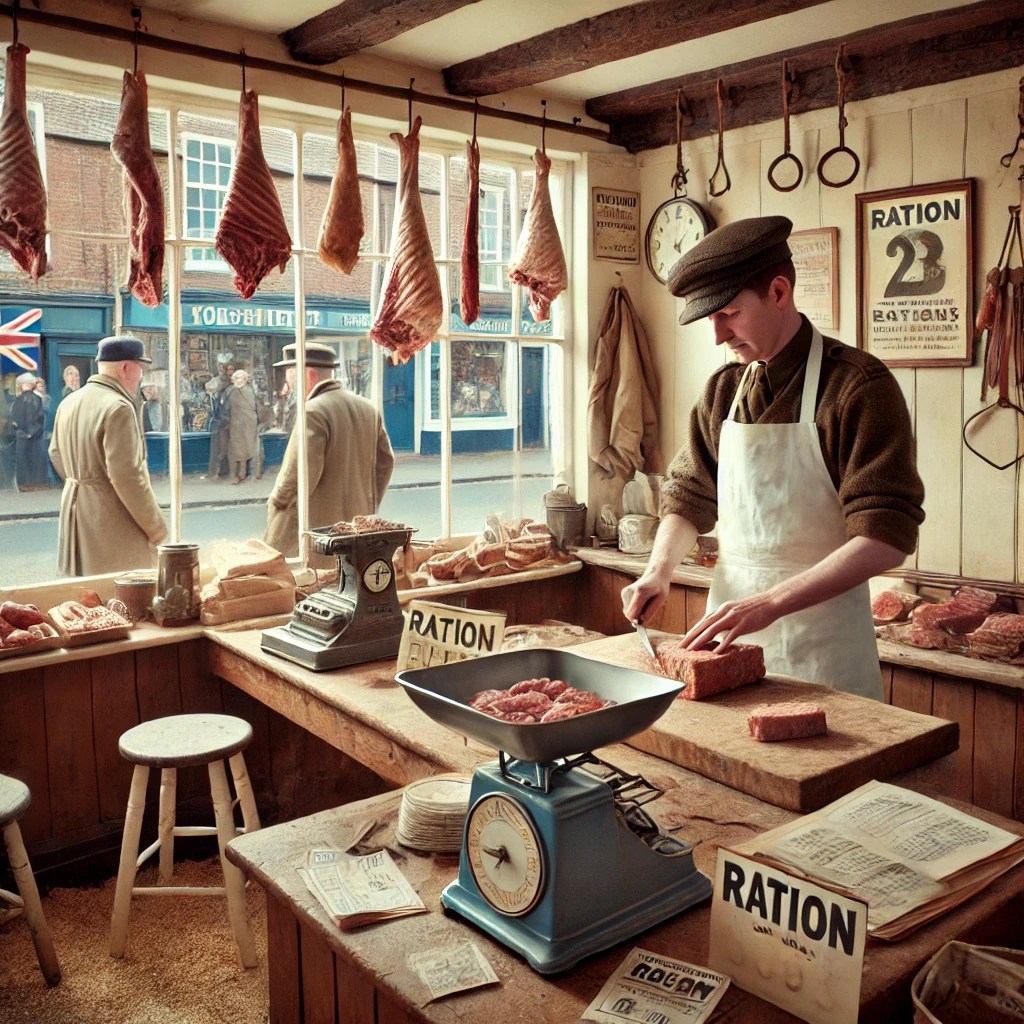
Working as a butcher in a small town during World War Two was a demanding and often exhausting profession, shaped by wartime rationing, shortages, and the ever-present worry of how to provide for the community.
Each day began before dawn, as the butcher would prepare the shop, checking the limited stock and planning how best to stretch it to meet the needs of local families. Meat was tightly rationed, and every customer had a ration book with coupons that dictated how much they could purchase. Some cuts were nearly impossible to come by, and anything considered a luxury, like bacon or fresh sausages, was rare and highly sought after. The butcher had to balance fairness with practicality, ensuring no one took more than their share but also trying to find ways to keep customers satisfied despite the restrictions.
The shop itself was a hive of activity, filled with the scent of sawdust, fresh meat, and salt from the curing process. In the cool back room, carcasses hung from hooks, waiting to be carefully portioned. Every scrap mattered, and waste was simply not an option. Bones were boiled for broth, fats were collected for cooking or even donated for the war effort, and offal, once overlooked, became an important source of nutrition.
Behind the counter, the butcher faced long queues of customers, many of whom were weary from standing in line at various shops to collect their rations. Some would plead for just a little extra, a bit of off-cut for a stew, or something special for a child’s birthday, but there was only so much that could be done. Relationships with local farmers and gamekeepers became invaluable. A friendly connection might mean the occasional delivery of a rabbit or some off-the-ration poultry, though everything had to be handled discreetly.
Despite the hardships, there were moments of camaraderie. Neighbours shared recipes for making the most of limited ingredients, and the butcher often became an unofficial advisor on how to stretch a small portion into a family meal. At times, military personnel or war workers would pass through town, bringing new faces into the shop and adding to the sense of both urgency and purpose.
Air raid sirens were a constant threat, and during particularly bad bombing raids, work had to be abandoned as everyone rushed to shelter. Yet, the next morning, the butcher was back at the block, sharpening knives, preparing orders, and ensuring that, even in the face of war, people could put a meal on the table. It was hard work, filled with long hours and difficult decisions, but it was also an essential role, helping to keep the community fed and holding on to a sense of normality in a world that had been turned upside down.
Francis’s sister, Amy Lillian Gascoigne (née Butt), sadly passed away on Tuesday, the 20th day of March 20th, 1945, at The Cottage Hospital in Mercer, Pennsylvania, United States of America.
Far from her birthplace in England, Amy’s journey had taken her across the Atlantic, building a life in America. Though distance separated her from her family in Romsey, her passing would have been deeply felt by those who loved her. The news of her death must have brought both sorrow and reflection, a reminder of the bonds that remain unbroken, no matter the miles between.
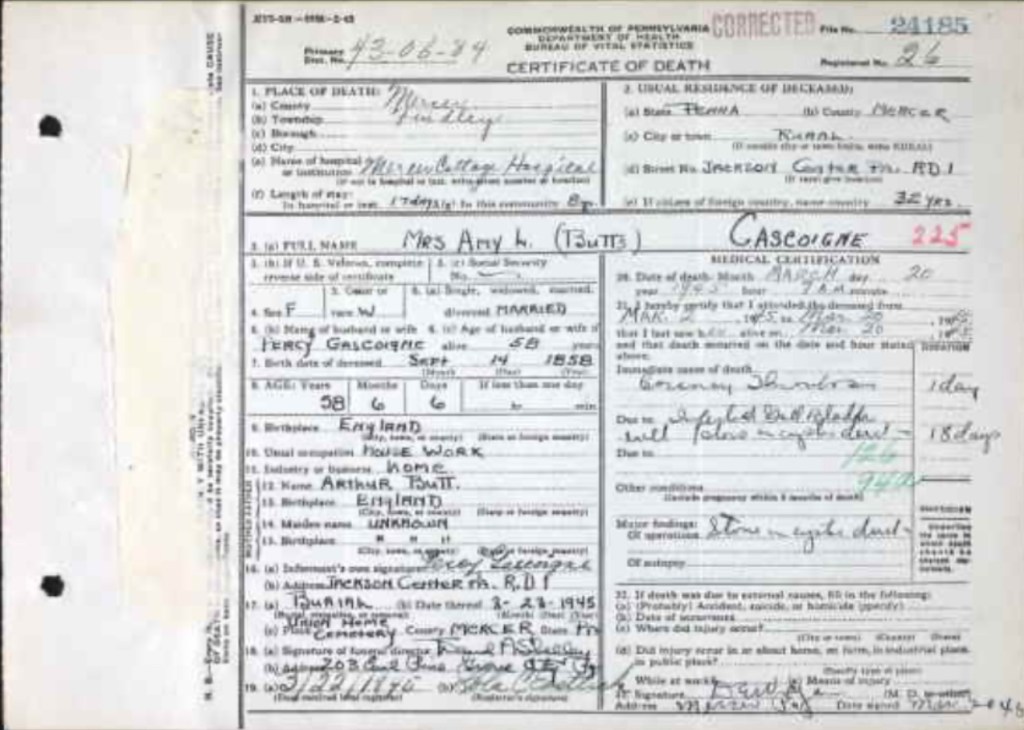
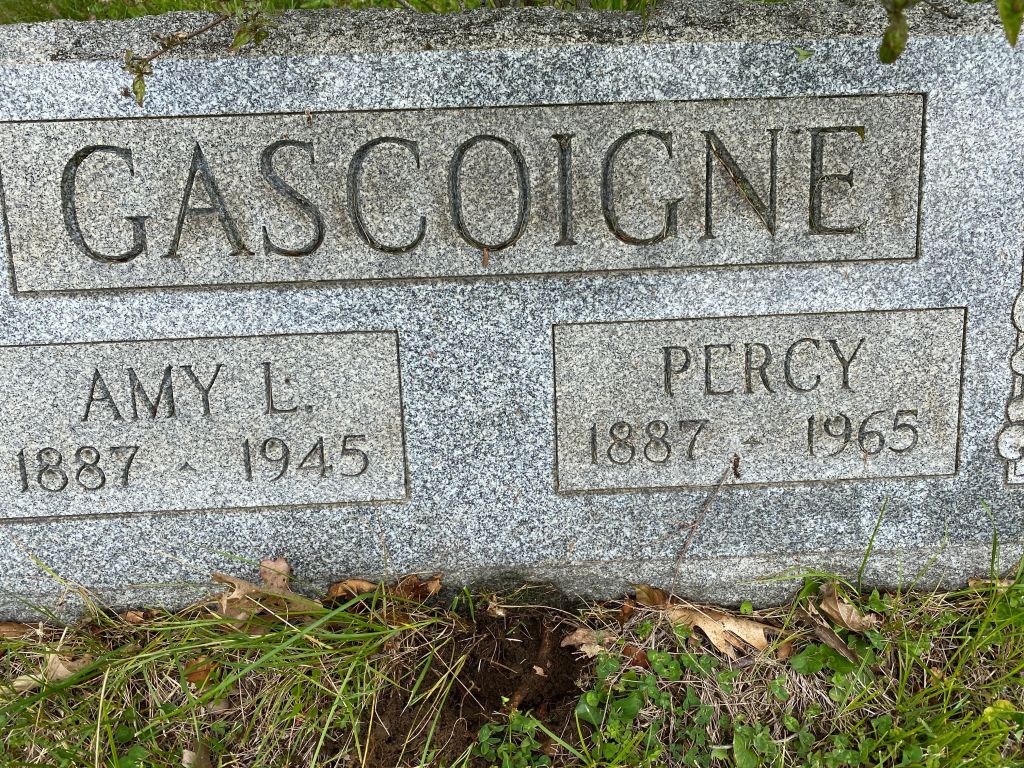
Francis’s sister, Amy Lilian Gascoigne (née Butt), was laid to rest on Friday, the 23rd day of March, 1945, at the Union Home Cemetery in Mercer, Pennsylvania, United States of America.
Though she had made her home across the ocean, her final resting place became a quiet corner of Pennsylvania, far from the familiar streets of Romsey where she had once lived. For Francis and the rest of the family back in England, the distance must have made their loss even more profound. They could not stand by her graveside, could not say their final goodbyes in person, but in their hearts, she remained as close as ever.
As she was laid to rest, thousands of miles from where her story began, one thing remained certain, she was loved, she was remembered, and her presence in the lives of those she left behind would never fade.
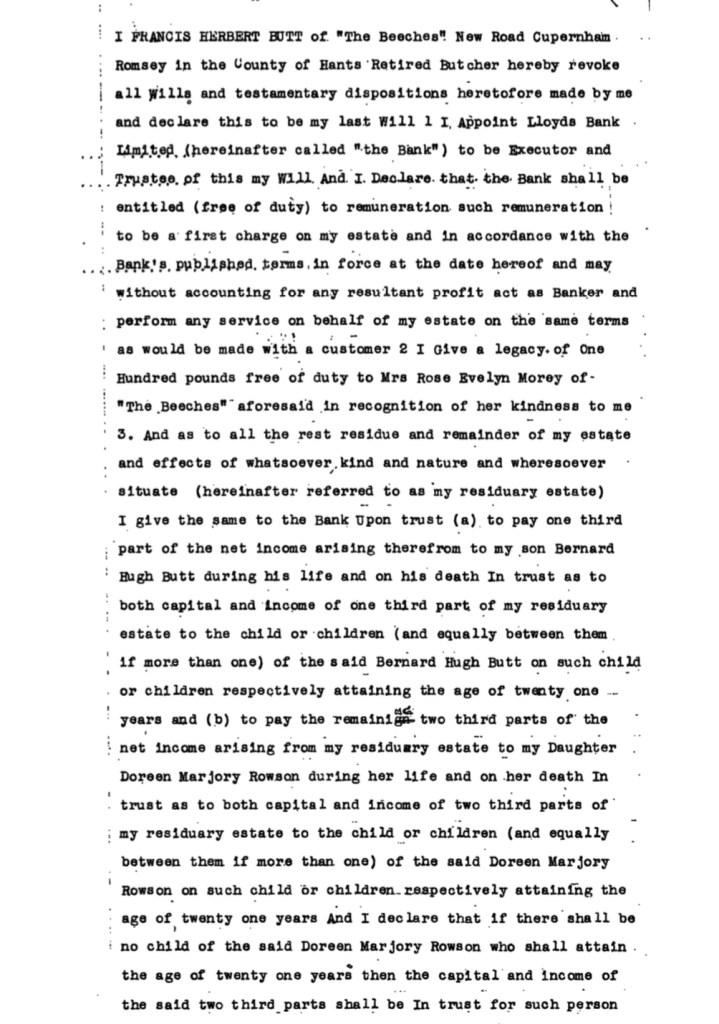
On Thursday, the 8th day of April, 1948, Francis Herbert Butt sat down with his solicitors to put his final wishes into writing. This meeting marked an important moment in his life, as he gave instructions for what would become his Last Will and Testament. Just two months later, he passed away, making this document the defining legal record of how he wished his estate to be distributed.
In his will, Francis began by revoking all previous wills and testamentary dispositions, ensuring that this final document was the only one to be honored. He appointed Lloyds Bank Limited as the Executor and Trustee of his estate, giving them full authority to manage and distribute his assets according to his instructions. He also ensured that the bank would be fairly compensated for their services, as per their published terms at the time.
Among his personal bequests, he left a legacy of £100, a meaningful sum at the time, to Mrs. Rose Evelyn Morey of "The Beeches," as a token of appreciation for her kindness toward him. This gesture reflects the gratitude Francis felt for those who had cared for him in his later years.
The remainder of his estate, referred to as his"residuary estate," was then carefully divided between his two beloved children. One-third of the net income from the estate was to be given to his son, Bernard Hugh Butt, for the duration of his life. Upon Bernard's passing, that portion of the estate was to be held in trust for his children, to be inherited once they reached the age of twenty-one.
The remaining two-thirds of the net income was designated for his daughter, Doreen Marjory Rowson, under the same conditions. She would receive income from the estate throughout her lifetime, and upon her passing, it would pass in trust to her children upon reaching twenty-one. However, Francis also made provisions for the possibility that Doreen might not have children. In that case, she had the power to specify in her own Will or Codicil who should inherit her share of the estate. If she did not make such provisions, her portion would pass to her next of kin.
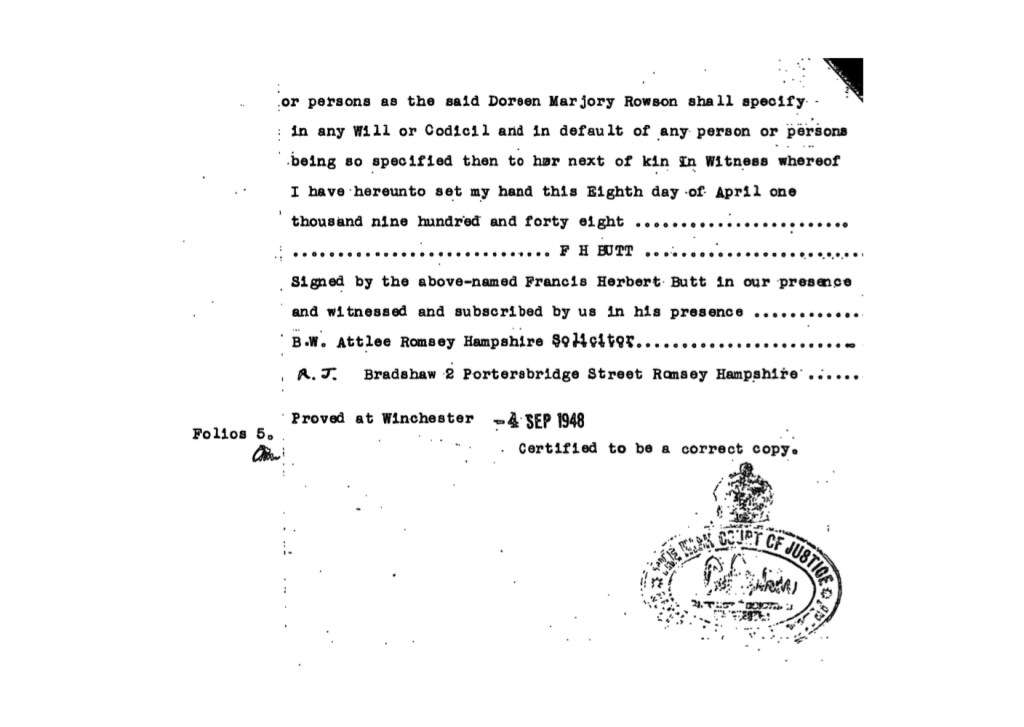
His signature, "F. H. Butt," was affixed to the document on that April day in 1948, witnessed and attested by B.W. Attlee, solicitor, of Romsey, Hampshire, and R.J. Bradshaw of 2 Portersbridge Street, Romsey, Hampshire.
The will was officially proved at Winchester on September 4th, 1948, ensuring that his final wishes would be honored. This certified document serves as a lasting testament to Francis’s careful planning, ensuring that his legacy would be preserved and his loved ones provided for in the years to come.
Françis’s last Will Testament reads as follows,

I FRANCIS HERBERT BUTT of "The Beeches" New Road Cupernham, Romsey in the County of Hants 'Retired Butcher hereby revoke aIl WILLs and testamentary dispositions heretofore made by me and declare this to be my last Will. 1 I Appoint Lloyds Bank Limited, (hereinafter called "the Bank") to be Executor and Trustee, of this my WIll And I Declare that the Bank shall be entitled (free of duty) to remuneration such remuneration to be a first charge on my estate and in accordance with the Banks, published terms in force at the date hereof and may without accounting for any resultant profit act as Banker and perform any service on behalf of my estate on the same terms as would be made with a customer 2 I Give a legacy, of One Hundred pounds free of duty to Mrs Rose Evelyn Morey of “The Beeches" aforesaid in recognition of her kindness to me 3. And as to all the rest residue and remainder of my estate and effects of whatsoever kind and nature and wheresoever situate (hereinafter referred to as my residuary estate) I give the same to the Bank Upon trust (a) to pay one third part of the net income arising therefrom to my son Bernard Hugh Butt during his life and on his death In trust as to both capital and income of one third part of my residuary estate to the child or children (and equally between them if more than one) of the said Bernard Hugh Butt on such child or children respectively attaining the age of twenty one years and (b) to pay the remaining two third parts of the net income arising fron my residuary estate to my Daughter Doreen Marjory Rowson during her life and on her death In trust as to both capital and income of two third parts of my residuary estate to the child or chilaren (and equally between them if more than one) of the said Doreen Marjory Rowson on such child or children respectively attaining the age of, twenty one years And I declare that if there shall be no child of the said Doreen Marjory Rowson who shall attain the age of twenty one years then the capital and income of the said two third parts shall be In trust for such person or persons as the said Doreen Marjory Rowson shall specify in any Will or Codicil and in default of any person or persons being so specified then to her next of kin in Witness whereof I have hereunto set my hand this Eighth day of April one thousand nine hundred and forty eight ...... F H BUTT
Signed by the above-named Francis Herbert Butt in our presence and witnessed and subscribed by us in his presence………
'B.W. Attlee Romsey Hampshire solicitor
R.J. Bradshaw 2 Portersbridge Street Romsey Hampshire……
Proved at Winchester - 4 SEP 1948
Certified to be a correct copy.
Francis Herbert Butt’s life came to an end on Friday, the 18th day of June, 1948, at the age of sixty-five. He passed away at the Royal South Hants Hospital in Southampton, Hampshire, England. His son, Bernard Hugh Butt, of Number 35, Woolland Avenue, Dudley, Wolverhampton, registered his father’s death on the same day. The registrar, H. W. Saunders, officially recorded that Francis, a retired butcher of The Beeches, New Road, Cupernham, Romsey, had died from uremia, carcinoma of the bladder, and simple prostate enlargement, as certified by medical director J. Ellsworth Laing.
Francis had spent his life dedicated to his family, his trade, and his community. As a butcher in Romsey, he carried on the family business, a tradition passed down from his father, Arthur Henry Butt. Through decades of hard work, he became a well-known and respected figure in the town. His role extended beyond his shop, as he served as an Air Raid Precautions Warden during World War II, looking out for the safety of those around him.
In his later years, he settled at The Beeches in Cupernham, where he lived until his final illness. Just two months before his passing, he met with his solicitors to carefully arrange his last will and testament, ensuring that his children would be provided for. Though his life came to a close that summer day, his legacy lived on in the family he nurtured, the business he built, and the town that had been his home.

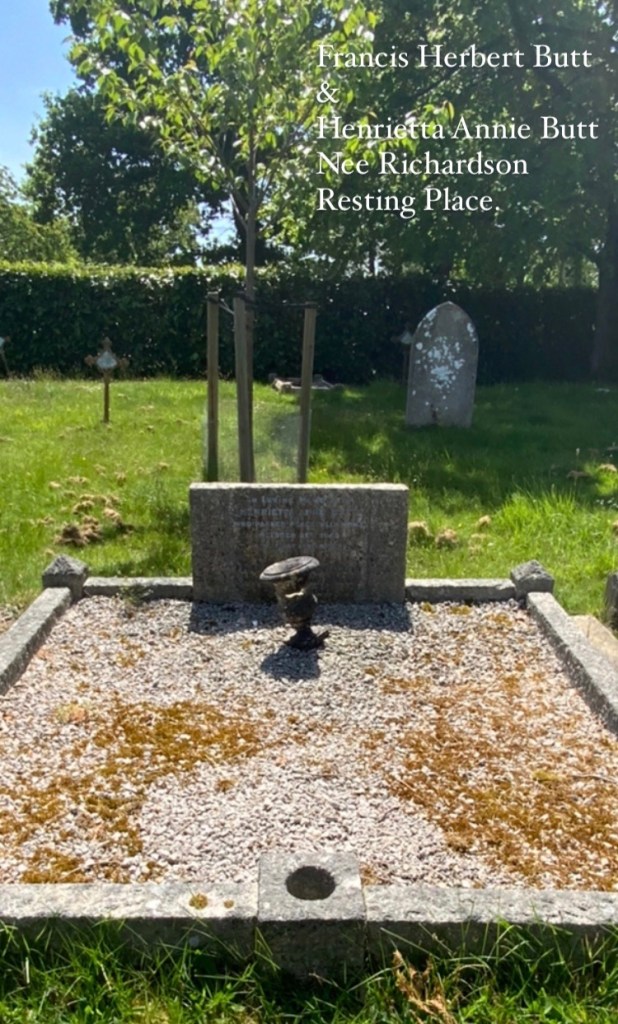
On Tuesday, the 22nd day of June, 1948, amidst profound sorrow and in the embrace of loved ones, Bernard and Marjorie bid their last farewell to their cherished father at Romsey Old Cemetery on Botley Road in Romsey, Hampshire, England. In grave R23, he found his final resting place, his soul finding solace once again beside his beloved wife Henrietta, reunited in eternal peace. The loss resonated deeply not only within their family but also in the heart of the Romsey community, marking the end of an era cherished by all who knew him.

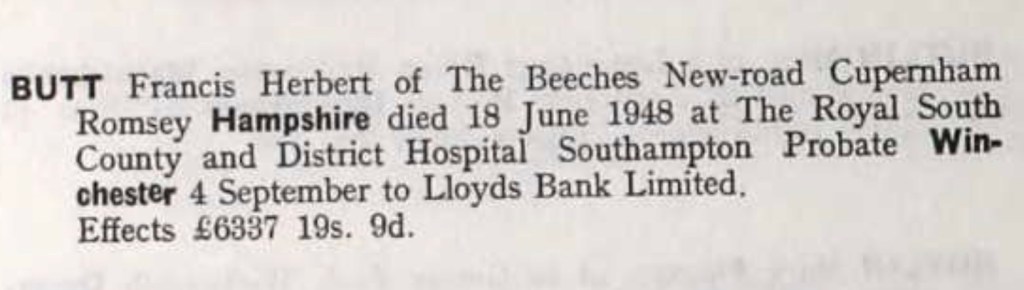
On Saturday, the 4th day of September, 1948, probate for Francis Herbert Butt, was officially granted at Winchester, Hampshire, England. This legal confirmation marked the final step in settling his estate following his passing on June 12th, 1948, at The Royal South County and District Hospital in Southampton. At the time of his death, Francis was living at"The Beeches," New Road, Cupernham, Romsey, Hampshire. His estate was placed under the management of Lloyds Bank Limited, which had been named as the sole executor of his will.
This probate ruling ensured that Francis's final wishes, as outlined in his Last Will and Testament, were carried out, bringing closure to his financial affairs and securing the future of those he left behind.
Francis’s probate reads as follows,

BUTT Francis Herbert of The Beeches New-road Cupernham Romsey Hampshire died 18 June 1948 at The Royal South County and District Hospital Southampton Probate Winchester 4 September to Lloyds Bank Limited.
On Saturday, the 4th day of September, 1948, the grant of probate for Francis Herbert Butt was officially issued at the District Probate Registry in Winchester, Hampshire, England. This legal document confirmed the administration of his estate following his passing on the 12th day of June, 1948, at The Royal South Hants Hospital in Southampton. At the time of his death, Francis had been residing at "The Beeches," New Road, Cupernham, Romsey, a place that had become his home in his later years.
His last Will and Testament was proved and registered at His Majesty's High Court of Justice, and administration of his estate was granted to Lloyds Bank Limited, located at 71 Lombard Street in the City of London.As the sole executor named in the will, the bank took on the responsibility of managing and distributing Francis’s assets according to his final wishes.
The estate's gross value was recorded at £6,337 19s 9d, while the net value, after deductions, was £6,093 6s 4d. A receipt from an Inland Revenue Officer confirmed that all necessary duties and interest had been paid, ensuring that his financial affairs were settled in accordance with the law.
The legal proceedings were overseen by the firm Tylee, Mortimer, and Attlee, Solicitors of Romsey, who handled the extraction of the probate grant. With this final legal step completed, Francis’s estate was formally passed on, closing the final chapter of his well-lived life.
The grant reads as follows,

In His Majesty's High Court of Justice.
The District Probate Registry at Winchester.
BE IT KNOWN that Francis Herbert Butt of "The Beeches" New Road Cupernham, Romsey in the County of Hants died on the 12th day of Jund 1948, at The Royal South Hants Hospital Southampton in the said county.
AND BE IT FURTHER KNOWN that at the date hereunder written the last Will and Testament
(a copy. whereof is hereunto annexed) of the sald deceased was proved and registered in che District Probate Registry of His Majesty's High Court of Justice at Winchester and that Administration of all the Estate which by law devolves to and vests in the personal representative of the said deceased was granted by the aforesaid Court to Lloyds Bank Limited of 71 Lousbard Street in the City of London, the sole Executor named in the said will.
And it is hereby certified that an Affidavit for Inland Revenue has been delivered wherein it is shewn that the gross value of the said Estate in Great Britain
(exclusive of what the said deceased may have been possessed of or entitled to or a Trustee and not beneficially) amount to £6337-19-9 and that the net value of the estate amounts to £6093-6-4.
And it is further certified that it appears by a Receipt signed by an Inland Revenue Officer on the sald Affidavit that an account of Estate Duty and Interest on such duty has been paid.
Dated the 4th day of September 1948
District Registrar.
Exracted by Tylee, Mortimer and Attlee Solicitors Romsey.

Rest in Peace,
Francis Herbert Butt (1883–1948).
Your story, your legacy, and your presence live on, not just in the history of Romsey, but in the very walls of the home and shop you once called your own. Through the hands of those who follow in your footsteps, your life’s work continues, and your memory remains forever woven into the heart of Bell Street.
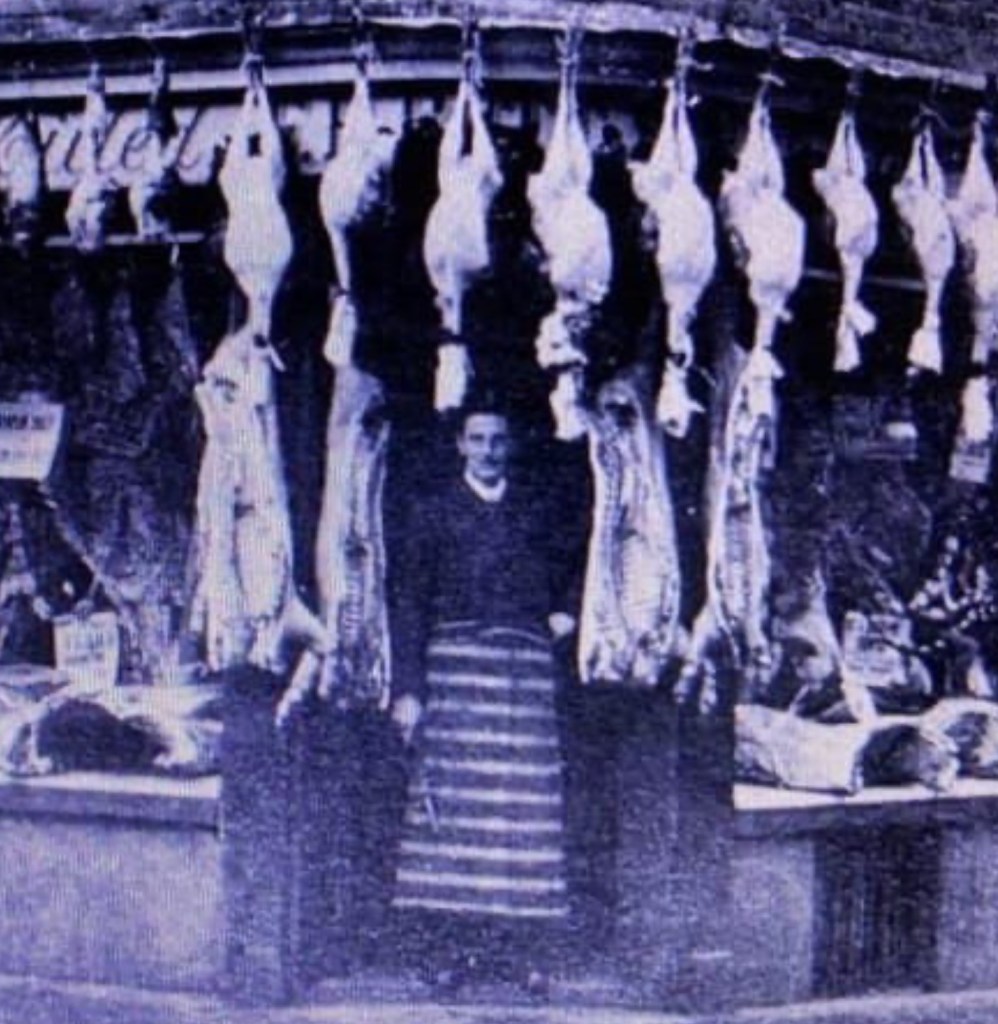
Francis Herbert Butt’s life was one of dedication, resilience, and quiet contribution. From his early years learning the family trade to his decades spent as a respected butcher in Romsey, he built a life centered on hard work, family, and community. Through times of prosperity and hardship, including the trials of two world wars, Francis remained steadfast, providing for his loved ones and serving his town in more ways than one. His role as an Air Raid Precautions Warden during World War II spoke to his sense of duty, just as his careful planning in his final years showed his deep concern for those he would leave behind.
Though his journey came to an end on a summer’s day in 1948, the echoes of his life remained in the streets he walked, the home he built, and the family who carried his name forward. His story is one of a life well lived, rooted in tradition, shaped by service, and remembered with respect.
Yet, for some, Francis, known to many as Frank, is more than just a memory. Locals say that his spirit still lingers in the very place that shaped so much of his life. The rooms of Number 8/10 Bell Street, where he lived and worked for so many years, are said to still carry his presence. Over the years, people have reported sensing him there, a quiet and watchful presence that refuses to fade.
Perhaps, though, the most remarkable connection lies in the present. My son now lives and works in Francis’s former home and butcher’s shop on Bell Street, continuing the very trade that defined Francis’s life. The thought that, after all these years, my son walks the same path, works in the same space, and carries on the tradition of butchery is truly extraordinary. It is as if time has folded in on itself, uniting past and present in a way that feels both profound and real. Whether Francis's spirit lingers or not, his legacy certainly does, living on through the hands of another butcher, shaping the town of Romsey just as he once did.
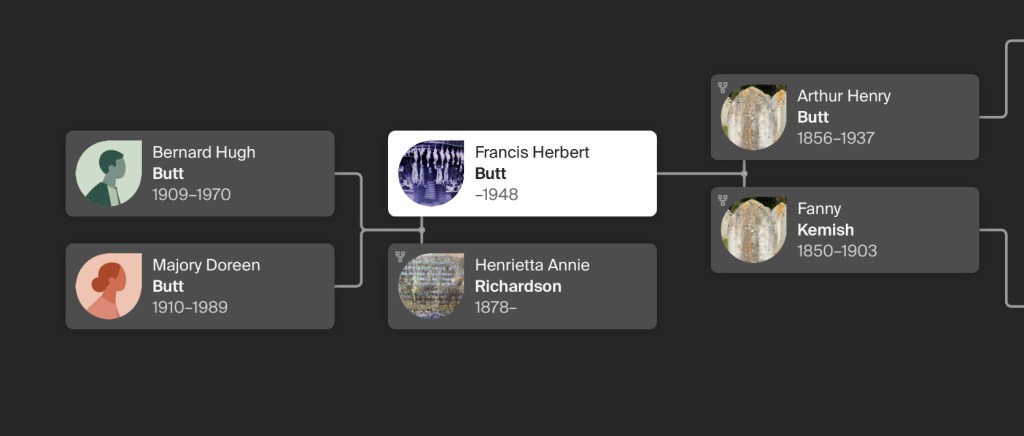
Until next time,
Toodle pip,
Yours Lainey.
🦋🦋🦋
I have brought and paid for all certificates,

Please do not download or use them without my permission.

All you have to do is ask.

Thank you.
 Intwined