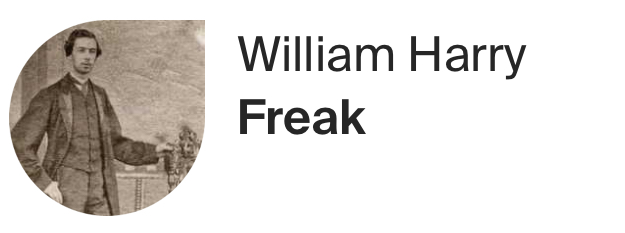
In the quiet corners of history, nestled within the yellowed pages of documents and faded photographs, lies the essence of William Harry Freak, a name that resonates through time and bloodlines, echoing with stories of courage, love, and the quiet strength of everyday life. Born in 1846, he embarked on a journey through an era defined by its own trials and triumphs, etching his narrative into the tapestry of our family's heritage.
Though separated by generations, the lives of our ancestors are not mere relics of the past, they are threads intricately woven into the fabric of who we are today. In retracing William's footsteps, we uncover not just dates and names, but a profound connection to our own identity and roots. His joys and sorrows, his ambitions and setbacks, all find resonance in the lives of every descendant who followed in his footsteps.
Exploring the life of William Harry Freak isn't just about uncovering history, it's about embracing a legacy that shapes our understanding of ourselves and our place in the world. It is a testament to the enduring power of family bonds and the profound significance of preserving our heritage. Through these stories, we discover that our journey is part of a larger narrative, a tapestry where each thread, no matter how faint, contributes to the richness of our shared history.
In exploring William’s early years, one cannot overlook the sheer size of his family. With many siblings, children, and extended relations, tracing each branch has been both a fascinating and daunting task.
I have done my best to obtain as many birth, marriage, and death certificates as possible, but the reality is that family history research has always been an expensive pursuit, and in recent years, the costs have only escalated. Subscriptions to genealogy websites, official records, last wills and testaments, and other essential documents quickly add up, often reaching into the hundreds of pounds. While gathering facts and documentation is of the utmost importance, there comes a point where difficult decisions must be made, especially with larger families. Unfortunately, marriage certificates, which are by far the most expensive, are the one item I have to forgo. However, I will still include the relevant details so that anyone wishing to purchase them for their own research can do so. After all, family history is a shared journey, and every piece of the puzzle helps bring the past to life.
So please join me as we delve into the early years of William Harry Freak, guided by the documents that have preserved his story. Together, let's celebrate the resilience, love, and legacy that continue to echo through the corridors of time, connecting us all in ways both profound and deeply personal.
So without further ado I give you,
The Life Of William Harry Freak,
1846–1891
The Early Years,
Through Documentation.
Welcome back to the year 1846, Southampton, Hampshire, England. The air is thick with the scent of the docks, salt, timber, coal smoke, and the unmistakable aroma of industry. The town hums with life, a bustling port filled with sailors, merchants, and dockworkers moving goods from around the British Empire. The world is shifting, the Victorian era is well underway, and with it comes both promise and hardship, depending on where one stands in society.
On the throne sits Queen Victoria, now in her ninth year as monarch, a ruler whose influence is growing ever stronger as Britain expands its reach across the globe. In Westminster, the Prime Minister is Sir Robert Peel, a man whose leadership has been tested by economic strife and the pressing matter of the Corn Laws, controversial tariffs on imported grain that have driven up the price of bread for the working poor. It is a year of great political upheaval, as Peel pushes for their repeal, a decision that ultimately costs him his position by the summer. Parliament is a battleground of ideologies, with the landed gentry fighting to protect their wealth while reformers strive for progress.
Southampton, a thriving port town, reflects the wider disparities of Victorian society. The wealthy elite live in large townhouses with fine furnishings, attended by servants who cook, clean, and maintain the grandeur of their homes. Their fashion is elaborate, women in full skirts supported by layers of petticoats, their bodices tight and adorned with lace, while men sport frock coats, waistcoats, and tall hats, exuding respectability and status. In contrast, the working class and the poor wear practical, worn clothing; men in rough woolen trousers and simple shirts, women in plain dresses, often with aprons, their hands hardened by relentless labor.
Transportation is a blend of old and new. The railway is rapidly expanding, bringing with it the promise of faster travel and new opportunities, but for many, getting around still means walking or taking a horse-drawn omnibus. Steamships are beginning to replace sailing vessels, making journeys across the seas more reliable, and Southampton, with its strategic coastal position, is a hub of maritime activity.
Energy is derived mainly from coal, powering factories and warming homes through inefficient fireplaces. Heating is a challenge, particularly for the poor, who rely on small fires or, in the worst cases, have none at all. Lighting is provided by candles or oil lamps, though wealthier households can afford the luxury of gas lamps, which flicker in drawing rooms and along the better-lit streets of town.
Sanitation is a growing crisis. Southampton, like many towns and cities, struggles with poor drainage, contaminated drinking water, and overcrowded slums. The poorest live in cramped, damp dwellings with little ventilation, and disease is rampant. Cholera, typhoid, and tuberculosis are grim realities for those at the bottom of society, while the affluent, though not immune, have better access to doctors and cleaner conditions.
Food, too, is divided by class. The rich dine on roast meats, fine breads, fresh vegetables, and imported delicacies such as exotic fruits and spices. The working class subsists on bread, cheese, and simple stews, while the poorest make do with whatever they can afford, often gruel or thin broth. The repeal of the Corn Laws later this year will lower bread prices, but for now, hunger is a daily struggle for many.
Entertainment varies wildly depending on wealth and social status. The upper classes enjoy the theatre, opera, and lavish dinner parties, while the working class might find amusement in a local tavern, street performers, or the occasional fair. Gambling is widespread, as are bare-knuckle boxing matches, providing both sport and the possibility of a quick fortune, or a brutal defeat. For the literate, penny dreadfuls, cheap, sensational stories, offer thrilling escapism.
The environment is increasingly affected by industrialization. The soot and smoke from coal fires darken the skies, and the rivers carry the waste of factories and human habitation alike. In rural areas, life remains tied to the land, but the pull of the cities is strong, and many leave their villages in search of work, only to find themselves trapped in overcrowded, unhealthy urban dwellings.
Gossip and scandal run rife, particularly among the upper echelons of society, where reputation is everything. Affairs, political intrigue, and financial ruin provide endless fodder for whispered conversations. Meanwhile, the working classes have their own tales of hardship, crime, and community struggles, passed along through word of mouth in the streets, markets, and pubs.
The differences between the rich, working class, and the poor are stark. The wealthy live in comfort, enjoying the spoils of industry and empire, shielded from the worst of society’s ills. The working class toil long hours in factories, shipyards, or domestic service, scraping by with little chance of upward mobility. The poorest exist in near destitution, reliant on whatever work they can find, often facing the grim prospect of the workhouse if they become too old, sick, or unlucky.
Beyond the daily struggles and successes of individual lives, 1846 is a year of historical significance. The Irish Potato Famine is in full force, devastating Ireland and sending waves of migrants to England and beyond in desperate search of survival. The expansion of the British Empire continues, shaping global politics and trade, while scientific and technological advancements promise a future that is both exciting and uncertain.
This is the world into which William Harry Freak was born, a time of contrasts, of progress and hardship, of deep divisions but also remarkable resilience. His story, like so many others of his time, is woven into the fabric of this era, shaped by the forces that defined mid-19th century Britain.
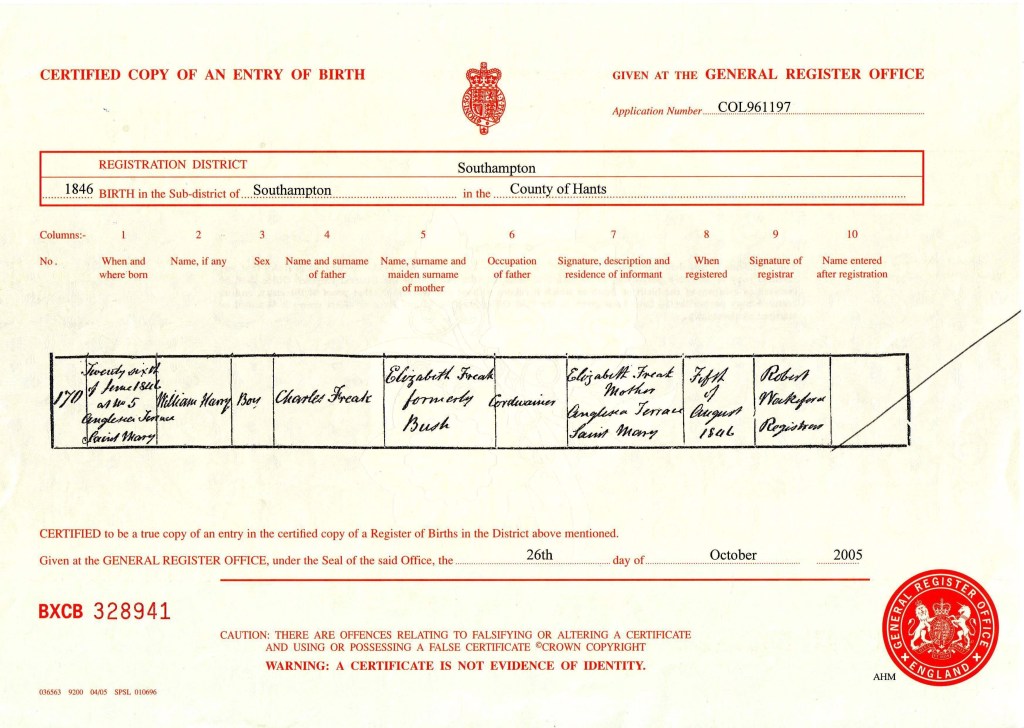
Charles and Elizabeth Freak (Formerly Bush), had been husband and wife for less than a year when they welcomed their first child into the world. Married on Tuesday the 9th day of September 1845 at Saint Thomas’s Church in Salisbury, Wiltshire, they began their married life together in Southampton, Hampshire. It was there, at their home, Number 5, Anglesea Terrace, in the bustling parish of Saint Mary’s, that their son was born. On Friday the 26th day of June 1846, William Harry Freak took his first breath, cradled in the arms of his mother, Elizabeth, as his father, Charles, looked on with pride. He was their firstborn, their hope for the future, a tiny life beginning in a world that was both challenging and full of promise.
Days turned into weeks, and on Wednesday the 5th day of August, 1846, Elizabeth carried her newborn son to be registered in Southampton, ensuring that his arrival was recorded for posterity. Robert Wakefield, the registrar in attendance, documented William’s birth, a simple yet significant act that would allow his name to live on long after his time had passed.
Robert documented in the birth register that William’s father, Charles, worked as a cordwainer, a skilled craftsman making fine shoes from leather, providing for his growing family through patience and precision. It was an honorable trade, one that required both artistry and dedication, ensuring that the people of Southampton had sturdy, well-made footwear. For Charles, it was more than just a means to earn a living, it was a craft, something built with his own hands, a skill that had likely been passed down through generations.
As William grew, he would have watched his father work, the scent of fresh leather filling their home, the rhythmic sound of hammer on sole echoing through the small workshop. Perhaps he would have sat beside him, fascinated by the way raw materials could be shaped into something both practical and fine. It was a working-class life, one of long hours and honest labor, but it was one that gave William a foundation, a sense of responsibility and perseverance that would stay with him throughout his life.
His father's profession, though steady, would not have made them wealthy. Money was likely always a concern, as it was for most families of their standing, but there was dignity in skilled work, in creating something that people needed. Charles and Elizabeth knew hardship, but they also knew the quiet joys of raising a family, of seeing their children grow and take their own place in the world. William, their firstborn, would have carried their hopes, just as every child does, the promise of the next generation, the continuation of their name and their story.
The surname Freak is an unusual and rare name, with origins that are not widely documented but are believed to be of Anglo-Saxon or Old English descent. Variants of the name, such as Freke or Freake, appear in historical records, particularly in the western and southern parts of England. It is thought to derive from the Old English word frec, meaning bold, daring, or greedy, possibly referring to someone known for their bravery or assertiveness. Some sources suggest that it may also have connections to a nickname, describing a person of distinctive character. The name appears in records as early as the medieval period, though it remained relatively uncommon.
Coats of arms associated with the Freke or Freak surname suggest that those bearing the name may have held land or titles in centuries past. The Freke family of Dorset, for example, was a notable lineage with a recorded coat of arms featuring a shield of azure (blue) with two bars or (gold), and in chief three mullets of six points or (gold stars). The design represents nobility, strength, and honor, and such coats of arms were often granted to families of distinction. While there may not be a widely recognized coat of arms for every branch of the Freak family, variations of the name have been linked to heraldic traditions over time.
The given name William has deep and enduring roots in English history. Derived from the Germanic elements wil (meaning "will" or "desire") and *helm* (meaning "helmet" or "protection"), it conveys strength, determination, and leadership. William became widely popular in England after the Norman Conquest of 1066, with William the Conqueror bringing the name into prominence. Over the centuries, it has remained a classic choice, borne by kings, statesmen, poets, and everyday men alike. It signifies a sense of steadfastness and resilience, qualities that many parents have wished upon their sons for generations.
Harry, often used as a diminutive of Henry but also a name in its own right, has a similarly rich history. It originates from the Old High German Heimirich, meaning "home ruler" or "estate ruler." Like William, it was brought into England by the Normans and became a favored royal name. Many English kings were named Henry, and "Harry" became the affectionate, more informal version of the name. It carries connotations of warmth, familiarity, and approachability, making it a beloved choice through the ages.
For William Harry Freak, his name connected him to a long lineage of strong, enduring English heritage, both through his surname and his given names. Whether his parents chose them for their traditional strength or simply because they liked the sound, William Harry was a name that carried weight, history, and identity, one that would be spoken and remembered long after his lifetime.
Anglesea Terrace in Southampton, Hampshire, England, is a historic street that reflects the city's rich maritime past and architectural heritage. Situated in the heart of Southampton, Anglesea Terrace has been a focal point for residential and commercial activity since its development in the 19th century. The terrace itself consists of elegant Georgian and Victorian townhouses, showcasing the affluent lifestyle of the city's upper classes during that era.
Southampton's maritime history is deeply intertwined with Anglesea Terrace, as the city was a major port and played a crucial role in maritime trade and shipbuilding. Many of the residents of Anglesea Terrace were affluent merchants, shipbuilders, and other professionals connected to the maritime industry, contributing to the prosperity and development of Southampton.
Over the years, Anglesea Terrace has retained much of its original charm and architectural character, despite undergoing some modernization and adaptation to contemporary living standards. Today, it continues to be a desirable residential area, known for its historical significance, architectural beauty, and proximity to the city center and waterfront.
William was just over a year old when his younger brother, Charles Augustus Freak, was born. It was the early hours of Wednesday, the 22nd day of September 1847, when Elizabeth brought her second child into the world, in the small family home at Number 9, Crown Street, Portsmouth, Hampshire. One can imagine the scene, perhaps Charles, their father, had stepped away from his boot-making work to be at his wife’s side, while little William, too young to fully understand, slept soundly in the next room.
Life had already changed significantly for the young family. In just over a year, they had moved from Southampton to Portsmouth, a naval town alive with the constant movement of ships, sailors, and industry. Their new home on Crown Street was a place of hard work and long days, where Charles continued his trade, now recorded not just as a cordwainer but as a boot maker, a subtle shift in description but a testament to his craft and skill.
It was on Friday, the 29th day of October 1847, that Elizabeth made the journey to register Charles Augustus’ birth in Portsea, Portsmouth. The registrar, Edward Luscombe, documented the details carefully, listing both parents, Charles and Elizabeth, of Number 9, Crown Street. When it came time for Elizabeth to sign, she left her mark, an X, a common reality for many women of her time who had not been taught to read or write. It was a simple yet poignant reminder of the struggles of working-class life, where formal education was often secondary to survival and labor.
With two young sons to care for, their home must have been filled with both joy and exhaustion. Two small boys under the age of two would have required Elizabeth’s constant attention, while Charles worked long hours to provide for them. Portsmouth, a city dominated by the Royal Navy and bustling maritime trade, was no quiet place to raise a family. The streets were filled with dockworkers, merchants, and sailors, and life could be both vibrant and harsh. Yet within the walls of their modest home, love and resilience carried them forward.
As Charles Augustus grew, he would follow in the footsteps of his older brother William, the two of them undoubtedly forming a close bond, sharing childhood adventures and hardships alike. Their story, like so many others, was one of movement, work, and survival, a family making their way through 19th-century England, each moment of their lives carefully recorded, waiting to be rediscovered by the generations that followed.
Crown Street, located in the Portsea area of Portsmouth, England, has a history that reflects the city's evolving urban landscape. Originally known as Coach and Horses Street, the name was changed to Crown Street at some point before 1985.
Today, Crown Street is primarily a residential area comprising mid-20th-century flats constructed between 1936 and 1979. The street encompasses 101 addresses, all of which are flats. Property values on Crown Street have seen a modest increase, with the average house price rising by 1.4% over the past 12 months, reaching approximately £99,605 as of January 2025. Rental prices have experienced a similar uptick of 1.4% during the same period. The most recent property sale was recorded on September 30, 2021, when a flat sold for £100,000; since then, local property prices have appreciated by 3.8%.
In terms of energy efficiency, assessments have been conducted for 77 properties on Crown Street, with the majority receiving a rating of 'C'.
The area surrounding Crown Street offers several educational institutions. Arundel Court Primary Academy and Nursery is located approximately 200 meters away and has been rated 'Good' by Ofsted. Other nearby primary schools include Ark Dickens Primary Academy and St John's Cathedral Catholic Primary School, both within a 400-meter radius and also rated 'Good'. For secondary education, The Portsmouth Academy is situated about 400 meters from Crown Street and holds a 'Good' rating, while St Edmund's Catholic School, approximately 600 meters away, has been rated 'Outstanding'.
Public transportation is accessible, with Fratton station located roughly 800 meters from Crown Street, providing residents with convenient rail connections.
Regarding safety, the area has a relatively high crime rate, with an annual total of 246 incidents per thousand residents, which is above the average for Portsmouth. The most common offenses include violence and sexual offenses, anti-social behavior, and public order crimes.
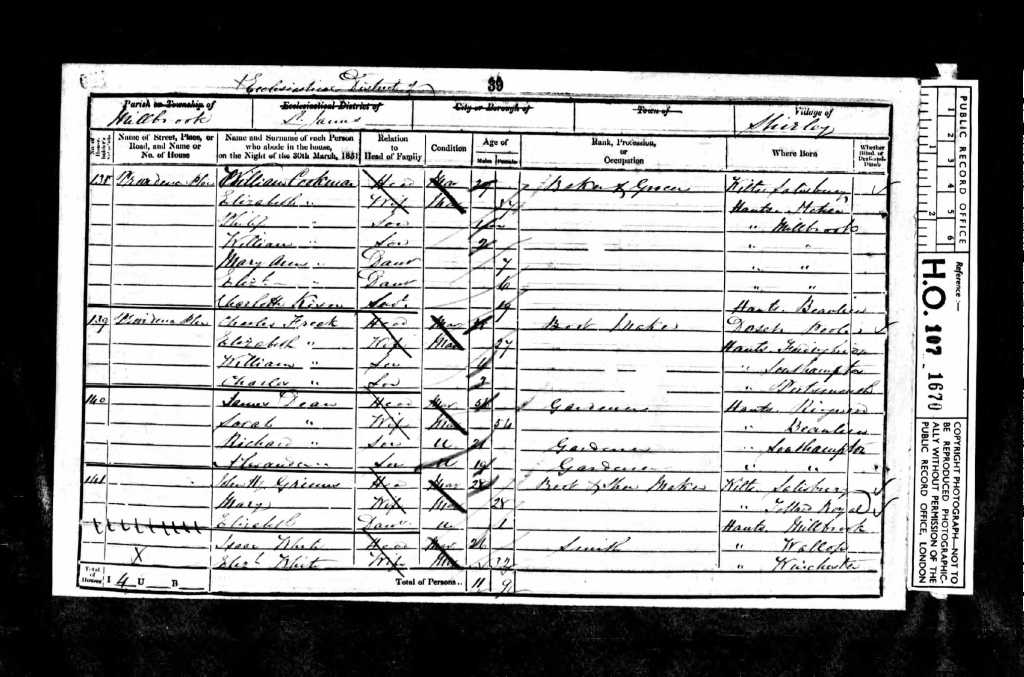
By the time the 1851 Census was completed on Sunday, the 30th day of March, William Harry Freak was nearing his fifth birthday. He was living with his parents, Charles and Elizabeth, and his younger brother, Charles Augustus, at Providence Place, Millbrook, in Shirley, Southampton, Hampshire. Life had once again led them back to Southampton, moving from Portsmouth to settle in the growing parish of Millbrook.
Charles, now firmly established in his trade, was recorded as a boot maker, a profession that demanded skill, precision, and long hours of labor. His work provided for the family, ensuring they had a roof over their heads and food on their table. Millbrook, once a rural village, was beginning to see more development as Southampton expanded, bringing new opportunities but also the challenges of an increasingly industrialized world.
For young William, home was likely a modest but loving place. He and his brother would have spent their days playing in the streets or open spaces nearby, surrounded by the sights and sounds of a working-class community. Their mother, Elizabeth, would have spent her days keeping the household in order, cooking, cleaning, and tending to her growing boys, all while supporting her husband in any way she could.
The census, though just a simple government document, captured a moment in time that allows us to glimpse their world. It recorded more than just names and occupations, it told a story of movement, of hard work, and of family. William, still just a little boy, had no way of knowing that 173 years later, his life would be pieced back together through these very records, bringing his name and story back into the light.
1851 Census.
Providence Place was a residential area located in the Millbrook district, which historically encompassed parts of present-day Shirley in Southampton, Hampshire, England. In the mid-19th century, Millbrook was a rural parish that included several hamlets, with Shirley being one of them. The area was characterized by agricultural activities and small communities.
In 1851, the population of the combined parish of Millbrook and Shirley had grown significantly, leading to the construction of a new church building in Shirley. This church, dedicated to St. James, was consecrated in 1836 to accommodate the increasing number of parishioners. The growth in population during this period indicates a developing community with expanding residential areas like Providence Place.
The mid-19th century was a time of change for the region. The enclosure of Shirley Common in the 1830s led to rapid development, with the Hampshire Chronicle noting in April 1830 that "Several elegant villas are about to be erected on Shirley Common." This development likely influenced nearby areas, including Providence Place, contributing to the transformation from rural landscapes to more suburban settings.
While specific records about Providence Place in 1851 are limited, it's evident that the area was part of a broader trend of growth and development in the Millbrook and Shirley regions during the mid-19th century. This period set the foundation for the suburban character that these areas exhibit today.
As the autumn leaves began to fall in 1851, the Freak family welcomed another child into their home. On Saturday, the 4th day of October, in the quiet parish of Shirley, Millbrook, Southampton, William's younger brother, Albert Freak, was born. By then, William was five years old, old enough to understand the arrival of a new baby in the household, perhaps watching with curiosity as his mother, Elizabeth, cared for her newborn son. Their modest home at Providence Place was now filled with the sounds of three young boys, each growing up in a world that demanded resilience and hard work.
Nearly four weeks later, on Friday, the 31st day of October 1851, Charles Freak made his way to register his son’s birth. Unlike Elizabeth, who had registered their previous children, this time, it was their father who took on the duty, ensuring that Albert's name was officially recorded. The registrar carefully documented the details, writing down the father’s name as Charles William Freak, though, for reasons unknown, the middle name William was crossed through, leaving only Charles Freak to stand as the official record. Whether this was an error or a conscious correction remains a mystery, a small but intriguing detail hidden in the folds of history. The birth entry also confirmed that Albert, a boy, was the son of Charles Freak, a boot maker, and Elizabeth Freak, formerly Bush, both of Providence Place, Shirley. Though the registrar’s name remains difficult to decipher, their handwriting captured a moment of history, securing Albert’s place in the official records of time.
Life for the Freak family in 1851 would not have been easy, with three young sons to feed and clothe on a boot maker’s wage. Yet, despite the daily struggles, there would have been moments of joy, William and Charles Augustus playing together, perhaps peering into the cradle to see their baby brother, their laughter filling the small home. Theirs was an ordinary life in many ways, yet it was also extraordinary in the simple fact that they endured, that their story lived on, waiting to be rediscovered generations later.
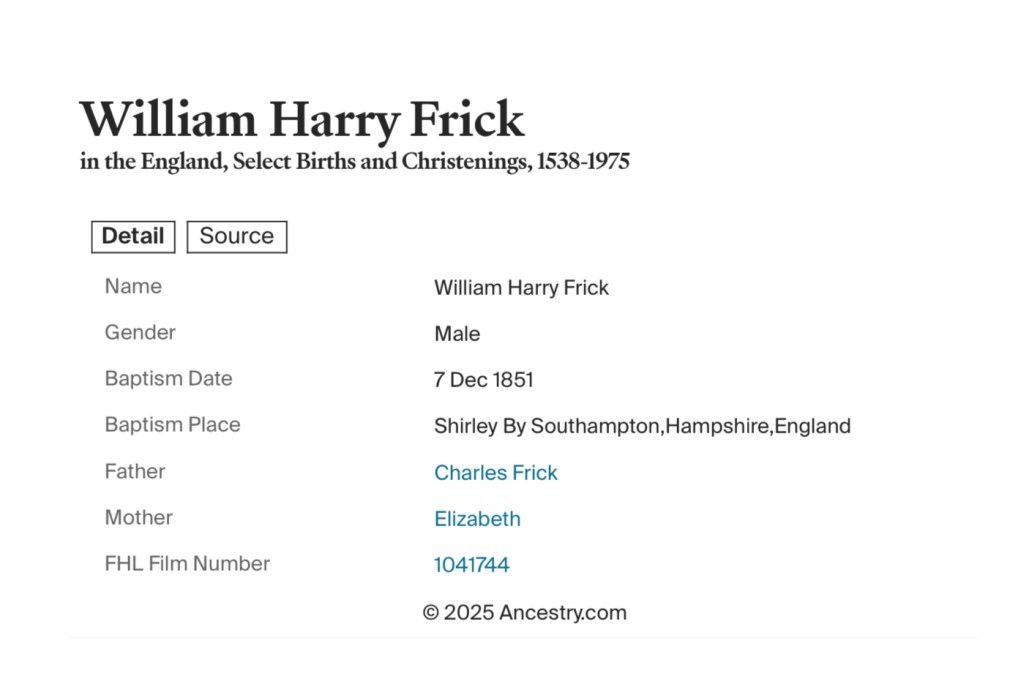
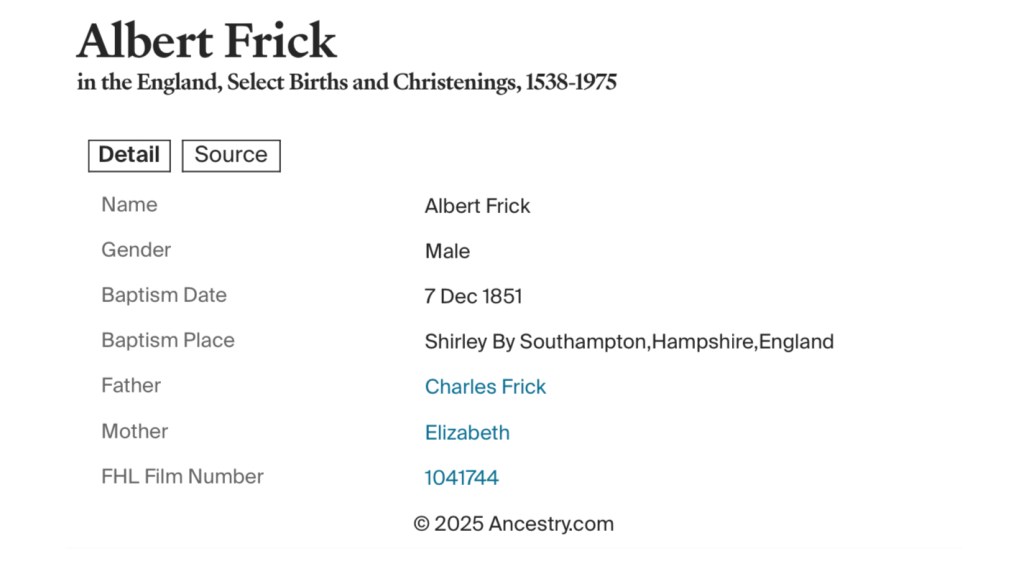
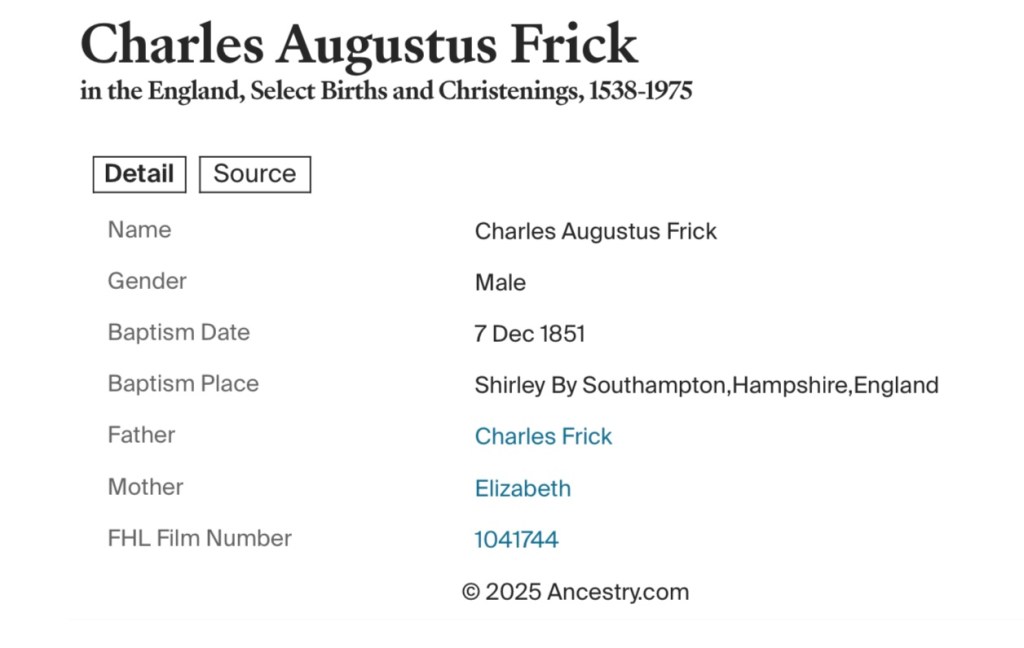
On Sunday, the 7th day of December 1851, Charles and Elizabeth Freak took their three young sons, William Harry, Charles Augustus, and Albert, to be baptised in Shirley, Southampton. It would have been a cold winter’s day, with the family making their way to the church, dressed in their best attire for the solemn yet joyful occasion. William, at five years old, was old enough to understand the significance of the moment, standing alongside his younger brothers as they were welcomed into the faith. For Charles and Elizabeth, it was not just a religious ceremony but a deeply personal moment, a chance to present their children before God and their community, offering prayers for their future and placing them under the care of a higher power.
Baptism was more than a rite of passage, it was a statement of belonging. In a time when infant mortality was heartbreakingly common, there was comfort in knowing that their children had been blessed and recorded in the church’s register, their names inscribed in ink as a permanent mark of their existence. That register, however, contained a small but significant error, the family surname had been written as “Frick” instead of “Freak”. Whether this was due to a misinterpretation of pronunciation, the minister’s handwriting, or simple human oversight, it serves as a reminder of how fragile and imperfect historical records can be. For modern researchers, such discrepancies can present challenges, but they also add an extra layer of intrigue, offering glimpses into the way names and identities were documented in the past.
Despite the mistake, the true story remains unchanged. On that December day in 1851, William stood proudly beside his baby brothers as all three were baptised together, surrounded by the warmth of family and faith. It was a day of hope and tradition, a moment of unity within the Freak family that would be carried forward through the generations. No matter how the records may falter, their names, their lives, and their legacy remain, waiting to be rediscovered and remembered.
By the summer of 1853, the Freak family had grown once more. On Monday, the 20th day of June, Elizabeth gave birth to another son, Edward Freak, at their home in Shirley, Millbrook, Southampton. The arrival of a new baby would have brought both joy and strain to their modest household at Providence Place. With four older brothers, William, now seven, Charles Augustus, nearly six, Albert, not yet two, and little Edward as the newest addition, Elizabeth’s days would have been filled with the constant demands of motherhood, while Charles worked tirelessly as a shoemaker to provide for his growing family.
It was more than a month later, on Tuesday, the 26th day of July, 1853, that Elizabeth made the familiar journey to register Edward’s birth. Once again, she carried out this important task, ensuring that her son’s name would be officially recorded. The registrar carefully entered the details into the birth register and on the birth certificate, noting that Edward, a boy, was the son of Charles Freak, a shoemaker, and Elizabeth Freak, formerly Bush, both of Providence Place, Shirley. The registrar’s handwriting, though perhaps difficult to decipher now, immortalized this moment, preserving Edward’s place in the historical record.
With four young sons now under one roof, life for the Freak family would have been anything but quiet. William, as the eldest, was likely given responsibilities in helping with his younger brothers, perhaps fetching water, gathering firewood, or even assisting his father in the workshop. The small home must have been filled with the sounds of childhood, laughter, tears, and the occasional scuffle between brothers. In a time when every penny mattered, and survival depended on the strength of family bonds, the Freak household would have relied on love, hard work, and resilience to see them through each passing day.
On Sunday, the 7th day of May, 1854, nearly a year after his birth, Edward Freak was carried into All Saints Church in Southampton by his devoted parents, Charles and Elizabeth, to be baptised. The church, standing as a place of faith and tradition, had witnessed many families before them bring their children forward to be welcomed into the Christian community. For Charles and Elizabeth, this was more than just a ceremony, it was an affirmation of their faith, their family, and their hopes for their young son’s future.
The baptism was recorded in the church register by the minister, C. S. Fanshawe, who carefully noted the details: Edward, the son of Charles Freak, a shoemaker, and Elizabeth Freak, formerly Bush. By this time, the family had moved once again, now residing at Number 2, Bannister Street, Southampton. It was not uncommon for working-class families to move frequently, often in search of better housing, work opportunities, or more affordable living conditions.
For William, now nearly eight years old, Edward’s baptism was likely one of many childhood memories, marking another moment in the ever-changing landscape of family life. He had watched his younger brothers grow, sharing in their milestones, their struggles, and their joys. In a home filled with young children, each new addition brought change, another mouth to feed, another soul to protect, and another bond to cherish.
As the service concluded and Edward was officially baptised, Charles and Elizabeth must have felt a moment of peace, knowing that their son’s name was now written not only in the pages of the church register but also in the greater story of their family. The weight of daily hardships, financial struggles, and the challenges of raising a large family may have loomed over them, but in that sacred moment, they stood together, bound by love and faith, shaping a legacy that would carry forward for generations to come.
By the time William’s youngest brother, Samuel Freak, was born on Friday, the 25th of February 1859, the family had moved once again, this time to Number 51, Stone Street, in Southsea, Portsmouth. Now aged twelve, William was no longer a little boy but on the cusp of adolescence, likely taking on more responsibilities within the household as his parents welcomed yet another child into their growing family.
Life in Southsea, a bustling coastal area near the Royal Navy docks, must have been a contrast to their previous homes in Southampton. The air carried the salty scent of the sea, and the streets were filled with the sounds of sailors, merchants, and craftsmen. Charles Freak, now documented as both a boot-maker and a journeyman, was continuing his skilled trade, no longer just working for himself but likely employed under contract by others, moving between workshops or businesses as needed. Stability was often elusive for working-class families, and the Freaks were no exception, shifting homes and livelihoods in search of better prospects.
On Friday, the 4th of March 1859, Charles himself registered Samuel’s birth in Portsea Island, Hampshire. The registrar, James Limington Childs, carefully recorded the details in both the birth registry and on the official certificate: Samuel, a boy, son of Charles Freak, a boot-maker and journeyman, and Elizabeth Freak, formerly Bush, both residing at Number 51, Stone Street, Southsea.
For Elizabeth, the arrival of another baby meant more sleepless nights and endless daily tasks, tending to an infant while caring for her older children. For William, his role as the eldest son must have felt even more significant, perhaps helping to look after his younger brothers or assisting his father with work. The constant movement from one place to another, the struggle to keep a large family fed and clothed, and the sacrifices made along the way were all part of their reality.
Despite the challenges, there would have been moments of joy, Samuel’s first smile, the way his older brothers gathered around him in fascination, the sense of family that bound them all together through hardship and change. Each new birth was not just another entry in the records but a continuation of their story, a thread in the tapestry of a family that endured, grew, and left a legacy that would one day be rediscovered.
By 1861, industrialization had transformed many urban areas, leading to significant migration from rural communities to cities in search of work. The census captured these social shifts, particularly in expanding industrial centers such as London, Manchester, and Birmingham, as well as in smaller towns affected by railway expansion. It also reflected the continuing impact of the Industrial Revolution, with new occupations and industries emerging in response to technological advancements.
One of the challenges of using the 1861 Census for historical research is the issue of transcription errors. Census records were handwritten by enumerators, who copied details from household schedules into official census books. Mistakes could easily occur, especially with surnames that were difficult to spell or read. In cases where names were misspelled or written illegibly, individuals and families might appear under incorrect spellings or even be omitted entirely. This is a known problem for many researchers, particularly when searching for ancestors with uncommon or phonetically complex surnames.
Unfortunately, there is no trace of William Harry Freak and his family in the 1861 Census, taken on Sunday, 7th April 1861. It is possible that their surname was inscribed incorrectly by the enumerator, making it difficult to locate them in the official records. Another possibility is that they were inadvertently omitted due to human error, a missing page, or confusion over their place of residence at the time. Researchers often encounter such difficulties when tracing family history, and alternative spellings or different sources may be required to confirm their whereabouts during this period.
Despite its imperfections, the 1861 Census remains a valuable historical document, providing a glimpse into the lives of ordinary people in mid-Victorian Britain. It offers insight into the social structure, family dynamics, and employment trends of the time, helping to paint a more complete picture of the era.
On Monday, the 28th day of April, 1862, William's family welcomed another addition when his brother, James Freak, was born at Freemantle, Millbrook, Southampton. By this time, William was already sixteen, and his other brothers, Charles Augustus, Albert, and Samuel, had all begun to grow older. The house in Freemantle must have been a lively place, with young children filling the home with their energy and excitement.
Nearly six weeks later, on Thursday, the 5th day of June, 1862, Elizabeth made her way to register James's birth. This time, it was the registrar, James William Matthews, who carefully documented the birth. In the official register, Matthews noted that James, a boy, was the son of Charles Freak, a master shoe maker, and Elizabeth Freak, formerly Bush. Their home was recorded as being in Freemantle, Millbrook, a part of Southampton that, at the time, would have been bustling with activity as the area continued to grow and develop.
The family’s status had seemingly risen a little by this time. Charles was now recorded as a “master shoe maker,” which suggested a greater level of skill and perhaps a steadier income. This change in Charles's occupation would have likely provided more stability for the growing family. Still, the daily challenges of raising a large family in a working-class household would have remained. Life in Millbrook was a constant balancing act, making ends meet while nurturing the bonds that held the family together.
As for William, his role as the eldest would have become more pronounced, especially with each new sibling arriving. While their parents worked to provide for them, William likely played an active role in caring for the younger children, helping around the house, and watching over his brothers as they grew up together. Each of these births, including James’s, was not just a moment in time, it was part of the family’s story, written in the birth certificates and the records that would preserve their legacy for future generations.
On Saturday, the 25th day of February 1865, the Freak family welcomed another son into their ever-growing household. Born at their home, Number 3, Sea Side Terrace, in St. Deny’s, South Stoneham, Philip Freak entered the world as the youngest of his many siblings. By this time, William was nearly nineteen years old, already forging his own path in life, but his family continued to expand, with his parents, Charles and Elizabeth, embracing the joys and challenges of raising yet another child.
Just a few days later, on Thursday the 2nd day of March 1865, Charles made his way to the registrar’s office in South Stoneham to officially record Philip’s birth. The registrar, Edward Messum, carefully documented the details, noting that Philip, a boy, was the son of Charles Freak, a master boot maker, and Elizabeth Freak, formerly Bush. Their address, Number 3, Sea Side Terrace, situated near the river in St. Deny’s, was recorded as the family’s home at the time.
A small but intriguing detail appears in the birth register, Philip’s name was initially written with two L’s as “Phillip”, but one was later crossed through, and a number 5 was written above it. Whether this was simply a correction of a clerical error or a decision made by Charles himself is uncertain. However, it is another reminder of how even the most official records can contain human touches, mistakes, corrections, and inconsistencies that leave traces of the personalities and decisions of those involved.
By the time of Philip’s birth, Charles had solidified his trade as a master boot maker, suggesting that he had gained both skill and reputation in his craft. This might have brought a slightly better standard of living for the family, but with so many children to care for, life would still have been filled with the daily struggles of working-class existence. For Elizabeth, the arrival of yet another child meant more work, more sleepless nights, and more mouths to feed, but also, undoubtedly, moments of deep love and pride as she nurtured her growing family.
For William, Philip’s birth may have been a distant event, perhaps he was already living independently, building his own future. But no matter where life had taken him, his family’s story continued, with each new brother adding another chapter, another name to be remembered, and another thread woven into the fabric of the Freak legacy.
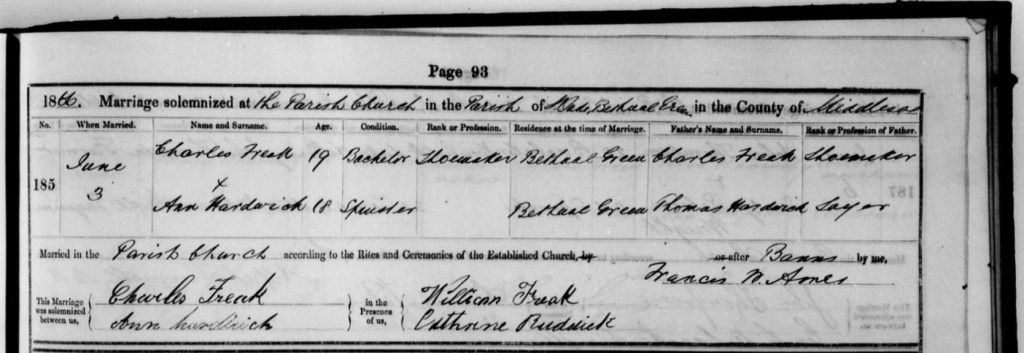
On a early summers day, Sunday, the 3rd day of June, 1866, William Harry Freak stood beside his younger brother Charles Augustus as a witness to one of the most significant days of his life, his marriage to Ann Hardwick. The ceremony took place at Saint Jude’s Church on Old Bethnal Green Road, in the heart of London’s East End. It was a day filled with both excitement and solemnity, as 19-year-old Charles, a bachelor and shoemaker, exchanged vows with 18-year-old Ann, a spinster, both residents of Bethnal Green.
The church, standing proudly amidst the bustling streets of Tower Hamlets, bore witness to their union, as family and friends gathered to see the young couple begin their lives together. Francis W. Aoner officiated the ceremony, carefully recording the details in the marriage register. Charles was noted as the son of Charles Freak, a shoemaker, while Ann was listed as the daughter of Thomas Hardwick, a sawyer. Alongside William, another key figure present was Catherine Hardwick, likely a close relative of the bride, who also served as a witness to the marriage.
For William, this moment was more than just an obligation, it was a testament to the unbreakable bonds of family. He had grown up alongside Charles Augustus, sharing the same childhood home, the same struggles, and the same memories. Now, as his brother took this significant step into adulthood, William stood in quiet support, affirming his place in Charles’s life as both a brother and a trusted witness to his future.
The streets of Bethnal Green, though far from their family roots in Southampton, now became the backdrop for the next chapter in Charles’s journey. The future was uncertain, as it always was for working-class families, but in that moment, under the roof of Saint Jude’s Church, with William standing beside him, Charles was not alone. He was surrounded by love, by family, and by the hope of what was to come.
The winter of 1866 cast a heavy shadow over the Freak family. On Tuesday, the 11th of December, William’s father, Charles Freak, passed away at just 44 years old. A devoted husband, father, and skilled bootmaker, Charles had spent his life working tirelessly to provide for his family. His sudden passing at The Album Inn, in the parish of South Stoneham, Southampton, must have come as a devastating shock to his loved ones.
Just a day later, on Wednesday, the 12th of December, an inquest was held to determine the circumstances of his death. R. Courtenay Davy, the deputy coroner of the borough of Southampton, oversaw the proceedings, concluding that Charles had died of natural causes. It was on Saturday, the 15th of December, that the registrar, Edward Matthews, formally recorded the details in the death register, preserving yet another painful moment in the family’s history.
For William, the loss of his father would have been profound. At just 20 years old, he was stepping into adulthood, a time when a young man might look to his father for guidance and support. Now, that presence was gone, leaving behind not only grief but also the daunting reality of a family left without its patriarch. His mother, Elizabeth, was now a widow, and his younger siblings had lost the man who had worked so hard to keep a roof over their heads.
The Album Inn, where Charles took his last breath, was not their home but a public house, a place where men often gathered after long days of labor. Whether Charles had been there seeking warmth, company, or simply a brief escape from life’s hardships, fate had chosen that moment to take him.
Though his death certificate marked the official end of his story, Charles’s legacy lived on in his children, in the trade he had dedicated his life to, and in the memories carried forward by those who loved him. The grief of his passing was a burden they had to bear, but so too was the strength he had instilled in them, the same strength they would need to carry on without him.
It is a difficult thing, searching for the final resting place of a loved one long gone, but with the help of my dear friend Bruce, we are doing all we can to locate Charles’s burial. His journey did not end with the inquest, nor with the official recording of his passing, but in a quiet place where his family would have gathered to say their last goodbyes.
There is something deeply important about finding where he was laid to rest. To stand where he was buried, to know the earth that holds him, brings a sense of connection across time. It is a final piece of his story, one that deserves to be known.
As soon as we uncover the details, I will add them here, ensuring that Charles Freak is remembered not just in documents and records, but as a man who lived, worked, loved, and was mourned.
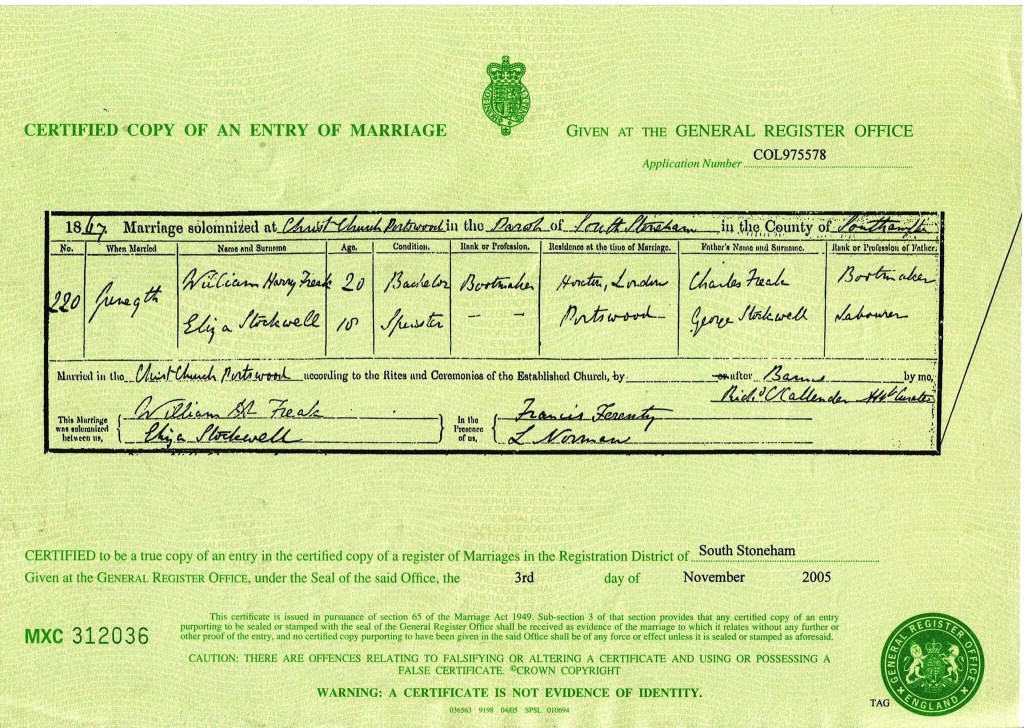
In the warmth of early summer, on Sunday, the 9th day of June 1867, William Harry Freak stood before family and friends at Christ Church, Portswood, Southampton, ready to begin a new chapter in his life. At 20 years old, he had followed in his father’s footsteps, working as a boot maker, a trade that required patience, precision, and dedication, qualities that would also serve him well in marriage. His bride, 18-year-old Eliza Stockwell of Portswood, stood beside him, ready to take his name and build a life together.
The ceremony, performed by a minister whose name is difficult to decipher from the records, was a solemn yet joyful occasion. Before the congregation, William and Eliza pledged their vows, their hands joined in promise and commitment. The marriage register recorded that William was the son of Charles Freak, a boot maker, while Eliza was the daughter of George Stockwell, a laborer. Their witnesses, Francis Ferrety and L. Norman, stood alongside them, signing their names as silent keepers of the moment, ensuring that this union would be remembered.
For William, this must have been a bittersweet day. His father, Charles, had passed just months before, and though his absence must have been deeply felt, William now carried forward the family name, stepping into adulthood as a husband and provider. Life was changing, as it always does, and this day marked not only the joining of two hearts but also the beginning of a future filled with both joys and struggles, as all marriages are.
With the echo of their vows still in the air, William and Eliza walked out of the church as husband and wife, ready to face whatever lay ahead, together.
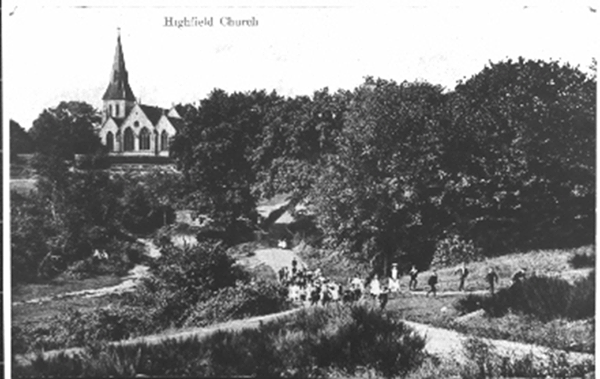
Christ Church, commonly known as Highfield Church, is an Anglican parish located in the Highfield area of Southampton, Hampshire, England. The church's foundation stone was laid on 12 September 1846, and it was consecrated on 17 September 1847 by the Right Reverend Charles Sumner, the Bishop of Winchester. The original name of the church was Christ Church, Portswood, but it became popularly known as Highfield Church in 1883.
The church was designed by architect Joshua Brandon, who, unfortunately, passed away before the building's completion and is buried in the churchyard. Constructed using Purbeck Stone with Caen Stone mouldings, the original structure featured a nave, a small chancel with clerestory windows, a south aisle, and a tower with a broached oak-shingled spire containing one bell.
Over the years, Highfield Church has undergone several modifications to accommodate the growing congregation and changing needs. In 1852, a parsonage was added, followed by the construction of the north aisle in 1855. Gas lighting was introduced in 1863, replacing the original candles. The chancel was rebuilt in 1869, during which the spire was restored, and the windows were raised. A significant western extension was completed in 1915 to serve the expanding parish community.
The church has been a focal point during significant historical events. During the First World War, many parishioners served on the battlefields, and a memorial was erected near the south door in 1921 to honor those who lost their lives. In the Second World War, Southampton endured heavy bombing, and although Highfield Church sustained damage, most notably the destruction of windows in both the east and west ends, the structure remained largely intact. The eastern windows were replaced in 1952 as a memorial to those who perished during the war.
In recognition of its architectural and historical significance, Highfield Church was designated as a Grade II listed building in October 1981. Today, it continues to serve the local community, hosting regular services and events, and stands as a testament to the rich history of the Highfield area in Southampton.
As I bring this first part of “The Life of William Harry Freak 1846–1891, The Early Years Through Documentation” to a close, I find myself reflecting on the weight of history that lives within these records. Though I never had the chance to meet William, his story, woven through birth certificates, baptismal records, census entries, and marriage registers, has become something deeply personal. His childhood, shaped by the skilled hands of his bootmaker father, his early years surrounded by siblings, and the sorrow of losing a parent so young, all form the foundation of a life that, like all lives, was filled with both struggle and love.
Through this journey, I have discovered not only William’s past but also a deeper connection to my own. Family history is not just about names and dates, it is about understanding where we come from, the sacrifices made before us, and the resilience that runs through our blood. William’s life, like that of his parents and siblings, is a thread in the tapestry of time, linking generations together, ensuring that those who came before are never truly lost to us.
There is still so much more to uncover, more chapters of his life to explore, and I will continue to piece together his story, moment by moment, document by document. But for now, I leave William as a young man, newly married, stepping into adulthood with his wife Eliza by his side. What challenges and triumphs lay ahead for him, I will share in the next part of this journey. Until then, his legacy remains, waiting to be told.
Toodle pip,
Yours Lainey.
👞👢👞
I have purchased and paid for all the certificates.
Please refrain from downloading
or using them without my permission.
Simply ask if you'd like to use them.
Thank you.








 Intwined