When Elizabeth Wren stepped into the church on that cool, spring morning in 1850, the air was thick with the quiet promise of forever. Her heart fluttered with a mixture of anticipation and uncertainty as she stood before her groom, the man who would become her world. His eyes, warm and full of quiet devotion, met hers, and in that moment, it seemed as though all the years before her had led to this single, fateful union.
The vows exchanged that day, words of love and fidelity, would shape the path she walked for the next fifty years. Would her marriage, so full of youthful hope, remain as steadfast as it appeared that morning? Or would time, as it does to all things, slowly erode the foundation they had so carefully built?
Her life as a wife and mother was not to be one without trials. The world around her was shifting, sometimes violently, in ways both familiar and unrecognizable. It was a time when society’s expectations of women were being questioned, as voices calling for change began to grow louder, and the very fabric of family, work, and purpose was being rewoven. And Elizabeth, like so many of her time, was caught between the old world she had known and the new one rapidly emerging on the horizon.
Were the days of her early marriage filled with the soft joys of shared moments, cooking for her husband, tending to the home, and nurturing the love that blossomed in the space between them. In those first years, her heart swelled with the arrival of her children, each one a living testament to her love for her husband. She dreamed of seeing them grow, of sending them out into a world where they might thrive and flourish, free from the struggles she had endured in her own childhood. I’m sure all she wished for their happiness, their health, their future.
As the years pressed on, would Elizabeth’s world became one of quiet reflection? Would she begin to question not just the choices she had made, but the life she had been handed? The industrial revolution was reshaping the landscape, bringing new ideas, new challenges, and new hopes to the people she had once known. The cities grew, and the lives of the people she loved seemed increasingly distant from the land she had come to love. Elizabeth’s once-simple life, filled with domestic comforts and quiet joys, was now overshadowed by the questions of a world she could hardly understand, much less control. But in her heart, she would have carried with her a wisdom that came from having lived through these changes, having borne witness to a time of transformation that few could comprehend fully.
By the time Elizabeth reached the twilight years of her life, the world around her was nearly unrecognizable. The comforts of her youth, the familiar rhythms of her home, had long since faded into memory. Her children, though they thrived and flourished in their own ways, were now scattered far and wide, each carving their own path in the ever-changing world. She had done her best, given everything she had, loved as fiercely as she could, and raised her children with the hope that they might find happiness in a world that had been anything but kind to her and her family.
In the final years of her life, Elizabeth Wren stood at the edge of an era. She had seen love and loss, triumph and tragedy, and had lived through the kind of hardships that would shape the future for generations to come. Her heart, though worn and scarred by time, remained ever steadfast, no longer bound by the naive hopes of youth but tempered by the quiet wisdom that can only come with age. I’m sure as she looked back on the years that had passed, on the dreams she had once held, the love she had given, the children she had nurtured, and the family she had built, there was no bitterness in her heart, only a deep sense of peace.
For Elizabeth, the story of her life was not one of simple happiness, but of perseverance, of resilience, of a woman who had weathered the storms of life with quiet grace and courage. As the years grew fewer and fewer, did she know that, in the end, it would be love, both the love she had given and the love she had received, that would carry her through to the very end. And so, as she stood on the threshold of her final days, did she face them not with fear, but with the quiet strength of a woman who had lived fully, loved deeply, and found, in the end, her peace.
Welcome back to the year 1849, Portswood, South Stoneham, Hampshire, England. The air is thick with the scent of coal smoke drifting from chimneys, mingling with the dampness of the nearby River Itchen. The roads are busy with carts and pedestrians navigating the uneven paths, and the sound of hammering from distant shipyards echoes across the landscape. Portswood, once a quiet rural area, is experiencing the effects of Southampton’s rapid expansion as trade and industry thrive.
Queen Victoria sits on the throne, her reign shaping Britain’s identity in the mid-19th century. She is a symbol of stability in an era of change, and her husband, Prince Albert, is deeply involved in promoting science, industry, and public works. In Parliament, Lord John Russell serves as Prime Minister, leading a Whig government that grapples with economic challenges, social reform, and the lingering impact of the Irish famine. The Houses of Parliament, recently rebuilt after the devastating fire of 1834, stand as a testament to Britain’s power, though inside, fierce debates rage about public health, urban poverty, and industrial expansion.
Fashion in 1849 reflects the rigid class distinctions of the time. Wealthy women wear voluminous dresses with crinolines, high necklines, and delicate lace details, their hair swept into intricate updos adorned with combs and ribbons. Gentlemen of means dress in frock coats, waistcoats, and top hats, their starched collars framing serious faces. Meanwhile, the working class wear practical and worn garments—women in simple dresses and shawls, men in rough wool coats and sturdy boots, their clothes often showing the dirt and strain of hard labor.
Transportation in Portswood and Southampton is changing as the railway extends its reach, connecting the region to London and beyond. The London and South Western Railway has already made travel faster and more efficient, allowing goods and people to move more freely than ever before. Horse-drawn carriages and carts still dominate the roads, kicking up mud and dust as they jostle over uneven surfaces. For those who cannot afford the railway, travel remains slow and arduous, with long walks or cramped coach journeys the only options.
Energy in 1849 is still largely dependent on coal and manual labor. Factories and homes rely on coal fires for warmth, while gas lighting, though spreading in cities, is still uncommon in rural and suburban areas like Portswood. Most homes rely on candles or oil lamps, casting flickering light into the evening darkness. The air in cities is thick with industrial smoke, and blackened buildings stand as a testament to the growing dominance of coal-fueled industry.
Heating and lighting remain rudimentary. Coal fires provide warmth in wealthier homes, while the poor often make do with little fuel, shivering through the harsh winter months. Gas lighting is a luxury reserved for the wealthy and for public spaces in major cities, while most homes continue to use candles and oil lamps. In the narrow streets of Southampton, the glow of gas lamps begins to illuminate the way, but in rural areas, darkness still falls quickly after sunset.
Sanitation is a growing concern, as Britain’s cities and towns struggle with the consequences of rapid urbanization. Cholera is a constant fear, and in 1849, another deadly outbreak devastates London and other parts of the country. The miasma theory, the belief that bad air causes disease, leads to efforts to clean up cities, but sewage still flows freely through many streets, and drinking water is often contaminated. In poorer areas, multiple families are crammed into damp, overcrowded dwellings, while wealthier households enjoy cleaner, more spacious accommodations.
Food varies greatly between the classes. The rich dine on meats, fresh vegetables, and exotic fruits imported from the empire, while the poor survive on bread, potatoes, and whatever scraps they can afford. In Southampton, markets bustle with traders selling fish, poultry, and seasonal produce, but prices are high, and many struggle to afford even basic meals. Public houses serve ale and simple fare, offering a rare comfort for laborers at the end of a long day.
Entertainment provides an escape from the hardships of daily life. Theatres in Southampton host plays and musical performances, while the working class find their amusement in taverns, street performers, and the occasional fair. Newspapers carry the latest gossip about the royal family, political scandals, and sensational crimes. Penny dreadfuls, cheap serial novels filled with thrilling tales, are a popular distraction for those who can read, offering stories of highwaymen, ghosts, and daring adventures.
The environment in 1849 is changing. Industrialization brings both prosperity and pollution. Southampton’s docks are busier than ever, but the air is thick with soot, and the once-clear rivers and streams are becoming tainted with waste. In rural areas, traditional farming continues, but the encroachment of industry is inevitable. Portswood, once a quiet village, is beginning to feel the pressures of expansion, as new housing and businesses spread outward from the city.
Gossip fills the streets and drawing rooms. People whisper about the latest royal pregnancies, the marriages of the upper class, and the ever-present scandals of politicians and businessmen. Murmurs of revolution still linger from the European uprisings of 1848, though in Britain, fears of political upheaval are easing. Instead, people debate the future, will the railway bring prosperity or displace traditional ways of life? Will the growing influence of the middle class change the rigid social order?
The difference between the rich, the working class, and the poor is stark. The aristocracy and upper middle class live in grand houses with servants attending to their every need, their children educated in the classics and destined for prestigious careers. The working class toil long hours in factories, docks, or domestic service, scraping together a modest existence with little hope of upward mobility. The poor, especially in urban slums, live in squalor, facing disease, hunger, and backbreaking labor just to survive.
Historical events shape the world beyond Portswood. The Great Famine continues to ravage Ireland, driving waves of desperate immigrants to British cities in search of work. In London, the cholera epidemic claims thousands of lives, leading to calls for better sanitation and public health measures. Across the Atlantic, tensions over slavery and expansion stir conflict in the United States, while in Europe, the aftershocks of the 1848 revolutions continue to unsettle governments.
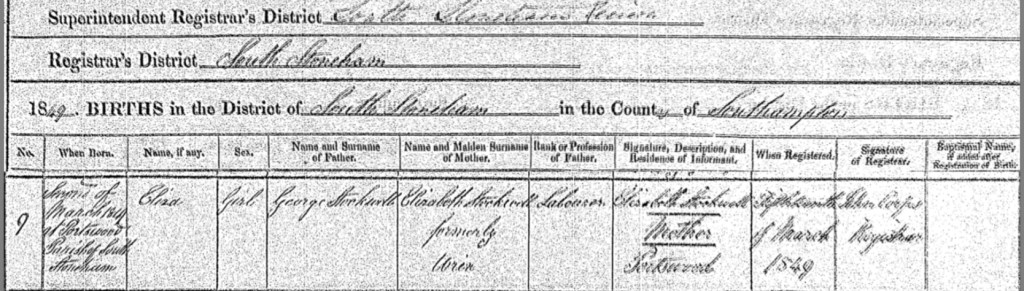
On a gentle spring day, as the world stirred with new life, Elizabeth Stockwell welcomed her firstborn into the world, a daughter, whom she and George lovingly named Eliza. The morning of Friday, the 2nd of March, 1849, marked the beginning of a new chapter, not just for Elizabeth as a mother, but for the little family she and George were beginning to build in Portswood, South Stoneham, Hampshire.
The tiny cries of newborn Eliza filled their humble home, a sound both fragile and powerful, a reminder of the delicate balance of life, of all the heartache Elizabeth had known, and of all the love she had yet to give. As she held her daughter for the first time, Elizabeth must have felt the weight of the moment, knowing that the journey of motherhood would bring both immense joy and inevitable sorrow, as she had witnessed in her own mother’s life.
Thirteen days later, on Thursday, the 15th day of March, Elizabeth made her way to the registrar’s office to officially record her daughter’s birth. The registrar, whose name is difficult to decipher in the historical record, documented that Eliza was the daughter of George Stockwell, a labourer, and Elizabeth Stockwell, formerly Wren, of Portswood. With this simple act, Eliza’s existence was etched into history, a name on a page, a life just beginning.
For Elizabeth and George, their daughter’s birth was a symbol of hope, of love carried forward through generations. In a world where nothing was guaranteed, Eliza was theirs, her tiny fingers grasping onto her mother’s, her future unwritten, yet full of endless possibility.
Portswood, located in the historic parish of South Stoneham in Hampshire, has a rich and evolving history that reflects the broader changes in the region over centuries. Situated just to the north of Southampton, Portswood originally consisted of rural farmland and scattered settlements, with little more than small villages and isolated farms. Its location, near the River Itchen and with access to key roads, made it a strategic area for development as Southampton expanded.
The area was originally part of the South Stoneham parish, which was known for its agricultural landscape and rural nature. The name "Portswood" itself likely refers to the presence of woodlands or forested areas used for timber and other resources. The "Port" part of the name may refer to its proximity to the city of Southampton, which was an important port town even in medieval times. Early records of Portswood are somewhat sparse, but it is believed to have been a quiet, agricultural area for much of the medieval period.  By the 18th century, the area began to see the first signs of urban development, particularly due to the growth of Southampton as a thriving port. The expansion of the town brought a greater demand for housing, services, and infrastructure, and Portswood, located on the outskirts of the town, became an attractive area for residential development. As trade and industry flourished in Southampton, it was no longer just a rural area but was becoming increasingly integrated into the city’s expansion.
The 19th century saw further changes as railways and roads connected Portswood to Southampton and other neighboring areas. The construction of the railway station in the mid-19th century was particularly important, as it allowed easier access to the city and the surrounding areas, making it a prime location for people to settle. During this time, Portswood transitioned from a quiet rural area to a more suburban environment, with new housing developments springing up to accommodate the growing population.
One of the defining features of Portswood during the Victorian and Edwardian eras was its role as a working-class suburb. The rapid industrialization of Southampton and its docks led to a population boom, with many workers moving to the area for housing. As the middle class expanded, so did the need for schools, shops, and places of worship. Portswood responded to these needs, with local schools, churches, and other community institutions becoming increasingly central to its identity.  Throughout the 20th century, Portswood continued to develop. It became a key residential area for both local workers and university students, especially with the expansion of the University of Southampton in the post-war years. This demographic shift brought a more diverse population to the area and led to the development of student accommodation, cafes, and cultural spots that made it an exciting place for young people. Its proximity to the university and transport links to the city center made Portswood a popular location for students, as well as professionals working in and around Southampton.
Over the years, Portswood has retained much of its traditional suburban character but has also seen considerable redevelopment, particularly in the late 20th and early 21st centuries. New housing estates, shops, and commercial developments have replaced some of the older buildings, and the area continues to grow as part of Southampton’s expanding urban fabric. However, parts of Portswood have maintained their historical charm, with period homes and local businesses still standing as a testament to its past.
Today, Portswood is a vibrant and diverse area, home to students, families, and professionals. The area’s rich history, from its agricultural roots to its role in Southampton’s urban growth, is still visible in its streets and architecture. While much of the rural landscape has been replaced by modern developments, remnants of Portswood’s history remain an important part of the area’s identity, ensuring that it continues to reflect both the past and present of Southampton.
On Sunday, the 15th day of April 1849, Elizabeth and George Stockwell carried their infant daughter Eliza to the doors of St Mary’s Church in South Stoneham, Hampshire. The morning light filtered through the stained-glass windows, casting soft colors onto the stone floors as the family stood before the baptismal font, ready to present their child to God.
For Elizabeth, this moment must have been deeply significant, a sacred tradition passed down through generations, marking the beginning of her daughter's spiritual journey. As Rev. W.D. Harrison gently poured the blessed water over Eliza’s tiny head, she was officially welcomed into the church, her name recorded in the baptism register alongside those of her parents. The entry confirmed that George was a labourer and that the family resided in Portswood, a modest detail in the register, but a testament to their place in the world.
Elizabeth had witnessed this ritual many times before, watching her younger siblings receive their own baptisms, some of whom had left this world far too soon. Perhaps she whispered a silent prayer that her little Eliza would grow strong, that she would be spared the sorrow of an early grave, that the waters of baptism would wash over her like a promise of a future filled with love, health, and happiness.
As they stepped out of the church, the crisp spring air wrapped around them, and Elizabeth held her daughter close, cherishing the weight of her in her arms. In that moment, nothing else mattered, Eliza was theirs, a child of faith, a child of hope, a child deeply loved.

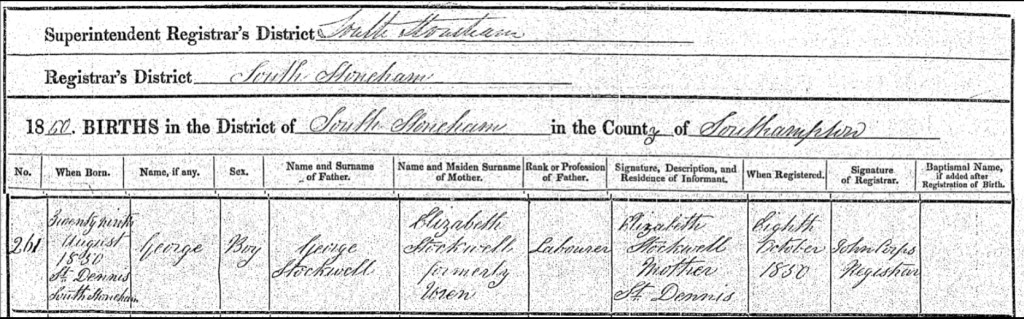
On Thursday, the 29th day of August 1850, Elizabeth Stockwell once again experienced the miracle of motherhood as she brought her second child into the world, a son, whom she and George named after his father. Born in St. Denis, South Stoneham, Hampshire, baby George entered a world that was both beautiful and uncertain, a world where love and hardship walked hand in hand.
In the quiet moments after his birth, as she cradled him in her arms, Elizabeth must have felt a familiar rush of emotion, the overwhelming love of a mother, the quiet fears that came with bringing a child into a world that could be both kind and cruel. She had known loss too many times before, had watched her own mother bury child after child, and she must have whispered a silent prayer that her little boy would be strong, that he would have a future filled with opportunity and joy.
On Tuesday, the 8th day of October, Elizabeth made the journey to the South Stoneham register office to officially record her son’s birth. Perhaps she carried him in her arms, wrapped tightly against the autumn chill, or maybe she left him at home in the loving care of his father or a neighbor. When she stood before the registrar, John Corps, he carefully recorded the details: George Stockwell, son of George Stockwell, a labourer, and Elizabeth Stockwell, formerly Wren, residing in St. Denis. With a few strokes of the pen, baby George’s place in the world was made official.
As Elizabeth left the office that day, the document tucked safely away, she may have glanced down at her son and smiled, knowing that this was just the beginning of his story. A story yet to be written, filled with the laughter of childhood, the trials of adulthood, and the unbreakable bond of family.
St Denis, located within the historic parish of South Stoneham, Hampshire, carries with it a name that hints at deep historical roots. Though now largely forgotten as a distinct settlement, the name itself suggests religious and medieval significance. "St Denis" is likely a reference to Saint Denis, the 3rd-century patron saint of France, whose veneration spread to England, particularly following the Norman Conquest. The presence of a place named after him suggests that at some point, there may have been a chapel, manor, or religious foundation dedicated to the saint in the area. South Stoneham, historically a widespread parish, encompassed several smaller settlements, including Swaythling, Portswood, and Bitterne. The parish was shaped by agriculture, woodlands, and the River Itchen, which provided an essential resource for milling, fishing, and transportation. The mention of St Denis as a specific location within this landscape implies that it may have once been a notable estate, a religious site, or even a small hamlet.
Medieval records of South Stoneham suggest that the area was dominated by large landholdings and church-owned lands. The manor of South Stoneham was historically linked to Winchester Cathedral, and religious influence in the region was strong. If St Denis had been the site of a chapel or an estate tied to the church, it would have played a role in the local economy and daily life, though it may never have been more than a small outlying settlement. By the 18th and 19th centuries, South Stoneham and its surrounding areas were still largely rural, though the growing importance of Southampton as a port and commercial hub was beginning to change the landscape. The introduction of turnpike roads and later the railway led to increasing urbanization. It is likely that any distinct settlement of St Denis was absorbed into this transformation, fading from local maps as larger villages and suburbs expanded.
The 20th century saw the continued spread of Southampton’s suburban areas, with much of South Stoneham becoming residential and commercial land. Many old place names disappeared from common use, replaced by modern developments and shifting boundaries. Today, St Denis does not appear as a distinct locality on contemporary maps, but historical records and references suggest that it was once an identifiable part of the wider South Stoneham landscape.
On Friday, the 30th day of August 1850, just one day after his birth, baby George Stockwell was carried into the sacred halls of St. Mary’s Church in South Stoneham to be baptised. The faint cries of the newborn echoed softly through the stone walls as his parents, Elizabeth and George, stood before the minister, ready to present their son to God.
For Elizabeth, this moment must have been a mixture of relief and reverence. Baptism was not just a ceremony, it was a rite of passage, a spiritual protection, and an act of faith. She had seen too much loss in her lifetime, had held and loved siblings who had not survived beyond infancy. In a world where life was fragile, especially for the children of labouring families, baptism felt like a safeguard, a plea to the heavens to watch over her precious boy.
The minister, whose name is now faded with time, solemnly recorded the details in the church register. Another George Stockwell now stood among the parish records, father and son forever linked by name. The simple words on the page confirmed his existence, his family, his place in the world: son of George, a labourer, and Elizabeth Stockwell, of St. Denis.
As the ceremony ended, Elizabeth may have pressed a gentle kiss to her son's forehead, whispering a silent promise to protect him, to love him, to give him the best life she could. With faith in her heart and hope for the future, she carried baby George out of the church and into the waiting world, ready to begin the next chapter of their journey together.

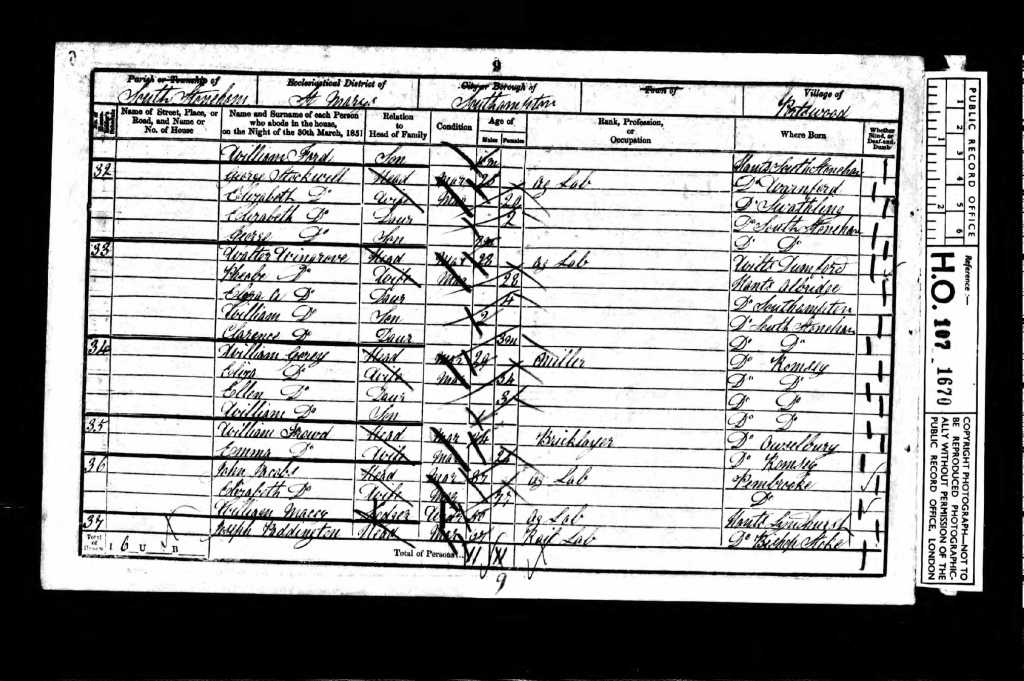
On the eve of the 1851 census, as the last light of Sunday, the 30th day of March, faded into dusk, Elizabeth Stockwell sat within the modest home she shared with her husband George in Portswood, South Stoneham. The air was still, save for the distant sounds of the village settling into night, perhaps the crackling of a hearth, the muffled conversations of neighbors, or the occasional cry of a child. Within her own walls, Elizabeth had all she held dear, her husband, her children, and the quiet rhythm of family life.
Beside her stood George, a hardworking agricultural labourer, his hands calloused from long days spent in the fields. He bore the weight of providing for his family, rising each morning with the sun to toil on the land, returning home weary but steadfast. Elizabeth, too, worked tirelessly, caring for their two young children, Elizabeth and George, ensuring their little home remained warm and full of love.
Their daughter, Eliza, barely two years old, may have been nestled in her mother’s lap, her tiny fingers curling around the fabric of Elizabeth’s dress, while baby George, just seven months old, slept soundly nearby. These were the quiet moments, the ones that often went unrecorded, yet they were the very essence of life, love found in the simplest of things, in the soft glow of a candle, in the whispered hush of a lullaby.
That night, as the census taker’s ledger awaited their names, Elizabeth may have paused for a moment to reflect on all that had brought her to this place. She had known hardship and sorrow, but she had also built a family of her own. As she lay down to rest, her children safe within arm’s reach, she could only hope that the future would be kind, that the life she and George were building would be one of strength, security, and love.
The summer of 1853 brought both joy and great change to Elizabeth’s life as she welcomed two new souls into the world, twins, a boy and a girl. In the quiet, early hours of the 3rd day of August, within their home in Saint Cross, Winchester, Elizabeth labored through the night. At 12:30 in the morning, her son Henry took his first breath, his cries breaking the silence of the darkened room. Just fifteen minutes later, at 12:45, his sister Sarah followed, their fates forever intertwined as they entered the world together.
The arrival of twins must have been met with both excitement and trepidation. Two tiny mouths to feed, two fragile bodies to nurture, it would be no small task. But Elizabeth, now a mother of four, knew well the weight of responsibility. She had felt the sting of loss before, had laid siblings and children alike to rest in the cold earth of Saint Nicholas Churchyard. Perhaps, as she held her newborns, she whispered silent prayers, willing them to be strong, to survive, to thrive.
Weeks later, on Sunday the 11th day of September, Elizabeth made the journey to the registrar’s office, carrying the weight of her growing family with her. Charles Mays, the registrar, carefully inked their names into the birth registry: Henry, a boy, and Sarah, a girl, children of George Stockwell, now recorded as a caster, and Elizabeth Stockwell, formerly Wren, of St. Cross.
Life in Winchester would be different from Portswood, but Elizabeth, ever resilient, would adapt. With four little ones depending on her, she had no choice but to press forward, finding strength in the love that surrounded her.


St Cross, Winchester, Hampshire, England, is a place steeped in history, faith, and tradition. Nestled in the peaceful water meadows of the River Itchen, just south of Winchester, the Hospital of St Cross is one of the oldest and most beautiful almshouses in England. The name "hospital" does not refer to a medical institution but rather to its original purpose as a place of hospitality and charity, offering shelter and sustenance to the poor, elderly, and travelers. Founded in the twelfth century, it has stood for nearly nine hundred years, preserving its medieval architecture and continuing its centuries-old mission of providing aid to those in need.
The origins of St Cross can be traced back to the reign of King Stephen, when Henry of Blois, the powerful Bishop of Winchester and grandson of William the Conqueror, established the institution around 1136. Henry of Blois was not only a church leader but also a statesman, a patron of the arts, and a man of great influence. Inspired by his travels to France and the hospices run by religious orders there, he founded St Cross to provide shelter, food, and care for the poor and needy. The hospital was endowed with lands and income to sustain its charitable work, and it became one of the wealthiest religious foundations of its kind in medieval England.
The buildings of St Cross are remarkable in their preservation and grandeur. The church, built in the Norman and early Gothic styles, is almost cathedral-like in its proportions. Its high vaulted ceilings, massive columns, and beautiful stained-glass windows create an atmosphere of reverence and timelessness. The almshouses, cloisters, and medieval gatehouse complete the scene, making it one of the finest surviving examples of monastic architecture. The entire complex exudes a sense of history, as if time has barely touched its stones.
Throughout the centuries, St Cross remained a place of charity and Christian service. It survived the turbulence of the Reformation, when many religious institutions were dissolved under Henry VIII. Although some of its lands were confiscated, the hospital itself was spared, and it continued to provide alms and shelter. In later centuries, it adapted to changing social conditions while remaining true to its original mission.
One of the most famous traditions of St Cross is the "Wayfarer’s Dole," which has been given to travelers for centuries. Any visitor who knocks on the door of the porter’s lodge can still receive a small beaker of beer and a morsel of bread, a custom said to date back to the hospital’s founding. This tradition reflects the medieval practice of hospitality, where religious houses and hospices offered food and drink to those in need.
Over time, the hospital became home to two distinct groups of brethren. The first, known as the Brothers of St Cross, followed the original foundation and wore black robes with a silver cross. Later, in the fifteenth century, Cardinal Beaufort, another Bishop of Winchester, established a second order within St Cross called the Order of Noble Poverty. These brethren wore red robes with a silver cross, leading to the nickname "the Black and Red Brothers" for the residents of the almshouse.
Despite its medieval origins, St Cross remains an active institution. The hospital continues to provide accommodation for elderly men, known as the brethren, who live within its historic buildings. The tranquil surroundings, including the beautiful gardens and the gentle flow of the River Itchen nearby, create a serene setting that has attracted visitors, writers, and artists for generations.
St Cross has often been described as a place frozen in time, where the echoes of history still linger. The connection to Winchester, with its great cathedral and royal past, adds to its significance, making it a site that bridges the medieval and the modern. It stands as a testament to the enduring power of charity and faith, a rare example of an institution that has remained true to its founding principles for nearly a millennium.
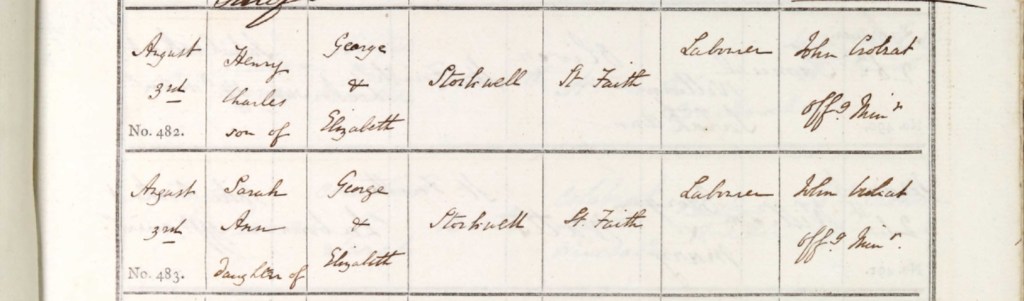
On a summer’s day, Wednesday, the 3rd day of August, 1853, Elizabeth and George Stockwell made their way to St. Cross with St. Faith Church in Winchester, the sacred place where their two precious twins, Henry Charles and Sarah Ann, would be baptised. The timing of the ceremony was both poignant and urgent. The twins, so new to the world, had arrived just hours earlier, at 12:30 and 12:45 in the morning, their tiny bodies still fragile, their futures uncertain.
Baptism was a moment of spiritual significance in those days, a ritual believed to offer protection, a safeguard for children so vulnerable in their early days of life. Yet Elizabeth, no stranger to hardship, must have been exhausted, her body still recovering from the rigors of childbirth. The physical toll of giving birth to twins, coupled with the emotional weight of fear and worry for their well-being, surely made this day even more overwhelming. The birth of Henry and Sarah had come with such a mix of joy and anxiety. In a world where infant mortality was far too common, Elizabeth and George would have been deeply aware of the precious fragility of life.
The minister, John Crokat, performed the ceremony and recorded the event in the church’s baptism register. Henry Charles and Sarah Ann Stockwell were marked as the son and daughter of George Stockwell, a labourer, and Elizabeth Stockwell, of St. Faith. They were baptised on the very same day they were born, a quickness that speaks volumes about the concerns that must have weighed heavily on Elizabeth’s heart.
It is likely that Elizabeth, despite her exhaustion, saw this act as a necessary step, a form of hope, of asking for divine protection over her beloved children. Perhaps, in those moments as her twins were brought forward, she whispered prayers of gratitude and protection, hoping beyond hope that they would survive to grow and thrive. The worries of a mother, raw and real, cannot be overstated, but neither can the strength it took to carry on.
St Cross with St Faith Church, located in Winchester, Hampshire, is a place of rich history and deep religious significance. Situated within the picturesque surroundings of St Cross, the church is part of the larger complex that includes the medieval Hospital of St Cross, one of England’s oldest almshouses. The church itself, though often overshadowed by the grandeur of the hospital, holds its own place in Winchester’s ecclesiastical history, blending the spiritual legacy of the town with centuries of faith and tradition.
The history of St Cross Church dates back to the founding of the Hospital of St Cross itself in the 12th century. The church was originally part of the religious and charitable foundation established by Henry of Blois, the Bishop of Winchester, in 1136. The bishop’s vision was to create a hospital that would provide shelter, food, and medical care to the poor, elderly, and travelers. The church served as the spiritual center for the residents of the hospital, and over the centuries, it has remained a significant part of the complex’s life, providing a place of worship and reflection for the community and visitors alike.
Architecturally, St Cross Church is a striking example of early Norman and Gothic design, with elements of both styles visible in its structure. The church was built with stone, its long, simple nave leading to a high altar at the far end. The Norman influences are evident in the thick, rounded arches and the solid construction, which was designed to withstand the test of time. Over the centuries, the church has undergone some changes and additions, but its fundamental structure remains largely unchanged since the medieval period.
The church was initially dedicated to St Faith, a Christian martyr whose feast day is celebrated on October 6th. St Faith’s dedication reflects the hospital’s role as a place of care and charity, as the saint was known for her unwavering faith in the face of persecution. The church was later referred to as "St Cross with St Faith" due to the strong connection between the hospital and the church's role as a spiritual hub for the hospital's residents.
The role of the church within the hospital complex has always been central to the lives of the brethren, the elderly men who lived at St Cross. The church was not only a place of regular worship but also a site for daily prayers and the spiritual care of the hospital’s residents. The clergy who administered the church were responsible for leading services and ensuring the continued religious education of the brethren. The church also played a key role in the spiritual wellbeing of the many travelers who sought refuge at St Cross, providing them with the opportunity to rest, pray, and seek solace before continuing on their journey.
Over the years, St Cross with St Faith Church has experienced several changes, especially during periods of religious and social upheaval. The English Reformation in the 16th century led to the dissolution of many religious foundations, but St Cross and its church were spared from dissolution due to their relatively small size and lack of significant wealth. During the Victorian period, there were efforts to restore and preserve the church, as the surrounding area gained more recognition for its historical and architectural value.
The church's surroundings, particularly the cloisters and gardens of the hospital, provide a serene and peaceful environment that enhances the experience of visiting. The river Itchen, which runs near the site, adds a natural beauty that complements the quiet dignity of the church and hospital buildings. Over the centuries, the church has remained a place of pilgrimage for those interested in its history, its spiritual significance, and its architectural beauty.
St Cross with St Faith Church is also known for its enduring role in the community. The church continues to host regular services, offering a spiritual home to both the residents of St Cross and members of the wider community. Visitors to the church are often struck by its sense of tranquility and timelessness, as if stepping into a space where centuries of faith and tradition have created an atmosphere of quiet reverence.
The church has not only been a religious space but also a focal point for various ceremonies and important events. The hospital’s annual celebrations, as well as special feast days dedicated to St Faith, continue to be observed with services and gatherings that reflect the long-standing traditions of the hospital and the church. The continued function of the church as both a place of worship and a symbol of the community’s commitment to charity underscores the enduring legacy of St Cross.
In addition to its religious functions, the church is an important part of the architectural and historical landscape of Winchester. The Hospital of St Cross and its church are an integral part of the city’s rich heritage, providing insight into the medieval period, the history of charitable institutions, and the religious life of England. For historians, pilgrims, and those interested in the architectural beauty of medieval churches, St Cross with St Faith Church offers a unique glimpse into the past, standing as a lasting testament to the faith and generosity that shaped the community of St Cross.
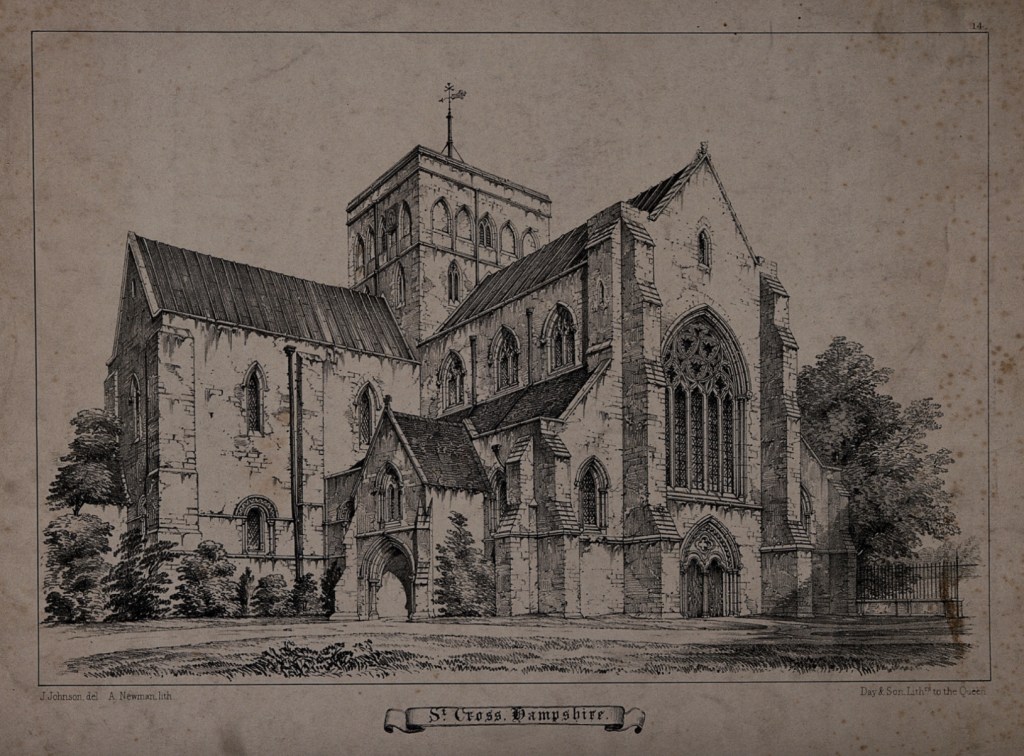
Tragedy struck with devastating force when, on Wednesday the 16th day of November, 1853, Elizabeth and George’s precious son, Henry Charles, just three months old, accidentally suffocated to death at their home in St Cross, Winchester. The loss of such a tiny life, so full of promise, left a gaping hole in the hearts of his grieving parents. To lose a child so young, in the most tragic and unexpected of ways, must have shattered the quiet joy that had only recently blossomed in their lives.
The events surrounding Henry Charles’ death remain shrouded in silence. The only official record of that fateful day comes from the Winchester coroner, John H. Todd, who formally registered Henry’s death on Tuesday the 13th day of December, 1853. The registrar, Charles Mays, documented in the death registry that Henry Charles Stockwell, a mere three-month-old infant, had tragically suffocated at St Cross on the 16th of November. Despite the records, the sorrow that Elizabeth and George must have felt is immeasurable. There were no detailed accounts in the newspapers of the time that could shed light on the specifics of the event.
It is heart-wrenching to imagine the agony Elizabeth must have endured, cradling her child in her arms only to lose him in such a fleeting moment. The grief of losing a child, especially in such an unexpected and unexplainable manner, would have been unbearable. The shock of the loss would have undoubtedly left her emotionally broken, and George, too, must have felt an immense weight of despair. They had already known the sting of loss before, but to lose their youngest child, just as they had begun to dream of his future, must have been a sorrow beyond words.
In the quiet of their home, Henry’s absence would have been felt in every corner, in every moment that passed without the sound of his cries, the warmth of his tiny hands. Elizabeth and George would have had to find the strength to carry on, though their hearts were broken, as they slowly navigated the deep, dark ache of losing their beloved son.

Elizabeth and George's hearts were shattered as they said their final goodbyes to their beloved son, Henry Charles, on Sunday, the 20th of November, 1853. The pain of losing him was a wound that would never fully heal. With heavy hearts, they laid their precious baby boy to rest at St. Cross with St. Faith Church in Winchester, Hampshire. The church, a place that had once welcomed Henry Charles for his baptism just months earlier, now became the site of his sorrowful burial.
The minister, John Crokat, performed the burial service with quiet reverence, acknowledging the profound grief of the young parents as they stood by the tiny grave. In the burial register, he recorded the sorrowful truth that Henry Charles Stockwell, from St. Faith, was buried on that cold November day, just four months old. Though his life was fleeting, Henry Charles’ memory would live on in the hearts of Elizabeth and George, forever marked by the tragic loss they had suffered.
As the earth was gently placed over their son’s grave, Elizabeth and George must have been consumed by a deep, unspoken sorrow. The sound of the minister’s voice, the weight of the ceremony, all would have seemed a blur as their hearts broke into a thousand pieces. No parent should ever have to face such a loss, but in the face of their unimaginable grief, Elizabeth and George would have clung to the love they had for Henry Charles, even as they were forced to say goodbye far too soon.

Elizabeth and George’s hearts, though still heavy with the loss of their son Henry Charles, found a glimmer of hope with the arrival of their daughter, Mary Stockwell, on Thursday, the 27th day of December, 1855. Mary’s birth brought a much-needed light into their lives, as the couple welcomed their precious daughter at Marine Parade, Southampton, Hampshire, England.
In the early days of the new year, Elizabeth made her way to the Southampton registry office to officially register her daughter’s birth. On Monday, the 4th day of February, 1856, Elizabeth’s name was recorded alongside that of her daughter, Mary, in the birth register. The registrar, Robert Wakeford, documented the important details: Mary, a little girl, was the daughter of George Stockwell, a Carter, and Elizabeth Stockwell, formerly Wren, who resided at Marine Parade, Southampton.
Although their hearts still carried the pain of past losses, the birth of Mary was a beacon of love and hope in their lives. Elizabeth and George must have found solace in the gentle presence of their daughter, holding her close, knowing that she would bring joy into their home once more. Mary, though born into a world marked by tragedy, would undoubtedly become the centre of her parents' affection and devotion, helping to heal the wounds that time could never fully erase.

On a winter’s morning, just weeks after welcoming their daughter into the world, Elizabeth and George carried little Mary in their arms and made their way to St. Mary’s Church, Southampton. It was Monday, the 11th of February, 1856, a day that marked Mary’s introduction into the Christian faith.
The stone walls of the church stood tall and solemn as the family stepped inside, the air filled with the faint scent of candle wax and damp wood. The echoes of their footsteps on the stone floor must have mingled with hushed whispers of other parishioners gathered to witness the sacred ceremony. As they approached the font, Elizabeth and George looked down at their infant daughter, swaddled in soft cloth, her tiny features peaceful and unknowing of the world around her.
The minister gently poured the blessed water over Mary’s forehead, marking the beginning of her spiritual journey. The sound of prayers and blessings filled the air as the baptism was recorded in the register a testament to Mary’s place within the church and her family’s enduring faith.
For Elizabeth and George, this moment was not just a religious duty but an act of hope. After all the heartbreak they had endured, they held onto the belief that Mary’s future would be bright, that she would grow strong and live a life filled with love. As they stepped out of the church that day, the winter sun breaking through the clouds, they must have whispered a quiet prayer, that this child would remain safe in their arms, untouched by the tragedies that had shadowed their past.
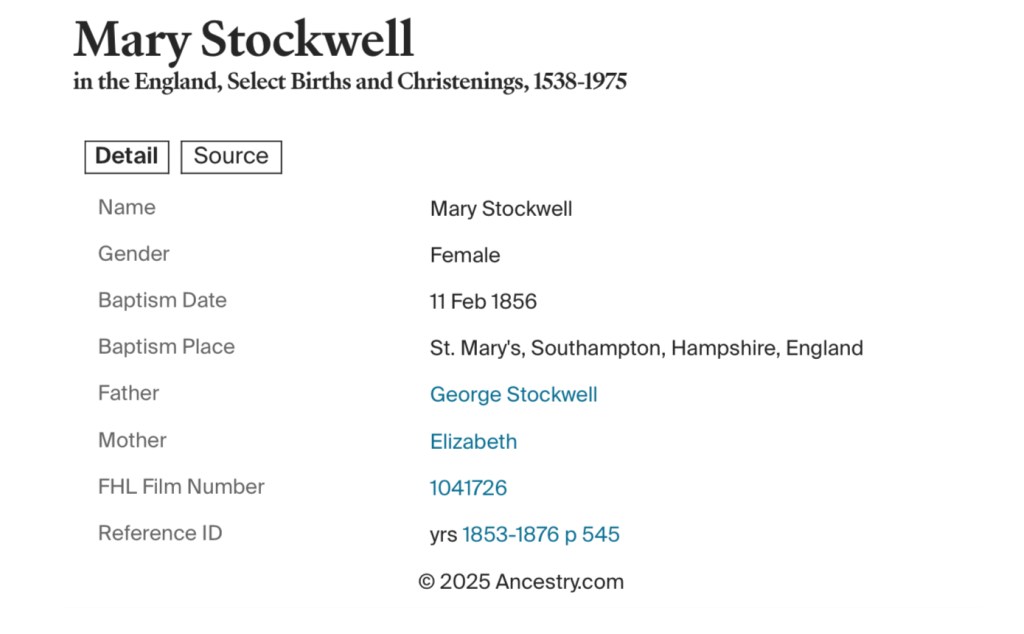
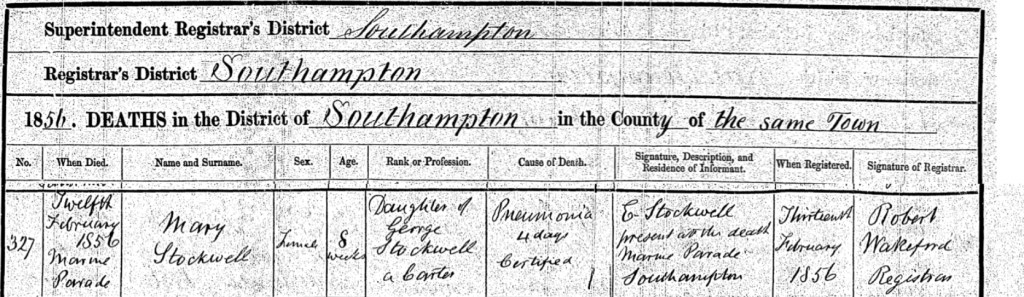
Just one day after Mary’s baptism, as her mother Elizabeth still held onto the warmth of that sacred moment, the cruel hand of fate stole their daughter away. On Tuesday, the 12th day of February 1856, just eight weeks after she had entered the world, Mary Stockwell took her final breaths in the home where she had been so dearly loved. The small house on Marine Parade, Southampton, which had once been filled with the soft sounds of a newborn stirring, now fell silent with grief.
Elizabeth was there, holding her tiny daughter, watching helplessly as life slipped away. How many times had she pressed a kiss to Mary’s forehead, hoping the warmth of a mother’s love could chase away the fever that gripped her fragile body? How many prayers had she whispered into the cold night air, pleading for a miracle that never came? Pneumonia had taken hold, and despite all her desperate efforts, there was nothing more she could do.
The following day, with a breaking heart, Elizabeth made the painful journey to register Mary’s death. The same hands that had cradled her child, had soothed her cries, now trembled as she signed her name before the registrar, Robert Wakeford. Only a day earlier, he had recorded Mary’s baptism, an entry of hope and new beginnings. Now, he solemnly wrote her name once more, this time marking the end of a life barely begun.
Mary Stockwell, daughter of George and Elizabeth, had succumbed to pneumonia after just four days of illness. Her death was certified, yet no piece of paper could capture the depth of sorrow that settled over her grieving parents. The weight of their loss was immeasurable, a wound that no time or prayer could ever truly heal.
Pneumonia, historically known as "the captain of the men of death" due to its severe impact, has been recognized since ancient times. The first descriptions date back to around 460 BC by Hippocrates, who identified it as a disease that causes inflammation of the lungs. Over the centuries, various epidemics and outbreaks have highlighted its deadly potential, including during the 1918 influenza pandemic.
In terms of treatment, antibiotics have revolutionized pneumonia management, particularly since the discovery of penicillin by Alexander Fleming in 1928. Today, antibiotics remain a cornerstone in treating bacterial pneumonia, while viral pneumonia may require antiviral medications if available. Supportive care, such as oxygen therapy and fluid management, is crucial in severe cases to help patients recover.
Prevention includes vaccination against common bacterial and viral pathogens that cause pneumonia, such as Streptococcus pneumoniae and influenza viruses. Additionally, maintaining good hygiene practices, avoiding smoking, and addressing underlying health conditions like HIV or chronic lung disease can reduce the risk of developing pneumonia.
Overall, while advances in medicine have significantly improved outcomes, pneumonia continues to pose a serious global health challenge, particularly among vulnerable populations such as the elderly and those with weakened immune systems.
On a cold and sorrowful Sunday, the 17th day of February 1856, Elizabeth and George Stockwell made the heartbreaking journey to Southampton Old Cemetery, where they laid their beloved daughter, Mary, to rest. The weight of their grief was immeasurable as they walked the quiet paths of the cemetery, their footsteps heavy with sorrow.
Mary, just eight weeks old, was buried in Row B, Block 7, Grave Number 224. She was the 7,586th soul to be interred in that sacred ground, yet to her grieving parents, she was not just another number, she was their daughter, their precious child, taken from them far too soon.
As the small coffin was lowered into the earth, Elizabeth and George would have clung to each other, their hands entwined in silent grief. The bitter February wind carried whispers of sorrow through the cemetery, rustling the bare branches above as if nature itself mourned alongside them.
There were no grand headstones or elaborate memorials for the daughter of a humble carter and his wife. Just a simple grave, marked only by love and loss, a resting place for a child who had barely begun her journey in life.
As the final prayers were spoken, I am sure Elizabeth longed to hold Mary once more, to press her to her chest, to feel the rise and fall of her breath. But all she could do now was whisper a final goodbye, leaving a piece of her heart there in the cold earth, where her baby girl would sleep forever.

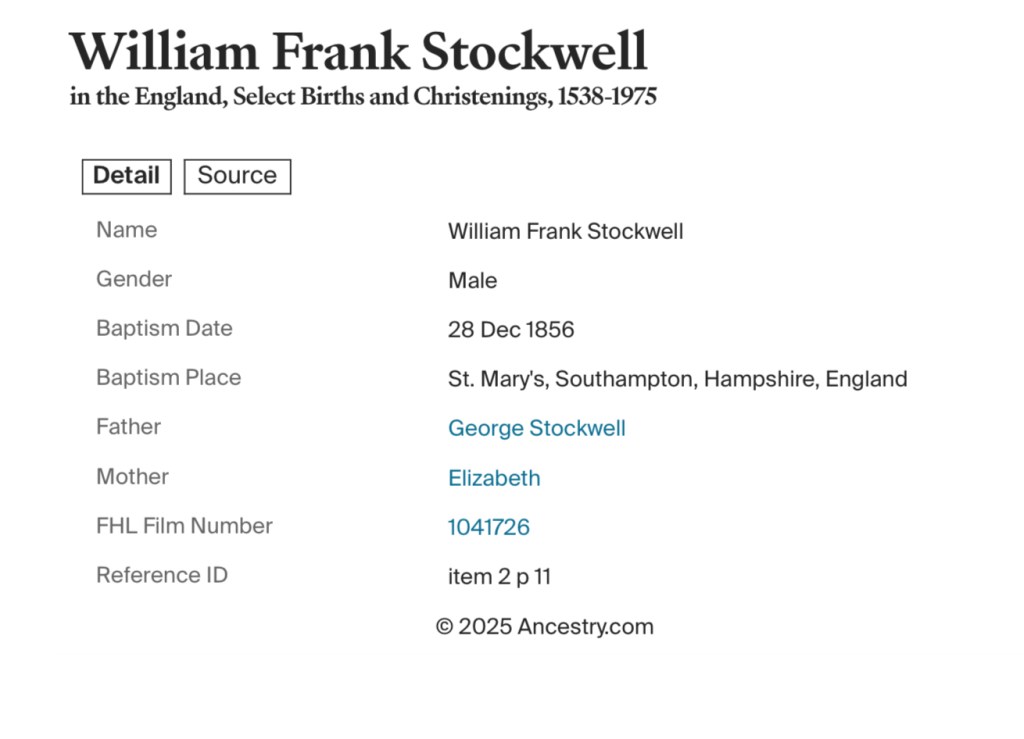
Elizabeth and George welcomed a new light into their lives when their son, William Frank Stockwell, was born on Wednesday, the 19th day of November 1856, at their home on Marine Parade, Southampton. After so much loss, his arrival must have been both a comfort and a reminder of the fragility of life.
More than a month later, on Monday, the 29th day of December 1856, Elizabeth made her way to the registry office in Southampton, her infant son nestled safely in her arms. She had made this journey before, too many times in grief, but this time, with hope. As she stood before the registrar, Robert Wakeford, she provided the details of her son’s birth, each word a quiet promise of the life she prayed he would have.
William Frank Stockwell, a boy. The son of George Stockwell, a carter, and Elizabeth Stockwell, formerly Wren. Born in their home by the sea, where the wind carried the scent of salt and possibility.
With her mark upon the document, Elizabeth sealed the first official record of her son’s life. A simple piece of paper, yet one filled with all the love and dreams she had for him.

On a crisp winter morning, Sunday the 28th day of December 1856, Elizabeth and George carried their infant son, William Frank Stockwell, to St. Mary’s Church in Southampton. The church, standing solemn and steadfast, had witnessed their joys and sorrows alike, and now, beneath its towering arches, they sought a blessing for their newborn son.
As the minister spoke the sacred words, water was gently poured over William’s tiny head, a symbol of protection and faith. In that moment, surrounded by the echoes of prayers and the flickering candlelight, Elizabeth must have held her breath, silently pleading that this child, this precious son, would be granted a long and healthy life.
William Frank Stockwell, a boy born of love, now carried the weight of his family’s hopes as he was welcomed into the faith, his name recorded in the baptism register of St. Mary’s Church.
The weight of loss bore down upon Elizabeth once more as she cradled the lifeless body of her precious son, William Frank. William had sadly passed away at their home, on Saturday the 9th day of January 1858. Just thirteen months old, his short life had been filled with the warmth of his mother’s arms, the gentle lullabies she whispered in the quiet hours, and the unspoken dreams she had for his future. But now, as the harsh January winds howled outside their home on Marine Parade, Southampton, all those dreams had been stolen away by the cruel grip of pneumonia.
Elizabeth had known this heartbreak before, but it never lessened. Watching yet another child slip away, feeling his tiny fingers go cold in hers, it was a pain that words could never truly capture. And yet, even in the depths of her sorrow, she found the strength to do what no mother should ever have to: she made that long, tear-filled walk to the registry office once more.
On Monday, the 11th of January 1858, with her heart shattered, Elizabeth stood before the registrar, Robert Wakeford, and uttered the words that made the nightmare real. William Frank Stockwell, her beautiful boy, had lost his battle with pneumonia after five agonizing weeks. As the ink dried on the register, sealing her grief into official record, Elizabeth, her hands trembling, her vision blurred by tears, placed her mark, an X. A silent testament to a mother’s unrelenting sorrow.
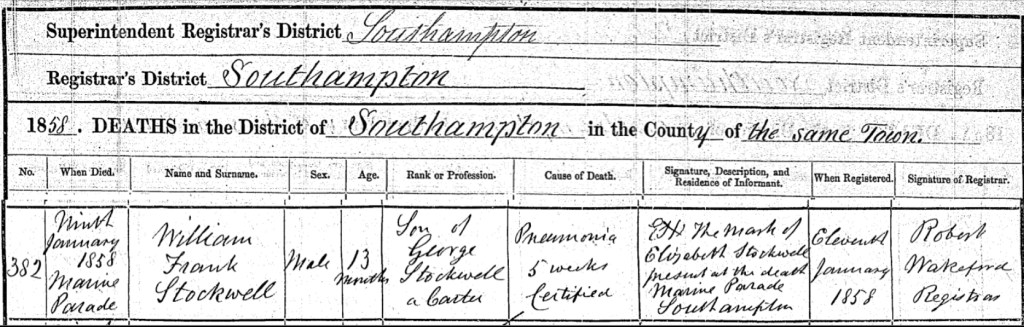
On a bitter January morning, the grieving footsteps of Elizabeth and George Stockwell echoed through Southampton Old Cemetery as they made the unbearable journey to lay their infant son, William Frank, to rest. The weight of loss pressed upon them with each step, the cold air biting against their tear-streaked faces.
On Tuesday, the 12th day of January 1858, they stood at the edge of an open grave, Row B, Block 7, Number 261, where their beloved William Frank would be buried. But he would not rest alone. In the cruel reality of infant mortality, this grave had already received the tiny bodies of others, 33 innocent souls taken too soon. The youngest among them had never even drawn breath, stillborn and nameless, while the oldest had barely reached 22 months.
There was no small coffin set apart, no tenderly carved headstone for William Frank. Instead, he was lowered into the shared earth alongside the others, a stark and sorrowful testament to the fragility of life. There were no grand words spoken, only the quiet sobs of his mother, the unspoken grief of his father, and the heavy silence of a world that kept turning despite their devastation.
As the grave was filled, Elizabeth and George knew they would have to walk away, leaving their baby behind in the cold ground. But how could a mother turn her back on her child? How could a father step away, knowing his son’s laughter would never again fill their home?
And yet, they did. Because they had no choice. Because life, despite its cruelty, demanded they carry on. But I’m sure as Elizabeth left that cemetery, her heart shattered beyond repair, she carried with her the unbearable weight of yet another child lost, another piece of her soul buried beneath the earth.

Elizabeth’s arms, so often left empty by grief, were once again filled with new life when she gave birth to her son, Henry Stockwell, on Wednesday, the 23rd day of June 1858. The walls of their home at Number 1, Marine Street, Southampton, had witnessed both the joys of birth and the unbearable sorrow of loss, and now, with Henry’s arrival, hope flickered once more in the hearts of his weary parents.
A week later, on Wednesday, the 30th day of June, Elizabeth set out on a familiar yet always bittersweet journey to the Southampton registry office. As she stepped through its doors, she carried not just the weight of her newborn son in her arms, but the memories of the children she had lost before him. The registrar, Robert Wakeford, recorded in the birth register that Henry Stockwell, a boy, was the son of George Stockwell, a Dock Labourer, and Elizabeth Stockwell, formerly Wren, of Number 1, Marine Street.
Though Elizabeth signed the document, she knew that ink and paper could never capture the depth of a mother’s love or the silent prayers she whispered for her son’s future. With each child she had birthed, she had learned to cherish every fleeting moment, never knowing how long they would be granted to her. As she held Henry close, she must have wondered, would he be the one to stay? Would he grow strong and fill their home with laughter? Or would fate, as it had so many times before, come to steal him away too soon?
For now, there was no answer, only the steady rise and fall of Henry’s tiny chest against hers, a rhythm of life that she held onto with all her heart.

Marine Street in Southampton, Hampshire, is a locale with a rich history that reflects the city's maritime heritage and urban development. Situated in the Chapel area of Southampton, Marine Street once connected Marine Parade to Melbourne Street, forming part of a vibrant community near the waterfront.
The Chapel area, where Marine Street was located, has long been associated with Southampton's maritime activities. In the 19th century, this district was a bustling hub, characterized by a network of streets that housed workers and their families involved in the city's thriving port and shipbuilding industries. The proximity to the docks made it a convenient residence for those whose livelihoods were tied to the sea.
Marine Street itself was emblematic of the working-class neighborhoods that flourished during this period. The street was lined with modest terraced houses, accommodating the growing population drawn to Southampton by employment opportunities. The community was tight-knit, with residents relying on local amenities such as pubs, shops, and schools that catered to their daily needs.
However, the mid-20th century brought significant changes to Marine Street and its surroundings. Urban redevelopment initiatives aimed at modernizing the city led to the demolition of many old structures in the Chapel area. Marine Street was among those affected, with demolitions occurring around 1961. This transformation was part of a broader effort to revitalize Southampton, which had suffered damage during World War II and was adapting to contemporary urban planning trends.
The absence of a baptism record for Henry raises haunting questions. Had Elizabeth and George, after so much heartache, begun to lose faith in the God they had once turned to in their times of joy and sorrow? With each tiny coffin they had laid in the cold earth, with every whispered prayer that had gone unanswered, did they begin to wonder if there was anyone listening at all?
Elizabeth had not only buried five of her own children but had also lived through the deaths of her younger siblings, tiny souls snatched away by illness and circumstance. She had walked the same paths to the churchyard over and over, carrying the weight of grief that no mother should bear. She had watched as her babies were lowered into the ground, helpless against the cruelty of a world that seemed determined to break her.
Perhaps, by the time Henry was born, she could no longer find it in herself to stand before an altar and offer him up to a God who had taken so much from her. Perhaps she still believed, but her faith was now wrapped in bitterness and doubt. Or perhaps, in the quiet of her home, she whispered her own private prayers over her newborn son, not trusting the church but still pleading with the heavens to let him stay.
Whatever the truth may be, Henry’s missing baptism speaks to a woman who had endured more than most. Whether it was an act of defiance, despair, or simple exhaustion, it leaves us wondering, how much loss can one heart take before it stops believing in miracles altogether?
Four days. Just four fleeting days was all the time Elizabeth had with her newborn son, Henry. After carrying him within her for months, feeling his tiny kicks, dreaming of the life he might lead, she barely had a chance to hold him before he slipped away.
On that Sunday, the 27th day of June, 1858, in the small, cramped home on Marine Street, death came quietly once more, stealing yet another child from Elizabeth’s aching arms. But this time, it was not she who registered his passing. Instead, on Tuesday the 29th day of June, their neighbour, Jane Dymott, took on the burden, a silent testament to Elizabeth’s unbearable grief. How could she bear to walk into that registry office again, to utter the same heartbreaking words, to sign her name with that sorrowful mark, an ‘X’ that had become the signature of her suffering?
The cause of death, debility, a vague and cruel term, meant little in the face of the reality. He had simply been too small, too fragile, too weak for this world. There was no fight, no lingering illness, just a life barely begun and then suddenly gone.
How must she have felt, standing in the empty silence of her home, the weight of yet another death pressing down upon her? Did she rage at the heavens? Did she sink into despair? Or had she, after so many losses, become numb to the pain, her tears long since drained away?
Henry never had the chance to grow, to laugh, to cry out for his mother’s touch. And Elizabeth, a mother in mourning once again, was left with nothing but memories of the briefest of moments, a heartbeat in time, gone too soon.

Debility, a term historically used to describe general weakness or a decline in physical or mental strength, has been recognized in medical literature for centuries. It was often associated with aging, chronic illnesses, and post-infection recovery. In earlier times, debility was a common diagnosis for unexplained fatigue and frailty, frequently mentioned in 19th-century medical texts and often linked to conditions such as tuberculosis or malnutrition.
The treatment of debility has evolved significantly. In the past, remedies included herbal tonics, rest cures, and dietary improvements. The Victorian era saw the rise of so-called "nerve tonics" and patent medicines, many of which contained stimulants like caffeine or even opiates. Today, treatment depends on the underlying cause. If debility stems from a chronic illness, managing the primary condition is key. Nutritional support, physical therapy, and lifestyle modifications such as regular exercise and a balanced diet can help improve strength and overall well-being.
Prevention of debility involves maintaining a healthy lifestyle, managing stress, ensuring adequate sleep, and addressing any medical conditions that could lead to physical decline. In older adults, preventing falls, staying active, and engaging in social activities are also crucial in reducing the effects of debility.
While the term is less commonly used in modern medical practice, the concept remains relevant, particularly in geriatrics and rehabilitation medicine, where improving quality of life and functional capacity is a priority.
Under the somber summer sky, Elizabeth and George walked the now-familiar path to Southampton Old Cemetery, their hearts burdened with yet another unbearable loss. On Thursday, the 1st day of July 1858, they laid their precious son, Henry, to rest in an open grave, Row C, Plot 13, Number 270, a place now marked only by sorrow and the weight of countless tiny lives lost too soon.
Henry was the 10,445th soul to be interred there, yet to Elizabeth, he was not just a number in the cemetery’s growing register. He was her baby, her love, her hope, now cradled not in her arms, but in the cold embrace of the earth.
Did she whisper a final lullaby as they lowered him down? Did she press one last kiss to his lifeless brow before saying goodbye? Or did she simply stand in silence, staring at the fresh earth, unable to find words for the grief that threatened to swallow her whole?
It was an unmarked grave, an open resting place shared with others, gone too soon, strangers in life, now bound together in death. There was no headstone to bear Henry’s name, no lasting marker to say that he had ever existed at all. Only his mother’s breaking heart would forever remember the son she had held for just four days.
As the soil was placed over him, sealing another chapter of sorrow, one might wonder, was this the moment Elizabeth stopped believing? How could any merciful God take so many innocent lives, leave a mother with empty arms time and time again? How many more children would she be forced to bury before fate allowed her to keep one?

It was on Sunday, the 16th day of January 1859, that Elizabeth’s sister, Mary Wren, married William Oakley in Chilworth, Hampshire, England. A new chapter began for Mary, as she stepped into married life, building a future with her husband.
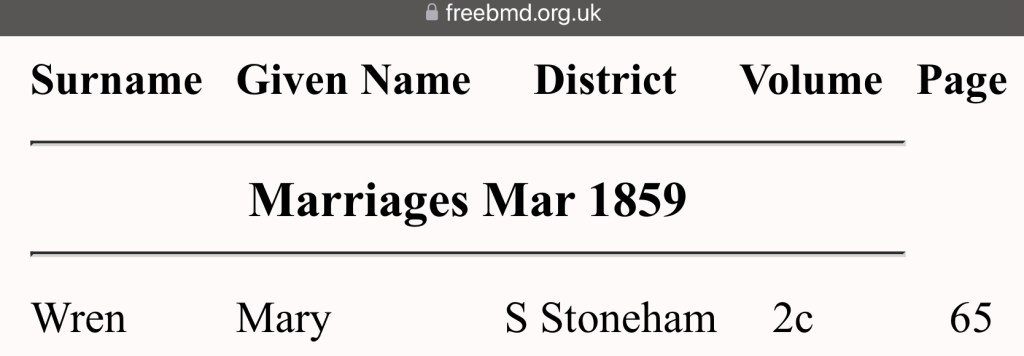
While the details of their wedding day remain just out of reach, the official record stands as proof of their union. Due to the rising costs of family research, obtaining every marriage certificate has become a challenge, but for those who wish to uncover more, a copy can be obtained through the General Register Office using the following reference:

GRO Reference – Marriages Mar 1859, Wren, Mary, Oakley, William, S. Stoneham, Volume 2c, Page 65.

As Elizabeth continued to navigate the hardships and joys of her own life, she may have found comfort in knowing that her sister Mary had embarked on her own journey, one filled with the same hopes and uncertainties that marriage and family life had brought to her.
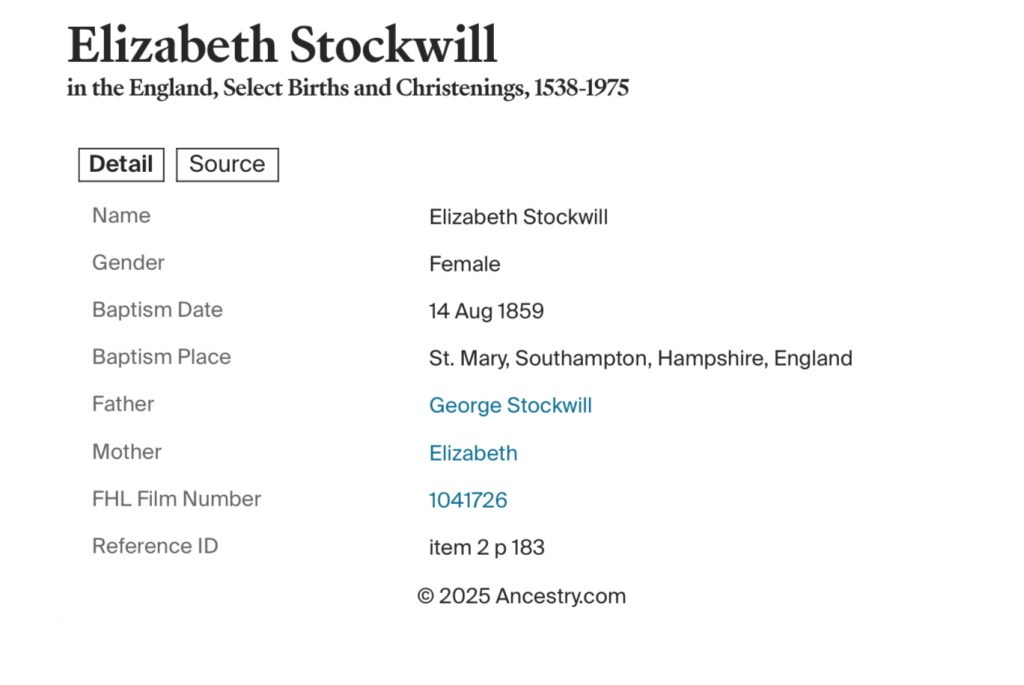
After so much loss, a new life entered the world, Elizabeth Stockwell, born on Sunday, the 15th day of May 1859, at the family’s home on Marine Street in Southampton. Perhaps, for a fleeting moment, her mother Elizabeth felt the stirrings of hope, the warmth of possibility that this child would be different, that this daughter would stay.
On Tuesday, the 21st day of June 1859, Elizabeth once again made the familiar journey to the Southampton register office to record the birth of her namesake. Robert Wakeford, the registrar, carefully noted in the birth register that baby Elizabeth was the daughter of George Stockwell, a general labourer, and Elizabeth Stockwell, formerly Wren, of Number 1, Marine Street.
Did Elizabeth smile as she spoke her daughter’s name aloud, as she gave the necessary details? Or did she hesitate, the weight of the past pressing against her, knowing that many of her children's names had been written in both the birth and death registers within heartbreakingly short spans of time?
This new Elizabeth was a symbol of resilience, a testament to her mother’s strength and unwavering love. Would fate be kinder this time? Would this child grow strong, filling their home with laughter instead of sorrow? Or would the cruel hands of fate, which had stolen so many before her, come knocking once again?

On Sunday, the 14th day of August 1859, Elizabeth and George carried their infant daughter to St Mary’s Church in Southampton, where she was baptised before God. As the minister performed the sacred rite, the cool stone walls of the church bore silent witness to yet another moment of devotion in Elizabeth’s life, a life that had seen more heartbreak than most could endure.
Was this baptism an act of faith, a desperate plea for divine protection over her newborn child? Or was it simply tradition, a ritual carried out because it had always been done? After losing so many before, did Elizabeth still dare to believe that this child would be different, that she would be given the chance to grow, to live, to love?
With the echoes of the minister’s words still lingering in the air, Elizabeth and George left the church, their daughter safely in their arms. They had done all they could. Now, all they could do was wait, wait and hope that this Elizabeth would survive where so many had not.
By the evening of Sunday, the 7th day of April 1861, Elizabeth and George Stockwell had settled into their home at Number 3, Godfrey Street, Southampton. With them were their surviving children, Eliza, George, Sarah Ann, and little Elizabeth. Life had not been kind to them, yet they carried on, bound by love and endurance.
Their modest dwelling was crowded, shared with two other families, the Songmans and the Kinnairds. Sixteen souls lived beneath that single roof, packed together in a home that could barely contain the weight of so many lives. The air must have been thick with the sounds of children, the scent of simple meals, and the murmured conversations of weary labourers after a long day’s work.
George, ever the provider, was listed as a labourer, while their son, George, had begun his education, a small glimmer of hope for a future beyond the struggles of the working poor. Despite the hardships they had endured, the heart-wrenching losses, the relentless uncertainty, Elizabeth and George continued forward. They had no choice but to press on, to keep their children safe, to build whatever life they could in a world that had already taken so much from them.

Godfrey Street, once a notable thoroughfare in Southampton, Hampshire, played a significant role in the city's 19th-century urban landscape. Situated in the eastern part of Southampton, the street extended from Marine Parade to Godfrey's Court, an area later occupied by the gasworks in Crabniton.
The street derived its name from a prominent landowner, Mr. Godfrey, whose estate around 1800 encompassed the region stretching from what is now Northam Road down to Marsh Lane. This expanse saw the development of a small village, marking the early growth of the area.
In its heyday, Godfrey Street was characterized by residential and commercial establishments, serving as a hub for the local community. Among its notable landmarks was the Godfrey Inn, a public house that operated until the early 20th century. This inn was part of the portfolio of A. Barlow & Co Ltd, a company that owned several pubs across Southampton and beyond.
The area surrounding Godfrey Street, including Godfrey's Court (also known as Godfrey's Cut or Passage), was known by the early 19th century as Crabniton. This district, located east of Golden Grove, later became the site of the gasworks, indicating the industrial evolution of the locality.
Over time, with urban development and industrial changes, Godfrey Street and its immediate environs underwent significant transformations. The establishment of the gasworks and other industrial facilities led to the restructuring of the area, leading to the disappearance of some of the original street layouts and landmarks.
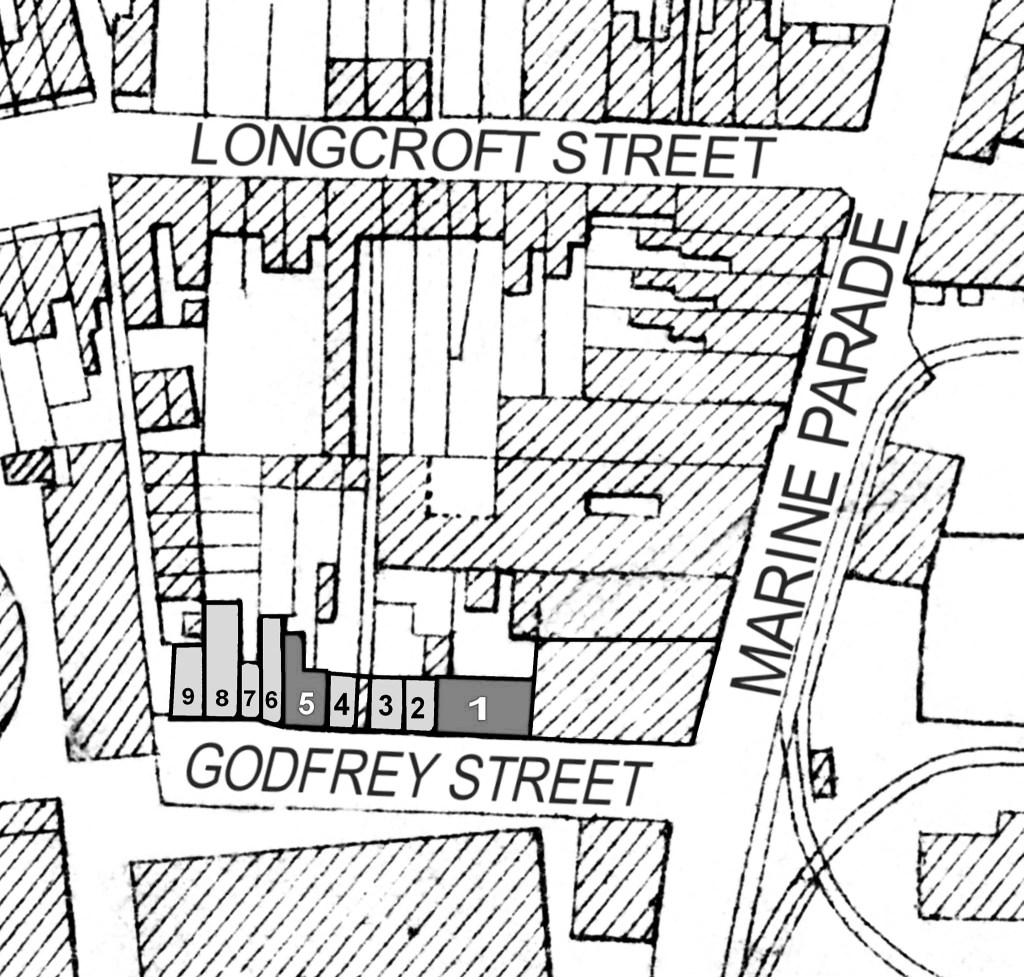
Godfrey’s Town all but disappeared when the gas company expanded its works at the turn of the 20th century and took over most of the land between Longcroft Street and Princess Street, leaving just a few buildings fronting Marine Parade until they too were built on in the early 1900s.
Godfrey’s Town on the 1846 map shows 15 buildings along Godfrey Street including the Victory public house which was No 1. It was owned by Barlow’s Victoria Brewery and its early landlord was John Powell. The Biffin family were licensees from the 1860s until the late 1880s, after which its name had changed to the Godfrey Inn by the 1890s. Following its name change the pub closed around the turn of the century under the stewardship of Frederick Thomas, its final landlord before the site was taken over by the gas works expansion.
Godfrey Street had a second pub which was the Olive Branch at No 5 where Thomas Cole was landlord in 1871. The Cole family were evident behind the bar until the late 1880s and the pub, owned by the Winchester Brewery, ceased trading in February 1904 and, like its neighbour the Godfrey Inn, was swallowed up by the expansion of the gas works at that time. The map shows Godfrey’s Town in its latter days of 1897.
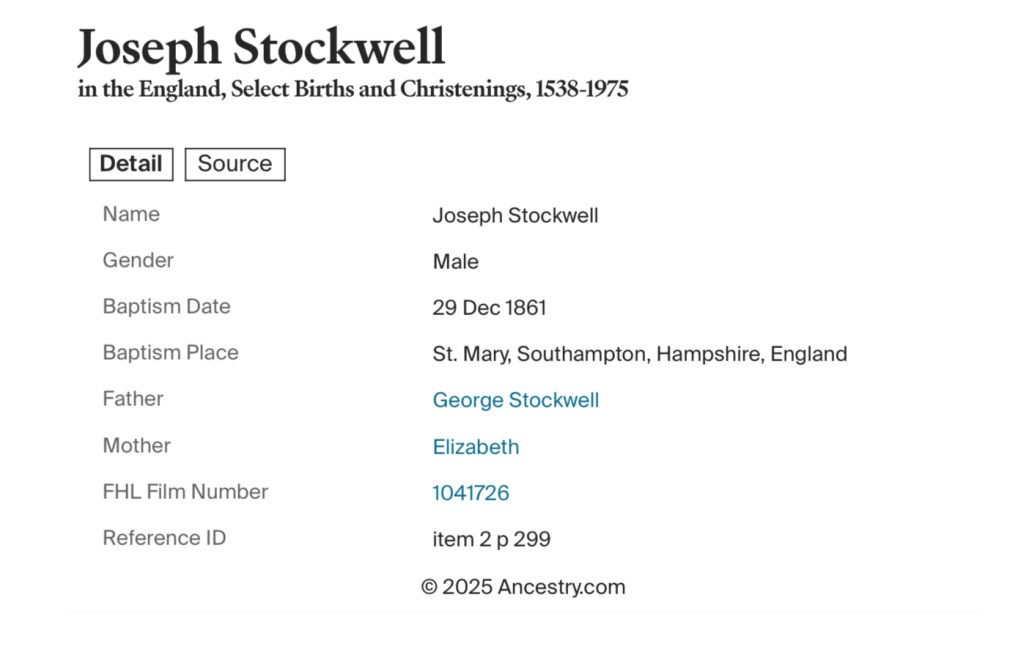
Amidst the struggles of daily life, a new glimmer of hope arrived for Elizabeth and George Stockwell. On Wednesday, the 11th day of September 1861, Elizabeth gave birth to a son, whom they named Joseph, at their home on Number 4, Godfrey Street, Southampton. Another child to love, another chance to rebuild after so much heartbreak.
A month later, on Tuesday, the 15th day of October, Elizabeth made the familiar journey into Southampton to register Joseph’s birth. With the weight of past losses still etched into her soul, she carried her newborn son’s details to the registrar, Robert Wakeford. He carefully inscribed into the register that Joseph, a boy, was the son of George Stockwell, a general labourer, and Elizabeth Stockwell, formerly Wren, of Godfrey Street.
With each child, Elizabeth must have hoped for a future free from sorrow, where she could watch them grow into adulthood. Yet, she knew all too well that life had never made such promises.

On Sunday, the 29th day of December 1861, Elizabeth and George brought their infant son, Joseph Stockwell, to St Mary’s Church, St Mary’s, Southampton, Hampshire, England, to be baptised. Surrounded by their family and community, they stood before the minister as Joseph was welcomed into the church.
The baptism was a moment of faith and tradition, marking the beginning of Joseph’s spiritual journey. Despite the many losses Elizabeth and George had endured, they continued to baptise their children, perhaps holding onto the hope that faith would provide comfort and protection for their growing family.
Elizabeth’s younger sister, Sarah Ann Wren, married Francis Ferentz (Farenty) in the district of South Stoneham, Hampshire, during the December quarter of 1862 at just 16 years old. Though the details of their wedding remain undocumented here, their union marked the beginning of a new chapter in Sarah Ann’s life.
For those interested in obtaining an official copy of their marriage certificate, the following GRO reference can be used:

GRO Ref - Marriages, Dec 1862, Wren, Sarah Ann, Farenty, Francis, S. Stoneham, Volume 2c, Page 91.

Sarah Ann’s marriage was another milestone in the Wren family's journey, as each sibling began forging their own path amid the hardships and joys of 19th-century life.

Elizabeth and George welcomed their daughter, Rosina Stockwell, into the world on Sunday, the 13th day of December 1863, at their family home, Number 3, Godfrey Street, Southampton, Hampshire, England.
A month later, on Thursday, the 14th day of January 1864, Elizabeth made the journey into Southampton to officially register Rosina’s birth. The registrar, Robert Wakeford, documented in the birth register that Rosina, a girl, was the daughter of George Stockwell, a general labourer, and Elizabeth Stockwell, formerly Wren, residing at Number 3, Godfrey Street, Southampton.
Rosina’s arrival brought new hope to the family, but with their history of loss, Elizabeth must have held her newborn daughter close, cherishing every precious moment.

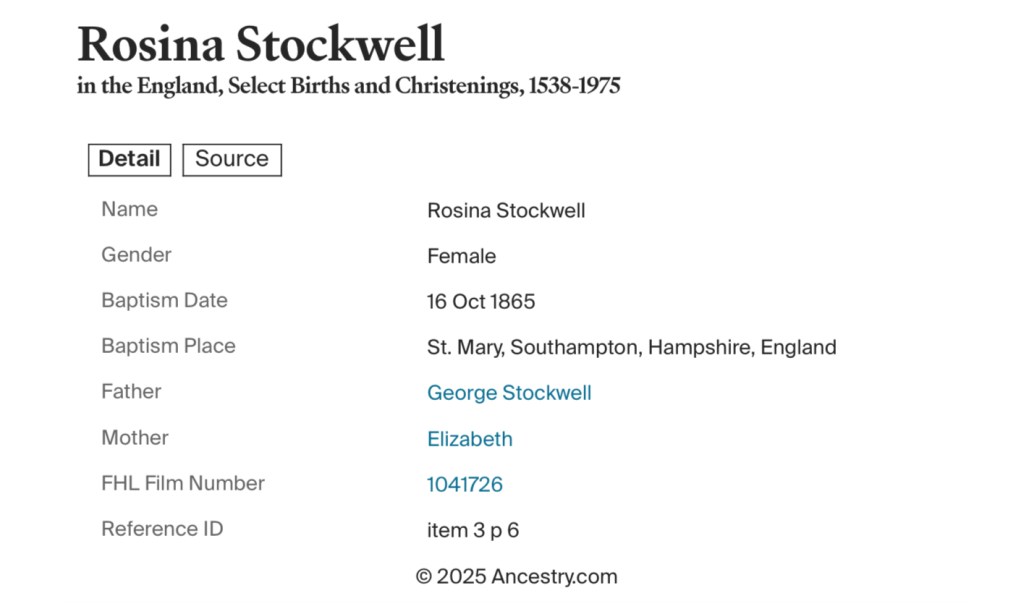
On Monday, the 16th day of October 1865, Elizabeth and George carried their beloved daughter, Rosina Stockwell, to Saint Mary’s Church in Southampton, Hampshire, England, to be baptised. The small church, filled with the echoes of whispered prayers and the flickering glow of candlelight, bore witness to yet another chapter in their lives.
As they stood before the minister, holding their precious child, they must have felt the weight of both joy and sorrow, the joy of welcoming Rosina into the faith, yet the lingering sorrow of all the children they had loved and lost before her. Elizabeth, who had endured so much heartache, might have whispered silent prayers for this daughter, hoping she would grow strong and healthy, spared from the cruel fate that had taken so many of her siblings.
The minister’s voice filled the sacred space as he carefully recorded Rosina’s details in the baptism register, a moment that would forever bind her to the church and community. George, a hardworking man, stood beside his wife, their hands perhaps clasped together, sharing an unspoken understanding of the trials they had faced.
Despite their hardships, this day was one of hope, of faith, and of an unwavering love for their children. As the ceremony concluded, Elizabeth may have held Rosina just a little tighter, pressing a gentle kiss to her tiny forehead, silently vowing to protect and cherish her for as long as life would allow.
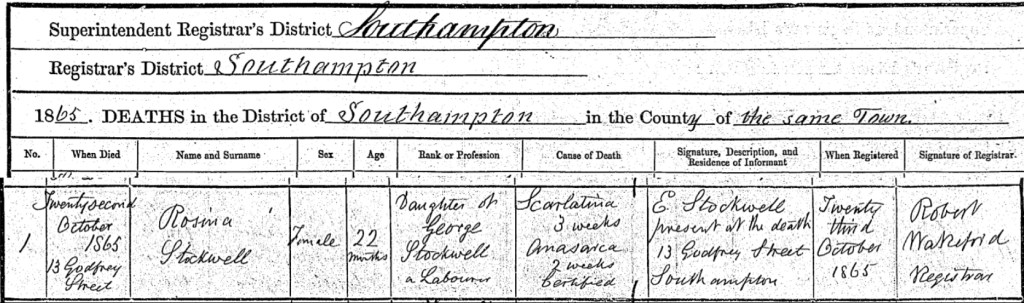
On Sunday, the 22nd day of October 1865, Elizabeth’s world was once again shattered as she held her 22-month-old daughter, Rosina Stockwell, in her arms, watching helplessly as life slipped away. Their home at Number 13, Godfrey Street, Southampton, had been filled with the echoes of a child’s laughter, the soft pitter-patter of tiny feet, and the warmth of a mother’s love. Now, it was silent, overtaken by the sorrow of yet another unbearable loss.
For three weeks, little Rosina had suffered from the cruel grip of scarlatina, her tiny body weakened further by anasaica in the final two weeks. Elizabeth had done everything she could, comforting her daughter through restless nights, cooling her fevered skin with trembling hands, whispering soft words of love and reassurance. But no amount of love or care could stop the inevitable. And so, on that fateful Sunday, Elizabeth was left to cradle her child’s still form, her tears falling onto Rosina’s soft curls as the weight of grief settled heavily on her heart once more.
Despite the agony that threatened to consume her, Elizabeth found the strength to do what she had done far too many times before, she made the sorrowful journey to the registrar’s office the very next day. With a heart laden with grief, she stood before Robert Wakeford, the familiar registrar who had recorded both the joyous arrivals and the devastating departures of her children. With a shaking hand, she gave Rosina’s details, her voice barely above a whisper as she confirmed the cause of death. The words scrawled into the register, Scarlatina, three weeks, Anasarca, two weeks, felt like a cruel finality to a life that had barely begun.
As Elizabeth left the registrar’s office, the cool autumn air wrapped around her, but it could do nothing to ease the deep ache inside her chest. She had buried too many of her children, and with every loss, a piece of her own soul seemed to fade. Now, she faced yet another painful farewell, another tiny grave to visit, and another cherished name etched into her heart forever.
Scarlatina, more commonly known as scarlet fever, is an infectious disease caused by the bacterium *Streptococcus pyogenes*, which also causes strep throat. It primarily affects children and was once a significant cause of illness and death, particularly in the 19th and early 20th centuries, before the advent of antibiotics. The disease presents with a sore throat, fever, and a distinctive red rash that gives it its name. The rash, which typically starts on the chest and spreads across the body, feels like sandpaper and is often accompanied by a flushed appearance of the face with a pale ring around the mouth. The tongue may also become swollen and take on a "strawberry" appearance due to inflamed red papillae.
Historically, scarlatina was a feared disease, often occurring in epidemics. Before the discovery of penicillin, there were limited treatment options, and complications such as rheumatic fever, kidney disease, and pneumonia could prove fatal. In the 18th and 19th centuries, outbreaks were common in crowded urban areas, and quarantine measures were sometimes imposed to control its spread. Families affected by scarlatina would often hang a red cloth outside their homes to warn others of infection. Treatment before antibiotics focused on bed rest, hydration, and attempts to reduce fever using cool compresses or herbal remedies. Some physicians recommended bloodletting or the use of mercury-based medicines, though these were often ineffective or harmful.
As medical understanding improved, scarlatina became less deadly, particularly with the introduction of antibiotics in the 20th century. Today, it is easily treatable with penicillin or other antibiotics, and while outbreaks still occur, they are far less dangerous than in previous centuries. However, if left untreated, the disease can still lead to serious complications.
Anasarca, also known as extreme generalized edema, is a medical condition characterized by widespread swelling due to the accumulation of fluid in the body's tissues. Unlike localized edema, which affects specific areas such as the ankles or hands, anasarca involves the entire body and is usually a symptom of severe underlying health issues rather than a disease itself.
Historically, anasarca was often associated with diseases such as heart failure, kidney disease, liver failure, and severe malnutrition. Before modern medicine, its causes were not well understood, and treatment options were limited. In the 19th century, physicians sometimes attributed the condition to an imbalance of bodily "humors" and attempted treatments such as bloodletting, purging, or diuretics derived from plants like foxglove. Patients suffering from anasarca were often bedridden, and the swelling could become so severe that it restricted movement, breathing, and organ function.
One of the most well-known causes of anasarca was nephrotic syndrome, a kidney disorder that leads to excessive protein loss in the urine, resulting in fluid retention. Liver diseases, particularly severe cirrhosis, could also cause extreme swelling due to the body's inability to manage fluid balance properly. In cases of heart failure, the body's weakened circulation system led to fluid buildup, worsening the condition over time. Malnourished individuals, particularly those suffering from extreme protein deficiency (kwashiorkor), often displayed anasarca as their bodies lost the ability to regulate fluid effectively.
With the advent of modern medical advancements, anasarca is now better understood and treated based on its underlying cause. Treatments may include diuretics to remove excess fluid, medications to support heart or kidney function, and dietary interventions to correct nutritional imbalances. However, in severe cases, the prognosis depends on the reversibility of the underlying condition. If the root cause, such as advanced heart or kidney failure, is untreatable, the outlook remains poor.
While both scarlatina and anasarca were once common and feared conditions, medical progress has significantly changed their impact. Scarlet fever, once a deadly childhood disease, is now easily treated, while anasarca remains a serious condition but is better managed with modern medical care. Their histories reflect the evolution of medical science and the continuous efforts to understand and combat disease.
On Wednesday, the 25th day of October 1865, Elizabeth and George Stockwell laid their beloved 22-month-old daughter, Rosina, to rest at Southampton Old Cemetery in Southampton, Hampshire, England. The day was heavy with sorrow as they made the heart-wrenching journey to the burial ground, a path they had walked far too many times before. In the quiet embrace of the cemetery, surrounded by countless other grieving families, they said their final farewell to the child they had so dearly loved.
Rosina was interred in Row N, Block 83, Number 59, in an open grave shared with many other infants, each one a child taken too soon. The youngest among them had never even drawn a breath, and Rosina, at just 22 months old, was the eldest. It was a cruel reminder of the fragility of life, of how many parents had stood in this very spot, whispering silent prayers and shedding tears over tiny graves.
Elizabeth’s heart ached as she watched the small coffin lowered into the earth, knowing she would never again hold her daughter, never hear her laughter, never feel her small arms wrap around her neck. The weight of loss pressed down on her shoulders, a burden that had grown heavier with each child she had been forced to say goodbye to. She thought of Rosina’s soft hair, her bright eyes, and the way she had once toddled around their home, filling it with joy. Now, there was only silence, and the bitter wind that carried away Elizabeth’s whispered goodbye.

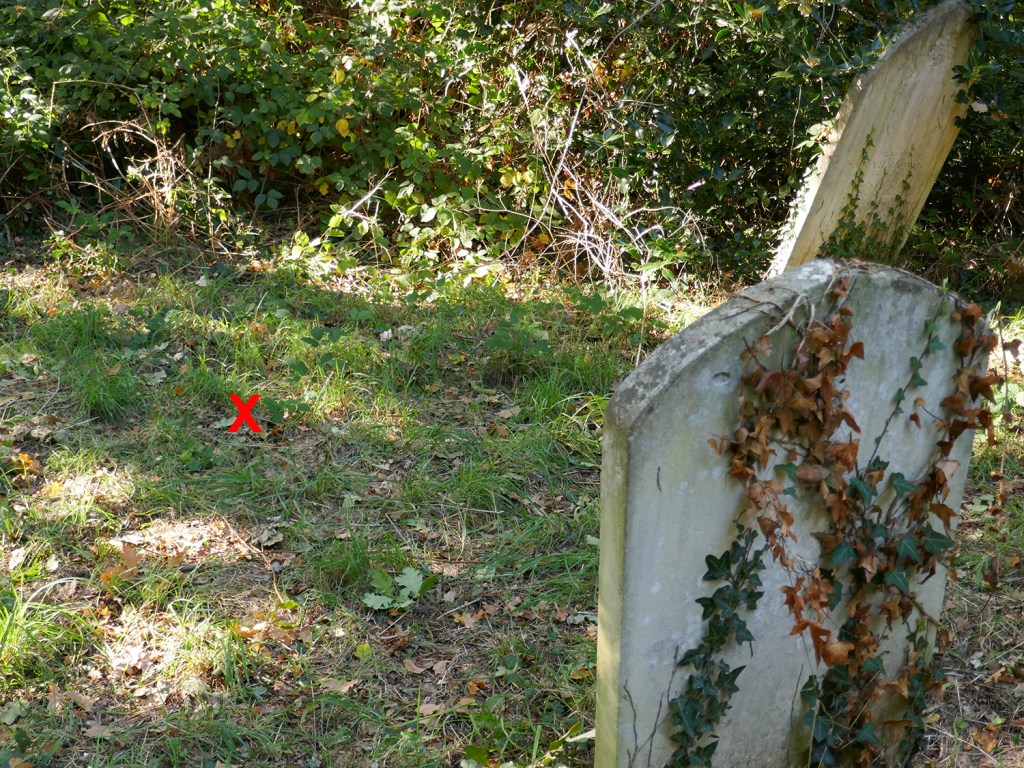
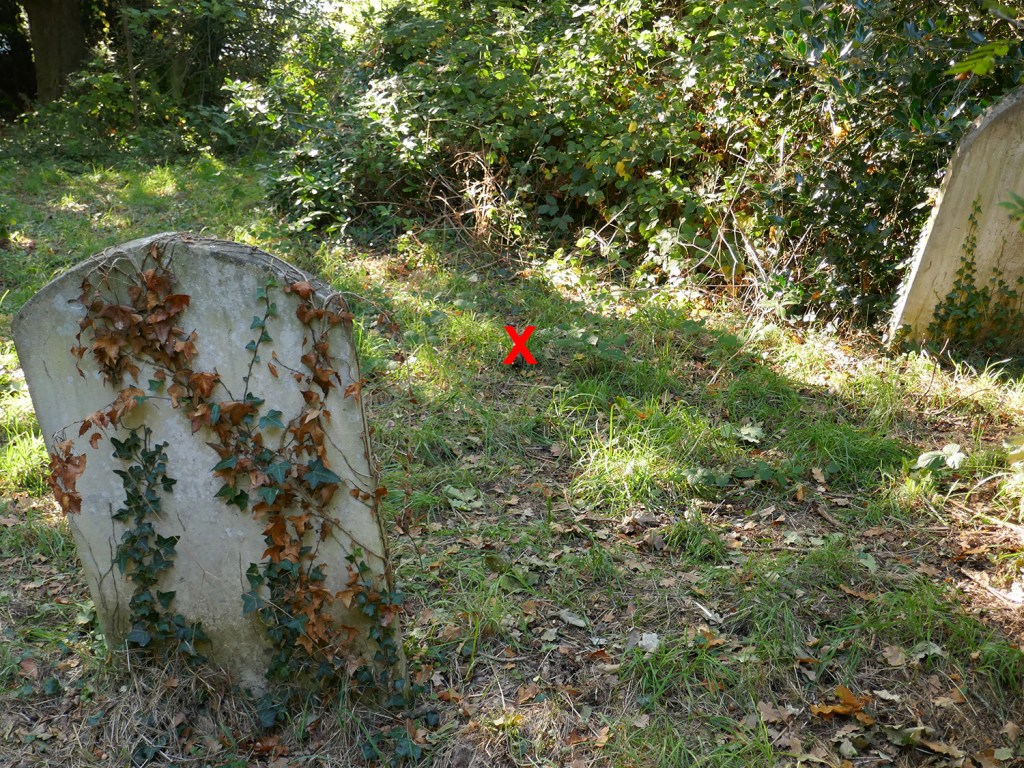
On a spring Monday, the 15th day of April 1867, Elizabeth brought a new life into the world. It was a bittersweet moment, one filled with hope yet shadowed by the pain of her past losses. Her son, whom they named Edward Stockwell, was born at their home at Number 5, West Place Chapel, Southampton, Hampshire, England. After all the sorrow Elizabeth had endured, this small boy, with his tiny fingers and soft cries, brought a moment of joy to their family. He was a bright light in the midst of so much heartache, a fresh beginning in a life that had been touched by so much tragedy.
Elizabeth made the journey to the Southampton register office on Friday, the 17th of May, 1867, to register her son’s birth. The registrar, William Cox, recorded in the birth register that Edward was the son of George Stockwell, a general labourer, and Elizabeth Stockwell, formerly Wren, who lived at West Place, Southampton. With this simple entry, Elizabeth officially welcomed her son into the world, though it must have felt like a small triumph amidst the struggles that had defined so much of her life.
Edward’s birth was a reminder of the resilience of life. After losing so many precious children, Elizabeth and George now had the opportunity to raise another child, and perhaps, in their hearts, they held on to the hope that this little one would be the one to grow and thrive, bringing some peace to the weary hearts of his parents.

West Place was a 19th-century street located on the east side of Western Esplanade in Southampton, Hampshire, England. Stretching from Simnel Street to Westgate Street, it was situated in an area that, at the time, lacked a dedicated shore road.
During the 19th century, Southampton underwent significant development, transitioning from a medieval port town to a bustling industrial city. This period saw the construction of various streets and buildings to accommodate the growing population and the expansion of commercial activities. West Place was among these developments, contributing to the urban landscape of the city.
The area surrounding West Place was characterized by a mix of residential and commercial properties, reflecting the diverse and evolving nature of Southampton's urban fabric during this time. The presence of establishments such as West Hall, which housed King Edward VI Grammar School in the late 17th century, indicates the area's importance in educational and civic matters.
While specific details about the daily life and community activities on West Place are limited, it is evident that the street played a role in the broader historical context of Southampton's growth and transformation. The existence of such streets highlights the city's adaptation to the needs of its inhabitants and its response to the pressures of urbanization during the 19th century.
Today, the legacy of West Place is preserved through historical records and maps, offering a glimpse into the city's past and the development of its urban landscape. These records serve as valuable resources for understanding the historical geography of Southampton and the evolution of its neighborhoods.
On a summer's day, Sunday the 9th day of June 1867, Elizabeth and George's daughter (my 3rd Great-Grandmother), Eliza Stockwell, took a step into a new chapter of her life. At 18 years old, Eliza, a spinster from Portswood, married 20-year-old bachelor William Harry Freak, a boot maker from Horton, London. The ceremony took place at Christ Church in Portswood, Southampton, Hampshire, England, a meaningful setting for their union.
The minister who officiated the ceremony, though his name remains unclear, recorded the details in the Marriage Index, noting that William was the son of Charles Freak, a boot maker, and Eliza was the daughter of George Stockwell, a labourer. Their wedding day was witnessed by Francis Ferrety and L. Norman, whose names remain etched in the registry as witnesses to the significant event in the lives of Eliza and William.
This marriage, marked by young love and the joining of two families, was a significant moment in Eliza's life, a turning point that led her into a new home and a new future with William, far from the family she had known in Southampton.
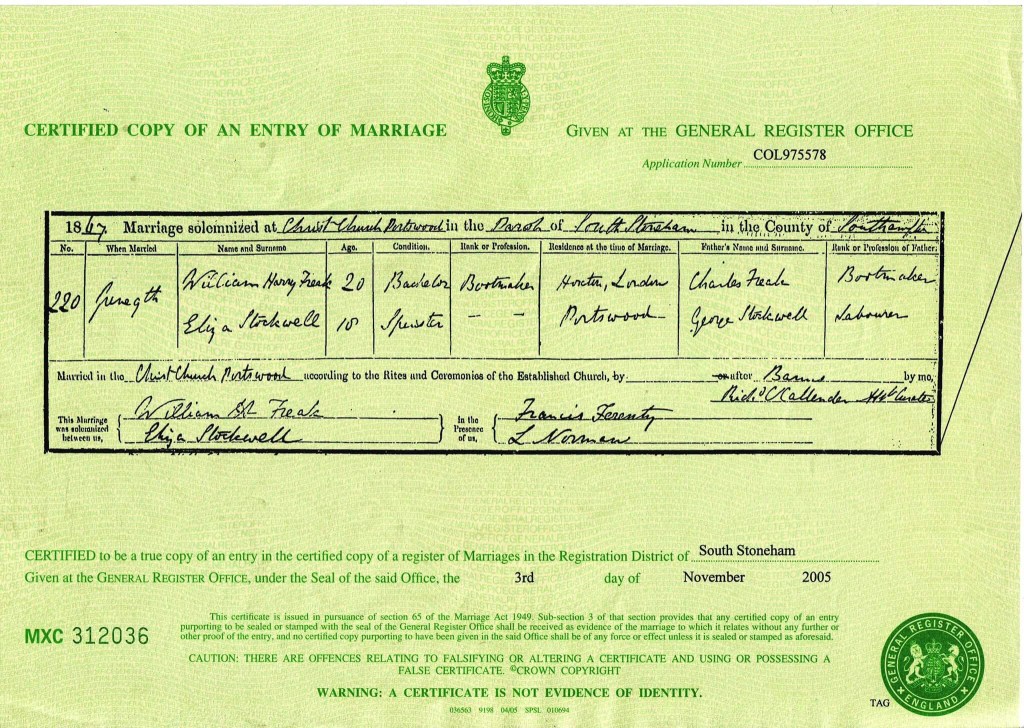
Christ Church, located in Portswood, Southampton, Hampshire, holds a rich history that is intertwined with the local community and the lives of those who lived in the area. Founded in the mid-19th century, Christ Church was built to serve the growing population of Portswood and surrounding areas, as Southampton began to expand due to industrialization and increased urbanization. It was consecrated in 1849, reflecting the changing needs of the population, particularly the increased demand for places of worship in the expanding residential areas.
The church is a beautiful example of the Gothic Revival architectural style, featuring pointed arches, intricate stained-glass windows, and a towering spire that reaches into the sky, offering a sense of grandeur and stability. The interior, with its high vaulted ceilings and elegant furnishings, provided a serene environment for worship, weddings, baptisms, and other religious ceremonies that were an integral part of the community's life. Christ Church not only served as a spiritual hub but also played a central role in marking important life milestones, such as births, marriages, and deaths.
For many families in the area, Christ Church was the place where they gathered for significant moments, including the marriage of Eliza Stockwell and William Harry Freak on the 9th day of June, 1867. The church stood as a testament to the deep connection between faith and the community. It was a place where generations of families came together, finding comfort and support in the church’s walls during both joyous and difficult times.
Over the years, Christ Church has remained a symbol of continuity, faith, and community spirit for those who lived in and around Portswood, and its legacy continues to reflect the rich history of Southampton. It is a place where memories have been made, families have been united, and lives have been celebrated in the heart of the city.
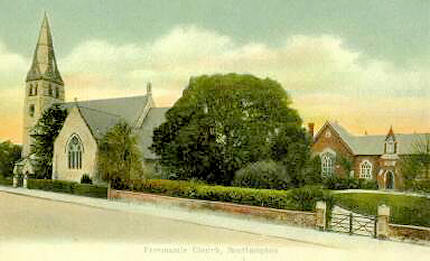
On Saturday, the 8th day of May, 1869, Elizabeth gave birth to a daughter, whom they named Ellen Stockwell. Their home, at West Place Chapel in Southampton, was once again filled with the soft cries of a newborn, a hopeful sound that echoed through their lives after years of heartbreaking loss. For Elizabeth and George, the birth of Ellen must have brought both a sense of joy and apprehension, knowing all too well the fragility of life. Their hearts, though scarred by the past, were ready to embrace the new life that had come into their arms.
Ten days after Ellen's birth, Elizabeth made the journey into Southampton to officially register her daughter's birth. On Tuesday, the 18th day of May, 1869, Elizabeth stood before William Cox, the registrar, who recorded in the birth register that Ellen was the daughter of George Stockwell, a general labourer, and Elizabeth Stockwell, formerly Wren, of West Place, Southampton.
This simple entry in the register, though brief, marked another chapter in their family's life, a moment where Elizabeth and George hoped, prayed, and believed that their little girl would bring new hope, strength, and a brighter future to their home. They had endured so much loss, and yet with every new child, they held onto the possibility that their family could grow and thrive despite the pain of the past. Ellen’s birth was a reminder that love and life continued, even in the face of sorrow, and perhaps, this child would be the one to carry them into a new season of happiness.

On Sunday, the 19th day of September, 1869, Elizabeth and George took their daughter Ellen to Saint Mary's Church in Southampton to have her baptized. It was a day filled with both solemnity and hope, as they stood before the congregation, asking for God's blessing upon their precious daughter. The baptism of Ellen was a sacred moment, marking her entry into the faith and the community.
As Elizabeth and George watched their little girl, they must have reflected on the difficult journey they had traveled, and the many losses they had endured. Yet, with this baptism, there was also a sense of renewal, an opportunity to begin anew and to place their trust in God once again.
The event was recorded in the church registers, a permanent reminder of that special day when Ellen was baptized and brought into the fold of the Church. For Elizabeth and George, it was more than just a religious ceremony, it was a promise, a commitment to care for their daughter and to raise her in the light of love and faith, hoping that she would thrive and bring joy to their family.
On a summer day, Monday, the 27th day of June, 1870, Elizabeth and George’s son, George Stockwell, took an important step in his life. The 20-year-old bachelor, a mariner, stood with his bride-to-be, Sarah Ann Bennett, a young woman from Hanover Street in Bristol. They were married at St Matthias Church in Bristol, Gloucestershire, a place where their love story would be forever etched in history.
The ceremony was officiated by Minister R. Clackie, who recorded in the marriage register that George was the son of George Stockwell, a labourer, and Sarah was the daughter of John Bennett, also a labourer. The couple, both of full age, stood together at the altar, ready to begin a new chapter in their lives.
As they exchanged vows, their union was witnessed by Robert Batty and Sarah Ellis, who, with warmth and joy, supported them in this special moment. For George and Sarah, this day symbolized the beginning of a new life filled with hopes and dreams, a life they would build together far from the familiar streets of Southampton, in the bustling heart of Bristol. Elizabeth and George, though not physically present, no doubt felt the deep significance of the occasion as they looked on with love and pride, watching their son take this step toward his own future.
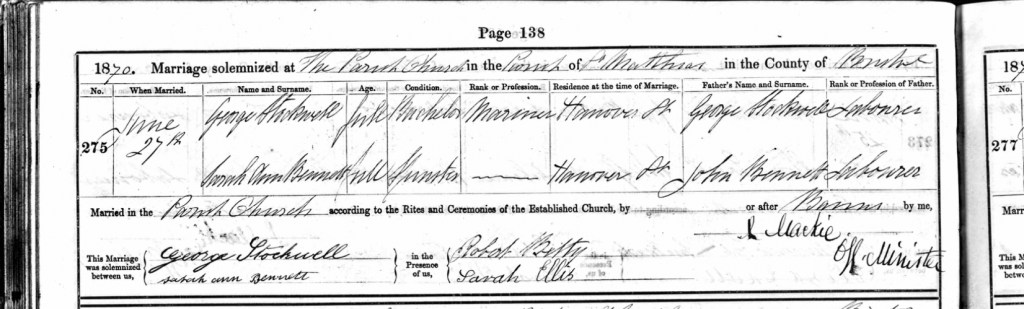
St Matthias Church, located in the vibrant area of Bristol, Gloucestershire, England, is a historic and prominent place of worship with a long and rich history that stretches back to the 19th century. The church was constructed during a period of rapid expansion and industrial growth in Bristol, a time when the population of the city was increasing, and there was a significant need for new churches to accommodate the growing communities in the surrounding areas.
St Matthias Church was consecrated in 1850, designed in the Gothic Revival style, a popular architectural choice of the time. It stands as a striking example of this style, featuring pointed arches, detailed stained-glass windows, and a soaring spire that provides a visible landmark for the area. The church’s design emphasizes verticality and light, with its tall, narrow windows allowing natural light to flood the interior, creating a sense of openness and serenity within.
The church played an important role in the spiritual life of the community, providing a place of worship, fellowship, and comfort for many of Bristol’s residents. It was used for regular services, baptisms, weddings, and funerals, making it a central part of local life. As families in the area went through the milestones of life, many gathered at St Matthias Church to mark these events. For generations, it has served as a place where local people could come together to celebrate the joys of life, as well as find solace in times of sorrow.
In addition to its spiritual functions, St Matthias Church also served as a social and community hub, where charitable events, gatherings, and activities were organized to support those in need. It became a focal point for both religious and social life in the area, strengthening the bonds of the community and fostering a sense of belonging and shared purpose.
Over the years, St Matthias Church has undergone various changes and updates, yet it has retained much of its original character and charm. The church is still an active place of worship today, continuing its legacy as a central part of the community in Bristol. It stands as a testament to the enduring faith of its congregation, as well as the changing history of the city and its people. The church remains an iconic and cherished landmark in the area, reflecting the rich cultural and spiritual heritage of Bristol.
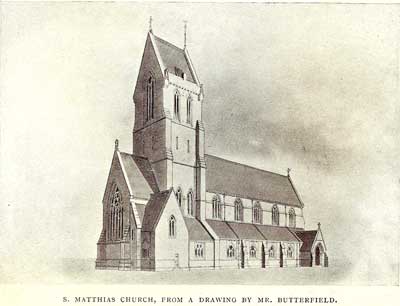
On the eve of the 1871 census, Sunday, the 2nd day of April, Elizabeth, her husband George, and their children, Elizabeth, Ellen, Joseph, and Edward, were living at Number 7, Bellevue Street, St. Mary’s, Southampton, Hampshire, England. George was listed as a labourer, while Elizabeth, Joseph, and Edward were noted as scholars, likely attending school in the area. The family’s home on Bellevue Street would have been a place filled with the sounds of growing children, each with their own dreams and ambitions, while Elizabeth and George continued to work hard to provide for their family. It was a moment in time, captured in the census, as they moved forward in life, as a family, despite the hardships and challenges they had faced along the way.

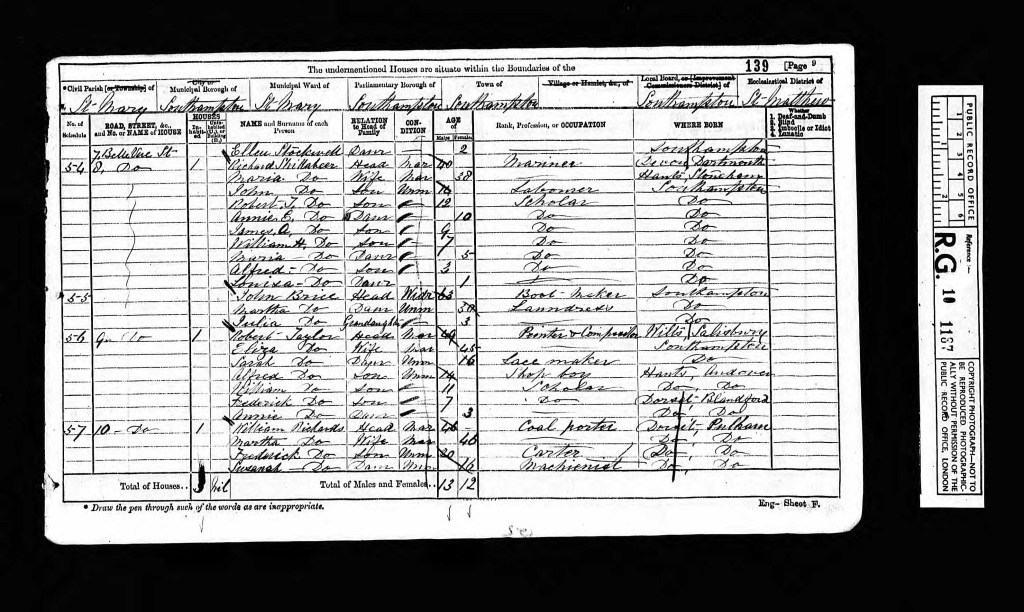
Bellevue Street, located in the St. Mary's district of Southampton, has a history intertwined with the city's development during the 19th century. The street extended from Dorset Street to St. Mary's Road, situated south of the historic St. Mary's Church, a site with origins tracing back to the Saxon era.
The area encompassing Bellevue Street began to flourish in the early 19th century. By 1829, newly erected cottages in nearby Charlotte Place were noted, indicating residential expansion. By 1850, the vicinity was described as "an assemblage of humble dwellings," reflecting a community of modest homes.
The name "Bellevue" is linked to Bellevue House, constructed in 1768 by Nathaniel St. Andre, a French physician who served King George I. The house was situated at the southern end of The Avenue and featured an impressive classical facade. The influence of Bellevue House persisted, with its name enduring in designations such as Bellevue Street and Bellevue Terrace.
Bellevue Street was characterized by residential properties that reflected the architectural styles of the period. The street's proximity to St. Mary's Church, a significant ecclesiastical site, added to its prominence within the community. Over time, urban development and modernization led to changes in the area, with some original structures being replaced or repurposed.
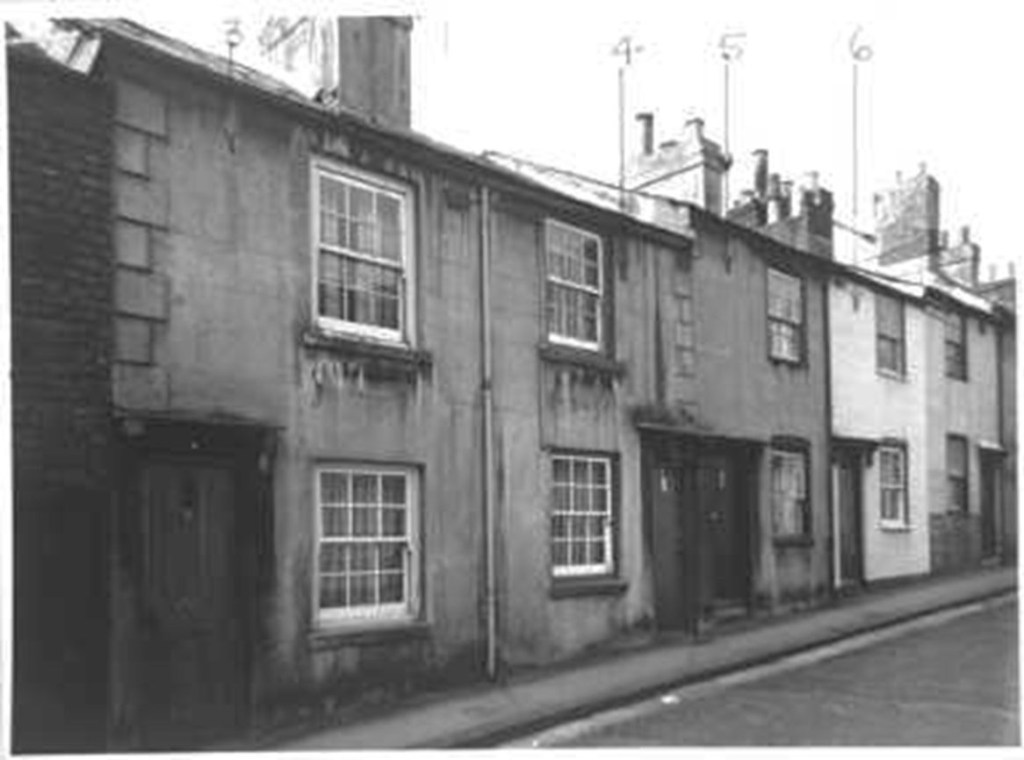
Elizabeth and George's daughter, 21-year-old Sarah Ann Stockwell, married William Woodman on Sunday, the 25th day of July 1875, at Saint James Church, Southampton, Hampshire, England. Their union was a significant moment in the Stockwell family’s history, marking Sarah’s new chapter in life. You can order a copy of their marriage certificate with the following GRO reference:

GRO Ref - Marriages September 1875, Stockwell, Sarah, Woodman, William, Southampton, Volume 2c, Page 13.

This was another milestone in Elizabeth's journey as a mother, witnessing her daughter take her place in the world with a partner of her own.

St James' Church, often referred to as Shirley Parish Church or St James' by the Park, is a significant landmark in Southampton, Hampshire, with a rich history dating back to the 19th century. The current church building, a Grade II listed structure, stands as a testament to the enduring faith and community spirit of the area.
The origins of a church in Shirley can be traced back to the Domesday Book of 1085, which records the presence of a church in the area. However, by 1574, the parish of Shirley was amalgamated with that of Millbrook due to a declining congregation, leading to the demolition of the original Shirley church in 1609. For over two centuries, residents of Shirley attended services in Millbrook.
By the early 19th century, the population of the combined parish had grown significantly, necessitating the construction of a new church to accommodate the spiritual needs of the community. Land for this new church was generously donated by Nathaniel Newman Jefferys, a local landowner. The church, dedicated to St James, was designed by local architect William Hinves in a neo-Gothic style and consecrated on 20 August 1836. The Hampshire Advertiser reported that despite "unfavourable weather," a large crowd attended the consecration ceremony. The original structure could seat 600 worshippers, featuring a Gothic screen behind the altar and a notable painting of the crucifixion by Shayer.
The church's first vicar, Reverend William Orger, served for 25 years, during which time the congregation grew rapidly. To accommodate this growth, balconies were added in 1840, increasing the seating capacity to 1,080. Further enhancements included the addition of a church clock in 1875 and a new chancel in 1881.
In 1912, the parish register for St John's Church was initiated, initially based in a temporary tin building. Plans for a permanent structure were submitted in 1957, with the foundation stone laid by the Bishop of Winchester, Dr Alwyn Williams, in 1959. The building later transitioned into a community centre known as St John's Centre.
A significant interior renovation of St James' Church took place in 1994, during which the pews were removed, and the floor was levelled and carpeted to create a more flexible worship space. In 2016, the seating was further updated with the installation of new, more comfortable chairs.
In recent years, there have been discussions regarding the future of the St John's Centre building. Proposals to replace it with housing were submitted in 2020 and 2021 but were either refused or withdrawn. Ultimately, the building was sold to the Church of Pentecost and officially handed over in early 2023, marking a new chapter in its history.
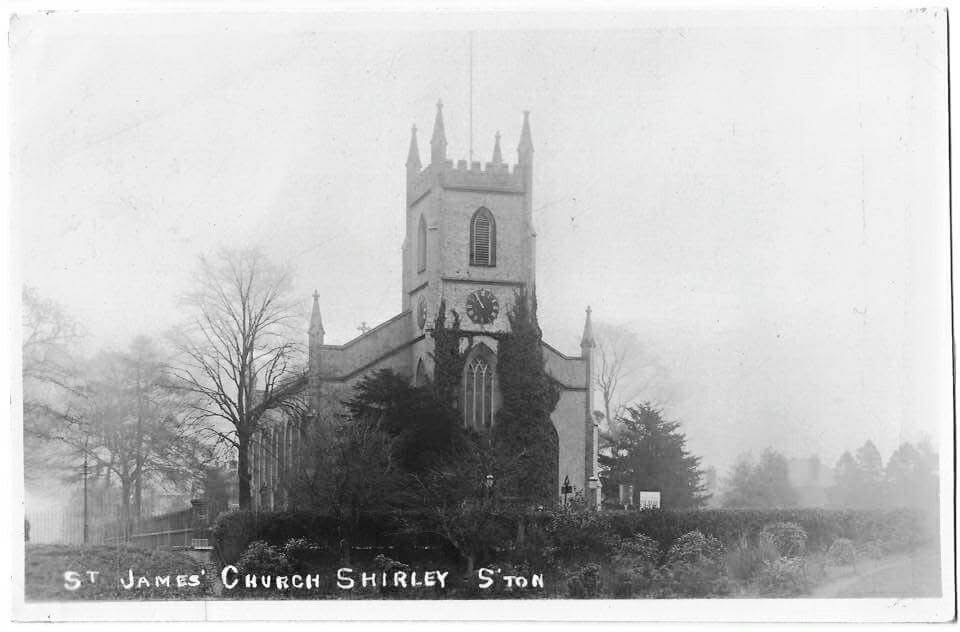
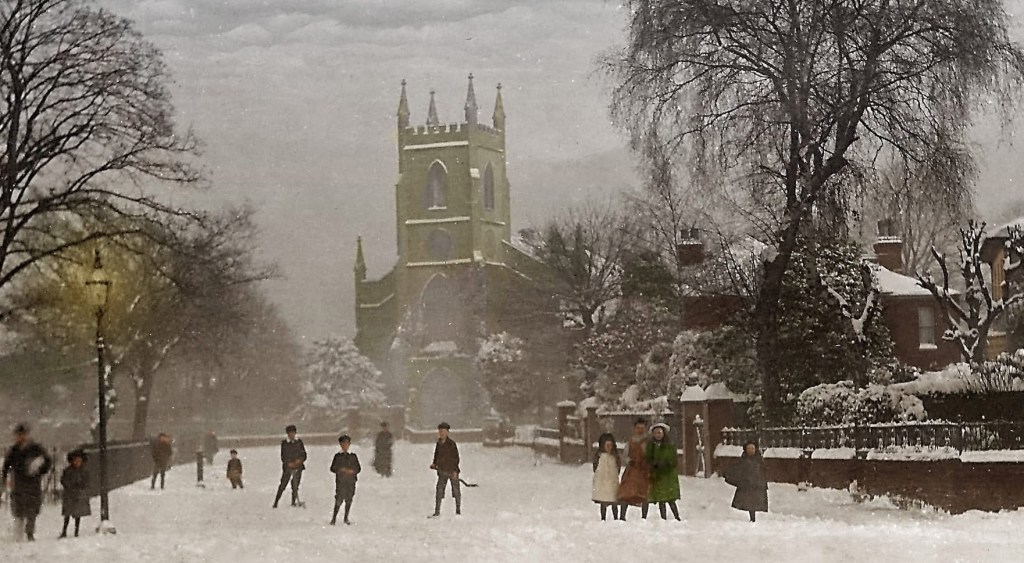
Elizabeth and George’s daughter, 20-year-old Elizabeth Stockwell, took a significant step into her own future when she married 27-year-old Jacob Bailey, a labourer, on Sunday, the 13th day of October 1878. The wedding took place at St. Mary’s Church in St. Mary’s, Southampton, Hampshire, England, a day filled with hope, love, and new beginnings.
As the ceremony unfolded, Elizabeth’s father, George Stockwell, was remembered as a labourer, while Jacob’s father, Charles Bailey, was also listed as a labourer. The couple stood before their loved ones, ready to begin their new life together.
The witnesses to their union were William Freak, Elizabeth’s brother-in-law, and Frances Allen Bond. They stood by her side, a reminder of the family that had shaped her and would continue to support her through the years ahead. Elizabeth, with a quiet but meaningful mark, signed the official marriage register with an “X.” It was a humble but powerful symbol of her presence in that sacred moment, one that would forever change the course of her life.
For Elizabeth, this was more than just a marriage; it was a beautiful step into adulthood, leaving behind the familiar world of her childhood and joining Jacob in creating a life of their own. Through her quiet resilience and love, Elizabeth had now woven herself into the fabric of a new family, a new chapter filled with its own joys and challenges.
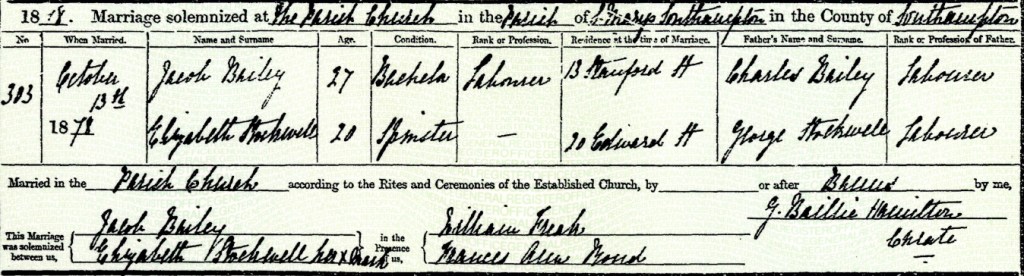
On the eve of the 1881 census, Sunday, the 3rd day of April, Elizabeth, along with her husband George and three of their children, Joseph, Edward, and Ellen, were living at Number 20, Edward Street, in St. Mary’s, Southampton, Hampshire, England. It was a modest home, filled with the warmth of a family that had weathered many storms and come through them stronger together. George, ever the hardworking man, was listed as a general labourer, while their son Joseph had taken on the work of a painter. Edward and Ellen, still in their younger years, were attending school as scholars, eager to learn and grow, just like their mother and father before them.
Also residing at Number 20 were Samuel Bond, his wife Hannah, and their daughter Marion. Their presence added to the bustle of the home, a familiar feeling of shared lives and interconnected families that helped create a tight-knit community.
Meanwhile, their daughter Eliza, now married and with children of her own, had her family, Charles, George, Rosa, and Mary Freak, visiting the home of James Leadbetter, who lived at Number 2, Edward Street. Though they were not living under the same roof, they were all bound together by the strength of family ties, the memories they shared, and the support they offered one another.
In this snapshot of their lives, Elizabeth and George’s home was filled with the rhythm of everyday life, a home where children were growing, adults were working, and family was everything. Despite the many challenges they had faced over the years, there was a sense of perseverance and love that continued to tie them all together.
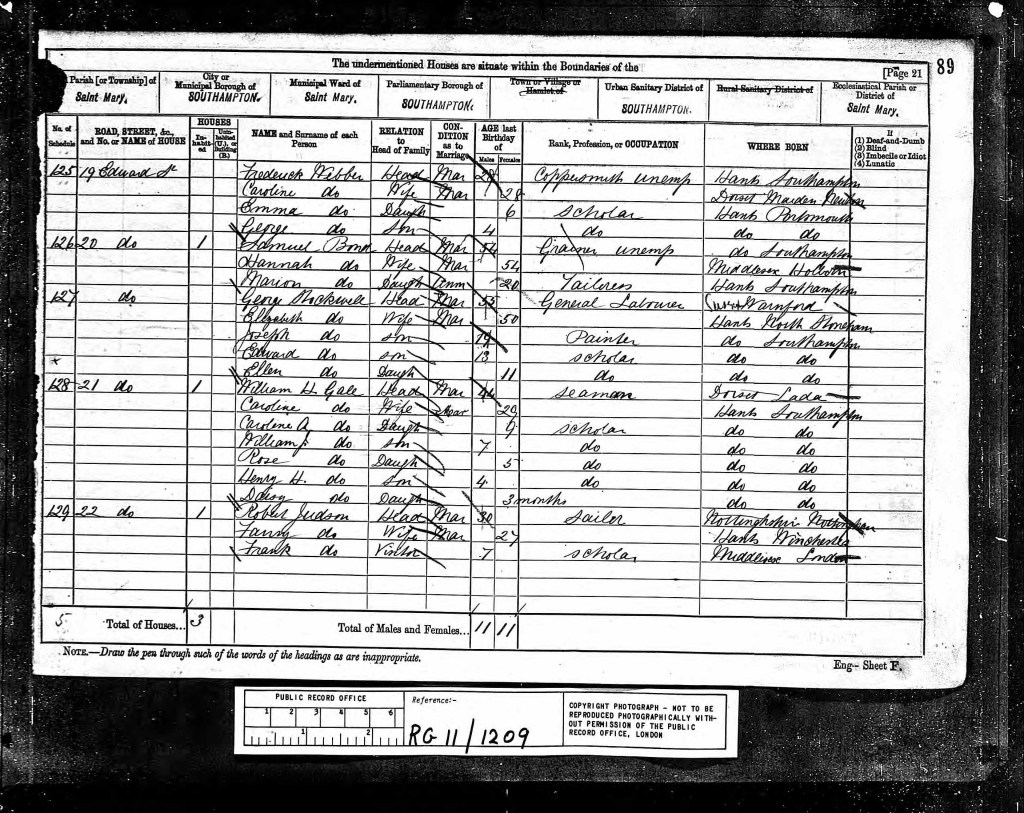
Edward Street, situated in the St Mary's district of Southampton, Hampshire, England, has a history intertwined with the city's development and the evolution of the St Mary's area. The St Mary's district traces its origins back to the Saxon period, with the founding of St Mary's Church in the 8th century serving as a focal point for the community. Over the centuries, the area surrounding the church expanded, leading to the establishment of various streets, including Edward Street. The district's growth was influenced by its proximity to the River Itchen, which facilitated trade and transportation, contributing to the urbanisation of the area. In the 19th century, the expansion of Southampton as a port city led to increased residential and commercial development in St Mary's. Edward Street emerged during this period, characterized by Victorian-era architecture and a mix of residential housing and local businesses. The street, like many others in the vicinity, was home to working-class families, many of whom were employed in the docks and related industries. The community was diverse, with a range of religious and cultural backgrounds represented among its residents. The area saw significant changes during the mid-20th century, particularly due to the impact of World War II. Southampton suffered extensive bombing during the Blitz, leading to the destruction of many buildings in the St Mary's district. Post-war reconstruction efforts in the 1950s and 1960s brought about modern housing developments and alterations to the original street layouts. While specific records about Edward Street's individual history are limited, its development reflects the broader trends experienced by the St Mary's area and Southampton as a whole.
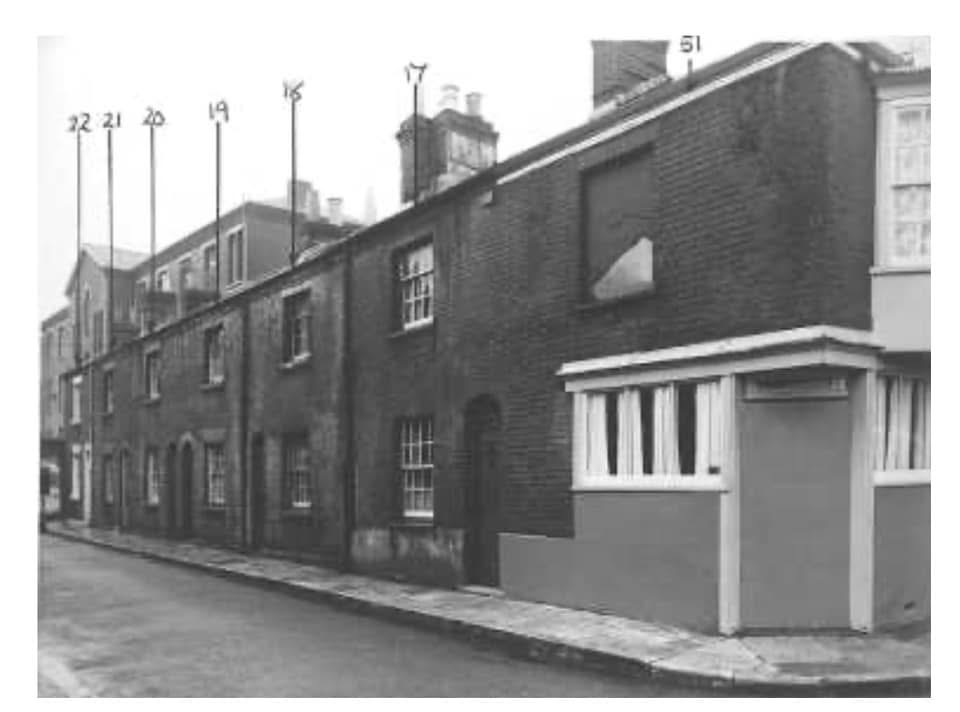
Elizabeth's father, 76-year-old Joseph Wren, a shoemaker by trade, sadly passed away on Sunday, the 11th day of February, 1883, at his home in Highfield, South Stoneham, Hampshire, England. It was a moment of great sorrow for Elizabeth, as the loss of a father is one of the most painful that a child can experience.
Joseph's grandson, William Oakley, the son of Mary, was with him at the time of his passing. It was William who, with a heavy heart, took on the difficult responsibility of registering his grandfather's death later that same day. William travelled to the registry office, where the registrar, Edward Messum, recorded Joseph's death in the register. The cause of death was noted as biliary obstruction, which had persisted for three days, along with vomiting, which had also lasted for three days.
Joseph's death was certified by Robert Iver, a final official acknowledgement of a life that had spanned 76 years. For Elizabeth and her family, this marked the end of an era, a passing that carried with it not only the loss of a father but also the quiet closure of another chapter in their shared history.

Biliary obstruction, a condition where the normal flow of bile from the liver to the intestines is blocked, has been recognized in medicine for centuries. Ancient physicians, including those in Greek and Egyptian traditions, noted symptoms such as jaundice and digestive issues, often linking them to liver and gallbladder dysfunction. Over time, medical advancements have identified gallstones, tumors, infections, and strictures as common causes of biliary obstruction.
Treatment has evolved significantly. Historically, herbal remedies and dietary adjustments were used to manage symptoms, but without surgical intervention, severe cases often led to life-threatening complications. The advent of modern imaging techniques, such as ultrasound and MRI, has greatly improved diagnosis, allowing for earlier and more precise treatment. Today, treatment depends on the cause of the obstruction. Gallstones, one of the most common culprits, may require medications, endoscopic removal (via ERCP), or gallbladder surgery (cholecystectomy). In cases caused by tumors or strictures, stents or surgical bypass procedures can restore bile flow.
Prevention primarily involves maintaining a healthy lifestyle, as obesity, high-fat diets, and certain metabolic disorders increase the risk of gallstones and biliary disease. Staying hydrated, consuming fiber-rich foods, and managing underlying conditions such as diabetes or liver disease can reduce the likelihood of developing a blockage.
While biliary obstruction can be life-threatening if untreated, advances in medical and surgical treatment have greatly improved outcomes, allowing many patients to recover fully and prevent recurrence.
Highfield, located in the historic parish of South Stoneham, Hampshire, is an area with a long and evolving history. Once a quiet rural hamlet, it has grown over the centuries into a well-established suburb of Southampton, known today for its leafy streets, academic institutions, and strong connections to the University of Southampton.
The origins of Highfield can be traced back to the medieval period when it was part of the wider South Stoneham parish. This parish, recorded in the Domesday Book of 1086, was an extensive rural area consisting of scattered farms, woodlands, and agricultural land. Highfield itself was likely an outlying settlement, with a few farmsteads and cottages dotting the landscape. The area remained largely unchanged for centuries, with farming being the primary occupation of its residents.
By the 18th and early 19th centuries, Highfield became increasingly attractive to wealthy individuals seeking a countryside retreat away from the growing urban environment of Southampton. As trade and industry flourished in the nearby city, successful merchants and professionals built elegant houses and estates in Highfield, taking advantage of its proximity to both Southampton and the picturesque Hampshire countryside. Among these was Highfield House, a grand residence that gave the area its name. The house, surrounded by extensive grounds, became a landmark of the area and remained significant until the 20th century.
The early 19th century saw gradual development, but it wasn’t until the latter half of the century that Highfield began to change more dramatically. As Southampton expanded and the demand for housing increased, parts of Highfield saw the construction of new homes, schools, and churches. The arrival of the railway in the mid-19th century further enhanced the area's appeal, making it more accessible to those commuting into the city for work or trade.
One of the most significant turning points in Highfield’s history came in the early 20th century with the establishment of the Hartley Institution, which later evolved into the University of Southampton. The university’s expansion throughout the 20th century transformed Highfield from a quiet residential suburb into a thriving academic district. The university's main campus, located in the heart of Highfield, became a focal point for education and research, attracting students, academics, and professionals from across the country and beyond.
Despite these developments, Highfield has managed to retain much of its original charm. Its streets are lined with a mixture of historic homes and modern university buildings, and green spaces such as the nearby Southampton Common provide a connection to the area's more rural past. Highfield Church, built in the 19th century, continues to serve as a landmark and place of worship, reinforcing the sense of community that has been present in the area for generations.
Today, Highfield is a sought-after residential area, balancing its historic roots with the vibrant energy brought by the university and its students. The blend of period architecture, academic institutions, and green spaces make it one of Southampton’s most distinctive suburbs. While much has changed since its early days as part of the South Stoneham parish, Highfield’s evolution reflects the broader growth of Southampton itself, from a medieval market town to a modern and dynamic city.
Elizabeth’s father, Joseph Wren, was laid to rest on Wednesday, the 14th of February, 1883, at Southampton Old Cemetery, Hill Lane, Southampton, Hampshire, England. His final resting place was in Row Q, Block 107, Number 303. With his burial, Joseph became the 40,966th person to be interred at the cemetery, a solemn reflection of the many lives that had passed through the gates over the years. For Elizabeth and her family, this was a moment of deep sorrow, marking the end of a long and meaningful life. His passing left a hole in their hearts, but his memory would remain with them, cherished in their thoughts and in the stories passed down through the generations.

Elizabeth and George’s son, 25-year-old Joseph Stockwell, married Eliza Thorn in the September quarter of the year 1886, in the Southampton district of Hampshire, England. Their union marked a new chapter in Joseph’s life as he began a family of his own. If you wish to obtain a copy of their marriage certificate, you can find it under the following GRO reference:

GRO Ref - Marriages Sep 1886
STOCKWELL, Joseph, THORN, Eliza, Southampton, Volume 2c, Page 29

On the eve of the 1891 census, Sunday, the 5th day of April, Elizabeth, her husband George, and their son Edward were living at Number 20, Edward Street, St. Mary’s, Southampton, Hampshire, England. George was working as a Ship Yard Labourer, while Edward had found work as a Labourer at a Paint Factory. The family occupied 2 rooms at Number 20, Edward Street, a modest dwelling amidst the bustling life of Southampton.
Joseph and Hannah Bond continued to reside in the same house, occupying 4 rooms. The close-knit nature of their living arrangements likely brought comfort to Elizabeth and her family, especially as they navigated the years together.
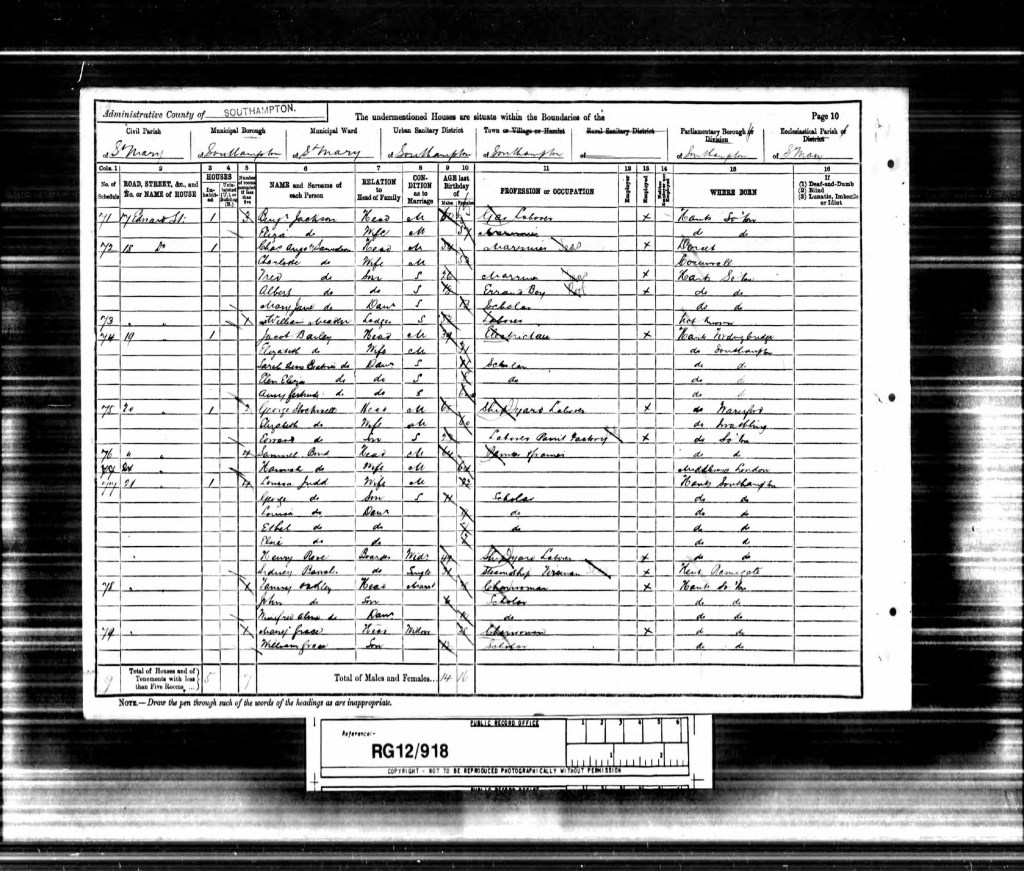
Elizabeth’s beloved mother, Sarah Wren, née Thorne, passed away on Tuesday, the 26th day of January, 1892, at the age of 85, at her home in Highfield, South Stoneham, Hampshire, England. It was her daughter Mary Oakley, living in Ivy Road, St. Deny’s, South Stoneham, who had the solemn responsibility of being with Sarah in her final moments. Mary, undoubtedly heartbroken, took on the heavy task of registering her mother’s death the following day, Wednesday, the 27th day of January, 1892.
The registrar, William James Miller, recorded that Sarah was the widow of Joseph, a casual labourer, and that she had passed away from bronchitis, which had afflicted her for a month. Sarah's death was certified by William R.Y. Ives, a Licentiate of the Royal College of Physicians (L.R.C.P.). It was a heart-wrenching loss for Elizabeth, whose mother had been a constant presence in her life, and the weight of this moment was no doubt felt deeply by the entire family.

Many people on Ancestry have listed Sarah's passing as occurring in 1881. Unfortunately, this is not the correct death record for her. I ordered the death certificate for a Sarah Wren with the GRO reference – WREN, SARAH, 74, 1881 D Quarter in SOUTH STONEHAM, Volume 02C Page 39. However, this certificate actually pertains to a different Sarah Wren, who was married to a John Wren.
It’s understandable that many people may have encountered confusion with Sarah’s death record. There are certainly several instances where similar names and ages can lead to misidentifications, especially when searching through large databases like Ancestry. It’s a good reminder that it’s important to always cross-reference multiple pieces of information, such as spouse names, age, and location, when working with historical records to ensure you're capturing the right individuals.

Bronchitis, an inflammation of the bronchial tubes that carry air to and from the lungs, has been recognized in medical history for centuries. Ancient physicians, including Hippocrates, described symptoms resembling bronchitis, such as persistent cough and mucus production. In the 19th and early 20th centuries, bronchitis was commonly linked to environmental factors like coal smoke and poor air quality, particularly in industrial cities.
Treatment has evolved significantly over time. In earlier centuries, remedies included herbal infusions, steam inhalation, and rest. With the discovery of antibiotics in the 20th century, bacterial bronchitis became more manageable, though most cases today are viral and do not require antibiotics. Instead, treatment focuses on relieving symptoms with hydration, cough suppressants, bronchodilators (for wheezing), and avoiding irritants like smoke or pollutants. Chronic bronchitis, often associated with smoking and chronic obstructive pulmonary disease (COPD), may require long-term inhaler therapy and pulmonary rehabilitation.
Prevention includes avoiding smoking, reducing exposure to air pollution, and practicing good hygiene to prevent viral infections. Vaccination against influenza and pneumonia can also help lower the risk of developing bronchitis as a complication of respiratory infections.
While acute bronchitis usually resolves on its own, chronic bronchitis can lead to long-term lung damage and respiratory complications, making early intervention and lifestyle changes crucial for long-term lung health.
On Monday, the 1st day of February 1892, Elizabeth, along with family and friends, gathered in the quiet, somber grounds of Southampton Old Cemetery, Hill Lane, Southampton, Hampshire, to say their final goodbyes to Sarah. It was a day filled with deep sorrow, as the weight of loss hung heavy in the air. Sarah, after a life full of hardships and moments of love, was laid to rest in Row Q, Block 107, Number 303, where she was finally reunited with her beloved husband, Joseph. For Elizabeth, the pain of losing her mother was almost too much to bear, and yet, amidst the tears, there was a sense of peace knowing that Sarah had returned to the arms of the man she had loved so dearly. Sarah’s passing marked the 52,799th burial at the cemetery, a testament to the many lives that had come and gone before her, but none more precious than the memory of the woman who had stood by Elizabeth through so much. The echoes of love, sacrifice, and resilience filled the air that day, and Sarah’s spirit, now at rest, would forever be carried in the hearts of those who loved her.

Elizabeth and George’s daughter, Ellen Stockwell, at 26 years old, married James Aland Snellgrove in the district of Southampton, Hampshire, in the April quarter of 1896. Their union marked a new chapter in Ellen's life, as she took the hand of James Aland Snellgrove, beginning their journey together. If you wish to obtain a copy of their marriage certificate, you can find it with the following GRO Reference:

GRO Ref - Marriages, June 1896, Stockwell, Ellen, Snellgrove, James Aland, Southampton, Volume 2c, Page 33.
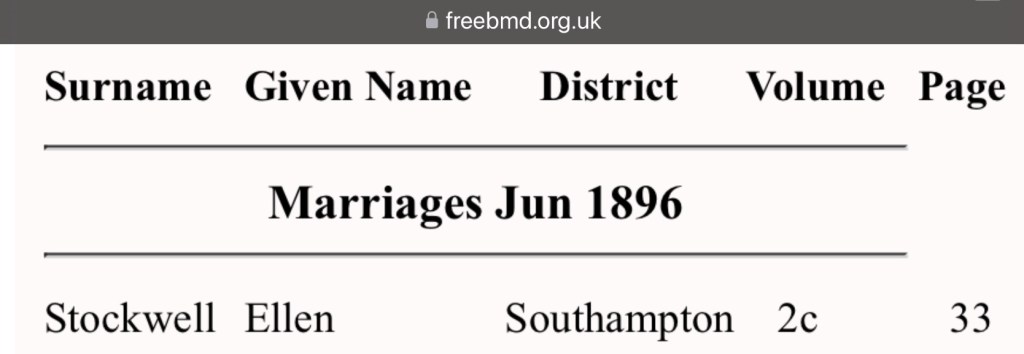
On Wednesday, the 21st day of March, 1900, Elizabeth Stockwell, nee Wren, at the age of 69, sadly passed away at her home at Number 21, Edward Street, Southampton, Hampshire, England. A life that had been filled with profound loss, enduring love, and countless struggles, Elizabeth’s journey came to an end surrounded by those who loved her deeply. Her daughter, Eliza Freak, nee Stockwell, who had been by her side, was there in the most heartbreaking moment, witnessing her mother’s final breath.
As difficult as it was, Eliza took on the sorrowful responsibility of registering her mother’s death, an act that would forever be etched in her heart. On Monday, the 2nd day of April, 1900, Eliza went to the registrar's office to ensure her mother’s passing was officially recorded. Harry George Whitchurch, the registrar, recorded in the death register that Elizabeth, the wife of George Stockwell, a general labourer, had succumbed to Chronic Bronchitis, a condition that had plagued her for some time. Her death had been certified by James Oliver, M.R.C.S.
Elizabeth's passing marked the end of a life filled with untold stories, deep sorrows, and enduring resilience. As a mother, a wife, and a woman who had seen more loss than anyone should bear, Elizabeth left behind a legacy of love and strength. The pain of her loss was felt by her family, but her spirit lived on in them, forever shaping their lives in the years to come.
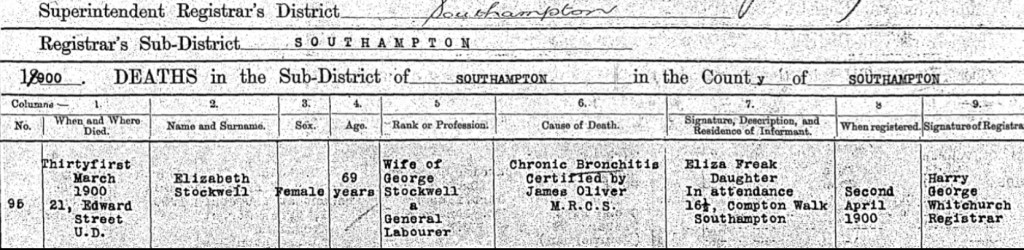
On Wednesday, the 4th day of April, 1900, Elizabeth Stockwell, after a life full of love, sorrow, and resilience, was laid to rest at Southampton Old Cemetery, Hill Lane, Southampton, Hampshire, England. Her final resting place was in Grave number P135/282 (Row P, Block 135, Number 282), where her memory would remain, tucked away beneath the quiet, sacred earth.
Her passing marked the end of an era for her family, yet, in death, she would be reunited with those she had loved so dearly. In the years that followed, her beloved husband, George, who would pass in 1903, and their son, Edward, who followed in 1905, would join her. Her daughter, Eliza Freak, nee Stockwell, who had borne the immense weight of her mother’s loss, would be laid to rest beside her in 1931. In the years after, her grandchildren, George Freak (1952) and Rosa Alice Townsend, nee Freak (1965), and her grandson-in-law, Charles Frederick Joseph Townsend (1967), would be buried near her, their lives intertwined by the generations that came before them.
Elizabeth, the 65,912th burial at Southampton Old Cemetery, left behind a family who loved her deeply, and as her descendants took their final rest beside her, it was clear that her legacy of strength, love, and family would endure for generations to come. Elizabeth's journey may have ended, but her influence and the love she instilled in her family continued to echo through the years.

Elizabeth Stockwell’s life was one of profound sorrow and remarkable strength. As a woman who faced the loss of so many loved ones, including not just her own children but her siblings as well, it’s impossible not to pause and reflect on the incredible mental fortitude she must’ve had to endure such an overwhelming burden. To lose a child is a pain that no parent should ever have to bear, yet Elizabeth bore it not once, but several times, with a heart heavy with grief. Yet, despite the heartbreak, she carried on. She never gave up.
Each time she buried a child, a sibling, or a loved one, she found the strength to move forward, to care for the others who still depended on her. Her resilience wasn’t just in surviving the losses, but in continuing to love, to nurture, and to keep her family together, even as the world around her seemed to crumble. Her life wasn’t just defined by the deaths she witnessed, but by the love, care, and hope she gave to those who remained. Elizabeth’s legacy isn’t one of tragedy alone, but of the quiet, unshakable strength that allowed her to carry on, day after day, year after year.
Though her journey ended in 1900, Elizabeth’s story continues to inspire. Her ability to persevere through the darkest moments of life, faced with an unrelenting wave of grief, reminds us all of the power of the human spirit. Her memory lives on, not just in the dates and records of her life, but in the love she left behind, woven through the generations of her family. For as much as Elizabeth lost, she gave so much more. And for that, she will never be forgotten.
Until next time, toodle Pip,
Yours Lainey.
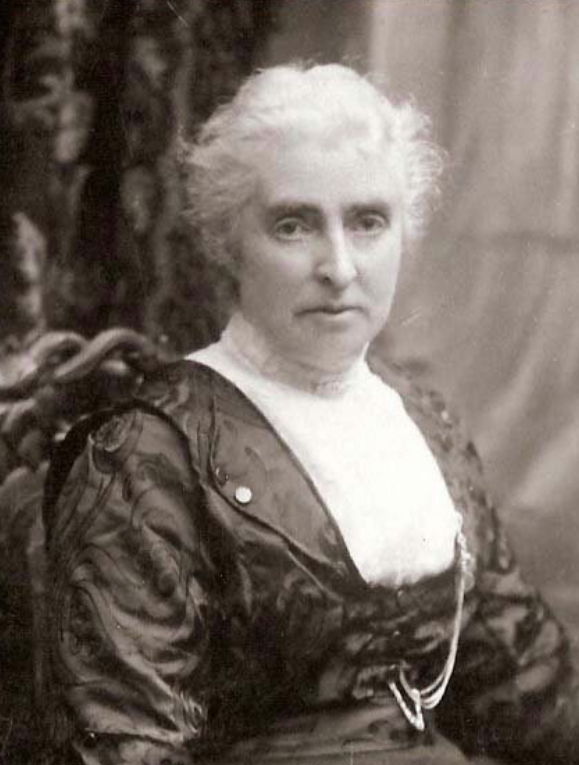
Rest in peace,
Elizabeth Stockwell, nee Wren.
1831–1900
Your life was marked by profound sorrow, unwavering strength, and an enduring love for your family. You faced unimaginable losses with a resilience that can only be admired. Your story is one of both grief and grace, and your memory will live on through the generations of those you loved and cared for. You are forever remembered and forever loved.

I have brought and paid for all certificates,

Please do not download or use them without my permission.

All you have to do is ask.

Thank you.
🦋🦋🦋
 Intwined