In the quiet corners of history, where ink fades and parchment crumbles, lies the tale of John Withers, a man whose life unfolds amidst the shadows of uncertain dates and scant documentation. Born in the year 1797, before the days of standardized birth records, John's early years are a mosaic of parish whispers and faded entries in dusty ledgers.
As I delve into the labyrinth of his lineage, piecing together fragments of baptisms and burials from parish records, I am reminded of the profound significance of these documents. They are not mere entries; they are portals to the past, gateways offering glimpses into a world where names of churches and burial grounds remain elusive, cloaked in the mysteries of time.
In my quest to resurrect John's story, I have traversed countless archives, trailing the footprints of vicars and curates who, like transient echoes, served not in one holy place alone. Each discovery, however modest, unravels a thread in the tapestry of his life, a testament to the resilience of memory against the eroding forces of history.
This journey has been a labor of love, a testament to perseverance and dedication. It is a testament to the countless hours spent sifting through archives, the resources poured into unlocking the secrets of his existence. As I embark on this endeavor to illuminate the life of my fourth great-grandfather, John Withers, I invite you to join me in exploring a narrative shaped by determination, illuminated by the faint but enduring light of the past.
The Life of John Withers
1797–1865
The Early Years
Through Documentation.”
Welcome back to the year 1797, Romsey, Hampshire, England. The town is quiet but industrious, nestled among the rolling countryside of southern England. The Abbey, a great and ancient presence, looms as the spiritual and social heart of the community, its bells marking the passage of time in a world both familiar and distant.
King George III sits on the throne. He has ruled since 1760 and continues to do so despite his periods of mental illness, which have begun to cast a shadow over his reign. At this point in time, he is in the midst of what many call his "madness," and the country, though respectful, murmurs with worry about his capacity to govern. William Pitt the Younger remains Prime Minister. Still in his thirties, he has already established a reputation for reform, fiscal strength, and a commanding grasp of politics, steering Britain through times of domestic pressure and war abroad.
Parliament, centered in London, remains the preserve of the landowning elite. Though ideas of liberty and reform circulate, especially inspired by events across the Channel in revolutionary France, the political world is deeply hierarchical, and power remains tightly held by a few wealthy men. Most people in Romsey, as elsewhere, have little say in national matters. They focus on survival, trade, and parish life.
In terms of social structure, England is rigidly stratified. At the top are the aristocrats and landed gentry who control the land and influence. Below them are professionals and merchants, increasingly important as the Industrial Revolution gains momentum. The working class, especially in rural communities like Romsey, consists of farm labourers, domestic servants, and craftspeople. The poor, those without steady employment, housing, or kin support, rely on the parish for help, often ending up in the workhouse if they fall on hard times.
Fashion in 1797 is heavily influenced by neoclassicism. The elite men wear tailored coats with high collars, waistcoats, breeches, stockings, and heeled shoes with buckles, their wigs slowly falling out of fashion in favour of more natural hair styles, powdered and neatly tied. Women's fashion, particularly for the upper classes, reflects Greco-Roman inspiration, with high-waisted muslin dresses, short sleeves, and light fabrics, far removed from the heavy gowns of previous decades. The working class, of course, wear sturdier, more practical garments, woollen garments, aprons, and simple bonnets for women, coarse shirts and trousers for men.
Transportation is mostly by foot or horse. Carriages clatter through Romsey's lanes, pulled by teams of horses and used by those who can afford them. The roads are often muddy and poorly maintained, though efforts to improve them are slowly gaining pace. The canals, a marvel of the new industrial age, are spreading elsewhere in the country but haven’t greatly altered life in Romsey yet. The railways are still decades away.
Energy comes from human and animal labour, with wood, peat, and coal burned for warmth and cooking. Heating is done via open hearths. Lighting at night is poor by modern standards, with candles and oil lamps offering a soft, flickering glow. Wealthier homes might use tallow or beeswax candles, while the poor make do with rushlights or go without.
Sanitation is rudimentary. There is no organised sewerage system, and most waste is disposed of in cesspits, ditches, or directly into rivers and streams. Disease is a constant threat, and medical understanding is basic. Infections, fevers, and epidemics can sweep through communities with little warning, and infant mortality remains high. The churchyard in Romsey records many brief lives and early deaths.
Food is seasonal and local. The rich enjoy meats, pies, puddings, wine, and imported delicacies like sugar and spices, though wartime blockades can interrupt supply. The poor survive on bread, cheese, small beer, and pottage made from root vegetables, with meat being a rare treat. The kitchen garden and local markets are vital for all classes. Preservation is by salting, smoking, and drying.
Entertainment revolves around the church, the tavern, and the home. Music, reading aloud, storytelling, and community events provide diversions. The theatre is popular in cities, though less available in rural towns like Romsey. Gossip circulates through town markets, churches, and inns, spreading news, scandal, and hearsay in equal measure. People are curious and eager for word of the wider world, Napoleon, after all, is on the rise in France, and war looms large in public consciousness.
The environment in and around Romsey is largely pastoral. Fields, hedgerows, and water meadows surround the town, with the River Test providing fresh water and power for mills. The countryside is worked intensively but retains its natural charm. There is an awareness of enclosure, and some resentment as common lands are taken over by private owners. The enclosure movement is reshaping rural life, pushing many off the land and into towns or poverty.
The differences between rich, working class, and poor are stark. The wealthy live in stone or brick houses, dine off fine china, and employ servants. The working class live in modest cottages, often sharing space with animals. The poor might live in a single room, in overcrowded conditions with little warmth or privacy. Their diets, clothing, and futures differ drastically, and social mobility is rare.
Historically, 1797 is a significant year. Britain is deep into war with Revolutionary France, and fears of invasion run high. The Royal Navy is a source of pride and tension, especially after the Spithead and Nore mutinies earlier that year, when sailors protested poor conditions and pay. Paper money begins to circulate more widely as gold becomes scarce. Across the nation, change is stirring, political ideas, industrial innovation, and social unrest, but in Romsey, life remains rooted in tradition, the cycle of the seasons, and the enduring presence of the Abbey.
John Withers, my paternal fourth great-grandfather, was born around the year 1797 in the historic market town of Romsey, Hampshire, England. He was the firstborn child of William Withers, who would have been around thirty at the time, and Mary Withers, formerly Grant, who was about twenty-six. In a time when records were sparse and official documentation was not yet a legal requirement, John's arrival into the world was not marked by a birth certificate, but instead pieced together from the few precious sources available, his baptism record and the 1841, 1851, and 1861 census returns. Each of these documents offers only a narrow glimpse, but together they begin to form the outline of his life.
Being the firstborn son held great significance, especially during that time. John’s birth not only continued the family line, but it also carried with it the weight of tradition and legacy. In families like the Withers, the arrival of a son, particularly a first son, meant the reassurance that the family name would carry on, that the line of generations would not be lost to time. John was that promise to William and Mary, the bearer of a name that would continue through the family for generations.
Uncovering John’s story has been no small task. Much of the information about his early life exists in scattered fragments, as birth registration wasn’t introduced in England until 1837. That leaves researchers like myself relying heavily on parish records, baptisms, burials, marriages, each entry offering a hint, a whisper from the past. These records, while invaluable, are frustratingly incomplete. They often don’t specify the exact church or burial ground, and even when they do, it's hard to be certain. Vicars and curates didn’t always serve in just one parish, and their movements from church to church make it difficult to know exactly where events in John's life truly took place.
Still, I’ve done everything I can to bring his story into the light. I’ve spent countless hours tracing church histories, following clergymen’s careers, and comparing notes from one dusty record to another. I’ve invested not just time, but a considerable amount of money, all in the hope of capturing who John was, not just the facts, but the feeling of his life. It’s been a journey of deep personal meaning. In many ways, John Withers is not just a name on a page to me, he is a man whose presence in history made mine possible. And so, with love and determination, I begin to tell his story the best I can, even with the limitations history has left me.
The surname Withers is of Anglo-Saxon origin and is generally considered to be a topographical name derived from the Old English word “wīðer,” meaning “against” or “opposite,” which may have been used to describe someone who lived on the opposite side of a river or stream. Alternatively, it may have come from a personal name such as “Wither,” possibly linked to a descriptive characteristic or occupation. In some cases, Withers may have developed from the Old Norse “vidr,” meaning “wood,” and therefore might refer to someone who lived near a forest or thicket.
The name has been recorded in England since at least the medieval period. Early examples of the surname appear in various forms in tax records, legal documents, and manorial rolls. In the 13th and 14th centuries, names like William Wither and Richard Wyther were seen in counties such as Hampshire, Surrey, and Wiltshire. Over the centuries, the surname remained relatively localized to southern England, though it gradually spread across the country and into colonial territories through migration and expansion.
By the 16th and 17th centuries, the Withers name appeared among yeoman farmers, clergy, and artisans. One notable bearer was George Wither (1588–1667), an English poet, satirist, and pamphleteer who was active during the English Civil War and wrote both royalist and parliamentarian tracts at different times.
In terms of the family crest and coat of arms, there are a few different arms attributed to families bearing the Withers name, suggesting multiple lines and branches rather than a single noble origin. One of the best-known coats of arms associated with the Withers family consists of a shield divided per fess (horizontally) with silver (argent) and black (sable), often featuring three lions’ heads erased or similar heraldic beasts, signifying strength, courage, and vigilance. The crest, which sits above the helmet in heraldry, may include a lion or a bird such as a falcon or eagle, representing noble bearing and swiftness. The motto, when associated, can vary depending on the family branch, but is often absent or undocumented for many Withers lines.
As with many surnames of English origin, not all families with the name Withers would have borne arms. The granting of a coat of arms was traditionally a privilege granted by a heraldic authority such as the College of Arms in England, typically to individuals rather than families en masse. Therefore, multiple unrelated Withers families could have developed separately and may not share the same heraldic symbolism.
In genealogical records, the Withers name has persisted across England, Scotland, and later in the United States, Canada, Australia, and New Zealand, where descendants of British emigrants carried the name abroad. In modern times, Withers remains a recognizable surname, found throughout the English-speaking world and often connected to historical roots in southern and central England.
The name carries with it a sense of English heritage tied to the land, with links to both rural origins and periods of literary and civil influence. Whether as a common surname of the countryside or tied to a line of minor gentry or landowners, Withers has remained quietly resilient throughout the centuries.
The name John is one of the most enduring and widely used names in the English-speaking world, with a history that stretches back through centuries of religious, royal, and everyday use. Its origin is ancient, coming from the Hebrew name Yochanan, which means "Yahweh is gracious" or "God is gracious." It passed into Latin as Ioannes and then into Old French and Middle English as Johan or John.
John gained prominence in the Christian world because of its strong association with key biblical figures. John the Baptist, the forerunner of Jesus, and John the Apostle, traditionally credited with writing the Gospel of John, the Book of Revelation, and three Epistles, made the name sacred to early Christians. Through centuries of religious tradition, the name spread widely across Christian Europe, becoming one of the most common names in the Western world.
During the Middle Ages in England, John became a dominant male name, found in all levels of society. It was used by kings, peasants, priests, and knights. King John of England, who reigned from 1199 to 1216, is one of the more infamous historical bearers of the name, remembered for his disputes with the barons that led to the signing of the Magna Carta in 1215. Despite his notoriety, the name itself did not suffer in popularity.
By the time of the Norman Conquest of England in 1066, John had already been established in Norman circles, and the Normans helped to entrench it further into English naming customs. Throughout the medieval period and into the modern era, it remained consistently popular. In fact, it was the most common male name in England for hundreds of years, and in many English-speaking countries it remained near the top of name charts until the 20th century.
John has many variations in different languages. In Irish, it is Seán or Eoin. In Welsh, it is Ieuan or Ioan. In Scottish Gaelic, it becomes Iain. In French, it is Jean. In Italian, Giovanni. In Spanish, Juan. In German, Johann or Johannes. Each form carries the same root meaning, but takes on cultural flavors specific to the region.
The name John has often been used generically to refer to the common man, think of "John Doe" in legal language, or phrases like "every Tom, Dick, and John." It has also appeared in idioms, such as "Dear John letter" or "John Bull," the latter being a national personification of England.
Through literature, the arts, and history, the name has remained iconic. It has been borne by countless historical figures, from John Milton and John Donne in literature, to John Locke in philosophy, to modern figures like John F. Kennedy and John Lennon. The name carries a quiet strength, simplicity, and timelessness.
Even today, though it may not be as commonly given to newborns as it once was, John remains a sturdy, familiar, and universally respected name, rich in history, religious heritage, and cultural significance.
Romsey, Hampshire, England is a historic market town nestled in the Test Valley, not far from Southampton and Winchester. It is situated along the River Test, one of England’s finest chalk streams, known for its clear waters and abundance of trout. Romsey’s setting has always been part of its appeal, with the river influencing early settlement, agriculture, and later industry.
Romsey’s history stretches back to at least the Saxon period. Its most iconic historical feature is Romsey Abbey, which dominates the town centre. The abbey began as a nunnery around the 10th century, possibly earlier, and grew in significance throughout the medieval period. The current Norman church structure was largely built in the 12th century and is a fine example of Romanesque architecture. The abbey served as both a religious centre and a focus of the town’s economic life for centuries. It survived the dissolution of the monasteries under Henry VIII because it continued to function as a parish church.
By the medieval era, Romsey had established itself as a prosperous wool town. Wool and cloth were the lifeblood of many English market towns in the Middle Ages, and Romsey was no exception. Trade brought wealth, and the town expanded its network of streets and buildings around the abbey. It held markets and fairs under charter, drawing in traders from surrounding areas.
In the post-medieval period, Romsey adapted to the changing economy. Brewing, tanning, and paper milling became prominent industries. The town benefited from its proximity to both the River Test and the growing trade centres on the south coast. The river also powered early mills, contributing to the town’s modest industrial success. By the 18th and 19th centuries, Romsey had become a hub for brewing and agriculture. Beer from Romsey was known for its quality and distributed locally and beyond.
In the 19th century, the arrival of the railway connected Romsey more directly to Southampton and Salisbury, stimulating its economy and easing the transport of goods and people. The town remained relatively small but became known for its pleasant character and genteel pace of life, attracting retirees and the middle class.
One of the most famous figures associated with Romsey is Lord Palmerston, who served twice as Prime Minister of Britain in the 19th century. He was born in Broadlands, a nearby country estate on the outskirts of Romsey. Broadlands later became the home of Lord Mountbatten of Burma, a prominent naval officer and statesman, and a member of the extended royal family. The estate has long tied Romsey to both political and royal heritage.
Today, Romsey is a blend of the historical and the modern. The town still holds weekly markets and maintains a strong sense of community. Its Georgian and medieval buildings are well-preserved, and the abbey remains a central landmark, not just for religious services but also concerts, festivals, and cultural events. The River Test continues to define the town’s charm, flowing through parks and gardens that are popular with residents and visitors alike.
Romsey remains a symbol of Hampshire’s rich rural heritage, with deep historical roots and a tranquil yet significant presence in the county’s past and present.
John Withers was baptised on Christmas Day, Monday the 25th day of December, 1797, in Romsey, Hampshire, a detail that adds a touching and almost poetic note to the beginning of his life. That day, as the townspeople gathered to mark one of the holiest days of the year, William and Mary brought their firstborn son to be baptised, offering him to the world with the promise of faith and family wrapped in the spirit of the season.
He was not alone at the font. Alongside him were six other children, Henry James, Belinda Cook, Ann (whose surname, sadly, isn’t clear), Joseph Medley, Elizabeth Hillier, and Maria Pope. All of them were baptised in the same service, bound together in that moment by water, prayer, and the shared hopes of their families.
And yet, as is so often the case with records from that time, vital pieces of the story are missing. The name of the church where this Christmas baptism took place was not recorded, nor was the name of the vicar or curate who welcomed these children into the Christian faith. We are left to imagine the stone walls, the flickering candlelight, the hymns echoing through the pews, and the pride of two young parents watching as their son's name was spoken aloud for the very first time in official record.
It’s these small glimpses, imperfect, incomplete, that I cling to in my search to understand John’s life. Every fragment matters. Every date, every name, every detail is a window into a world long gone, and yet still so deeply connected to mine.
John’s younger sister, Elizabeth Withers, was born around 1799 in Romsey, Hampshire, just two years after John’s Christmas Day baptism. Like her brother, Elizabeth’s early life is shrouded in the same veil of uncertainty that cloaks so many who were born before the introduction of civil registration in 1837. Her birth, too, is not marked by an official certificate but rather inferred from what little documentation is available.
Her arrival would have been significant in its own way, bringing new life and perhaps a sense of joy and balance to William and Mary’s young household. Together, John and Elizabeth represent the beginning of a new chapter for the Withers family in Romsey, one son to carry on the name, and a daughter whose life, like so many women of the time, may be more difficult to trace, but no less important in the family’s story.
On Sunday, the 15th day of December 1799, William and Mary, once again stood at the baptismal font, this time with their infant daughter, Elizabeth. The setting was Romsey, Hampshire, a familiar and cherished place for the growing Withers family. While the details surrounding the church and officiant remain, frustratingly, absent from the record, the act itself is clear: Elizabeth Withers was welcomed into the world and the Christian faith that winter day.
She was not alone. That same service also saw the baptism of John Lockier, son of James and Eliza Lockier, a reminder of how closely lives were lived and celebrated in those small communities, children from different families beginning their journeys side by side, their names recorded together for posterity. It’s a quiet moment, but one that brings a sense of intimacy to the past. We can imagine the congregation gathered, the chill of December in the air, and the pride on the faces of the parents as their children’s names were read aloud.
Elizabeth’s baptism, like her brother John’s two years earlier, is one of the few concrete pieces of her early life that remain. But it’s enough to tell us she was there, loved, named, and held close by her family. These simple records, though scarce, mean everything to those of us reaching back through time to find our people.
John’s younger brother, William Withers, adds yet another layer of mystery to the unfolding story of the Withers family. He was born on the 23rd day of May 1801, though exactly where in Hampshire, or even if it was in Hampshire at all, remains unclear. The records surrounding William are particularly conflicting, with various family trees and sources on Ancestry listing his birth year as 1797, and his birthplace as Southampton. But when looking closely at his baptism details, I believe a more accurate estimate places his birth around 1801, perhaps even in Salisbury, Wiltshire.
If Salisbury was indeed his birthplace, it introduces a curious twist in the Withers family’s otherwise consistent presence in Romsey, Hampshire. William appears to be the only child whose birth may have taken place outside that familiar setting. This raises many questions. Did William and Mary temporarily move? Were they visiting family or working elsewhere at the time? Or was it perhaps a misrecording that has followed him through generations of documentation?
Salisbury, with its majestic cathedral and bustling medieval streets, feels like an unexpected backdrop for the birth of a Withers child. And yet, its possibility makes William’s arrival all the more intriguing. It’s these puzzles, these bits that don’t quite fit, that keep the story alive. Each inconsistency is a doorway into deeper research, a prompt to look again, to dig further, and to wonder what life must have really looked like for this family over two centuries ago.
What remains certain is that William Withers, the younger brother of John and Elizabeth, was born into a family in motion, a family growing, changing, and, in many ways, still leaving more questions than answers.
On Wednesday, the 10th day of June 1801, John’s parents William and Mary Withers had their son, William, baptised in Salisbury, Wiltshire, a moment that stands out in the family’s story not only for its clarity but also for its curious departure from their usual home in Romsey. Unlike so many other family events cloaked in uncertainty, this baptism record is unusually generous in detail, even providing William’s exact date of birth: the 20th day of May 1801.
The choice, or perhaps the necessity, of Salisbury for William’s birth and baptism adds a fascinating wrinkle to the Withers narrative. He remains the only one of William and Mary’s children known to have such a clear link to Salisbury, and the reason for their presence there is still a mystery. Were they briefly living in the city? Could William’s work have brought the family there? Or were they staying with extended family, as was common during times of childbirth? The record doesn't say, and so the questions linger.
What we do know is that Salisbury was a significant place at the time, and baptising their son there would have been no small moment. The towering spire of the cathedral, the ancient stones underfoot, the long-standing parish tradition, all would have added weight and solemnity to the occasion. And in this service, as their newborn son was welcomed into the Church, William and Mary ensured that, just like his older siblings, young William was firmly planted in the family’s legacy.
Though his birth possibly being in Salisbury sets him apart, his name and presence tie him closely to the Withers line, another branch on a tree that continues to grow through each discovered record, each remembered name.
Ann Withers, the younger sister of John, Elizabeth, and William, was born around the year 1802, sometime before Sunday the 21st of November 1803, in Romsey, Hampshire, England. On that November Sunday, her parents, William and Mary, brought her to be baptised, a quiet but deeply meaningful moment in the life of their growing family.
The baptism took place in Romsey, the Withers’ enduring home and the place where most of their children would begin their lives. Though the name of the church and the officiating clergyman remain unrecorded, the parish register confirms the date and the act. Ann shared her baptism day with another child, Benjamin, the son of Thomas and Ann Bedford marking yet another instance where lives briefly touched in a communal service that brought families together in faith and tradition.
Ann’s baptism not only confirms her place in the family but also helps bridge the gaps that so often leave early 19th-century lives in shadow. In a world without birth certificates or consistent record-keeping, this single entry gives us her name, her belonging, and her presence within the rhythm of the Withers household. Each record like this is more than a name on a page, it’s a voice from the past, a moment that reassures us that she was here, she was loved, and she mattered.
Jane Withers, the fifth known child of William and Mary Withers, was born around the year 1805 and baptised on Sunday, the 5th day of May that same year, in Romsey, Hampshire, England. Her baptism, like those of her siblings before her, offers us a cherished glimpse into the Withers family's continued life in their beloved hometown. Though no official birth certificate exists, as was the case for all children born before civil registration, Jane’s baptism grounds her firmly in the family’s unfolding story.
That Sunday service was a shared moment in the lives of several local families. Alongside Jane, four other children were baptised: Robert Watson, Thomas Pelham, George Bandy, and James Bell. I can imagine the church filled with quiet joy and the hum of voices, as parents gathered with their babies in arms, each name read aloud in turn, each child welcomed into the community with love and hope.
For William and Mary, Jane’s baptism would have marked yet another milestone, another daughter to cherish, another soul to guide. Each child they brought to the font wove another thread into the fabric of their family, and Jane’s inclusion reminds us that even in times when documentation was limited, the rituals of life, birth, baptism, family, were carefully observed and deeply felt.
Through these records, however brief, Jane’s place is made known. She wasn’t just another name in an old register, she was a daughter, a sister, and part of a legacy that still echoes generations later.
Lydia Withers, the youngest daughter of William and Mary Withers, was born on Friday, the 22nd day of July, 1808, in Romsey, Hampshire, England. Her birth, like those of her siblings, occurred in the heart of the Withers family’s home, a place filled with memories and community.
Just a month after her birth, on Sunday, the 21st day of August 1808, Lydia was baptised in the same town. As with the baptisms of her siblings, this important moment in her early life would have been marked by the traditional rituals of the time, though, like the others, the name of the church and the officiating clergyman remain lost to history.
Her baptism on that summer Sunday is a beautiful reflection of the continuity of the Withers family in Romsey, with each child, each new life, being welcomed into both faith and family. Lydia’s place in the family is firmly established through this record, ensuring she is remembered, not just as another name in the past, but as a part of the broader Withers story, a daughter whose life, though long gone, continues to echo through the generations.
Jumping forward to the year 1817, we see John Withers not as a son or brother, but as a young man beginning a family of his own. At around 20 years old, John had fallen in love with a young Romanian girl named Mary Cole, who was just 16 at the time. Their relationship, though not yet bound by marriage, led to the birth of their first child, a daughter named Emma Withers.
Emma was born on Monday, the 29th day of December 1817, in Romsey, Hampshire, the same town where John himself had been baptised twenty years earlier. There is no birth certificate to mark the occasion, as civil registration would not come into effect until two decades later in 1837, but thankfully, Emma’s baptism provides a precious detail, it confirms her exact date of birth.
The location of her birth has been pieced together through later census records, each one reinforcing that Romsey remained the home of the Withers name. In this way, even without formal documentation, the town continues to serve as the beating heart of the family story.
Emma’s arrival would have been deeply significant, not only as John’s first child, but as a daughter born into love, if not into wedlock. In that time, her birth may have raised eyebrows, but for John and Mary, it marked the beginning of a new generation. And for us, it is a moment that brings the story full circle, a child born in the same streets and under the same sky as her father, carrying forward the Withers name and legacy in her own way.
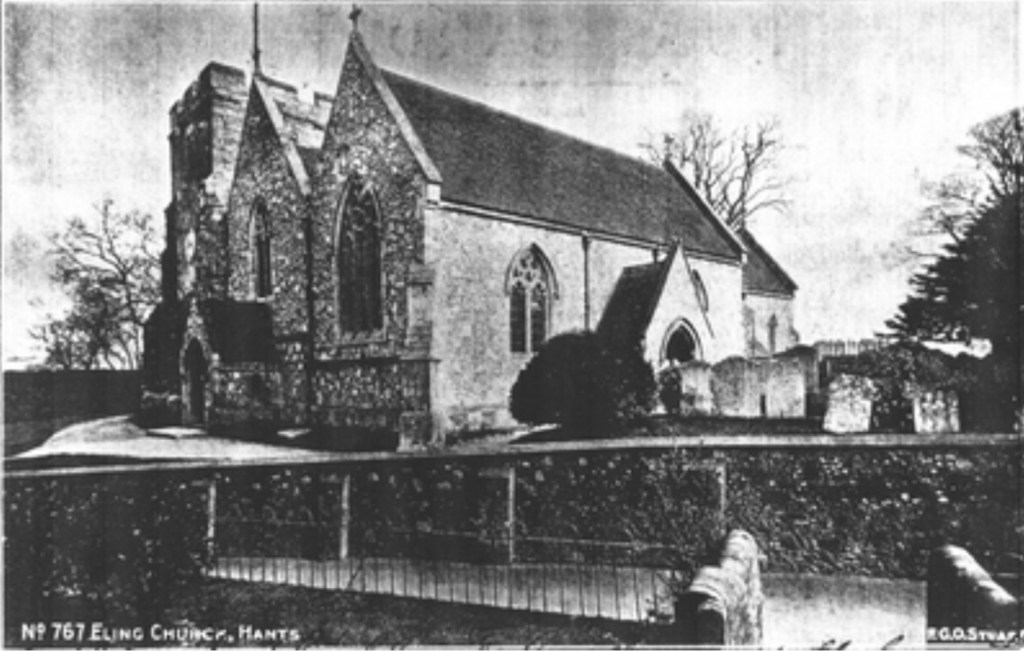
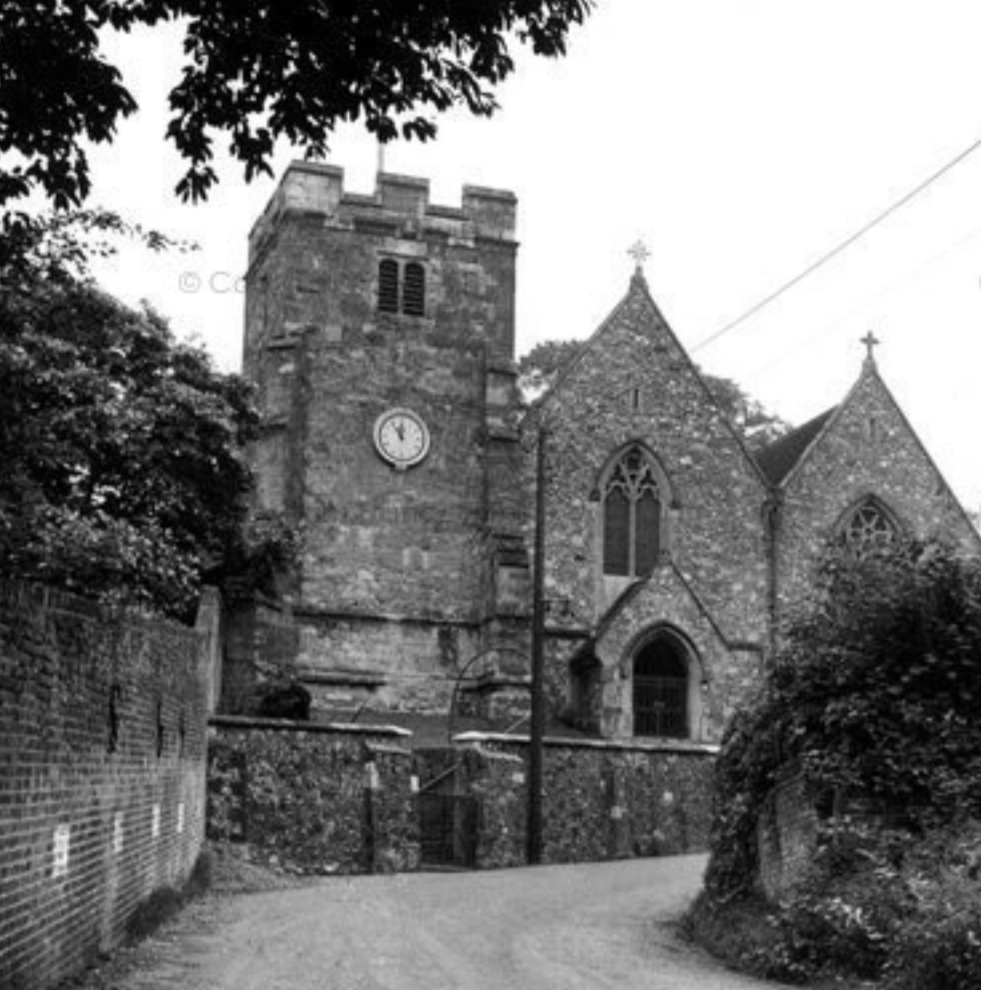
On Sunday, the 25th day of January 1818, John Withers and Mary Cole took their infant daughter, Emma, to be baptised at The Church of St. Mary the Virgin in Eling, Hampshire, a place just outside the town where John himself had grown up. It was there, in the quiet of that parish church, that their baby girl was formally welcomed into the Christian faith.
The baptism was performed by Jon Moleworth, the curate of nearby Millbrook, who carefully recorded Emma’s details in the parish register. His entry is one of the most detailed we have from this time, and it gives us such a vivid sense of the moment. He noted that Emma was the illegitimate daughter of John Withers, a labourer, and Mary Cole of Romsey. He even included Emma’s exact birth date, Monday, the 29th of December 1817, offering a rare clarity that so many records of this period lack.
Emma’s baptism marks not only the beginning of her life’s story but also the next chapter in John’s, his transformation from a son into a father, from a boy growing up in Romsey to a man building a life of his own.
St Mary the Virgin Church in Eling, Hampshire, is one of England's oldest churches, with origins dating back to the Saxon period. The church stands on Eling Hill, overlooking the Solent and Test Estuary, and has been a site of Christian worship since at least the 9th century.
The earliest structure on the site was a wooden Saxon church, later replaced by a stone building in the late Saxon period. Remnants of this era include a simple stone arch and a narrow Saxon window, indicative of the church's ancient origins. The Domesday Book of 1086 records a church at Eling, confirming its significance during that time.
The church has undergone several architectural changes over the centuries. The nave dates from the 11th to 12th centuries, while the chancel arch was added in the late 13th century. A two-bay south arcade was constructed in the 14th century, and the tower was built during the Tudor period, with additions in the early 17th century. A significant restoration between 1863 and 1865 by architect Benjamin Ferrey gave the church much of its current Victorian appearance, although the tower and north aisle retain their earlier character.
Inside the church, visitors can find Saxon gravestones that were excavated from beneath the building and are now displayed in the nave. The churchyard is known for its natural beauty, offering views over the estuary. A lych gate, erected in 1902 to commemorate the coronation of King Edward VII, stands at the entrance, featuring Arts and Crafts metalwork.
Today, St Mary the Virgin Church remains an active place of worship within the Anglican team ministry serving Totton and Eling. It is a Grade II* listed building, recognized for its architectural and historical significance. The church continues to be a focal point for the community, hosting regular services and events.
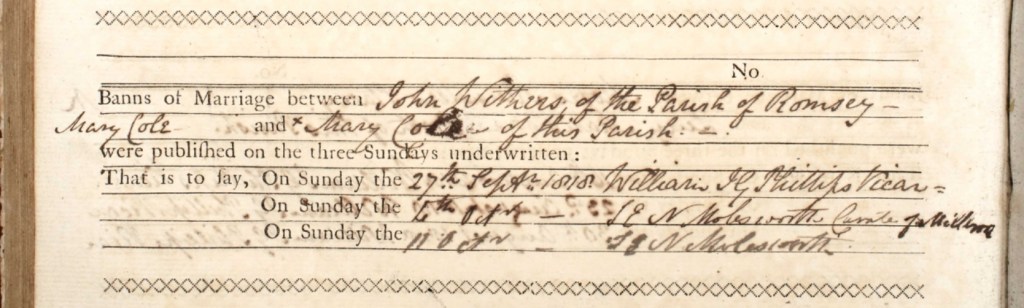
On Sunday, the 27th day of September 1818, just nine months after the birth of their daughter Emma, John Withers of the parish of Romsey and Mary Cole of the parish of Eling took the first formal step toward becoming husband and wife. That day, their marriage banns were read aloud for the first time at St Mary the Virgin Church, Eling’s Parish Church in Hampshire, England, a public declaration of their intention to wed.
The first reading was conducted by Vicar William H. Phillips, while the second and third readings, on the 4th and 11th of October, were led by Curate J.E.N. Molesworth, the same man who had baptised their daughter Emma earlier that year. These banns, spoken before the gathered congregation, were a legal requirement and tradition, allowing the community an opportunity to raise any objections to the forthcoming union.
This simple act of having their names read in church was deeply significant. It symbolised their commitment not only to each other but to their child, to their shared life, and to the expectations of the time. It was a public affirmation of love and responsibility, witnessed by those who knew them. After a year marked by new beginnings and quiet scandal, John and Mary were making it known, they belonged together, and they were ready to stand before God and community as husband and wife.
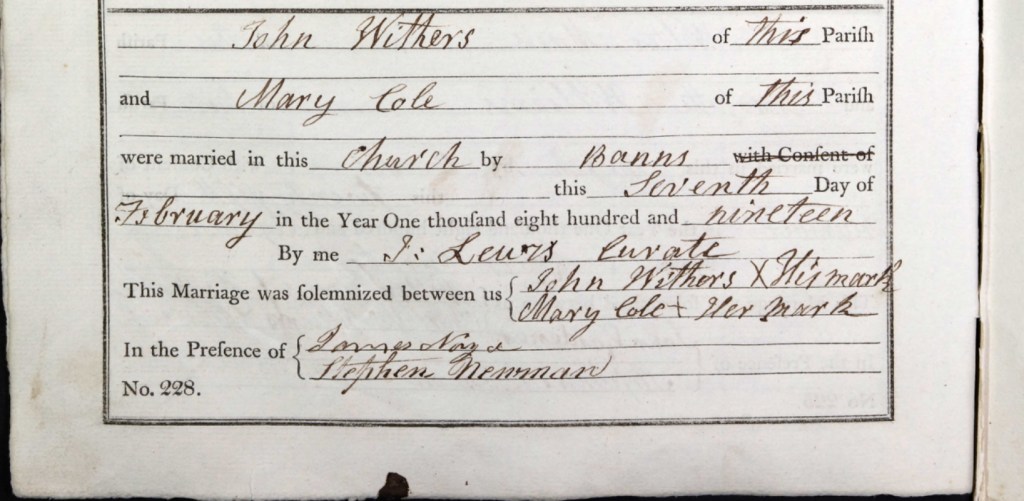
 On Sunday, the 7th day of February 1819, 22-year-old John Withers and 17-year-old Mary Cole stood together at the altar in Romsey, Hampshire, and were married by banns. The ceremony was performed by J. Lewis, the parish curate, in the same church where generations of Withers family moments had unfolded before them. It was a cold February day, but for John and Mary, it marked a beginning, the formal union of a love that had already brought their daughter Emma into the world.
They were young, no doubt feeling the weight and wonder of the moment. Neither could write, so when it came time to sign the official document, they each left their mark, simple Xs placed with care. There’s something deeply moving in that: two young people, without education or means, pledging their lives to one another in the face of all life’s uncertainties, signing their love into history with the only marks they had.
The record itself captures the raw honesty of the moment. It reads:

“John Withers of this Parish and Mary Cole of this Parish were married in this Church by Banns this Seventh Day of February in the Year One thousand eight hundred and nineteen, by me J Lewis Curate. This Marriage was solemnized between us, John Withers X his mark, Mary Cole X her mark. In the presence of James Noyce and Stephen Nammrard.”

Their witnesses, James Noyce and Stephen Newman, friends, perhaps, or neighbours, stood beside them, sharing in the significance of the day. The marriage was officially recorded as entry No. 228 in the church register, a number that now carries more than ink, it carries story, legacy, and a promise made in youth that would shape generations to come.
This moment was more than just a formality. It was John and Mary, choosing each other before their community and God, and beginning the journey of building a life together, with Emma in their arms and hope in their hearts.
As we close the first chapter of John Withers’ life story, we leave behind a young man shaped by the soil of Romsey, by his family’s humble strength, and by the rhythms of rural England at the turn of the 19th century. Born the first son of William and Mary Withers, John carried not only the family name but also the weight of continuity, something deeply meaningful in a world where legacy was passed down not just in words, but in labor, land, and love.
He grew up among a bustling household of siblings, each christened under the arches of Romsey’s churches, each a thread in the Withers tapestry. The details of their births and baptisms, woven with care into parish records, tell us not only of their presence but of a family grounded in faith and community. From the winter morning when John was baptised on Christmas Day, to the day he stood in that same parish church beside his young bride, every milestone formed part of a life quietly rich with meaning.
John’s path was not always easy. He worked as a labourer, and became a father before he became a husband. Yet even in uncertainty, his commitment to Mary Cole, despite the initial stir their union may have caused, speaks to a deep and steady love. When he and Mary stood before the curate, both signing their marriage certificate with a simple "X", it was a mark not of illiteracy, but of shared truth, this was their beginning, carved out in faith and resolve.
As part one of John’s story comes to a close, we are left with the image of a young husband, whose roots now ran deeper than ever, into the town that raised him, the Abbey that recorded his joys and sorrows, and the family he was beginning to build. His was a quiet kind of courage, one born not of grandeur, but of devotion, to work, to love, and to the generations yet to come.
Until next time,
Toodle pip,
Yours Lainey.
🦋🦋🦋
I have brought and paid for all certificates,

Please do not download or use them without my permission.

All you have to do is ask.

Thank you.








 Intwined