Welcome to “The Life of Harry Carr 1869–1947: The Early Years Through Documentation,” a journey into the past, where time itself seems to whisper the story of my second great-grandfather, Harry Carr. Born in the year 1869, the eighth child of Henry and Caroline Carr, in the serene town of Romsey, Hampshire, England, Harry’s life began like a delicate thread, woven into the rich tapestry of a world still untouched by the turbulence of the 20th century.
In these pages, we seek to uncover the quiet beauty of his early years, through the whispers of old documents and the faded ink of letters long ago written. It is through these fragile records that we can glimpse a soul, bound by love for family and the enduring pull of home, yet destined to grow beyond the rolling hills and cobblestone streets of Romsey.
Come with me, then, as we wander through these early days of Harry’s life, where history mingles with memory, and the past softly illuminates the present. With each step, we will honor the quiet moments and the untold stories, as we remember a man whose legacy still lingers like a whisper on the wind, echoing through the generations, reminding us that even the smallest of lives leaves an imprint upon the world.
Welcome back to the year 1869, Romsey, Hampshire, England. The town rests quietly amid the rolling green landscape of southern England, where horse-drawn carriages rattle along cobbled lanes, steam trains whistle in the distance, and the broad River Test winds its way past water meadows and market stalls. Life here is marked by the rhythms of the Victorian age, under the firm and far-reaching rule of Queen Victoria, who has been monarch since 1837. She is in the third decade of a reign that defines the empire, while her Prime Minister in this year is William Ewart Gladstone, a Liberal reformer known for his commitment to modernising the state and addressing social inequalities. The Parliament of the United Kingdom sits in London, with both the House of Commons and the House of Lords engaged in national matters, including the balance of imperial power and the social changes rippling through industrial Britain.
Romsey, though relatively small and steeped in agrarian tradition, feels the growing influence of the industrial world. The railway has reached Hampshire, with nearby stations connecting the town to larger centres like Southampton and London. For many, the railway represents more than travel, it is a symbol of change, of possibility, and for some, of disruption to a simpler way of life.
In 1869, society is distinctly stratified. The wealthy enjoy lives of considerable comfort, often in large country houses or well-appointed townhomes with servants to attend to every need. Their meals are prepared in well-stocked kitchens, and their clothing is tailored from fine fabrics like silk and velvet. Ladies of fashion wear structured dresses with bustles and crinolines, while gentlemen don waistcoats, frock coats, and top hats. Their lives are governed by etiquette and leisure, filled with formal dinners, reading, correspondence, and occasional visits to the theatre or London.
By contrast, the working class and the poor lead far more difficult lives. In rural towns like Romsey, many labour on farms or in small industries such as milling, brewing, or textiles. Some may find work in the larger nearby cities, especially with the expansion of docks in Southampton. They live in modest cottages or crowded lodging houses, often without proper ventilation, sanitation, or reliable access to clean water. Their clothing is practical, made of wool or coarse cotton, and often handed down or repaired repeatedly.
Transportation for most people still involves walking or horse-drawn carts. While railways offer faster travel for those who can afford it, many villagers rarely leave their home parishes. For goods and letters, horse-drawn mail coaches and trains serve as vital links, and the telegraph is beginning to speed up communication across the country.
Energy is drawn primarily from coal, which powers factories, steam engines, and heats many middle- and upper-class homes. Poorer households rely on wood or coal for small fires, which also serve for cooking. Lighting is provided by oil lamps and candles, although gas lighting is beginning to appear in towns and cities, including some parts of Hampshire. In wealthier homes and public buildings, gas fixtures are a mark of modernity. The atmosphere in towns like Romsey is often smoky from coal fires, mixed with the scent of livestock, damp earth, and whatever industry operates nearby.
Heating in homes is central to comfort during the long, cold months, though limited to fireplaces in the main rooms. Bedrooms and outbuildings are often unheated. Water must often be drawn from wells or pumps, and many homes still lack indoor plumbing. Public sanitation is rudimentary, with chamber pots, privies, and cesspits still common. In urban centres, reformers are beginning to demand improvements, and slowly, sewage systems are being built, but progress is uneven.
Food in 1869 is seasonal and local. Working families eat bread, porridge, root vegetables, and the occasional bit of meat or fish. Preservation relies on salting, pickling, and drying. The wealthy enjoy more elaborate meals with multiple courses, including game, exotic fruits, imported tea, and pastries. Markets are bustling with produce, and Romsey’s market town heritage remains strong. Sunday roasts and family dinners are important rituals in homes that can afford them.
Entertainment varies widely by class. The upper classes enjoy musical performances, recitations, and literary salons. Theatre and opera trips to London are common among the elite. For the working class, entertainment is simpler and more communal—folk music, storytelling, public houses, church socials, and country fairs provide relief from the week’s labours. Books, newspapers, and serialized novels are increasingly accessible, with literacy improving slowly among all classes.
Diseases are still a major concern. Cholera, typhoid, tuberculosis, and smallpox are widespread, especially in areas with poor sanitation. Medical understanding is still developing, though the work of people like Florence Nightingale and the growing influence of germ theory are beginning to change hospital practices. Vaccination for smallpox is spreading, but many diseases remain poorly treated, and infant mortality is high.
The environment is undergoing change. While Romsey retains its rural charm with gardens, hedgerows, and riverside walks, nearby areas are touched by the expansion of industry and the encroachment of railway lines. Smoke from coal is a constant in more urban settings, and waste from tanneries and mills often enters local waterways. Nature is still abundant in the countryside, though increasingly shaped by human activity.
Gossip and local news spread quickly through tightly-knit communities. Much of it is shared at market, in churchyards after Sunday service, or in local inns and alehouses. People exchange word of births, marriages, deaths, fortunes won and lost, scandalous behaviour, and political developments, blending truth with speculation in equal measure. The local press carries stories of crime, moral debate, social change, and the activities of the royal family, feeding both admiration and curiosity.
In terms of wider historical events, 1869 sees the continued expansion of the British Empire, with influence growing in India, Africa, and the Pacific. The Suez Canal opens in Egypt this year, dramatically shortening the sea route between Britain and India, a fact celebrated in political and commercial circles. At home, the Church of Ireland is officially disestablished, marking a significant religious and political change. Meanwhile, debates continue over workers’ rights, the education of the poor, and the role of women in public life. The suffragette movement is still decades away from major victories, but its earliest seeds are being planted in intellectual circles.
Romsey in 1869 sits at the edge of this changing world, rooted in the rhythms of rural life yet slowly absorbing the innovations, disruptions, and possibilities of the Victorian age. The abbey still towers above the town, markets still bring farmers and merchants together, and the lanes echo with footsteps both familiar and new. It is a time of contrast, tradition, and transformation.
On the 19th day of March, in the year 1869, a child was born in the quiet town of Cupernham, Romsey, Hampshire, a boy named Harry Carr. The day was a Friday, a moment in time when the world was unaware of the great journey this child would one day embark upon. It was a birth that, though humble, would echo through the corridors of history, the soft beginnings of a story we now seek to tell.
Romsey, the town that cradled Harry’s early days, is steeped in history. Nestled in the heart of Hampshire, Romsey has been a place of importance since the Saxon era. Its name itself traces back to Rupes, a term meaning “cliff” or “rock,” signifying the town’s position by the River Test. Through centuries, Romsey has borne witness to the ebb and flow of English history, from the peaceful times of the Anglo-Saxons to the Norman Conquest and beyond. It was here, among the narrow streets and the stunning Abbey, a grand testament to medieval architecture, that Harry’s life began. The town, with its blend of the old and the new, its cobbled streets and green fields, would shape the young boy who would grow to be so much more than a name on a birth certificate.
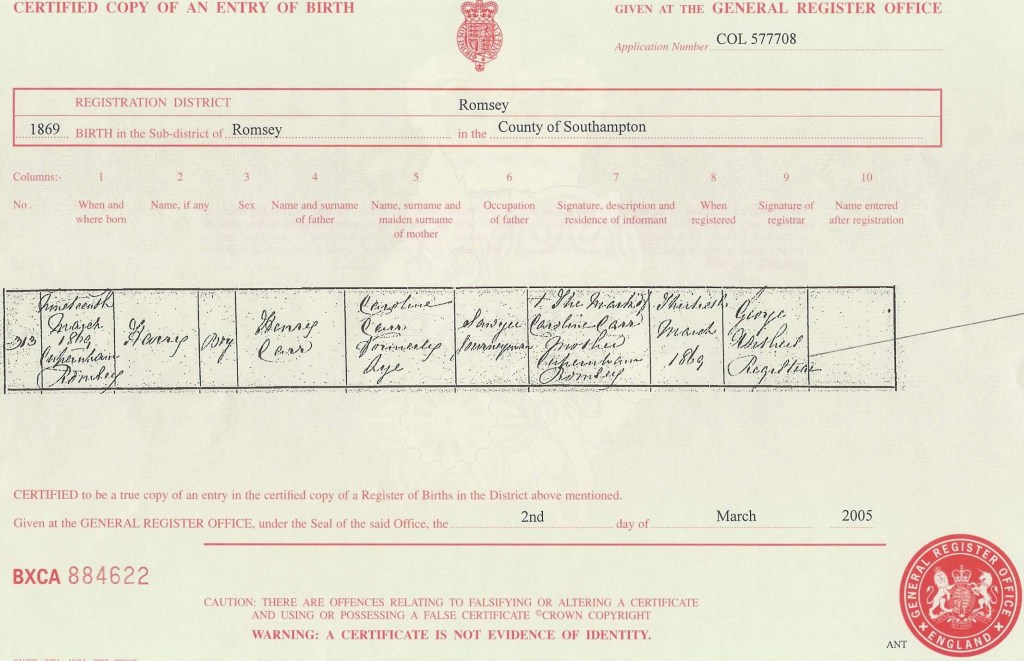
Harry’s mother, Caroline, registered the birth on Tuesday the 30th day of March, 1869, in the heart of Romsey, where Registrar George Withers carefully inked Harry’s details into the official record. The entry read: "Harry, a boy born on the 19th March 1869, at Cupernham, Romsey, to Henry Carr, a journeyman sawyer, and Caroline Carr, formerly Lye, of Cupernham, Romsey." He was the eighth child in a growing family, the younger brother of Elizabeth (1851), George Henry (1853), Jane (1855), Ellen (1858), Charity (1861), Emily (1863), and Matilda (1866), each name woven into the fabric of this loving household.
The name Harry is of Old English origin, a diminutive form of Henry, meaning "home ruler" or "ruler of the household." This speaks not only to Harry's position in the family but perhaps to the quiet strength he would grow into a man of integrity, responsibility, and wisdom. In a world where names hold power and meaning, Harry was more than a child of his time; he was a living testament to his family’s legacy.
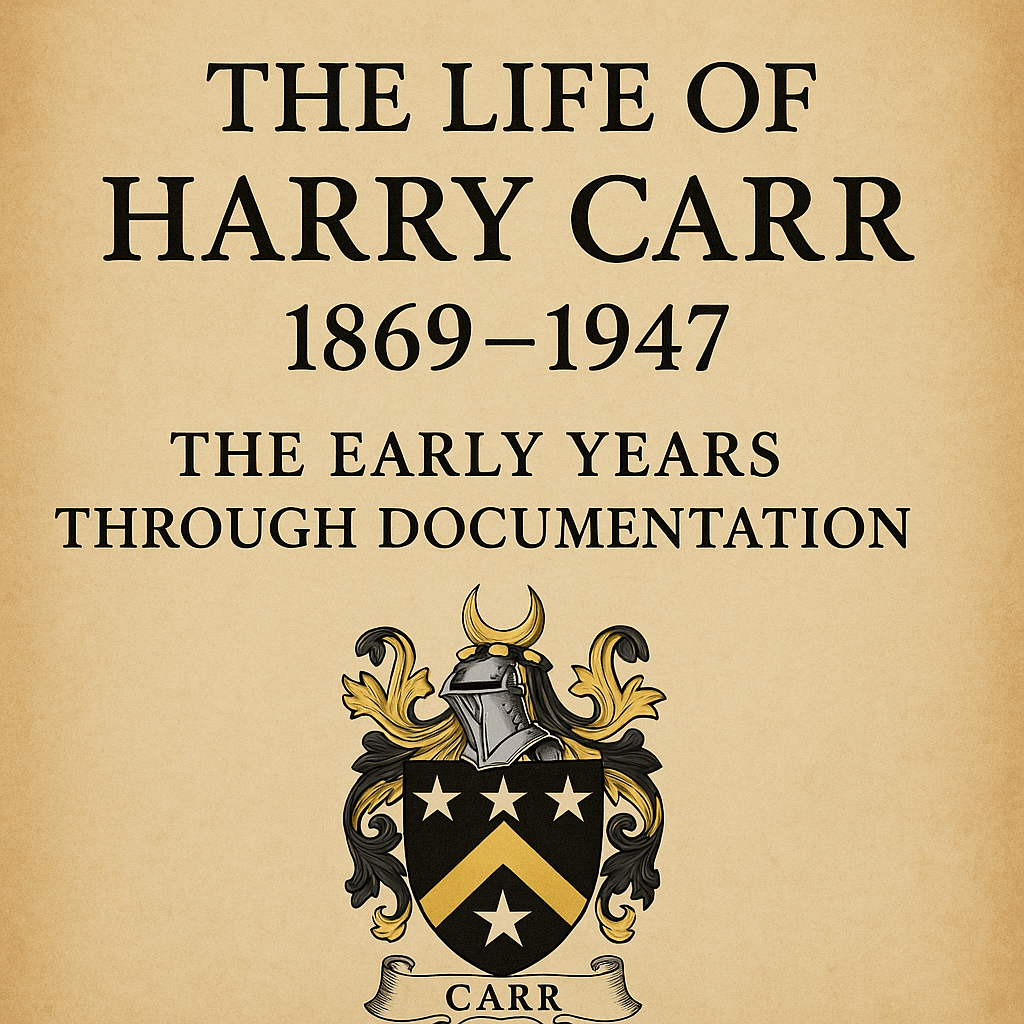
As for the surname Carr, it traces its roots to the Old Norse word kjarr, meaning "marsh" or "wetland." The Carr family name, therefore, evokes images of a strong, steadfast lineage, people connected to the land, resilient and enduring through time. The Carr family crest, which bears the marks of honor and nobility, depicts a black shield with a gold chevron between three silver stars. This symbolizes the Carr family's enduring strength and bright future, three stars shining as a guiding light through the dark, like the lives of those who bear the name.
Harry Carr was born into a legacy that stretched back through the centuries, a legacy of resilience and quiet nobility. His birth, marked by the simple yet profound details recorded in the registry, would be just the beginning of a life that would unfold in ways unimaginable in those early years. And so, from the very start, Harry Carr stood as more than just a name on a birth certificate, he was a part of something much larger, a thread woven into the enduring tapestry of family and history, in a town whose stones have long borne witness to countless lives and stories.
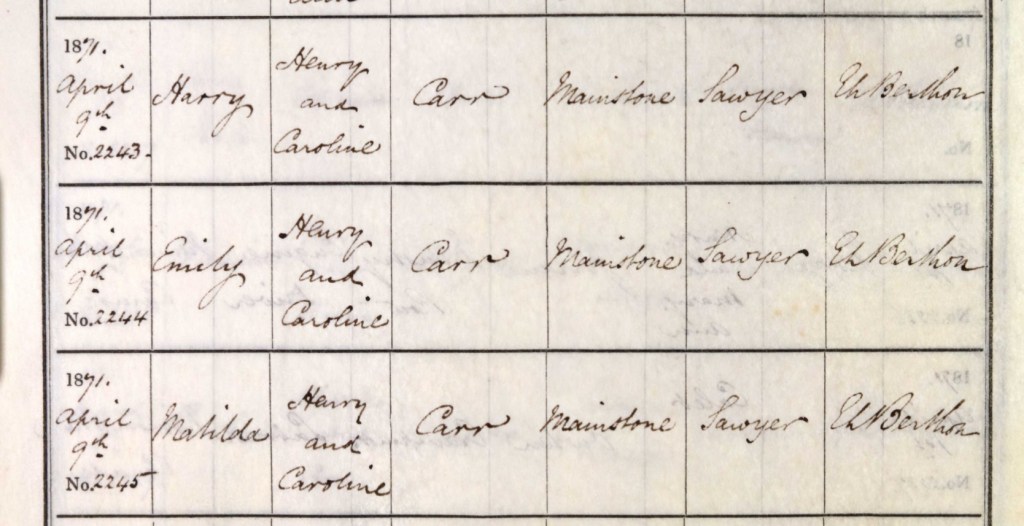
On Sunday, the 9th day of April, 1871, Henry and Caroline brought three of their children, Harry, Emily, and Matilda, to be baptized in the serene town of Romsey, Hampshire. The ceremony took place in the hallowed surroundings of the church, where the gentle sound of prayers mingled with the soft light streaming through the windows. It was here that E.L. Berthon, the officiating clergyman, performed the sacred rite, and in the baptism register, he carefully logged the details of this significant moment. He recorded that Harry, Emily, and Matilda were the children of Henry Carr, a sawyer, and Caroline Carr, who hailed from Mainstone. This moment, though simple in its nature, was a significant step in their spiritual journey, marking not only their place within the family but also their connection to the broader community that held them close.
On the eve of the 1871 census, Sunday the 2nd day of April, young Harry, at the tender age of two, lived with his parents, Henry and Caroline, and his siblings in the quiet enclave of Mainstone, Romsey, Hampshire. Henry, aged 41, and Caroline, aged 40, were raising their family in this charming rural part of the town. The household also included Harry's older siblings: Ellen, 12; Charity, 10; Emily, 7; and Matilda, 4. Henry worked diligently as a sawyer, providing for his loved ones in a life that was simple, yet filled with the warmth of family.
The family lived in the entirety of their premises, where the rhythms of daily life were carried out within the modest yet steadfast walls. Strangely, however, the census recorded young Harry under the name George H. Carr, a mystery that still lingers in the annals of their family history. The names of his siblings were also written with peculiar errors, Ellen became Hellin, Charity was listed as Chariety, Emily as Emly, and Matilda as Matylda. These small discrepancies serve as a reminder of the imperfect nature of the past, where the written word often carried its own set of mysteries.
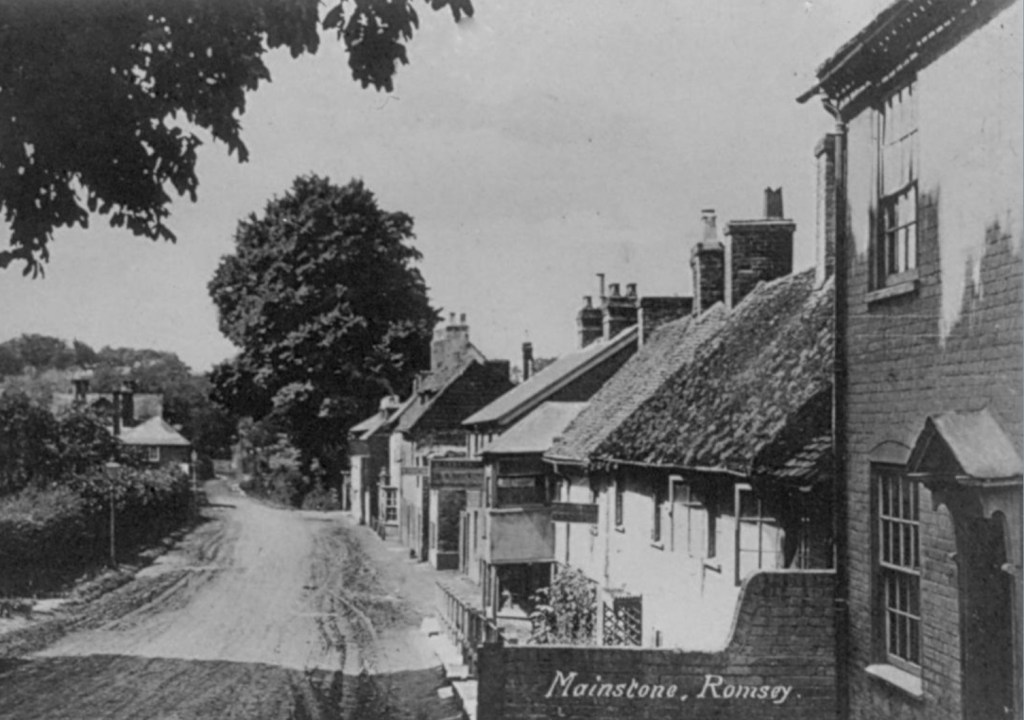
Mainstone, the village that was their home, holds a quiet and profound place in the tapestry of Romsey's history. Nestled in the western part of Romsey, it lies within the parish of Romsey Extra, which is the rural expanse that stretches beyond the town's central area, Romsey Infra. The distinction between the two has existed since at least the twelfth century, if not earlier, adding layers of historical depth to this picturesque corner of England.
Historically, Mainstone was not under the control of Romsey Abbey, unlike much of the surrounding land. Instead, it was held by various lay landowners, a distinction that set it apart from the more centrally controlled areas. By the 14th century, Mainstone was referred to as "Villa de Marstone," and was tied to the name of John Pauncefot, marking its existence as a humble hamlet during the medieval period. Unlike the more tightly-knit settlements to the east of the River Test, Mainstone’s layout was more dispersed, with farmsteads scattered across the landscape in a pattern that spoke of rural serenity and quiet independence.
One of the area’s notable buildings is 1 Mainstone, a Grade II listed structure that stands as a testament to the area’s historical and architectural significance. This 18th-century two-storey house, with its colourwashed brick and toothed brick eaves cornice, proudly faces the river, its angular bay window still standing as a beautiful reminder of times gone by. The original casement windows remain intact, and its simple yet elegant design carries with it a deep connection to the past.
In present-day Mainstone, the rural charm remains, though it has gradually adapted to the needs of modern life. New residences and businesses, such as the Mainstone Veterinary Clinic, have been woven into the fabric of the community, allowing the area to maintain its sense of history while serving the evolving needs of its people.
The story of Mainstone, from its medieval beginnings as a scattered hamlet to its current place in the Romsey community, reflects the broader narrative of change and continuity that has shaped this region of Hampshire. The land that Harry and his family called home, with its enduring architecture and rich heritage, offers a tangible connection to a past that is never truly gone but continues to live in the present, echoing through the lives of those who came before and those who continue to call it home.
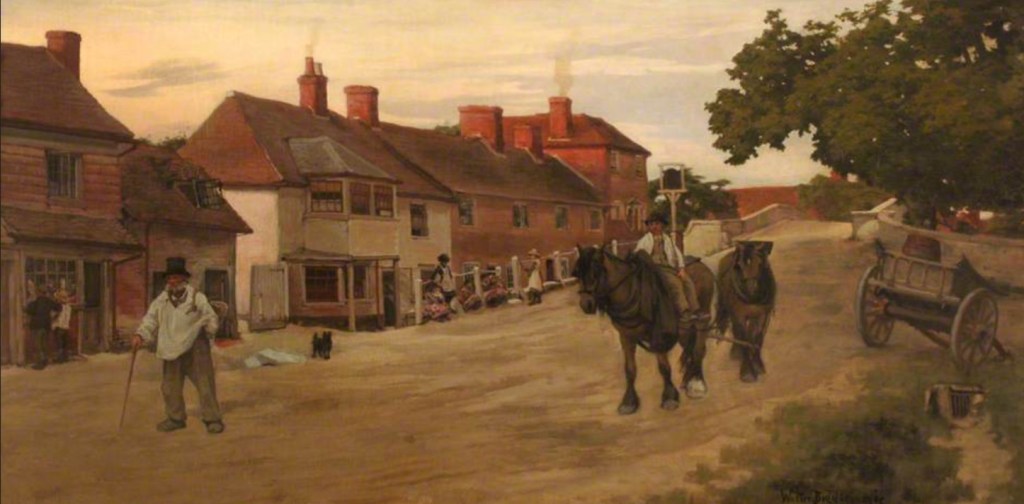
Mainstone Looking toward Romsey
Walter Biddlecombe (b.1856)Mainstone in the 1920s (Image: Romsey Local History Society)
On Monday, the 22nd day of September, 1873, in the peaceful surroundings of Mainstone, Romsey, Hampshire, another child was born into the Carr family, a girl named Fanny. Her arrival, like that of her siblings, marked another moment in the ongoing story of a family rooted in the heart of this rural landscape. The birth of Fanny would become another thread woven into the tapestry of Henry and Caroline Carr’s growing household.
Her mother, Caroline, registered Fanny's birth on Tuesday, the 14th day of October, 1873, in Romsey. The event was carefully recorded by Registrar George Withers, who, in his precise hand, logged the details in the official register. He noted that Fanny Carr, a girl, was born on the 22nd of September, 1873, at Mainstone, Romsey, to Henry Carr, a journeyman sawyer, and Caroline Carr, formerly Lye, of Cupernham, Romsey. Fanny, the ninth child in the family, was welcomed into a home already rich with the laughter and love of her older siblings.
In a family of many, each child brings a unique light to the household. Fanny, born into a lineage that spanned the countryside of Romsey, would carry with her the same legacy of resilience and quiet nobility that defined her family. Her birth, though simple and marked by the everyday rhythms of life in a small village, would become yet another chapter in the long and enduring story of the Carr family.
On Sunday, the 9th day of November, 1873, in the hallowed surroundings of the Parish Church of Romsey, Hampshire, possibly within the storied walls of Romsey Abbey, Henry and Caroline, brought their daughter, Fanny, to be baptized. This sacred moment, like so many before it, was a significant step in the spiritual journey of their family. The vicar, E.L. Berthon, officiated the ceremony, his voice rising in prayer as he performed the rite with reverence and care.
In the baptism register, Vicar Berthon carefully recorded the details of the occasion, marking the day with his precise hand. He noted that Fanny Carr, daughter of Henry Carr, a sawyer, and Caroline Carr, of Mainstone, was baptized on the 9th day of November, 1873. This moment, simple yet profound, solidified Fanny's place not only within her family but also within the wider embrace of the community of Romsey, where faith and tradition bound her to a long line of history.
In this quiet act of devotion, the Carr family, like so many before them, acknowledged the spiritual journey of their beloved child. Fanny’s baptism, performed amidst the centuries-old stones of Romsey’s church, connected her to a rich heritage of faith, a heritage that would continue to shape her life in the years to come.
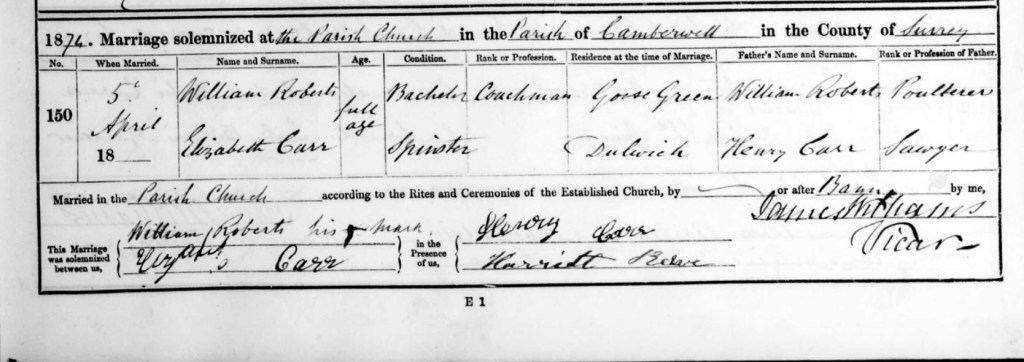
On Sunday, the 5th day of April, 1874, in the sacred space of St. Giles’ Church, Church Street, Camberwell, Southwark, 23-year-old Elizabeth Carr, a spinster of Dulwich, became the bride of William Roberts, a bachelor and coachman of Goose Green. It was a union, blessed under the watchful eyes of Vicar James Williams, who performed the ceremony and carefully recorded the event in the parish register. The details of their marriage were logged with the clarity of faith and love: both Elizabeth and William were of full age, and Elizabeth, the daughter of Henry Carr, a sawyer, was joined in matrimony to William, the son of William Roberts, a poulterer.
The witnesses to this momentous occasion were none other than Elizabeth's father, Henry Carr, and a woman whose name remains a mystery, Harriett, her surname unclear, but her presence marking a significant moment in Elizabeth’s life. As the vows were exchanged within the venerable walls of St. Giles' Church, Elizabeth and William stepped into a new chapter, their futures entwined as husband and wife.
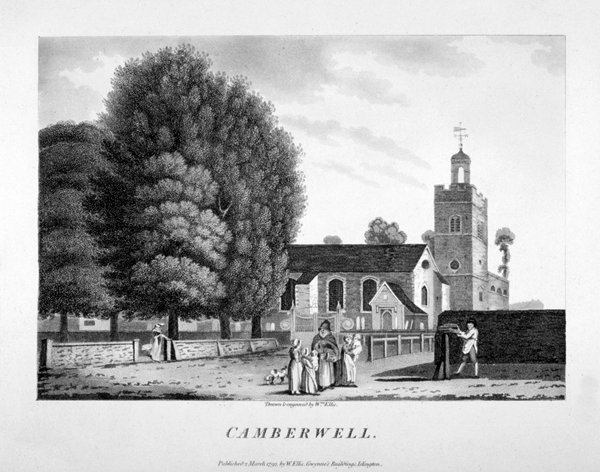
St. Giles' Church, the very place where Elizabeth and William began their journey together, is a monument to the rich history of Camberwell, London, and to the resilience of faith across the centuries. This church, a striking example of Victorian Gothic Revival architecture, stands on land steeped in history. Its origins trace back to before 1089, mentioned in the Domesday Book as the parish church of Camberwell, serving a community that spanned from Peckham to Dulwich. Over the years, the church underwent many changes, its original medieval structure evolving until it was tragically destroyed by fire on the 7th of February, 1841.
Yet, as with many things that endure, the spirit of St. Giles’ Church was not extinguished. A competition was held to design a new church, and the architectural firm of George Gilbert Scott and William Bonython Moffatt triumphed, bringing forth the present structure, completed between 1842 and 1844. With its cruciform plan, towering spire that reaches 210 feet into the sky, and intricate details, the church was consecrated on 21st November 1844. Built in the Gothic Revival style, St. Giles' Church stands as a symbol of faith, history, and architectural beauty, its walls now made of Portland stone, after the original Caen and Sneaton stones were damaged by the effects of pollution.
Inside, the church’s nave and aisles provide space for reflection and worship, while the 14th-century sedilla and piscina in the Lady Chapel are remnants of the medieval past. The stained-glass windows, including the East Window designed by John Ruskin, tell stories from Creation to the End of Time, continuing the church's long tradition of artistic and spiritual significance.
Beneath the church lies a crypt over 300 years old, which, since 1962, has housed the Camberwell Samaritans, a service dedicated to supporting the homeless and distressed. This humble beginning evolved into the St. Giles Trust, continuing its charitable work in the community today. The crypt now serves as an arts venue and jazz club, maintaining the church's role as a living, breathing community hub.
As Elizabeth Carr and William Roberts exchanged vows within the walls of this storied church, they too became part of its long history, two lives forever etched in time, their union celebrated under the watchful gaze of a community that has endured centuries of change.
On Saturday, the 10th day of November, 1877, in the heart of Romsey, Hampshire, Harry's younger brother, Frederick, known affectionately as Frank, was born. Yet, even in this moment of new life and joy, there remains a curious silence, a mystery that has continued to elude us in the search for his place within the official records.
Despite the passage of time, I have been unable to find a birth index for Frank under the Carr or Lye names, which is an unusual and perplexing absence. Many family trees on ancestry have him listed with a birth index under the reference GRO Reference: CARR, FREDERICK, 1877, D Quarter in ROMSEY, Volume 02C, Page 81, but this record attributes the maiden name of the mother as Gifford, not Lye, leaving us with a lingering question, could this really be Frank’s birth registration? The inconsistency in the names leads me to doubt that it is the correct record for him.
What is even more puzzling is that Frank does not appear in the subsequent census returns. His absence in the official records only deepens the mystery, and as of yet, no baptismal record has been found to confirm his place within the family’s story. This search, which should be an exploration of roots and connections, has become a frustrating reminder of the limitations of archival records and the gaps that time and circumstance often leave behind.
It is a challenge I cannot quite reconcile, this missing piece of the puzzle in the story of Harry’s life. It is disheartening to come so close, to trace the delicate threads of a family’s past, and yet be left with unanswered questions. But even in the face of these gaps, the search continues, for every life, even those left partially untold, deserves its place in the greater narrative of history. And so, Frank’s story, though veiled in uncertainty, will remain a part of the journey, just as much a part of Harry’s story as any other chapter.
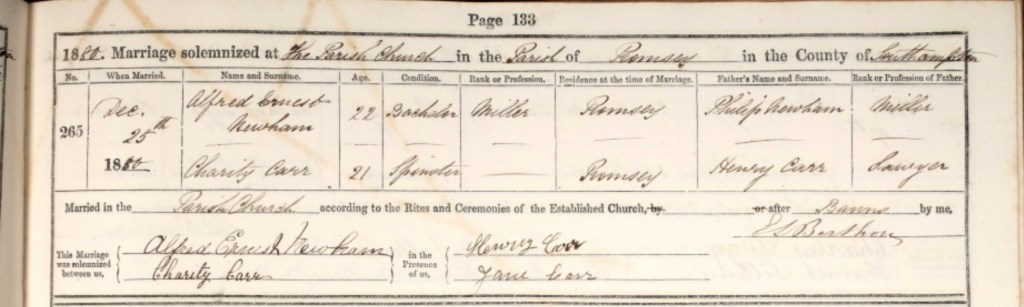
On Saturday, the 25th day of December, 1880, Harry’s sister, Charity Carr, a 19-year-old spinster from Romsey, stood before the altar of Romsey Abbey, ready to begin a new chapter in her life. Beside her was Alfred Earnest Newham, a 22-year-old bachelor and miller, also from Romsey, whose life would soon be intertwined with hers. The ceremony, performed by E. L. Berthon, was a moment of quiet significance, marking the union of two hearts and two families.
As the vows were exchanged, the details of this new beginning were carefully recorded in the marriage register: Charity, daughter of Henry Carr, a sawyer, and Alfred, son of Philip Newham, a miller. The register serves as a testament to their union, a permanent mark on the pages of time. Witnessing the ceremony were Charity’s father, Henry Carr, and her sister Jane, whose presence at the wedding added a special sense of family to the occasion.
Charity and Alfred’s wedding, held in the storied halls of Romsey Abbey, was not just the joining of two individuals, but the melding of two lives, full of hope and promise for the future. On that winter’s day, as the cold air swept through the Abbey’s ancient stone walls, Charity embarked on her journey with Alfred by her side, a journey bound by love, family, and the unspoken connection that had brought them together in the heart of Romsey.
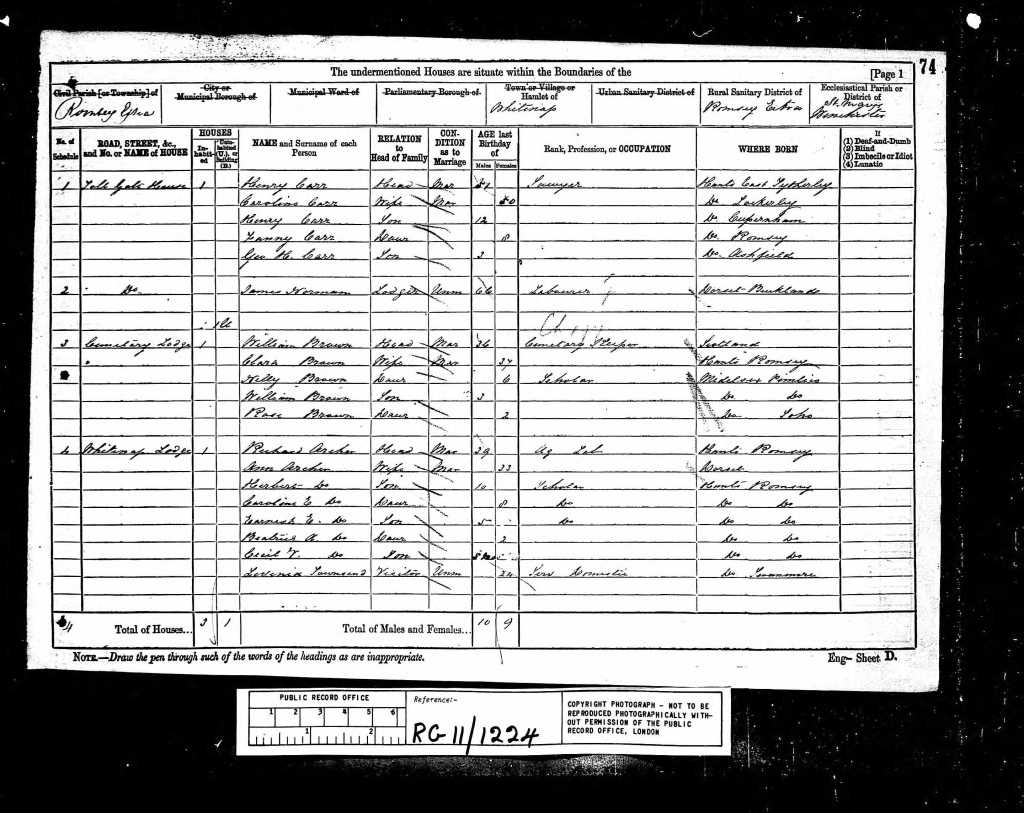
On the eve of the 1881 census, Sunday, the 3rd day of April, 12-year-old Harry, his parents Henry, aged 37, and Caroline, aged 50, along with his siblings, Fanny, aged 8, and Geo. H., aged 3, were residing at the Toll Gate House in Romsey, Hampshire. The family’s life, though humble, was filled with the steady rhythm of work and family, as Henry continued to provide for them through his work as a sawyer. They occupied the whole of the premises, living in a space where the walls surely echoed with the sounds of everyday life.
However, as with so many moments in history, this census return is far from straightforward. Once again, there are discrepancies that add an air of mystery to the family's story. For one, Harry is listed under the name Henry, which is both curious and confusing. But what makes this even more perplexing is the entry of a sibling named Geo. H. Carr. Could this be Frank, the elusive brother whose birth and records remain so difficult to trace?
I have searched diligently through the GRO references for a birth record of a Geo. H. Carr around 1878, in Ashfield, Hampshire, but the search has thus far yielded no answers. What deepens the mystery further is that Harry’s brother, George Henry Carr, who was born on the 7th day of May, 1853, lived until 1932, and therefore cannot possibly be the same person listed in the 1881 census as the 3-year-old Geo. H. Carr.
These inconsistencies in the census return continue to raise questions, questions that, for now, remain unanswered. The story of Harry’s family, though full of love and resilience, is also one of complexity and untold chapters, where even the simplest of documents sometimes leave us with more questions than answers. And yet, each of these gaps, these mysteries, are as much a part of their story as the details we can confirm. The search for clarity continues, even as the puzzle pieces shift and fall just out of reach.
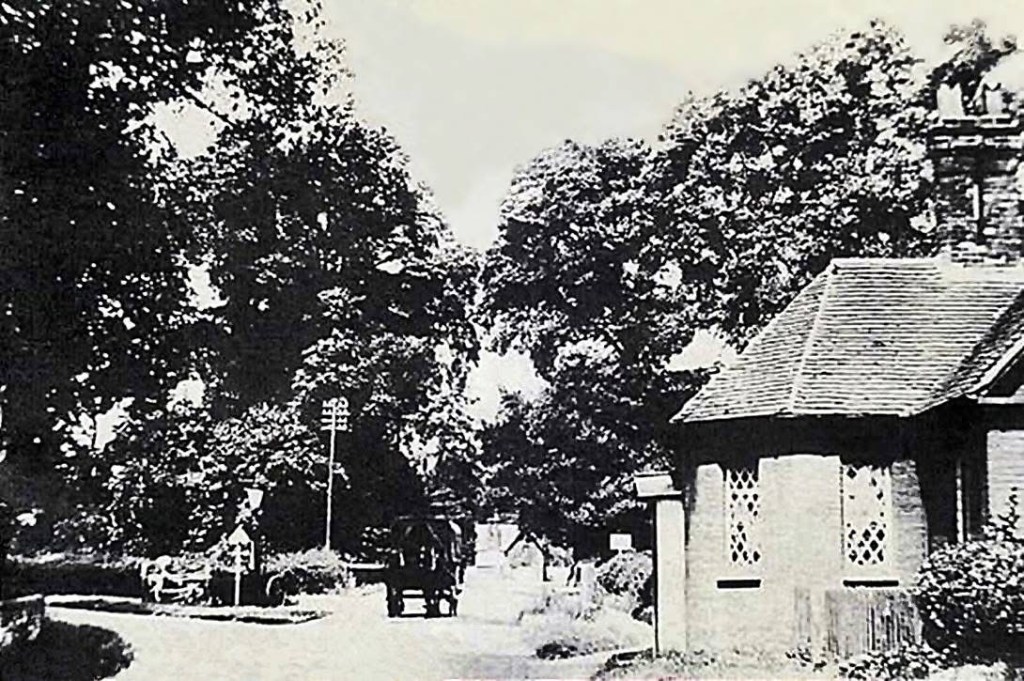
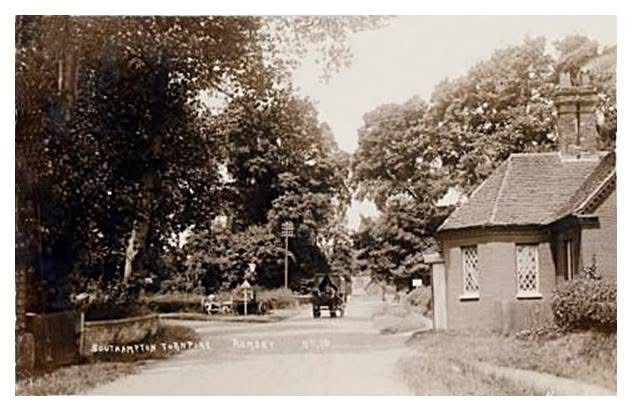
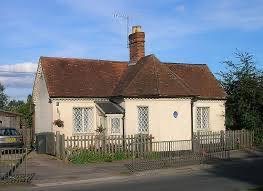
Toll Gate House in Romsey, Hampshire, England, commonly known as Gunville Gate House, is a notable historical structure situated along Southampton Road (A3057). Constructed in 1864 by the London & South Western Railway, it was established to serve the Southampton Turnpike Road, which had been rerouted from the Broadlands estate. This building functioned as a toll house, collecting fees from travelers using the turnpike road. However, its role was relatively short-lived; tolls on turnpike roads in the UK were abolished in 1872, leading to the cessation of its toll-collecting duties.
Architecturally, Gunville Gate House is a single-storey, three-bay brick structure featuring a projecting hexagonal central bay, forming a truncated 'T' plan. This design was typical of mid-19th-century toll houses, providing the toll collector with a clear view of the road in both directions. The building's historical and architectural significance has been recognized with a Grade II listing, ensuring its preservation as part of the region's heritage.
Today, Gunville Gate House stands as a testament to the era of turnpike roads and the infrastructure that supported them.Its preservation offers insight into the transportation history of Romsey and the broader developments in road travel during the 19th century.
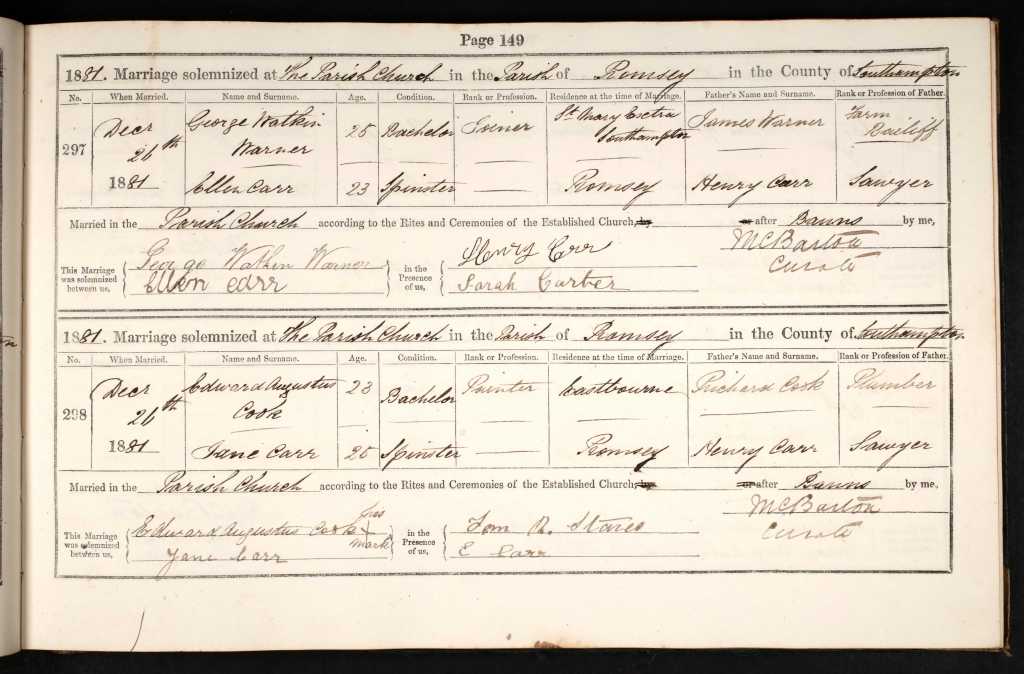
On Monday, the 26th day of December, 1881, a day that would forever bind two sisters in the shared memory of a special occasion, Harry's sisters, Jane and Ellen Carr were united in marriage in a double ceremony at the grand Romsey Abbey. The air was filled with a sense of quiet reverence and joy, as both sisters embarked on new chapters in their lives, surrounded by family and the timeless beauty of the Abbey.
First, 25-year-old Jane Carr, a spinster from Romsey, stood beside Edward Augustus Cook, a 23-year-old bachelor and painter from Eastbourne. The ceremony, performed by Curate M. C. Barton, was a union that marked the joining of two families. The marriage register reflects the union: Jane, daughter of Henry Carr, a sawyer, and Edward, son of Richard Cook, a plumber. Witnessing this moment of devotion were Tom P. Stares and Jane’s brother, E. Carr, who both marked this occasion with their presence.
Immediately following, 23-year-old Ellen Carr, also of Romsey, married 25-year-old George Walkin Warren, a joiner from St. Mary’s Extra, Southampton. Just as her sister had, Ellen stood before Curate M. C. Barton, who again officiated the ceremony. The marriage register details this union as well: Ellen, daughter of Henry Carr, a sawyer, and George, son of James Warren, a farm bailiff. Ellen and George’s witnesses were Henry Carr, their father, and Sarah Carter, whose presence served as a testament to their shared moment of joy.
The shared wedding day of Jane and Ellen at Romsey Abbey not only marked the union of two couples, but also deepened the bonds between siblings. Two lives, bound by love, faith, and family, were transformed within the sacred walls of the Abbey, where generations had gathered before them. It was a day of celebration, a reflection of love, new beginnings, and the promise of futures intertwined.
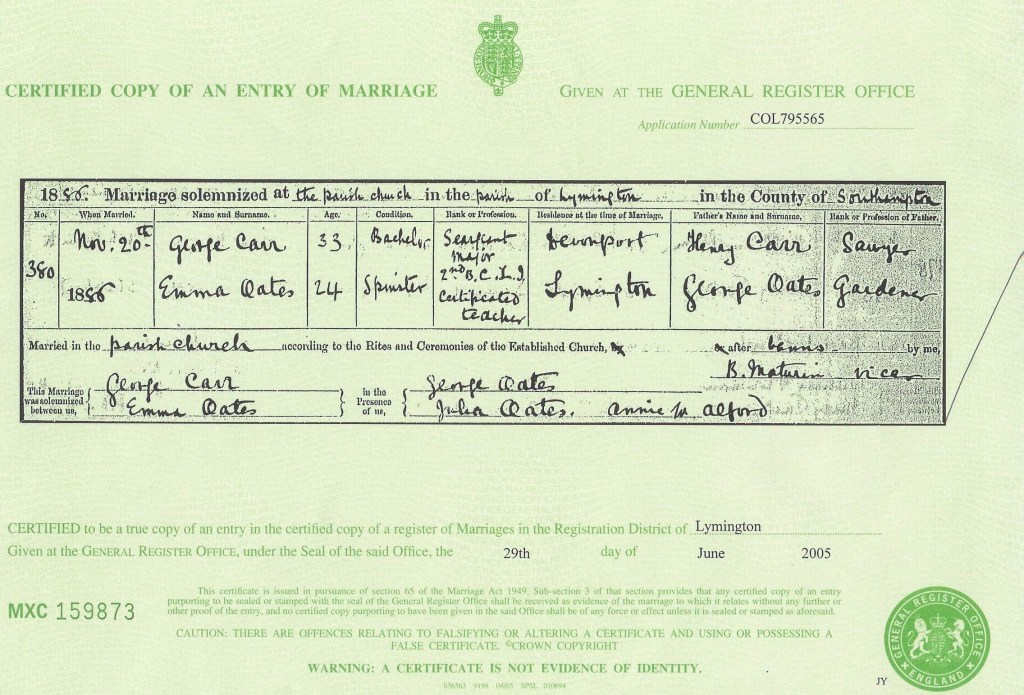
On Saturday the 20th day of November, 1886, 33-year-old Harry’s brother, George Carr, a bachelor and Sergeant Major in the Second Battalion of the British Columbia Light Infantry, residing in Devonport, stood before the altar of St. Thomas the Apostle Church in Lymington, Hampshire. He married 24-year-old Emma Oates, a spinster and certified teacher from Lymington. The ceremony, solemn and momentous, was performed by B. Maturer, the officiating clergyman, who recorded their vows in the parish register, forever binding their names together in the sacred tradition of marriage.
The register tells us that George was the son of Henry Carr, a sawyer, and Emma, the daughter of George Oates, a gardener. Their witnesses, George and Julia Oates, along with Annie W. Alford, stood beside them in support, marking the significance of the union with their presence and testimony.
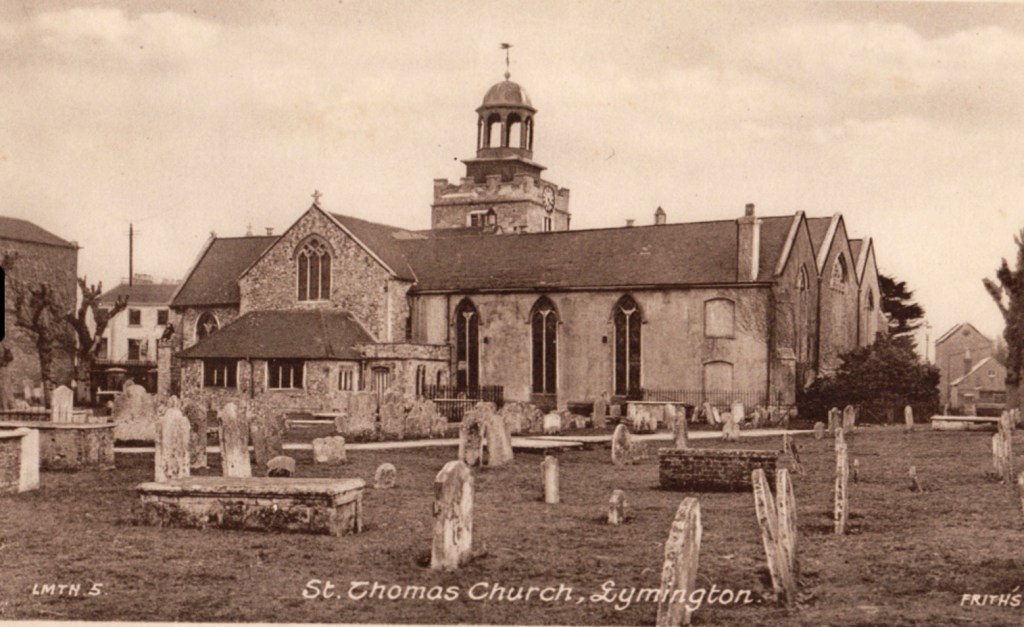
The church in which George and Emma were married St. Thomas the Apostle Church, holds a rich and storied history, standing as a testament to over 800 years of worship, faith, and community life. Situated proudly at the top of Lymington's High Street, this Anglican parish church has witnessed centuries of change, its enduring presence a reminder of the town's deep roots in ecclesiastical tradition.
Built around 1250 as a chapel affiliated with the Priory of Christchurch, St. Thomas’ Church retains elements of its medieval origins, including Early English architectural features such as lancet windows, a trefoil-headed piscina, and compound columns, delicate echoes of a bygone era. Through the centuries, the church has undergone various restorations and expansions, each contributing to its character and significance.
In the 17th century, the church saw the addition of its tower, a magnificent structure completed around 1670. Made of limestone ashlar with a distinctive timber cupola, the tower houses a peal of eight bells, five of which were cast in 1785 by Robert II Wells, and three added later in 1901 by John Taylor & Co. The bells still ring out over Lymington, a poignant reminder of the church’s long history and the voices of those who have come to worship there.
The 18th and 19th centuries brought further changes, including the addition of galleries supported by Tuscan columns and the construction of the narthex in 1811, which extended the church and enclosed the former west wall. Inside, the blend of classical and Gothic elements creates a space both reverent and inspiring, from the nave with its barrel-vaulted ceiling to the chancel adorned with decorative plasterwork. The north-east chapel, built as a mortuary chapel by Hugh Courtenay, still stands as a quiet testament to the church's deep connection to the past, with its ceiled wagon roof dating from around 1500.
Recognizing its architectural and historical importance, St. Thomas the Apostle Church was designated a Grade II* listed building in 1953, ensuring its preservation for future generations. Today, it remains an active place of worship, a venue for concerts and civic events, and a church deeply committed to outreach and environmental initiatives. It continues to serve the people of Lymington, providing both spiritual nourishment and a sense of connection to the town’s rich heritage.
As George Carr and Emma Oates stood before the altar in this ancient church, exchanging vows and pledging their lives to one another, they became part of the living history of St. Thomas the Apostle Church. Their union, a moment of personal significance, was but one of countless others that have been celebrated within these walls, an enduring connection to the faith, community, and tradition that has shaped Lymington for over eight centuries.
St Thomas the Apostle Church, Lymington, Hampshire, England.
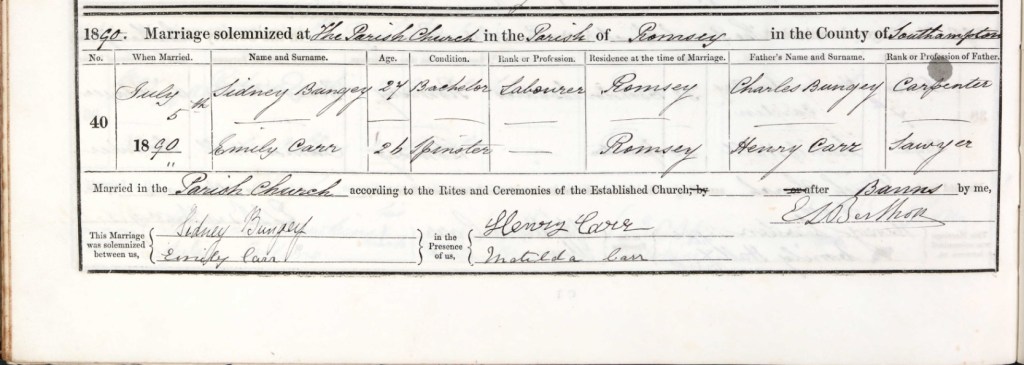
On Saturday, the 5th day of July, 1890, under the vaulted arches of Romsey Abbey, Harry’s sister, 26-year-old Emily Carr, a spinster from Romsey, stood alongside Sidney Bungay, a 27-year-old bachelor and labourer, also of Romsey. The warm summer day seemed to hold a sense of promise and anticipation as the couple pledged their vows, marking the beginning of a new chapter in their lives.
The ceremony, performed by E. L. Berthon, was recorded in the marriage register with careful detail: Emily, the daughter of Henry Carr, a sawyer, and Sidney, the son of Charles Bungay, a carpenter. Their union was witnessed by Emily’s father, Henry Carr, and her sister Matilda, whose presence added the comforting weight of family to the moment.
As they stood in the sacred space of Romsey Abbey, their vows echoed through the centuries-old walls, binding them not only to each other but to the rich history of the place itself. For Emily and Sidney, this day was not only a union of hearts but also a symbol of the enduring strength of family and community, ties that would continue to shape their lives in the years ahead.
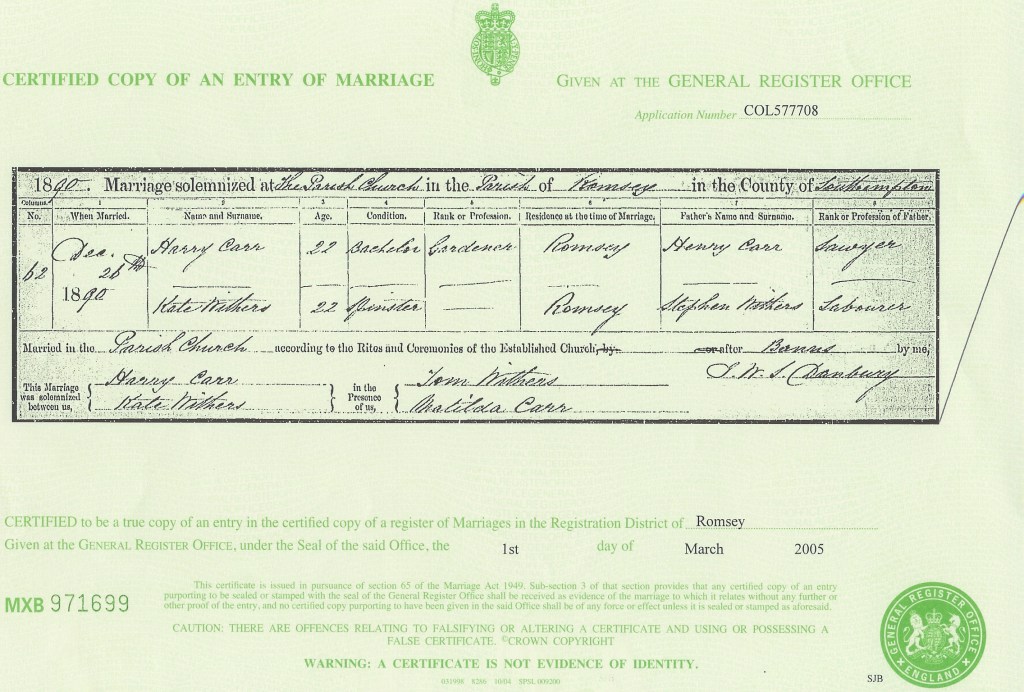
On the 26th day of December, 1890, beneath the towering arches of Romsey Abbey, Harry Carr, a 22-year-old bachelor and gardener from Romsey, stood beside Kate Withers, also 22, a spinster from the same town, ready to begin their shared journey through life. The solemn yet joyful occasion took place on a crisp winter’s day, when the light filtered softly through the Abbey’s ancient windows, casting a sacred glow upon the couple as they exchanged vows.
The ceremony was performed by J. W. S. Danbury, the officiating clergyman, who recorded the details of the marriage in the parish register with his careful hand. The register notes that Harry was the son of Henry Carr, a sawyer, and Kate was the daughter of Stephen Withers, a labourer. In the presence of their families and the community, Harry and Kate vowed to join their lives together, a union forged in love and promise.
Among the witnesses to this important moment were Harry’s sister, Matilda Carr, and Kate’s brother, Tom Withers. Their presence, as close family members, marked the union of not just two people but two families, whose lives would be intertwined through the bond of marriage.
Romsey Abbey, the setting for their vows, has stood for centuries as a symbol of faith, history, and community. Its walls have witnessed countless moments of devotion, and on this particular day, the Abbey became the backdrop for the beginning of Harry and Kate’s life together, a life that, like the Abbey itself, would endure through time, filled with love, challenges, and the quiet beauty of shared moments.
As we close the first chapter of Harry's journey, we are reminded of the many milestones that shaped his early life, from his humble birth in the heart of Romsey, Hampshire, to the bustling streets of Cupernham, where his childhood was steeped in the love and warmth of family. Through the years, Harry witnessed the changing tides of life, marked by the steady hands of his parents, the guidance of his community, and the unspoken strength that comes with growing up in a town rich in history.
From the registers of baptism to the parish records of his marriage, Harry’s life has been recorded in the delicate ink of history, each entry a testament to the enduring spirit of his family and the ties that bound him to the land and the people of Romsey. The names of his siblings, his parents' quiet dedication, and the town’s presence in his life all served to shape him into the man who, on that cold winter’s day in December 1890, stood before the altar of Romsey Abbey, pledging his heart and future to Kate Withers, the love of his life.
In the coming chapters, we will see how Harry’s life blossomed, how his love for Kate would bloom into a family of his own, and how the man who began his journey in the quiet corners of Hampshire would go on to leave his mark on the world. But for now, we pause at this moment, where Harry Carr’s journey through documentation brings us to the beginning of his new life, one bound by love, faith, and the promise of a future shared with the woman he adored.
Until next time,
Toodle pip,
Yours Lainey.




 Intwined