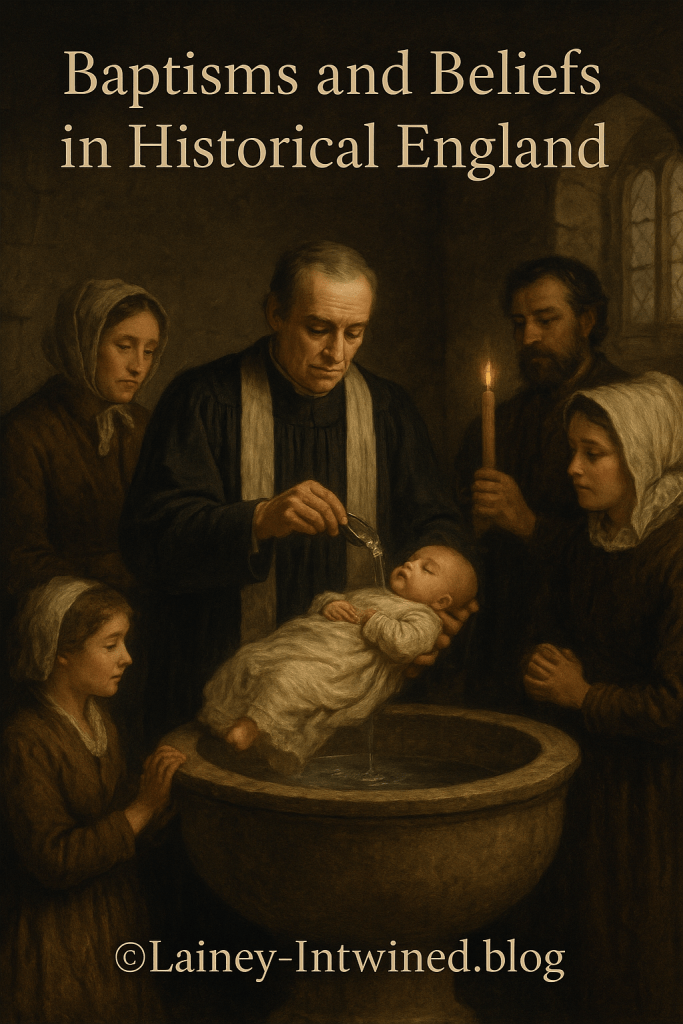
In the England of past centuries, baptism was more than a religious duty. It was a moment when the fragile beginnings of life were bound to the eternal, when families and neighbors gathered in hope, and when the Church sought to bring even the smallest infant into the fold of both heaven and community. Parish registers, carefully kept in Hampshire, Wiltshire, and beyond, reveal how this sacred rite unfolded in ways that were as practical as they were symbolic, shaped by tradition, geography, mortality, and belief.
It may surprise us today that many baptisms were performed not on Sundays but on Wednesdays. This choice was rarely a matter of doctrine. Sundays were filled with the great communal drama of worship and Mass, while weekdays allowed clergy to focus on other sacraments. Wednesday, poised at the heart of the week, offered a natural pause between obligations, a day when priests, godparents, and families could gather without the press of Sunday duties. In the liturgical imagination, Wednesdays and Fridays carried echoes of fasting and penance, and baptisms performed on such days carried undertones of cleansing, renewal, and preparation for Christian life. Yet in truth, it was often simple practicality that prevailed, with registers from the sixteenth to eighteenth centuries showing Wednesday as a favored day across English parishes.
Still, not every baptism waited for midweek. In rural England, urgency often dictated that the rite be performed at home, or in the quiet of early morning. The shadow of infant mortality loomed large, and parents feared their child might die before reaching the parish font. To delay was to risk a soul. A midwife or priest might therefore baptize the newborn almost immediately, sometimes within hours of birth, sometimes in the dim light of dawn. Bad weather, harsh winters, and the long distances of scattered parishes made such private baptisms not only understandable but necessary. Canon law made room for this reality, permitting baptisms outside church walls in cases of need, and authorizing anyone, even a layperson, to act, so long as water and the sacred Trinitarian words were used. Midwives, trained in the formula, became guardians not just of birth but of eternal life, standing at the threshold between body and soul.
The records left behind bring these moments vividly to life. Some parish clerks noted only the essentials: the date, the child’s name, the parents. Others offered detail and context, adding phrases like “in danger of death,” “at home,” or “privately baptized.” Marginal notes might tell us the outcome: “child survived” or “died shortly after baptism.” One Hampshire entry from 1693 records: “John, son of Thomas and Mary Carter of Romsey Infra, was privately baptized at home by me, John Whitaker, minister, in danger of death. Godparents: William and Elizabeth Moore.” Another, from 1721, tells of Anne, daughter of Richard and Susanna Green, baptized at home by the parish minister because “the child was weakly and could not be brought to the church.” Such entries, often accompanied by prayers in the minister’s hand, “May the Lord preserve her life”, echo the tenderness and urgency of the moment.
Sometimes the circumstances were stranger still. Registers contain notes of baptisms performed by midwives, when the priest could not arrive in time, or of “conditional baptisms,” performed if there was doubt whether an earlier ceremony had been valid. The formula would be adjusted “baptised conditionally, if not already baptized”, to ensure the sacrament’s sufficiency without presuming to repeat it. These practices reveal a Church that was at once careful and compassionate, eager to secure the spiritual safety of every child even amid the uncertainties of rural life.
Beyond names and dates, parish registers also record glimpses of the world in which these baptisms took place. Entries often identified the family’s village or parish, linking each child to a precise place in the landscape: Romsey Infra, Romsey Extra, Sherfield English. Sometimes they included the father’s occupation, yeoman, blacksmith, labourer, tracing the contours of social order across the countryside. Marginal notes occasionally mark extraordinary circumstances: a harsh winter, an epidemic, a flood. In such moments, the register becomes more than a sacramental ledger; it is a diary of parish life, capturing the texture of daily existence alongside the eternal.
Yet baptism was never only a clerical matter. It lived within a fabric of custom and superstition that gave the ritual deeper resonance. Families feared that unbaptized children were spiritually exposed, vulnerable not just to death but to darker forces. To guard against witches or spirits, iron objects, scissors, knives, were placed near cradles, while red threads or small charms were tied to the infant’s clothes. Midwives sometimes carried holy water or blessed tokens to protect newborns until a priest could arrive. Parents often chose names invoking saints, believing such names offered a shield against illness and misfortune. Even the written entry in the parish register could be regarded as a form of spiritual safeguard, a mark not only on paper but in heaven.
After baptisms, neighbors and relatives would bring food or small gifts, gestures that were both celebratory and protective, binding the child securely within the parish network. Baptismal wax or cloths were sometimes kept near the cradle, symbols of the sacrament’s enduring power. For many families, such practices blurred the line between Christian ritual and folk belief, creating a world where faith and folklore, liturgy and daily life, worked together to guard the most vulnerable.
To read these registers, to imagine the candlelit kitchens where midwives poured water over a child’s head, or the quiet chapels where a priest whispered the baptismal formula on a winter morning, is to glimpse the mixture of hope and fear that defined family life in early modern England. Baptism was at once a sacrament of salvation, a safeguard against mortality, and a moment of community solidarity. Whether performed on a Wednesday at the parish font, in the hush of dawn, or at a bedside by the hands of a midwife, it was always a ritual of both necessity and grace, linking fragile human lives to a faith that promised eternal belonging.
 Intwined