Some stories are written in ink. Others are woven through generations, paws in snow, yarn in hand, and memories passed quietly from heart to heart.
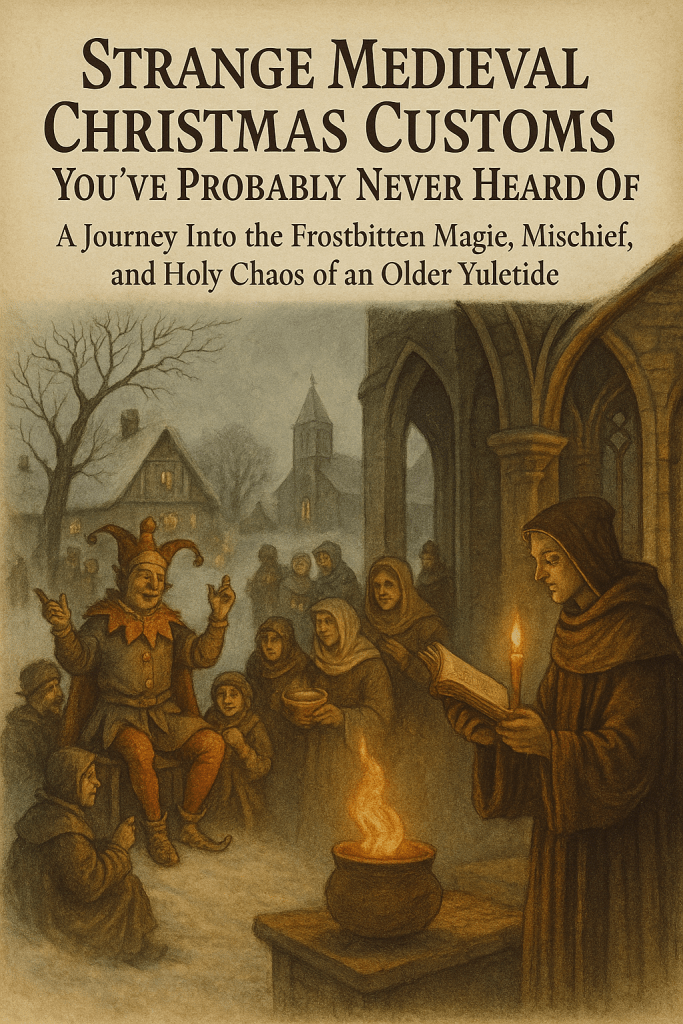
Strange Medieval Christmas Customs You’ve Probably Never Heard Of – A Journey Into the Frostbitten Magic, Mischief, and Holy Chaos of an Older Yuletide.
There is a peculiar charm in looking back toward the Middle Ages, that twilight realm poised delicately between myth and memory, where faith and folly, solemnity and spectacle, reverence and irreverence mingled together like spices stirred into a simmering winter cauldron. The medieval Christmas season was not a tidy sequence of events but an enchanted braid of ancient rites, sacred feasts, communal revelry and gleeful unruliness. It was a world where the sound of church bells drifted across frost-bright fields, summoning villagers to candlelit vigils, while just beyond the churchyard wall peasants prepared to crown a mock king, a jester-lord who ruled for a day with mischief as his scepter.
Picture it: the cold breath of December curling through thatched cottages; the glow of tallow candles dancing across illuminated manuscripts; monks chanting beneath stone arches while, in the orchards, farmers splashed cider upon the roots of naked apple trees, coaxing them into future fruitfulness with song and ritual. The wassail bowl steamed, passing from hand to hand, an elixir of community and hope. Mummers roamed from door to door performing rowdy plays that made saints chuckle and sinners cheer. The Feast of Fools erupted in the nave itself, where clergy transformed into merrymakers for a fleeting moment, reminding the world that joy, too, had its place in the sacred order.
If the Victorian Christmas shimmered with sentiment and neatly folded symbolism, the medieval one glowed with something older, stranger and far more ungoverned, a primal warmth that burned brightly against the long winter night. It was a celebration steeped in superstition and miracle, bustling markets and holy masses, raucous games and whispered prayers. It was a world where the sacred and the absurd danced together as equals, neither embarrassed by the other.
Draw closer to the fire now, feel its heat ripple through the present as it once did through the stone halls of abbeys and the smoke-dark rafters of medieval inns. Let the crackling logs escort us back through the centuries, into a Yuletide woven with wonder and riddled with glorious absurdity, where every flicker of flame seems to carry a song, a blessing, a secret from the distant past.
The Feast of Fools and the Reign of Holy Absurdity.
In the deep midwinter of the Middle Ages, when the long nights pressed close against the windows of the world and the breath of humanity rose like incense in the frozen air, there arrived a brief and wondrous season in which gravity itself seemed to lose its grip. It was known as the Feast of Fools, that bright and unruly carnival blossoming between Christmas and the turning of the New Year, when the ordinary scaffolding of society loosened, swayed, and for a few delicious days collapsed into mirth.
Within stone cathedrals that usually trembled beneath the weight of solemn hymns, a delightful chaos unfurled. The high clergy traded dignity for disguise, surrendering mitres and stoles to the smallest acolytes, who in turn strutted about like miniature bishops with the proud, precarious swagger of cats wearing crowns. Priests slipped into the roles of choirboys, choirboys into the roles of priests, and the venerable rituals of the Church were reenacted with a winking theatricality that made even the angels, one imagines, lean over the battlements of heaven to smother a smile.
Strains of sacred music softened into gleeful parodies, Latin chants rewove themselves into playful rhymes, and processions wandered like jubilant drunks through the nave, weaving a tapestry of reverence and mischief. In some towns, a mock bishop or even a mock pope was elected, often a child, sometimes a jester, whose brief reign brought a gentle, shimmering satire to the pageantry of power. Bells rang with a different timbre during those days, as though they too had decided to abandon strict discipline and dance a little in the winter air.
Yet none of this, in the eyes of participants, was an act of disrespect. These revels carried within them the wisdom of an older world, a recognition that the human soul, no matter how devout, must occasionally tilt its crown and let in the breeze. It was not mutiny against holiness but a companion to it, a reminder that joy was also a form of worship. The Feast of Fools served as a release valve for the pressures of a year spent under the stern demands of survival and piety. It allowed each person, from venerable cleric to humble villager, to loosen the iron clasp of propriety, if only for a moment, and feel the warm pulse of communal laughter.
In those fleeting days of sacred absurdity, the medieval Christmas season revealed its full, generous spirit. It was a celebration not only of divine mysteries but of human frailty and delight, a time when the world leaned toward its own heart and remembered that even in the coldest months, lightness is necessary, laughter is medicinal, and a little well-crafted nonsense can be as holy as prayer.
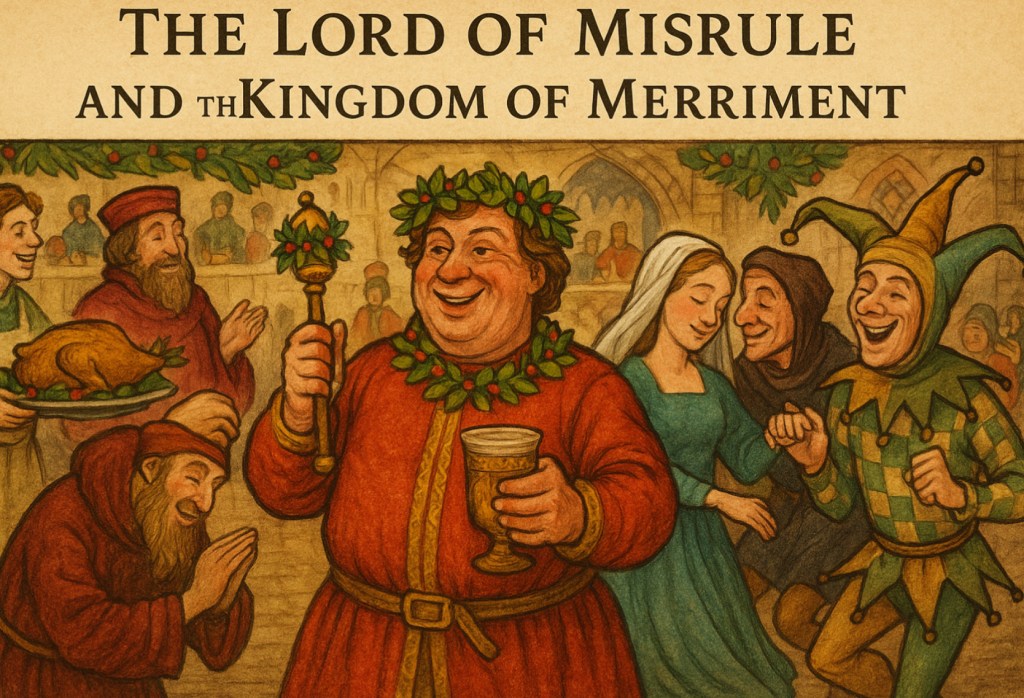
The Lord of Misrule and the Kingdom of Merriment.
Wandering hand-in-hand with the Feast of Fools came a companion custom just as beloved and just as deliriously delightful: the crowning of the Lord of Misrule. In the smoky warmth of manor halls, in the bustling heart of small villages, and at times even within the glittering orbit of royal courts, an ordinary man was plucked from common life and transformed, with a wink and a cheer, into the sovereign of Yuletide chaos. He might be a servant, a stable-boy, a baker, or a fiddler; fortune chose whimsically, without regard for birthright or pedigree. Once selected, he was robed in bright, improbable colours, decked with garlands fragrant of winter greenery, and placed upon a makeshift throne as though he had descended from legend itself. A cup of spiced ale or steaming wassail was pressed into his hand, and by its blessing he was anointed king of mischief for the season.
Under his merry rule, the world softened around the edges. The stiff constraints of medieval life melted like frost upon a sunny sill. Days ripened with feasting, with music that spiraled through rafters like ribbons of gold, with dances so lively that even the grudging feet of elders found themselves tapping. Servants were waited upon by their masters, who approached the table with ceremonious humility and a twinkle in the eye. Nobles dipped their heads to peasants in theatrical bows, a parody and yet a gentle reminder of shared humanity. The jesters, those agile poets of foolishness, found themselves promoted to high advisers, dispensing mock decrees and whimsical judgments that carried, for once, the full weight of royal authority. Bonfires crackled, mummers performed plays of ancient folklore, and in some places the Lord of Misrule led processions from house to house, gathering laughter like a harvest.
The world, in those fleeting days, turned itself upside down like an hourglass, letting the sand of social order run in the opposite direction just long enough to let everyone remember how arbitrary its arrangement could be. This ritual inversion was not rebellion but catharsis, an ancient medicine for the spirit. Even the Church, though wary at times, understood the necessity of such sanctioned disorder, for it lifted the weariness of the year and swept away the dust of duty.
There was magic in it, and mystery too, a sense that the fabric of the world had been loosened enough for joy to seep through the seams. The Lord of Misrule reminded all who followed him that power, no matter how splendid its trappings, is as transient as the flicker of a candle in a draught. He reminded them that laughter, freely shared, is a sacrament of its own kind, and that a community which can laugh together can also endure together. Within his brief and merry reign, peasants and lords, elders and children, the solemn and the silly, all found themselves woven into a single tapestry of mirth.
In the end, the kingdom of merriment dissolved as gently as it had arisen. The garlands were laid aside, the bright robes folded, the mock crown returned to its chest. But the memory lingered in the air like the sweet after-scent of spices and evergreen: a reassurance that beneath the rigid architecture of everyday life lies a beating heart that longs for delight. And each year, when winter returned, that heart was given permission, indeed, encouragement, to revel once more in the holy folly of the season.
The Boy Bishop and Childhood Raised to Sacred Heights.
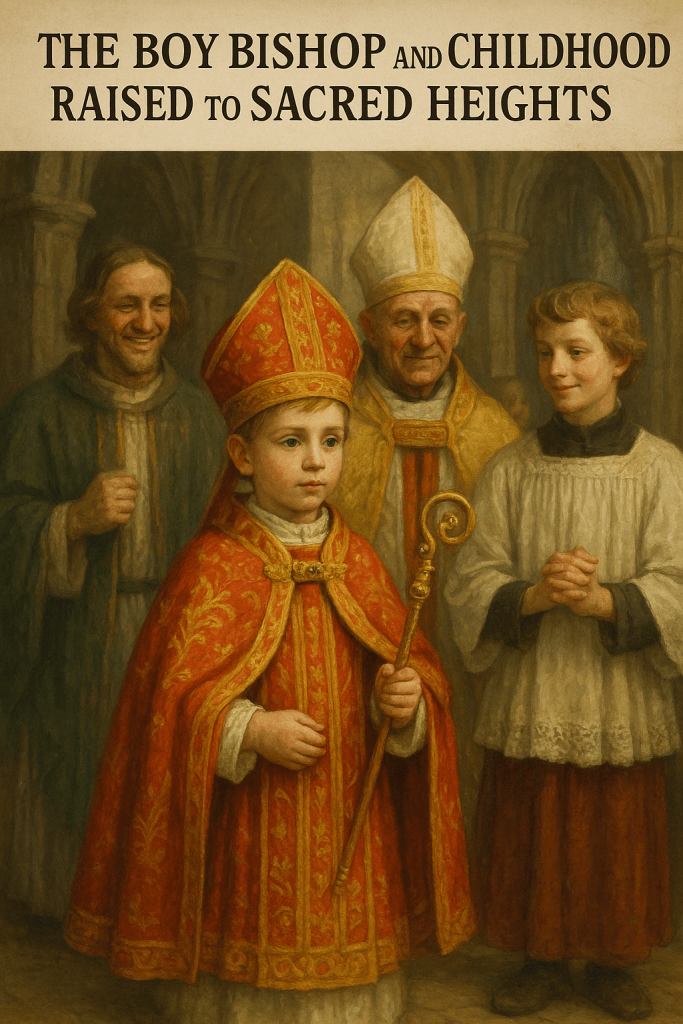
Among all the marvels that shimmered through the medieval winter, none glowed with quite the same tender enchantment as the election of the Boy Bishop. While snow hushed the world and candlelight trembled like captive stars within cathedral walls, the Feast of Saint Nicholas arrived with its soft, expectant magic. From the ranks of choirboys, one small figure was chosen, lifted for a brief, luminous span into the lofty role of bishop. His companions looked on with a mixture of pride and astonished delight, as though one of their own had suddenly sprouted wings.
Robes of ecclesiastical splendor, heavy with embroidery and history, were draped over shoulders still narrow from childhood. The great mitre, often slipping sideways, sat like an enchanted crown upon his brow. Into his hands was placed a tiny crozier, carved to match the grandeur of the real one but sized like a wand from a fairy tale. Thus dressed, he stood transformed: no longer merely a child, but a symbol of innocence raised to sacred heights, walking the thin silver line between play and genuine holiness.
He led processions through echoing naves, his steps small yet steady, his face composed with an earnestness that touched even the most stony-hearted parishioner. Bells chimed gently above him, as though adjusting their voices to suit his small stride. The congregation followed, their smiles tucked discreetly at the corners of their mouths, not in mockery but in admiration. For in those brief days, the world turned toward youth with a reverence rarely afforded it, and even the stern pillars of the Church softened their shadows.
The boy delivered sermons crafted with the help of adults, yet spoken in his own clear, high voice. And somehow, in that fragile tone, the words grew softer and brighter than they would have sounded from any adult bishop. His messages were hopeful, tender, laced with a simplicity that felt like truth distilled. He reminded his listeners of charity, of kindness, of the small mercies that knit a community together more securely than any law or edict. In some places, he undertook ceremonial duties: blessing parishioners, visiting the sick, offering prayers for the poor. People listened with the kind of attention one might give to a miracle, for there was something profoundly moving about being guided, even briefly, by someone not yet acquainted with cynicism.
In England and parts of continental Europe, the Boy Bishop’s reign could last until Holy Innocents’ Day, a span of time that stitched together celebration and remembrance. During those days his authority, though symbolic, was recognized. He rode at the head of festive processions, distributed small gifts, and was treated with the respectful formality due a spiritual leader. The real bishop stepped aside with grace, understanding that this ritual inversion was not frivolity but a deeply rooted affirmation of the sacredness of youth.
This gentle tradition whispered an important truth into the medieval ear: that wonder deserved a place beside wisdom, that childhood held its own kind of holiness, and that the voice of a child might sometimes speak more tenderly to the human spirit than the voice of a king or cleric. In an age often remembered for its hardships and stern pieties, the Boy Bishop stood as a radiant exception, a bright flame cupped carefully against the winter wind.
And when the short reign came to its close, when the robes were returned, the mitre set back upon its accustomed shelf, and the crozier handed again to its rightful owner, the memory lingered. It lived on in the hearts of villagers and clergy alike, a reminder that within even the most ancient traditions lies room for play, for imagination, and for the belief that sanctity sometimes chooses the smallest hands to carry its light.
The Feast of the Ass and the Braying Hymns of Midwinter.
Amid the tapestry of medieval winter rites, woven with threads of solemnity and star-lit wonder, there existed a celebration as endearing as it was uproarious: the Feast of the Ass. It was a festival that dared to lift its voice not in lofty harmonies, but in the warm, unpolished music of barnyard humility. While some feasts crowned mock kings and others elevated children to sacred thrones, this one turned its gaze toward a creature whose quiet patience had earned a place in the softest corners of the nativity tale, the humble donkey.
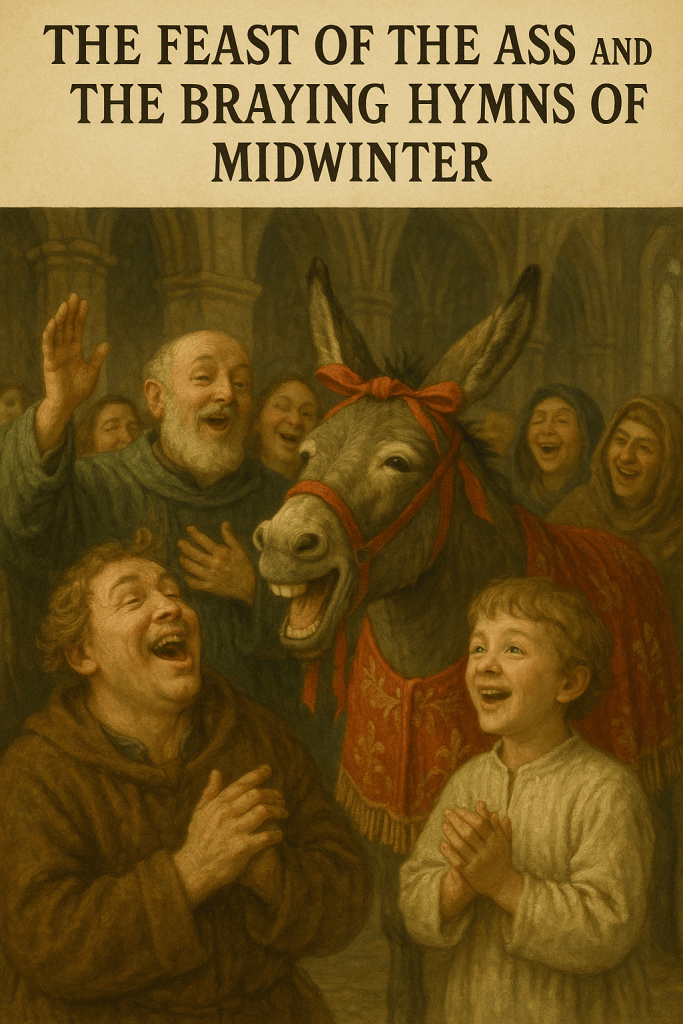
Rooted in the reverence for biblical stories, particularly the Flight into Egypt, the festival honored the steadfast beast who carried the Holy Family away from danger. In certain regions of France, where the tradition flourished most vividly, a real donkey was led into the church itself on the appointed day. Draped in ribbons, woven garlands, or embroidered cloth, the creature trotted solemnly down the nave, its hooves striking sparks of surprise and delight from the assembled congregation. Some accounts speak of the animal being guided all the way to the choir, where it stood with a dignity that rivaled the stone saints overhead.
The Mass that followed was no ordinary service. It shimmered at the edges with the delightful absurdity that winter seems always eager to allow. At moments where the priest expected the usual responses, the congregation instead offered their loudest, most wholehearted hee-haws. These were not timid imitations but full-throated brays, echoing through the cold stone like rustic trumpets. In Beauvais, where the feast is said to have reached its most exuberant form, the priest himself concluded the service by turning toward the people and giving a hearty hee-haw three times, to which the congregation responded in kind. The entire church, for a fleeting instant, became a chorus of joyful beasts.
It would be easy, at first glance, to mistake this for mockery, but those who lived in that age knew better. In a world where hardship lay close at hand and winter pressed unforgivingly at every door, the Feast of the Ass offered a rare mixture of mirth and reverence. It reminded the faithful that the great arc of sacred history depended not only on kings, angels, or miracles, but also on the modest labor of a creature whose only virtues were patience, steadiness, and the willingness to bear burdens without complaint.
The braying hymns of this midwinter celebration carried a lesson wrapped in laughter. They taught that humility was not a virtue to be whispered about, but sung aloud; that holiness could be found in the lowliest stable as surely as in the grandest cathedral; that wisdom sometimes speaks through the quiet endurance of animals rather than the proclamations of the mighty. Even the cold, aloof stones of the church seemed to soften under the sound, warmed for a moment by the memory of a donkey’s gentle role in the sacred flight.
When the ribbons were removed and the animal led back into the crisp winter air, the echoes of the hee-haws lingered like a smile in the rafters. And so the Feast of the Ass took its place among the season’s rituals: a reminder that the world, for all its solemnity, always has room for warmth, for laughter, and for the humble creatures who carry the weight of our stories with unassuming grace.
Wassailing the Apple Trees and Awakening the Sleeping Earth.
Far from the echoing cathedrals and laughter-drenched halls where misrule reigned for a spell, another tradition stirred gently at the very edges of winter’s stillness. In the orchards lying beneath a quilt of frost, in the quiet reaches of fields where the breath of the earth seemed held in patient suspense, people gathered for a rite both humble and enchanted, the wassailing of the apple trees. It was a celebration stitched from the threads of blessing and performance and the simplest, sweetest sort of village camaraderie.
On the appointed night, often around Twelfth Night when winter’s grip was firmest, families and neighbours set forth with torches raised high against the velvet dark. Their boots crunched on frozen ground, their laughter rose in little clouds of steam, and in their hands they carried bowls and pitchers of hot, spiced cider, fragrant with cinnamon, nutmeg, and the promise of warmer days. The orchards, bare and skeletal in the moonlight, awaited them like an audience of slumbering giants.
Once gathered among the trees, the villagers began their songs. These were not the carefully measured hymns of the church but lively, rustic refrains, old as the hedgerows and as persistent as roots. They sang to the apple trees with the familiarity one reserves for ancient friends, urging them to wake from the long dream of winter, to stir their sap when the sun returned, and to bless the coming year with heavy branches and sweet fruit. Some songs were humorous, some reverent, all stitched with a sense of gratitude that the land listened, and perhaps, in its slow and quiet way, understood.
Children, their cheeks flushed with cold and excitement, struck the trunks gently with sticks, a playful drumming meant to rouse the trees from their enchanted sleep and chase away whatever mischief or blight might linger unseen in the shadows. Their laughter rose into the dark like sparks from a hearth. Adults, moving with a more deliberate grace, poured spiced cider around the roots of the oldest trees. The steaming liquid soaked into the frozen soil like an offering of warmth itself, a libation acknowledging both the generosity of past harvests and the hope for future abundance.
In some places a more theatrical custom took root: the selection of a wassail king or queen who led the rites with exaggerated pomp, or the raising of a piece of toast, literal toast, studded with crumbs, into the branches as a gift for the good spirits of the orchard and a distraction for the malicious ones. Robins, those bright-eyed guardians of winter, were believed to stand watch, and villagers toasted them as well, trusting their vigilant wings to keep the groves safe.
Though softened over centuries by Christian observance, the ritual carried a pulse of far older memory. It murmured of the time when the turning of seasons was itself a sacred drama, when trees were thought to dream and speak, and when the boundary between the human and natural world lay thin as morning mist. Wassailing wove these ancient threads together with the newer cloth of Christian gratitude, forming a tapestry that felt as warm and alive as the cider itself.
In this way, the orchards became sanctuaries of a different sort, where faith mingled with folklore and the coldest month of the year blushed with unexpected hope. As the torches flickered and the songs faded into the night, December seemed to grow less barren and more tenderly alive, as though beneath the frozen earth something stirred, listening, stretching, preparing for the slow unfurling of spring.
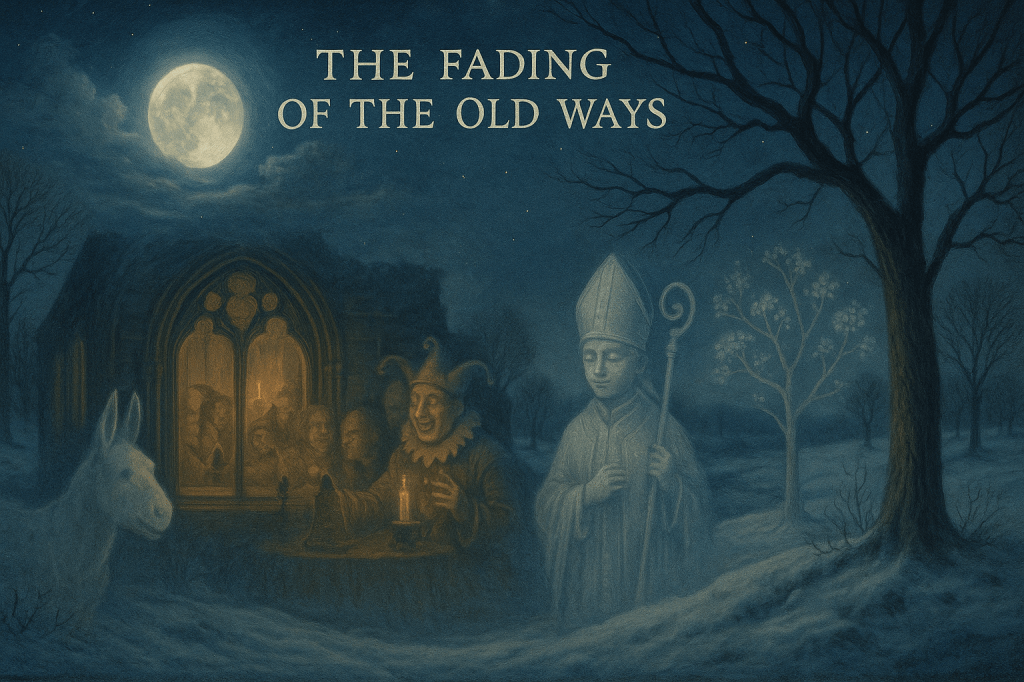
The Fading of the Old Ways.
Time, that tireless traveler whose cloak is stitched with centuries, moves onward without pause, and even the most beguiling customs eventually grow drowsy along the path. The medieval world, with all its pageantry and holy mischief, entered a new age where the bright tapestry of rituals was tugged and rewoven. During the Reformation, when Europe tightened its posture and sharpened its devotion into more austere lines, many of these joyful ceremonies dimmed like candles being pinched out one by one. The lilt of comic hymns faltered, the mock kings and child bishops were ushered quietly from their brief thrones, and the donkey, once welcomed into stone naves with garlands on its sturdy back, found the church doors closed against its gentle bray. What remained was a leaner, sterner winter, its shadows less playful, its merriment more restrained.
Yet not all was swept away by the winds of reform. Some customs lingered in pockets of countryside where memories cling like frost upon hedge branches. Others dissolved not from condemnation but from simple forgetfulness, like snowflakes that melt before they reach the earth. New celebrations rose in their place, shaped by shifting beliefs and changing lives, but the old ones did not vanish entirely. They slipped instead into the twilight realm of the historical imagination, where they shimmer more brightly for being half-remembered, half-dreamed.
There they remain, glowing like embers at the edges of winter. These traditions remind us that Christmas was once a season in which the world allowed itself to be wild and tender in the same breath, where the sacred and the silly danced arm in arm around the Yule fire. They reveal a time when people understood that life is strengthened not only by reverence but by play, not only by solemn prayer but by laughter that lifts the heart like lantern-light in the dark. They carry with them the memory of a world that believed winter to be alive with spirits and blessings, where darkness was never empty but filled with the quiet stirrings of rebirth.
And perhaps, if you slip outside on Christmas Eve when the stars hang crisp as bells and the air hums with the hush of frost, you may catch a glimmer of those ancient festivities. Listen closely to the wind threading its fingers through the branches. You might hear the faint, merry riot of fools tumbling through a candlelit hall, their revels warming the cold stone. You might hear the bray of a donkey stepping solemnly into a long-ago church, its voice rising into a joyful hymn that startles even the rafters. You might imagine a small boy clad in robes too grand for him, speaking a winter sermon with the fragile wisdom of innocence. And far off, barely more than a breath, the apple trees may whisper in their sleep, dreaming of the warm cider poured at their roots and the promise of returning spring.
Though the old ways have faded, their echoes still drift through the world like snowflakes caught in moonlight, soft, fleeting, and full of wonder for those who choose to listen.


 Intwined