There is something exquisitely peculiar about Christmas Eve in the old folklore of Europe, something that glimmers like frost under moonlight and hums like a half-forgotten lullaby carried across centuries. Long before electric bulbs crowned our houses with cheerful constellations, long before the rustling of wrapping paper filled parlors and kitchens, our ancestors believed this night to be the most enchanted moment of the turning year. It was a pause set deep within winter’s breast, a breath held between the drawing in of darkness and the trembling sigh of dawn. In that breathless interval, the veil between the possible and the impossible thinned to silken threads.
The world, they said, did not merely endure Christmas Eve; it awakened to itself. The snowflakes drifting from the sky did more than fall softly upon field and roof. They hovered, listening, attentive as angels. The wind, normally a restless wanderer, carried stories instead of storms, whispering secrets gathered from the high crowns of forests and the deep folds of valleys. Even the humblest things seemed capable of shedding their everyday skins. A candle flame might stretch upward and speak. A loaf of bread might reveal a blessing. A pair of shoes might decide to show you the path your heart would one day take. In those ancient hours, the mundane glowed with latent magic.
People would stand by their windows or slip outside into the crisp night air and feel, without quite knowing why, that the world had grown sentient. Animals in barns and stables were believed to speak at the stroke of midnight, not with childish make-believe but with solemn voices that had waited all year for their single hour of wisdom. Some said that farm animals knelt in reverence, honoring the holy birth by instinct older than memory. Others whispered that the waters of wells turned to wine at midnight, shimmering darkly for anyone brave enough to lift the bucket and taste. Even the trees themselves were thought to stir. If you passed too near an orchard, you might hear the apple trees creak and murmur as though confiding in one another their dreams for spring.
The night held warnings as well as wonders. In certain villages, people believed that spirits walked abroad more freely than at any other time, not malevolent but wistful, searching for warmth or memories that still tethered them to the living world. Households burned bright candles not only for celebration but for protection, so the gentle dead might pass without lingering. In Scandinavia, families laid out food for the house spirits to keep them content and ensure good fortune for the coming year. And all across Europe, windows were left unlatched just a little, not enough for snow to drift inside, but enough to show hospitality to wandering blessings.
To wander into these old superstitions is to step into a midnight realm where imagination and belief once danced with equal weight. They remind us that Christmas Eve was not always a night of predictable comforts, but a threshold, a liminal hour when the universe seemed to lean in close and breathe upon the world. Each superstition is a tiny miracle, a glimmering shard of an age when every shadow might hide a marvel and every sound might carry a message.
So let us draw the curtains tight against the winter cold, light a candle to soften the darkness, and stroll deeper into these legends. For just beyond the edges of modern celebration lies a Christmas Eve that shimmered with the supernatural, a night alive with whispering spirits, wise creatures, and the quiet certainty that magic was not only possible but expected.
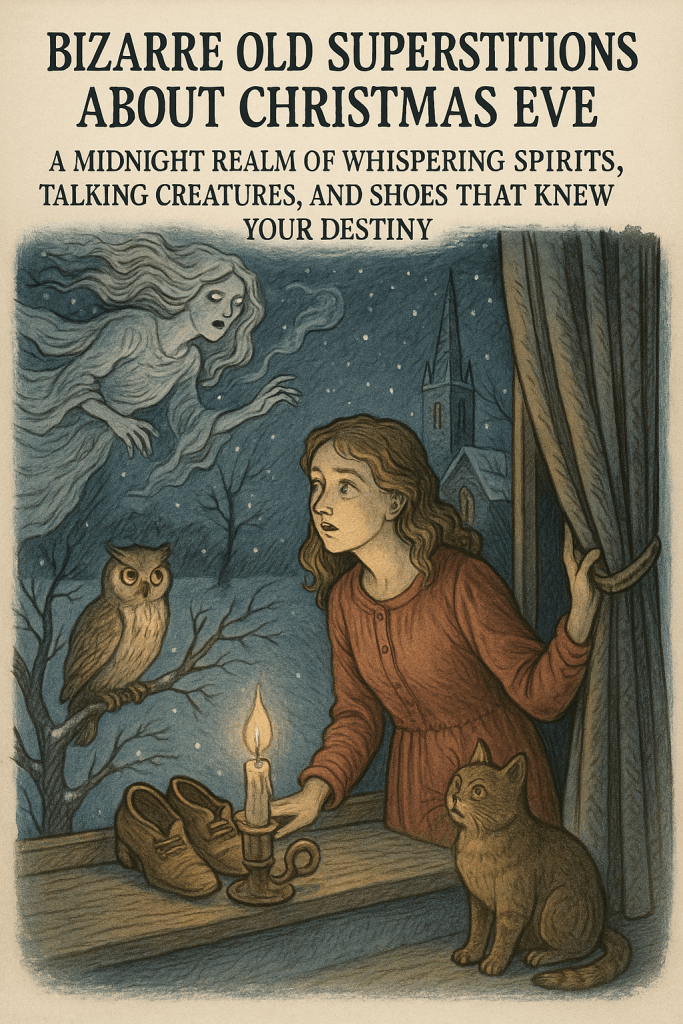
The Midnight Murmurs of Animals.
When the church bells tolled their slow, solemn twelve and the world slipped into that fragile hour between ending and beginning, the veil that separates the ordinary from the enchanted was said to tremble like a silk curtain caught in a breath of divine breeze. In that trembling moment, the gift of speech descended upon the animals of field and forest with a gentleness as soft as snowfall. It was not the crude mimicry of parrots nor the dreamlike babble of imagination. It was true speech, wise and weighted, as though all creatures had been saving their words for this single, sacred hour.
Cattle, patient guardians of winter barns, were believed to low in the language of humans, their voices warm and grave as they spoke of the year’s hardships and blessings. Horses, noble and restless in their stalls, whispered soft prophecies into the straw, their breath rising like ghostly smoke. Sheep murmured comfort to one another, telling stories of shepherds long gone. Cats, with their glinting lantern-eyes, were said to utter truths so piercing that not even the bravest soul would wish to hear them twice. And the ox, humble hero of countless nativity scenes, was said to lift its heavy head and praise the Holy Child with a depth that made the rafters quiver.
In some corners of Europe, old tales claimed that forest creatures joined the midnight chorus as well. Wolves paused in their snowbound wanderings, not to howl, but to speak softly of the ancient covenants between moon and earth. Birds, those tiny heralds of dawn, kept silent all night only to break their hush at the stroke of twelve with words shimmering like frost. Even the deer in the deep winter woods were said to kneel and murmur prayers in voices gentle as leaves brushing together.
Yet woven into this miracle was a warning sharp as the winter star. For the marvel was not meant for human ears. Anyone reckless enough to creep into the stable and listen risked misfortune of the direst kind. Sorrow might settle upon the household like an unwelcome guest. Madness might slip into the mind like a shadow that never lifts. In some stories, those who listened were struck mute forever, as though punished for attempting to steal a gift never meant for them. It was said the creatures spoke in reverence, in ancient remembrance, in a holiness that no person should dare to trespass.
And so the people stayed indoors on Christmas Eve, warm by their hearths, trusting that out in the dim glow of lanterns and moonlight, their animals were taking part in a quiet miracle the world had almost forgotten. The barns, thick with the scent of hay and winter breath, became secret cathedrals for a single hour, places where creation itself knelt in reverence before stirring back into silence.
This was Christmas magic at its most intimate, a reminder that nature, too, keeps vigil on the holy night. While humans slept or prayed, beasts great and small were granted their one private moment of worship, their voices rising into the frost-laden air before fading once more into the soft, patient silence of the season.

Bees Who Sang Carols Beneath the Stars.
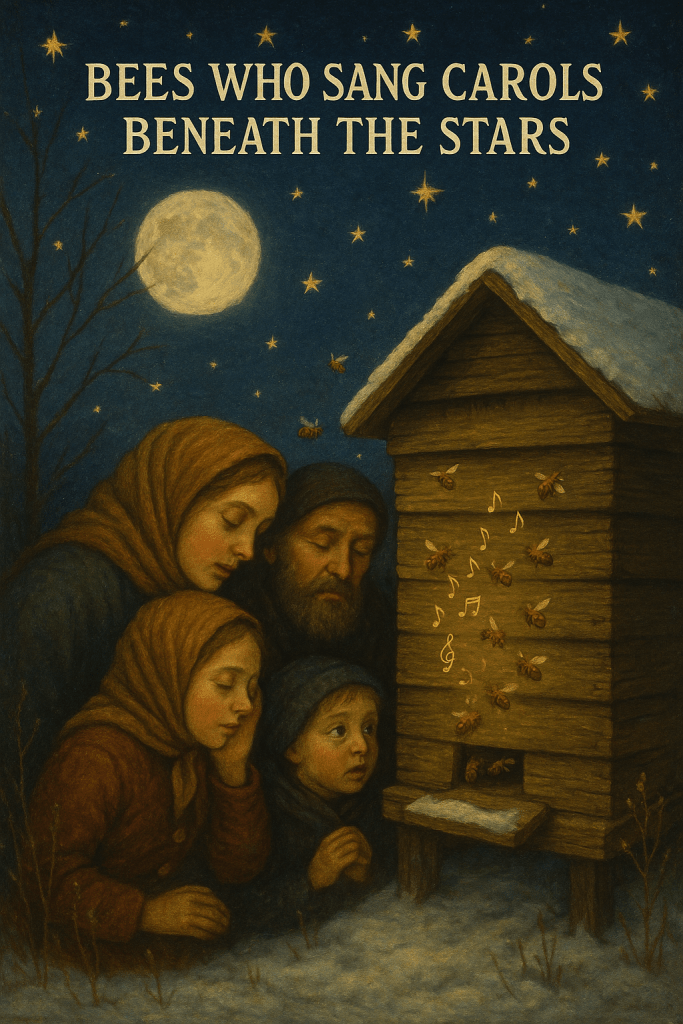
In the quietest corners of Britain, and in scattered pockets of Europe where folklore clung to the land like morning mist, there blossomed a tender belief about creatures so small that winter might have seemed to silence them entirely. Bees, those golden artisans of summer, those keepers of honey and the sun’s own secrets, were thought to stir on Christmas Eve when all the world held its breath. Though snow lay heavy on the hives and frost etched delicate runes across their wooden walls, the people swore the bees did not truly sleep. Not on that night. Never on that holy night.
As midnight approached and the stars sharpened into needles of diamond light, the bees were said to awaken from their winter hush. They did not swarm or stray or fret. Instead, they lifted their tiny voices in a humming so faint and so otherworldly it seemed woven from starlight itself. Some claimed the sound was unmistakably the melody of ancient carols, the very hymns sung by shepherds at the cradle of Christ. Others insisted that it was no earthly tune at all but a celestial chorus, a harmony meant only for angels, children, and hearts still soft enough to listen.
Families would pull on cloaks and shawls and step out into the crisp December dark. Lanterns glowed like small moons in their hands. They walked carefully toward the hives, drawn as though by a promise. Parents urged silence, and children tiptoed through the cold with breath rising like little prayers. One by one, they pressed their ears against the wooden boxes, their cheeks chilled by the bark and frost, hoping to catch the whisper of a miracle. Perhaps they heard only the creak of branches or the shifting of the night wind. Perhaps a lucky few heard a tremor of music, the gentlest thread of sound, so delicate it seemed to come not from the hives but from the stars themselves.
In some regions, keepers of bees left small offerings beside the hives on Christmas Eve: a cup of sweet ale, a slice of bread, a candle stub burning bravely in the dark. These humble gifts were meant as thanks, acknowledging the bees’ summer labours and honouring their winter vigil. For honey was not merely food but medicine, luxury, and light. To cherish the bees was to cherish the golden heart of the year.
There were places where people believed that bees could understand prayer, that they mourned when their keeper died, that they bore wisdom older than kingdoms. If such tales seem fanciful now, they were once spoken with the utmost sincerity. For to the medieval and early modern mind, the world was a vast, breathing tapestry in which every creature had a thread to weave and a song to sing. On Christmas Eve, when the fabric of reality shimmered thin as frost, it felt only natural that bees, too, might offer their tribute to the sacred birth.
Whether the bees truly sang, history does not say. Their music may have been imagined, or forgotten, or heard only by those innocent enough to believe in wonders. Yet the superstition itself glows like a candle left burning through the centuries. It speaks of a world in which all creation rose in quiet celebration, where even the smallest wings trembled with reverence, and where the darkness of midwinter was softened by the thought that somewhere beneath the stars, within a humble hive, the bees were humming hymns to greet the newborn dawn.
Shoes That Told the Future.
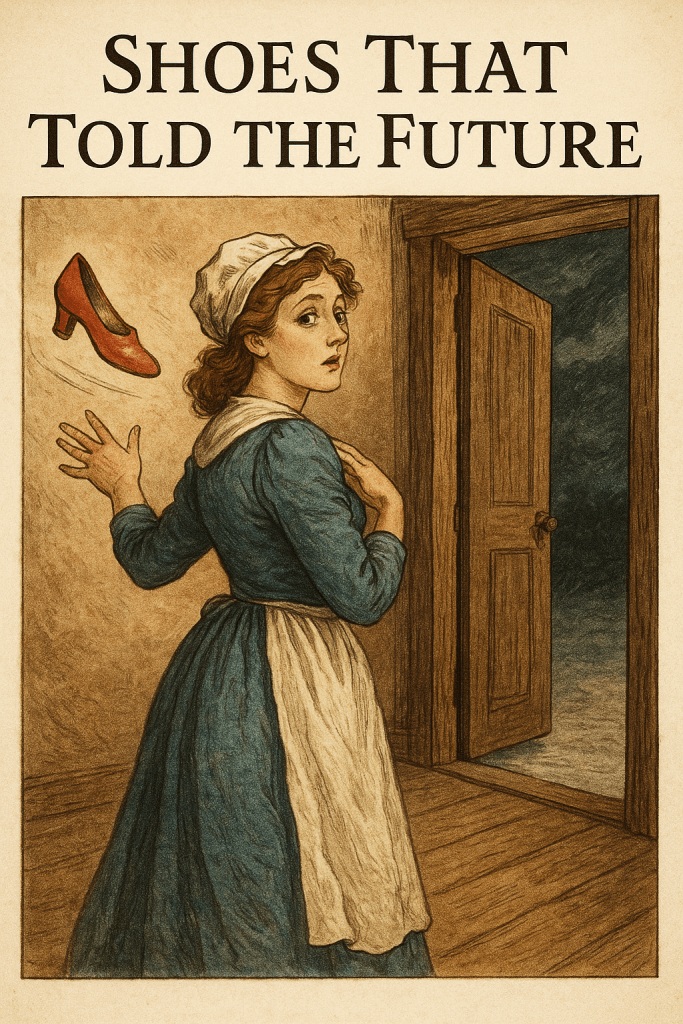
Christmas Eve, poised delicately like a snowflake between the fading year behind and the mysterious year ahead, was long regarded as a threshold night, a place where the unseen currents of fate slipped closer to mortal ears. In those quiet, enchanted hours, when the hearth glowed warmly and the wind prowled softly around the eaves, young women with hearts full of wonder and restless curiosity sought glimpses of what destiny might cradle for them. Love, marriage, companionship, a future shaped by the turning of a shoe, such were the secrets the night was believed willing to reveal.
When the lamps were dimmed and the household hushed, a girl might stand before the door with her shoe in hand, feeling a delicious tremor of anticipation. Behind her lay the safety of childhood rooms; before her stretched the vast, uncharted promise of adulthood. With a breath held tight in her chest, she cast the shoe over her shoulder, letting it fly blind into the future’s embrace. How it landed mattered more than any fortune-teller’s rune. If the toe pointed outward, toward the road or the open fields or simply the world beyond the doorstep, romance was said to be drawing near, as if her destiny were already striding toward her on gentle, unseen feet. But if the toe pointed back into the home, it meant the heart must wait another year, tenderly and patiently, like a candle kept unlit until the proper moment.
In some regions, the charm was performed with ceremony: shoes polished or tied with little ribbons, doors flung wide to the winter night, the stars watching with cool amusement from above. In others, it was a more secret ritual, carried out in bedrooms lit only by moonlight, where sisters whispered encouragement and covered their giggles behind their hands. Sometimes the shoe was a sturdy boot dusted with snow; sometimes it was a delicate slipper worn smooth by dancing. No matter its shape, it was transformed for that moment into a herald of fate.
The doorway itself became a kind of oracle, a symbolic border as potent as the night that framed it. For a door was neither inside nor outside, neither shelter nor wilderness, but both. The wind, slipping through its cracks, seemed almost to guide the shoe, nudging it with mischievous or merciful fingers. And the shoe, humble though it was, accepted its temporary destiny with surprising gravity, landing in silence like a message from some small domestic spirit who knew the mysteries of the heart.
Families watched with affectionate amusement, understanding that even if the magic was playful, the yearning behind it was sincere. For in a world shaped by the rhythms of harvests and hearths, these little rituals offered a momentary conversation with the unknown, a chance to feel that fate might be listening.
And so, on Christmas Eve, when the air shimmered with candlelight and possibility, the tossing of a shoe became more than a superstition. It became a gesture of bravery wrapped in innocence: the willingness to ask the winter night a question, and to accept whatever answer it chose to give.
Shadows and Candle Flames That Whispered Omens.
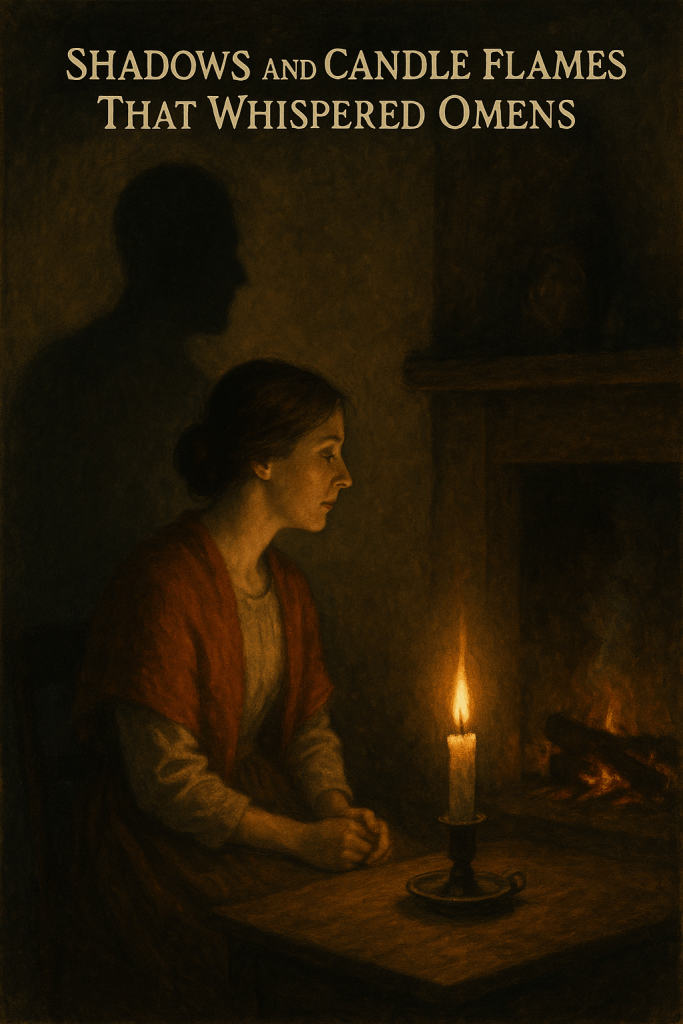
On Christmas Eve, when darkness settled over the world like a velvet cloak stitched with stars, the smallest flame became a prophet. In cottages and manor houses alike, people lit their candles with quiet reverence, for they believed that on this holy night, the delicate dance of light and shadow carried truths too subtle for daylight to reveal. Every flicker mattered. Every tremor of brightness against the winter hush seemed to whisper something from beyond the edge of human knowing.
Shadows lengthened along the walls, soft as breath and yet filled with portent. People watched their silhouettes stretch and sway, studying the shapes as one might read the lines of a palm. A shadow that appeared headless, an eerie illusion born of shifting flame, was said to foretell sorrow in the coming year, as though the soul itself had momentarily stepped aside. A tall, unwavering shadow meant strength and protection, a guardianship bestowed by unseen hands. Even a shadow that wavered and danced suggested that fortune was restless, preparing to move in unexpected ways.
The candles themselves were living storytellers. A flame that burned steady and serene, glowing like a small sun trapped in wax, promised a year of peace, the kind of quiet prosperity that settled gently over a household. But a flame that sputtered, bent low, or flickered violently was believed to signal a presence slipping silently through the room, a wandering spirit, perhaps, or an ancestral blessing passing by like a sigh. In some regions, it was said that placing a candle in the window invited lost souls or weary travelers, both mortal and otherworldly, to find brief comfort in the warmth of the living.
The hearth, ever the heart of the home, kept its own secret language. The Yule log, crackling in the grate, was not merely fuel but a storyteller of sparks. If the log split sharply with a sudden crack, visitors were soon to come, friends or strangers, no one could be certain, only that footsteps would cross the threshold before long. A hearth that hummed softly promised contentment; one that hissed and spat foretold quarrels brewing beneath the surface. And if the smoke drifted straight upward in a single graceful column, it meant prosperity was on the way, as though the heavens themselves had opened a path for good fortune to descend.
Even the simplest winter sounds seemed heightened with meaning on Christmas Eve, the faint settling of the timber beams, the wind brushing against the shutters, the rustle of holly hung above the mantel. Everything was significant. Everything spoke. For this was a night when the world was believed to lean closer, listening and answering in its own quiet language.
It was a time when nothing was truly still, when flame and shadow and smoke wove their murmured promises into the fabric of the dark, reminding everyone who watched that Christmas Eve belonged as much to mystery as to merriment. And those who sat before the flickering lights felt, in their hearts, that the world was vast, alive, and whispering, waiting only for those brave enough to understand its signs.
Food for Wandering Souls.
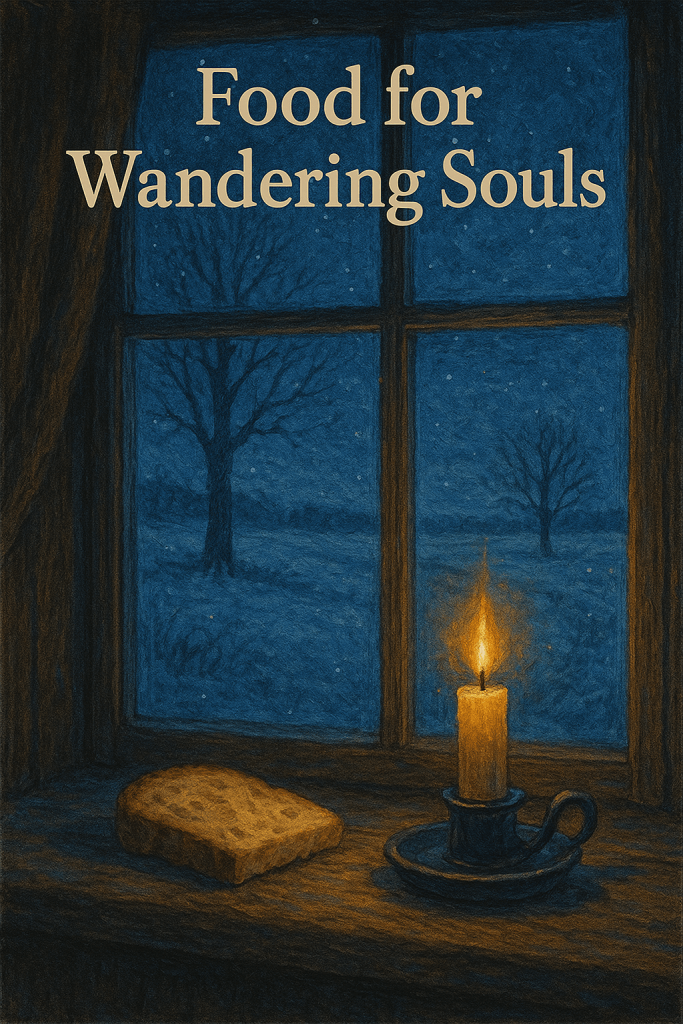
On Christmas Eve, when the air grew still enough to hear one’s own heartbeat and the world lay wrapped in winter’s deep embrace, some families observed a custom as gentle as a whispered prayer. They placed a slice of bread upon the table or set it tenderly by the window, a small, humble offering meant for those who had once shared their hearth and laughter but now walked quietly beyond the veil. It was said that on this night, the spirits of ancestors roamed softly across the frozen fields, drawn like moths to the warmth of memory, returning for a brief and blessed moment to the homes they had cherished in life.
The bread was not a summons. It did not call the dead, nor command them, nor coax them from their rest. It was simply an act of kindness, a gesture born from love rather than fear. In that modest crust of bread lay remembrance, gratitude, and the unspoken promise that no one who had lived and loved would ever be forgotten. Families believed that these wandering souls paused at the window, touched by the offering, warmed by the thoughtfulness of the living, before continuing on their quiet pilgrimage through the winter night.
Often, a candle burned beside the bread, its little flame trembling with every draft and yet steadfast in its purpose. In the dark hours, that candle became a beacon, a soft lantern guiding the lost or longing spirits through the cold. Its light spilled onto the snow, turning the drifts to silver, and for a fleeting instant, the world seemed gentler. The living imagined their ancestors seeing that glow from afar, recognizing it as surely as one recognizes the familiar shape of home.
Across Europe, variations of this custom flickered into life. In parts of Scandinavia, families left out not only bread but bowls of porridge or ale for ancestral spirits and household guardians alike. In the Germanic lands, it was believed that the dead walked the night in peaceful procession, blessing homes where they had once dwelt. In Eastern Europe, a place was sometimes left empty at the holiday table, the chair pulled slightly back as though waiting for an invisible guest. All these traditions carried the same tender truth: on Christmas Eve, the boundary between the living and the dead grew diaphanous as frost on glass.
Yet this closeness was not a thing to fear. There were no rattling chains, no shuddering ghosts, no pale phantoms looming in corners. The spirits of Christmas Eve were gentle, like the memory of a hand once held, or a voice remembered only in dreams. Their presence brought no dread, only a delicate stillness, as if the house itself were listening to footsteps that no longer pressed upon its floorboards.
For in these old beliefs, Christmas Eve was not merely a feast of the newborn light but also a moment to honor the light that had once flickered in those who came before. It was a night stitched with tenderness, when people acknowledged that love does not vanish with the passing of years, that affection leaves imprints deeper than time can erase, and that the bonds of family and memory stretch across the veil with a strength no winter can diminish.
Thus the living and the dead drew close, without voice, without fear, sharing the same silent night. And as the candle burned low, its flame pulsing gently like a heartbeat, those who kept the vigil understood something profound: the world is wider than we know, and love endures in places where the eye cannot follow.
The Magic That Still Lingers
Though the superstitions of old have settled gently into the soft dust of memory, as fragile as frost on an abandoned windowpane, a trace of their enchantment still clings to Christmas Eve like perfume to a forgotten letter. Even now, in an age of glowing screens and hurried footsteps, the night retains a hush that no invention, no electric brilliance, can quite sweep away. There is a stillness to it, a poised quiet, as though the world itself pauses to listen for something just beyond the reach of mortal hearing. The hours grow delicate. The shadows soften. And in that tender suspension, something ancient stirs.
For all our modern certainties, there remains the sense that Christmas Eve is watching us with gentle, knowing eyes. That if one were bold enough to venture outside at the stroke of midnight, the cold air would ring with more than silence. You might hear the rustle of unseen wings brushing against the dark. You might catch a distant hymn drifting through the branches, a note so faint and pure it seems to come from the stars themselves. Or perhaps, if fortune favors you, you might sense the soft, benevolent presence of something older than winter, older than faith, gliding across the snow with a whisper of blessing.
The old stories, once whispered by firelight, may have spoken of omens and portents, of spirits wandering and animals awakening, but perhaps beneath their layers of superstition lay a simpler, deeper truth. They were less about fear than about reverence. Less about prediction than about wonder. They reminded the people who told them that the world is not as silent as it seems, that beneath the crust of frost and the weight of night there pulses a quiet magic that never truly fades. Mystery was not an intruder but a companion, walking beside humanity like a beloved shadow.
Christmas Eve, they believed, was the night when the boundary between the ordinary and the extraordinary grew thin enough to glimpse through. And perhaps it still is. Perhaps every candle lit in a window sings softly to the darkness. Perhaps every drift of snow bares the imprint of something more than the wind. Perhaps every heart that pauses, even for a moment, feels brushed by a wonder too gentle to name.
So listen closely this year. Step outside if you dare, letting the cold kiss your cheeks and the stars steady your breath. Close your eyes and let the silence settle around you like a cloak. Who knows what you might hear? A whisper of ancestors retracing familiar paths, a lone carol carried from some distant farmhouse, the gentle hum of a winter creature stirring, or simply the sound of your own heart recognizing, for one perfect instant, that the world is far more magical than it pretends to be.
For the magic never left. It merely waits for those willing to listen.
Until next time,
Toodle pip,
Yours Lainey.
🎄🎄🎄
 Intwined