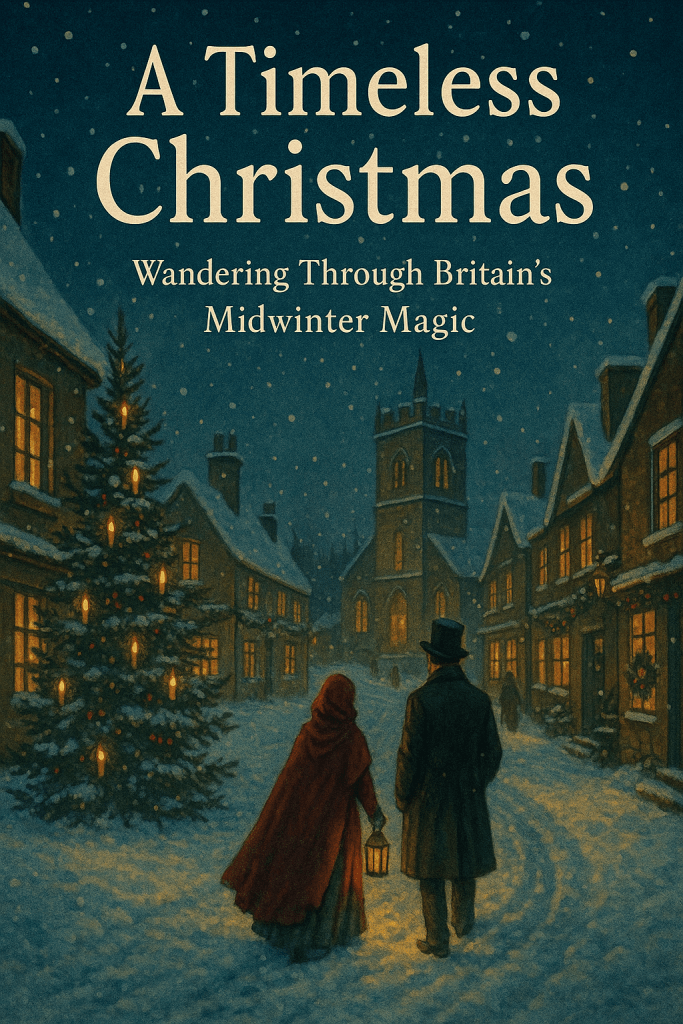
There is a hush that drifts across the United Kingdom each December, a soft, knowing hush that feels older than the stones of its cathedrals, older than the kingdoms that once fractured its land, older even than the language we whisper our carols in. It slips through hedgerows and over rooftops like a benevolent ghost, one that has walked beside Britons for a thousand years and returns faithfully with every turning of the calendar. It glides along quiet country lanes where the frost clings to bramble and hawthorn, it curls through the narrow medieval streets of York, Chester, Edinburgh, and Canterbury; it hums above the Thames as London gathers itself beneath a canopy of light. By the time dusk falls, so early it seems almost bashful, the hush has settled into hearth-warmed homes, where windows glow like pockets of enchantment against the winter dark.
Christmas in Britain is not merely a day marked by ink on a calendar. It is a long, wandering story, a story with chapters written in bonfires and wassail bowls, in cathedral choirs and cobbled marketplaces, in the kitchens of terraced houses fragrant with spice. It is a tapestry woven from pagan midwinter rites that once honored the sun’s rebirth; from the feasting halls of medieval lords who roasted boar beneath rafters of oak; from the elegance of Victorian parlors where Prince Albert’s German tree first cast its candlelit glow, and from the humbler, quieter rituals of countless ordinary people. Those who lit tallow candles in draughty stone cottages, placing holly at the windows to beckon luck inside. Those who sang beneath vaulted church ceilings that amplified their hope into something almost celestial. Those who stirred puddings by rationed lamplight during the war, whispering wishes into the batter because they believed wishes had power, even then, especially then.
To wander through the history of Christmas in the United Kingdom is to peel back layer upon layer of memory, each with its own texture, its own warmth, its own whisper of wisdom. In the ancient forests, druids once gathered mistletoe with reverence, believing it held the promise of life in the dead of winter. In bustling Tudor kitchens, cooks labored over sweetened marchpane shaped into castles and mythical beasts, edible sculptures meant to astonish. In Georgian drawing rooms, families exchanged modest gifts and sipped syllabub by candlelight while horse-drawn coaches rattled past frosted windows. Victorian streets filled with the music of brass bands, the scent of roasted chestnuts, and the earnest goodwill of a nation newly enchanted by Dickensian ideals of charity and cheer.
Yet the story is not only grand or historical. It is personal, achingly so. It belongs to the fisherman wrapping a knitted scarf around his neck before joining the village carol service; to the nurse stepping outside after a long shift to find snowflakes drifting like soft applause; to the grandmother polishing her treasured ornaments before hanging them, one by one, on the tree; to the child pressing their nose to the cold pane, waiting for the first star to appear. Christmas in Britain lives just as powerfully in these small, luminous moments as in any royal proclamation or ancient rite.
And still the hush continues, wandering, gathering, deepening. It carries with it the laughter of past revelers, the prayers of centuries of congregations, the steady heartbeat of traditions passed hand to hand, hearth to hearth. It reminds us that though winter is long and night is early, there is a light, quiet, steady, human, that refuses to dim.
To follow that hush through the ages is to discover not only the story of Christmas, but the story of a people continually finding tenderness in the coldest season, continually choosing hope, continually weaving joy from the threads of the old and the new. It is to find, within the frost and the firelight, a wistful truth: that each December, the United Kingdom does not merely celebrate Christmas, it remembers it, reclaims it, and reimagines it, again and again, with wonder.
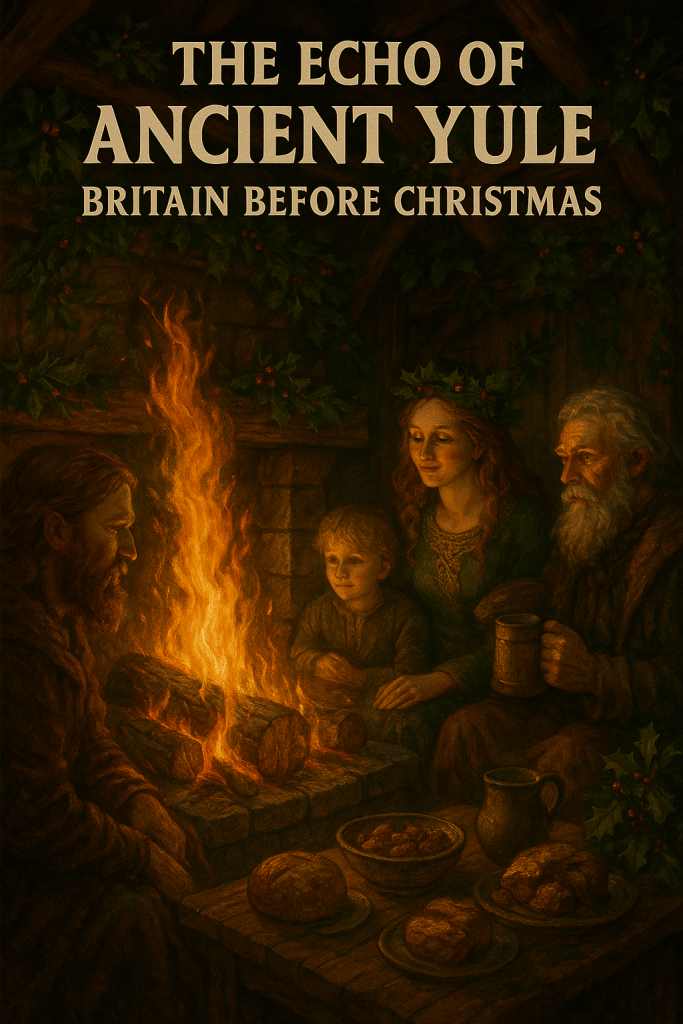
🔥The Echo of Ancient Yule: Britain Before Christmas.🔥
Long before Christianity crossed the seas to Britain, before monks illuminated manuscripts beneath candle glow or church bells gathered villages into shared worship, midwinter was already a treasured and trembling moment. The early peoples of the islands, Celts who read the sky with reverence and Norse settlers who brought their own fierce, tender traditions, met the darkest days of the year not with resignation, but with ritual. The festival of Yule, drifting southward from Scandinavia and weaving itself into the older rhythms of Celtic observance, became a time to honor the returning sun, to acknowledge the world’s slow turning toward light.
In an age ruled by the fragility of harvests and the delicacy of daylight, the winter solstice was more than a date; it was a covenant. Each shortening day seemed to teeter on the edge of uncertainty, and so the moment the sun paused at its lowest arc carried a quiet, quivering hope. To welcome that promise, families gathered fragments of the green world and carried them into their homes. Holly, with its waxy leaves and bright berries, its thorned edges thought to fend off misfortune. Ivy, twining and patient, symbol of life’s persistence even when frost ruled the soil. Mistletoe, rare and sacred, cut with ceremony from oak branches and caught before it touched the ground, believed to hold healing and protection. And evergreen boughs of fir and pine, beloved for their steadfast color, reminders that nature’s spirit did not slumber entirely, no matter the cold.
These greens were not mere decoration. They were companions in the dark months, living emblems hung above doorways and tucked beside the hearth, offerings of gratitude and talismans of endurance. Within their scent lay the memory of warmer seasons; within their presence, the suggestion of spring preparing its distant return.
Inside the dwellings, roundhouses of timber and thatch, or sturdier stone homes softened by peat smoke, families prepared to keep the longest night at bay. Fires were coaxed to life with patience, their first sparks carrying the weight of ancient belief. Some households lit a great Yule log, often an entire tree trunk chosen weeks before, dragged home with communal pride, and laid upon the hearth as though it were a guest of honor. Tradition whispered that the log must burn steadily through the night to ensure good fortune for the year ahead. Its ashes would be carefully gathered, scattered over fields to bless the soil or saved as charms against mischief and storm.
The fire’s glow symbolised warmth, hope, and the triumph of light over a darkness that was not merely metaphorical but absolute, pressing close beyond the thin walls of winter homes. Flames leapt and crackled, casting dancing shapes against wooden beams, their rhythm like the heartbeat of the season itself.
Feasts were held with whatever could be spared. In prosperous years there might be roasted meats and thick stews, but often the fare was simpler: dried fruits, stored apples, smoked fish, bread dense with grains harvested months before. Yet the modesty of the meal did not lessen the magic of the moment. To eat together in midwinter, to share the fruits of one’s labor while the wind sighed around the eaves, was a sacred gesture. It was a declaration of unity, reminding each person that survival was not an individual endeavor but a communal act.
Between cups raised in quiet blessing and stories traded in the amber light, there settled a profound understanding that winter, for all its stillness, held its own kind of beauty. Outside, the land lay in a hush that felt ancient, as though the earth itself were listening. Inside, voices rose in song, in laughter, in murmured gratitude. The festival of Yule stitched warmth into the cold and illuminated the darkness with human companionship.
These early traditions, humble yet resonant, lent their spirit, their scents, their symbols, and their quiet enchantment to the celebration that would one day become Christmas. Though centuries of faith and custom would reshape the midwinter festival, adding new stories, new rituals, new meanings, the heart of it remained the same: a longing for light, a reverence for hope, and a belief that even in the deepest dark, something bright waits to return.
🕯️Christianity Takes Root: The First British Christmases.🕯️
When Christianity began to spread through Britain during the late Roman era and into the centuries that followed, it did not simply sweep away the ancient rhythms of the land. Instead, it settled gently among them, layering new meanings atop old ones, absorbing the midwinter customs that had comforted generations. Missionaries arriving from Rome and Ireland, monks building small communities of devotion across wild coasts and wooded valleys, and kings who gradually embraced the new faith, all helped shape a celebration that was at once Christian in spirit and unmistakably rooted in British soil.
By the early Middle Ages, Christmas had grown into a holy feast of profound significance. Churches, often the sturdiest and most cherished buildings in a settlement, glowed with the trembling warmth of candles set in iron sconces or simple wooden holders. The air inside was fragrant with beeswax and pine. Monks in woolen habits chanted liturgies written in Latin, their voices rising and falling like waves against ancient stone. Villagers stepped inside, shaking snow from their cloaks, and listened as the familiar world of fields and hearths gave way to the distant wonder of Bethlehem, the stable, the star, the fragile miracle of a child born in winter.
Yet Christmas was far more than a single day. It unfurled into an entire season of devotion and delight known as Christmastide, beginning with the dawn of Christmas Day and flowing through to the revelry of Twelfth Night. Before it arrived, Advent offered weeks of preparation marked by restraint, reflection, and quiet anticipation. Fasting was common, as was prayer; households waited, watched, and hoped. Then, when Christmas finally broke across the calendar like the sun cresting the horizon, the world softened. It was time for warmth, for companionship, for merrymaking after the long solemnity.
Within the cold stone halls of early medieval manors, lords and their households gathered for meals that bordered on the extravagant. The table might groan under roasted meats, spiced pies, honeyed cakes, and cups of ale or mead passed from hand to hand. Minstrels played softly in the corners, and the echo of laughter rose to the rafters. In contrast, village celebrations were humbler but no less heartfelt. Neighbors visited one another’s cottages, and in many places, groups of carolers wandered from door to door, offering blessings in song. The earliest carols were not the gentle hymns of later centuries but lively, rhythmic songs that blended sacred imagery with local color, the kind of music that warmed cold fingers and made lantern light feel brighter.
Among the most cherished rural customs was wassailing, a tradition that wove Christian cheer with older, earthy rites. In cider-growing regions, families and neighbors gathered in their orchards on cold nights between Christmas and Twelfth Night, carrying bowls of warm spiced drink. They sang to their apple trees, sometimes solemnly, sometimes with cheerful mischief, urging them to wake, to thrive, to bear abundant fruit in the year ahead. Cider was poured at the roots as an offering, and pieces of toast were hung in the branches to honor the robins thought to guard the orchard. It was part prayer, part celebration, part ancient midwinter magic.
In these centuries, the British Christmas was not simply a religious observance. It was a tapestry woven from scripture and song, ritual and revelry, holy reflection and hearty feasting. It carried the memory of older festivals yet shone with the new hope of Christian belief. And for the people who lived through Britain’s long, cold winters, farmers, monks, nobles, shepherds, and children alike, it offered something essential: a season where darkness felt thinner, where community grew stronger, and where the story of a humble birth illuminated even the furthest corners of the year.
🔔Medieval Revelry: Feasts, Fools, and the Lord of Misrule.🔔
The medieval Christmas was a season that shimmered with contrasts, a time when the sacred and the playful danced together like firelight flickering across stone walls. The church offered solemn masses, quiet prayers, and the steady cadence of chant, yet beyond its doors the world burst into color and mischief. Christmas in the Middle Ages was not merely a day of worship, but an entire tide of celebration that could stretch for twelve days or more, each one threaded with merriment, ritual, and a sense of gentle upheaval.
It was during this season that the curious figure of the Lord of Misrule emerged, presiding over festivities with an authority that existed only in jest. In great households, monasteries, and sometimes even royal courts, this temporary ruler, often a low-ranking servant, a boy from the choir, or a member of the community known for wit, was granted full permission to overturn decorum. For a brief and sparkling moment, the world turned upside down. The humble commanded the mighty, the quiet directed the loud, and good-natured chaos reigned. The Lord of Misrule led parades through manor halls or village lanes, calling out riddles, initiating pranks, and summoning all to join in dances that warmed the coldest winter nights.
Mummers’ plays unfolded wherever there was room, inside smoky halls, in marketplace squares, or sometimes at the thresholds of cottages. Their stories were stitched together from fragments of legend, folk memory, and Christian symbolism: St. George clashing swords with a dragon or rival knight; a fool who tumbled and jested his way into unlikely wisdom, a quack doctor who revived fallen characters with comic potions. These performances were noisy, unruly, and often hilariously improvised, their masks painted with flour or soot, their costumes patched together from old cloth and whatever scraps could be spared. Yet beneath the laughter there lingered a sense of continuity, as though these tales were ancient embers carried forward from one generation to the next.
Feasting lay at the heart of medieval Christmas, a dazzling contrast to the sparse meals of the agricultural year. In manor houses, long tables were laden with roasted boar’s head adorned with bay leaves, steaming trenchers of venison, pigeons wrapped in pastry, root vegetables sweetened with honey, and mince pies that combined fruits, spices, and finely chopped meats. There were flagons of ale and mead, and cups of Hippocras, a warm spiced wine whose fragrance filled the air with cinnamon, ginger, and clove. Even in modest cottages, people saved their best for Christmas, sharing whatever they had, perhaps a small joint of meat, a loaf enriched with dried fruit, or a treasured pot of ale brewed months earlier.
Christmas provided rare luxuries for those who were accustomed to scarcity. Travelling minstrels arrived with lutes and fiddles slung across their backs, bringing melodies from distant towns. They played in lamplit chambers or by the firesides of inns, their songs drifting through the rafters like birdsong in midwinter. Children received tiny treasures: a carved wooden horse, a painted nut, a strip of bright cloth to braid into their hair. Such gifts were simple by later standards, but to young hands they felt enchanted, imbued with the wonder of the season.
Church bells rang throughout the days and nights, their tones echoing across frozen fields and snow-dusted rooftops. Their sound carried a message that mingled reverence with joy, reminding everyone, from the shepherd watching his flock on the hillsides to the nobleman warming himself beside a grand hearth, that Christmas was both a holy remembrance and a human celebration.
Snow often lay like a quilt across the land, softening the sharp lines of winter and giving the world an air of quiet expectancy. Under the white hush, torchlight seemed brighter, laughter seemed warmer, and the revels of the season acquired a kind of dreamy, suspended beauty. Medieval Christmas was an age-old story told anew each year: a mingling of devotion and delight, of sacred story and earthly pleasure, of a world briefly allowed to turn upside down so that all might remember its righting with renewed hope.
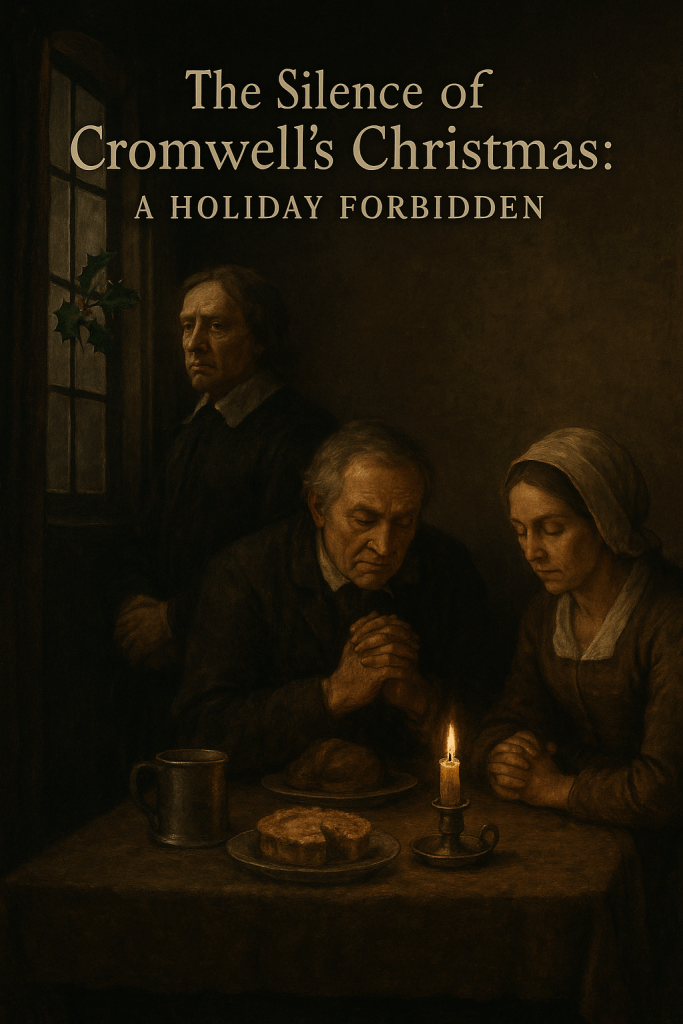
🕊️The Silence of Cromwell’s Christmas: A Holiday Forbidden.🕊️
The seventeenth century swept across Britain like a bitter wind, carrying with it upheaval, fear, and transformations so deep that even the heart of winter could not escape their reach. The English Civil War had torn families apart and reshaped loyalties, and when the Puritans rose to power in the aftermath, they sought to recast the nation according to their stark, devout ideals. To them, Christmas, rich with medieval festivity, brimming with raucous merriment, scented with spiced drink and evergreen, was a relic of excess, superstition, and sinful indulgence. What had once been a cherished blend of worship and revelry appeared to Puritan eyes as nothing more than pagan frivolity dressed in Christian clothing.
By the mid-1640s, their influence had grown strong enough that Parliament declared Christmas a working day like any other, abolishing its celebration in both church and home. Churches were ordered to stand undecorated, their stone arches stripped of winter greenery, their candles extinguished except for the most necessary light. Tradesmen were discouraged, sometimes even punished, for selling customary Christmas foods. Mince pies, long associated with the season and its feasting, became symbols of forbidden luxury. Markets were monitored, taverns kept under watch, and public revelry silenced beneath the stern gaze of moral reform.
Yet the soul of Christmas proved far more enduring than the laws meant to extinguish it. Customs embedded through centuries do not vanish at the flicker of a quill. In cottages tucked among hedgerows, in townhouses overlooking narrow cobbled streets, in farmsteads where the nearest neighbor was a mile of frosted field away, families remembered. They remembered the warmth of shared meals, the glow of firelight reflected in holly berries gathered from the hedges, the songs that once lifted winter evenings into something almost sacred. They remembered, and they resisted in the softest, bravest ways.
Curtains were drawn tightly against the windows. On Christmas Eve, tables were quietly set with whatever humble feast a family could manage—perhaps a small joint of meat secretly purchased, perhaps bread sweetened with dried fruit saved from autumn’s harvest. Voices kept low so as not to carry beyond the door, families prayed, sang, or told the Nativity story in whispers. Children were taught to rejoice silently, to hold excitement in their hearts rather than their voices. A sprig of holly tucked behind a beam or slipped into a window frame became a quiet act of defiance, a statement that tradition could be smothered but not uprooted. Even the simplest symbol, a single candle lit after dusk, felt like a rebellion.
There were moments when the suppression sparked open protest. In several towns, including Canterbury and Norwich, riots broke out when officials attempted to enforce the ban. Shopkeepers refused to open their doors on Christmas Day. Some parishioners defiantly decorated church walls with holly and ivy, only to have soldiers strip them bare. The country simmered with resentment, though its resistance remained mostly gentle, more weary than furious.
The ban endured throughout the Interregnum, shaping nearly two decades of winters in which Christmas was pushed underground. But the festival endured in memory and in longing, preserved in songs murmured at hearthsides and in the whispered blessing shared over modest meals. It lived in the hearts of people who, even in a season of fear, found ways to honor light in the darkest days of the year.
And then, in 1660, the monarchy returned. Charles II entered London to jubilant crowds, and with him came the swift restoration of traditions long suppressed. Christmas re-emerged almost at once, bursting back into public life as though the nation had been holding its breath for years and could finally exhale warmth again. Holly adorned doorways openly, bells rang without fear, mince pies were baked in abundance, and fires burned brightly in hearths that had stood too quiet for too long.
In that moment of return, Christmas did not simply resume; it bloomed. Its reawakening revealed just how deeply it had rooted itself in the British imagination, how resilient the celebration was, how tied to the rhythms of life, how impossible to truly forbid. The silence forced upon it had only made the season’s eventual reappearance all the more radiant, like a flame shielded in cupped hands finally released to flicker and dance freely once more.
🕊️The Elegance of Georgian Christmas: Refinement and Celebration.🕊️
The Georgian era ushered in a Christmas season bathed in candlelit grace, a period when refinement and sociability settled over Britain like a gentle snowfall. This was a time of polished manners, powdered wigs, and gilded drawing rooms, and yet beneath the silk and etiquette lived the familiar heart of midwinter joy. Christmas did not roar with rowdy revelry as in medieval days, nor did it hide in shadows as it had under the Puritans. Instead, it shimmered, cultivated, elegant, and warmly indulgent.
Feasting grew ever more elaborate as trade and empire expanded Britain’s palate. Tables gleamed beneath dishes enriched with imported spices and foreign luxuries: nutmeg and cinnamon from far-off islands, glistening citrus fruits from the Mediterranean, raisins and currants carried across seas. Christmas puddings steamed in cloth-bound bundles, their interiors studded with dried fruit, candied peel, and brandy-soaked richness. Roasted meats were served alongside delicate pastries and jellies molded into ornate shapes, and decanters of warming liqueurs glowed ruby and amber in the light of countless candles. Yet what defined a Georgian feast was not merely abundance, but elegance, each dish presented with an eye for symmetry and grace.
Twelfth Night, that grand and final jewel in the Christmastide crown, remained the highlight of the season. Bakers crafted towering Twelfth Cakes swirled with sugar and spice, concealing within them small charms and tokens, a coin, a bean, a ribbon, a tiny plaster figure. Whoever found these hidden surprises was said to discover their fortune for the year, prosperity, love, marriage, luck, or in some cases, mischief. Drawing rooms buzzed with laughter each time a guest bit into a slice and made the fateful discovery. In great houses, Twelfth Night also inspired elaborate masquerades, complete with costumes, music, and spirited games that flirted with the playful anarchy of the medieval Lord of Misrule, though rendered now in silks rather than rough homespun.
Although the Christmas tree had not yet claimed its future place in British homes, greenery was still welcomed indoors with affection and ceremony. Holly wreaths framed doorways against the chill. Ivy curled gracefully around bannisters, lending an air of soft enchantment to staircases. In wealthier households, mantels and mirrors were draped with laurel and bay, their polished leaves catching the candlelight like flakes of green gold. To step into a Georgian home at Christmas was to breathe in the mingled scents of greenery, citrus, and spice, all woven together into a tapestry of comfort.
Churches, too, transformed during the season. Choirs grew increasingly sophisticated, shaped by new musical influences and the rising popularity of composers who sought to elevate sacred music into something both devotional and stirring. Services rang with harmonious arrangements that carried through nave and transept with a warmth capable of dispelling even the bitterest winter wind. It was in this era that parish communities began to rediscover the joy of carols, some newly written, others carried from centuries past, sung with renewed vigor and refinement.
This period also offered the earliest whispers of traditions that would later flourish. Among fashionable circles, handwritten and hand-painted Christmas greetings were exchanged, delicate notes adorned with winter landscapes, floral borders, or graceful lettering. These early cards were small tokens of affection or friendship, crafted with care long before mass printing would transform them into a national custom. They hinted at the sentimental revolution that would bloom in Victorian parlors, but in the Georgian world they felt like treasures, intimate and personal.
A Georgian Christmas was a season poised elegantly between eras, rooted in ancient customs yet welcoming new refinements, touched by nostalgia yet eager for sophistication. It was a time when the frost on a windowpane seemed to glimmer with a quiet poetry, when footsteps across a snowy garden path might lead to a door thrown open in welcome, when music, conversation, and candlelight joined hands to create a winter wonder that was gentle, cultivated, and deeply human. In these drawing rooms and parish churches, the modern Christmas began to take shape, gathering grace note by grace note, ready to shine even brighter in the era that would follow.
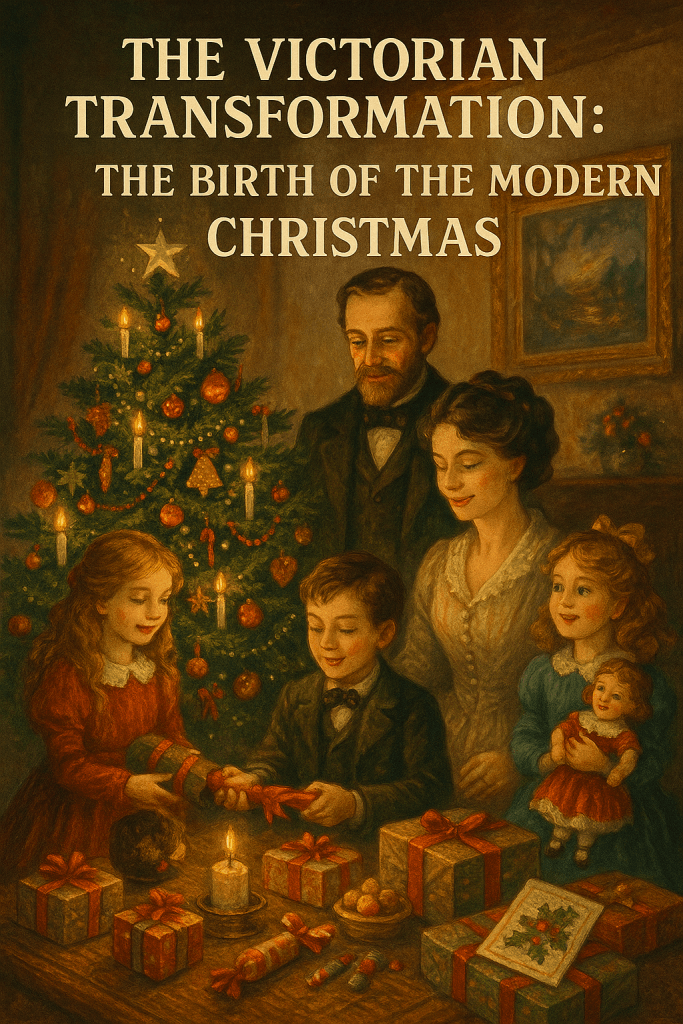
🎄The Victorian Transformation: The Birth of the Modern Christmas.🎄
If one era can truly claim to have shaped the Christmas cherished in Britain today, the Christmas of glowing hearths, of laughter echoing through parlours, of cards and carols and generosity, it is the Victorian age. The nineteenth century embraced the season with open arms, breathing new life into old customs and inventing new ones with a warmth and enthusiasm that still ripple through the holiday’s modern form. Christmas, once a varied patchwork of regional traditions, blossomed into a unified celebration of family, sentiment, and shared joy.
At the heart of this transformation stood Charles Dickens. His words flowed through Britain like a thawing wind, softening hearts and reminding a rapidly industrialising nation of its moral core. When A Christmas Carol appeared in 1843, it was more than a story, it was a rekindling. Dickens wrote of hearths in humble homes, of feasts modest but meaningful, of spirits who urged compassion, and of a world that could be better if only people opened their hearts. His tale of Ebenezer Scrooge’s redemption, told with humour, tenderness, and a deep belief in human goodness, reawakened an old truth, that Christmas was not simply a festival, but a reminder of kindness. Factories, shopkeepers, and families alike embraced the message, and the book’s influence lingered long after its ink dried. It changed the way Britain felt about midwinter.
Yet Dickens was not alone in reshaping the season. Queen Victoria and Prince Albert, with their carefully curated vision of domestic bliss, offered the country a new icon: the Christmas tree. Albert, born in Germany, brought with him the evergreen tradition that had long flourished in continental households. At Windsor Castle, the royal couple adorned a fir tree with candles, ribbons, sweets, fruits, and delicate handmade ornaments, arranging beneath its branches small gifts wrapped in bright paper. When an engraving of the royal family gathered around their illuminated tree was published in the Illustrated London News in 1848, the image captured the nation’s imagination. Soon, parlours across Britain glowed with their own trees, each one a small universe of light and story. Families decorated them with oranges studded with cloves, gilded walnuts, sugared biscuits, spun-glass ornaments, and gifts nestled among the branches. To gather around the tree became a ritual not just of decoration, but of togetherness.
The Victorians, ever fond of invention and novelty, introduced a lively newcomer to the festivities: the Christmas cracker. Conceived by confectioner Tom Smith in the 1840s, the first crackers were simple paper-wrapped sweets inspired by French bonbons. But soon a tiny spark of gunpowder was added to make the now-familiar snap, and the sweet was replaced by small trinkets, riddles, and paper crowns. The crack of a Christmas cracker became a sound of collective delight, a small explosion of joy that punctuated countless dinners and gatherings. To don a flimsy paper crown at the table was to partake in the season’s gentle magic, to be both regal and foolish for one merry moment.
Christmas cards joined the celebration as well. The very first commercially produced card, created in 1843, the same year Dickens published his famous novella, depicted a family raising a toast, flanked by scenes of charity and care for the poor. From that simple design blossomed an industry. Cards soon became richly illustrated with robins, snow-covered cottages, wreaths, bells, holly boughs, and sprightly children wrapped against the cold. Sending a card became an expression of affection, a thread connecting friends and family across great distances in an age when railways and postal reforms made communication faster than ever.
Music, too, experienced a renaissance. Victorian Britain rediscovered and celebrated old carols that had lingered half-forgotten in rural corners, preserving them in printed collections like Christmas Carols, Ancient and Modern. New carols were composed as well, melodies that lifted the heart and softened winter’s edge. Streets, churches, and drawing rooms filled with the sound of harmonies that echoed down generations.
Most profoundly, Victorian culture enshrined Christmas as a time of giving. Charity boxes appeared in churches and shops. Philanthropic societies delivered food, coal, and clothing to families in need. Employers began offering small gifts or holiday meals to their workers. Dickens’s message, that to honor Christmas was “to open one’s heart freely” took root everywhere from factories to town halls.
The Victorian Christmas became a glowing constellation of customs, each one reflecting a blend of nostalgia and invention, domesticity and imagination. In parlours lit by hearth and candle, families played games, exchanged gifts, and savoured feasts that blended tradition with newfound abundance. Snowfall, real or romanticised, became part of the season’s imagery, cloaking Britain in an idyll of silvered rooftops and lamplight.
In the Victorian era, Christmas became not merely a festival but a feeling, a celebration of home, family, memory, and hope. It became a story Britain chose to tell every year, one rich with sentiment and illuminated with kindness. And though the decades have passed and the world has changed, the Victorian Christmas continues to glow at the heart of the season, warming even the coldest midwinter nights.
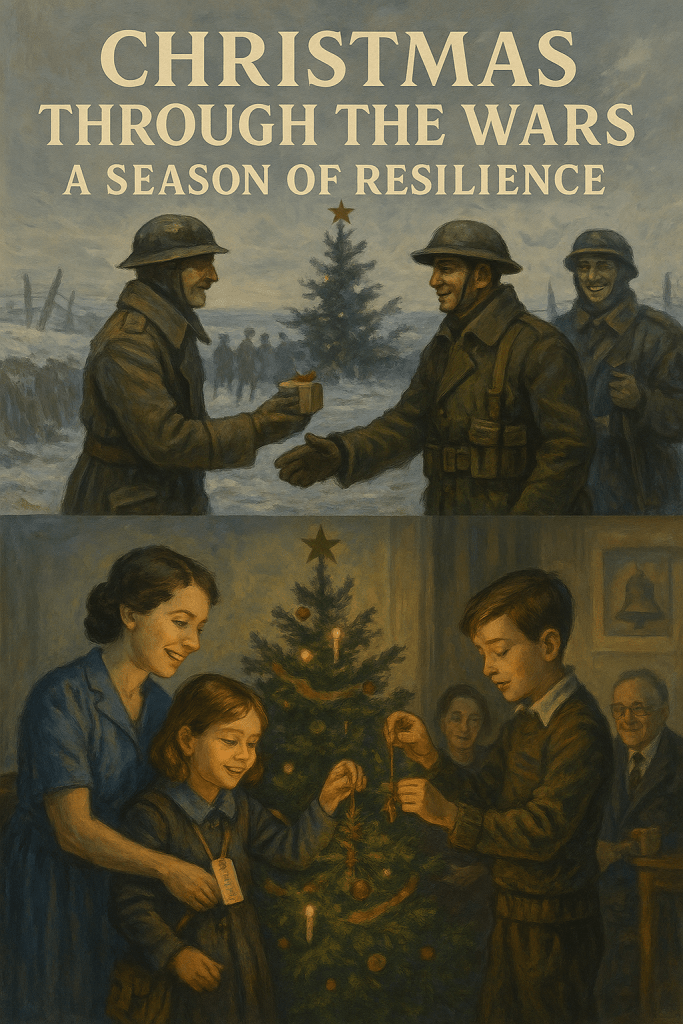
🕯️Christmas Through the Wars: A Season of Resilience.🕯️
The twentieth century ushered Britain into an age of profound upheaval, an age in which the comforting rituals of Christmas were tested against the harsh realities of global conflict. And yet, even in the shadow of devastation, the season’s quiet magic refused to fade. Instead, it adapted, softened, strengthened, proving itself to be not a luxury of peaceful times but a deeply rooted human need, a way of remembering warmth in the coldest moments of history.
When the First World War descended upon Europe in 1914, it carved trenches into landscapes and into lives. The Western Front became a frozen labyrinth of mud, fear, and exhaustion. But on Christmas Eve, in a moment that seemed to rise from some ancient, gentler memory, the guns fell silent. German soldiers placed candles upon the edges of their trenches; British soldiers listened as the strains of Stille Nacht drifted across the frosted darkness. Voices answered in English, hesitant at first, then strong. By dawn on Christmas morning, men who had faced each other across barbed wire now met in the narrow strip of no-man’s-land, shaking hands, exchanging cigarettes, sharing simple gifts of chocolate, tobacco, buttons, and treasured photographs from home. Some played football on the frozen earth; others simply stood and talked, discovering in their enemy not a faceless foe but a boy who missed his mother, a man who kept a sweetheart’s letter in his coat pocket. The truce was brief and fragile, discouraged by commanders and broken by necessity, but its spirit endured, a fleeting, miraculous reminder that humanity can surface even in the darkest winter of war.
The Second World War brought a different kind of struggle, closer to home and woven into the daily fabric of British life. Rationing reshaped every meal, every celebration, every expectation. Yet even with sugar strictly limited, eggs scarce, and luxuries nearly unreachable, families refused to surrender the comforts of Christmas. Housewives became alchemists, transforming what little they had into feasts of ingenuity. Christmas puddings were made with dried carrots for sweetness, breadcrumbs stretched recipes to feed more mouths, and treasured family molds were filled with whatever ingredients could be coaxed into feeling festive. Many families saved ration coupons for months so that Christmas Day might still bring its small, sacred indulgence.
Homes were decorated with a creativity born of necessity. Paper chains were crafted from old newspapers, pine cones, polished and painted, stood in place of ornaments; sprigs of greenery from winter hedgerows brought a whisper of nature indoors. When blackout regulations darkened the country, candles glowed behind heavy curtains, giving Christmas its own secret brightness, intimate and quiet.
The war scattered families, yet it also brought new forms of togetherness. Children evacuated from cities found themselves spending Christmas in unfamiliar countryside homes, discovering new customs while sharing their own. Some learned to gather holly from hedgerows; others introduced city-born traditions that soon became beloved in rural households. In these blended celebrations, the meaning of Christmas widened, gathering new textures of memory and belonging.
Communities rallied around one another with a tenderness sharpened by hardship. Neighbours exchanged small gifts made by hand, knitted socks, knitted gloves, a jar of jam saved from autumn’s fruits. Churches held candlelit services that offered solace amid fear. Soldiers on distant fronts received parcels containing tiny tokens of home: a knitted scarf, a plum cake, a letter infused with the scent of a familiar house. And across bomb-damaged streets, people gathered to sing carols, their voices rising into a sky whose stars were often hidden by war but never extinguished.
When peace finally returned, Britain emerged into a world transformed. New technologies carried Christmas into every home. Radios crackled with carols, festive dramas, and the steady, reassuring cadence of the monarch’s Christmas Broadcast, a tradition begun with King George V in 1932 and embraced ever since. Later, television brought images to accompany the voices: the Queen addressing her people beside a glowing tree, Christmas specials drawing families to gather around a single flickering screen, classic films becoming seasonal companions watched year after year.
Through war and recovery, through sorrow and rebuilding, Christmas revealed itself as something deeper than decoration or indulgence. It became an anchor, a shared memory of peace, a promise of hope, a celebration of the enduring warmth that people can offer one another even when the world grows cold. And in that resilience, in that tender defiance against despair, the heart of the British Christmas shone with a light no conflict could ever fully dim.
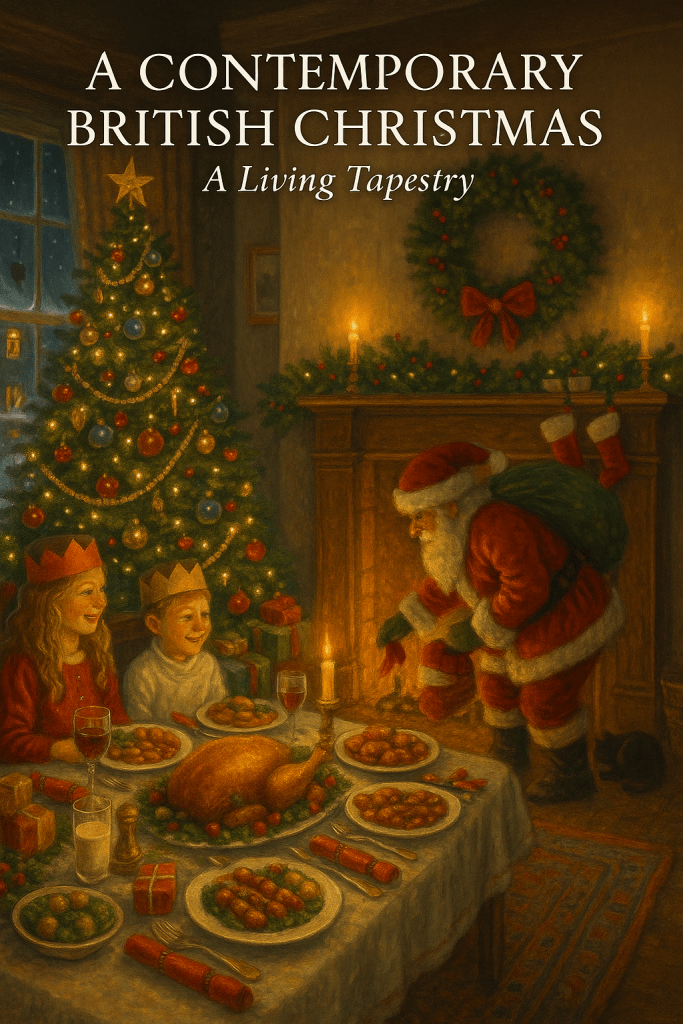
🎅A Contemporary British Christmas: A Living Tapestry.🎅
Today’s Christmas in the United Kingdom is a magnificent patchwork, its threads drawn from centuries of memory and constantly rewoven with new colours and customs. It is a season that glimmers with nostalgia yet grows a little more expansive each year, a living tapestry that holds both the echo of ancient carols and the sparkle of modern lights.
In cities, the season begins with a quiet shift in the air long before December arrives. Streets unfurl their first strings of twinkling lights like early snowflakes made of flame. Markets appear in public squares, their wooden chalets glowing with warmth. The scent of mulled wine drifts between stalls selling gingerbread, hand-knit scarves, and artisan gifts. Children clutch hot chocolates crowned with cream; adults linger beneath canopies of light that seem to stretch like constellations overhead. Crowds gather for the switching-on ceremonies, when mayors, musicians, or sometimes beloved local schoolchildren transform entire towns with a single golden flicker.
In villages, the first sign of the season might be the church door framed with holly or the arrival of handmade wreaths hung from cottage gates. Even the smallest communities now host Christmas tree lightings, where neighbours gather in the cold dusk to sing a carol or two before retreating to the village hall for warm drinks. The countryside has its own rhythms: frost settling on stone walls, the glow of lantern walks, the quiet magic of stars revealed in winter’s early darkness.
Schools across the nation become hives of excitement as December nears. Children rehearse their nativity plays with shy smiles and fluttering nerves. Tea towels are tied as shepherds’ headdresses, cardboard wings shimmer with glitter, and small voices rise to tell the ancient story with an earnestness that softens every heart in the room. For many families, these plays become treasured memories, moments when the spirit of Christmas feels distilled into something gentle and pure.
Santa’s grottos open in garden centres, shopping malls, and heritage houses. Parents guide wide-eyed children through scenes of elves at work, paper snowflakes drifting from ceilings, and sleigh bells jingling from unseen corners. The final moment, the meeting with Father Christmas, often feels like a tiny enchantment in itself, a brief suspension of disbelief where wonder reigns unchallenged.
Newer traditions have taken root alongside the old. Christmas Eve boxes have become beloved in many homes, filled with small delights: a pair of soft pyjamas, a chocolate treat, perhaps a book to read before bed. They create a quiet prelude to the festivities, a pause of cosy anticipation as children set out mince pies for Father Christmas and a carrot for the reindeer, placing them on the hearth with solemn importance.
Inside homes, Christmas trees glow like living hearths. Some families decorate theirs with heirloom baubles, glass ornaments passed down from grandparents, or paper stars made by small hands decades ago. Others craft themes anew each year, gold, red, silver, woodland, Nordic, eclectic bursts of colour. Whatever their style, trees stand as proud symbols of the season, guardians of memory and keepers of light.
When Christmas Day dawns, Britain stirs to a variety of rituals. Some families lace their boots for early-morning walks through parks or fields softened by frost, breathing in the crisp air before the bustle of the day. Others gather in churches filled with candlelight and familiar hymns. Many tune in to the King’s Christmas Speech, a tradition that feels like a thread linking every household across distance and time.
And then there is the feast, a quilt of flavours stitched together from centuries of practice. Roast turkey crowned with golden skin. Pigs in blankets tucked beside roasted potatoes crisped to perfection. Stuffing fragrant with sage, steaming vegetables, parsnips glazed to sweetness, and the ever-divisive Brussels sprouts, loved and loathed in equal measure. Crackers stretch across the table, ready to be pulled with a pop that releases jokes groan-worthy enough to be delightful, paper crowns meant to be worn with playful dignity, and tiny treasures tucked inside their folds.
After the meal come hours of gentle contentment: board games spread across coffee tables, the rustle of wrapping paper, the glow of films playing in cosy living rooms, long conversations that drift and settle like snowflakes. Outside, winter winds roam freely; inside, warmth pools in every corner.
Across the country, in city flats overlooking rivers of lights, in village cottages nestled beside ancient lanes, in Victorian terraces strung with evergreen and ribbon, each household shapes Christmas into something personal. Some traditions are inherited, others invented, many shared, all cherished. Together they form a mosaic of celebration, a testament to the enduring power of the season to gather people, soften hearts, and weave joy through even the darkest winter days.
A contemporary British Christmas is not fixed; it evolves gently with every generation. Yet at its core remains the same timeless truth: that amid the cold and the dark, warmth can always be created, light can always be kindled, and love, steady, generous, enduring, can always be renewed.
❤️The Heart That Endures.❤️
The history of Christmas is, at its core, a story of endurance, transformation, and quiet enchantment, a tale that has grown alongside the very people who have lived upon these islands. It stretches back through centuries like a trail of lanterns glowing in the dark, each one illuminating a moment when winter felt less forbidding because someone, somewhere, placed a sprig of green above a hearth or lit a candle against the long night. It is ancient evergreen branches woven through drafty medieval halls where laughter echoed against cold stone, the fragrance of holly and ivy mingling with woodsmoke. It is the muted, forbidden glow of candles during the Puritan age, their flames hidden behind shuttered windows, small and trembling yet impossibly stubborn. It is the joyous exuberance of the Georgian and Victorian eras, when families gathered around decorated trees or exchanged cards newly printed with sentimental scenes, when Dickensian warmth softened even the hardest of hearts. And it is the quiet courage of families who, in wartime, clung to tradition with rationed ingredients, handmade ornaments, and whispered prayers.
Through every chapter, Christmas has adapted without ever breaking. Its rituals might have changed their shapes, their colours, their flavours, but the golden thread that held them together, a longing for light, warmth, generosity, and hope, never loosened. In this way, Christmas in Britain is not merely a festival of the present moment but a living archive, a tapestry woven from the hands and hearts of those who came before. It is the lingering scent of oranges studded with cloves from a childhood long past. It is the soft crackle of fire that once warmed a grandparent’s sitting room. It is a carol heard in school halls thick with tinsel, or a Christmas Eve walk through a quiet neighbourhood where each window spills a little light onto the frost.
Christmas in Britain is not merely celebrated. It is remembered in ways both grand and intimate. It is reinvented every year, shaped by each household’s unique blend of tradition and improvisation, of inherited rituals and personal touches. A family might unwrap decades-old ornaments, each one carrying a story that resurfaces the moment it is held in the hand. Another might bake the same pudding recipe their great-grandmother once steamed in a cloth tied with string. Children, wide-eyed, absorb these customs with the unspoken understanding that one day they, too, will carry them forward.
There is something tender in the way these traditions are passed from one generation to the next. They are not handed over like obligations but offered like blessings, gentle, glowing, and full of love. A father teaching a child how to pull a cracker. A grandmother reciting the first lines of a carol learned in her own schooldays. A mother placing the star atop the tree, remembering all the Christmases when she was small enough to be lifted for the same honour. Each gesture is small, yet together they shape a season that feels deeply personal while belonging to millions at once.
Christmas in the United Kingdom remains a season that invites the whole nation, whether in cities humming with lights, in villages ringed by hedgerows, or in coastal towns where winter waves crash like distant drums, to pause. To gather. To soften. To remember that even in the coldest and darkest months, there are moments of beauty that cannot be dimmed. It invites us to let the gentle magic of midwinter remind us of what it means to cherish, to hope, and to dream: to believe, even for a few precious days, that kindness matters, that light returns, and that warmth can always be made by human hands.
❤️My Heart’s Whisper.❤️
To me, Christmas is a quiet stirring of the heart, a season where love gathers itself into the soft glow of candles and the familiar embrace of family. It is the joy of giving, wrapping presents not merely in paper but in affection, in gratitude, in the hope that a small token might carry the weight of all the things we sometimes struggle to say aloud. It is a way of saying “I care,” “I see you,” “I’m grateful you’re part of my world.”
Christmas is the sound of familiar laughter rising from rooms where generations meet, the scent of recipes handed down like heirlooms.
It is the warmth that rises when generations come together around a table, sharing stories that have been told so often they have become part of the family’s fabric.
And it is, too, the gentle ache of remembrance: a silent thought for those no longer seated beside us, a raised glass to the ones we loved fiercely and still love across the quiet distance of time. Christmas holds joy and longing in the same breath, reminding us that love endures, that it echoes through memory, through laughter, through the soft hush of winter, and through every heart that pauses long enough to feel it.
As you reach the end of this journey through stories, memories, and the gentle glow of Christmas past and present, I want to thank you for walking beside me.
Wherever you are reading from, whether in a quiet corner of your home, beside a twinkling tree, or wrapped in a blanket against the winter chill, I hope this season brings you moments of peace that settle softly on the heart, and moments of joy that warm you from within.
May your days be touched with kindness, your gatherings filled with laughter, and your nights lit by the small, steadfast lights that make this time of year so magical.
And may you carry with you the love of those around you, as well as the memory of those you hold forever in your heart.
Wishing you and your loved ones a beautiful, gentle, and deeply happy Christmas. May it be a season of warmth, wonder, and hope.
Until next time,
Toodle Pip,
Yours Lainey, Miss Pants and Mr Toe Beans.





 Intwined