For as long as humans have watched the sun slip early behind winter’s horizon, candles have glowed in response, small, defiant flames cupped in cold hands, flickering with hope during the longest nights. The darkest days of the year have always stirred something ancient in us, something that reaches back to times when winter meant uncertainty, vulnerability and a longing for light. And so people turned to candles not only to see, but to feel, to believe, to remember and to connect.
The earliest candlelight rituals were born from simple necessity. When night blanketed the earth for long hours, fire was the only force that kept back the dark. But soon flame took on deeper meaning. In ancient European solstice traditions, people lit candles or torches to beckon the sun’s return, believing that light itself had power to encourage the world back toward warmth. These early rituals were gentle offerings to the heavens, small luminarias guiding the sun through its long midwinter journey, as if human hands could steady the great wheel of the seasons.
Across cultures, the ritual of candlelight unfolded with beautiful variety. Romans celebrated Saturnalia with lamps and glowing garlands, turning the dark season into a festival of warmth and cheer. In northern lands, where winter stretched long and fierce, households carried candles from room to room, blessing each threshold against the deep and wandering cold. Even in the chill silence of the ancient world, fire moved like a quiet blessing from home to home, an intimate reminder that people were never fully at the mercy of winter.
As centuries drifted forward, candle rituals deepened in meaning. Medieval families, cloaked in the dim glow of tallow candles, gathered near hearths during long advent evenings. The flame symbolized hope during a season that tested faith as much as strength. In drafty cottages and noble halls alike, people leaned toward the same small lights, their hearts warmed by the shared symbolism. Churches filled with candlelight became sanctuaries of soft gold, the air rich with beeswax and incense. A single flame in a towering stone nave could feel like the heartbeat of the season itself, steady, luminous, unwavering, reminding weary souls that darkness, however deep, was never absolute.
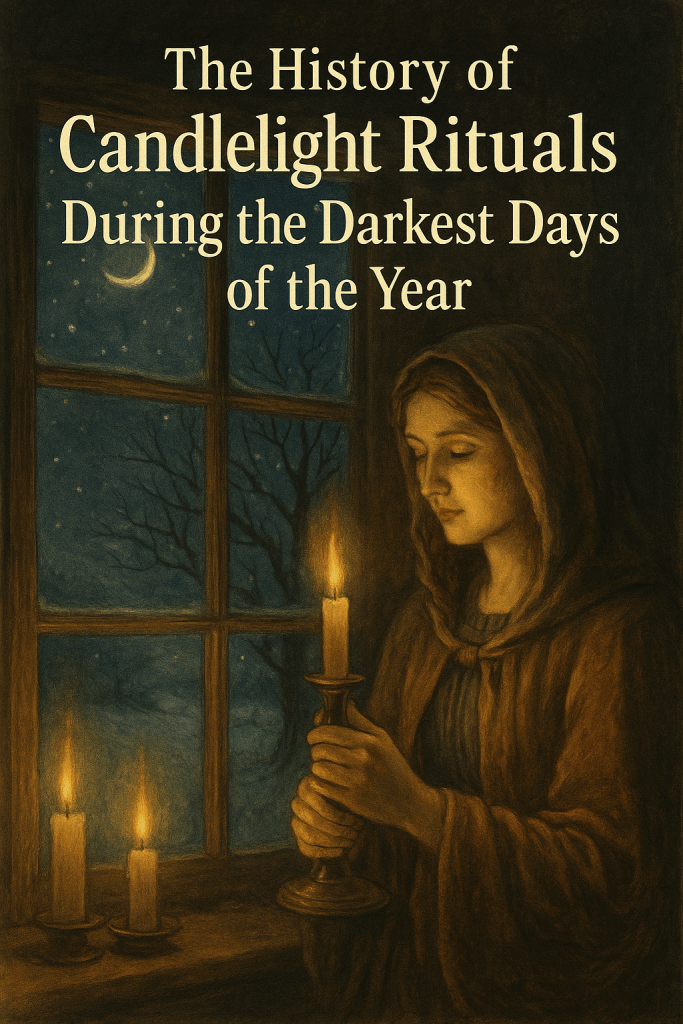
Homes, too, found quiet magic in these rituals. A candle placed at a window on the longest night of the year signaled welcome to wandering travelers, both real and symbolic. Some believed it guided loved ones back from faraway places; others believed it honored those who had gone before. The winter window candle was more than decoration, it was a tender gesture, a wordless message of presence and longing. That soft glow behind glass made the cold world outside seem a little less lonely.
In colder climates, families used candlelight to mark the turning of the year, creating moments of togetherness when the world outside lay hushed and frozen. Children gathered close as elders told stories by flickering light, the flame casting shadows that seemed to dance with the tales themselves. The candle transformed the room into a small universe, intimate and timeless, where time softened, voices lowered and hearts came closer.
By the eighteenth and nineteenth centuries, candle rituals blossomed into cherished traditions. Yule logs burned with ceremonial vigor, Christmas trees sparkled with carefully watched candles that turned the nights into dazzling enchantments. Rooms glowed with circles of warm light, and the contrast between inside and out, the howling wind beyond the walls, the gentle radiance within, made these rituals feel even more precious. Victorian households embraced candlelit evenings of music, storytelling and reflection, savoring the way flame softened the world into something gentler, more romantic, more deeply human.
Yet across all these eras, one truth threaded through every culture and custom, candlelight made the darkness less daunting. It was a way to shape the night rather than be swallowed by it. A way to honor the season not with fear, but with reverence. A way to remind ourselves that even the smallest warmth could stand bravely against winter’s vast, enveloping cold.
And though we no longer depend on candles for survival, we still turn to them instinctively during the darkest days. We line them on windowsills, cluster them around tables, light them during dinners, vigils and celebrations. Each flame, whether in a bustling city apartment or a quiet countryside home, is a tiny continuation of a tradition older than recorded memory.
Perhaps we do this because the winter darkness still speaks to something in us. It slows the world, hushes our pace and opens a space for reflection. And in that spacious quiet, we reach for light, warm, living, softly shimmering. The ritual of candlelight reminds us that we, too, carry a spark within us. That even in the longest nights, there is beauty, comfort and connection waiting to glow.
And so, through thousands of winters, candles have remained humble companions. Their light is fragile yet fearless, romantic yet grounding, ancient yet evergreen. They burn for hope. They burn for memory. They burn for love. And as long as winter darkens the sky, candles will continue to shine, small beacons that turn the coldest season into something luminous, magical and deeply human.
Until next time,
Toodle pip,
Yours Lainey.
 Intwined