Winter has always felt like a season stitched from silence and memory. The world slows. The trees bare their bones. The sun slips away early, as though retreating into a contemplative slumber. In this hush, in this pale, breathless stillness, many ancient cultures sensed that the veil between the living and the dead grew thinner, not with fear but with reverence. When the earth entered its season of rest, people turned their thoughts to those who had gone before them, believing winter to be the natural time for remembrance. Winter was never just a passage to endure, but a sacred interval when love reached backward through time.
In the far north, where the sun flirted with disappearance and nights stretched long enough to feel like whole lifetimes, Nordic peoples believed their ancestors walked gently among them during the deep winter months. Fires were kept burning not only to warm the living, but to guide wandering spirits toward comfort. A piece of bread, a ladle of warm ale, a morsel of meat might be left on a threshold. It was hospitality, not ritual, a kind of ancestral courtesy. These offerings whispered: If you pass by, rest here. You are missed. You are remembered. In this way, kinship outlasted the grave, and winter became a season of quiet reunion.
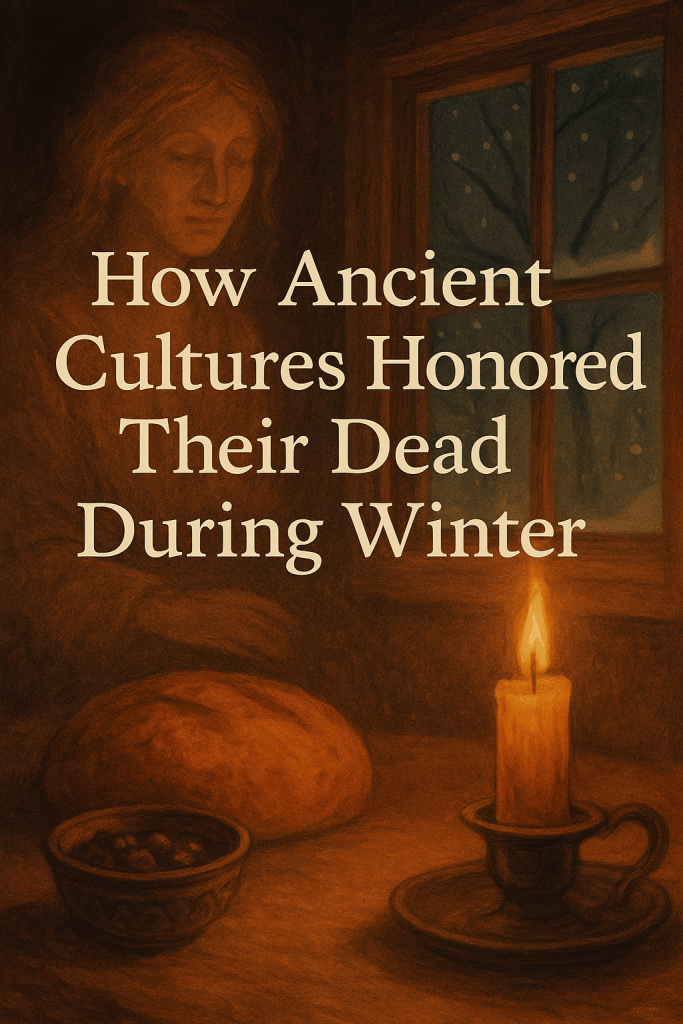
The Celts also felt their ancestors close in the cold months. Though Samhain was the great festival of the thinning veil, winter itself remained companion to the dead. Souls were believed to revisit their homes, not as ominous figures but as cherished guests who drifted in on cold winds. A candle in the window illuminated their way. A bit of food by the door welcomed them. A seat left empty at the table was not a gesture of grief, but an act of honor. The Celts understood something we often forget: that love is not severed by silence, and presence need not be physical to be felt.
Farther east, ancient Japanese households gathered in winter to honor their ancestors with rituals that filled the cold months with warmth and meaning. Incense curled into the air like delicate threads of memory. Ancestral tablets gleamed softly upon home altars. Prayers were spoken not with grand ceremony, but with everyday devotion. In the quiet of winter nights, the living and the dead seemed to share the same breath.
In ancient China, winter was particularly intertwined with ancestor veneration. During the winter solstice festival, Dongzhi, families visited tombs with offerings of food and warm wine. Incense was burned, and joss paper sent necessities and comforts into the afterlife. Yin, the force of darkness, reached its peak at the solstice, only to yield slowly to the returning yang of light. The ancestors, too, were believed to move with these cycles, their presence part of the natural rhythm of the cosmos.
In the Mediterranean world, ancient Romans honored their ancestors in late winter through Parentalia, a tender festival devoid of pomp. Families adorned graves with small wreaths of evergreen and left offerings of grain, bread, and wine. These gestures were deliberate and contemplative, reminders that even in a bustling empire, quiet devotion had a place. Winter, muted and reflective, made remembrance feel intimate rather than grand.
Even in the distant Andes, the Inca honored their dead with rituals that blurred the line between past and present. Ancestors were not abstract memories; they were guardians, advisers, sometimes even participants in festivals. During certain winter observances, the mummies of revered ancestors were brought into homes, clothed warmly, and offered food as though hunger and cold still touched them. It was an act not of superstition, but of profound familial continuity.
And then, across the mists and moors, there is England and the lands of the United Kingdom, a place where winter remembrance took on its own ancient character. Long before church bells marked holy days, the people of these islands honored their dead in ways woven from folklore, hearth-glow, and a close relationship with the land.
In ancient and early medieval England, winter was considered a time when ancestors lingered near the homestead. The long, dark nights invited them closer. Hearth fires were never left to die completely; their embers symbolized lineage, a flame carried forward from generations past. People believed that to let the hearth go cold in winter might allow ancestral protection to falter, so fires were kept smoldering, warm hearts for wandering spirits.
In some regions, bread and ale were placed upon the doorstep or windowsill, much like in the far north. The gesture was humble, an everyday sort of sacrament. In Yorkshire and parts of Scotland, a tradition known as “the dumb supper” lingered: a silent meal set for the dead, with places laid carefully, food served respectfully, and no word spoken while it lasted. Silence was the language of that communion, a way to bridge the space between the living and the departed.
The Yule season itself carried ancestral resonance. Evergreens, holly, ivy, and later the Christmas tree, were believed to shelter nature spirits and ancestral souls during the cold. Their green endurance symbolized life persisting beyond death. In old English lore, the robin, with its bright red breast, was thought to carry messages between worlds, flitting through the dark months as a small, feathered herald of remembrance.
Bonfires lit on hilltops, an echo of even older pre-Christian rites, were meant not only to drive away harmful forces but to warm and guide benevolent spirits. And in certain corners of the countryside, it was believed that on Christmas Eve, the dead might return to their old parish churches to pray. To stumble upon these spectral congregations was discouraged, but lighting a candle in the window was encouraged, a kind welcome rather than a fearful retreat.
These winter rituals across the world share a single heart: love. A love so persistent it refused to bow even to death. A love that believed connection did not end, it simply changed shape, becoming quieter, deeper, and threaded through the rituals of winter.
Perhaps that is why winter still feels so evocative. A snowfall can feel like a benediction. A candle’s glow can soften the heart into remembering. A December hush can make you feel as though someone you once loved stands just behind you, close enough that your breath mingles with memory.
These rituals were never only superstition. They were longing, gratitude, loyalty to lineage. They were the understanding that memory itself is a living presence. The ancients honored their dead by feeding them in the cold months, by lighting candles in the dark, by making room for them at the table of winter. They kept love warm through frost and night.
And perhaps, without realising it, we still do the same. When we hang lights, when we gather around a fire, when we whisper the names of those who are no longer here, we echo ancient gestures. We become part of an unbroken human story, the story of honoring love that outlives the body.
Winter, with all its silence and shadow, has always known how to cradle both memory and hope. It teaches us that the dead are never truly gone. They linger in warmth shared, in stories told, in traditions kept alive with gentle hands. And as the days lengthen and light begins its slow return, we carry them with us, stepping into each new season accompanied by the soft, enduring footprints of those who walked before us.
Until next time,
Toodle pip,
Yours Lainey.
 Intwined