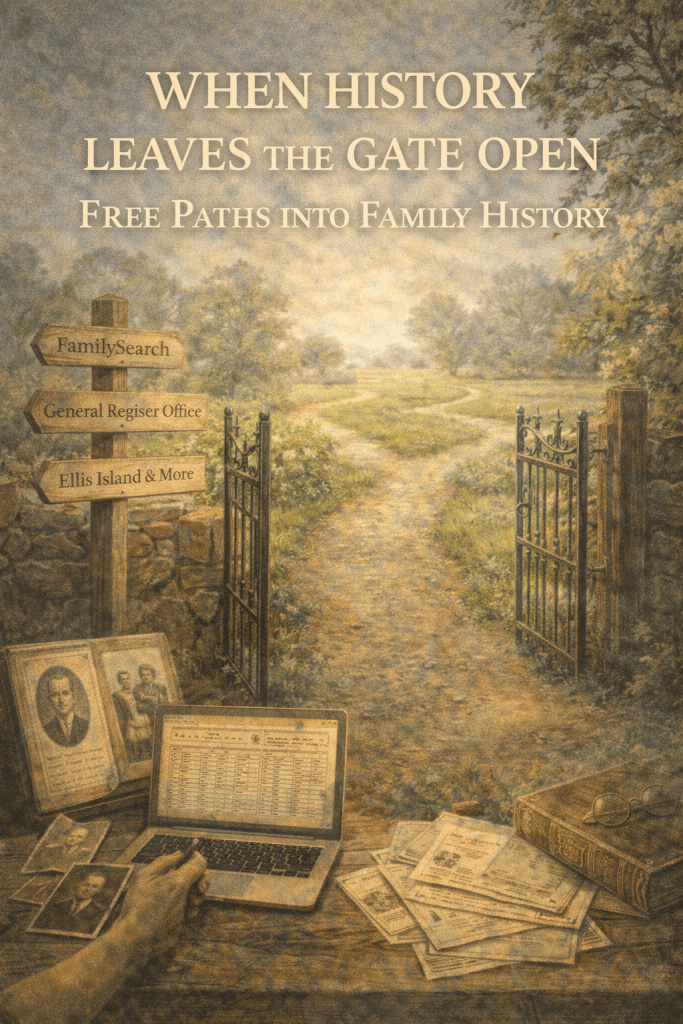
There is a particular kind of magic in free genealogy websites. They feel like old iron gates left thoughtfully unlatched, doors standing open not by accident but by invitation.
For anyone drawn to family history, especially within the United Kingdom, these digital spaces hum softly with memory. They echo with footsteps once taken along cobbled streets, parish lanes, factory floors, and open fields. They remind us, gently and insistently, that history does not belong only to those who can afford subscriptions or scholarly credentials. Memory, like love, longs to be shared.
Free genealogy websites are not lesser tools, nor are they merely stepping stones to something better.
Again and again, they prove themselves to be the foundations upon which the most careful, ethical, and meaningful research is built. Used with patience and curiosity, they can guide you from your own name backward through decades and centuries of ordinary lives made extraordinary simply by being remembered.
At the heart of free genealogy sits FamilySearch, a resource that often becomes a quiet companion rather than a loud guide. Created and maintained by the Church of Jesus Christ of Latter day Saints, it offers free access to an astonishing range of records from across the world, with particularly strong coverage for England, Wales, Scotland, and Ireland. Parish registers stretch back into the early modern period. Census returns gather families under one roof. Civil registration indexes offer structure and reassurance. Probate calendars whisper of property, affection, and dispute. Many records are digitised, some even browsable image by image, waiting patiently for careful eyes.
FamilySearch rewards those who move slowly. It is tempting to accept the sprawling family trees built by others, but the true strength of the site lies in its records, not in its conclusions. The joy is in opening an image and reading it fully, noting the witnesses at a marriage, the marginal scribbles of a parish clerk, the occupations that shift from census to census. Each document is less a fact to collect than a conversation to enter, one that unfolds gently if you allow it time.
For those researching England and Wales, the General Register Office website is one of the most quietly powerful tools available. Though it does not offer full certificates for free, its searchable indexes to births, marriages, and deaths provide clarity that can lift long standing uncertainty. Being able to identify exact registration districts, quarters, and reference numbers anchors families firmly in time and place. It is particularly valuable where names repeat across generations, as they so often do. This is a site that rewards patience and precision, offering certainty without spectacle.
The National Archives of the United Kingdom opens another door entirely, one that leads into the machinery of the state and the lives caught within it. Its catalogue is free to search and vast in scope. Here live military service records, pension files, wills, criminal registers, transportation records, immigration papers, and correspondence that once passed across official desks. Many documents are digitised and freely available, while others reveal where deeper stories may be found. Learning to navigate the catalogue can feel daunting at first, but once familiar, it becomes a map to lives that rarely appear in baptism or marriage registers alone.
Local record offices and county archives across the UK add a further layer of richness. Many now offer free online catalogues and selected digital collections. While not always fully digitised, these resources tell you what exists and where it rests. A poor law record in Yorkshire. A settlement examination in London. A burial register in Cornwall. They remind us that family history is deeply local, shaped by parish boundaries, workhouses, and neighbourhood ties as much as by blood.
Beyond Britain, free genealogy websites follow the paths our ancestors took when they left home behind. For families who crossed the Atlantic, the Ellis Island and Statue of Liberty Foundation database offers free access to passenger lists recording arrivals in the United States. Each entry feels like a held breath, a moment balanced between one life left behind and another not yet begun. Names shift in spelling. Ages drift. Places blur. Yet courage gleams quietly through the ink.
The National Archives of Australia provides free access to immigration records, naturalisation files, and military service documents that trace British families as they built new lives beneath unfamiliar skies. Library and Archives Canada opens census returns, passenger lists, and land records that map the slow spread of families across provinces and generations. These sites reward flexible thinking, creative spelling, and an openness to surprise, for migration rarely travelled in straight lines.
Irish research, shaped profoundly by loss, makes free resources especially precious. The National Archives of Ireland offers digitised census returns from 1901 and 1911, allowing researchers to step into households frozen in time, seeing not only names but rooms, religions, occupations, and literacy. Irish Genealogy provides free access to civil registration images that feel like small acts of survival in themselves. Here, absence speaks as loudly as presence, and every discovered record carries weight.
Newspapers, too, play a quiet but transformative role in free genealogy. Local libraries across the UK and beyond often provide free access to historic newspapers, either in reading rooms or online. Birth announcements, marriage notices, obituaries, court reports, shipping news, and snippets of community life fill the spaces between official documents. Newspapers remind us that our ancestors were not only recorded by governments. They were noticed by neighbours, discussed by towns, and woven into everyday life.
Using free genealogy websites well is less about speed and far more about listening.
Search with intention.
Read deeply.
Compare records.
Accept that names wander, dates argue, and truths emerge slowly. A
life is rarely contained within a single document. It reveals itself gradually, through patience and care.
There is something profoundly moving about discovering how much of the past remains freely available. It feels like a quiet generosity offered across time, as though those who came before us wanted to be found, wanted their lives to be known by those who would follow.
Free genealogy websites do not promise easy answers or instant certainty, but they offer something far more enduring. They offer access, possibility, and the chance to meet ordinary people again through the traces they left behind.
When you sit late at night scrolling through a census page or lingering over a parish register, remember that you are not merely researching.
You are remembering on behalf of those who can no longer speak.
And in these open digital spaces, waiting patiently for anyone willing to look, the past stands ready, quietly hopeful, to be loved back into being.
Until next time,

Ta ta for now.

Yours, Lainey.
 Intwined