There are places that vanish so completely they leave no faces behind.
No photographs. No fixed moments held still in silver or light, nothing to point at and say this is how it looked, this is how they stood.
Only words remain, rumours, court records, complaints, reform pamphlets, and the soft, persistent ache of absence.
Britain’s earliest slums belong to this quiet and fragile category of loss. They were demolished before the camera learned how to see them, cleared away before anyone thought their lives worth preserving on paper or glass.
To imagine these vanished places, we must loosen our reliance on images. We must let go of certainty and learn to listen instead. We must read between lines written by others, hear echoes in maps where streets have been rubbed away, and feel our way toward lives that were lived intensely and briefly, and then swept aside.
In eighteenth and early nineteenth century Britain, long before photography became common, poverty lived densely and often invisibly. Cities expanded at a breathless pace. London, Manchester, Liverpool, Birmingham and many others drew people in with the promise of work in workshops, docks, factories, and trades, then folded them into whatever spaces already existed. Housing could not keep up. Old medieval buildings were divided again and again, rooms split into smaller rooms, staircases shared by dozens. Cellars became homes where damp clung to the walls. Attics became homes where summer heat pressed low against the roof. Yards filled with lean to structures built from scavenged timber, brick fragments, tar, and hope. These neighbourhoods were not designed or planned. They accumulated slowly, layer by layer, like human sediment.
They came to be known as rookeries, a name borrowed from crowded bird nests and spoken with a mixture of fear and fascination. The most infamous were in London. St Giles, Seven Dials, Saffron Hill, the Mint, Whitecross Street. These were not slums pushed to the edge of the city. They lay close to wealth, pressed up against theatres, markets, churches, law courts, and fashionable streets. The poor lived within steps of prosperity. They were not hidden away. They were simply unseen.
What makes these places invisible to us now is not only the absence of photographs, but the way they were written about at the time. When they appear in records, they are framed as problems rather than places, hazards rather than homes. Official reports speak of filth, vice, disease, and danger. Reformers wrote with moral urgency and horror. Magistrates wrote with irritation and fatigue. Novelists wrote with drama and exaggeration. Rarely did anyone pause to describe the colour of a doorway rubbed smooth by passing hands, the sound of children inventing games in a narrow court, or the way light slanted briefly into a shared yard at noon before vanishing again.
And then, almost without ceremony, these places were gone.
From the late eighteenth century onward, Britain entered an age that called itself improvement. Streets were widened. New roads were driven through old quarters. Entire neighbourhoods were cleared in the name of health, morality, and progress. The New Road, now Marylebone Road, cut through long settled communities. Later, railway lines tore through working class districts with blunt efficiency, removing homes and streets with astonishing speed. There was no requirement to record what was destroyed. Demolition itself was considered sufficient documentation.
The people who lived there moved on, or were pushed on, leaving little trace behind. Most could not write. Few kept diaries. Their possessions were modest and easily lost. Their homes were regarded as temporary, even though generations were born and died within the same walls. When those walls fell, so did the evidence that these lives had ever taken shape there.
Photography arrived too late to save these places. By the time cameras became portable and affordable in the mid nineteenth century, many of the worst rookeries had already been erased. The Old Nichol in East London was famously photographed before its demolition at the end of the century, but it survived into a later age of scrutiny. Earlier slums had no such witness. They exist now only in maps where street names have been scratched out, in court transcripts listing addresses that no longer exist, in parish registers recording baptisms, marriages, and burials from streets that have slipped out of reality.
There is something profoundly tender in this absence. We are practiced at mourning ruins, castles, abbeys, and grand houses. We know how to grieve stone when it belonged to power and privilege. But these slums were homes. However harsh the conditions, they were places where people loved and quarrelled, cooked meals, sang songs, raised children, endured bitter winters, celebrated weddings, and mourned their dead. Their lives were as layered and meaningful as any others, yet they vanished without a visual farewell.
What remains are whispers. A description of a single room shared by three families. A complaint about a blocked drain that never seemed to clear. A line in a reform pamphlet describing a narrow court where sunlight never reached the ground. These fragments ask us to imagine carefully and kindly, without spectacle, without turning suffering into scenery.
There is always a temptation to romanticise what has been lost, to soften hardship because time has passed and danger is no longer immediate. That would be a mistake. Conditions were often brutal. Overcrowding spread disease. Clean water was scarce. Work was unpredictable. Life expectancy was short, especially for children. But hardship does not erase humanity. If anything, it sharpens it, concentrates it, makes every small joy more urgent.
The tragedy of these invisible slums is not only that they were destroyed, but that they were never truly seen while they stood. Their removal allowed cities to congratulate themselves on progress while forgetting the people who paid for it. Streets became cleaner. Avenues grew wider. Respectability returned. And the memory of what had stood there before dissolved like dust in sunlight.
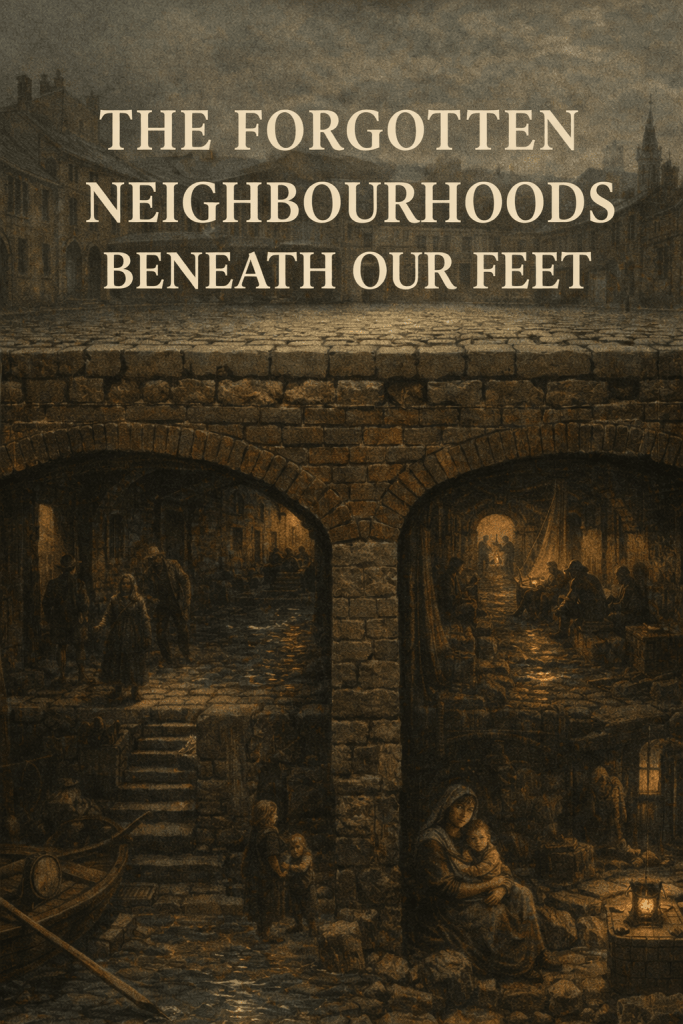
Yet the city still remembers, even if it speaks softly. Beneath modern roads lie old foundations. Beneath parks lie the outlines of vanished homes. Beneath railway arches linger the shadows of streets where life once pressed close together, warm and difficult and alive.
When we walk through parts of Britain’s cities today, we sometimes feel a strange sense of depth, as if the ground is holding more than it reveals. That feeling comes from places like these.
The invisible slums.
The forgotten neighbourhoods beneath our feet.
The lives that left no photographs but shaped the city all the same.
To remember them is an act of kindness.
It is a way of saying that lives do not need to be beautiful, prosperous, or carefully recorded to matter. Sometimes history survives not in images, but in imagination, empathy, and the quiet decision to look where no picture remains.
Until next time,

Ta ta for now.

Yours, Lainey.
 Intwined