There is a moment, early in every family history journey, when the past feels impossibly far away.
Names hover without weight or warmth.
Dates slip through the fingers like mist.
Stories feel more like echoes than truths, softened by time and repetition.
It is often here, in that quiet uncertainty, that records begin to speak. Not as cold or bureaucratic things, but as gentle witnesses. They are the places where lives first brushed against ink and paper, where ordinary days were preserved simply because someone believed they mattered.
These first records do not ask for expertise, fluency in Latin, or heroic leaps across centuries. They ask only for attention. For patience. For a willingness to sit quietly and listen. They are the true foundations of careful genealogy, especially in the United Kingdom, where history has long been written parish by parish, household by household, life by life.
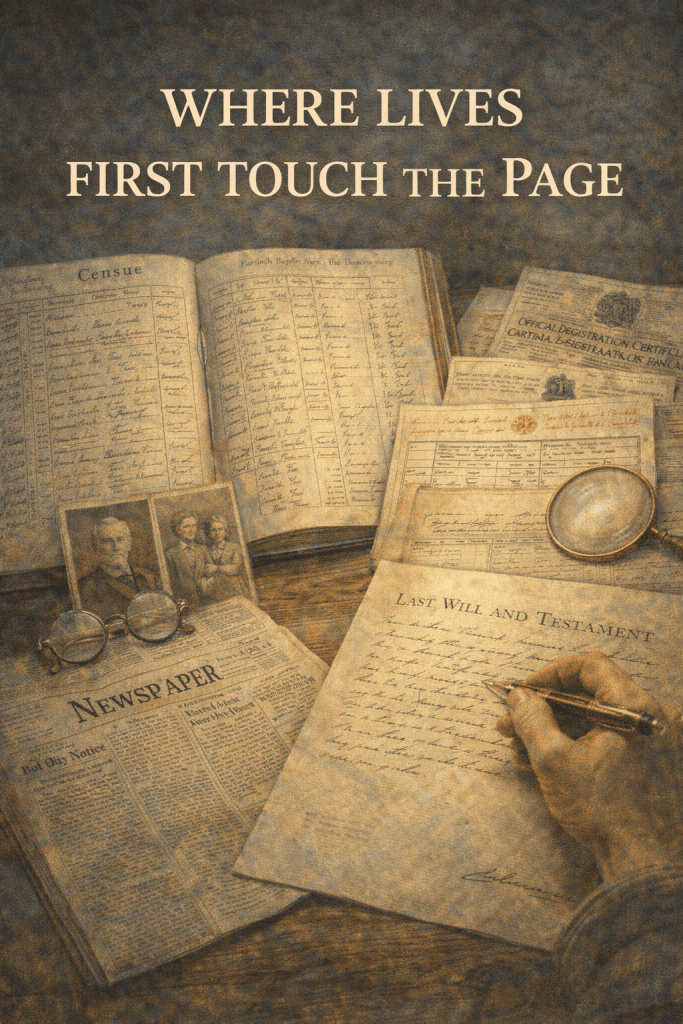
For many, the census is the first true doorway. In the United Kingdom, census records from 1841 through to 1921 allow us to step inside homes long emptied of voices. Every ten years, families paused, unknowingly, to be counted. They stand together on the page, suspended in a single moment. Children who will not survive to adulthood appear beside siblings not yet born. Elderly parents linger near the end of their stories. Occupations whisper of skill, exhaustion, pride, or necessity. Addresses place families on streets that may no longer exist, in houses that have been rebuilt, renamed, or erased entirely.
The census is imperfect and beautifully human. Ages drift from one decade to the next, not through deception, but through habit, uncertainty, or a loose relationship with calendars. Names shift spelling. Birthplaces grow vague. Yet what matters most is not precision. It is presence. The census tells us who belonged together, who shared walls and meals and worries. For a brief moment, it lets us stand in the same room.
Before certificates shaped lives into tidy forms, the parish kept watch. Parish registers of baptisms, marriages, and burials are among the most tender records a genealogist can ever touch. In England and Wales, many reach back into the sixteenth century, carrying generations through the same careful handwriting, the same churchyards, the same stone fonts worn smooth by centuries of hope. A baptism records not only a child, but belief in a future. A marriage marks intention, community, and belonging. A burial, often heartbreakingly brief, reminds us how fragile life once was, how quickly names moved from cradle to grave.
These records root families to place in a way few others can. They bind surnames to villages, hamlets, chapels, and parishes that shaped daily life. They remind us that for many centuries, most people lived and died within a few miles of where they were born, their world defined by footpaths, seasons, and church bells.
From 1837 onward in England and Wales, and earlier in Scotland, civil registration brought a new kind of certainty. Birth, marriage, and death records introduced structure and consistency, fixing families more firmly in time. A marriage certificate is often the most generous of all, naming fathers, occupations, and witnesses who quietly sketch out family networks and friendships. A birth certificate can restore a mother’s maiden name, returning an identity that might otherwise vanish behind marriage and motherhood. A death certificate closes a chapter, sometimes gently, sometimes abruptly, hinting at illness, accident, or exhaustion.
Together, these records form a sturdy frame, one upon which the rest of your research can rest safely.
Wills and probate records speak in softer, more intimate voices. They tell us not only who existed, but how they cared, worried, and chose. A father names his children and reveals who he trusted. A widow claims what she is owed. A neighbour receives a keepsake. Even modest possessions carry meaning. A bed, a chest, a few books, a cow, a set of tools. In Britain, probate calendars and wills often reach into periods before census records begin, bridging silences and restoring relationships that might otherwise be lost. They remind us that ancestors were not simply born and buried. They planned, hoped, argued, forgave, and imagined futures they would never live to see.
Newspapers breathe life back into the bones of research. They are not always kind, but they are always human. Birth announcements brim with pride. Marriage notices shimmer with optimism. Obituaries attempt to make sense of a life in a handful of lines. Court reports reveal missteps and desperation. Accidents, advertisements, lost items, and village gossip spill across their pages. A single paragraph can transform a name into a voice. For families across the United Kingdom and beyond, newspapers often provide the colour missing from official records, capturing moments too small or too personal for registers and ledgers.
Taken together, these records form the steady heartbeat of family history research. They are not glamorous. They do not promise instant revelations or noble ancestors. What they offer is something far richer. Connection. Continuity. Truth shaped by time.
They ask us to slow down. To read carefully. To notice patterns and silences. To treat each name with the same care we would offer a living person. When you open a census page or trace a finger across a parish register, you are not merely collecting information. You are bearing witness. Each record is a quiet agreement between past and present, a promise that lives once lived in ordinary ways will not vanish into anonymity.
This is where genealogy truly begins.
Not with grand discoveries or dramatic stories, but with listening.
With allowing lives to touch the page, and through it, to touch you.
Until next time,

Ta ta for now.

Yours,
 Lainey.
 Intwined