There was a time when death was meant to teach a lesson.
For centuries in Britain, execution was not hidden away or softened by distance. It was theatre, moral instruction performed in daylight, staged so openly that no one could claim ignorance.
The gallows rose at crossroads, on commons, outside prisons, and in fields just beyond city edges. Life paused, carts stopped, shops closed, and people gathered. Justice, the authorities believed, worked best when it could be seen, smelled, heard, and remembered.
But crowds have hearts as well as eyes. And sometimes, instead of leaving quietly chastened, they erupted.
Public executions were designed to terrify people into obedience.
Yet again and again, they achieved something else entirely. They stirred sympathy instead of fear, anger instead of submission, grief instead of gratitude. They reminded people not of the majesty of the law, but of its cruelty. When that happened, the gallows became a spark, and the streets caught fire.
On execution days, the crowds were vast. At Tyburn, London’s most infamous execution ground, tens of thousands could gather, flooding the open space near what is now Marble Arch. Families arrived early, bringing bread, cheese, and ale. Hawkers sold pies, gin, printed broadsides recounting the crime, and cheap souvenirs marked with verses or woodcut images. Pickpockets drifted through the press of bodies. Children climbed walls, carts, and lampposts for a better view.
It was grim, but it was also familiar, almost ritualistic. Many had seen executions before. They knew the rhythm of the day, the long wait, the sudden hush, the final moment.
And that familiarity mattered. Because when something felt wrong, the crowd sensed it instantly.
Some executions provoked outrage because the condemned were young, or visibly terrified, or accused of crimes that felt pitifully small against the enormity of death. In the eighteenth century, Britain’s Bloody Code listed more than two hundred offences punishable by hanging.
Stealing a handkerchief, taking goods worth a few shillings, cutting down a tree, breaking into a house at night. When someone died for such acts, the punishment felt grotesquely out of scale, and the crowd knew it.
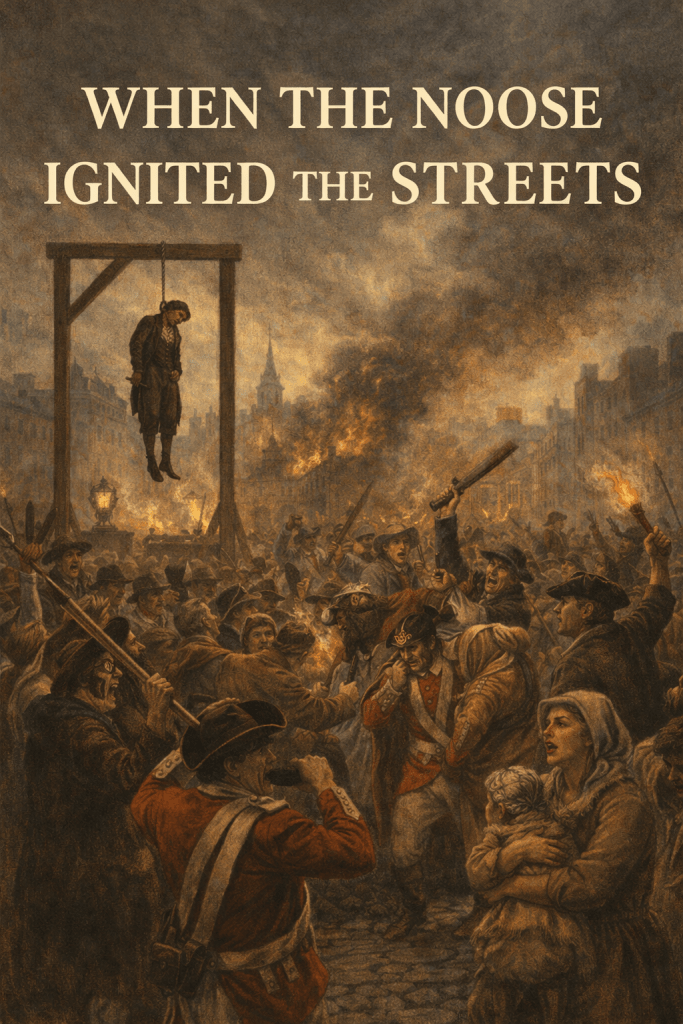
At Tyburn, unrest was frequent. Prisoners were carried from Newgate Prison in open carts, jolting through packed streets. The journey could take hours. Taverns along the way became stopping points, where the condemned might drink one last cup of ale. If the crowd sympathised, they cheered, sang, threw flowers, and treated the procession as an act of defiance rather than a march toward death.
When Jack Sheppard, the famous thief and prison escape artist, was taken to Tyburn in 1724, the streets were so crowded that movement nearly stopped. He was a folk hero, admired for his daring escapes and charm. His execution felt less like justice and more like betrayal, and the tension that day was thick enough to touch.
Riots often erupted when executions were mishandled. When ropes snapped. When the condemned struggled too long at the end of the noose. When executioners were drunk, careless, or cruel. A botched hanging stripped away any illusion of dignity. It reminded the crowd that this was not divine judgement but human violence, clumsy and flawed. Anger flared quickly when suffering was prolonged, especially when it felt unnecessary.
Sometimes the outrage was political. The execution of rebels and dissidents often drew crowds already heavy with resentment.
After the Jacobite uprisings, hangings became acts of warning, yet they frequently hardened resistance instead. The executed were mourned as martyrs, their names carried forward in songs and stories. Even earlier, the execution of figures like William Wallace, brutally put to death in 1305, lingered in cultural memory not as a triumph of authority, but as a symbol of resistance and injustice.
In 1760, the hanging of Laurence Shirley, the Earl Ferrers, at Tyburn drew enormous attention. He was a nobleman convicted of murdering his steward, and his execution shocked the public because it crossed class lines. That a peer of the realm could die on the gallows unsettled expectations. Crowds did not respond with awe at equality before the law. Instead, they watched with fascination and unease, sensing the theatrical nature of a system that usually spared the powerful.
In 1768, the execution of John Williams at Tyburn ignited one of the most violent disturbances ever seen there. Williams was accused of murder, but sympathy ran high. The crowd attacked officials, tore down the gallows, and fought soldiers sent in to restore order. What was meant to be a display of authority collapsed into chaos. The noose did not command obedience. It exposed how fragile authority became when confronted by collective fury.
There were quieter acts of rebellion too. Some crowds surged forward to rescue the condemned, rushing the scaffold in frantic attempts to cut them down. Others fought fiercely to claim the body after death. Burial mattered.
To be denied it, or handed over for dissection, was an additional punishment. Bodies were precious. They were not simply proof of justice carried out, but evidence of lives that deserved dignity, even at the end.
What made these moments so powerful was recognition. Many in the crowd saw themselves in the person about to die. They shared the same streets, the same hunger, the same precarious work, the same temptations. They knew how easily misfortune, desperation, or one poor decision could tip a life into criminality. The gallows did not feel distant. They felt frighteningly close.
Authorities responded as authorities often do, with force and retreat. Soldiers guarded executions. Scaffolds were relocated. Eventually, the solution was to remove the spectacle altogether. Executions were shifted behind prison walls. The lesson learned was not that the law was too harsh, but that it was too visible. Justice, it seemed, worked better when hidden.
The last public executions in Britain took place in 1868, outside Newgate Prison. By then, crowds were no longer seen as moral witnesses but as problems to be controlled. The ritual had failed too many times.
The theatre had backfired.
And yet, something vanished when the gallows disappeared from public view. Not the cruelty, but the confrontation. Public executions forced society to look directly at what punishment meant.
They made it impossible to pretend that the law was abstract or bloodless. When riots broke out, they revealed a truth the authorities struggled to accept. People were not simply afraid of the law. They were judging it.
Today, it is easy to dismiss those crowds as unruly or barbaric.
But often, they were responding to something deeply human. A refusal to accept suffering as entertainment. A belief, instinctive and fierce, that justice should feel just.
Those riots were moments when ordinary people spoke without speeches, when emotion spilled into action and filled the streets.
They remind us that history is shaped not only by laws passed in quiet rooms, but by collective feeling rising up, loud and uncontainable.
The gallows were meant to silence.
Instead, sometimes, they taught people how to shout.
Until next time,

Ta ta for now.

Yours, Lainey.
 Intwined