Long before radiators hummed and thermostats glowed with their quiet, obedient warmth, people faced winter as one faces an ancient, moody giant. Cold was not merely an inconvenience but a presence that pressed against the walls of every home, seeped through every crack and tested the ingenuity and resilience of all who lived beneath its reign. Yet somehow, through creativity, community and a deep intimacy with the changing seasons, people found ways not just to survive these wintry months, but to fill them with meaning, tenderness and unexpected beauty.
Survival began with the home itself. Families built their dwellings as though preparing for a long conversation with cold weather, knowing it would linger. Thick stone walls or sturdy timber frames formed the bones of these shelters, and thatched roofs were laid generously to keep warmth from slipping skyward. Once winter arrived, the house shrank lovingly inward. Windows were shuttered, gaps stuffed with moss or cloth, and heavy curtains were pulled across rooms like soft barriers. The world outside blustered and howled, but inside, people created small pockets of warmth where life continued to glow, where laughter clicked gently like firelit beads on a string.
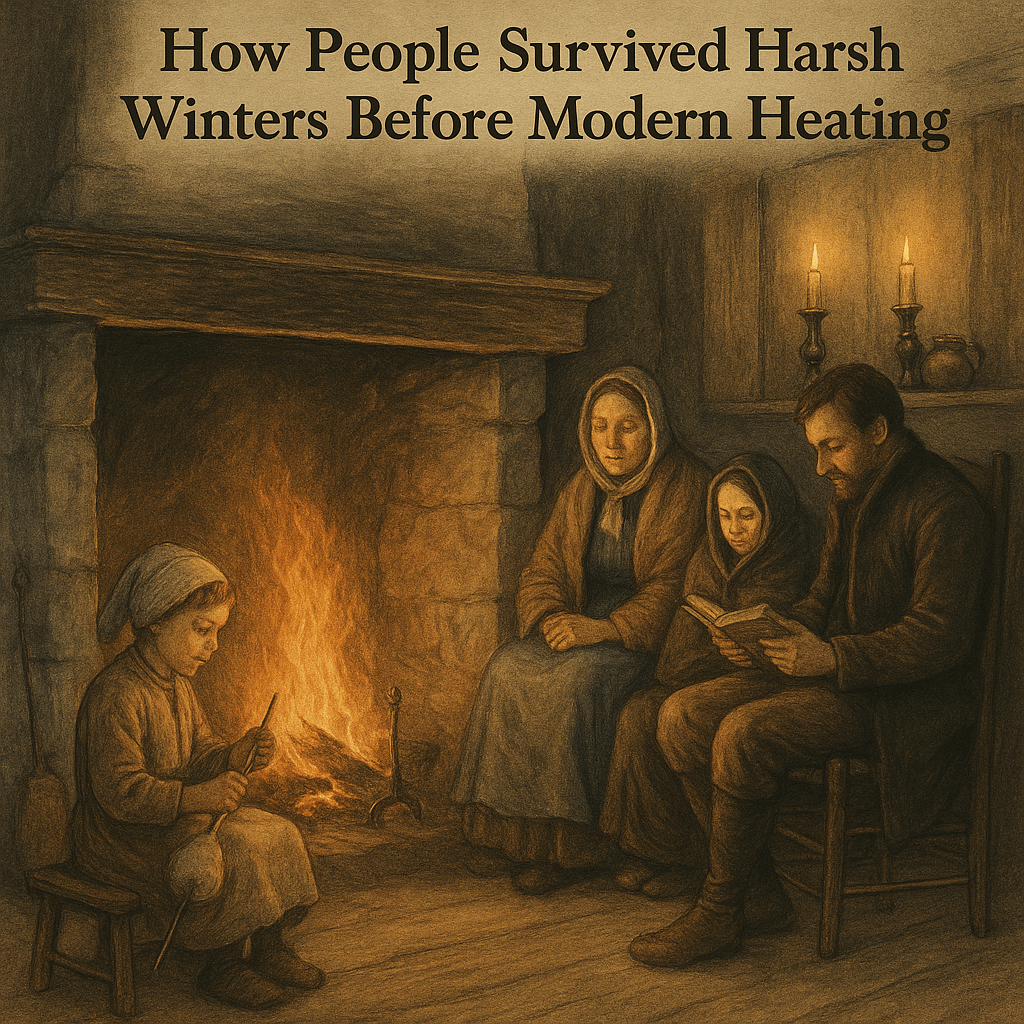
At the center of every home, from peasants’ cottages to elegant townhouses, stood the hearth. More than a mere source of heat, the hearth was the beating heart of winter life. Flames cracked and swayed as if performing a gentle dance, throwing golden light onto the walls and filling the air with the scent of burning wood. Families gathered close not only for warmth but for companionship. Meals simmered slowly over embers, clothes dried on wooden racks nearby and stories drifted lazily from one generation to the next. In the glow of fire, harsh winter softened into something communal, almost tender, its edges rounded by shared presence.
As time moved forward, stoves began to appear, cast-iron marvels in the 1700s and 1800s that promised more efficient heat and less smoke. These sturdy iron creatures radiated steady warmth, turning corners of the home into cherished havens where people would naturally gravitate. Families learned where warmth lingered best: near the stove’s glowing belly, behind a wind-blocking door or beneath quilts warmed earlier by the fire. Rooms were often shut off to conserve heat, transforming houses into snug labyrinths of warmth and shadow, each doorway a small transition between cold and comfort.
Clothing played its own important role in the quiet battle against winter’s chill. People dressed in layers upon layers: linen close to the skin, then wool, then fur or thickly woven cloaks. Mittens were knitted from sheep’s wool that still carried traces of lanolin, offering not just insulation but softness. Children slept in nightcaps, their breath puffing into the cold air of unheated bedrooms like tiny drifting clouds. Mornings were brisk negotiations with the cold, they scampered swiftly toward the hearth, chasing warmth the way kittens chase sunbeams, laughing breathlessly when they finally reached it.
Winter meals offered comfort and strength when the world outside felt sparse and unforgiving. Before modern refrigeration, food preservation was both an art and a necessity. Cellars held potatoes and apples slumbering in the dark. Crocks brimming with sauerkraut or pickled vegetables lined shelves. Cuts of meat rested in salt or hung in cool storage, waiting to flavor hearty stews. Kitchens became alchemical sanctuaries where cold-linked hunger was kept at bay through careful planning and the magic of slow-cooked nourishment. A warm meal was more than sustenance; it was a blessing, a small ritual of reassurance that flowed through the body like sunlight.
And yet, in those long months when daylight slipped quickly behind the hills, survival was not only about holding onto warmth, it was about holding onto spirit. Families spent evenings engaged in quiet comforts. Spinning wheels hummed in gentle rhythm. Needles clicked softly. Folk songs curled toward the rafters. Candles flickered like little indoor stars, their light a reminder that even in the darkest season, brightness could be coaxed from the smallest flame. These evenings stitched together a sense of stillness and belonging, moments where the world felt content to wait, and so too did the people within it.
Communities, too, played a vital role. Neighbors shared firewood, mended roofs together after a heavy snowfall or took in those who had fallen upon hard times. Winter reminded people that survival was rarely a solitary undertaking. These bonds, shaped partly by necessity and partly by love, gave winter its own gentle warmth. Even amid storms, there was a sense of shared endurance, a collective heartbeat beneath the snow. A knock at the door often meant an offer, not a request: “We had extra,” or “Let me help,” or simply, “You shouldn’t face this cold alone.”
And above all else, people embraced winter as a season of rhythm. They accepted its challenges as part of the natural cycle, trusting that spring would return as surely as it always had. Winter was a teacher, stern yet poetic, inviting patience, creativity and stillness. It asked people to slow down, to listen to the crackling fire, to savor simple joys and to notice the small, delicate beauties that only winter reveals: frost etching lace on windowpanes, moonlight resting on snow like a silver sigh, the hush that settles over a world blanketed in white.
So, long before the hum of modern heating, people survived harsh winters with ingenuity, layered clothing, glowing hearths and hearts warmed by one another. They lived in close conversation with the season, finding poetry in the frost on windowpanes and romance in the shared closeness of family around a fire. Winter shaped them, challenged them and, in many ways, strengthened their capacity for tenderness. For in a world without modern warmth, the brightest heat was often found in human connection itself, a quiet flame that refused to be extinguished, no matter how fiercely the cold prowled outside.
Until next time,
Toodle pip,
Yours Lainey.
 Intwined