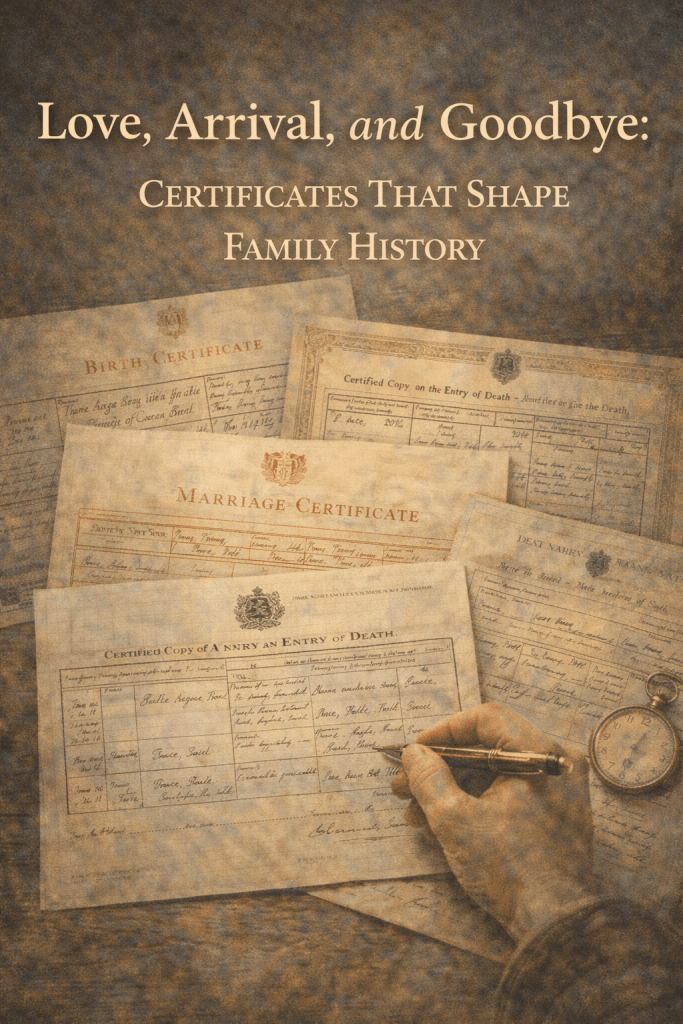
There is a particular weight to a certificate that no index or transcript can ever quite carry. It is not heavy in the hand, yet it holds the gravity of a moment when a life was formally acknowledged by the world.
A birth declared.
A marriage promised.
A death quietly recorded.
These documents are not merely pieces of evidence. They are acts of recognition, moments when an ordinary life brushed briefly against authority and was written into permanence.
For family historians, especially those researching within the United Kingdom, the purchase of a birth, marriage, or death certificate is often the moment when research begins to feel undeniably real. Names step out of search results and into rooms, streets, and occupations. Ink replaces speculation. Paper replaces guesswork. What once felt like a distant outline gains texture and warmth.
In England and Wales, civil registration began in 1837, quietly reshaping how lives were recorded. Before this date, families arrived, married, and departed within the watchful care of the parish. After it, the state began to mark the milestones of ordinary people with official formality. Understanding this system matters deeply, because certificates do not exist in isolation. They belong to a structure, and learning that structure allows a researcher to move forward with confidence rather than hope alone.
A birth certificate does far more than announce a child’s arrival. It places that child within a household and a moment in time. It names a mother, often restoring a maiden name that would otherwise disappear behind marriage and motherhood. It may name a father, or it may leave that space blank, a silence that speaks with its own quiet force. An address situates a family within a neighbourhood and a class, while an occupation hints at the rhythm of daily life. Even the informant matters. Was it the mother herself, a father, a midwife, a relative, or an institution. Each choice reveals something about who was present, who was trusted, and how that first fragile moment unfolded.
Marriage certificates often become the emotional and practical heart of family history research. They draw two families together and offer one of the rare opportunities to step back another generation with certainty. Fathers are named. Occupations recorded. Residences noted. Witnesses sign their names or make their marks, often siblings, cousins, or close friends whose presence confirms relationships that census records only suggest. A single marriage certificate can untangle years of confusion, particularly where names repeat across generations or families drift between counties, cities, and circumstances.
Death certificates bring a different kind of understanding. They close a chapter, but they also raise questions. An age at death may challenge what you thought you knew. A cause of death may hint at dangerous work, epidemic disease, childbirth, or years of quiet illness. The informant may be a grieving spouse, an adult child, a neighbour, or an institution, each one revealing something about how and where a life ended. Death certificates must be read gently. They are not always precise, but they are always human.
In England and Wales, most researchers begin purchasing certificates through the General Register Office. Its indexes allow births, marriages, and deaths to be searched with increasing clarity as the decades pass. Learning to read these indexes carefully, noting registration districts, volumes, and page numbers, transforms ordering from guesswork into intention. Local register offices also play an important role, sometimes offering faster service or deeper local knowledge. Choosing where to order from becomes part of the research itself.
Cost is an unavoidable consideration, and it deserves honesty rather than discomfort. As of now, a standard birth, marriage, or death certificate ordered from the General Register Office in England costs eleven pounds. For some births and deaths, a digital PDF version is available for seven pounds, offering a more affordable option when suitable. Certificates are investments, not souvenirs. Their value lies not in quantity, but in purpose. A single well chosen certificate can answer multiple questions, while ordering too many too quickly can cloud rather than clarify. Thoughtful researchers learn to pause, to extract everything possible from indexes, census records, parish registers, and newspapers before committing to purchase. This is not hesitation. It is respect.
It is also important to remember that a certificate is never the end of a story. It is an anchor. From a birth certificate, paths may open toward baptism records, school admissions, census returns, or apprenticeship papers. A marriage certificate may lead you into parish registers, newspaper announcements, or probate files. A death certificate can guide you toward burial registers, memorial inscriptions, coroner’s inquests, or poor law records. Certificates steady the research, allowing imagination and investigation to walk hand in hand.
The emotional weight of receiving a certificate should never be underestimated. Opening an envelope to find a familiar street name, an occupation that explains long held family stories, or a cause of death that reframes an ancestor’s life can be unexpectedly moving. Sometimes joy waits there. Sometimes sorrow. Both belong. Family history is not neutral work. It is an act of empathy across time.
Beyond England and Wales, the experience changes, but the feeling remains. Scottish civil registration records are famously rich, often naming both parents on birth and death records and offering detail that feels astonishingly generous. Irish certificates carry the weight of survival, shaped by loss, fire, and fragmentation, yet what remains is deeply precious. In Australia, Canada, New Zealand, and the United States, civil records echo British traditions while adapting to new landscapes and histories. Learning these differences becomes part of understanding the journeys families made and the lives they rebuilt.
What unites all certificates, wherever they are found, is their purpose. Someone once stood before an official and said this child was born, this couple was married, this life has ended.
By purchasing these records today, we honour those moments. We acknowledge that these lives mattered enough to be written down, and that they still matter enough to be read.
Certificates do not shout.
They do not embellish.
They tell the truth as it was known at the time, shaped by memory, grief, pride, and circumstance.
And in that quiet honesty, they offer family historians something rare and steady.
They offer connection, certainty, and the deep comfort of knowing that the past has not entirely slipped away.
Until next time,

Ta ta for now.

Yours, Lainey.
 Intwined