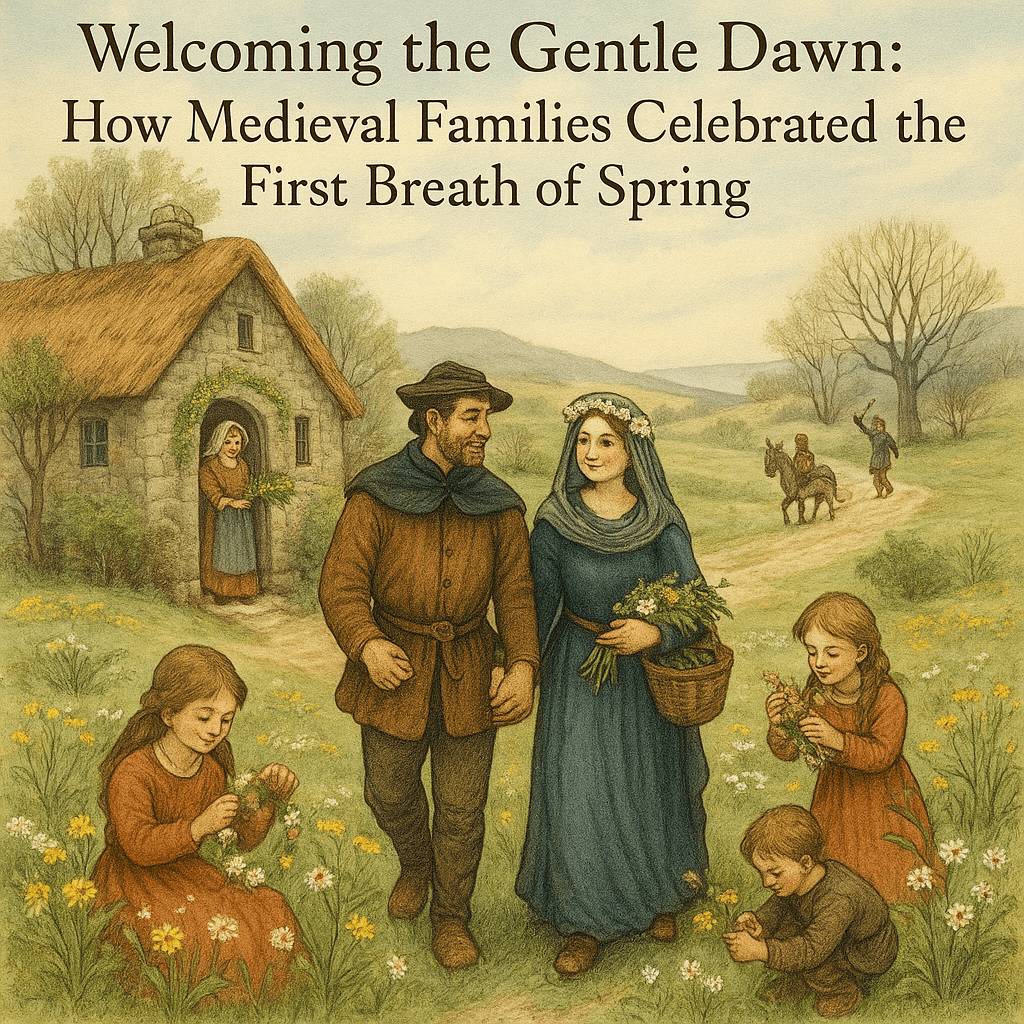
When the first tender signs of spring crept toward the medieval world, they arrived not with trumpets or fanfare, but with the gentlest transformations: a softness in the wind, a brightening of the morning sky, a trickle of melted snow singing through the fields. For medieval families who had weathered long months of cold, hunger and dim candlelit evenings, these earliest hints were nothing short of miraculous. Spring came quietly, yet its quietness carried the weight of renewed life, like a whispered promise finally fulfilled.
After the deep rest of winter, people looked eagerly for subtle changes, training their eyes to catch even the smallest shift. The soil thawed with a sigh, its frozen grip releasing like a hand unclenching, and families walked the edges of their fields, pressing their boots into the softening ground as though greeting an old friend just returned from a long journey. They watched for the first brave shoots of green, sometimes tiny curls of wild herbs like sorrel, chickweed or dandelion, which poked up long before cultivated crops dared to rise. These humble plants were treasured not just for their flavor after months of preserved foods, but for what they symbolized: the earth stirring awake beneath its chilly blanket.
With the lengthening of daylight came a flurry of chores that felt lighter than winter’s burdens. Tools that had rested all season were brought out from storage, cleaned, sharpened and set beside the fields in quiet anticipation, almost like companions waiting for their cue. The rhythm of winter, slow, fire-centered, inward, shifted to a lively pulse. Medieval households swept out the soot and dust that had gathered during the cold months, letting fresh breezes glide through open shutters. Beds were aired, floors scrubbed and tapestries beaten free of winter’s heaviness. It was not simply cleaning; it was a ritual of renewal, a domestic celebration, a way of preparing the home to welcome the season of growth with open arms and fresh scents.
Food changed too, slowly but joyfully. After months of salted meats, dried peas and stored root vegetables, the smallest fresh offering felt like treasure. Families gathered early wild greens for pottages and broths, delighting in their tart brightness, a taste that seemed to sing of warmer days ahead. Eggs, scarce in winter when hens hardly laid, became abundant again. A pot of custard or a simple dish of eggs boiled with herbs could transform an ordinary day into a quiet feast. Milk flowed more freely as livestock found new grasses, and butter churned in spring held a brightness that winter butter never could. Children tasted the new season with wide-eyed wonder, savoring each fresh bite as though spring itself had settled on their tongues.
Rituals emerged across regions to honor the turning of winter into spring. In many villages, people walked the boundaries of fields and meadows, singing or offering blessings to the sleeping earth. Some placed sprigs of early greenery over doorways to invite good fortune inside, while others lit small fires or carried embers through their homes, symbolically chasing winter’s chill from every corner. The church bell tolled with renewed warmth, calling communities together to acknowledge the season’s promise with prayers of thanks and songs that felt lighter on the tongue.
Young people often took part in charming customs. They gathered flowers, sometimes carefully preserved from the last autumn, sometimes new blooms coaxed from sheltered corners, and wove them into garlands. These were carried through villages or hung in homes, brightening spaces still touched by winter’s gray. Children played in thawing fields, splashing through puddles that sparkled in the returning sunlight, their laughter rising like birdsong, as though their voices themselves were part of spring’s arrival.
And always, large or small, there were celebrations. Some were simple gatherings around the hearth, where families spoke of the planting to come and planned their work with hopeful hearts. Others were community feasts, where last stores were shared with joyful caution, as if saying to one another, “We made it through.” Villages might crown a young girl with early blossoms as a living symbol of spring, or dance in open meadows where the earth’s scent was sweetening day by day. Musicians brought out lutes, pipes or drums, and their playful tunes echoed across hills still streaked with patches of snow.
Even the animals joined in the season’s awakening. Lambs stumbled across fields on uncertain legs, calves nudged their mothers for milk and chickens clucked with sudden vigor after the stillness of winter. Medieval families welcomed these signs with relief, animals represented sustenance, stability and the promise of a thriving year. Their renewed energy mirrored the renewed spirits of the people who cared for them, as though all life, human and animal alike, breathed a collective sigh of relief.
As daylight stretched into the evenings, people lingered outside longer, absorbing the warmth on their skin and listening to the softened song of the landscape. The world felt gentler, more forgiving, washed clean of winter’s severity. The hardships of the cold months softened into memory, replaced by a cautious but determined joy. Spring was not guaranteed to be easy, medieval life never was, but it was a gift, a reprieve, a rekindling. And people embraced it with a gratitude that felt woven into the land itself.
In this way, medieval families greeted spring not as a single moment but as a gradual unfolding, like petals opening to sunlight. It was a season of small miracles and shared wonder, of chores renewed and spirits lifted, of rituals that stitched together the bonds between earth and home. Each fresh blade of grass, each egg collected, each laugh carried on the warming wind reminded them that life, after all its slumbering, had returned.
And so they welcomed spring with open hands and hopeful hearts, honoring the ancient cycle that turned the world from darkness to light, from quiet endurance to joyful beginnings once more.
Until next time,
Toodle pip,
Yours Lainey.
(Lyrics written by me, Music is AI generated.)
🌷🌷🌷
 Intwined