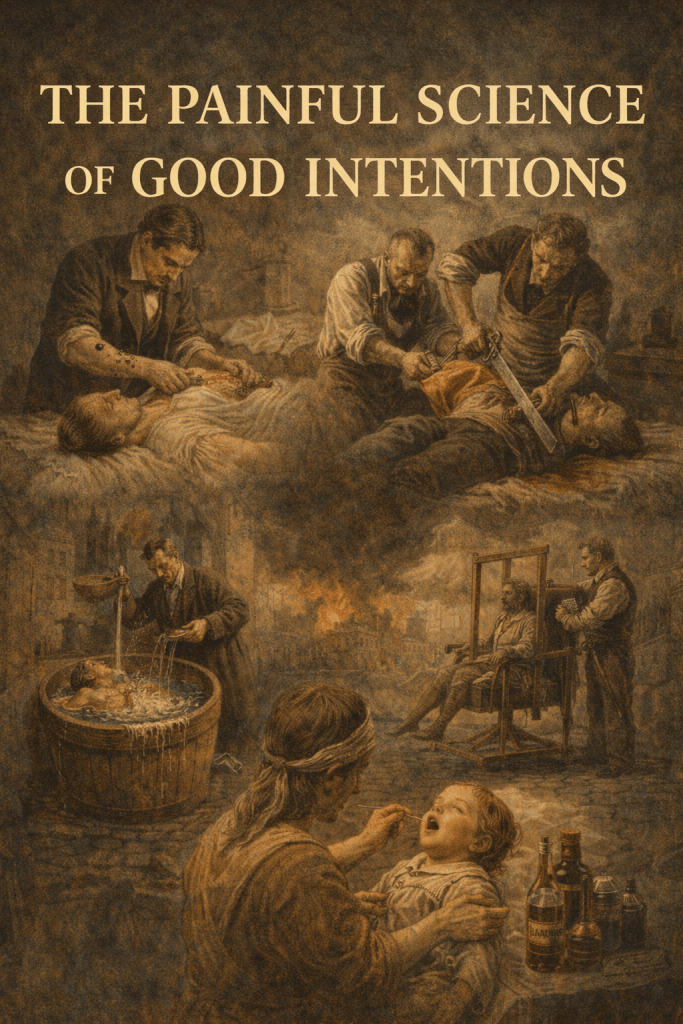
There is a comforting belief that medicine always moves forward in a clean, orderly line, that each generation knows more than the last and leaves nothing behind except ignorance and error.
It is a soothing thought, and an understandable one.
Yet history is far gentler and stranger than that.
Britain’s medical past is crowded with treatments once offered in good faith, administered with confidence, and later quietly abandoned. Some were painful, some frightening, some quietly devastating. Many were born not of cruelty, but of hope. And hope, that most tender and treacherous of forces, can heal just as easily as it can mislead.
Before antibiotics, before anaesthetics, before microscopes revealed the invisible world of bacteria and viruses, medicine relied on theory, tradition, and observation filtered through fear. Illness was mysterious. Pain was normalised. Death was familiar, present in every household sooner or later. Doctors worked with what they had, and what they had was often a fragile mixture of inherited wisdom, ancient texts, and educated guesswork wrapped in authority.
Bloodletting lingered in Britain for centuries, long after doubts had begun to murmur at the edges of medical thinking. It was elegant in its simplicity. Illness, according to humoral theory, came from imbalance. Too much blood, too much heat, too much vitality turned against itself. Remove blood, restore harmony. Leeches were applied with care and almost tenderness, their use governed by charts, seasons, and the nature of the complaint. Patients often reported feeling lighter afterward, calmer, even improved. That sensation of relief reinforced belief, though it often came not from healing, but from rest, attention, or the simple passage of time. When bloodletting went wrong, as it often did, weakness, fainting, infection, and death could follow. Excessive bleeding left patients dangerously depleted, their bodies unable to fight the very illness they were meant to overcome. When the practice finally faded, it did so not in scandal, but in quiet embarrassment, slipping gently into the shadows of medical history.
Then there were purges and emetics, treatments that answered suffering with more suffering. Vomiting, diarrhoea, and sweating were encouraged and praised as signs that the body was expelling disease. Medicines containing antimony, mercury, or powerful plant extracts forced the body into violent response. Patients were congratulated for endurance. Children were subjected to these treatments too, their small bodies assumed to be resilient enough to survive what adults sometimes could not.
Dehydration, electrolyte imbalance, and organ damage were common, though poorly understood. We forget how often medicine once asked patients to be brave not just against illness, but against the cure itself.
Mental illness reveals, perhaps more than any other field, how deeply medicine can be shaped by fear and misunderstanding.
In Britain’s asylums, treatments were often designed to control behaviour rather than to heal minds. Cold water baths plunged patients into shock, believed to quiet agitation or reset disordered thoughts. Prolonged immersion could lead to hypothermia, exhaustion, and terror. Rotational chairs spun bodies at speed until nausea, dizziness, and confusion overwhelmed the senses, the idea being that the mind could be shaken back into order through physical force. Restraints, isolation, and enforced silence were also prescribed as therapeutic. Many physicians truly believed they were restoring balance and calm, doing their best in a world starved of answers. Yet the suffering they caused lingers in the historical record like a bruise that never quite fades.
Early surgery offers one of the most haunting chapters of all.
Before effective anaesthesia, operations were swift and brutal by necessity. Speed was not merely admired, it was essential. A skilled surgeon was one who could amputate a limb in minutes, sometimes seconds. Patients were held down by assistants, given alcohol, opium, or leather to bite, and told to endure. Shock from pain could be fatal.
Infection was common, almost expected. Pus was once considered a healthy sign of healing. Survival depended as much on luck as on skill. When anaesthesia arrived in Britain in the mid nineteenth century, it was greeted with awe and suspicion in equal measure. Some argued pain was morally necessary, even divinely ordained. Others feared unconsciousness itself. Ether and chloroform brought their own dangers, including respiratory failure and sudden death, yet they transformed medicine forever. Forgetting how much pain once filled hospital wards is itself a kind of mercy.
There were treatments that promised modernity and delivered harm. Early X rays were celebrated as miracles, windows into the living body. They were used freely, often repeatedly, without shielding or restraint.
Doctors tested machines on themselves. Patients stood exposed for long periods. Burns, hair loss, chronic ulcers, and later cancers followed before the dangers of radiation were understood. The glow of progress blinded people to risk, and once again, knowledge arrived too late for some.
Children were especially vulnerable to forgotten medicine. Soothing syrups and tonics were sold openly for coughs, teething, fretfulness, and sleep. Many were laced with alcohol, laudanum, morphine, or other opiates. They worked swiftly and effectively, quieting pain and distress. That effectiveness masked the danger. Dependence crept in silently. Overdoses were tragically common.
By the time regulation arrived, countless families had trusted remedies that soothed children into dangerous stillness.
What makes these treatments hardest to face is how ordinary they were. They unfolded in clean rooms and crowded wards, in parlours and institutions, administered by people who believed they were helping. There were no villains in white coats, no theatrical cruelty. There were men and women doing what their training, textbooks, and mentors told them was right, guided by tradition, authority, and the aching desire to do something rather than nothing.
Britain did not forget these treatments because they were shocking. It forgot them because they were sincere. They unsettle the comforting belief that progress is inevitable and always kind. They whisper a warning about certainty, about confidence untempered by humility.
Yet there is tenderness here too. Within these abandoned practices lies the long, stubborn human effort to ease suffering. Each forgotten treatment represents a lesson learned at a cost. Each quiet disappearance from medical teaching marks a moment when medicine chose to change, to admit uncertainty, to do better next time.
Modern hospitals are gentler places because of these missteps. Pain is anticipated and managed. Consent is respected. Evidence is demanded. None of this arrived fully formed. It was built slowly and imperfectly by people who made mistakes and lived long enough to question them.
To remember Britain’s forgotten medical treatments is not to mock the past. It is to honour the courage of patients who endured, the doctors who learned, and the fragile, hopeful belief that tomorrow’s knowledge will be kinder than today’s. History does not ask us to judge. It asks us to remember softly, so that forgetting does not make us careless again.
Until next time,

Ta ta for now.

Yours, Lainey.
(lyrics written by me. Music is AI generated.)
🦋🦋🦋
 Intwined