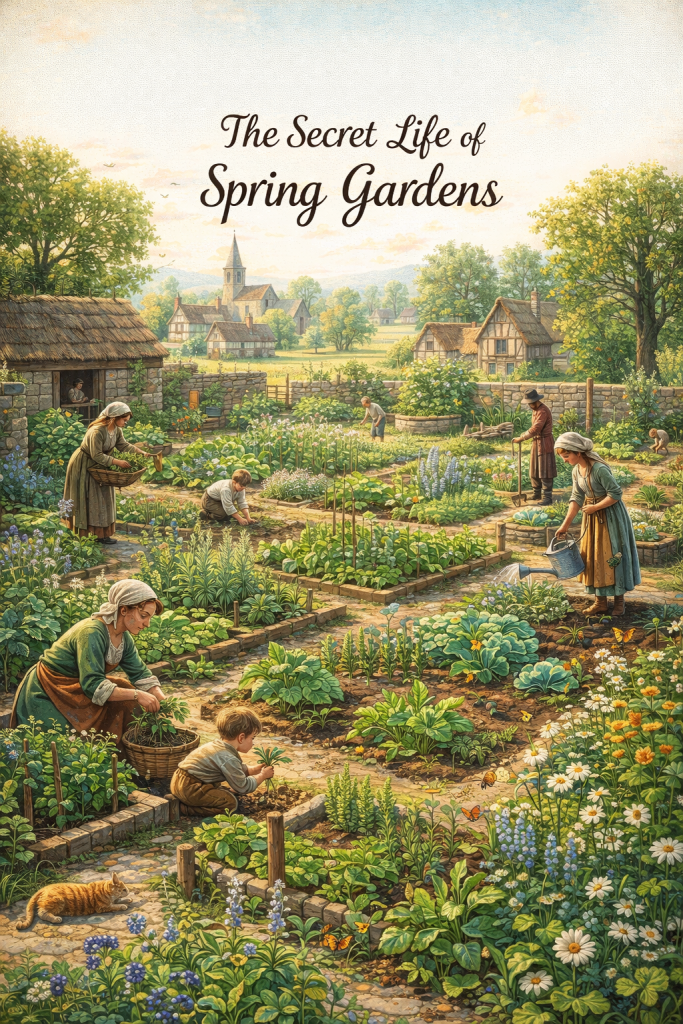
The story of spring gardens across centuries is a tale written quietly in the soil, whispered from one generation of growers to the next. Before the hum of machines or the convenience of modern tools, people tended the earth with nothing more than their hands, simple implements and a deep, almost tender understanding of the land’s rhythms. Their spring gardens were not just places of labor, but sanctuaries of hope, nourishment and quiet devotion.
When early spring arrived, the world softened like candle wax beneath a gentle flame. Medieval families stepped into their garden plots with careful reverence, feeling the thawed earth crumble between their fingers. These gardens were often nestled close to the home, protected by small stone walls or hedges that kept precious plants safe from wandering animals. Inside these boundaries lay the heart of daily life: herb beds fragrant with rosemary, sage and thyme; rows of onions and leeks preserved through winter; tiny plots ready for beans, peas and leafy greens. Monastic gardeners tended even grander spaces, walled cloisters where herbs for healing and prayer grew in fragrant harmony, their paths walked by sandaled feet and contemplative minds.
The tools were simple: wooden dibbers for making holes in ready soil, spades shaped by blacksmiths, baskets woven from willow branches. But growers wielded more than tools, they wielded wisdom. They knew when to plant by watching the sky, the budding branches and the arrival of certain birds. The moon’s phases were consulted, its pull upon the world believed to guide seeds toward their best beginnings. Everything grew in a relationship of patience and attention, a dance between human hands and the earth’s slow but generous gifts. A gardener could tell by the smell of soil whether it was ready or by the feel of a breeze whether frost lurked in the night ahead.
As centuries turned, colonial families carried this ancient knowledge with them across oceans. In the New World, spring gardens became lifelines. Settlers planted kitchen gardens close to their cabins, places bursting with promise. Here grew beans that climbed toward the sun, squash vines curling across warm soil, lettuces growing tender and crisp in the gentle light. Medicinal herbs, yarrow, chamomile, mint, were tucked carefully along the edges, ready to soothe fevers, settle stomachs or flavor stews. These gardens were stitched from memory and necessity: a patch of Europe here, a trace of Indigenous wisdom there, all meeting in the humble space of a small plot of earth.
Even in these rugged settlements, gardening held a certain poetry. Families saved seeds from the previous year, tucking them into pouches or little wooden drawers through winter’s silence. When spring returned, these saved seeds became a bridge from past to future. Planting them was not merely the beginning of a new season, but a continuation of a lineage of care. Each seed held a memory, of a summer long gone, of weather survived, of meals shared, while each sprout held a promise yet to unfold.
The work was constant, but it was filled with quiet joy. Early mornings found gardeners stepping into dew-dappled air, their breaths rising like mist as they knelt beside young shoots. They watered with buckets drawn from shallow wells or nearby streams. They weeded with patient fingers, clearing the way for tender seedlings to thrive. Children, eager to help, carried handfuls of compost or gathered herbs for supper, learning the language of the garden long before they could read a written word. They memorized the shapes of leaves, the scents of roots, the feel of soil, skills passed on not through parchment but through living, daily touch.
And always, spring brought its little celebrations. The first peas plucked from the vine tasted brighter than any feast. The scent of fresh mint crushed between fingertips announced that winter had truly passed. Families shared vegetables with neighbors, creating a web of friendship rooted in the soil. Even pruning fruit trees, though hardly glamorous, felt like an act of affection, an offering of shape and care that would result in apples or plums months later.
Gardening in centuries past was also shaped by necessity, resourcefulness and deep observation. Soil was fed with ash from hearth fires, manure from the barn and scraps from the kitchen. Companion planting, placing certain plants together to improve growth, was practiced long before it had a name. Calendulas gleamed golden beside cabbages, their sunny petals gently distracting pests, while beans curled around cornstalks in supportive, leafy companionship. Each garden was its own small, bustling ecosystem, shaped, tended and cherished by human hands.
But perhaps the most magical part of these spring gardens was how alive they felt. They buzzed softly with bees beside blooming herbs. They rustled as breezes passed through rows of young greens. They offered their own subtle music: the drip of water from a wooden ladle, the whisper of leaves brushing against one another, the soft thud of a basket filling with early harvest. They taught patience, humility and wonder. And every growing season, no matter how many times a gardener had turned the soil, the miracle of new sprouting life never lost its enchantment.
As spring unfolded year after year, these gardens became quiet diaries of human resilience. Medieval herb gardens fed and healed whole households. Colonial kitchen plots sustained families through hardships and celebrated their triumphs. Across both eras and landscapes, the earth remained a faithful partner, offering its bounty in exchange for care and understanding.
And though the world has changed in ways those early gardeners could never have imagined, the essence of spring planting remains the same. It is still an act of hope whispered into the ground. It is still a communion with nature’s cycles. It is still a story written in green shoots, fragrant blossoms and the steady hum of life returning after winter.
The secret life of spring gardens, in every century, is that they are not merely places where food grows, they are places where people grow too. Steadier, humbler, more patient, more connected to the gentle turning of the seasons and the quiet miracle of life awakening in the soil.
Until next time,
Toodle pip,
Yours Lainey.
Lyrics were written by me
but the music and vocals were AI generated.
🌷🌷🌷
 Intwined