There comes a moment in almost every family history journey when the free paths begin to narrow. The easy discoveries have been gathered. The familiar names have been traced through census pages and parish registers. And then, suddenly, the past seems to hover just beyond reach, close enough to feel but resting behind subscription screens and polite requests for payment. It is a moment filled with hesitation and hope, and often with a small, late night question whispered into the glow of a screen.
Is this worth it?
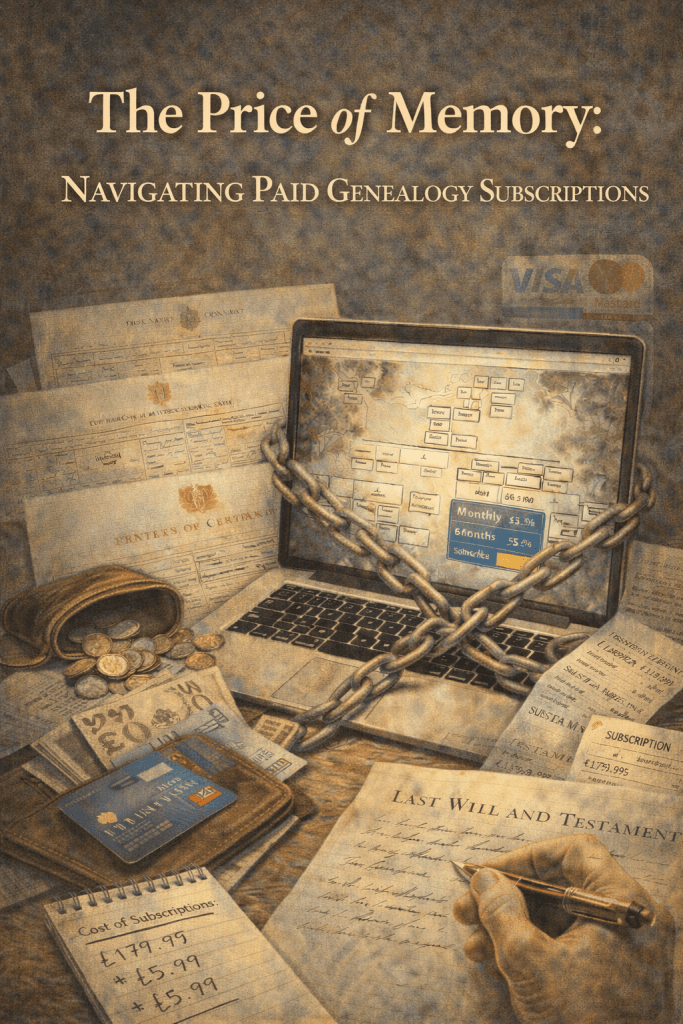
Paid genealogy subscriptions can feel like a gate closing just as curiosity deepens. They can stir discomfort, frustration, even guilt, as though history itself has been given a price tag. Yet they also represent years of careful labour, preservation, digitisation, and stewardship. Every scanned parish register, every indexed census page, every searchable military roll or passenger list exists because someone lifted it from dust, decay, or quiet neglect. Subscriptions, at their best, are not tolls demanded by history. They are contributions to the work of remembering.
Within the United Kingdom, paid subscriptions often reveal their greatest value once research moves beyond the foundations. Census images in full colour and context, parish registers gathered county by county, nonconformist records that catch those who lived outside the established church, probate collections, military service files, electoral rolls, school records, and trade directories are frequently brought together on subscription platforms in ways that allow patterns to emerge. These services offer not only access, but cohesion, pulling fragments into something that begins to resemble a life rather than a list of facts.
Yet no subscription is complete, and no single platform holds every parish, every register, or every story. Some services excel in England and Wales, others shine when research crosses into Scotland or Ireland.
Many truly come into their own when families leave British shores and reappear in Canada, Australia, New Zealand, South Africa, or the United States. Choosing a subscription is rarely about finding the best one in any absolute sense. It is about choosing the right one for the question you are asking right now.
It is easy to fall into the comforting belief that paying guarantees truth.
It does not.
A subscription opens doors, but it does not walk the path for you. Transcriptions can contain errors.
Indexes can mislead.
Names can be conflated.
Online family trees, however confidently constructed, still require evidence and verification.
Paid access replaces neither careful reading nor thoughtful comparison. It simply broadens the room in which those skills are exercised.
There is one cost in genealogy that remains unavoidable and essential, and that is the purchase of birth, marriage, and death certificates. However expensive they may feel, and they often do, these documents remain the strongest anchors available to family historians.
Subscriptions may guide us toward possibilities, but certificates confirm reality. They name parents, places, occupations, and relationships with an authority no index can match. They ground research in lived truth. They are not indulgences or optional extras.
They are the backbone of responsible family history!!!
For this reason, paid subscriptions should never replace certificates. They should serve them. A subscription is at its most powerful when it helps narrow uncertainty and clarify which certificate to order and why. Used thoughtfully, paid access can save money rather than drain it, reducing guesswork and preventing the purchase of unnecessary documents. Restraint, in this sense, becomes an act of respect for both history and resources.
One of the quiet truths of paid genealogy is that time matters just as much as money. A short subscription, entered with purpose, can yield more than a long one approached without direction. Sitting down with a clear question, a known family group, and a defined plan transforms paid access into a focused tool rather than an endless temptation. When the subscription ends, the research continues, strengthened by what has been learned rather than distracted by what was merely available.
There is also an emotional weight that comes with paying for access to the past. When money is spent, expectations rise. We hope for breakthroughs, revelations, lost connections rediscovered. Sometimes those moments arrive with breathtaking clarity. Other times, the value lies in ruling out possibilities, in confirming that a cherished story was only a story, or that a silence truly exists where records should be. These outcomes are not disappointments. They are part of honest research, and often bring a deeper understanding than easy answers ever could.
Paid subscriptions work best when they stand alongside free resources, local archives, libraries, and record offices. They do not replace the parish chest, the county archive, or the patient assistance of local historians. They complement them, offering reach when travel is impossible and time is limited. The strongest genealogies are built from many strands, paid and free, digital and physical, woven together with care and humility.
It is also important to acknowledge that not everyone can afford paid subscriptions.
Access to history, like access to education, is shaped by circumstance as much as by curiosity. Libraries that offer free access to subscription platforms perform a quiet act of generosity, opening doors that might otherwise remain closed. Sharing research responsibly, citing sources carefully, and supporting open access projects helps ensure that knowledge does not remain locked behind individual accounts.
In the end, paid genealogy subscriptions are neither heroes nor villains. They are tools. Their worth lies not in their price, but in how they are used.
They should support thoughtful research, not replace it.
They should serve evidence, not override it.
And they should always lead us back to the simple truth that family history is not about owning records.
It is about understanding lives.
We pay not because the past belongs to companies, but because remembering requires care.
And when used wisely, subscriptions become one more way we honour those who lived quietly before us, leaving just enough behind to be found.
Until next time,

Ta ta for now.

Yours, Lainey.
 Intwined