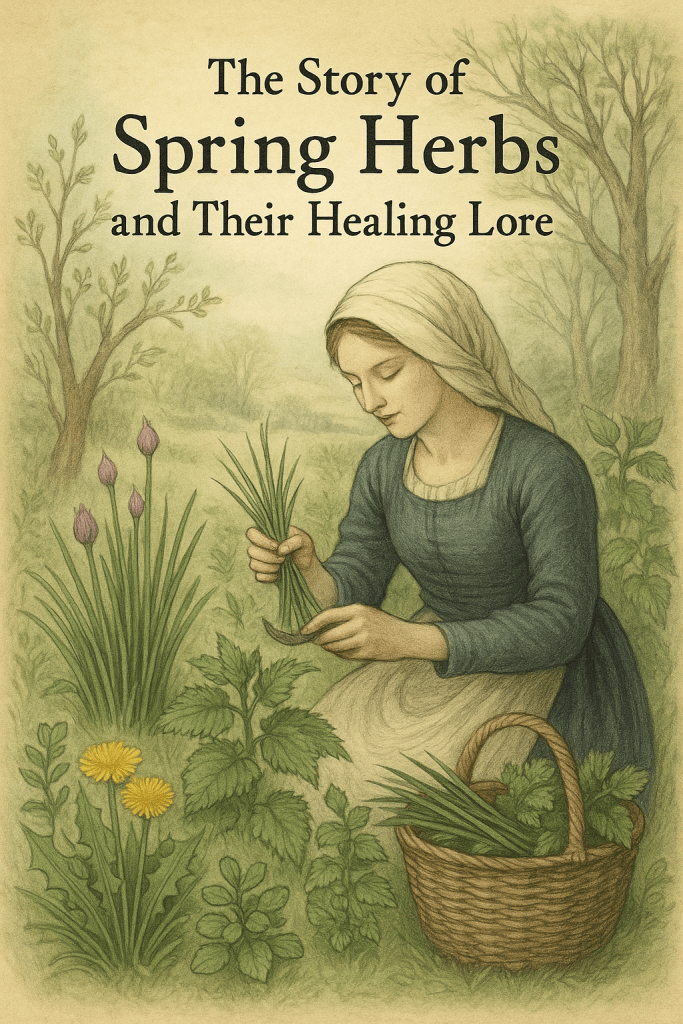
In the earliest days of spring, when the earth stirs softly from its winter dreaming, the first herbs rise like tender messengers between seasons. Medieval folk, villagers of the early modern world and colonial settlers alike watched for these brave little greens with a mixture of gratitude, reverence and relief. After months of dried roots and salted stores, the sight of fresh herbs, bright, fragrant and rich with healing lore, felt almost miraculous. They were, in many ways, the very heartbeat of spring.
Chives were among the first to wake. Their slender, hollow stalks pierced the soil like emerald quills, writing the season’s first chapter in strokes of green. In medieval herb gardens, chives were treasured not only for their gentle onion flavor, perfect for early spring pottages and cheeses, but for the protective magic they were believed to carry. Hung over doorways or planted near the threshold, they were thought to guard the home from misfortune. In the kitchen, they offered the comfort of mild heat, a bright contrast to the heavy foods of winter. A handful stirred into butter or broth announced that spring had truly arrived, its flavor a tiny trumpet in a season that preferred to whisper.
Nettle, fierce in appearance yet generous in spirit, unfurled its serrated leaves soon after. Though it stung unwary hands, those who understood its nature greeted it like an old friend. Throughout the medieval and early modern world, nettle was celebrated as a cleanser, a plant that swept away winter’s sluggishness. Rich in minerals, it brewed into a vivid green tonic that strengthened weary bodies. It was cooked into soups, turned into simple teas and used as a spring medicine to rouse blood and spirit. Healers spoke of nettle with respect, for it offered resilience in a season of renewal. Even its sting was said to coax warmth into aching limbs, a folk remedy that seemed to echo the plant’s own bold personality.
Dandelion, sunny-hearted and persistent, arrived with a brilliance that seemed to laugh at the lingering cold. Medieval herbalists saw it as a gift for both body and soul. Its leaves, slightly bitter but deeply nourishing, appeared in early salads and cleansing brews meant to wake digestion and brighten mood. Its golden flowers found their way into syrups and wines, capturing sunlight in a bottle. Its deep-reaching roots were dried and brewed to ease melancholy and strengthen the liver. The entire plant was valued, from bloom to root, each part offering its own kind of renewal. To see the first dandelions scattered across a meadow was to witness the earth smiling again after months of silence.
Mint, with its cool, invigorating scent, emerged as the season settled into its softness. Medieval gardens often kept mint close to walkways so its fragrance would lift as people passed. In cooking, it brought brightness to early lamb stews and fresh cheeses. In medicine, it calmed troubled stomachs, soothed headaches and cleared the breath during long spring chores. Spiritually, mint was used to purify spaces, tucked into washing water or burned in small bundles to refresh rooms that had been shuttered tight through winter. Its presence in the garden was a whisper of vitality, a reminder that freshness and clarity could be coaxed from the earth with patience.
As spring herbs emerged, so too did the rituals surrounding them. Women gathered the first greens with quiet ceremony, often choosing dawn as their companion. Dew was considered a blessing, enhancing the plants’ healing power, and so herbs plucked in early morning carried droplets of magic. These gatherings were both practical and spiritual: baskets filled with nourishment and medicine, hands filled with the energy of the waking season. In many villages, the first herbs were shared with neighbors, an unspoken promise of mutual care after winter’s hardships, an early-season kindness as dependable as the turning of the year.
Cooking with these herbs offered its own quiet poetry. A pot simmering with nettle and barley. Butter whipped with chives until it gleamed pale green. Mint leaves steeping in a simple clay cup. Early salads of dandelion greens dressed with nothing more than vinegar, salt and hope. These foods were humble, yet they nourished in ways deeper than hunger. They brought brightness back to the table, color back to the day, and a sense of renewal back into winter-tired bodies. They reminded families that the world was waking up and they could, too.
Herbs carried stories as much as they carried nutrients. Chives told of protection. Nettle of strength. Dandelion of resilience. Mint of clarity and cleansing. Together, they formed a tapestry of spring wisdom, inherited from centuries of observation and belief. Medieval healers learned from monks, who learned from older traditions still, colonial settlers carried such lore across oceans and families everywhere passed these truths from kitchen to field to child, like heirlooms that could be eaten, brewed, or tucked into the folds of a garment “for luck.”
It is easy to imagine a medieval mother kneeling beside her herb bed, breathing in the scent of mint and listening to the rustling leaves. Or a healer stirring a pot of nettle broth for an exhausted villager. Or a colonial child plucking a dandelion and blowing its seeds into the warming wind, sending tiny wishes drifting across the fields as the first butterflies of the season fluttered past.
The story of spring herbs is, at its heart, a story of awakening. These early greens were among the first to remind humanity that the world renews itself, again and again, no matter how long or harsh the winter. They taught people to look closely, to gather gently, to eat gratefully and to trust in the returning rhythm of life.
And so, with every spring that blooms across centuries, the same simple, powerful truth endures, the earth speaks first through its smallest plants, offering healing, nourishment and a quiet invitation to begin again.
Until next time,
Toodle pip,
Yours Lainey.
The lyrics were written by me
but the music and vocals were AI generated.
🌿🌿🌿
 Intwined