For more than eighty years, Britain solved one of its most persistent problems by sending it away. Crime, poverty, unrest, hunger, inconvenience, all were gathered together and placed on the far side of the world.
Transportation to Australia was punishment, yes, but it was also erasure. Once someone was sent, they were unlikely to return. Many never even allowed themselves to imagine that they might. Distance did the work that walls could not.
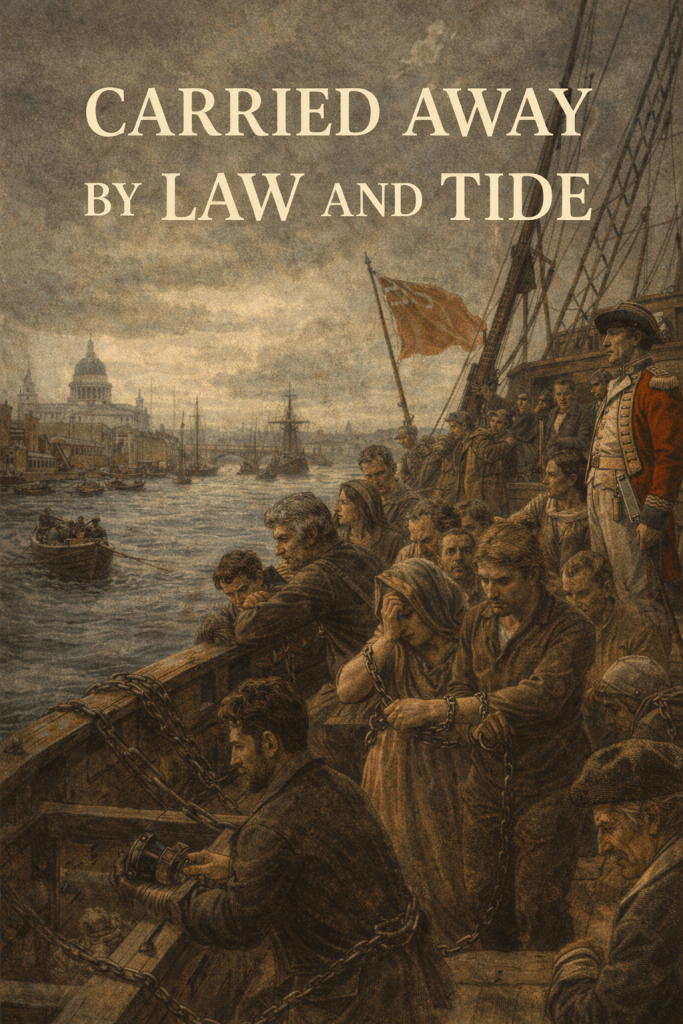
Between 1787 and 1868, more than 160,000 people were transported from Britain and Ireland to Australia. They left from ports like London, Portsmouth, Plymouth, Bristol, and Cork, watching familiar coastlines thin into memory. They boarded ships knowing that whatever waited for them across the ocean, it would not include home. Transportation was not merely a sentence measured in years. It was a sentence of separation, of tides and horizons that closed behind them.
The crimes that carried people so far were often small, desperate, and heartbreakingly ordinary. Stealing bread. Taking cloth from a shop counter. Passing a forged coin in a moment of need. Breaking into a house and leaving with a spoon or a handkerchief. Under the Bloody Code, such acts had once carried the death penalty. Transportation emerged as a kind of mercy, sparing the body while removing the person. Judges pronounced the sentence with practiced calm.
Seven years.
Fourteen years.
Life.
Each term fell like a door shutting, final and unmoved by tears.
Those who heard these words were rarely hardened villains. Many were young, some barely out of childhood. Many were poor, pushed into crime by hunger or misfortune. Some had never stood in a courtroom before. Some wept openly. Some fainted. Others stared straight ahead, already withdrawing from a world that no longer wanted them. Once sentenced, they were sent to gaols or to the hulks, old warships stripped of sails and honour, moored on rivers like the Thames and the Medway. These floating prisons were damp, overcrowded, and harsh. Months or even years could pass there while convicts waited for a transport ship to be fitted and filled.
The voyage itself was an ordeal few could fully imagine. Transport ships were cramped and heavily laden with human cargo. Men and women were usually separated, though families were often torn apart rather than preserved.
Below deck, hammocks were slung so close together that bodies brushed even in sleep. Light was scarce. Air grew stale and thick. The smell of sweat, sickness, bilge water, and unwashed clothing clung to everything. In rough seas, water poured across the lower decks. In tropical heat, the air became suffocating.
Food was monotonous and dispiriting. Salted meat, hard ship’s biscuit, dried peas, oatmeal. Fresh produce was rare, especially on early voyages. Water could turn foul and green with age. Scurvy haunted the long months at sea, loosening teeth, swelling gums, weakening limbs, turning simple movement into pain. Mortality was once high, though reforms in the early nineteenth century gradually reduced deaths through better rations, ventilation, and the appointment of naval surgeons tasked with protecting convict health. Even so, suffering remained an accepted part of the punishment.
Discipline aboard ship was strict and often merciless. Floggings were common and public, intended to warn others into obedience. Iron collars, leg shackles, reduced rations, and solitary confinement were used freely. Illness did not always bring mercy.
Yet there were moments of kindness that flickered unexpectedly. Some surgeons kept careful journals, insisting on cleanliness, fresh air, and exercise. Some captains believed order did not require cruelty. Experience varied wildly, shaped by the character of those in command.
As weeks became months, the sea itself grew intimate. The horizon repeated itself endlessly. Time was marked by ports glimpsed and left behind, by storms survived, by the crossing of the equator, by burials at sea. Friendships formed in the dark and the heat, bonds strengthened by shared endurance. Others retreated inward, conserving feeling as carefully as food. Songs were sung softly at night. Letters were written with care, though many would never be sent, their words floating nowhere.
When land finally appeared, relief was often mixed with fear.
Australia was vast, strange, and unforgiving. New South Wales, Van Diemen’s Land, later Western Australia, were places still being forced into shape by colonial ambition. Convicts were unloaded, counted, inspected, and assigned. Chains might be removed, but freedom did not follow. They belonged now to the system.
In the colonies, convicts were sent to government gangs, road building parties, farms, and private households. Labour was relentless. The sun was harsh. Discipline remained rigid. Punishments could be severe. Flogging, confinement, secondary transportation to harsher settlements. Places like Norfolk Island became infamous for brutality so extreme that its name alone carried terror across the colonies. For some, hope narrowed to survival alone.
And yet, life was not only misery. Distance sometimes offered possibility. Skilled convicts were in demand. Those who behaved well could earn tickets of leave, allowing them to work and live with limited independence. After serving their sentence, many received land grants. They married, had children, planted crops, built homes. Lives that would have been impossible in Britain slowly took root. Australia became not just a place of punishment, but a place of becoming.
What they did not have was return. Passage back to Britain was costly and rare. Even those who prospered often stayed, bound by family, distance, or resignation. Letters home might arrive years later, if at all. Parents died without seeing children again. Sweethearts faded into memory. Britain became something half remembered, shaped more by longing than detail.
The stories of those who never returned are not only stories of punishment. They are stories of loss and endurance, of grief carried quietly, of resilience shaped by necessity. Transportation shattered lives, but it also reshaped them. It created a society built partly from the unwanted and the desperate. It left a legacy written into Australia’s foundations and into Britain’s long silence.
Eventually, Britain ended transportation, uneasy with what it had made. Prisons replaced ships. Distance was no longer the answer. But those who were sent away did not vanish.
Their descendants live on. Their labour built roads, towns, farms, and futures. Their stories, once dismissed as criminal footnotes, now ask to be remembered with honesty and compassion.
Transportation to Australia was never only about crime. It was about who Britain was willing to lose.
And for those who never returned, the sea did not simply carry them away. It carried them into history, where their lives still wait, patiently and softly, to be acknowledged.
Until next time,

Ta ta for now.

Yours, Lainey.
 Intwined