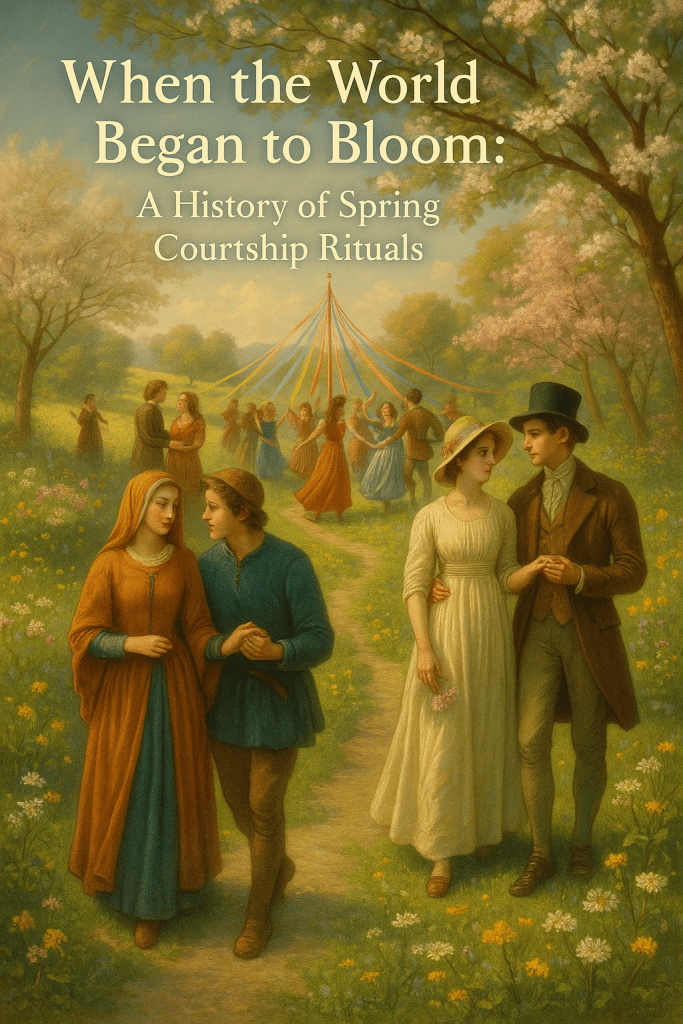
When spring returns, it does so with a kind of soft insistence, a gentle unfurling that stirs not only the earth but the human heart. Throughout history, as frost loosened its grip and blossoms unfurled like shy smiles, romance itself seemed to awaken with the season. Courtship, which winter kept tucked beneath heavy coats and hearthside obligations, blossomed into something tender, hopeful and sweetly daring in the brightening warmth of spring.
In the medieval world, spring courtship often began in gardens, those quiet spaces enclosed by stone walls or hedgerows where herbs grew in tidy squares and birdsong drifted through the air like silk threads. Young men and women walked the narrow paths lined with violets, rosemary and sage, knowing full well that an invitation for such a walk was not given lightly. It was in these gardens that glances lingered, hands sometimes brushed as if by accident and poetry flitted between leaves like sparrows. Even the smallest gesture, offering a sprig of thyme, admiring a new rosebud, carried meaning. Troubadours’ love songs spilled from open windows, their verses weaving gently into the season. These melodies shaped the atmosphere of budding romance, giving young hearts permission to stir.
As the centuries unfolded, spring remained the season that encouraged bravery in matters of the heart. In villages across Europe, the Maypole stood as the most colorful symbol of this awakening. Ribbons fluttered from its tall wooden frame like strands of captured sunlight. As young folk danced, weaving ribbons in shimmering patterns, they also wove unspoken promises. The dance allowed shy flirtations to unfold in plain sight, laughter, playful tugging, the quick tangle and untangle of ribbons like fate testing its threads. To be paired with someone in the dance was sometimes a spark, sometimes a declaration and always a moment remembered, treasured, analyzed by candlelight with friends later.
In more refined circles, the tradition of garden walks continued to flourish. By the seventeenth and eighteenth centuries, formal gardens with long alleys of lime trees or orchards blooming in pale pink became favored spaces for quiet companionship. A gentle stroll beneath flowering branches held a weight beyond its simplicity. It allowed couples to speak softly without the heavy chaperoning of interiors, to pause knowingly at a particularly lovely blossom, to marvel together at the first butterfly of the season. The unhurried pace encouraged hearts to open like the petals underfoot. A fallen apple blossom handed from one person to another could stir more emotion than any elaborate verse.
With the rise of literacy and widespread letter-writing, spring also became a season of ink-stained confessions. Families often resumed travel after winter, leaving lovers separated by miles of muddy roads or swollen rivers. Letters written in springtime had a particular liveliness, full of metaphors borrowed from nature, references to greening hillsides, blooming orchards and the writer’s own feelings thawing with the season. Some letters were folded with pressed violets tucked inside; others carried bits of poetic longing dressed as observations about weather or farm work. Nature, full of fresh metaphors, gave lovers endless ways to say what might otherwise feel too bold.
In rural communities, spring courtship blended seamlessly with the rhythm of work. Fields needed tending, animals birthing and gardens planting. During these communal tasks, young men and women found opportunities to speak, to tease, to share simple meals beneath the warming sun. A shared shoulder of a plow, a hand offered to steady someone crossing a muddy patch, a smile exchanged over a row of peas, these were the courtships of everyday life. Romance wove itself into the fabric of labor, each gesture a stitch binding two futures a little closer. Even the songs sung in the fields had a softness in spring, a lilting warmth that winter never inspired.
Victorian spring romances carried their own particular elegance. Park promenades blossomed into social rituals, offering space for young couples to be seen together, watched over by chaperones, but carried forward by the season’s gentle boldness. Blossoms in the ladies bonnets, pressed flowers in gentlemen’s notebooks and the soft exchange of glances beneath parasols created a language understood without words. A gentleman offering his arm for a walk beneath budding trees was a gesture laden with charm. A lady adjusting her glove or lowering her gaze became its own kind of poetry. It was a season of soft persuasion, where the return of life to the world mirrored the desires newly stirring in the heart.
Across eras and cultures, spring’s courtship rituals shared a common thread, the belief that love grows best when the world is waking. Nature, in its generous unfolding, offered permission for affection to bloom. The first warm breeze could carry a promise; the first bloom could stir longing; the first birdcall at dawn could awaken dreams of companionship. Spring was the canvas upon which lovers painted their hopes, some bold, some hesitant, some fragile as petals, all touched by the season’s enchantment.
Even today, echoes of these ancient rituals remain. Couples still walk in gardens where the air carries the scent of early blossoms. They leave flowers on doorsteps, write heartfelt letters, plan picnics under flowering trees and feel their spirits lighten as sunlight lingers a little longer each evening. Spring continues to whisper its age-old message: that life renews, hearts open and love, like the earth itself, is always ready to rise again.
The story of spring courtship throughout history is not merely about rituals or customs. It is about the timeless truth that beneath the thawing earth lies the desire to connect, to cherish and to be cherished. Spring, with all its tender beginnings, gently reminds humanity that romance is as perennial as the flowers that bloom each year, returning faithfully, beautifully, with every turning of the season.
Ta ta for now.
Yours Lainey.
The lyrics were written by me
but the music and vocals were AI generated.
❤️❤️❤️
 Intwined