There is a moment each year when the light shifts, subtly and softly, like a curtain being drawn back, and people feel an ancient stirring to open their windows, lift the dust-covered corners of their homes and let the world breathe again. This instinct, familiar to us now as spring cleaning, is far older than modern vacuums or scented soaps. It is a tradition rooted in hearth soot, sacred customs and the deep human longing to begin anew when winter loosens its hold. It is the home’s equivalent of stretching after a long sleep, shaking the dreams of winter from its beams.
For centuries, winter was a season of closed shutters, smoking hearths and rooms crowded with the necessities of survival. Fireplaces burned day and night, filling homes with warmth but also with a stubborn layer of soot that clung to beams, rafters and clothing. Chimneys rarely drew well in stormy weather, and windows were seldom opened in the biting cold. Every breath of winter living left a trace upon the house.
By the time the first mild breeze of spring arrived, walls and ceilings wore the season’s residue like a heavy cloak. Cleaning was not a choice but a liberation, a shedding of winter’s husk.
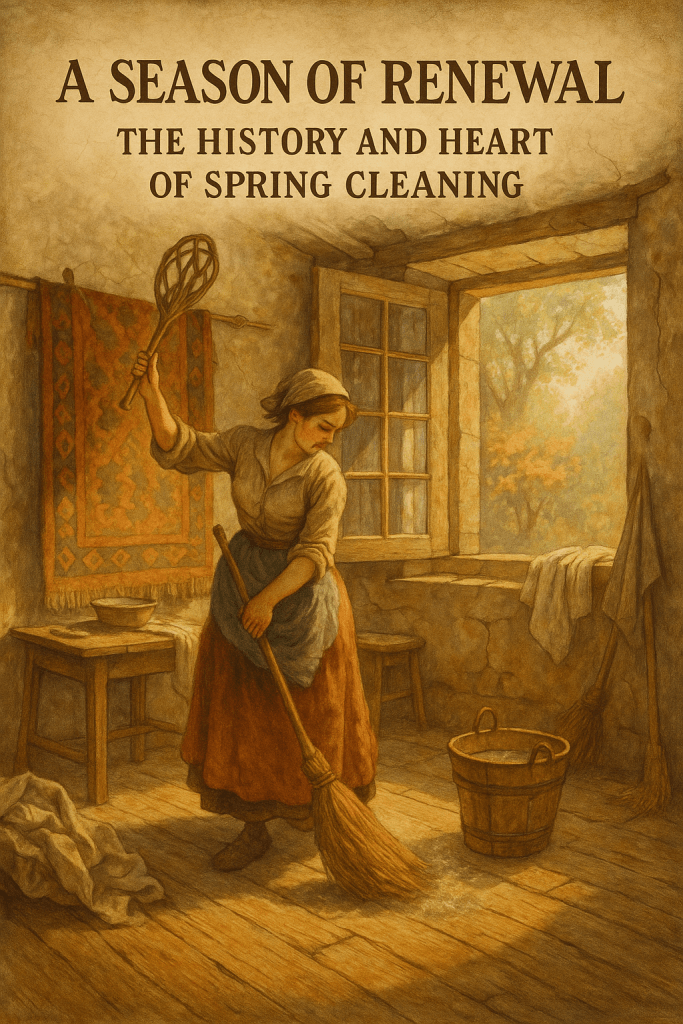
In medieval Europe, the clearing of soot and stale air became its own quiet ritual. Families waited for a run of gentle days, then threw open shutters that had stayed shut for months. The first rush of fresh air was a celebration in itself, carrying the scent of thawing earth and the promise of green things returning. Housewives swept old rushes from the floors and beat them outdoors where sunlight could purify what winter had dulled. Bedding was shaken beside hedgerows, tapestries carried into courtyards to be beaten free of dust, and kitchens scrubbed until the stone gleamed. Children darted between tasks, chasing dust motes as if they were sprightly creatures fleeing into the light, thrilled by the unexpected freedom of open doors and warmer breezes.
In England and across the British Isles, spring cleaning was not merely a task but a seasonal certainty. Winters there were damp, smoky and dim, and homes accumulated the evidence. Open fires burned almost constantly, leaving ceilings darkened with soot and furnishings steeped in the scent of smoke. When spring arrived, households embarked on what was often called shaking out or turning out the house. Mattresses were dragged outdoors to be beaten and aired in the crisp but sunlit March weather. Floors of slate or flagstone were scrubbed on hands and knees, and wooden boards were scoured with gritty sand until they felt new again. Fresh rushes were laid, sometimes mixed with fragrant herbs like lavender and pennyroyal, their scents drifting through the rooms with the rising warmth.
Across Scotland, spring cleaning often intertwined with old Beltane customs. Homes were swept thoroughly to banish lingering winter spirits, and the hearth was cleaned with extra care in preparation for the ceremonial Beltane fire that symbolised purification and renewed life. In Ireland and Wales, cleanliness at spring’s arrival was tied to good fortune, and a neglected hearth was considered a risky invitation to ill luck. Families whitewashed their cottages anew, turning them bright and cheerful as daisies in the fields.
Religious traditions around the world strengthened the feeling of seasonal renewal. In the Jewish faith, spring cleaning reached a profound level of attentiveness before Passover as families searched for even the smallest crumbs of leavened bread. The act was more than tidying, for it was spiritual preparation and a clearing of the heart. In Iran, the celebration of Nowruz brought a ritual known as shaking the house, a thorough cleansing meant to welcome the new year with freshness and good fortune. Throughout Asia, homes were scrubbed in anticipation of the Lunar New Year. Medieval Christians scrubbed their homes before Easter so that cleanliness became part of the holy anticipation of resurrection. In many places across Europe, Africa and the Middle East, the cleansing of the home echoed the cleansing of the spirit, as if the world itself paused to inhale and begin again.
By the early modern period, hearth soot still ruled every spring. Colonial households resembled their British cousins in grime and necessity. Fires and tallow candles, relied upon through the long dark months, covered walls and rafters in a rich patina of winter. When spring finally softened the air, women scrubbed smoke-darkened walls, polished brass until it glowed and boiled linens in great iron pots in the yard. Even ceiling beams blackened by months of cooking fires were scoured until the wood shone brighter. There was pride in this transformation, a renewed sense of clarity that came from turning a winter cave into a bright living home once more. Neighbours often helped one another, sharing soap, spare hands and conversation as they worked.
Victorian Britain transformed spring cleaning into a grand annual spectacle. Coal fires, oil lamps, velvet draperies and layered carpets trapped winter’s evidence in every corner of the home. When March or April softened the winds, houses came alive with activity. Rugs were dragged out onto lawns and beaten over wooden frames in steady, thumping rhythms that echoed down neighbourhood lanes. Mattresses were hauled into the sun, parlours scrubbed and polished to capture every glimmer of returning daylight, and windows washed until they seemed almost invisible. Fresh breezes filtered in through lace curtains, carrying hope and the sense that winter’s heaviness was being swept away, room by room. Everyone felt the shift. Spring lived not only in the air but in the renewed brightness of the walls.
Yet spring cleaning was never simply a matter of removing soot or chasing dust. It was a ritual of transformation. After months of closeness and confinement, people longed for the feeling of rebirth. Cleaning became a way to align the household with nature’s awakening. Buds swelled on branches, lambs tottered across meadows and streams hurried along with melted snow, and humans responded by clearing and refreshing their homes.
To clean was to step into the very rhythm of spring.
There was romance woven through these labours. The beating of rugs became a friendly gathering. Linens drying in fields looked like small white sails fluttering across the grass. Children carried pails of water back and forth, their laughter rippling ahead of them like sunlight on a stream. Even a simple sweep of the doorstep felt like opening a new chapter of life. A clean threshold welcomed possibility.
Spring cleaning also carried an emotional clarity. It was a time for setting aside what was no longer needed, discovering forgotten treasures in hidden corners and creating space for new memories. The work of the hands guided the work of the heart. Order made room for hope.
Today, even without the soot of open fires or the drafts of medieval winters, the impulse remains. We still feel the tug to refresh what has grown heavy, to brighten our homes as the world brightens outside. We clean because spring signals possibility, because sunlight reveals forgotten corners, because opening a window feels like sending a small prayer into the air. Simple, earnest and filled with light.
Spring cleaning, ancient and enduring, is the quiet declaration that life begins again. It is the home’s own awakening, a devotion to renewal that hums through centuries. And when we pause in a freshly aired room and inhale that first true breath of spring, we join a long lineage of hands and hearts that have welcomed the season by sweeping winter gently, lovingly, away.
Ta ta for now.
Yours Lainey.
 Intwined