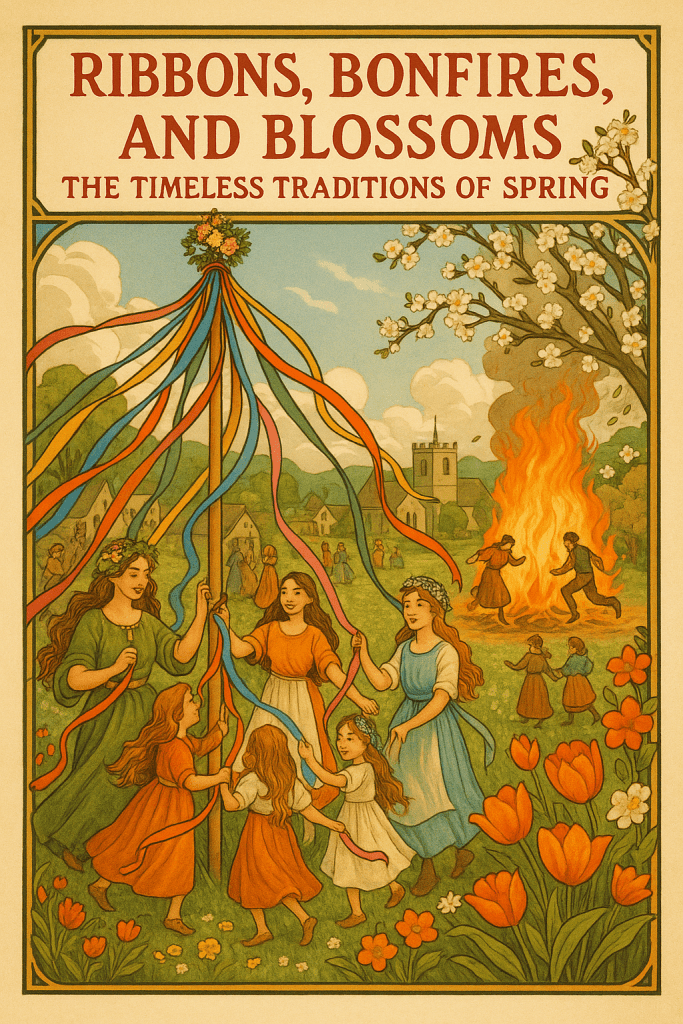
There comes a moment each year when the world seems to breathe out. The light lingers a little longer in the corners of the day, birdsong returns like forgotten music, and a hush falls across the land, not of silence, but of anticipation. Spring is coming, and with it, the oldest invitation known to humankind: to awaken alongside the earth and celebrate the return of life.
Long before clocks and calendars set the rhythm of our days, long before science traced the tilt of the earth’s axis or mapped the changing light, people felt the pulse of the seasons in their very bones. And spring, above all, stirred them to dance, to sing, to clean, to plant, and to praise. From bonfires leaping on remote hillsides to ribbons twirling around maypoles, from flower-strewn thresholds to skies filled with color, the traditions of spring are a testament to our timeless yearning for renewal.
In the ancient lands of northern Europe, the goddess Ostara was honored at the vernal equinox, her name echoing in the dawn and in the East where the sun rises. She was a bringer of balance and brightness, and her symbols, eggs, hares, blooming flowers, have persisted quietly into modern celebrations. With the equinox’s perfect harmony of light and dark, people lit fires to encourage the sun’s return, scattered fresh-cut greenery across hearths, and blessed the sleeping earth to stir awake once more. Everything carried meaning, from the way the smoke rose to the first buds on the hawthorn.
Far away in Persia, Nowruz heralded the new year with grandeur and joy. For over three thousand years, families have prepared for this day with days of deep, loving attention to the home and soul. Every corner was swept, every cloth washed and aired, every heart realigned. Tables known as haft-sin were set with sacred objects, sprouting greens for rebirth, apples for health, candles for light, vinegar for wisdom, and coins for prosperity. As twilight fell, bonfires leapt into the sky, and people danced over their flames, leaving behind the weight of winter and stepping into spring's warmth with open arms and soot-kissed soles.
In India, the world awakens in a riot of color. Holi, the festival of spring, bursts forth like laughter. Crowds pour into streets with bright pigments in hand, flinging powdered color into the air, onto strangers and beloveds alike. It is a celebration of light over darkness, joy over sorrow, love over loneliness. On this day, people become walking tapestries of spring itself, their faces streaked with pink, yellow, blue, and green, their spirits lit from within. Beneath the revelry lies something eternal: the urge to renew, to forgive, to emerge brighter than before.
And in the mist-laced countryside of England and the broader United Kingdom, spring came with its own gentle revelries, drawn from layers of Celtic, Anglo-Saxon, Norse, and Christian threads. May Day, with its dewy grass and sun-dappled fields, was a feast of fertility, laughter, and color. Villages crowned a May Queen in blossoms so fresh they still carried the morning's fragrance. Children and sweethearts danced around the maypole, winding ribbons into intricate braids, their feet echoing the rhythm of growth beneath the soil. Morris dancers jingled through cobbled lanes, green men paraded with leafy masks, and milkmaids decorated their pails with blooms.
These were not mere performances, they were living prayers for good harvests, happy unions, healthy children, and long, golden days ahead.
In the Middle Ages, the English spring was marked not only by its pageantry but by its practicality. Plough Monday signaled the return to the fields, often with merriment and mischief. Lent brought a time of spiritual clearing that mirrored the physical renewal of the season. Palm Sunday saw processions weaving through villages with budding branches and songs of hope, while Easter followed with lilies and bells and feasting that made the most of spring’s new bounty. The greenwood became a sacred space once again, and the hedgerows, once bare, began to hum with bees and secrets.
In Scotland, the festival of Beltane lit the hills with flame. It was a night of magic and movement, when cattle were driven between two bonfires to protect them, and lovers leapt through sparks to seal their bonds. The ash from these fires was believed to bless the land, the animals, and the heart. Beltane celebrated fertility not only of body, but of soil, imagination, and joy.
Wales, too, had its mystical rhythms. The Mari Lwyd, that ghostly horse figure who wandered door to door in winter, was finally tucked away, and the doors were opened wide to the new light. Trees were leafing again, and song spilled from village greens. There was a sweetness in the air, a softness to the wind, and everywhere, people gathered to greet the season with song, cider, and celebration.
No matter the landscape, be it wind-swept moor or sun-soaked terrace, the spring festival echoed a shared longing: to be made new again. It was not merely about honoring the thaw or the bloom, but about remembering that we, too, are part of nature. Just as snowdrops push bravely through the frost, just as lambs tumble into uncertain light, so do we shed what’s grown heavy and turn our faces toward the sun.
And though today our lives are often insulated from the wild timing of the earth, these ancient rituals still flicker within us. We find ourselves flinging open windows without knowing why. We clean and sort and sweep with more energy than winter ever allowed. We reach for color in our clothing, our food, our surroundings. We attend spring fairs and weddings, and still, somewhere in our blood, we understand that to tie a ribbon, to light a fire, to gather flowers is to say: I’m alive, and the world is alive, and this matters.
Spring festivals endure not only because they are beautiful, but because they remind us who we are. They teach us that to mark time with joy, with community, with reverence and play, is deeply human. They whisper that it is never too late to begin again, never too cold to thaw, never too tired to rise.
So whether you greet the season with a flower behind your ear, a new broom in your hand, or a silent moment beneath a blossoming tree, know that you are part of something ancient, gentle, and true. For spring, that old magician, is always ready to return. And when it does, it carries with it the laughter, the longing, and the love of every soul who has ever danced beneath its sun.
Until next time,
Ta ta for now.
Yours Lainey.
The lyrics were written by me
but the music and vocals were AI generated.
🌼🌼🌼
 Intwined