The wedding night has always glowed with a curious blend of tenderness and tension, half shrouded in expectation and half illuminated by the soft lantern light of hope. It is a moment that has never belonged entirely to the couple alone, at least not in most centuries of human history. Instead, it has wandered through time carrying traces of law, ritual, fear, blessing, romance and community, shifting in meaning as societies changed. In England and across the wider world, the journey of the wedding night reveals far more than what happened behind a chamber door. It reveals how people understood love, duty, womanhood, manhood and the sacred beginnings of a shared life.
In medieval England, marriage was less a private vow and more a binding of families and fortunes. The wedding night was the hinge upon which legitimacy swung. If the couple did not consummate their union, the marriage could be annulled as if it had never been. This gave the first night an atmosphere more ceremonial than intimate. It was not entirely unusual for relatives, friends or clergy to escort the new couple to their bedchamber, placing them solemnly upon the bed like pieces on a sacred altar. Blessings were murmured, holy water sprinkled, candles lit. The door finally closed, leaving behind an echo of footsteps and expectations heavy as winter cloaks.
Yet even in these moments of formality, a faint fragrance of sweetness floated through the ritual. Medieval English households often adorned the marriage bed with flowers and aromatic herbs. Rosemary, symbol of loyalty, perfumed the air. Meadowsweet was laid beneath pillows, believed to soften tempers and sweeten dreams. Friends sang outside the chamber door in goodnatured mischief, their laughter a reminder that marriage, even when encircled by law and duty, was still a celebration of new beginnings.
By the Tudor and Elizabethan periods, the wedding night held fast to its legal importance but began to glow with a little more warmth. The days-long feasting that often accompanied weddings spilled into the evening, until the newlyweds were ceremoniously, and sometimes tipsily, “put to bed.” Friends nudged the couple toward the chamber with ribald jokes softened by affection. Lace-trimmed sheets and embroidered pillows turned the room into a small sanctuary. Spiced wine and sweetmeats waited on the bedside table, symbols of the sweetness hoped for in the marriage itself. Though the marriage bed still bore the weight of public expectation, its surroundings began to resemble something more human, more tender.
Across the world, other cultures shaped the wedding night with their own beauty. In India, marriage beds were transformed into fragrant groves with cascades of jasmine and marigold. In the Middle East, music thrummed outside the chamber like a protective heartbeat. In East Asia, chambers draped in red glowed with promise and good fortune. Each tradition tried, in its own way, to shelter the couple from fear and to usher them gently toward a shared life.
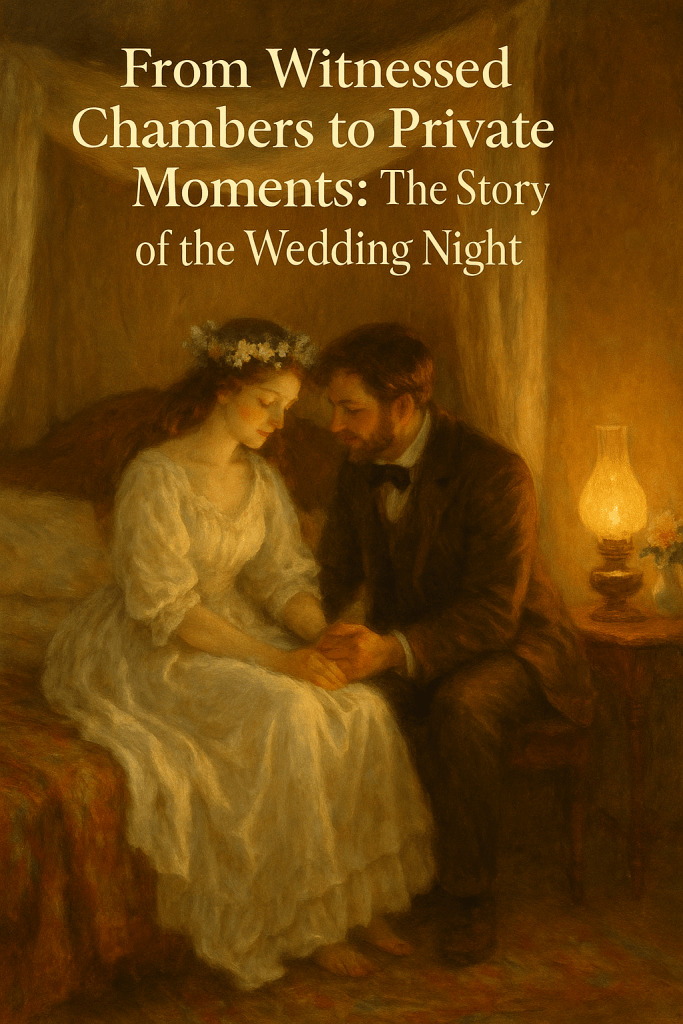
In England, as the centuries unfurled into the Georgian and Victorian eras, ideas of privacy, emotion and romance deepened. The wedding night gradually untangled itself from the public stage. Although Victorian households brimmed with moral instruction and anxious advice books, the first night became a more private threshold. Mothers whispered guidance to daughters. Sisters and dear friends offered quiet counsel. Gentlemen read treatises imploring them to be patient and kind. Misunderstandings and anxieties lingered, but behind the closed door of the bridal chamber, the moment finally began to belong to the couple rather than to church or community.
Still, Victorian romanticism often clashed with reticence, and the wedding night became a place where innocence collided with expectation. Brides blushed not only from modesty but from the weight of silence surrounding marital intimacy. Grooms oscillated between eagerness and uncertainty. Yet through this delicate awkwardness, couples found ways to discover one another, sometimes slowly, sometimes tenderly, sometimes with laughter that eased the tension of centuries of formality.
The twentieth century ushered in a revolution of its own. Courtship became more free-spirited, and love, at last, positioned itself squarely at the center of marriage. Education improved. Conversations about relationships expanded. Couples married later, often having already chosen one another through affection rather than treaty. The wedding night stepped out of the realm of performance and became a chapter written entirely by two people alone.
Today, wedding nights in England and throughout the world reflect the immense variety of modern love stories. Some couples share their first married evening dancing until dawn, too joyful and exhausted to do anything but fall asleep tangled in ribbons and memories. Others savor a quiet supper together and speak softly about dreams for the life ahead. Some couples come to the wedding night as long-time partners, for whom the night feels like a sweet continuation rather than a ceremonial threshold. Others still treat it as a sacred moment of discovery, holding fast to tradition in their own personal way.
What remains true, through every century, is the symbolism of the moment. The wedding night is a doorway. It is the crossing from one life into another, from solitude into companionship, from two stories into a shared narrative. It once belonged to families, to priests, to courts of law. Now it belongs to love itself.
And so the story of the wedding night, once crowded with witnesses and rituals, has blossomed into something gentler and far more intimate. It has become a moment shaped by kindness, curiosity, trust and the shimmering hope that two human hearts, having chosen each other, will find comfort in the quiet miracle of beginning anew.
Until next time,

Ta ta for now.

Yours Lainey.
 Intwined