Easter arrives each spring like a soft exhale after winter’s long-held breath. It is a celebration built of light and color, of hope and rebirth, and its familiar customs, eggs, rabbits, bonnets, sunrise gatherings, and feasts, are far older and far richer than they first appear. In England and throughout the United Kingdom, Easter took shape through centuries of layered tradition, a gentle braiding of ancient seasonal rituals and Christian symbolism, each strand shining with its own quiet meaning. It is a tapestry that speaks to both the rhythms of the land and the stirrings of the soul, to the return of warmth, of light, and of life.
Long before Easter bore its Christian name, the people of early Britain and northern Europe honored the coming of spring with festivals glowing with dawn and renewal. The Anglo-Saxon month of Ēosturmonath, described by the monk Bede, was named for a goddess associated with morning light and awakening. Though much about her is lost to time, the idea she represented, new beginnings, brightness, the lifting of darkness, still hums through the season we call Easter. Christian and older seasonal traditions mingled not through conflict, but through gentle coexistence, like two streams flowing into the same spring-lit river.
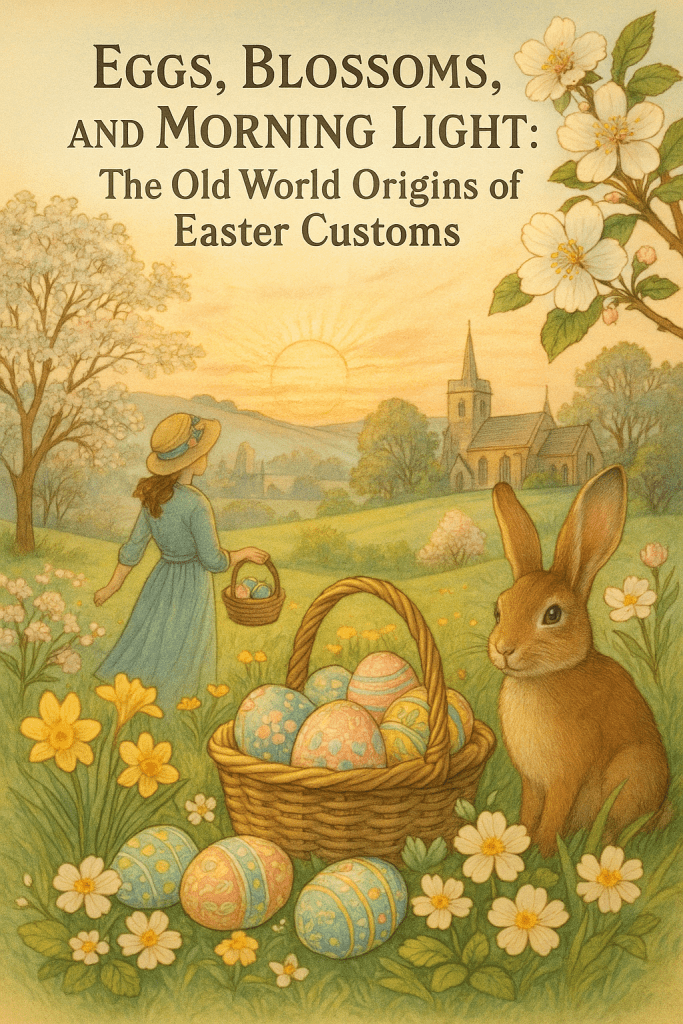
Eggs, those perfect symbols of potential, carried meaning long before they nestled in baskets of colored straw. In ancient Europe, eggs were painted with bright dyes drawn from plants and minerals, offered to deities or exchanged as charms of good fortune. Their shells held the promise of life still hidden, a reminder that the world, too, was cracking open after winter’s stillness. By the Middle Ages in England, eggs had become tokens of merriment after the restraint of Lent, when they were traditionally avoided. On Easter morning, they returned to the table in triumph. Children wandered from cottage to cottage, singing little blessing rhymes in exchange for eggs, while women dyed them with onion skins, nettle leaves, beetroot, and herbs gathered from hedgerows. Some households gilded eggs in shimmering gold leaf to mark especially joyful years. To tap an egg against a friend’s was more than a game, it was a small, ceremonial breaking of winter’s hold.
Rabbits and hares, too, found their way into Easter lore long before chocolate molds shaped their modern form. In Britain, the hare in particular was a creature of mystery and moonlight. It ran with uncanny speed across early spring fields, appeared suddenly at dusk, and was said to sit motionless as though listening to the whisper of hidden worlds. Its early stirrings each spring and its remarkable fertility made it a fitting emblem of revival. German folklore later added the idea of an egg-giving hare, and as stories traveled and mingled, the Easter Bunny emerged, tamer, sweeter, yet still carrying the ancient symbolism of nature’s unstoppable return to life.
Easter bonnets, trimmed with ribbons, lace, and blooms, also reach back to older customs. In medieval England, people attended Easter services in new or freshly cleaned garments as a sign of spiritual renewal. Wearing something new symbolized casting off the remnants of winter in both body and spirit. By the eighteenth and nineteenth centuries, this blend of symbolism and springtime fashion blossomed into the tradition of decorating hats with real and artificial flowers. Victorian Easter parades shimmered like walking gardens, bonnets dotted with violets, primroses, daffodils, and even sprigs of blossoming hawthorn. Families would stroll together along London’s promenades, each hat a tiny celebration of spring.
The poetry of Easter morning deepened further with sunrise services. Long before Christianity shaped them into rituals honoring the Resurrection, dawn itself held sacred meaning. For countless ancient peoples, sunrise marked the victory of light over darkness, warmth over cold, life over stillness. Christianity embraced this symbolism beautifully. In England and the wider United Kingdom, worshippers have greeted Easter dawn on hilltops, beaches, and village greens for centuries. Bundled against the lingering chill, they gather in silence as the horizon blushes pink, then gold. The first birdcalls break the hush. Light seeps across the land. And in that moment, the story of the empty tomb mingles seamlessly with the ancient awe of watching night yield to day.
Feasting has always been Easter’s final and most joyful expression of renewal. After the fasting and simplicity of Lent, Easter tables brimmed with foods that announced abundance. In medieval and early modern England, roasted lamb appeared both as a practical spring dish and a symbol of Christ as the Lamb of God. Simnel cake, rich with fruit and encircled with marzipan, commemorated both seasonal sweetness and the end of restraint. Hot cross buns, fragrant with spice and marked with the sign of the cross, were baked in homes and sold in bustling markets long before they became supermarket staples. Every region added its own flavor.
In Cornwall, traveling performers known as pace-eggers went from home to home acting out traditional plays and receiving eggs as tokens of thanks. In northern England, families rolled bright eggs down grassy hillsides, the tumbling motion said to represent the rolling away of the tomb’s stone.
In Scotland, Easter Eve once brought bonfires, their flames dancing high into the night in echoes of ancient rites of purification.
Even the simplest details of Easter carried meaning. Primroses placed on the table were not simply decoration, they were the first flowers to bloom in many corners of Britain, promising that warmth had truly returned. Willow branches, cut and brought indoors, reminded families of both new life and ancient resilience. In many rural households, children awoke Easter morning to find that the “plecking hare” had visited, leaving eggs hidden in the grass or the garden.
To celebrate Easter today is to become part of a story unbroken by centuries. When we dye eggs or bite into a chocolate rabbit, when we put on a cheerful hat or walk in the soft light of an April morning, we are echoing gestures made by countless hands long before ours. Easter is not only a religious feast or a spring holiday. It is a bridge between earth and sky, between old customs and new joy, between the ancient rhythm of seasons and our own longing for renewal.
It reminds us that after darkness comes light, after scarcity comes abundance, after winter comes the tender green of hope. Easter, in all its color and charm, invites us to step forward with the world, into warmth, into brightness, into life awakening once more.
Until next time,

Ta ta for now.

Yours Lainey.
 Intwined