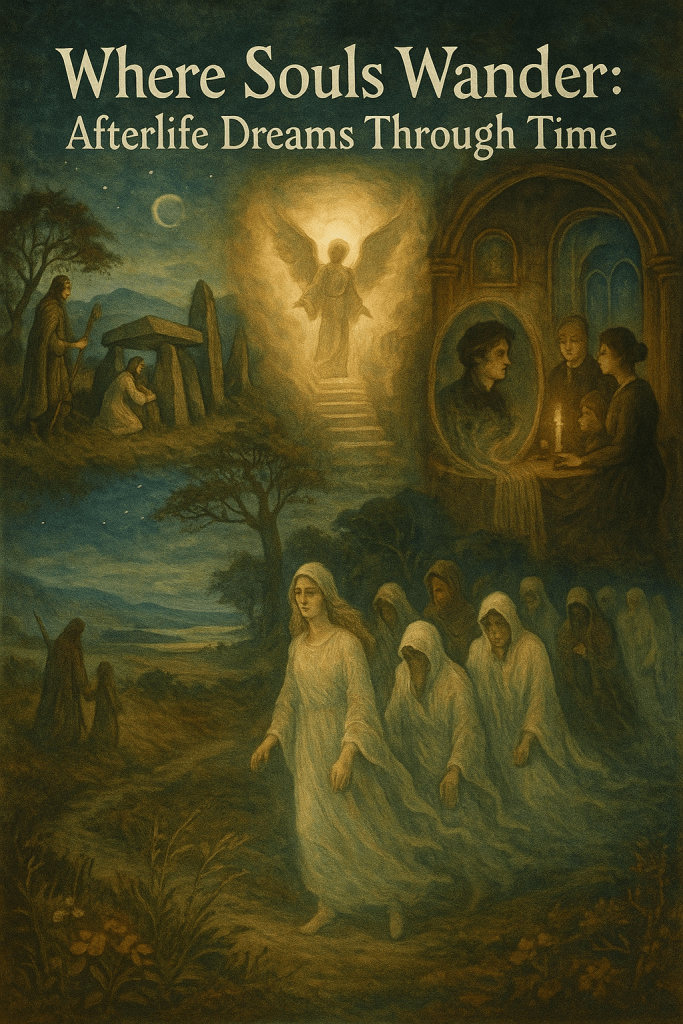
Across the long stretch of human history, people have lifted their eyes beyond the horizon of life and wondered what waits in that mysterious hush after the final breath. Every age, every culture, every corner of the world has imagined the beyond in its own radiant or shadowed colors. These visions are never simply born of fear. They are woven from hope, longing and the deep tenderness with which humanity regards the soul. In England, and in lands far from it, dreams of the afterlife shimmer like lanterns carried through time, each one illuminating the ancient question: what becomes of love when life is done?
In ancient Britain, before ink ever touched parchment, the people of the isles believed that death was a voyage.
The Celts pictured the soul slipping across the sea to the Otherworld, a realm of eternal summer, warm breezes and bright meadows untouched by winter’s hardships. Death was not a descent but a crossing, gentle as a tide. The sun setting in the west became a symbol of that passage, and many believed the soul traveled toward that glowing edge of sky. Families placed goods with their dead, brooches, weapons, tools, food, tokens for the journey ahead. Those ancient barrows and standing stones still scattered across the British landscape whisper of a time when the world was alive with spirits and the veil between life and death felt soft as morning mist.
Christianity later reshaped England’s spiritual horizon, yet carried forward the tenderness of earlier beliefs. The promise of Heaven shone like a lighthouse on a distant shore, a realm of peace, reunion and divine embrace. Medieval churches, cool with stone and fragrant with incense, taught that life was a pilgrimage and death its long-awaited homecoming. Angels, saints and the light of God tended this celestial world. Funerals became solemn prayers for safe passage, as though heaven’s door hovered just above the grieving. The living did not think of the dead as vanished, they remained in prayerful companionship, held close by devotion.
Still, old beliefs lingered like gentle shadows beneath Christian teachings. People quietly spoke of loved ones who returned in dreams or birdsong, or of spirits who watched over the homes they once lived in.
All Souls’ Day became a moment between worlds when families lit candles on windowsills, guiding beloved spirits tenderly through the dark. The old world and the new faith wove together like intertwined threads, shaping a vision of the afterlife that was both sacred and enchanted.
Across oceans and continents, humanity dreamed in equally vivid colors. Ancient Egyptians imagined the soul embarking on an epic journey through trials, its heart weighed against a feather before entering eternal fields of harvest and sunlight. In China, ancestors were honored with offerings, ensuring that spirits remained peaceful and protective.
Indigenous American traditions described afterlives flowing like rivers, cyclical and natural, a continuation of life within the great weaving of the universe. Hindus envisioned reincarnation, each life a step toward spiritual refinement, while Buddhists sought liberation, a serene dissolving into pure awareness. Each culture carved out a vision that soothed its people, turning the great unknown into something familiar, beautiful or purposeful.
In England’s early modern era, folk beliefs danced gently alongside Catholic and Protestant teachings. Funeral bells were rung so that souls might find their way. Some families covered mirrors after a death, worried that spirits might become confused or caught between reflections. Rosemary, fragrant and evergreen, was carried to funerals and laid on coffins, its scent a symbol of remembrance and protection. The afterlife felt near, not distant, as though the departed were simply traveling along a path parallel to the living, close enough to be felt in quiet moments.
Then arrived the Victorians, who embraced mourning with a depth and artistry that shaped an entire generation. After Prince Albert’s death, Queen Victoria’s long grief cast a gentle, solemn influence across Britain. Mourning became a language. Women wore black crepe and gleaming jet jewelry that whispered of remembrance. Families sat for funeral photographs, wanting to keep one more likeness. Cemeteries transformed into romantic landscapes of stone angels, winding paths, ivy-draped monuments and poetic epitaphs. Visitors strolled through places like Highgate Cemetery as though walking through gardens of memory.
At the same time, spiritualism blossomed. Families grieving lost children or soldiers gone to distant wars gathered around tables lit by candles, hoping for a message from beyond. Mediums promised to open doors between realms. Séances brought trembling hope to hearts that longed to hear once more the voices they had lost. Though trickery often entwined with belief, the yearning itself was sincere, ancient and deeply human: a desire to feel that love could still reach across the veil.
As global travel broadened horizons, English spiritual beliefs absorbed ideas from other cultures. Stories of reincarnation, ancestor realms and celestial journeys sparked new possibilities. The afterlife became less a fixed doctrine and more a vast, shimmering tapestry where many paths and dreams could coexist.
In modern times, beliefs have grown beautifully diverse. Some picture heaven as radiant peace, a place where all wounds are healed.
Others feel their loved ones as gentle presences in starlight, birdsong or sudden warmth. Some imagine returning to nature’s embrace, becoming part of rain, oceans and tree roots. Others hold tenderly to the idea of reincarnation, envisioning the soul as a traveler moving from life to life like a flame passed from candle to candle.
Today, the afterlife is deeply personal, shaped by culture, faith, memory and the stories families share.
Across all these eras and all these visions, one truth glows steadily beneath the centuries: afterlife beliefs are acts of love. They are the ways humans soothe their grief, honor their dead and make sense of the unspeakable. They tell us that connection is not destroyed by death, only transformed. When we tend graves, light candles, speak names aloud or dream of those we miss, we keep their presence alive in our hearts.
The long history of afterlife dreams, from Celtic summerlands to Christian heavens, from ancestral watchfulness to reincarnated journeys, reveals a truth more comforting than any certainty. Souls wander, yes, but they wander not beyond our reach. They drift through our memories, our stories, our tenderness. They remain woven into the fabric of our days.
And perhaps that is the greatest comfort of all, that love continues.
It endures in ways no grave can contain, shining softly through time like a lantern that never goes out.
Until next time,

Ta ta for now.

Yours, Lainey.
Lyrics were written by me
but the music and vocals were AI generated.
🕊️🕊️🕊️
 Intwined