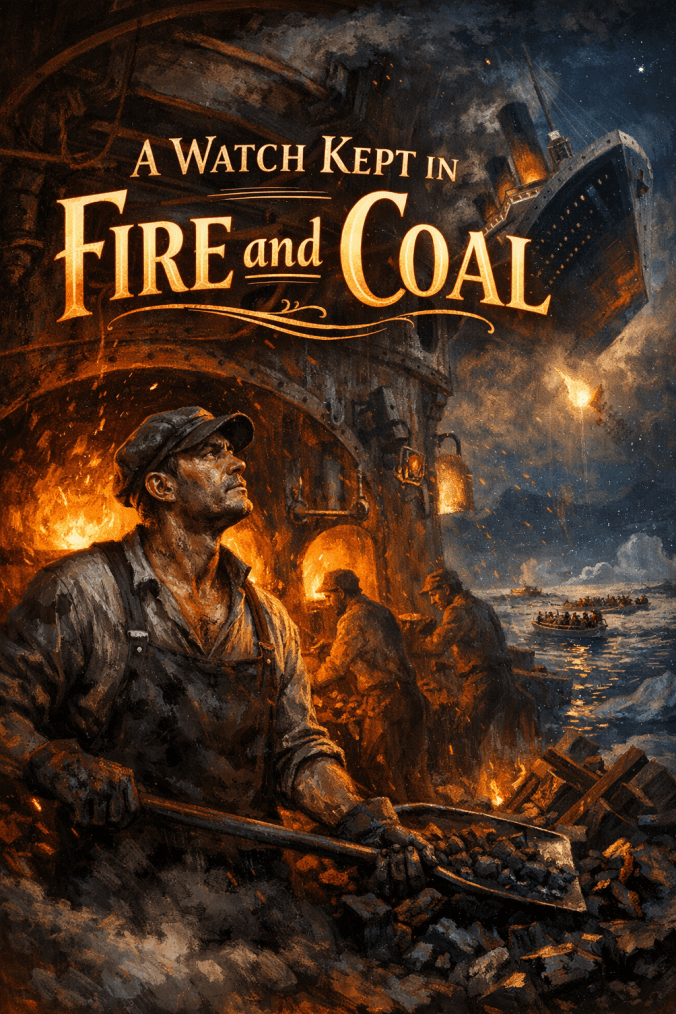
This story is written for the men who worked where the light did not reach.
It is shaped by technical reports, shift logs, inquiry testimony, and the sparse records left behind by those whose labor powered the ship but rarely entered its mythology.
Firemen and stokers appear in history most often as numbers, as roles, as necessities. Their voices are largely absent. Their work is described clinically. Their deaths are recorded briefly, if at all.
Yet the ship did not move without them.
The men in this story are imagined, but their lives are not. They reflect the lived reality of the firemen and stokers of the Titanic, men who labored in relentless heat, who understood danger intimately, and who were trained to endure without complaint. Their courage was not sudden or dramatic. It was practiced, habitual, and carried out far below the decks where gratitude could find it.
For my husband and me, this story is personal in the deepest sense.
Both of our families lost ancestors who worked as firemen and stokers aboard the Titanic. They went down with the ship, not because they failed to escape, but because their duty required them to stay where the work was most dangerous and the chances least. Their names survive in records. Their labor survives in engineering diagrams and reports. Their final hours survive only in inference and silence.
We did not know these men, but we live in the shadow of what they did.
We have wondered what it meant to choose obedience over survival, to keep the lights burning while the ship was already wounded, to work in rising water and fading heat so that others might have time to live. We have wondered whether they knew how essential they were, and whether they understood that history would rarely speak their names aloud.
This story is our way of standing with them.
It is written in remembrance of men whose hands shoveled coal, whose bodies absorbed heat and exhaustion, whose final acts were not witnessed by the world above. It is written with gratitude, humility, and love, for the ancestors we lost and for all those like them.
What follows is not speculation for its own sake.
It is an act of recognition.
A light offered below decks.

A name spoken where silence has long endured.

A story told so their watch is finally seen.
Yours, Lainey.
A Watch Kept in Fire and Coal.
I was a fireman, a stoker aboard the Titanic. My name was Jesse, and I lived my life where the ship hid its beating heart.
To say I worked below decks is too gentle a phrase. I lived beneath the ocean even while it was held at bay, in a world of iron and fire where the air itself felt forged. The boiler rooms were vast and low-ceilinged, a maze of steel ribs and sweating pipes, lit not by lamps but by flame. The furnaces glowed like open mouths, ravenous and unending. They breathed when we fed them and roared when they were pleased. Coal dust coated everything. It worked its way into the creases of our hands, the corners of our eyes, our lungs, our dreams. No matter how often we washed, we carried the ship on our skin.
We worked stripped to shirts and boots, bodies shining with sweat, muscles aching with repetition. Shovel, lift, throw. Again and again. The coal bunkers never seemed to empty, and the furnaces never seemed satisfied. Time below decks was measured not in hours but in pressure and heat, in the rhythm of labor and the ache in the shoulders. Above us were polished railings, warm light, laughter, music. Below us was the truth. Fire, water, and men forcing them into uneasy obedience.
We knew our place in the world and on the ship. We were not passengers. We were not meant to be seen. But we were necessary. Without us, the great vessel was nothing more than a floating shell.
Sunday night, the fourteenth of April, began like any other. The gauges glimmered steadily. The engines pulsed with confidence. Orders came down the voice pipes calm and assured. The ship was running strong, eager even. She wanted speed, and we gave it to her willingly, shovelful by shovelful. Each load of coal felt like a promise kept. We were proud of her, proud of what our labor allowed her to be.
Then came the feeling.
Not a crash. Not an explosion. A trembling sigh ran through the steel, subtle but unmistakable. It traveled through the deck plates into our bones. Coal shifted with a low mutter. Tools clinked where they hung. We froze, shovels raised, listening to something that did not belong.
The engines slowed.
That silence was worse than any noise. A ship like that does not hesitate without reason. Silence in a boiler room feels like a held breath before bad news.
Orders followed swiftly, sharper now. Close dampers. Bank the fires. Maintain pressure. We moved at once, faster than before, sweat turning cold on our spines. The heat was still there, but something else had joined it. Fear, quiet and heavy. Somewhere beyond the iron walls, water was coming. At first it was only a distant sound, like wind in a tunnel. Then it grew clearer, steady and patient, as if the sea had decided it was time to collect what it had always owned.
Word spread that the ship was damaged. No one shouted. No one panicked. There was only a tightening of jaws and a grim understanding. We had been trained for obedience, drilled into endurance. Keep the lights burning. Keep the pumps alive. Buy time.
Time for whom, we did not ask.
Water crept across the floor, shockingly cold against skin accustomed to fire. It lapped at our boots, then our ankles. Steam rose where it touched hot iron, hissing like something angry and alive. Men shouted instructions and names to be heard above the roar. Some whispered prayers they had not spoken in years. Some cursed the sea, the ship, fate itself. Most of us simply worked. To stop was to think, and to think was unbearable.
I saw a man lose his footing in the dark and vanish beneath the rising water. One moment he was there, coughing and swearing, the next he was gone. There was no time to mourn him. The sea does not pause for grief.
When the order finally came to abandon the boiler rooms, it felt unreal. We had spent our lives being told to stay, to endure, to hold the line. Leaving felt like betrayal, even as the water rose higher.
Climbing the ladders was like rising from the depths of the earth. Each rung pulled me farther from the fire and closer to the unknown. When I reached the open deck, the cold struck with shocking cruelty. The night air was sharp enough to steal breath. Sweat froze against my skin. Above us, the stars blazed in impossible clarity, scattered across the sky as if nothing below could trouble them.
The ship was listing now, her injury undeniable.
I saw lifeboats being lowered, creaking as they descended. There were too few, and we all knew it. I saw mothers holding children so tightly it seemed they might fuse together. I saw men step back, hats removed, faces hollow. Officers shouted orders that trembled despite their discipline. And through it all came the music, drifting gently across the deck, a sound so tender it almost broke me. It was not meant to save us. It was meant to remember us.
We firemen stood apart, blackened by coal, breath steaming in the cold. For the first time, we felt seen. And for the first time, we knew we no longer belonged anywhere on the ship. The fires were dying. There was nothing left for us to feed.
I did not move toward the boats. Not because I thought myself brave. Because I understood time. I had lived my life measuring it in pressure and endurance. I knew ours had already been spent below.
When the water reached the deck, it came with terrible speed. The ship groaned, a deep wounded sound, like something alive and afraid. The tilt grew steeper. People ran. Some slipped and slid helplessly. The night became chaos, sound and motion and terror all at once.
Then she broke.
The sound of it is something no man ever forgets. Steel screaming as it tore apart. Fire finally surrendering. The great heart of the ship ripped open, and the sea rushed in with merciless purpose.
The cold was immediate and absolute. It crushed breath from my chest, thought from my mind. Yet in one strange, fleeting moment, there was pride. Pride in the labor that had kept her alive. Pride in the men who had stood shoulder to shoulder with me in the heat. Pride that we had held the darkness back as long as human hands could.
Morning came pale and quiet over the wreckage. Boats drifted among the dead and the living. A distant ship arrived, smoke on the horizon like a promise that arrived too late.
Names were called into the still air.
Many were never answered.
Mine was one of them.
If you remember us, the stokers and firemen, remember this. While others slept, we burned. While others danced, we shoveled. While others dreamed, we fed the fire that carried them across the sea. And when the night finally claimed us all, we stayed below until there was nothing left to save but dignity.
The ship went down, but she did not go dark until we let her.