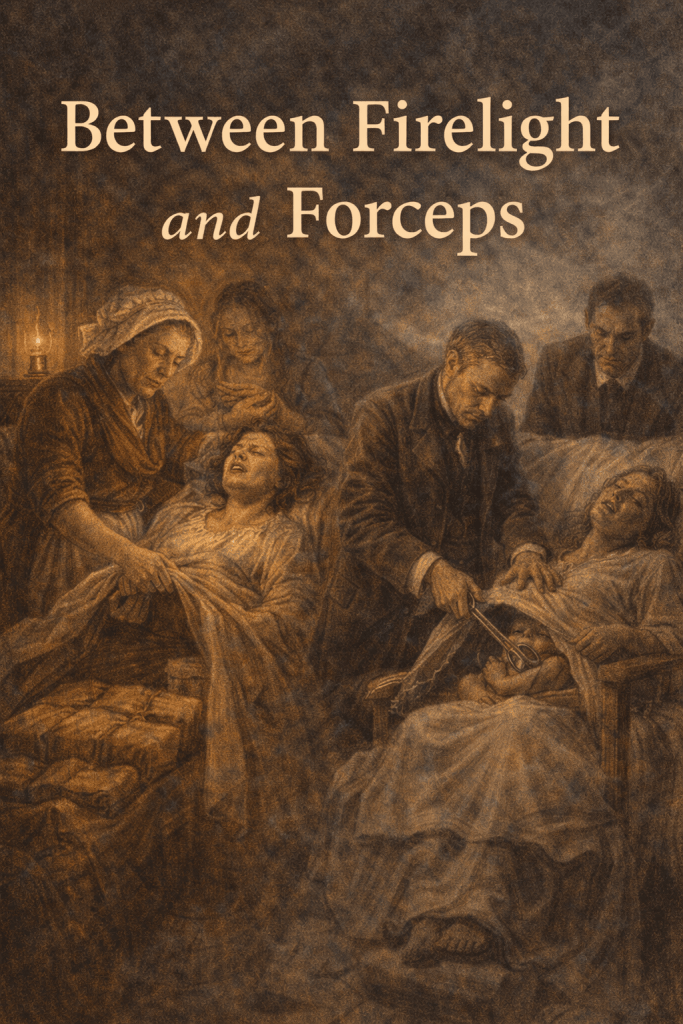
For most of human history, birth belonged to women. It unfolded in warm rooms where firelight flickered against familiar walls and the air held the scent of clean linen, herbs, and patience.
Birth was not summoned by bells or schedules but arrived in its own time, welcomed by hands that had done this work before. Midwives came quietly, often in the night, carrying no instruments of authority but an intimate knowledge shaped by years of watching bodies labour and lives begin.
They knew when to wait and when to act, when to murmur encouragement and when to fall silent. They understood that birth was not something to be commanded. It was something to be accompanied.
For centuries in Britain, midwives held unquestioned authority over childbirth. They were trusted figures within their communities, called again and again by the same families, sometimes across generations. Their knowledge was not written in books or delivered from lecture halls. It lived in memory, in muscle, in careful observation. It passed from woman to woman through apprenticeship, storytelling, and repetition.
Birth was not a medical event. It was a social one, woven into the life of the household and the wider community.
Women gathered. Experience gathered with them.
Midwives did far more than deliver babies. They confirmed pregnancies, eased fears, tended miscarriages, washed and wrapped the dead as gently as the living. They bore witness to beginnings and endings alike. They heard confessions spoken only in pain or relief. Their authority rested not on credentials but on trust, and for a long time, that was enough.
Then, slowly and almost imperceptibly at first, the balance shifted.
From the seventeenth century onward, medicine in Britain began to change its shape and its language. Universities expanded. Scientific inquiry gained prestige. Knowledge became something written down, formalised, codified in Latin and taught to men who could afford education and entry into professional life. Women were barred from these spaces by custom and law. What midwives knew through touch and time, physicians began to claim through theory and text.
Childbirth was gradually reframed.
Once understood as a natural process guided by experience, it came to be described as inherently dangerous, unpredictable, and in need of expert control. Male physicians, often called man midwives, entered the birthing room. Their presence carried social status as much as skill.
Among wealthy families, calling for a doctor became a symbol of refinement, progress, and modern thinking. Birth itself began to change character, moving from a communal female space to a stage upon which professional authority could perform.
Class reshaped birth as powerfully as gender. Poor and rural women continued to rely on midwives out of necessity, while the wealthy increasingly turned to doctors. This divide created a powerful illusion that medicalised birth was safer and superior. Yet in practice, outcomes did not always support this belief. In many cases, they quietly contradicted it.
One of the most potent symbols of this transformation was the forceps. Developed and closely guarded by male practitioners, most famously the Chamberlen family in Britain, forceps were treated as secrets rather than tools. For generations, the Chamberlens concealed their design, arriving at births with the instrument hidden in boxes or beneath blankets. Women in labour were sometimes blindfolded. Midwives were excluded from their use and often from witnessing them at all.
Technology became authority.
Knowledge became something proprietary, controlled, and unmistakably gendered.
As doctors gained influence, midwives found themselves increasingly scrutinised. They were examined, licensed, regulated, and criticised. Their mistakes were recorded meticulously. Doctors’ failures, by contrast, were often framed as tragic inevitabilities or acts of God.
Midwives were labelled unscientific, old fashioned, even reckless. The same experiential knowledge that had sustained communities for centuries was recast as ignorance.
Beneath this professional struggle lay much older fears. Midwives had always lived at the threshold between life and death. They knew herbs and blood. They touched bodies when few others were permitted to do so. In earlier centuries, such women had sometimes been suspected of witchcraft. As medicine professionalised, echoes of that suspicion lingered. Female bodily knowledge unsettled institutions built on male authority and abstraction.
Women felt the change intimately.
Doctors often arrived as strangers, armed with instruments and rules, speaking in technical language that left little room for comfort or consent. Birth became more controlled, more directed. Women were told when to push, when to lie still, when to endure. Emotional reassurance gave way to procedure. The familiar presence of a midwife was sometimes replaced by authority that did not ask permission.
The great irony of this transformation lay in safety. Early medical practice frequently increased risk rather than reduced it.
Doctors moved between patients without washing their hands, unaware of the invisible dangers they carried. Puerperal fever swept through lying in hospitals and private homes alike, killing thousands of women.
Midwives, who attended fewer births and used fewer invasive techniques, were often far safer. Yet the narrative of progress had already taken hold, and evidence struggled to be heard.
Still, midwives did not vanish.
They adapted. Some submitted to new regulations and formal training. Some worked alongside doctors, negotiating uneasy partnerships. In rural Britain, midwives remained the primary caregivers well into the nineteenth century, long after urban centres had embraced medical dominance. Women continued to trust them, valuing their calm presence, their familiarity, and their willingness to listen. Knowledge continued to pass quietly from hand to hand, mother to daughter, teacher to apprentice, even when official recognition lagged behind lived reality.
By the late nineteenth and early twentieth centuries, the struggle began to shift once more. Medical science improved. Hygiene practices changed. Evidence accumulated. Slowly, the value of midwifery was re recognised, not as a rival to medicine, but as its necessary companion. Midwives reclaimed professional standing, blending ancient experiential wisdom with modern understanding. Birth, once again, began to make room for both skill and compassion.
Today, midwifery stands as something both ancient and vividly alive. It carries the memory of a time when women guided women through birth without question, and the resilience of those who endured marginalisation without disappearing. The quiet struggle between midwives and doctors shaped not only medical practice, but how society understands women’s bodies, authority, and care.
This is not a story of simple villains and heroes. It is a story of power and fear, of knowledge gained and knowledge dismissed, of progress that sometimes forgot to ask what it left behind. It reminds us that improvement is rarely straightforward, and that what is lost in the name of advancement is not always easily recovered.
To remember this history is to honour the women who stood at the bedside when no one else would, who trusted bodies before instruments, who held life gently while the world argued over who should be allowed to do so.
Until next time.

Ta ta for now.

Yours, Lainey.