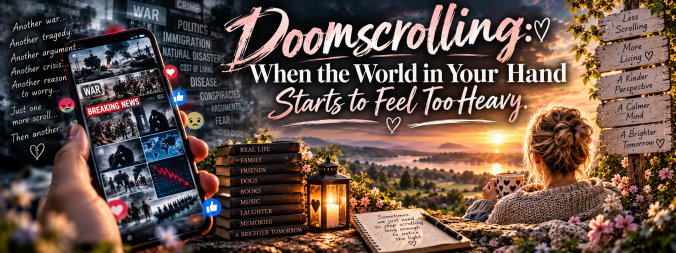
There is something rather extraordinary about the little rectangle most of us carry around in our pockets.
Within seconds, I can see what somebody on the other side of the world had for breakfast. I can watch a puppy learning to walk. I can discover a photograph of somewhere I would love to visit, learn something about an ancestor, listen to a song that makes me cry, laugh at something completely ridiculous, message somebody I love or discover something I never knew existed.
Our phones have given us the world. Quite literally. And yet, sometimes, that world feels unbearably heavy. Because somewhere along the way, many of us developed a rather strange habit.
We scroll. And scroll. And scroll.
A war.
Scroll.
A murder. Scroll.
A political argument.
Scroll.
A missing child.
Scroll.
Someone furious about immigration. Someone furious about the government. Someone furious about somebody being furious about the government. A natural disaster. A financial crisis. A disease. A warning. A prediction. A conspiracy. Another war. Another tragedy. Another reason why apparently everything is falling apart.
And before we know it, twenty minutes have disappeared and we are sitting there feeling considerably worse about the world than we did before we picked up our phone. There is a name for it.
Doomscrolling.
And I think it might be one of the strangest consequences of living in the age of social media.

We Were Never Meant to Carry the Whole World.
Human beings have always lived alongside terrible things.
Wars happened. People died. Crimes were committed. Governments made dreadful decisions.
Diseases spread. Natural disasters destroyed communities.
There has never really been a peaceful golden age when absolutely everything was wonderful.
But for most of human history, people didn't carry knowledge of every terrible thing happening across the planet around in their pocket.
Our ancestors knew about their village, their family, their neighbours.
Perhaps they read a newspaper or heard news from elsewhere.
But they weren't exposed, from the moment they woke until the moment they went to sleep, to an endless stream of human suffering.
We are.
And I sometimes wonder whether our brains know what on earth to do with it all. Because my phone can show me something heartbreaking happening thousands of miles away while I am sitting safely at home drinking a cup of coffee.
My brain sees it. My emotions respond to it. I feel sadness, fear, anger or helplessness. Then, with one movement of my thumb, another tragedy appears. And another. And another. There is barely enough time to process one before the next arrives. That cannot be nothing.

Negativity Has Power.
The uncomfortable truth is that negative things grab our attention.
A headline saying:
"Everything is reasonably okay today."
probably isn't going to have millions of people frantically clicking on it.
But:
"THIS CHANGES EVERYTHING."
"YOU NEED TO BE WORRIED ABOUT THIS."
"BRITAIN FACES DISASTER."
"EXPERTS ISSUE TERRIFYING WARNING."
Well...
Now you want to know what happened. I do too.
We tell ourselves we are just going to have a quick look. Then another headline appears. And another. Social media learns remarkably quickly what makes us stop scrolling. If anger makes us stop, we see more things that make us angry.  If fear keeps us watching, we see more things that frighten us.
If outrage makes us comment, outrage becomes incredibly valuable. And that is the part I find unsettling.
Because eventually, without necessarily realising it, we can begin to mistake what we are being shown for what the world actually is. They aren't necessarily the same thing.

The Algorithm Doesn't Know How You Feel.
An algorithm doesn't sit there thinking:
"Poor thing. She's had enough terrible news today. Let's show her a Labrador puppy falling a sleep in it’s water bowl."
It notices behaviour. You stopped. You watched. You clicked. You commented. You shared. So it gives you more.
And sometimes we interact with things precisely because we hate them.
We watch a video because we are horrified. We read the comments because we cannot believe what people are saying. We click an article because the headline frightens us. We reply because somebody has made us furious.
To us, that interaction might mean:
"This is awful."
To a computer, it can simply mean:
"This held her attention."
So...
Here is some more.

And Then Something Strange Happens.
After enough scrolling, the world can begin to look much darker than the world immediately around us. You put your phone down. Look out of the window. And...Nothing is happening.
Someone is walking their dog. A neighbour is putting the bins out. Someone somewhere is probably arguing with a self-service checkout. A child is laughing. Someone is making dinner. Someone has just fallen in love.
Someone has just received wonderful news. Somebody is holding their newborn baby for the first time. A nurse is comforting a frightened patient.
A stranger is helping another stranger. Someone has found a lost dog. Someone has forgiven somebody. Someone has planted a tree whose shade they may never live long enough to sit beneath.
Millions upon millions of ordinary acts of kindness are happening every day.
But most of them aren't breaking news.
"Man Helps Elderly Woman Carry Shopping to Her Car" probably won't trend worldwide.
"Family Has Quite Nice Sunday Lunch Together" isn't going viral.
"Millions of People Went About Their Day Without Hating Anybody" won't generate thousands of furious comments.
Goodness is often quiet. Fear is loud. And social media has a very large microphone.

The Comments Can Be Worse Than the Post.
Sometimes I make the mistake of reading the comments.
You would think I would have learned by now. I haven't.
A perfectly ordinary post can somehow descend into hundreds of strangers shouting at one another.
Politics, Religion, Immigration, Gender, War, Money, Race, Brexit, Climate change. Somebody could probably post a photograph of a cheese sandwich and eventually two strangers would be calling each other idiots over it.
There is something about being behind a screen that can make people forget there is another human being on the other side.
Words we might never say to someone's face are typed within seconds.
There is little pause. Little reflection. Little room for:
"Perhaps I don't know the whole story."
Instead, everything becomes certain.
Everyone chooses a side.
And the angriest voices often seem the loudest. But the loudest voices are not necessarily the majority. Sometimes they are simply...
the loudest.

Fear Keeps Us Coming Back.
Perhaps the strangest part of doomscrolling is that we often know it makes us feel awful. Yet we continue doing it. Just one more story. One more update. One more video. One more comment section.
Part of us seems to believe that if we keep looking, eventually we will reach the end and feel reassured. But social media doesn't really have an end.
There is always another post. Another opinion. Another crisis. Another prediction. Another person telling us we should be terrified about something we hadn't even considered being terrified about five minutes earlier.
There is no moment when the internet announces:
"That's everything. You're completely up to date. Put the kettle on."
It just keeps going.

I Don't Want to Become Ignorant.
There is another side to this. I don't want to bury my head in the sand. Terrible things do happen. Important things deserve our attention. People suffering deserve to be seen. Governments should be questioned.
Injustice shouldn't be ignored simply because looking at it makes us uncomfortable. Switching off completely isn't the answer.
But perhaps there is a difference between being informed and being consumed.
I can know what is happening without absorbing hours of anger every day.
I can care about the world without carrying every tragedy personally. I can disagree with someone without hating them. I can put my phone down. Perhaps that last one is more powerful than we realise.

Because My Real Life Isn't Inside My Phone.
This is the thing I have to remind myself. My actual life is here. It is in conversations. Family, Friends, Dogs, Cups of coffee. Books. Music. Laughter, Memories, Plans. The ridiculous little things that happen during an ordinary day. The people I love are not headlines. My home isn't a newsfeed. My future isn't decided by whichever frightening prediction appeared on Facebook this morning. And the world isn't made entirely of the worst things human beings did today.
Social media can connect us in extraordinary ways. It can reunite families. Preserve memories. Teach us things. Help us find communities. Give lonely people somewhere to belong.
Allow ordinary people to tell stories that once might never have been heard.
There is enormous beauty there. But there is darkness too.
And perhaps we need to remember that we are allowed to decide how much of it we let through the door.

Put the Phone Down Occasionally.
Maybe the answer isn't deleting social media.
Maybe it is simply remembering that it isn't reality in its entirety. It is a window. And somebody else often decides what appears through that window.
So every now and then, perhaps we should close it.
Put the phone down. Look around. Talk to somebody. Stroke the dog. Read a book. Go outside. Listen to music. Make something. Laugh at something completely stupid. Notice the ordinary world happening quietly around us.
This is something my hubby and I actually try very hard to do.
We have a strict no-phone time in the evenings. And I love it.
At a certain point, the phones are put down and the outside world is, for a little while at least, switched off.
No scrolling. No news. No arguments between complete strangers. No frightening headlines. No endless stream of people telling me what I should be angry about, frightened of, worried about or outraged by today.
Just us. Our home. Our little world. And I genuinely think my brain needs it.
It gives my brain time to shut off from all the noise of the outside world, something I think is very much needed in today's day and age.
Because we aren't really designed to be constantly available, constantly informed and constantly absorbing information from the moment we wake up until the moment we go to sleep.
Sometimes our brains need quiet. Mine certainly does.
Although, being me, even my attempt at switching off can occasionally create an entirely new argument inside my overactive brain.
Because if one of my nearest and dearest messages me during our no-phone time and I don't answer it until the following morning, I feel incredibly guilty.
And then it starts.
"What if they needed me?" "What if they think I was ignoring them?" "Should I have checked?" "What if something was wrong?"
Which is slightly ridiculous when you think about it.
Not that many years ago, people weren't contactable every second of every day.
You could ring someone's house and they simply weren't in.
You tried again later. That was it. Nobody panicked because they hadn't replied to a message within twenty minutes.
There were no little blue ticks telling us somebody had read something.
No "last seen at..." No notifications following us from room to room. No expectation that because somebody can contact us at any moment, we must therefore be available at every moment. And I think that is something I am still learning. Being contactable doesn't mean I have to be constantly available.
I can love my family with every fibre of my being and still answer their message in the morning. I can care deeply about the people in my life without carrying my phone around like an electronic umbilical cord.
And taking a few hours away from it doesn't mean I love anybody less.
It simply means that sometimes I need to give my brain permission to be quiet.
Although convincing my brain of that is apparently still a work in progress.
Perhaps that is another strange thing social media and smartphones have given us.
Not just the ability to be connected...but the guilt of occasionally choosing not to be. And maybe we need to become a little more comfortable with being unavailable, because there is a whole life happening beyond that screen.
While the internet is shouting that humanity is doomed, somewhere nearby somebody is probably doing something kind. Nobody filmed it. Nobody uploaded it. Nobody argued underneath it. It didn't go viral. It simply happened. And that is worth remembering.
Because the world contains terrible things. It always has. But it contains beautiful things too.
And if we spend too long staring at a screen designed to capture our attention, we might accidentally convince ourselves that the darkness is all there is.
It isn't. Sometimes we just need to stop scrolling long enough to notice the light.
Until next time,
Toodle pip,
Lainey.
Intwined — Because every life has a story worth telling.

