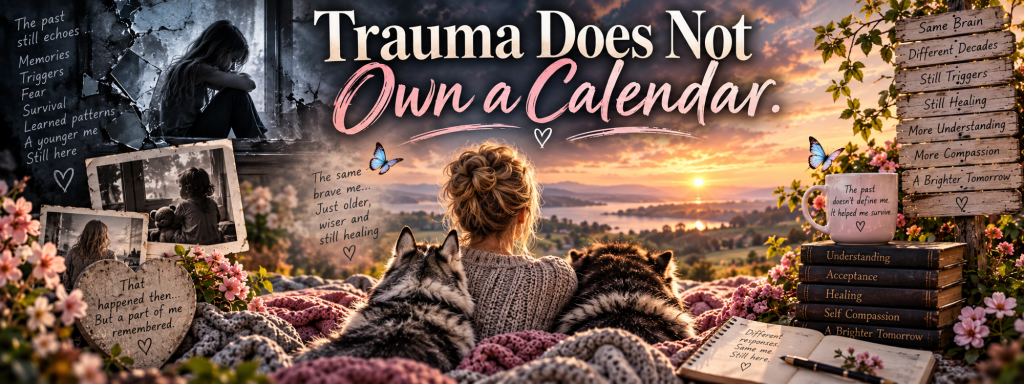
There is something I have come to understand about trauma.
It does not own a calendar.
It does not look at the date and think, Well, that happened thirty years ago. Time to pack up and leave.
It does not necessarily disappear because you grew older, built a life, raised a family, laughed again, loved again and became someone the younger version of you would barely recognise.
Sometimes trauma waits quietly.
And sometimes, decades later, you realise that something you thought belonged to your past has been travelling beside you all along.
Not because you chose to carry it.
But because your brain remembered.

I Thought Surviving Meant It Was Over
For a long time, I think I misunderstood what surviving meant.
I thought if something terrible happened and you somehow got through it, then eventually it became part of your history.
Something that happened then.
Life continued.
Days became months. Months became years. Years became decades.
You learned how to function. You went to work. You paid bills. You loved people. You laughed at ridiculous things. You celebrated birthdays and Christmases. You worried about your children.
You cooked dinner, cleaned the house, went on holidays and did all those wonderfully ordinary things that make up a life.
From the outside, the past looked like exactly that.
The past.
But the human brain is extraordinary.
And sometimes incredibly frustrating.
Because trauma can teach the brain lessons that it continues to remember long after the danger has gone.

The Brain Learns to Protect You
When something frightening, painful or overwhelming happens, our brain does not sit there calmly analysing the situation.
It reacts.
It tries to keep us alive.
Fight.
Flight.
Freeze.
Sometimes fawn.
Our nervous system can flood the body with stress hormones. Our attention narrows. We become alert to danger.
In that moment, those reactions can be incredibly useful.
The problem is that sometimes the brain becomes too good at protecting us.
It learns patterns.
It remembers sensations.
It notices voices, smells, places, expressions, situations and feelings that remind it, consciously or unconsciously, of something that once meant danger.
And years later, the logical part of you can be saying,
I'm safe.
While another part of your brain is screaming,
But what if you're not?
That is one of the strangest things about trauma.
You can know something intellectually and feel something completely different physically.

Thirty Years Can Disappear in a Second
Perhaps this is one of the hardest things to explain to somebody who has never experienced it.
Something can happen today that seems completely insignificant to everyone else.
A smell.
A sound.
A sentence.
Someone raising their voice.
A particular expression on someone's face.
A feeling of being trapped.
A situation where you suddenly feel powerless.
And for a moment, your body does not seem to understand that decades have passed.
Your heart races.
Your stomach turns.
Your muscles tighten.
You become angry, frightened, defensive or desperate to escape.
And afterwards you might even think,
Why on earth did I react like that?
Sometimes the answer is because your reaction was never entirely about today.
Today simply knocked on a door that was built a very long time ago.

Trauma Can Alter the Brain.
This was perhaps the part that fascinated me most when I began understanding trauma differently.
Trauma is not simply "thinking about something bad that happened."
Research has found associations between significant or prolonged trauma and changes in how brain systems involved in fear, memory, emotion and stress responses function.
Areas including the amygdala, hippocampus and prefrontal cortex are often discussed in trauma research.
In very simple terms, the amygdala helps detect potential threats.
The hippocampus plays an important part in memory and placing experiences into context.
And areas of the prefrontal cortex help us reason, regulate emotions and recognise that what happened then is not necessarily happening now.
Trauma can affect the communication between these systems.
It can leave the brain more sensitive to possible danger.
Which means something I once thought was a weakness can sometimes be understood very differently.
Hypervigilance.
Overthinking.
Always looking for what might go wrong.
Being startled easily.
Struggling to trust.
Feeling uncomfortable when you cannot control a situation.
Reacting strongly to something other people consider insignificant.
Sometimes these behaviours have a history.
Sometimes they began as protection.
The brain learned:
Watch carefully.
Be prepared.
Don't let it happen again.
And then nobody told the brain when the war was over.

The Child, Teenager or Younger Adult Does Not Simply Vanish.
There is another part of this that I find incredibly moving.
We sometimes talk about our younger selves as though they were completely different people.
That happened to me when I was young.
But that younger person did not disappear.
She grew.
She became you.
Her brain became your brain.
Her memories travelled with you.
Her survival strategies may have travelled with you too.
And perhaps some of the things we dislike about ourselves as adults make a little more sense when we understand where they came from.
Perhaps the person who constantly expects something to go wrong once learned that terrible things really can happen without warning.
Perhaps the person who hates confrontation once learned that keeping quiet felt safer.
Perhaps the person who needs reassurance learned very early that security could disappear.
Perhaps the person who seems fiercely independent once discovered that depending on somebody could hurt.
That does not mean every personality trait is caused by trauma.
Human beings are far more complicated than that.
But sometimes understanding our history allows us to look at ourselves with curiosity instead of criticism.
Instead of asking,
"What is wrong with me?"
we can ask,
"What happened that taught my brain to respond this way?"
Those are two very different questions.
Time Does Not Automatically Heal Everything
We often say, time heals.
I am not sure I completely believe that anymore.
Time can soften things.
Time can give us distance.
Time can allow us to build beautiful things around painful memories.
But time alone does not necessarily teach the nervous system that it is finally safe.
Sometimes healing happens because, years later, we finally understand what happened to us.
Sometimes it happens because somebody listens.
Sometimes it happens through therapy.
Sometimes through talking.
Sometimes through writing.
Sometimes simply through recognising a pattern and thinking,
Oh.
That's where you came from.
And suddenly a piece of yourself that never made sense begins to fit into the puzzle.
Decades Later Does Not Mean Too Late
Perhaps that is the most important thing I have learned.
If something that happened decades ago still affects you, it does not mean those decades were wasted.
It does not erase everything you have achieved since.
Look at everything that happened in between.
You lived.
You loved.
You survived days you once thought impossible.
You created memories that had absolutely nothing to do with the thing that hurt you.
Trauma may have helped shape parts of your brain and your behaviour.
But it did not write every chapter.
And the brain itself gives us another extraordinary reason for hope.
It can change.
Our brains remain capable of learning and adaptation throughout life. New experiences, relationships, understanding and appropriate support can help us develop different responses.
The brain that learned danger can also learn safety.
The brain that learned run can gradually learn stay.
The brain that learned trust nobody can discover that some people are trustworthy.
The brain that spent years waiting for the next disaster can slowly begin to understand that sometimes nothing terrible is coming.
Perhaps healing is not about somehow becoming the person we would have been if the trauma had never happened.
We can never know who that person might have been.
Perhaps healing is about understanding the person who survived it.
About finally meeting ourselves with compassion rather than frustration.
About recognising that some of our strangest reactions might once have been ingenious survival mechanisms.
And then gently telling our brain:
Thank you.
You protected me when I needed you.
But you don't have to fight that battle anymore.
Because trauma does not own a calendar.
Thirty years can pass and the brain can still remember.
But thirty years passing also means something else.
You are still here.
And perhaps the most remarkable thing about the human brain is not simply that trauma can change it.
It is that healing can change it too.
Until next time,
Toodle pip,
Lainey.
Intwined — Because every life has a story worth telling.

