When April turned to May in the year 1919, the world was slowly finding its breath again. The guns had fallen silent, the soldiers had come home, and villages like Lockerley and Mottisfont were stirring gently back to life. The air smelled of new beginnings, damp earth, wild violets, the smoke of morning fires curling from cottage chimneys. It was in that tender season of renewal that Eva Kate Hatcher, no longer the girl of Newtown and Carters Clay, became Mrs. Eva Newell, the wife of Frank Newell, a good and steady man of the Hampshire soil.
Their marriage, though humble in setting, was rich in heart. Frank, a general labourer by trade, brought home the scent of the fields and the sound of honest work upon his boots. Eva, his gentle bride, brought warmth, grace, and quiet devotion, her hands soft from washing, her smile patient, her spirit deeply rooted in the rhythms of home. Together, they made their life along Romsey Road, Lockerley, in a small cottage trimmed with ivy and wild roses, where laughter and the scent of baking bread became the measure of their days.
The years that followed were not always easy, but Eva was no stranger to endurance. She had known loss too soon and sorrow too often. She had watched her parents bury their children, had stood beside her mother through grief and war, had learned that love is as much about carrying on as it is about holding close. And so she carried on, with quiet courage and a steadfast heart, through the seasons of her married life.
The mornings began with the rattle of the kettle on the stove and the crackle of kindling in the hearth. Frank would take his tea strong and his bread thickly buttered before stepping out to work, his cap pulled low, his footsteps echoing down the lane. Eva would watch him go from the window, her hand resting upon the sill, before turning to her day, the washing, the sweeping, the endless rhythm of care that kept the household humming. Yet she did it all with love, for it was love that gave meaning to the ordinary.
On Sundays, the church bells of St. John’s, Lockerley, rang out once more, no longer the mournful toll of loss but the steady peal of endurance. Eva would walk the lane to service with Frank by her side, her gloved hands folded around her prayer book, her head bowed as the vicar read from the Gospel of John: “Let not your heart be troubled; ye believe in God, believe also in me.” The hymns she loved most were those her mother once sang “Abide With Me” and “The Day Thou Gavest, Lord, Is Ended” their words a balm to the weary, a reminder that faith and love endure beyond grief.
As the years unfolded, the world changed around them. The bright hopes of the 1920s gave way to the lean years of the Depression, when every coin counted and every loaf was stretched to feed a family. Yet Eva’s home remained a haven, tidy, fragrant with lavender and polish, her mending basket always by her chair. The Second World War came and went, its sirens echoing even through the quiet lanes of Hampshire. Eva kept calm and carried on, her courage quiet but unyielding. She was the heart of her family, her cottage a refuge from the uncertainty that gripped the wider world.
By the time peace returned once more, the young bride of 1919 had become a matronly figure with silvering hair and the soft-lined hands of a woman who had built her life one humble day at a time. She had grown into the very image of her mother, patient, resilient, endlessly kind. Children and grandchildren would come to sit at her knee, listening to her stories of the old daysm of the mills and fields, of the church at Lockerley, of her father George and her sister Florence. Her laughter was gentle, her memory sharp, her heart forever anchored to the soil of Hampshire.
And though time carried her into the modern age, past ration books and coronations, through the hum of motorcars and the wonder of electric light, she never forgot the simple truths that had shaped her: that love is endurance, that faith is quiet strength, and that even the smallest life can hold great beauty when it is lived with tenderness.
In her final years, as the world grew louder and faster, Eva remained the same, steady, humble, true. The lanes she had walked as a girl still wound through the same fields, though the cottages had changed, and the old mill’s wheel turned slower now. Yet when the evening light slanted through her window and the air filled with the scent of lilac, she could still hear the faint echo of her past, the laughter of her sister, the voice of her mother, the proud footsteps of her father walking home from work.
When her time came in 1973, at nearly eighty years of age, Eva left the world as she had lived within it, quietly, gently, surrounded by love. Her story, written not in grand gestures but in the tender ink of everyday life, came full circle. From Carters Clay to Lockerley, from daughter to wife, from loss to love enduring, she was, and remained, the beating heart of all who came after her.
And though her name now rests upon a headstone weathered by Hampshire rain, the spirit of Eva Kate Hatcher, Mrs. Newell, still lingers in the fields and lanes she once walked, in the warmth of remembered hearths, and in the generations who carry her story forward, through love, through memory, and through time itself.
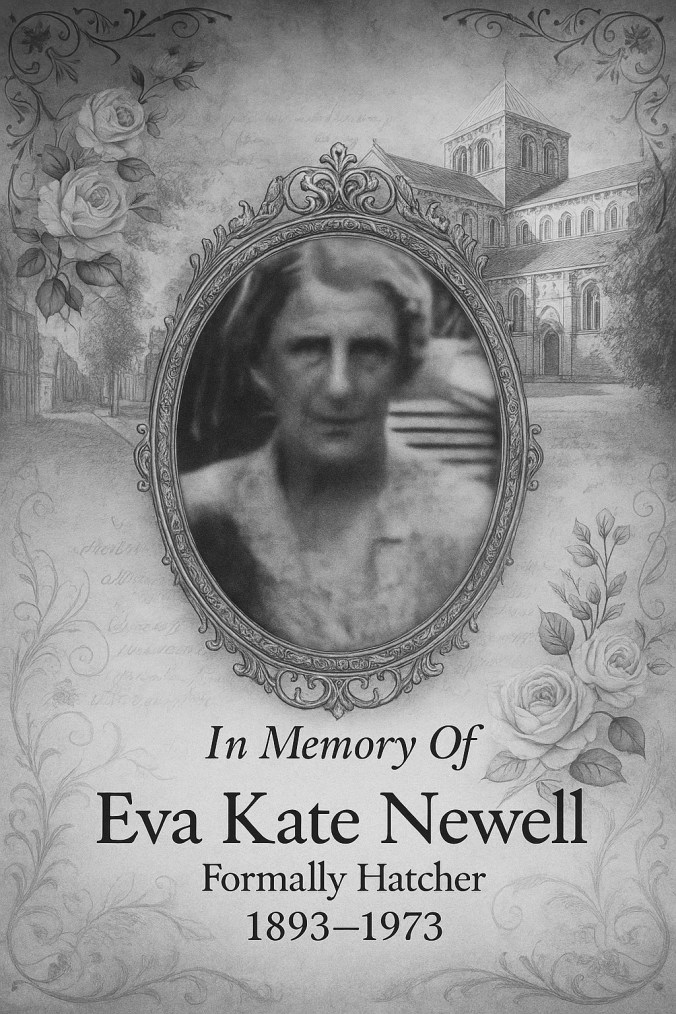
When Eva Kate Hatcher first drew breath on a warm August morning in 1893, the world around her was one of horses and hearthfires, fields and faith, a world lit by oil lamps and softened by the rhythm of rural life. England was still deep in the embrace of the Victorian era, ruled by Queen Victoria, a monarch whose influence had stretched across more than half a century. Empire, industry, and invention were reshaping the nation, yet in the quiet hamlets of Hampshire, life remained rooted in the turning of the seasons, the hum of the mill, and the steady toil of hands upon the land.
By the time Eva reached her twenty-fifth year in 1919, the world had transformed beyond anything her parents could have imagined. She had been born into a century of horses and candles and had come of age in one of motorcars and electricity, of suffragettes and soldiers, of loss and resilience. The England of her youth was gone, replaced by a nation reshaped by war, by progress, and by pain.
In her childhood home in Newtown, Lockerley, life had been humble but filled with love. Her father, George, rose with the dawn, his hands already roughened by years of labour in the fields and flour mills, while her mother, Fanny, tended hearth and home, baking bread in a soot-blackened oven, scrubbing linen in cold well water, and caring for her growing brood. Eva had known the simplicity of an age before electricity, when light came from flickering lamps and warmth from the coal fire that never quite chased the chill from the cottage corners. Her world was the lane, the chapel, the hedgerows blooming with wildflowers and the laughter of her brothers and sister as they played among the fields.
But woven through those early years was sorrow. Even as a little girl, Eva learned the ache of loss, for four of her parents’ six children died before their time, small graves marked by tender hands in the churchyard of Lockerley. Her father’s steady strength and her mother’s quiet faith carried the family through, but grief left its mark on them all. It was in those years that Eva’s heart grew deep and compassionate, shaped by watching her mother’s resilience, her father’s endurance, and the way love could survive even the cruelest of storms.
By the time she was seven, in 1901, England had changed hands, Queen Victoria had died that January, and a new century had dawned under King Edward VII. For the first time, the world felt different: there was talk of electricity, of telephones, of women working beyond the home. Yet in Carters Clay, Lockerley, life moved gently forward. Eva likely helped her mother with washing and mending, fetched water from the pump, and learned her letters by lamplight after supper. On Sundays, she would have sat beside her family in the small Methodist chapel, her voice rising in hymns such as “All Things Bright and Beautiful” and “O For a Thousand Tongues to Sing.”
As she grew into a young woman, England too grew restless. By 1907, her grandmother Mary Ann Pearce had passed away in nearby West Wellow, another loss that etched its quiet ache into the Hatcher line. Two years later, in 1909, tragedy struck again when her beloved brother Ernest, only nineteen, succumbed to meningitis. The family moved often, from Newtown to Carters Clay to Dunbridge, Mottisfont to Ratley, Awbridge, chasing work where it could be found, George’s steady hands now tending engines at the flour mills by the River Test. Each move meant fresh beginnings, yet the sorrow of absence followed them always.
When George himself died in 1913, aged just fifty-seven, Eva’s world cracked open. He had been the pillar of her childhood, the quiet anchor of the Hatcher home. His death, witnessed by Fanny and likely by Eva herself, left their modest cottage hollow and silent. That spring, when his body was lowered into the churchyard of St John’s, Lockerley, beside the children he had already buried, Eva stood at her mother’s side, learning the weight of final goodbyes.
And then came the war.
In August 1914, Britain declared war on Germany. The men of Lockerley and Mottisfont, farmers, carters, millhands, answered the call, marching off to battles in places few could find on a map. The trains that once carried grain and timber now carried soldiers and sorrow. For women like Eva, life became one of waiting and working, taking on tasks the men had left behind, tending families alone, sewing for the Red Cross, and reading every scrap of news that drifted through the village like a ghost. The war touched every corner of Hampshire. Its shadow fell long over Romsey, where convalescent soldiers filled Broadlands House, and over the Test Valley, where telegram boys on bicycles brought news that shattered homes.
When peace finally came in November 1918, it was bittersweet. The village bells that had long been silent for funerals now rang for armistice, their sound echoing through frost and memory. But joy was tempered by grief, too many had not come home. Even within Eva’s own family, tragedy struck again: her beloved sister, Florence Fanny Dowling, died just weeks later in December 1918, leaving behind four young children. For Eva, it was another cruel twist of fate, another empty chair at the family table.
By the spring of 1919, when she stood before the registrar in Romsey and became Mrs Eva Kate Newell, the world had turned over completely from the one she had been born into. She had begun life under the soft rule of Queen Victoria and now lived in the reign of King George V, a world reshaped by war, women’s voices rising, and machines replacing muscle. She had seen carriages give way to motorcars, lamps to electric bulbs, the old quiet of the countryside replaced by the restless hum of modernity.
Yet through all this, Eva had endured  steady, gentle, and unyielding, much like the Hampshire soil that had borne her family for generations. Her life, already marked by love and loss, stood as a testament to the quiet courage of ordinary people who weathered extraordinary times.
From the flickering lamplight of her childhood cottage to the fresh spring sun that shone upon her wedding day, Eva’s journey had been one of resilience, grace, and faith. The world around her had changed beyond recognition, but her heart remained steadfast, anchored in family, in love, and in the enduring belief that even after sorrow, life, somehow, always begins again.
And so it was the year 1919, Romsey, Hampshire, England.
The air is thick with the mingled scents of renewal and remembrance. The Great War has ended barely a year ago, and the echoes of its toll still linger in every heart, every street, every field of England. In Romsey, a market town nestled within the quiet beauty of Hampshire, life is slowly knitting itself back together. The church bells toll once more for weddings instead of funerals, and the lanes, long shadowed by grief, are bright again with the laughter of returning soldiers and the clatter of horse carts on cobbled roads.
Upon the throne sits King George V, a steady figure of duty and restraint, his reign marked by both loyalty and loss. The Prime Minister is David Lloyd George, the “Welsh Wizard,” whose government now struggles to turn a war-torn nation toward peace. Parliament debates tirelessly within the grand halls of Westminster, the echoes of change resounding through its chambers as the newly enfranchised voices of women and working men begin to shape the country’s future. Britain in 1919 stands on the edge of transformation, old traditions straining under the weight of a new, uncertain world.
In the countryside of Hampshire, life moves to a gentler rhythm. The difference between the classes is still deeply felt, though softened slightly by the shared sacrifices of the war. The rich return to their estates and manors, their grand drawing rooms lit once more by chandeliers and laughter, though many have lost sons and heirs on the battlefields of France. The working class, men like Frank Newell and the late George Hatcher, continue to toil in fields, mills, and railway sheds, their hands coarse from labour but their hearts proud. The poor, often widows, orphans, and the wounded, struggle to rebuild lives from scraps, some dependent on meagre pensions, others relying on charity or the kindness of neighbours. Yet even in hardship, there is resilience, a quiet dignity that holds the fabric of rural life together.
Fashion, too, reflects this shift between old and new. The lavish silks and corsets of the Edwardian era have given way to simpler, freer styles. Women, emboldened by their wartime roles, walk Romsey’s high street in calf-length skirts and blouses, their hair cropped shorter, their hats smaller, their spirits bolder. Men favour sturdy tweeds, flat caps, and the reliable comfort of worn leather boots. The soldiers’ uniforms, though faded, are still worn with pride on Sundays, reminders of courage and sacrifice.
Transportation hums softly through the landscape. Horses still pull carts along the lanes toward the Romsey market, but the cough and rattle of motorcars are now increasingly common. Bicycles, too, are everywhere, especially among the young, symbols of freedom and mobility in a world rediscovering movement. The railway at Dunbridge and the nearby stations thrum with steam and smoke, carrying passengers between Winchester, Salisbury, and Southampton. Travel feels like a luxury, yet also a promise, as people venture further than they once dared.
Houses in 1919 are humble but cherished. In places like Lockerley and Mottisfont, red-brick cottages line narrow lanes, their hearths the heart of family life. Heating comes from open fires or small iron stoves, the air scented faintly of coal and woodsmoke. Lighting, too, remains modest, oil lamps and candles flicker in the evenings, their soft glow falling upon simple furnishings, handmade quilts, and the ever-present family Bible on the mantelpiece. Only wealthier homes, or those near the town centre, boast electricity. Yet even without modern convenience, there is warmth, both literal and of the soul.
Hygiene and sanitation are practical matters, not yet refined. Water is drawn from wells or village pumps, and outdoor privies are still the norm in many homes. Soap, once scarce during the war, is now more readily available, and women like Fanny Hatcher scrub their families’ clothes on washboards, hands raw but hearts proud. The influenza pandemic, which swept through Britain only a year earlier, has left its shadow still, its memory a quiet fear that lingers behind closed doors. Many still wear mourning ribbons for those it claimed.
The table of 1919 is one of simplicity and gratitude. Rationing has ended, but habits of frugality remain. Meals are hearty, thick soups, bread and dripping, boiled potatoes, cabbage, and bacon when it can be afforded. Sunday dinners might feature a joint of beef or lamb shared among family, and puddings sweetened with golden syrup or treacle. Tea remains the constant comfort, poured steaming into chipped cups beside the fire, where stories are told and prayers softly murmured before bed.
Entertainment in Romsey is gentle and communal. The wireless has not yet reached most cottages, so evenings are filled with song, storytelling, and laughter. The local pub buzzes with conversation, its low ceilings echoing with folk tunes and the clink of tankards. Dances are held in parish halls, gramophones spinning the latest waltzes and foxtrots. For the young, there are outings by bicycle to the Test Valley, picnics by the river, or strolls through the quiet lanes beneath a canopy of hawthorn and elm. Courtship, for a girl like Eva, is tender and restrained, stolen glances, shy smiles, letters written in careful script, and walks chaperoned by fading daylight. A kiss, if it happens, is rare and sacred, a whispered promise rather than a passion.
Schooling has grown more accessible, though many children still leave early to work or help at home. Lessons are strict, teachers stern, but knowledge is treasured. In every classroom, a portrait of the King hangs above the chalkboard, and prayers begin and end the day. Religion remains the steady heartbeat of life, Sunday services, Methodist hymn singing, and the toll of the church bell that calls the faithful to gather, rain or shine. Faith is less about grandeur and more about endurance, about finding grace in small things: the bloom of spring after loss, the warmth of community after war.
The gossip of the day is a mixture of relief and restlessness. Women speak of new freedoms, the vote, the right to work, the promise of equality, while men talk of wages, rebuilding, and the slow return of peace. There are whispers of change in the air, a sense that the world has shifted forever. Yet in the heart of Hampshire, life holds to its familiar rhythm: the rhythm of the seasons, the pull of the land, the resilience of ordinary people who have seen too much but endure all the same.
And so, in 1919, as Eva Kate Hatcher becomes Mrs. Eva Kate Newell, she steps into a world both weary and hopeful. The war is over, but the work of living has only just begun. The earth is scarred, yet fertile, hearts are broken, yet brave. And amidst it all, love, quiet, steadfast, and enduring, remains the truest constant of all.
It was Saturday, the 15th day of November in the year 1919, a soft and misty morning in Romsey, Hampshire. The town, still catching its breath after the long shadow of the Great War, stirred quietly as a new life prepared to enter the world. At Number 157 Middlebridge Street, a modest brick cottage warmed by the steady glow of the hearth, Eva Kate Newell (née Hatcher) laboured through the long and tender hours of childbirth, her heart trembling between pain and wonder.
The year was one of healing and hope. Fields once trampled by sorrow were green again, and though the bells of Romsey Abbey rang more gently now, their chime carried a promise of renewal. Within that humble home, Eva, young, steadfast, and shaped by the times that had tested her generation, brought forth her firstborn son.
The world outside was hushed, but inside the little room, life quickened. The rhythmic crackle of the fire kept time with Eva’s laboured breath. Perhaps the midwife, a local woman with years of quiet wisdom, whispered reassurance, her hands steady and sure. Birth in those days was a sacred and perilous passage, no hospital machines, no sterile white corridors, only the ancient courage of women and the nearness of those who loved them.
And then, at last, as morning gave way to the pale amber light of afternoon, a child’s first cry broke the stillness. It was the sound of renewal, a note of pure, trembling life. Donald George had arrived. His mother, exhausted yet radiant, cradled him against her breast, her tears of relief mingling with quiet laughter. The world beyond the curtained window seemed suddenly brighter, the November air charged with something almost holy.
Frank Newell, her husband, a general labourer and once a Private in the Wiltshire Regiment, looked down upon his tiny son with pride swelling in his chest. The war had taken much from him, yet here, in his arms, was all that was worth living for. The home at Middlebridge Street, modest though it was, glowed with the warmth of a family made whole.
In the days that followed, Eva rested, wrapped in the gentle rhythms of new motherhood, the lull of feeding, the soft sighs of her sleeping baby, the scent of woodsmoke and soap in the air. Life was not easy in 1919, but there was a quiet dignity in the simple things: the sound of Frank’s boots on the cobbled street as he returned from work, the clink of the milk pail, the murmur of neighbours at the door offering congratulations and advice.
And when, on Friday the 19th day of December, 1919, Frank walked to the Registrar’s Office to record the birth of his beloved son, he did so with a heart both humble and proud. With careful hand he signed the register, his name beside Eva’s, a small act that immortalised their joy in ink and parchment.
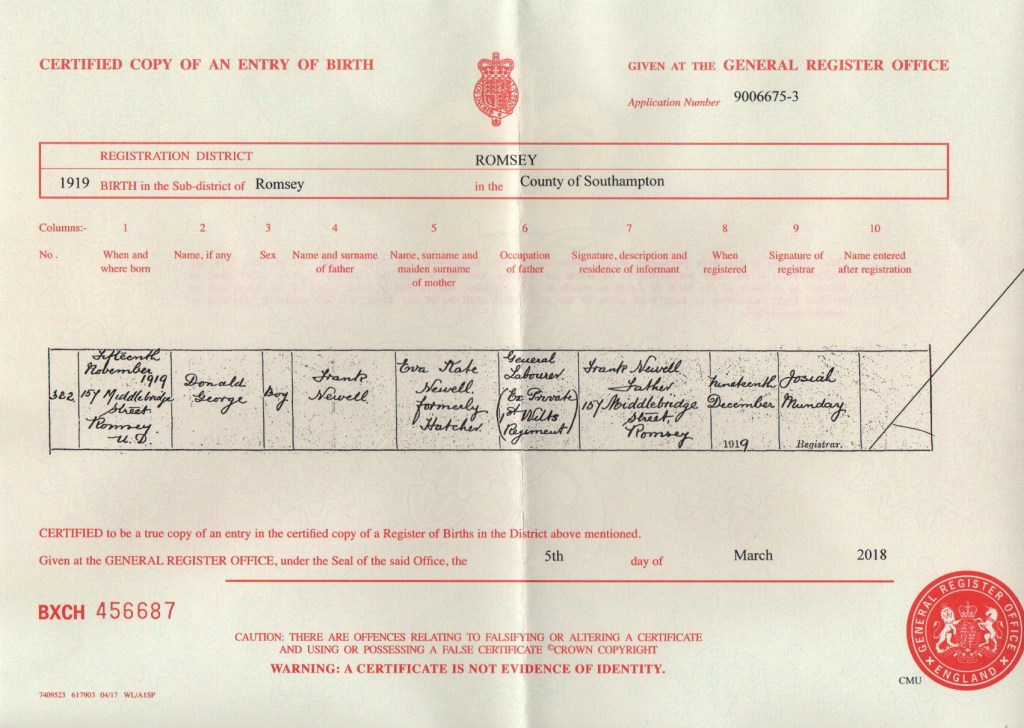
Registrar Josiah Munday, steady in his duty, entered the details into the official record:
No.: 382

When and where born: Fifteenth November 1919, 157 Middlebridge Street, Romsey U.D.

Name, if any: Donald George

Sex: Boy

Name and surname of father: Frank Newell

Name, surname and maiden surname of mother: Eva Kate Newell, formerly Hatcher

Occupation of father: General Labourer (Ex-Private of Wiltshire Regiment)
Signature, description, and residence of informant: Frank Newell, Father, 157 Middlebridge Street, Romsey

When registered: Nineteenth December 1919
Signature of Registrar: Josiah Munday
Name entered after registration: —
And so it was that in the heart of Romsey, in a quiet street lined with ordinary homes and extraordinary stories, the Newells began a new chapter, one written not in grand deeds or riches, but in love, endurance, and the tender miracle of new life.
Donald George’s birth marked more than the beginning of one small boy’s journey, it was the quiet unfolding of a legacy that would ripple through time, a golden thread binding generations yet to come. His first breath not only crowned the courage of his mother, Eva, but also became the bridge that would one day connect my father and me. Donald was my father’s father, my grandfather, the living link through which love, memory, and blood have flowed across a century. His life began as a testament to the strength and grace of Eva, a woman who, like so many of her time, carried both the weight of the past and the bright promise of the future in her gentle, steadfast heart.
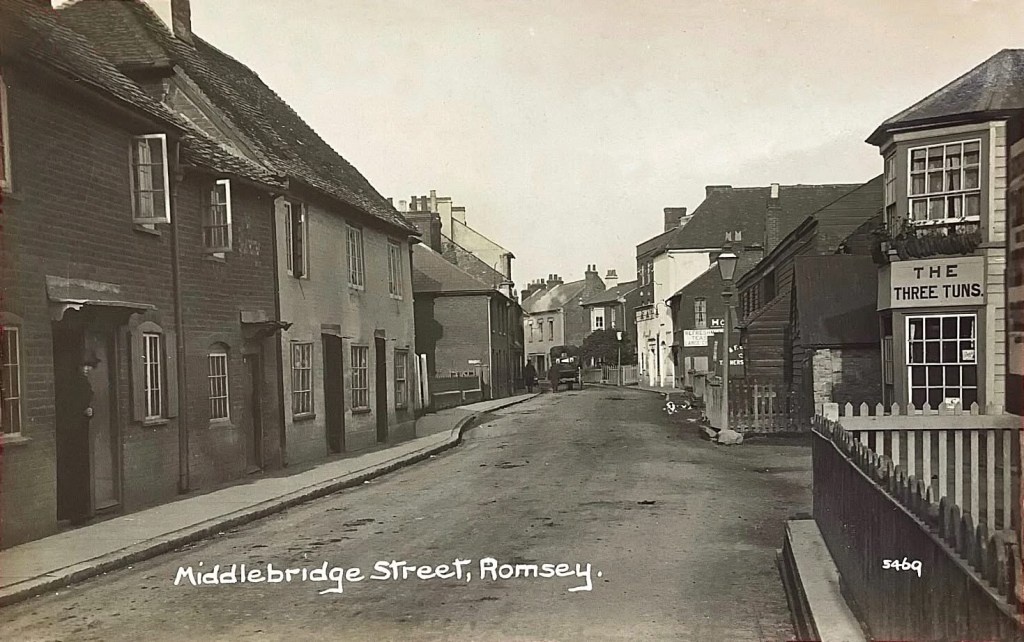
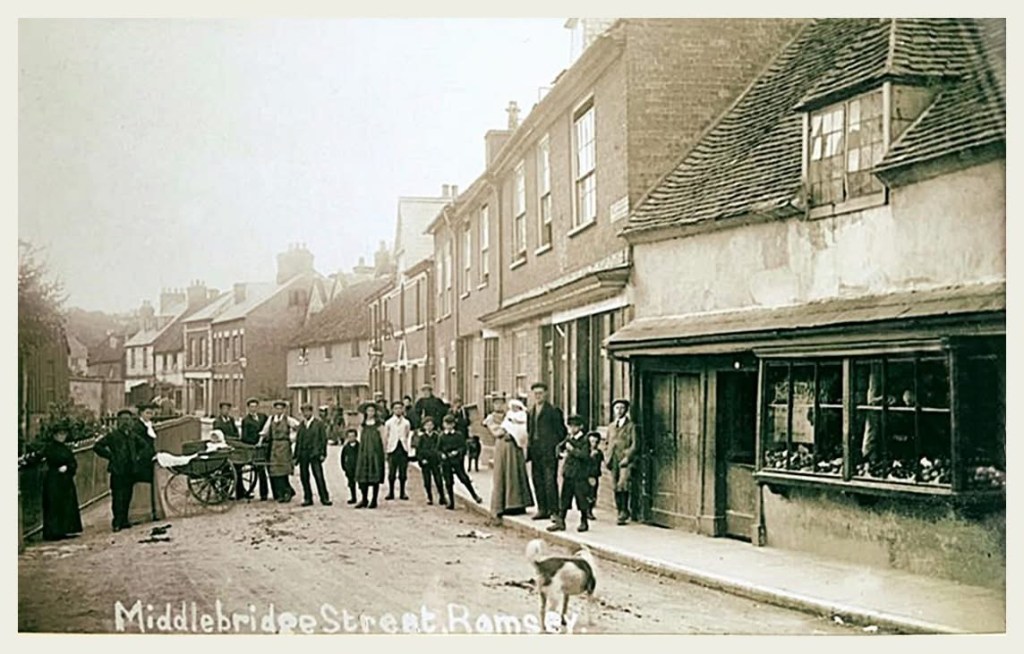
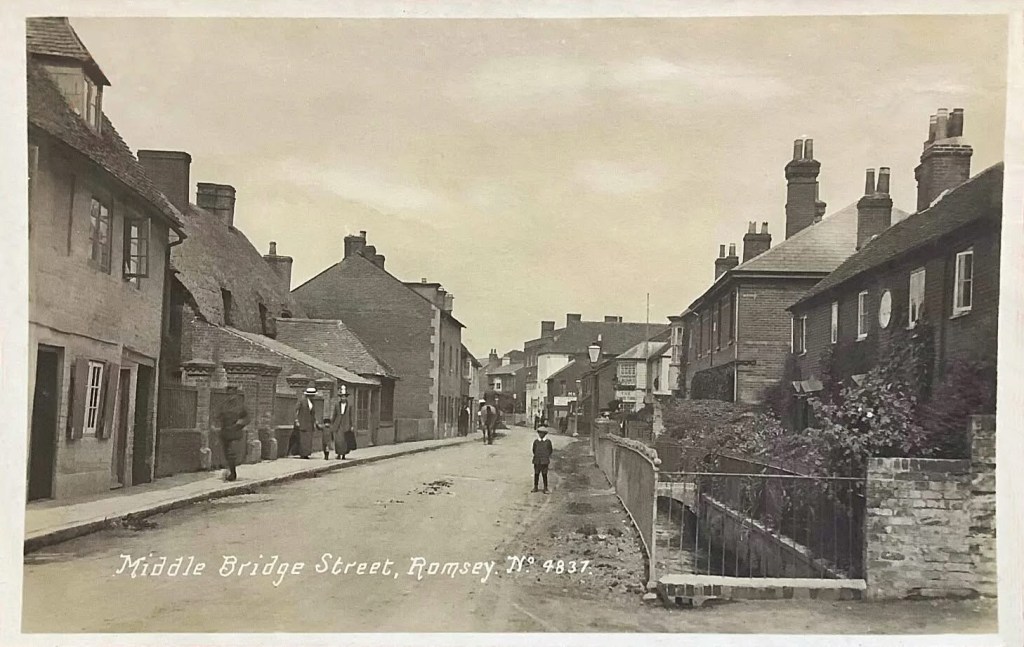
Middlebridge Street in Romsey slips south from the market town towards the River Test, ending at Middle Bridge and the approaches to the Broadlands estate, for centuries it has been one of the town’s working spines, with a stream running beside the roadway and a dense run of old cottages and workshops, many now listed for their historic interest. The bridge at the foot of the street is ancient in origin, the site appears in a 10th-century charter defining Romsey Abbey’s lands, there may have been a bridge here from the thirteenth century, and the structure known in later times as Middle Bridge or Mainstone Bridge was rebuilt on eighteenth-century foundations after a county survey by the engineer Robert Mylne; in the twentieth century its line fed into the town bypass. For generations the street was busy with small industries and everyday institutions, tanneries and abattoirs, a timber yard and saw mill, three schools, three public houses and a church, so that by the nineteenth and early twentieth centuries it read like a compact town within a town. The Three Tuns still anchors local memory in records stretching back to the eighteenth century, while the Bridge Tavern stood at the junction with the main road until its closure in 1911. The river and its causeway shape daily life here, the private road and public footpath linking Middlebridge to Sadler’s Mill and on to the Memorial Park and Abbey, a circular walk that has long stitched together Romsey’s most picturesque corners. In times of upheaval the crossing also mattered, during the Civil War, when Royalists and Parliamentarians traded control of the town, local tradition and histories recall a skirmish on or near Middle Bridge in 1643, a reminder that this quiet approach to the river once formed a defensive threshold. Today the street’s fabric, surviving timber-framed fronts, brick façades, and doorways that open almost directly onto the pavement, tells the layered story of a riverside community where tradespeople lived above their work, where children walked to nearby schools and pubs served the shift changes from mills and yards, and where a newborn like Donald George in 1919 would have entered a world steeped in the sounds of water, cartwheels, and workshop hammers along the Test.
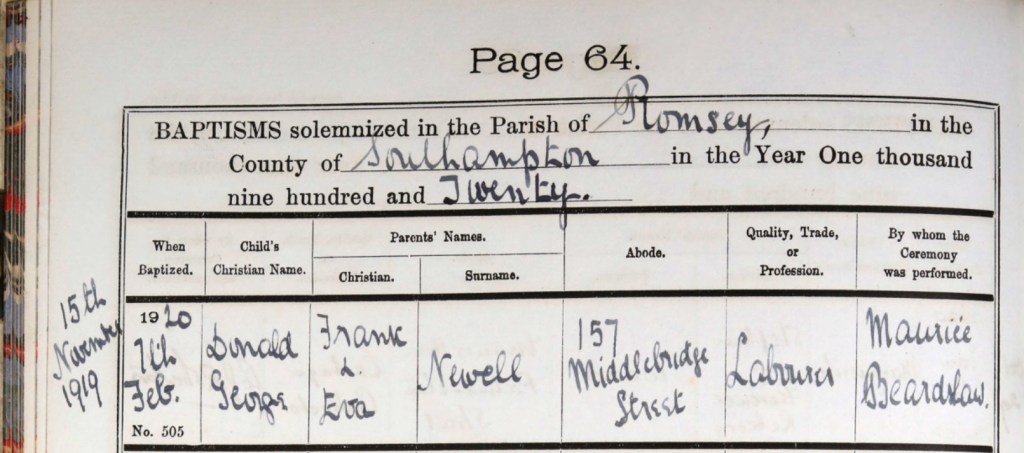
It was a winter’s day, Saturday the 7th day of February in the year 1920, when the pale morning light fell softly through the ancient windows of Romsey Abbey, its beams dancing upon the worn stone and whispering across centuries of prayer. Outside, frost clung to the hedgerows, and the River Test murmured quietly beneath a thin veil of mist. Inside, the air was still and sacred, scented faintly with candle wax and cold stone, a place where heaven seemed to rest gently upon the earth.
Into this timeless haven came Eva and Frank Newell of 157 Middlebridge Street, a young couple of simple means but great devotion. Frank, his work-worn hands now tenderly steady, and Eva, her heart full to overflowing, carried their precious son, little Donald George, into the heart of the Abbey to be welcomed into the Christian faith and the embrace of their Romsey community.
Eva’s shawl was drawn close around her shoulders, her cheeks touched with the chill of the February air. Yet within her heart was only warmth, the fierce, trembling joy of a mother presenting her child before God. Donald, swaddled against her, was still and bright-eyed, a quiet miracle in her arms. For Eva, this day was not merely a ritual; it was a prayer made flesh, an offering of gratitude for life after hardship, for love after loss, and for hope that might yet endure through him.
The Abbey stood as it had for centuries, vast and eternal, its arches rising like open arms to the heavens. Candles flickered upon the ancient stone font, where so many before had been named and blessed. The Reverend Maurice Beardshaw, in his flowing vestments, received the family with solemn kindness. His voice, calm and measured, echoed softly through the nave as he spoke the words that would bind Donald to the long story of faith that had filled those walls since before memory.
The water, cool and clear, touched the child’s brow, and in that instant, something eternal stirred. Eva’s eyes glistened as she watched; her soul seemed to widen with both humility and wonder. Frank stood close beside her, his heart full of quiet pride, a man who had once stood on fields of war, now standing within a house of peace, watching his son begin his own journey beneath the blessing of God.
And so, upon Page 64 of the Romsey Parish Register, the moment was preserved for all time:
BAPTISMS solemnized in the Parish of: Romsey
 in the County of: Southampton
in the Year One thousand nine hundred and Twenty
When Baptized: 7th February 1920

Child’s Christian Name: Donald George

Parents’ Names: Frank and Eva Newell

Abode: 157 Middlebridge Street

Quality, Trade, or Profession: Labourer

By whom the Ceremony was performed: Maurice Beardshaw

Note in margin: 15th November 1919 – Date of birth

Entry No.: 505
With that inscription, Donald’s name was woven forever into the tapestry of Romsey’s parish life, his story becoming part of something older and greater than himself. Beneath the Abbey’s vaulted ceiling, where countless prayers had risen before, another thread of love and faith had been added.
As Eva stepped out into the winter air once more, the Abbey bells began to toll, their sound spilling like light over the rooftops of the town. She lifted her face to the pale sky, her son nestled close, and felt the weight of the moment, the past behind her, the future before her, and the fragile, holy present beating softly in her arms.
For this was more than a baptism, it was the consecration of a family’s hope, a promise whispered across generations. Donald George, her son, her heart, my father’s father, my grandfather, would carry forward the strength and tenderness of that day. Through him, the story of Eva’s love, her quiet courage, and her steadfast faith would live on, flowing like the river beside which she had once walked, steady and eternal, through the ages.
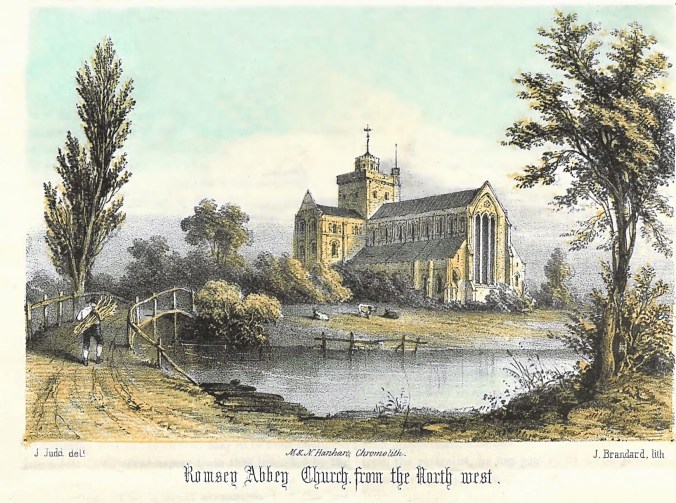
Romsey Abbey, nestled in the heart of Hampshire, England, is a remarkable tapestry of faith, royalty, resilience, and mystery. Its origins reach back to the year 907 AD, when King Edward the Elder, son of Alfred the Great, established a religious house for nuns under the care of his daughter, Elflaeda. This early nunnery, later refounded by King Edgar in 967 under the rule of St. Benedict, flourished under the spiritual guidance of Abbess Ethelflaeda, an enigmatic figure remembered not only for her leadership, but for her ascetic rituals, including the chanting of psalms while standing naked in the icy waters of the River Test by night.
By around 1000 AD, a stone church and nunnery stood at Romsey, serving as a place of education and worship for the daughters of nobility. Construction of the present building began between 1120 and 1140, with significant expansions in the following centuries, including the graceful arches of the nave and a north aisle to accommodate the growing town. By the 1230s, the abbey was home to over 100 nuns. Yet its golden age was not to last. The devastation of the Black Death in 1349 reduced the number of nuns to just nineteen. Still, the shared use of the abbey by both the convent and local townspeople likely spared it from the fate of many monasteries that were demolished during Henry VIII's Dissolution of the Monasteries. When Romsey Abbey was suppressed in 1539, its nuns were dispersed, but the townspeople, recognizing its importance, purchased the building in 1544 for £100 to serve as their parish church.
Over time, parts of the building were removed, including the Lady Chapel and the north aisle, deemed unnecessary and too costly to maintain. The Abbey also bore the scars of the English Civil War, when Parliamentary troops desecrated the interior, tearing up seats and destroying the organ. In the austere Puritan years that followed, preachers like the so-called ‘intruder’ John Warren imposed their stern reforms upon the sacred space.
By the eighteenth century, Romsey Abbey had entered a long twilight of neglect. Visitors lamented the condition of the once-majestic church, with over 40 windows bricked up and the grandeur of earlier centuries fading into silence. But the nineteenth century sparked a revival. Under the guidance of the Rev. Edward Lyon Berthon, a new energy took root. Romsey also saw curates like John Keble serve here in the early 1800s, Keble would go on to become a leading light in the Oxford Movement, shaping the future of the Church of England. Other clergy played vital roles in restoring the Abbey’s spiritual life and reconnecting it to the local community.
Though no longer home to Benedictine nuns after the sixteenth century, the memory of their presence lingers. Legends whisper through the ancient stones of Romsey Abbey, telling of ghostly figures drifting down shadowy aisles and mysterious sounds echoing after dark. A peculiar and macabre relic housed within the display of human hair reminds visitors of the past's intimate rituals of grief and remembrance.
Romsey Abbey remains not only a monument to architectural beauty and sacred devotion, but also a living story, centuries in the making. It stands as a witness to England’s shifting tides of faith, monarchy, war, and reformation, and continues to inspire awe, reflection, and wonder in all who walk beneath its arches.
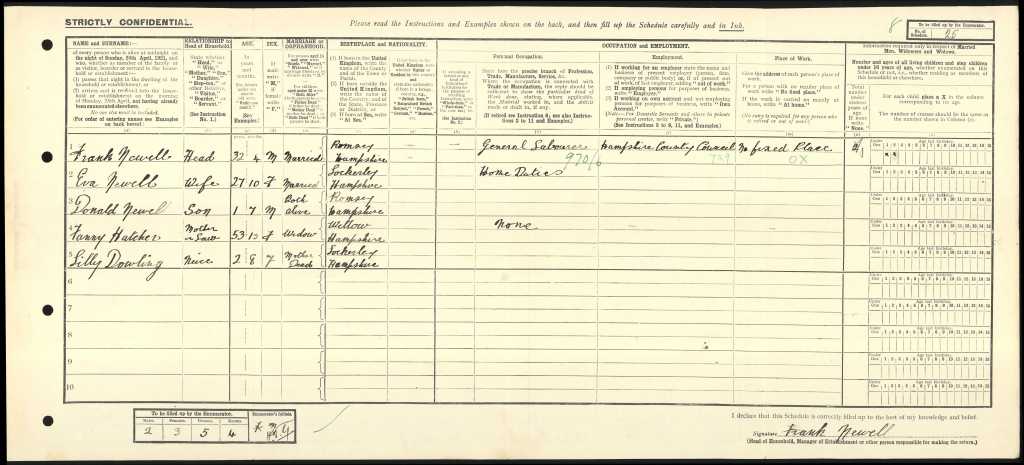
It was the evening of Sunday, the 19th day of June, 1921, when the town of Romsey settled under a veil of summer stillness. The air was warm and still, scented faintly with the river reeds and the soft smoke of evening fires. In the heart of the town, at Number 157, Middlebridge Street, lamplight glowed through the small-paned windows of a four-room dwelling, modest, weathered, and full of life.
There, Eva Kate, aged twenty-seven years and ten months, gathered her little household close as the quiet business of the Census came to call upon England once more. It was a ritual of counting and recording, of giving names to the stories that filled each humble home, yet to Eva, it was more than mere numbers, it was the quiet affirmation of her world, her family, her love.
Her husband, Frank Newell, thirty-two years old and head of the household, sat at the small wooden table with the Census paper spread neatly before him. His handwriting was careful, deliberate, the same hand that had once signed the register of their son’s birth and baptism. The form had been brought earlier that day by an enumerator, a local official tasked with walking the lanes of Romsey, collecting the lives of its people in ink and order. Now, as twilight deepened beyond the window, Frank bent over the paper, the nib of his pen scratching softly as he wrote their names, a quiet act of presence in the grand ledger of the nation.
Beside him, Eva tended to little Donald George, now one year and seven months old. He was sleepy from the day’s play, his mother’s gentle hum his lullaby. Eva’s mother, Fanny Hatcher, aged fifty-three years and ten months, sat close by, her knitting resting in her lap, a widow, a matriarch, and the steady anchor of three generations now gathered under one roof.
In the corner of the small room, a child’s laughter floated, Iris Lilly Dowling, just two years and eight months old, known fondly as Lilly on the Census. She was the daughter of Eva’s late sister, Florence Fanny Dowling (née Hatcher), whose life had come to a sorrowful close on the 11th day of December, 1918, within the somber walls of Hampshire County Lunatic Asylum at Fareham. That loss, so soon after the war, had carved a quiet ache into Eva’s heart and yet, from grief had blossomed love.
For little Iris, left motherless and tender in years, had found not absence, but abundance, in the arms of Auntie Eva, Uncle Frank, and Grandmother Fanny. Her father, William Dowling, still lived at Bedfords in Lockerley, caring for his other children, but Iris never returned to his household. Instead, she grew within the gentle care of the Newells, her laughter mingling with Donald’s, her place in the family as natural as the morning light. It was said, and long believed, that Eva and Frank adopted her, raising her as their very own, a daughter of love, not of law.
The Census form, with its neat lines and solemn precision, captured it all in quiet ink:
Frank Newell, Head, age 32 — General Labourer for the Hampshire County Council, with no fixed place of work.
Eva Newell, Wife, age 27 years and 10 months — Home Duties, the unspoken labour of love.
Fanny Hatcher, Mother, age 53 years and 10 months — None given, though her hands and heart never ceased their work.
Donald Newell, Son, age 1 year and 7 months.
Lilly Dowling, Niece, age 2 years and 8 months.
When Frank finished, he looked once more at what he had written, every name a story, every line a life, and signed his name with quiet pride. The ink glistened for a moment under the lamplight before sinking into the paper, binding the Newell family forever to that night in June 1921.
Beyond their small home, the evening murmured with familiar sounds, the soft clatter of dishes next door, the call of a blackbird in the dusk, the distant chiming of Romsey Abbey’s bells. Their neighbours at Number 159, were Ernest Pearce, Fanny’s brother and Eva’s uncle, with his wife Elizabeth and their four children, and Fanny’s father William Hatcher, Eva’s beloved grandfather. And their other neighbours at Number 155, were Caleb Biddlecombe, his wife Annie, and their lively brood of four. The street was alive with kinship, threads of family and friendship woven together like ivy across the cottages.
And so the Census was taken, not by faceless officials, but by the hands and hearts of ordinary people who paused, for one evening, to take measure of their lives.
For Eva, that night was not merely about being counted, it was about belonging, to her family, her town, and her time. She was a woman who had known loss yet gathered love around her like a shawl, warming all within her reach. Within that little house at Middlebridge Street, history itself seemed to breathe, the story of a family rooted in love, resilience, and the enduring grace of everyday life.
It was Friday, the 21st day of September, 1923, when the quiet heart of Romsey seemed to beat a little slower. Inside Number 157, Middlebridge Street, now the home of her uncle Ernest Pearce, the same home where her son and niece had once laughed and played, Eva Kate felt the weight of another ending draw near.
Her grandfather, William Pearce, once so strong and sure, now lay fading gently before her eyes. He was eighty-six years of age, a road labourer by trade, a man who had built his life with the same steady hands that had shaped the roads beneath Hampshire’s endless skies. He had been there all her life, a pillar of calm wisdom, his stories stitched with soil and seasons, his laughter echoing through her childhood.
The house was hushed that evening. A faint golden light filtered through the lace curtains, catching the slow drift of dust in the air, each speck, it seemed to Eva, a memory of the years he had lived. The clock on the mantel ticked softly, counting out the last moments of a long and well-worn life.
Her uncle Ernest Pearce, William’s son, stood faithfully by the bedside, watching over his father’s final hours. Eva, nearby, held her breath as she watched her grandfather’s chest rise and fall, slower now, shallower, until at last it was still.
It was a gentle passing, no struggle, no fear. Just the quiet surrender of a heart that had carried the burdens and blessings of eighty-six English years. The doctor, G. H. Johnson, M.R.C.S., later called it Senectus and Heart Failure, words that, to Eva, sounded too cold, too clinical, for something so sacred. To her, it was simply his time to rest.
She had always admired him, his patience, his steadfast work, his quiet pride in the roads he had helped to build. He was part of Romsey itself, its cobbles, its bridges, its long lanes stretching out through fields of green and gold. To think of the world without him felt, for Eva, like standing in a house missing one of its walls, exposed, changed, yet still standing because of what he had built.
Three days later, on Monday the 24th day of September, 1923, Ernest walked solemnly to the Registrar’s Office to bear witness to their loss. With careful hand, he signed his name as Informant, noting his father’s passing at their shared address Number 157, Middlebridge Street, Romsey. The Registrar, Josiah Munday, familiar now to the family through births, baptisms, and losses, recorded the details in his neat, unwavering hand:
1923. DEATHS in the Sub-District of Romsey in the County of Southampton.
No.: 42

When and Where Died: Twenty-first September 1923, 157 Middlebridge Street, Romsey U.D.

Name and Surname: William Pearce

Sex: Male

Age: 86 years

Rank or Profession: Road Labourer

Cause of Death: (1) Senectus, (2) Heart Failure, Certified by G. H. Johnson, M.R.C.S.

Signature, Description, and Residence of Informant: Ernest Pearce, Son, Present at the Death, 157 Middlebridge Street, Romsey

When Registered: Twenty-fourth September 1923

Signature of Registrar: Josiah Munday, Registrar.
Eva’s eyes filled as she watched Ernest return home that afternoon, his face lined with both fatigue and love. The paper he carried, so small, so official, seemed far too thin to bear the weight of such a man’s life.
The family spoke little that evening. Frank sat quietly by the hearth, young Donald at his feet, unaware of the depth of what had passed. Fanny, Eva’s mother, wiped her eyes in silence, for she had just lost her father.
Eva stood by the window, gazing out toward the dusky street. She imagined her grandfather’s soul taking the familiar road toward the open fields beyond Romsey, the very paths he had once laid with his own hands. It comforted her to think he might still be walking there, steady and unhurried, the way he always did.
Where he was laid to rest, no one could later say for certain. His grave, somewhere among the whispering yews and moss-soft stones of the local churchyards, became part of the earth itself, hidden, yet not lost. Eva, could feel him everywhere, in the scent of rain on the road, in the rumble of cart wheels, in the quiet endurance of the people of Romsey.
Her grandfather had lived his life in rhythm with the land, building, mending, giving, loving. And though time would carry away names and markers, his spirit endured in the stories Eva told her children and the paths her family would walk for generations to come.
For she knew, deep in her heart, that the roads of Romsey, strong, weathered, and true, would always whisper his name.

It was Tuesday, the 14th day of March, 1939, a serene spring day in Romsey, when the world seemed briefly suspended between winter’s hush and the first tremors of life’s return. The hedgerows were dusted with green, the air carried the soft perfume of awakening earth, and the hum of bees drifted lazily over the gardens that Eva’s father-in-law Alfred Newell had once so lovingly tended.
At Number 29, Cherville Street, beneath a modest roof and behind a weathered door, Alfred’s long and faithful lifecame gently to its close. He was seventy-five years old, a nursery gardener by trade, a man who understood the patience of seeds, the rhythm of the soil, and the quiet faith that all things, given care, will bloom again. His hands, once strong and sure, had coaxed beauty from the ground for decades, the same hands that had steadied children, mended tools, and turned the pages of a life lived humbly and well.
But the years had been heavy, and his body, worn by time and chronic bronchitis, had grown fragile. In his final months, the simple act of breathing had become a battle, his chest rising with effort, yet his spirit, stubborn, steadfast, refused to yield until the very end. There was sadness, too, within him, the quiet sorrow of one who had outlived so many he had loved.
When his final breath came, Elizabeth Ada Wheeler, his devoted stepdaughter, was there beside him, the daughter of his heart if not of his blood. She had been constant in her care, as steadfast as spring returning after winter’s long retreat. As the last sigh left Alfred’s lips, the room seemed to still, even the ticking clock paused in reverence. The man who had tended the gardens of Romsey was now part of its soil forever.
Eva and Frank received the news at their home. It was Frank’s father, the man who had shaped his earliest days, who had taught him how to hold a spade, to work with his hands, to find quiet pride in honest labour. When the message came, Frank sat very still, the paper trembling slightly between his fingers.
Eva saw the shadow fall across his face, that look of deep, helpless sorrow only a son can wear. She said nothing at first, instead, she reached for his hand. They sat in silence, the fire burning low, the air thick with unspoken grief. At last, she moved closer, her arms wrapping around him, her voice soft and steady against his shoulder.
“He’s at peace now, love,” she whispered, her words trembling with both tenderness and truth. “He’s gone back to the earth he loved, he’ll never be far from you.”
Frank did not answer, but his breath caught, his heart breaking quietly in her embrace. For Eva, it was a different kind of pain, not the loss of her own kin, but the ache of watching the man she loved crumble under the weight of his. She stroked his hair as tears came, thinking of Alfred’s hands, so like Frank’s, strong, roughened, yet capable of such gentleness.
Meanwhile, at Number 29 Cherville Street, Elizabeth Ada carried out her solemn duty with grace. On that same day, the 14th day of March, 1939, she walked to the Registrar’s Office, her steps slow but sure, and gave the necessary details of Alfred’s passing. The Deputy Registrar, Geo. F. Frampton, received her with kindness and recorded the loss with measured care, as was his duty.
In the official register, Alfred’s passing was preserved for all time:
No.: 132

When and Where Died: Fourteenth March 1939, 29 Cherville Street, Romsey U.D.

Name and Surname: Alfred Newell

Sex: Male

Age: 75 years

Rank or Profession: Nursery Gardener

Cause of Death:
I(a) Cardiac Failure
I(b) Acute Bronchitis
II. Chronic Bronchitis
Certified by H. Verna Knight, M.R.C.S.

Signature, Description, and Residence of Informant: B. A. Wheeler, Step-daughter, Present at the Death, 22 Church Lane, Romsey

When Registered: Fourteenth March 1939

Signature of Registrar: Geo. F. Frampton, Deputy Registrar.
Eva would later read those words on the certificate, the stark formality of them catching in her throat. There, in black ink, was the end of a man who had been so alive, so steady, reduced now to lines and numbers. And yet, she thought, Alfred’s true record was not written there at all. It lived in Frank’s eyes, in the hands that bore his likeness, in the soil that would forever bloom because of him.
In the evenings that followed, Eva often found Frank standing silently at the back door, looking out toward the garden. The dusk light would catch the sadness in his profile. She would join him there, slipping her arm through his, resting her head against his shoulder. Together, they would listen to the wind moving through the trees, the faint call of a blackbird settling for the night.
“Your father’s in every leaf,” she would murmur. “Every root that runs deep.”
And Frank, though still grieving, would nod, because he felt it too.
Though the formalities of Alfred’s death were completed that same day, his memory lingered not in ledgers but in love, in the flowers that grew wild along the Romsey lanes, in the laughter of the grandchildren he never met, in the quiet faith of a family bound by earth and heart.
To Eva, he became not just Frank’s father, but part of her own story, a reminder that life’s truest legacies are not measured by possessions or records, but by the tenderness left behind.
And so the seasons turned once more, and spring deepened into summer. Yet in Eva’s heart, the soft ache of that March day remained, a bittersweet chord of sorrow and love, echoing through the quiet corners of her home.

It was a quiet and somber morning, Friday, the 17th day of March, 1939, when Romsey awoke beneath a veil of soft grey cloud. Spring had only just begun to stir; the air was cool and sharp, the first daffodils trembling in the breeze along Botley Road, their yellow heads bowed as if in mourning. The town itself seemed to pause, hushed and reverent, as the funeral procession made its slow and solemn way from Number 29, Cherville Street, where Alfred Newell had drawn his final breath only days before.
At seventy-five years old, Alfred’s life had been one of quiet dignity, a man of the earth, a nursery gardener, whose hands had coaxed colour from the soil, whose years had unfolded in harmony with the rhythm of the land. Now, he was making his final journey through the town that had known him in life and would cradle him in death.
The small cortege moved steadily through the narrow lanes, the horse-drawn hearse draped in black crepe, the coffin polished to a dark sheen and adorned with a modest spray of white lilies and ivy, symbols of purity and eternal life. Behind it walked his family, heads bowed beneath the soft chill of the March wind. Among them was Eva, her gloved hand slipped into that of her husband Frank, whose heart seemed to falter with each slow step.
Frank’s grief was quiet but consuming. He had inherited his father’s gentleness, his patience, his love for honest work, and now felt the ache of that bond breaking. Eva, walking beside him, felt the tremor in his hand, the weight of unspoken sorrow pressing upon him. She said little, her strength that day was not in words, but in the steady warmth of her presence, the gentle, unwavering comfort of a woman whose love could steady even the heaviest of hearts.
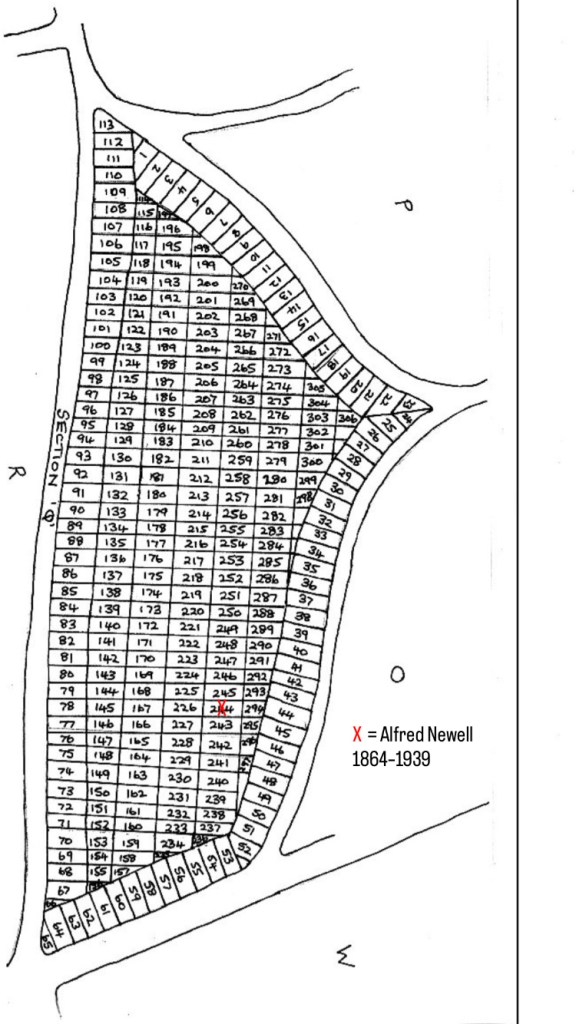
When they reached Romsey Old Cemetery on Botley Road, the morning light was dim and pearled through the trees, their bare branches etched against the sky. The gates creaked softly as they entered, and the sound of footsteps upon damp earth mingled with the distant calling of rooks. The grave, plot number Q244, had been lovingly purchased by Alfred’s younger son, also named Alfred, a final act of filial devotion. It lay in a quiet corner of the cemetery, where the grass grew thick and wild, and the air carried the mingled scent of moss and blossoms.
The Reverend, robed in black and white, stood beside the open grave, his breath clouding faintly in the cold air. His voice rose gently, carrying through the stillness as he read from the Book of Common Prayer, words familiar and comforting to all gathered there:
“I am the Resurrection and the Life, saith the Lord: he that believeth in me, though he were dead, yet shall he live.”
A soft murmur passed through the small crowd as the congregation joined in the old hymns of farewell “Abide with Me”, its verses trembling with both sorrow and hope, and the ever-familiar “The Lord is My Shepherd.” Their voices, quivering and low, seemed to rise up into the grey morning air, mingling with the rustle of the trees and the whisper of the wind across the gravestones.
When it came time for the final committal, the Reverend’s voice grew softer still, as he spoke the words that brought all hearts to stillness,
“Earth to earth, ashes to ashes, dust to dust…”
The ropes strained gently as the coffin was lowered into the ground. Frank’s hand gripped Eva’s tightly, his knuckles white, his breath catching in his throat. Eva felt the tremor of his pain and pressed closer, her other hand reaching to rest upon his arm. As the coffin touched the earth, a sob broke free from him, quiet, raw, and utterly human. She turned toward him, tears gathering in her own eyes, and whispered softly, almost into his ear,
“He’s gone home, my love… he’s gone home to the soil he loved.”
Frank could not answer, but his fingers tightened around hers in gratitude, as if drawing strength from the very love that had carried them both through loss before. Around them, Alfred’s wife, Sarah, stood weeping quietly, supported by her daughter Elizabeth Ada Wheeler, who had stood so faithfully at Alfred’s bedside. The rest of the family, sons, daughters, stepchildren, grandchildren, encircled the grave in silence, their faces pale with grief but lit with a tender reverence.
When the first handful of soil fell upon the coffin, its soft thud seemed to echo through the hearts of all gathered there. Eva felt it deeply, the sound of parting, the sound of love returning to the earth. Frank reached down, took a small clump of soil in his hand, and let it fall through his fingers like a final benediction.
“Thy will be done,” the Reverend intoned, closing his Bible. Then came the final prayer, so often spoken in the cemeteries of England in those days:
“Grant him eternal rest, O Lord, and let perpetual light shine upon him.”
The family lingered even after the others began to drift away, unable to leave so soon. The crisp wind carried the faint scent of lilac and the distant toll of the Abbey bells marking the hour. Eva, standing beside her husband, watched as the grave-diggers gently filled the earth back in, the rich soil dark against the polished wood.
In that moment, she felt an ache both old and familiar, the ache of watching life close its circle. She thought of Alfred’s hands, so like Frank’s, planting and tending with quiet devotion; of the patience of his work; of the deep, wordless bond between father and son. She pressed her gloved hand over Frank’s heart and whispered, almost to herself,
“He’s not gone from you, my darling. Every garden you plant, every tree you touch, he’ll be there.”
Frank nodded faintly, eyes glistening, his gaze fixed on the newly covered grave where a simple wooden marker now stood, Alfred Newell, 1864–1939, soon to be replaced by stone.
As they turned to leave, Eva cast one last look over her shoulder. The grave seemed peaceful beneath the grey sky, surrounded by the murmuring trees and the sleeping rows of generations past. The soil was still fresh, yet already it felt as though the earth had embraced him, the gardener returned to his garden.
The walk home was quiet. The world moved on, carts rattling, shop bells chiming, but within Eva, time stood still. She felt both the weight of Frank’s sorrow and the quiet strength of her own heart. She had learned, through her years, that grief was not the absence of love, but its truest echo.
And as she and Frank reached the turning onto the street where they lived, she looked up at the budding branches overhead and thought of Alfred’s spirit, not gone, but growing again, somewhere unseen, in the everlasting spring of the soul.

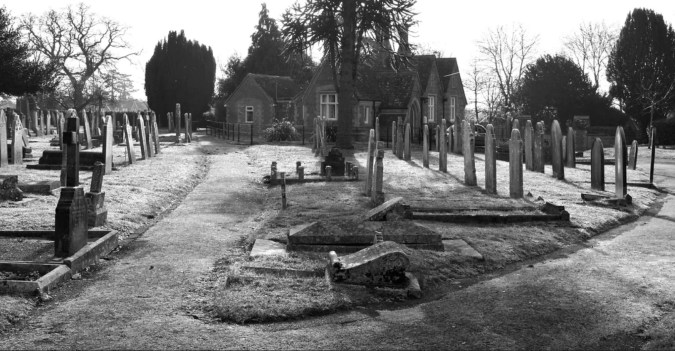
Romsey Old Cemetery, located on Botley Road in Romsey, Hampshire, is a historically significant site that holds an important place in the town’s past. Established in the 19th century, it reflects the community’s evolving history, serving as the final resting place for many residents over the years. The cemetery, which sits on the outskirts of the town, offers a glimpse into the lives of Romsey’s past inhabitants, many of whom were part of the town’s agricultural and industrial development. While it remains a peaceful and serene place today, the cemetery has also been the subject of local legends and ghost stories, adding a layer of mystery to its historical importance.
The cemetery was created in the early 1800s to accommodate the growing population of Romsey. As the town expanded, the older burial grounds at the local churches became insufficient, prompting the establishment of the Old Cemetery on Botley Road. This burial ground became a key part of Romsey’s religious and social life, as it provided a place for the deceased to be laid to rest while also serving as a symbol of the community’s traditions and beliefs about death and remembrance. The cemetery was designed to be spacious and accommodate a large number of graves, and many of Romsey’s prominent families from the 19th and early 20th centuries are buried there. Over the years, it became a serene and reflective space, offering solace to families mourning their loved ones.
The architecture of the cemetery, with its rows of gravestones and memorials, reflects the styles and trends of the time, with many gravestones bearing intricate carvings and epitaphs that tell the stories of the people interred there. As with many cemeteries of the period, the space became more than just a burial ground, it was a place for the community to gather, reflect, and remember. The cemetery was used not only for burials but also as a space for memorials and commemorative plaques, contributing to its historical significance.
Though peaceful today, the cemetery has been associated with various rumors of hauntings and ghostly occurrences. Over the years, locals have told stories of strange sightings and unexplained sounds, particularly during the evening hours. Visitors and residents have occasionally reported seeing shadowy figures moving between the graves or hearing faint footsteps when no one is around. These eerie stories have helped build the cemetery’s reputation as a site with a haunted past, adding to its intrigue.
The most common ghostly tales connected to Romsey Old Cemetery describe figures that seem to materialize among the gravestones before vanishing as quickly as they appeared. Other reports suggest the sounds of whispering voices or soft footsteps echoing through the cemetery, even when it is quiet and still. Some claim that the air around the cemetery feels unnaturally cold, particularly in certain areas. While there is no documented evidence to support these claims, the cemetery’s age and historical significance, coupled with the emotional weight of the graves, make it a natural setting for such stories to emerge. Many of the legends surrounding the cemetery are based on local folklore, passed down through generations.
The cemetery has also been the subject of speculation due to some of the stories attached to specific graves. Certain gravestones, particularly those marking untimely or tragic deaths, are said to be the focus of these supposed hauntings. Whether these tales are the result of the imagination or rooted in the real-life sorrow and loss experienced by the community remains unclear. What is certain, however, is that the cemetery’s long history and its connection to the people of Romsey have contributed to the sense of mystery that surrounds it.
Today, Romsey Old Cemetery remains a quiet and respected site for reflection. While the supernatural stories continue to intrigue some visitors, the cemetery is primarily a place for remembrance and contemplation. It continues to serve as a final resting place for the people of Romsey, offering a tranquil space where families can visit and reflect on the lives of those who came before them. The cemetery’s significance is not only in the stories it holds but in the role it plays in connecting the past with the present, allowing those who visit to pay their respects and honor the town’s history.
It was a Sunday morning in early September when the quiet peace of Romsey was broken by a sound that would echo for generations, the solemn voice of Prime Minister Neville Chamberlain crackling through the wireless, announcing that Britain was once again at war with Germany. In their small home, Eva and Frank sat side by side, the air heavy with disbelief. The words seemed to hang in the room like smoke, familiar and terrible all at once. They had heard them before, twenty-five years earlier, when the world had promised “the war to end all wars.” But this time, there was no illusion of glory, no rush of youthful courage. There was only the hollow ache of knowing what war truly meant. Frank’s gaze dropped to his hands, those same hands that still carried the marks of frostbite from the trenches of World War I, his toes long lost to the bitter cold of France. He could still smell the mud, still hear the cries that never faded, and now, as the wireless fell silent, he felt the old ghosts stir. Eva reached for him instinctively, her heart breaking not just for the world, but for the quiet suffering in his eyes.
Outside, Romsey too seemed to hold its breath. Shopkeepers paused mid-task, the blacksmith at his forge stopped hammering, the sound dying away into uneasy silence. The Abbey bells, which had once tolled for peace, now rang with grim resolve. Mothers clutched their children a little closer, and fathers stared at the horizon, remembering. The talk in the streets was hushed, the Home Guard being organised, ration books soon to come, the blackout curtains being stitched by candlelight. Businesses that had only just recovered from the lean years of the Depression braced for shortages once more. And though Romsey was far from the front lines, the war crept into every home, in the ration lines, in the dim glow of oil lamps, in the dread of telegrams delivered at dawn.
For Eva and Frank, the war felt cruelly familiar yet terrifyingly new. The first war had taken youth and innocence; this one threatened their very sense of safety. Where once Frank had fought in distant trenches, now war would come from the skies, the hum of aircraft above Hampshire, the fear of bombs over nearby Southampton. Yet amidst the fear, Eva’s resolve hardened. She had lived through one war already, raised children in hardship, buried loved ones, and learned that love itself was an act of defiance. As she looked across the table at Frank, his face lined with the weight of memory, she placed her hand over his and whispered, “We’ve faced the darkness before, my love… and we’ll face it again, together.”
It was Friday, the 29th day of September, 1939, and autumn had begun to draw its soft veil over Romsey. The air was crisp, the leaves beginning to bronze, and the faint scent of chimney smoke carried on the wind. Yet beneath the gentle hum of the season lay a quiet tension, a tremor of unease that touched every household in England. War had come again, and now, the Government called upon every man, woman, and child to be counted, not for curiosity, but for duty.
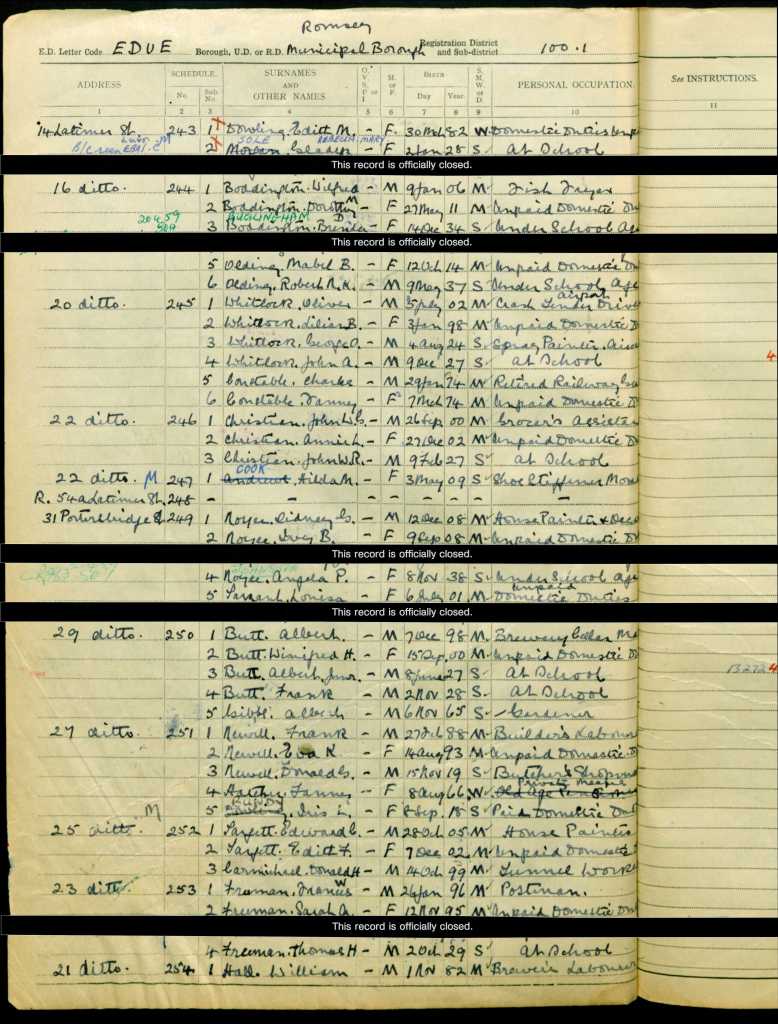
On that day, within the modest walls of Number 27, Portersbridge Street, Eva Kate prepared her family for the National Registration, a solemn act that would mark each of them in the nation’s wartime record. The enumerators, local men and women, many known to the townsfolk, went door to door, their clipboards clutched tight, their pens scratching names into history. They wore armbands marked “National Registration,” and their task was immense, to record every soul in Britain, from the newborn to the elderly, to aid in the issuing of identity cards, ration books, and the coordination of a country now poised for the unknown.
Eva watched from the window as one of them approached, a middle-aged man in a worn overcoat, his hat dampened by mist. She straightened the tablecloth, smoothed her apron, and called softly for Donald and Iris to come in from the back garden. There was a gravity to the moment, though she smiled as she opened the door.
Inside the small parlour, life unfolded as it always had, the kettle singing, the clock ticking, yet today felt different. The enumerator’s questions, simple on their surface, carried the weight of something far larger. “Name… date of birth… occupation…” Each word was written carefully, deliberately, as if anchoring lives against the shifting tide of war.
At Number 27 Portersbridge Street, he recorded them all:
Frank Newell,
Sex: Male.
Born: 22nd Feb 88.
S, M, W or D: M,
Personal Occupation: Builder’s Labourer.
Eva Kate,
Sex: F.
Born: 14th Aug 93.
S, M, W or D: M.
Personal Occupation: Unpaid Domestic Duties,
Donald Newell,
Sex: Male,
Born: 15th Nov 19.
S, M, W or D: S,
Personal Occupation: Butcher’s Shop,
Fanny Hatcher,
Sex: F.
Born: 8th Aug 66,
S, M, W or D: W.
Personal Occupation: Old Age Pensioner (crossed out), Private Means.
Iris L. Dowling,
Sex: F.
Born: 8th Sept 18.
S, M, W or D: S.
Personal Occupation: Paid Domestic Duties.
As the enumerator wrote, the scratch of his pen seemed to echo through the years, a sound of preservation, of names being safeguarded against the chaos to come. Outside, the town moved in subdued rhythm. At Number 29, their neighbours Albert and Winifred Butt tended to their two young boys, Albert and Frank, both schoolboys whose voices often drifted over the garden wall in bursts of laughter. Albert Gibbe, the gardener who lodged with them, came home each evening with his boots caked in the rich Romsey soil and a whistle on his lips, a man who carried the scent of the earth wherever he went. On the other side, at Number 25, lived Edward C. Targett, the house painter, his wife Edith, and their lodger, Donald H. Carmichael, a tunnel worker whose days were spent in darkness beneath the ground, one of the countless unseen labourers already fortifying England for the long fight ahead.
As the man finished his entries, Eva offered him tea, as was her way, and he smiled, weary but grateful. When he left, she closed the door softly and stood for a moment, listening to the quiet. The paper he had filled would travel to London, to the heart of the war effort, where names became numbers, and numbers became ration books, identity cards, and mobilisation lists.
For Eva, it felt strange, to see her family reduced to ink and classification. Yet she knew it was necessary. The National Register would help issue food rations, organise civil defence, and even track the movement of evacuees and workers. It was a map of the nation’s heart, drawn at the very moment that heart began to beat in fear once more.
That evening, as the light faded, she sat beside Frank, who was quietly mending a boot by the hearth, a trade that had been passed down through the generations. The glow of the fire caught his face, worn, brave, beloved. She thought of the last war, of the frozen fields of France that had stolen Frank’s toes but not his spirit, of the nights he had trembled in sleep from dreams he could not speak aloud. And now, she thought, the world was beginning again.
“Do you think it will be the same?” she asked softly.
Frank paused, his eyes fixed on the fire. “No,” he said after a moment. “This one will be different. It won’t just be the men this time… it’ll touch everyone.”
Eva nodded, her heart heavy with both fear and resolve. For she understood, this war would not be fought far away, but in the skies above, in the fields, in the very rhythm of daily life. It would come in the form of ration lines, blackouts, sirens, and the aching absence of those called to serve.
And yet, as she looked around the room, at her mother’s quiet grace, at Donald’s steady hands, at Iris’s youthful spirit, and at Frank’s unshakable calm, she felt a flicker of something stronger than fear.
They had survived one war already. They had rebuilt, loved, and carried on. They would do it again.
That night, as the wind brushed softly against the windows and the fire burned low, Eva whispered a silent prayer, not for victory, but for endurance. For her family, for Romsey, and for all the ordinary souls who, in their quiet courage, would hold the world together while it fell apart.
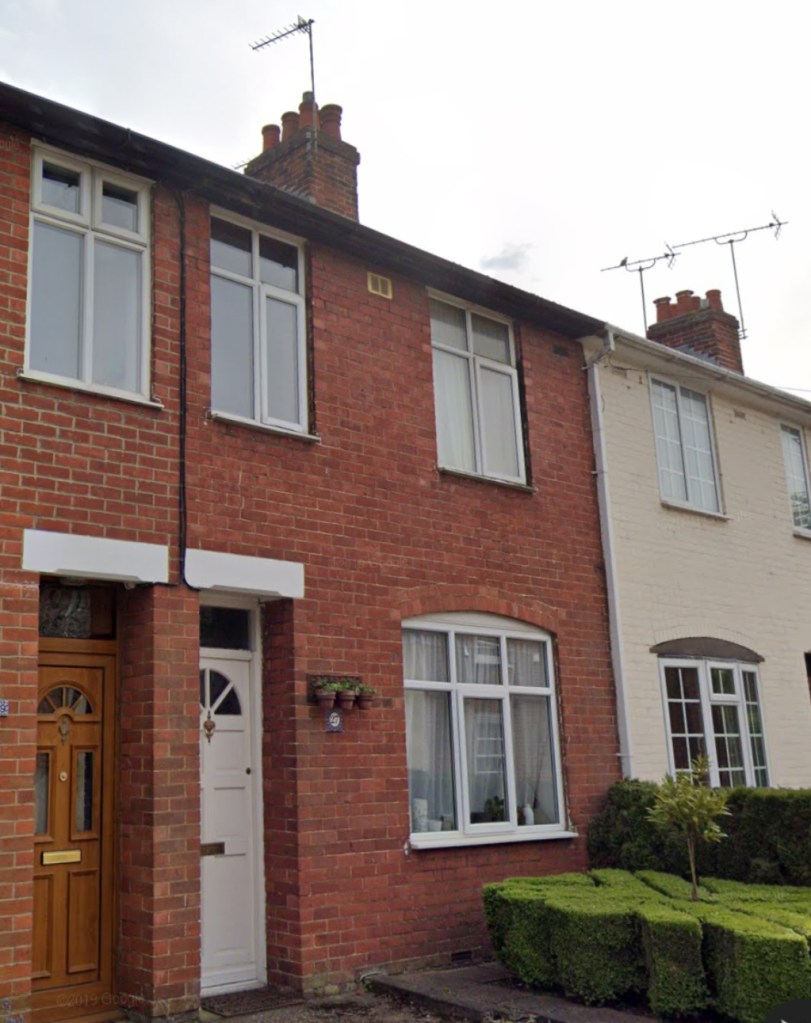
Portersbridge Street in Romsey, Hampshire, is a historic thoroughfare that reflects the town's rich architectural and social heritage. The street is characterized by its narrow, winding layout, a feature common in central Romsey due to the town's development before the advent of modern vehicular traffic. This sinuous nature of Portersbridge Street contributes to the town's distinctive charm and character.
The architectural landscape of Portersbridge Street is marked by several Grade II listed buildings, indicating their special architectural or historic interest. Notably, Nos. 2 and 4 Portersbridge Street are recognized for their early 19th-century construction, featuring red brick facades and slate roofs. These buildings exemplify the residential architecture of that period in Romsey.
Another significant structure is Nos. 26–30 Portersbridge Street, which also holds a Grade II listing. These buildings contribute to the historical fabric of the street, showcasing architectural styles and construction techniques from their respective periods.
The weeks that followed the National Registration of 1939 ushered Romsey into a new rhythm, a world divided by fear and resilience, uncertainty and faith. The news crackled daily from the wireless, bringing reports of bombings, evacuations, and soldiers marching to ports, while the Abbey bells, once a sound of comfort, now carried a strange gravity, echoing through the narrow lanes like a prayer for all those who might not return.
Inside Number 27 Portersbridge Street, Eva felt the change seep into every corner of their home. The windows were soon fitted with blackout curtains, thick and dark, stitched by her own hands in the dim light of an oil lamp. Each evening, as dusk fell, she would move from room to room ensuring not a glimmer escaped, her fingers tracing the fabric like a ritual of protection. Outside, the once-friendly glow of Romsey’s windows had vanished, the town was cloaked in darkness, save for the faint beams of torches darting across the cobblestones as air-raid wardens called softly, “Put that light out!”
For Frank, the new war brought old ghosts. Though he was no longer young enough to serve, the memories of the trenches in France, the bitter cold that had taken his toes, the screams that had filled the night, returned to him in the stillness. Sometimes Eva would find him sitting by the fire after midnight, the orange light flickering across his face, his gaze far away. She never pressed him to speak. Instead, she would kneel beside him, resting her head against his shoulder until his breathing steadied again.
Their son, Donald, now a young man, had found work in a butcher’s shop, his days filled with the smell of sawdust and salt, his hands red from the cold. He did his part, proud to serve his community in his quiet way. Iris, still bright-eyed and full of youth, continued her domestic work in town, helping others keep their homes in order amidst the rationing and fear. Fanny, Eva’s mother, frail now but sharp of mind, became the family’s anchor, a calm voice when nerves frayed, a keeper of old wisdom and steadfast faith.
When the ration books finally arrived, stamped and brown and smelling faintly of ink, Eva handled them as though they were sacred. Each page represented not just sustenance but survival, every coupon a promise that her family would endure. She queued in the cold mornings for butter and sugar, exchanged recipes with neighbours for making do with less, and turned every scrap of bread into something warm and comforting. Waste was unthinkable, gratitude was everything.
The shops of Romsey changed, too. The butcher rationed meat, the grocer’s shelves grew sparse, even the baker, who once filled the street with the smell of fresh loaves, now worked in quiet discipline, every ounce of flour accounted for. Yet the townsfolk carried on with a kind of determined grace. At the market, women still laughed softly as they bartered for turnips or tins of treacle. Children played hopscotch in the alleyways, their chalked lines defiant against the grey world around them.
Then came the sirens, the first eerie wails that split the night, rising and falling like a voice from another world. Eva’s heart would seize each time, though she moved calmly, ushering Fanny and Iris toward the shelter they had dug at the back of the garden. Frank, limping slightly from his old wounds, would gather blankets and the lamp, his movements sure and practiced. In those moments, as the earth shook faintly beneath them, Eva would close her eyes and pray. She prayed not for victory or vengeance, but for endurance, for her family, for her neighbours, for the children of Romsey who should never have to know fear as she and Frank once had.
The blackouts became routine, the rationing a way of life. Yet amidst the hardship, Eva found beauty in the small things, the first snowdrops pushing through the frozen soil; the warmth of Frank’s hand when he took hers as they walked to fetch water, the sound of Donald’s laughter drifting through the kitchen after long days of work. These moments, she thought, were what the war could never take.
Romsey itself changed, but not in spirit. Its people, bakers, builders, gardeners, and shopkeepers, learned to bend without breaking. They shared what they could, whispered reassurances across fences, and sang hymns in the Abbey that trembled with both sorrow and hope. On Sundays, Eva would sit beside Frank in the pews, the light from the stained glass pooling across their clasped hands. The vicar’s voice would echo softly through the nave, reading from the Psalms:
“God is our refuge and strength, a very present help in trouble.”
The words lingered in Eva’s heart long after the service ended. She carried them home with her like a talisman, repeating them under her breath as she stirred the pot, mended a shirt, or sat beside Frank when the world outside seemed too heavy to bear.
And though the war raged beyond the quiet streets of Romsey, in the skies over London, in the seas that claimed sons and brothers, within that small house, life continued. It was a life of ration books and candlelight, of fear and faith intertwined. But it was also a life full of love, the kind that neither bombs nor darkness could ever destroy.
For Eva, the war was no longer just a matter of nations. It was the daily act of keeping hope alive, of tending her home like a garden in winter, waiting for spring to return once more.
The morning of Tuesday, the 2nd day of April, 1940, dawned cold and deceptive, the kind of spring day that carried both promise and sorrow in the same breath. Over Romsey, a thin veil of mist clung to the rooftops and drifted through the narrow lanes, as though the town itself were holding its breath. At Number 27, Porterbridge Street, the air inside the small home was hushed, weighted with the unspoken ache of parting.
Eva stood by the window, her hands trembling slightly as she straightened a button on her son’s coat. Donald George, her only child, her pride, her heartbeat, stood before her, his face alight with the fragile glow of youth and duty. The Somerset Light Infantry awaited him, his Army Number, 5677419, freshly inked upon the papers that would bind him to a world of marching boots and foreign skies. To the War Office, he was another name, another number, but to Eva, he was the boy who had once chased butterflies in the garden, whose laughter had filled every corner of this little house.
His trade, listed neatly as Butcher Roundman, seemed so modest, so real, a tether to the earth, to Romsey, to the safe simplicity of home. His faith, Church of England, was quietly written on the page, but in Eva’s heart, it was a living thing, a whisper of protection, a mother’s hope disguised as prayer. His Approved Society, Refuge, Membership Number 7575328, meant little to her except that the word Refuge felt strangely fitting, a small, bureaucratic promise of care in a world rapidly losing its mercy.
Frank, standing by the doorway, said little. His silence was heavy with memory, the mud and terror of France, the frostbite that had stolen his toes and branded his youth with pain. He had once stood just as Donald stood now, full of belief and fear and something greater than both. The sound of marching feet still haunted his dreams, and the ache of cold earth still lingered in his bones. Watching his son tie his laces, adjust his cap, and square his shoulders, Frank felt pride swell and break within him like a wave. This was his son, steady, brave, and ready  yet the thought of history repeating itself hollowed him.
Eva tried to smile. She busied her hands, folding Donald’s scarf, adjusting his collar, anything to keep from breaking. The scent of soap and wool filled the room, and for a fleeting second, she saw not a soldier, but her little boy again, the one who had once climbed onto her lap with scraped knees and tearful eyes, the one she had rocked to sleep while the Abbey bells tolled softly in the distance.
Outside, the cobbled street lay still, the early light touching the rooftops in silver. A milk cart rattled by, and the faint toll of the Abbey clock drifted through the air. Everything seemed ordinary, heartbreakingly ordinary and that, Eva thought, was the cruelest part. The world carried on, indifferent to the breaking of one mother’s heart.
When the time came for Donald to go, he lifted his small pack and turned toward the door. Frank reached for his hand, gripping it tightly, his voice rough with emotion. “Make us proud, son,” he said quietly and the words, simple as they were, trembled with all the love and fear a father could hold.
Eva stepped forward then, unable to stop herself. She pressed her hands against his cheeks, her thumbs brushing the warmth of his skin as though trying to memorize it. Her voice, when it came, was soft but fierce, the voice of every mother who has ever sent her child into the unknown.
“Keep your heart kind, my darling. No matter what you see, or where they send you, keep it kind. And remember, you carry home inside you.”
Donald smiled, the corners of his mouth trembling. He kissed her cheek, just once, just long enough, then turned and stepped out into the cool Romsey morning.
Eva stood at the doorway long after he had gone, her hand resting on the frame, her body swaying slightly as though the world beneath her had shifted. Frank came to stand beside her, his arm finding its way around her shoulders, but neither spoke. They watched until the street swallowed their son, the sound of his boots fading into the hum of distant life, and then they stood in silence, bound together by love and the terrible courage of letting go.
The world outside was already changing. War had begun its slow, relentless pull across England. The Abbey bells tolled in warning now, not worship. Posters called young men to serve, women to volunteer, and families to endure. But inside Eva’s heart, the war was something deeper and quieter, not fought on fields or in skies, but within the tender, endless ache of a mother’s waiting.
That night, as the blackout curtains fell and the house sank into shadow, Eva sat by the window, her hands clasped tight around her rosary. The wind moved softly through the street, whispering through the chimneys like a prayer unfinished. She closed her eyes and pictured Donald’s face, the courage there, the sweetness still unspoiled, and whispered into the dark,
“God, let him come home.”
The words floated up, invisible but real, joining countless other prayers whispered across England that night, the prayers of mothers whose hearts beat in rhythm with both pride and fear, love and longing, light and shadow.
And in that moment, though war loomed vast and merciless, Eva’s love, fierce, enduring, and eternal, shone brighter than any darkness could ever dim.
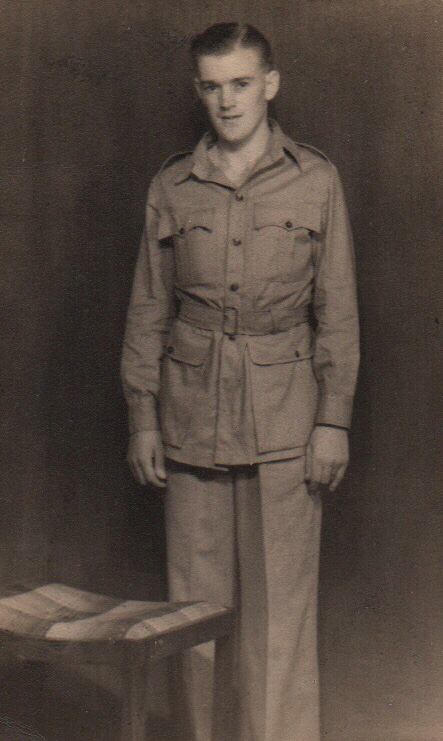
The days that followed Donald’s departure slipped into weeks, and the weeks into months, slow, heavy, and measured by the rhythm of the postman’s footsteps. For Eva, time became a fragile thing, stitched together by waiting and prayer. Each morning she would open the curtains to the pale Hampshire light, her eyes falling first upon the little lane outside, half-hoping, half-dreading to see a uniformed figure coming up the path with news, the kind of news that could either mend or shatter a heart.
At Number 27, Porterbridge Street, life carried on in its quiet, unspoken way. Frank worked where he could, taking labouring jobs as the war drew men away from home and work became both scarce and urgent. His limp grew heavier with the damp, his old frostbitten wounds flaring in the cold, but he never complained. Instead, he poured his worry into small acts, tightening a hinge, chopping extra wood, mending Eva’s garden gate, the things a man does when he feels helpless against a greater enemy.
Eva, meanwhile, found her strength in the rhythm of care. She may have mended uniforms for the local boys, rolled bandages with the Women’s Voluntary Service, and helped distribute ration books at the town hall, her pen moving across names with quiet purpose. Yet behind her calm eyes, every task carried the same thought, Where is he today? Is he cold? Has he eaten?
Then, one grey morning, the first letter came. The envelope was thin, the handwriting familiar, uneven, hurried, but blessedly alive. Donald wrote from his camp with the Somerset Light Infantry, telling them of long marches, simple food, and the camaraderie of men thrown together by duty. He spoke of missing home, of the smell of Romsey’s river, of his father’s laughter and his mother’s cooking.
Eva held that letter as though it were a living thing, pressing it to her chest before unfolding it again and again until the paper grew soft and creased. She would sit by the hearth in the evenings and read it aloud to Frank and Fanny, her voice trembling slightly at the edges. Even Iris, now growing into a young woman herself, would sit close by, listening in reverent silence.
But for every letter that came, there were stretches of silence, long, aching gaps that swallowed whole months. The nights of no word were the hardest. Eva would lie awake beside Frank, her mind full of restless visions, Donald standing under foreign stars, the sound of guns rolling over fields, rain drenching his uniform. Sometimes she would dream she heard his voice calling her name, and wake with her heart hammering, her pillow damp with tears.
Romsey changed as the war deepened. The familiar cobbled streets now echoed with the heavy rumble of army lorriesand the quick tread of uniformed boots. The Abbey bells, which had once rung for weddings and Sunday services, now tolled for the fallen. Windows were crisscrossed with tape to guard against bomb blasts, even the night sky felt different, blacked out, muffled, waiting.
When the air-raid sirens wailed, Eva moved through the house like instinct itself, gathering her mother, Frank, and Iris into the garden shelter, her hands sure though her heart quaked. The whistle of falling bombs in distant Southampton was a sound that could drain the blood from her face. Sometimes the ground would shudder faintly even in Romsey, and she would clutch the locket she wore under her blouse, the one with Donald’s photograph inside, his young face smiling as though the world could never hurt him.
Yet amidst the fear, life persisted, stubborn, beautiful, and utterly human. Eva still tended her little patch of garden behind the house, planting beans and marigolds between the cracks of rubble and hope. She baked what she could with rationed flour, sharing with neighbours when she had enough. Frank built her a small shelf near the window where she kept Donald’s letters, neatly tied with a ribbon, her own small shrine of faith.
As the years dragged on, the war began to feel endless, a long, dim tunnel with no promise of light. News reached Romsey of local boys lost overseas, of fathers and sons who would not be coming home. Funerals grew quieter, more private, grief became a language spoken in glances and silences. Each time the vicar came up Porterbridge Street, Eva’s stomach clenched. Each time the postman turned toward her door, her breath caught.
But Donald’s letters kept coming, irregular, but alive. Sometimes they were little more than a page, sometimes only a few words. Yet to Eva, each one was a miracle, proof that her boy still walked beneath the same stars.
In her heart, she carried two wars, the one Frank had fought and survived, and the one Donald now faced. And though fear was her constant shadow, love was her light. Every prayer she whispered at night, at the hearth, by the window, in the still hush before dawn, rose not just for her son, but for all sons, all mothers, all who waited.
By 1944, as rumours of victory began to stir, Eva found herself daring to hope again, cautiously, tenderly, like someone touching a wound that might yet heal. She would sit on the garden step, the evening air filled with birdsong, and imagine Donald walking back down Porterbridge Street, older, changed, but smiling still.
And when VE Day finally came, and the bells of Romsey Abbey rang out in a wild, jubilant chorus, Eva wept. The sound filled the town like sunlight after endless storm. Neighbours embraced in the streets, laughter spilling through the open doors. But for Eva, the celebration was quieter, more sacred. She went to her little shelf, untied the ribbon that bound Donald’s letters, and whispered through her tears,
“You made it, my darling. You made it through.”
For she knew that war did not end in a single day, nor did fear vanish with the sound of peace. Yet love, her love,  had endured it all. And in that endurance lay her victory.
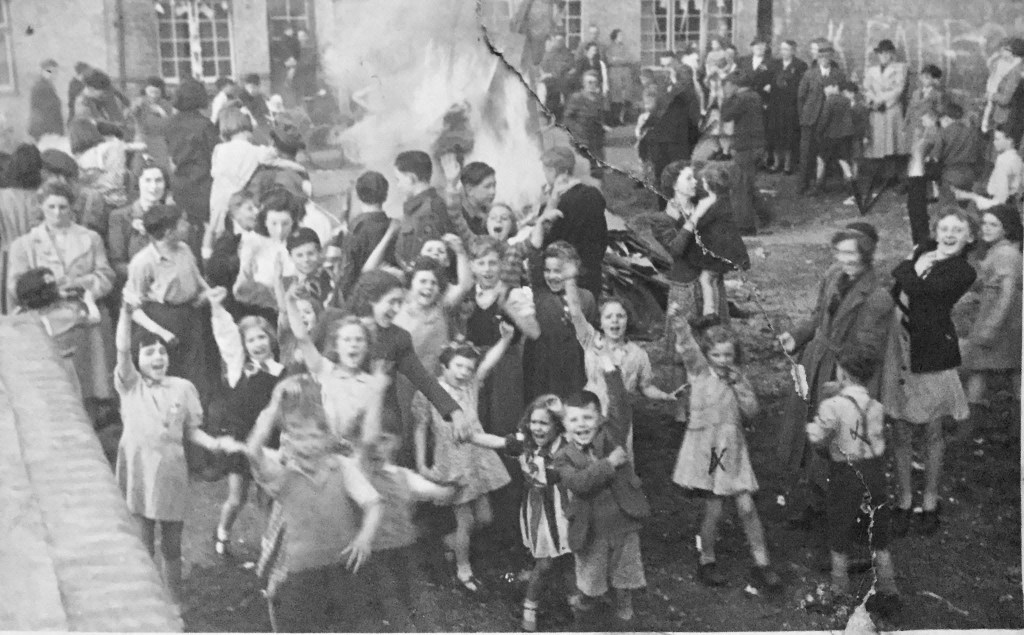
Banning Street, Romsey
On the gentle morning of Saturday, the 25th day of April 1942, while wartime England balanced itself between fear and fragile hope, it was not only a young bride whose life took a tender turn. In Romsey’s familiar heart, at 27 Portersbridge Street, a woman who had quietly shaped another’s life now watched her niece step into her own future. Eva Kate Newell had been far more than an aunt to Iris Lilian Dowling, she had been her guardian, her comforter, her teacher, and her soft place to land when the world felt too heavy. After Iris’s difficult beginnings and the absence of her father’s steady presence, it was Eva, alongside her devoted husband Frank, who had woven the fabric of Iris’s childhood with warmth, gentleness, and a love as steady as the turning seasons.
And now, on this soft spring morning, as the bells of the Parish Church of Romsey chimed through the quiet lanes, Eva stood with an aching tenderness in her chest, watching the young woman she had raised walk beneath the church’s ancient arches. The stone walls, smoothed by centuries of vows and whispered prayers, seemed almost to glow as they had watched Iris grow from a small, uncertain child into the graceful bride before them.
The marriage entry captured the formalities in its careful lines:

1942, Marriage solemnized at the Parish Church in the Ecclesiastical Parish of Romsey in the County of Southampton.

No. 187.

When Married: 25th April 1942.

Name and Surname: Leslie Albert Bundy, Iris Lilian Dowling.

Age: 27, 23.

Condition: Bachelor, Spinster.

Rank or Profession: Private, Pioneer Corps; —.

Residence at the time of Marriage: 225 Cottage, Aldershot Camp; 27 Porters Bridge Street.

Father’s Name and Surname: Ernest Bundy; William George Dowling.

Rank or Profession of Father: Farm labourer; labourer.

Married in the Parish Church according to the Rites and Ceremonies of the Church of England by licence by me, W. B. Corbray, Vicar.

This Marriage was solemnized between us:

Leslie Albert Bundy,

Iris Lilian Dowling

In the presence of us:

Frank Newell,

Victor Lawes.
Yet the ink on the page told only the simplest version of the truth. It did not speak of the countless nights when Eva soothed Iris’s childhood tears, nor the mornings when she plaited her hair with gentle fingers. It did not record the laughter that echoed in their modest home or the warmth of the meals Eva prepared with loving hands. It could not capture the quiet pride that swelled in Eva’s chest now, as she watched her niece, her girl, walk toward the altar.
No one truly knows who accompanied Iris down the aisle. It might have been her father William, though life had drawn him far from her. It might have been Frank, whose name appears as witness. Or, in some tender unspoken way, it might have been Eva herself, guiding Iris with an invisible hand, her love wrapped around her like a shawl. For Eva had always been the one Iris returned to, the voice that steadied her, the embrace that sheltered her, the unwavering presence that shaped her into the woman who now stood ready to promise her life to another.
Perhaps as Iris placed her hands into Leslie’s, Eva’s breath caught. Perhaps she pressed a hand to her chest as she watched the vows spoken, her heart full of joy and a small, aching sweetness. The Reverend W. B. Corbray’s words washed through the church, but to Eva they must have sounded like both an ending and a beginning. And when Iris leaned over the register and wrote her name, Iris Lilian Dowling, Eva saw not just a bride, but the little girl she had once carried on her hip, soothed through fevers, comforted in storms.
Outside, the April air was cool and touched by the distant hum of war, but as the newly married couple stepped into the daylight, Eva felt a warmth unfurl within her. She had given Iris everything she could, love, guidance, a home, and now Iris carried those gifts into her new life, woven into her very being.
And perhaps, as the bells of Romsey rang out across the rooftops, Eva allowed herself a quiet, trembling smile. For though the world was uncertain, though bombs fell not too far from where they stood, she had kept one small corner of life safe and bright. Iris stepped forward into her future with a steady heart, and that steadiness, Eva knew, had begun long ago in the shelter of her arms.
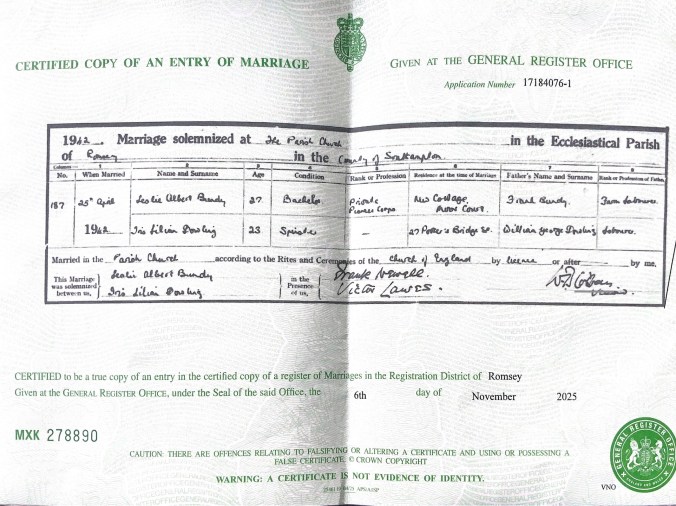
It was Thursday, the 6th day of December, 1945, when winter’s chill settled softly over Portersbridge Street in Romsey, Hampshire. The war had finally ended, the guns fallen silent, and yet for Eva, another, more intimate battle was drawing to its quiet close, the slow fading of her beloved mother, Fanny Hatcher.
The small house was still that morning, the fire burning low in the grate, its gentle crackle the only sound that dared disturb the hush. Outside, Romsey stirred to life, the distant clatter of carts, the soft ring of a bicycle bell, but within those familiar walls, time itself seemed to pause. Eva sat close beside her mother’s bed, her hands folded over Fanny’s frail ones, the years between them melting away until they were once more simply mother and daughter, the teacher and the child, bound by a love that had endured through wars, widowhood, and life’s many crossings.
Fanny, a widow of George Hatcher, the engine driver, had lived seventy-four years, her life shaped by both the smoke of the railways and the rhythms of this old market town. Hers had been a generation tempered by the Victorian hearth, tested by the Great War, and worn but not broken by the second. The lines upon her face told the story of endurance, of laughter and loss, of faith and fierce devotion. Even as her breath grew faint, she remained composed, her spirit anchored in the quiet wisdom of a woman who had long made peace with the turning of time.
Eva leaned close, brushing a stray curl of silver hair from her mother’s forehead. The pulse beneath her fingers fluttered gently, like the wings of a bird preparing to take flight. She whispered softly, “I’m here, Mum,” and Fanny’s lips curved into the faintest smile. There was no fear in her eyes, only a tender, luminous calm, the peaceful knowing of a soul ready to return home, to be once more in the arms of her dearest George and the six children who had gone before her, their spirits surely reaching out to welcome her across that unseen threshold.
When the final moment came, it was like the extinguishing of a candle’s flame, not abrupt, but graceful. Eva felt her mother’s hand grow still in hers. The silence that followed was deep and sacred, filling the room like light. For a long while she simply sat, unable to move, the enormity of love and loss pressing gently against her heart.
Then, remembering what Fanny had once taught her long ago “Always open the window when a soul departs, so it may find its way home” Eva rose and did just that. She pushed the small window open, and a breath of cold December air drifted in, brushing her cheeks like a benediction. She stood there for a moment, watching her mother’s spirit, invisible yet somehow felt, lift softly into the morning, mingling with the pale light and the slow, rising mist over Romsey.
Her niece, Iris Lillian Bundy, stood quietly nearby, tears shining in her eyes. It was Iris who later walked to the Registrar’s Office that same day, her grief still tender, to give her account of Fanny’s passing. The familiar hand of Registrar W. H. Corban took careful note of every detail, ensuring that Fanny’s long life was faithfully entered into the official record:
1945 Deaths in the Sub-District of: Romsey in the County of Southampton
No.: 394

When and where died: Sixth December 1945, Portersbridge Street, Romsey U.D.

Name and surname: Fanny Hatcher

Sex: Female

Age: 74 years

Rank or profession: Widow of George Hatcher, Engine Driver

Cause of death: (a) Senile myocardial degeneration. Certified by G. H. Johnson, M.R.C.S.

Signature, description, and residence of informant: I. L. Bundy, present at the death, 24 Portersbridge Street, Romsey

When registered: Sixth December 1945

Signature of registrar: W. H. Corban, Registrar.
That simple entry, so factual, so restrained, could never capture the fullness of the woman Eva had known. To the world, Fanny was a line in a register, a widow, seventy-four, gone quietly on a winter morning. But to Eva, she was the sound of a lullaby hummed in the dark, the smell of bread baking on a Sunday, the voice that had soothed every fear and steadied every storm. She was the heartbeat of home.
After the formalities were done, Eva returned to the stillness of the house. The bed was empty now, the window still open. She sat for a while, letting the cold air wash over her, her tears falling freely, quietly, not from despair, but from love too deep for words. Outside, the Abbey bells began to toll, their sound low and resonant across the rooftops. They did not mourn, she thought, they welcomed.
Later, when she closed the window at last, she did so gently, whispering, “Safe journey, Mum.” And in that whisper lived a lifetime, a daughter’s gratitude, a mother’s lesson, and the unbroken thread between the living and the gone.
For Fanny’s passing was not an ending, but a soft continuation, her spirit lingering in the ticking of the old clock, in the scent of lavender that still clung to her shawl, in the warmth that never left the walls of Number 27, Portersbridge Street.
Eva knew she would never stop missing her mother, but she also knew, with the quiet certainty of love that had weathered every storm, that she would never be without her.

It was Tuesday, the eleventh of December, 1945, when Romsey awoke beneath a sky the colour of pewter. A soft, wintry mist hung low over Botley Road, the air damp and cold, carrying the scent of turned earth and rain-soaked yew. The war had ended only months before, yet peace felt fragile, like glass in trembling hands. Now another kind of farewell was being written into the quiet heart of this Hampshire town, the laying to rest of Fanny Hatcher, wife, mother, grandmother, and for Eva, her only surviving child, the axis upon which her whole world had turned.
For five days the house on Portersbridge Street had been still, shrouded in mourning. Fanny’s coffin, plain, polished oak, adorned with possibly white chrysanthemums and sprigs of rosemary for remembrance, had rested in the front parlour, as was custom still in those years. A candle burned beside it through the nights, its flame a watchful sentinel. Eva, unable to sleep, would sit beside her mother’s casket in the hush of the small hours, her hand resting lightly on the wood, whispering half-formed prayers, half-memories.
When the morning of the funeral came, the undertakers arrived in their dark coats and solemn hats. The coffin was carried carefully down the narrow steps by most likely Frank, Donald, Iris’s husband Les and men who had known Fanny in life, neighbours and friends who had once shared a garden fence, a loaf of bread, or a kind word. The pallbearers, guided by quiet dignity, placed her upon the waiting black horse-drawn hearse, the glass panels glinting faintly in the thin December light. Behind it, the small procession began its slow journey toward Romsey Old Cemetery on Botley Road, the clip-clop of hooves echoing softly along the cobbles, the town pausing as the cortege passed.
Eva and Frank walked arm in arm, their steps measured and heavy. Donald, her son, and Iris Lillian, her beloved niece and granddaughter to Fanny, followed close behind. Iris, now married, had taken on the duty of arranging her grandmother’s burial with love and care, purchasing grave plot P197 so that Fanny might rest in dignity, close to the heart of the town she had loved all her life.
When they reached the cemetery, frost glimmered faintly across the grass, and the air hung still, heavy with breath and memory. The ancient yews stood watchful and black against the grey sky. As the mourners gathered, their quiet breaths mingled with the mist, and the faint toll of the Abbey bell drifted across the distance, solemn and slow, a sound that had marked every chapter of Fanny’s long life.
The Reverend, robed in black and white, opened his prayer book, his voice carrying gently through the cold. “I am the resurrection and the life…” he began, the familiar words echoing against the stones and open earth. Eva bowed her head, her gloved hand gripping Frank’s for strength. The hymn followed “Abide With Me” its verses trembling on the air as those gathered sang softly through their tears.
Abide with me, fast falls the eventide;
The darkness deepens; Lord, with me abide…
Each note seemed to rise into the pale winter sky, dissolving into the chill as though carried heavenward. Eva’s voice faltered, her throat tight, but she whispered the final words, steady and sure, for she had promised her mother she would not weep too loudly, that love should be remembered in peace, not despair.
When the coffin was lifted once more and carried toward the grave, the pallbearers moved slowly, their boots crunching softly over the frost. Frank stepped forward to lend his hand, his breath visible in the cold air, his eyes filled with quiet reverence. The polished wood gleamed as it was lowered into grave P197, the ropes creaking gently, the sound achingly final.
The Reverend read from the Book of Common Prayer, his words a balm for the living as much as a blessing for the dead:
“Earth to earth, ashes to ashes, dust to dust,
in sure and certain hope of the resurrection to eternal life.”
Eva’s gaze blurred as she watched the earth being returned, the dull thud of soil against the coffin lid striking her chest like a heartbeat. Somewhere above them, a robin began to sing, a small, bright sound that cut through the stillness. She looked up, and for a moment, the world seemed to still.
Her mother was gone, yet not gone.
She felt it in the air, in the faint warmth that brushed her cheek though the day was cold. And she remembered, through her tears, the moment of her mother’s passing, how Fanny, her eyes filled with luminous calm, had seemed to look beyond the room, as though seeing something, someone waiting. Eva had opened the window then, just as her mother had taught her, to set her soul free, to let it rise into the morning light and find her beloved George and the six of her seven children who had gone before.
Now, as the earth settled over the grave, Eva imagined that reunion, her mother’s laughter, the clasp of her father’s hand, the joy of all her lost siblings running once more toward her through some eternal field of gold. The thought brought both ache and comfort, a beauty too vast for tears.
When the final prayer was spoken and the mourners began to drift away, Eva lingered. She laid her gloved hand upon the mound of fresh earth, her breath a white cloud in the cold air.
“Thank you, Mum,” she whispered. “For everything.”
The wind moved softly through the yews, carrying her words away like a blessing. The robin sang once more, and the faintest shaft of pale sunlight broke through the clouds, falling across the grave as though the heavens themselves had opened to receive her.
Years later, I walk the paths of Romsey Old Cemetery with map in hand and memory in heart, and searched for grave P197. Yet I could not find it. The years and moss had claimed the stone, hiding it from sight.
But Eva, ever her mother’s daughter, understood, her mother’s spirit could not be confined to one place.
It lived in the air of Romsey, in the hum of the River Test, in the scent of lavender by the window, in the echo of laughter shared across generations.
Fanny Hatcher had returned to the earth, but her love remained, steadfast, unbroken, eternal, living still in the quiet rhythm of her daughter’s heart.

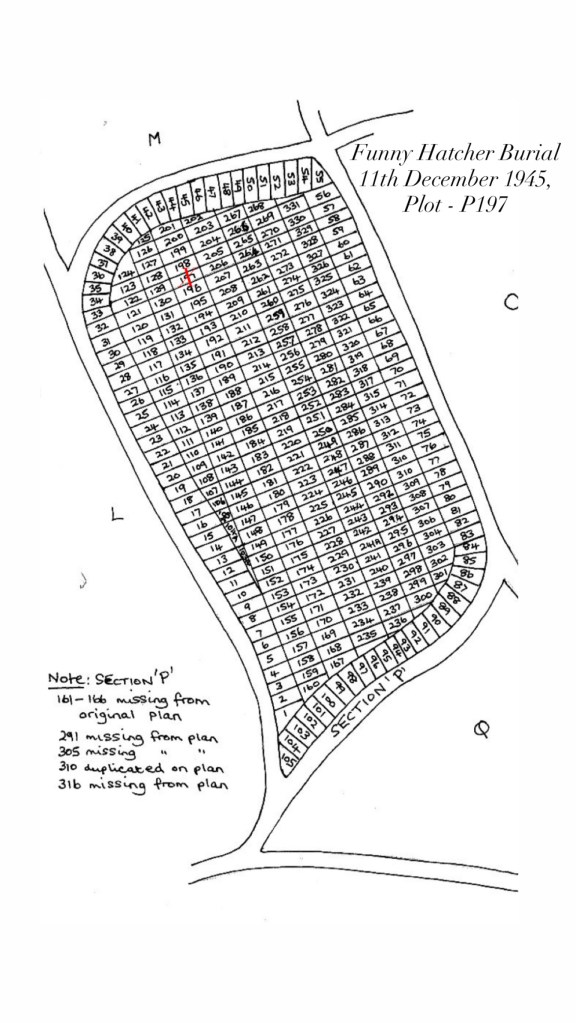
The winter of 1946 still held Hampshire in its cold embrace. Frost glittered along the hedgerows, catching the pale sunlight like scattered glass, and the fields around Romsey lay hushed beneath a shroud of mist. It was on such a morning, Wednesday, the 13th day of February, that William Hatcher, Eva’s uncle, and brother to her late father George, took his final, quiet breath at Waltham House, Droxford R.D. Once known as the Droxford Union Workhouse, the place had long stood as both a refuge and a sorrow, a home for those whom life had pressed hardest.
Eva learned of his passing not from hurried telegram or formal letter, but through the slow, inevitable whisper of family news, carried to her across the cold weeks that followed her mother’s own death. The ache of it settled deep in her heart, for William had been one of the last living threads to her father’s side of the family, a small but precious tether to the past she had already begun to lose piece by piece.
The official record told the bare bones of his story, with all the restrained dignity of ink upon a registrar’s page:
No. 87

When and where died: Thirteenth February 1946, Waltham House, Droxford R.D.

Name and surname: William Hatcher

Sex: Male

Age: 83 years

Rank or profession: Of Romsey, Hants — General Labourer

Cause of death: 1(a) Coma; (b) Paraplegia, certified by J. Gibbs, L.R.C.P.
Signature, description, and residence of informant: V. H. Gosch, Occupier, Waltham House, Droxford, Southampton

When registered: Fourteenth February 1946

Signature of registrar: J. Philpott, Registrar.
Just a few lines, a lifetime folded neatly into formality. But to Eva, the words stirred memories far richer than the paper could bear. She could see him as a young man in Newtown, before age and infirmity had claimed him, quiet and thoughtful, standing by the hedgerow in Newtown, watching the sunrise paint the fields gold. He had been “crippled from birth,” the records said, and later cruelly marked as “imbecile” a word that belonged to ignorance, not truth. For William was gentle, she remembered her mother saying, patient and observant, with eyes that saw the world in ways others could not.
His life had not been one of toil and trade, as his brother’s had, but one of endurance. After his mother Susan died in 1903, his world had grown smaller, the walls of the Romsey Workhouse becoming both his shelter and his prison. When he was later moved to Droxford, to Waltham House, it was as though he had drifted farther from the life he had known, farther from the familiar bells of Romsey Abbey, the murmur of the River Test, and the laughter of family gatherings he once watched from the edge of the room.
And yet, even there, Eva liked to believe he had moments of peace, the way light fell through the windows on a winter morning, or the sound of sparrows in the courtyard. Perhaps the nurses spoke to him kindly. Perhaps he thought sometimes of home, of his brother George’s laughter, or of the smell of damp earth after rain in the lanes of Hampshire.
When Dr. J. Gibbs, L.R.C.P., certified his passing, coma, paraplegia and Registrar J. Philpott recorded it the following day, Thursday, the 14th day of February, it closed a chapter that had begun long before the century’s turn. Eighty-three years of quiet existence, lived without complaint or bitterness. A life shaped by solitude, yet dignified in its persistence.
For Eva, the news brought a deep, familiar ache, the kind that sits beside you, silent, and will not move. She was now the last of her line, the final bearer of the Hatcher name in her branch of the family. Her mother gone. Her father long buried. And now her uncle, her father’s brother, the last link to that earlier, humbler time when the Hatchers had filled the Lanes of Newtown with their laughter and their labour.
She thought of him often in those quiet months that followed, not with pity, but with tenderness. She would picture him walking again, freed at last from the frailties that had bound him, his step light and sure as he moved through some brighter place where suffering no longer followed. Perhaps he had found his mother again, and his brother George, and all those who had gone before.
Where William was laid to rest remains a mystery. Perhaps he sleeps beneath the tangled ivy of a village  churchyard near Romsey, near the whispering yews and the hum of bees that stir in summer. Or perhaps his grave lies upon the gentle slope of Droxford’s hills, where the wind moves softly over the grass and the Hampshire sky opens wide and endless.
Wherever he rests, Eva knew that the land itself remembers him, the soil he once stood upon, the air he once breathed, the bells of Romsey Abbey that surely tolled the day he passed. She would sometimes pause by the river and think of him, her heart whispering the same words she had once spoken for her mother:
“You’re free now. Free to walk, free to rest. Free to go home.”
And though his name appears only as a line in a record, William Hatcher’s spirit lived on, not lost, but folded gently into the quiet heart of Eva’s memory, part of the enduring story of a family that had known sorrow and still chosen love.

Waltham House, once known as the Droxford Union Workhouse, stood quietly in the Hampshire countryside, a solemn witness to more than a century of change. It was born of necessity and hardship, created under the Poor Law Amendment Act of 1834, when parishes across England were grouped into “Unions,” each responsible for building a workhouse to shelter those unable to support themselves. The Droxford Poor Law Union came into being in March 1835, and by 1837 the workhouse had been built to serve the parishes scattered across the Meon Valley.
For generations, its high brick walls and iron gates marked the border between the respectable world and the world of the destitute. Inside, the routines were strict, the divisions absolute. Families were often separated; men, women, and children lived apart. The workhouse was meant to be both a refuge and a deterrent, food, shelter, and medical care were provided, but always with an edge of austerity. The air carried the smell of carbolic soap and boiled oats, and the days were measured out by the ringing of the workhouse bell.
In its early years, Droxford, like so many other unions, found itself under scrutiny. There were investigations into neglect, cruelty, and the treatment of children, a dark shadow that hung over the entire Poor Law system. Yet for all its harshness, the workhouse also represented survival. It offered safety when there was none elsewhere, a roof when all other doors had closed.
By the end of the nineteenth century, the Droxford Workhouse housed close to a hundred souls, the aged and infirm, widows, children, and those the records coldly labelled “idiots” and “lunatics.” In truth, many were simply poor, alone, or unwell. They spent their days in quiet labour or rest, their lives shaped by the slow turning of institutional time.
The building itself was designed to house around two hundred people, a grim but practical structure of red brick and slate, surrounded by fields and enclosed yards. As decades passed, the harshness softened slightly, the old Poor Law giving way to new ideas of welfare and care. By the early twentieth century, Droxford had begun to change. The workhouse system was dying, replaced by a new vision of social support, though the transition was slow and incomplete. For many, the stigma of the workhouse remained.
When William Hatcher spent his final years there, the place had already shed much of its cruelty. It was no longer the feared institution of Victorian memory but a kind of almshouse or infirmary for the elderly, the sick, and those without family. The name had changed too; by then it was called Waltham House. The nurses were kind, the regime gentler. There were gardens, and on fine days, the residents might sit outside beneath the trees, watching the light drift over the hills of Droxford.
For William, who had lived a life of quiet endurance, Waltham House may have offered a final refuge—a place where he was fed, tended to, and no longer alone. When he died there on the thirteenth of February 1946, the long chapter of his life closed within those same walls that had seen so many endings before. His death was certified by Dr. J. Gibbs and recorded the next day by Registrar J. Philpott, one entry among thousands in the county’s ledgers.
In time, the world moved on. The Poor Law Unions were abolished, and the old workhouses became hospitals, homes for the elderly, or stood empty until their demolition. Waltham House was finally closed and torn down in 1973, its history buried beneath new foundations.
Yet for all that, the memory of places like Waltham House lingers. It is carried in the stories of families like Eva’s, in the quiet sorrow of knowing that her uncle William ended his days there, and in the gentler understanding that by then, the workhouse had become less a place of punishment and more a house of care for those left behind.
If one stands today among the fields near Droxford, where the wind moves softly through the grass, it is easy to imagine the lives once held within those walls. The echoes of footsteps, the murmur of voices at prayer, the toll of the dinner bell at noon, all now faded into memory, yet still part of the landscape of Hampshire. For William, for all who found both hardship and solace there, the story of Waltham House endures as a quiet chapter in the long, complex tale of compassion and endurance that shaped the generations before us.
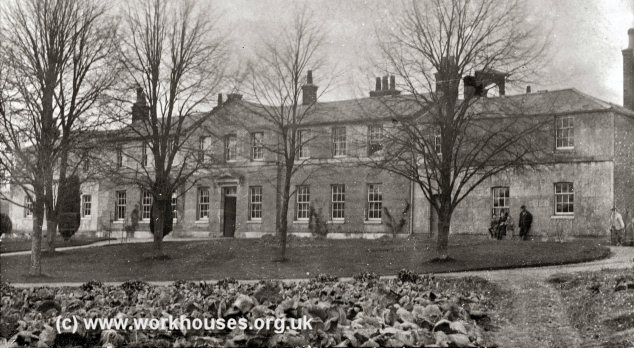
Life for William in the workhouse would have been one of quiet repetition and simple endurance. By the time he came to live at Waltham House, the harshest days of the old Poor Law were already passing, but its shadow still lingered in the air. The building itself was solid and cold, a great red-brick institution standing at the edge of Droxford’s gentle hills, its corridors echoing with footsteps and the faint smell of boiled vegetables and disinfectant.
The days began early. The bell would sound before dawn, calling the residents from their narrow iron-framed beds. In earlier decades, able-bodied inmates would have been sent to work, breaking stones, scrubbing floors, or tending the gardens. But by the 1930s and 1940s, Waltham House had become less a place of labour and more a house of care for the frail and forgotten. William, crippled from birth and long accustomed to institutional life, would have followed a gentler rhythm. He might have sat by the tall windows in the day room, wrapped in a woollen shawl, watching the light shift across the courtyard. On fine days, the attendants would take some of the residents outside to sit beneath the trees, where they could feel the wind on their faces and hear the church bells drifting faintly over the fields.
Meals were simple but regular, porridge in the mornings, soup and bread at noon, perhaps a little meat on Sundays. The rooms were plain, their walls whitewashed and bare except for a few framed texts or fading photographs of the King and Queen. The days were marked by small rituals: the arrival of the post, the rattle of the medicine trolley, the sound of footsteps as nurses moved from one ward to another. There was a kind of stillness to it all, a life reduced to its simplest form, eating, resting, remembering.
For William, the workhouse would have carried both safety and sorrow. It offered him a bed, warmth, and care, but also a sense of final confinement. He had outlived his parents, his brother George, and the Romsey of his youth. The fields and riverbanks of his boyhood were far behind him now, replaced by the muted world of shared wards and quiet halls. Yet perhaps, in his own way, he found peace there. The staff, by then trained in nursing rather than discipline, treated the old residents with a measure of gentleness. They knew his name, they brought him tea, they tucked the blanket around his feet.
When death came to the workhouse, it came softly. There were no family vigils or the comfort of home, but neither was there neglect. For those who were very old or frail, as William was, the end often came in the early hours when the building was hushed, the only sound the slow tick of the hall clock and the faint rustle of the night nurse’s shoes. His final illness, paralysis and coma, the record said, would have left him mostly still, drifting in and out of wakefulness. The nurses would have moistened his lips, kept his hands warm, and perhaps whispered his name to let him know he was not alone.
When he finally slipped away, there would have been a moment of silence. The nurse would have drawn the sheet gently over his face, then gone to fetch the matron. His name would have been entered in the ledger, his bed tidied, ready for the next occupant. A doctor certified the death, the registrar wrote it down in his book. There were no grand ceremonies, no mourning clothes or carriages waiting at the gate. But perhaps, as dawn broke over Droxford and the frost began to melt from the hedgerows, a shaft of pale light found its way through the high windows of Waltham House and rested quietly upon him.
For William, who had known the confines of the workhouse for so long, death may have felt less like an ending and more like a release, a door opening at last. He had lived his whole life within the boundaries of Hampshire, his story woven into its soil and seasons. And though he died far from the familiar streets of Romsey, the earth that received him was of the same county, the same gentle land that had shaped his beginning. It is easy to imagine his spirit returning to those places he had loved, the river, the fields, the sound of distant bells, his body at rest, his soul finally free from the walls that had held him for so long.
The morning of Saturday, the 1st day of June, 1946, dawned clear and tender over Romsey, the town breathing once more after years of wartime darkness. The bells of Romsey Abbey pealed softly across the rooftops, their echoes mingling with the song of birds and the faint hum of early summer. Beneath those ancient arches, where sunlight spilled through the stained glass like liquid gold, Donald George Newell, the only son of Eva and Frank, stood ready to begin the next chapter of his life.
At twenty-six, Donald had already lived a lifetime of courage. He had marched beneath foreign skies, carried the weight of duty on his young shoulders, and returned home shaped by war but unbroken by it. Now, dressed in his uniform of His Majesty’s Forces, he stood at the heart of his hometown, ready to bind his future to that of Mollie Joan Carr, a gentle-hearted woman of twenty-four whose calm grace and steadfast spirit promised him peace after years of turmoil.
The Abbey, with its cool stone and centuries of memory, seemed to hold its breath as the guests gathered, neighbours, friends, family, all witnesses to the quiet triumph of love over loss. Eva sat near the front, her gloved hands folded tightly in her lap, her heart full to bursting. She had dreamt of this day since the moment she first cradled Donald in her arms, a fragile newborn in the winter of 1919. And now, as the organ began its stately hymn, she watched her son, the boy who had survived war and uncertainty, walk toward his bride beneath the Abbey’s vaulted ceiling.
Donald, of 27 Portersbridge Street, and Mollie, daughter of Frederick Carr, a retired gentleman of 75 Upper Crescent, Nursling, came together that day not just in marriage, but in hope, the first great hope of a new era, when the world, weary from loss, dared to dream again.
The Church of England service, solemnized by Vicar W. J. Corban, carried the comfort of ancient words long spoken over generations. There was reverence, and yet joy too, a sense of rebirth, of something fragile and beautiful taking root in the wake of war. The couple’s voices trembled as they spoke their vows, but the words rang clear, rising into the vaulted heights like a promise to the heavens themselves.
With this ring, I thee wed,
With my body, I thee honour,
And all my worldly goods with thee I share.
For Eva and Frank, standing among the congregation, the moment was almost too much to bear. Eva’s eyes shone with tears she did not try to hide. She remembered Donald’s first steps across the kitchen floor, his laughter as a boy running along Middlebridge Street, the weight of her fear when he went to war, and now the sight of him standing tall and sure, ready to build a future of his own. Beside her, Frank squeezed her hand, his rough palm trembling, his eyes fixed on his son with quiet pride.
The ceremony was recorded with the precision of the age, every detail inked into the parish register for posterity:
Marriage solemnized at the Parish Church in the Parish of Romsey, in the County of Southampton.

No. 309

When Married: First June 1946

Names: Donald George Newell and Mollie Joan Carr

Ages: 26 and 24

Condition: Bachelor and Spinster

Rank or Profession: H.M. Forces and —

Residence at the time of Marriage: 27 Portersbridge Street, 75 Upper Crescent, Nursling

Father’s Names: Frank Newell, Frederick Carr

Fathers’ Occupations: Builder’s Labourer, Retired Gentleman

Married by Licence according to the Rites and Ceremonies of the Church of England by me, W. J. Corban, Vicar.

This marriage was solemnized between us:

Donald George Newell p
Mollie Joan Carr

In the presence of: Frederick Ernest Carr
Leslie Albert Bundy.
When the signatures were written and the last hymn rose gently through the Abbey, sunlight broke across the stone floor, bathing the couple in light as if heaven itself had offered its blessing.
Outside, the townspeople gathered along Church Street, smiling, their faces warmed by the early summer sun. The war had ended scarcely a year before, but on that morning, the air seemed to shimmer with renewal. As Donald and Mollie emerged from the Abbey, the bells pealed again, jubilant and bright, and Eva thought her heart might burst with love and relief. She had prayed through the war that her son would come home, and now he stood before her, married, whole, and radiant with life.
Frank placed a steady hand on her shoulder as confetti scattered like blessings upon the newlyweds. He said little, but in the silence between them, Eva understood everything, the pride, the tenderness, the gratitude for all that they had endured together. Their family had come through two wars, unthinkable loss, and unending labour, yet somehow love had survived. It had taken root in their son, and now it would grow again in the life he would build with Mollie.
Later, as they returned home to Portersbridge Street, Eva sat by the window, her thoughts drifting between past and present. She imagined Fanny, her mother, watching from above, smiling at the continuation of their family’s story. She thought of William, her uncle, and all the quiet souls who had shaped their line, their love now flowing onward through Donald and Mollie.
Unfortunately there are certain documents I am unable to share due to the 100-year law, which protects the privacy of individuals and their immediate descendants. This law exists to ensure that personal information about people who may still be alive or recently deceased is kept private. It means that birth, marriage, and death certificates, along with other personal records, are generally not accessible to the public until 100 years have passed from the date of birth, or in some cases, 50 years after a marriage or death. Because of this restriction, some of the most intimate details about Donald’s life, such as his early childhood, the specifics of his marriages, and even certain aspects of his family connections, remain hidden from view. Other official documents that could provide insight into his daily life, work, or personal milestones are similarly protected by the law. While this can be frustrating for those of us trying to piece together a full picture of our ancestors, it is a reminder of the care taken to protect personal histories and respect the privacy of living family members. Even with these limitations, the fragments of information that are accessible allow me to imagine the life he led, the challenges he faced, and the family he nurtured. The gaps left by the 100-year law also encourage me to reflect on the passage of time, the fleeting nature of memory, and the importance of preserving the stories we can collect. While I may not yet be able to share every record, the story of Eva Frank and Donald, continues to emerge through the pieces I have and the limited memories passed down through generations, making the journey of discovery all the more meaningful.
That June day in 1946 was more than a wedding. It was a promise fulfilled, a bridge between what had been endured and what was yet to come. For Eva, it was the moment her heart, so long burdened by fear and loss, finally exhaled. Her son, her Donald, stood at the threshold of his own life, the world before him bathed in sunlight, and in that light she saw everything she had ever hoped for, love, endurance, and the quiet grace of a family forever bound by the strength of its heart.
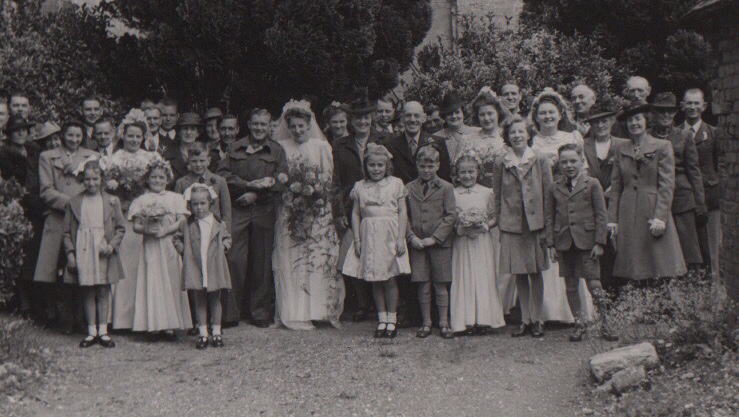
The morning of Friday, the 7th day of June, 1946, dawned bright and clear over Romsey, the kind of early summer day when sunlight dances across the cobblestones and the scent of lilac drifts through open windows. As Eva unfolded the Romsey Advertiser, her heart gave a quiet flutter. There, printed upon the page in crisp black letters, lay the story of her son’s wedding, her Donald’s, retold for all the town to read. The heading itself seemed to shimmer from the paper:
“Pink and White Wedding — Pretty Ceremony at Romsey Abbey.”
For a long moment, she simply held the newspaper in her hands, tracing the words as though they were something sacred. She had lived the day itself, had stood beneath the Abbey’s ancient arches and watched her son take his vows, but seeing it here, captured in print, preserved for posterity, filled her with a tenderness beyond measure. It was as if the joy of that June afternoon had been pressed between the pages like a flower, its colour and fragrance still intact.
The article spoke with fond admiration, describing how “an interesting wedding was solemnised at Romsey Abbey on Saturday afternoon, the Vicar, Canon W. H. B. Corban, officiating.” It named her son proudly, Sergeant Donald Newell, of the Somerset Light Infantry, only son of Mr. and Mrs. Frank Newell, of 27 Portersbridge Street, Romsey, and his bride, Miss Mollie Joan Carr, youngest daughter of Mr. and Mrs. Frederick Carr, of Oak Glen, Upton Crescent, Nursling. To the townsfolk, they were the young couple whose love had blossomed in the bright aftermath of war; to Eva, they were her heart walking in two bodies, her son and the woman who would now share his life.
She read of Mollie’s gown of white silk taffeta, the embroidered veil held by a wreath of orange blossoms, the gold pendant set with a sapphire, and the lovely bouquet she carried, all described in gentle, reverent prose that made Eva smile through her tears. She could see it all again as she read: the sunlight spilling through the Abbey’s stained glass, the way it seemed to gild Mollie’s veil as she stood beside Donald, both so young and full of hope.
The report went on to name the attendants, Mrs. Iris Bundy, her beloved niece who was more daughter than kin, standing proudly as matron of honour, Miss Peggy Envest and Mrs. Violet Fudge, the bride’s dear friends; and the two little girls, Anne Doling and Ann Dowling, cousins of the bride and groom, their laughter still echoing in Eva’s ears. The article detailed their gowns of pink satin and mauve taffeta, their silver shoes, their headpieces of pink feathers, and the bouquets of pink and mauve irises they carried, all rendered in such tender detail that Eva could almost hear the rustle of silk and the soft murmur of the congregation once more.
The paper recorded too the gold necklaces and bracelets Donald had gifted his attendants, and the silver horseshoespresented by Miss Diane and Master Kenneth Martin, sweet tokens of luck for the newlyweds. It spoke of the reception at the Victoria Restaurant, where sixty guests gathered amid laughter and toasts, and of the couple’s departure for Cambridge, where their honeymoon would begin. “The bride,” it noted, “wore a dress of brown beneath a white fur fabric coat, with brown accessories.” Eva could see her now, her new daughter-in-law turning to wave one last time before stepping into the car beside Donald, her smile radiant and sure.
Eva read each line slowly, as though it were poetry written for her alone. She could almost hear the faint hum of the printing press that had captured her family’s joy, the turning wheels setting her son’s name, Donald George Newell, into type that would outlast them all. For a woman who had endured two wars, who had known the ache of separation and the quiet fear of waiting, this small article was more than a record; it was a keepsake of everything she had fought to preserve.
She folded the newspaper with care and pressed it between the pages of the family Bible, alongside baptismal certificates and faded photographs. There it would stay, a small relic of happiness, of love reborn after so much loss. To others, it was simply a report of a local wedding; to Eva, it was the living heart of her family, set down in ink, a moment of grace that would one day tell her grandchildren who they came from and what it meant to endure and love.
That evening, as dusk settled softly over Romsey and the bells of the Abbey tolled faintly in the distance, Eva sat by the window of 27 Portersbridge Street, the folded newspaper resting in her lap. She thought of Donald and Mollie, perhaps now walking hand in hand through the quiet streets of Cambridge, their laughter carried on the night air. Her heart swelled with pride and peace.
For though the world had changed and the years had taken much, love, that steadfast, ordinary, miraculous love, had remained. And now it lived on, in her son and his bride, in their laughter, in the pages of a newspaper, and in the heart of a mother who would remember that June forever.
The article reads as follows:
PINK AND WHITE WEDDING Pretty Ceremony at Romsey Abbey.
An interesting wedding was solemnised at Romsey Abbey on Saturday afternoon, the Vicar (Canon W. H. B. Corban) officiating. The contracting parties were Miss Mollie Joan Carr, youngest daughter of Mr. and Mrs. Frederick Carr, of Oak Glen, Upton Crescent, Nursling, and Sergeant Donald Newell, of the sommerset light infantry, the only son of Mr. and Mrs. Frank Newell, of 27 Portersbridge Street, Romsey. The bride was given away by her father and wore a charming picture in a becoming dress of white silk taffeta and an embroidered veil held in place with a wreath of orange blossoms. She carried a lovely okay and firm and what a gold pendant studied with a sapphire and pose the gift of the bride. She was attended by Mrs. Iris Bundy (sister of the bridegroom) as matron of honour, and by Miss Peggy Envest and Mrs Violet Fudgd (friends) and two small bridesmaids Anne Doling (cousin of the bride) and Ann Dowling (cousin of the bridegroom) Of the elder Attendance two wore dresses of pink satin and the third a dress of mauve fringed taffeta, while all wore silver shoes and head dresses of pink feathers with small pink veils. Their bouquets were of pink mauve irises and fern and their fancy gold necklaces were a gift of the bridegroom. The two little girls were very pretty in dresses of pink silk net with wreath head-dresses of silver leaves, forget-me-nots and rosebuds. They carried posies of pink and mauve hydrangeas and wore gold bracelets, the gift from the bridegroom. L private Leslie Bundy, a friend of the bridegroom was the best man. As the happy couple left the church the bridge was presented with silver horseshoe by Miss Diane and Master Kenneth Martin. Some 60 guests attended the reception which was held at the Victoria Restaurant. When Mr. and Mrs. Newell later left for Cambridge, where the honeymoon is being spent, the bridge was wearing a dress of brown beneath a white fur fabric coat, and brown accessories. They were the recipients of numerous handsome presents.
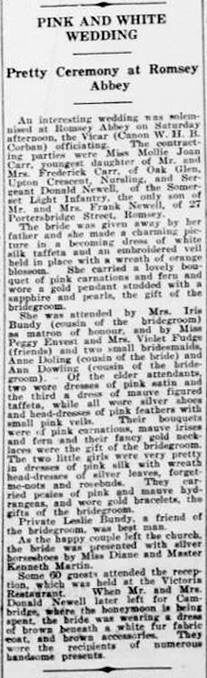
It was Monday, the 7th day of April, 1947, when the soft light of early spring fell upon the quiet wards of Romsey District Hospital, Hampshire. The war was over, but its echoes still lingered in the bones of England, ration books on the tables, patched coats on the hooks, and hope growing tenderly again, like the first primroses along the hedgerows. And it was on that morning, beneath the stillness of the hospital’s sunlit corridors, that a new cry rose into the air, small, pure, and full of promise.
Gillian Mary Newell had arrived.
To Eva and Frank, it felt as though time itself had paused, that after all the griefs and struggles of their years, life had given them this moment of pure renewal. Their first grandchild, born to their beloved son Donald George Newell and his wife Mollie Joan, was more than a baby, she was a symbol, a fragile blossom of the future unfurling in the gentle hands of the past.
Eva could almost see it as she sat by the window that morning, the newspaper folded in her lap, the faint hum of the Abbey bells drifting across the town. Somewhere not far away, their son, once the boy who had run barefoot through Middlebridge Street, once the soldier who had faced the fire and fear of war, now stood in awe beside a hospital cot, his rough hands trembling as they cupped the smallest of miracles.
Donald, now home and working with Southern Railway as a furnaceman, had built a quiet, honest life with Mollie, the young woman who had brought warmth and steadiness into his days. Their modest home at Number 73, Upton Crescent, Nursling, in the parish of Nursling and Rownhams, had become a place of laughter and peace, a place where the clock ticked gently, the kettle whistled each morning, and love lived in the ordinary rhythms of family.
And now, within those walls, a new rhythm would begin, the coo of a baby, the soft shuffle of tiny feet to come, the hum of lullabies in the evening light.
Four days later, on Friday, the 11th day of April, 1947, Donald went to the Registrar’s Office in Romsey. He carried himself with quiet pride, a touch of solemnity in his step, the weight of fatherhood still new upon his shoulders. With careful hand, he signed his name, D. G. Newell, Father, affirming their address at 73 Upton Crescent, Nursling, and with that small act, sealed the next chapter of their family’s story. The registrar, his name written simply as H. W. [surname unclear], recorded the event with his customary precision, the familiar ink of duty preserving for generations the first details of this small, miraculous life:
No. 61

When and Where Born: Seventh April 1947, Romsey District Hospital, Romsey U.D.

Name, if any: Gillian Mary

Sex: Girl
Name and Surname of Father: Donald George Newell

Name, Surname, and Maiden Surname of Mother: Mollie Joan Newell, formerly Carr

Occupation of Father: Furnaceman, Southern Railway, of 73 Upton Crescent, Nursling, Nursling and Rownhams

Signature, Description, and Residence of Informant: D. G. Newell, Father, 73 Upton Crescent, Nursling, Southampton

When Registered: Eleventh April 1947

Signature of Registrar: H. W. [Surname unclear], Registrar.
When Eva heard the news, perhaps written in Donald’s letter, perhaps told through his proud voice at the door, her eyes filled with tears she could not contain. In her mind’s eye, she saw the child, soft curls like spun silk, hands no bigger than her thumb, the sweet, uncertain flutter of new life. She imagined the scent of talcum powder and milk, the hush of lullabies drifting through the rooms at night. And her heart ached with joy so deep it felt almost like sorrow, the kind that comes when something so perfect feels too fragile for this world.
To Eva, this little girl was not only a granddaughter. She was a living bridge, between the old and the new, between the generations that had known hardship and those now born into peace. She was the whisper of Fanny’s voice, of George Hatcher’s laughter, of all those who had walked before and whose love still lingered in the marrow of the family’s bones. In her tiny heartbeat lived the music of survival, the triumph of life continuing, quietly and beautifully, beneath the same Hampshire skies that had watched over them for decades.
She imagined the years ahead: Gillian Mary toddling through the garden at Portersbridge Street, chasing butterflies among the foxgloves, Frank stooping to lift her high into his arms, his rough hands surprisingly gentle; Donald and Mollie watching from the gate, smiling at the future that now belonged to them.
And as dusk fell on that April evening, Eva sat by the fire, the glow warming her face. The world outside was slowly rebuilding, roofs mended, gardens replanted, lives reborn. But within her heart, something eternal had taken root, a certainty that all they had endured, all the love they had sown through the long years of struggle, had not been in vain.
Through Gillian Mary, life had begun again.
She was the first note in a new song, the soft echo of the past transformed into promise, the delicate thread binding the generations together beneath the same soft Hampshire sky.
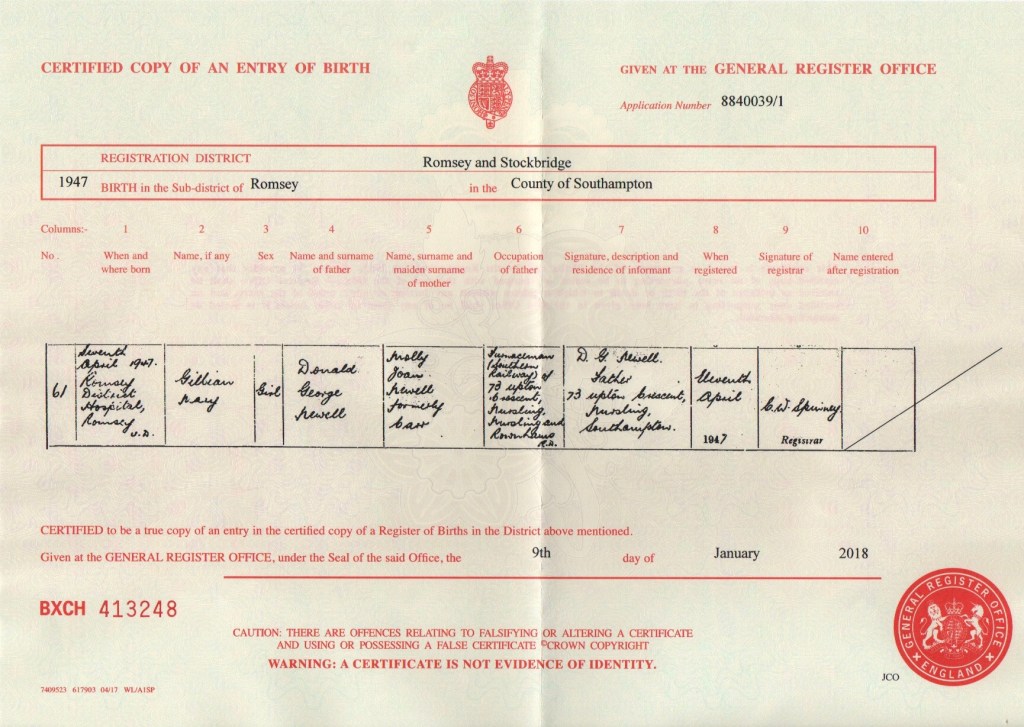
It was Saturday, the 18th day of October, 1947, when a shadow fell gently but irrevocably over the Newell family, a sorrow so quiet, so unbearable, that even the autumn air seemed to hold its breath. The trees around Romsey were turning gold and russet, their leaves drifting softly to the ground, yet for Eva and Frank, the beauty of the season meant little that day. Their darling granddaughter, Gillian Mary, the tender bloom who had brought such joy only months before, was gone.
Just six months earlier, Gillian had been born into the warmth of Number 73, Upton Crescent, Nursling,  a small, happy home where laughter had begun to echo once more after the long, weary years of war. She was the beloved child of Donald George Newell, their devoted son and a furnaceman with the Southern Railway, and his wife Mollie Joan, whose soft voice and steady hands had guided her baby’s earliest days.
Her life, though brief, had been touched by all the simple joys of infancy, the tender rhythm of her breathing as she slept, the soft curl of her tiny fingers around her mother’s thumb, the way her eyes followed the light that danced through the lace curtains each morning. She had been the family’s heart, a symbol of all they had endured and of all that might yet be made whole again.
But that October morning began with unease. Mollie had taken Gillian for a walk through Romsey Park, hoping the crisp air and birdsong would soothe her baby’s restlessness. It was a gentle morning, the grass still jeweled with dew, the air filled with the laughter of other children at play. Yet as Mollie wheeled the pram along the familiar paths, she noticed that something in Gillian’s face was not as it should be, a stillness, a pallor, a faint, distressing whimper that chilled her to the bone. Her heart quickened with dread. The child who had been her joy now seemed fragile in a way she could not name.
Worried and trembling, she returned home to Upton Crescent, where Donald met her at the door. Together they hurried to seek medical help, their movements frantic, hearts pounding with unspoken fear. Before the day was through, Gillian was admitted to the Royal South Hants Hospital in Southampton, a place whose whitewashed walls held both the promise of healing and the echo of heartbreak.
For a time, hope lingered, as it always does in the hearts of the faithful. Doctors and nurses worked gently, doing all that skill and mercy could allow. But despite their care, despite the prayers whispered by her bedside, the tiny body that had been so full of promise could not endure. Gastro-enteritis and intussusception, cruel words in a doctor’s hand, stole the breath from her small lungs, even after an operation had been tried in desperation. And so, as the autumn sun slipped beneath the horizon, little Gillian Mary slipped too, her spirit quiet as a sigh, leaving behind a silence that would echo for a lifetime.
Two days later, on Monday, the 20th day of October, 1947, Donald went to the registrar’s office to do what no parent should ever have to do, to give name and witness to his child’s passing. His hand must have trembled as he signed his name, D. G. Newell, Father, 73 Upton Crescent, his heart breaking with every stroke of the pen. The registrar, J. R. Moody, recorded the details in his careful, practiced hand, a document of facts that could never capture the magnitude of loss:
No. 286

When and Where Died: Eighteenth October 1947, Royal South Hants Hospital, U.D.

Name and Surname: Gillian Mary Newell

Sex: Female
Age: Six months

Rank or Profession: of 73 Upton Crescent, Nursling, Infant daughter of Donald George Newell, Railway Furnaceman

Cause of Death: (a) Gastro-enteritis, (b) Intussusception, (c) Operation
Certified by: Y. G. Miller, M.B.

Signature, Description, and Residence of Informant: D. G. Newell, Father, 73 Upton Crescent, Nursling, Hants

When Registered: Twentieth October 1947

Signature of Registrar: J. R. Moody, Registrar.
When the news reached Eva, she felt her world falter. She had known loss before, the pain of war, the deaths of siblings, the long ache of her own mother’s passing, yet nothing could prepare her for the grief of losing a grandchild, that delicate bridge between past and future. It felt as though a candle had been snuffed out before its flame had truly burned. She thought of the way Gillian’s tiny hand had once curled around her finger, the faint scent of her hair, the gurgle of her laughter like birdsong. All those moments, so brief and perfect, now shimmered only in memory.
In the quiet of their home on Portersbridge Street, Eva and Frank held each other close, speaking little. Grief had no need of words, it lived in the silence between heartbeats. Eva wept for her son and his dear Mollie, whose cradle now stood empty, its blankets folded with aching precision. She prayed for strength, for them, for herself, for the fragile endurance of a family that had already weathered so many storms.
And yet, in the stillness that followed, Eva sensed something else, a presence, light and tender as breath. She imagined Fanny, her mother, waiting in that mysterious beyond, her arms outstretched to receive the child, to comfort and cradle her as only she could. It brought her a strange peace to think that Gillian was not alone, that the little soul had been carried home by love itself.
Though she had lived for only six short months, Gillian’s life left an indelible mark upon the Newells. She was a reminder that even the briefest flicker of existence can illuminate generations, that love, once given, is never truly lost.
And so, whenever Eva walked through Romsey Park in the years that followed, she would pause by the flowerbeds, watching the petals tremble in the wind. She would close her eyes and remember the soft cry of a baby, the light of an early spring morning, and the love that had filled those fleeting months.
For in that love, Gillian Mary still lived, delicate, eternal, and ever held in the quietest corners of Eva’s heart.

It was a bitter, sorrow-laden Wednesday, the 22nd day of October, 1947, when the sky above Romsey hung low and heavy, as though even the heavens mourned with them. The air was still, sharp with the scent of damp earth and fallen leaves, and a pale mist curled along the edges of Botley Road, where Romsey Old Cemetery lay waiting beneath the sighing yews. There, in that sacred, frost-touched ground, the Newell family gathered, Eva and Frank, their son Donald, and his young wife Mollie, to lay to rest their precious Gillian Mary, whose life had been so heartbreakingly brief.
The earth was hard with autumn’s chill, and the grass glistened with frost that crunched softly beneath their steps. No words seemed large enough for the weight of what they carried. Eva clutched Frank’s hand, her fingers trembling, her body almost swaying beneath the ache that filled her. Her heart, that steadfast heart which had endured the long nights of war, the losses of loved ones, the passing of generations, now felt as though it were breaking in two. Beside her, Frank stood silent, his face drawn and pale, the lines of labour and love etched deep across his brow. The man who had once faced the roar of battle now faced a silence far more unbearable, the stillness of a child’s grave.
Donald and Mollie stood together, the young couple bound by a grief too vast to comprehend. Their hands were entwined, yet their faces seemed almost ghostly in their sorrow, the look of two souls who had given everything of their hearts to a child and had to let her go. Mollie’s eyes were hollow with sleeplessness, her body trembling with the exhaustion of grief, her heart aching with the memory of the small weight she would never again hold.
A small coffin, pale and delicate, was carried gently to the graveside. The mourners gathered in silence, the priest’s words floating like fragile threads through the still, cold air: prayers of release, of mercy, of remembrance. The hymns were soft and simple “Abide With Me” and “Jesus, Lover of My Soul” their familiar melodies trembling from lips that could scarcely form the words. The final blessing fell like a whisper upon the wind.
Gillian Mary was laid to rest in grave number P197, beside her great-grandmother, Fanny Hatcher née Pearce, whose own life had been marked by quiet fortitude and unyielding love. As the casket was lowered, the earth, rich and dark, was gently returned, shovelful by shovelful, each one sounding like a soft heartbeat against the wooden lid. The scent of turned soil mingled with the faint sweetness of autumn roses left by tender hands, their petals trembling in the chill.
Eva felt her breath catch as she gazed down, tears blurring her vision. In her mind, she saw her mother Fanny waiting there in the stillness of eternity, arms outstretched to welcome the little soul into the warmth of the beyond. It gave her the smallest measure of comfort to know that her granddaughter would not be alone, that she would be held in love, as she always had been.
The world around them seemed to hush, as though creation itself bowed in mourning. The wind stirred gently through the yews, carrying with it the faint cry of a distant blackbird and the rustle of leaves that fell like tears from the trees. For a long while, none of them moved. Donald stood with his head bowed, Mollie leaning against him, her gloved hands clutching his sleeve. Frank slipped an arm around Eva’s shoulders, holding her as though she might fall. And in that moment, surrounded by the graves of generations gone, their grief seemed to knit them even closer together, bound by the unbroken thread of love that not even death could sever.
When the final prayer was spoken and the mourners began to drift away, Eva lingered. She reached down, brushing her fingertips against the cold stone where her granddaughter’s name would one day be carved, and whispered a quiet promise, that Gillian would not be forgotten, that her short, bright life would live forever in their hearts.
As she turned to leave, she glanced once more at the grave. The late afternoon light broke briefly through the clouds, touching the mound of freshly turned earth with a silvery glow. It was fleeting, but it was enough, a sign, perhaps, of peace.
And so Gillian Mary rested, not lost, but home. Beneath the Hampshire sky, beside her great-grandmother, she became part of the earth that had cradled her family for generations. And in the long years that followed, when Eva walked again through the gates of Romsey Old Cemetery, she would pause by that quiet spot beneath the yews, her heart whispering the same eternal truth she had always known, Love does not end. It changes form, it deepens, it abides, just as surely as the river flows, the seasons turn, and the souls of the beloved live on in the hearts that remember them.

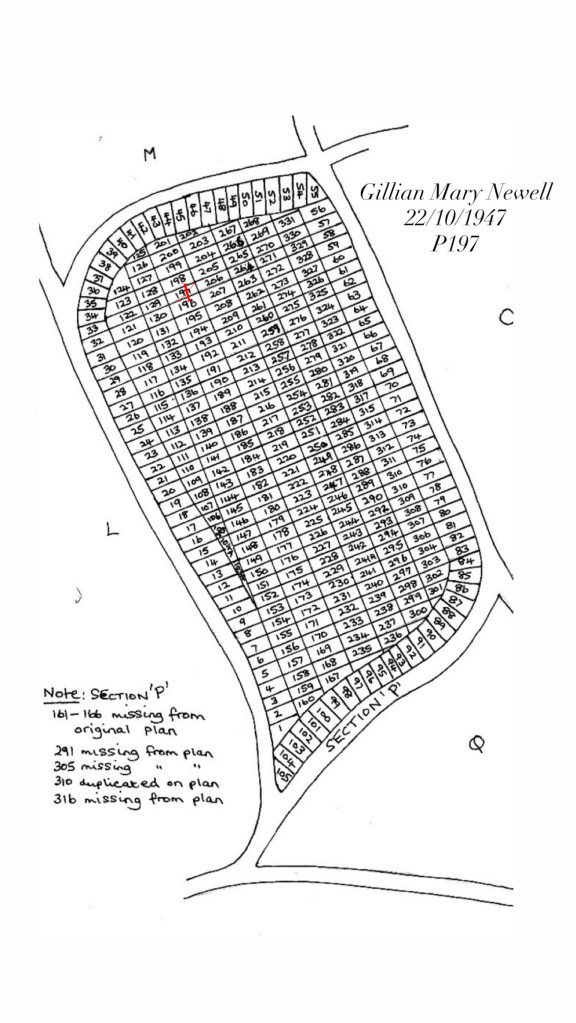
In the soft turning of years that followed the heartbreak of losing little Gillian Mary, life, in its quiet mercy, began once more to bloom for Frank and Eva. The ache of absence never truly faded, it lingered in the edges of days, in the hush before sleep, yet, like spring after a long winter, hope returned to their doorstep in the gentle form of new life and laughter.
Their beloved son, Donald George, and his devoted wife Mollie Joan, found courage enough to love again, to open their hearts to the possibility of joy. And in time, that courage was blessed threefold. Into their world came Stuart Richard, Christopher  John my wonderful father and Stephen Anthony Newell. Each child was a gift of renewal, a living testament to love’s endurance after loss, and a reminder that even the most fragile hearts can mend when bound by faith, family, and the healing passage of time.
Though the intimate details of their early lives remain veiled by the hundred-year law, their presence in the Newell home was unmistakable, bright, boundless, and full of the laughter that had once seemed lost. The rooms that had echoed with sorrow now rang with the joyful chaos of boys’ voices, the patter of small feet, and the tender sound of Eva’s laughter as she bent to tie a shoelace, wipe a tear, or offer another slice of bread and jam.
For Frank and Eva, these boys became the sunlight of their later years, the living reward for all they had endured. Frank, whose hands had known a lifetime of hard labour, now used them to lift his grandsons high into the air, their delighted cries carrying through the garden on summer afternoons. Eva, ever patient, ever kind, taught them small lessons wrapped in warmth, how to be gentle, how to listen, how to love without measure. They were her heart’s echo, her second chance at the wonder of childhood.
My father, Christopher John, adored them both. To him, his grandparents were more than family, they were an anchor, a source of comfort and wisdom that shaped him in ways words can barely describe. He cherished every shared laugh, every quiet moment by the hearth, every story told in the glow of evening lamplight. And though I was never there to witness those moments, I feel them still, in the pulse of memory, in the space between one breath and the next. I can almost hear Frank’s gentle chuckle, the rustle of Eva’s apron, the scent of soap and home and Sunday roasts lingering in the air.
Time, as it always does, carried them onward. But love, that steady, unbreakable thread, never left them. It moved through generations like a quiet current, binding us all together, from those early days in Romsey’s streets and gardens to the lives we now live under the same eternal sky.
And when I think of them, Frank and Eva, Donald and Mollie, Stuart, Christopher, and dear little Gillian Mary, I find comfort in believing that they are once again gathered together beyond the veil of time. I picture them in a place where sorrow cannot reach, where laughter rings pure and bright, where Great-Grandmother Eva hums softly as she rocks Gillian in her arms, Mollie stands whole again with light in her eyes, Frank smiles his gentle, knowing smile, and my father sits beside them, finally at peace.
It is a beautiful thought, that love, once kindled, is never extinguished. That the Newells, who lived and loved so deeply, are together again in that quiet, endless morning beyond this life, their souls woven forever into the same golden thread of memory, devotion, and home.
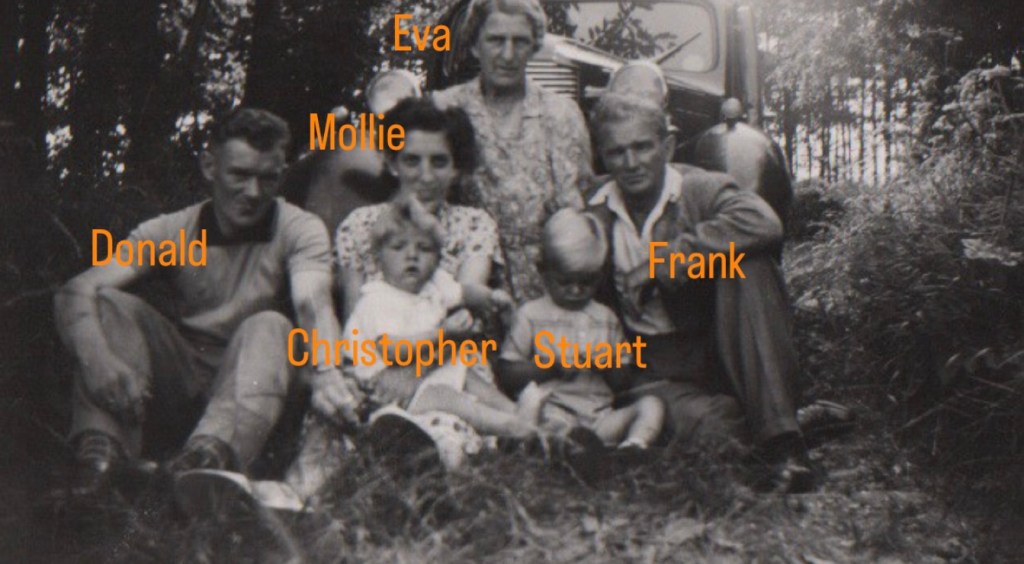
On Saturday the 26th day of September, 1953, within the familiar, time-worn walls of Number 44 Cherville Street, Romsey, a long and gentle life came softly to its close. Eva’s stepmother-in-law, Sarah Emily Newell, beloved widow of Alfred Newell, slipped quietly from this world, leaving behind a home filled with the lingering grace of her years. The evening light fell pale and golden through the windows, and the old clock on the mantel ticked steadily on, marking the passage from life into memory.
The official record, written with solemn care that same day, captures the facts with its characteristic restraint:
No. 78

When and where died: Twenty-sixth September 1953, 44 Cherville Street, Romsey U.D.

Name and surname: Sarah Emily Newell

Sex: Female

Age: 87 years

Rank or profession: Widow of Alfred Newell, Domestic Gardener

Cause of death: (1a) Senility, Certified by J. P. Lalonde, M.B.

Signature, description, and residence of informant: F. R. Moody, grandson, 39 The Hundred, Romsey

When registered: Twenty-sixth September 1953

Signature of registrar: C. A. Spinney, Registrar
Yet behind those measured lines lies the quiet poetry of a life lived with steadfast grace. Sarah Emily had walked the paths of Romsey for nearly nine decades, through seasons of laughter and loss, through wars and peace, through the slow unfolding of time that leaves its tender mark on all who endure it. She had shared her life with Alfred, her late husband, a man of the soil, a domestic gardener whose hands coaxed beauty from the earth and who, in turn, had loved her with the same patient devotion with which he tended his gardens. Together, they had built a life not of grandeur, but of goodness, a life of steady rhythm, of morning tea by the hearth, of evenings softened by candlelight and conversation.
In her final days, Sarah Emily’s mind wandered through the corridors of her past, her memories drifting like autumn leaves through the rooms she had known for so long. Sometimes she would smile faintly, murmuring the names of loved ones long gone, Alfred, her husband; friends from her youth; perhaps even Eva and Frank, whose kindness and kinship had touched her twilight years. The gentle hum of the world outside, the church bells of Romsey Abbey, the clip of footsteps along Cherville Street, the soft chime of the wind through the open window, seemed to cradle her in the rhythm of a life well-lived.
Her grandson, Frederick Robert Moody, stood faithfully at her side, a quiet witness to her final moments. There was no struggle, no fear, only the slow fading of breath, the tender closing of a chapter written in love, endurance, and simple dignity. The doctor, J. P. Lalonde, certified her passing with the calm respect reserved for those who leave the world peacefully, their journey complete.
That same day, Registrar C. A. Spinney entered her name into the official records of Romsey, ensuring that Sarah Emily Newell, aged eighty-seven, would not be forgotten. And though the little house at Cherville Street would grow still without her, its rooms echoing faintly with memory, her presence lingered in every corner. It lingered in the scent of lavender that clung to her linens, in the teacup she always kept by the window, in the flowers that still bloomed in the garden Alfred once tended.
For Eva, learning of Sarah Emily’s passing must have stirred both sorrow and reflection. Theirs had been a shared path for many years, their lives bound by marriage, kinship, and the unspoken understanding that grows between women who have both endured much and loved deeply. To Eva, Sarah’s passing marked the fading of another generation, a gentle reminder that life, no matter how long, is as delicate as the gardens they all once walked through together.
And so, the record was signed, the ink dried, and another page in the story of Romsey turned. But within the hearts of those who remembered her, her grandson, her family, and all whose lives she quietly touched, Sarah Emily’s spirit remained: humble, enduring, and ever rooted in the soil of love.
Even now, when the evening light spills across Cherville Street, one might imagine her presence still, a soft whisper in the air, a tender echo of kindness and care, reminding us that a life lived gently is never lost, only transformed.

As the soft gold of early autumn drifted over Romsey, the air hung heavy with the scent of ripened fruit and fading blooms. The world itself seemed to move more slowly, as if pausing to honour the closing of a long, steadfast life. Along Cherville Street and Middlebridge, the dahlias stood in their final, brilliant defiance, crimson, amber, and rust, each bloom a small flame against the encroaching chill. The wind moved through the turning leaves, scattering them across the cobbled paths like sighs too quiet to be heard.
It was Tuesday, the 29th day of September, 1953, when Sarah Emily Newell, Eva’s step-mother-in-law, was laid to rest in Romsey Old Cemetery, along Botley Road, Hampshire. The day carried that peculiar stillness that only autumn can hold, neither grief nor peace alone, but both, intertwined like the vines curling over the old stone wall. Beneath a dove-grey sky, the mourners gathered among the leaning headstones and sleeping angels, their breath rising faintly in the cool air. The earth was soft from recent rain, fragrant with moss and memory.
Here, in the quiet heart of Romsey, Sarah’s journey came to its gentle close. Her name was now inscribed upon Grave Q244, her spirit folded into the same soil that had cradled her through life. For more than eight decades she had walked these very streets; she had known both the hum of workday hours and the hush of long evenings by the fire. The widow of Alfred Newell, a domestic gardener, she had shared his love for living things, for soil and seed and the steady miracle of growth. When death had left its mark upon their household, Sarah brought with her a calm, steadfast light. She tended where sorrow had lingered, mended what had frayed, and wove herself into the fabric of Frank’s family with a devotion that asked for no praise.
For Frank, who had stood in the trenches of one war and seen the shadows of another, the passing of this quiet, kindly woman stirred a familiar ache. She had not been his mother, yet she had been part of the fragile scaffolding that held the family together in the years after loss. Standing at her grave that September afternoon, perhaps he felt the weight of endings, the knowledge that life, no matter how gently lived, must always return to silence. And yet, in that same silence, there was the comfort of continuity, the understanding that the bonds of love are not severed by death but carried forward in memory, in gesture, in the way kindness echoes through generations.
The cemetery itself seemed alive with a strange serenity. The yews whispered softly overhead, robins flitted low between the crosses; and far away, the Abbey bell tolled, its sound rolling through the air like a heartbeat that refused to fade. As the vicar spoke the final words of farewell, the wind stirred the leaves at their feet. The earth closed gently over her, rich and dark and yielding, as though the land was taking back one of its own, enfolding her once more into its eternal embrace.
When the mourners departed, the quiet returned. Only the rustle of the leaves remained, dancing lightly over the mound of fresh earth. The dahlias bowed their heads in the cooling breeze, their colours glowing briefly in the slanting light, a final benediction. In their fleeting beauty was everything Sarah had been: simple, steadfast, and radiant in her modest grace.
As dusk gathered over Romsey, a thin veil of mist rising from the meadows, another chapter in Frank’s story closed. The same sky that had watched over his childhood, his battles, and his many farewells now witnessed this last act of parting. And yet, as he turned to leave, hand in Eva’s, there was a quiet peace. He knew, as all those who have loved and lost must know, that every life, like every falling leaf, finds its way home again.

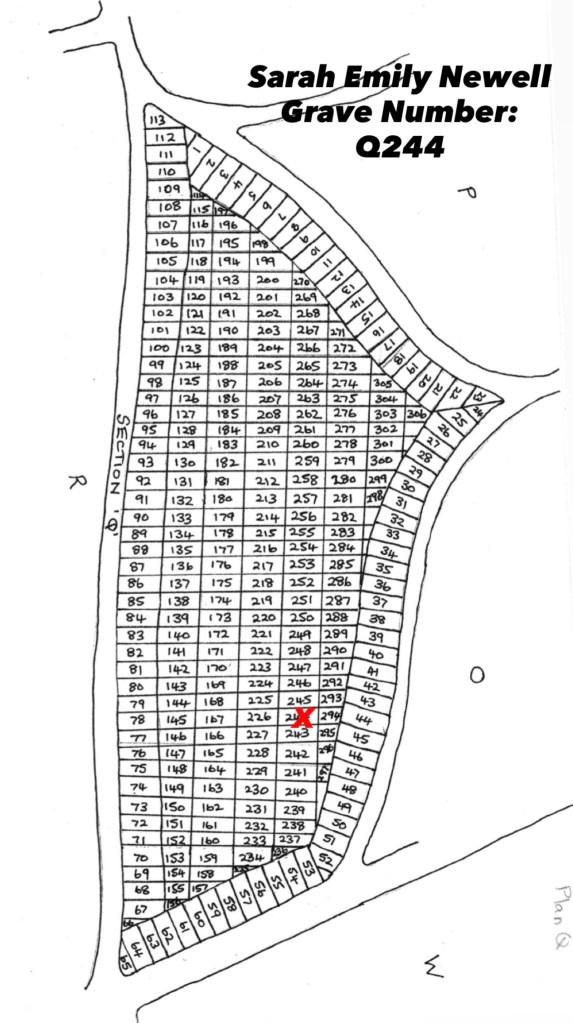
On Tuesday, the 10th day of October, 1972, as autumn’s light slanted softly across the familiar rooftops of Romsey, the world grew unbearably still within the walls of Number 27, Porterbridge Street. There, in the small, timeworn home that had cradled a lifetime of love, laughter, and labour, Frank Newell, Eva’s beloved husband, her soulmate, her truest friend, slipped peacefully from this world at the age of eighty-two.
Within those walls, their love had deepened like the roots of an old oak, steady and enduring through every storm life had sent their way. Now, as the autumn wind brushed softly against the windowpanes, the rhythm of his breath stilled, and a silence deeper than any she had ever known settled over the house.
Born on the 27th day of February, 1890, in the humblest of beginnings, the Romsey Union Workhouse, Frank had known struggle before he ever knew comfort. Yet he had turned that beginning into something remarkable, shaping a life of integrity and quiet strength. He was a man molded by labour and love, by loyalty and endurance. Every chapter of his life had been written in the soil and spirit of Romsey, the town that had raised him, tested him, and, in the end, became inseparable from his very being.
Through the years, his hands had known many trades, grocer, soldier, builder’s labourer, storeman, each role marked by the same steady dedication that defined him. There were no medals for the kind of hero he was, no headlines for the daily courage it takes to build a life from simple means and steadfast work. Yet to Eva, he was everything, her anchor, her reason, the laughter in the long evenings, the warmth beside her in bed when the nights grew cold.
In his final years, Frank faced the frailties of age with the quiet bravery that had always been his way. Though his body grew weary, the heart failure, the chronic bronchitis, the papilloma of the bladder, all of it certified by Dr. Peter Johnson, his spirit remained constant, still warmed by the things that had always brought him peace. There was the smell of woodbine smoke curling softly through the parlour, the crackle of the radio as he listened to the low, familiar voices of boxing commentators, and the comfort of Eva’s hand, always near his own.
On that October day, when the breath finally left him, Eva’s world tilted irreversibly. The man she had loved since her youth, the boy who had once courted her under the Romsey sky, the soldier she had prayed for through the dark years of war, the husband she had stood beside in poverty and plenty, was gone. She felt the house grow suddenly vast and hollow, every clock tick a reminder of absence, every shadow whispering his name.
It was his niece, Iris Bundy, ever faithful and kind, who undertook the duty of registering his death that very day, walking to the registrar’s office with a heavy heart to ensure that his life, all its quiet dignity and meaning, would be formally preserved. Registrar L. Wootton wrote it carefully into the Romsey and Stockbridge records, a document of fact that could never capture the depth of love and loss behind each line:
Registration District: Romsey and Stockbridge
Administrative area: County of Hampshire
Sub-district: Romsey

Entry No.: 46
1. Date and place of death: Tenth October 1972, 27 Porterbridge Street, Romsey
2. Name and surname: Frank Newell
3. Sex: Male
4. Date and place of birth: 27th February 1890, Romsey, Hants
5. Occupation and usual address: Storeman (retired), 27 Porterbridge Street, Romsey
6. (a) Name and surname of informant: Iris Bundy
(b) Qualification: Niece
(c) Usual address: 26 Palmerston Street, Romsey
7. Cause of death:
(a) Heart Failure
(b) Chronic Bronchitis
(c) Papilloma of Bladder
, Certified by Peter Johnson, M.B.
8. Date of registration: Tenth October 1972
9. Signature of registrar: L. Wootton, Registrar
When the ink dried, the record was complete. Yet the true story, the ache and tenderness that filled that little house, lived on in Eva’s heart alone.
In the days that followed, Eva moved through her home like a shadow of herself. The chair by the fire remained empty, his coat still hung in the hallway, his tools still lined the shed, waiting for hands that would never again return. At night, she would reach for him in her sleep, half-dreaming he was there beside her, and awaken to the silence that pressed like frost against her heart. The world, once full of shared laughter and simple pleasures, now felt muted, hollowed out.
For all her resilience, for all the years of loss she had endured, this parting struck deeper than any before. Frank had been her life’s constant, her compass, her joy. Without him, even the familiar streets of Romsey felt foreign, as though the town itself grieved the loss of one of its own.
Yet within her sorrow, there flickered a quiet gratitude. She had loved and been loved completely, a rare gift in any lifetime. And though her days ahead would pass in solitude, she carried him with her, in memory, in the rhythm of her breath, in the stillness of each dawn when the Abbey bells tolled over the town they both had called home.
In the end, Frank Newell’s life was not one of grandeur, but of grace. His spirit lived on, in Eva’s heart, in the laughter of their descendants, in the cobbled streets where his footsteps once fell. And as the evening light faded over Porterbridge Street, Eva would sometimes sit quietly by the window, watching the world go by, whispering softly into the stillness “Goodnight, my love… until we meet again.”
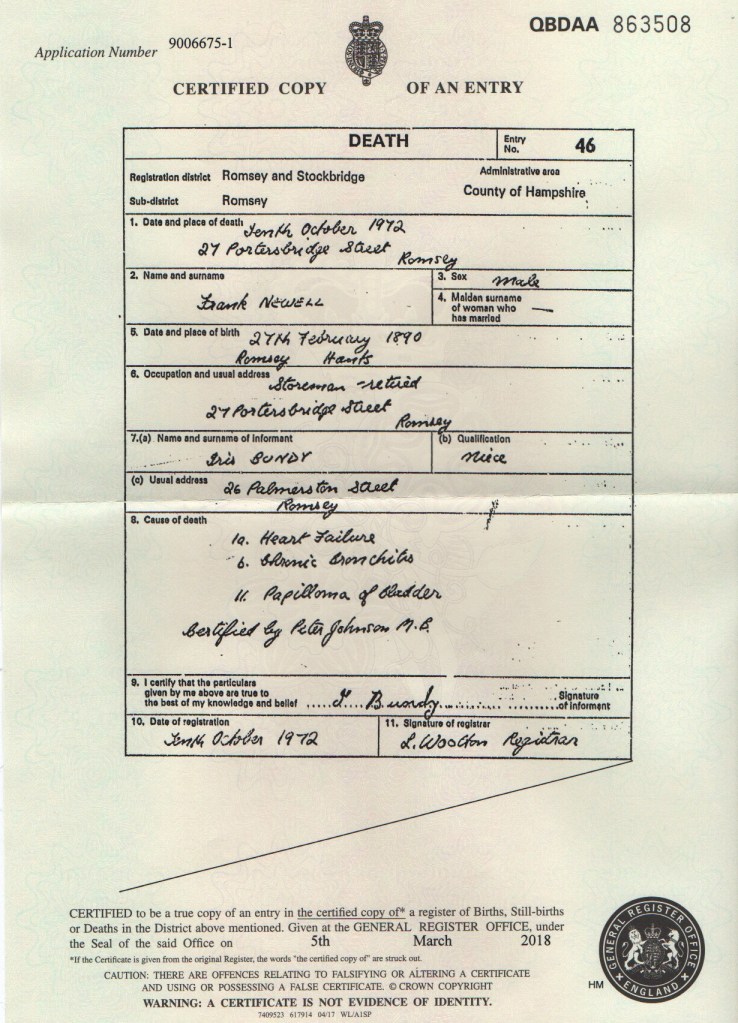
Sometime in the days that followed Frank’s passing, The Romsey Advertiser printed a small notice, no more than a few lines of ink, but within those words lay an entire lifetime. The exact date of publication has been lost to time, yet the sentiment it carried still echoes softly through the years:
NEWELL. — Peacefully, in October 10th, at 27, Portersbridge-street, Romsey, Frank, aged 82 years.
Simple words, brief as a breath, and yet behind them stretched the vastness of a life, and the immeasurable ache of love left behind.
For Eva, seeing those lines in print must have been both a comfort and a wound. There, upon the familiar pages of the local newspaper she had read for decades, the one that had announced marriages, births, and the small doings of Romsey folk, was her beloved Frank’s name, now written in the language of farewell. Just one sentence, quiet and restrained, as was the custom of the time, yet within its simplicity lay the weight of all she had lost: her husband, her steadfast companion, the very heartbeat of her home.
How strange it must have felt, she thought, to see the love of her life distilled into a few spare words, peacefully, in October 10th, at 27, Portersbridge Street. Those walls had seen their laughter, their quarrels, their tenderness, and now they had borne witness to his final breath.
The address printed there, their address, was not merely a place. It was the living map of their years together, the smell of fresh bread from the kitchen, the echo of his step on the stair, the murmured hum of the radio on a Sunday afternoon. For Eva, the mention of 27, Portersbridge Street in the paper was both an ending and an immortality, a reminder that he would always be tied to Romsey, to the home where their story had been written, line by line, through fifty years of shared living.
Neighbours who read the notice would have nodded in quiet sorrow. Frank had been a familiar figure, courteous, hardworking, the kind of man who nodded to everyone on the street and always offered help when it was needed. To them, he was another good man gone; to Eva, he was the air itself, the warmth in her evenings, the quiet voice that filled her silence.
That single printed line, unadorned, unassumingm became, for Eva, a memorial more intimate than marble or stone. She cut it carefully from the paper, folding it with trembling hands and tucking it between the pages of the family Bible, next to the yellowing marriage certificate that had once marked the beginning of their life together.
And there, amid verses of love and faith, the words endured:
Peacefully, in October 10th, at 27, Portersbridge Street, Romsey, Frank, aged 82 years.
Peacefully, yes, she liked to think it was true. That his final moments were gentle, that his spirit slipped away like light fading at dusk. And though her heart ached with the emptiness he left behind, she clung to that one word, peacefully,  as both promise and prayer.
For in the quiet rhythm of her grief, Eva believed that Frank had not truly gone. His presence lingered in every familiar corner, in the scent of pipe smoke that seemed to drift through the house some evenings, in the way the sunlight touched his empty chair by the window. And in the small cutting from the Romsey Advertiser, pressed now between the pages of Scripture, his life, and their love, was preserved, humble yet eternal.

It was Friday, the 13th day of October, 1972, a day wrapped in the still melancholy of autumn. The air over Romsey hung cool and damp, scented faintly with woodsmoke and fallen leaves, as though the town itself were holding its breath in mourning. The season was turning, chestnuts gleamed darkly beneath the trees, and the hedgerows along Botley Road wore their russet crowns. It was on this solemn, tender day that Eva Kate, her son Donald, his wife Mollie, her niece Iris, and the family and friends who loved him most gathered to lay Frank Newell to rest in the peaceful grounds of Romsey Old Cemetery.
For three days before the funeral, Frank had lain at rest in his own home, Number 27, Porterbridge Street, the house that had been the heart of his life with Eva. The coffin, most likely of polished oak and brass, rested in the front parlour, draped with flowers, possibly chrysanthemums, dahlias, and late roses from neighbours’ gardens, their fragrance mingling with the soft scent of beeswax polish and old wood. A single candle burned beside him in the evenings, its flame steady and low, as Eva sat close by, her trembling hand resting on the edge of the coffin, whispering small fragments of prayer and memory into the quiet. She could not imagine a world without him, even the walls seemed to hold their breath, waiting for his voice, his footfall, the small sounds that had filled the rhythm of her life for over fifty years.
When the morning of the funeral came, a hush fell over the house. The undertakers from one of Romsey’s long-standing funeral firms, men dressed in black coats and gloves, arrived with quiet respect. Their hearse, polished to a mirror sheen, waited outside on Porterbridge Street, the horses long replaced by the slow dignity of a black car, its windows reflecting the pale autumn sky. Neighbours stood silently at their doorsteps as the pallbearers, strong men who had known Frank through work and kinship, lifted the coffin carefully, their steps measured, their faces solemn.
The short journey through Romsey’s narrow streets was familiar, every cobble and corner a page from Frank’s life. The hearse passed the Abbey that had tolled for his parents, for neighbours, for friends long gone. The bells of Romsey Abbey chimed softly that morning, a slow, measured toll that seemed to echo across the centuries, through all the births and burials that had marked the town’s steady pulse.
At Romsey Old Cemetery on Botley Road, the autumn trees stood tall and bare-limbed against the grey sky, their leaves scattering across the winding paths like gold and rust. The mourners gathered by Grave P67, the earth freshly turned, dark and damp from days of rain. The vicar, in his black cassock and white surplice, stood with his prayer book open, his voice low but sure, carrying through the still air as he began the familiar words of the Book of Common Prayer, words that had comforted generations before them:
“I am the resurrection and the life, saith the Lord;
he that believeth in me, though he were dead, yet shall he live.”
As the wind rustled through the yews, the small congregation sang softly “Abide with Me”, Eva’s trembling voice barely more than a whisper through her tears. The hymn’s words “Hold Thou Thy cross before my closing eyes” caught in her throat, each line an ache, a plea for strength. Another favourite followed, “The Lord’s My Shepherd”, its familiar cadence rising faintly against the cold sky.
When the service reached its end, the pallbearers lowered Frank’s coffin into the earth. Eva clutched Donald’s arm tightly, her breath shuddering as the sound of the ropes creaked and then stilled. The vicar’s voice fell to a gentle murmur, the prayer of committal spoken with grave tenderness:
“Earth to earth, ashes to ashes, dust to dust;
in sure and certain hope of the resurrection to eternal life.”
Eva’s hand shook as she stepped forward, casting a single white rose upon the coffin’s resting place. The petals brushed against the damp soil before settling softly upon the wood. Around her, others followed suit, small blossoms of remembrance dropped into the grave like whispered farewells. She felt the world tilt beneath her feet, the familiar landscape of her life shifting forever. Her heart, once full of laughter and shared dreams, now ached with the heavy silence of absence. The love of her life, the man she had waited for through wars, raised a son with, grown old beside, was gone, and the air itself seemed emptier for it.
As the mourners departed one by one, Eva lingered. The cemetery grew quiet again, the soft murmur of the wind through the trees the only sound. A robin alighted on a nearby stone, its small red breast bright against the grey. She took it as a sign, that he was still near, somehow, in the air that moved around her, in the warmth that still lingered on her cheek where his kiss might have been.
That evening, as dusk settled over Porterbridge Street, Eva returned home to an empty chair by the hearth. His pipe still rested on the mantel, the faint scent of tobacco still in the air. She sat for a long while in silence, her hands folded in her lap, the flickering light of the fire dancing across her face. Life, she knew, would never be the same. Yet in her heart, love endured, quiet, steadfast, unbroken, the invisible thread that would, in time, lead her back to him.
And so, Frank Newell, husband, father, grandfather, labourer, soldier, and son of Romsey, was laid to rest in Grave P67 at Romsey Old Cemetery, beneath the same Hampshire sky that had watched over his first breath in the workhouse so many years before. The soil that covered him was the same he had walked and worked upon all his life. And in that final, tender return to the earth, the circle of his days closed with grace, his story now part of Romsey’s eternal heart, and his memory forever held in the trembling hands of the woman who had loved him beyond all measure.

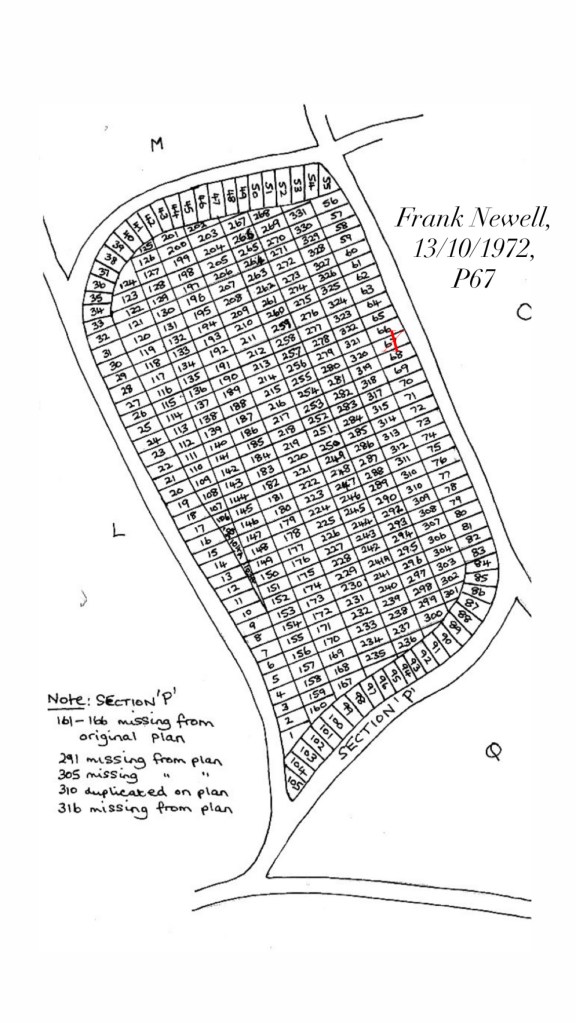
On Wednesday, the 31st day of October, 1973, as autumn leaves drifted through the narrow streets of Romsey, the air thick with the scent of woodsmoke and dying roses, Eva Kate Newell took her final, tender breath within the quiet walls of Romsey District Hospital. Outside, the wind sighed softly through the yews and the town moved at its usual, unhurried pace, the Abbey bells marking the hour, unaware that a life so deeply woven into Romsey’s fabric was slipping away.
She was eighty years old, a widow, a mother, and once, long ago, a girl from Newtown, Lockerley, born on the 14th day of August, 1893, when the world still held the slow rhythm of horse-drawn carts and kerosene lamps. Her story was one of devotion, endurance, and love, love that had taken root in Hampshire soil and bloomed through every hardship. She had walked the path of wifehood and widowhood with the same quiet grace she brought to everything in her life, her heart forever tied to the man who had shared her years, her beloved Frank.
The official record, written with careful precision, bears the details of her passing, simple, factual, but shadowed by the weight of farewell:
Registration District: Romsey and Stockbridge
Sub-district: Romsey
Administrative area: County of Hampshire

Entry No.: 100
1. Date and place of death: Thirty-first October 1973, Romsey District Hospital, Romsey
2. Name and surname: Eva Kate Newell
3. Sex: Female
4. Maiden surname of woman who has married: Hatcher
5. Date and place of birth: 14th August 1893, Lockerley, Hants
6. Occupation and usual address: Widow of Frank Newell, Storeman (retired), 27 Portersbridge Street, Romsey
7. (a) Name and surname of informant: Donald George Newell
(b) Qualification: Son
(c) Usual address: 37 Chambers Avenue, Romsey
8. Cause of death:
1a. Carcinomatosis
b. Carcinoma of breast
Certified by A. Johnson, M.B.
9. “I certify that the particulars given by me above are true to the best of my knowledge and belief.” — D. G. Newell
10. Date of registration: Thirty-first October 1973
11. Signature of registrar: L. Wootton, Registrar
Her son, Donald George, stood as witness to the final chapter of his mother’s life, his hand steady as he signed the register, the same careful script she had once guided when he was a boy. Beneath the clinical words, carcinomatosis, carcinoma of the breast, lived the truth of her final struggle, the slow fading of a life that had once been so full of tenderness, laughter, and quiet resilience.
At Number 27 Portersbridge Street, the home that had been her world, her presence lingered in every corner. The ticking of the clock on the mantel seemed softer now, the house heavy with memory, of shared meals, of whispered prayers, of Frank’s laughter echoing faintly from another time. There were evenings when the scent of her rose soap still hung in the hallway, or the faint rustle of her apron seemed to brush through the stillness, as if her spirit could not bear to leave the place she had so deeply loved.
She had lived through two world wars, the Great Depression, loss, and renewal, yet had remained unshaken, always finding beauty in small things, the sound of the Abbey bells at dusk, the chatter of children on their way to school, the rhythm of her garden, where lilies and lavender returned faithfully each year. Her heart had carried not only her own joys and sorrows but the memories of generations, of her mother, Fanny, of her sisters lost too soon, of her dear son Donald, and of the grandchildren who carried forward the echo of her voice.
When the final light of that October day fell across Romsey’s rooftops, it painted the sky in tender shades of rose and silver, as if the heavens themselves bent low in farewell. Somewhere beyond the veil of pain and time, perhaps Eva saw him, Frank, waiting in the soft light of eternity, the same warm smile that had steadied her through every trial now reaching out to guide her home.
And so, as the evening deepened and the Abbey bells tolled once more across the quiet Hampshire fields, Eva Kate Newell was folded gently into the peace she had so long earned. Her name, once inked neatly into the pages of the registrar’s book, became more than a record, it became a story, a love letter written across eight decades of devotion, loss, and unbreakable grace.
Though her body rested now beneath the same sky where her life had begun, her spirit endured, in the laughter of her descendants, in the scent of roses each spring, in the steadfast heart of Romsey itself. For she had belonged wholly to this place, its soil, its people, its pulse, and now, at last, the earth held her gently once more.
And somewhere, unseen but felt, Frank and Eva were together again, their hands entwined beyond time, their hearts at rest, and their love eternal.
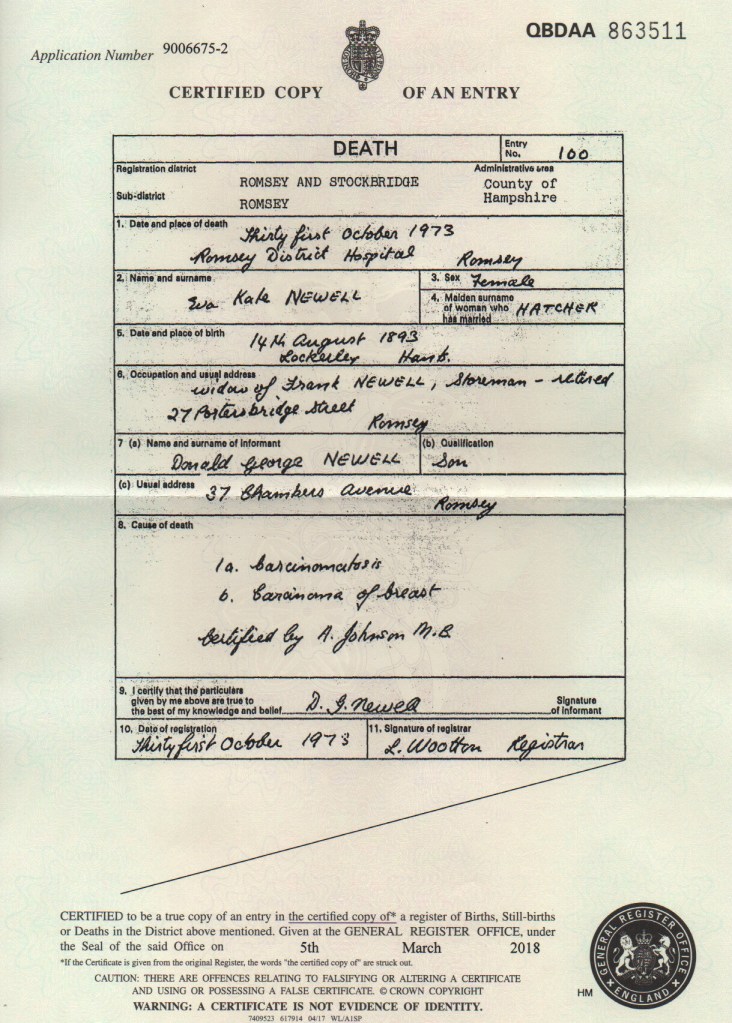
Sometime after that soft, sorrowful day when Eva Kate Newell drew her final breath, a small notice appeared in the pages of The Romsey Advertiser, that gentle chronicle of local lives and losses. The exact date of its publication has been lost to time, but its words remain etched in the memory of those who loved her, a simple tribute that carried the weight of an entire life:
NEWELL. – On Oct. 31st, at Romsey Hospital, Eva Kate, of 27 Portersbridge-street, Romsey.
Sadly missed by all the family.
Just two short lines, brief, almost whispered, and yet within their quiet restraint lay the vast expanse of eighty years: a lifetime of endurance, love, laughter, and loss.
For Donald, her devoted son, reading those words must have brought both pride and ache. The newspaper she had once read each week, folded neatly beside her tea cup, now bore her name in solemn print. And for those who turned the page that day  neighbours, friends, shopkeepers who had known her face for decades, that familiar address, 27 Portersbridge Street, spoke more than any epitaph could. It was the home where Eva had lived her entire married life, where the scent of lavender and coal dust mingled in the air, where laughter had once spilled through the open doorway, and where love, steadfast and enduring, had lingered through every hardship.
She had lived through two world wars, raised her son with courage and faith, and borne her losses with the quiet dignity of a woman who understood that love, once given, never truly fades. And now, in that short printed notice, all that she had been  daughter, wife, mother, grandmother, friend, was gathered into a single breath of remembrance.
For Donald, Mollie, Iris, and the grandchildren, the line “Sadly missed by all the family” carried more truth than the words could ever hold. They missed the sound of her soft voice calling them in from the garden, the way she’d hum old hymns while polishing the brass, the steady warmth of her presence, that sense of home that existed wherever she was.
To the towns people of Romsey, who had watched her walk its cobbled streets for decades, shawl wrapped around her shoulders, basket in hand, her passing marked the quiet end of an era. Eva had been one of those steadfast souls who seemed woven into the fabric of the town itself, as constant as the Abbey bell, as familiar as the smell of rain on the River Test.
The obituary’s simplicity belied the fullness of her story. There were no grand words, no mention of the sacrifices she had made, the love she had given, or the strength she had carried through her years. But those who knew her didn’t need them. Her life was written not in headlines, but in kindness, in constancy, in the small, unspoken gestures of care that had bound her family together through every storm.
Perhaps Donald, after cutting the notice from the paper, folded it gently and tucked it beside his father’s, the one printed a year before. Two clippings, nearly identical in form, yet bound by a lifetime of love. In that quiet symmetry, there was comfort: the thought that Frank and Eva’s names, once printed side by side in the local news of the living, now rested side by side in eternity.
And though the Romsey Advertiser offered only a few simple words “Sadly missed by all the family” those who loved her knew that behind them lay oceans of memory, the sound of her laughter, the gentleness of her touch, and the enduring warmth of her heart that would never fade from the lives she had shaped.
Even now, decades later, those words still seem to echo softly through the air of Porterbridge Street, carried perhaps by the same Hampshire wind that once rustled her curtains and whispered through the rose bushes she tended with care. For love such as Eva’s does not end; it lingers, quietly, eternally, in the hearts of those who remember her.

In the deep throes of autumn, when the trees of Romsey released the last of their golden leaves to the waiting earth, the air itself seemed to pause, still, reverent, and touched with sorrow. The 5th day of November, 1973, dawned pale and wind-stirred, a day when memory and mourning moved quietly through the narrow lanes of the old Hampshire town. It was on this soft, sombre Monday that Eva Kate Newell was laid to rest in the peaceful embrace of Romsey Cemetery, Botley Road, her grave marked O107, a final resting place not far from those she had loved and lost before.
For several days before her funeral, Eva had lain in repose at Number 27, Porterbridge Street, the home she had shared with her beloved Frank, the walls still holding the faint scent of lavender and old roses that had always clung to her presence. Her coffin, a simple oak casket polished to a soft sheen, rested beneath the front window where the afternoon light fell in tender stripes across the wood. Around it, small vases of chrysanthemums and lilies stood like sentinels of devotion, tokens brought by neighbours who had known her all their lives, by the grandchildren who had adored her, and by her niece Iris, whose love had never wavered.
Each evening, Donald and Mollie sat nearby, their hands clasped, speaking in hushed tones of the years that had passed too swiftly, of laughter that once filled these rooms, of Frank and Eva’s love, a love so steadfast it seemed to have become part of the very air of the house. When the undertakers arrived that Monday morning, dressed in their traditional black coats and bowler hats, their quiet dignity matched the mood of the day. The coffin was gently carried from the home that had been her world for half a century, placed into the polished black hearse that waited patiently outside.
Neighbours stood silently on their doorsteps as the cortege moved slowly down Porterbridge Street, the hearse followed by a modest procession of cars. The route passed through the heart of Romsey, where the Abbey bells chimed softly in the cold air, as though tolling a farewell for one of its own. The carriages rolled toward Romsey Cemetery on Botley Road, where the low stone walls and whispering yews enclosed a space of deep stillness and peace.
The mourners gathered, Donald and Mollie, Iris and her husband Leslie, her grandsons Stuart, Christopher, and Stephen Newell, along with friends, neighbours, and the few remaining faces from Eva’s long life in Romsey. The sky hung heavy with clouds, the faintest drizzle falling, a fine mist that clung to coats and lashes, as though the heavens themselves mourned with them.
Six pallbearers, most likely including Donald, family friends, maybe even hers grandsons or men from the funeral firm, bore her coffin from the hearse with slow, steady reverence. Each step toward the grave felt sacred, the soft tread of shoes on damp earth, the quiet creak of the wooden handles, the rhythmic toll of the Abbey bell faint in the distance. The casket was set gently above the open grave, Grave O107, the earth dark and glistening from the morning’s rain.
The vicar from Romsey Abbey, clad in his black cassock and white surplice, opened his prayer book as the congregation gathered close, their breaths misting in the cool air. His voice rose softly above the rustle of leaves, the familiar, timeless words of the Book of Common Prayer falling like balm upon the gathered hearts:
“I am the resurrection and the life, saith the Lord:
he that believeth in me, though he were dead, yet shall he live.”
A hymn most likely followed, maybe “Abide With Me”. Its verses wove through the cemetery like a sigh, carried on the wind:
“Hold Thou Thy cross before my closing eyes,
Shine through the gloom, and point me to the skies.”
Many wept quietly, the sound of tears mingling with the gentle murmur of prayer. A reading maybe from Psalm 23, “The Lord is my Shepherd,” followed, its words comforting in their familiarity, a promise of rest, of green pastures and still waters, of reunion.
When the time came, the pallbearers lowered the coffin slowly into the earth, the ropes creaking softly, the soil waiting to receive her. Donald stepped forward first, his hand trembling as he dropped a single white rose into the grave. Mollie followed, her tears catching in the folds of her handkerchief. Then Iris, Leslie, and the three grandsons, Stuart, Christopher, and Stephen, each let fall their blossoms, their petals bright against the dark soil, symbols of love that would never fade.
The vicar’s voice grew gentler as he spoke the final words of committal, words that had echoed over English graves for generations:
“Earth to earth, ashes to ashes, dust to dust;
in sure and certain hope of the Resurrection to eternal life.”
As the prayer ended, a hush fell. Only the soft patter of rain and the whisper of wind moved through the air. Eva had come home, home to the same earth that had cradled her since birth, home to rest beside her beloved Frank, whose grave lay near enough that the autumn leaves brushed across both. Together again, their story, one of devotion, endurance, and the quiet strength of love, found its peaceful close beneath the Hampshire sky.
When the mourners slowly departed, the cemetery returned to stillness. The last of the leaves drifted down upon the fresh mound of soil, settling like blessings. In the distance, a robin perched upon the iron gate, singing a small, sweet song, a promise, perhaps, that love never truly leaves, it only changes form.
That evening, as darkness folded over Romsey and the street lamps glowed softly along the old cobblestones, Donald and Mollie may have returned to the quiet house on Porterbridge Street. The kettle set to boil, the same as Eva had always done, and for a long moment, no one spoke. But in the gentle tick of the clock, in the familiar hum of home, there was comfort, the sense that Eva and Frank, united once more, were watching over them still.
And so, in Grave O107, beneath the yews of Romsey Cemetery, Eva Kate Newell was laid to rest, a woman of grace, courage, and infinite love, her spirit folded back into the soil of the town that had shaped her, her heart forever entwined with the man she had loved beyond all measure.

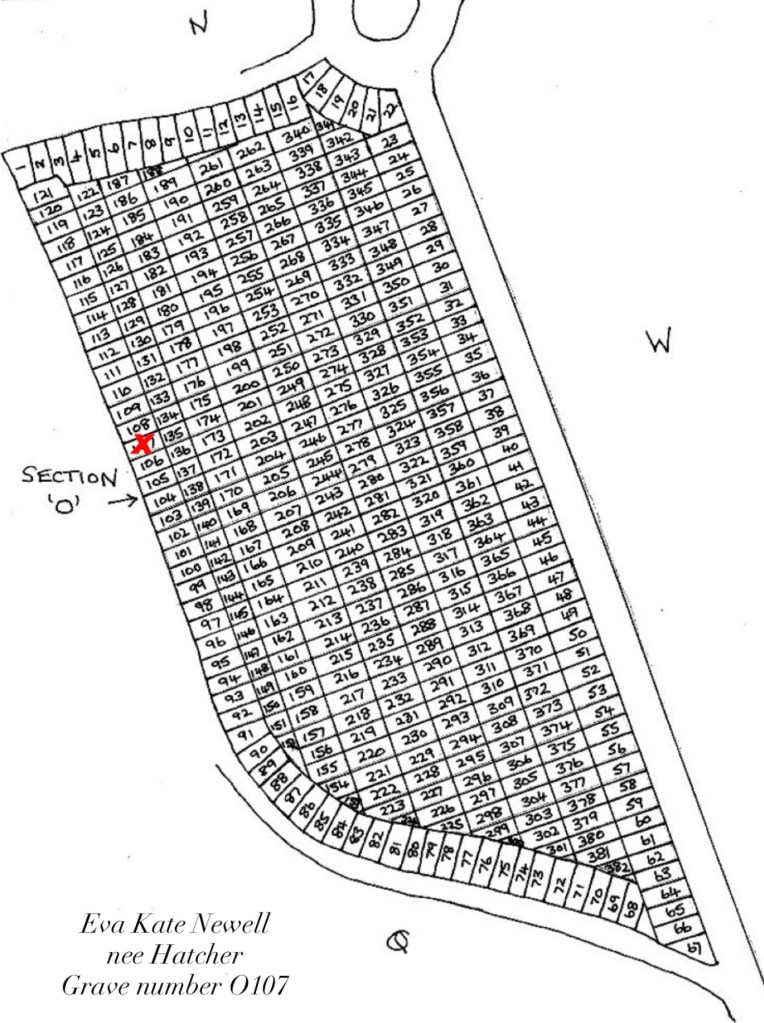
“The Light on Porterbridge Street”
In Romsey’s heart, where the river hums,

And the Abbey bells like memories come,

She walked in grace through cobbled years,

With laughter’s light and tender tears.

At Porterbridge Street, her story grew,

Two hearts as one, both kind and true.

Frank by her side, her soul’s own twin,

Their love a lantern lit within.

Through rationed days and nights of war,

They kept the faith they’d built before.

His weary hands, her steadfast care,

Two lives entwined in silent prayer.

She watched him labour, steadfast, strong,

Through dust and dawn, through right and wrong,

And every woodbine curl of smoke

Was love’s soft ghost, a vow unspoke.

Their son was born, her joy, her light,

Who filled their home with golden sight.

Through childhood days and manhood’s call,

She held his heart through it all.

But life, as life will, dealt its pain,

And joy gave way to loss again.

A tiny cradle, softly stilled,

A dream unlived, a promise spilled.

Yet still she rose, her spirit kind,

The past behind, but love enshrined.

Her hands would mend, her voice would soothe,

And grief grew gentle, worn and smooth.

The years spun on, the decades turned,

As hearths grew cold and candles burned.

Her Frank grew old, his breath grew slow,

Till autumn came, and she let go.

Oh, what a silence filled that room,

When love departed into bloom.
For when he left, the house grew small,

A hollow echo, heart and all.

She lingered there, one year alone,

Among the things that love had known,

His cup, his chair, his folded coat,

His name a hymn within her throat.

And when her own soft ending came,

The wind outside still spoke his name.

Her son stood close, her eyes were kind,

Her peace, at last, in love defined.

Now side by side, beneath the yews,

Where Hampshire rains and sunlight fuse,

They rest in earth, in Romsey’s keep,

Where roots run deep and memories sleep.

And if you walk where dahlias bloom,

Between the stones, beyond the gloom,

You’ll feel her there, a gentle thread,

A love that lingers, never dead.

For every life she touched still hums,

Where the Abbey bells through twilight come,
Her heart still beats in those she bore,

Her love still lives, forevermore.
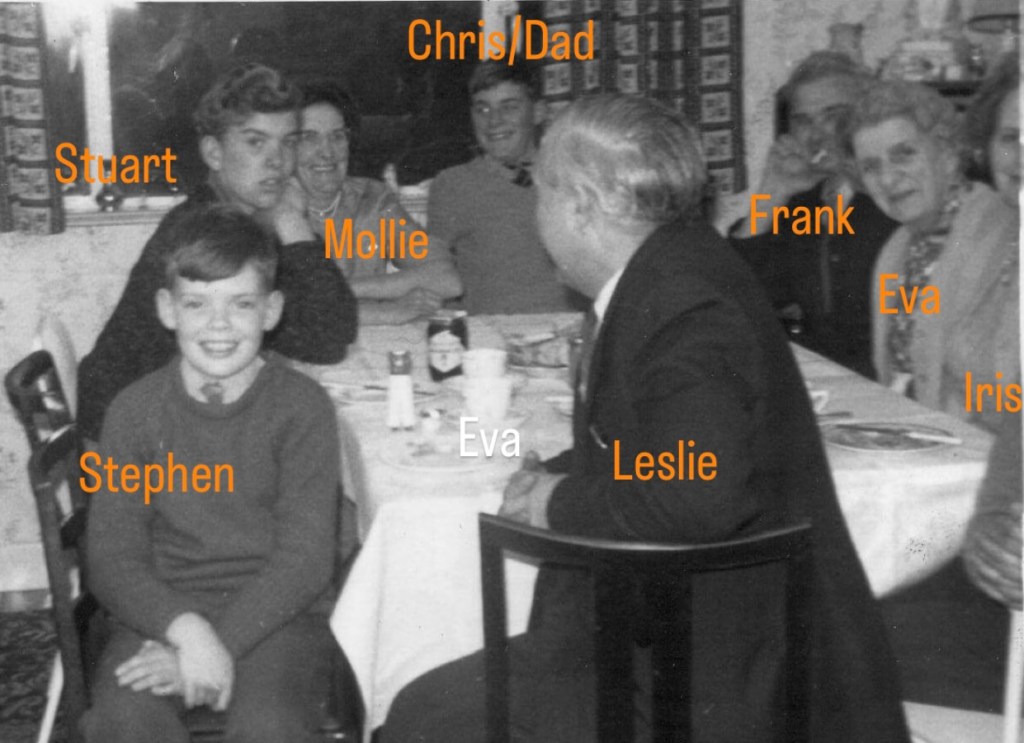
When Eva Kate Hatcher was born in the soft summer of 1893, Hampshire was a place still resting in the gentle arms of the 19th century. Life in her small village of Lockerley would have been marked by simplicity and repetition, the kind of life where each day folded softly into the next. The pace was slow, guided by the turn of the seasons and the toll of the church bell. Queen Victoria still reigned, and England, though deep into the Industrial Age, was a land divided between the old and the new. Hampshire, with its blend of farmland, market towns, and growing port cities, embodied this delicate balance, a county on the cusp of transformation.
In those earliest years of Eva’s life, the railway had already begun to weave its silver threads through Hampshire, binding together villages and towns that had once been worlds apart. The line from London to Southampton, completed decades earlier, had opened the county to movement and opportunity. Trains hissed and roared through the green fields, bringing goods, people, and ideas. For families like the Hatchers, the railway meant more than travel, it was work, it was livelihood, and it was connection. Her father, George Hatcher, was an engine driver, one of the brave men who guided the great steam machines through fog and rain, his hands blackened by soot and his heart tied to the rhythmic beat of the rails. The railway was modernity itself, a symbol of progress in a world that still lit its homes by candlelight and lamp.
Housing in the 1890s was simple and functional. In villages like Lockerley or towns like Romsey, most homes were built of red brick or chalky stone, their windows small and their hearths large. Coal fires were the centre of the home, both for warmth and for cooking. Water came from a pump or well, and most cottages lacked indoor plumbing. Light, until the turn of the century, came from paraffin lamps or gas, their flicker soft and golden against whitewashed walls. By the time Eva was a young woman, however, electricity was beginning to appear in towns, transforming the evenings from dim and smoky to bright and alive.
Education, too, was changing. When Eva attended school, the 1870 Education Act was still shaping the landscape of learning, bringing schooling to children of all classes for the first time. Classrooms were simple, with wooden benches, chalkboards, and a single teacher for dozens of pupils. Girls like Eva were taught reading, writing, arithmetic, and domestic skills, sewing, mending, and the virtues of thrift and modesty. Schooling ended early, usually around the age of twelve, when girls were expected to help at home or enter service. Yet education, though limited, had planted the seeds of literacy and self-determination in a generation of working-class children.
Religion was the steady heartbeat of community life. The church, in Lockerley, likely the village’s Anglican parish, was not only a place of worship but also of gathering, guidance, and belonging. Sunday services were attended by nearly everyone, and the church calendar shaped the rhythm of life: baptisms, marriages, harvest festivals, and funerals marking the passage of time. Faith, for families like the Hatchers, offered comfort, order, and a moral compass in an ever-changing world.
By the time Eva reached her twenties and married Frank Newell in the early 1910s, Hampshire was stepping into the modern age. The horse and cart still ruled the country lanes, but motorcars were beginning to rattle and cough their way through the streets of Romsey. The town itself was a blend of the old and new, cobbled roads lined with gas lamps, shopfronts advertising tea, bread, and cloth, and the great Abbey casting its shadow over the marketplace as it had done for centuries. Romsey’s people were tradesmen, shopkeepers, and labourers, their days measured by honest work and their evenings by community and kinship.
Then came the Great War in 1914. For Eva and Frank, as for every English family, life was irrevocably changed. Frank went to serve his country, enduring the horrors of the trenches, the bitter cold that cost him his toes, and the haunting memories that would follow him home. In Hampshire, the war transformed daily existence. The county’s fields filled with training camps, its women took to factory floors and hospitals, and its villages waited anxiously for letters that too often never came. Food was rationed, prices rose, and life became a matter of endurance. When peace came in 1918, the world that returned was not the one that had left.
The 1920s and 1930s saw the slow rebuilding of life and hope. Electricity began to spread more widely, first to Romsey’s businesses, then into homes like Eva’s. Street lamps replaced gaslight, bringing a pale modern glow to the market square. The arrival of radio changed evenings forever, voices and music now drifted through parlours that had once known only the ticking of the clock. Transport grew easier, too. Bicycles and buses gave new freedom to working people, and the railway continued to serve as Hampshire’s proud artery of commerce and connection. Housing gradually improved as well. Council estates began to rise beyond the old town limits, offering indoor plumbing, small gardens, and the modern marvel of running water.
Clothing evolved with each decade. Eva would have seen corsets loosen and hems rise as the Edwardian world gave way to the flapper age. By the 1940s, war had imposed austerity again — dresses remade from old curtains, coats patched and mended, stockings scarce and treasured. The post-war years, however, brought a quiet prosperity. Synthetic fabrics and ready-made clothes became more affordable, and women like Eva could, for the first time, choose from catalogues and high-street shops rather than relying on a seamstress or their own needle.
Food, too, told the story of the times. In Eva’s childhood, meals were plain and local: bread, broth, and vegetables from the garden, with meat a Sunday luxury. The World Wars brought ration books and ingenuity, powdered eggs, tinned meat, and the careful art of making do. Yet in the 1950s and 60s, as rationing ended, the family table blossomed again. Tinned fruit, custard, roasts, and cups of tea returned in abundance, and new appliances, the refrigerator, the electric cooker, transformed kitchens once dominated by coal ranges and iron kettles.
Health care, which in Eva’s youth was a matter of fortune and charity, changed beyond recognition during her lifetime. When she was born, illness was often treated with home remedies or the care of a local doctor paid in coins or favours. The establishment of the National Health Service in 1948 was one of the most profound transformations she would have lived to see, free care for all, a revolution of compassion and equality that reshaped British life. Hospitals like Romsey District Hospital, where Eva would eventually pass away, became symbols of this new era of care and dignity.
Government, too, shifted profoundly in her time. Eva was born into a world where women had no political voice. By 1918, women over thirty were granted the vote, and by 1928, full suffrage arrived. Though she may never have spoken much about politics, Eva’s lifetime encompassed the entire arc of women’s emancipation, from silence to civic participation. The working classes, too, found greater representation. The Labour movement and post-war social reforms gave rise to council housing, pensions, and public welfare, small safeguards against the hardship her mother’s generation had faced.
Through it all, Hampshire evolved from a Victorian county of quiet farms and mills to a modern landscape of motorways, housing estates, and bustling towns. Romsey grew, its market square filling with cars instead of carts, its people trading bicycles for buses, its skyline brightened by neon instead of gaslight. Yet the Abbey still stood as it always had, the river still wound through meadows and gardens, and the heartbeat of the town, its people, its families, its unspoken kindnesses, endured.
When Eva passed away in 1973, the world she left behind was almost unrecognisable from the one she had entered eighty years earlier. Televisions glowed where once had stood oil lamps. Jet planes crossed the skies she had watched as a child, once filled only with birds. Children grew up with radios and record players, not church bells and market songs. Yet for all the changes, the machines, the progress, the modern marvels, what mattered most remained unchanged. Home, family, faith, and love: the quiet pillars of life that had carried Eva from the gentle fields of Lockerley to her final rest in Romsey.
Her life was the story of a century,  one woman’s journey through the age of steam to the age of speed, through wars, inventions, losses, and love. And in that journey, Hampshire itself can be seen: resilient, evolving, yet forever rooted in its heart of green hills, winding rivers, and steadfast souls.
Rest in peace,
Eva Kate Newell,
formerly Hatcher,
Born in the soft summer light of 1893, and laid to rest in the golden hush of 1973. For eighty tender years, she walked this earth with quiet grace, her life a tapestry of love, endurance, and devotion. From the cobbled streets of Lockerley to the warm heart of Romsey, she built her world with steady hands and a gentle spirit, shaping a home filled with laughter, kindness, and care. As wife to her beloved Frank, mother to Donald, and grandmother to those who followed, she gave of herself endlessly, asking for little but leaving behind everything that mattered, love that outlasts time, memories that soften grief, and a legacy that lives on in the hearts of all who knew her. Though the years have passed and the world has changed, her presence lingers still, in every whisper of the Hampshire wind, in the chime of the Abbey bells, and in the quiet places where love endures beyond all endings.
And so, the story of Eva Kate Newell, formerly Hatcher, draws to its gentle close, not with fanfare or grand farewell, but with the same quiet grace that marked her every day upon this earth. Hers was a life woven from simple beauty, the laughter shared over a humble meal, the warmth of family gathered close, the soft murmur of the Abbey bells drifting through the open window on a Sunday morning. She knew both joy and sorrow, carrying them with equal tenderness, and through it all she remained steadfast, a wife devoted, a mother devoted still, and a woman whose love left its imprint upon every heart it touched.
Though her body rests now beneath the whispering trees of Romsey Old Cemetery, her spirit moves still, in the light that spills upon Portersbridge Street, in the rustle of autumn leaves she once swept from her doorstep, in the echo of her voice calling her family home. Time may have folded her name into the pages of history, yet her story lives on, in the generations who carry her strength, her gentleness, and her unspoken wisdom within them.
Eva’s life was never about grandeur or gain, but about love, love given freely, quietly, faithfully, even in the face of loss. It is in that love that she endures. And so, as her chapter closes, we do not say goodbye, but thank you, for the tenderness she gave, the courage she carried, and the light she left behind. Her journey has ended, but her presence remains eternal, woven forever into the heart of Romsey, and into the souls of those who still speak her name with love.
Until next time,
Toodle pip,
Yours Lainey.
I have brought all certificates throughout Intwined,
Please do not download
or use them without my permission.

All you have to do is ask.

Thank you.
Intwined —
Because every life has a story worth telling.

