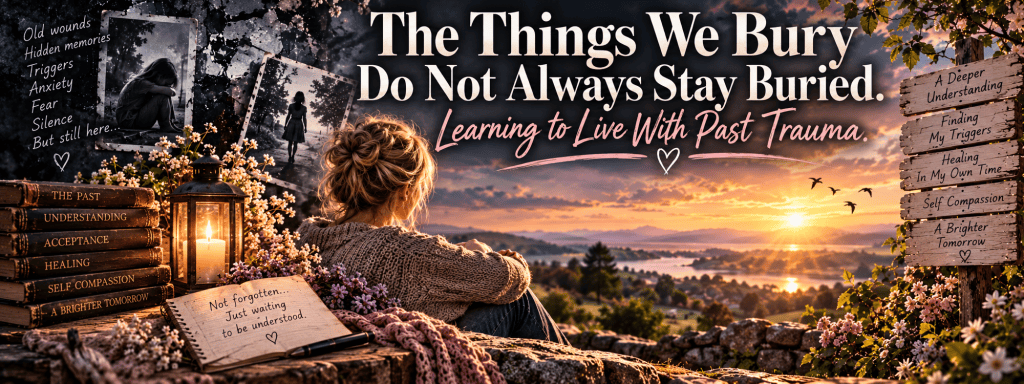
There are some things in life we put away.
Not in boxes.
Not in cupboards.
Not somewhere we can physically see them.
We put them somewhere much deeper.
Somewhere inside ourselves.
We take the memories that hurt too much, frighten us too much or carry emotions we do not know what to do with, and we push them into the darkest corners of our minds.
Then we close the door.
And sometimes we spend years pretending there isn't a door there at all.
I think I once believed that was strength.
Perhaps many of us do.
Don't think about it.
Don't talk about it.
It's over.
Other people have had worse.
Just get on with your life.
And so we do. We get on with life.
We become remarkably skilled at it.
But there is something I have slowly come to understand.

Burying something is not necessarily the same as healing from it.

Sometimes it simply means learning how to live around the place where we buried it.

When Silence Feels Safer.
There are countless reasons people do not talk about trauma.
Sometimes there are no words for what happened.
Sometimes we are frightened of what other people might think.
Sometimes we worry about upsetting the people we love.
Sometimes we convince ourselves that because something happened many years ago, mentioning it now would be pointless.
And sometimes silence simply feels safer.
So we lock it away.
We tell ourselves that we are protecting everyone else. Perhaps we are protecting ourselves too.
And that may be exactly what we need for a while.
There should never be shame attached to that.
Nobody owes the world the intimate details of their most painful experiences.
Healing does not require announcing your history from the rooftops.
You do not have to tell everybody.
You do not have to write about it.
You do not have to confront people.
You do not have to make something private public simply to prove that you have healed.
But there is a difference between choosing privacy and being imprisoned by silence.
That difference matters.

The Locked Room Inside Us
I sometimes imagine unresolved trauma as a locked room inside a house.
You can live perfectly well without entering it.
You can decorate every other room. You can fill the house with people you love. You can play music. You can laugh in the kitchen. You can build an entire life there.
And yet you always know that one room exists.
Perhaps you avoid walking past it.
Perhaps certain sounds seem to come from behind the door.
Perhaps occasionally something happens and suddenly you find yourself standing outside it again.
You thought you had forgotten where the key was.
But your body hadn't.
Your brain hadn't.
And suddenly something you buried twenty or thirty years ago feels frighteningly close.
That is one of the dangers of pushing trauma so deeply inside ourselves that we refuse to acknowledge it.
We may stop talking about it.
We may even stop consciously thinking about it.
But the feelings connected to it can sometimes emerge elsewhere.
In anxiety.
In anger.
In fear.
In relationships.
In our need for control.
In the things we avoid.
In the situations that make our hearts suddenly race.
In the way we react to something and afterwards wonder:
Where on earth did that come from?
Sometimes the answer is behind that locked door.

You Don't Have to Dig Everything Up
This is important.
Managing past trauma does not mean forcing yourself to remember every detail.
It does not mean sitting alone and deliberately reopening every wound.
It does not mean constantly returning to the worst moment of your life.
And it certainly does not mean that somebody else has the right to demand your story.
Sometimes healing begins much more gently.
It begins with noticing.
Why does this situation make me feel unsafe?
Why do I react so strongly when somebody says that?
Why do I immediately expect the worst?
Why do I shut down during confrontation?
Why does this particular feeling seem strangely familiar?
You do not always have to begin with the memory.
Sometimes you begin with the person you are today.

Learning Your Own Triggers.
One of the most powerful things we can do is become curious about ourselves.
Not judgemental.
Curious.
There is an enormous difference.
Instead of saying,
For goodness' sake, why am I like this?
perhaps we can begin asking,
What is happening inside me right now?
Notice the body.
A racing heart.
Tight shoulders.
A clenched jaw.
A sinking feeling in the stomach.
The sudden urge to escape.
The feeling that something terrible is about to happen even when logically you know you are safe.
Sometimes our bodies recognise a trigger before our conscious minds do.
Learning those signals can give us an opportunity to respond differently.
To slow our breathing.
To put our feet firmly on the floor.
To look around the room.
To remind ourselves where we are.
To say:
This is now.
That was then.
I am here.
I am safe in this moment.
Simple words.
But sometimes powerful ones.

Let Someone In.
There are some things that become heavier the longer we carry them alone.
Talking can help.
That does not necessarily mean telling everyone.
Perhaps it is one trusted friend.
A partner, a family member, a counsellor, a therapist, a doctor.
Someone who can hear the truth without trying to rewrite it.
There can be enormous relief in finally saying something aloud that has existed only inside your head.
Because secrets have a strange ability to grow in darkness.
Shame can grow there too.
Fear can.
Guilt can.
The mind can spend years replaying something without ever hearing another perspective.
Sometimes another human being simply saying,
I hear you.
can begin to loosen something that has been tightly knotted for decades.

Writing Can Give the Pain Somewhere Else to Live.
For some of us, speaking is difficult.
Writing can be different.
There is something strangely powerful about taking thoughts that have lived inside your head and putting them onto a page.
You don't have to show anybody. You can write a letter you never send. You can keep a journal. You can write poetry. You can write song lyrics. You can write to your younger self. You can write the things you wish somebody had said to you. You can even write something and destroy it afterwards.
The purpose is not necessarily to create something beautiful. It is simply to allow the words to exist somewhere other than inside you.
Perhaps that is one of the reasons I write.
Words give feelings somewhere to go.

Healing Is Not Forgetting
I think we sometimes imagine healing incorrectly.
We think healing means reaching a point where something no longer hurts.
Where we never think about it.
Where we can tell the story without emotion.
Where the memory somehow becomes meaningless.
But perhaps that isn't healing at all.
Some things will always matter.
Some memories will always carry sadness.
Some events divide life into before and after.
Healing does not necessarily erase that line.
Perhaps healing means being able to look across it without being dragged backwards.
It means remembering without completely returning.
It means recognising a trigger without allowing it to control the entire day.
It means understanding why your brain learned certain behaviours and gradually teaching it that different responses are possible now.
It means allowing the past to be part of your story without permitting it to become the author of everything that follows.

There Is No Prize for Carrying It Alone.
This may be one of the hardest lessons.
We praise people for being strong. For coping. For getting on with things. For never complaining.
But sometimes strength becomes a disguise.
Sometimes I'm fine becomes such an automatic answer that eventually we stop asking ourselves whether it is true.
There is no medal for suffering quietly.
There is no prize for carrying something alone for thirty years when sharing even a fraction of its weight could make the journey easier.
Seeking help is not surrendering to the past.
It is deciding that the past has already taken enough.

Open the Door Gently.
Perhaps the answer is not to throw open that locked door.
Perhaps we simply stop pretending it isn't there.
We approach it when we are ready.
We might sit outside it for a while.
We might speak to somebody through it.
We might open it an inch.
And if what lies behind it feels overwhelming, we can step away again and seek support.
Healing does not have to be dramatic.
It can happen in tiny pieces.
A conversation.
A realisation.
A boundary.
A journal entry.
A therapy appointment.
A moment when you recognise a trigger and choose a different response.
A day when something that once destroyed you merely makes you pause.
A moment when you suddenly realise:
This memory belongs to me.
But it no longer controls me.

What We Bury Deserves Light.
I don't think every painful thing needs to be excavated.
I don't think every secret needs to be shared.
And I certainly don't believe we should force ourselves to relive experiences before we are ready.
But I do believe there can be danger in spending a lifetime desperately guarding a locked room inside ourselves.
Because guarding it takes energy.
Silence takes energy.
Pretending takes energy.
Running from ourselves takes energy.
And perhaps healing begins when we finally realise that the part of us behind that door is not something terrible waiting to escape.
Perhaps it is simply an earlier version of ourselves.
Still frightened, still confused, still waiting for someone to say:

You don't have to hide anymore.

And perhaps, after all these years, the person who finally gets to say those words...
is us.
We cannot change what happened. We cannot go backwards and protect the person we once were.
But we can protect the person we are now.
We can listen to them. We can understand them.
We can ask for help when the weight becomes too heavy.
And slowly, carefully, compassionately, we can stop organising our lives around a locked door.
Because the past may always live somewhere within us.
But it does not have to remain buried deep within our soul to prove that we survived it.
Sometimes surviving was the first chapter.
Learning how to live freely afterwards is the one we get to write now.
Until next time,
Toodle pip,
Lainey.
Intwined — Because every life has a story worth telling.

