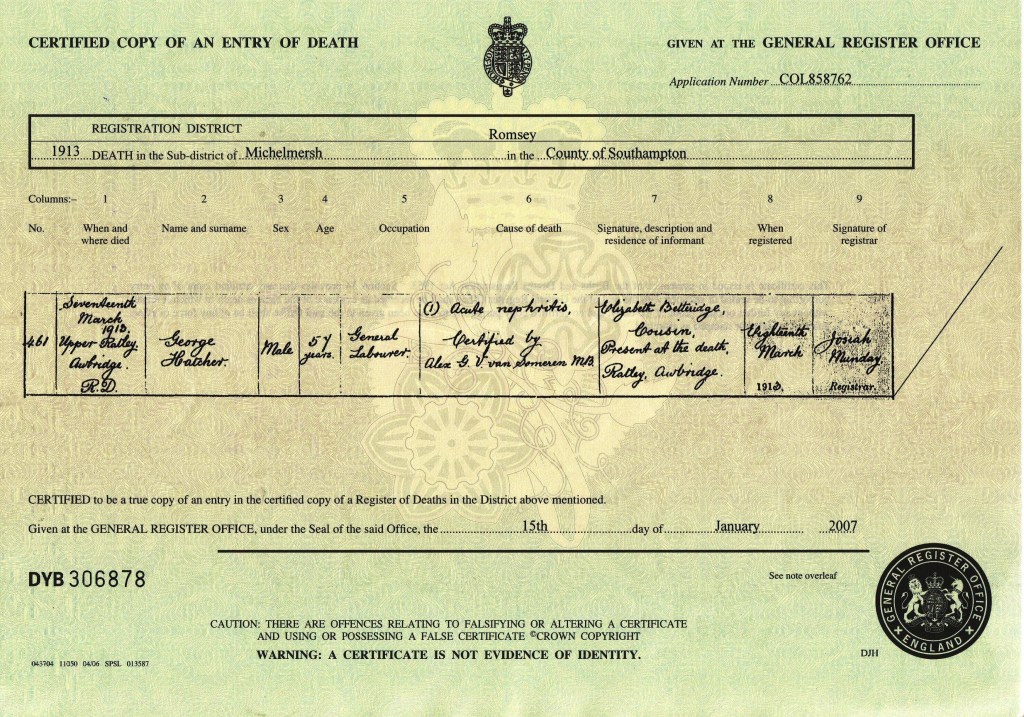
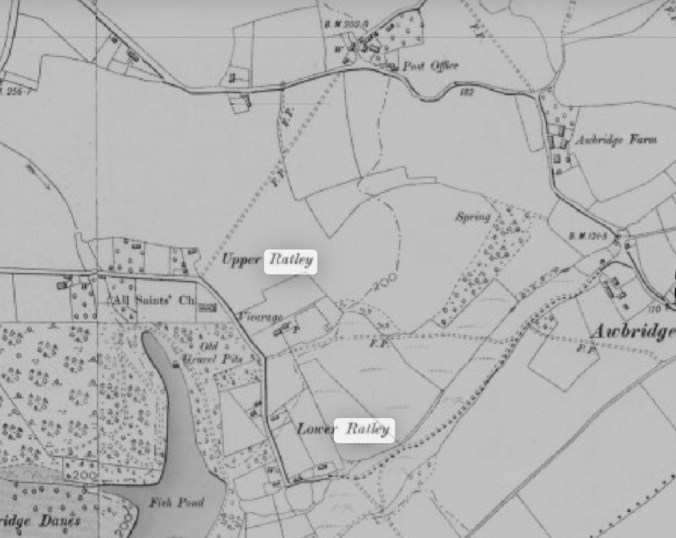
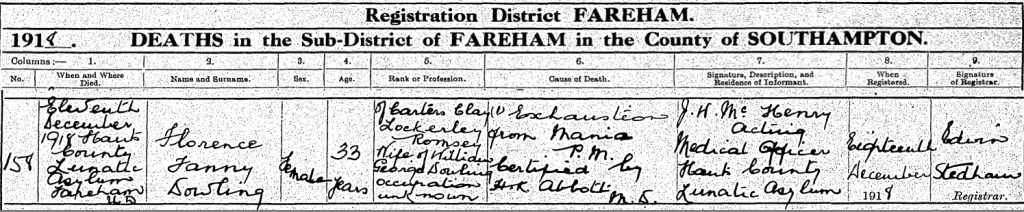
Every life is a story, yet so often, the chapters that come before us are half-faded, written in the ink of memory, scattered through time, and bound together only by love. This is the story of Eva Kate Hatcher, my great-grandmother, the daughter of George Hatcher and Fanny Hatcher (née Pearce), a woman born into the soft light of a Hampshire summer in 1893, whose life would unfold quietly, steadfastly, across the changing landscape of the 20th century. Hers is not a tale of endurance, faith, and the unbroken thread of family, a thread that, even now, reaches through generations to bind her story to my own.
Family history is not merely the study of names and dates, it is the uncovering of spirit, the gathering of echoes left behind by those who came before us. In learning their stories, we come to understand ourselves more deeply, to see the ways in which their joys, their losses, and their choices ripple gently through our own lives. There is something profoundly spiritual in this work, a quiet awakening of gratitude, a sense that the blood that once pulsed through their hearts now flows through ours, carrying not just lineage, but love, resilience, and belonging.
When I first began to trace my family’s roots, I did so after the passing of my father, Christopher Newell, in 1997. At that time, I knew almost nothing of the people who had shaped the branches of our tree, no stories of their laughter, their hardships, their homes, or the lives they built with such humble devotion. My father, who might have answered a thousand questions, was already gone, and I was left with the quiet ache of all the things I had never thought to ask. It is one of life’s tender cruelties, that youth so rarely recognises the value of ancestry until it is too late to seek its voice.
And yet, through time, faith, and patience, the pieces have begun to fall into place. Old records, faded photographs, and the brittle pages of parish books have become my guide, fragile bridges back to the world where Eva once lived. Her early years can be glimpsed through these surviving traces, a birth recorded in careful script, a baptism solemnised in faith, census pages that anchor her family within the quiet Hampshire countryside.
Beyond 1923, however, her story begins to blur, veiled by the Hundred Year Law, which guards the privacy of those still within living memory. It is a gentle barrier between past and present, one that both protects and withholds, leaving the later chapters of Eva’s life to rest, for now, in mystery. But the documents that remain, however modest, hold the heartbeat of her beginnings, the foundation of all that was to come.
So this first part of her story, The Early Years Through Documentation, is an act of remembrance and reverence, a return to the dawn of a life once lived in simplicity and grace. It is written with love, not only for Eva herself, but for all those whose stories, though quiet, are the truest measure of who we are. In tracing her steps, we do not merely recover history, we reclaim a piece of our own souls.
Welcome back to the year 1893, Newtown, Lockerley, Hampshire, England.
The air is still and clean here, touched by the scent of meadows and woodsmoke, and the steady rhythm of rural life hums through the valley. Carts creak along the narrow lanes, iron-rimmed wheels striking sparks from flint, and the faint whistle of a distant train carries across the fields, a sound that reminds even the quietest hamlet that the modern world is slowly, insistently, drawing near.
England in 1893 was a country poised between two ages, still deeply rooted in the traditions of the past, yet on the threshold of modernity. On the throne sat Queen Victoria, who had ruled for more than half a century, her reign defining not only a nation but an era. The monarch was a figure of reverence and stability, her black-clad image gazing sternly from parlour walls across the kingdom. The Prime Minister was William Ewart Gladstone, serving his final term as leader of the Liberal government. Parliament, alive with debate, wrestled with great issues, Irish Home Rule, trade, empire, and the rights of working men and women, though for many ordinary people in places like Newtown and Lockerley, Westminster’s concerns felt very far away.
In these rural parishes, life followed the rhythm of the seasons. The great divide between rich and poor was as stark as ever. The wealthy, the landed gentry and industrialists, lived in fine brick houses or country estates, their rooms filled with velvet drapes, polished furniture, and the new marvels of gaslight and plumbing. Their days were shaped by leisure and refinement, marked by carriage rides, afternoon teas, and the occasional charity bazaar.
For the working class and the rural poor, life was simpler and far harsher. Agricultural labourers like George Hatcher rose before dawn and worked long hours for modest wages, earning barely enough to keep their families fed. Most lived in tied cottages, small, brick or chalk-built dwellings owned by the farmer or estate. These cottages, often with thatched roofs and uneven floors, might have two or three rooms, a scullery with a cold water pump, and a hearth that served as both kitchen and heating. The fire, burning coal or wood, was the heart of the home, the source of warmth, light, and comfort through bitter winters.
Lighting came from candles, oil lamps, or, for the slightly better-off, paraffin lanterns. Electricity was a distant luxury, reserved for cities like London or Southampton. The nights in Lockerley were long and dark, the sky a deep canopy of stars unmarred by modern glare.
Hygiene and sanitation were simple, sometimes grim. Water was drawn from wells or pumps, and washing was done by hand in heavy basins. Outside privies were the norm, small wooden huts with earth or bucket seats, emptied by hand when full. Illness and infection were constant threats. Diseases such as diphtheria, consumption (tuberculosis), typhoid, and scarlet fever were common, often sweeping through families with tragic speed. Doctors were expensive, and many relied instead on home remedies or the advice of the local midwife or herbalist.
Food for working families was plain but nourishing when times were kind: bread, potatoes, porridge, bacon, and seasonal vegetables. Sunday dinner, a rare luxury of roast meat, was the week’s highlight. Tea was the universal comfort, sweetened with sugar when it could be afforded. The village grocer sold flour, soap, salt, and perhaps a little treacle for the children, who played in the lanes barefoot in summer and wrapped in hand-me-down coats come winter.
Clothing reflected both class and custom. The wealthy wore layers of tailored wool and silk, with corsets, bustles, and hats adorned with feathers or lace. The working poor dressed for necessity: men in corduroy or fustian trousers, rough shirts, and waistcoats; women in long cotton dresses, aprons, and shawls, their hair tied neatly under bonnets. Clothes were mended again and again until the fabric gave way entirely.
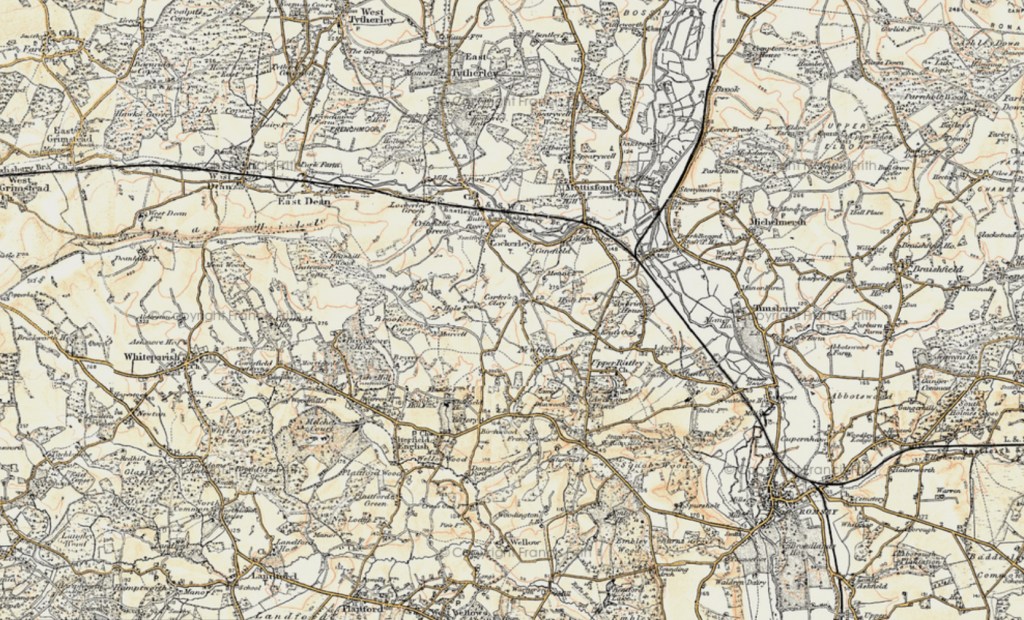
Travel was changing the face of the countryside. The railway had reached nearby Dunbridge and Romsey, bringing with it not only goods and opportunity but also a sense of connection to the wider world. Steam trains, their great engines hissing and whistling, linked Hampshire’s villages to Southampton, Salisbury, and beyond. Horse-drawn carts still carried the daily loads of hay, milk, and wood, while bicycles, the new pride of the young and adventurous, were beginning to appear along the lanes.
Education had begun to reach even the smallest parishes. The Elementary Education Act of 1880 had made schooling compulsory for children up to ten, and many villages, including Lockerley, had small local schools. Children learned to read, write, and recite their catechism beneath the stern gaze of the schoolmaster or mistress. Ink-stained fingers, slates, and recitation of moral lessons filled their days. Yet for many, schooling was brief, work on farms and in service awaited them by their early teens.
Religion was the steady pulse of life, offering comfort, structure, and community. On Sundays, families dressed in their best and walked to St John’s Church or the Methodist Chapel in Newtown. The day began with the toll of bells and the scent of polished pews, hymns rising through the rafters. The Church of England guided most hearts, though Methodism had found strong roots among the labouring poor, its message of personal faith and redemption ringing true for those who knew hardship well.
Entertainment, when it came, was modest and communal, harvest festivals, chapel socials, travelling fairs, and the occasional market day in Romsey or Salisbury. Music, laughter, and storytelling filled the spaces between toil and sleep. A gramophone or harmonium was a rare treasure, and families gathered by lamplight to read aloud or sew by the hearth. Gossip, too, was a form of entertainment, the gentle hum of village life carried by whispers over hedges and along garden paths. Every birth, marriage, and misfortune was known and discussed with care, for in small communities, everyone’s story was part of the whole.
The environment was both harsh and beautiful. Winters were cold and damp, with frost glistening on the fields and smoke curling from cottage chimneys. Summers were lush, filled with the scent of hay and wildflowers, the air thick with the hum of bees. Life moved at the pace of nature, patient, enduring, and in harmony with the land.
And so it was in 1893, the year of Eva Kate Hatcher’s birth. The world into which she arrived was one of transition, caught between candlelight and electricity, between horse and locomotive, between the old ways and the new. It was a time when family was everything, when love and survival walked hand in hand, and when even the humblest life, recorded in fading ink upon parish pages, held the quiet grace of eternity.
On a soft and golden Thursday, the 24th day of August in the year 1893, the fields of Newtown, Lockerley lay bathed in the mellow warmth of late summer. The hum of bees drifted lazily over the ripened corn, and the faint murmur of the wind moved through the hedgerows like a whispered hymn. It was harvest time in Hampshire, a season of both toil and grace, and within a modest brick cottage tucked along the quiet lanes of the village, another kind of labour was taking place: one that would bring forth new life into the world.
There, behind the curtained window where sunlight danced upon the worn wood of the sill, Fanny Hatcher, aged twenty-four, laboured through the long, unrelenting hours of childbirth. The air in the room was heavy with both fear and faith. A fire glowed faintly in the hearth though the day was warm, for the old women who tended her swore that every birth needed heat to help the mother’s strength. Perhaps it was a local midwife, hands calloused, voice low and steady, who knelt beside the bed, whispering soft encouragements as Fanny clutched the sheets and prayed quietly under her breath. Her husband, George Hatcher, thirty-five years old and weathered from years of labouring on the Hampshire fields, waited just beyond the door, pacing the cottage floorboards with rough hands twisting in his cap, listening helplessly to the sounds of pain and promise from the next room.
Outside, the scent of hay and clover hung thick in the air, mingling with the far-off calls of men working the harvest fields. The world beyond those walls carried on in its eternal rhythm  horses snorting, scythes swishing, wagons creaking  yet within, time seemed to stand still, held captive by the small miracle about to unfold.
When at last the infant’s cry pierced the stillness, it was like sunlight breaking through storm clouds. Eva Kate Hatcher had arrived, tiny, perfect, and fierce with life. Fanny, exhausted and trembling, gathered her daughter close, the sheen of labour still upon her brow, her heart swelling with that profound love only a mother can know. George stepped forward then, his roughened hands, the same that had turned soil, hauled timber, and driven engines, now trembling as he reached to touch his daughter’s downy head. It was a moment of grace amidst hardship, a light that would shine through all their years of struggle and endurance.
Eva was their fifth child, born into a family that had already known both joy and sorrow in equal measure. Two of her brothers, little Caleb George and James, had died in infancy, heartbreaks that had left invisible scars upon their parents’ hearts. And yet, with Eva’s arrival, hope stirred anew in that small home. The sound of her cries seemed to knit the air together again, to remind George and Fanny that love, though tested by loss, had not been defeated.
In the weeks that followed, as summer faded gently into autumn, George continued his work as an agricultural labourer, his days spent in the open fields of Lockerley, his evenings by the fireside where Fanny rocked their baby to sleep. The rhythm of life resumed, the fields, the mills, the church bells, but now it was steadied by the soft breath of a new child, the promise of tomorrow resting quietly in her cradle.
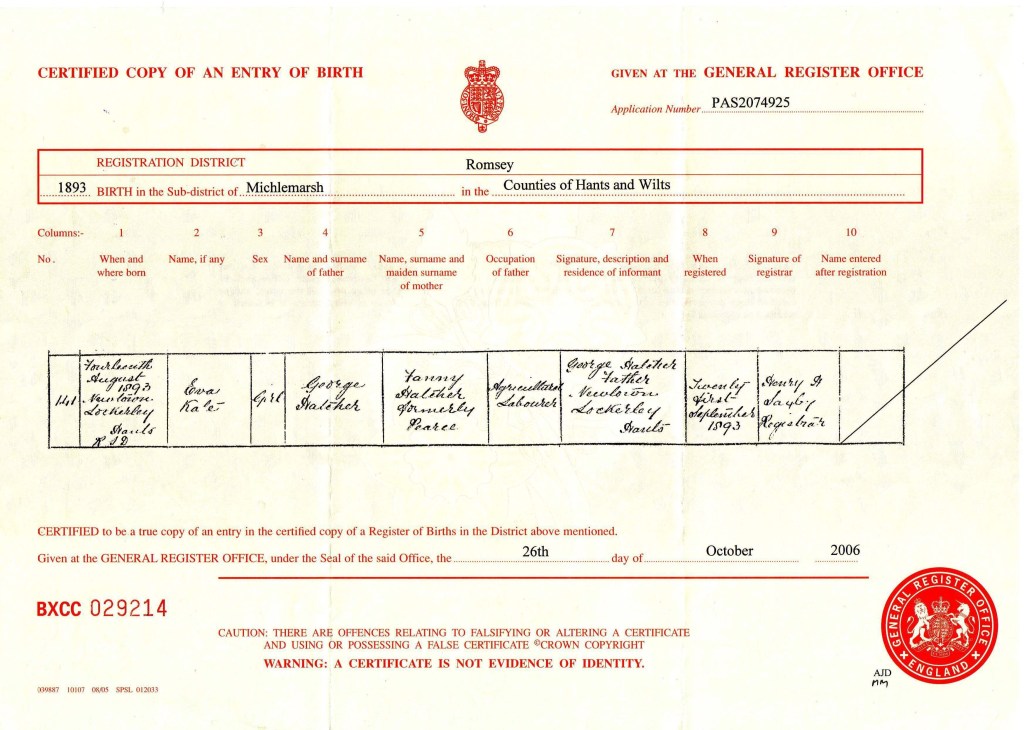
On Thursday, the 21st day of September, 1893, George walked the familiar road to the Romsey Registrar’s Office to record his daughter’s birth. His boots, worn but polished for the occasion, left small prints in the chalky dust of the lane. He stood before Registrar Henry H. Saxby, hat in hand, his voice low but sure as he gave the details that would secure his daughter’s place in history:
No. 441

When and Where Born: Twenty-fourth August 1893, Newtown, Lockerley, R.S.D. Hants.

Name, if any: Eva Kate.

Sex: Girl.

Name and Surname of Father: George Hatcher.

Name, Surname, and Maiden Surname of Mother: Fanny Hatcher, formerly Pearce.

Rank or Profession of Father: Agricultural Labourer.

Signature, Description, and Residence of Informant: George Hatcher, Father, Newtown, Lockerley, Hants.

When Registered: Twenty-first September 1893.

Signature of Registrar: Henry H. Saxby, Registrar.
There, in the steady hand of the registrar, Eva’s story began, not just as an entry in the ledger of life, but as part of a greater narrative woven through generations. For George and Fanny, it was not simply the naming of a child, it was an affirmation that life, no matter how fragile, endures.
That modest document, now yellowed with age and softened by time, is more than a record. It is a fragment of love preserved, a window into a moment when two souls, weary but unbroken, welcomed their daughter into the world with hearts full of hope. The ink may have faded, but its meaning has not.
And so, in the soft light of that August day in 1893, among the fields and cottages of Hampshire, the story of Eva Kate Hatcher began, a story born of earth and endurance, of hands calloused by labour and hearts tempered by love. The wind that moved through the fields that day still seems to carry her name, whispering it through the hedgerows and across the centuries, a reminder that even the humblest beginnings can echo forever in the blood and memory of those who come after.
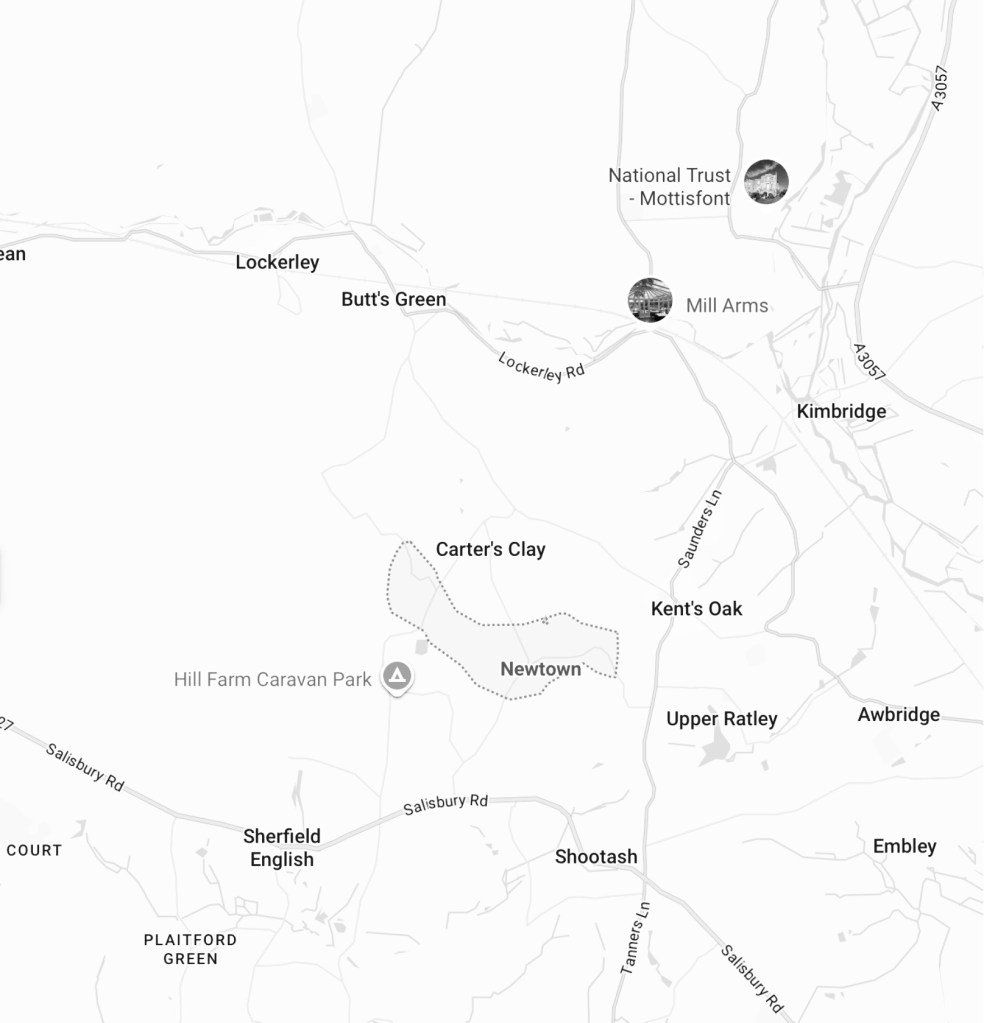
Newtown, a small rural village near Lockerley in Hampshire, lies within a quiet corner of the Test Valley, surrounded by gentle hills, farmland, and ancient woodland. Though modest in size, it holds a long and deeply rooted history that reflects the slow evolution of the English countryside over the centuries. Its story is woven into that of the surrounding parishes of Lockerley, East Dean, and Mottisfont, and it remains one of those Hampshire villages where traces of the medieval landscape can still be seen in the pattern of fields, lanes, and cottages.
The name Newtown might suggest a place of more recent origin, but it is thought to have emerged in the later medieval period, possibly as a newer settlement or extension of an existing one. In early records from the thirteenth and fourteenth centuries, similar names appear in rural Hampshire to describe small hamlets or agricultural clearings that developed alongside older manors. It is likely that Newtown began as a farming settlement established during a period of agricultural expansion, when areas of woodland were cleared to make new fields for cultivation.
By the seventeenth and eighteenth centuries, Newtown had developed into a small but stable community. It lay within the ancient parish of Lockerley and was closely connected to the estates and farms that dominated the area. The economy was almost entirely agricultural, with local families working as farmers, labourers, shepherds, and craftspeople. The soil of the Test Valley, rich and chalky, supported both arable crops and grazing livestock, and the nearby woods provided timber, firewood, and game. The rhythm of life was marked by the seasons, and the villagers were bound closely to the land.
In the nineteenth century, the Industrial Revolution and changes in agricultural practice brought gradual but noticeable effects to the area. The Enclosure Acts had already reshaped much of rural Hampshire, and the patchwork of hedgerows and small fields seen around Newtown today owes much to that era. Steam power and new machinery reached the farms, though much of the work was still done by hand. Cottages built of brick and flint, with thatched or tiled roofs, lined the winding lanes, and smallholdings produced vegetables, eggs, and dairy for local markets.
The 1841 census and later records show Newtown as a hamlet of only a few dozen households, with names that recur through generations, suggesting that many families had lived there for centuries. Some of the cottages and farm buildings that survive today date from the late Georgian and early Victorian periods. A few were built or improved by local estate owners to house their workers, part of the social order that defined village life at the time.
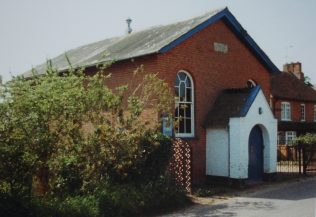
Religion played a central role in the community’s identity. The villagers attended church at Lockerley, where St John’s served the wider parish. In the mid-nineteenth century, the rise of Methodism brought a new form of worship to the area, and a Primitive Methodist Chapel was built in Newtown. This small chapel, simple in design but spiritually important, provided a place for hymn singing, prayer, and fellowship, especially among the working class. It was part of a wider Methodist movement that spread across rural Hampshire, offering hope and moral guidance in hard times. The chapel remained active for many decades and was an essential part of the village’s social fabric.
The surrounding countryside also shaped Newtown’s history. Butler’s Wood to the west and other nearby copses were once part of larger tracts of ancient woodland that stretched across the region. These woods were valuable resources for timber, charcoal, and foraging. Some of the hedgerows in the area are believed to be centuries old, containing species that mark their medieval origin. Wildlife has always been abundant, with the River Dun and the River Test nearby providing rich habitats for fish, birds, and otters.
During the twentieth century, Newtown, like many rural villages, saw changes brought about by mechanisation, the decline of agricultural labour, and the expansion of transport links. The railway station at nearby Dunbridge, opened in the nineteenth century, connected the area to larger towns such as Romsey and Salisbury. This made travel and trade easier but also gradually reduced the isolation that had defined village life for so long. After the Second World War, many of the old farm labouring families left for towns, while others stayed and adapted to modern forms of rural living.
Despite these changes, Newtown retained much of its quiet charm. It remains a small, close-knit community surrounded by fields, hedges, and old oaks. The lanes are narrow and lined with cottages that look much as they did a hundred years ago. The sense of continuity is strong; the same farms that once provided food for the local parishes still work the land, and the same patterns of rural life echo through the village.
Newtown’s history is not marked by great events but by the steady passage of ordinary lives. It tells a story of English rural endurance, of families who tilled the same soil for generations, of faith and fellowship in small chapels and parish churches, of cottages built to last, and of a landscape shaped gently by human hands. Today, it stands as a peaceful reminder of Hampshire’s agricultural past, where history lingers quietly in the fields, the woods, and the winding lanes that have changed little since the days when the village first earned its name.
On a gentle autumn Sunday, the 29th day of October in the year 1893, the village of Newtown stirred beneath a veil of golden light. The hedgerows burned amber and russet, the last leaves clinging to the trees as a faint mist drifted from the meadows. Down in the heart of the hamlet, the bell of the little Methodist Circuit Chapel began to toll  soft and measured, its sound curling through the air like a prayer. It was a day of worship, of gratitude, and of sacred promise, for on this morning, George and Fanny brought their infant daughter, Eva Kate, to be dedicated to God’s keeping.
Inside the chapel, the light was tender and slanted, falling through tall, simple windows that looked out upon the fields of Lockerley. The scent of beeswax and damp wool filled the air as parishioners took their seats upon the narrow wooden pews, faces turned toward the small pulpit at the front. There was no grandeur here, no painted ceilings nor gilded altar, but a holiness all its own, born from simplicity and sincerity. Faith, in this place, was not adorned with gold, it was lived in humble hearts, in quiet hands, in the daily acts of love and endurance that defined the lives of people like George and Fanny.
The service began with the familiar sound of a hymn, led by the minister, William Sheasby, whose voice rose strong and warm against the chapel walls. Perhaps it was “O For a Thousand Tongues to Sing” or “Love Divine, All Loves Excelling” hymns beloved by Methodists, their verses swelling with joy and devotion. The small harmonium wheezed softly as the congregation joined in, voices weathered and unpolished, yet filled with heartfelt reverence. Children fidgeted on their mothers’ laps, the smell of rain-dampened coats mingled with the faint sweetness of hymnbook pages turned by worn fingers.
When the hymn faded, the minister stepped forward, his Bible open in his hand, the flicker of lamplight dancing across the gilt edges of the pages. His reading might have been from the Gospel of Mark “Suffer the little children to come unto me, and forbid them not, for of such is the kingdom of God.” Those words, spoken with quiet conviction, filled the room like a benediction, wrapping around the gathered souls in warmth.
Then came the moment itself. George and Fanny rose from their pew, carrying little Eva Kate, wrapped in white linen trimmed with lace, likely stitched by Fanny herself in the weeks before. Her face, soft and new, was framed by the tender glow of morning light. George, his hands rough from years in the fields, held her as though she were made of glass, while Fanny stood close, her eyes glistening with that mix of awe and exhaustion known only to a mother. Together, they walked to the front, where Reverend Sheasby stood beside the simple wooden font.
The water, drawn fresh that morning from the well behind the chapel, gleamed like crystal in the shallow bowl. As the minister dipped his fingers and raised them to Eva’s brow, his voice filled the stillness:
“I baptize thee in the name of the Father, and of the Son, and of the Holy Ghost. Amen.”
A murmur rippled softly through the pews, a sigh of reverence, of shared joy. Fanny bowed her head, lips moving in silent prayer, while George’s gaze lingered on his child, his heart swelling with both pride and humility. Around them, the congregation smiled, neighbours who had known the Hatchers for years, who had mourned with them the children they had lost and now rejoiced with them in this moment of grace.
Another hymn followed, perhaps “All Things Bright and Beautiful” the congregation’s voices rising together like the very breath of the land itself. Outside, the wind stirred the chapel trees, scattering a handful of leaves across the graves that rested near the boundary wall. Inside, the air was warm with devotion, with hope renewed, with the quiet strength of a community bound by faith.
When the final prayer was spoken, Reverend Sheasby recorded the baptism in his careful hand:
BAPTISMS solemnized in the Parish of [Blank] in the County of [Blank], in the Year 1893

Date of Baptism: 29th October 1893

Child’s Christian Name: Eva Kate

Parents’ Names: George and Fanny Hatcher

Abode: Lockerley

Quality, Trade, or Profession: Labourer

By whom the Ceremony was performed: William Sheasby.
That entry, now faded by time, remains more than a record, it is a moment of devotion captured in ink, a glimpse into the heart of a family whose faith, though humble, was unshakable.
One can almost see it now,Fanny stepping out into the cool air after the service, Eva bundled close against her chest, the sunlight glinting off the wet cobbles of the chapel yard. George would have walked beside her, his arm brushing hers, his expression soft, a man not prone to words, but whose silence carried the weight of everything he felt. Perhaps the minister’s wife pressed a small posy of autumn blooms into Fanny’s hand, or a neighbour whispered a blessing as they passed.
As the Hatchers made their way home along the narrow road to their home, the sound of the chapel bell lingered behind them, mingling with the song of robins in the hedges. It was the sound of faith made simple, of life sanctified in its truest form, by love.
And thus, on that crisp October morning in 1893, Eva Kate Hatcher, daughter of George and Fanny, was welcomed not only into her family but into the eternal fold of faith. The water that touched her brow was more than symbolic, it was a promise, that no matter what trials awaited her in the years ahead, she would carry within her the prayers of that little chapel, the warmth of her parents’ devotion, and the steadfast love that had shaped the Hatcher name for generations.
The hymn that closed the service would linger long after, rising like a blessing over the Hampshire fields:
“Faith of our fathers, living still,
In spite of dungeon, fire, and sword,
Oh, how our hearts beat high with joy,
Whene’er we hear that glorious word.”
And in that refrain, tender, enduring, eternal, the story of the Hatchers continued, stitched forever into the sacred song of Newtown’s quiet fields.
The Primitive Methodist Chapel in Newtown, near Lockerley, Hampshire, holds a significant place in the local religious history. Established in 1867, it was part of the broader movement of Primitive Methodism that sought to provide accessible worship spaces for communities in rural areas. This chapel was particularly notable for its adaptability, it was constructed as a movable building, allowing it to be relocated as needed to serve the spiritual needs of the community. The decision to build a movable chapel was influenced by previous challenges faced by the movement, including opposition from local landowners and religious authorities, which had led to the closure of earlier preaching houses.
The chapel served as a vital center for worship and community gatherings in Newtown until its closure in 1991. During its operational years, it was a hub for religious activities, including services, Sunday schools, and community events. The building's design and construction reflected the values of the Primitive Methodist movement, emphasizing simplicity and functionality to accommodate the needs of its congregation.
After its closure, the chapel underwent various changes. The building was eventually repurposed for commercial use, reflecting the evolving needs and development of the area.
The Methodist Circuit is made up of around 1,000 Methodist Christians who worship in fifteen churches in this part of Hampshire and Wiltshire. They have worshipping communities in farming areas, in towns and cities and on the edge of the port city of Southampton.
They include the ancient cathedral city of Winchester, the expanding community of Eastleigh, the market town of Romsey, famous as the home of Lord Louis Mountbatten, and a section of the New Forest National Park, once including Newtown.
The forename Eva has a long and graceful history, reaching back to the very roots of Western culture and language. It is a name that has crossed centuries, languages, and faiths, carrying with it meanings of life, renewal, and femininity.
Eva is derived from the Hebrew name Chava, which means “life” or “living one.” In the Hebrew Bible, Chava is the name of the first woman, translated into Latin as “Eva” and into English as “Eve.” Thus, Eva shares the same ancient origin as Eve, and both names embody the idea of life itself, as Eve is described as “the mother of all living.” The name entered Western Europe through Latin translations of the Bible, and from there it spread across Christian Europe during the Middle Ages.
In England, the name Eva became known through religious influence in the early medieval period but did not come into regular use until the twelfth century. It gained popularity as Christianity took firmer hold across Europe, with its associations of purity, life, and womanhood making it a fitting choice for girls born into devout families. Medieval records show women named Eva in monasteries, noble households, and town registers, particularly in Norman and Anglo-Norman circles.
The name flourished especially in continental Europe. In Germany, Austria, and Scandinavia, Eva became a familiar and elegant name during the late Middle Ages. In Spain and Italy, it was used less frequently but remained understood through its biblical connection. In the Slavic world, Eva and its variant Ewa became widespread and remain common in Poland, the Czech Republic, and Slovakia to this day.
By the eighteenth and nineteenth centuries, Eva had become a name of quiet refinement and poetic charm in England. It was often chosen by parents who wanted a name that was simple, biblical, and melodious. It gained new popularity in the Victorian era, when biblical and classical names came into fashion once more. Writers and poets admired its short, lyrical sound, and it appeared frequently in literature and art of the period. Charles Dickens used it for the gentle character of Little Eva in his novel Dombey and Son, and the name’s sentimental associations were reinforced by the character of Little Eva in Uncle Tom’s Cabin by Harriet Beecher Stowe, which helped popularise the name in both Britain and America.
The late nineteenth and early twentieth centuries saw Eva continue as a name of quiet strength and grace. It was particularly loved in rural and working-class families across England, where it was often passed down through generations. On the Isle of Wight, in Hampshire, and other southern counties, parish records show the name appearing frequently in baptismal registers from the 1870s onward. It was sometimes paired with other traditional names such as Mary, Jane, or Florence, reflecting the naming customs of the time.
In terms of meaning and symbolism, Eva has always carried the sense of life, renewal, and hope. Because it is derived from the Hebrew word for life, it was often seen as a name celebrating vitality and the continuity of creation. In Christian thought, Eva’s meaning was sometimes contrasted with that of Mary, who was viewed as the “new Eve,” redeeming humanity’s fall through her obedience. Thus, the name carried both spiritual depth and timeless grace.
Across languages and cultures, Eva has remained consistent in form and sound. It is one of those rare names that require no translation: Eva in English, Éva in Hungarian, Ewa in Polish, and simply Eva in German, Spanish, and Scandinavian tongues. Its simplicity and universality have allowed it to endure without ever feeling bound to one time or place.
In modern times, Eva continues to be used widely across the world. It appears frequently in birth records from the early twentieth century through to today, maintaining a steady appeal that few names can match. It has been borne by artists, queens, saints, and writers, among them Eva Perón of Argentina, whose fame gave the name a romantic and political resonance in the twentieth century.
Ultimately, Eva is a name that combines brevity with beauty and history with meaning. From its ancient Hebrew roots through centuries of European tradition to its enduring modern charm, it remains a symbol of life and grace. Whether spoken in the quiet of an English parish or written in Latin on a medieval manuscript, Eva has always carried the same timeless message: that life is sacred, enduring, and full of renewal.
The surname Hatcher is of English origin and carries with it a long and fascinating history that dates back to the Middle Ages. It is primarily an occupational or locational name, deriving from the Old English word “hæcc” or “hacca,” meaning a gate, hatch, or wicket, combined with the suffix “-er,” which denotes a person associated with a place or occupation. In this case, a Hatcher would likely have been a keeper of a gate or someone who lived near a hatch gate, often a type of gate across a river or drainage channel used to control water flow. This origin ties the name to the rural and agricultural life of medieval England, when land, water, and farming shaped both livelihoods and identities.
The earliest recorded forms of the surname appear in southern England, particularly in counties such as Wiltshire, Hampshire, and Somerset. One of the earliest known references to the name is found in the 13th century, when individuals bearing the name “le Hatcher” were recorded in various tax and manorial rolls. The name appears in several forms through history, including Haccher, Hatchar, and Hachere, before settling into the modern spelling of Hatcher. It is possible that some bearers of the name also came from villages with “Hatch” in their names, such as West Hatch in Somerset or Hatch in Wiltshire, making it partly locational as well.
As families began to establish themselves, the Hatchers became more prominent in Hampshire and neighboring counties. During the 16th and 17th centuries, records show Hatcher families involved in farming, trade, and later in parish and civic roles. By the time of the 19th century, the name had spread more widely across England and beyond, particularly to the United States, where several early settlers named Hatcher arrived in Virginia and New England during the colonial period. Many of these emigrants were from southern English counties, carrying their family name and traditions across the Atlantic.
The English Hatcher family crest and coat of arms reflect the symbolism common in heraldry of the gentry and freeholders of the late medieval and early modern periods. The most widely recognized Hatcher coat of arms depicts a shield featuring three hatches or bars arranged across its surface, often rendered in silver and black or red, representing strength, protection, and steadfastness. Some versions of the arms include a chevron, symbolizing protection and faithful service, or a lion, representing courage and loyalty. Above the shield, the crest commonly features a bird, often a falcon or dove, denoting peace and resolve. The family motto associated with certain branches of the Hatcher family is sometimes given as “Ad Finem Fidelis,” which translates as “Faithful to the end,” a phrase that encapsulates the steadfast nature of the family’s heritage.
Heraldic designs varied slightly depending on branch and region, as coats of arms were often granted to specific individuals rather than to entire surnames. However, all versions of the Hatcher arms share a sense of dignity and craftsmanship typical of English heraldry of the period.
In summary, the surname Hatcher is an old English name rooted in agricultural and rural traditions, likely born from the role of gatekeepers or those living near hatch gates. It has been present in southern England for over seven centuries, particularly in Hampshire, Wiltshire, and Somerset. The Hatcher coat of arms, with its heraldic imagery of strength and loyalty, stands as a visual symbol of an enduring English lineage tied closely to the land and its communities.
On a soft April morning in the year 1898, when the last of winter’s chill was giving way to the tender warmth of spring, a new sound joined the song of the Hampshire countryside, the cry of a newborn child. Beneath the gentle skies over Carters Clay, a quiet hamlet in the parish of Lockerley, Eva’s mother Fanny, once again brought life into the world. Her daughter Eva, not yet five years old, would always remember her mother’s face that spring, pale but glowing, her smile weary yet radiant with love, for on that day, she was no longer the youngest. She had become a sister.
That Tuesday, the 19th day of April, dawn broke softly over the fields beyond the Hatcher cottage. The hedgerows were greening again, the air heavy with the scent of damp earth and opening buds. The small home, warm with the faint glow of the hearth, was filled with the rhythm of quiet footsteps and hushed voices. Fanny, now thirty years old and tempered by both joy and heartache, laboured through the long hours of the morning as George, forty, waited outside, his weathered hands twisting his cap, listening for the cry that would tell him both mother and child were safe.
When at last that cry came, small, strong, and certain, the world within that cottage seemed to pause. Wilfred Charles Hatcher had arrived. Fanny cradled him to her breast, her heart swelling with that familiar, aching love that only a mother can know, while George stood beside her, his eyes shining with quiet pride. The little home at Carters Clay, once filled with the playful chatter of Florence and the laughter of Eva, now held something new, the fragile, precious music of a newborn’s breath.
For Eva, it was the beginning of a lifelong bond. She had known already the stillness of loss, two brothers, Caleb George and James, had been carried to their graves before she was old enough to understand why her mother’s eyes sometimes filled with tears when she looked at the cradle. But now, as she tiptoed to her mother’s bedside and peered down at the tiny bundle, she saw not loss but promise, a new companion for her childhood days. Perhaps she reached out with a hesitant hand, her small fingers brushing against her brother’s cheek, soft and warm as sunlight.
Her father, proud and steady as always, made the journey to the Romsey Register Office several weeks later, on Thursday, the 26th day of May. It was a ritual he knew well, the walk along the winding lanes, past meadows and hawthorn hedges, through the hush of fields he’d worked all his life. His boots left prints in the chalky road as he carried with him the knowledge that his family had grown once more. In the quiet office, he gave his details with the dignity of a man who understood that such acts, small though they seemed, were the ways a life was made official, recorded, remembered.
The register tells his story still:
No. 102.

When and Where Born: Nineteenth April 1898, Carters Clay, Lockerley, R.S.D.

Name, if any: Wilfred Charles.

Sex: Boy.

Name and Surname of Father: George Hatcher.

Name and Maiden Surname of Mother: Fanny Hatcher, formerly Pearce.
Rank or Profession of Father: General Labourer.

Signature, Description, and Residence of Informant: George Hatcher, Father, Carters Clay, Lockerley.

When Registered: Twenty-sixth May 1898.

Signature of Registrar: Henry H. Saxby, Registrar.
Those lines, written in the neat Victorian hand of Registrar Henry H. Saxby, say little of the warmth that filled that modest home, but Eva would have remembered. She would have remembered her father’s quiet pride as he returned from town that day, his hands still marked by the soil and grease of his labour, and how her mother smiled faintly from her chair by the window, the baby sleeping soundly in her arms.
Carters Clay itself was a tiny speck upon the map of Hampshire, a place of gentle beauty where life moved at the pace of the seasons. The cottage sat among hedges alive with birdsong, its thatched roof silvered by time. The road that ran past was narrow and rutted, edged with wild primroses and foxgloves. To the north rose the rolling fields of Lockerley, to the south the meadows sloped toward the River Test, its waters bright and cold. The village church, St John the Evangelist, stood just beyond, its new stone walls already softening with moss, a place where families gathered, where bells marked both joy and sorrow, where the Hatchers had prayed through all of life’s seasons.
Though no record of Wilfred’s baptism survives, the Hatchers’ faith was the quiet, enduring kind that did not always need a minister’s hand to sanctify. Eva would have watched, perhaps, as her mother bent over the cradle one evening, whispering a prayer into the still air, thanking God for this small, perfect gift. Her father, solemn yet tender, might have bowed his head beside her, their faith simple and sincere, their home, for that moment, a chapel of its own.
For little Eva, those early years were steeped in the smells and sounds of the countryside, the steady rhythm of her father’s boots leaving for work before dawn, the murmur of her mother’s voice as she hummed hymns while hanging washing in the soft air, the lullaby of crickets and nightingales that rose through the open window at dusk. And now, there was the steady breathing of her baby brother beside her, a comfort in the dark.
The birth of Wilfred Charles brought with it not just new life but a renewal of hope, a thread of continuity woven through hardship and endurance. George and Fanny had known what it was to grieve, to bury, to begin again; and Eva, though too young to fully understand, would one day look back and see in that moment the strength that defined her parents’ lives, the quiet grace with which they met both joy and sorrow, the unshakable love that bound them all.
And so, beneath the soft Hampshire sky, surrounded by the hum of the fields and the music of the turning seasons, the Hatcher family grew. For Eva, her brother’s birth marked the first chapter in her memory, a story that began not with wealth or grandeur, but with love, endurance, and the simple, eternal rhythm of life in Carters Clay.
Carters Clay is a quaint hamlet nestled within the civil parish of Lockerley, Hampshire, situated in the scenic Test Valley. This rural area is characterized by its peaceful countryside setting, with properties like detached bungalows and thatched cottages dotting the landscape. The hamlet is accessed via Carters Clay Road, a quiet country lane that meanders through fields and farmland, offering residents and visitors alike a tranquil environment.
Historically, Carters Clay was part of the larger Lockerley estate. The manor of Lockerley was granted by Henry VIII to Francis Dawtrey in 1538, and later sold to Richard Dawtrey in 1588. Over the centuries, the area has evolved from agricultural land to a more residential community, with properties in Carters Clay Road varying in size and style, reflecting the area's development over time.
The hamlet's proximity to Lockerley provides access to local amenities, including a village shop, a garage, and Lockerley Church of England Primary School. The parish church of St John the Evangelist, built in 1890, serves as a focal point for the community. Additionally, the area is near Lockerley Camp, an Iron Age hillfort located to the east of the village, offering historical insights and a connection to the region's ancient past.
Time has a way of folding gently upon itself, like pages in an old family Bible, where the past and present touch without ever truly parting. Though more than a century has passed since Eva, George and Fanny Hatcher walked the lanes of Lockerley and Carters Clay, their presence lingers still, not only in the pages of records and parish books, but in the quiet, unspoken way history sometimes repeats itself through blood and fate.
Carters Clay will always hold a special place in my heart. I first learned of the little hamlet when I was just fifteen years old, at the tender age when the world is wide and full of promise, and when the past seems little more than a shadow behind us. I had just begun dating the boy who would one day become my husband, unaware that the paths of our families had crossed long before we were even born.
Carters Clay was where he came from, his childhood home, the place where his own roots reached deep into the Hampshire soil. His family still live there now, their days unfolding among the same fields, hedgerows, and quiet lanes that once echoed with the footsteps of my ancestors. It wasn’t until years later that I learned the extraordinary truth, his great-grandfather, Frederick Charles Hiller, had lived in a house called Hatchers Farm, the very place that had once belonged to my own forebears, the Hatchers of Lockerley.
The name alone felt like a whisper through time, Hatchers Farm,f as though the land itself remembered, as though the souls who had toiled there still watched kindly over their descendants, guiding two branches of history to entwine again. I often think of George and Fanny, of little Eva, born in the soft light of summer in 1893, and of how their story, once nearly forgotten, has found its way back into the light through chance, love, and remembrance.
Perhaps it is no coincidence. Perhaps Carters Clay has always been a place where threads are woven and rewoven, a corner of Hampshire where love lingers long after lives have ended. When I walk there now, when the evening mist settles over the fields and the wind moves softly through the trees, I feel something deeper than nostalgia. I feel connection to the land, to the people who came before, and to the unseen hands that shaped us all.
In rediscovering their story, I have found more than ancestry, I have found a sense of belonging, of understanding, of peace. The past is not gone, it simply waits for us to listen. And somewhere among the hedgerows of Carters Clay, I like to think that Eva, George and Fanny are smiling, their story alive once more, their love remembered, their legacy continuing, just as it always was meant to.
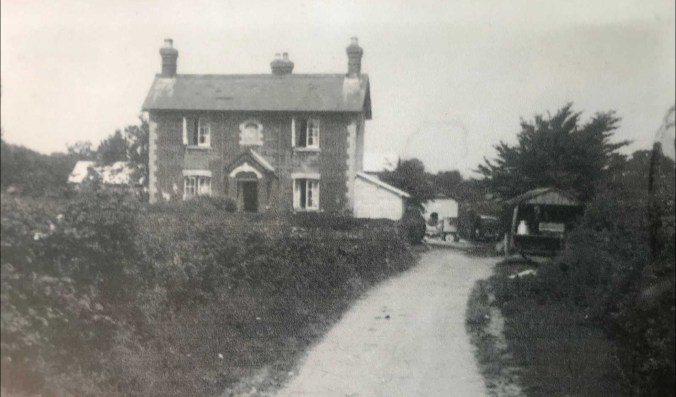
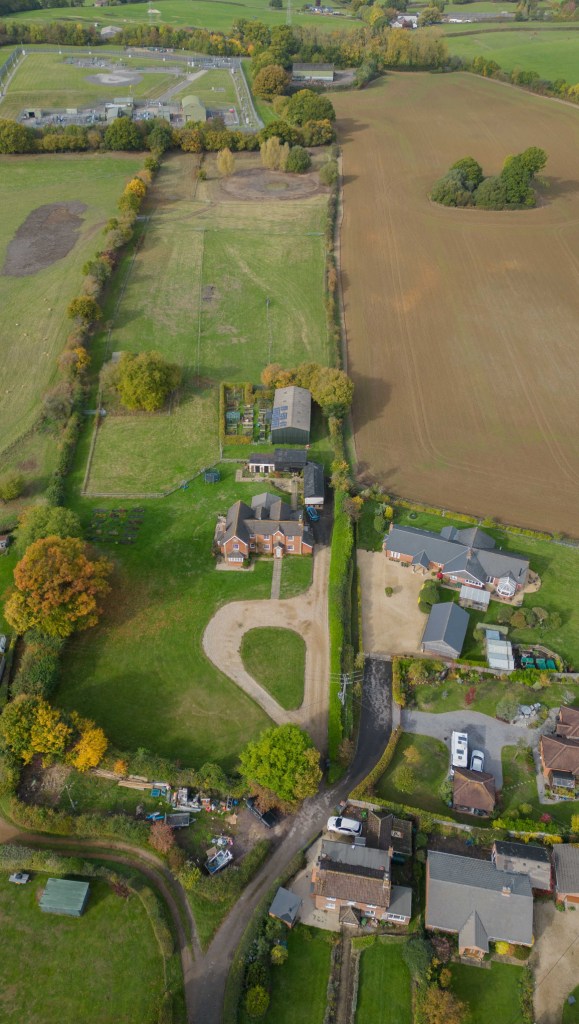
Hatchers Farm, Carters Clay
Hatchers Farm, Carters Clay
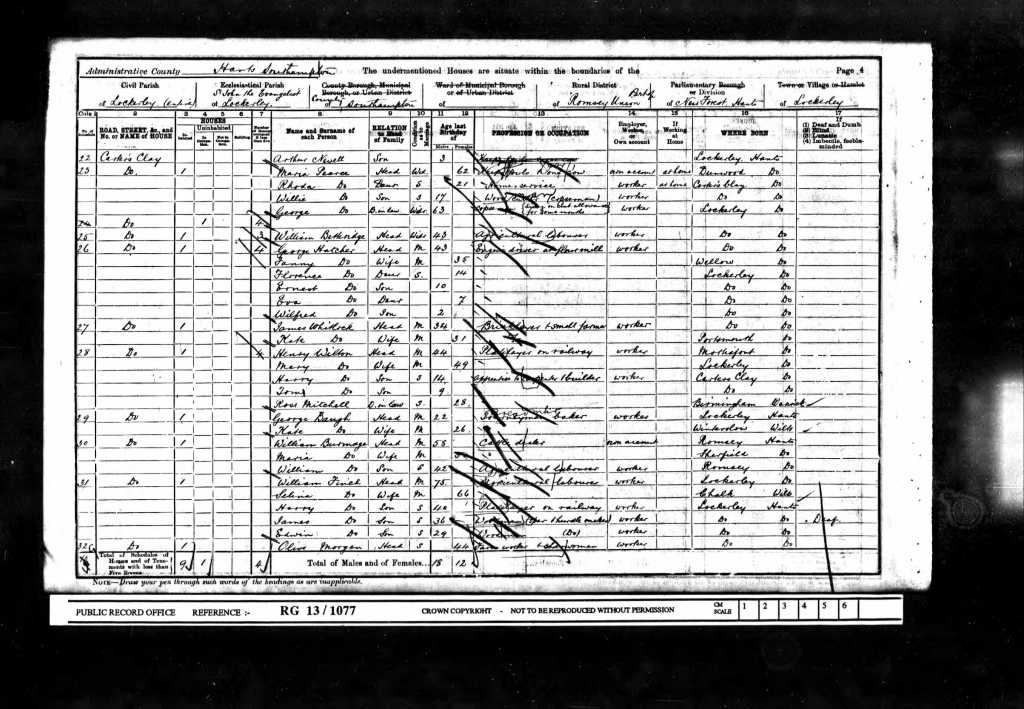
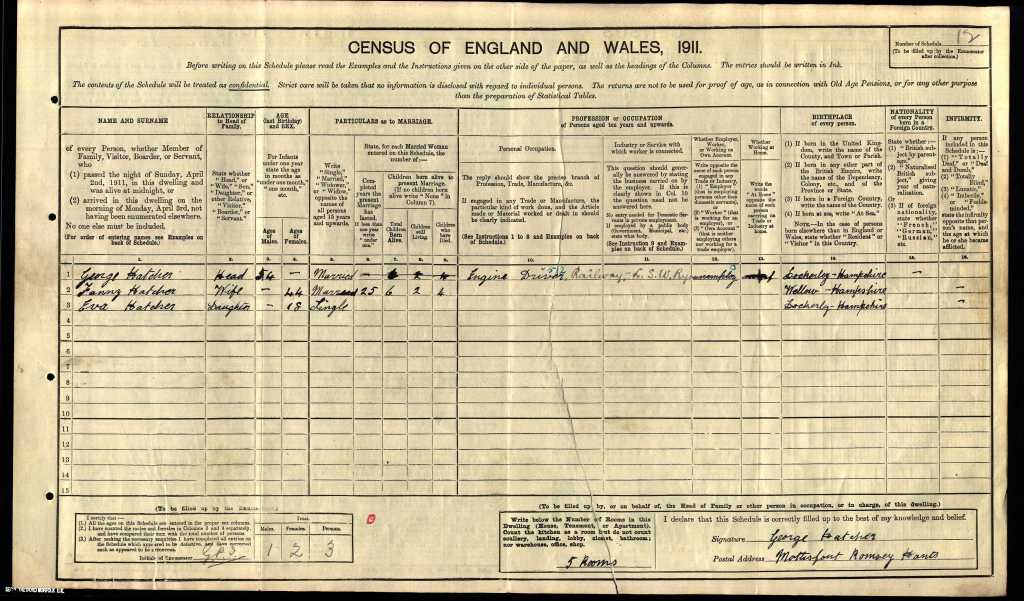
On the still and silvered evening of Sunday, the 31st day of March, 1901, the last soft light of early spring fell across the quiet hamlet of Carters Clay, Lockerley. The scent of woodsmoke drifted from cottage chimneys, and the faint hum of the countryside, a barking dog, a creak of cart wheels on the lane, the far-off song of a blackbird, carried through the cooling air. Inside one of those humble homes, its four rooms warmed by the steady pulse of the hearth, the Hatcher family gathered as they did most evenings, unaware that the night would soon be captured forever in ink, a single line on the 1901 Census of England and Wales, a frozen moment in time.
The census, taken by the steady hands of government enumerators who walked from door to door, lanterns flickering and papers rustling in the cold March air, sought to count every soul beneath the vast canopy of the British Empire. Each household, from London’s grandest townhouse to Hampshire’s smallest cottage, was to be written into the nation’s story. The enumerator assigned to Lockerley would have trudged the muddy lanes of Carters Clay with notebook in hand, knocking gently at doors, greeted by wary yet courteous villagers who offered their details with the formality and humility of their station.
And so it was that evening when the door of the Hatcher home opened, perhaps to the sound of George’s deep voice welcoming the caller in, or Fanny’s softer one, ever courteous, ushering the man from the chill. The scent of coal smoke, bread, and simmering stew would have lingered in the small kitchen as the enumerator took down their names, the family of George and Fanny Hatcher, living within those four rooms of warmth and love.
In the gentle lamplight, seven-year-old Eva Kate sat quietly beside her mother, her small hands folded in her lap, her wide eyes catching the dance of shadows on the wall. To her, this was simply another evening at home, the grown-ups speaking softly, her father’s roughened hand resting on the table after a long day’s work. Yet unknowingly, she too was being written into history, her name soon to appear in tidy, careful script among the households of Hampshire.
Her father, George, now forty-three, was an engine driver at the flour mill in Dunbridge, a position that spoke of strength, skill, and trust. Each dawn, he left the cottage before the sun had lifted, boots crunching over frost and gravel, bound for the mill where the great wheels turned and the hiss of steam filled the air. His days were long, his work steady, his presence the quiet anchor of the family’s life.
Her mother, Fanny, aged thirty-five, was the heart of that home, her hands worn but gentle, her spirit enduring through joy and hardship alike. She carried the weight of motherhood with grace, her every action shaped by love, the tending of children, the mending of clothes, the baking of bread, the soft singing of hymns as she worked by lamplight.
Eva’s older sister, Florence, was fourteen, on the edge of womanhood, already helping her mother about the house and dreaming perhaps of her own future. Her brother Ernest, ten years old, was lively and curious, his world still one of games and muddy boots, though the shadow of work already loomed near, as it did for all boys of his class. And then there was little Wilfred, just two years old, a bundle of laughter and light who toddled unsteadily about the small cottage, the darling of them all.
Their home, though modest, was alive with love. Its four rooms, kitchen, parlour, and two small sleeping chambers, held everything they owned and everything they were. The warmth of the fire cast a golden glow upon the worn wooden table, upon the clock that ticked softly on the mantel, upon the simple lace curtains that Fanny had likely sewn herself. Outside, the moon rose over fields damp with dew, over thatched roofs and winding hedgerows, over the scattered lights of neighbours, the widowed labourer William Betteridge, who lived not far away, and James Whitlock, the bricklayer and small farmer, with his wife Kate and their family, all recorded that same night beneath the same unchanging sky.
When the enumerator finally closed his ledger and stepped back into the night, perhaps nodding kindly to George before vanishing down the lane, he left behind more than paper and ink. He had, without knowing it, sealed a piece of the Hatchers’ world  a quiet portrait of rural life at the turn of the century, drawn not with paint or poetry, but with the steady rhythm of names and numbers.
For little Eva, that night would soon blur into the endless pattern of childhood days, mornings spent under her mother’s watchful eye, evenings waiting for her father to return from Dunbridge, the smell of flour dust still clinging to his coat. Yet, in the pages of the census, she remains forever seven years old, her name a whisper from a world long past.
That entry, Carters Clay, Lockerley, Hampshire, 1901, is more than a record of who lived where and when. It is a window into the life that shaped her, a home of laughter and labour, of love that endured through scarcity, of warmth built from nothing more than faith and the steadfast beating of the human heart. For Eva, those years in Carters Clay were the foundation of everything, the soil from which her spirit grew, tender yet unbreakable, like the wildflowers that bloomed along the Hampshire lanes she once called home.
In the spring of 1901, when little Eva Kate Hatcher was seven years old, life in the quiet hamlet of Carters Clay, Lockerley, Hampshire, moved with the slow and steady rhythm of the seasons. Nestled among rolling fields and hedgerows, it was a world shaped by work, weather, and the closeness of family. The lanes were narrow and bordered by hawthorn and dog roses, the cottages scattered like small islands of warmth across the countryside. Each home carried the scent of earth, woodsmoke, and bread baking, and in the evenings, the faint glow of lamplight flickered through small windowpanes as the village settled into its nightly hush.
For Eva, the day began early, with the first light creeping softly through the tiny bedroom window she shared with her brother Wilfred. The chill of the Hampshire morning seeped through the thatch above, and the air smelled faintly of damp linen and lavender soap. Downstairs, her mother, Fanny, was already at the hearth, stirring the ashes and coaxing the first flames of the day into life. The comforting crackle of kindling filled the cottage, followed by the familiar scent of porridge simmering in a heavy pot.
By the time Eva’s father, George, stepped into the room, his sleeves rolled and boots laced for work, the day had properly begun. He was a man of quiet presence, his hands roughened by years at the flour mill in Dunbridge, where he worked as an engine driver. Before he left, he would bend to kiss his wife’s cheek, ruffle Eva’s dark hair, and step out into the pale dawn, his figure soon lost in the mist that clung to the fields. To Eva, he was both strong and gentle, the heart of their small world, a man whose silence spoke of love and endurance.
As the door closed behind him, Fanny turned her attention to the day’s work, and Eva, still small but eager to help, took her place at her mother’s side. Life in a working family left no room for idleness. She fetched water from the well, the bucket heavy and cold in her hands, and gathered kindling from the lane, her boots damp with morning dew. Indoors, she helped peel potatoes or scrub vegetables at the table, her feet swinging from the stool as she worked. When her mother washed clothes, Eva would help by rubbing small garments on the washboard until her wrists ached or by pegging out the linen in the garden, watching it billow and snap in the wind like sails on a ship.
If her mother was the warmth of the home, her father was its steadfast frame, and together they shaped Eva’s days with love and quiet discipline. On Sundays, the family dressed in their best clothes and walked to chapel or church, Fanny’s gloved hand holding Eva’s small one tightly as they made their way down the winding road. Faith was woven through the rhythm of their lives, as natural as the turning of the seasons.
When the week began again, it was possible that Eva joined the other village children on the walk to Lockerley School, a sturdy brick building that stood at the edge of the village. The journey, nearly two miles each way, wound past fields and hedgerows alive with birdsong. Sometimes the children skipped or sang to keep themselves warm, their laughter echoing down the lane. Lessons began promptly at nine o’clock, and woe betide the child who arrived late. The classroom smelled of chalk, ink, and damp wool. At her small wooden desk, Eva learned her letters and numbers, traced neat rows of words on a slate board, and recited scripture under the watchful eye of the schoolmistress.
School was strict and orderly, designed to teach not just reading and writing but obedience and virtue. Talking during lessons could earn a scolding, or worse, the shame of standing in the corner wearing the dunce cap. For more serious mischief, a child might feel the sting of the cane on their hands or legs, a punishment that left both pain and pride smarting. Yet despite the sternness, there was kindness, too. Teachers often saw it as their duty to nurture not only the mind but the soul, and many took quiet pride in seeing the village children grow into decent men and women.
When lessons ended and the final bell rang, Eva and her friends ran freely into the open air, their laughter rising over the fields. They played games with hoops or skipping ropes, their cheeks flushed and their shoes muddy, until the sinking sun told them it was time to go home.
Evenings in the Hatcher cottage were gentle and familiar. George would return from Dunbridge, his clothes dusted faintly white from flour, his face tired but kind. Supper was simple but hearty, bread and dripping, or stew made from whatever vegetables and meat Fanny could manage. As the fire crackled and the oil lamp flickered, the family gathered close. George might hum a tune from chapel hymns, or Fanny would tell a story while mending a shirt, her needle glinting in the light. Eva often sat at her father’s knee, resting her head against him as the day’s warmth faded from the fire.
Before bed, Fanny would lead a short prayer of thanks. Her voice was soft, her words steady, asking God’s care for their small family and remembering the children they had lost. Eva, still too young to fully understand, listened with a quiet, trusting heart.
At last, she climbed beneath the cool sheets, Wilfred already asleep beside her. Through the window came the sound of the wind in the trees, the distant lowing of cattle, and the faint rush of the mill wheel turning far away in the dark. These were the sounds of her world, the music of Carters Clay.
For Eva, life was simple yet full, each day a small story of love, work, and wonder. She had no grand possessions, no fine toys or silken dresses, but she had something far richer, a home bound by tenderness, a mother’s guiding hands, and a father whose quiet strength steadied them all. The Hampshire air she breathed carried the rhythm of her childhood, a rhythm that would echo through her heart for the rest of her days.
On a still February, the 5th day, in the year 1903, the winter mist lay low across the fields of Newtown, Lockerley. Frost glistened upon the hedgerows, and the air hung heavy with that peculiar silence that comes just before dawn. Beneath the eaves of a modest cottage, where the hearth’s embers had long kept company with the ticking of the clock, Eva’s grandmother, Susan Hatcher née Luke, mother, widow, and matriarch, drew her final breath. She was eighty-three years of age, her life a tapestry woven from the threads of labour and love, faith and fortitude. Hers had been a world of small, steady blessings, the whisper of wind through the beech trees, the rhythm of the seasons, the laughter of children once small and bright before her eyes.
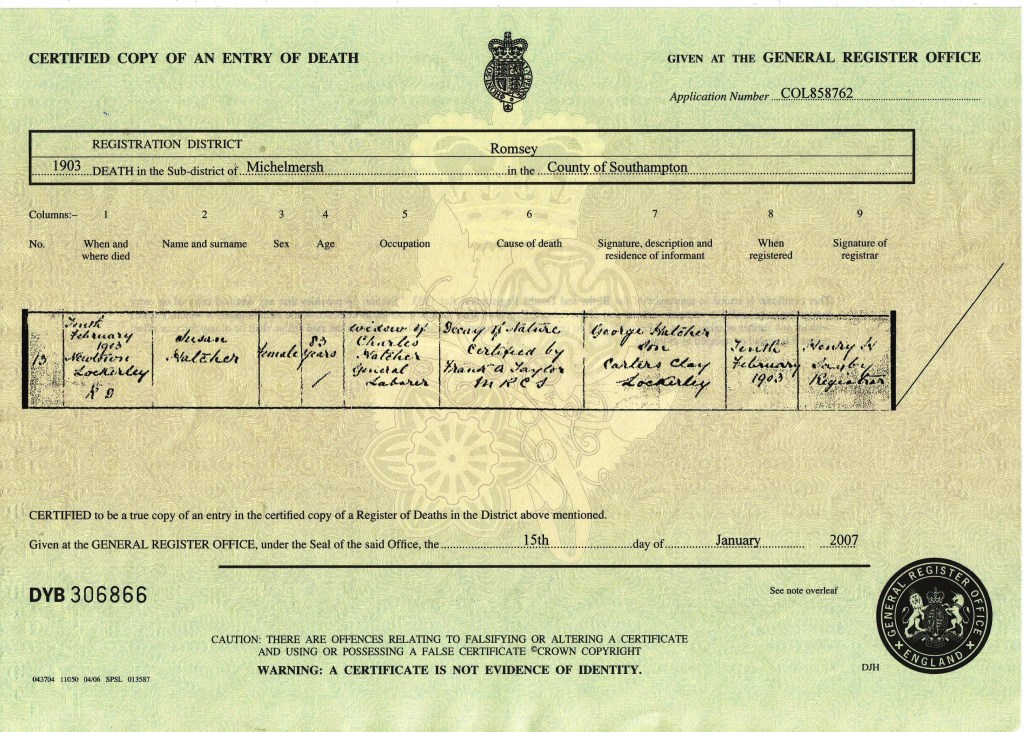
To those who knew her, it was not sickness that claimed her, but the gentle passing of time itself. Her death, simply written as “Decay of Nature” by Dr. Frank A. Taylor, M.R.C.S., was not a tragedy but a closing, the final, tender sigh of a long and honest life. The neighbours would have said she had “gone easy,” her spirit leaving as softly as the smoke from her chimney, rising into the pale February sky.
For George Hatcher, her devoted son and Eva’s father, the moment carried a depth of sorrow that words could scarcely hold. He had lived close by for much of his life, his own cottage never far from hers at Butler’s Wood, and in her final years he had watched her strength fade like the light at dusk. He had always known this day would come, yet when it did, it fell upon his heart like the quiet weight of snow. It was George who stood by her bedside in those last hours, holding her frail hand in his own, those same hands that had once been guided by hers when he was a boy. Perhaps he whispered a hymn she had loved, or simply sat in silence, the fire crackling softly, until the stillness told him she was gone.
When the dawn broke over the frosted fields, George stepped outside into the cold air, his breath rising in the pale light. The larks were beginning to stir, and though grief lay heavy upon him, there was a peace in knowing his mother’s long labours had come to their gentle end. In her passing, there was no struggle, only the serenity of a soul returning home.
On Tuesday, the 10th day of February, George made the solemn journey to Romsey, the old market town where the registrar kept his books. The road would have been muddy with thawing frost, the hedges still white in places, the world hushed beneath the pale winter sun. At the registrar’s office, the familiar figure of Henry H. Saxby received him, pen poised to record the facts as duty required. George stood there quietly, hat in hand, his heart still heavy with loss, as the registrar wrote in his precise hand:
1903 DEATH in the Sub-district of Michelmersh in the County of Southampton.
Registration District: Romsey.
He recorded:
No.: 13
When and Where Died: Fifth February 1903, Newtown, Lockerley, R.D.
Name and Surname: Susan Hatcher
Sex: Female
Age: 83 years
Occupation: Widow of Charles Hatcher, formerly General Labourer
Cause of Death: Decay of Nature, Certified by Frank A. Taylor, M.R.C.S.
Signature, Description, and Residence of Informant: George Hatcher, Son, Carters Clay, Lockerley
When Registered: Tenth February 1903
Signature of Registrar: Henry H. Saxby, Registrar
Those few lines, written in neat black ink, held the closing of a life that had spanned nearly a century, a life lived quietly but fully, rooted in Hampshire soil. To the registrar, it was one among many entries that day; to George, it was the final act of devotion to the woman who had given him life.
Back in Carters Clay, when he returned home, his wife Fanny and little Eva must have seen the sorrow written plainly on his face. They would have set the kettle to boil, and the three of them would have sat in silence by the fire, each lost in thought. For Fanny, Susan had been more than a mother-in-law, she had been a steady, guiding presence, a keeper of wisdom and warmth. For seven-year-old Eva, her grandmother’s death was likely her first brush with the mystery of mortality. Perhaps she remembered her grandmother’s soft voice, the way she smelled faintly of lavender and woodsmoke, or the stories she told of the old days when life moved at the pace of the horse and plough.
The following days in Lockerley would have carried a quiet solemnity. The church bell tolled gently, and neighbours called at the door with murmured condolences, their words simple but sincere. In that close rural world, grief was shared as naturally as bread or labour. Each person knew the rhythm of life and loss, each had buried their own and understood the ache that lingered in its wake.
And so, Susan Hatcher’s long journey came to rest. She was remembered with gratitude, her name written forever in the records of Romsey, her spirit folded tenderly into the same earth she had walked upon for eighty-three years. In the turning of the seasons, in the hush of the Hampshire fields, and in the steadfast hearts of those she left behind, her presence endured, quiet, constant, and everlasting.
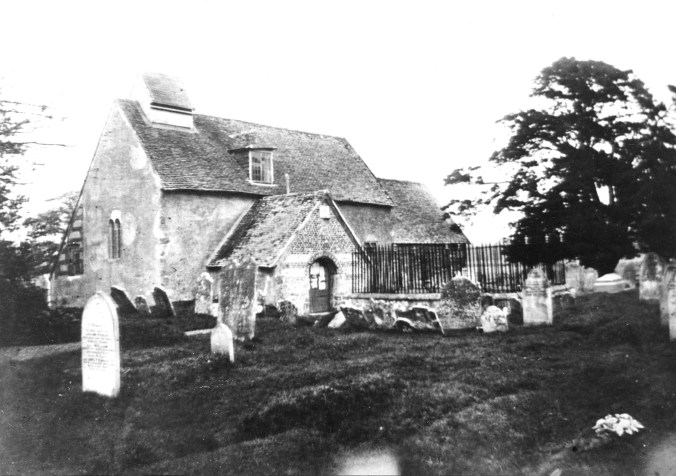
On a still winter Sunday, the 15th day of February, 1903, the village of Lockerley lay wrapped in a pale morning mist. The hedgerows sparkled faintly with frost, and a quiet reverence seemed to rest upon the earth. Beneath the ancient yews of St John’s Churchyard, the villagers gathered in somber procession to lay to rest Susan Hatcher, beloved mother of George, and grandmother to little Eva, whose tender eyes watched the solemn ritual unfold from her mother’s side.
Susan had passed just ten days earlier, on the 5th of February, at Newtown, Lockerley, eighty-three years of age and long a part of the land she would now return to. Hers was a life measured by the honest rhythm of work, love, and faith. Her passing, simply recorded as “Decay of Nature”, seemed more a gentle fading than an end, like a candle softly guttering out at dusk.
In those days, death was still a quiet domestic visitor. Susan’s body would have been prepared at home by careful, loving hands. Her son, George Hatcher, likely helped lift her frail form onto the wooden table where the women of the family, perhaps Fanny and a kindly neighbour, washed and dressed her one final time. She would have been clothed in a simple gown, her grey hair smoothed neatly, her hands folded upon her breast. A sprig of rosemary, for remembrance, might have been laid upon her chest, and the room perfumed faintly with lavender to soften the still air.
The coffin, made by a local carpenter, would have been brought to the house, a plain pine box, modest and strong, lined with white muslin. It stood upon trestles in the main room of the cottage, and for several days the family kept vigil there, the scent of beeswax candles mingling with the faint chill of winter air. George sat close through those evenings, his weathered hands resting upon his knees, eyes fixed on the quiet form of the woman who had once held his hand through childhood’s storms. To him, she was not gone, only changed, her spirit now woven into the gentle hum of the countryside she had loved.
When the morning of the funeral came, the sky was a pale, sorrowful grey, the kind that promised neither snow nor sun. The coffin was borne out from the cottage and placed upon a simple hand-bier, covered with a black pall edged in white. The road from Newtown to Lockerley wound between fields still hard with frost, and as the cortege made its slow way along the lane, the villagers paused their work to watch and bow their heads. Four men stepped forward from among the mourners, their faces solemn beneath the pale February light. Three were almost certainly Susan’s own sons, George, John and Stephen, sturdy men shaped, like their mother, by a life of labour and endurance. Perhaps even her youngest, William, if he were strong enough that day, took his place beside them, his steps uncertain but full of love. Alongside them walked neighbours and lifelong friends, men who had known Susan all their days, who had broken bread at her table and shared in the harvests of years gone by. Together they bore the coffin’s weight upon their shoulders, not merely lifting wood and nail, but the story of a woman whose quiet grace had bound them all, carrying her gently along the familiar lane to her final rest. George’s face was pale and drawn, his step steady but heavy with grief. Beside him, Fanny held Eva’s and Wilfred’s hands, the children’s eyes wide, their small mind only half understanding the solemn pageantry of loss, yet sensing the sadness that clung to the air like mist. Be side them walked their oldest sister Florence.
At St John’s, the great bell tolled slowly, its mournful peal carrying over the valley and through the fields that Susan had once known so well. The vicar, Reverend J. P. May, stood waiting by the church gate, his breath curling faintly in the cold. Inside, the nave smelled of damp stone and candle wax, the faint scent of incense rising from the chancel. The coffin was set before the altar, and the service began.
The familiar words of the burial service, drawn from the Book of Common Prayer, echoed softly through the church:
“I am the resurrection and the life, saith the Lord: he that believeth in me, though he were dead, yet shall he live.”
George bowed his head, his hands clasped tight, while Fanny’s eyes glistened with silent tears. The hymn that followed was one Susan herself might have loved, perhaps “Abide with Me” or “Rock of Ages”, sung by trembling voices that rose and fell like the sighing of wind through the trees. The old harmonium creaked beneath the organist’s hands, its notes warm and wavering, and the congregation sang with that soft sincerity peculiar to village churches, where every voice carries memory.
The vicar spoke of Susan’s long life, of her faith, her labour, her quiet constancy, and of the promise that death was not an ending, but a homecoming. Then, as the final prayer faded, the pallbearers lifted the coffin once more and carried it through the open doors into the cold air. The congregation followed, their boots crunching softly on the gravel path that wound between gravestones grey with lichen.
At the edge of the churchyard, in grave number OD3, the earth lay open, dark and waiting. A hush fell over the gathered mourners as the vicar’s voice rose again, steady and clear,
“Earth to earth, ashes to ashes, dust to dust…”
The dull sound of earth falling upon the coffin’s lid was like a heartbeat, soft yet final. George stepped forward then, his hand trembling as he dropped his handful of soil, the same soil he had worked all his life, upon the grave. The sound was small but full of love. Fanny followed, tears spilling freely, her other hand still clutching Eva’s small fingers.
Eva would always remember that moment, the way her mother’s hand shook, the way her father’s eyes looked far away, as though he could see beyond the grey clouds to some brighter shore. For the child, it was her first real glimpse of the mystery of loss, and though she did not yet understand death, she felt its weight in her heart, mingled with awe and tenderness.
When the final hymn, “Nearer, My God, to Thee,” drifted over the graves, the mourners turned to leave, their steps slow and quiet. George lingered behind a moment longer, his hat in his hands, his breath unsteady. This was the woman who had given him life, who had taught him to work, to pray, to love his home. Now she was part of the earth itself, her spirit forever bound to the land he had always called his own.
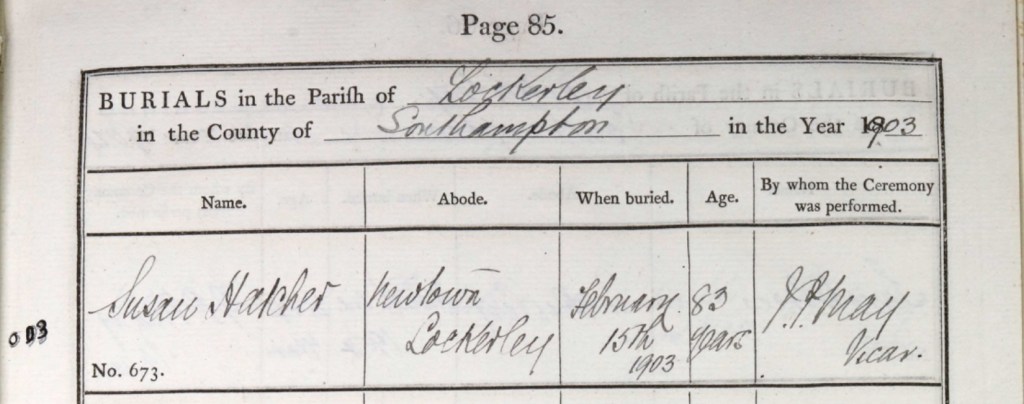
The parish register records her passing with tender simplicity:
BURIALS in the Parish of Lockerley in the County of Southampton in the Year 1903
Name: Susan Hatcher.
Abode: Newtown, Lockerley.
When Buried: February 15th, 1903.
Age: 83 years.
By whom the Ceremony was performed: J. P. May, Vicar.
Entry Number: 673.
In the weeks that followed, George carried on with quiet endurance, as he always had. Yet beneath that calm lay a deeper ache  for soon after his mother’s burial, his younger brother William, long troubled and dependent upon her care, was taken into the Romsey Workhouse. It was a blow that struck George hard, for William had been Susan’s constant companion in her later years, and now he was lost to the cold anonymity of the institution. Whether he truly understood that their mother had gone, no one could say, but George feared he did not, and that knowledge haunted him for years to come.
For little Eva, her grandmother’s resting place at St John’s became a quiet mystery. Sometimes, when visiting Lockerley with her mother, she would stand at the churchyard gate, watching the yews sway gently in the wind, the gravestones leaning softly into the earth. It was there she first learned that love, though parted by death, never truly leaves us. The Hampshire air, the bells of St John’s, and the tender rhythm of her family’s faith would carry that lesson in her heart for all the days of her life.
St. John’s Church in Lockerley, Hampshire, is a charming and historic church that has served the local community for centuries. Located in the heart of the picturesque village of Lockerley, which lies in the Test Valley, the church is an important part of the area’s history, culture, and spiritual life.
The history of St. John’s Church dates back to the medieval period, though the current structure reflects several stages of development over the centuries. The original church was likely built around the 12th century, though records from that time are sparse. The church’s dedication to St. John the Evangelist indicates its religious association with the Christian tradition, particularly with the apostle John, one of the most prominent figures in the New Testament. The church’s early history is tied to the broader religious and agricultural practices of the village, which has been a rural community for much of its existence.
Over the centuries, St. John’s Church was subject to several expansions and renovations. The original Norman structure would have been relatively simple, reflecting the needs of a small rural community. However, as Lockerley grew and developed, particularly during the medieval and post-medieval periods, the church was modified to accommodate a larger congregation and to reflect the changing architectural styles of the time. One of the most notable periods of change came in the 19th century, when the church was rebuilt in the Victorian era.
The current building of St. John’s Church was constructed in 1889–90 under the direction of the architect J. Colson, in a style that blends both Gothic and Perpendicular Gothic elements. This period saw significant growth in the Test Valley, and Lockerley, with its proximity to the town of Romsey, benefitted from an expanding population and increased prosperity. The design of the church reflects the period's architectural tastes, with soaring arches, intricate stained-glass windows, and the use of local materials that give the church a distinctive character.
St. John’s Church is a relatively large and impressive building for a rural village church. The structure features a chancel with an outshot, a nave with transepts, and a southwest tower that adds a sense of grandeur to the village’s skyline. The church’s stained-glass windows, depicting various scenes from the Bible, are particularly beautiful, and they provide a striking contrast to the stonework of the building. The wooden roof of the nave, designed with king-post trusses on arch-braces, is another notable feature of the interior, displaying the craftsmanship of the period.
Over the years, St. John’s Church has been at the center of life in Lockerley, hosting regular religious services, weddings, baptisms, and funerals. The churchyard is the final resting place for many of the village’s residents, with gravestones marking the passage of time and offering a sense of continuity to the village’s history. The church continues to play an important role in the spiritual life of the community, offering a space for worship, reflection, and prayer.
In addition to its role as a place of worship, St. John’s Church has also served as a venue for significant community events. The church is a place where people come together to mark important milestones, both religious and personal. Many of the village’s residents, both past and present, have been married, baptized, or buried in the church, giving it a special place in the collective memory of Lockerley.
The churchyard itself is a peaceful and tranquil space, with the graves of local families dotting the landscape. These graves serve as a reminder of the long history of Lockerley, and they provide a connection to the past. The churchyard is not only a site of historical importance but also a beautiful setting for reflection, surrounded by the natural beauty of the Hampshire countryside.
As for rumors of hauntings, like many historic churches, St. John’s has been the subject of local legends and ghost stories. However, there are no widely documented or substantiated paranormal occurrences associated with the church. Given the long history of the building and the village, it is not unusual for local folklore to suggest the presence of spirits or supernatural events. In many cases, such stories are passed down through generations, often becoming part of the cultural fabric of a place. While there may be occasional whispers or tales shared by the community about unexplained occurrences, there is no firm evidence to suggest that the church is haunted.
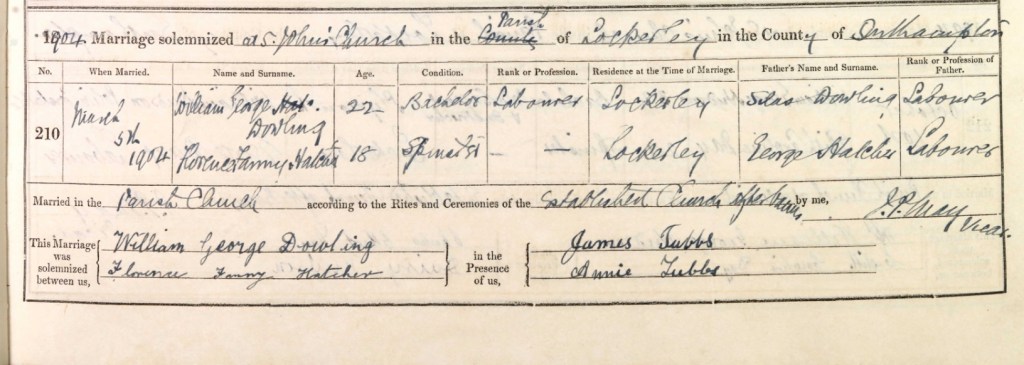
On a soft and golden morning, Saturday, the 5th day of March, 1904, the village of Lockerley stirred to life beneath a tender spring sky. The air carried the sweet scent of damp earth and hawthorn, and from the tower of St John’s Church, the bells began to ring, slow and sonorous at first, then bright with joy, echoing through the folds of the Hampshire hills. Their song drifted over the hedgerows and thatched cottages, over the furrowed fields where lambs bleated in the distance, calling the villagers to witness a moment of beauty and promise. It was the wedding day of Eva’s sister, Florence Fanny Hatcher, George and Fanny’s eldest surviving daughter, and the air itself seemed to hum with anticipation.
Inside the modest stone church, sunlight streamed through the stained glass windows, pooling like honey upon the worn wooden pews. The smell of beeswax polish and lilies mingled with the faint chill of the old stone floor. It was here that George, the steadfast father, stood tall and solemn, his best coat brushed and his boots polished, though the hands that held his daughter’s were still calloused from years of labour. To see Florence, radiant in her simple white dress, likely her Sunday best, sewn by her mother’s careful hands, was to feel the fullness of all that his life had been for.
Florence’s dress, modest yet lovely, might have been adorned with lace at the collar and cuffs, a small sprig of myrtle pinned near her heart, the Victorian symbol of everlasting love. Her veil, perhaps borrowed from a friend, trembled in the morning light. At her side, a posy of possibly violets and primroses, gathered from the hedgerows that lined the village lanes, filled the air with the quiet perfume of early spring.
The guests, family, neighbours, and friends from the village, took their places as Vicar J. G. May began the ceremony. The Book of Common Prayer was opened, its well-thumbed pages carrying the timeless rhythm of love and faith:
“Dearly beloved, we are gathered together here in the sight of God…”
The words rose softly beneath the arches, mingling with the rustle of skirts and the faint clatter of boots upon the flagstone floor. Hymns were sung in proud, if uneven voices “O Perfect Love” and “The Voice That Breathed O’er Eden,” both favourites of the time, filling the air with their tender melody. The village harmonium wheezed and sighed beneath the fingers of the organist, yet the music was no less holy for its imperfection.
As George walked his daughter slowly down the aisle, his heart swelled with a mixture of pride and quiet sorrow. Each step was a memory, of the days when Florence had run barefoot through the meadows of Newtown and Carters Clay, her laughter bright against the hum of the harvest, of nights when he had carried her, half-asleep, from the fire to her bed. Now she was grown, her hand trembling within his, the same small hand he had once taught to hold a spade or a needle. At the chancel steps, he gave her away, his eyes meeting those of William George Dowling, a young labourer of twenty-two whose steady gaze promised the same devotion and care that George himself had once vowed to Fanny.
From the pews, Fanny watched, her eyes bright with unshed tears. She clutched her handkerchief to her lips as her daughter spoke her vows, her baby girl now a bride. Little Eva, just ten years old, sat beside her mother, her dark eyes wide with wonder. The world, to her, seemed wrapped in light that morning. The rustle of dresses, the solemn hum of the congregation, the scent of wax and flowers, all imprinted themselves upon her young heart. She looked up at her father then, standing so proud in his Sunday coat, his hair brushed back neatly, his eyes softened by love. To Eva, he seemed unshakable, the very heart of their family, the man who held them all together.
When the vows were spoken and the gold ring slipped onto Florence’s finger, the vicar pronounced them husband and wife. The bells rang once more, louder this time, spilling their jubilant sound over the fields like sunlight through glass. The newlyweds stepped out into the spring air, greeted by the smiles and cheers of those who loved them. Petals were tossed from small hands, the path before them bright with colour and laughter.
Afterwards, there would have been a small celebration, perhaps a gathering at the family cottage in Carters Clay, where the table was laid with fresh bread, cold ham, butter, and sweet currant cake. The neighbours would come bearing their best wishes, the kettle would be kept always boiling, and there might have been music and dancing long into the night. George would have sat quietly for a while, a mug of ale in hand, watching Florence and William share their first dance as husband and wife, a faint smile touching his lips.
That day, though recorded so simply in the parish register:
1904. Marriage solemnized at St John’s Church in the Parish of Lockerley in the County of Southampton.
No. 210.
When Married: March 5th, 1904.

Name and Surname: William George Dowling, Florence Fanny Hatcher.

Age: 22, 18.

Condition: Bachelor, Spinster.

Rank or Profession: Labourer, —.

Residence: Lockerley, Lockerley.

Father’s Name and Surname: Silas Dowling, George Hatcher.

Rank or Profession of Father: Labourer, Labourer.
Married according to the rites and ceremonies of the Established Church after Banns, by me, J. G. May, Vicar.
This marriage was solemnized between us:
William George Dowling
Florence Fanny Hatcher.
In the presence of us:
James Tubbs,
Annie Tubbs.
was one of deep joy for the family. It was a day when love triumphed over hardship, when the Hatchers, humble though they were, stood tall among their neighbours, their faith and devotion shining brighter than gold.
For little Eva, watching her sister walk away arm-in-arm with her new husband, it was a moment of wonder and awakening, her first glimpse of what love might look like when it grew up, when it took courage and grace and became a promise made before God. Years later, when life had carried her far from those fields and hedgerows, she would still remember that morning at St John’s, the bells, the vows, her father’s proud figure beneath the church’s worn arches, and she would understand that what she had witnessed was not just a wedding, but the living heart of what her family was built upon, faith, love, and the quiet, enduring strength of the Hatchers of Lockerley.
In the dim, sorrowful light of Wednesday, the 15th day of November, 1905, the world within the Hatcher home at Carters Clay seemed to stop. The autumn wind outside was hushed, and even the steady murmur of the nearby mill wheel  where George spent his long days as an engine driver  seemed to turn with a mournful slowness. Inside the small cottage, warmth flickered from the fire, but it could not reach the cold that had settled over the hearts within. It was there, in that tender, fragile hour, that Eva’s beloved brother, little Wilfred Charles Hatcher, just seven years old, slipped away in the loving arms of his mother and father.
For days, Fanny had kept vigil beside his bed, her prayers whispered between tears, her hands cool upon his fevered brow. The cruel hand of diphtheria had taken hold, that dreaded illness that swept silently through the countryside, stealing children from their mothers’ arms without mercy. The local physician, Dr. E. O. Scallan, had done all that could be done, but in those days, medicine often bowed before fate. As Wilfred’s breathing grew shallow, the air grew still, and Fanny’s heart seemed to break in two. She held him close as his small hand went limp in hers, whispering words of love through her sobs, as if her voice alone might anchor his fading spirit.
George, worn and weary, knelt at the foot of the bed, his face shadowed by the dim light of the hearth. He had weathered many hardships, the long hours at the mill, the loss of his mother, the ache of poverty, but nothing had ever struck him like this. He was a man of few words, but his silence that night spoke more than language ever could. When the last faint breath left Wilfred’s lips, George bowed his head, the strength of a lifetime trembling beneath the weight of a father’s grief.
The following morning, the cottage was unbearably quiet. The small toys Wilfred had played with lay untouched, the sound of his laughter still lingering in the walls like a haunting echo. Eva, just twelve years old, watched her parents through tear-blurred eyes. She did not fully understand death, but she knew that something precious had been taken from them, from her. She would remember forever the way her mother’s sobs filled the tiny room, the way her father sat by the cold fire, his calloused hands clasped, his gaze distant. For a child like Eva, that morning marked the end of innocence, the moment she learned that love, no matter how fierce, cannot always keep the ones we cherish.
Two days later, on Friday, the 17th day of November, Wilfred’s older brother Ernest made the solemn journey into Romsey. It was a bitter day, the air sharp with frost as he walked the familiar lanes now burdened with loss. His duty was one that no young man should bear, to record the death of his little brother. At the registrar’s office, Henry H. Saxby received him with quiet sympathy, and Ernest, his hand trembling, signed his name beneath the cold words that reduced a vibrant boy to a few strokes of ink:
DEATHS in the Sub-District of Michelmersh in the County of Southampton No.: 132

When and Where Died: Fifteenth November 1905, Carters Clay, Lockerley, R.D.

Name and Surname: Wilfred Charles Hatcher

Sex: Male
 Age: 7 years

Rank or Profession: Son of George Hatcher, Engine Driver at Flour Mills
 Cause of Death: Diphtheria, Certified by E. O. Scallan, M.D.

Signature, Description, and Residence of Informant: Ernest J. Hatcher, Brother, in attendance, Carters Clay, Lockerley

When Registered: Seventeenth November 1905

Signature of Registrar: Henry H. Saxby, Registrar.
Those lines, so formal, so distant, gave no hint of the love that had filled Wilfred’s short life. They could not speak of the mornings when he ran laughing through the garden, his bare feet on the cool earth, nor of the evenings when Fanny tucked him beneath a quilt she had sewn with her own hands. They could not tell of George’s pride when Wilfred followed him to the mill, his little fingers tracing the lines of his father’s worn palms, eager to be like him.
In the days that followed, sorrow hung thick in the air. The cottage, once filled with the hum of daily life, now seemed hollow. Fanny sat often by the window, her sewing untouched, watching the wind move through the fields beyond. George returned to the mill, for there were bills to pay and work to be done, but his step was slower, his shoulders bent a little more. And Eva  dear, gentle Eva, clung close to her mother, helping where she could, her young heart carrying more understanding than a child should ever bear.
For the rest of her life, Eva would remember that November, the way the cold crept in through the cracks in the cottage door, the way the fields outside lay silvered in frost, the way grief seemed to echo through every sound. Yet she would also remember the tenderness, her father’s rough hand resting on her shoulder, her mother’s soft voice murmuring hymns through tears, the strength that somehow grew from their sorrow.
Wilfred’s name lived on, not only in the registry at Romsey, but in the stories whispered by firelight, in the memories guarded by those who loved him. He became, for Eva, a reminder of both fragility and love  the brother whose laughter had once filled her world, and whose absence taught her heart its first prayer of longing.
The morning of Saturday, the 18th day of November, 1905, dawned cold and grey over the village of Lockerley. A faint mist clung to the hedgerows and the damp earth, and a hollow stillness seemed to linger in the air  the kind of stillness that comes when a home has lost its laughter. At St John’s Churchyard, beneath the bare arms of the ancient yews, the villagers gathered quietly, their breath rising in small clouds, to bid farewell to Wilfred Charles Hatcher, the bright-eyed little boy whose laughter had once filled the Hatcher cottage at Carters Clay. He was only seven years old.
The parish register would later record it with simple precision:

BURIALS in the Parish of Lockerley in the County of Southampton in the Year 1905.
Name: Wilfred Charles Hatcher.
Abode: Lockerley.
When Buried: November 18th, 1905.
Age: 7 years.
By whom the Ceremony was performed: W. May, Vicar.
Entry Number: 687.
Just words, written in ink, yet behind them lay a grief too deep for language, a silence too heavy for any pen to hold.
The small coffin, made by the village carpenter, had been carried from the family’s cottage that morning, resting first in the same small room where Wilfred had taken his last breath. For two nights, his parents, George and Fanny, had kept vigil beside him. Fanny had sat close, her trembling hands brushing his hair from his brow, whispering prayers through her tears, unable to believe her little boy’s laughter would never fill the rooms again. The scent of beeswax candles and lavender hung in the air, mingled with the faint trace of smoke from the hearth. When the time came to carry him from their home, Fanny’s heart broke anew. She pressed her lips to his cool forehead one last time, whispering goodbye, her sobs muffled in the folds of her black shawl.
The coffin was small, heartbreakingly small, and covered in a simple white cloth. George walked beside it, his face pale, his shoulders stooped not from age, but from the unbearable weight of loss. His hands, rough and strong from years of labour at the flour mill, were now helpless, empty things. Beside him walked Ernest and Florence, silent in their mourning, while little Eva, barely twelve, clung to her mother’s skirt, her eyes wide and wet, too young to understand the full breadth of death, but old enough to feel its shadow.
At the lychgate, Reverend W. May met them, his voice low as he began the sacred words of committal. The bell tolled above them, slow, solemn notes that drifted across the valley and echoed through the fields where Wilfred had once played. The villagers bowed their heads as the small procession moved along the gravel path to grave OE1, the earth dark and waiting.
The hymn that followed was “There is a Blessed Home Beyond this Land of Woe,” its soft melody carried on the cold wind. The congregation sang with trembling voices, their sound rising faintly into the grey sky. “Safe in the arms of Jesus,” Fanny murmured through her tears, pressing Eva close to her side as the vicar read from the Book of Common Prayer:
“Suffer the little children to come unto me, and forbid them not; for of such is the kingdom of heaven.”
George stood like a figure carved from stone, his eyes fixed on the coffin as it was lowered into the earth. When the vicar’s voice fell silent, he stepped forward, his movements slow, deliberate. Bending down, he gathered a small handful of the cold, damp soil, the same soil he had worked and known all his life, and let it fall gently upon the tiny coffin below. The sound was soft, but it struck through the heart like thunder. Fanny followed, her tears spilling freely, her hand trembling as she released her own handful, whispering a final farewell through broken breath.
The last of the autumn leaves, loosened by the wind, drifted gently down, settling upon the fresh-turned earth as though nature itself sought to comfort the boy now sleeping beneath her care. The air was thick with sorrow, and yet there was a strange peace too, the kind that comes when love, though torn by grief, still binds the living to the dead.
When the vicar closed his prayer book, the mourners began to drift away, their boots crunching softly on the gravel path. George lingered a moment longer, his hand resting upon Fanny’s shoulder. For a man who had spent his life in quiet endurance, this loss cut deeper than any wound. He had buried too many of his children already, and each grave had stolen a piece of his heart. Fanny leaned into him, her sobs quiet, her face hidden in his coat, while Eva stood beside them, small, solemn, and forever changed.
As they turned to leave, the church bell rang once more, a final toll that echoed over the fields of Lockerley, through the hedgerows, across the quiet lanes of Carters Clay. It carried with it the sound of farewell, a mother’s love, a father’s sorrow, a sister’s unspoken prayer. And though the register marked the moment with a simple number, Entry 687, its echo lived on in every heart that had known that little boy’s laughter.
For Eva, that day would remain etched in her memory like a shadow on her soul. The image of the small grave beneath the yew tree, the sound of the hymn carried by the wind, her mother’s trembling hand clutching hers, these would become part of her forever. In later years, when she herself would walk the paths of loss and love, she would remember that morning in St John’s churchyard, when heaven gained a child, and a family learned the measure of grief that only love could create.
On Thursday, the 28th day of March, 1907, the quiet hamlet of West Wellow lay beneath a sky of tender grey, its hedgerows kissed with the first blush of spring. A soft drizzle fell across the thatched roofs, the air rich with the scent of damp earth and violets pushing bravely through the verges. In a modest cottage near the lane, the faint warmth of a dying fire glowed against the hearth as  Eva’s grandmother, Mary Ann Pearce, wife of William Pearce, roadman of the parish, and mother to Fanny Hatcher, drifted gently toward the twilight of her years.
She was sixty-six, her body worn by labour but her spirit unbowed, the heart and hearth of her family, whose hands had shaped bread, soothed fevers, and tended the wounded hearts of those she loved. Outside, the sparrows called to one another across the hedges as though nature itself were keeping vigil, singing softly to ease her passing. Within, her eldest daughter Fanny sat faithfully by her side, her hand resting over her mother’s thin fingers, feeling the ebb and flow of breath grow slower, shallower, until at last, with one quiet sigh, it ceased.
No physician’s words nor registrar’s ink could ever describe what passed between mother and daughter in that small room, the silent gratitude of a child who had learned all the best parts of herself from the woman she now watched slip away. For Fanny, this was more than loss, it was the ending of a great love, the one that had first cradled her, guided her, and taught her that strength could live quietly within gentleness.
Later, Registrar Henry H. Saxby would set down the bare details in the official record, as was his duty:

No. 206.
When and Where Died: Twenty-eighth March 1907, West Wellow, R.D.
Name: Mary Ann Pearce.
Age: 66 years. Wife of William Pearce, Roadman.
Cause of Death: Influenza, Bronchitis, Gastritis, Certified by E. O. Scallon, M.D.
Informant: Sarah E. Russell, Present at the Death, West Wellow.
When Registered: Thirtieth March 1907. Registrar: Henry H. Saxby.
But the life behind those lines was far greater than the sum of words and ink. Mary Ann was the quiet soul of her family, a woman whose love had been steadfast through hunger and harvest, sickness and celebration. Her laughter had once rung through kitchens heavy with the smell of baking, her hymns had filled the cottage on Sabbath evenings, her prayers had carried her children through life’s tempests.
For William Pearce, her husband of decades, the loss was like the dimming of a lantern. The woman who had walked each mile of his working life beside him, mending his coats, keeping his table warm, had slipped beyond reach. He moved through the following days in a daze of quiet grief, his world altered, the long Hampshire roads seeming emptier without her presence waiting at their end.
Though they lived in different villages, Wellow and Lockerley were neighbours in all but name, and Mary Ann had been ever-present in the Hatchers’ lives. She often visited, walking the winding lanes to Carters Clay with a shawl about her shoulders and a basket of fresh bread or sewing in hand. Her laughter would fill the kitchen while George stoked the fire, and Eva, now thirteen, wide-eyed and adoring,  would sit at her grandmother’s knee, listening to stories of the old days, of family and faith, and of the unyielding kindness that runs through the generations of good women.
Now, as Eva watched her mother weep, she understood, perhaps for the first time, that even love as deep as theirs must one day meet the parting of worlds. In the stillness of that evening, she would remember the scent of her grandmother’s lavender soap, the soft touch of her hand, the way her voice, rich with her Hampshire lilt, could turn an ordinary moment into something sacred. That memory would live in her heart forever, shaping the woman she would become.
The village of Wellow mourned her quietly, as country places do, through hushed words at the church gate, a neighbour’s loaf left on the doorstep, a shared nod of understanding between old friends. The bell of St. Margaret’s Church tolled slow and low, its echo folding gently over the fields she had known all her life.
Though Registrar Saxby’s ink has long since faded, Mary Ann’s spirit endures. It lingers in Fanny’s patience, in Eva’s compassion, in every act of tenderness that passed through their hands and hearts. She left no riches, no monument, no mark upon history, save the love that bound her family together and the faith that guided them through every sorrow.
And so, when the April rain fell upon the fields of Wellow, washing the winter from the earth, it seemed to carry with it the whisper of her memory, soft, steadfast, eternal. For the soil itself had known her footsteps, the flowers had known her touch, and the generations after would carry her name not in stone, but in the living spirit of all she gave.
On Monday, the 1st day of April, 1907, the village of West Wellow awoke beneath a veil of pale spring mist. The dawn was hushed, the fields glistening with dew, and from the churchyard of St. Margaret’s, the tolling of the bell rose slow and mournful, its sound rolling over the meadows like a sigh. Each note carried with it the weight of love and loss, announcing to the valley that Mary Ann Pearce, wife, mother, grandmother, and the quiet matriarch of her family, was being laid to rest.
For Eva, though still a young girl, her grandmother’s passing marked a moment her heart would never forget. West Wellow lay only a few miles from Lockerley, close enough that the Hatchers could walk the lanes to visit often. She remembered the warmth of her grandmother’s embrace, the way her voice carried an old Hampshire lilt when she spoke, and how her laughter, bright and musical, filled the small kitchen of the cottage by the road. To Eva, her grandmother was the embodiment of home itself, the smell of freshly baked bread, the creak of a well-worn chair, the gentle rustle of skirts as she moved about her chores. Now, as the bell tolled, it seemed to Eva that the heart of the world had fallen silent.
In those days, death and mourning were tender, sacred rituals of their own. After Mary Ann’s passing on the 28th of March, her body would have been laid out in the front room of her cottage, the “best room,” as they called it, where white sheets covered the small wooden table, and vases of early daffodils stood nearby. Neighbours came quietly to pay their respects, women with shawls over their heads and men with caps held in hand. Candles burned at either end of the coffin, their flames soft and steady, casting a golden glow across her peaceful face. Fanny, Eva’s mother, would have been there often, her hands resting on the edge of the coffin, tears spilling freely as she whispered her goodbyes. To her, this was not just her mother, this was the woman who had taught her strength, endurance, and faith in all seasons.
On the morning of the funeral, the coffin was carried out through the cottage door, its polished wood glinting in the soft daylight. Draped in a black pall, it was set upon a simple hand-bier drawn by two strong farm horses, their heads bowed as though they, too, understood the gravity of the day. The journey from cottage to church was slow and reverent, the wheels creaking over the damp lane. Villagers paused at their gates as the procession passed, some crossing themselves, others lowering their heads in respect. The air was cool and scented faintly with woodsmoke and spring blossom.
At the church gates, six men stepped forward, neighbours, perhaps, and kinsmen, to carry her into St. Margaret’s Church, the same place where her children had been baptised, where hymns had once filled the air with hope and thanksgiving. Their steps were steady, each man shouldering the weight with solemn care, while behind them walked Eva’s grandfather William Pearce, her grieving husband, supported by his daughters Fanny and Hester, and sons, Walter, John, Harry, William and Ernest their faces pale with sorrow. Fanny’s heart ached with every toll of the bell, each sound reminding her that she was now motherless.
Inside the church, the scent of beeswax and lilies lingered. The Vicar, G. G. Elton, met them at the door, his voice steady as he spoke the ancient words:
“I am the resurrection and the life, saith the Lord: he that believeth in me, though he were dead, yet shall he live.”
The congregation murmured softly, their breath clouding faintly in the cool air. Then rose the hymn “Abide With Me” its melody trembling through the rafters, carried by voices thick with grief. Fanny and Eva sang through tears, their words faltering, yet somehow finding strength in the unity of loss.
When the final prayers were spoken and the coffin was carried out once more, the mourners followed into the churchyard, the sound of their steps muffled by damp grass. Beneath the great yew trees, their dark branches stretching wide like guardians of the past, a grave had been prepared. The soil lay freshly turned, its scent mingling with that of rain-wet moss. The vicar’s voice rose once more, gentle and solemn:
“Earth to earth, ashes to ashes, dust to dust; in sure and certain hope of the resurrection to eternal life.”
Fanny knelt to press a small sprig of primrose onto the lid of the coffin before it was lowered, her tears falling freely onto the damp wood. William Pearce, with trembling hands, took up a handful of soil and let it slip between his fingers, each grain a farewell. Eva watched silently beside her mother, her small hand clutching Fanny’s, her heart aching though she could not yet comprehend the depth of such loss.
When the hymn “Nearer, My God, to Thee” rose softly through the churchyard, carried by the wind, the family’s grief seemed to join with the land itself, the fields her grandmother had walked, the hedges she had tended, the very soil that would now cradle her forever.
Later that day, Vicar Elton entered the record in the parish register with quiet precision:

Burials in the Parish of Wellow in the County of Southampton in the Year 1907.
Page 49.
Name: Mary Ann Pearce.
Abode: West Wellow.
When buried: April 1st.
Age: 66 years.
By whom the Ceremony was performed: G. G. Elton.
Yet for Eva, that entry was not just a record, it was a story, a chapter of her family’s heart. She would remember the day always, the heavy stillness, the lilting hymns, the cool touch of her mother’s hand in hers. Though the grave soon grew soft with grass and the seasons passed, her grandmother’s spirit never left her. It lingered in the smell of spring rain, in the sound of the church bell at dusk, and in the quiet acts of kindness that Fanny and Eva carried forward, the legacy of a woman whose love had shaped them both.
And so, beneath the ancient yews of St. Margaret’s Church, surrounded by the land she had cherished, Mary Ann Pearce came to rest, her memory rooted deep in the Hampshire soil, her spirit alive still in every beating heart that bore her name.
Saint Margaret's Church in East Wellow, Hampshire, is a beautiful and historic parish church that has stood as a central spiritual and community landmark for many centuries. Located in the picturesque surroundings of the Test Valley, the church is an integral part of East Wellow, a village with a rich history tied to the local agricultural community and its connections to the broader historical developments of Hampshire.
The history of Saint Margaret’s Church can be traced back to the 12th century, with the earliest known reference to the church appearing in the Domesday Book of 1086. The church was built during a time when many villages in England were establishing places of worship and community gathering, and it has since played a significant role in the religious and social life of the village. The church’s name, "Saint Margaret," likely refers to Saint Margaret of Antioch, a Christian martyr whose feast day is celebrated in June. Saint Margaret was revered in medieval Christian communities, particularly in England, where many churches were dedicated to saints who had strong associations with faith and protection.
Saint Margaret’s Church has seen several architectural modifications over the centuries, but much of the original Norman structure remains, particularly in the form of the church’s solid stone walls and simple, unpretentious design. The church was built in the Romanesque style, typical of early medieval churches, and it would have been a simple, functional building intended to serve the needs of the local population. Over time, as the church became a focal point for the growing community, various changes were made to accommodate the increasing number of parishioners and to reflect the evolving architectural tastes of the time.
During the 13th century, the church underwent its first major expansion, as many churches did during the medieval period. This expansion likely included the addition of a chancel and the extension of the nave, as well as the inclusion of larger windows to allow more light into the building. As was common in many rural churches, St. Margaret’s was at the heart of village life, providing not only a place for worship but also a space for social and community activities. During this time, the churchyard would have also served as the burial ground for local residents, with gravestones marking the lives of those who had contributed to the local community.
Over the centuries, the church continued to evolve, particularly during the Victorian era when many older churches were restored or rebuilt. In the 19th century, Saint Margaret’s Church underwent significant restoration work under the direction of Victorian architects who were dedicated to preserving medieval structures. During this time, the church was modernized with the addition of stained-glass windows, new pews, and other decorative features that reflected the Gothic Revival style that was popular during the period. The restoration also helped to maintain the integrity of the church’s structure, ensuring that it remained a functioning place of worship for generations to come.
One of the most notable features of Saint Margaret’s Church is its beautiful churchyard, which is the final resting place for many generations of Wellow residents. The churchyard is home to a variety of graves and memorials, some of which date back to the medieval period. The gravestones, many of which are carved with intricate symbols and inscriptions, provide insight into the lives of the people who lived in Wellow and the surrounding area over the centuries. The churchyard is not only a place of remembrance but also serves as a peaceful and tranquil area, surrounded by trees and greenery, where locals and visitors alike can reflect and appreciate the history of the village.
In addition to its religious functions, Saint Margaret’s Church also played an important role in the social life of East Wellow. Like many churches in rural England, Saint Margaret’s was the center for various community events, including festivals, fairs, and charitable activities. The church was a space where people came together to celebrate important events in the church calendar, such as Christmas, Easter, and harvest festivals. These occasions were important not only for their religious significance but also as social events where the community could gather and bond.
Saint Margaret’s Church has been a part of the local community for over 900 years, and it continues to be an active place of worship and community gathering. The church holds regular services, including Sunday worship, as well as special events like weddings, christenings, and funerals. It remains a beloved part of East Wellow, serving as a reminder of the village’s deep historical and spiritual roots. The church also hosts occasional concerts, events, and educational programs, continuing its role as a cultural and social center for the village.
As for rumors of hauntings or supernatural occurrences, like many historic churches, Saint Margaret’s Church has been the subject of local folklore and ghost stories. While there are no widely known or documented cases of hauntings, the church's long history, the age of its structure, and the quiet, serene atmosphere of the churchyard may naturally lead to tales of mysterious happenings or eerie experiences. Churches with such a long history often become part of local ghost lore, and their dark corners and ancient gravestones sometimes inspire imagination and stories passed down through generations.
On a bitter winter’s day, Saturday the 10th day of January, 1909, a stillness fell upon the small cottages at Dunbridge, near Mottisfont, the kind of stillness that follows only after great sorrow. The frost clung thickly to the hedgerows, the Test River ran dark and slow beneath a film of ice, and a grey sky pressed low upon the Hampshire fields. Inside New Cottages, where the faint scent of coal smoke lingered and the kettle hissed quietly on the range, Ernest John Hatcher, just nineteen years of age, drew his final breath. He was Eva’s brother, her companion through childhood’s laughter and loss and his passing marked another heartbreak in a family already weathered by grief.
The illness had come swiftly, cruelly. Acute meningitis, the doctor called it, that unseen hand that stole the bright from his eyes and the warmth from his laughter. For days, the Hatchers had kept vigil by his bedside. Fanny, her hands trembling though her spirit would not yield, wiped his brow with a damp cloth, whispering prayers between sobs. George, steadfast and silent, sat at the foot of the bed, his eyes fixed upon the boy he had raised with such pride, the boy who had walked in his shadow at the mill, learning the rhythm of work and the dignity of labour.
As the January light faded and the fire burned low, the sound of Ernest’s breathing faltered. Fanny reached for George’s hand, their fingers entwined, two parents bound by a sorrow too vast for words. Together they watched the life slip softly from their son’s face, his features calm now, as though sleep had finally claimed him after a long and weary fight. This was the fourth time they had stood thus, beside the deathbed of a child, and though grief was not new to them, it had not grown any easier to bear. Each loss had carved its own hollow into their hearts, each goodbye leaving them a little more fragile, a little more silent.
The next morning, Sunday’s frost still sharp upon the ground, George rose before dawn. The world outside was cold and colourless as he set out for Romsey Registry Office, the road long beneath his weary feet. He carried no outward sign of the storm that raged within him only the steady, uncomplaining gait of a man who knew his duty and bore it faithfully, as he always had. There, before Registrar Josiah Munday, George signed his name once more in the book that had already known too many Hatchers lost too soon.
The entry was simple, factual, unyielding:
No. 279.
When and Where Died: Tenth January 1909, New Cottages, Dunbridge, Mottisfont, R.D.
Name and Surname: Ernest John Hatcher.
Age: 19 years.
Rank or Profession: Packer at flour mills.
Cause of Death: Acute Meningitis, Certified by E. O. Scallon, M.D.
Informant: G. Hatcher, Father, present at the death, New Cottages, Dunbridge.
When Registered: Eleventh January 1909. Signature of Registrar: Josiah Munday.
Yet no ledger, no official record, could capture the true weight of that moment, the trembling hand of a father writing his son’s name for the last time, the ink barely dry before the tears blurred his vision.
For Eva, now fifteen, her brother’s death left an emptiness she could not yet name. She had adored Ernest, his teasing laughter, his easy smile, the way he’d lift her onto his shoulders when she was small to pick apples from the trees behind the cottage. He had been a bridge between her childhood and the wider world, the steady presence that made the house feel safe. Now his chair by the hearth sat empty, his work boots neatly tucked beneath it, as though he might return at any moment.
Florence, too, felt the ache keenly. As the eldest, she had mothered her younger siblings in ways even Fanny could not, and losing Ernest felt like losing a part of her own heart. Together, the two sisters clung to one another in the days that followed, their shared grief binding them as tightly as blood.
Though life went on, as it must, the Hatcher home was forever changed. The laughter that once rang through its small rooms grew quiet, replaced by the soft murmur of prayer and the crackle of the hearth. Some nights, when the fire burned low and the wind moaned through the chimney, Fanny would imagine she heard her children’s voices, Caleb, James, Wilfred, and now Ernest, playing together somewhere beyond the veil of sorrow, their laughter carried on the breeze that swept across the fields of Hampshire.
And George, though he spoke little of it, would sometimes pause in his work at the mill, hand resting upon the great wheel as it turned, feeling in its rhythm the echo of all he had lost. His strength was unbroken, but within that strength lived a tenderness, a devotion that only deepened with every child gone before him.
For Eva, the memory of that winter would never fade. It was the season when she learned the fragility of joy, the weight of love, and the way grief could both wound and shape a soul. Yet from that sorrow grew something enduring, the quiet, unspoken promise that she would remember them all, that their names would not be lost to time.
And so, though Ernest John Hatcher’s life was brief, his presence lingered, in the heartbeat of his mother’s prayers, in the steadfast pride of his father’s silence, and in the tender heart of his sister Eva, who would carry the memory of her brother through every season that followed.
Dunbridge is a tranquil hamlet situated in the Test Valley district of Hampshire, England, approximately 3.75 miles southeast of Romsey. Nestled along the River Dun, a tributary of the River Test, Dunbridge's history is deeply intertwined with its natural surroundings and its role in the broader context of the region's development.
The origins of Dunbridge trace back to the Domesday Book, where it is recorded as "Denebrugg," indicating its establishment during the Anglo-Saxon period. The name is believed to derive from Old English, possibly meaning "white hill," reflecting the area's topography. Over the centuries, Dunbridge evolved from a rural settlement into a more defined community, with the construction of infrastructure such as roads and later, the railway, facilitating its development.
A significant aspect of Dunbridge's history is its connection to the Mottisfont estate. Mottisfont Abbey, founded in 1201 as an Augustinian priory, is located nearby. The priory was dissolved in 1536, and the estate subsequently transformed into a country house. The proximity of Dunbridge to Mottisfont Abbey likely influenced its growth and integration into the surrounding agricultural landscape. Today, Mottisfont Abbey is a Grade I listed building and a popular National Trust property, known for its historical significance and beautiful gardens.
In the 19th century, the construction of the railway line through Dunbridge further connected the hamlet to the broader region. The Mottisfont & Dunbridge railway station, opened in 1865, facilitated transportation and trade, contributing to the area's development.
Dunbridge, is steeped in industrial history, notably through its former Dunbridge Flour Mill. Established around 1890, this steam-powered mill was a significant local enterprise, distinguishing itself from earlier water-powered mills in the region.
The mill was owned and operated by T. Aylward & Sons, who also managed Lockerley Mill. Thomas Aylward resided in Dunbridge House and owned several properties on Barley Hill, many of which were rented to mill workers. Adjacent to the mill was The Stores, a general store run by the Fletcher family from 1935, providing essential goods to the local community.
The mill's location was strategically chosen, with direct access to the railway line, facilitating the transport of corn and coal. Corn arrived via train, and coal was delivered to power the mill's steam engines. The mill operated 24 hours a day during the week, contributing to the area's industrial landscape.
Tragically, on the evening of October 27, 1939, the mill was destroyed by a devastating fire. The heat from the blaze was so intense that it was unbearable to stand outside nearby buildings. The cause of the fire remains uncertain, with speculation ranging from mechanical failure to sabotage. The mill's destruction marked the end of an era for Dunbridge's industrial activity.
In the years following the fire, the mill site remained vacant until 1978, when it was redeveloped into three residential houses. Today, the legacy of Dunbridge Flour Mill lives on in local memories and historical records, serving as a testament to the hamlet's industrial past.
Today, Dunbridge retains much of its rural charm, with its scenic landscapes and proximity to historical sites like Mottisfont Abbey. The hamlet's rich history, from its early origins to its development alongside the Mottisfont estate and the advent of the railway, continues to shape its character and appeal.
On a bleak Thursday morning, the 14th day of January, 1909, the parish of Lockerley lay hushed beneath a frost-bitten sky. The bare branches of the yews stood motionless against the pale horizon, their black silhouettes etched in stillness, while a soft mist clung to the fields beyond. The ground was hard with winter’s hold, the earth reluctant to open for yet another child of the Hatcher family. In that silence, broken only by the slow toll of St John’s Church bell, the people of Lockerley gathered to bid farewell to Ernest John Hatcher, a boy of nineteen whose laughter had once been bright and full, and whose absence now felt vast and unending.
For George and Fanny, it was a sorrow too cruelly familiar. They had walked this path before, too many times, their hearts already lined with the scars of loss. Three of their children had gone before Ernest, each leaving a hollow space where love had once been. Now, standing once more in the cold churchyard, side by side with their daughters Florence and Eva, they faced the unbearable yet again. The grief upon Fanny’s face was quiet but consuming, her gloved hand trembled in George’s as the wind pressed against her veil. Eva, just fifteen, clung to her mother’s arm, her breath clouding the cold air, her eyes fixed upon the coffin that carried her brother, her friend, her companion, the boy who had teased her, protected her, and shared the laughter of childhood that now seemed impossibly far away.
In those days, it was custom for the coffin to remain in the family home before burial, a final night of farewell. And so, before dawn broke that morning, Ernest’s coffin, simple yet lovingly polished, rested in the small parlour of New Cottages, Dunbridge. White linen draped the table where it lay, and sprigs of holly, one of the few greens still found in January, had been placed upon its lid. Neighbours and friends came quietly, their footsteps muffled on the frozen earth, to pay their respects. Some whispered prayers, others simply stood in silence. Fanny, her face pale and drawn, kept vigil beside her boy, her hand resting gently upon the coffin as though by touch alone she could keep him near a little longer.
When morning came, the coffin was lifted with reverence onto a horse-drawn bier, draped in black cloth and followed by the family on foot. The frost still glistened upon the hedgerows as the small procession made its slow journey from Dunbridge to Lockerley, the iron-rimmed wheels creaking softly over the cold, hard road. The air was still, the world suspended in quiet mourning. At the churchyard gate, four men stepped forward, neighbours, perhaps, or fellow mill workers who had known Ernest’s easy smile and willing hands, to carry him on their shoulders through the gate and up the narrow path to the church.
Vicar J. P. May met them at the porch, his voice steady yet soft as he began the familiar words from the Book of Common Prayer:
“I am the resurrection and the life, saith the Lord: he that believeth in me, though he were dead, yet shall he live.”
Inside St John’s, the stone walls held the chill of the season, yet the air was thick with emotion. The scent of candle wax and damp wool filled the space, and the faint echo of footsteps upon the flagstone floor mingled with quiet weeping. Fanny’s tears fell silently as the hymn began, perhaps “Abide With Me”, or “Jesu, Lover of My Soul”, those old favourites that spoke of faith in the shadow of despair. Their voices, thin with grief, rose and trembled in the still air, each note carrying the weight of love and loss.
When the service was done, the mourners followed the coffin once more, out into the cold morning light. The path to the grave wound between rows of leaning stones, their inscriptions softened by moss and time. There, at grave number OE2, the earth waited, dark, frozen, unwilling. As the coffin was lowered, a robin sang from the yew above, its small, clear voice cutting through the heavy silence. Vicar May’s words drifted into the air:
“Earth to earth, ashes to ashes, dust to dust, in sure and certain hope of the resurrection to eternal life.”
The family stood close together as George reached down and took a handful of soil, his rough fingers trembling. He let it fall slowly, softly, onto the lid below. Fanny followed, whispering a prayer through her tears, while Florence’s hand came to rest upon Eva’s shoulder, steadying her. The sound of soil upon wood was gentle but final, a sound that would echo in their hearts for years to come.
The entry in the parish register would later mark the moment with calm precision, as all such moments are recorded, simple, unfeeling, eternal:
BURIALS in the Parish of Lockerley in the County of Southampton in the Year 1909.

Name: Ernest John Hatcher.

Abode: Mottisfont.

When Buried: January 14th, 1909.

Age: 19 years.

By whom the Ceremony was performed: J. P. May, Vicar.

Entry Number: 714.
Yet for the Hatchers, that cold Thursday was more than an entry in a book, it was another fracture in the story of their lives. That evening, as the sun sank behind the yews and the frost crept once more across the fields, Fanny and George sat by the fire in silence, their hands entwined. Eva, staring into the flickering glow, could almost imagine she saw her brother’s face in the dance of the flame, smiling, whole, untouched by pain. She would carry that image with her always, through the years that followed, through every joy and sorrow yet to come.
And though Ernest’s name would fade with time from the tongues of others, Eva would never forget. To her, he remained the boy who made her laugh in summer meadows, who shared her secrets and defended her tears, who left this world far too soon but never truly departed. His grave beneath the yews of St John’s Churchyard became sacred ground, not only for the family who buried him there but for the generations yet to come who would seek his name and find, in that quiet corner of Hampshire, the enduring love that even death could not erase.
On the quiet spring evening of Sunday, the 2nd day of April, 1911, the gentle hum of the Hampshire countryside settled softly over Dunbridge, near Mottisfont. The fading light of day spilled golden through the cottage windows, glinting against the polished wood of the small table where Eva’s father, George, aged fifty-four, sat with pen in hand. It was Census Night, and across England and Wales, thousands of lamps were being lit just like his, small flickers of life and record, marking the souls who called each house a home.
Their cottage, modest yet warm, stood not far from the river and the flour mill whose steady rhythm had long been the heartbeat of George’s days. Within its five humble rooms, the Hatcher family lived a life stitched together by work, love, and endurance. Fanny, now forty-four, moved quietly about the kitchen, the faint scent of supper lingering in the air, while Eva, eighteen years old, sat by the fire mending a tear in her apron. The glow from the hearth flickered across her thoughtful face, casting her in the warm amber light that made her seem older, wiser than her years.
Her father bent carefully over the form, his pen scratching steadily against the paper. The 1911 Census was unlike those before, for the first time, it was written by the hand of each head of household, not by an enumerator. Every name, every detail was a personal testimony, a glimpse into the intimate fabric of a family’s life. George’s handwriting, neat and deliberate, carried with it the weight of both pride and quiet sorrow. In the box marked “Children born alive,” he wrote the number six, his hand steady but his heart unsteady. Then, beside it, “Children still living: two.” The pause between those two figures seemed to stretch through time itself, a father’s silent grief rendered permanent in ink.
For Fanny, watching from across the room, those numbers were not just statistics. They were ghosts, the faces of the four little ones she had once held, their laughter now only echoes in her memory. The room grew still for a moment, the only sound the faint ticking of the clock and the murmur of the mill beyond the fields. Then George exhaled softly, dipping his pen once more and writing:

Name: George Hatcher.
Age: 54. Occupation: Engine Driver, Railway (L.S.W. Ry).

Name: Fanny Hatcher.
Age: 44. Occupation: —.

Name: Eva Hatcher.
Age: 18. Occupation: —.

The ink shimmered faintly in the lamplight, the names forming a kind of quiet poetry, a record not just of residence, but of endurance.
Outside, the evening deepened. From across the way came the soft sounds of other families, Alfred and Beatrice Moody and their children, Alfred, Edith, and Edwin, the laughter of the boys carried faintly through the cool night air. And beyond them, the Carpenter family, Henry, the foreman if the mill, and his wife Mary, their home lively with the chatter of their children, Lionel, Ewart, Dorothy, Wilfred, and Gwendolyn. Dunbridge was a world of hard work and simple joys, where every man knew his neighbour and every woman her duty.
Inside the Hatcher home, Eva looked up from her stitching, her gaze resting on her father as he folded the completed census form with careful precision. To her, he seemed a man carved from the very heart of Hampshire itself, steady, strong, weathered by time and toil, yet gentle in the quiet moments. His hands, stained from years of labour at the mill and on the railway engines of the London and South Western Railway, moved tenderly over the paper, as though sealing something sacred.
For Eva, life in 1911 was poised between the innocence of youth and the thresholds of womanhood. The world beyond Lockerley and Mottisfont was stirring, the age of industry and change, but her own world was one of familiar rhythms, the turning of the mill wheel, the Sunday walk to St. John’s Church, the laughter of children playing in the lane, and the comfort of evenings spent by the fire while her father read aloud from the newspaper or her mother hummed a hymn beneath her breath.
And yet, beneath that quiet domestic peace, an unspoken ache lingered, the kind that only a family acquainted with loss could know. Perhaps as the lamp burned low that night and George placed the census form aside, Fanny’s hand brushed his, a wordless gesture of shared remembrance. Perhaps Eva, lying in her narrow bed beneath the sloped roof, listened to the wind outside and thought of her brothers, Caleb, James, Wilfred, and Ernest, and wondered if heaven was very far away.
That night, as the clock struck midnight and the nation slept, the names of George, Fanny, and Eva Hatcher became part of England’s great story, a single family among millions, yet no less precious. The ink of George’s hand would endure long after he himself was gone, a testament to the life they lived, the losses they bore, and the love that bound them still.
And though the world would soon change, the old ways giving way to new, in that moment, beneath the soft Hampshire sky, the Hatchers’ cottage in Dunbridge glowed with a simple, steadfast grace. It was a home built not of wealth or ease, but of devotion  a small, enduring light in the vastness of time, where Eva’s story, and the stories of those before her, quietly continued to unfold.
1911, in the little village of Dunbridge, Mottisfont, nestled along the meandering River Test in the heart of Hampshire, a place of green meadows, water meadows glinting in the morning sun, and the distant sigh of the railway that stitched together so many working lives. It was a world on the cusp of change, though in Dunbridge, life still moved to the rhythm of the seasons, of dawn and dusk, of field and hearth. For eighteen-year-old Eva, daughter of George and Fanny, this was a time of quiet duty, hope, and the first stirrings of womanhood.
Their home, one of the five-room cottages near the mill, was modest but warm. The scent of woodsmoke and soap always lingered, mingling with the faint perfume of the river carried on the wind. Eva’s days began early, often before sunrise, when the first light slipped through the thin curtains and her father’s boots could be heard on the floorboards as he prepared for his shift as an engine driver for the London and South Western Railway. The sound of the kettle hissing on the range signalled the start of another day.
While her father worked long hours with the hum of the engines, Eva and her mother, Fanny, tended to the small but endless duties of home. Eva would rise and dress quietly, pulling on her cotton shift and woollen dress, her long hair brushed smooth and tied neatly back with a ribbon. On cold mornings, she might wrap herself in a knitted shawl or her father’s old jacket while she fetched kindling from the lean-to. Together, she and Fanny would light the iron range, the heart of every cottage, blackening their fingers with coal dust as the first warmth of the day spread through the kitchen.
Breakfast was simple and hearty,bread thick with dripping, or porridge if oats were at hand. Occasionally, they might have bacon or a fried egg if George had been paid early, but luxuries were rare and savoured. Tea was drunk strong and unsweetened, poured from a pot that never seemed to leave the stove.
After her father left for work, the rhythm of household life began in earnest. Eva helped her mother scrub the stone floors, beat the dust from the rugs, polish the copper pots until they shone, and hang the week’s washing on the line strung between apple trees in the small garden behind the house. Their hands were always busy, mending, darning, starching, cleaning, for in a working family, idleness was a stranger. Yet there was comfort in the constancy of it all, in the soft clatter of dishes, in the smell of soap and sunlight.
When the chores were done, Eva often turned her hands to small labours of her own, helping a neighbour with mending, assisting at the grocer’s in Mottisfont, or gathering wildflowers and herbs from the hedgerows. The countryside around Dunbridge was her world, a tapestry of winding lanes, meadows edged with hawthorn, and the murmur of the River Test where willows trailed their branches in the water.
Clothing for country girls like Eva was practical rather than fashionable. She would have worn a long woollen skirt, a blouse of white or cream cotton, often with lace at the collar, and a pinafore apron to keep the worst of the day’s work from her dress. Her boots were sturdy and well-polished, though often patched by her father’s careful hand. On Sundays, for chapel or church, she wore her best dress, one she likely helped her mother sew, perhaps navy serge or dark green wool, with a hat trimmed modestly with ribbon or dried flowers.
Evenings were quiet affairs, lit by the gentle glow of an oil lamp or the soft orange of the hearth. George would return home weary but content, and supper might be waiting, a stew of whatever vegetables were in season, perhaps a little meat, or bread and cheese with pickles. The family would sit together, the conversation turning from the day’s labour to news from nearby villages, the health of neighbours, or talk of Florence, who was now married and living her own life. Eva might mend clothes by the fire while her mother read softly from the Bible, or while her father told stories from his railway days, the rhythmic chuff of the engines echoing faintly in his voice.
On Sundays, life slowed. The Hatchers would walk together to St John’s Church in Lockerley, the path familiar and worn beneath their boots. Inside the stone walls of the church, light streamed through stained glass, catching the scent of beeswax and hymnbooks. Eva would stand beside her mother, her voice rising softly with the congregation in hymns such as “All Things Bright and Beautiful” or “The Lord’s My Shepherd.” Sundays were days for rest, reflection, and visits, perhaps to neighbours or to her sister’s home, where laughter and shared tea bridged the distance between sorrow and survival.
If Eva was being courted and at eighteen, that would not have been uncommon, courtship in 1911 was a tender, measured affair bound by strict propriety and unspoken codes. A young man might walk her home from church, or meet her along the lane under the watchful eyes of others. They might share a stroll along the riverbank, never straying too far or unchaperoned, their conversation gentle and formal. A hand offered across a stile, a brief meeting of eyes, these small gestures were the unspoken language of affection. Letters, too, might pass quietly between them, folded carefully, sealed with hope.
To be alone together was rare and frowned upon, a young woman’s reputation was her most precious possession. Yet for Eva, romantic feelings were likely something both thrilling and uncertain, the memory of her father’s quiet strength serving as the measure by which she would one day judge all men.
As for amusements, life in Dunbridge offered simple joys, church socials, small fairs, and occasional dances in nearby halls where lanterns glowed and fiddles sang late into the night. Eva might have danced a modest waltz beneath the bunting, her cheeks flushed with laughter, her mother watching fondly from the sidelines. Books were shared between neighbours, songs learned by heart, and evenings were spent in the comforting company of kin and community.
Travel was limited, for most journeys were made on foot, or by horse and cart when necessity called. The railway that George worked upon was a link to the wider world, the promise of Salisbury or Romsey within reach, but for most, such excursions were rare and carefully planned.
So life for Eva in 1911 was a tapestry of simplicity, faith, and endurance, a balance between work and wonder, loss and love. She lived in a world that was small in distance, yet vast in feeling, one where each dawn carried both duty and grace. Her days were filled with the scent of bread baking, the hum of bees in summer, the clatter of her father’s boots on the step, and her mother’s soft voice calling her home at dusk.
In that little cottage by the mill, Eva’s story was quietly unfolding, a life rooted deeply in the Hampshire soil, rich not in gold or grandeur, but in the enduring beauty of love, labour, and belonging.
On a soft March morning, Monday the 17th day of March, 1913, the small hamlet of Upper Ratley, nestled among the hedgerows of Awbridge, lay still beneath a sky of pale spring light. The first buds trembled on the trees, and the distant murmur of the Test River wove its way through the hush, the gentle, eternal rhythm of Hampshire’s countryside. Inside a modest cottage warmed by the faint glow of the hearth, Eva’s father, George Hatcher, husband, father, and steadfast soul, lay upon his bed, his breathing shallow but peaceful. The light fell softly across his face, etched with the lines of a life lived in quiet service and devotion.
He was fifty-seven years old, a man whose hands had long borne the marks of toil and love in equal measure, hands that had steadied the wheels of the mill, soothed the fever of his children, and built, with simple labour, the small and tender world that was his family. The fields, the hum of the railway, the steady thrum of engines along the London and South Western Railway, these were the music of his life, a rhythm that matched the very beat of his heart. But now, that heart was growing weary.
Acute nephritis, the doctor had said, Dr. Alex G. T. Van Sommeren, M.B., who had done all he could. Yet the illness had its way, and George, who had weathered every hardship with quiet endurance, began to fade like twilight over the fields he loved.
At his bedside sat those dearest to him, Fanny, his beloved wife of twenty-seven years, and their daughters, Eva, now nineteen, and Florence, the eldest. The little cottage was silent save for the ticking of the clock upon the mantel and the faint rustle of the wind against the thatch. Fanny held her husband’s hand, her thumb tracing the calloused lines of his palm, her eyes red from nights of vigil. Eva knelt at the foot of the bed, her hands clasped in prayer, while Florence stood nearby, her quiet sobs barely restrained.
George’s eyes, though dimmed by pain, still held a flicker of that familiar warmth, the same eyes that had looked upon his children with pride, that had met Fanny’s across the years with unspoken love. When at last the moment came, he drew a slow, gentle breath, his chest rising and falling like the soft swell of the tide, and then, with a peace that seemed to hush even the wind, his breath stilled.
For a long while, no one moved. The world outside carried on, the birds sang, the mill wheel turned, a distant train cried through the morning mist, yet within that small room, time seemed to stop. Fanny, her heart breaking anew, pressed her lips to her husband’s brow, and through her tears, she rose to do what she had done before, for each of the children they had lost: she opened the window. The chill air swept gently into the room, stirring the curtains, as if to carry George’s soul on its way, free now from pain, rising softly into the Hampshire sky.
It was a simple act, yet sacred, a final gift of love from a wife to her husband, her soulmate, her rock, the man who had stood beside her through joy and unbearable grief alike. Eva watched her mother, her heart swelling with both sorrow and reverence, for she knew she was witnessing something holy, the final thread between earth and heaven being tenderly released.
The following morning, Tuesday, the 18th day of March, Elizabeth Wiltshire, George’s devoted cousin and constant friend, took upon herself the solemn duty of travelling into Romsey to register his passing. The registrar, Josiah Munday, wrote the entry in his careful hand, precise, official, and heartbreakingly brief:
No. 461.
When and Where Died: Seventeenth March 1913, Upper Ratley, Awbridge, R.D.
Name: George Hatcher.
Sex: Male.
Age: 57 years.
Occupation: General Labourer.
Cause of Death: Acute Nephritis, Certified by Alex G. T. Van Sommeren, M.B.
Informant: Elizabeth Wiltshire, Cousin, Present at the Death, Ratley, Awbridge.
When Registered: Eighteenth March 1913.
Signature of Registrar: Josiah Munday.
A handful of words to capture the end of a life that had been so much more, a life of work and faith, of deep, enduring love, and quiet courage.
For Eva, her father’s death marked the end of childhood itself. George had been her guide, her teacher, the one whose laughter filled the house, whose steady voice had taught her right from wrong, whose hand had once lifted her high enough to see the horizon. Now that hand was gone, the chair by the hearth empty, and the house at Upper Ratley seemed too still, too wide, without him. She watched her mother move through the days that followed, quiet, pale, determined, and though the grief was unspeakable, there was also a peace in knowing that George had left this world surrounded by those he loved most.
For Fanny, the loss was devastating beyond words. George had been her companion in everything, her strength when the world had taken their children, her reason to rise each morning. To see his empty chair was to feel her heart split anew each day, and yet she carried on, as she always had, the same way he had, with grace and quiet endurance.
The parish record would later show his name among the dead, George Hatcher, aged 57, General Labourer, of Upper Ratley, but such entries could never capture the truth of his life. His story was written not in ledgers, but in the hearts of those who loved him, in the soil he had worked, in the rails his hands had guided, in the memories that lingered like the whisper of spring wind through the fields of Hampshire.
And though his body lay beneath the earth of Lockerley, his spirit lived on, in Fanny’s steadfast heart, in Florence’s quiet strength, and in Eva’s tender remembrance. For as long as the fields turned gold with harvest, as long as the mill wheel turned and the trains sang through the valley, the echo of George Hatcher’s life, humble, steady, and true, would remain.
That March morning, when the air was cool and the world seemed to pause, his soul was set free, carried out through the open window, rising above the fields he loved so well, returning, at last, to peace.
Ratley is a small, rural area situated within the parish of Awbridge in Hampshire, England, located in the picturesque Test Valley. The village of Awbridge, with its historic charm and tranquil environment, is known for its agricultural heritage and scenic beauty, and Ratley is one of its small communities. While Ratley itself may not have a large population or notable landmarks today, its connection to Awbridge and its history reflect the rural, agricultural life that defined much of Hampshire, particularly during the 19th and early 20th centuries.
Historically, Ratley would have been part of the farming landscape of the Test Valley. During the 19th century, most of the people in rural Hampshire worked in agriculture. Small villages like Ratley were primarily home to farmworkers, tradespeople, and laborers who contributed to the cultivation of the land and the production of goods. Many of the houses in Ratley would have been modest, simple cottages built to house the families who worked on nearby farms or in local industries. These homes would have been built from local materials, with thatched roofs or slate tiles and small gardens for growing vegetables or keeping animals.
In the 19th century, life in Ratley would have been hard for most families, with the majority of people relying on farming as their main livelihood. The work would have been physically demanding, with long hours spent tending to crops or livestock, often dictated by the seasons. Farmers in Ratley would have raised sheep and cattle, grown cereals like wheat or barley, and produced other crops to sustain their families and the local community. Most people lived a subsistence lifestyle, and while the village would have been small, it likely had a strong sense of community where everyone contributed to the daily workings of the area.
The social structure in Ratley, like much of rural Hampshire, was deeply shaped by class and the agricultural economy. The landowners and wealthier families would have lived in larger houses or estate properties, possibly with significant landholdings, while the majority of the population would have been tenants or workers who lived in more modest cottages. The differences between the wealthier landowners and the working class were evident in daily life, with the wealthy having access to more resources, better living conditions, and more opportunities for education and leisure.
In terms of infrastructure, Ratley in the 19th century would have had very basic amenities. Roads would have been unpaved, and transportation was primarily by foot or horse-drawn carriage. There was no running water or sewage systems, and much of life in Ratley was shaped by the rhythms of nature and the seasons. Heating and lighting would have come from coal or wood fires, and candles would have been used for light after dark.
Ratley, being a small rural area, would have been part of the larger parish of Awbridge, which included the local church, St. John the Baptist Church, in Lockerley, as a central institution and after 1876 All Saints Church in Church Lane, Awbridge. The church would have played an important role in the social and spiritual life of the community, with regular services, festivals, and baptisms. Religious observances would have been an essential part of life, and the churchyard would have served as the final resting place for many of the community’s residents.
As industrialisation began to transform much of England during the 19th century, rural areas like Ratley remained largely unaffected by the rapid growth seen in towns and cities. However, improvements in transportation, particularly the expansion of the railway network, brought some changes to rural areas. The nearby town of Romsey, a larger market town, benefited from the railways, which facilitated trade and travel. Ratley, while still a small rural community, was connected to these broader changes, even if its daily life continued to center on farming and agriculture.
In the early 20th century, Ratley, like many rural villages, would have felt the effects of broader social and economic changes. World War I and World War II had a profound impact on rural communities, with many men leaving to fight in the wars, and women taking on new roles in the workforce. Life in Ratley would have been shaped by these global events, but the community’s agricultural roots remained strong.
Today, Ratley, as part of the parish of Awbridge, remains a quiet and peaceful area. The picturesque countryside and its proximity to Romsey, with its market town charm, make it an attractive location for people seeking a rural lifestyle while still being close to larger towns. The legacy of its agricultural past is still visible in the surrounding landscape, and the village continues to be a peaceful part of the Test Valley.
On a soft, pale morning in March of 1913, the world seemed to move more slowly in Lockerley, as though the fields themselves grieved. Mist clung to the hedgerows and the air smelled faintly of damp soil and early spring grass. The tolling of St John’s Church bell rolled through the stillness, each note a low, mournful heartbeat, a sound that would echo in Eva’s memory for the rest of her days. It was Saturday, the 22nd day of March, and the earth was opening to receive her father, George Hatcher, the man who had been the centre of her world.
Just five days before, on Monday the 17th, Eva had sat beside his bed in Upper Ratley, Awbridge, watching the gentle rise and fall of his chest grow slower with every hour. The light through the window had been thin and gold, the kind that comes just before dusk. Her mother, Fanny, held one of his hands, her thumb tracing the roughness of his knuckles, while Eva held the other, her tears falling silently onto the bedclothes. Beside them, Florence tried to be strong, but her composure wavered with each laboured breath.
Eva had never known the house so quiet. Even the ticking of the clock seemed to falter, as though time itself hesitated to move forward. When his breathing finally stilled, Fanny rose with a grace born of habit and heartbreak, and crossed the small room to the window. With trembling fingers, she lifted the latch and pushed it open. Cool air swept in, carrying the scent of damp earth and wood smoke. “To set his soul free,” she whispered the same words she had spoken for each of her four children lost before him. Eva would never forget the sound of those words, nor the way her mother’s shoulders shook as she said them.
Five days later, they brought him home to St John’s Church, Lockerley, the same place where he had stood proudly to give away Florence on her wedding day, and where he had once carried his children to be laid to rest. The coffin, simple and solid, had rested in their front room the night before, candles burning low at its corners, the faint scent of beeswax and pine mingling in the air. Neighbours came quietly to pay their respects, bringing bunches of primroses and rosemary, murmuring soft condolences before slipping away into the dusk.
On the morning of the funeral, the coffin was lifted onto a black-draped horse-drawn bier. Eva and Florence walked arm in arm behind their mother as the procession made its slow way down the narrow country lanes. The wheels turned softly over the damp earth, and Eva could hear the rhythmic clop of hooves, the occasional rustle of skirts, and the sigh of the March wind through the trees.
At the churchyard, the yew branches hung low, their needles glistening with morning dew. Reverend J. P. May waited at the gate, his prayer book held solemnly against his chest. Four men, neighbours, perhaps men who had worked beside George at the mill, bore the coffin with care, their faces set with quiet reverence. The sound of their boots upon the gravel mingled with the low murmur of prayers, and for Eva, the moment felt suspended in time, the last act of love for a man who had lived his life so humbly, so faithfully.
Inside the church, candles flickered against the stone walls as Reverend May’s voice filled the air:
“Man that is born of a woman hath but a short time to live, and is full of misery...”
Eva closed her eyes and felt her mother’s gloved hand slip into hers. She could hear the soft sniffles of her sister beside her, could feel the weight of their shared grief pressing against her chest. When the hymn began “Abide With Me” the familiar words caught in her throat, but she sang all the same. It was her father’s favourite, she remembered, he had hummed it often on Sunday mornings while lacing his boots for church.
The cold air met them again as they stepped outside for the committal. Grave number OC1, it was there, among the quiet stones and the soft hum of the countryside he had loved all his life. The vicar’s voice trembled gently over the words of farewell:
“Earth to earth, ashes to ashes, dust to dust...”
and as George’s coffin was lowered into the ground, Fanny took a single step forward. Her hand shook as she dropped a handful of earth, the sound soft and final. Eva followed, her fingers trembling as the soil slipped through them, each grain a goodbye she could barely bring herself to say.
The wind rose briefly then, stirring through the yews, lifting a few loose strands of Eva’s hair. It felt, for a fleeting moment, like a whisper, the familiar warmth of her father’s voice carried on the air.
When the last hymn faded and the mourners drifted away, Eva lingered beside the grave, her hand resting lightly on the fresh mound of earth. The sun had broken through by then, casting a golden glow over the grass. In that moment, she felt both the weight of her loss and the strange, enduring comfort of love that never truly leaves.
After the mourners had slowly drifted away, their footsteps fading down the winding lane and the last echo of the church bell melting into the still March air, Reverend J. P. May, solemn and steady, returned to the vestry. The air was cool within those quiet stone walls, the faint scent of candle smoke lingering from the service. Taking up his pen, he opened the great leather-bound parish register, the same book that had marked the milestones of Lockerley’s people for generations and, with practiced care, inscribed the details that would forever preserve the passing of George Hatcher.
BURIALS in the Parish of Lockerley in the County of Southampton in the Year 1913.

Name: George Hatcher.

Abode: Awbridge.

When Buried: March 22nd, 1913.

Age: 57 years.

By whom the Ceremony was performed: J. P. May, Vicar.

Entry Number: 742.
The nib of the pen scratched softly across the page, the ink gleaming wet for a moment before settling into permanence. Outside, the yews whispered in the wind and the churchyard lay calm again, save for the fresh mound of earth that now covered George’s resting place.
As they walked home, Fanny between her two daughters, Eva turned once more to look back. The church bell rang one final time, slow and solemn, its echoes rolling through the fields her father had once worked. And though her eyes were blurred with tears, she smiled faintly, knowing that somewhere beyond the mist and morning light, he was free, his soul set loose upon the Hampshire wind.
In the fading days of 1918, when frost silvered the hedgerows and the air over Hampshire hung still with winter’s hush, another sorrow found its way into the Hatcher family’s long and tender story. The Great War had barely ended, bells of peace had only just begun to fade from memory when, on Wednesday the 11th day of December, 1918, a quieter, more personal tragedy unfolded. Within the solemn, echoing halls of the Hants County Lunatic Asylum in Fareham, Eva’s beloved sister, Florence Fanny Dowling, slipped away from this world. She was only thirty-three years old, once the golden-hearted girl of Newtown, and Carters Clay, wife to William George Dowling, and mother to four young children. Her laughter, once bright and familiar as birdsong, had grown faint over the years, dimmed by the invisible weight of sorrow that had pressed upon her spirit until it could bear no more.
Her death was recorded with the calm precision of bureaucracy, the details captured in a registrar’s hand:

No. 158.
When and Where Died: Eleventh December 1918, Hants County Lunatic Asylum, Fareham R.D.
Name: Florence Fanny Dowling.
Sex: Female.
Age: 33 years.
Rank or Profession: Of Carters Clay, Lockerley, Romsey. Wife of William George Dowling (occupation unknown).
Cause of Death: Exhaustion from Mania, Certified by H. Abbott, M.D. Informant: J. H. McHenry, Acting Medical Officer, Hants County Lunatic Asylum.
Registered: Eighteenth December 1918, Edwin Stedham, Registrar.
But paper and ink could never speak the truth of it, never tell of the light that went out when Florence closed her eyes for the last time, nor of the silence that fell across two small villages that had once echoed with her voice.
Back in Ratley, Awbridge, as news travelled over frost-bitten lanes and across winter fields, Fanny Hatcher received word of her eldest daughter’s death. The letter came with the bluntness of officialdom, but its meaning struck her like a physical blow. The mother who had already buried four sons, Caleb, James, Wilfred, and Ernest, now faced the loss of her daughter too, her Florence, her firstborn girl, her joy. Fanny’s grief was no longer a single wound but an unending ache that reached through every fibre of her being. Her trembling hands folded the letter and pressed it to her heart, as if the warmth of her body might somehow bring her child back.
And for Eva, now twenty-five, the loss was almost beyond bearing. Florence had been more than a sister, she had been her closest friend, her companion in childhood laughter, her confidante in womanhood. Eva could still picture her as a young bride at St John’s Church in 1904, her face radiant beneath the veil, their father George’s hand resting with pride on her shoulder. Now both were gone, and the world felt emptied of their voices.
As the year’s final days drifted toward Christmas, the Hatcher home in Ratley was filled not with celebration, but with quiet remembrance. The hearth crackled low, the scent of coal mingling with Fanny’s tears as she stared into the fire, her memories flickering in the flames, tiny faces, small hands, and the sound of Florence’s laughter echoing faintly from long ago.
Florence left behind four children, William, Ethel, Wilfred, and the youngest, little Iris Lillian, a baby not yet old enough to understand her mother’s absence. The family gathered what strength they could to carry on. Fanny, her heart broken but her will unyielding, turned to Eva. And Eva, with all the tenderness that had defined her from girlhood, made a vow that would shape the rest of her life, to love Iris as her own.
In that moment, Eva’s story and Florence’s became one, not through shared laughter, but through devotion born of loss. She took her sister’s child into her arms, her tears mingling with the baby’s breath, whispering promises only a sister could make, that Iris would never be unloved, that her mother’s warmth would live through her, that the name Florence Fanny Dowling would never be forgotten.
Outside, the fields of Hampshire lay quiet beneath a thin layer of frost, the air carrying the scent of chimney smoke and the faint tolling of distant church bells. The year was ending, and the world seemed caught between grief and renewal. And though Eva’s heart was heavy with loss, somewhere deep within her, a small flame of love endured, the same steadfast light that had burned in her father, in her grandmother, in all those who had come before.
Florence’s name would fade into parish registers and weathered stones, but in Eva’s heart, she remained vivid, the sister who once laughed beside her under the Lockerley sun, whose memory became both her sorrow and her strength, and whose child would grow beneath the shelter of her unending love.
Let us return, for a moment, to the winter of 1918, the closing days of the Great War, and to the quiet, red-brick expanse of the Hampshire County Lunatic Asylum at Fareham. The building, vast and imposing, loomed over the surrounding countryside like a somber sentinel. Its windows stared out across the fields and orchards of Knowle Hill, reflecting a grey, exhausted sky. Within those walls, thousands of souls drifted between anguish and calm, their suffering muffled by stone and routine. It was here, amidst the long corridors and echoing wards, that Eva’s sister, Florence Fanny Dowling, spent her final days, her body and mind weakened by what doctors called “exhaustion from mania.”
To understand what that meant for Florence, one must step into her world as it was then, a world that understood so little of the mind’s delicate machinery. Mania, as recorded in the medical books of the early twentieth century, was a word that could mean many things: deep agitation, sleeplessness, delusions, uncontrollable grief, or simply a heart and mind pushed beyond endurance. The war had drained the nation’s spirit, and families like Eva’s had endured more loss than the human heart was meant to hold.
By the time Florence was admitted to the asylum, she would already have been very ill. The records never tell us exactly what led her therem perhaps months of insomnia and distress, perhaps a breakdown of the body after years of childbearing and hardship, or perhaps grief so deep that it fractured her mind. “Exhaustion from mania” was often the final phrase written when the patient’s body could no longer bear the strain of unquiet thoughts.
Life in the asylum was governed by silence, order, and routine. The great clock at the centre of the building ruled the day. At dawn, the wards stirred to the ringing of bells, and nurses, many young, some weary beyond their years, began their rounds. Patients were washed and dressed, their hair brushed, their beds made with military precision. The rooms smelled faintly of soap, starch, and carbolic acid. The cold stone floors echoed with footsteps, the shuffle of slippers, the creak of doors.
Florence would have been placed in a women’s ward, most likely among others suffering from what the doctors termed “melancholia,” “mania,” or “hysteria.” The ward would have been long, high-ceilinged, lined with rows of iron bedsteads separated by narrow tables. Gas lamps glowed dimly along the walls. The windows were large but barred, framing the winter light as if it were a distant, unreachable thing.
Meals were plain and repetitive, porridge in the morning, broth or suet pudding at midday, bread and tea in the evening. The patients’ days were punctuated by moments of “occupation therapy”: sewing, laundry, gardening, simple work to calm the mind. Some women sat by the windows and stared out at the trees. Others murmured softly to themselves, rocking as though to soothe an invisible pain.
Florence, if her illness had left her restless, may have been gently restrained at times, not cruelly, but for her own safety. A canvas jacket or leather wrist straps were common, though the staff at Knowle were said to be more humane than many. Still, the isolation was profound. Visits were few, as travel was difficult, and families were often too poor or too ashamed to come. Fanny, living miles away in Lockerley, would have felt the separation like a wound, perhaps writing letters that never reached her daughter’s hands.
There were no modern medicines then to quiet the mind, no gentle sedatives to bring rest. Treatments might have included bromide tonics or cold baths intended to calm “overexcitement.” The doctors, trained in the older traditions of mental care, believed that routine and seclusion could heal. Yet for many, it was not healing they found, but a kind of dim stillness, the world slowing until it finally fell silent.
On Wednesday, the 11th day of December, 1918, that stillness came for Florence. Her death certificate recorded it simply: “Exhaustion from mania.” What that means, in truth, is that her heart gave out. The sleeplessness, the agitation, the unending turmoil of her thoughts had worn her body thin. In the days before her death, she may have lain in bed, her breathing shallow, attended by nurses who checked her pulse by lamplight. Perhaps there was a moment of calm before the end, a sigh as though she had at last laid down a burden too heavy to carry.
When she died, the hospital would have wrapped her gently in a plain shroud. The ward matron would make a note in the ledger: name, date, cause of death. There was no ceremony, no family gathered at her side. Her body would have been taken to the small mortuary at the edge of the grounds, its walls chilled by December frost. The following week, her details were sent to the registrar in Fareham, where they were copied neatly into the death register, one more line among many, each a story of suffering untold.
Back in Lockerley, the letter would have come to Fanny, folded neatly and stamped with the seal of the institution. Perhaps it was delivered by hand, perhaps through the post, but however it arrived, the moment Fanny read the words her world must have tilted. Her Florence, the daughter she had nursed, watched marry, and seen become a mother herself, was gone. No one had been there to hold her hand. No one had whispered her name at the end.
For Florence, that peace may have come too late, but for her mother Fanny, who carried the grief of so many children, her daughter’s suffering was another scar upon her soul. She had known the agony of watching her babies fade in her arms, and now she faced the anguish of knowing her grown child had died alone, far from home, in a place meant for the forgotten.
In the end, Florence’s story, like so many women’s stories of that time, was swallowed by silence. But her life, and her mother’s enduring love, remind us that behind every medical entry and every cold record lies a human heart, beating, breaking, and longing to be remembered. And perhaps, if the walls of Knowle still whisper in the quiet of night, it is her voice among them, soft, tired, and still searching for the warmth of home.
The once formidable and now ghosted place known as the Hampshire County Lunatic Asylum in Fareham, its red brick buildings, weathered by time and softened by ivy, still stand in fragments today beneath the name Knowle, whispering of the thousands of lives that passed through its doors.
It began as an answer to the growing need of a county burdened by its poor and afflicted. In the mid-nineteenth century, the County Justices sought to establish a place where the “pauper lunatics” of Hampshire might be kept and treated, as required by the new Lunacy and County Asylums Acts. The land at Knowle Farm, between Fareham and Wickham, was chosen, and architect James Harris designed the vast complex that would open its doors in December of 1852. Built from Fareham’s deep red bricks, the asylum stood proudly upon a hill overlooking the countryside, its corridors long and echoing, its windows tall and narrow, as though designed to let in light but not too much freedom.
When it first opened, patients were transferred from older institutions at Nursling and elsewhere, bringing with them the first murmurs of a thousand private sorrows. The asylum was its own world, self-contained and sealed away from the life beyond its walls. There were gardens where patients worked the soil, laundries where women scrubbed and folded linen, workshops for carpentry and tailoring, and even a chapel built in 1875 to tend to their spiritual care. Nurses and attendants lived on the grounds, and patients were expected to contribute to the running of the place, for labour was seen as both occupation and cure.
Over time, new wings were added, and the asylum grew until it resembled a village in itself. Separate buildings housed those deemed incurable, while others were reserved for quieter souls, their minds lost but their bodies docile. It was a world of routine and repetition, of bells and keys, of morning inspections and nightly lock-ups. And yet, within those walls, there were moments of kindness too. Some doctors, forward-thinking for their day, encouraged music, reading, and walks among the fields. Others believed in silence and restraint. Lives were measured in the sound of footsteps along tiled corridors, the flicker of gaslight upon whitewashed walls, and the endless rhythm of the seasons beyond barred windows.
During the First World War, the asylum, like the world outside, changed. Many staff left to serve at the front, leaving the wards understaffed and overcrowded. Resources grew scarce, and the asylum became heavy with fatigue and despair. When Florence Dowling, Fanny’s daughter, entered those gates in her final months of 1918, she entered a place that had seen more grief than healing, its walls heavy with the stories of forgotten lives.
After the war, the asylum’s name changed with the times. It became Knowle Mental Hospital in the 1920s and Knowle Hospital after the creation of the National Health Service in 1948. The language softened, but the suffering remained. As treatments evolved, so too did the methods, electric shocks, insulin comas, and sedatives replaced the old leather straps and cold baths. The red-brick giant remained standing, yet within it, hope was often fragile, and lives like Florence’s passed into silence with little notice beyond the registrar’s steady hand.
There was a burial ground on the site, a quiet field of grass and yew where over five thousand souls were laid to rest. Most graves were unmarked, some containing more than one body, the names long since lost. When the hospital closed in 1996 and the land became Knowle Village, the graveyard remained, a place of stillness where the past lingers in whispers. It is said that those who wander there at dusk sometimes feel the air shift, as though the earth itself remembers. Some have spoken of voices carried faintly on the wind, or of light footsteps along the long-closed corridors of the old wards.
The haunting of Knowle is not one of fear, but of memory. It is the echo of prayers murmured by forgotten lips, the touch of those who once sought comfort in its shadowed halls. It is the sigh of Florence herself, and of so many like her, whose final days were spent far from home, under the watchful eyes of doctors and the endless ticking of the asylum clock.
Today, the grand red buildings stand reborn as homes, the chapel restored, the corridors bright once more. Yet beneath the polished floors and painted plaster, the ghosts of Knowle remain. They are the souls who remind us that the story of Hampshire’s asylum was not merely one of madness, but of humanity, of minds misunderstood, of suffering borne quietly, and of the love and loss left behind in the hearts of those, like Fanny, who waited at home for news that never truly brought peace.
On a mournful winter’s morning, Monday the 16th of December 1918, the parish of Lockerley lay wrapped in a grey hush, the sky low and swollen with rain, as though heaven itself wept for the sorrow it was about to receive. The church bell at St John’s tolled slowly, each note rolling through the valley like a sigh, its echo carrying across the sodden fields and hedgerows where Eva and her sister Florence had once walked hand in hand as children. Now, those same fields stood silent, their frost-hardened furrows bowing beneath a veil of mist, as the people of Lockerley gathered to lay Florence Fanny Dowling, née Hatcher, to rest, aged just thirty-three years.
Inside St John’s Church, the air hung thick with the mingled scent of damp wool, candle wax, and rain drifting through the open stone doorway. The pews creaked softly as neighbours shifted in their seats, heads bowed beneath dark veils and hats, the quiet sob of a child breaking the heavy stillness. At the front, beside the flower-draped coffin, stood Reverend J. P. May, his eyes kind yet shadowed by the weight of too many farewells. His voice rose, tender and steady, not with cold formality but with compassion, as though each word were being spoken from the heart. He spoke gently of Florence, of her kindness, her patience, her quiet grace, and the love she had poured into the lives of her family and neighbours. Candlelight flickered across the brass of the lectern as his words wove through the still air like a soft prayer, the promise of peace lingering in every syllable.
And while her name would later be written in the parish register:
Burials in the Parish of Lockerley in the County of Southampton,
Entry Number 780,
Abode: Lockerley,
When Buried: December 16th, 1918,
Age: 33 years,
By whom the Ceremony was performed: J. P. May, Vicar
the truest record of that morning was written not in ink but in the hearts of those who loved her. It lived in the tears that slipped quietly down her husband’s cheek, in the trembling breath of her mother, and in the silent prayer whispered by Eva, who felt as though a part of her own soul was being buried with her sister.
Outside, the churchyard lay damp and dark beneath the yews, the scent of earth mingling with the cold tang of rain. The grave, number O81, yawned open beside her kin, the same sacred ground that had already claimed so many of the Hatcher family. The coffin, simple but lovingly adorned with holly and evergreen sprigs, was carried from the lychgate by trembling hands, her husband, William George Dowling, pale and hollow-eyed with grief, and neighbours who had known Florence since she was a girl. Behind them walked her four children, William, Ethel, Wilfred, and baby Iris, their small faces pale with confusion and sorrow. Little Iris was carried in her aunt’s arms, wrapped in a shawl that still held the faint scent of her mother’s perfume.
As the vicar’s voice rose once more “I am the resurrection and the life, saith the Lord” the mourners bowed their heads. The words floated through the cold December air, mingling with the quiet sobs of women clutching handkerchiefs and the soft, persistent tapping of rain upon black umbrellas. Then came the hymn, “Abide With Me,” the same one their late father had loved, its familiar melody trembling through the winter air like a memory returning home.
Eva stood close to her mother, Fanny, her gloved hand gripping tightly to her arm as though holding her upright against the weight of heartbreak. For Fanny, this moment was almost too cruel to bear, the fifth child she had laid to rest, the fifth farewell spoken in the same sacred earth. Only Eva remained now, her last living child, her final tie to the family she and George had so lovingly built, only to watch it crumble beneath the relentless hands of fate.
From her place at the edge of the grave, Fanny’s eyes followed the coffin as it was lowered into the ground. Her breath caught as the first handful of soil fell upon the polished wood, the dull thud of finality echoing through the mist. She thought of Florence as a baby in her arms, as a bright, laughing girl running barefoot through the meadows of Carters Clay, as a bride glowing with joy beneath the spring sun of 1904. Each memory shimmered before her eyes and then faded, like the steam rising from the wet earth.
And Eva, standing beside her, could not stop her tears. Florence had been her confidante, her mirror, her dearest friend. They had shared secrets in the fields of Newtown, laughter over wash-day buckets, dreams whispered by lamplight when the rest of the world slept. To lose her now was to lose a part of herself, the piece that had known her since birth, the sister who had understood her without words. As the vicar spoke the closing prayer, “Earth to earth, ashes to ashes, dust to dust,” Eva felt the world fall still, her heart cracking open beneath the weight of a pain both sharp and endless.
When the final verse of “Nearer, My God, to Thee” drifted into silence, the mourners began to leave, their footsteps soft against the sodden path. But Fanny and Eva lingered, their figures small against the vastness of the churchyard, their faces pale beneath the veil of drizzle. They watched as the gravediggers, quiet and respectful, patted the earth smooth over Florence’s resting place. The church bell tolled once more, slow, solemn, and final.
Somewhere beyond the yews, a blackbird sang, a single fragile note piercing the hush. Eva lifted her eyes to the greying sky and whispered her farewell, her breath trembling in the cold air. “Rest easy, my dearest Flo,” she murmured. “I’ll keep her safe. I promise.”
And in the year to come, she would keep that promise. Little Iris Lillian, Florence’s youngest, would grow beneath Eva’s loving care, her laughter and warmth filling the silences that grief had left behind. It was through her that Florence’s love lived on, woven into every lullaby, every tender kiss goodnight.
So when twilight fell over St John’s Churchyard and the first stars blinked faintly above the Hampshire hills, Florence Fanny Dowling was not lost entirely. Her spirit lingered in the hearts of those who had loved her, in her mother’s quiet endurance, and most of all in Eva’s steadfast heart, where her memory glowed softly, like candlelight against the dark, eternal and unextinguished.
The morning rose softly over Lockerley, that little Hampshire village tucked among the hedgerows and chalk-white lanes. It was the 26th day of April, 1919, a Saturday of fragile sunlight and awakening birdsong, the kind of morning that trembles between memory and hope. The war had ended, though its ghosts still lingered like mist over the fields. The world was tired, tender, and ready to love again.
And in a small, modest room, the Romsey Register Office, pale-walled and smelling faintly of ink and rain, Eva Hatcher stood waiting to speak the words that would change her life.
She was twenty-five years old, the only surviving child of Fanny Hatcher, her mother, the last bright thread in a tapestry worn thin by loss. Fanny stood beside her, her gloved hands trembling slightly, her heart both soaring and aching. Six years had passed since her husband, George Hatcher, had died, her George, the railway man with coal-dusted hands and a gentle laugh that had once filled their home. He should have been here. He should have been the one to give Eva away. Fanny could almost see him in that quiet room, his cap in his hand, his eyes damp with pride.
Eva’s dress was simple, for these were not times of extravagance. It was most likely white muslin, hand-stitched with care, its hem brushing softly against her ankles. Around her shoulders she possibly wore a shawl of fine ivory wool, borrowed from her mother Fanny’s wedding shawl, now softened with age. Her hair, shining, was gathered in a loose chignon, from which a few wisps had escaped to frame her face. On her breast, she pinned a small posy of primroses and forget-me-nots, picked that very morning from the lane behind their cottage, flowers of remembrance, and of new beginnings.
Across from her stood Frank Newell, twenty-eight years old, a man of the earth and of honest work. His hands were strong, his face sun-browned, his eyes steady and kind. The son of Alfred Newell, a gardener, Frank carried the quiet confidence of someone who had learned life’s truths from soil and season. There was no finery about him, but something far rarer, steadfastness, gentleness, and a heart that would not falter.
The ceremony itself was brief, yet filled with an intimacy that church grandeur could never equal. Registrar Arthur Elcombe presided, his voice low and rhythmic as if conscious of the sacredness in the ordinary. The Superintendent Registrar, Mr. A. J. Harrington, looked on solemnly, while Walter James Read and W. G. Loose signed their names as witnesses, hands slightly ink-stained, perhaps, from the pen that trembled at such a moment.
Marriage solemnized at The Register Office in the District of Romsey in the County of Southampton

Date of Marriage: 26th April 1919
Names and Surnames: Frank Newell, Eva Hatcher
Ages: 28 years, 25 years
Condition: Bachelor, Spinster.
Rank or Profession: General Labourer,[Blank]
Residence at the time of marriage: Romsey Road, Lockerley, Romsey Road, Lockerley.
Fathers' Names: Alfred Newell, George Hatcher (Deceased)
Rank or profession of father: Gardener, Engine Driver at Flour Mills
Married in The Register Office by Licence before me Registrar: Arthur Elcombe and Superintendent Registrar: A.J. Harrington
This Marriage was solemnized between us:
Frank Newell
Eve Hatcher
In the Presence of:
Walter James Read
W. G. Loose
There were no pealing bells, no grand procession. Yet in the stillness of that modest room, something holy stirred.
Perhaps, had it been in a church, the air would have swelled with the familiar comfort of “O Perfect Love, all human thought transcending”, that hymn of gentle blessing often sung at weddings in those years after the Great War. Or maybe “The Voice that Breathed o’er Eden” soft and tender, like the morning itself.
If there had been readings, they might have chosen 1 Corinthians 13 “Love is patient, love is kind…” words that seemed to mirror Eva’s own quiet nature. And when they bowed their heads, Fanny perhaps whispered a prayer of her own making,
“Lord, grant them peace in the years to come,
laughter in their home, bread on their table,
and love that endures beyond all sorrow.
Let George see her from Heaven’s rail,
and let his heart rest knowing she is cherished.”
When the moment came, when the registrar asked, “Do you take this man…” Eva’s voice, though small, was sure. “I do,” she said, her words like sunlight breaking through cloud.
And Fanny wept quietly, not out of sadness, but because love, in its truest form, always holds a touch of ache. She had brought Eva through hardship, hunger, and fear, she had held her through nights of air raids and whispered prayers. And now, she was letting her go, into another life, another home, another chapter of love.
When the ink dried upon the register, two fathers’ names lay side by side:
Alfred Newell, living still,
 and George Hatcher, gone but never absent.
The page seemed to shimmer, as if the past had pressed its hand upon the present, sealing memory and blessing together.
Outside, the world had turned golden. The cobbles of Romsey gleamed from a passing shower, and the lilacs trembled in the wind. Eva and Frank stepped out hand in hand, newly bound, their faces alight with shy joy. The air smelled of earth and blossom. Somewhere, in a distant churchyard, perhaps a bell tolled faintly, not for ceremony, but in sympathy with love renewed.
Fanny lingered at the doorway of the Register Office. She lifted her face toward the sun, closed her eyes, and for a moment she could feel George beside her, not as a ghost, but as presence, warm and wordless.
“We did it, my love,” she murmured softly. “She’s safe. She’s happy.”
And there, beneath the tender April sky, Eva Newell, once Hatcher, began her married life. She walked away with her husband’s arm around her shoulders, the scent of spring in her hair, the sound of her mother’s heart behind her like a benediction.
The war had taken so much, brothers, fathers, sons, yet it had not taken everything. Love, though bruised and quiet, endured. It grew again, like the primroses by the lane, fragile, luminous, and eternal.
“Eva’s Song”
In the cradle light of Hampshire dawn,

Where meadows sigh and larks are born,

A child was laid in gentle arms,

A blossom bright through life’s alarms.

Eva Kate, with eyes so clear,

A whisper soft, a life so dear,

The world turned slow, the hearth fire burned,

And love, her lullaby, returned.

Through lanes of Wellow, wild with bloom,

She wandered wide, her heart in tune,

To thrush and brook, to bee and breeze,

To laughter threading through the trees.

Her mother’s hands, her father’s song,

Taught her how the brave belong,

To work, to love, to hope, to stay,

When softer souls might turn away.

But sorrow came, as winters must,

And turned the heart’s bright gold to dust.

One brother, then another gone,

Their names like ghosts at evensong.

The church bells tolled, the blackbirds cried,

Each grave a wound, each tear a tide,

Yet Eva stood, so small, so strong,

A tender soul, yet made of stone.

Her father’s voice, once warm and deep,

Was silenced in his final sleep.

And in the hush that grief had grown,

Eva learned she was not alone.

Her mother’s heart, though torn in two,

Still beat for her, steadfast, true.

They stitched and sang, and mended days,

In quiet faith, in humble ways.

Then Florence fell, her laughter stilled,

The world once more with sorrow filled.

Four children left to mourn her face,

And one sweet Iris took her place

Within Eva’s arms, a mother’s part,

A sister’s love reborn in heart.

For loss had taught her not despair,

But how to love beyond repair.

Through all the years, through toil and rain,

Through silent nights of patient pain,

She bloomed, a woman, brave and kind,

With gentle hands and steadfast mind.

And when at last love’s whisper came,

It did not shout, it spoke her name,

Frank, the steady, earthbound soul,

Who saw in her a heart made whole.

On April’s morn, in Romsey fair,

With violets woven in her hair,

She stood in light, serene, complete,

The war behind, her future sweet.

No choir sang, no bells were wide,

Yet heaven smiled upon the bride.

For every loss had led her there,

To love’s soft breath, to answered prayer.

So sing her song, ye fields of green,

Of all she was, and all she’s been,


The tender rhythm of a life.

From cradle’s cry to vow’s first kiss,

Each grief had carved a deeper bliss.

For Eva’s heart, through storm and strife,

Was love made flesh, the soul of life.
And so, as the spring of 1919 unfolded across the Hampshire countryside, Eva Kate Hatcher stood at the turning of her life’s great path. Behind her lay the years of innocence and hardship, the laughter of childhood in the meadows of Carters Clay, the quiet rhythm of family life at Dunbridge, the shadow of loss that so often darkened their humble doorstep. She had known love and sorrow in equal measure, each shaping her in ways unseen.
From the cradle songs her mother once hummed beside the fire, to the tolling of church bells that marked so many goodbyes, Eva’s life had been a tapestry of tenderness stitched through with endurance. She had grown from a child of the Hampshire lanes into a woman of quiet strength, one who had learned that even in grief, love does not die, but deepens.
There were moments, even as she smoothed the folds of her wedding dress, when the ghosts of those she had loved brushed softly against her heart, her father’s kind eyes, her sister Florence’s laughter, her brothers’ distant echoes of boyhood play. They were with her still, unseen but near, woven into the very fabric of who she had become.
On that April morning, as she stepped out from the Romsey Register Office hand in hand with Frank, the world felt newly tender. The rain-washed cobblestones gleamed beneath their feet, and a shy sun broke through the clouds as though to bless their union. Behind her, Fanny watched with eyes full of love and memory, the last living thread of her motherhood walking bravely into a future her heart could only imagine.
For Eva, it was not an ending, but a beginning born of everything that came before, every loss, every lullaby, every tear shed quietly into her pillow. Her childhood had been shaped by hardship, but her womanhood would be defined by hope. And as the soft breeze of spring lifted her veil and carried the scent of blossom through the air, she knew deep within her gentle heart, that love endures all things, and that even the most fragile life can bloom again after the storm.
This was the close of one chapter, the end of her beginning and the dawn of the life she would make as Mrs. Eva Newell, with the memories of her past folded tenderly into the pocket of her soul.
Until next time,
Toodle pip,
Yours Lainey
I have brought all certificates throughout Intwined,
Please do not download
or use them without my permission.

All you have to do is ask.

Thank you.
Intwined —
Because every life has a story worth telling.