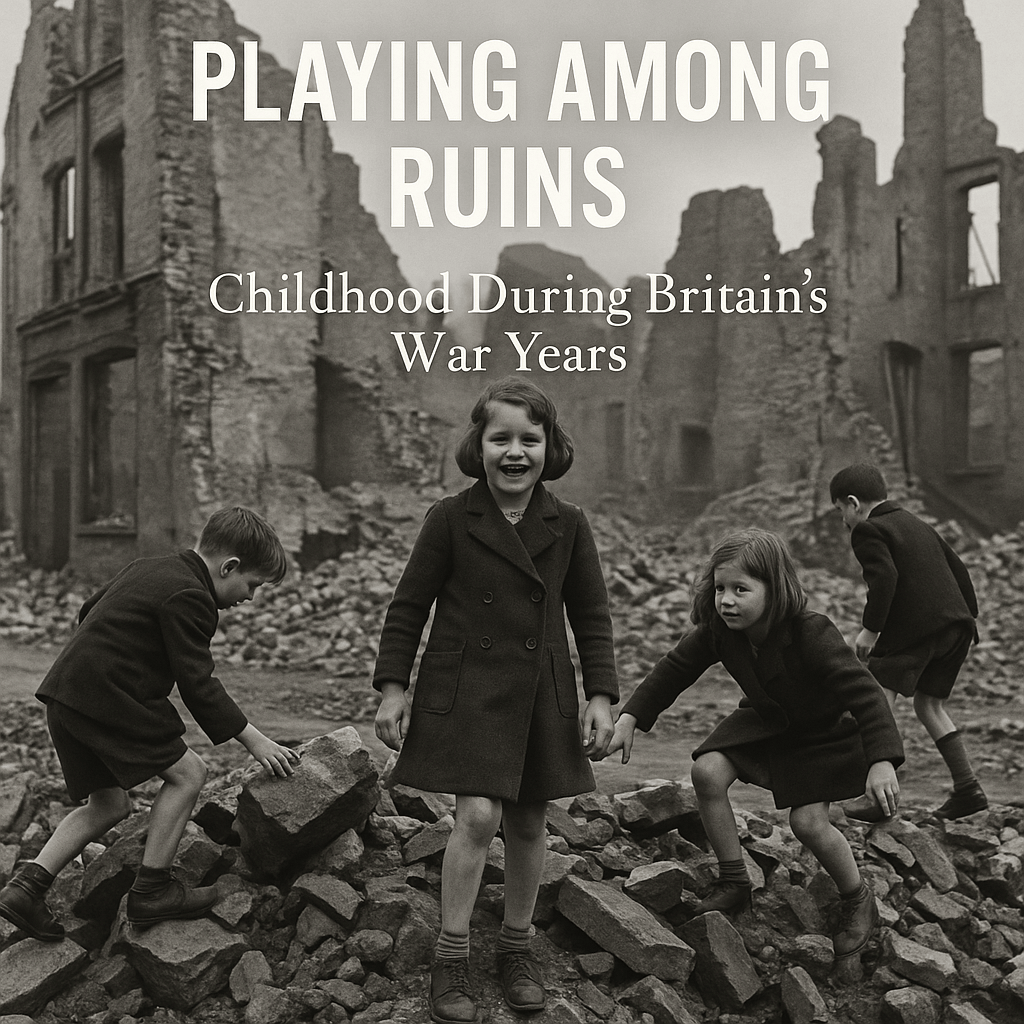
Children did not choose the wars that shaped them, yet the First and Second World Wars settled themselves quietly and persistently into British childhoods, rearranging ordinary days, small dreams and lifelong memories. For those who grew up in these years, war was never an abstract idea discussed in hushed adult voices. It was woven into the fabric of daily life, into the way mornings began, games unfolded, friendships formed and the world felt when one was young and learning what safety meant.
For many children, war announced itself through separation. Evacuation trains waited at platforms thick with steam, labels pinned to coats, gas masks bumping against knees. Mothers packed small suitcases with care that bordered on ritual, folding clothes neatly, tucking in familiar objects, smoothing hair and holding back tears until the very last moment. Some children boarded trains with excitement, imagining cows, open fields and freedom from the city. Others went quietly, sensing the gravity of the moment without fully understanding it. The journey away from home was often the first great fracture in childhood, a sudden lesson that love and safety could exist at a distance.
Arrival in the countryside brought its own bewilderment. Villages and small towns welcomed waves of evacuees whose accents, habits and expectations felt foreign. Some children found themselves absorbed into warm households where kindness flowed easily, discovering fresh milk, quiet nights and skies filled with stars. Others faced loneliness or discomfort, navigating unfamiliar rules and the ache of being a guest rather than a child at home. Siblings were sometimes separated, placed with different families, learning independence far earlier than childhood ever intended. Letters became lifelines, read aloud, folded carefully and read again until the words lived inside the heart.
Children who remained in cities lived a different wartime childhood, one shaped by vigilance and interruption. Schools closed when buildings were damaged or taken over for military use, and lessons shifted into churches, halls and borrowed rooms. Education became uneven, shaped by sirens and shortages, yet teachers persevered, determined to offer routine amid uncertainty. Children learned sums and spelling while practicing air-raid drills, their exercise books resting beside gas masks and blackout curtains drawn tight against the afternoon light.
Play, ever adaptable, found new shapes. Bombsites became landscapes of imagination where piles of brick and twisted iron turned into castles, pirate ships and secret hideaways. Children climbed and explored with a daring born not of recklessness, but of resilience. These games were not a denial of danger, but a way of mastering it, of transforming fear into something graspable and familiar. Laughter echoed where destruction stood, as if joy itself were quietly reclaiming ground.
Nighttime left some of the deepest impressions. Sirens cut through sleep, and children learned their sound before they fully understood its meaning. Shoes were pulled on quickly, coats wrapped tight, hands clasped as families moved toward shelters. In Anderson shelters and underground stations, children listened closely to adult voices, sensing safety in calm tones and steady presence. Stories were told softly, songs hummed under breath, and fear was met with reassurance that became memory’s anchor.
Food shortages shaped growing bodies and minds alike. Rationing turned sweets into treasures and meals into exercises in creativity. Children learned early that nothing was wasted, that leftovers mattered, that gardens and allotments were sources of pride. Many remembered these years not only for scarcity, but for the excitement of small treats, the joy of sharing, the satisfaction of growing something with one’s own hands. These lessons lingered long after ration books disappeared.
Friendships formed with remarkable speed and depth. Shared experience erased the need for explanation. Children understood one another instinctively, bonded by the knowledge that tomorrow was never guaranteed to look like today. Loss, too, entered quietly. Some children lost parents, siblings or friends, learning grief without the language to fully name it. Many carried these sorrows inward, weaving them into adulthood with a strength that astonished those who came later.
When peace finally arrived, childhood did not simply pick up where it had paused. Many children returned home altered, older in spirit than their years suggested. Cities were rebuilt, schools reopened and families reunited, yet something fundamental had shifted. Wartime childhoods had taught adaptability, independence and awareness beyond age. Habits formed then endured for life: saving scraps, valuing togetherness, listening carefully, never quite taking safety for granted.
Looking back, these childhoods reveal extraordinary resilience. Children found wonder amid fear, joy amid disruption. They laughed, learned, played and dreamed even as the world trembled around them. Their memories are not only of sirens and ruins, but of kindness shared, friendships forged and moments of beauty that appeared unexpectedly and stayed.
The children of war grew into adults who carried those years quietly within them, shaping how they loved, worked and remembered. Their stories remind us that history is not written only by those who fight, but also by those who grow up beneath its shadow, learning early how to endure, how to adapt and how to hope.
Until next time,

Ta ta for now.

Yours, Lainey.