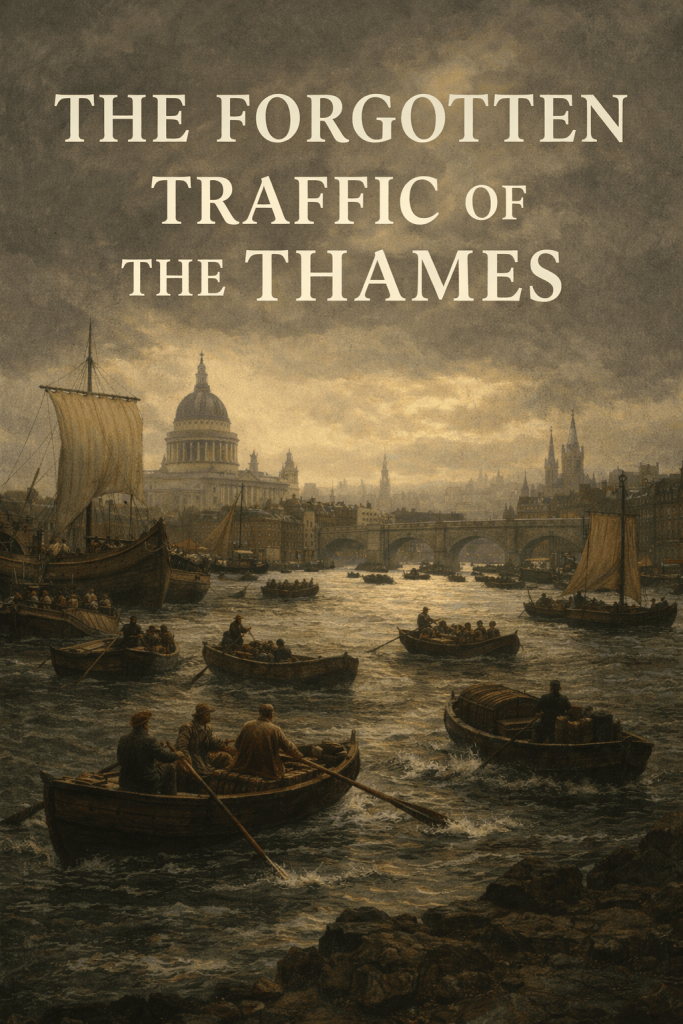
There was a time when London did not rush along pavements or disappear beneath the ground into tunnels of steam and steel.
It moved on water. It listened to the tide. It breathed in rhythm with the river’s slow, patient pulse.
The Thames was not scenery. It was not a backdrop. It was London’s great living road, wide and crowded and endlessly alive.
Before bridges multiplied and streets filled with wheels and feet, the river was the city’s main artery. To understand London as it once was, you must imagine its people looking not left and right, but down toward the water. They listened for the splash of oars, watched for sails catching the light, read the surface of the river the way modern commuters read timetables and screens. The Thames was not crossed casually. It was consulted.
For centuries, Londoners travelled by boat as naturally as we now board buses or trains. The river carried thousands of craft each day. Slender wherries skimmed the surface like quicksilver, built for speed and balance. Barges moved more slowly, heavy with timber, coal, grain, bricks, ale and wine. Lighters ferried cargo between great ocean-going ships and the shore, making the river a place of constant exchange. Foreign visitors wrote in astonishment of the spectacle, calling the Thames one of the busiest waterways in the world, so crowded with boats it seemed almost solid.
At the heart of this floating city were the watermen. Licensed by the Crown and organised into powerful companies, most famously the Company of Watermen and Lightermen, they were London’s first professional transport network. These men knew every bend of the river, every hidden current, every treacherous eddy. You hailed them from the stone stairs that lined the riverbanks, stairs worn smooth by centuries of use. Many of those steps still exist today, tucked behind railings or half-forgotten, their names echoing old purposes. A shout, a wave, a negotiated fare, and you were off, gliding past the city as it revealed itself along the shore.
Kings and queens understood the river’s power.
Henry VIII kept a magnificent royal barge, using the Thames as his ceremonial road. Elizabeth I preferred water travel too, appearing in splendour on the river, dressed in velvet and pearls, drifting past cheering crowds. Courtiers followed in richly decorated boats, banners snapping in the wind. On the Thames, rank floated visibly. Ornate barges for the wealthy, plain wherries for ordinary folk, all sharing the same shifting surface.
For everyday Londoners, the river was practical, affordable, and often far quicker than travelling by land. Streets were narrow, uneven, crowded with animals and refuse. The Thames was open and direct. It carried apprentices to workshops, merchants to markets, lovers to secret meetings beneath bridges, and preachers to crowds eager for words. It carried prisoners too, ferried grimly toward the Tower, the journey itself a kind of procession. News travelled on the water. Gossip travelled faster. The river carried laughter, argument, grief and hope all at once.
The Thames had its own language and its own rules. Journeys were planned around the tide. The ebb and flow governed everything, when boats could dock, when crossings were easiest, when travel became dangerous. The river was not something to be conquered. It was something to be read, respected and worked with. Watermen passed their knowledge down through generations, a river wisdom that could not be written, only lived.
This watery world was not gentle. The river was dangerous and unforgiving. Boats collided. People slipped and fell. Thousands drowned over the centuries, their names rarely recorded, yet their loss absorbed into London’s collective memory. In winter, the Thames sometimes froze so solid that traffic stopped entirely, giving rise to frost fairs held directly on the ice, complete with stalls, games and printing presses. In summer, the smell could be overwhelming, as waste flowed freely into the water. The Thames gave life and took it, often in the same breath.
And then, gradually, almost without announcement, the river’s traffic thinned.
Bridges came first. London Bridge had long stood as both crossing and obstacle, crowded with houses and shops, but new bridges spread east and west, stitching the city together above the water. Roads improved. Coaches multiplied. The river was no longer the only way across.
The Industrial Revolution completed the shift. Railways thundered into the city, offering speed without dependence on tide or weather. Streets were widened and paved. The Embankment reshaped the river’s edge, confining it behind stone walls, civilising it, taming its reach. The Thames still flowed, but it was no longer allowed to dominate as it once had.
For the watermen, this change was devastating. Generations who had lived by the oar watched their livelihoods ebb away. Some adapted, working with cargo or ferries. Others resisted, clinging to tradition. Many slipped quietly into poverty. Their songs, their slang, their intimate knowledge of the river faded from daily life. Even Doggett’s Coat and Badge race, still run today, remains as a rare living echo of that once vital world.
Now, it is difficult to imagine London without its roads, rails and underground tunnels. The river feels decorative, scenic, occasionally useful, but no longer essential. We cross it without thought. We admire it from bridges, photograph it at sunset, sit beside it with coffee cups and conversations.
And yet, if you stand quietly by the Thames, especially at dawn or dusk, you can still sense its old authority. The water moves as it always has, indifferent to centuries of change. The tide still turns. The current still pulls. The river remembers.
Those vanished fleets are not truly gone. They linger in place names, in old stairs hidden behind railings, in laws and traditions that still quietly exist. They linger in the truth that London is, at heart, a river city, shaped by water long before it was shaped by stone.
Once, the Thames was London’s pulse, its path, its promise.
It carried the city on its back, day after day, century after century. And though the boats have thinned and the river’s voice has softened, it still flows through London’s story, patient and enduring, waiting for us to remember that we were once a city carried by water.
Until next time,

Ta ta for now.

Yours, Lainey.