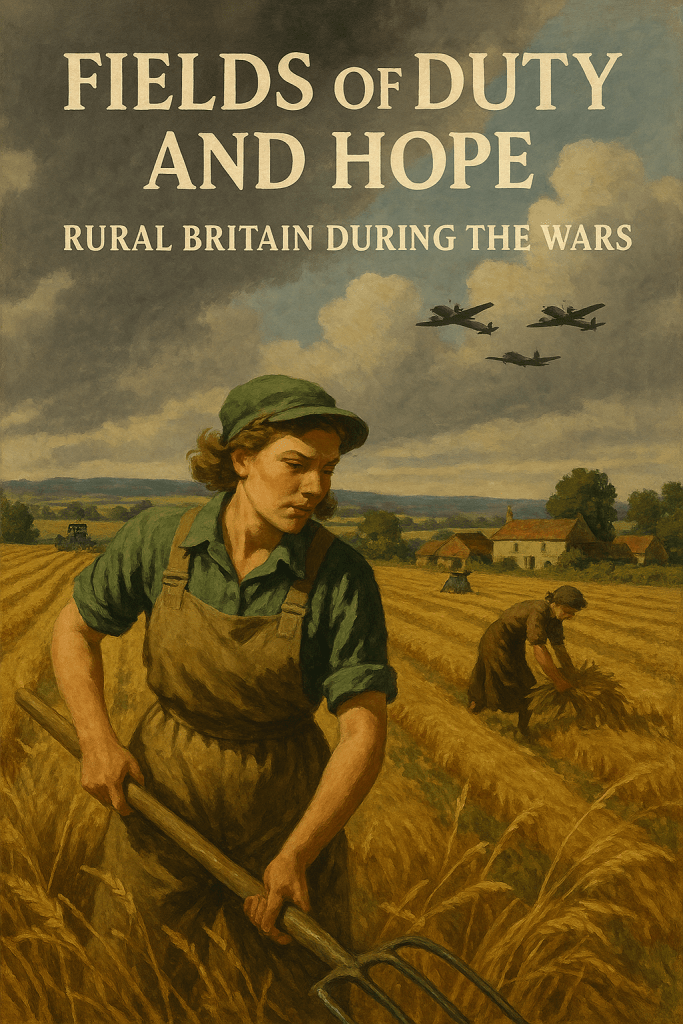
When war came to Britain, it did not stop at the city’s edge or lose its way among hedgerows and winding lanes. It travelled steadily outward, slipping into valleys and villages, settling into fields shaped by centuries of careful hands. The countryside, so often imagined as a place apart from conflict, became one of the war’s quiet backbones. Here, amid ploughed earth and weathered stone, Britain fed itself, trained its defenders and reshaped its landscape in ways that would echo long after the guns fell silent.
Before the wars, rural Britain moved to an ancient rhythm. Seasons guided labour, bells marked time and the land itself dictated the pace of life. Fields rested and were sown in turn, livestock grazed familiar routes and villages lived close to soil and sky. When the First World War arrived, that rhythm faltered. Young men left farms and smallholdings to enlist, their absence felt immediately in empty barns and untended fields. Older men, women and children stepped into the gaps, learning quickly that the land could not be left waiting. Food imports became uncertain and suddenly the countryside was no longer simply sustaining itself. It was sustaining the nation.
Fields once left fallow were pressed back into service. Hedges were cut back to widen plots. Marginal land was reclaimed and coaxed into productivity. The countryside learned urgency, and the land responded as it always had, slowly but faithfully, under hands determined to make it yield.
The Second World War deepened and sharpened this transformation. With the threat of German U-boat blockades choking supply lines, Britain turned inward with renewed resolve. Survival depended on home-grown food, and the countryside became a lifeline. Under the Dig for Victory campaign, farming expanded at a pace unseen for generations. Pastures were ploughed, parklands and great estates surrendered their lawns to rows of crops and every workable acre was called upon to contribute. Tractors replaced horses where machinery could be spared, altering landscapes that had barely changed since the Victorian age. Fields grew larger, straighter, more utilitarian, shaped by necessity rather than tradition.
Women stepped into this reshaped land with remarkable determination. The Women’s Land Army became one of the most recognisable and quietly heroic sights of wartime Britain. Young women arrived from towns and cities, many with little experience of rural life, and learned quickly how to work the land. They rose before dawn to milk cows, harvested crops under wide and unforgiving skies, drove tractors, mended fences and dug drains. Farming was relentless, often lonely and physically exhausting, yet it carried a sense of purpose that steadied both body and spirit. These women formed deep bonds with one another and with the land itself, friendships forged through shared fatigue, laughter and mud-caked boots. Their contribution kept Britain fed and their legacy reshaped how the nation viewed women’s work long after the war ended.
The countryside also absorbed the machinery and movement of war in ways that transformed daily life. Fields and moorland were requisitioned for training grounds, their quiet broken by the tramp of boots and the rumble of tanks. Soldiers practised manoeuvres where sheep once grazed, learning skills that might soon save their lives far from home. Barns became barracks, village halls turned into briefing rooms and lanes echoed with unfamiliar accents. For rural communities, the arrival of troops brought disruption, but also companionship. Locals shared meals, dances and evenings by the fire with young men who would soon leave again, forming tender, fleeting connections made more precious by uncertainty.
Airfields appeared almost overnight, long concrete runways slicing across farmland with startling abruptness. Where wheat once rippled, aircraft now roared into the sky. The countryside filled with new sounds, engines warming at dawn, planes lifting into wide blue distances, the crack of gunfire during training exercises. For rural children, these sights and sounds became part of growing up, extraordinary yet woven into the everyday alongside lambing season and blackberry picking.
Evacuation brought another quiet transformation. City children arrived in villages clutching small suitcases and wearing labels tied to their coats. Rural homes absorbed them as best they could. Some families welcomed evacuees with warmth, introducing them to farm chores, fresh milk straight from the churn and the freedom of open fields. Others struggled with overcrowding, difference and the strain of shared space. Yet for many children, the countryside offered a sense of safety and wonder. They learned to read weather in the sky, seasons in the soil and silence in a way cities rarely allowed. Some carried these years as cherished memories long after peace returned.
The land paid a price for its service. Ancient landscapes were scarred by trenches, concrete structures and barbed wire. Woodlands were felled to meet wartime demand for timber, altering ecosystems and familiar views. Some estates never fully returned to their former shapes. The countryside bore the marks of urgency, its beauty bruised yet remarkably resilient.
And still, there was romance in the way rural Britain endured. Harvests were celebrated with renewed gratitude. Villagers gathered for modest feasts, shared produce, sang and danced when they could. There was comfort in the continuity of seasons, in the steady turning of the year even as the wider world trembled. The land gave what it could, and people responded with care, patience and persistence. In fields at dusk, under skies streaked with pink and gold, fear softened and hope found room to breathe.
When peace returned, the countryside stood altered but unbroken. Fields carried the memory of hard years, villages remembered loss and friendship in equal measure. Some wartime changes faded as land healed and temporary structures were removed. Others remained, shaping modern farming and rural life for generations. Yet the spirit of those years lingered, a quiet understanding of how deeply the land and its people had been relied upon.
Rural Britain at war tells a story not of retreat, but of resolve. It reminds us that victory was not only fought on battlefields, but grown patiently from soil, harvested by tired hands and sustained by those who worked the land through fear and fatigue. In fields reshaped by necessity and hearts steadied by purpose, the countryside played its essential role. And in doing so, it proved that even the gentlest landscapes can carry immense strength when history calls upon them.
Until next time,

Ta ta for now.

Yours, Lainey.