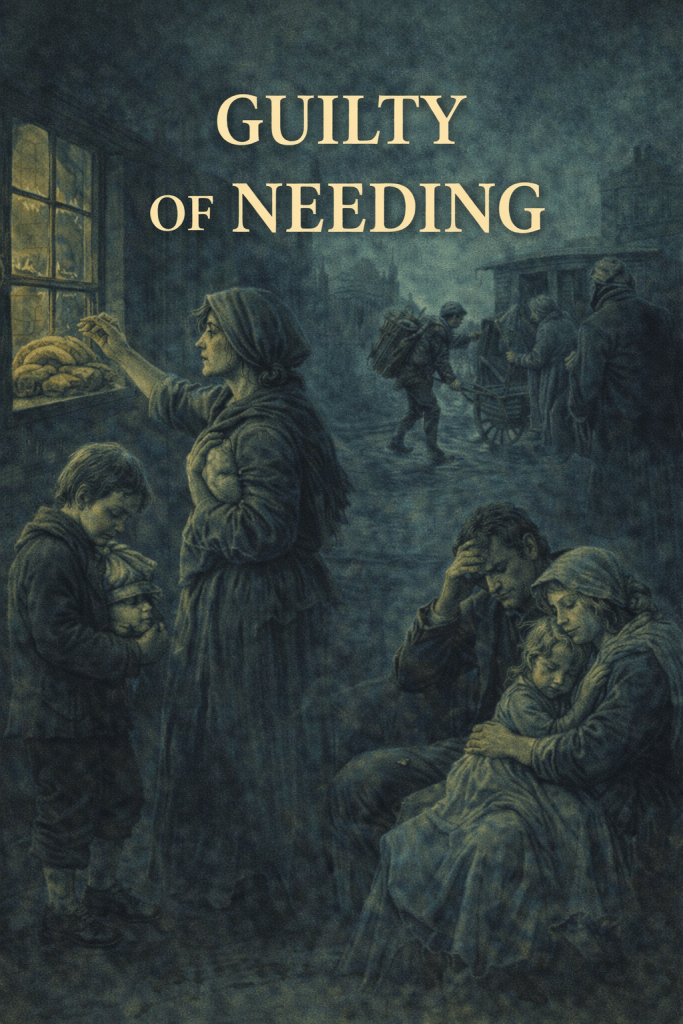
There is a quiet misunderstanding stitched into Britain’s criminal past, one that hangs like fog over old court records and yellowed newspapers.
We are taught to imagine crime as something sharp and deliberate, a conscious turn toward wrongdoing.
Yet when you lean closer to the voices buried in those records, another truth begins to surface. Many crimes were not born of malice, but of need.
They were the crimes of empty cupboards, cold hearths, unpaid rent, and bodies worn thin by labour that never quite stretched far enough to survive.
For much of British history, poverty itself hovered dangerously close to illegality.
The law did not merely punish harm.
It punished want.
Petty theft filled the courts more reliably than any other offence. People stole bread, cheese, turnips, cloth, shoes, handkerchiefs, and tools. The lists of stolen goods are often heartbreakingly modest. A loaf of bread. A scrap of linen. A single spoon. These were not luxuries. They were attempts to keep hunger from the door. Servants took food from employers’ kitchens. Labourers slipped produce from fields they had worked. Mothers took what their children could not go without. The law recorded these acts with precision, yet the context lived just beyond the ink.
One of the most haunting examples is Mary Jones, executed in London in 1771. She was a young woman, barely twenty, who stole two pieces of cloth from a draper’s shop. The cloth was not for fashion or profit. Court testimony suggests she intended to sell it to buy food. Under the Bloody Code, theft of goods above a certain value was a capital offence. Mary Jones was hanged at Tyburn. Newspapers noted her calmness. The law noted the value of the cloth.
Hunger was not entered into evidence.
Under the Bloody Code, hundreds of offences carried the death penalty, many of them tied to property rather than violence. Stealing goods worth more than a shilling could lead to the gallows. Juries sometimes intervened, deliberately undervaluing stolen items to save the accused from execution. Judges occasionally exercised mercy. But mercy was uncertain. Hunger was not.
Vagrancy laws made poverty visible and therefore criminal. To be without work, without a fixed home, without a parish willing to claim responsibility for you was to exist in legal peril. Begging was an offence. Sleeping rough could lead to arrest. Walking from village to village in search of work marked a person as suspicious rather than desperate. In the eyes of the law, movement itself became a crime. The poor were expected to remain invisible, and when they could not, they were punished for being seen.
Children were swept into this system with alarming ease. Court records are filled with boys and girls charged with theft, vagrancy, or simply being found alone in public places. In 1787, a child named John Hudson was sentenced to transportation at the age of nine for stealing a waistcoat. His crime was not cunning.
It was need.
Childhood offered little protection when poverty demanded action.
Another child, Elizabeth Hayward, only thirteen, was hanged in 1742 for stealing a piece of cloth. Judges acknowledged her youth. The law acknowledged only the offence. These were not rare aberrations. They were the visible edges of a system that treated survival as transgression.
Rural poverty carried its own dangers. Poaching was among the most fiercely prosecuted crimes in the countryside. For generations, hunting had been tied to survival. Taking a rabbit or a deer could mean food for a family. As land became enclosed and ownership tightened, these acts were redefined as theft. Game laws protected the pleasures of the wealthy and criminalised hunger. Men were imprisoned, transported, and sometimes killed for taking animals they once relied upon. The law did not ask why a man risked his life for a rabbit. It asked only whose land it came from.
Smuggling, too, often grew from need rather than greed. Heavy taxes on everyday goods such as tea, salt, soap, and spirits pushed prices beyond reach. Along Britain’s coasts, entire communities turned to smuggling as a way to live. Women carried tea beneath their skirts. Children acted as lookouts. Fishermen moved contraband alongside their catch. When smugglers were tried, courts spoke of criminal networks and defiance of the Crown. Local people spoke of affordable food and shared survival.
Debt quietly destroyed lives without ever needing a crime of violence. Debtors’ prisons were filled with people whose only offence was owing money they could not repay. Illness, injury, failed harvests, or lost employment could plunge a family into debt overnight. Once imprisoned, a debtor could not work, ensuring the debt remained unpaid. Families often followed them into prison or collapsed outside its walls. Misfortune hardened into permanence.
Winter sharpened the law’s cruelty. The theft of wood, coal, and turf rose sharply in cold months. Gathering fallen branches from an estate or digging fuel from common land could lead to fines or imprisonment. Forest laws guarded property while homes froze. Warmth was regulated.
Survival was punished.
Women bore a particular weight. They were prosecuted for stealing food for children, for pawning household items to pay rent, for begging while holding infants. In many cases, their husbands were dead, absent, or imprisoned. Poverty stripped women of protection and cast their desperation as moral failure. The law saw wrongdoing where there was care.
Transportation to Australia stands as one of the clearest illustrations of how Britain solved poverty with distance. Between 1787 and 1868, thousands were sent away for minor property crimes driven by need. Stealing a handkerchief, a loaf of bread, a small sum of money could result in seven years, fourteen years, or life on the other side of the world. Britain exported its poor under the language of justice, removing visible hardship rather than confronting its cause.
Punishment itself deepened poverty. Fines drained what little people possessed. Imprisonment removed earners from families. Public shaming destroyed reputations and opportunities. Transportation severed communities forever.
Crime did not end poverty. It entrenched it, passing hardship from one generation to the next.
The law often responded not to harm, but to fear. Periods of war, famine, and economic downturn brought harsher enforcement and broader definitions of crime. Rather than addressing rising prices, unemployment, or inadequate relief, authorities reached for punishment. Poverty became a problem to manage rather than a condition to relieve.
Occasionally, court records allow the accused to speak. Some said plainly that they were hungry. That their children had not eaten. That work had vanished. These moments sit quietly in the margins of legal history, rarely shaping outcomes. The law listened, but it did not hear.
What emerges from these stories is not a nation overrun by criminals, but one struggling with inequality and choosing punishment over compassion. Crime was often the final step taken when every other door had closed.
Looking back, it becomes clear that many criminal records are really records of need. They tell us less about morality and more about survival. They ask uncomfortable questions about who defines crime, whose suffering is tolerated, and whose desperation is punished.
To remember these crimes is not to excuse harm, but to recognise humanity where history once saw only guilt. It is to understand that the line between law and life has not always been drawn kindly.
The past whispers a truth we would do well to listen to.
When survival is illegal, crime becomes ordinary.
And when poverty is punished, justice loses its warmth.
Until next time,

Ta ta for now.

Yours, Lainey.